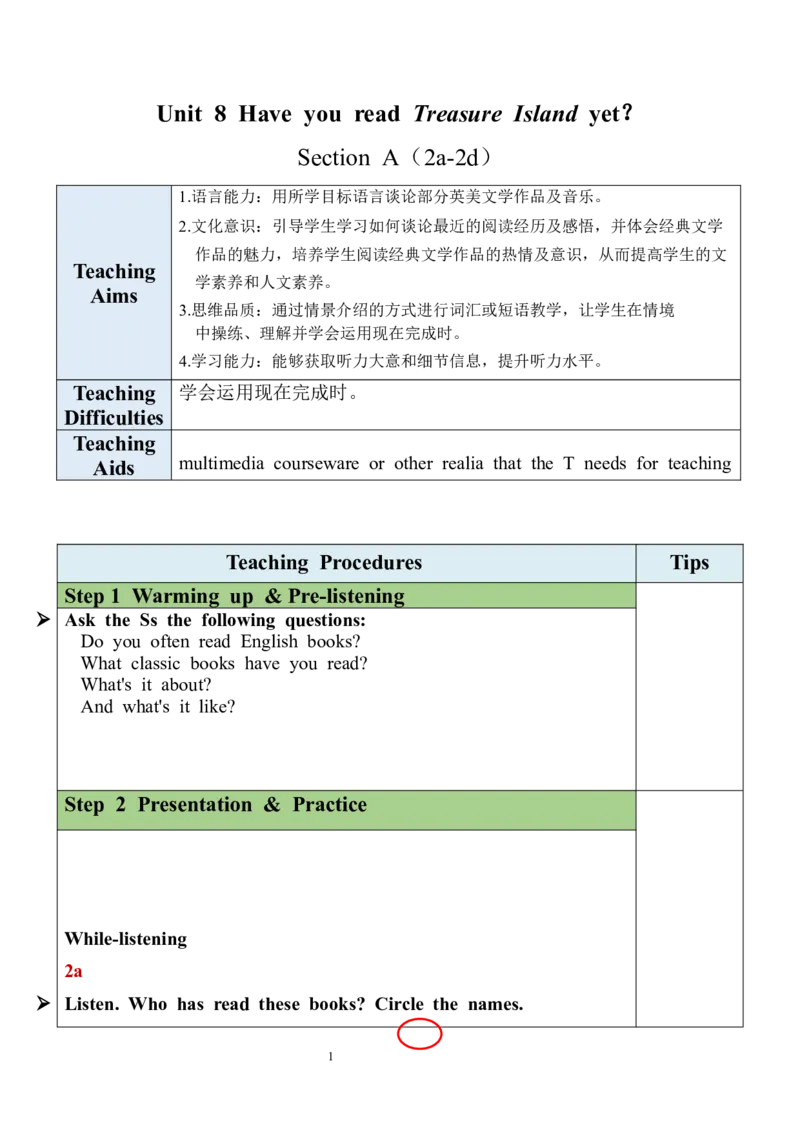
文档文本内容
Unit 8 Have you read Treasure Island yet?
Section A(2a-2d)
1.语言能力:用所学目标语言谈论部分英美文学作品及音乐。
2.文化意识:引导学生学习如何谈论最近的阅读经历及感悟,并体会经典文学
作品的魅力,培养学生阅读经典文学作品的热情及意识,从而提高学生的文
Teaching
学素养和人文素养。
Aims
3.思维品质:通过情景介绍的方式进行词汇或短语教学,让学生在情境
中操练、理解并学会运用现在完成时。
4.学习能力:能够获取听力大意和细节信息,提升听力水平。
Teaching 学会运用现在完成时。
Difficulties
Teaching
Aids multimedia courseware or other realia that the T needs for teaching
Teaching Procedures Tips
Step 1 Warming up & Pre-listening
Ask the Ss the following questions:
Do you often read English books?
What classic books have you read?
What's it about?
And what's it like?
Step 2 Presentation & Practice
While-listening
2a
Listen. Who has read these books? Circle the names.
11. Treasure Island Mark / Tina
2. Oliver Twist Mark / Tina
3. Robinson Crusoe Mark / Tina
4. Tom Sawyer Mark / Tina
Read the following sentences and understand them.
1. Oliver Twist is about a boy who goes out to sea and finds an
island full of treasures.
2. Robinson Crusoe is a classic.
3. Tina thinks that Treasure Island is a fantastic book.
4. Tom Sawyer is about a boy who lives in the United Kingdom.
Explain the key words.
2b
Listen again and write T for true and F for false.
1. Oliver Twist is about a boy who goes out to sea and finds an island full
of treasures.
2. Robinson Crusoe is a classic.
3. Tina thinks that Treasure Island is a fantastic book.
4. Tom Sawyer is about a boy who lives in the United Kingdom.
Answers:1. F 2. T 3. T 4.F
Listen and read.
Tina:Hi, Mark.
Mark:Hey there, Tina. What's up?
Tina:I'm reading this fantastic book.
Mark:What is it?
Tina: Treasure Island. Have you read it yet?
Mark:No, I haven't. What's it about?
2Tina:It's about this boy who goes out to sea and finds an island full of
treasures. What are you reading right now?
Mark:I've just finished Oliver Twist and Robinson Crusoe..
Tina: Oh, yeah. I've already read both of them. They're classics. We
had to study Robinson Crusoe last term.
Mark:So what are you studying this term?
Tina: Tom Sawyer. It's a story about a boy who lives in the United
States. Many exciting things happen to him.
Mark:Sounds interesting. I'll have to read it.
Post-listening
2c
Use the information in 2a and 2b to talk about the books.
A: Has Tina read Treasure Island?
B: Yes, she has. She thinks it's fantastic.
A: What's it about?
B: It's about …
Introduce some background knowledge.
Treasure Island:
the boy found a treasure map;
the boy encountered pirates;
the pirates planned a mutiny(暴动)
Tom Sawyer:
the boy was an orphan;
the boy lived on the banks of the Mississippi River;
the boy had a good friend named Huckleberry Finn
3 Introduce the book report.
In English-speaking countries, students are often asked to read some
books and write book reports. A book report, or a book summary, is
essentially an analysis of the contents of a book. It shows that you fully
understand the book. Your book report should be informative and
objective.
Step 3 Presentation & Reading
2d
Ask the Ss to role-play the conversation.
Explain the key words and phrases to the Ss.
Read the conversation in 2d and answer the questions.
1. Which books have Amy and Steve chosen to write about?
2. Has Steve finished reading his book yet? What's the book about? What
does he think of the book?
3. Has Amy finished reading her book yet? How many pages has she
already read? What's it like?
4. When do they have to hand in the book report?
Answers:1.Amy chose Treasure Island. Steve chose Little Women.
2.Yes.he has.It's about four sisters growing up. He thinks it's really
good.
3.No, she hasn't.She has already read 25 pages.
4.They have to hand in the book report in two weeks.
Role-play in groups of four.
Some tips:
Make eye contact.
Express interest in what other person is saying.
4 If you are not familiar with the subject matter, just ask questions.
Feel confident and do not hesitate to take part in a conversation.
Enjoy the conversation.
Ask the Ss to watch the video.
Step 4 Language points learning
1. Oliver Twist is about a boy who goes out to sea and finds an
island full of treasures.
full of 满是......的;(有)大量的;(有)丰富的
full of 在此处作后置定语,修饰 island。be full of 意为“充
满......”,相当于 be filled with。
She received a basket full of flowers.
If you read a lot, your life will be full of pleasure.
treasure n. 珠宝;财富;贵重物品;珍品
treasure 作“珠宝;财富”讲时为不可数名词。作“贵重物品;珍
品”讲时是可数名词,经常用复数。
We shall take the buried treasure away to a safe place.
The gallery has priceless art treasures.
【拓展延伸】treasure的其他用法:
treasure
动词,意为“珍惜;珍视”
I treasure his friendship.
2. You should hurry up.
hurry up 赶快;急忙(做某事)
hurry up 常用在口语中,用来催促别人。其中,hurry 作不及物动
词,意为“匆忙;赶快”。
e.g. Hurry up, or you will miss the flight. There is little time left.
3. The book report is due in two weeks.
due adj. 预期;预定
due 作形容词,通常用作表语,后面引出预期的时间、地点等。be
due to do sth. 表示“预计做某事;预定要做某事”。
5e.g. When is the baby due? 孩子什么时候出生?
Rose is due to start school in January.罗斯预定一月份开始上学。
【拓展延伸】due to 意为“因为,由于”,相当于 because of,但
due to一般不置于句首, because of 可以。
He was absent from work due to / because of illness.
Step 5 Summary & Homework
Summary
Ask Ss to do the exercises from PPT P25-27.
Homework:
Preview the passage on Page 59.
Preview the new words and phrases.
Do the exercises in students’ book.
This is the second period of the unit. The teacher needs to encourage the
Teaching students to practice the target language in listening and speaking. With the
Reflection help of language practice, the students can perceive the usage of the
present perfect tense.
6