文档文本内容
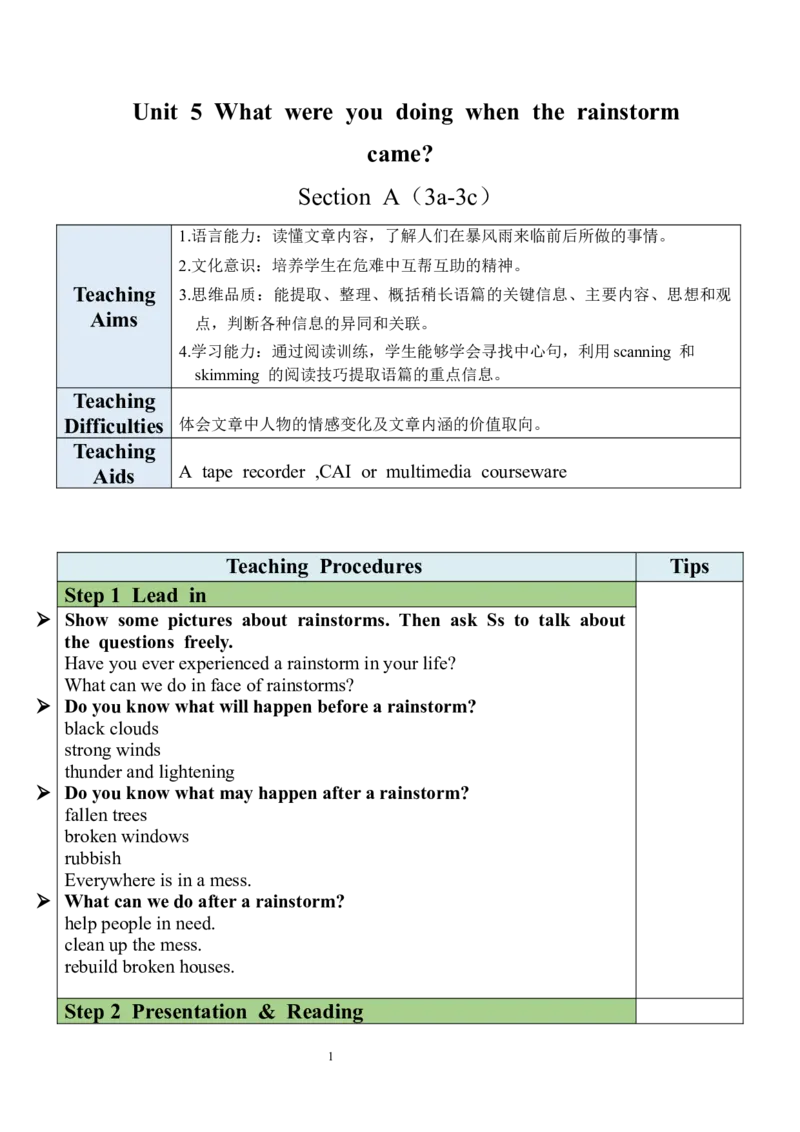
Unit 5 What were you doing when the rainstorm
came?
Section A(3a-3c)
1.语言能力:读懂文章内容,了解人们在暴风雨来临前后所做的事情。
2.文化意识:培养学生在危难中互帮互助的精神。
Teaching 3.思维品质:能提取、整理、概括稍长语篇的关键信息、主要内容、思想和观
Aims
点,判断各种信息的异同和关联。
4.学习能力:通过阅读训练,学生能够学会寻找中心句,利用scanning 和
skimming 的阅读技巧提取语篇的重点信息。
Teaching
Difficulties 体会文章中人物的情感变化及文章内涵的价值取向。
Teaching
Aids A tape recorder ,CAI or multimedia courseware
Teaching Procedures Tips
Step 1 Lead in
Show some pictures about rainstorms. Then ask Ss to talk about
the questions freely.
Have you ever experienced a rainstorm in your life?
What can we do in face of rainstorms?
Do you know what will happen before a rainstorm?
black clouds
strong winds
thunder and lightening
Do you know what may happen after a rainstorm?
fallen trees
broken windows
rubbish
Everywhere is in a mess.
What can we do after a rainstorm?
help people in need.
clean up the mess.
rebuild broken houses.
Step 2 Presentation & Reading
1Pre-reading
3a
Ask Ss to look at the title and the photo on PPT P13 and make
predictions.
Title: The Storm Brought People Closer Together
1. What can you see in the photo?What happened?
2. How can a storm bring people closer?
Background
Alabama is in the southeast of the United States. There are often
tornadoes(龙卷风), hurricanes(飓风) and rainstorms in March and April
every year.
3a
While-reading
Explain the key words and phrases.
Ask Ss to finish the task 1.Skimming and matching.Match the
main idea with each paragraph.
Analyse the passage’s structure.
before the storm
during the storm in the order of time
after the storm
Ask Ss to finish the task 2. Read para.1 carefully and answer the
questions.
1. What was the weather like before the heavy rain started?
2. How did Ben's family know the storm was coming?
Answers:1.The weather was very terrible. Strong winds were blowing, and
black clouds were making the sky very dark.
2.The news on TV reported that a heavy rainstorm was in the area.
Ask Ss to finish the task 3. Read para.2 carefully and fill in the
blanks.
What did people do before the storm?
__________ in the neighborhood was busy.
Ben's dad was putting pieces of _____ over the windows.
Ben's mom was making sure the _________ and _____ were
working.
Ben's mom was putting some _______ and _______ on the table.
Answers: Everyone wood flashlights radio candles matches
What should they prepare before the storm comes?
pieces of wood/ flashlight/ radio/ candles/ matches
Ask Ss to finish the task 4. Read para.3 carefully and fill in the
2blanks.
What were Ben's family doing during the storm?
Ben: He was helping his mom _____________.
Ben's family: They tried to play ____________ after dinner.
But it was _______ to have fun.
Answers: make dinner a card game hard
Ask Ss to finish the task 5. Read para.4 carefully and answer the
questions.
1. When did Ben fall asleep?
2. What was the neighborhood like after the storm?
3. What did Ben and his family do then?
4. What did the writer think of the rainstorm?
Answers: 1.At around 3:00 a.m.
2.The neighborhood was in a mess. Fallen trees, broken windows and
rubbish were everywhere.
3.They joined the neighbors to help clean up the neighborhood together.
4.Although the storm broke many things apart, it brought families and
neighbors closer together.
Presentation
3a
Ask Ss to read the passage and answer the questions.
1.What was the weather like before the heavy rain started?
2. What was the neighborhood like after the storm?
Answers:1.The weather was very terrible. Strong winds were blowing, and
black clouds were making the sky very dark. It felt like midnight.
2.The neighborhood was in a mess.Fallen trees, broken windows and
rubbish were everywhere.
3b
Complete the sentences using information from the passage.
1. When the news on TV was reported, strong wind ____________
outside.
2. While Ben's mom was making sure the radio was working, his dad
_______________________________________.
3. Ben ______________________________ when the heavy rain finally
started.
4. When Ben _________ at 3:00 a.m., the wind _______________.
Answers:1.were blowing
2.was putting pieces of wood over the windows
3.was helping his mom make dinner
4.fell asleep was dying down
3c
Ask Ss to discuss the questions with a partner.
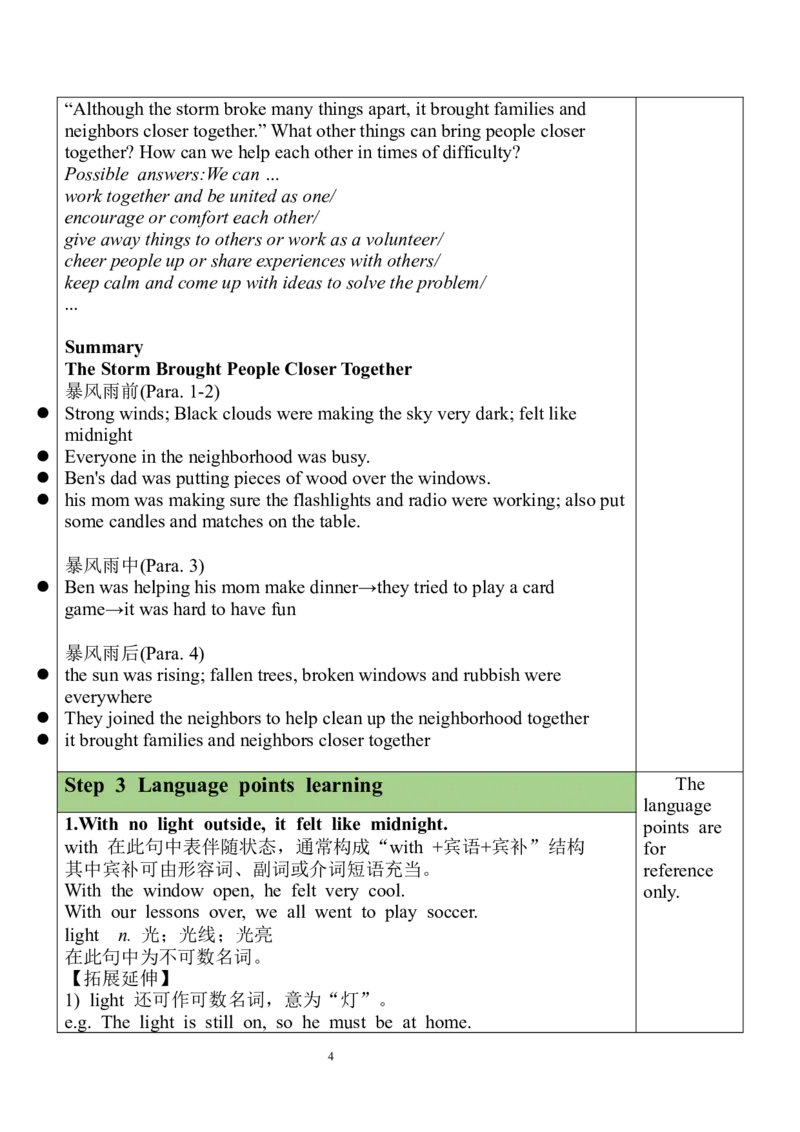
3“Although the storm broke many things apart, it brought families and
neighbors closer together.” What other things can bring people closer
together? How can we help each other in times of difficulty?
Possible answers:We can …
work together and be united as one/
encourage or comfort each other/
give away things to others or work as a volunteer/
cheer people up or share experiences with others/
keep calm and come up with ideas to solve the problem/
...
Summary
The Storm Brought People Closer Together
暴风雨前(Para. 1-2)
Strong winds; Black clouds were making the sky very dark; felt like
midnight
Everyone in the neighborhood was busy.
Ben's dad was putting pieces of wood over the windows.
his mom was making sure the flashlights and radio were working; also put
some candles and matches on the table.
暴风雨中(Para. 3)
Ben was helping his mom make dinner→they tried to play a card
game→it was hard to have fun
暴风雨后(Para. 4)
the sun was rising; fallen trees, broken windows and rubbish were
everywhere
They joined the neighbors to help clean up the neighborhood together
it brought families and neighbors closer together
Step 3 Language points learning The
language
1.With no light outside, it felt like midnight. points are
with 在此句中表伴随状态,通常构成“with +宾语+宾补”结构 for
其中宾补可由形容词、副词或介词短语充当。 reference
With the window open, he felt very cool. only.
With our lessons over, we all went to play soccer.
light n. 光;光线;光亮
在此句中为不可数名词。
【拓展延伸】
1) light 还可作可数名词,意为“灯”。
e.g. The light is still on, so he must be at home.
4灯还亮着的,所以他一定在家。
2) light 还可作形容词,意为“轻的;浅色的;轻柔的”。
e.g. We both like listening to light music.
light blue 淡蓝色
3) light 还可作动词,意为“点亮”,过去式为lit/lighted。
e.g. He lighted a candle.
feel like 感觉像
其后可以接名词或从句。
I felt like a fool at that moment.
I felt like I was flying in the sky.
【拓展延伸】
feel like doing sth. 想要做。。。。。。
I didn't feel like eatig anything.
2. Ben's dad was putting pieces of wood over the windows while
his mom was making sure the flashlights and radio were
working.
make sure 确保;确认;查明
make sure + (that) 从句 确保......
make sure of (doing) sth. 确保(做)某事
When we read a piece of news online, we'd better make sure it's
true before sending it to others.
You'd better make sure of the time and address.
3. Ben was helping his mom make dinner when the rain began
to beat heavily against the windows.
beat v.敲打;打败
(1) beat在此处作不及物动词,意为“敲打”,其过去式为beat,过
去分词为beaten。
Sid was beating at the door with his hand.
(2) beat还可作及物动词,意为“战胜;打败”。
In yesterday's game, Switzerland beat the United States two to one.
【易混辨析】win与beat
win 意为“获胜;赢;赢得”,指在竞赛或战争中获得胜
利,其宾语多为表示比赛、战争、奖品、金钱或奖牌等
的名词。
beat 意为“打败“,指在游戏或竞赛中击败对手,其宾语是
比赛或竞争的对手。
against prep. 倚;碰;撞
(1) against在此处作介词,意为“碰;撞”。
The child knocked his head against the tree.
5(2) against作介词,还可意为“倚着;靠着”。
The worker put the ladder against the wall.
【拓展延伸】against作介词,还有以下意思。
①与......相反;逆
We were walking against the strong wind.
②反对
They're against building a factory here.
③与......比赛
Our class are much sure to win the basketball game against Class
Three.
4. He finally fell asleep when the wind was dying down at
around 3:00 a.m.
asleep adj. 睡着的
【易混辨析】sleepy, asleep, sleep与sleeping
sleepy 形容词,“困倦的;瞌睡的”,可作表语和定语。
asleep 形容词,“睡着”,通常用作表语,不用作定语。
sleep 可作动词和名词,意为“睡觉”。
sleeping 形容词,通常用作定语,表示与睡觉有关的东西,如
sleeping bag, sleeping car等。
The little boy was so sleepy that he fell asleep in the sleeping bag.
He is sleeping now. Don't make noise.
5. When he woke up, the sun was rising.
rise v. & n. 升起;增加;提高
【易混辨析】rise与raise
rise (rose, risen) 不及物动词,意为“升起;增加;提高”,
强调主语在位置、数量或价值等方面的增
加,比如太阳的升起、价格的上涨、温度的
上升等。
raise (raised, 及物动词,意为“举起;提升”,说明主语
raised) 发出的动作是要作用于其他事物的,比如举
手、升国旗等。
While we were raising the flag, the sun rose in the east.
6. Fallen trees, broken windows and rubbish were everywhere.
fallen adj. 倒下的;落下的
fallen在此处作形容词,意为“倒下的;落下的”,仅用于名词前作
定语。fallen leaves 意为“落叶”。
Autumn is a beautiful season with fresh air and fallen leaves.
【拓展延伸】fallen还是动词fall(落下;掉落)的过去分词形式。
Several of the books have fallen onto the floor.
6Step 5 Summary & Homework
Summary The
Ask Ss to do the exercises on PPT P45-47. homework
Homework can vary
Read and recite the passage in 3a. with the
Do the exercises in students’ book. specific
conditions.
During the teaching process, teachers had better not translate every
sentence into Chinese or explain it in Chinese, but to understand students'
mastery of information through asking questions at all levels, guide students
Teaching to pay attention to some words, phrases or sentence patterns through asking
Reflection questions, and "force" students to answer questions with some words,
phrases and sentence patterns through asking questions, so as to enable
students to perceive the target language and use the target language, and
cultivate students' ability to use the target language.
7