文档文本内容
Unit 2 I’ll help to clean up the city parks.
Section A(3a-3c)
1.语言能力:了解Mario和Mary各自参与的志愿者工作和感受以及选择志愿者
工作的原因。
Teaching 2.文化意识:了解志愿服务及慈善活动的内容,表达帮助他人的意愿和建议,
Aims
初步形成关爱他人和社会的意识。
3.思维品质:能根据语篇推断人物的心理、行为动机等,推断信息之间简单的
逻辑关系。
4.学习能力:能整理、归纳所学内容,把握重点和难点。
Teaching
理解在不同语境中动词不定式的用法。
Difficulties
Teaching
Aids CAI or multimedia courseware
Teaching Procedures Tips
Step 1 Lead in
Ask Ss the following questions:
1. What do you think about volunteers?
2. What kinds of work can volunteers do?
3. What do you usually do on your free time? Would you like to
volunteer to do anything for others?
Do you know them?
(T shows the pictures in PPT8)
They were always volunteering to help others and never expected
reward. We should learn from them.
What could we do as volunteers?
(T shows the pictures in PPT9 and PPT10)
Answers: We could clean up the parks.
We could help the traffic police.
We could help the old people.
We could teach children to learn.
Step 2 Presentation & Practice
Pre-reading
1 Ask Ss to look at the title and answer the questions.
1. Do the students work for money or do they work for free? What word in
the title helps us get the answer?
2. Are the volunteers young or old? How do we know?
Answers:1.They work for free. Volunteer.
2. They are young. Students.
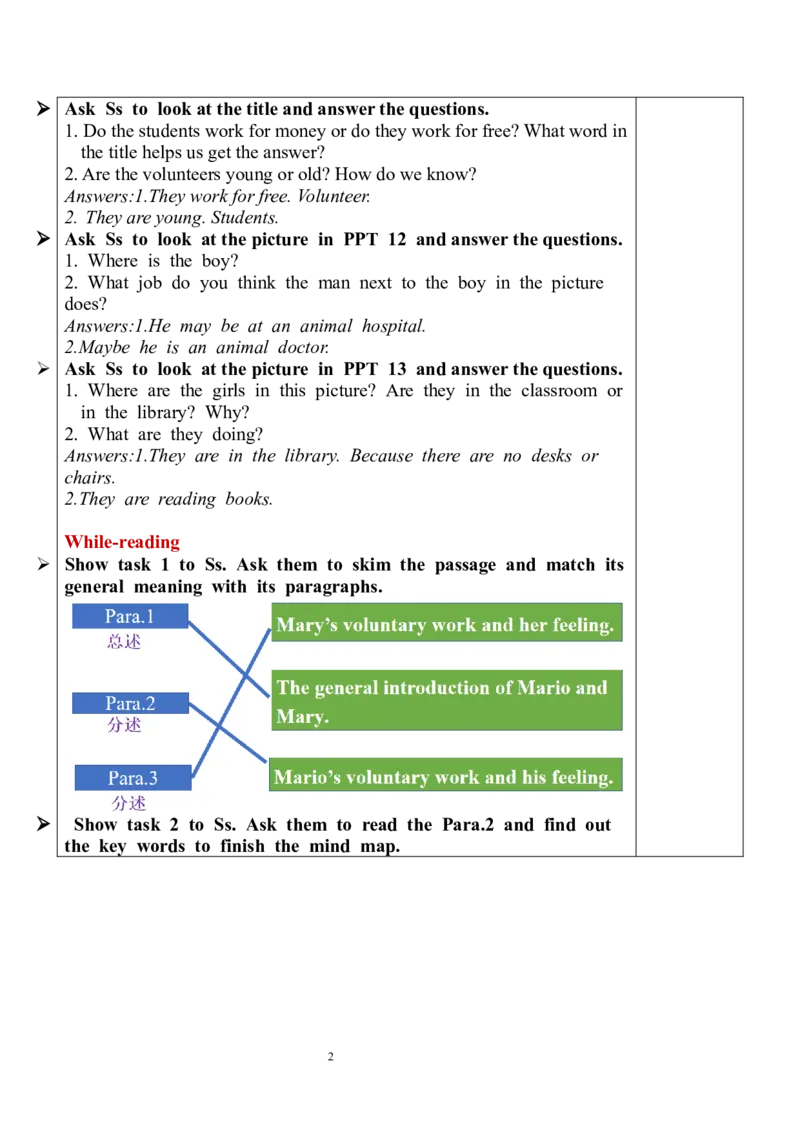
Ask Ss to look at the picture in PPT 12 and answer the questions.
1. Where is the boy?
2. What job do you think the man next to the boy in the picture
does?
Answers:1.He may be at an animal hospital.
2.Maybe he is an animal doctor.
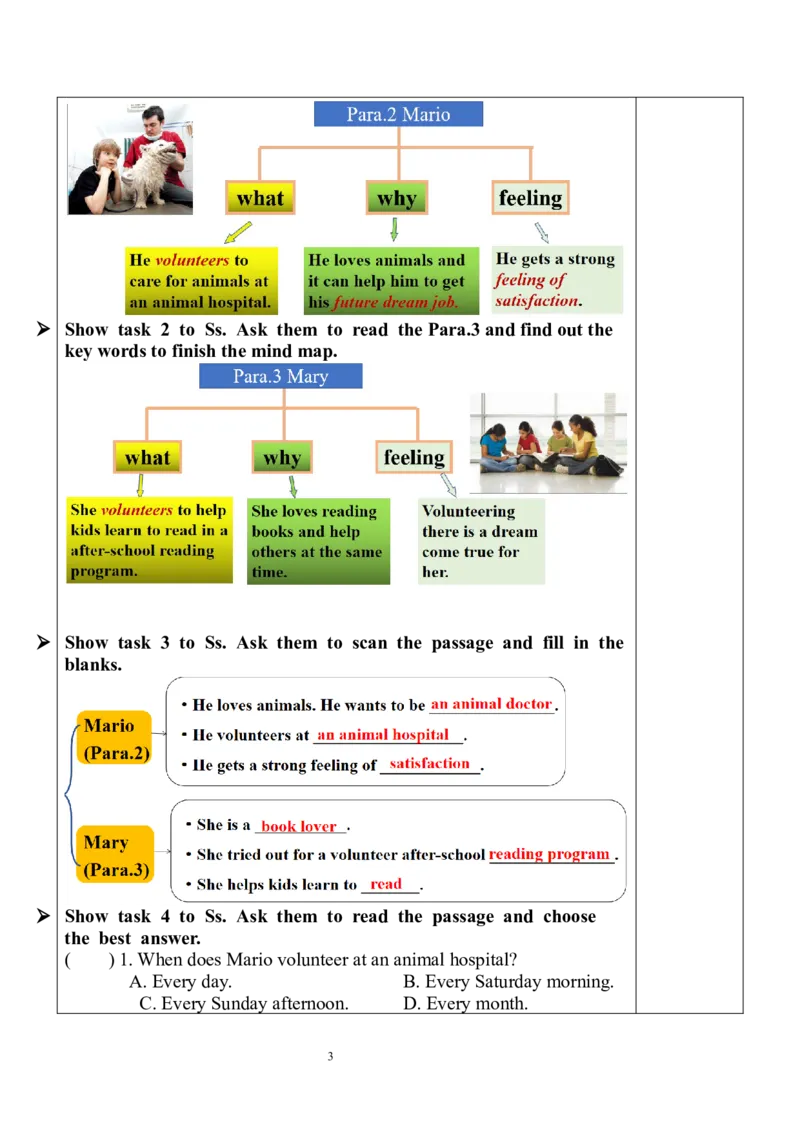
Ask Ss to look at the picture in PPT 13 and answer the questions.
1. Where are the girls in this picture? Are they in the classroom or
in the library? Why?
2. What are they doing?
Answers:1.They are in the library. Because there are no desks or
chairs.
2.They are reading books.
While-reading
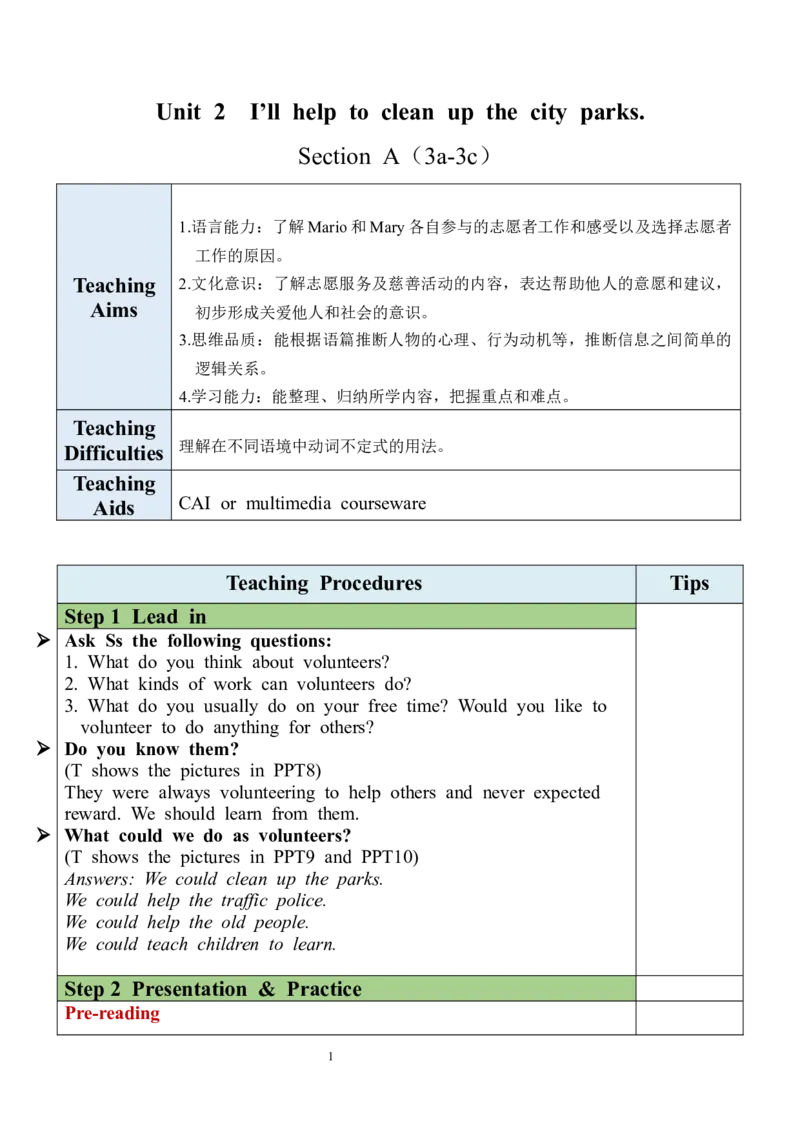
Show task 1 to Ss. Ask them to skim the passage and match its
general meaning with its paragraphs.
Show task 2 to Ss. Ask them to read the Para.2 and find out
the key words to finish the mind map.
2 Show task 2 to Ss. Ask them to read the Para.3 and find out the
key words to finish the mind map.
Show task 3 to Ss. Ask them to scan the passage and fill in the
blanks.
Show task 4 to Ss. Ask them to read the passage and choose
the best answer.
( ) 1. When does Mario volunteer at an animal hospital?
A. Every day. B. Every Saturday morning.
C. Every Sunday afternoon. D. Every month.
3( ) 2. What does Mary do in a volunteer after-school reading program?
A. She helps kids to read.
B. She helps kids to sing and dance.
C. She teaches kids to play soccer.
D. She cleans up the city park.
( ) 3. What do Mario and Mary have in common?
A.They both have a kind heart.
B. They are both rich.
C. They both like animals.
D. They both like reading.
Answer:1.B 2.A 3. A
Presentation
3a
Ask Ss to read the article.Explain the phrases that are marked
on PPT P19 - P21.
Ask Ss the question: What do Mario and Mary volunteer to do?
(tips: Show the pictures in PPT 22.)
Answer: 1.Mario volunteers at an animal hospital every Saturday
morning and learn about how to care for animals.
2.Mary volunteers at an after-school reading program to help kids learn to
read once a week.
3b
Ask Ss to read the article again and answer the questions.
1. Why do Mario and Mary volunteer to help others?
2. What do they say about volunteering?
Answer: 1.Mario volunteers at an animal hospital because he loves
animals and wants to be an animal doctor. He believes his
volunteer work can help him to get his future dream job.
Mary volunteers at an after-school reading program because she
loves books and enjoys helping kids learn to read.
2.Mario says volunteering is hard work, but he can get a strong feeling of
satisfaction when he sees the animals get better and the look of joy on
their owners’ faces.
Mary says volunteering at an after-school reading program is a dream
come true for her. She can do what she loves to do and help others at the
same time.
3c
Ask Ss to use infinitives to complete the sentences below.
1. Mario would like ______ an animal doctor.
2. Mario works for an animal hospital because he wants ________ about
how ________ for animals.
3. Mary decided __________ for a job at an after-school reading program
4last year. She still works there now ____________ kids learn to read.
4. Mary has a dream job because she can do what she loves ______.
Answers:1.to be 2.to learn to care 3.to try out to help
4.to do
Step 3 Language Points
1. Mario Green and Mary Brown from Riverside High School give up
several hours each week to help others.
He volunteers at an animal hospital every Saturday morning.
以上两句中的each和every是一对近义词,但各自的侧重点不同。
Each student has a book.
They each have ten books.
Each of us has a gift.
Every member in my family likes exercising.
【特别提醒】each不能与almost, nearly, not等搭配,而every可
以。
Almost every cake was sold.
Not every student went on holiday.
2. I get such a strong feeling of satisfaction when I see the animals get
better and the look of joy on their owners’ faces.
satisfaction n. 满足;满意 一般用作不可数名词。
Your support and satisfaction are the best reply to our service.
【拓展延伸】satisfaction的相关词汇:
satisfy v.使满意;满足
satisfied adj. 满意的;满足的
satisfaction n.满意;满足
be satisfied with对······感到满意
3. She could read by herself at the age of four.
1) by oneself 相当于 alone 或 on one’s own,意为“某人独自”。
He walked for a while by himself in the garden.
All the students finished their exercises by themselves.
2) at the age of 在……岁时
at the age of 后直接跟基数词,相当于“at age+基数词”或“at+基数
词”。
He became a doctor at the age of 27 (= at age 27/at 27).
【拓展延伸】by the age of 意为“在某岁数之前;到……岁时”。
By the age of seven he could write beautifully.
54. Last year, she decided to try out for a volunteer after-school
reading program.
try out 参加······选拔;试用
(1)try out 在此处意为“ 参加······选拔”,与介词for连用。
Why don’t you try out for the basketball team?
(2)try out还有“试用”的意思。
Do you want to try out this new product?
Step 4 Summary & Homework
Summary The
Ask Ss to do the exercises from PPT P32 to P34. homework
Homework can vary
Read and recite the passage in 3a. with the
Do the exercises in students’ book. specific
conditions.
This is the third period of the unit. In this period, we should practice
the target language more in reading and speaking activities. Besides,
Teaching
we can set some suitable tasks to help students do the reading
Reflection
comprehension in order to improve their reading skills.And students
should know the main content in this passage.
6