文档文本内容
Unit 9 Have you ever been to a museum?
Section A(1a-1c)
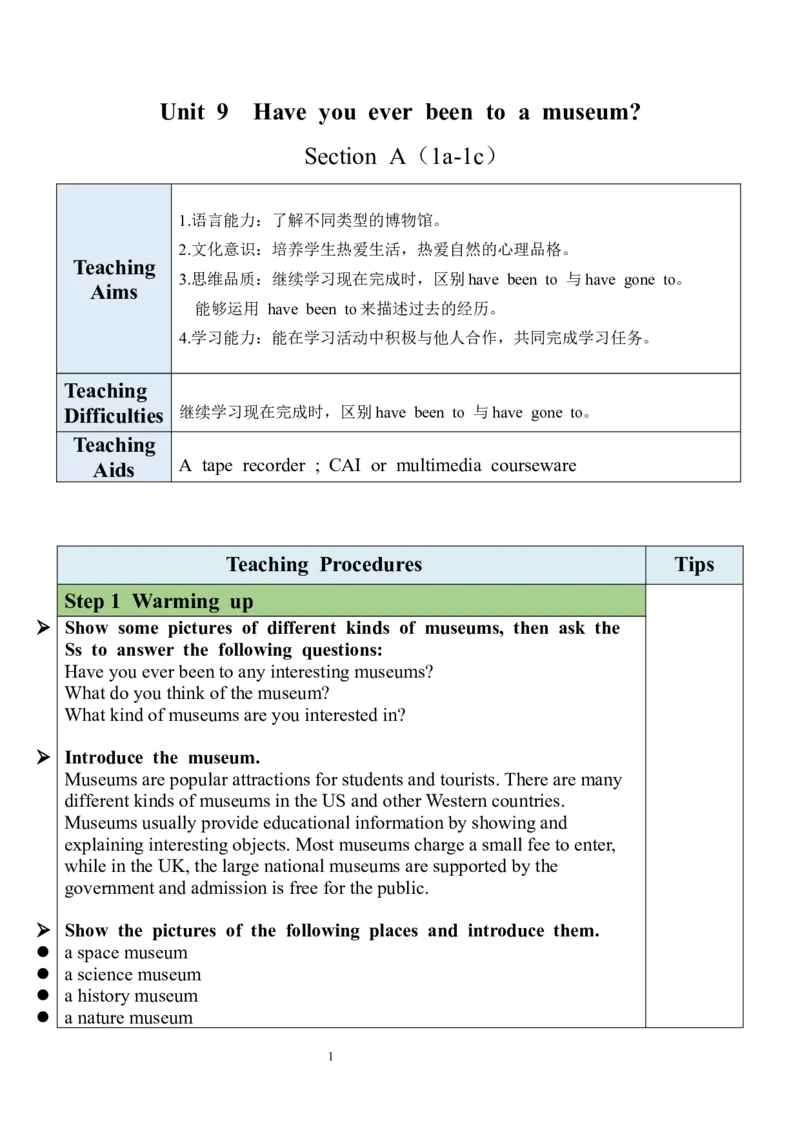
1.语言能力:了解不同类型的博物馆。
2.文化意识:培养学生热爱生活,热爱自然的心理品格。
Teaching
3.思维品质:继续学习现在完成时,区别have been to 与have gone to。
Aims
能够运用 have been to来描述过去的经历。
4.学习能力:能在学习活动中积极与他人合作,共同完成学习任务。
Teaching
Difficulties 继续学习现在完成时,区别have been to 与have gone to。
Teaching
Aids A tape recorder ; CAI or multimedia courseware
Teaching Procedures Tips
Step 1 Warming up
Show some pictures of different kinds of museums, then ask the
Ss to answer the following questions:
Have you ever been to any interesting museums?
What do you think of the museum?
What kind of museums are you interested in?
Introduce the museum.
Museums are popular attractions for students and tourists. There are many
different kinds of museums in the US and other Western countries.
Museums usually provide educational information by showing and
explaining interesting objects. Most museums charge a small fee to enter,
while in the UK, the large national museums are supported by the
government and admission is free for the public.
Show the pictures of the following places and introduce them.
a space museum
a science museum
a history museum
a nature museum
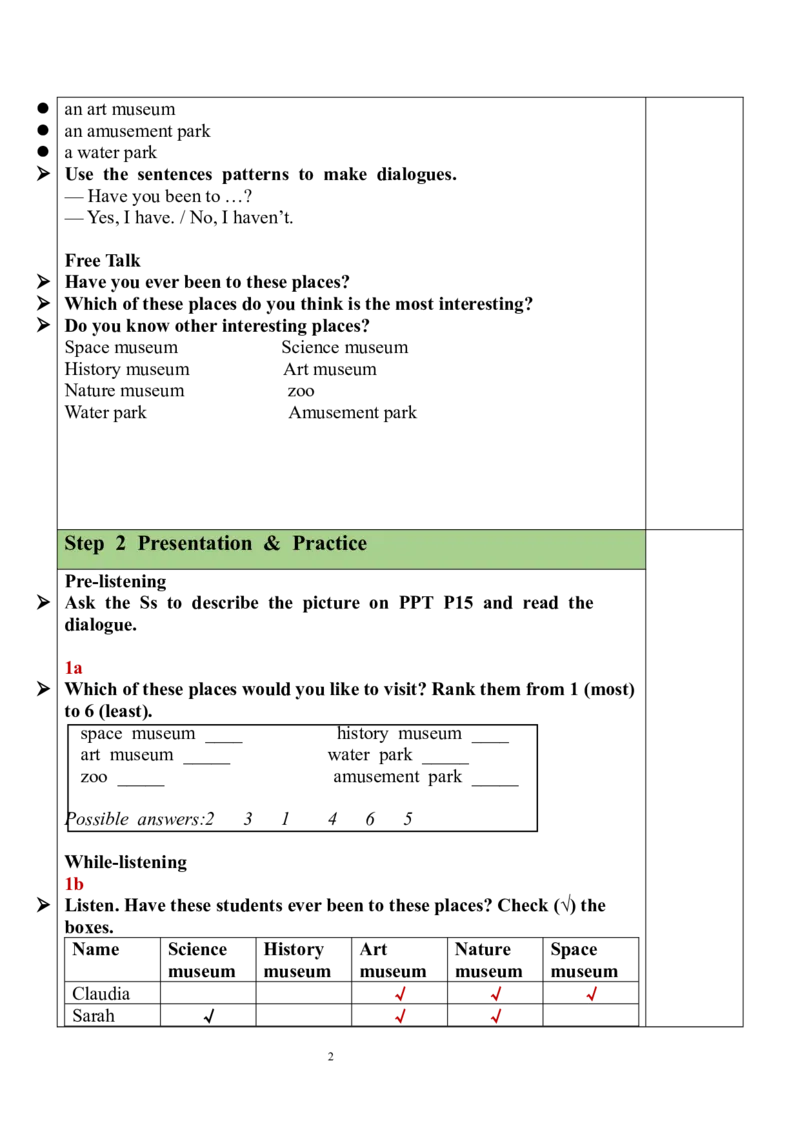
1 an art museum
an amusement park
a water park
Use the sentences patterns to make dialogues.
— Have you been to …?
— Yes, I have. / No, I haven’t.
Free Talk
Have you ever been to these places?
Which of these places do you think is the most interesting?
Do you know other interesting places?
Space museum Science museum
History museum Art museum
Nature museum zoo
Water park Amusement park
Step 2 Presentation & Practice
Pre-listening
Ask the Ss to describe the picture on PPT P15 and read the
dialogue.
1a
Which of these places would you like to visit? Rank them from 1 (most)
to 6 (least).
space museum ____ history museum ____
art museum _____ water park _____
zoo _____ amusement park _____
Possible answers:2 3 1 4 6 5
While-listening
1b
Listen. Have these students ever been to these places? Check (√) the
boxes.
Name Science History Art Nature Space
museum museum museum museum museum
Claudia √ √ √
Sarah √ √ √
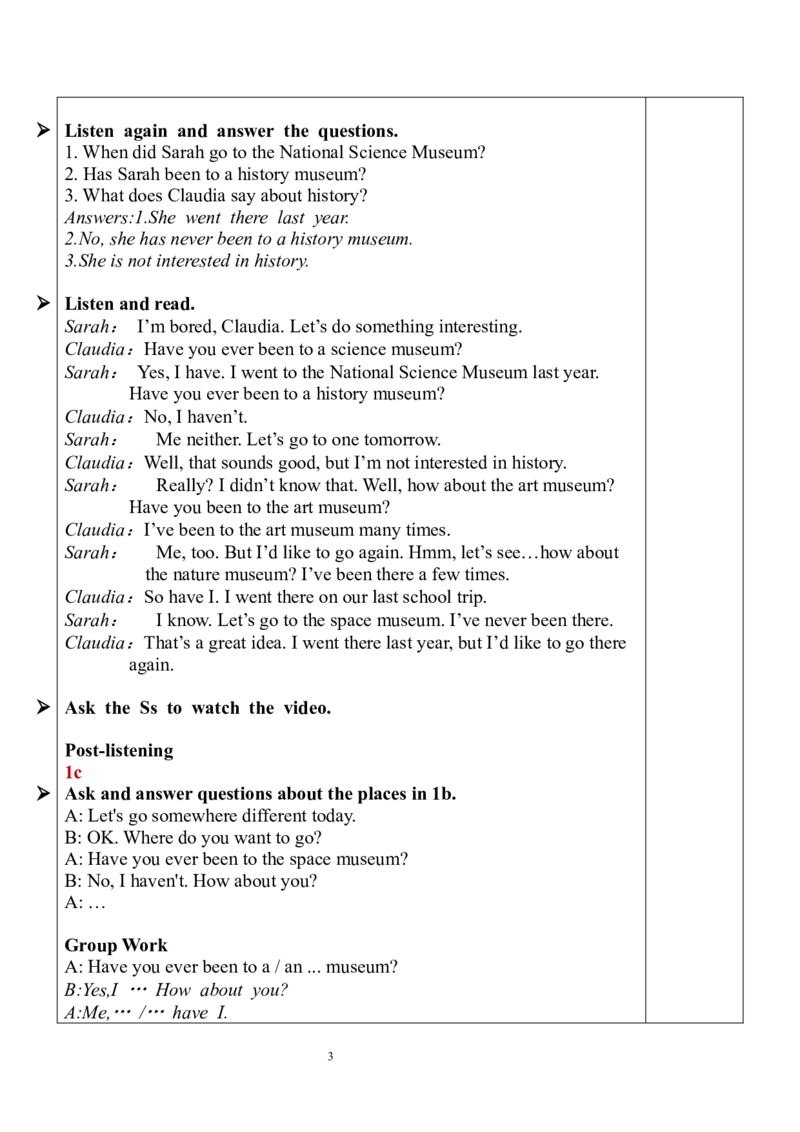
2 Listen again and answer the questions.
1. When did Sarah go to the National Science Museum?
2. Has Sarah been to a history museum?
3. What does Claudia say about history?
Answers:1.She went there last year.
2.No, she has never been to a history museum.
3.She is not interested in history.
Listen and read.
Sarah: I’m bored, Claudia. Let’s do something interesting.
Claudia:Have you ever been to a science museum?
Sarah: Yes, I have. I went to the National Science Museum last year.
Have you ever been to a history museum?
Claudia:No, I haven’t.
Sarah: Me neither. Let’s go to one tomorrow.
Claudia:Well, that sounds good, but I’m not interested in history.
Sarah: Really? I didn’t know that. Well, how about the art museum?
Have you been to the art museum?
Claudia:I’ve been to the art museum many times.
Sarah: Me, too. But I’d like to go again. Hmm, let’s see…how about
the nature museum? I’ve been there a few times.
Claudia:So have I. I went there on our last school trip.
Sarah: I know. Let’s go to the space museum. I’ve never been there.
Claudia:That’s a great idea. I went there last year, but I’d like to go there
again.
Ask the Ss to watch the video.
Post-listening
1c
Ask and answer questions about the places in 1b.
A: Let's go somewhere different today.
B: OK. Where do you want to go?
A: Have you ever been to the space museum?
B: No, I haven't. How about you?
A: …
Group Work
A: Have you ever been to a / an ... museum?
B:Yes,I … How about you?
A:Me,… /… have I.
3C:Has A ever been to a / an…?
D:Yes, A …
B:No,I …What about you?
A:Me,… / … have I.
C:Has A ever been to a / an…?
D:No, A …
Step 3 Language points learning
1. Me neither.
Me neither 的用法
Me neither 是常见的交际用语,表示自己的情况与前面的否定情况一
样,此处相当于 Neither / Nor have I。“Neither / Nor + 情态动词
/ 助动词 / be动词 + 主语”表示前面所述的否定情况也同样适用于
另一个人或物。
— I don’t like winter. It’s too cold.
— Me neither. ( = Neither / Nor do I. )
【拓展延伸】如果表示自己的情况和前面的肯定情况一样,则用 Me
too 或“So + 情态动词 / 助动词 / be 动词 + I”。“So + 情态动
词 / 助动词 / be动词 + 主语”表示前面所述的肯定情况也同样适用
于另一个人或物。
— I often visit my grandparents on weekends.
— Me too. ( =So do I. )
2. Let's go somewhere different today.
somewhere adv.在某处;到某处
形容词修饰 somewhere 时,形容词应放在 somewhere 之后。适用于
这种用法的词有:some-,any-,every-,no- 构成的复合词。
Can we go somewhere warm?
I want to go somewhere interesting to relax with family.
【拓展延伸】在否定句和疑问句中,常用 anywhere 代替
somewhere,anywhere 意为“在任何地方”。
Many of these animals are not found anywhere else.
Did you go anywhere interesting?
3. Have you ever been to the space museum?
have been (to) 表示“去过某地” (去过,已经回来了)
【拓展】
have gone (to) 表示“去了某地” ( 没有回来)
两个用法中,后如果接地点副词(here、there),则不加介词 to
4Step 4 Summary & Homework
Summary The
Ask the Ss to do the exercises on PPT P29-P32. homework
Homework can vary
Preview the conversation in 2d. with the
Do the exercises in students’ book. specific
conditions
.
This is the first period of the unit.During this period, teachers interact
with students through high-density questions according to the topic
picture in 1a, which is helpful for students to learn new vocabulary,
and also help students review the language content they have learned.
Teaching
When checking the answers, teachers need not rush to judge right or
Reflection
wrong. They should let students speak actively. At this stage, it is
OK to understand sentences without explaining for the time being so
that students can accumulate more perceptual knowledge in the stage
of grammar perception.
5