文档文本内容
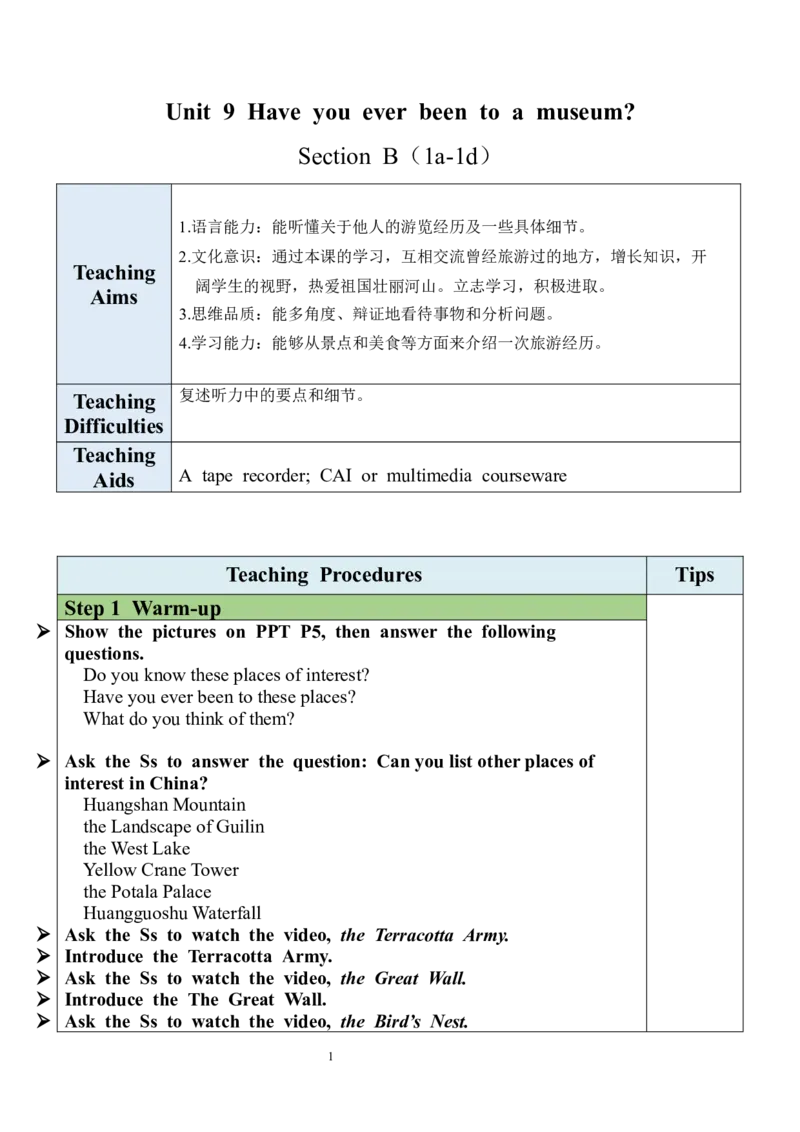
Unit 9 Have you ever been to a museum?
Section B(1a-1d)
1.语言能力:能听懂关于他人的游览经历及一些具体细节。
2.文化意识:通过本课的学习,互相交流曾经旅游过的地方,增长知识,开
Teaching
阔学生的视野,热爱祖国壮丽河山。立志学习,积极进取。
Aims
3.思维品质:能多角度、辩证地看待事物和分析问题。
4.学习能力:能够从景点和美食等方面来介绍一次旅游经历。
复述听力中的要点和细节。
Teaching
Difficulties
Teaching
Aids A tape recorder; CAI or multimedia courseware
Teaching Procedures Tips
Step 1 Warm-up
Show the pictures on PPT P5, then answer the following
questions.
Do you know these places of interest?
Have you ever been to these places?
What do you think of them?
Ask the Ss to answer the question: Can you list other places of
interest in China?
Huangshan Mountain
the Landscape of Guilin
the West Lake
Yellow Crane Tower
the Potala Palace
Huangguoshu Waterfall
Ask the Ss to watch the video, the Terracotta Army.
Introduce the Terracotta Army.
Ask the Ss to watch the video, the Great Wall.
Introduce the The Great Wall.
Ask the Ss to watch the video, the Bird’s Nest.
1 Introduce the The Bird’s Nest.
Step 2 Presentation & Practice
Pre-listening
1a
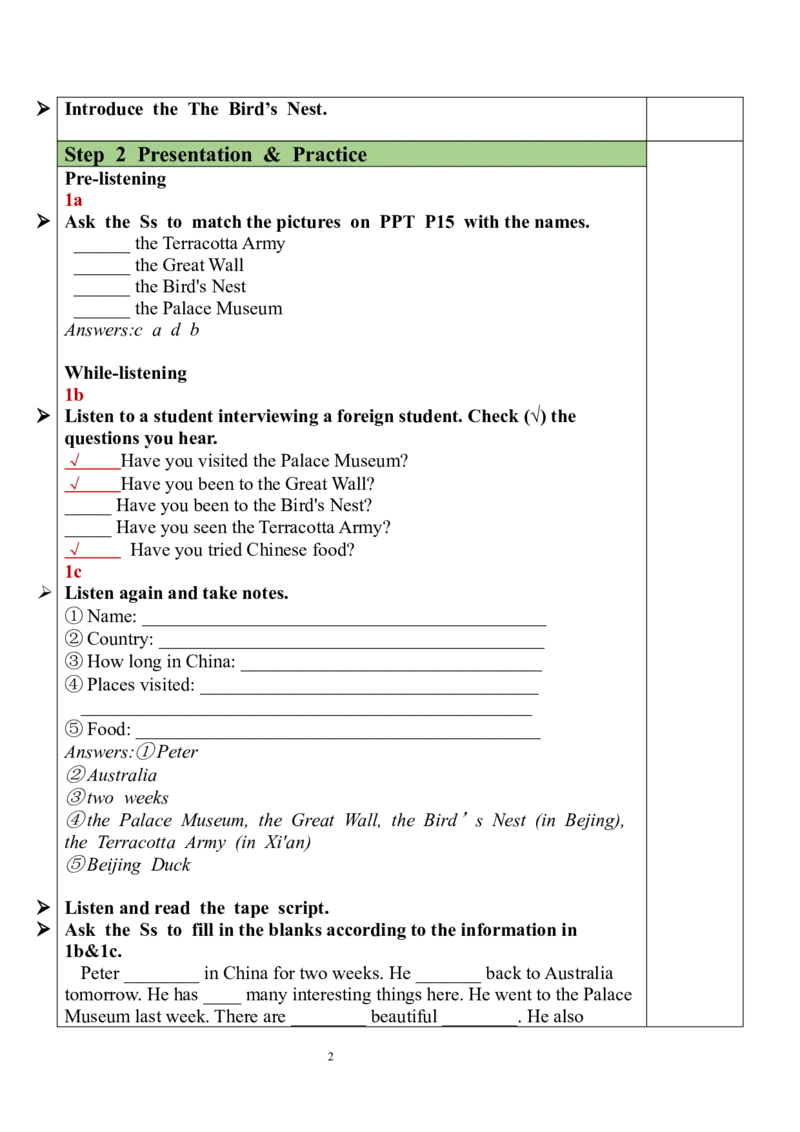
Ask the Ss to match the pictures on PPT P15 with the names.
______ the Terracotta Army
______ the Great Wall
______ the Bird's Nest
______ the Palace Museum
Answers:c a d b
While-listening
1b
Listen to a student interviewing a foreign student. Check (√) the
questions you hear.
√ Have you visited the Palace Museum?
√ Have you been to the Great Wall?
_____ Have you been to the Bird's Nest?
_____ Have you seen the Terracotta Army?
√ Have you tried Chinese food?
1c
Listen again and take notes.
①Name: ___________________________________________
②Country: _________________________________________
③How long in China: ________________________________
④Places visited: ____________________________________
________________________________________________
⑤Food: ___________________________________________
Answers:①Peter
②Australia
③two weeks
④the Palace Museum, the Great Wall, the Bird’s Nest (in Bejing),
the Terracotta Army (in Xi'an)
⑤Beijing Duck
Listen and read the tape script.
Ask the Ss to fill in the blanks according to the information in
1b&1c.
Peter ________ in China for two weeks. He _______ back to Australia
tomorrow. He has ____ many interesting things here. He went to the Palace
Museum last week. There are ________ beautiful ________. He also
2__________ the Great Wall and the Bird’s Nest. He thinks the Terracotta
Army in Xi’an is very ________. He loves ____________ very much. His
_______ dish is Beijing Duck.
Answers:has been is going seen so many treasures
has been to fantastic Chinese food favorite
Post-listening
1d
What places have you been to? Ask your partner.
Have you visited …?
Have you been to ...?
Have you seen ...?
Have you tried …?
Sample dialogue:
A: Have you visited Xi’an ?
B: Yes, I went there last summer.
A: Have you been to the Terracotta Army ?
B: Of course. It was fantastic.
A: Have you seen …?
A: Have you tried …?
Step 3 Summary & Homework
The
Summary homework
Ask the Ss to do the exercises on PPT P23-P25. can vary
Homework: with the
Preview the passage in Section B 2b. specific
Do the exercises in students’ book. conditions
.
The design of activities before listening(Activities1a) is very important.
The purpose is to activate the memory in students' brain, recall the learned
words, phrases and sentence patterns, and pave the way for listening
activities. At the same time, students' response process is also to learn and
Teaching
consolidate language knowledge in application. The role of teachers in this
Reflection
link is also very important. They should be good at providing topics and
mastering the rhythm and difficulty levels of the discussion and
adjusting the discussion atmosphere. We should not only encourage
excellent students to express actively, but also pay attention to the students
3with average or weak foundation and give them the opportunity to express,
even if they are just asked to repeat the statements of other students or
express whether they agree with others.
4