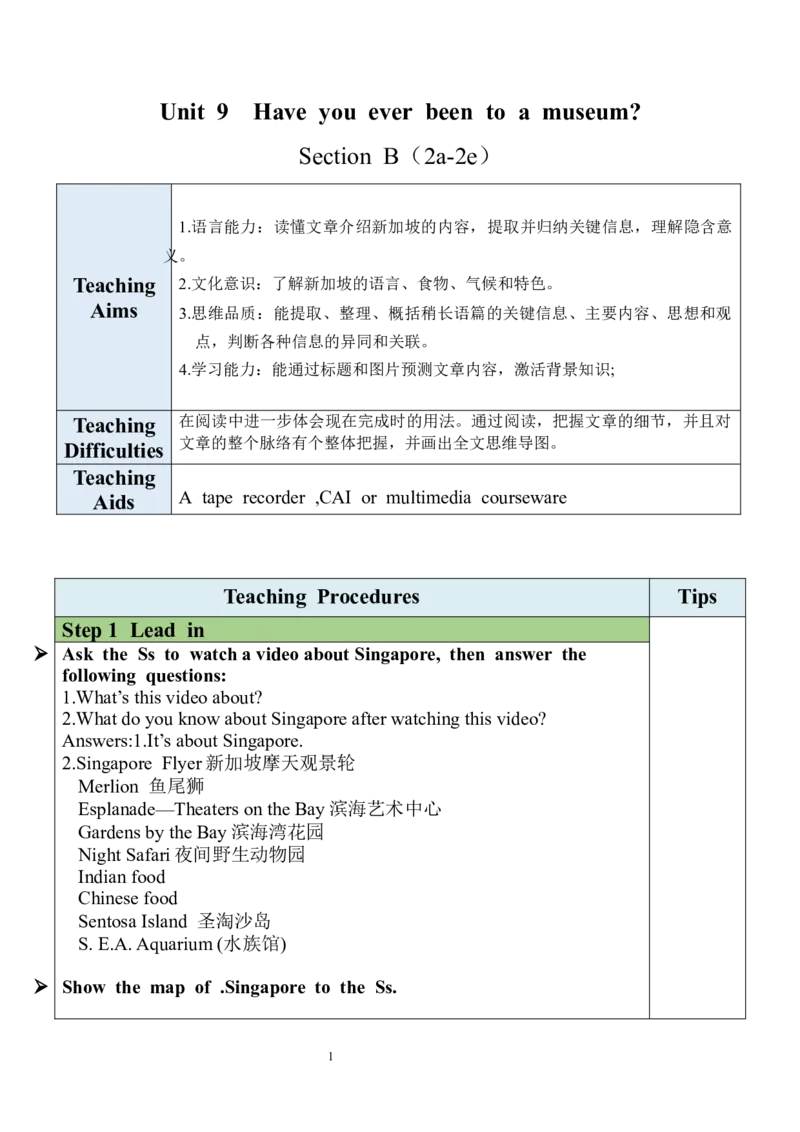
Unit 9 Have you ever been to a museum?
Section B(2a-2e)
1.语言能力:读懂文章介绍新加坡的内容,提取并归纳关键信息,理解隐含意
义。
Teaching 2.文化意识:了解新加坡的语言、食物、气候和特色。
Aims
3.思维品质:能提取、整理、概括稍长语篇的关键信息、主要内容、思想和观
点,判断各种信息的异同和关联。
4.学习能力:能通过标题和图片预测文章内容,激活背景知识;
Teaching 在阅读中进一步体会现在完成时的用法。通过阅读,把握文章的细节,并且对
文章的整个脉络有个整体把握,并画出全文思维导图。
Difficulties
Teaching
Aids A tape recorder ,CAI or multimedia courseware
Teaching Procedures Tips
Step 1 Lead in
Ask the Ss to watch a video about Singapore, then answer the
following questions:
1.What’s this video about?
2.What do you know about Singapore after watching this video?
Answers:1.It’s about Singapore.
2.Singapore Flyer新加坡摩天观景轮
Merlion 鱼尾狮
Esplanade—Theaters on the Bay滨海艺术中心
Gardens by the Bay滨海湾花园
Night Safari夜间野生动物园
Indian food
Chinese food
Sentosa Island 圣淘沙岛
S. E.A. Aquarium (水族馆)
Show the map of .Singapore to the Ss.
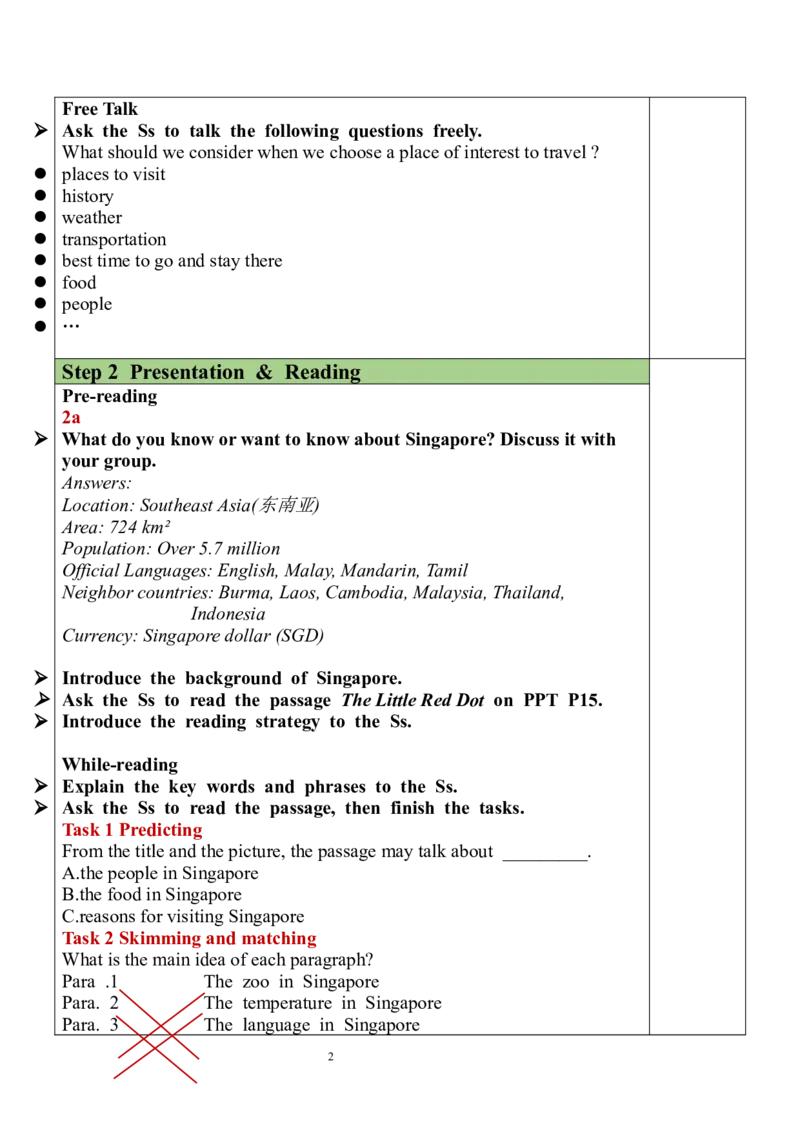
1Free Talk
Ask the Ss to talk the following questions freely.
What should we consider when we choose a place of interest to travel ?
places to visit
history
weather
transportation
best time to go and stay there
food
people
…
Step 2 Presentation & Reading
Pre-reading
2a
What do you know or want to know about Singapore? Discuss it with
your group.
Answers:
Location: Southeast Asia(东南亚)
Area: 724 km²
Population: Over 5.7 million
Official Languages: English, Malay, Mandarin, Tamil
Neighbor countries: Burma, Laos, Cambodia, Malaysia, Thailand,
Indonesia
Currency: Singapore dollar (SGD)
Introduce the background of Singapore.
Ask the Ss to read the passage The Little Red Dot on PPT P15.
Introduce the reading strategy to the Ss.
While-reading
Explain the key words and phrases to the Ss.
Ask the Ss to read the passage, then finish the tasks.
Task 1 Predicting
From the title and the picture, the passage may talk about _________.
A.the people in Singapore
B.the food in Singapore
C.reasons for visiting Singapore
Task 2 Skimming and matching
What is the main idea of each paragraph?
Para .1 The zoo in Singapore
Para. 2 The temperature in Singapore
Para. 3 The language in Singapore
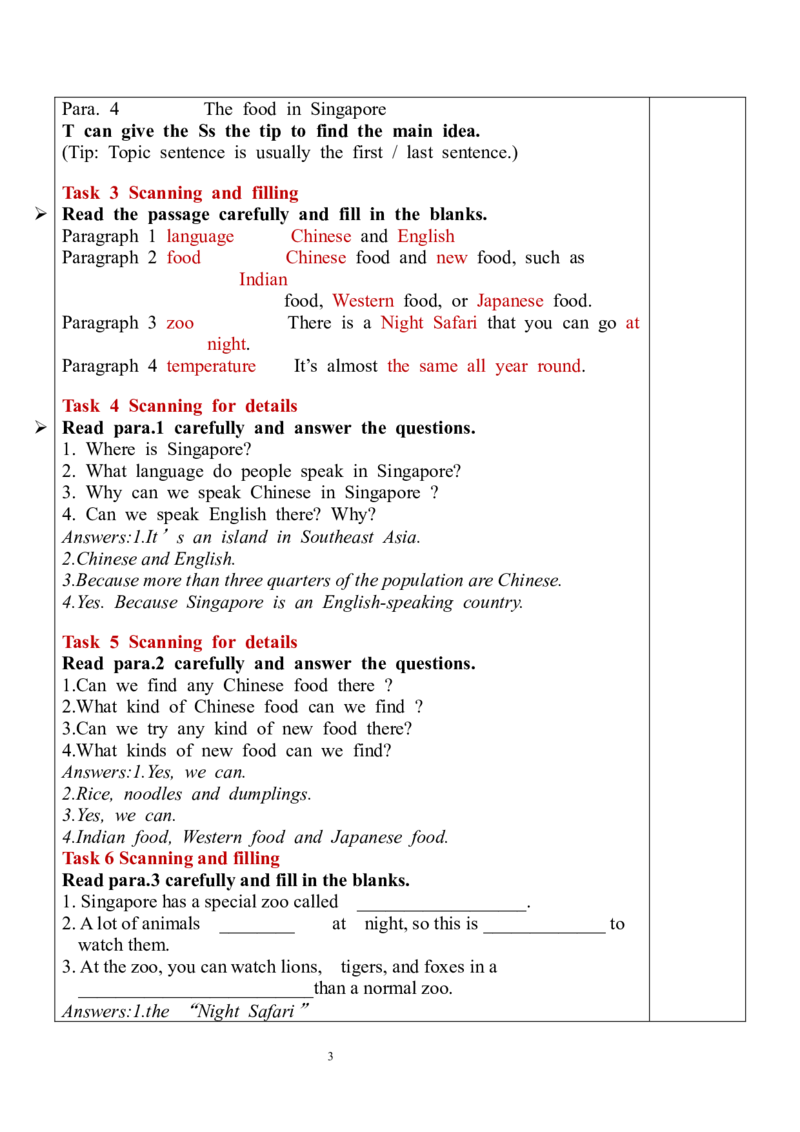
2Para. 4 The food in Singapore
T can give the Ss the tip to find the main idea.
(Tip: Topic sentence is usually the first / last sentence.)
Task 3 Scanning and filling
Read the passage carefully and fill in the blanks.
Paragraph 1 language Chinese and English
Paragraph 2 food Chinese food and new food, such as
Indian
food, Western food, or Japanese food.
Paragraph 3 zoo There is a Night Safari that you can go at
night.
Paragraph 4 temperature It’s almost the same all year round.
Task 4 Scanning for details
Read para.1 carefully and answer the questions.
1. Where is Singapore?
2. What language do people speak in Singapore?
3. Why can we speak Chinese in Singapore ?
4. Can we speak English there? Why?
Answers:1.It’s an island in Southeast Asia.
2.Chinese and English.
3.Because more than three quarters of the population are Chinese.
4.Yes. Because Singapore is an English-speaking country.
Task 5 Scanning for details
Read para.2 carefully and answer the questions.
1.Can we find any Chinese food there ?
2.What kind of Chinese food can we find ?
3.Can we try any kind of new food there?
4.What kinds of new food can we find?
Answers:1.Yes, we can.
2.Rice, noodles and dumplings.
3.Yes, we can.
4.Indian food, Western food and Japanese food.
Task 6 Scanning and filling
Read para.3 carefully and fill in the blanks.
1. Singapore has a special zoo called __________________.
2. A lot of animals ________ at night, so this is _____________ to
watch them.
3. At the zoo, you can watch lions, tigers, and foxes in a
_________________________than a normal zoo.
Answers:1.the “Night Safari”
32.wake up the best time
3.more natural environment
Task 7 Scanning for details
Read para.4 carefully and answer the questions.
1. What is the weather like in Singapore ? Why?
2. When can we go to Singapore?
Answers:1.The temperature is almost the same all year round. Because
it is so close to the equator.
2.Whenever (At any time of year/ In any season).
2b
Read the article. How many reasons can you find for visiting Singapore?
Answers:There are eight reasons for visiting Singapore:
1. wonderful and safe place to take a holiday
2. can speak Putonghua
3. good place to practice English
4. able to find a lot of food from China
5. place to try new food
6. the Night safari
7. temperature is almost the same all year round (so you can visit it at any
time),
8. not too far from China
2c
The statements below are false. Use information from the article to
correct them.
1. Most people in Singapore only speak English.
2. It is not easy to get many different kinds of good food in Singapore.
3. It is better to see lions and tigers during the daytime because they will
probably be awake.
4. It is best to visit Singapore in the autumn.
Answers:1.Most people in Singapore speak English as well as Putonghua.
2.It is easy to get many different kinds of good food in Singapore.
3.It is better to see lions and tigers at night because they will probably be
awake.
4.You can visit Singapore at any time of the year.
2d
Fill in the conversation about Singapore using the information from the
article.
A: I’m going to Singapore next week. __________ you ever __________
4there before?
B: Yes, I've __________ to Singapore many times. It’s my favorite country
to visit in __________ Asia.
A: What languages do people __________ there?
B: Mostly Chinese and __________.
A: What about the food? Is it good?
B: It's excellent! __________ you ever tried Indian food? Indian food is
really good in Singapore.
A: I see. Have you __________ heard of the Night Safari? Someone told me
to go there.
B: Yes! I __________ been to the Night Safari. It was really exciting to
__________ the animals in the dark.
A: And is it always __________ in Singapore?
B: All __________ round! It's always summer there!
Answers:Have been
been Southeast
speak English
Have ever
have watch/see
hot/sunny year
2e
Make notes about Singapore. Write down anything that you remember.
Do not look at the article.
safe place to take a holiday
can speak Putonghua there
good place to practice English as well
different kinds of food
Night safari
temperature the same all year round
Step 3 Language points learning
1. On the one hand, more than three quarters of the population are The
Chinese, … On the other hand, … language
On the one hand,… On the other hand, … 一方面......另一方面...... points are
on the one hand... on the other hand... 常用于列举原因、情况等,说明一 for
个事物的两个方面。有时 on the other hand也可单独使用。 reference
On the one hand, teachers should take good care of the students; on the other only.
hand, students should respect their teachers.
分数的表达法
three quarters 意为“四分之三”。分数在英语中通常借助基数词和序
数词来共同表达。其中分子常用基数词,分母用序数词。如果分子大
5于1,分母要用复数形式。
三分之二 two thirds
十分之一 a / one tenth
【拓展延伸】分数修饰名词在句子中作主语时,若该名词为可数名词
单数或不可数名词,则谓语动词用单数形式;若该名词为可数名词复
数,则谓语动词用复数形式。
About one fifth of the water is polluted.
About two thirds of the students are going to attend the meeting.
2. …, so you can simply speak Putonghua a lot of the time.
simply adv. 仅仅;只;不过
simply 在此处相当于 just 或 only。
Simply add hot water and stir.
【拓展延伸】simply 还有“简单地;简朴地”的意思。simple 作形容
词,意为“简单的;容易的”。
The book explains grammar simply and clearly.
They live simply.
The machine is very simple to use.
3. Maybe you fear that you won't be able to find anything good to eat
when you travel.
fear v. & n. 害怕;惧怕
① fear 在此处作及物动词,意为“害怕;惧怕”,相当于be afraid
of。
Children usually fear to go out alone at night.
He fears that he may lose his job, so he works hard every day.
② fear 还可作名词,意为“害怕;惧怕” 。be in fear of “害怕……;
担心……”。
Don't let a little fear stop you from getting what you want.
We are in fear of tigers.
4. Whether you like Indian food, Western food or Japanese food, you'll
find it all in Singapore!
whether conj. 不管……(还是);或者……(或者);是否
①在此处 whether 作连词,常与 or 连用,意为“不管……(还
是);或者……(或者)”,引导让步状语从句。
Whether the news is true or not, you should be prepared.
② whether 作连词,还可意为“是否”,引导宾语从句(名词从
句)。
My deskmate asked me whether I needed any help.
65. So you can choose to go whenever you like — spring, summer,
autumn or winter.
whenever conj. 在任何……的时候;无论何时
whenever 作连词,此处引导让步状语从句,相当于 no matter when。
与其用法相似的还有:
whatever = no matter what 无论什么
whichever = no matter which 无论哪一 个
wherever = no matter where 无论在哪里
whoever = no matter who 无论谁
however = no matter how 无论如何
Whenever/No matter when it happened, it was certainly not last Friday.
The quality is the same, whichever of them you choose.
Whoever/No matter who you are, you must obey the school rules.
【拓展延伸】whenever还可意为“每当;每次”,此时用来引导时间
状语从句。
Miss Chan is very patient. Whenever we ask questions in class, she explains
to us very carefully.
Step 4 Summary & Homework The
homework
Summary can vary
Ask the Ss to do the exercises on PPT P44-P47. with the
Homework specific
Read and recite the passage in 2b. conditions
Do the exercises in students’ book. .
In order to practice the students' reading ability,we must do a lot of work
and keep on doing the same work.We usually help students to get the
relative knowledge or new words and expressions ready for the reading.And
Teaching
during reading,we use noting supporting details strategy and read the
Reflection
passage again and again.Students read with tasks,finish the tasks and learn
the new words and expressions while reading.After that,they can use the
information to retell the story.We should train the students in this way.
7