文档文本内容
Unit 1 What's the matter?
Section B(2a-2e)
1.语言能力:读懂文章,了解阿姆斯特朗的登山经历。
2.文化意识:培养学生不轻言放弃的精神。
Teaching
3.思维品质:能提取、整理、概括稍长语篇的关键信息、主要内容。
Aims
4.学习能力:能在学习过程中积极思考,主动探究,发现并尝试使用多种策略
解决语言学习中的问题,积极进行拓展性运用。
Teaching 教育学生如何应对意外事故。
Difficulties
Teaching multimedia courseware or other realia that the T needs for teaching
Aids
Teaching Procedures Tips
Step 1 Warming up
Show some pictures in PPT 9 and talk about the questions:
1.Do you know these sports below?
2.Do you think they may be dangerous?
3.What accidents or problems may happen when we do these
sports?
4.What should we do in the face of these accidents or problems?
Show some pictures in PPT 10 and PPT 11. Then talk about the
questions:
What accidents or problems may happen when we do these
sports?
Have you ever met these situations(情形)?
What should we do when we are in these situations?
Possible answers: keep calm(冷静). / go to the doctor right now.
lie down and rest. / take some medicine. /
put some medicine on the cut. /call 120....
Lead in
Show some pictures of climbing mountains to Ss. Ask them some
questions:
11.Do you like climbing mountains?
2.Did any accidents happen during your climbing?
3.What did you do to overcome(克服) them?
Today we will come into the world of Aron Ralston. Ask them some
questions:
1.Do you know Aron Ralston?
2.Do you know the story of him?
He is a mountaineering enthusiast (登山爱好者).
Background
Aron Ralston在2003年5月峡谷探险时遇到意外,右臂被夹在
石缝中无法动弹,他只好借由身体的力量靠在峡谷岩壁上,这样支
撑了5天之后,他突然想出了一个匪夷所思的办法,用小刀割断自己
的手臂,并且成功的救了自己。断肢六小时后由直升机救走,抢救
医生说:再晚一个小时获救的话Aron Ralston就会因失血过多而不
治。
2004年Aron Ralston出版的回忆录《Between a Rock and a
Hard Place》(《生死两难》)中详尽叙述了这段惊心动魄的经历!而
他的真实经历也被拍成电影《127 Hours》。
Show the video about Aron Ralston to Ss.
Step 2 Presentation & Reading
Pre-reading
2a
Accidents or problems can sometimes happen when we do
sports. Write the letter of each sport next to each accident or
problem that can happen.
_______ fall down _______ have problems breathing
_______ get hit by a ball _______ get sunburned
_______ cut ourselves _______ hurt our back or arm
Answers: A B B C
A A B C
A B A B C
While-reading
Show task 1 to Ss. Ask them to answer what the main idea of each
paragraph is. Then match the general meaning with each paragraph.
Show task 2 to Ss.
Read paragraph 1 and find out Aron's personal information.
Answers: Aron Ralston American mountain climbing
taking risks lost his life accidents
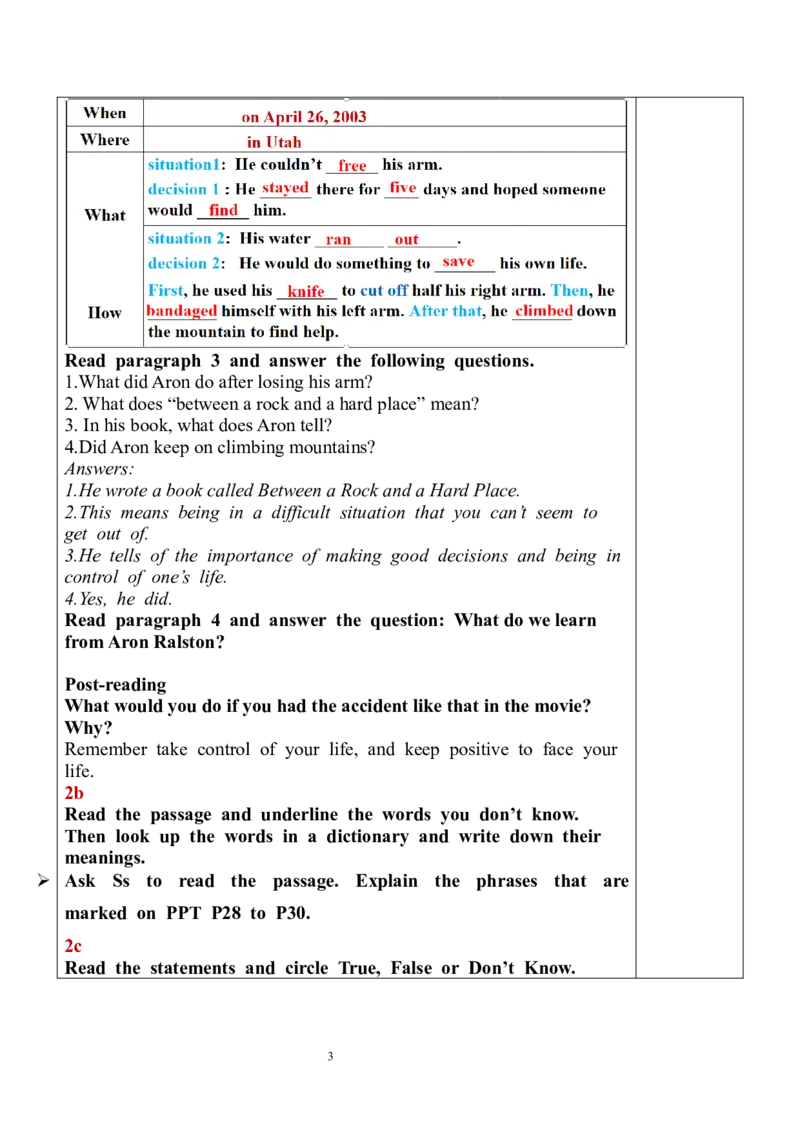
Read paragraph 2 and find out Aron's accident.
2Read paragraph 3 and answer the following questions.
1.What did Aron do after losing his arm?
2. What does “between a rock and a hard place” mean?
3. In his book, what does Aron tell?
4.Did Aron keep on climbing mountains?
Answers:
1.He wrote a book called Between a Rock and a Hard Place.
2.This means being in a difficult situation that you can’t seem to
get out of.
3.He tells of the importance of making good decisions and being in
control of one’s life.
4.Yes, he did.
Read paragraph 4 and answer the question: What do we learn
from Aron Ralston?
Post-reading
What would you do if you had the accident like that in the movie?
Why?
Remember take control of your life, and keep positive to face your
life.
2b
Read the passage and underline the words you don’t know.
Then look up the words in a dictionary and write down their
meanings.
Ask Ss to read the passage. Explain the phrases that are
marked on PPT P28 to P30.
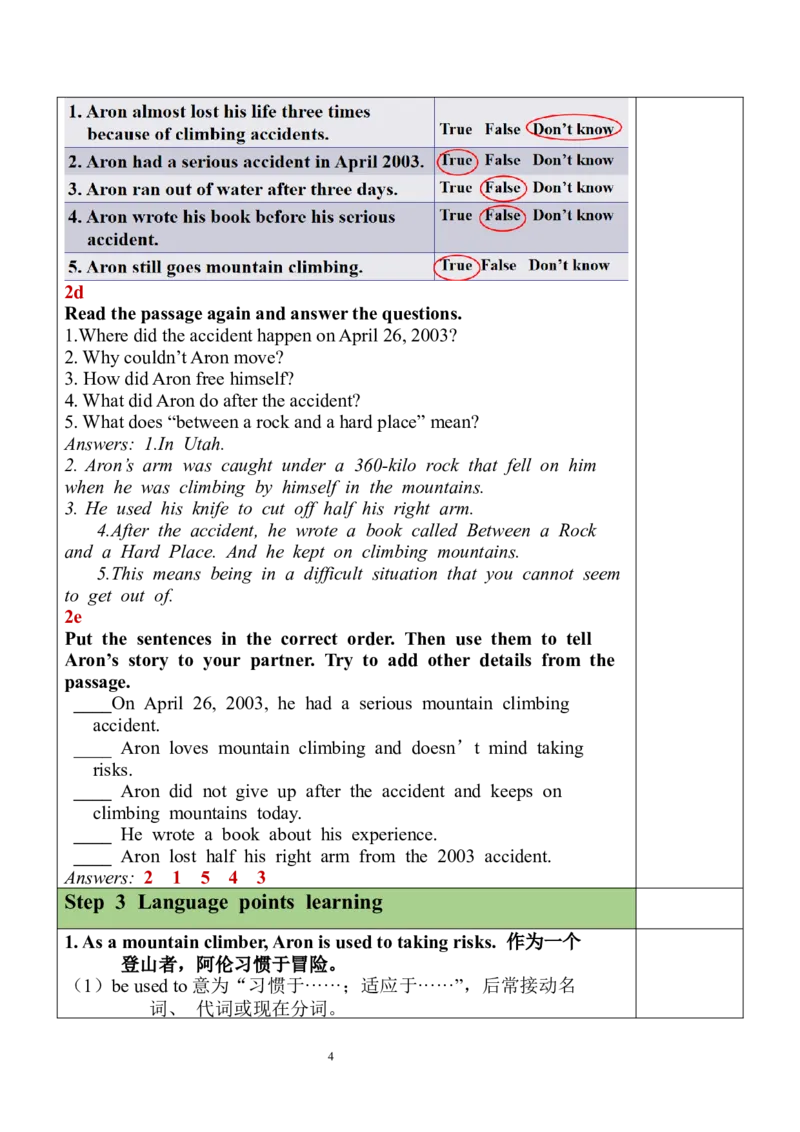
2c
Read the statements and circle True, False or Don’t Know.
32d
Read the passage again and answer the questions.
1.Where did the accident happen on April 26, 2003?
2. Why couldn’t Aron move?
3. How did Aron free himself?
4. What did Aron do after the accident?
5. What does “between a rock and a hard place” mean?
Answers: 1.In Utah.
2. Aron’s arm was caught under a 360-kilo rock that fell on him
when he was climbing by himself in the mountains.
3. He used his knife to cut off half his right arm.
4.After the accident, he wrote a book called Between a Rock
and a Hard Place. And he kept on climbing mountains.
5.This means being in a difficult situation that you cannot seem
to get out of.
2e
Put the sentences in the correct order. Then use them to tell
Aron’s story to your partner. Try to add other details from the
passage.
____On April 26, 2003, he had a serious mountain climbing
accident.
____ Aron loves mountain climbing and doesn’t mind taking
risks.
____ Aron did not give up after the accident and keeps on
climbing mountains today.
____ He wrote a book about his experience.
____ Aron lost half his right arm from the 2003 accident.
Answers: 2 1 5 4 3
Step 3 Language points learning
1. As a mountain climber, Aron is used to taking risks. 作为一个
登山者,阿伦习惯于冒险。
(1)be used to意为“习惯于······;适应于······”,后常接动名
词、 代词或现在分词。
4be/get used to doing “习惯于做某事”
be used to do “······被用来做某事”
used to do “过去常常做某事”
e.g. I am used to eating rice now. 我现在习惯吃米饭。
The knife can be used to cut meat. 刀能用来切肉。
I used to ride to work. 我过去骑车去工作。
(2)take risks是动词词组,意为“冒险”,其同义词组是take a
risk。在此短语中,risk 作名词。
e.g. We do not expect untrained people to take risks.我们不主张未受过
培训的人去冒险。
I have to take a risk in my job.做我这种工作要冒风险。
risk也可作动词,意为“冒······风险;使······面临风险”。
risk one's life to do sth. 冒着生命危险去做······
e.g. The soldier risked his life to save the little girl.
2. There were many times when Aron almost lost his life because
of accidents. 有很多次 阿伦因为事故几乎失去了他自己的生命。
almost是副词,意为“几乎;差不多”。用来修饰不定代词、动
词、副词、形容词等。
e.g. The girl is almost eight years old.这女孩将近八岁了。
He is almost two metres tall.他差不多有两米高。
3. But when his water ran out of, he knew that he would have to do
something to save his own life. 但当他的水用光了的时候,他知道他必
须做点什么来挽救他自己的生命。
run out (of)意为“用尽;耗尽”。
e.g. We have run out of head notepaper.我们已用完了有抬头的信纸。
They have run out of their supplies.他们的供应品已耗尽了。
4. So he used his knife to cut off half his right arm. 所以他用刀切除
了右臂一半。
(1) knife是可数名词,意为“刀”,其复数形式是knives。
e.g. The soldiers sharpened up their knives. 战士们把刀磨得锋利。
(2) cut off 是动词短语,意为“切除”。
e.g. Please help me to cut off the rinds of lemons.请帮我切除柠檬的皮。
cut的相关短语:
cut away 切掉;减掉 cut up 切碎
cut down 砍刀;削减 cut in 插嘴
cut into halves 切成两半 cut into pieces 切成碎块
cut out 剪去;删掉
55. This means being in a difficult situation that you cannot seem to
get out of. 它的意思是“处于一个你似乎无法摆脱的困境中”。
(1)此处mean 表示“……意思是;意味着”,用来解释上句出现
在书名中的习语的意思。如:
What do you mean? 你的意思是什么?
常用短语:
mean to do sth. 打算做······
mean a lot to sb. 对某人来说很重要
mean that从句 打算/意思是······
mean 可作形容词,意为“吝啬的;刻薄的”。
e.g. Don't be so mean to your brother. 不要对你的兄弟如此刻薄。
meaning n. 意思;意义 the meaning of ······的意义
meaningful adj. 有意义的
meaningless adj. 无意义的
(2) a difficult situation that you cannot seem to get out of和a decision
that could mean life or death均为定语从句。
在前者中,从句that you cannot seem to get out of 修饰名词 situation;
在后者中,从句that could mean life or death 修饰名词decision。
(3) get out of意为“离开;从······出来”。
e.g. I couldn't get out of going to that wedding.我不能逃避出席婚礼。
She backed her car out of the garage.她从车库倒车出来。
6. Aron didn't give up after the accident and keeps on climbing
mountains today. 阿伦在这起事故后并没有放弃,现在仍然坚持登
山。
(1) give up 表示“放弃”,可接名词、代词、动名词作宾语。
e.g. He gave up smoking at last. 他最终戒烟了。
give相关短语:
give in 屈服;投降 give out 分发
give away 泄露;赠送 give sb. a hand 帮某人一把
give off 发出(光、热、气味等) give back 归还
(2) keep on doing 表示“坚持做······”。
e.g. He kept on writing these years. 他这些年坚持创作。
keep相关短语及句型:
keep doing sth. 一直做······
keep from doing sth. 忍不住做······
keep sb. from doing sth. 阻止某人做······
keep up with 跟上
Step 4 Summary & Homework
6Summary
Ask Ss to do the exercises from PPT P51-53.
Homework
Read and recite the new words and phrases.
Do the exercises in students’ book.
In the process of English teaching, teachers should try their best to
encourage students to participate in the discussion and do not
Teaching
overemphasize the correct answers. This can not only broaden students'
Reflection
thinking space, help the development of creative thinking ability, but also
help students master the language in use.
7