文档文本内容
Unit 6 An old man tried to move the mountains.
Section B(2a-2e)
1.语言能力:能够读懂《糖果屋》的故事内容,并能根据人物对白总结故事情
节要点,并能够了解戏剧的文本特征。
2.文化意识:学习故事主人公韩塞尔遇到困难,勇敢、机智、沉着冷静的优秀
Teaching
品质。
Aims
3.思维品质:能够根据关键词的提示讲故事,并且能够在剧本的帮助下,进行
戏剧表演。
4.学习能力:能在学习活动中积极与他人合作,共同完成学习任务。
Teaching 能够根据关键词的提示讲故事,并且能够在剧本的帮助下,进行戏剧表演。
Difficulties
Teaching multimedia courseware or other realia that the T needs for teaching
Aids
Teaching Procedures Tips
Step 1 Warming up
Introduce the Grimm’s Fairy Tales《格林童话》to the Ss.
Then ask the Ss the following questions.
Do you know these fairy tales?
Introduce the Brothers Grimm.
Jacob (1785-1863) and Wilhelm Grimm (1786-1859) were two German
brothers famous for having collected many of the stories that are now
popular in Western countries and around the world. Jacob and Wilhelm
Grimm spent many years collecting and publishing popular folk stories.
The versions of the stories they collected were often very violent(暴
力的) and scary — they were meant to teach people important
lessons, not just entertain and amuse. Modern versions of their
stories are often much gentler, with happier endings and less
frightening characters.
Ask the Ss the following question:
Old, traditional stories such as fairy tales and folk tales usually have
positive messages in them. So what social or moral messages did you get
from the stories we have learnt so far in this unit?
1 Ask the Ss to have a discussion.
What's your favorite fairy?
What can you learn from it?
Step 2 Presentation & Reading
Pre-reading
2a
A fairy tale is an old, traditional story. Do you know what these fairy
tales are about?
Sleeping Beauty
Cinderella
Little Red Riding Hood
Introduce the plots of these fairy tales.
Sleeping Beauty
This is a classic fairy tale about a princess who is cursed to sleep for a
hundred years by an evil fairy. She would be awakened by a handsome
prince’s kiss years later.
Good things can sometimes take a long time to happen.
Cinderella
Cinderella is a girl who is treated badly by her mean stepmother but
achieves happiness and marries a prince at last.
Good may triumph over evil if one is willing to overcome adversity.
Little Red Riding Hood
It’s about a young girl who faces danger when she meets a big, bad wolf.
While she is on her way to visit her grandmother, the wolf dresses up and
pretends to be her grandmother waiting in her bed ...
2We should be careful of people trying to cheat us for their own
reasons or purposes.
Do you know Hansel and Gretel? What do you know about it?
Hansel and Gretel《韩塞尔与葛雷特》/《糖果屋》
Reading Strategy
Finding Out the Text Type
Before you read, decide what kind of text it is. Is it a letter, a play, a short
story or something else?
Read quickly and answer the following question.
What’s the type of the text in 2b?
Answer: A play.
Introduce the play.
戏剧
①根据场景不同分为不同的幕(scene)。
②文本多以人物对白为主,偶尔有旁白或舞台指示语。
③有的戏剧文本简单介绍故事背景。
Ask the Ss to read the text in 2b and answer the questions.
1.How many characters are mentioned(提到) in the play?
2.Who are they?
Answers:1.Five.
2.Gretel, Hansel, Wife, Husband and an Old Woman.
Show the pictures of characters.
3While-reading
2b
Ask the Ss to read the first paragraph of Hansel and Gretel. Think
about how the fairy tale will continue. Then read the rest of the story.
Explain the key phrases and words.
Task 1 Skimming and reordering
Number the pictures on PPT P23 according to the play.
Task 2 Scanning for details
Read para.1 carefully and fill in the blanks.
1.Why: One year, the weather was ___dry _____ no food would
grow.
2.Where:in a forest
3.Who:Hansel ,Gretel, Stepmother,and father
4.What happened:The stepmother wanted to_____ the kids, and
Hansel
planned to _____ themselves.
Answer:1.so that 4.kill save
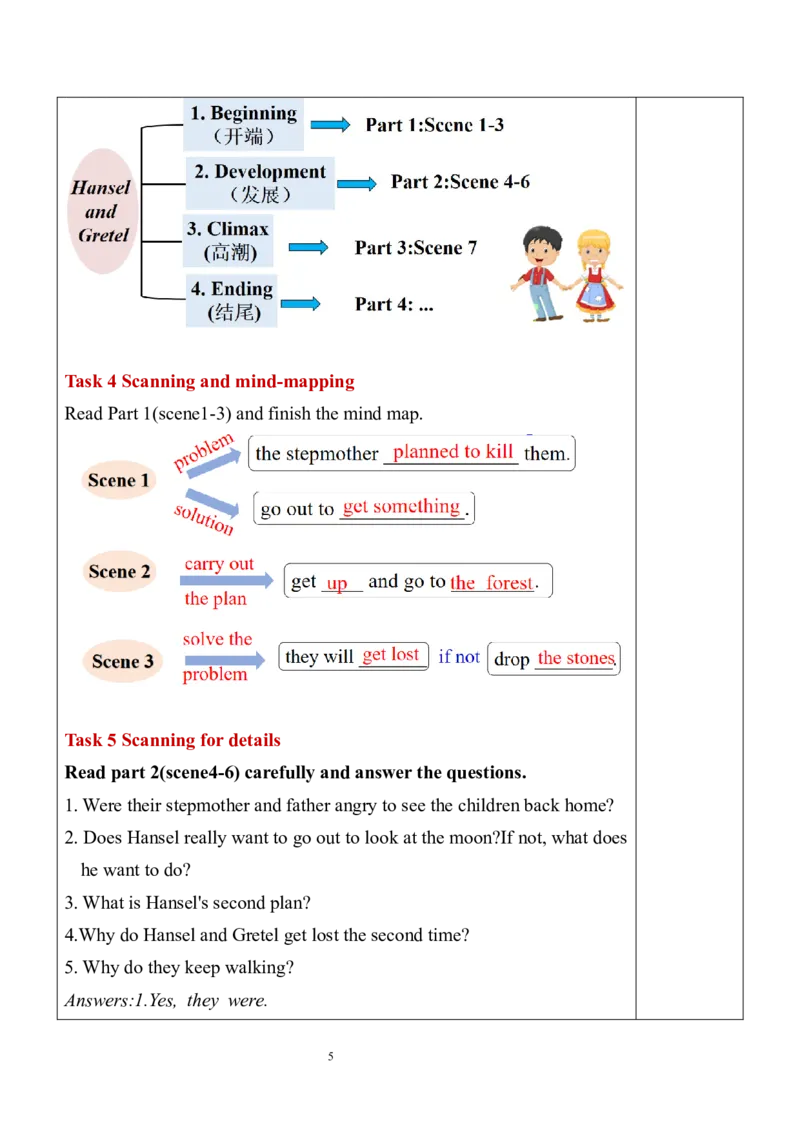
Task 3 skimming and dividing
Divide the seven scenes into several parts.
4Task 4 Scanning and mind-mapping
Read Part 1(scene1-3) and finish the mind map.
Task 5 Scanning for details
Read part 2(scene4-6) carefully and answer the questions.
1. Were their stepmother and father angry to see the children back home?
2. Does Hansel really want to go out to look at the moon?If not, what does
he want to do?
3. What is Hansel's second plan?
4.Why do Hansel and Gretel get lost the second time?
5. Why do they keep walking?
Answers:1.Yes, they were.
52.No, he wants to get white stones.
3.He will drop pieces of bread instead.
4.The birds ate pieces of bread.
5.Because they want to find their way out.
Post-reading
Task 6 Predict the ending
Guess : What happened between the old woman and the children?
2c
Ask the Ss to match each description below with the correct scene.
A. The children get lost.
B. The children wake up.
C. The children cannot find the pieces of bread.
D. Gretel learns about Hansel’s plan.
E. The children surprise the parents.
F. Hansel has to change his plan.
G.The children learn that something bad is going to happen.
Answer: A.——SCENE SEVEN
B.——SCENE TWO
C.——SCENE SIX
D.——SCENE THREE
E.——SCENE FOUR
F.——SCENE FIVE
G.——SCENE ONE
2d
Ask the Ss to read the play again and answer the questions.
1. Why does the wife tell her husband to leave the children in the forest?
62. What does Hansel go out to get?
3. Why does he do this in the moonlight?
4. How do Hansel and Gretel find their way home?
5. Why do Hansel and Gretel get lost the second time?
Answers:1.Unless he leaves the children to die in the forest, the whole
family will die because they don’t have enough food.
2.He goes out to get some white stones.
3.Because when the moon is shining bright, they’ll be able to
see the stones.
4.They follow the white stones which Hansel dropped along the
way.
5.They can’t find any of the pieces of bread they dropped on the
ground.
2e
Act out the play in groups of four.
Introduce some tips of acting.
Building a character
Communicating with your partners
Lines
Self-confidence
Showtime
Group work
Ask the Ss to act out the play.
Hansel Gretel Father stepmother an old woman
Step 3 Language points learning
1. The wife told her husband that unless he left the children to die in
the forest, the whole family would die.
whole adj. 全部的;整体的
7【易混辨析】 whole与all
whole 位于冠词、物主代词等限 the whole family
定 词 之 后 , 即 “ 限 定 词 +
whole + 名词”。
all 位于冠词、物主代词等限 all the family
定词之前,即“all + 限定词 +
名词”。
注意:whole 一般不用来修饰不可数名词或物质名词
2. Tonight, when the moon is shining bright, we’ll be able to see the
stones.
bright adv. 光亮地;明亮地 adj. 明亮的;光线充足的
① bright 此处作副词,意为“光亮地;明亮地”,常与动词 burn,
shine等连用。
The stars were shining bright.
② bright还可作形容词,意为“明亮的;光线充足的”,其比较级为
brighter, 最高级为brightest。
The room is comfortable and bright.
3. What a long time you slept in the forest!
本句是 what 引导的感叹句。这种感叹句的中心词是名词或名词短
语。 其结构为:
What + a / an (+形容词) + 名词 + 陈述句!
What(+形容词)+ 可数名词复数 / 不可数名词 + 陈述句!
e.g. What an easy question (it is)!
What nice music!
【拓展延伸】how 也可引导感叹句, 这种感叹句的中心词是形容词
或副词。 其结构是: How+形容词/副词(+主语+谓语)!
How hard the workers are working!
【特别提醒】what 引导的感叹句有时可与 how 引导的感叹句进行相
互转化。
What an interesting story it is! = How interesting the story is!
4. It’s leading us to that wonderful house made of bread, cake and
candy.
lead v. 带路;领路
lead 在此作动词,意为“带路;领路”。此外,lead 还可表示“通
向;导致;过(某种生活)”等。 lead 的过去式和过去分词均为
8led。
lead的常用结构
①lead sb.+地点状语 引领某人去某地
e.g. He led us into the classroom.
②lead to 通向;导致;引起
e.g. Eating too much sugar can lead to health problems.
③lead sb. to do sth. 引导/促使某人做某事
e.g. What led you to change your idea?
④lead a…life 过......的生活
e.g. She leads a happy life with her brother and sister.
5. Then they hear an old woman’s voice from inside the house.
voice n. 声音
【易混辨析】 voice, sound 与 noise
voice 指人的声音或说话、 She said in a low voice.
唱歌发出的声音。
sound 泛指自然界的各种声 I heard a strange sound.
音。
noise 多 指 不 悦 耳 的 “ 噪 What’s up? There’s such a
声,喧闹声”。 loud noise in the classroom.
Step 4 Summary & Homework
Summary
Ask the Ss to do the exercises on PPT P42-45.
Homework
Read and recite the new words and phrases.
Do the exercises in students’ book.
This is a period in which students do more practice in reading. The teacher
should practice the students’ ability of reading quickly and efficiently.
Teaching While reading, they should help the students find out the text type. It
Reflection is a play. Then help them learn how to catch the main idea of each
scene. They learn some new words and new language items when they are
finishing the tasks and reading the article again and again.
910