文档文本内容
Unit 6 An old man tried to move the mountains.
Section A(3a-3c)
1.语言能力:了解如何运用一般过去时态讲述英语故事;能在实际运用中体会领
悟连词(如if...not, unless, as soon as等)的用法,从而学会用一般过去时态及
恰当连词描述神话故事。
Teaching 2.文化意识:学习孙悟空乐于助人及永不放弃的精神。
Aims
3.思维品质:能掌握一般的阅读技巧和策略(如寻读等),获取相关语篇信息,
提高阅读能力。
4.学习能力:在阅读中查读首尾句,获取主旨,了解文章结构;并善于抓关键词
借助思维导图总结或复述文本内容。
Teaching 用英语讲述The Monkey King 的故事。
Difficulties
Teaching
Aids multimedia courseware or other realia that the T needs for teaching
Teaching Procedures Tips
Step 1 Lead in
Free Talk
Show the pictures of the Four Great Classics of Chinese literature.
Then ask the Ss the following questions.
Do you know the Four Great Classics of Chinese literature?
Have you ever read them?
Journey to the West《西游记》
Romance of the Three Kingdoms《三国演义》
Water Margin《水浒传》
A Dream of Red Mansions《红楼梦》
Warming up
Look at the pictures on PPT P6. Do you know which classic they're
from?
Introduce the background of Journey to the West to the Ss.
Journey to the West (Chinese: 《西游记》) is a Chinese novel
published in the 16th century during the Ming Dynasty and
attributed to Wu Cheng'en. It is one of the Four Great Classical
Novels of Chinese literature.
1Discussion
Ask the Ss to discuss the following questions.
Do you know what story the classic tells of?
Answer: The story is about four people. They went through eighty-
one difficulties and went to the west for scriptures(真经).
What are the names of the four main characters in Journey to the
West?
Answer: They are Tang Seng, Sun Wukong, Zhu Bajie and Sha
Heshang.
Which character do you like best?
Answers may vary.
What do you think of Sun Wukong?
Smart /brave/ Lively/ magic...
Step 2 Presentation & Reading
Pre-reading
Ask the Ss to look at the picture on PPT P10 and guess.
1.Will this passage be about Monkey King?
2.Will this passage be a story about Monkey King?
(Tip: the theme picture(主题图)can help you understand!)
While-reading
3a
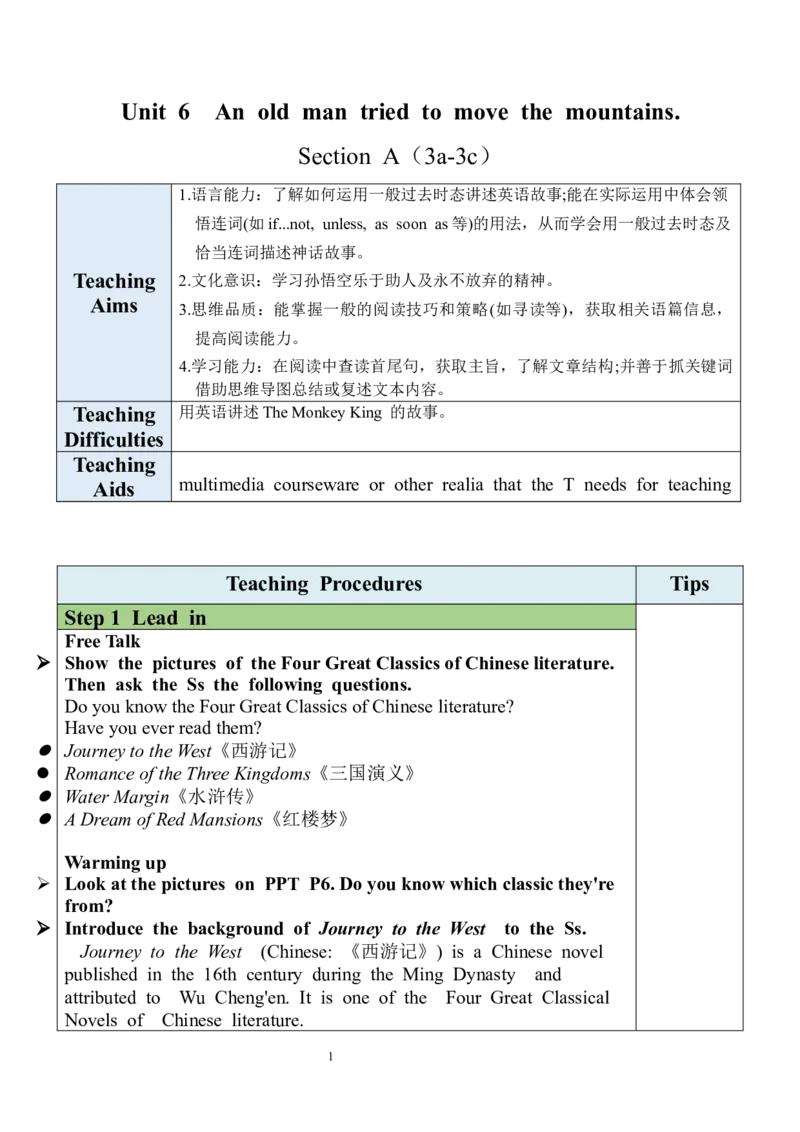
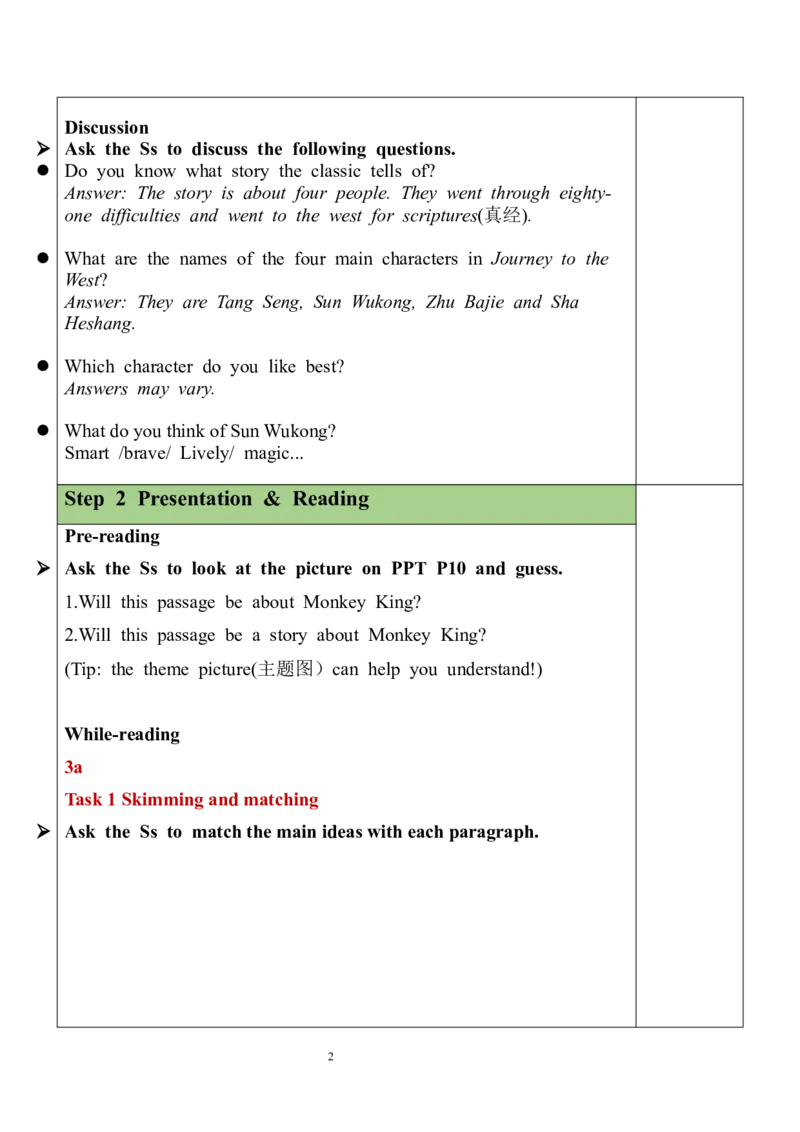
Task 1 Skimming and matching
Ask the Ss to match the main ideas with each paragraph.
2Task 2 Scanning and judging
Ask the Ss to read Para. 1 carefully and tell T or F.
1.In November 1978, pupils in England were able to watch a new
TV program called Monkey. ( )
2.Most of them were hearing this story for the second time. (
)
3.The Monkey King is the main character in the traditional Chinese
book Journey to the West. ( )
Answer: F F T
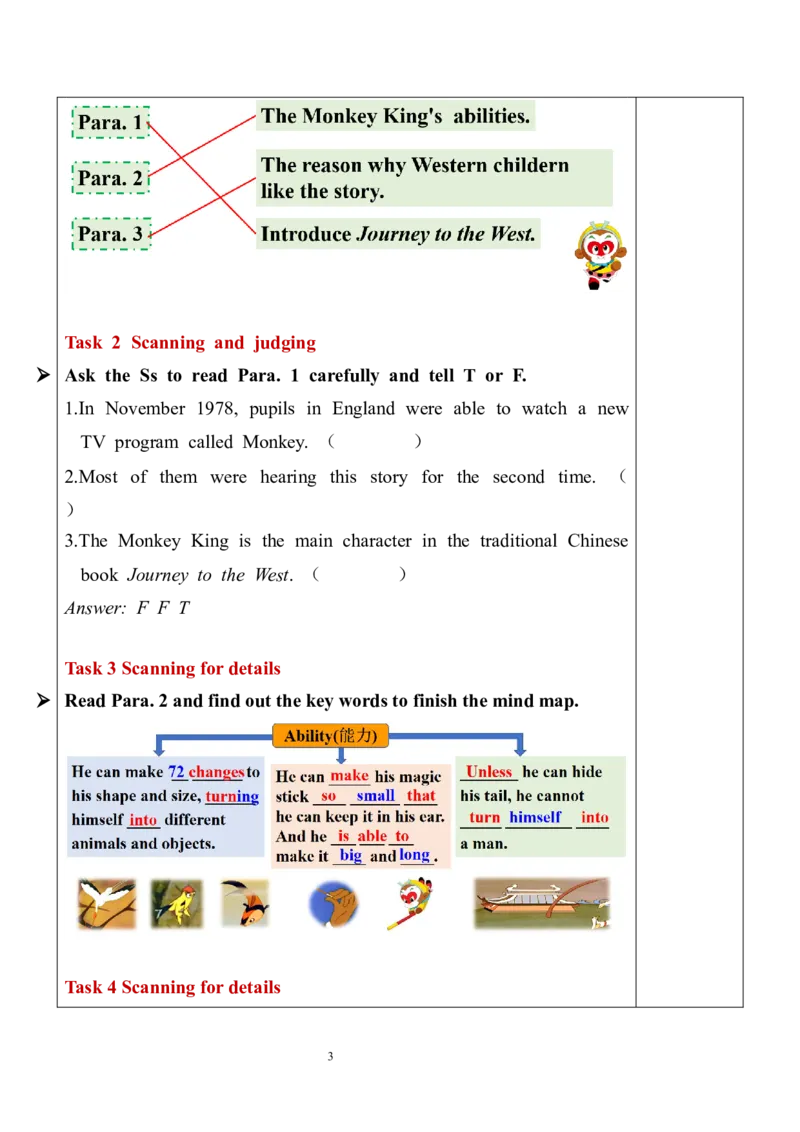
Task 3 Scanning for details
Read Para. 2 and find out the key words to finish the mind map.
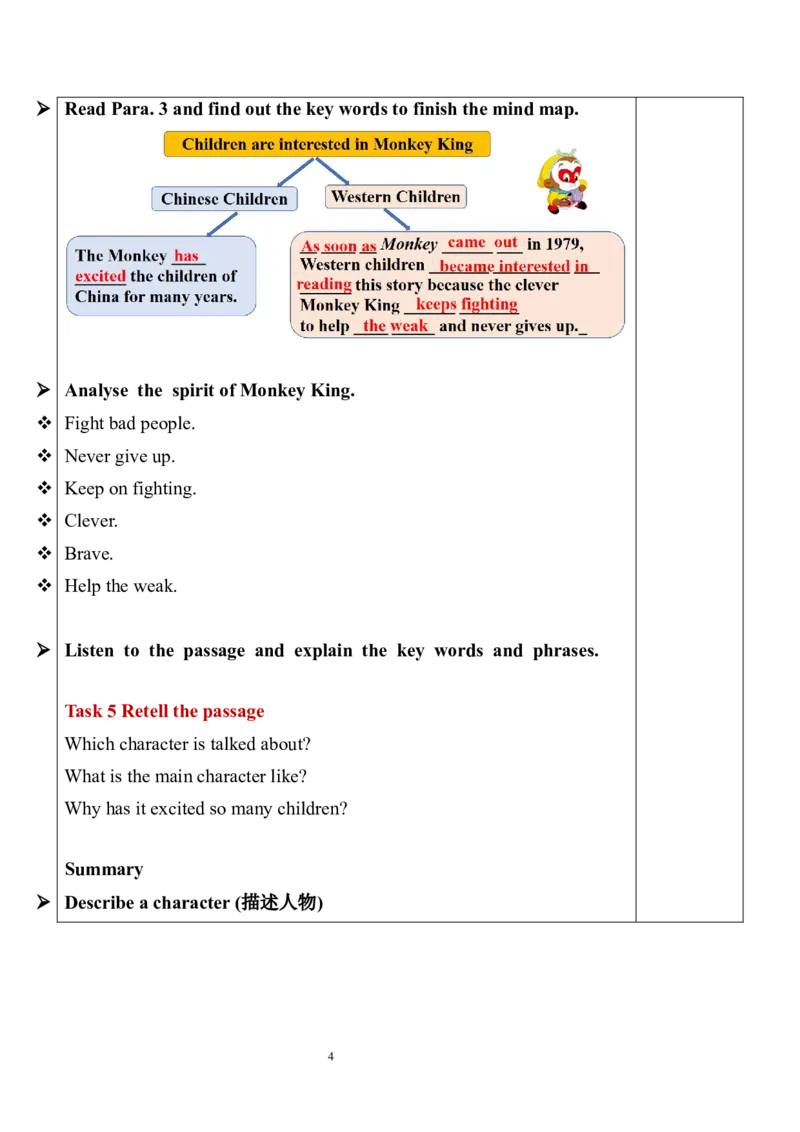
Task 4 Scanning for details
3 Read Para. 3 and find out the key words to finish the mind map.
Analyse the spirit of Monkey King.
Fight bad people.
Never give up.
Keep on fighting.
Clever.
Brave.
Help the weak.
Listen to the passage and explain the key words and phrases.
Task 5 Retell the passage
Which character is talked about?
What is the main character like?
Why has it excited so many children?
Summary
Describe a character (描述人物)
4Can you share your favorite character now ?
Presentation
3a
Ask the Ss to read the passage and answer the questions.
1. Which book is talked about?
Journey to the West.
2. Who is the main character?
The Monkey King. / Sun Wukong.
3. What is he like?
He can change his shape and size, but he cannot turn himself into a man
unless he can hide his tail. He is clever, and keeps fighting to help the
weak and never gives up.
3b
Read the passage again and complete the chart about the Monkey
King.
53c
Ask the Ss to complete the sentences below with phrases from the
passage.
1. Journey to the West is a _________ Chinese book. It tells one of the
most popular stories in China.
2. When the English TV program Monkey ________ in 1979, Western
children __________________ this wonderful story.
3. The Monkey King can ____________ to his body. He is able to
________________ different animals and objects.
4. The Monkey King ___________ make his magic stick small or large.
Answer:1.traditional
2.came out became interested in
3.make changes
4.can/is able to
Step 3 Language points learning
1. This is because he can make 72 changes to his shape and size,
turning himself into different animals and objects. 此处只摘录部
分语法点
turn … into … 把……变成
turn … into … 相当于 change… into…。
They turned/changed the reading room into a laboratory.
【拓展延伸】 turn into表示“变成”,turn在此作不及物动词。
A few weeks later, winter turned into spring.
62. But unless he can hide his tail, he cannot turn himself into a man.
hide (过去式hid)
vt. 隐藏;隐蔽
Hearing someone come in, he hid himself behind the door.
vt. 掩盖(真实情感);隐瞒(计划、真相等)
He tried to hide evidence from the police.
【拓展延伸】hide 还可作名词,意为“隐蔽处,藏身处”。
We found a good hide to watch birds.
3. To fight bad people, the Monkey King uses a magic stick.
magic adj. 有魔力的;有神奇力量的
Have you ever heard the magic sword?
【拓展延伸】 magic 还可作名词,意为“魔法;魔术”。magician
作名词,意为“魔术师;巫师”。
The magician is performing magic on the stage. He is waving a magic
wand (魔杖). Do you think he has magic?
4. The Monkey King has excited the children of China for many years.
现在完成时
本句中 has excited 是现在完成时结构。现在完成时表示从过去某一
时间开始一直持续到现在的动作或状态,基本结构为“have/has + 动
词的过去分词”。
Our school life has changed a lot since 2017. We have more activities now.
excite v. 使激动; 使兴奋
The match result excited us. = We were excited at the match result.
【拓展延伸】
excitement n. 激动;兴奋
excite v. 使激动;使兴奋
excited adj. 激动的;兴奋的
exciting adj. 令人激动的
During the match, people shouted in excitement.
5. And as soon as the TV program came out more than 30 years ago,
Western children became interested in ...
come out 出版;发行;发表
When is her new novel coming out?
【拓展延伸】 come out 的其他常见含义:
①(太阳、月亮、星星)出现
The rain stopped and the sun came out.
②(花朵)盛开;开花
The roses came out late this year because of the cold weather.
7③被获知;为人所知
No doubt that the truth will come out one day.
Western adj. 西方国家的;(尤指)欧美的;西方的
There are many differences between Eastern and Western culture.
It is impolite to keep others waiting in many Western countries.
【拓展延伸】表示方向的名词, 加后缀–ern, 可构成相应的形容词:
west(西方)→ western(西方的)
east(东方)→ eastern(东方的)
south(南方)→ southern(南方的)
north(北方)→ northern(北方的)
Step 4 Summary & Homework
Summary
Ask Ss to do the exercises from PPT P31-34.
Homework
Read and recite the passage in 3a.
Do the exercises in students’ book.
In this period, teacher should help students learn more about Journey
Teaching to the West. Students should practice the target language through
Reflection different activities. Besides, teacher should encourage students to talk
about the Monkey King.
8