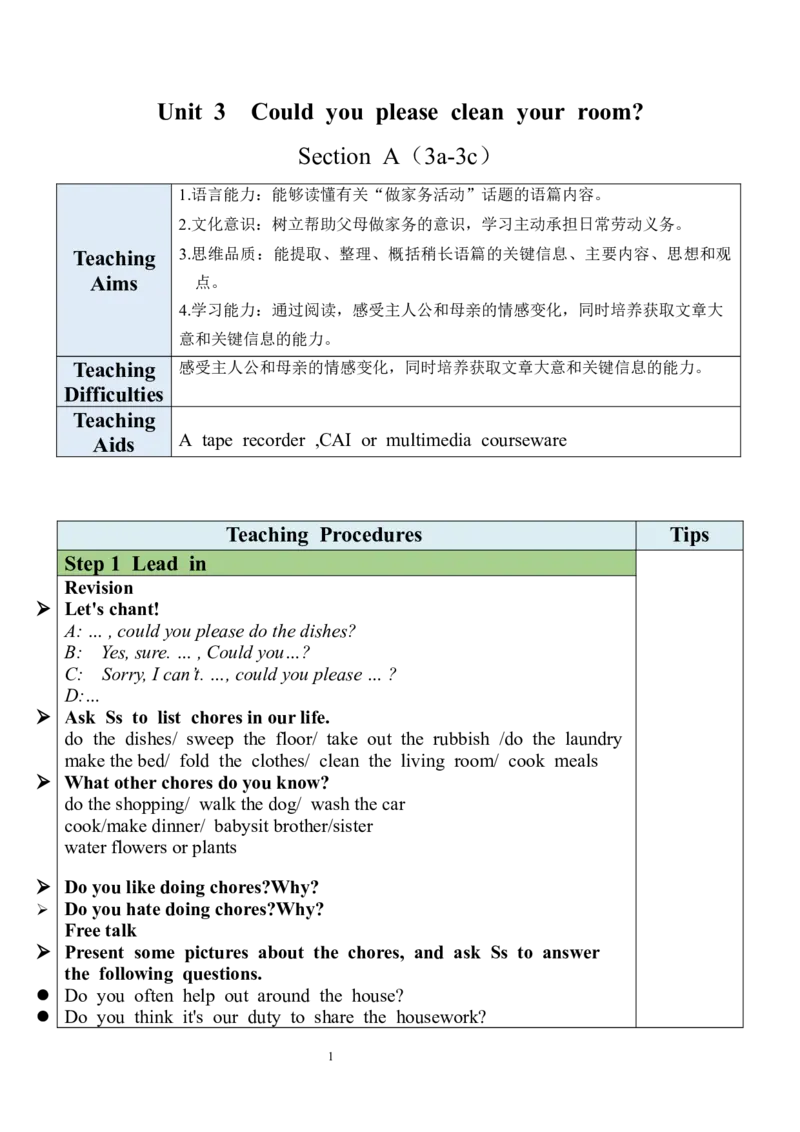
文档文本内容
Unit 3 Could you please clean your room?
Section A(3a-3c)
1.语言能力:能够读懂有关“做家务活动”话题的语篇内容。
2.文化意识:树立帮助父母做家务的意识,学习主动承担日常劳动义务。
Teaching 3.思维品质:能提取、整理、概括稍长语篇的关键信息、主要内容、思想和观
Aims 点。
4.学习能力:通过阅读,感受主人公和母亲的情感变化,同时培养获取文章大
意和关键信息的能力。
Teaching 感受主人公和母亲的情感变化,同时培养获取文章大意和关键信息的能力。
Difficulties
Teaching
Aids A tape recorder ,CAI or multimedia courseware
Teaching Procedures Tips
Step 1 Lead in
Revision
Let's chant!
A: … , could you please do the dishes?
B: Yes, sure. … , Could you…?
C: Sorry, I can’t. …, could you please … ?
D:…
Ask Ss to list chores in our life.
do the dishes/ sweep the floor/ take out the rubbish /do the laundry
make the bed/ fold the clothes/ clean the living room/ cook meals
What other chores do you know?
do the shopping/ walk the dog/ wash the car
cook/make dinner/ babysit brother/sister
water flowers or plants
Do you like doing chores?Why?
Do you hate doing chores?Why?
Free talk
Present some pictures about the chores, and ask Ss to answer
the following questions.
Do you often help out around the house?
Do you think it's our duty to share the housework?
1 Who do the most chores in your family?
Step 2 Reading & Presentation
Pre-reading
Look at the picture and answer the questions.
Was the house clean and tidy, or was it a mess?
What would you do if your house is a mess like this?
While-reading
Show task 1 to Ss. Ask them to skim the story and choose the
right answer.
The general idea of the story is about _____.
A. when to do the chores
B. who should do the chores
C. how to do the chores
Answer: C
Show task 2 to Ss. Ask them to read Paragraph 1-3 and answer
the questions.
1. When did this story happen?
2. What was the first thing Nancy did when she got home?
3. What did her mother want her to do?
4. What did Nancy want to do?
Answer:1.Last month.
2.She threw down her bag and went to the living room.
3.She wanted her to take the dog for a walk.
4.She wanted to watch TV.
Show task 3 to Ss. Ask them to read Paragraph 4-6 and answer
the questions.
1. What does Nancy's mother do during the day? And what does
she have to do in the evening?
2. What was the result when neither Nancy nor her mother did any
housework for a week?
Answer:1.She works during the day and does houswork in the
evening.
2.Nancy couldn’t find a clean dish or a clean shirt.
Show task 4 to Ss. Ask them to read Paragraph 7-9 and answer
the question.
What did Nancy finally understand?
Answer:“We need to share the housework to have a clean and comfortable
home.”
Show task 5 to Ss. Ask them to fill in the chart.
Show task 6 to Ss. Ask them to retell the story.
2Last month, when Nancy came home from school she
______________her bag and went to the living room. Her mom
came over ____________________she sat down in front of the
TV. Her mother wanted her to____________________first, but she
wanted to watch one show first. Her mother was angry with her
but said _________. For one week, _______ of them did any
housework. Finally, Nancy could not find __________ or
__________.She knew she was wrong. To solve the problem, she
did chores around the house. She thinks it's important for us to
__________________.
Answer:threw down as soon as/the minute take the dog for a
walk
nothing neither a clean dish a clean shirt share the
housework
T can summarize: It's our duty to share the housework.
Ask Ss the question: How did they feel at first and at last?
T can show the additional material on PPT 19.
Show task 7 to Ss. Read the report and answer the questions.
1. How much time do American teenagers spend on housework?
2. What housework do American teenagers do?
3. Why should children do housework?
Answer:1.72 minutes a day.
2.Clean the toilet,cook meals, wash the family car and do a clean-
up of the house.
3.Doing housework can help children understand and share the
duty of looking after the family./ ...
Presentation
3a
Read the story and answer the questions.
1. Why was Nancy's mom angry with her?
2. Did they solve the problem? How?
Answer:1.Because she didn’t do any housework.
2.Yes, they did. Nancy said sorry to her mother. She finally
understood that they needed to share the housework to have a
clean and comfortable home.
Analyse the structure and explain the key words and phrases.
起因 (Para. 1-3)
经过 (Para. 4-6)
结局 (Para. 7-9)
3b
3 Read the sentences below. Underline the sentences from the reading
that mean the same thing.
1.Neither of us did any housework for a week.
2.My mom came over as soon as I sat down in front of the TV.
3.You're tired, but I’m tired, too.
Sentences with the same meanings.
Answer:1.For one week, she did not do any housework and neither did I.
2.The minute I sat down in front of the TV,my mom came over.
3.I'm just as tired as you are.
3c
Decide whether the underlined words in the sentences are verbs
or nouns. Then write another sentence using the underlined
word in the other form.
1.Could you take the dog for a walk? (noun)
I walked home from school.(verb)
2.Could I watch one show first?
_____________________________________________
3.I can’t work all day.
____________________________________
4.You watch TV all the time.
___________________________________
5.“What happened?” she asked in surprise.
__________________________________________________
Answer:2.(noun)
Could you please show me your new book?(verb)
3.(verb)
I have to do some work. (noun)
4.(verb)
Your new watch looks nice. (noun)
5.(noun)
Oh, my god, you surprised me a lot. (verb)
Summary
起因 (Para.1-3)
·I was too tired.
·My mother wanted me to take the dog for a walk.
·I wanted to watch a TV show first.
经过(Para.4-6)
·Mother replied angrily.
·For one week, my mother did not do any housework
and neither did I.
·I could not find a clean dish or a clean shirt.
4结局(Para.7-9)
·Mother found the house clean and tidy.
·We need to share the housework.
Step 3 Language points learning
1. I threw down my bag and went to the living room. The
throw down 扔下;随手丢下 language
【相关短语】 points are
throw...at... 把……扔向…… for
throw away 丢弃 reference
throw up 呕吐 only.
throw off 摆脱;迅速脱下
2. The minute I sat down in front of the TV, my mom came
over.
My mom came over as soon as I sat down in front of the
TV.
as soon as 一……就……
as soon as 引导的时间状语从句,相当于the minute(that)。在含有as
soon as 引导的时间状语从句的复合句中,如果主句用一般将来时
(或主句含情态动词,或主句为祈使句),从句应用一般现在时。
The football fans cheered as soon as they heard the exciting news.
You can go as soon as he comes.
come over 过来;突然感到;顺便来访
I already told you not to come over.我已经告诉你别过来了。
I'm sorry.I don't know what came over me. 对不起。我不知道自己
是怎么回事。
【come相关短语】
come out 出版,发行;出来
come across 偶遇;碰到
come to oneself 苏醒
come up with 想出;提出
come along 到达;抵达;跟随
3. I'm just as tired as you are!
as...as... 像……一样……
as...as...表示两者在某方面程度相同,as...as... 中间用形容词或副词的
原级。其否定形式为not as/so...as...,意为“不如……”。
Does the dish taste as good as it looks?
He doesn't study as/so hard as his brother.
5【拓展延伸】 as... as... 中的第一个as后一般接形容词或副词的原
级,但有时也与名词连用, 比如:
as much+不可数名词+as
as many+可数名词复数+as
There aren't as many people at the meeting as we have expected.
4. She replied angrily.
reply n.回答,答复; 反应;
v. 作答;做出反应回应,作出反应,回复
I wrote to you last week and I am waiting for your reply. (noun.)
上个星期我写信给你,我正在等待你的答复。
Please reply in writing to this invitation. (verb.)
请写信回复邀请。
5. For one week, she did not do any housework and neither did
I.
neither + be动词/助动词/情态动词+主语
neither did I是“neither+be动词/助动词/情态动词+主语”结构,表
示前面描述的否定情况也适用于后面。neither在此作副词,意为“也
不”。该结构中的neither也可用nor代替。此结构的时态与前一句保
持一致。
—I don't like this dress.
—Neither/ Nor do I.
—Tom can't play the piano at all.
—Me neither. /Neither can I.
so + be动词/助动词/情态动词+主语
表示前面描述的肯定情况也适用于后面。其时态应与上一句保持一
致,前后两个句子的主语指的是不同的人或物。
He will go to Hangzhou for a vacation. So will I.
He made some mistakes in grammar. So did Lucy.
【拓展延伸】neither的其他用法:
1) 作代词,意为“两者都不”。neither of 结构作主语时,谓语动词
用单复数形式均可。
Neither of them has/have a car.
2)用于“neither... nor ...”结构,意为“既不……也不……”,连接
两个并列成分作主语时,谓语动词的数要与邻近的主语保持一致。
Neither I nor he knows Linda.
3)作限定词,意为“两者都不”,常置于单数可数名词前,其对应词
为both。“neither+单数可数名词”作主语时,谓语动词要用单数形
式。
Neither sentence is correct.
66. “What happened?” She asked in surprise.
in surprise 惊讶地;吃惊地
in surprise常用于动词之后作方式状语,相当于with surprise。其中
surprise作名词,意为“惊奇”,
含surprise的常用短语还有:
to one's surprise“令某人惊讶的是”。
Simpson looked at them in/with surprise.
To my surprise, the man who helped me clean the yard is our
headmaster.
Step 5 Summary & Homework
Summary The
Ask Ss to do the exercises from PPT 41 to PPT 43. homework
Homework can vary
Read and recite the passage in 3a. with the
Do the exercises in students’ book. specific
conditions.
In this period, we should practice the target language more in reading
and speaking activities. Besides, we can set some suitable tasks to
Teaching help students do the reading comprehension in order to improve their
Reflection reading skills.And students should know the main structure in this unit.
Remind them of the differences between a special question and a polite
question which usually has an objective clause.
7