文档文本内容
Unit 4 Why don’t you talk to your parents?
Section A(3a-3c)
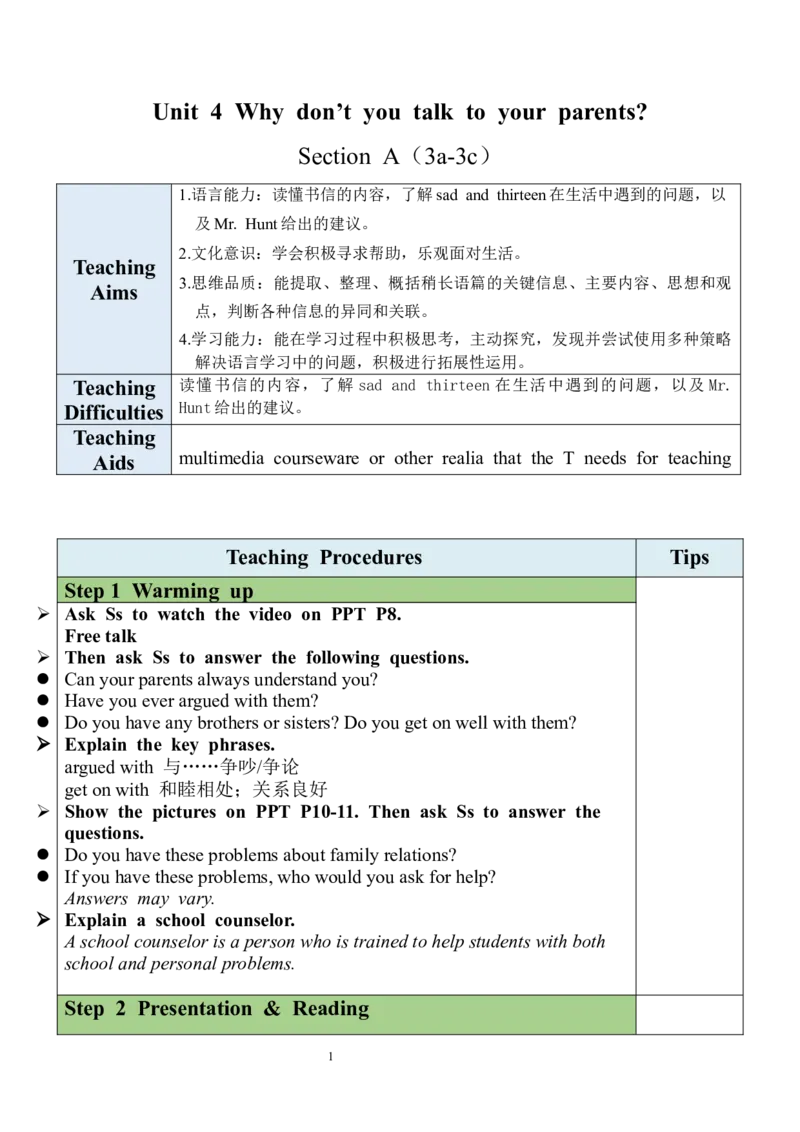
1.语言能力:读懂书信的内容,了解sad and thirteen在生活中遇到的问题,以
及Mr. Hunt给出的建议。
2.文化意识:学会积极寻求帮助,乐观面对生活。
Teaching
3.思维品质:能提取、整理、概括稍长语篇的关键信息、主要内容、思想和观
Aims
点,判断各种信息的异同和关联。
4.学习能力:能在学习过程中积极思考,主动探究,发现并尝试使用多种策略
解决语言学习中的问题,积极进行拓展性运用。
Teaching 读懂书信的内容,了解 sad and thirteen 在生活中遇到的问题,以及 Mr.
Difficulties Hunt给出的建议。
Teaching
Aids multimedia courseware or other realia that the T needs for teaching
Teaching Procedures Tips
Step 1 Warming up
Ask Ss to watch the video on PPT P8.
Free talk
Then ask Ss to answer the following questions.
Can your parents always understand you?
Have you ever argued with them?
Do you have any brothers or sisters? Do you get on well with them?
Explain the key phrases.
argued with 与……争吵/争论
get on with 和睦相处;关系良好
Show the pictures on PPT P10-11. Then ask Ss to answer the
questions.
Do you have these problems about family relations?
If you have these problems, who would you ask for help?
Answers may vary.
Explain a school counselor.
A school counselor is a person who is trained to help students with both
school and personal problems.
Step 2 Presentation & Reading
13a
Pre-reading
Show the picture on PPT P12 to Ss. Then ask them to look at
the picture and guess.
1. What's the relationship between them?
2. What's the problem with them?
Answer:1.They may be a couple.
2.They argue with each other. They don’t get on well with each other.
How do you feel when your parents argue?
worried, afraid, scared, nervous ...
While-reading
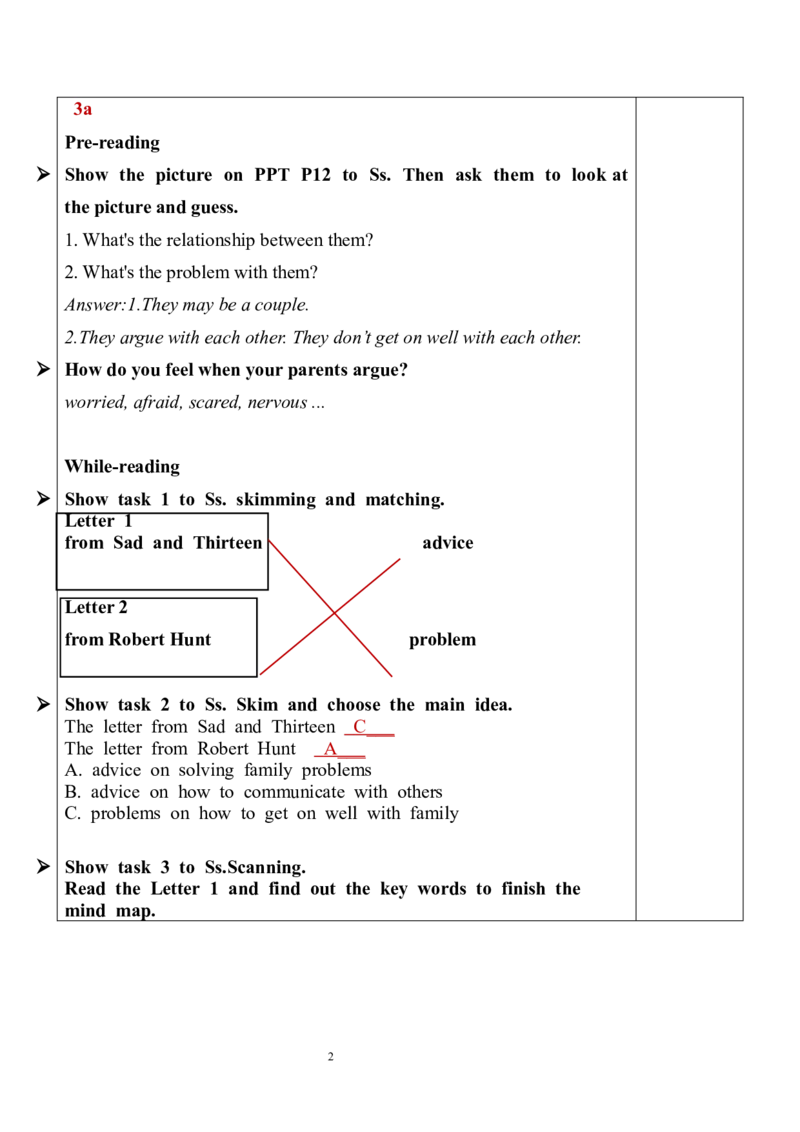
Show task 1 to Ss. skimming and matching.
Letter 1
from Sad and Thirteen advice
Letter 2
from Robert Hunt problem
Show task 2 to Ss. Skim and choose the main idea.
The letter from Sad and Thirteen C__ _
The letter from Robert Hunt A__ _
A. advice on solving family problems
B. advice on how to communicate with others
C. problems on how to get on well with family
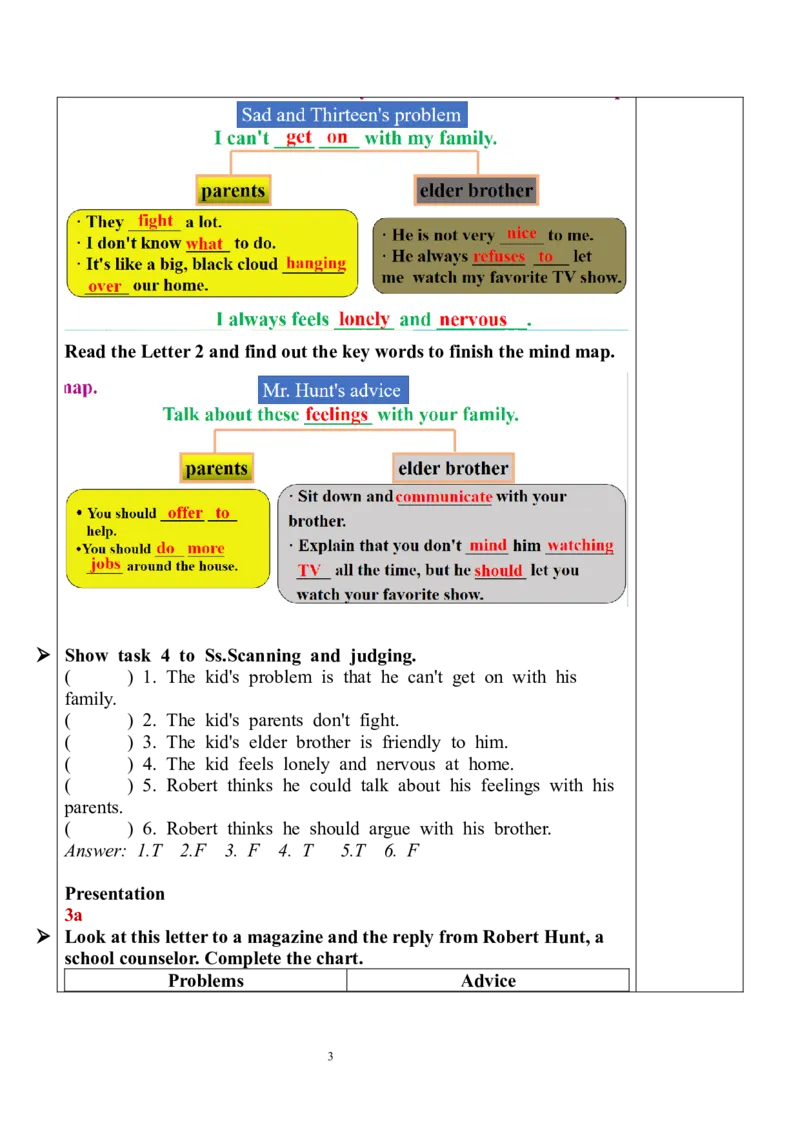
Show task 3 to Ss.Scanning.
Read the Letter 1 and find out the key words to finish the
mind map.
2Read the Letter 2 and find out the key words to finish the mind map.
Show task 4 to Ss.Scanning and judging.
( ) 1. The kid's problem is that he can't get on with his
family.
( ) 2. The kid's parents don't fight.
( ) 3. The kid's elder brother is friendly to him.
( ) 4. The kid feels lonely and nervous at home.
( ) 5. Robert thinks he could talk about his feelings with his
parents.
( ) 6. Robert thinks he should argue with his brother.
Answer: 1.T 2.F 3. F 4. T 5.T 6. F
Presentation
3a
Look at this letter to a magazine and the reply from Robert Hunt, a
school counselor. Complete the chart.
Problems Advice
3(Tips:Ask Ss to listen to the conversation. Then explain the key
words and phrases.)
Answer:
Problems:
can't get on with his family
parents fight a lot
elder brother is not very nice to him and treats him unfairly (e.g.
won't let him watch his favorite TV show while he watches
whatever he wants)
always feels lonely and nervous at home
Advice:
talk about these feelings with his family
offer to help parents(e.g. do more jobs around the house so that
they have more time for proper communication)
communicate with his elder brother and let him know he doesn't
mind him watching TV all the time, but he should let him watch
his favorite show
3b
Ask Ss the question.Do you agree or disagree with Mr. Hunt's
advice? Why?
I agree/disagree with his advice because...
Answers may vary.
Sample: I agree with his advice because more communication can
make family members understand each other better and know about
the feelings they have.
I don’t agree with his advice. The parents and elder brother may
get even angrier as they may think that the writer is disrespectful.
They may feel that children should not comment on the behavior of
their seniors.
3c
Which words or phrases in the letters have the same or similar
meanings as the following? Write a sentence using each word or
phrase.
make sth. clear — explai n
Can you explain to me how to do this math problem?
①talk — _______ ________________
②not allow — _______ ________________
③worried — _______ ________________
④get along with — _______ ________________
4Answer: ①communicate
Family members should communicate with each other so that they can
understand each other better.
②refuse
Tom refuses to let her younger brother use her computer.
③nervous
I'm always very nervous before a test.
④get on with
John and I get on with each other because we have a lot in common.
Ask Ss to fill in the blanks according to the letters.
Sad and Thirteen has some __________. He can’t _____ ____ _____ his
family. His parents _____ a lot. It’s the only ______________ they have.
When they ______, it’s like a big black cloud ________ _____ their home.
He doesn’t like it. His brother always watches whatever he wants until
midnight. He _______ to let him watch his favorite TV show. So he
always feels ______ and ________ at home. Robert Hunt thinks Sad and
Thirteen should ______ _____ these feelings to his family. He should
______ to help. Maybe he ______ ____ _____ jobs around the house so
that they have more time ____ ______ _____________. Secondly, he
could sit down and ____________ _____ his brother. He could ________
that he ______ _____ him watching TV all the time. However, he should
let him watch his ________ _____.
Answer:
problems get on with fight communication argue
hanging over refuses lonely nervous talk about offer could
do more for proper communication communicate with
explain doesn’t mind favorite show
5 A good relation depends on good communication.
First, listen to each other.
Then, open your mind.
Next, voice your true feelings.
Finally, treat each other equally.
Step 3 Language points learning
1. My problem is that I can't get on with my family.
get on with 和睦相处;关系良好
get on with后接表示人的名词或代词作宾语,相当于get along with。
get on/along well/badly with sb. 意为“和某人相处得好/不好”。
The new teacher is getting on/ along well with the students.
【拓展延伸】get on/along with sth. 意为“(谈及或问及工作情况)进
展”。
How are you getting on with your novel?
2. When they argue, it's like a big, black, cloud hanging over our
home.
argue v. 争吵;争论
argue with sb. 与人争吵/争论
argue about/over sth. 就某事而争吵/争论
argue with sb. about sth. 为某事与某人争论
They were arguing about/over the matter again.
Mary often argues with her mother about which clothes to wear.
【拓展延伸】 argument作名词,意为“争吵;辩论”。have an
argument with sb. 意为“与某人争吵/辩论”。
I'm very sorry to have an argument with you.
3.Instead he watches whatever he wants until late at night.
instead adv. 代替;反而;却
单独使用时位于句首或句末。
e.g. There’s no coffee. Would you like some tea instead?
instead of 是介词短语,意为“代替……”,后面可跟名词、代词、
介词短语、动词-ing形式等。
e.g. My mother went shopping on foot instead of by bus.
e.g. Why don’t you play football instead of just looking on?
whatever pron. 任何;每一
6本句中whatever作代词,意为“任何;每一”,引导宾语从句,作
watches的宾语。
You can wear whatever you feel comfortable.
【拓展延伸】 whatever还可意为“无论什么;不管什么”,相当于
no matter what,引导让步状语从句。
As far as we know, safety comes first whatever you do.
until conj. &prep. 直到
until作连词或介词,意为“直到……为止”,用于肯定句中时,表
示主句的动作或状态一直持续到从句动作发生或状态出现时为止。
用于否定句中,表示动作直到某时才发生。
e.g.He lived with his parents until he graduated from college.
e.g. I shall stay here until twelve o'clock.
e.g. We didn't leave until the rain stopped.
4. If your parents are having problems, you should offer to help.
offer to do sth. 主动提出做某事
offer在此作动词,意为“提供”。
The kids offered to do the dishes.
【拓展延伸】
offer相关短语:offer sth. to sb.= offer sb. sth.为某人提供某物
The government tried to offer more jobs to the local people.
offer还可作名词,意为“提议;提供”。
Thanks for your offer of help.
5. You should explain that you don't mind him watching TV all the
time.
explain v. 解释;说明
explanation n. 解释;说明
explain to sb. 向某人解释
explain sth. to sb. 向某人解释某事
sb. explains+宾语从句 某人解释说……
You'd better go and explain to the teacher.
Could you explain the reason of being late to me?
He explained that he was too busy.
Step 4 Summary & Homework
Summary
Ask Ss to do the exercises from PPT P35-37.
Homework:
Read and recite the passage in 3a.
Do the exercises in students’ book.
7In this period,reading practice is important.We learn a lot of new words
and expressions while we are reading.The students must pay enough
Teaching attention to the new words in 3a as well as they finish the task. It is a good
Reflection idea to ask them write down the useful phrases in the reading materials.
They can learn from these models and copy them when writing their own
articles.
8