文档文本内容
Unit 4 Why don’t you talk to your parents?
Section A(1a-1c)
1.语言能力:能够描述中学生常见的问题。
2.文化意识:鼓励学生大胆表达自己的想法和意愿。正确认识生活中的一些困
Teaching
难,能采用正确的方式解决生活中的问题。
Aims
3.思维品质:培养根据具体问题提供合理建议的逻辑思维能力。
4.学习能力:能够根据描述的问题,自主发表观点和建议。
Teaching
Difficulties 能根据对方所提出的问题,给出一些合理的建议。
Teaching
Aids multimedia courseware or other realia that the T needs for teaching
Teaching Procedures Tips
Step 1 Warming up
Brainstorm
Ask Ss the following questions:
What kinds of problems do you have in your daily life?
Do you have any idea how to work out the problems?
Lead in
Show the pictures on PPT7-11 to Ss. Then ask them the
questions:
What's the matter with the boy?
Answer:He has too much homework so he doesn't have any free time to do
things he likes.
What's wrong with the boy ?
Answer:He has to study too much so he doesn't get enough sleep.
What's wrong with the boy ?
Answer:He has to take more lessons after school.
What's wrong with the girl?
Answer:She got into a fight with her best friend.
What's the matter with the boy ?
Answer:His mother doesn't allow him to hang out with his friends.
Ask Ss to share other problems or troubles in our life.
Answers may vary.
For example, fail the exam, too heavy, parents fight a lot and so on.
1 Ask Ss the following questions:
How can we work out these problems?
Can you give any good suggestions or advice?
Why don’t you…?
Why not…
You should…
Suggestions You could…
How/What about…
You'd better…
Step 2 Presentation & Practice
Pre-listening
1a
Look at these problems. Do you think they are serious or not?
Explain the key phrase in the sentences.
1. I have to study until really late, so I don't get enough sleep.
2. I have too much homework so I don't have any free time to do
things
I like.
3. My parents don't allow me to hang out with my friends.
4. I have to take more lessons after school.
5. I got into a fight with my best friend.
E.g. allow sb. to do sth.允许某人做某事
hang out 闲逛;常去某处
get into a fight with sb. 和某人打架/吵架
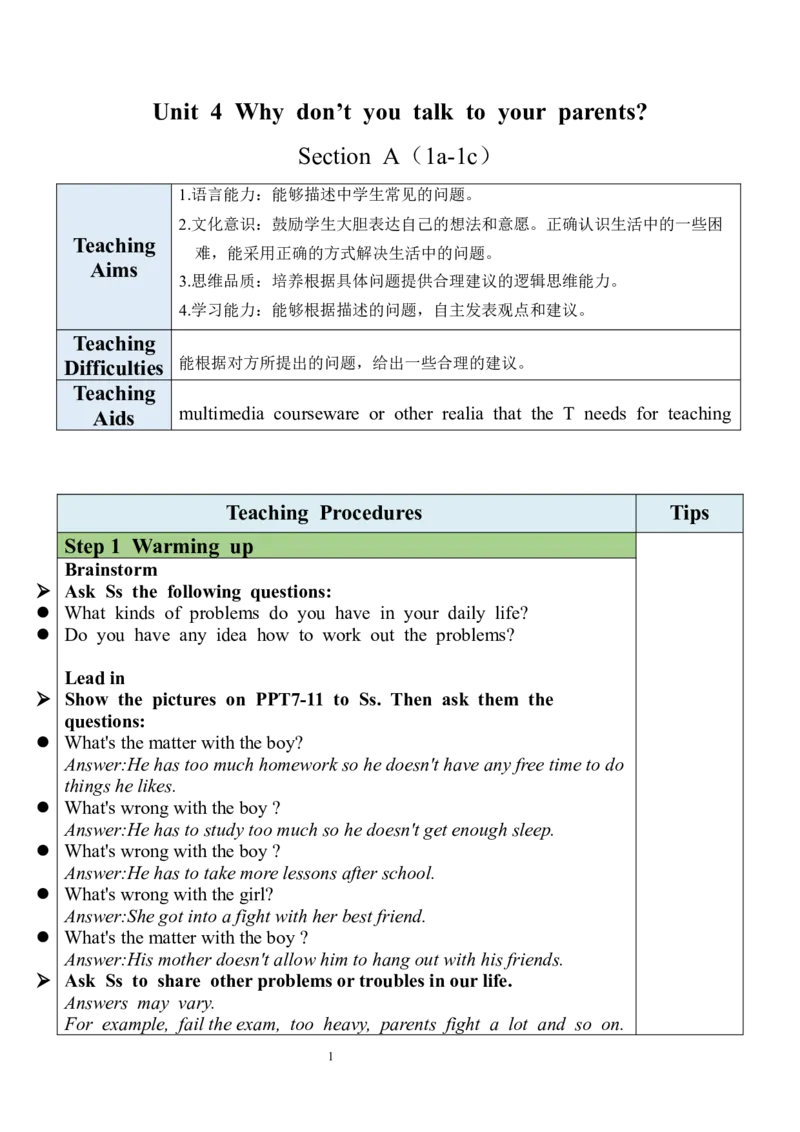
Then write them in the appropriate box.
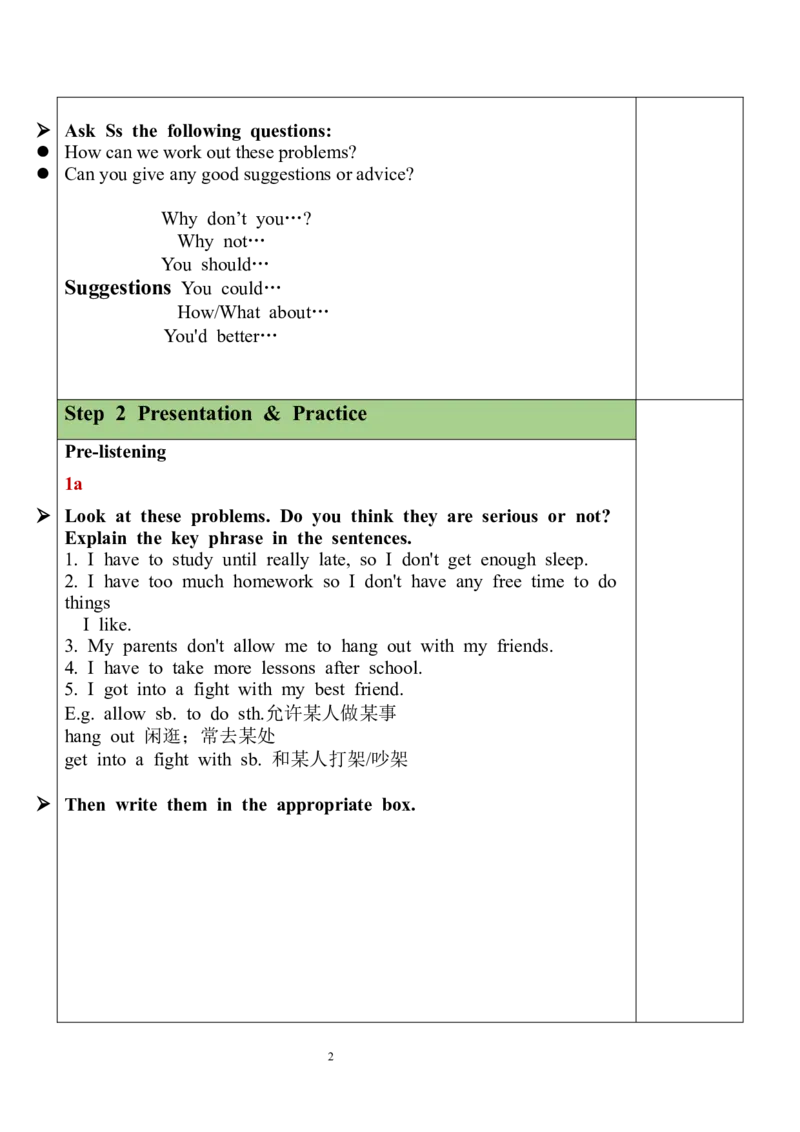
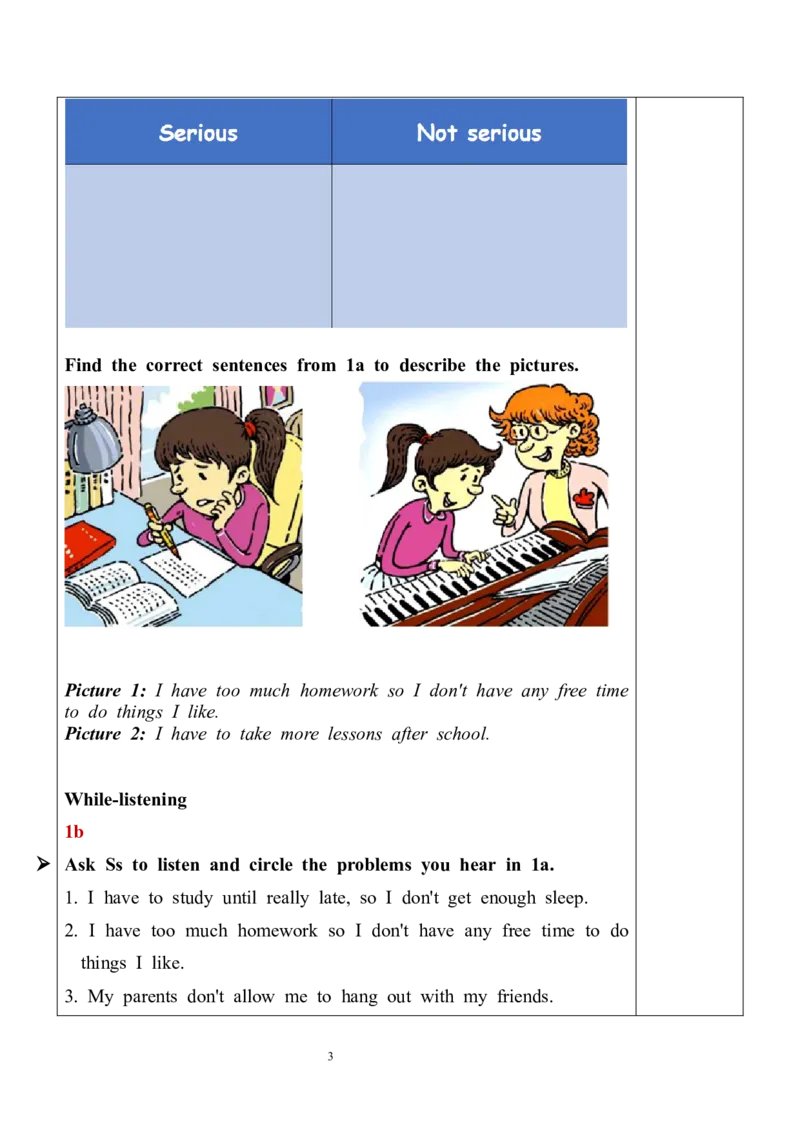
2Find the correct sentences from 1a to describe the pictures.
Picture 1: I have too much homework so I don't have any free time
to do things I like.
Picture 2: I have to take more lessons after school.
While-listening
1b
Ask Ss to listen and circle the problems you hear in 1a.
1. I have to study until really late, so I don't get enough sleep.
2. I have too much homework so I don't have any free time to do
things I like.
3. My parents don't allow me to hang out with my friends.
34. I have to take more lessons after school.
5. I got into a fight with my best friend.
Listen and read.
Girl 1: You look really tired. What’s the matter?
Girl 2: Well, I had an art lesson after school yesterday. Then I did
my homework until really late last night, so I didn't get
enough sleep.
Girl 1: Oh, so you should start studying earlier tonight, and then
you can sleep earlier.
Girl 2: But I have a piano lesson after school today, so I can only
study later tonight.
Girl 1:Maybe you should tell your parents that you can't do so
many things.
Girl 2: I did, but they think it's important that I learn new things.I
started learning the piano when I was six!
Girl 1:Oh, that's a really long time! You must be really good now.
Girl 2:Yes,but I'm so tired.
Girl 1: Why don’t you talk to your parents again? Explain to them
that
you need to get enough sleep to stay healthy.
Girl 2:Yes,that's a good idea.I'll try to talk to them again.
Post-listening
1c
Ask Ss to look at the problems in 1a and make conversations.
4Ways to ask about problems.
◆ What’s wrong (with…)?
◆ What’s the matter (with …)?
◆ What’s the problem/trouble?
◆ What happened?
◆ What’s up?
Ways to give advice.
◆Why don’t you …?
◆How/What about … ?
◆I think you should...
◆Maybe / Perhaps you should/could…
◆Why not…?
◆You'd better…
Step 3 Language points learning
1.My parents don't allow me to hang out with my friends.
allow v. 允许;准许
allow的用法:
allow sb. to do sth. 允许某人做某事
allow doing sth. 允许做某事
be allowed to do sth. 被允许做某事
My parents don't allow me to watch TV on school nights.
We don't allow eating in the classroom.
In Britain, people are not allowed to use plastic bags except in hospitals.
2. What's wrong?
wrong adj. 有毛病;错误的
(1) wrong作形容词,在此意为“有毛病的”。
The doctor could find nothing wrong with him.
(2) wrong作形容词,还可意为“错误的”,此时其反义词为 right“正
5确的”。
Sorry, I dialed the wrong number.
What's wrong? 怎么了?
该句可以单独使用,也可以与 with 连用。“What's wrong (with...)?”
常用于以下几种情况:
(1) 用于询问对方有什么问题或有什么不顺心的事,意为“(……)
怎么了?”或“(……)出什么事了?”。
—What's wrong with Jim?
—He left his homework at home.
(2) 用于医生询问患者的病情,意为“(……)怎么了?”或
“(……)哪里不舒服?”。
—What's wrong with you?
—I have a headache.
(3) 用于询问某物出了什么毛病或故障,意为“(……)出什么毛病
了?”。同义句:Is there anything wrong with sth.?
—What's wrong with this clock?
—It doesn't work.
3. I have too much homework.
I have to study too much.
I have too many after-school classes.
too much的用法:
①作形容词词组,修饰不可数名词。
e.g. The students have too much homework.
②作副词词组,修饰动词。
e.g. Don't watch TV too much.
③作名词词组。
e.g. He has given me too much.
辨析:too much /much too/ too many
①much too 意为 “太”,用于加强语气,常用来修饰形容词或副
词。
e.g. The question is much too difficult for me.
6②too many 意为“太多的”,用来修饰名词复数形式。
e.g. There are too many people in the station.
Step 4 Summary & Homework
Summary
Ask Ss to do the exercises from PPT P29-30.
◆ What’s wrong (with…)?
◆ What’s the matter (with …)?
◆ What’s the problem/trouble?
◆ What happened?
◆ What’s up?
◆Why don’t you …?
◆How/What about … ?
◆I think you should...
◆Maybe / Perhaps you should/could…
◆Why not…?
◆You'd better…
Homework
Preview the conversation in 2d.
Do the exercises in students’ book.
This is the first period of the unit.During this period, teachers interact
with students through high-density questions according to the topic picture
in 1a, which is helpful for students to learn new vocabulary, and also help
Teaching students review the language content they have learned. When checking the
Reflection answers, teachers need not rush to judge right or wrong. They should let
students speak actively. At this stage, it is OK to understand sentences
without explaining for the time being so that students can accumulate more
perceptual knowledge in the stage of grammar perception.
7