文档文本内容
Unit 4 Why don’t you talk to your parents?
Section A(2a-2d)
1.语言能力:能够掌握询问困难的句型、提供建议的常用表达。
2.文化意识:培养学生良好的合作意识,鼓励学生大胆表达自己的想法和意
Teaching 愿。正确认识生活中的一些困难,能采用正确的方式解决生活中的问题。
Aims 3.思维品质:能发现语篇中事件的发展和变化,辨识信息之间的相关性,把握
语篇的整体意义。
4.学习能力:能在学习活动中积极与他人合作,共同完成学习任务。
Teaching 1. 能正确使用情态动词could,should 表达或劝告。
Difficulties 2.能正确使用 Why don’t you…?句型表达建议。
Teaching
Aids multimedia courseware or other realia that the T needs for teaching
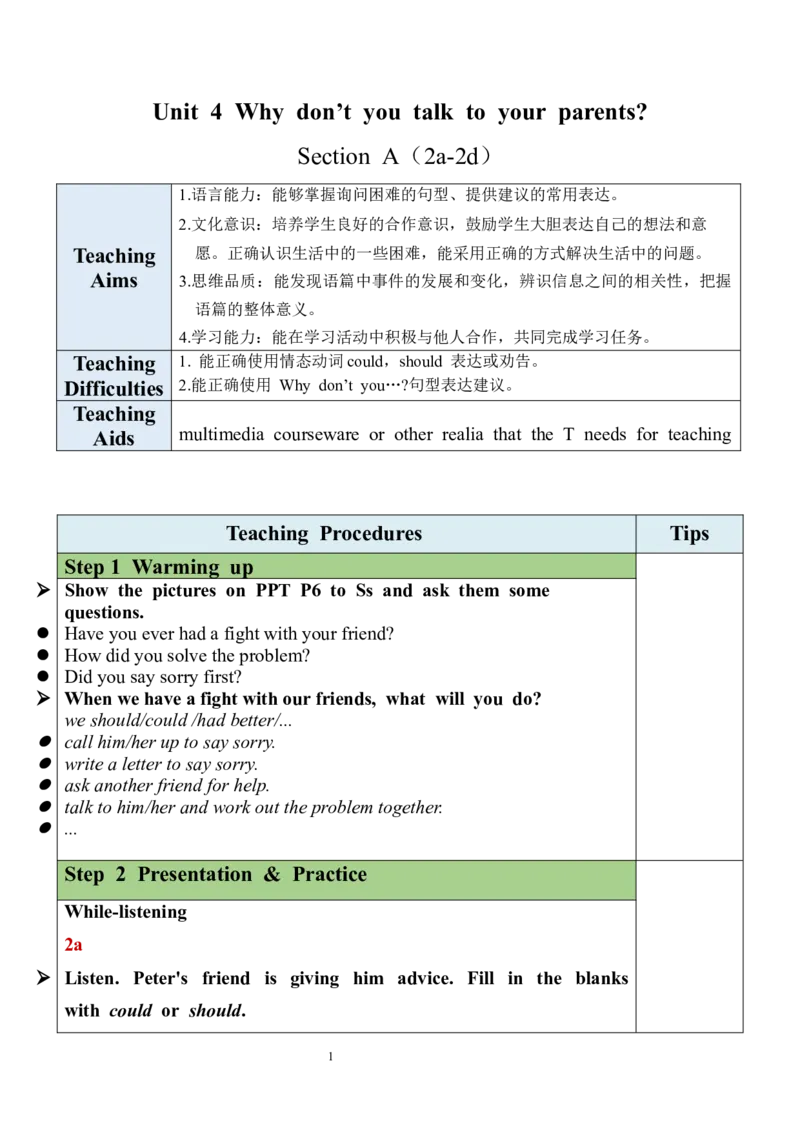
Teaching Procedures Tips
Step 1 Warming up
Show the pictures on PPT P6 to Ss and ask them some
questions.
Have you ever had a fight with your friend?
How did you solve the problem?
Did you say sorry first?
When we have a fight with our friends, what will you do?
we should/could /had better/...
call him/her up to say sorry.
write a letter to say sorry.
ask another friend for help.
talk to him/her and work out the problem together.
...
Step 2 Presentation & Practice
While-listening
2a
Listen. Peter's friend is giving him advice. Fill in the blanks
with could or should.
1Advice
1. You _______ write him a letter.
2. You _______ call him up.
3. You _______ talk to him so that you can say you're sorry.
4. You _______ go to his house.
5. You _______ take him to the ball game.
Answer:1.could 2.should 3.should 4.could 5.could
2b
Listen again. Why doesn't Peter like his friend's advice? Write the
letters (a-e) next to the advice in 2a.
Why Peter doesn't like the advice
a. It's not easy.
b. I don't want to wait that long.
c. I don't want to surprise him.
d. I'm not good at writing letters.
e. I don't want to talk about it on the phone.
Explain the key phrase: be good at 擅长
Advice
1. You could write him a letter. ( )
2. You should call him up. ( )
3. You should talk to him so that you can say you're sorry. ( )
4. You could go to his house. ( )
5. You could take him to the ball game. ( )
Answer:1. d 2. e 3. a 4. c 5. b
Listen and read.Then ask Ss to find the sentences about giving
advice and the reason why Peter doesn’t like his friend’s advice.
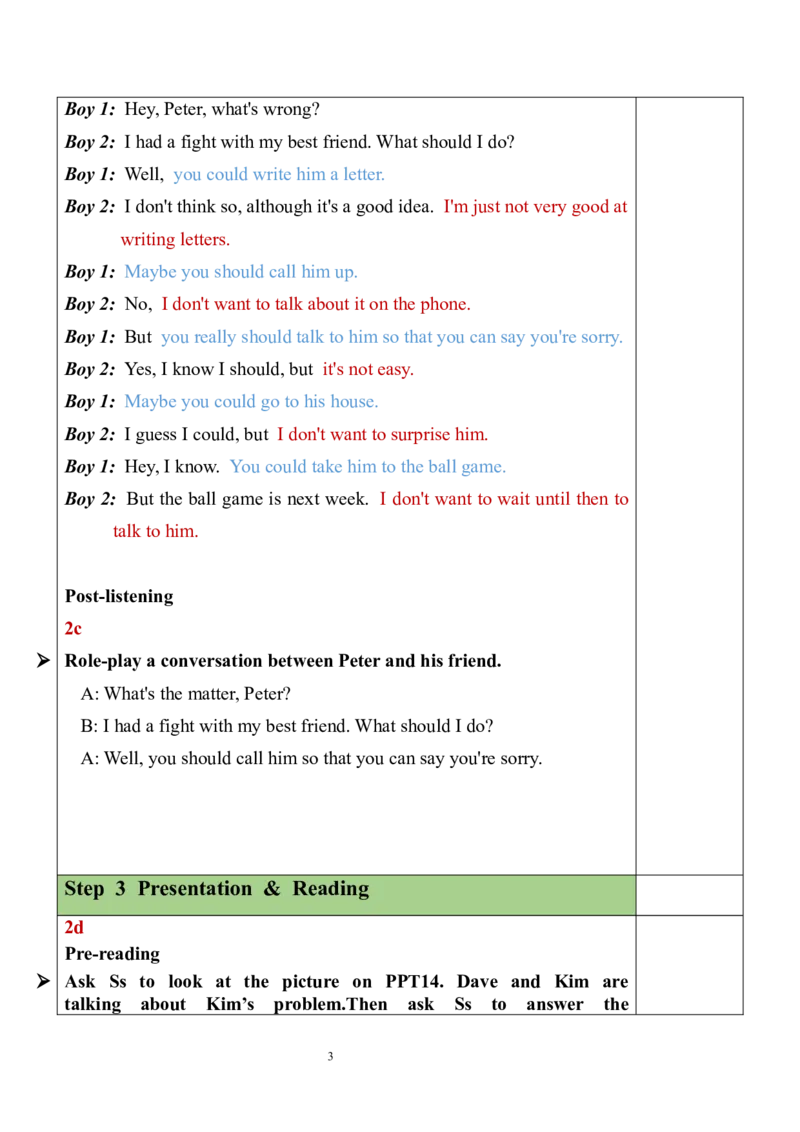
2Boy 1: Hey, Peter, what's wrong?
Boy 2: I had a fight with my best friend. What should I do?
Boy 1: Well, you could write him a letter.
Boy 2: I don't think so, although it's a good idea. I'm just not very good at
writing letters.
Boy 1: Maybe you should call him up.
Boy 2: No, I don't want to talk about it on the phone.
Boy 1: But you really should talk to him so that you can say you're sorry.
Boy 2: Yes, I know I should, but it's not easy.
Boy 1: Maybe you could go to his house.
Boy 2: I guess I could, but I don't want to surprise him.
Boy 1: Hey, I know. You could take him to the ball game.
Boy 2: But the ball game is next week. I don't want to wait until then to
talk to him.
Post-listening
2c
Role-play a conversation between Peter and his friend.
A: What's the matter, Peter?
B: I had a fight with my best friend. What should I do?
A: Well, you should call him so that you can say you're sorry.
Step 3 Presentation & Reading
2d
Pre-reading
Ask Ss to look at the picture on PPT14. Dave and Kim are
talking about Kim’s problem.Then ask Ss to answer the
3following questions.
1.How does Kim look?
2.Can you guess what made Kim unhappy?
Answer:1.She looks unhappy.
2.Maybe someone looked through her things without telling
her.
While-reading
Role-play the conversation.
Explain the key phrases to Ss.
Ask Ss to read the conversation in 2d and answer the
questions below.
1. How does Kim feel about her sister after her sister gave back the
things?
2. Does Dave think it is all right for Kim's sister to take away Kim's
things?
3. Does Dave think the two sisters have a serious problem? How do you
know?
4. What did Dave mean by saying “Hope things work out” ?
Answer:1.She is still angry with her sister.
2.No, he doesn't.
3.No, he doesn't. He thinks it's not a big deal.
4.He hoped Kim would forgive her sister and get on well with her.
Post-reading
Watch the video and try to repeat !
Step 4 Language points learning
1. Well, I found my sister looking through my things yesterday.
find sb. doing sth. 意为“发现某人正在做某事”, 表示动作正在进
行,doing sth. 作宾语补足语。
I find the girls dancing under the tree.
【拓展延伸】find sb. do sth.“发现某人做过某事”,强调发现动作经
常发生或发现动作的全过程。
I find him enter the building.
look through 浏览;快速查看
4He looked through the book and decided to buy it.
【拓展延伸】含look的常用短语:
look up 向上看;查阅 look down upon/on 看不起;轻视
look for 寻找 look up to 敬仰;仰慕
look into 调查 look forward to 期待
look over 仔细检查 look after 照顾
look out 小心;向外看 look like看起来像
2. Hope things work out.
(1) work out在此处意为“成功地发展”,相当于不及物动词,其后
可接 fine, well, badly等词,表明结果如何。
Everything is working out well.一切都进展顺利。
(2)work out还可意为“解决;算出”,此时为“动词+副词”型短
语,代词作宾语时,要放在work与out之间。
Xiong'an New Area will help to work out many big problems of Beijing,
such as traffic jams.
3. 表建议的句型
Suggestions
①Why don’t you + do sth.?为什么不做……呢?
②Why not + do sth.?为什么不做……呢?
③You should+ do sth.你应该做……
④You could+ do sth.你可以做……
⑤How/What about+ doing sth.?做……怎么样呢?
⑥You'd better+ do sth.你最好做……
⑦Let's+ do sth.让我们做……吧。
Step 5 Summary & Homework
Summary
Ask Ss to do the exercises from PPT P24-26.
Homework
Preview the passage on Page 27.
Preview the new words and phrases.
Do the exercises in students’ book.
In this period, there are more new words and expressions. The T should
provide more practice in listening and speaking and encourage Ss to be
Teaching
more involved. In the reading part, Ss can experience more practice in using
Reflection
the target language in natural speech. In this part, the T should teach Ss a
reading strategy— the SQ4R(survey, questions,read, record,recite, review).
56