Unit 9 Have you ever been to a museum?
Section A(2a-2d)
1.语言能力:能够听懂谈论过去经历的文章。
2.文化意识:通过谈论自己或他人曾经去过的有趣的地方,增强学生
Teaching 对生活、对大自然的热爱。
Aims
3.思维品质:通过学习Have you ever been to ..., I have been to ...进一步学习现在
完成时。
4.学习能力:能用现在完成时询问他人的经历,并能谈论自己的经历。
Teaching
Difficulties 现在完成时的正确运用。
Teaching
Aids A tape recorder ; CAI or multimedia courseware
Teaching Procedures Tips
Step 1 Warming up
Show the pictures on PPT P5-P6, then answer the following
questions:
Have you ever been to ...?
Yes, I have.
I have ever been to…
No, I haven’t.
I have never been to…
Step 2 Presentation & Practice
Pre-listening
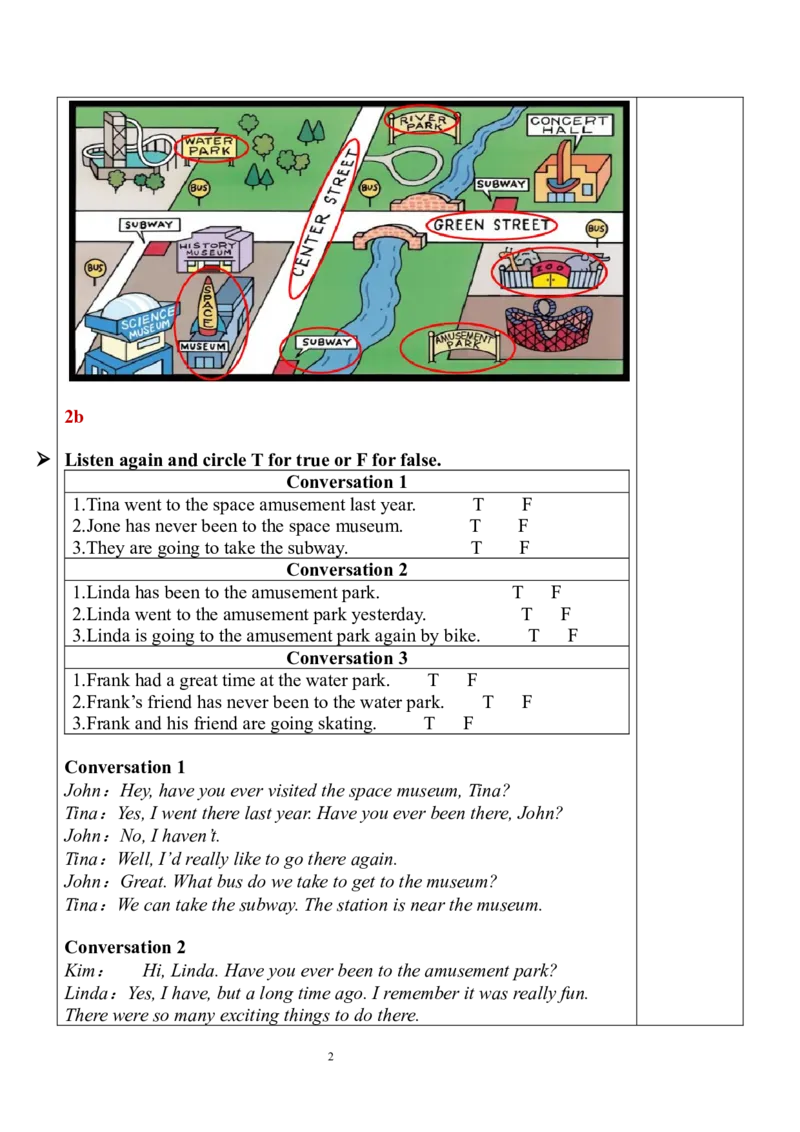
Look at the map of the town on PPT P7 and describe locations.
e.g. The amusement park is on Green Street, behind the zoo.
While-listening
2a
Look at the map of the town. Listen and circle the places you
hear.
12b
Listen again and circle T for true or F for false.
Conversation 1
1.Tina went to the space amusement last year. T F
2.Jone has never been to the space museum. T F
3.They are going to take the subway. T F
Conversation 2
1.Linda has been to the amusement park. T F
2.Linda went to the amusement park yesterday. T F
3.Linda is going to the amusement park again by bike. T F
Conversation 3
1.Frank had a great time at the water park. T F
2.Frank’s friend has never been to the water park. T F
3.Frank and his friend are going skating. T F
Conversation 1
John:Hey, have you ever visited the space museum, Tina?
Tina:Yes, I went there last year. Have you ever been there, John?
John:No, I haven’t.
Tina:Well, I’d really like to go there again.
John:Great. What bus do we take to get to the museum?
Tina:We can take the subway. The station is near the museum.
Conversation 2
Kim: Hi, Linda. Have you ever been to the amusement park?
Linda:Yes, I have, but a long time ago. I remember it was really fun.
There were so many exciting things to do there.
2Kim: Do you want to go again next week?
Linda:Sure. I think that would be a great idea.
Kim: Do you think we can ride our bikes there?
Linda:Of course! It’s not very far away. It’s just on Green Street,
behind the zoo.
Conversation 3
Tom: Have you ever been to the water park, Frank?
Frank:No, I’ve never been there.
Tom: Neither have I. Let’s go there together!
Frank:I’d really love to go, but I don’t have any money.
Tom: Well, let’s go skating instead. There’s a great new place for
skating in River Park on Center Street.
Frank:That’s a great idea. Could I borrow your bike? I want to go home
to get my skates.
Post-listening
2c
Look at the map in 2a and make conversations about the places.
A: Have you ever been to the space museum?
B: Yes, I have. How about you?
A: No, I haven't.
B: Oh, it's fantastic. Let's go tomorrow.
A: OK. How are we going to get there?
B: We can take the subway.
Pair Work
Some sentences you may use:
I’d really like to go there again.
What bus do we take to get to ...?
There were so many ... things to do there.
Neither have I.
Let's go ... instead.
There’s a great new place for…
A: Have you ever been to the Concert Hall?
B: No, I haven’t.
A: I have been there last year. Would you like to go there?
B: Yes, I’d like to . Where is it?
A: It’s on Green Street, opposite the zoo.
B: How are we going to get there?
A:…
3Sample
Conversation 1
A: Have you ever been to the water park?
B: No, I haven’t. But I’m going there next week. Would you like to come?
A: Sure. How will we get there?
B: We can ride our bikes.
Conversation 2
A: Have you ever been to Disneyland?
B: No, I’ve never been there.
A: Neither have I. Let’s go!
B: I’d really love to , but I don’t have any money.
A: Let’s go skating instead.
B: OK, when do we go there?
A: What about tomorrow?
B: That sounds good.
2d
Role-play the conversation.
Explain the key words and phrases.
Read the conversation in 2d and answer the questions.
1.When did Jill go to the film museum?
2.What does Jill love about the film museum?
3.What did Jill learn about?
4.Who did Jill camp with on the weekend?
5.Has Anna ever been camping?
Answers:1.In April.
2.She loves all the old movie cameras.
3.She learned about the inventions that led to color movies.
4.With her friends.
5.No, she hasn’t.
Ask the Ss to watch the video.
Step 3 Language Points learning
1. It’s really interesting, isn’t it?
反意疑问句
The
本句是一个反意疑问句。反意疑问句是指在陈述句后附加一个简短问
language
句,用于征询肯定或否定的意见,或者希望陈述句所说的内容得到证
points are
实。
for
一、反意疑问句的两种形式:
reference
① 肯定的陈述句+否定的简短问句
only.
4② 否定的陈述句+肯定的简短问句
二、反意疑问句的答语:
反意疑问句的答语应符合事实。事实是肯定的,用yes;事实是否定
的,用no。当句式是“前否定,后肯定”时,翻译要以事实为依
据,yes翻译为“不” , no翻译为“是的”。
— They had milk and bread for breakfast, didn't they?
肯定 否定
— Yes, they did.
— He isn’t a teacher, is he?
否定 肯定
— No, he isn’t. 是的,他不是。/ Yes, he is. 不,他是。
2. I learned about the inventions that led to color movies, too.
这是一个含有定语从句的复合句。that led to color movies 是一个由
that引导的定语从句,修饰前面的先行词inventions。that 在定语从
句中做主语,不能省略,此处可以替换为which.
invention n. 发明;发明物
invention在此处作可数名词,意为“发明;发明物” ,此外,
invention 还可作不可数名词,意为“发明”。其动词形式为invent,
意为“发明;创造”。inventor 作名词,意为“发明家”。
Edison invented a lot of things. He was a great inventor and he is
famous for his inventions.
lead to 导致;通向;把……带到
All roads lead to Rome. 条条大路通罗马。
In given conditions, a bad thing can lead to good results.在一定条
件下,一件坏事可以导致好的结果。
The man led us to our rooms.这个人把我们带到了我们的房间。
3. I’ve never been camping. 我从未野营过。
此句为现在完成进行时,这一时态的结构 has / have been + 现在分
词,表示从过去某一时刻一直延续至今的动作。在本句中,说话人使
用这一时态来强调自己至今从未有过野营的经历,欠缺这方面的经
验。
e.g. We’ve been living like this ever since the birth of my little
brother.
自打我小弟弟出生,我们就一直这样生活。
Step 4 Summary & Homework
5Summary
The
Ask the Ss to do the exercises on PPT P30-P33.
homework
Homework
can vary
Preview the passage on Page 67.
with the
Preview the new words and phrases.
specific
Do the exercises in students’ book.
conditions.
In this period, there are more new words and expressions. The T should
provide more practice in listening and speaking and encourage Ss to be
Teaching more involved.The teacher should get them to learn the main structure-
Reflection have been to/ have gone to and get the students to practice it in listening
and speaking. In the reading part, Ss can experience more practice in using
the target language in natural speech.
6