Unit 7 What’s the highest mountain in the world?
Section A(1a-1c)
1.语言能力:学习和巩固词汇短语句型: square, meter, deep, desert,
population,man-made, feel free等; 并熟练大数的读法。
2.文化意识:通过比较,了解国家及世界“地理之最”,培养对祖国的自豪
Teaching
Aims 感,对大自然的热爱之情。
3.思维品质:了解中国及世界地理和自然。
4.学习能力:通过听说训练,学习并掌握物体长宽高及面积的表达;熟练运用
形容词和副词的比较级、最高级。
Teaching 熟练运用形容词和副词的比较级、最高级来谈论地理和自然。
Difficulties
Teaching
Aids multimedia courseware or other realia that the T needs for teaching
Teaching Procedures Tips
Step 1 Warming up
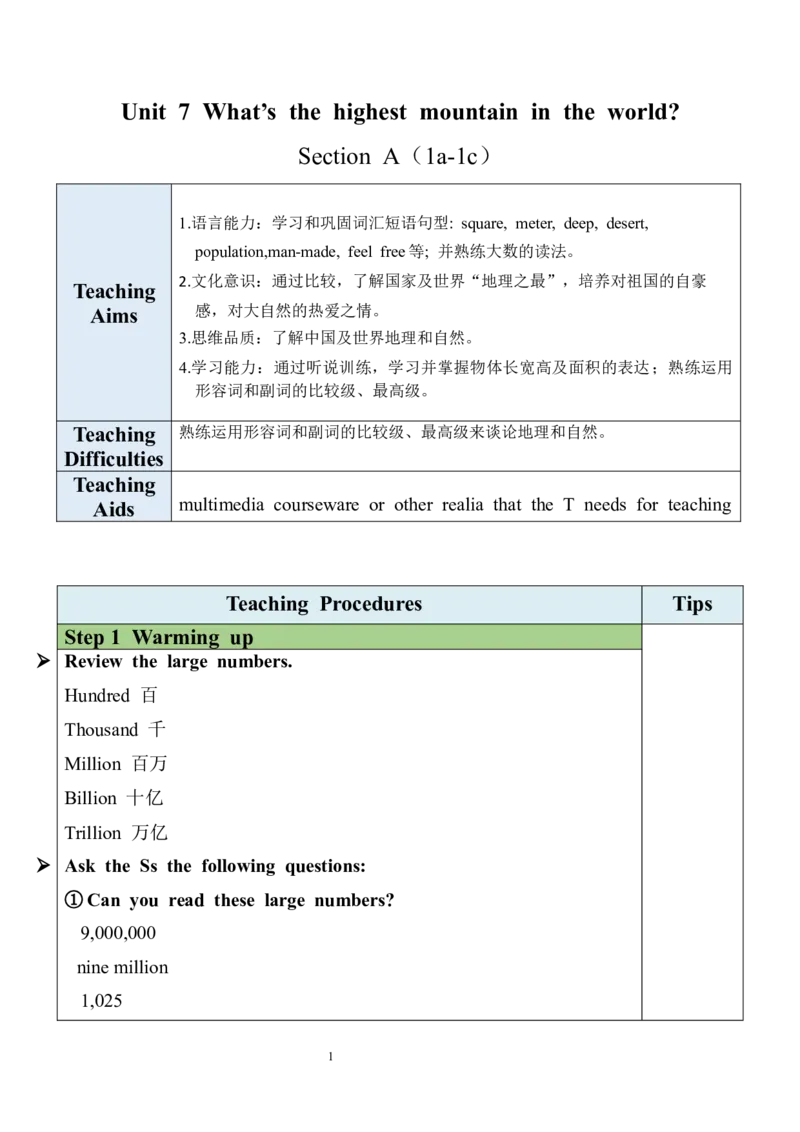
Review the large numbers.
Hundred 百
Thousand 千
Million 百万
Billion 十亿
Trillion 万亿
Ask the Ss the following questions:
①Can you read these large numbers?
9,000,000
nine million
1,025
1one thousand and twenty-five
6,671
six thousand six hundred and seventy-one
8,848.86
eight thousand eight hundred and forty-eight point eight six
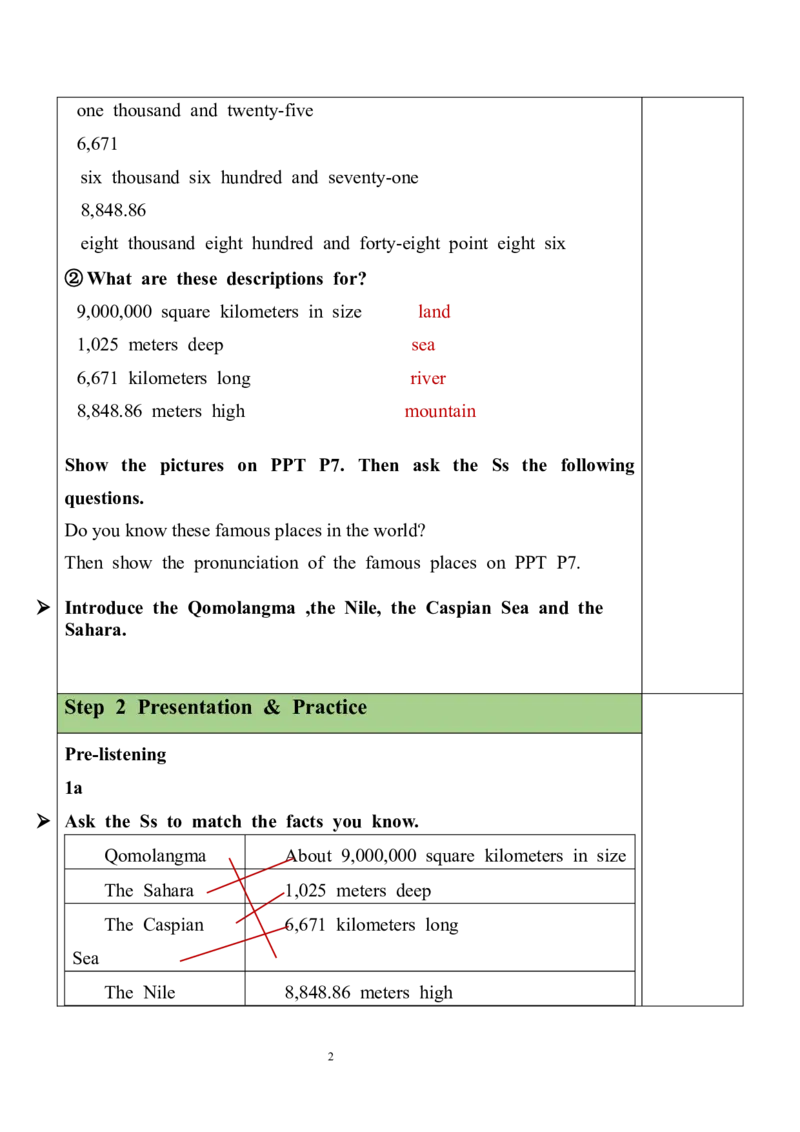
②What are these descriptions for?
9,000,000 square kilometers in size land
1,025 meters deep sea
6,671 kilometers long river
8,848.86 meters high mountain
Show the pictures on PPT P7. Then ask the Ss the following
questions.
Do you know these famous places in the world?
Then show the pronunciation of the famous places on PPT P7.
Introduce the Qomolangma ,the Nile, the Caspian Sea and the
Sahara.
Step 2 Presentation & Practice
Pre-listening
1a
Ask the Ss to match the facts you know.
Qomolangma About 9,000,000 square kilometers in size
The Sahara 1,025 meters deep
The Caspian 6,671 kilometers long
Sea
The Nile 8,848.86 meters high
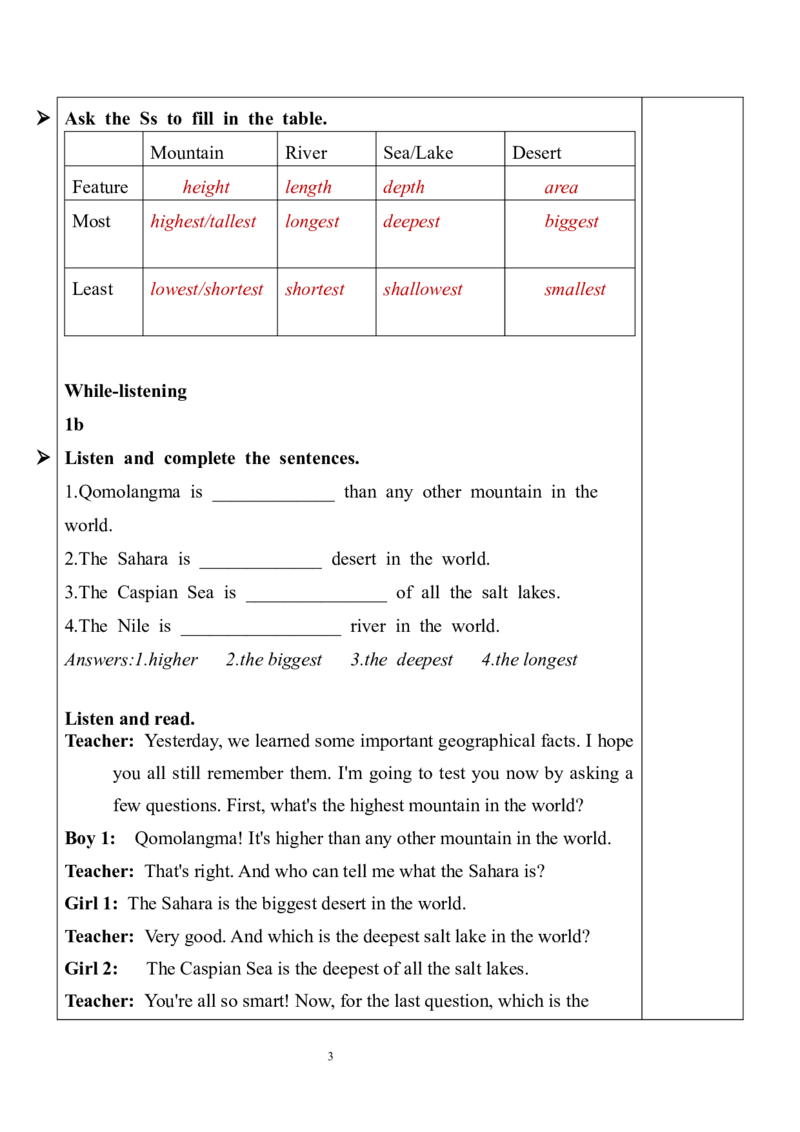
2 Ask the Ss to fill in the table.
Mountain River Sea/Lake Desert
Feature height length depth area
Most highest/tallest longest deepest biggest
Least lowest/shortest shortest shallowest smallest
While-listening
1b
Listen and complete the sentences.
1.Qomolangma is _____________ than any other mountain in the
world.
2.The Sahara is _____________ desert in the world.
3.The Caspian Sea is _______________ of all the salt lakes.
4.The Nile is _________________ river in the world.
Answers:1.higher 2.the biggest 3.the deepest 4.the longest
Listen and read.
Teacher: Yesterday, we learned some important geographical facts. I hope
you all still remember them. I'm going to test you now by asking a
few questions. First, what's the highest mountain in the world?
Boy 1: Qomolangma! It's higher than any other mountain in the world.
Teacher: That's right. And who can tell me what the Sahara is?
Girl 1: The Sahara is the biggest desert in the world.
Teacher: Very good. And which is the deepest salt lake in the world?
Girl 2: The Caspian Sea is the deepest of all the salt lakes.
Teacher: You're all so smart! Now, for the last question, which is the
3longest river in the world?
Boy 2: I know! The Nile is the longest river in the world.
Boy 1: And the Amazon is the second longest river in the world.
Teacher: It seems that you know the answers to all my questions. Good
job!
Ask the Ss to watch the video.
Post-listening
1c
Ask the Ss to use the information in 1b to make conversations.
Sample:
--What is the highest mountain in the world?
--Qomolangma.
--What is the biggest desert in the world?
--The Sahara.
Think of other objects that are high, big, deep or long and
describe them.
I live in the highest building in the city.
We have the biggest field of all the high schools in town.
Helen has the longest hair in the class.
Step 3 Language points learning
1. 长、宽、高、深、面积的表达方法
①基数词 + 单位词 + 形容词(long, wide, high, deep等)
②基数词 + 单位词 + in + 名词(length, width, height, depth, size等)
The river is 20 meters wide. = The river is 20 meters in width.
【拓展延伸】作定语时用合成词“数词 - 单位词单数- 形容词”。
This 20-meter-long rope isn’t long enough to help climb the mountain.
42. Qomolangma is higher than any other mountain in the world.
比较级 + than any other + 可数名词单数
该结构意为“比其他任何一个……都……”,指同一范围内比较,表
示最高级含义。
She is thinner than any other student in her class. = She is the thinnest in
her class.
注意:other必不可少,用以将主语从比较对象中排除,避免逻辑矛盾。
【特别提醒】如果比较对象不在同一范围内或不属于同一类别,应用
“形容词/副词比较级 + than any(任何的) + 可数名词单数”。
The Pacific Ocean is larger than any lake in the world.
练一练
①Hulunbuir is bigger than any other city in China.
②Hulunbuir is bigger than an y city in Anhui.
Step 4 Summary & Homework
Exercises
Ask Ss to do the exercises from PPT P25-26.
Summary
英语表示“有多长(宽,高……)”时,一般将数词和数量单位放在表示长宽高
的形容词前。
长度 long
谈论物体的 高度 tall/high
深度 deep
宽度 wide
1. —How high/tall/long/wide/deep...+ is + 主语?
—It's + 数量+high/tall/long/wide/deep.
2. 数词+ square kilometer(s) in size.
数词+ square meter(s)
A: How high is Qomolangma?
B: It’s 8,848.86 meters high.
5A: How deep is the Caspian Sea?
B: It’s 1,025 meters deep.
A: How long is the Nile?
B: It’s 6,671 kilometers long.
A: How big is the Sahara?
B: It’s about 9,000,000 square kilometers in size.
Homework
Preview the conversation in 2d.
Do the exercises in students’ book.
This is the first period of the unit. The topic of the unit is about “facts
Teaching
about the world” and we talk about geography and nature. It’s necessary
Reflection
for students to learn some expressions about the large numbers.
6