文档文本内容
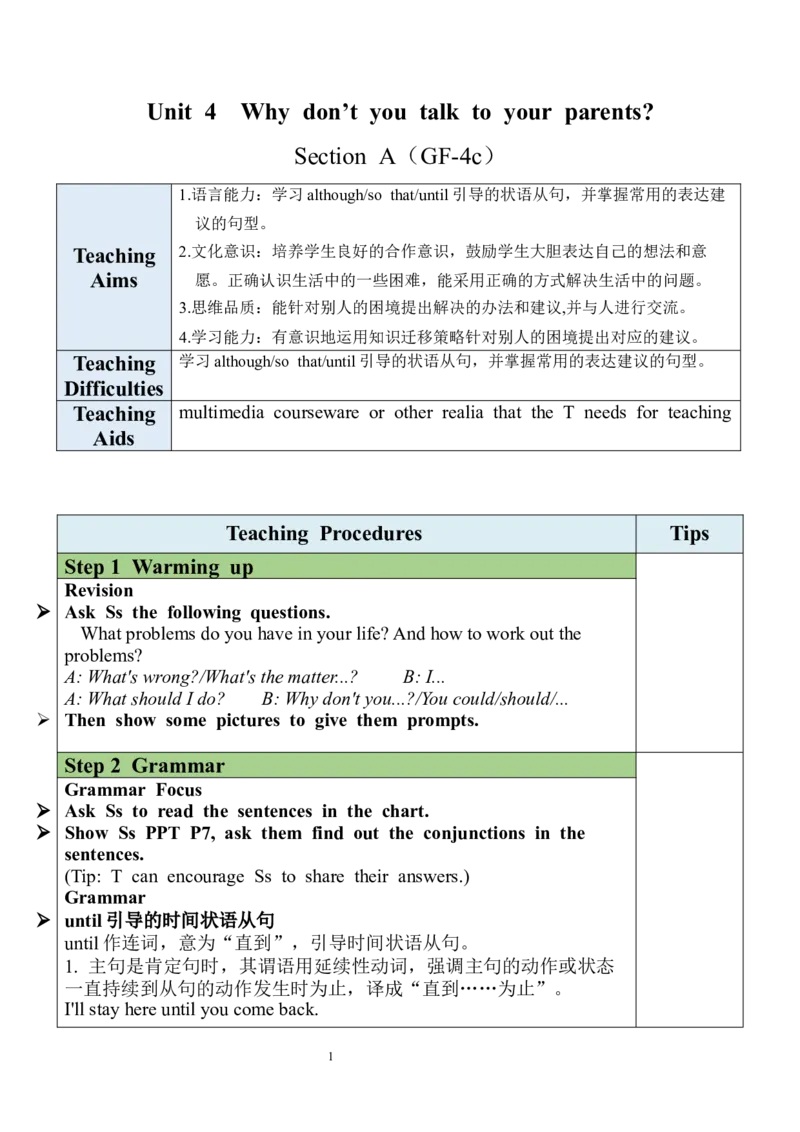
Unit 4 Why don’t you talk to your parents?
Section A(GF-4c)
1.语言能力:学习although/so that/until引导的状语从句,并掌握常用的表达建
议的句型。
Teaching 2.文化意识:培养学生良好的合作意识,鼓励学生大胆表达自己的想法和意
Aims 愿。正确认识生活中的一些困难,能采用正确的方式解决生活中的问题。
3.思维品质:能针对别人的困境提出解决的办法和建议,并与人进行交流。
4.学习能力:有意识地运用知识迁移策略针对别人的困境提出对应的建议。
Teaching 学习although/so that/until引导的状语从句,并掌握常用的表达建议的句型。
Difficulties
Teaching multimedia courseware or other realia that the T needs for teaching
Aids
Teaching Procedures Tips
Step 1 Warming up
Revision
Ask Ss the following questions.
What problems do you have in your life? And how to work out the
problems?
A: What's wrong?/What's the matter...? B: I...
A: What should I do? B: Why don't you...?/You could/should/...
Then show some pictures to give them prompts.
Step 2 Grammar
Grammar Focus
Ask Ss to read the sentences in the chart.
Show Ss PPT P7, ask them find out the conjunctions in the
sentences.
(Tip: T can encourage Ss to share their answers.)
Grammar
until引导的时间状语从句
until作连词,意为“直到”,引导时间状语从句。
1. 主句是肯定句时,其谓语用延续性动词,强调主句的动作或状态
一直持续到从句的动作发生时为止,译成“直到……为止”。
I'll stay here until you come back.
12.主句是否定句时,其谓语用非延续性动词,强调主句的动作在从句
的动作发生之后才开始,一般译成“直到……才……”。
We can't get off the bus until it stops.
We didn't start our discussion until he arrived.
so that引导的目的状语从句
so that意为“为了,以便”,引导目的状语从句,相当于in order
that,从句中多含有can, could, may, might等情态动词。
I took a taxi so that I could get there earlier.
although引导的让步状语从句
although意为“尽管;然而”,引导让步状语从句,相当于though。
Although we are neighbors, I don't know them well.
Although she was in poor health, she continued to carry out her duties.
【注意】although或though不能与but用在同一个句子中,但可以与
yet, still同时使用。
Although/Though he was badly ill, he still went to school.
表建议的句型
1.Why don't you do sth.? = Why not do sth.? 你为什么不做某事?
Why don't you try once more? = Why not try once more?
2.Shall we do sth.? 我们做某事好吗?
Shall we meet at the school gate?
3.Let's do sth. 让我们做某事吧。
Let's go to a restaurant for a change.
4.You/We had better do sth. 你(们)/我们最好做某事。
You'd better go to hospital at once.
5.You/We (not )should do sth. 你(们)/我们(不)应该做某事。
We should ask our teacher for help.
6.You/We could...你(们)/我们可以……
You could go to the movies instead of staying at home.
7.Would you like sth. / to do sth.? 你想某物/做某事吗?
Would you like to go to the Great Wall?
Would you like some drink?
8.What/How about (doing) sth.? (做)某事/某物怎么样?
What/How about watching a film this weekend?
What/How about a bowl of noodles?
【特别提醒】perhaps也可用于提建议,常位于句首。
Perhaps you can park your car over there.
回答建议的句型
肯定回答
Good idea. / That's a good idea. 好主意。
OK. / All right. / Great. 好。
Yes, please. / I'd love / like to. 好的。/我愿意。
Sounds good / great. 听起来不错。
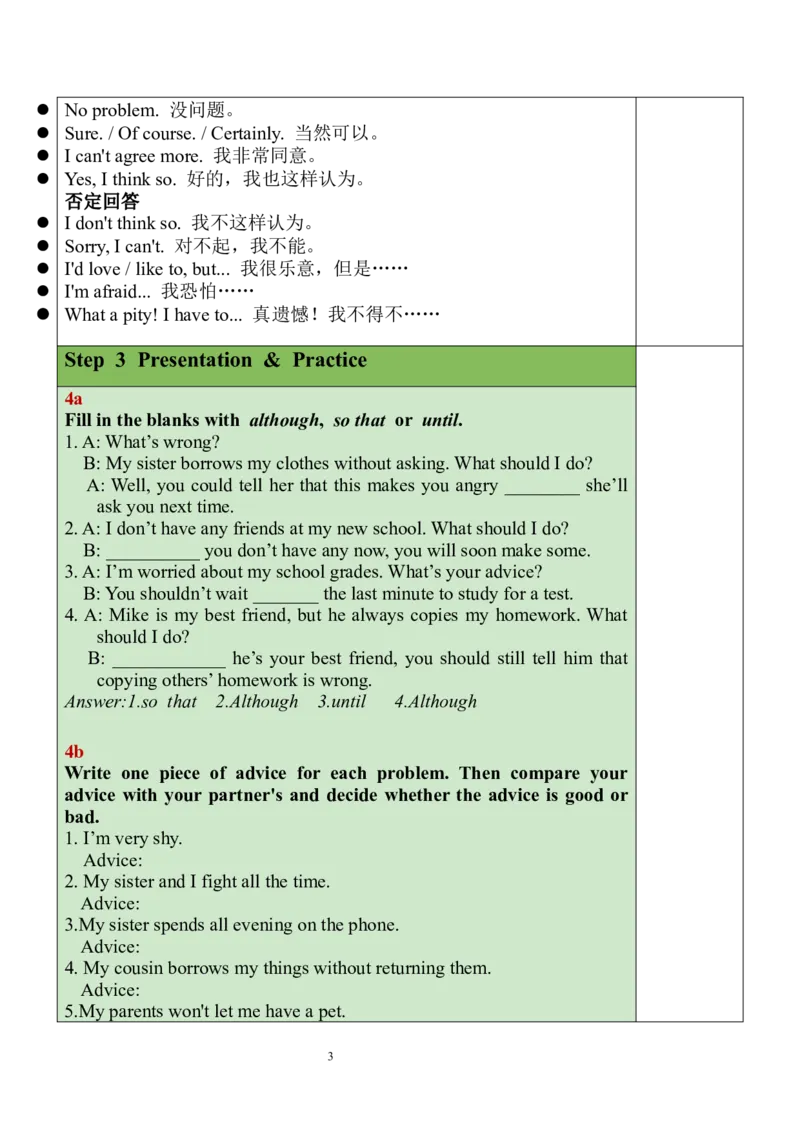
2 No problem. 没问题。
Sure. / Of course. / Certainly. 当然可以。
I can't agree more. 我非常同意。
Yes, I think so. 好的,我也这样认为。
否定回答
I don't think so. 我不这样认为。
Sorry, I can't. 对不起,我不能。
I'd love / like to, but... 我很乐意,但是……
I'm afraid... 我恐怕……
What a pity! I have to... 真遗憾!我不得不……
Step 3 Presentation & Practice
4a
Fill in the blanks with although, so that or until.
1. A: What’s wrong?
B: My sister borrows my clothes without asking. What should I do?
A: Well, you could tell her that this makes you angry ________ she’ll
ask you next time.
2. A: I don’t have any friends at my new school. What should I do?
B: __________ you don’t have any now, you will soon make some.
3. A: I’m worried about my school grades. What’s your advice?
B: You shouldn’t wait _______ the last minute to study for a test.
4. A: Mike is my best friend, but he always copies my homework. What
should I do?
B: ____________ he’s your best friend, you should still tell him that
copying others’ homework is wrong.
Answer:1.so that 2.Although 3.until 4.Although
4b
Write one piece of advice for each problem. Then compare your
advice with your partner's and decide whether the advice is good or
bad.
1. I’m very shy.
Advice:
2. My sister and I fight all the time.
Advice:
3.My sister spends all evening on the phone.
Advice:
4. My cousin borrows my things without returning them.
Advice:
5.My parents won't let me have a pet.
3Advice:
Answer:1.You should practice speaking in front of class more.
2.You could try to do more fun things with her so that you will like
each other better and not fight so often.
3. Maybe you could talk to her about it.
4.You could tell him that this makes you unhappy so that he will
return them soon next time.
5.You should communicate with them.
4c
Choose one of the problems and ask your classmates for advice.
Decide which classmate has the best advice.
Problems
You left your homework at home.
Your best friend is more popular than you.
You are afraid of speaking in front of people.
Your best friend does not trust you anymore.
Your parents always argue.
Sample:
A: My best friend is more popular than me. I want to be like him. What
should I do?
B: You could try to be friendlier.
C: You should just be yourself.
Group work
The group collects advice. The group leader reports to the class, and
selects the best advice.
Step 4 Language Points
1. My cousin borrows my things without returning them.
return v. 归还;回来;返回
return在此处作及物动词,意为“归还”,相当于give sth. back。
return sth. to sb. = return sb. sth., 意为“把某物还给某人”。
I'm going to return this book to Tom.=I'm going to return Tom his book.
【拓展延伸】return 还可用作不及物动词,意为“回来;返回”,相
当于come back。
返回某地
return to+地点名词
return+地点副词
He returned to the factory.
42. You are afraid of speaking in front of people.
afraid adj. 害怕;畏惧
afraid在句中一般作表语,不作定语,其主要用法有:
be afraid of sb./sth. 害怕某人/某物
be afraid of doing sth.害怕做某事 (强调担心会发生, 但实际未必发生)
be afraid to do sth. 不敢做某事 (强调不敢去做某事)
be afraid+ that从句 担心……
Never be afraid of difficulties and never give up hope.
Are you afraid of going to the dentist?
He was afraid to travel by plane.
I'm afraid that I will fall into the hole.
3. Your best friend doesn't trust you anymore.
not...anymore 不再……
主要用来表示数量和程度,常修饰短暂性动词,指某个动作不再重
复发生,相当于no more。
My father didn't smoke anymore.= My father no more smoked.
【拓展延伸】 not... any longer 主要用来表示时间及距离上的“不
再” ,一般修饰延续性动词,表示某个动作或状态不再延续下去,
相当于no longer。
She isn't a student any longer.= She is no longer a student.
Step 5 Summary & Homework
Summary
Ask Ss to do the exercises from PPT P28-32.
Homework
Preview the new words and phrases in Section B(1a-1e).
Do the exercises in students’ book.
We always learn grammar when we have enough language knowledge.
When dealing with grammar, we can get the students to conclude or sum
Teaching up what they have learned in this unit and then learn the structure and the
Reflection pattern drills. After they learn the main structure in the grammar focus
frame, the students should practice in different activities. And we’d better
give them some written work after speaking and reading.
5