文档文本内容
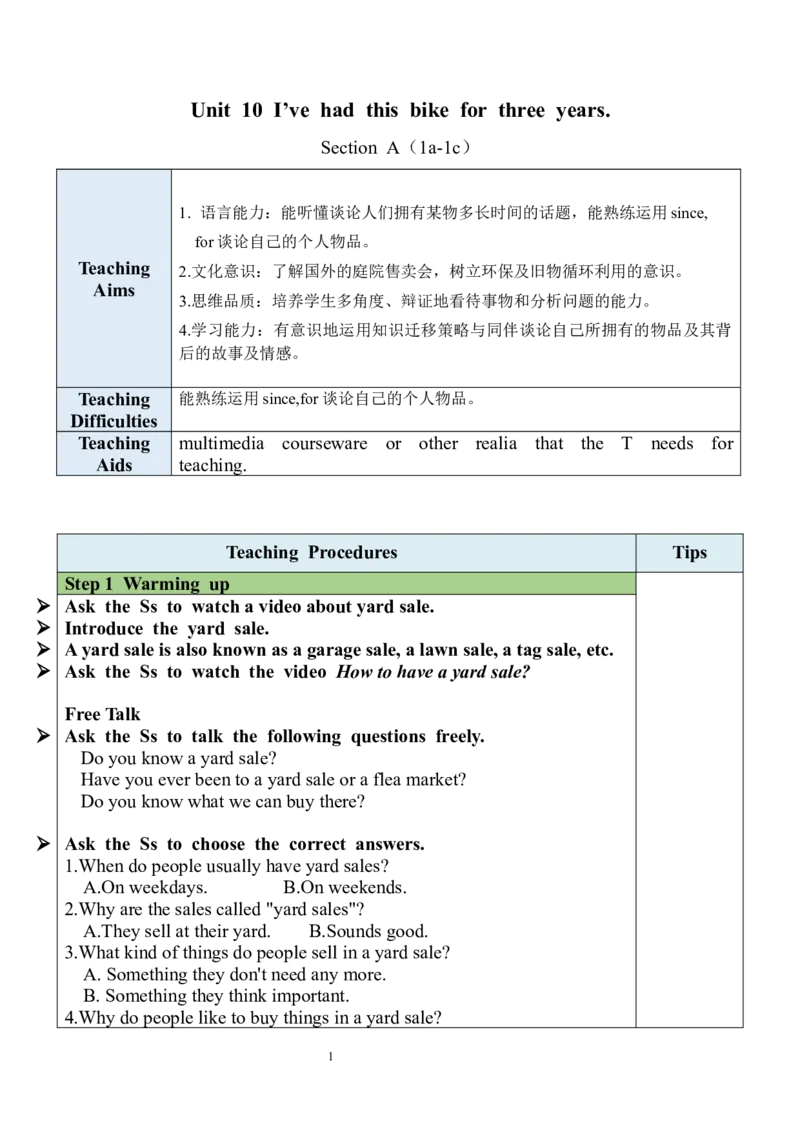
Unit 10 I’ve had this bike for three years.
Section A(1a-1c)
1. 语言能力:能听懂谈论人们拥有某物多长时间的话题,能熟练运用since,
for谈论自己的个人物品。
Teaching 2.文化意识:了解国外的庭院售卖会,树立环保及旧物循环利用的意识。
Aims
3.思维品质:培养学生多角度、辩证地看待事物和分析问题的能力。
4.学习能力:有意识地运用知识迁移策略与同伴谈论自己所拥有的物品及其背
后的故事及情感。
Teaching 能熟练运用since,for谈论自己的个人物品。
Difficulties
Teaching multimedia courseware or other realia that the T needs for
Aids teaching.
Teaching Procedures Tips
Step 1 Warming up
Ask the Ss to watch a video about yard sale.
Introduce the yard sale.
A yard sale is also known as a garage sale, a lawn sale, a tag sale, etc.
Ask the Ss to watch the video How to have a yard sale?
Free Talk
Ask the Ss to talk the following questions freely.
Do you know a yard sale?
Have you ever been to a yard sale or a flea market?
Do you know what we can buy there?
Ask the Ss to choose the correct answers.
1.When do people usually have yard sales?
A.On weekdays. B.On weekends.
2.Why are the sales called "yard sales"?
A.They sell at their yard. B.Sounds good.
3.What kind of things do people sell in a yard sale?
A. Something they don't need any more.
B. Something they think important.
4.Why do people like to buy things in a yard sale?
1A.Because the things are very cheap.
B.Because the things they can't buy in other place.
Answers: B A A A
Step 2 Presentation & Practice
Pre-listening
Describe the picture on PPT P12 and read the dialogue.
Name Objects
Amy bike cup toy
Jeff book clock T-shirt
The picture shows two children standing outside, talking. The boy is
having a yard sale. He is standing behind a table on the grass in
the yard in front of his house. The table is covered with things his
family is selling: old clothes, toys, cups and glasses, plates and
bowls, books, a vase and a lamp. The girl is carrying a backpack
on her back and asking about the red bicycle.
1a
Look at the things at the yard sale. Do you have any of these
things at home? How long have you had them?
Show the pictures of the things at the yard sale.
—Do you have a bike at home?
—Yes, I do. / No, I don’t.
—How long have you had the bike?
—I’ve had it for three years.
While-listening
1b
2 Ask the Ss to listen and check (√) the facts you hear.
√ Jeff’s family is having a yard sale.
√ Amy thinks it’s hard to sell her old things.
______ Jeff has had his bike for more than 10 years.
______ Amy wants to keep her old things because they bring back sweet
memories.
√ You can also give old things away to people in need.
Explain the key words and phrases in the sentences in 1b.
Listen again and answer the questions.
1.What’s the relationship between Amy and Jeff?
2.What things did Amy ask about?
Answers:1.Seller and buyer.
2.The bike and book.
Ask the Ss to listen and read the tape script.
Amy:You have some great things at this yard sale, Jeff.
Jeff: Thanks, Amy. Our family has collected so many things over the
years, but we don’t use them anymore.
Amy:But isn’t it hard to sell some of your things? There are many things
I’ve had since I was a child. I don’t think I could sell them.
Jeff: Yes, it’s hard to say goodbye to certain things.
Amy:By the way, how long have you had that bike over there?
Jeff: I’ve had it for three years! I learned how to ride a bike on it.
Amy:Old things really bring back sweet memories. But it’s true that we
may never use some of these things again.
Jeff: Yes, like old toys or books you’ve already read. You can sell
those,
or you can also give them away to kids or people who need them.
Amy:Oh! How much is this book?
3Jeff: You can have it for 75 cents.
Ask the Ss to watch the video.
Post-listening
1c
Ask the Ss to practice the conversation. Then make conversations
about other things in the picture above.
A: This is a really old book.
B: Yes, I’ve had it for seven years. I’ve read it three times.
A: Why are you selling it?
B: Because I don't read it anymore.
A: How much is it?
B: You can have it for 75 cents.
Show some samples to the Ss.
Ask the Ss to list the old things you want to sell on Idle Fish(闲鱼)
and discuss with your partners.
e.g. I have an old clock. I’ve had it for two years. I want to sell it
because I don’t like it anymore. I want to sell it for 15 yuan.
4Step 3 Language points learning
1. —How long have you had that bike over there?
—I’ve had it for three years.
how long 多长时间
how long在此处引导特殊疑问句,用于询问“多长时间”,常与现
在完成时连用。对其回答时常用“for+时间段(for可省略)”
“since+过去的时间点或从句”或“since+时间段+ago”。
—How long has she been in China?
—She has been in China since three years ago.
—How long have you learned English?
—For more than five years./More than five years.
2. Amy wants to keep her old things because they bring back
sweet memories.
memory n. 记忆;回忆
memory 在此处作可数名词,其复数形式为 memories。
What is your earliest memory?
【拓展延伸】
① memory 作名词,还可意为“记忆力”。
I have a bad memory.
② memorize 作动词,意为“记忆”。
My Chinese teacher asked me to memorize the poem.
3. You can also give old things away to people in need.
give away 赠送; 捐赠
He was giving his collection away for nothing.
【拓展延伸】与 give 相关且易混淆的短语有:
give out 分发;give off 放出,释放;give in 投降,屈服;give up
停止,放弃;give or take 相差不到......
He wouldn’t give out any information.
Three thousand people came, give or take a few hundred.
in need 贫困;在困境中
in need 意为“贫困;在困境中”,为固定短语。
in need of 意为“需要......”。
We are collecting money for children in need.
A friend in need is a friend indeed.(谚语)患难见真情。
After working for twelve hours, she was in great need of a rest.
Step 4 Summary & Homework
5Summary
Ask Ss to do the exercises from PPT P31-32.
Homework:
Preview the conversation in 2d.
Do the exercises in students’ book.
This is the first period of the unit. The topic is living environment. The
function is talking about possessions and things around you. So it is
Teaching important to get the students to know the yard sale. And we should learn
Reflection the new words and expressions in the first period of the unit. We’d better
learn them by using them in listening, speaking and reading activities. And
we always learn them in the meaning group.
6