文档文本内容
Unit 1 What’s the matter?
Section A(3a-3c)
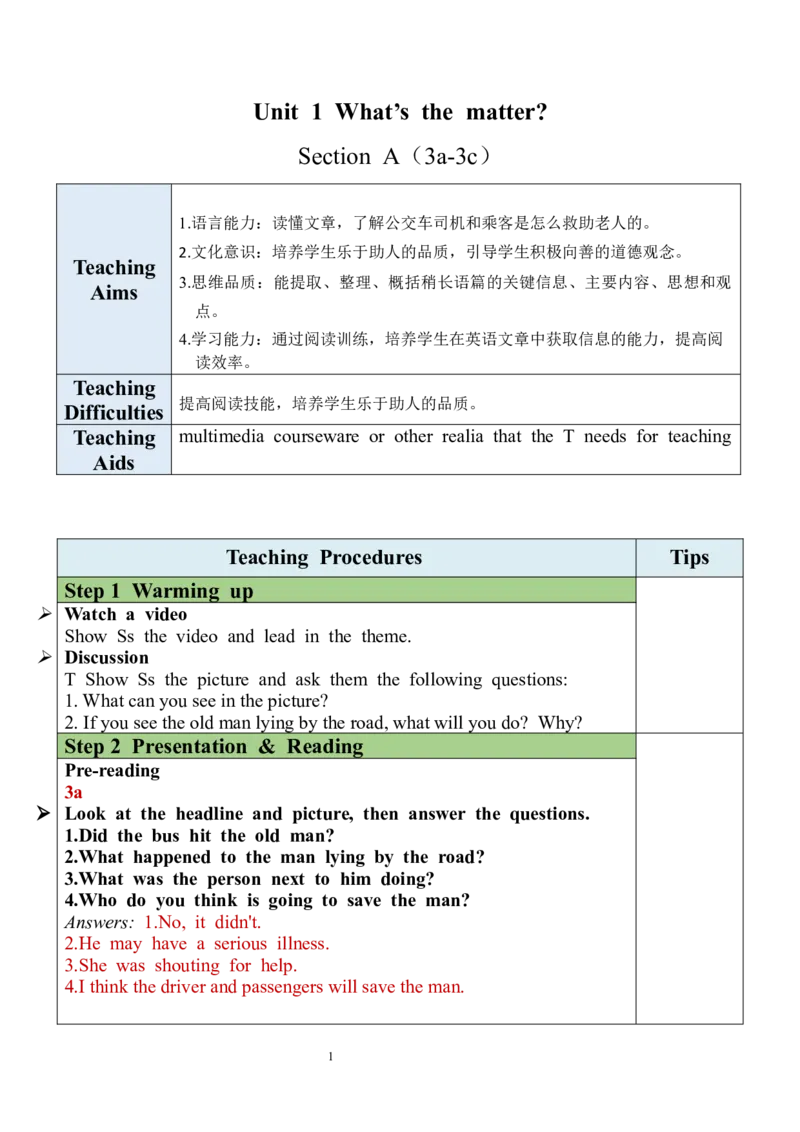
1.语言能力:读懂文章,了解公交车司机和乘客是怎么救助老人的。
2.文化意识:培养学生乐于助人的品质,引导学生积极向善的道德观念。
Teaching
3.思维品质:能提取、整理、概括稍长语篇的关键信息、主要内容、思想和观
Aims
点。
4.学习能力:通过阅读训练,培养学生在英语文章中获取信息的能力,提高阅
读效率。
Teaching
提高阅读技能,培养学生乐于助人的品质。
Difficulties
Teaching multimedia courseware or other realia that the T needs for teaching
Aids
Teaching Procedures Tips
Step 1 Warming up
Watch a video
Show Ss the video and lead in the theme.
Discussion
T Show Ss the picture and ask them the following questions:
1. What can you see in the picture?
2. If you see the old man lying by the road, what will you do? Why?
Step 2 Presentation & Reading
Pre-reading
3a
Look at the headline and picture, then answer the questions.
1.Did the bus hit the old man?
2.What happened to the man lying by the road?
3.What was the person next to him doing?
4.Who do you think is going to save the man?
Answers: 1.No, it didn't.
2.He may have a serious illness.
3.She was shouting for help.
4.I think the driver and passengers will save the man.
1While-reading
Show task 1 to Ss. Ask them to skim the passage and match
it’s beginning, body and end with its general meaning.
Ask Ss to scan the passage and finish the task 2.
1.Read the Para.1 and find out the key words to finish the mind map.
Answers:
When: 9 a.m. yesterday
Where: Zhonghua Road
Who: a driver , an old man and a woman
What: an old man was lying on the side of the road
2.Read the Para.2 and fill in the chart.
Answers: ①had heart problems ②stopped the bus ③got off
④asked ⑤told the passengers ⑥moved the man
3.Read the Para.3 and answer the questions.
What do people think of the bus driver?
Answers:
Passages: He didn’t think about himself. He only thought about saving a
life.
You: In my opinion, he is the most “beautiful” bus driver in China. He
is beautiful in mind .
Show task 3 to Ss. Ask them to finish the mind-map.
Answers:
The bus driver Wang Ping saw an old man lying on the road.
He stopped the bus and decided to send the man to the hospital.
All passengers agreed to go with the driver and some passengers helped
him.
The man was saved by the doctors in time.
3a Presentation
Read the passage. Do you think it comes from a newspaper or a
book? How do you know?
Answers: Newspaper. It is reporting something that happened very
recently, and the whole story is very short.
Ask Ss to listen to the passage. Explain the phrases that are
marked on PPT P17 to P19.
3b
Read the passage again and check the things that happened in the
story.
Post-reading
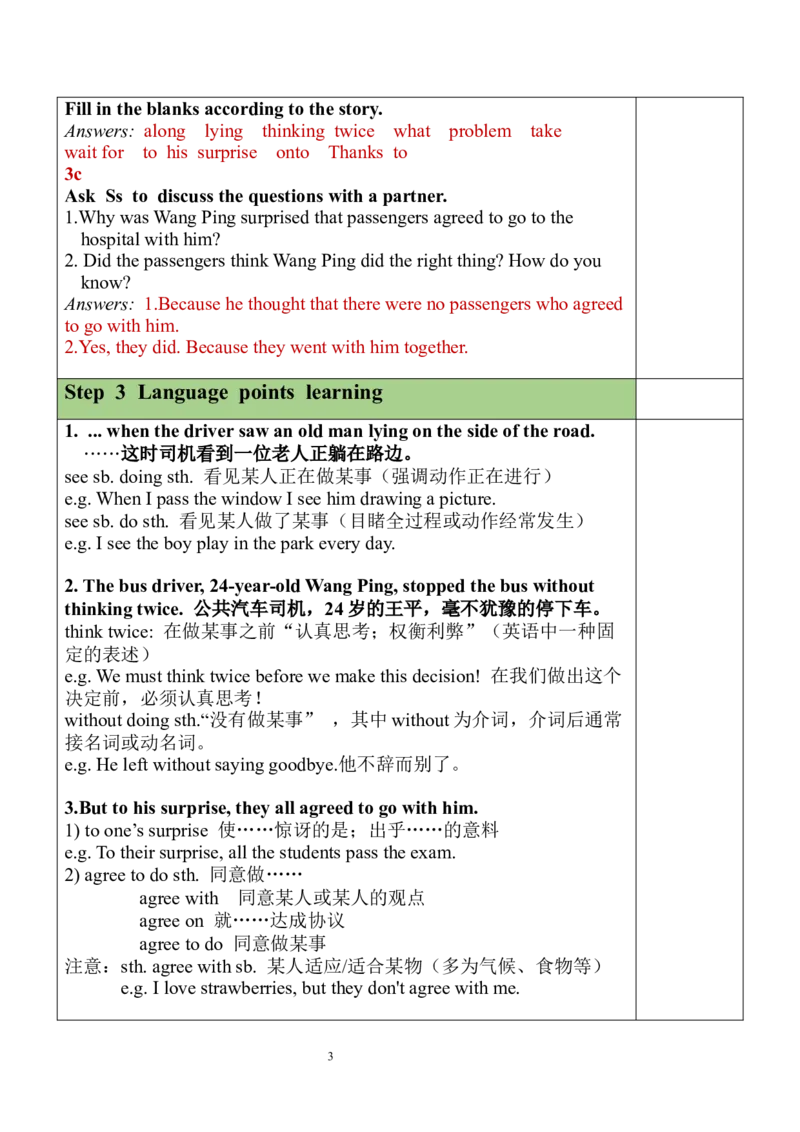
2Fill in the blanks according to the story.
Answers: along lying thinking twice what problem take
wait for to his surprise onto Thanks to
3c
Ask Ss to discuss the questions with a partner.
1.Why was Wang Ping surprised that passengers agreed to go to the
hospital with him?
2. Did the passengers think Wang Ping did the right thing? How do you
know?
Answers: 1.Because he thought that there were no passengers who agreed
to go with him.
2.Yes, they did. Because they went with him together.
Step 3 Language points learning
1. ... when the driver saw an old man lying on the side of the road.
······这时司机看到一位老人正躺在路边。
see sb. doing sth. 看见某人正在做某事(强调动作正在进行)
e.g. When I pass the window I see him drawing a picture.
see sb. do sth. 看见某人做了某事(目睹全过程或动作经常发生)
e.g. I see the boy play in the park every day.
2. The bus driver, 24-year-old Wang Ping, stopped the bus without
thinking twice. 公共汽车司机,24岁的王平,毫不犹豫的停下车。
think twice: 在做某事之前“认真思考;权衡利弊”(英语中一种固
定的表述)
e.g. We must think twice before we make this decision! 在我们做出这个
决定前,必须认真思考!
without doing sth.“没有做某事” ,其中without为介词,介词后通常
接名词或动名词。
e.g. He left without saying goodbye.他不辞而别了。
3.But to his surprise, they all agreed to go with him.
1) to one’s surprise 使……惊讶的是;出乎……的意料
e.g. To their surprise, all the students pass the exam.
2) agree to do sth. 同意做……
agree with 同意某人或某人的观点
agree on 就……达成协议
agree to do 同意做某事
注意:sth. agree with sb. 某人适应/适合某物(多为气候、食物等)
e.g. I love strawberries, but they don't agree with me.
34. Thanks to Mr. Wang and the passengers, the doctor saved the man
in time. 多亏了王先生和这些乘客,医生及时救了这个人。
thanks to sb./sth. “多亏;因为;由于”(to为介词)
e.g. Thanks to your help, we were successful.
多亏了你的帮助, 我们得以成功。
5. ... because they don’t want any trouble, ...
(1)当trouble意为“困难;麻烦”时,是不可数名词。
如: I’m sorry to give you so much trouble.
be in trouble意为“有困难;陷入困境”。
e.g. He always asks me for help when he is in trouble.
(2) get sb. into trouble 意为“使某人陷入困境”
e.g. If you come, you may get me into trouble.
(3) 主语 + have / has trouble (in) doing sth. 意为“某人在做某事方面
有困难”。
e.g. I have some trouble (in) reading the letter.
当trouble意为“麻烦事;烦心事”时,是可数名词。
e.g. She was on the phone for an hour telling me her troubles.
Phrases summary
see sb. doing sth. 看见某人正在做某事
lie on the side of the road 躺在路边
to one’s surprise 使……惊讶的是 in time 及时
agree to do sth. 同意做某事
thanks to 多亏;由于 right away 立即;马上
lie down 躺下 get into trouble 陷入困境
get some sleep 睡会觉 wait for 等待
fall down 突然倒下;跌倒;倒塌
Step 4 Summary & Homework
Exercises: Ask Ss to do the exercises from PPT P33 to P34.
Homework
Read and recite the passage in 3a.
Do the exercises in students’ book.
4This is the third period of the unit. In this period, we should practice
the target language more in reading and speaking activities. Besides,
Teaching
we can set some suitable tasks to help students do the reading
Reflection
comprehension in order to improve their reading skills.And students
should know the main content in this passage.
5