文档文本内容
Unit 3 Could you please clean your room?
Section B(3a-Self Check)
1.语言能力:在书面表达中,能选用不同句式结构和时态,描述和介绍青少年
是否应该做家务,表达情感、态度、观点和意图。
Teaching 2.文化意识:学会体谅父母,帮助父母做适当的家务劳动,增强责任感,培养
Aims 自己的独立意识。
3.思维品质:能根据所给的表格内容和图片对语篇进行创编。
4.学习能力:运用知识迁移策略表达自己关于青少年做家务的观点。
Teaching 表达自己关于青少年做家务的观点。
Difficulties
Teaching multimedia courseware or other realia that the T needs for teaching
Aids
Teaching Procedures Tips
Step 1 Presentation & Reading
Pre-writing
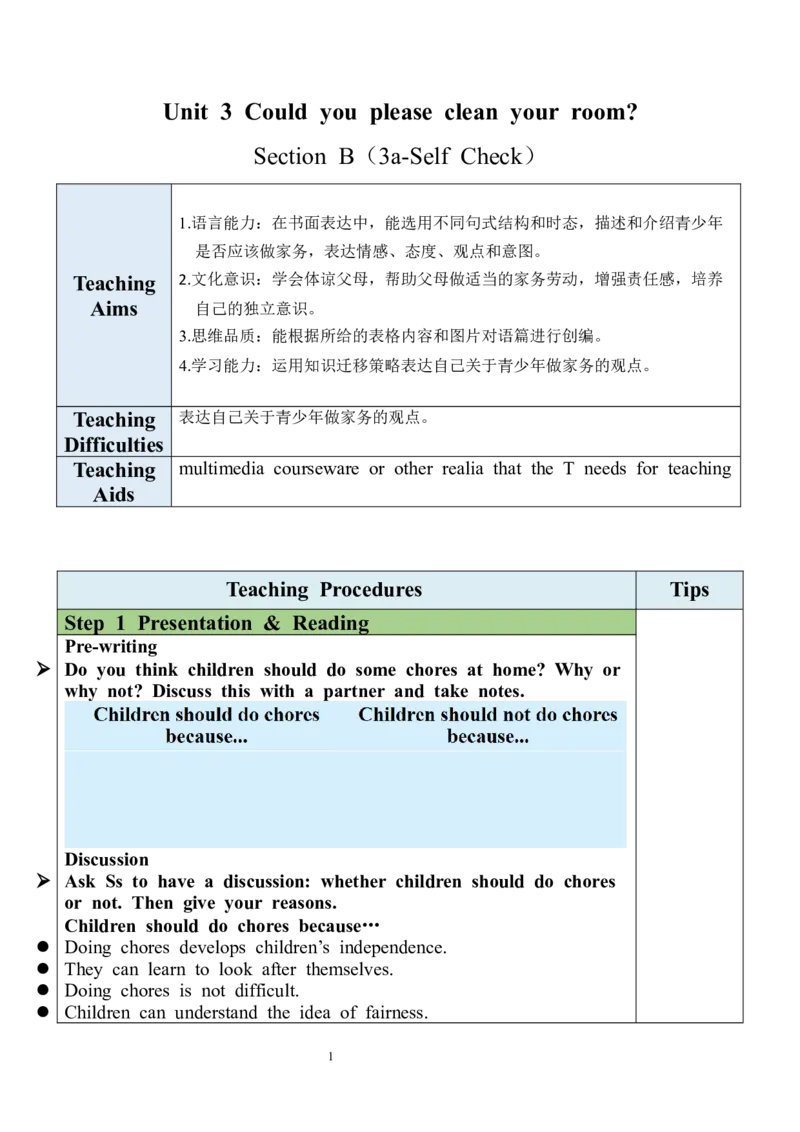
Do you think children should do some chores at home? Why or
why not? Discuss this with a partner and take notes.
Discussion
Ask Ss to have a discussion: whether children should do chores
or not. Then give your reasons.
Children should do chores because…
Doing chores develops children’s independence.
They can learn to look after themselves.
Doing chores is not difficult.
Children can understand the idea of fairness.
1 Doing chores is good for their future.
Sharing the housework can make parents less tired.
Children shouldn't do chores because…
It’s a waste of time.
Children should spend time on their schoolwork.
Sometimes it’s difficult for them.
Children already have enough stress from school.
It’s parents’ job to provide a clean and comfortable environment.
They will have to do it when they are older, so there is no need to
do it now.
While-writing
3b
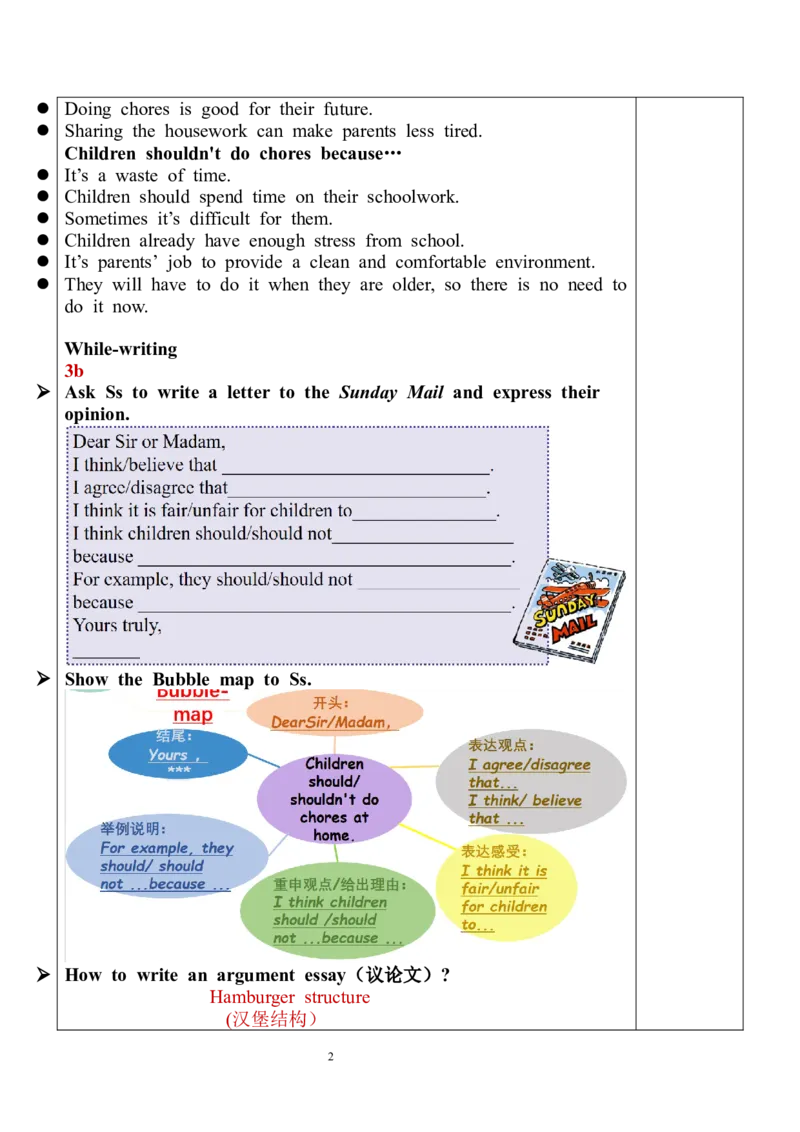
Ask Ss to write a letter to the Sunday Mail and express their
opinion.
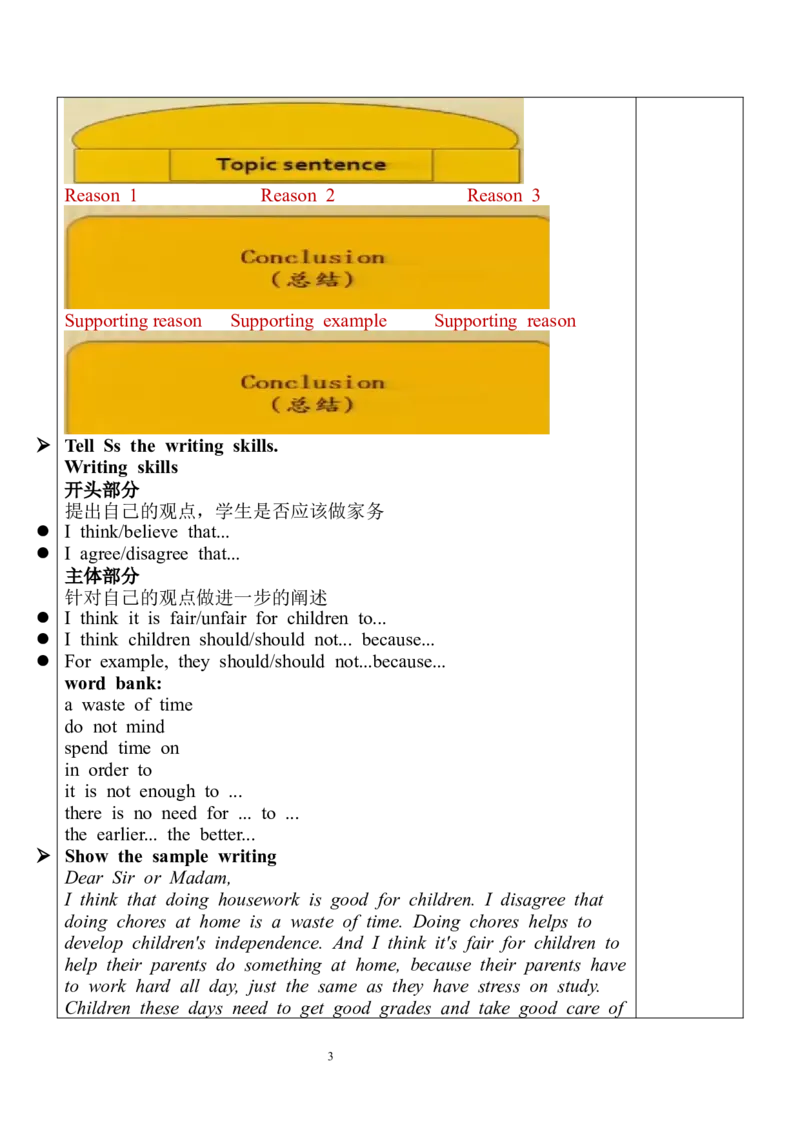
Show the Bubble map to Ss.
How to write an argument essay(议论文)?
Hamburger structure
(汉堡结构)
2Reason 1 Reason 2 Reason 3
Supporting reason Supporting example Supporting reason
Tell Ss the writing skills.
Writing skills
开头部分
提出自己的观点,学生是否应该做家务
I think/believe that...
I agree/disagree that...
主体部分
针对自己的观点做进一步的阐述
I think it is fair/unfair for children to...
I think children should/should not... because...
For example, they should/should not...because...
word bank:
a waste of time
do not mind
spend time on
in order to
it is not enough to ...
there is no need for ... to ...
the earlier... the better...
Show the sample writing
Dear Sir or Madam,
I think that doing housework is good for children. I disagree that
doing chores at home is a waste of time. Doing chores helps to
develop children's independence. And I think it's fair for children to
help their parents do something at home, because their parents have
to work hard all day, just the same as they have stress on study.
Children these days need to get good grades and take good care of
3themselves as well.
I think children should share some housework with their parents,
because it's a good way to learn how to look after themselves. For
example, they should help their parents do some cooking, because
when they are alone at home, they can get themselves something to
eat.
Yours truly,
Li Hua
remember
One can’t expect to control the world without sweeping his room
first.
一屋不扫何以扫天下。
It's our duty to help parents do chores.帮父母做家务是我们的责
任。
Self Check
Exercise 1
Ask Ss to make a list of chores using these verbs.
1. do ___________________________________________
2. clean _________________________________________
3. make _________________________________________
4. fold __________________________________________
5. sweep _________________________________________
6. take out ________________________________________
Answer:1.do the dishes/ do the shopping /do the laundry
2.clean the living room/ clean your bedroom
3.make the bed
4.fold your clothes
5.sweep the floor
6.take out the rubbish/take out the trash
Exercise 2
Permission(许可)
A: Could I go out for dinner with my friends?
B: Sure, that should be OK.
A: Could we get something to drink after the movie?
B: No, you can't. You have a basketball game tomorrow.
Requests(请求)
A: Could you please take out the rubbish?
B: OK, but I want to watch one show first.
A: Could you please take the dog for a walk?
B: Yes, sure.
Are these polite requests or permission? Write the numbers in
4the correct places in the chart.
1. Could you please do your homework?
2. Could I watch TV?
3. Could you take out the rubbish first?
4. Could I use your computer?
5. Could I leave now?
6. Could you come back before nine?
Requests Permission
1, 3, 6 2, 4, 5
Exercise 3
Ask Ss to use the questions in activity 2 to write a conversation.
A: ____________________________________________
B: ____________________________________________
A: ____________________________________________
B: ____________________________________________
Sample
A: Could I watch TV after dinner? I want to watch my favorite program.
B: Well, have you finished your homework?
A: Ah... no. I'll do my homework after watching the program.
B: I don't think that's a good idea. Could you do your homework first?
A: OK. But I'll miss the first part of the program.
Step 2 Language points learning
1.I think it's fair/unfair for children to ...
fair adj. 合理的;公正的
unfair adj. 不合理的;不公正的
fair 作形容词,还可意为“白皙的;浅色的;天气晴朗的”。
She has long fair hair. 她有一头浅色长发。
a fair and breezy day 风和日丽的一天
fair n. 展览会;商品交易会
a book fair 图书交易会
Step 3 Summary & Homework
Summary
Do the exercises from PPT P27-P28.
Homework
Write an article of at least 80 words about your volunteer activity.
5 Remember the words, expressions and sentences in this unit.
Preview Unit 4 Section A (1a-2d).
In the last period, the students should use the words they have learned
to practice writing. First, they must express their opinion on doing
Teaching chores. Then, they should write down some sentences to state their
Reflection reasons. The process of writing should connect what they have
learned with what they have known. And the teacher can give them
some advice about how to do it.
6