文档文本内容
Unit 2 I’ll help to clean up the city parks.
Section B(1a-1e)
1.语言能力:正确运用已知的英语语言来解释新词汇。
2.文化意识:引导学生要关爱他人,并力所能及的去帮助那些需要帮助的人。
Teaching
3 3.思维品质:通过图片预测所听内容,听懂与助人行为相关的对话,并获取细
Aims
节
。 信息。
4.学习能力:运用本单元所学句型讨论我们可以用什么样的形式去帮助需要帮
助的人。
运用本单元所学句型讨论我们可以用什么样的形式去帮助需要帮助的人。
Teaching
Difficulties
Teaching
Aids A tape recorder; CAI or multimedia courseware
Teaching Procedures Tips
Step 1 Lead in
T can show some pictures in PPT 12 to Ss. Then ask them the
following questions:
Have you ever helped others as a volunteer?
What do you want to do if you are a volunteer ?
Step 2 Presentation & Practice
1a
Ask Ss to match the sentences with similar meanings.
__b__ 1. I’ve run out of it. a. I repaired it.
____ 2. I take after my mother. b. I don’t have any more of
it.
____ 3. I fixed it up. c. I’m similar to her.
____ 4. I gave it away. d. I didn’t keep it.
Answers: 2.c 3.a 4.b
Match the phrasal verbs with paraphrases(释义).
A. come up with B. call up C. put off D. cheer up
( ) 1. to make a phone call to sb.
1( ) 2. to make other people happy
( ) 3. to think of an idea, answer, etc.
( ) 4. to decide to do sth. at a later time or date because you
can’t or don’t want to do it now.
Answers: 1.B 2.D 3.A 4.C
Pre-listening
1b
Ask Ss to match the phrasal verbs with the nouns. Then make
sentences with the phrases.
run out of my bike
take after money
fix up my father
give away old clothes
Sample: I gave away my bike to a children’s home.
I have run out of money during my vacation.
My brother takes after my father.
I fixed up my bike yesterday.
I decided to give away my old clothes to the children’s home.
1c
T shows the pictures in PPT 18-21 to Ss.Then ask them the
questions.
Look at Jimmy’s pictures carefully and answer the questions.
1. Does Jimmy have any money in his pocket?
2. What problem do you think he has?
Answer:1.No, he doesn't.
2.I think he may run out of his money.
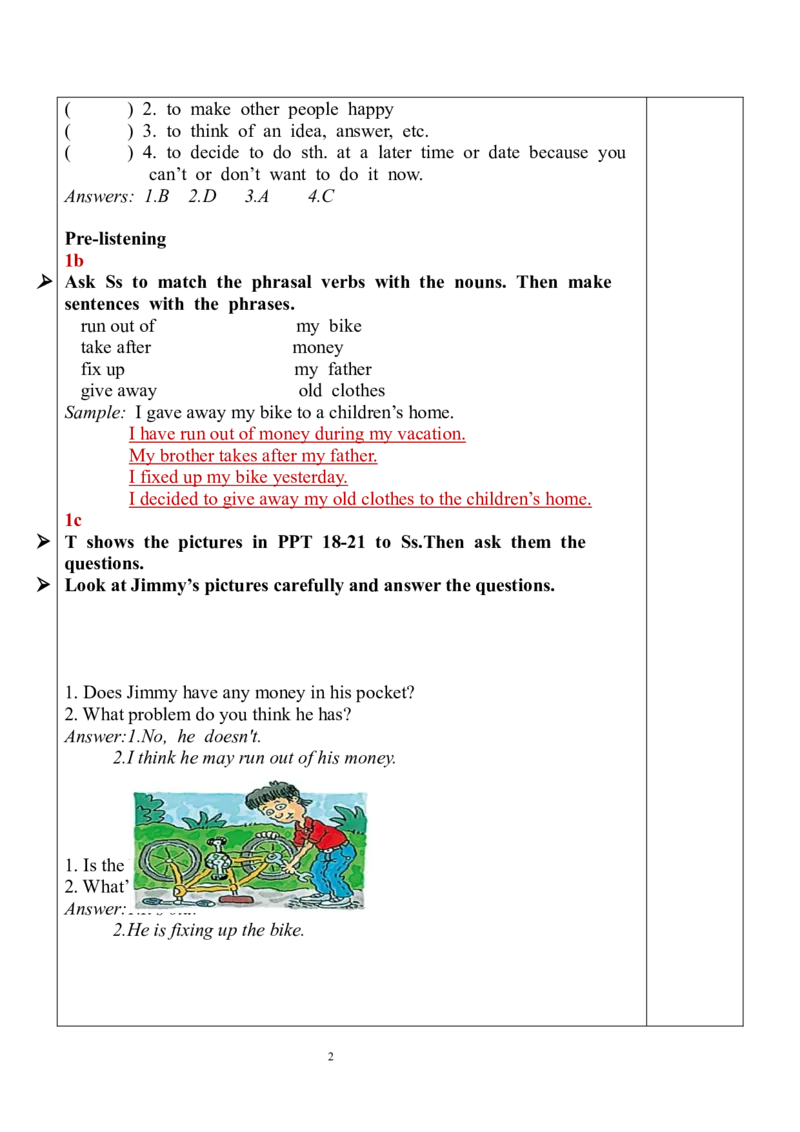
1. Is the bike in the picture new or old?
2. What’s Jimmy doing?
Answer:1.It's old.
2.He is fixing up the bike.
21. What does the boy find?
2. Does the bike have a broken wheel?
3 3.Why doesn’t the owner want it any longer?
Answer:1.He finds an abandoned(废弃的) bike.
2.Yes, it does.
3.Maybe it's broken.
1. How does the bike look in this picture?
2. What does Jimmy do with the bike?
3. Do you think your parents will be proud of you if you do this?
Answer:1.It looks great.
2. He repairs it and makes it work well.
3.Yes, they will.
While-listening
1c
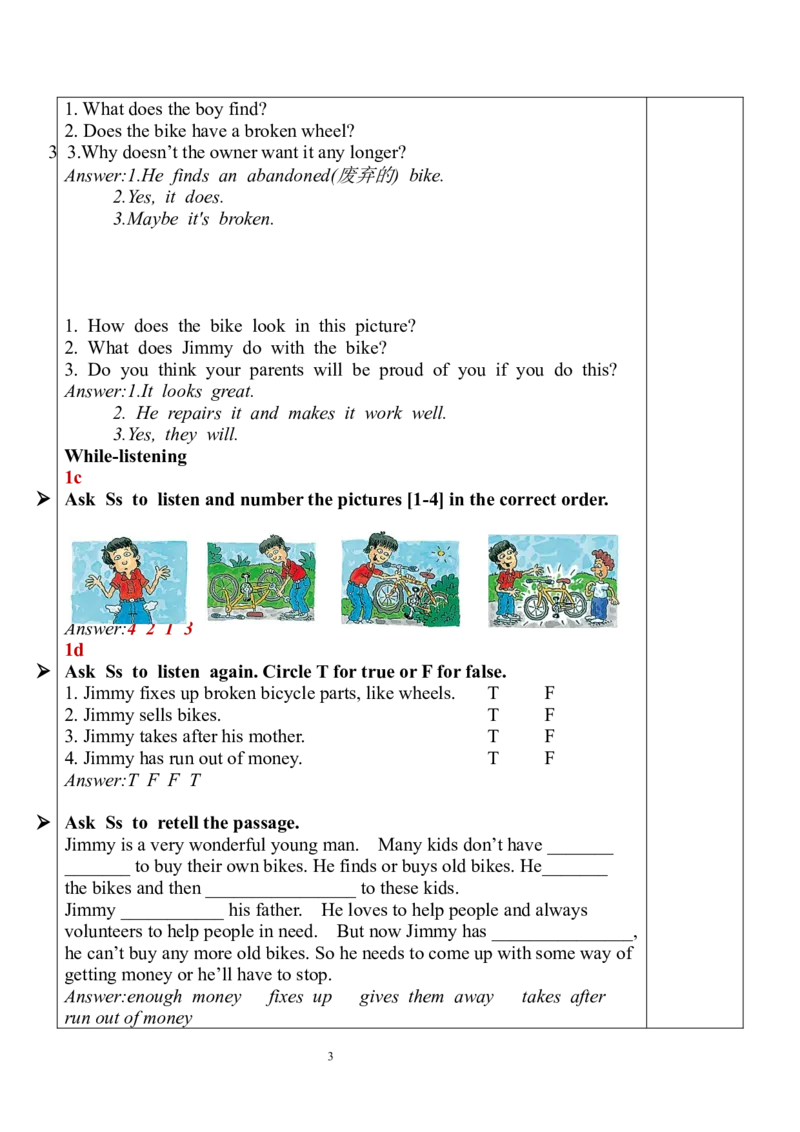
Ask Ss to listen and number the pictures [1-4] in the correct order.
Answer:4 2 1 3
1d
Ask Ss to listen again. Circle T for true or F for false.
1. Jimmy fixes up broken bicycle parts, like wheels. T F
2. Jimmy sells bikes. T F
3. Jimmy takes after his mother. T F
4. Jimmy has run out of money. T F
Answer:T F F T
Ask Ss to retell the passage.
Jimmy is a very wonderful young man. Many kids don’t have _______
_______ to buy their own bikes. He finds or buys old bikes. He_______
the bikes and then ________________ to these kids.
Jimmy ___________ his father. He loves to help people and always
volunteers to help people in need. But now Jimmy has _______________,
he can’t buy any more old bikes. So he needs to come up with some way of
getting money or he’ll have to stop.
Answer:enough money fixes up gives them away takes after
run out of money
3Post-listening
1e
Role-play a conversation between Jimmy and the reporter. Use the
information in 1c and 1d.
A:What do you do, Jimmy?
B:I fix up...
Sample:
--What do you do, Jimmy?
--I find or buy old bikes. I fix up some old bikes. Then I give them away to
the kids who don’t have enough money to buy bikes.
--Wow! Your parents must be proud of you.
--I guess so. But I’ve run out of my money, so I can’t buy any
more old bikes. I need to come up with some way of getting money
or I’ll have to stop.
Step 3 Language points
1.I’ve run out of it.
run out of = use up 意为“用完”、“卖光”。
e.g. I am running out of my money.
= My money is running out.
We are running out of the gas.
= Our car is running out of the gas.
2. I take after my mother.
take after(外貌或行为)像
take after 着重指因有血缘关系而相像,其同义短语是 be similar to。
take after是“动词+介词”型短语,无论是名词还是代词作宾语,都位
于after后面。
The boy seems to take after his father.
【拓展延伸】
look like意为“看上去像······”,多指外貌上像。
Lucy looks like her aunt very much.
3. I gave it away.
give away赠送;捐赠
give away是“动词+副词”构成的短语。代词作宾语,要放在中间。
The rich man gave away most of his money to charity.
【拓展延伸】
give away还有“颁发;泄露”之意。
4The headmaster gave away the prizes on the school sports day.
She would give nothing away.
4. Jimmy fixes up broken bicycle parts, like wheels.
fix up = repair (修理)
【拓展延伸】
fix v. 固定;安装;确定;决定(日期;时间;数量等);
安排;组织
e.g. We will fix the date of the next meeting.
You have to fix visits up earlier with the museum.
Step 4 Summary & Homework
The
Summary homework
Ask Ss to do the exercise from PPT32 to PPT33. can vary
Homework: with the
Preview the passage in Section B 2b. specific
Do the exercises in students’ book. conditions
.
The design of activities before listening(Activities1a and 1b) is very
important. The purpose is to activate the memory in students' brain, recall
the learned words, phrases and sentence patterns, and pave the way for
listening activities. At the same time, students' response process is also to
learn and consolidate language knowledge in application. The role of
teachers in this link is also very important. They should be good at
providing topics and mastering the rhythm and difficulty levels of the
discussion and adjusting the discussion atmosphere. We should not only
Teaching
encourage excellent students to express actively, but also pay attention to
Reflection
the students with average or weak foundation and give them the
opportunity to express, even if they are just asked to repeat the statements
of other students or express whether they agree with others. Teachers should
also purposefully pre-teach the unfamiliar words possibly appearing in
1c-1d.
In addition, the demonstration of teachers' language is extremely
important. The wording should be concise, clear and easy to understand,
which is also an important language information input.
56