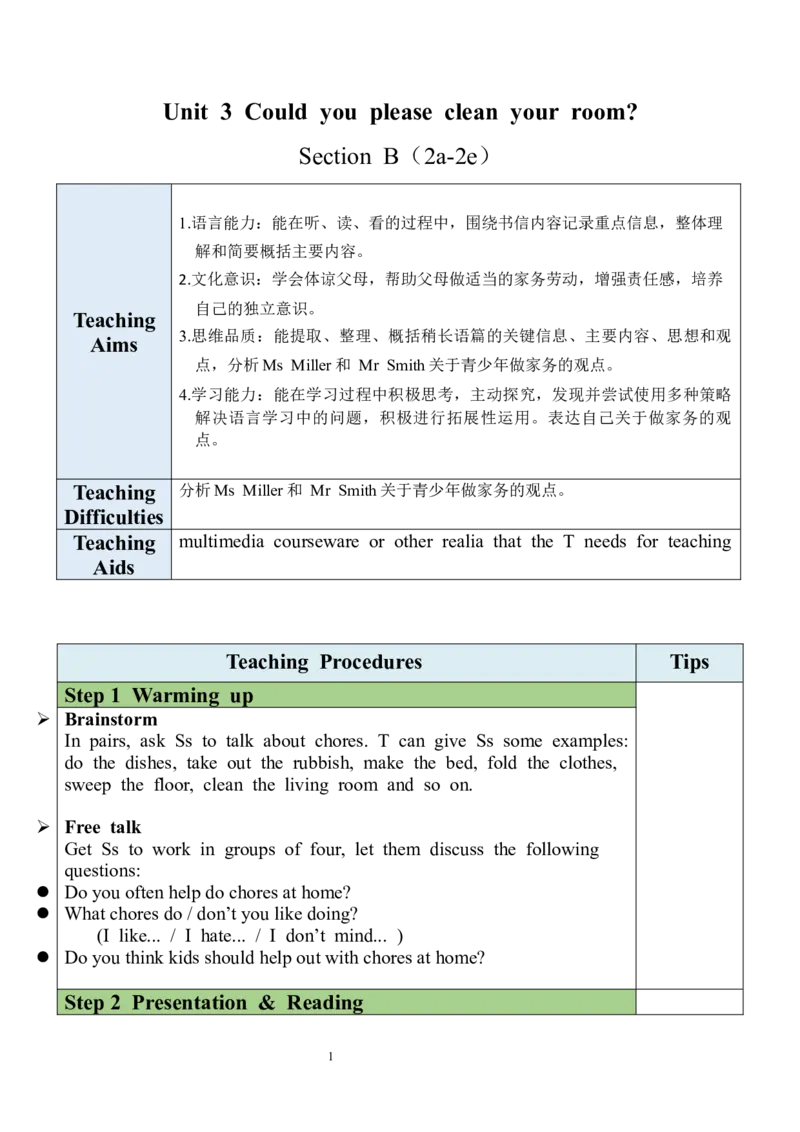
Unit 3 Could you please clean your room?
Section B(2a-2e)
1.语言能力:能在听、读、看的过程中,围绕书信内容记录重点信息,整体理
解和简要概括主要内容。
2.文化意识:学会体谅父母,帮助父母做适当的家务劳动,增强责任感,培养
自己的独立意识。
Teaching
3.思维品质:能提取、整理、概括稍长语篇的关键信息、主要内容、思想和观
Aims
点,分析Ms Miller和 Mr Smith关于青少年做家务的观点。
4.学习能力:能在学习过程中积极思考,主动探究,发现并尝试使用多种策略
解决语言学习中的问题,积极进行拓展性运用。表达自己关于做家务的观
点。
Teaching 分析Ms Miller和 Mr Smith关于青少年做家务的观点。
Difficulties
Teaching multimedia courseware or other realia that the T needs for teaching
Aids
Teaching Procedures Tips
Step 1 Warming up
Brainstorm
In pairs, ask Ss to talk about chores. T can give Ss some examples:
do the dishes, take out the rubbish, make the bed, fold the clothes,
sweep the floor, clean the living room and so on.
Free talk
Get Ss to work in groups of four, let them discuss the following
questions:
Do you often help do chores at home?
What chores do / don’t you like doing?
(I like... / I hate... / I don’t mind... )
Do you think kids should help out with chores at home?
Step 2 Presentation & Reading
1Presentation
Pre-reading
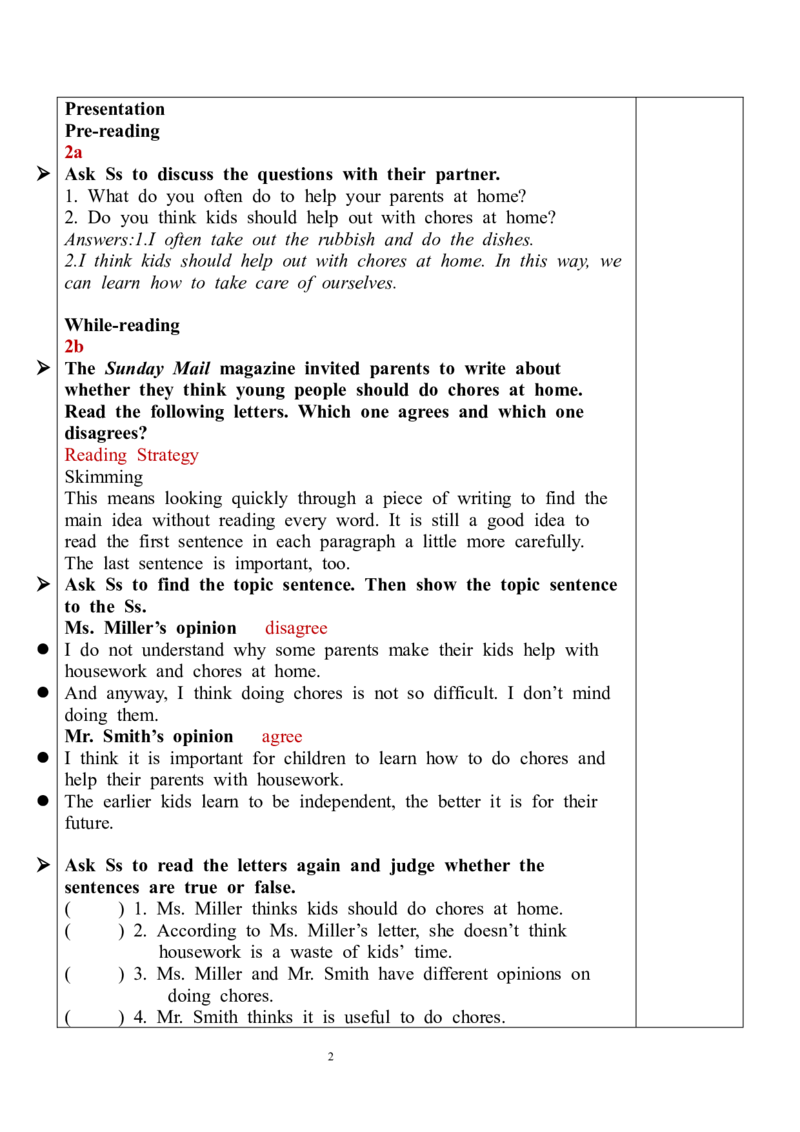
2a
Ask Ss to discuss the questions with their partner.
1. What do you often do to help your parents at home?
2. Do you think kids should help out with chores at home?
Answers:1.I often take out the rubbish and do the dishes.
2.I think kids should help out with chores at home. In this way, we
can learn how to take care of ourselves.
While-reading
2b
The Sunday Mail magazine invited parents to write about
whether they think young people should do chores at home.
Read the following letters. Which one agrees and which one
disagrees?
Reading Strategy
Skimming
This means looking quickly through a piece of writing to find the
main idea without reading every word. It is still a good idea to
read the first sentence in each paragraph a little more carefully.
The last sentence is important, too.
Ask Ss to find the topic sentence. Then show the topic sentence
to the Ss.
Ms. Miller’s opinion disagree
I do not understand why some parents make their kids help with
housework and chores at home.
And anyway, I think doing chores is not so difficult. I don’t mind
doing them.
Mr. Smith’s opinion agree
I think it is important for children to learn how to do chores and
help their parents with housework.
The earlier kids learn to be independent, the better it is for their
future.
Ask Ss to read the letters again and judge whether the
sentences are true or false.
( ) 1. Ms. Miller thinks kids should do chores at home.
( ) 2. According to Ms. Miller’s letter, she doesn’t think
housework is a waste of kids’ time.
( ) 3. Ms. Miller and Mr. Smith have different opinions on
doing chores.
( ) 4. Mr. Smith thinks it is useful to do chores.
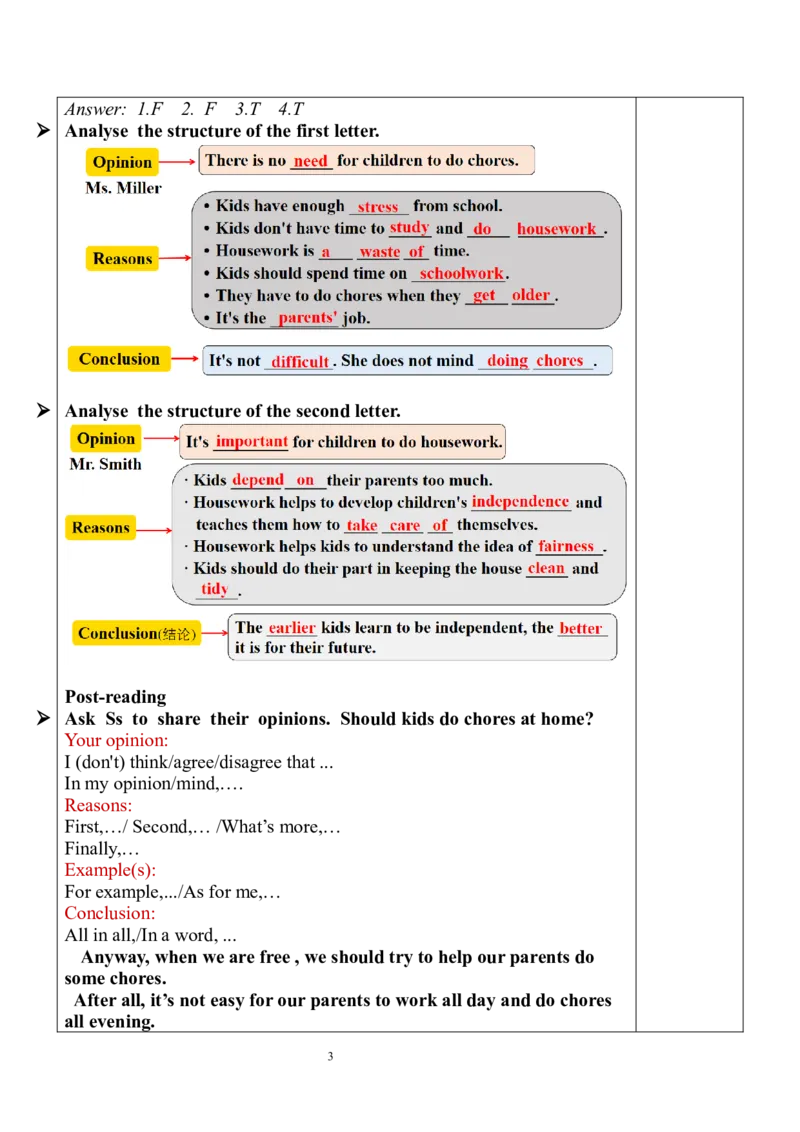
2Answer: 1.F 2. F 3.T 4.T
Analyse the structure of the first letter.
Analyse the structure of the second letter.
Post-reading
Ask Ss to share their opinions. Should kids do chores at home?
Your opinion:
I (don't) think/agree/disagree that ...
In my opinion/mind,….
Reasons:
First,…/ Second,… /What’s more,…
Finally,…
Example(s):
For example,.../As for me,…
Conclusion:
All in all,/In a word, ...
Anyway, when we are free , we should try to help our parents do
some chores.
After all, it’s not easy for our parents to work all day and do chores
all evening.
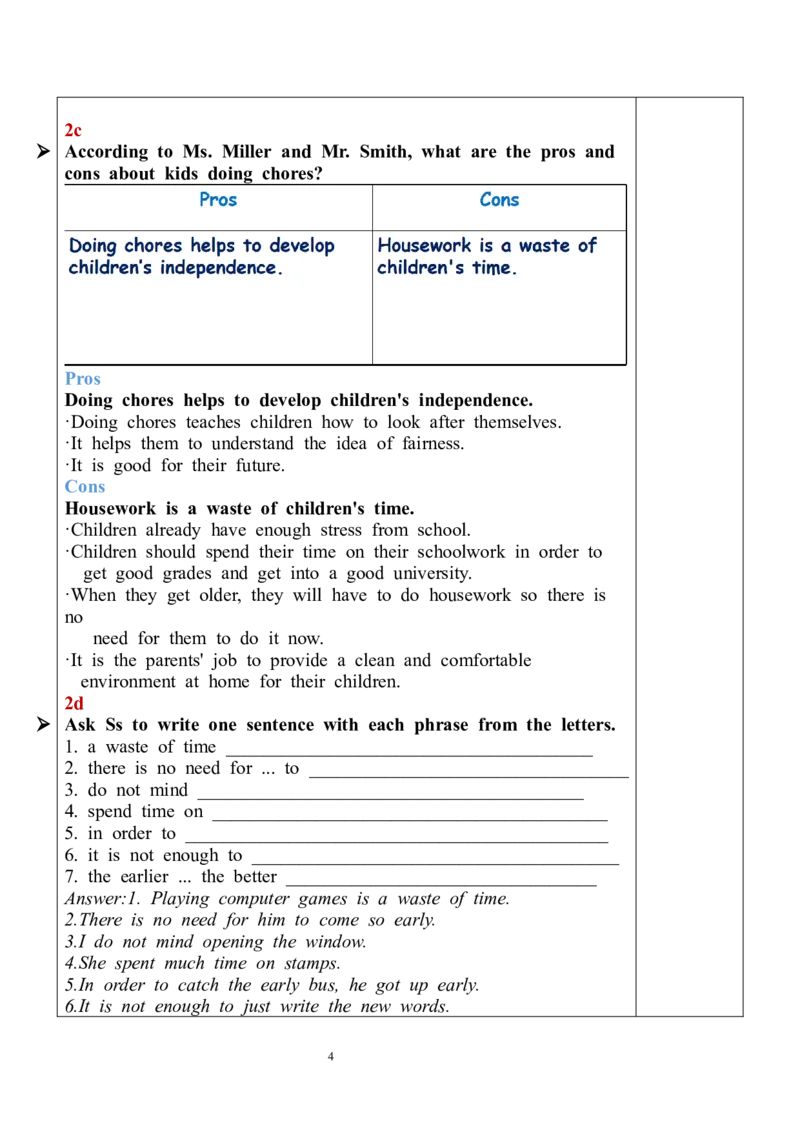
32c
According to Ms. Miller and Mr. Smith, what are the pros and
cons about kids doing chores?
Pros
Doing chores helps to develop children's independence.
·Doing chores teaches children how to look after themselves.
·It helps them to understand the idea of fairness.
·It is good for their future.
Cons
Housework is a waste of children's time.
·Children already have enough stress from school.
·Children should spend their time on their schoolwork in order to
get good grades and get into a good university.
·When they get older, they will have to do housework so there is
no
need for them to do it now.
·It is the parents' job to provide a clean and comfortable
environment at home for their children.
2d
Ask Ss to write one sentence with each phrase from the letters.
1. a waste of time _______________________________________
2. there is no need for ... to __________________________________
3. do not mind _________________________________________
4. spend time on __________________________________________
5. in order to _____________________________________________
6. it is not enough to _______________________________________
7. the earlier ... the better _________________________________
Answer:1. Playing computer games is a waste of time.
2.There is no need for him to come so early.
3.I do not mind opening the window.
4.She spent much time on stamps.
5.In order to catch the early bus, he got up early.
6.It is not enough to just write the new words.
47.The earlier a child starts learning a new language, the better he
will be at it.
2e
Ask Ss to discuss the questions with a partner.
1. Which letter do you agree with? Why?
2. What would you say to the person who wrote the letter you
don't agree with?
Answer:1.I agree with the second letter. Because I think kids need
to do some chores at home in order to learn how to take care of
themselves.
2.Grades are not everything. Besides study, kids really need to learn some
basic life skills.
Step 3 Language points learning
1. I do not understand why some parents make their kids help with
housework and chores at home.
make sb. do sth. 使某人做某事
make sb. do sth. 为固定结构,其中sb.后接不带to的动词不定式作宾
语补足语。其否定形式为make sb. not do sth., 意为“使某人不要做某
事”。有此用法的词还有let, have。
Kids like reading stories which can make them laugh.
2. Kids these days already have enough stress from school.
stress n. 精神压力;心理负担
stress 作名词还可意为“强调;重要性”。
I think you should place more stress on the cost.我认为你应该更多的去
强调成本。
He stressed the importance of getting a good education.他强调了接受良
好教育的重要性。
拓展延伸:
stressful adj. 令人有压力的
stressed adj. 感到有压力的
It was a stressful time for all of us. 那是一个让我们所有人都感到压力
的时期。
I always feel stressed out.我总是感觉到压力很大。
3. They should spend their time on schoolwork in order to get good
grades and get into a good university.
spend time/money on sth. 在某事/物上花费时间/金钱
【易混辨析】spend, cost, take与pay均有“花费”的意思,区别如
5下:
例词 主语 宾语 常用结构
spend 人 时间或 sb. spend(s) some time/money on sth.
金钱 某人在某事/物上花费时间/金钱
sb. spend(s) some time/money doing sth.
某人花费时间/金钱做某事
cost 物 金钱 sth. cost(s) (sb.) some money
某物花费(某人)多少钱
take it或事 时间 it takes sb. some time to do sth.
物 做某事花费某人多长时间
(doing) sth. take(s) sb. some time
(做)某事花费某人多长时间
pay 人 金钱 sb. pay(s) some money for sth.
某人为某物付多少钱
in order to 目的是;为了
in order to表示目的,后接动词原形,其否定形式为in order not to。
In order to finish the report, he stayed up very late.
Jenny will get up earlier than usual in order to catch the first bus.
【拓展延伸】in order that也表示“为了”,其后接从句。有时可与
in order to进行转换。
He raised his voice in order that we could hear him clearly.
I worked hard in order that I could get good grades. = I worked hard in
order to get good grades.
4. So there is no need for them to do it now.
there is no need for sb. to do sth.对某人来说没有必要做……
It hardly rains here, so there is no need for me to buy an expensive
umbrella.
There is no need for them to explain the reason to anyone.
5. It's the parents' job to provide a clean and comfortable
environment at home for their children.
It's+名词+ to do sth. 其中it为形式主语,真正主语为to do sth.
It's everyone's duty to keep the environment clean and tidy.
provide v.提供
【相关短语】
provide sb. with sth.
provide sth. for sb. 为某人提供某物
6. And anyway, I think doing chores is not so difficult. 反正我觉得干
6家务也不太难。
anyway是个副词,置于句首时,其后常常用逗号与其他成分隔开。
意为“反正,仍然,依然”。
Sam didn’t get the job, but he is not unhappy because it didn’t pay well
anyway.
anyway还可以表示“不管怎样,无论如何”。
It’s just a cold. But anyway you should still see the doctor.
7. Since they live in one house with their parents, they should know
that everyone should do their part in keeping it clean and tidy.
do one's part in doing sth. 在某事上尽职责;尽本分
since conj. 因为;既然
prep., conj. & adv. 从……以后;自……以来
(1) since在此处作连词,意为“因为;既然”,引导原因状语从句,
常位于句首。
Since you don't know the boy, I'll ask someone else.
(2) since作连词,还可意为“从……以后;自……以来”,其引导的
时间状语从句常用一般过去时,主句多用现在完成时。
Mary has lived here since she was five.
(3) since作介词,意为“从……以后;自……以来”,后接表示时间
点的词或短语。
She has been here since three o'clock this morning.
(4) since作副词,意为“从……以后;自……以来”,常与现在完成
时连用。
She left here ten years ago, and I haven't seen her since.
8. The earlier kids learn to be independent, the better it is for their
future. 孩子们越早学会独立,对他们的未来就越好。
“the +比较级+......, the +比较级+...... ”表示“越……,就越……”。
如:
The more he explained, the better we understood.
他解释得越多,我们就理解得越透彻。
Step 4 Summary & Homework
Summary
Ask Ss to do the exercises from PPT P39-43.
Homework
Read and recite the new words and phrases.
Do the exercises in students’ book.
Teaching This is a period in which students do more practice in reading. The teacher
7should practice the students’ ability of reading quickly and efficiently.
While reading, help the students learn how to catch the main idea and the
Reflection most important ideas as quickly as they can by mind-mapping. They learn
some new words and new language items when they are finishing the tasks
and reading the article again and again.
8