Unit 3 Could you please clean your room ?
第三课时(分层作业)
基础达标
一、根据首字母填空
根据语境及所给首字母提示,补全所缺单词。
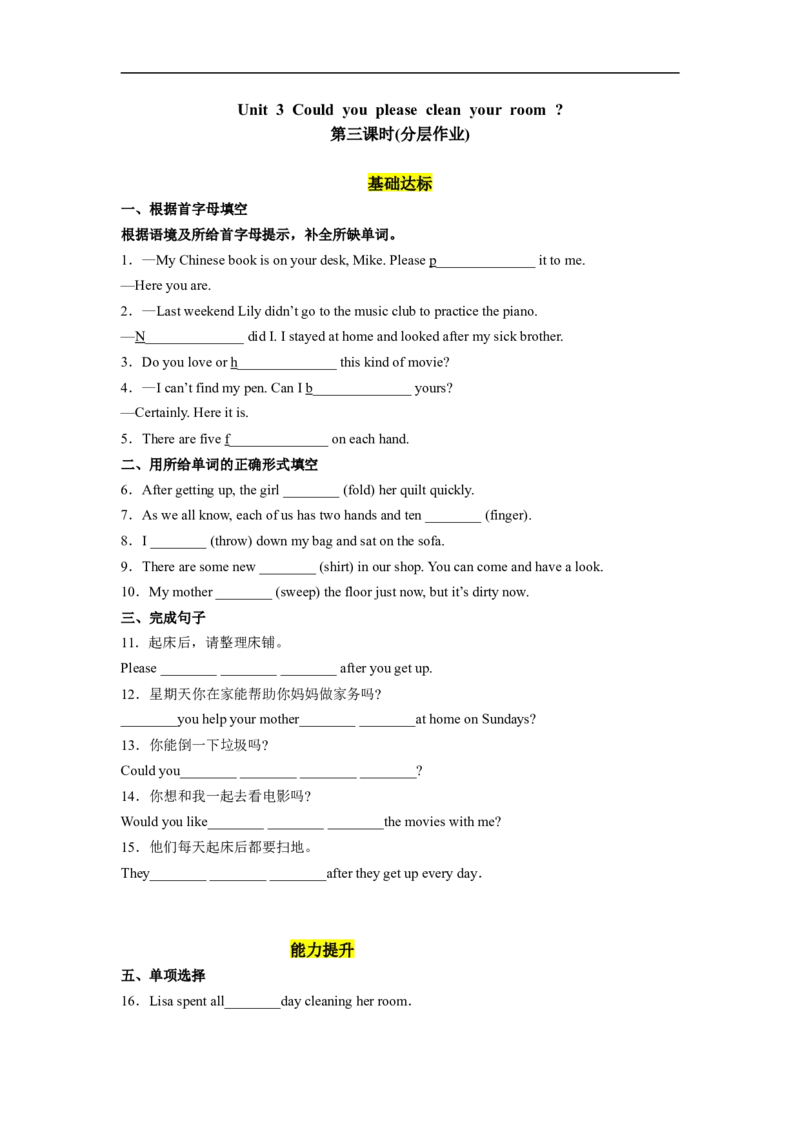
1.—My Chinese book is on your desk, Mike. Please p______________ it to me.
—Here you are.
2.—Last weekend Lily didn’t go to the music club to practice the piano.
—N______________ did I. I stayed at home and looked after my sick brother.
3.Do you love or h______________ this kind of movie?
4.—I can’t find my pen. Can I b______________ yours?
—Certainly. Here it is.
5.There are five f______________ on each hand.
二、用所给单词的正确形式填空
6.After getting up, the girl ________ (fold) her quilt quickly.
7.As we all know, each of us has two hands and ten ________ (finger).
8.I ________ (throw) down my bag and sat on the sofa.
9.There are some new ________ (shirt) in our shop. You can come and have a look.
10.My mother ________ (sweep) the floor just now, but it’s dirty now.
三、完成句子
11.起床后,请整理床铺。
Please ________ ________ ________ after you get up.
12.星期天你在家能帮助你妈妈做家务吗?
________you help your mother________ ________at home on Sundays?
13.你能倒一下垃圾吗?
Could you________ ________ ________ ________?
14.你想和我一起去看电影吗?
Would you like________ ________ ________the movies with me?
15.他们每天起床后都要扫地。
They________ ________ ________after they get up every day.
能力提升
五、单项选择
16.Lisa spent all________day cleaning her room.A.a B.an C.the D./
17.—My English is poor. Could you help me with it?
—________.
A.Thank you B.Me, too C.No problem D.See you
18.—Helen, could you please water the flowers in my garden?
—___________.They are so lovely.
A.That's too bad B.With pleasure C.You're welcome D.I'm afraid not
19. For kids of this age, two hours of sitting in a classroom ________ too long.
A.is B.are C.was D.were
20.John, please _________your dictionary from the schoolbag and look up the new word.
A.take away B.take up C.take off D.take out
21.—What does Tom’s newest smart phone look like?
—It’s wonderful! You can ________ it in half just like closing a book.
A.hand B.open C.fold D.cut
22.Love your parents __________ they are alive. Don't wait until it is too late.
A.while B.though C.because D.unless
23.—Will Tina come here by bike?
—No, she ________ riding a bike.
A.enjoys B.hates C.loves D.stands
24.—Can I____ Robinson Crusoe? Mrs Zhao.
—Sure, it’s very interesting, but you can only ____it for two weeks.
A.borrow; lend B.lend; borrow C.borrow; keep D.lend; keep
25.I will finish ________ the novel this afternoon. Then I will give it back to you.
A.read B.reading C.to read D.reads
26.—Can she play the guitar or the violin?
—________.But she can play the drums.
A.Both B.Either C.Neither D.All
27.—Could I________your iPad,Alice?
—Of course.Here you are.
A.lend B.bring C.borrow D.return
28.I will do some cleaning as soon as I my homework.
A.finish B.will finish C.has finished D.finished
29.—Will you go to the Universal Beijing Resort (环球度假区) this summer vacation?
—If you don’t, ________.
A.Neither do I. B.Neither I will. C.Neither will I. D.Neither I do.
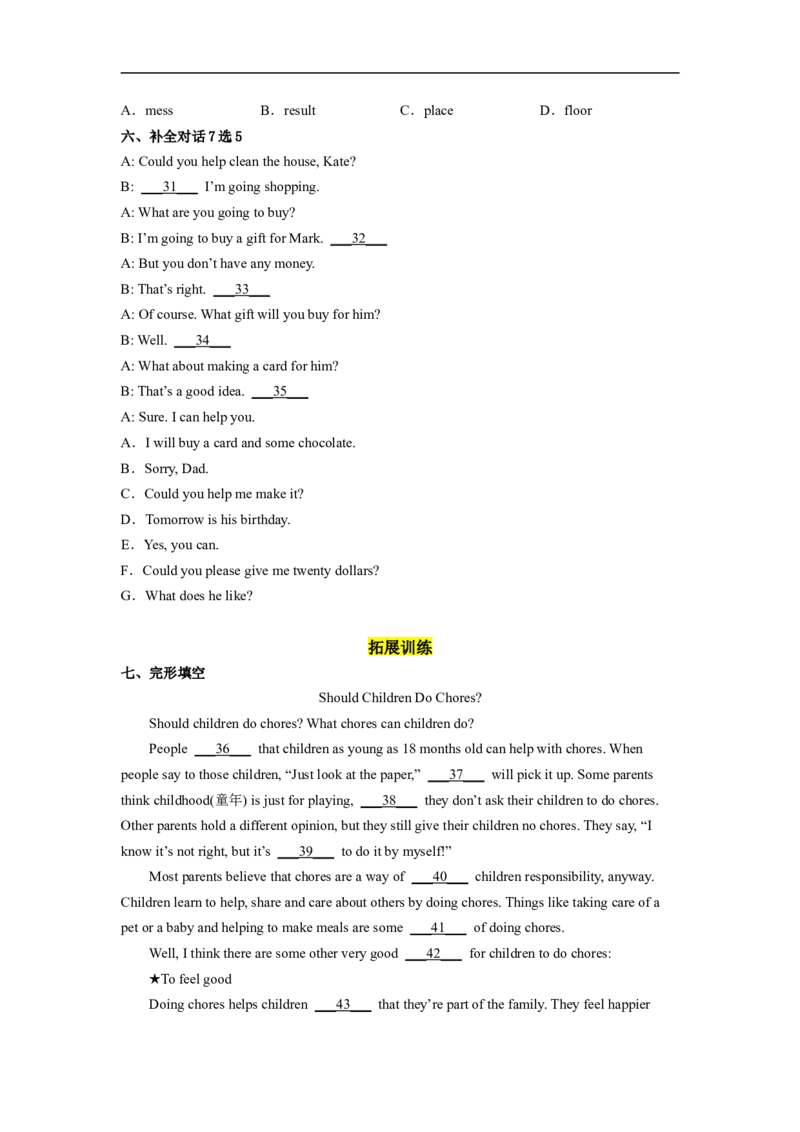
30.Tony, look at the books! What a ________! Put them away!A.mess B.result C.place D.floor
六、补全对话7选5
A: Could you help clean the house, Kate?
B: ___31___ I’m going shopping.
A: What are you going to buy?
B: I’m going to buy a gift for Mark. ___32___
A: But you don’t have any money.
B: That’s right. ___33___
A: Of course. What gift will you buy for him?
B: Well. ___34___
A: What about making a card for him?
B: That’s a good idea. ___35___
A: Sure. I can help you.
A.I will buy a card and some chocolate.
B.Sorry, Dad.
C.Could you help me make it?
D.Tomorrow is his birthday.
E.Yes, you can.
F.Could you please give me twenty dollars?
G.What does he like?
拓展训练
七、完形填空
Should Children Do Chores?
Should children do chores? What chores can children do?
People ___36___ that children as young as 18 months old can help with chores. When
people say to those children, “Just look at the paper,” ___37___ will pick it up. Some parents
think childhood(童年) is just for playing, ___38___ they don’t ask their children to do chores.
Other parents hold a different opinion, but they still give their children no chores. They say, “I
know it’s not right, but it’s ___39___ to do it by myself!”
Most parents believe that chores are a way of ___40___ children responsibility, anyway.
Children learn to help, share and care about others by doing chores. Things like taking care of a
pet or a baby and helping to make meals are some ___41___ of doing chores.
Well, I think there are some other very good ___42___ for children to do chores:
★To feel good
Doing chores helps children ___43___ that they’re part of the family. They feel happierwhen they do something meaningful for the family.
★To learn some skills
Children will learn ___44___ to cook, clean and do other things in the house. These life
skills will serve them well throughout(贯穿整个时期) their lives.
All in all, doing chores is good ____45____ children to grow up. So start to help your
parents with chores. Act now!
36.A.hope B.find C.wonder
37.A.you B.he C.they
38.A.though B.so C.because
39.A.happier B.luckier C.quicker
40.A.making B.teaching C.allowing
41.A.examples B.messages C.preparations
42.A.steps B.activities C.reasons
43.A.dream B.imagine C.understand
44.A.why B.how C.when
45.A.for B.of C.with
八、阅读单选
When you finish some chores at home, will your parents give you a reward(奖励)? It is
common for parents to do that. But some people do not think it is a good idea.
One of them is Susie Walton, an education expert. She believes if kids get rewards, they will
think that housework is not worth doing unless they get something in return. Kids won’t sweep the
floor if they see it is dirty. But they will if their parents reward them for it. Walton also says, “A
home is a living place for everyone in the family. It’s important for kids to see that we all should
play our part in keeping our home clean.”
Other people don’t think so. They believe that rewards encourage kids to do more chores.
Rewarding them also teaches them real world lessons. They can learn that they need to work to
make money. Now, there are also mobile phone apps like ChoreMonster. With the app, kids get
points after doing chores. After getting some points, they can do something they like. For example,
parents will allow them to play video games for half an hour if they get 80 points.
So each side seems to have their own reasons. Whether you give children rewards depends on
your own ideas. Maybe you have better ways to solve this problem.
46.Which of the following is Susie Walton’s opinion?
A.Don’t ask kids to do housework. B.Don’t give kids rewards for doing chores.
C.Don’t allow kids to play computer games. D.Don’t let children play a part in doing chores.
47.What do people want to teach kids by giving kids rewards for doing chores?A.People need to work to make money. B.Doing chores is a good way to make money.
C.They can only be allowed to watch TV by doing chores.
D.They must share housework because they live in the same house.
48.Which idea may the writer agree with?
A.Parents should give rewards to let their kids do chores.
B.Kids should offer to help with chores at home.
C.Apps are better choices for parents than money.
D.We don’t know what’s the best way to get kids helping.
参考答案:
1.pass 2.Neither 3.hate 4.borrow 5.fingers
【解析】1.句意:——我的语文书在你的桌子上,迈克。请把它递给我。——给你。
分析句意及首字母提示可知,此处表示“传递”的含义,用英语表达是pass,此处用于祈
使句中,所以用动词原形即可。故填pass。
2.句意:——上个周末莉莉没有去音乐俱乐部练钢琴。——我也没有。我待在家里照顾生
病的弟弟。
根据句意及首字母提示可知,此处表示否定的含义,构成“neither+助动词+主语”结构,
用于句首需大写首字母。故填Neither。
3.句意:你喜欢还是讨厌这类电影?
分析句意及首字母提示可知,此处表示“讨厌”的含义,用英语表达是hate,此处与love
构成并列结构,所以用动词原形即可。故填hate。
4.句意:——我找不到我的钢笔了。我可以借用你的吗?——给你。
分析句意及首字母提示可知,此处表示“借用”的含义,用英语表达是borrow,此处用于
情态动词Can之后,所以用动词原形即可。故填borrow。
5.句意:每只手上有五个手指。
分析句意及首字母提示可知,此处表示“手指”的含义,用英语表达是finger,此处用于five之后,所以用其名词复数形式。故填fingers。
6.folded
【详解】句意:起床后,那女孩迅速叠好被子。根据前文“After getting up”可知事情发生
在起床后应为一般过去时,所以谓语动词用过去式。又因为“fold”规则变化,直接加ed。
故填folded。
7.fingers
【详解】句意:众所周知,我们每个人都有两只手,十根手指。finger意为“手指”,
“十根手指”则需用其复数形式,故填fingers。
8.threw
【详解】句意:我把书包扔下坐在沙发上。“throw”是动词,表示“扔”。根据“sat”可知
句子讲述过去发生的动作,是一般过去时,谓语动词用过去式“threw”。故填threw。
9.shirts
【详解】句意:我们店里有些新衬衫。你可以过来看看。根据前文“There are some”可知
此处要填可数名词复数,故填shirts。
10.swept
【详解】句意:我妈妈刚才扫了地,但现在很脏。根据“just now”可知,句子是一般过去
时,动词用过去式,故填swept。
11. make your bed
【详解】整理床铺:make one’s bed;根据after引导的时间状语从句的主语“you”可知,
one’s用形容词性的物主代词your;根据句首Please提示可知,句子是祈使句,动词应用原
形。故填make;your;bed。
12.Could:do chores/housework
【详解】一般疑问句用could开头,表示礼貌,动词help后接动词原形或动词不定式。
“做家务”为do chores/housework。
13.take out the trash/rubbish
【详解】“倒垃圾”为take out the trash/rubbish。
14.to go to
【详解】短语“去看电影”go to the movies;另外,Would you like to do…?用来提建议。
15.sweep the floor
【详解】“扫地”为sweep the floor。
16.D【详解】all day意为“一整天”,该短语中不必加冠词。
17.C
【详解】句意:——我的英语很差。你能帮我吗?——没问题。
考查情景交际。Thank you谢谢你;Me, too我也是; No problem没问题;See you再见。
根据“Could you help me with it?”可知上文是请求帮助,下文是“No problem”没问题回答。
故选C。
18.B
【详解】句意:——海伦,你能给我花园里的花浇水吗?——很乐意。它们太可爱了。
考查情景交际。That’s too bad那太糟糕了;With pleasure很乐意;You’re welcome不客气;
I’m afraid not恐怕不行;根据句意理解及后句They are so lovely.可知,这里是同意帮忙,表
示“乐意效劳”,故选B。
19.A
【详解】句意:对于这个年龄的孩子来说,坐在教室两个小时太长了。
考查be动词。根据句意这里叙述的是客观的真实情况,应该用一般现在时。two hours of
sitting in a classroom表示一段时间,用作主语时,谓语动词该用第三人称单数形式。故选
A。
20.D
【详解】句意:约翰,请从书包里拿出你的字典来查这个新单词。考查动词短语。A. take
away拿走、带走;B. take up占据、开始从事;C. take off起飞、脱下;D. take out取出、
拿出。根据语境:请…你的字典从你的书包里来查这个新单词,可知此处表达的是“取出、
拿出”,结合选项可知D选项符合题意,故答案选D。
21.C
【详解】句意:——汤姆的最新版的智能手机是什么样子的?——它很棒!你可以像合上
一本书一样把它折叠起来。
考查动词辨析。hand“递,交”;open“打开”;fold“折叠”;cut“切”。根据“just like
closing a book”可知,你可以把它折叠起来,fold“折叠”。故选C。
22.A
【详解】句意:爱你的父母吧,趁他们还健在。不要等到为时已晚。
考查连词辨析。while当……的时候,表时间;though尽管,表让步;because因为,表原
因;unless除非,表条件。本句是时间状语从句,根据句意结构,可知选A。
23.B【详解】句意:——缇娜会骑自行车来这里吗?——不,她讨厌骑自行车。
考查动词辨析。enjoy喜欢;hate讨厌;love热爱;stand站立。不会骑自行车来这里,应该
是讨厌骑自行车,hate doing sth.讨厌做某事,故选B。
24.C
【详解】句意:——我可以借《鲁宾逊漂流记》吗?——当然,它很有趣,但是你只能借
两个星期。
考查动词辨析。borrow借入,短暂性动词;lend借出,短暂性动词;keep保持,这里强调
保管,延续性动词。Can I borrow Robinson Crusoe? 强调借入,所以前句用borrow;后句句
中for two weeks是一段持续的时间,第二个空需用延续性动词keep.故选C。
25.B
【详解】句意:今天下午我将读完这本小说。然后我就把它还给你。
考查非谓语动词。finish doing sth.做完某事,此处用动名词形式reading作宾语。故选B。
26.C
【详解】本题考查both,either,neither的辨析。结合答语中的“但是她会敲鼓”可知,她
不会弹吉他,也不会拉小提琴,故neither“两者都不”符合题意。
27.C
【详解】结合本题情景可知,说话人想借Alice的iPad,故答案为C。
28.A
【详解】句意:我一完成我的作业,我就打扫卫生。根据as soon as 一 ---就---,引导时间
状语从句,当主句是一般将来时态时,从句不用将来时态,用一般现在时态代替;故选
A。
29.C
【详解】句意:——今年暑假你会去北京环球度假区吗?——如果你不去,我也不去
考查倒装句和时态。Neither+助动词+主语,表示“……也不”;Neither+主语+主语,表示
“……的确不”。if引导的条件状语从句用一般现在时,主句用一般将来时,排除A项。
结合句意,表示你不去,我也不去,故选C。
30.A
【详解】句意:Tony,看这些书,太乱了,请把它们整理一下。
考查名词辨析。mess杂乱;result结果;place地方;floor地板。根据“Put them away!”可
知,书很乱。what a mess“真是一团糟”。故选A。
31.B 32.D 33.F 34.A 35.C【分析】本文是Kate想出去购物给Mark买一个生日礼物,爸爸答应给Kate二十美元以及
帮她做一张卡片。
31.根据“Could you help clean the house”及“I’m going shopping”可知,要去购物所以不能
帮忙打扫房间,B选项“抱歉,爸爸”符合,故选B。
32.根据“I’m going to buy a gift for Mark”可知,此处解释为什么要给他买礼物,D选项
“明天是他的生日”符合,故选D。
33.根据“But you don’t have any money”及“Of course”可知,没有钱所以要向对方借一点,
F选项“你可以给我二十美元吗”符合,故选F。
34.根据“What gift will you buy for him”可知,此处应回答打算买什么礼物,A选项“我
要买一张卡片和一些巧克力”符合,故选A。
35.根据“Sure. I can help you”可知,此处应询问对方是否可以帮忙做某事,C选项“你可
以帮我做它吗”符合,故选C。
36.B 37.C 38.B 39.C 40.B 41.A 42.C 43.C 44.B 45.A
【分析】文章首先讲述了不同的人对孩子做家务的看法,之后介绍了孩子做家务的好处。
36.句意:人们发现十八个月大的孩子可以帮助做家务。
hope希望;find发现;wonder好奇。根据“When people say to those children, “Just look at
the paper,”…will pick it up”可知这是人们发现的现象。故选B。
37.句意:当人们对这些孩子说“看这张纸”,他们会把纸捡起来。
you你;he他;they他们。根据“When people say to those children, “Just look at the
paper,”…will pick it up”可知此处指“those children”,代词用they。故选C。
38.句意:一些父母认为童年是玩耍的时间,所以他们不让他们的孩子做家务。
though虽然;so所以;because因为。根据“Some parents think childhood(童年) is just for
playing,…they don’t ask their children to do chores”可知前后句是因果关系,用so引导。故选
B。
39.句意:我知道这是不对的,但是自己做更快。
happier更快乐;luckier更幸运;quicker更快。根据“Other parents hold a different opinion,
but they still give their children no chores …I know it’s not right, but it’s…to do it by myself”以
及常识可知,虽然家长觉得应该让孩子做家务,但是他们觉得自己做会更快。故选C。40.句意:大部分的家长认为家务是教孩子们负起责任的一种方式。
making制作;teaching教;allowing允许。根据“Children learn to help, share and care about
others by doing chores.”可知孩子通过家务会学到很多东西,所以做家务能够教孩子这些东
西。故选B。
41.句意:像照顾宠物或婴儿、帮助做饭等这些事情都是做家务的一些例子。
examples例子;messages信息;preparations准备。根据“Things like taking care of a pet or a
baby and helping to make meals are some…of doing chores”可知这些事情都是做家务的一些例
子。故选A。
42.句意:我认为孩子们做家务还有一些其他的好理由。
steps步骤;activities活动;reasons理由。根据下文的描述可知,这些都是孩子们要做家务
的理由。故选C。
43.句意:做家务帮助孩子们理解自己是家庭的一部分。
dream梦想;imagine想象;understand理解。根据“Doing chores helps children…that they’re
part of the family. They feel happier when they do something meaningful for the family”可知做家
务能让孩子理解自己是家庭的一部分。故选C。
44.句意:孩子们将学习如何做饭、打扫和做其他事情。
why为什么;how如何;when什么时候。根据“Children will learn…to cook”可知此处指学
习怎么做饭。故选B。
45.句意:总的来说,做家务对孩子们的成长有好处。
for对于;of……的;with和。be good for…“对……有好处”,固定搭配。故选A。
46.B 47.A 48.D
【导语】本文从正反两方面讨论了孩子帮忙做家务是否应获得奖励。
46.推理判断题。根据第二段“She believes if kids get rewards, they will think that housework
is not worth doing unless they get something in return”Susie Walton认为如果孩子们做家务给奖
励,他们就不会主动做家务,除非获得回报,Susie Walton的观点是孩子做家务不要给奖励。
故选B。
47.细节理解题。根据第三段“They can learn that they need to work to make money”可知,
人们想通过孩子做家务给奖励来教孩子——需要工作赚钱。故选A。
48.观点态度题。根据最后一段“So each side seems to have their own reasons. Whether you
give children rewards depends on your own ideas. Maybe you have better ways to solve thisproblem.”可知孩子做家务是否给奖励取决于自己的想法,由此推出我们不知道让孩子帮忙
的最佳方式是什么。故选D。