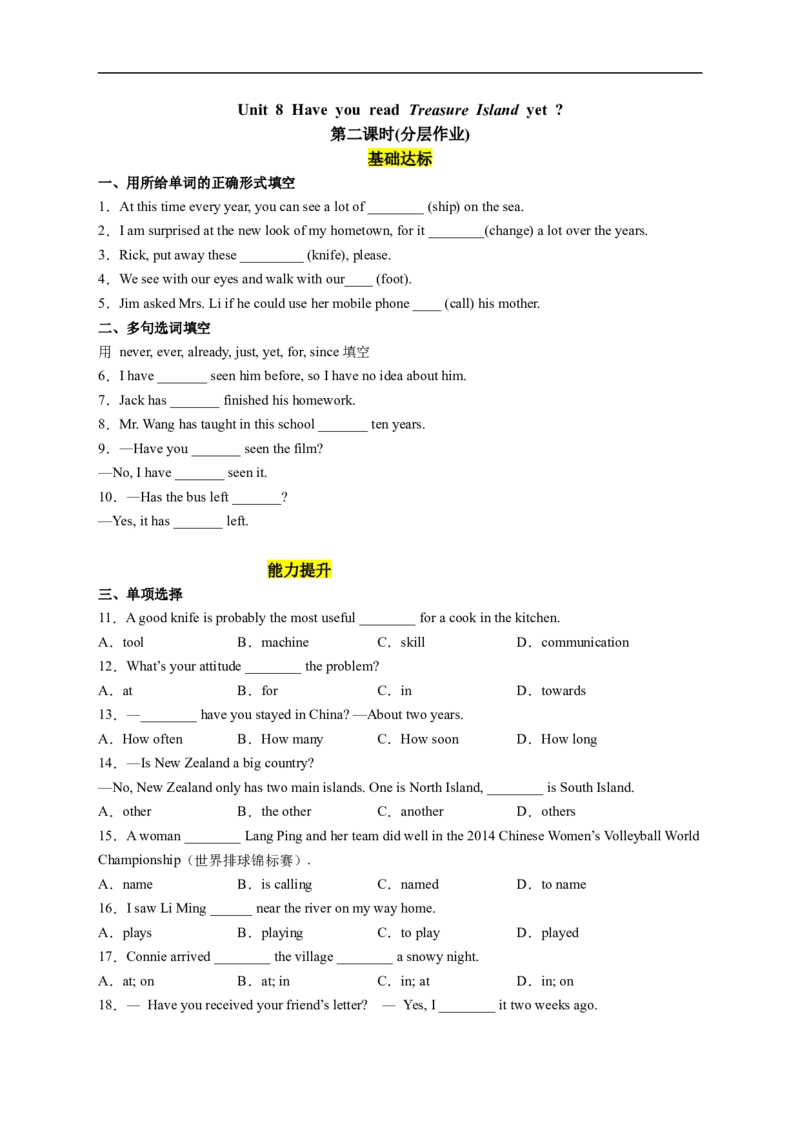
Unit 8 Have you read Treasure Island yet ?
第二课时(分层作业)
基础达标
一、用所给单词的正确形式填空
1.At this time every year, you can see a lot of ________ (ship) on the sea.
2.I am surprised at the new look of my hometown, for it ________(change) a lot over the years.
3.Rick, put away these _________ (knife), please.
4.We see with our eyes and walk with our____ (foot).
5.Jim asked Mrs. Li if he could use her mobile phone ____ (call) his mother.
二、多句选词填空
用 never, ever, already, just, yet, for, since填空
6.I have _______ seen him before, so I have no idea about him.
7.Jack has _______ finished his homework.
8.Mr. Wang has taught in this school _______ ten years.
9.—Have you _______ seen the film?
—No, I have _______ seen it.
10.—Has the bus left _______?
—Yes, it has _______ left.
能力提升
三、单项选择
11.A good knife is probably the most useful ________ for a cook in the kitchen.
A.tool B.machine C.skill D.communication
12.What’s your attitude ________ the problem?
A.at B.for C.in D.towards
13.—________ have you stayed in China? —About two years.
A.How often B.How many C.How soon D.How long
14.—Is New Zealand a big country?
—No, New Zealand only has two main islands. One is North Island, ________ is South Island.
A.other B.the other C.another D.others
15.A woman ________ Lang Ping and her team did well in the 2014 Chinese Women’s Volleyball World
Championship(世界排球锦标赛).
A.name B.is calling C.named D.to name
16.I saw Li Ming ______ near the river on my way home.
A.plays B.playing C.to play D.played
17.Connie arrived ________ the village ________ a snowy night.
A.at; on B.at; in C.in; at D.in; on
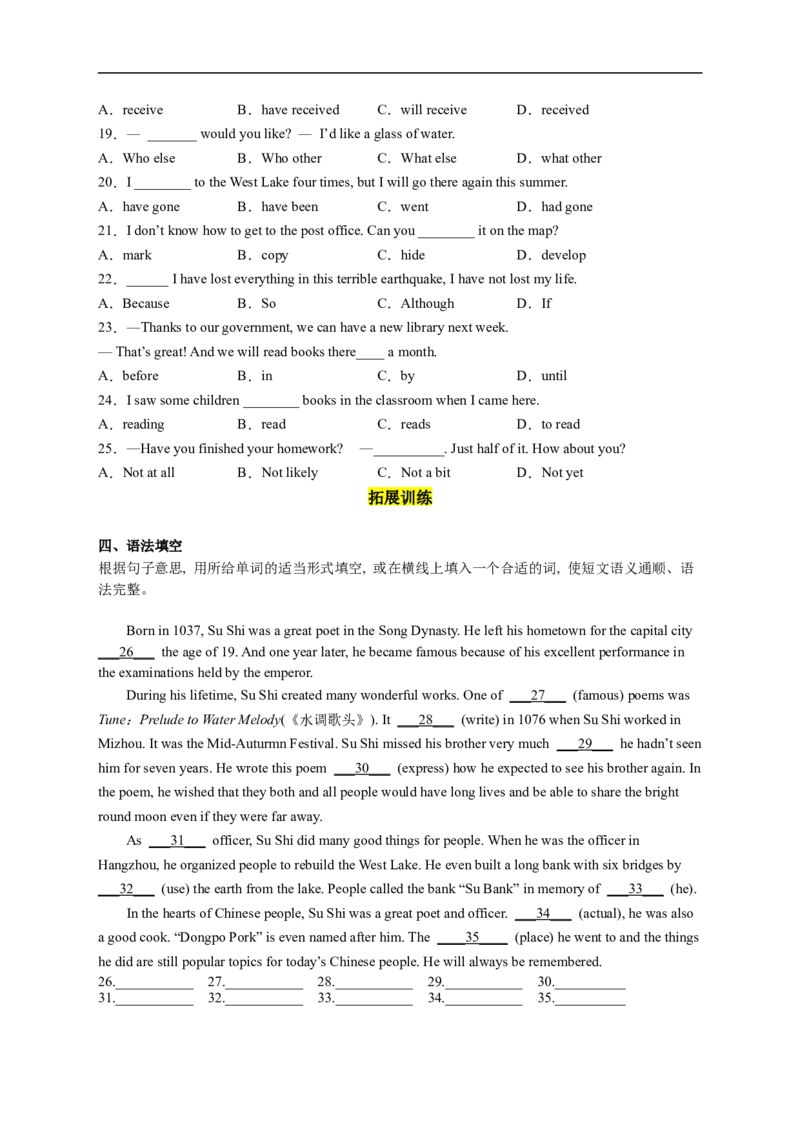
18.— Have you received your friend’s letter? — Yes, I ________ it two weeks ago.A.receive B.have received C.will receive D.received
19.— _______ would you like? — I’d like a glass of water.
A.Who else B.Who other C.What else D.what other
20.I ________ to the West Lake four times, but I will go there again this summer.
A.have gone B.have been C.went D.had gone
21.I don’t know how to get to the post office. Can you ________ it on the map?
A.mark B.copy C.hide D.develop
22.______ I have lost everything in this terrible earthquake, I have not lost my life.
A.Because B.So C.Although D.If
23.—Thanks to our government, we can have a new library next week.
— That’s great! And we will read books there____ a month.
A.before B.in C.by D.until
24.I saw some children ________ books in the classroom when I came here.
A.reading B.read C.reads D.to read
25.—Have you finished your homework? —__________. Just half of it. How about you?
A.Not at all B.Not likely C.Not a bit D.Not yet
拓展训练
四、语法填空
根据句子意思, 用所给单词的适当形式填空, 或在横线上填入一个合适的词, 使短文语义通顺、语
法完整。
Born in 1037, Su Shi was a great poet in the Song Dynasty. He left his hometown for the capital city
___26___ the age of 19. And one year later, he became famous because of his excellent performance in
the examinations held by the emperor.
During his lifetime, Su Shi created many wonderful works. One of ___27___ (famous) poems was
Tune:Prelude to Water Melody(《水调歌头》). It ___28___ (write) in 1076 when Su Shi worked in
Mizhou. It was the Mid-Auturmn Festival. Su Shi missed his brother very much ___29___ he hadn’t seen
him for seven years. He wrote this poem ___30___ (express) how he expected to see his brother again. In
the poem, he wished that they both and all people would have long lives and be able to share the bright
round moon even if they were far away.
As ___31___ officer, Su Shi did many good things for people. When he was the officer in
Hangzhou, he organized people to rebuild the West Lake. He even built a long bank with six bridges by
___32___ (use) the earth from the lake. People called the bank “Su Bank” in memory of ___33___ (he).
In the hearts of Chinese people, Su Shi was a great poet and officer. ___34___ (actual), he was also
a good cook. “Dongpo Pork” is even named after him. The ____35____ (place) he went to and the things
he did are still popular topics for today’s Chinese people. He will always be remembered.
26.___________ 27.___________ 28.___________ 29.___________ 30.__________
31.___________ 32.___________ 33.___________ 34.___________ 35.__________五、完形填空
One night, a little swallow flew over the city. He was very ___36___ and wanted to have a good
sleep in the city. When he saw the Statue of the Happy Prince (王子), he flew down and got ready to sleep
___37___ the feet of the Happy Prince.
Just as he was putting his head under his wing, some ___38___ fell on him. He thought it was
raining. But when he looked ___39___, he found the sky was ___40___ clear and bright that he could
see lots of stars. Suddenly, he saw some tears were running down the Prince’s golden ___41___
“___42___ are you crying?” asked the swallow.
“In a little street, there’s a poor house. From one of the windows, I see a woman ___43___ at a
table. She’s sewing clothes for ___44___ women to wear. In a bed in the corner of the room, her little
boy is sick. He’s asking for oranges, but his mother has only water to give him, so he is crying. The boy is
so thirsty ____45____ the mother is so sad. Little swallow, will you please take her the ____46____
from the top of my sword (宝剑)?”
“It is very cold here and I am leaving for a warm place, but I will stay with you and do as you ask.”
The swallow took the bright red jewel from the Prince’s sword and flew away with it in his mouth.
He flew into the woman’s room and ____47____ it beside the woman’s needle.
____48____ he flew back, he told the Prince what he had done. “It ‘s strange,” he added, “It’s so
cold but I feel quite ____49____ now.”
“That’s ____50____ you have done a good thing,” said the Prince. The little swallow began to think
about this, and then he fell asleep.
36.A.hungry B.tired C.angry D.sad
37.A.among B.above C.below D.between
38.A.water B.snow C.grass D.milk
39.A.at B.down C.up D.for
40.A.quite B.so C.such D.very
41.A.ear B.feet C.hair D.face
42.A.Where B.How C.When D.Why
43.A.sitting B.eating C.drinking D.cooking
44.A.poor B.rich C.young D.old
45.A.but B.or C.and D.so
46.A.jewel B.orange C.gold D.diamond
47.A.forgot B.took C.got D.put
48.A.Before B.After C.Till D.While
49.A.cold B.hot C.warm D.cool
50.A.because B.though C.if D.whether
六、阅读单选Once a man was shipwrecked(遭遇海难) on a small, lonely island. There was no one living on this
island, so he hoped that someone could come to save him. Every day he watched the horizon(地平线), but
no ships ever appeared. The man grew sad.
He thought he should do something to save himself. He built a little house out of wood for shelter.
But one day, after looking for food, he arrived home to find his little house on fire. The smoke rose to the
sky. The worst thing happened and everything was lost. He was full of sadness and anger. “God, how
could you do this to me?” he cried.
Early the next day, however, he was woken up by the sound of a ship. The ship was coming near to
the island. It had come to save him.
“How did you know I was here?” the man asked these people. “We saw your smoke signal(信号),”
they answered.
It is easy to get discouraged when things are going badly. But we shouldn′t lose heart, because hope
is at work in our lives. Remember, next time your little house is burning to the ground, it just may be a
smoke signal that brings better luck.
51.Why did the man stay on this island?
A.He tried to test his skills to live here. B.His ship had an accident at sea.
C.He liked the beauty of this island. D.His friends left him on this island.
52.What did the man do on this island?
A.He did nothing but worry every day. B.He tried his best to call for help.
C.He built a house to save himself. D.He did something to enjoy himself there.
53.The underlined word “discouraged” means “ ” in Chinese.
A.勇敢的 B.气馁的 C.激动的 D.易怒的
54.Those people found the man because .
A.he made a fire as a signal to call for help B.they found some food on this island
C.they saw his little house on the island D.a fire happened on the island
55.What does the story tell us?
A.A bad thing can turn into a good one. B.Accidents always mean good luck.
C.Everything can go well in the end. D.Saving yourself is better than asking for help.
参考答案:
1.ships
【详解】句意:每年的这个时候,你可以在海上看到很多船。ship“船”,可数名词,a lot of修饰
可数名词的复数形式,故填ships。
2.has changed
【详解】句意:我对家乡的新面貌感到惊讶,因为这些年来它已经改变了很多。根据“over theyears”可知,句子用现在完成时,结构为have/has done,主语it是第三人称单数,助动词用has,
故填has changed。
3.knives
【详解】句意:Rick,请把这些小刀收起来。knife小刀,是一个名词。由空前的“these”“这些”
可知,这里应用名词复数形式。故填knives。
4.feet
【详解】句意:我们用眼睛看东西,用脚走路。foot脚,人有两只脚,因此用复数形式,foot的复
数形式是feet,故填feet。
5.to call
【详解】句意:吉姆问李太太他是否可以用她的手机给他妈妈打电话。固定搭配:use sth to do
sth“用某物做某事”,空处应用动词不定式,故填to call。
6.never 7.already 8.for 9. ever never 10. yet just
【解析】6.句意:我以前从未见过他,所以对他一无所知。根据语境“I have no idea about him.”
可知,我“从来没有”见过他。故填never。
7.句意:杰克已经完成了作业。这里是肯定句,表示“已经”。故填already。
8.句意:王先生已经在这所学校教书十年了。“ten years”是时间段,所以用for引导时间段。故
填for。
9.句意:——你看过这部电影吗?——没有,我没见过。第一个空表示“曾经”,所以是ever;
第二个空根据回答“No”可知,表示“从来没有”看过,所以是never。故填ever;never。
10.句意:——公共汽车已经离开了吗?——是的,它刚刚离开。第一个空表示“已经”且是疑
问句,所以是yet;第二个空根据回答“Yes”可知,表示肯定,结合备选词汇,just“刚刚”离开符
合题意。故填yet;just。
11.A
【详解】句意:一把好刀可能是厨房里厨师最有用的工具。
考查名词辨析。tool工具;machine机器;skill技巧;communication交流。根据“A good knife”和
“for a cook”可知,一把好刀对厨师来说是最有用的工具。“工具”tool。故选A。
12.D
【详解】句意:对于这个问题你是什么态度呢?
考查介词辨析。at在;for为了;in在……里面;towards对着。根据“What’s your attitude ... the
problem?”可知,此处是指对于这个问题你是什么态度,the attitude towards意为“……的态度”,故选D。
13.D
【详解】句意:——你在中国待了多长时间?——大约两年。
考查疑问词组。How often多久一次;How many多少;How soon多久以后;How long多久。根据
“About two years.”可知问在中国待了多久,用How long提问。故选D。
14.B
【详解】句意:——新西兰是个大国吗?——不,新西兰只有两个主要岛屿,一个是北岛,另一
个是南岛。
考查代词词义辨析。other其它的;the other两者中的另一个;another多者中的另一个;others其它
的人或物;根据语境“has two main islands”可知,这里表示两者中的另一个,one…the other…“一
个……,另一个……”。故选B。
15.C
【详解】句意:一个叫做郎平的女人和她的团队在2014年中国女子世界排球锦标赛上打得很好。
考查非谓语动词。根据“did well in”可知,句子已有谓语动词,故空格处应用非谓语动词。结合选
项单词可知,“A woman”和“call”为被动关系,故此处应用named,在这里是过去分词作后置定
语。故选C。
16.B
【分析】
【详解】句意:回家的路上我看见李明正在河边玩。考查动词固定用法,see sb. do sth.看见某人做
了某事(的全过程); see sb. doing sth.看见某人正在做某事(强调该动作正在进行)。故答案选
B。
17.A
【详解】句意:Connie在一个下雪的晚上到达了这个村庄。
考查介词辨析。at 用作地点介词时,意为“在(某处)”,后接小地点;用作时间介词时,意为“在
(某时间或时刻)”,后接时刻点。in 用作地点介词时,意为“在(某处)”,后接大地点;用作时间介
词时,意为 “在(某时间)内”,后接上午、下午、晚上或表示月、季、年、世纪等较长的时间;
on用作方位介词时,意为“在……上”;用作时间介词时,意为“在(某一天) ”,后接具体某天的
上午、下午、晚上或具体日期、节假日、星期等。本题中 “the village”为小地点,第一个空应填
地点介词at;“a snowy night”为具体的某个晚上,第二个空应填时间介词on。故选A。
18.D
【详解】句意:——你收到你朋友的信了吗?——是的,我两周前收到的。考查一般过去时。receive收到,动词原形;have received已经收到,现在完成时结构;will receive
将收到,一般将来时结构;received收到,过去式。根据时间状语“two weeks ago”可知,是一般
过去时。故选D。
19.C
【详解】句意:——您还想要什么?——我想要一杯水。
考查特殊疑问句。Who else还有谁;Who other其他什么人;What else还有什么东西;what other
其他什么东西,other后需有名词。根据“I’d like a glass of water.”可知,还想要一杯水,因此应用
what else来提问“还要什么”。故选C。
20.B
【详解】句意:我去过西湖四次,但是今年夏天我将再去那里。
考查动词时态。根据“I...to the West Lake four times, but I will go there again this summer.”可知,我
已经去过西湖四次了,但今年夏天我还要去,but连接的两句为转折关系,时态为现在完成时,此
处表示“去过”用have been to表达。故选B。
21.A
【详解】句意:我不知道怎么到邮局。你能在地图上标记一下吗?
考查动词辨析。mark标记;copy复制;hide隐藏;develop发展。根据“...it on the map?”可知此处
指在地图上标记位置。故选A。
22.C
【详解】句意:虽然我在这次可怕的地震中丢掉了所有的东西,我没有丢掉我的生命。A.因为B.
所以C.虽然D.如果。这是一个让步状语从句,表示的是“虽然”我什么都丢了,“但是”我还有
自己的生命,不存在因果关系或是条件,排除ABD,表示让步选用although表示“虽然”,故选
C。
【点睛】注意although 与 though的用法区别,一、用作连词都表示“虽然”,两者大致同义,可
换用,只是 although比though更为正式。二、用作副词,although 一般不用作副词,而though可用
作副词,且一般放在句末(不放在句首),意为“可是”、“不过”。例句:It’s hard work; I enjoy it
though.工作很辛苦,可是我乐意干。三、用于习语,在as though (好像,仿佛), even though(即使,纵然)
等固定短语中不能用 although。
23.B
【详解】句意:——多亏了我们的政府,下周我们可以有一个新图书馆。 ——太好了!一个月后
我们就可以在那里读书了。A. before在……之前;B. in在……里;在……之后C. by靠近;D. until
直到。如果选择A,该句话的时态不对,排除;根据we can have a new library next week. 下周我们可以有一个新图书馆。可知,一个月后我们就可以在那里读书了。因此应该选择介词in,in a
month:一个月之后。选项C/D的语境不对。故选B。
24.A
【详解】句意:当我来这里时我看到一些孩子正在教室读书。
考查非谓语动词的用法。see sb. doing sth.意为“看见某人正在做某事”,强调动作正在进行;see
sb. do sth. 意为“看见某人做了某事”,强调看到整个过程。由“when I came here”可知,看到孩
子们正在读书,故选A。
25.D
【详解】句意:——你完成作业了吗?——现在还没有,就写完一半。你呢?
考查情景交际。Not at all一点也不;Not likely不见得;Not a bit一点也不;Not yet还没有。根据
“ Just half of it. ”可知还没完成,只完成一半。故选D。
26.at 27.the most famous 28.was written 29.because 30.to express 31.an 32.
using 33.him 34.Actually 35.places
【导语】本文是一篇说明文,文章介绍了伟大的诗人苏轼的一生。
26.句意:他在19岁时离开家乡去了京城。at the age of...“在……岁时”。故填at。
27.句意:最著名的诗歌之一是《水调歌头》。此处考查one of the+形容词最高级+名词复数,表
示“最……之一”。故填the most famous。
28.句意:它是苏轼1076年在密州工作时所写。此处主语是动作的承受者,用被动语态。时态是
一般过去时,it+was+过去分词。故填was written。
29.句意:苏轼非常想念他的哥哥,因为他已经七年没见过他了。根据“he hadn’t seen him for
seven years(他有七年没见过他了)”可推测这是苏轼非常想念他哥哥的原因, because可用于引
导原因状语从句。故填because。
30.句意:他写这首诗是为了表达他多么希望再次见到他的兄弟。根据句意可知,此处用不定式
表目的。故填to express。
31.句意:作为一名官员,苏轼为人们做了很多好事。此处表示泛指,一个。officer发音以元音
音素开头,用an。故填an。
32.句意:他甚至用湖里的泥巴建造了一条由六座桥组成的长堤。介词后接动词的动名词形式。
故填using。
33.句意:人们称这个堤岸为“苏东坡”来纪念他。根据介词后接代词宾格形式,可知此处要填代词he的宾格。故填him。
34.句意:事实上,他也是一个好厨师。分析句子结构可知此处应是副词,用来修饰整个句子,
句子首字母大写。故填Actually。
35.句意:他去过的地方、做过的事情至今仍是中国人津津乐道的话题。根据“he went to”可知,
此处是指他去过的地方,应用复数形式。故填places。
36.B 37.D 38.A 39.C 40.B 41.D 42.D 43.A 44.B 45.C 46.A 47.
D 48.B 49.C 50.A
【分析】本文讲述了一只小燕子助人为乐的故事。一天晚上,一个小燕子飞过这座城市时他感到很
累,就想在快乐王子雕像的两只脚之间睡一觉。突然,他看见一些泪水顺着王子的脸淌下来。小燕
子弄清了事情的来龙去脉,并帮快乐王子完成了他的心愿。
36.句意:他很累,想要在这个城市好好睡一觉。
hungry饿的;tired累的;angry生气的;sad伤心的。根据下文have a good sleep 推知这儿填tired,
故选B。
37.句意:当他看到快乐王子的雕像,他飞下来,准备睡觉脚之间的快乐王子。
among三者之间;above在……上方;below在……下面;between在两者之间。根据常识脚一般指
两只,在两者之间用between。故选D。
38.句意:正当他把头放在翅膀下面时,一些水落在他身上。
water水;snow雪;grass草;milk牛奶。根据下文He thought it was raining. 他原认为是下雨。故
选A。
39.句意:但当他抬头时,他发现天空非常清澈明亮,他可以看到很多星星。
look up仰望, look at 看着......,look down 俯视,look for寻找,根据see lots of stars看星星。需要
仰望。故选C。
40.句意:但当他抬头时,他发现天空非常清澈明亮,他可以看到很多星星。
quite很,十分;very很;such+冠词+形容词+that如此……以至于;so+形容词或副词+that...如
此……以至于的用法。空格后是形容词clear and bright+that。所以应该是so...that...结构,引导结果
状语从句。故选B。
41.句意:突然,他看到王子金色的脸上流着眼泪。
ear 耳朵;feet 脚;Chair Dface语境理解。眼泪应该是顺着脸淌下来。故选D。
42.句意:你为什么哭?where哪里; how怎样; when什么时间; why为什么。根据上下文的意思可知,这儿问的应该
是为什么。故选D。
43.句意:从一个窗口,我看到一个女人坐在一张桌子旁。
sitting坐; eating吃; drinking喝; cooking烹饪。根据She’s sewing clothe可知 sit at a table 坐
在桌旁,可知,故选A。
44.句意:她在为有钱的女人缝制衣服。
poor贫穷的; rich富有的; young年轻的; old年老的。根据 for可知,贫穷的妇女给富有的人
做衣服。选项A.C.D 均不合题意,故选B。
45.句意:男孩很渴,母亲很伤心。
but 但是,表示前后是转折关系;or或者,表示前后之间是选择关系; and和,表示前后是并列
关系; so因此,表示前后之间是因果关系。The boy is so thirsty.和The mother is so sad. 之间是顺
承的关系,故选C。
46.句意:小燕子,请你把我剑上的宝石给她。
jewel宝石; orange 橘子;gold 金子;diamond钻石。从句中sword 一词可知这儿应该选A。
47.句意:他飞进妇女的房间,把它放在妇女的针旁边。
forgot忘记; took 带走;got 到达;put放。 put...beside...意为“把......放在......的旁边。故选D。
48.句意:飞回来后,他告诉王子他所做的一切。
before在……之前; after在……之后; till 直到;while当……时候。由事情发生的先后顺序可知
选B。
49.句意:天气很冷,但我现在感觉很暖和。
cold冷的; hot 热的;warm暖和的; cool凉爽的。 but连接两个意义相反的分句,前一个分句
中用cold, 所以后一分句用warm。故选C。
50.句意:那是因为你做了件好事。
because因为; though尽管; if 如果;whether是否。That’s because...与That’s why...的用法区别。
That’s because...意为“那是因为......; That’s why... 意为“那是为什么......”。上文已知道结果,下文
自然应交代原因。故选A。
51.B 52.C 53.B 54.D 55.A
【解析】本文是一篇记叙文,主要讲述一个人遭遇海难,在等待救援船只无果的情况下自己建了
一个木头房子,有一天回来发现木头房子着火了,他很沮丧。第二天因为房子着火释放出的烟,
他反而被救。因此文章鼓励人们不要灰心。“房子着火”可能也会带来好运。51.细节理解题。根据文章第一句“Once a man was shipwrecked(遭遇海难) on a small, lonely
island.”可知这个人是因为遭遇海难而在岛上,故选B。
52.细节理解题。根据第二段“He built a little house out of wood for shelter. ”可知他建了所小房子
自救,故选C。
53.词义猜测题。根据最后一段“when things are going badly. But we shouldn′t lose heart, because
hope is at work in our lives.”可知当事情变坏,希望还在,所以我们不应该“气馁”。故选B。
54.细节理解题。根据倒数第二段“We saw your smoke signal(信号)”可知救援船是看到小房子意外
着火起的烟而赶到,故选D。
55.主旨大意题。文章主要讲述一个流落荒岛的人因为房子着火意外被救的故事,从故事中可以
看出事情由坏变好,A项“一个坏事情也可以变成好事情”符合语境。故选A。