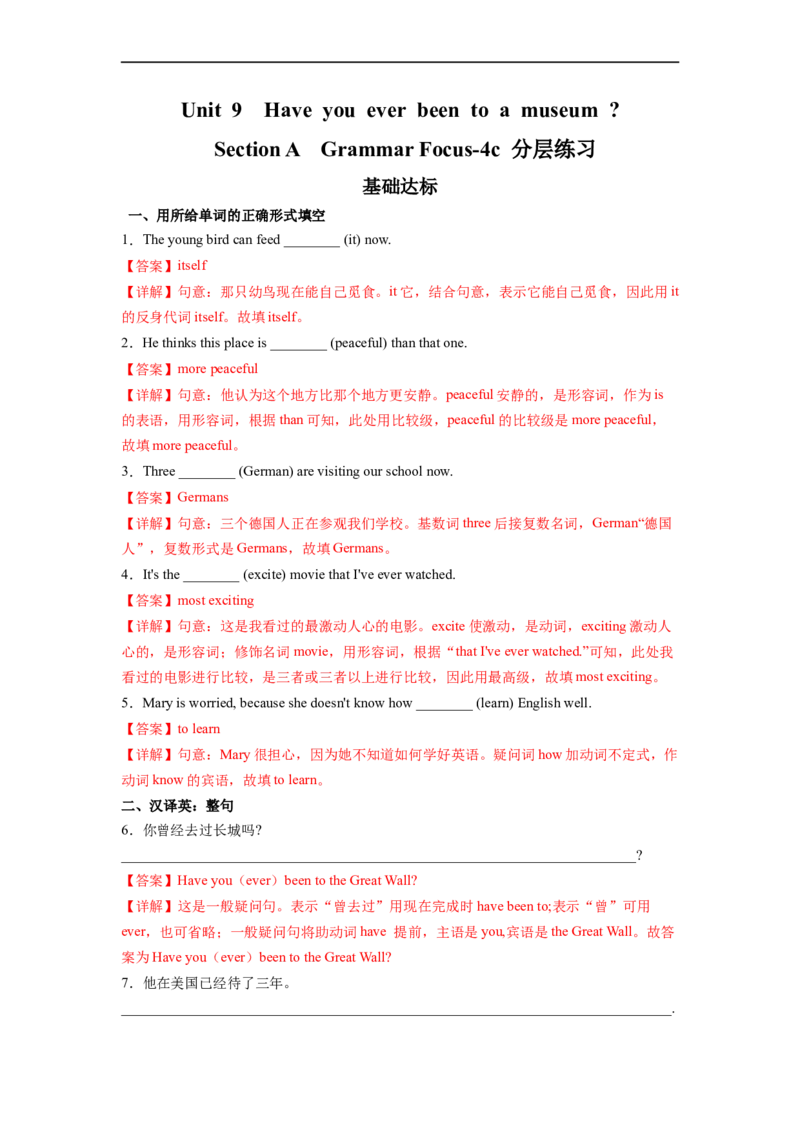
Unit 9 Have you ever been to a museum ?
Section A Grammar Focus-4c 分层练习
基础达标
一、用所给单词的正确形式填空
1.The young bird can feed ________ (it) now.
【答案】itself
【详解】句意:那只幼鸟现在能自己觅食。it它,结合句意,表示它能自己觅食,因此用it
的反身代词itself。故填itself。
2.He thinks this place is ________ (peaceful) than that one.
【答案】more peaceful
【详解】句意:他认为这个地方比那个地方更安静。peaceful安静的,是形容词,作为is
的表语,用形容词,根据than可知,此处用比较级,peaceful的比较级是more peaceful,
故填more peaceful。
3.Three ________ (German) are visiting our school now.
【答案】Germans
【详解】句意:三个德国人正在参观我们学校。基数词three后接复数名词,German“德国
人”,复数形式是Germans,故填Germans。
4.It's the ________ (excite) movie that I've ever watched.
【答案】most exciting
【详解】句意:这是我看过的最激动人心的电影。excite使激动,是动词,exciting激动人
心的,是形容词;修饰名词movie,用形容词,根据“that I've ever watched.”可知,此处我
看过的电影进行比较,是三者或三者以上进行比较,因此用最高级,故填most exciting。
5.Mary is worried, because she doesn't know how ________ (learn) English well.
【答案】to learn
【详解】句意:Mary很担心,因为她不知道如何学好英语。疑问词how加动词不定式,作
动词know的宾语,故填to learn。
二、汉译英:整句
6.你曾经去过长城吗?
_________________________________________________________________________?
【答案】Have you(ever)been to the Great Wall?
【详解】这是一般疑问句。表示“曾去过”用现在完成时have been to;表示“曾”可用
ever,也可省略;一般疑问句将助动词have 提前,主语是you,宾语是the Great Wall。故答
案为Have you(ever)been to the Great Wall?
7.他在美国已经待了三年。
______________________________________________________________________________.【答案】He has been in America for three years.
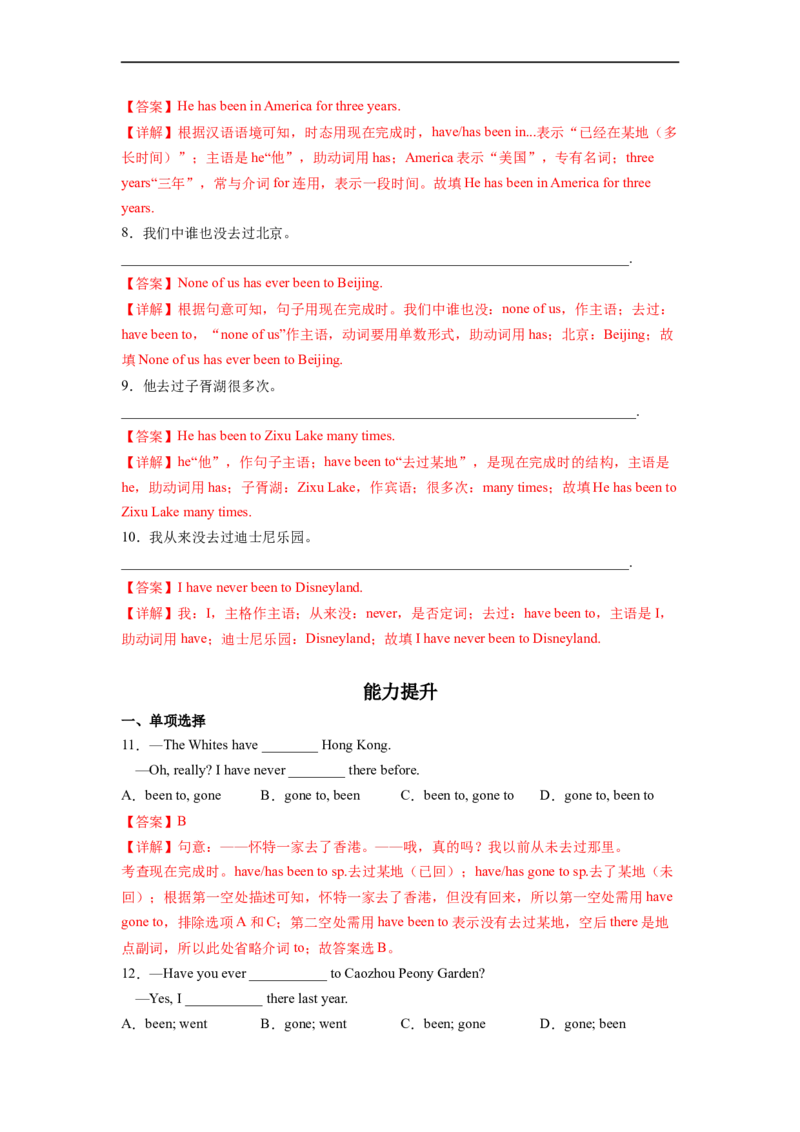
【详解】根据汉语语境可知,时态用现在完成时,have/has been in...表示“已经在某地(多
长时间)”;主语是he“他”,助动词用has;America表示“美国”,专有名词;three
years“三年”,常与介词for连用,表示一段时间。故填He has been in America for three
years.
8.我们中谁也没去过北京。
________________________________________________________________________.
【答案】None of us has ever been to Beijing.
【详解】根据句意可知,句子用现在完成时。我们中谁也没:none of us,作主语;去过:
have been to,“none of us”作主语,动词要用单数形式,助动词用has;北京:Beijing;故
填None of us has ever been to Beijing.
9.他去过子胥湖很多次。
_________________________________________________________________________.
【答案】He has been to Zixu Lake many times.
【详解】he“他”,作句子主语;have been to“去过某地”,是现在完成时的结构,主语是
he,助动词用has;子胥湖:Zixu Lake,作宾语;很多次:many times;故填He has been to
Zixu Lake many times.
10.我从来没去过迪士尼乐园。
________________________________________________________________________.
【答案】I have never been to Disneyland.
【详解】我:I,主格作主语;从来没:never,是否定词;去过:have been to,主语是I,
助动词用have;迪士尼乐园:Disneyland;故填I have never been to Disneyland.
能力提升
一、单项选择
11.—The Whites have ________ Hong Kong.
—Oh, really? I have never ________ there before.
A.been to, gone B.gone to, been C.been to, gone to D.gone to, been to
【答案】B
【详解】句意:——怀特一家去了香港。——哦,真的吗?我以前从未去过那里。
考查现在完成时。have/has been to sp.去过某地(已回);have/has gone to sp.去了某地(未
回);根据第一空处描述可知,怀特一家去了香港,但没有回来,所以第一空处需用have
gone to,排除选项A和C;第二空处需用have been to表示没有去过某地,空后there是地
点副词,所以此处省略介词to;故答案选B。
12.—Have you ever ___________ to Caozhou Peony Garden?
—Yes, I ___________ there last year.
A.been; went B.gone; went C.been; gone D.gone; been【答案】A
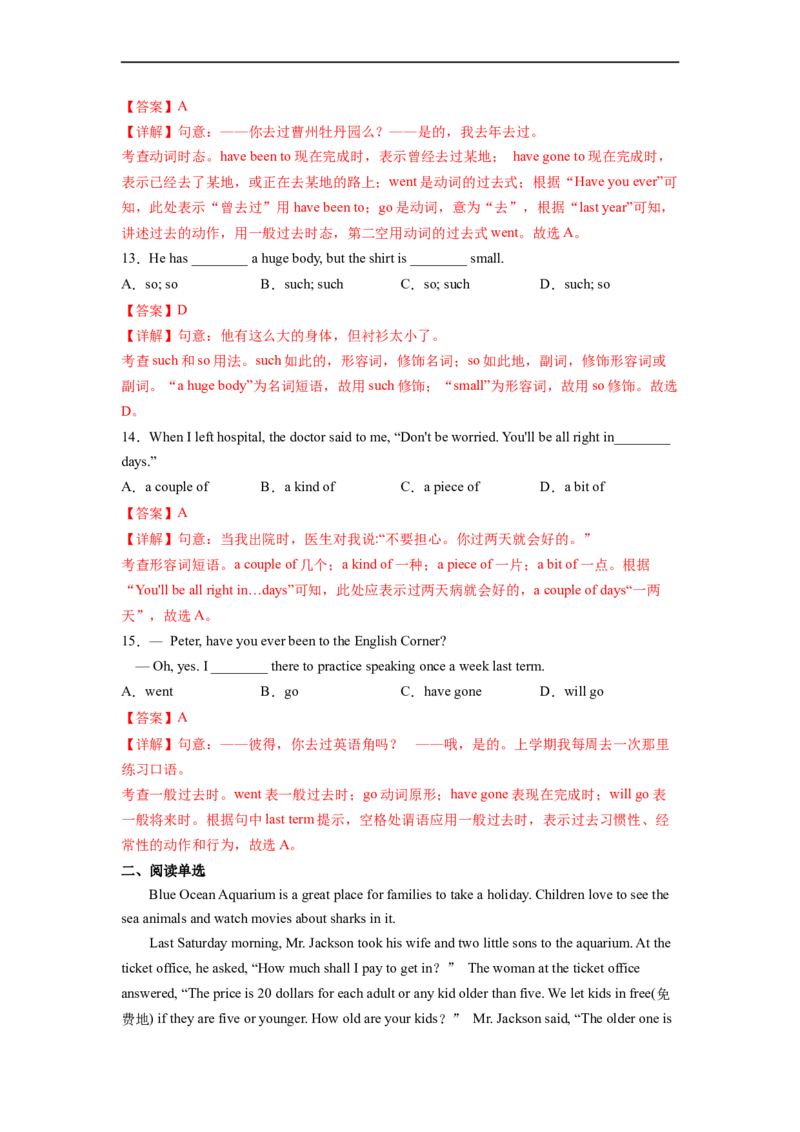
【详解】句意:——你去过曹州牡丹园么?——是的,我去年去过。
考查动词时态。have been to现在完成时,表示曾经去过某地; have gone to现在完成时,
表示已经去了某地,或正在去某地的路上;went是动词的过去式;根据“Have you ever”可
知,此处表示“曾去过”用have been to;go是动词,意为“去”,根据“last year”可知,
讲述过去的动作,用一般过去时态,第二空用动词的过去式went。故选A。
13.He has ________ a huge body, but the shirt is ________ small.
A.so; so B.such; such C.so; such D.such; so
【答案】D
【详解】句意:他有这么大的身体,但衬衫太小了。
考查such和so用法。such如此的,形容词,修饰名词;so如此地,副词,修饰形容词或
副词。“a huge body”为名词短语,故用such修饰;“small”为形容词,故用so修饰。故选
D。
14.When I left hospital, the doctor said to me, “Don't be worried. You'll be all right in________
days.”
A.a couple of B.a kind of C.a piece of D.a bit of
【答案】A
【详解】句意:当我出院时,医生对我说:“不要担心。你过两天就会好的。”
考查形容词短语。a couple of几个;a kind of一种;a piece of一片;a bit of一点。根据
“You'll be all right in…days”可知,此处应表示过两天病就会好的,a couple of days“一两
天”,故选A。
15.— Peter, have you ever been to the English Corner?
— Oh, yes. I ________ there to practice speaking once a week last term.
A.went B.go C.have gone D.will go
【答案】A
【详解】句意:——彼得,你去过英语角吗? ——哦,是的。上学期我每周去一次那里
练习口语。
考查一般过去时。went表一般过去时;go动词原形;have gone表现在完成时;will go表
一般将来时。根据句中last term提示,空格处谓语应用一般过去时,表示过去习惯性、经
常性的动作和行为,故选A。
二、阅读单选
Blue Ocean Aquarium is a great place for families to take a holiday. Children love to see the
sea animals and watch movies about sharks in it.
Last Saturday morning, Mr. Jackson took his wife and two little sons to the aquarium. At the
ticket office, he asked, “How much shall I pay to get in?” The woman at the ticket office
answered, “The price is 20 dollars for each adult or any kid older than five. We let kids in free(免
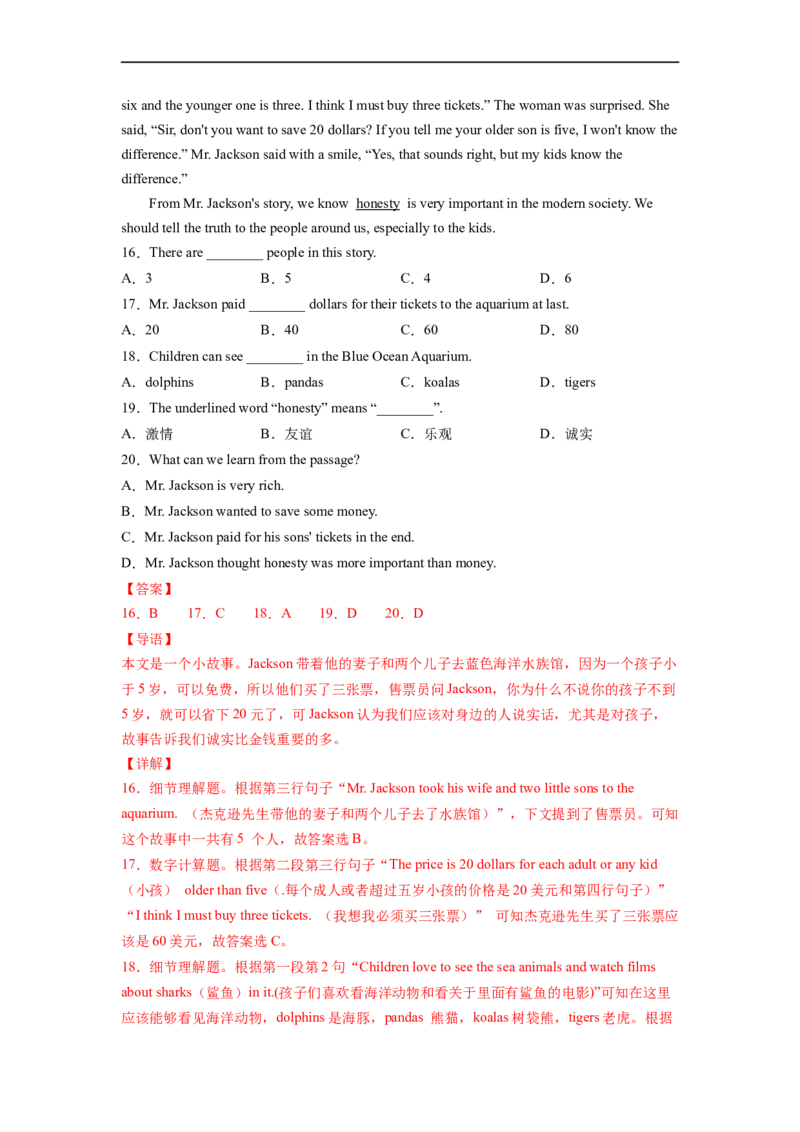
费地) if they are five or younger. How old are your kids?” Mr. Jackson said, “The older one issix and the younger one is three. I think I must buy three tickets.” The woman was surprised. She
said, “Sir, don't you want to save 20 dollars? If you tell me your older son is five, I won't know the
difference.” Mr. Jackson said with a smile, “Yes, that sounds right, but my kids know the
difference.”
From Mr. Jackson's story, we know honesty is very important in the modern society. We
should tell the truth to the people around us, especially to the kids.
16.There are ________ people in this story.
A.3 B.5 C.4 D.6
17.Mr. Jackson paid ________ dollars for their tickets to the aquarium at last.
A.20 B.40 C.60 D.80
18.Children can see ________ in the Blue Ocean Aquarium.
A.dolphins B.pandas C.koalas D.tigers
19.The underlined word “honesty” means “________”.
A.激情 B.友谊 C.乐观 D.诚实
20.What can we learn from the passage?
A.Mr. Jackson is very rich.
B.Mr. Jackson wanted to save some money.
C.Mr. Jackson paid for his sons' tickets in the end.
D.Mr. Jackson thought honesty was more important than money.
【答案】
16.B 17.C 18.A 19.D 20.D
【导语】
本文是一个小故事。Jackson带着他的妻子和两个儿子去蓝色海洋水族馆,因为一个孩子小
于5岁,可以免费,所以他们买了三张票,售票员问Jackson,你为什么不说你的孩子不到
5岁,就可以省下20元了,可Jackson认为我们应该对身边的人说实话,尤其是对孩子,
故事告诉我们诚实比金钱重要的多。
【详解】
16.细节理解题。根据第三行句子“Mr. Jackson took his wife and two little sons to the
aquarium. (杰克逊先生带他的妻子和两个儿子去了水族馆)”,下文提到了售票员。可知
这个故事中一共有5 个人,故答案选B。
17.数字计算题。根据第二段第三行句子“The price is 20 dollars for each adult or any kid
(小孩) older than five(.每个成人或者超过五岁小孩的价格是20美元和第四行句子)”
“I think I must buy three tickets. (我想我必须买三张票)” 可知杰克逊先生买了三张票应
该是60美元,故答案选C。
18.细节理解题。根据第一段第2句“Children love to see the sea animals and watch films
about sharks(鲨鱼)in it.(孩子们喜欢看海洋动物和看关于里面有鲨鱼的电影)”可知在这里
应该能够看见海洋动物,dolphins是海豚,pandas 熊猫,koalas树袋熊,tigers老虎。根据常识可知人们在海洋馆里能够看见海豚,故答案选A。
19.词义猜测题。根据本文最后一句“We should tell the truth(事实) to the people around
us,especially(尤其是)to the kids. (我们应该对身边的人说实话,尤其是对孩子)”,
可知它的意思是诚实,故选D。
20.主题归纳题。根据本文最后一段第1句“From Mr. Jackson's story, we know honesty is
very important in the modern society. (从杰克逊先生的故事,我们了解到在现代社会诚实是
非常重要的)”,可知诚实比金钱更重要,故选D。
拓展训练
多任务混合阅读(2022春·河北石家庄·八年级校考期末)
阅读下面短文,按要求完成下列各题。
Everyone likes their childhood and wishes to go back there. I also have a wonderful
childhood. There are many sweet memories in it, and I want to share some with you.
During my childhood I lived with my family. I have an elder sister and a younger brother, and
we used to play a game called “yard sale”. It means “selling” old things like old toy, clothes,
books, crayons and so on in the front yard, and we didn’t buy them with money. Instead, we
bought them with cards. We had so much fun.
Like other children, I also played a lot with many toys during my childhood. Children are
always crazy about their toys. I owned two cute toy bears in my childhood and they were my
favorite. They felt so soft and comfortable that I fell asleep with them every night. I regarded
them as my best friends then. I didn’t share them with anyone. Whenever someone touched them,
I would cry loudly.
This is my childhood. Do you have any kind of sweet memories like this?
(1,2题完成句子,3题回答问题,4题找出并写下第三段主题句,5题将文中划线句子译成汉语)
1.During the writer’s childhood she played a game called “________” with her brother and
sister.
2.In the game, the writer bought the old things with ________ instead of money.
3.What was the writer’s favorite in her childhood?
________________________________________________________________________
4._________________________________________________________________________
5._________________________________________________________________________
【答案】
1.yard sale 2.cards 3.Two cute toy bears.
4.Like other children, I also played a lot with many toys during my childhood.
5.当时我把它们视为我最好的朋友。
【导语】
本文的作者主要向我们分享了自己在童年时期喜欢做的事情和喜欢玩的东西,里面有很多甜蜜的回忆。
【详解】
1.根据第二段“During my childhood I lived with my family. I have an elder sister and a
younger brother, and we used to play a game called ‘yard sale’.”可知,在作家的童年时期,她
和她的兄弟姐妹玩了一个名为“庭院大甩卖”的游戏。故填yard sale。
2.根据第二段“Instead, we bought them with cards.”可知,在游戏中,作者用卡片购买旧东
西,而不是钱。故填cards。
3.根据第三段“I owned two cute toy bears in my childhood and they were my favorite.”可知,
这位作家小时候最喜欢的是那两只可爱的玩具熊。故填Two cute toy bears.
4.分析第三段内容可知,本段主要介绍了作者童年时期最喜爱的玩具以及和它们玩耍的场
景,所以第一句可作为主题句。故填Like other children, I also played a lot with many toys
during my childhood.
5.I“我”;them“它们”;regarded sth. as“把……看作……”;my best friends“我最好的朋
友”;then“当时”。故填:当时我把它们视为我最好的朋友。