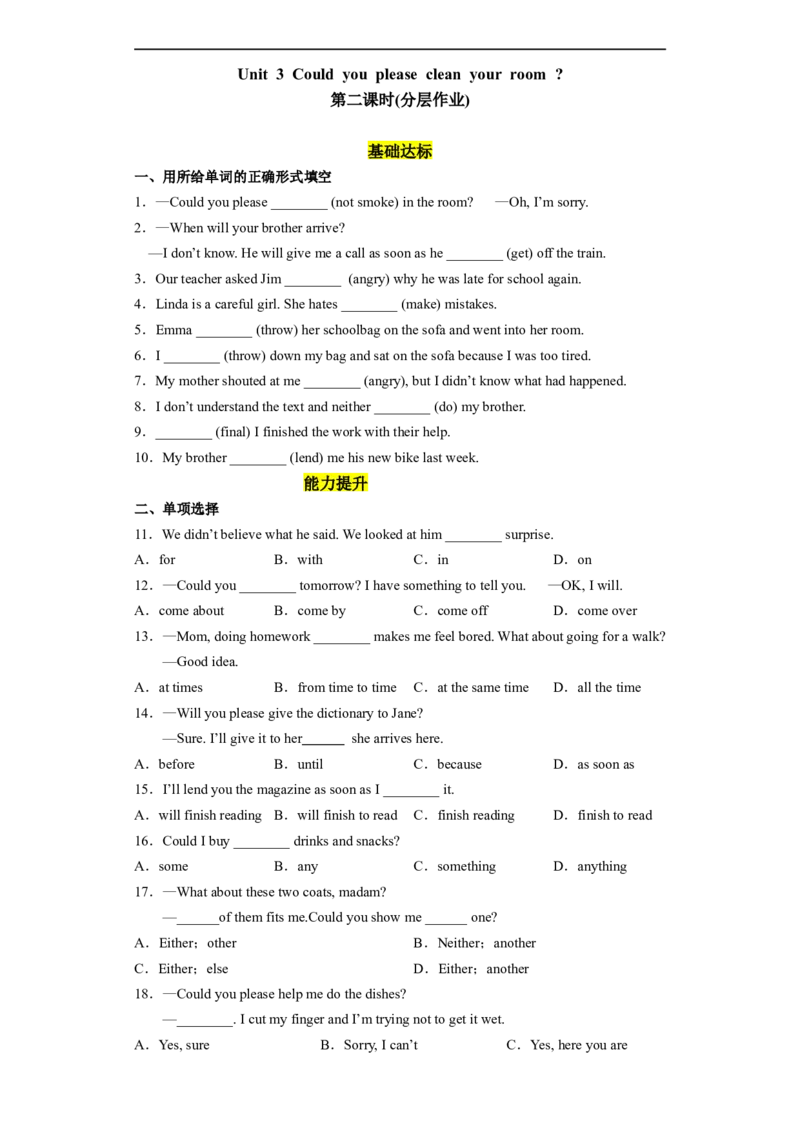
Unit 3 Could you please clean your room ?
第二课时(分层作业)
基础达标
一、用所给单词的正确形式填空
1.—Could you please ________ (not smoke) in the room? —Oh, I’m sorry.
2.—When will your brother arrive?
—I don’t know. He will give me a call as soon as he ________ (get) off the train.
3.Our teacher asked Jim ________ (angry) why he was late for school again.
4.Linda is a careful girl. She hates ________ (make) mistakes.
5.Emma ________ (throw) her schoolbag on the sofa and went into her room.
6.I ________ (throw) down my bag and sat on the sofa because I was too tired.
7.My mother shouted at me ________ (angry), but I didn’t know what had happened.
8.I don’t understand the text and neither ________ (do) my brother.
9.________ (final) I finished the work with their help.
10.My brother ________ (lend) me his new bike last week.
能力提升
二、单项选择
11.We didn’t believe what he said. We looked at him ________ surprise.
A.for B.with C.in D.on
12.—Could you ________ tomorrow? I have something to tell you. —OK, I will.
A.come about B.come by C.come off D.come over
13.—Mom, doing homework ________ makes me feel bored. What about going for a walk?
—Good idea.
A.at times B.from time to time C.at the same time D.all the time
14.—Will you please give the dictionary to Jane?
—Sure. I’ll give it to her she arrives here.
A.before B.until C.because D.as soon as
15.I’ll lend you the magazine as soon as I ________ it.
A.will finish reading B.will finish to read C.finish reading D.finish to read
16.Could I buy ________ drinks and snacks?
A.some B.any C.something D.anything
17.—What about these two coats, madam?
—______of them fits me.Could you show me ______ one?
A.Either;other B.Neither;another
C.Either;else D.Either;another
18.—Could you please help me do the dishes?
—________. I cut my finger and I’m trying not to get it wet.
A.Yes, sure B.Sorry, I can’t C.Yes, here you are19.— Could you tell me how to pay for the food by QR code (二维码) on the phone?
--______.
A.Take it easy B.It doesn’t matter C.You’re welcome D.Sure, I’d love to
20.—Will you go to Peter’s party this Saturday evening?
—I haven’t decided yet. If you don’t go, ________.
A.so do I B.neither do I C.so will I D.neither will I
三、完成句子
21.我对音乐不感兴趣,我妹妹也不感兴趣。
I am not interested in music. And ________ ________ my sister.
22.你为什么总是问同一个问题?
Why do you ask the same question ________ ________ ________?
23.明天晚上过来吃晚饭怎么样?
What about ________ ________ for dinner tomorrow evening?
24.请问你能带狗去散散步吗?
Could you please ________ the dog ________ ________ ________?
25.他们两个一个星期都没做任何家务。
________ ________ ________ did any housework for a week.
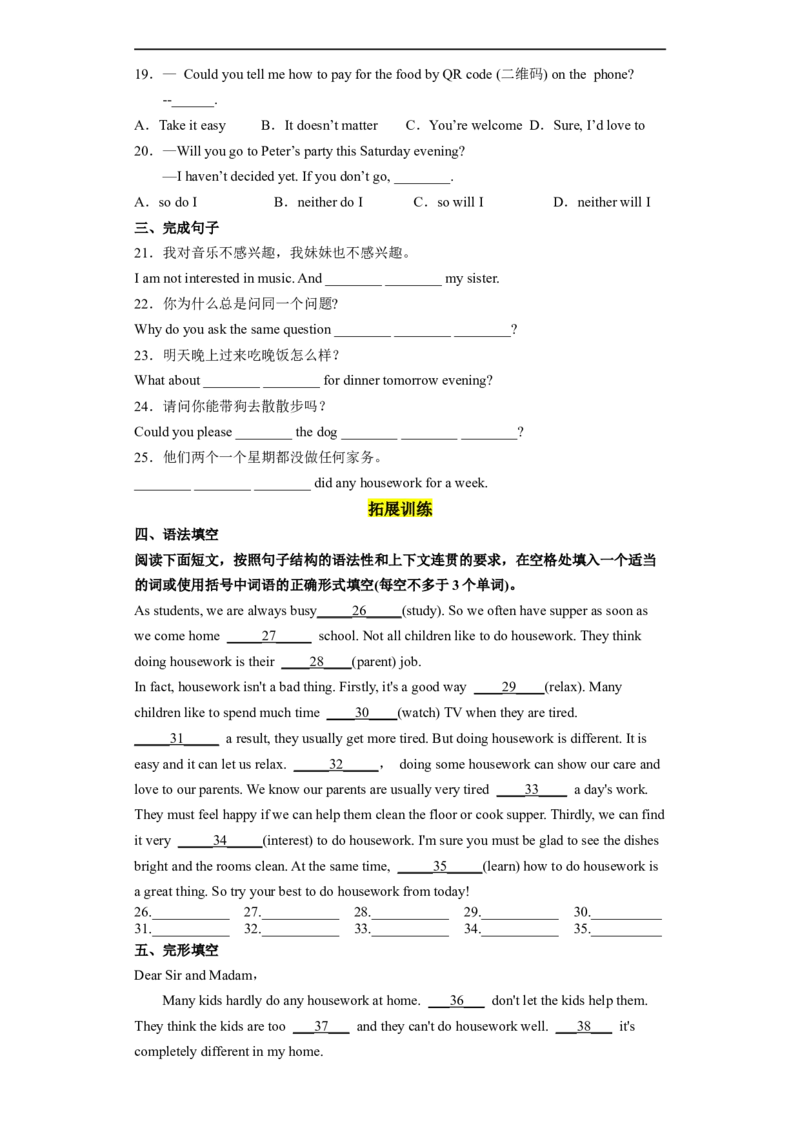
拓展训练
四、语法填空
阅读下面短文,按照句子结构的语法性和上下文连贯的要求,在空格处填入一个适当
的词或使用括号中词语的正确形式填空(每空不多于3个单词)。
As students, we are always busy_____26_____(study). So we often have supper as soon as
we come home _____27_____ school. Not all children like to do housework. They think
doing housework is their ____28____(parent) job.
In fact, housework isn't a bad thing. Firstly, it's a good way ____29____(relax). Many
children like to spend much time ____30____(watch) TV when they are tired.
_____31_____ a result, they usually get more tired. But doing housework is different. It is
easy and it can let us relax. _____32_____, doing some housework can show our care and
love to our parents. We know our parents are usually very tired ____33____ a day's work.
They must feel happy if we can help them clean the floor or cook supper. Thirdly, we can find
it very _____34_____(interest) to do housework. I'm sure you must be glad to see the dishes
bright and the rooms clean. At the same time, _____35_____(learn) how to do housework is
a great thing. So try your best to do housework from today!
26.___________ 27.___________ 28.___________ 29.___________ 30.__________
31.___________ 32.___________ 33.___________ 34.___________ 35.__________
五、完形填空
Dear Sir and Madam,
Many kids hardly do any housework at home. ___36___ don't let the kids help them.
They think the kids are too ___37___ and they can't do housework well. ___38___ it's
completely different in my home.I don't like doing chores. But I have ___39___ choice but to do it because doing chores
is a rule in my family. When I come back from school, my mom ___40___ says, “Could you
take out the rubbish?” or “Could you help me with cooking?” I know she's just trying
to make me more independent and ___41___ me how to take care of myself. But ___42___
does she make me do all the housework? OK, a ___43___ kid often does some housework at
home. I know I am the oldest and I should do chores. I should help others. But it's not fair(公
平的) to me. My sisters should do them, ___44___.
Yesterday I did ___45___ the chores again. My parents visited my aunt with my sisters
yesterday morning. They left me ___46___ at home because I had to do my homework.
When I finished my homework, I found it was really a ___47___ at home. They didn't do
any chores. So I cleaned the rooms, ___48___ the dishes and watered the flowers. Oh! I
must look like a(n) ___49___.
What should I do? I ___50___ doing chores all the time. Could you give me some
advice, please?
Yours,
John
36.A.Sisters B.Parents C.Brothers D.Aunts
37.A.young B.lazy C.old D.short
38.A.However B.But C.So D.Though
39.A.any B.some C.every D.no
40.A.never B.hardly C.always D.almost
41.A.ask B.help C.teach D.expect
42.A.when B.why C.how D.where
43.A.good B.clever C.cute D.shy
44.A.well B.too C.either D.neither
45.A.any B.no C.most D.all
46.A.alone B.lonely C.quiet D.independent
47.A.job B.matter C.problem D.mess
48.A.bought B.borrowed C.carried D.washed
49.A.cook B.doctor C.servant D.actor
50.A.like B.enjoy C.hate D.miss
六、阅读单选
Should children do chores? Some people think that children should not do chores, but
many experts believe that children can benefit(受益)from doing chores. They can learn
problem-solving and independence from doing chores.
However, most experts agree that the chores should fit the children. For example, young
children shouldn’t wash the dishes or take out the rubbish. However, they can do the chores
like picking up toys, putting books in the bookcase…to keep the home tidy. In fact, youngchildren usually would like to do chores because they like doing what Mom or Dad does, and
that helps them feel more grown-up.
As the children grow older, many experts advise giving them more difficult chores like
washing the dishes and walking the dog. However, children usually do not want to do the
chores. The middle school students may spend more than two hours a night on their
homework. Perhaps more chores on the weekend, not on weekdays can be helpful.
51.Which chore is the best for 5-year-old Lisa?
A.Washing the dishes.B.Picking up toys. C.Taking out the rubbish. D.Washing
the clothes.
52.Why would young children like to do chores?
A.Because they like to grow up. B.Because they like to walk the dog.
C.Because they think that chores are easy. D.Because they like to learn from their
parents.
53.What’s the best time for a middle school student to do chores?
A.On Monday night. B.On Friday morning.
C.On Friday afternoon. D.On Sunday morning.
54.According to the passage, we can infer ________.
A.young children shouldn’t do chores
B.children don’t like to grow up
C.parents should give children money to do chores
D.the middle school students have little time to do chores on weekdays
55.What’s the best title for this passage?
A.Why should children do chores? B.How long should children do chores?
C.What chores fit children? D.When should children do chores?参考答案:
1.not smoke
【详解】句意:——请你不要在房间里抽烟好吗?——哦,对不起。Could为情态动词,
后应用动词原形,not置于Could后、实义动词smoke前,故填not smoke。
2.gets
【详解】句意:——你哥哥什么时候到?——我不知道。他一下火车就会给我打电话。as
soon as意为“一……就……”,在其引导的时间状语从句中,当主句采用一般将来时,从
句应用一般现在时,从句主语he为第三人称单数,故填gets。
3.angrily
【详解】句意:我们的老师生气地质问吉姆为什么上学又迟到了。原句缺少副词修饰动词
asked,所以所给词angry应变为副词angrily,意为“生气地”。故填angrily。
4.to make##making
【详解】句意:琳达是一个细心的女孩。她讨厌犯错误。hate to do sth=hate doing sth“讨厌
做某事”,是固定短语,此处应用不定式或动名词形式,故填to make/making。
5.threw
【详解】句意:艾玛把书包扔在沙发上,走进了自己的房间。and并列两部分,动词要保
持一致,结合“went”可知,此处的动词也用过去式,故填threw。
6.threw
【详解】句意:我扔下包坐在沙发上,因为我太累了。and连接并列句,时态一致,根据
sat可知是一般过去时态,故填threw。
7.angrily
【详解】句意:我妈妈向我生气地大喊,但是我不知道发生了什么事。根据空前的
“shouted at me”可知,应该填的是angry的副词angrily“生气地”修饰动词短语,故填
angrily。
8.does
【详解】句意:我不懂这篇课文,我弟弟也不懂。根据“neither+be动词/助动词/情态动词
+主语”表示“某人也不……”,助动词/be动词的形式取决于后面的主语,由“I don’t
understand the text”可知,空缺处应该用助动词,my brother是第三人称单数,所以用do的
第三人称单数does,故填does。
9.Finally
【详解】句意:最终在他们的帮助下我完成了那项工作。final最终的,在这里修饰整个句子,应该用副词形式finally,故填Finally。
10.lent
【详解】句意:上周我哥哥把他的新自行车借给了我。last week上周,是表示过去的时间
状语,所以句子用一般过去时,lend过去式是lent,故填lent。
11.C
【详解】句意:我们都不相信他说的话。我们惊讶地看着他。
考查介词辨析。for为了;with和;同;in在……里;on在……上。根据“We didn’t believe
what he said.”以及语境可知,我们不相信他说的话,惊讶地看着他,因此in surprise“惊讶
地”符合题意,故选C。
12.D
【详解】句意:——你明天能过来吗?我有点事要跟你说。——-好的,我会来。
考查动词短语词义辨析。come about发生;come by走过;come off 从……掉落;come
over顺便来访。根据“I have something to tell you.”可知,问话人有点事要跟对方说。委婉
地请求别人做某事时常用句型:Could you (please) do sth?“你可以做什么吗?”选项D“顺便
来访”符合语境,此处指问话人邀请对方来访。故选D。
13.D
【详解】句意:——妈妈,一直做作业让我觉得无聊,出去散步怎么样?——好主意。
考查介词短语辨析。at times有时;from time to time不时地;at the same time同时;all the
time一直。根据“doing homework…makes me feel bored”可知,说话者觉得做作业很无聊。
结合句意可知,选项D“一直”符合语境。此句表达“一直做作业让人觉得无聊”。故选
D。
14.D
【详解】本题回答语的含义是我一到这儿就把这本字典给她,as soon as表示一……就,与
题意相符,故选D。
15.C
【详解】句意:我一读完这本杂志我就把它借给你。
考查时间状语从句的时态以及finish的用法。句子含有as soon as引导的时间状语从句,应
遵循“主将从现”的原则,所以此处时态为一般现在时;而finish“完成”后续动名词作宾
语,故选C。
16.A
【详解】句意:我可以买些饮料和零食吗?考查词义辨析。some一些,一般用于肯定句或表示特殊意义的一般疑问句中;any一些,
一般用于否定句或疑问句中;something某物,某事,一般用于肯定句中或表示特殊意义的
一般疑问句中;anything任何事物,一般用于否定句或疑问句中。空格处修饰名词“drinks
and snacks”,应用形容词,此句是含有情态动词的一般疑问句,应用some。故选A。
17.B
【详解】句意:——夫人,这两件外套怎么样?——两件都不适合我。你能给我再拿一件
吗?
考查不定代词。either两者其一;neither二者都不;other修饰名词,位于名词的前面;else
修饰不定代词、疑问代词或疑问副词,置后。another形容词,三者或以上另外的;根据
“Could you show me ... one”可知此处指“二者都不合适”,用neither;空格2指“拿另外
的一件”,用another;故选B。
18.B
【详解】句意:——你能帮我洗碗吗? ——对不起,我不能。我割伤了手指,我尽量不把
它弄湿。
考查情景交际。Yes, sure是的,当然可以;Sorry, I can’t对不起,我不能;Yes, here you are
是的,给你。根据下文“I cut my finger and I’m trying not to get it wet”,可知不能洗碗,故
选B。
19.D
【详解】句意:你愿意告诉我怎么样在手机上用二维码支付买的食物吗?A项意为“放松
些”,B项意为“没关系”,C项意为“你客气了”,D项意为“当然,我愿意”。故选D
项。
20.D
【详解】句意:——这个星期六晚上你会去彼得的聚会吗?——我还没决定。如果你不去,
我也不去。
考查倒装句。so/neither/nor 表示前面所说的情况也适合于后者时,用“so/neither/nor +
be/助动词/情态动词+主语”这样的倒装句式。“so+ be/助动词/情态动词+主语”表示前句
所述的肯定情况也适用于另外一个人或物,如果前面的陈述句是否定形式,这一结构的否
定式是“neither/nor+ be/助动词/情态动词+主语”。根据上文“I haven’t decided yet. If you
don’t go”可知,前面所说的情况也适用于后者,即“我也不去”需用neither的倒装结构,
可排除AC两项;结合if条件句遵循主将从现,助动词需用will,故选D。21. neither is
【详解】前句是否定句,谓语是be动词,后句表示“也不”,用结构:neither+be动词+主
语。my sister作主语,be动词用is。故填neither;is。
22. all the time
【详解】由英汉对照可知,空格处填“总是”,all the time“总是”,固定短语。故填all;
the;time。
23. coming over
【详解】come over:过来,what about doing sth:做某事怎么样,故填coming;over。
24. take for a walk
【详解】根据中英文对照可知此处缺“带……散步”,在英文中表达为“take…for a
walk”,结合空前“could”可知此处填动词原形,故填take;for;a;walk。
25. Neither of them
【详解】固定搭配:neither of表示“两个都不”;后接人称代词宾格them“他们”,故填
Neither;of;them。
26.studying 27.from 28.parents' 29.to relax 30.watching 31.As 32.
Secondly 33.after 34.interesting 35.learning
【分析】现在的孩子总是忙于学习,很少在家做家务。这篇短文给我们讲述的是做家务其
实也不是一件坏事,并给出了三个理由。
26.句意:作为学生,我们总是忙于学习。study学习,是一个动词。这句话中使用了句型
be busy doing sth.忙于做某事。故这里填动名词studying。
27.句意:所以我们经常一从学校回到家就吃晚饭。from来自,从…。根据句意come
home from school表示从学校回到家,故填from。
28.句意:他们认为做家务是他们父母的工作。parent父亲或母亲,根据句意可知,这里
指“父母二人”,且应表示…的,应用名词所有格形式,故应填parents’。
29.句意:首先,它是一种放松的好方式。relax放松,是一个动词。a good way一种好方
法,后面常跟动词不定式,作后置定语。故应填to relax。
30.句意:当他们累的时候,很多孩子喜欢花费太多时间看电视。watch观看,是一个动
词。这句话中使用了句型spend time (in) doing sth.花费时间做某事,因此这里应填动名词
watching。31.句意:结果他们通常会变得更累。这里考查固定短语as a result,意为“结果是…”,
故这里应填As。
32.句意:其次,做家务能表示我们对父母的关心和爱。根据上文Firstly, it's a good way
4 (relax).可知,这里介绍做家务是一件好事的第二个原因,应填Secondly。
33.句意:我们知道在一天的工作之后我们的父母都很累了。after在…之后,根据句意…
are usually very tired可知,应是在一天的工作之后,故填after。
34.句意:第三,我们发现做家务是很有趣的。interest兴趣,可以作名词或者动词。句中
使用的句型是find it+形容词+to do sth.“发现做某事是…的”,这里表示“做家务令人感兴
趣”,故应填interesting,形容词。
35.句意:同时,学习如何做家务是一件很棒的事情。learn学习,学会,是一个动词。根
据句子结构可知,该空以及后面的短语…how to do housework是句子的主语,故应用动名
词形式learning。
【点睛】这篇短文讲述了让孩子学会做家务的好处。短文中心明确,主题突出,层次清晰,
内容贴近教材主题和学生们的日常生活,比较容易理解。题型是短文填空,考查形式有两
种:一种是直接填写适当的单词,此类题型以考查虚词的用法为主,如介词、连词、冠词、
代词等。例如第6小题,这里考查固定短语as a result,意为“结果是…”,故这里应填
As。另一种形式是给出一个提示词,需要填写它的适当形式,这种题型以考查实词用法为
主,如名词单复数、动词时态、语态、非谓语动词、形容词和副词的基本用法以及比较级
或最高级的用法等。例如第4小题,所给单词relax放松,是一个动词。a good way一种好
方法,后面常跟动词不定式,作后置定语。故应填to relax。再如第9小题,句中使用的句
型是find it+形容词+to do sth.“发现做某事是…的”,这里表示“做家务令人感兴趣”,故
应填interesting,形容词。
36.B 37.A 38.B 39.D 40.C 41.C 42.B 43.A 44.B 45.D 46.A
47.D 48.D 49.C 50.C
【分析】本文讲述了作者是个孩子,在家总是做所有的家务。他觉得是因为需要帮忙做家
务,但是应该大家一起做,不应该他全部做,他很烦恼,不知道该怎么办。
36.句意:父母不让孩子帮助他们。
Sisters妹妹们;Parents父母;Brothers哥哥们;Aunts阿姨们;根据后文“parents”及常识可知是父母,故选B。
37.句意:他们认为孩子们太小,不能很好地做家务。
young年轻的;lazy懒惰的;old老的;short短;根据“kids”可知是小孩子,可推测出此处
是年轻的,故选A。
38.句意:但在我家就完全不同了。
However但是(后接逗号);But但是;So;Though尽管;根据“Many kids hardly do any
housework at home”可知许多孩子在家几乎不做家务,以及下文作者需要做家务,可推测出
此处是转折关系,且空后没有逗号,故选B。
39.句意:但是我别无选择,只能这样做。
any一些(用于否定句);some一些(用于肯定句);every任何一个;no没有;根据
“have no choice but to do sth”表示“别无选择,只能做什么”,可推测出此处是no,故选
D。
40.句意:当我放学回来,我妈妈总是说:“你能把垃圾拿出去吗?”
never从不;hardly几乎不;always总是;almost几乎;根据“…she make me do all the
housework?”可知她让我做所有的家务,可推测出此处是总是,故选C。
41.句意:我知道她只是想让我更独立教我如何照顾自己。
ask问;help帮助;teach教;expect期望;根据“she's just trying to make me more
independent”可知她只是想让我更独立,及后文“如何照顾自己”,可推测出此处是教,故
选C。
42.句意:但是她为什么让我做所有的家务呢?
when什么时候;why为什么;how如何;where什么时候;根据后文妹妹们不做家务,可
推测出此处是为什么,符合题意,故选B。
43.句意:一个好孩子在家里也会做家务的。
good好;clever聪明的;cute可爱的;shy害羞的;根据“does some housework at home”可
知在家里也会做家务,可推测出此处是好的,故选A。
44.句意:我的姐妹们也应该这样做。
well好;too也(肯定句句末);either也(否定句句末);neither两者都不;根据作者做
家务,觉得妹妹们也应该做家务,可推测出此处是也,放肯定句句末,故选B。
45.句意:昨天我又做了所有的家务。
any任何;no不;most最多的;all所有;根据“she make me do all the housework”可知她让
我做所有的家务,可推测出此处是所有,故选D。46.句意:他们留下我一个人在家。
alone独自;lonely寂寞;quiet安静;independent独立的;根据“leave sb alone”表示“让某
人独自一人”,此处是副词修饰动词“leave”,可推测出此处是alone,故选A。
47.句意:当我完成作业时,我发现家里真的是一团糟。
job工作;matter要紧;problem问题;mess混乱;根据“They didn't do any chores.”可知他
们没有做任何家务,可推测出此处是混乱,故选D。
48.句意:所以我打扫房间,洗碗和浇花。
bought买;borrowed借;carried随身携带;washed洗;根据“the dishes”可知碗,可推测
出此处是洗,故选D。
49.句意:我必须看起来像个仆人。
cook做饭;doctor医生;servant仆人;actor男演员;根据上文作者在家打扫卫生,做所有
的家务,可推测出此处是仆人,故选C。
50.句意:我讨厌总是做家务。
like喜欢;enjoy喜爱;hate讨厌;miss错过;根据上文“ it's not fair(公平的) to me”可知这
是不公平的,可推测出此处是作者讨厌,故选C。
51.B 52.D 53.D 54.D 55.C
【分析】本文探讨孩子适不适合做什么家务,分析了不同年龄大小的孩子适合做什么家务,
专家给出了合理建议。
51.推理判断题。根据第二段中“For example, young children shouldn’t wash the dishes or
take out the rubbish. However, they can do the chores like picking up toys, putting books in the
bookcase…to keep the home tidy.” 可知,小孩子不应该洗碗或倒垃圾,他们可以做家务,如
捡起玩具、把书放在书架上……保持家里整洁等。5岁的丽莎属于young children,从而判
断,最适合她做的家务活是收拾玩具、把书放在书架上……保持家里整洁等。故选B。
52.细节理解题。根据第二段最后一句“In fact, young children usually would like to do
chores because they like doing what Mom or Dad does, and that helps them feel more grown-up.”
可知,事实上,小孩子通常喜欢做家务,因为他们喜欢做爸爸妈妈做的事情,这让他们觉
得自己更成熟了。所以小孩子喜欢做家务活儿的原因是喜欢向大人学习。故选D。
53.推理判断题。根据最后一段“The middle school students may spend more than two hours
a night on their homework. Perhaps more chores on the weekend, not on weekdays can be
helpful.”可知,中学生每晚花在家庭作业上的时间可能超过两个小时。也许更多的家务活儿安排在周末,而不是工作日会更有帮助。从而推断中学生在工作日几乎没有时间做家务。
所以安排中学生在周末做点儿家务活儿,符合语境。故选D。
54.推理判断题。根据最后一段“The middle school students may spend more than two hours
a night on their homework. Perhaps more chores on the weekend, not on weekdays can be
helpful.” 可知,中学生每晚花在家庭作业上的时间可能超过两个小时,也许更多的家务活
儿安排在周末,而不是工作日会更有帮助。从而推断中学生工作日要写作业,几乎没时间
做家务,符合语境。故选D。
55.最佳标题题。根据第二段中“For example, young children shouldn’t wash the dishes or
take out the rubbish. However, they can do the chores like picking up toys, putting books in the
bookcase…to keep the home tidy.”小孩子不应该洗碗或倒垃圾。然而,他们可以做家务,如
捡起玩具、把书放在书架上……保持家里整洁。根据最后一段第一句“As the children grow
older, many experts advise giving them more difficult chores like washing the dishes and walking
the dog.”可知,随着孩子们年龄的增长,许多专家建议给他们更多困难的家务,比如洗碗
和遛狗。综上所述,文章在探讨不同年龄的孩子适合什么家务。所以这篇文章最好的题目
是“什么家务适合孩子做?”故选C。