文档文本内容
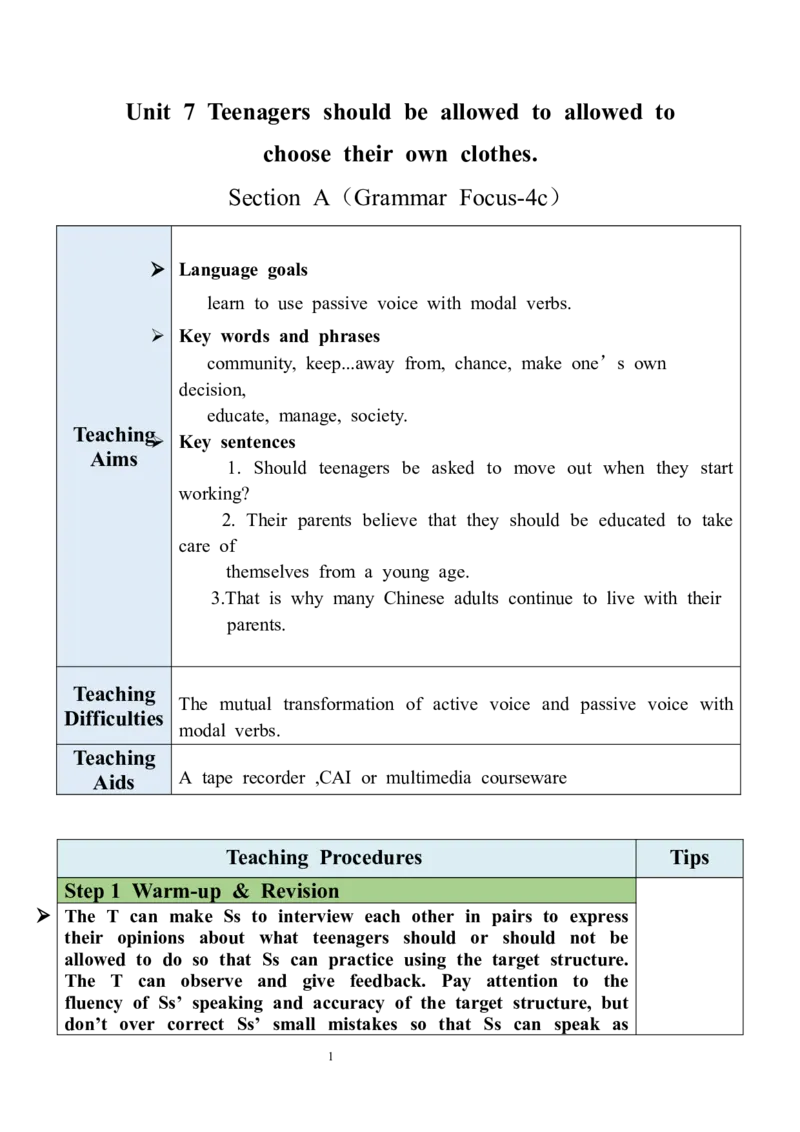
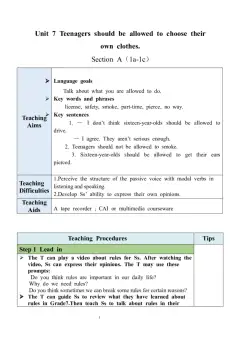
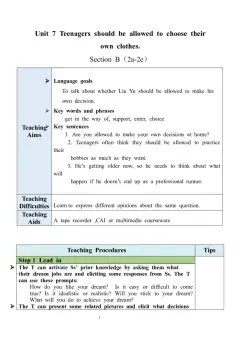
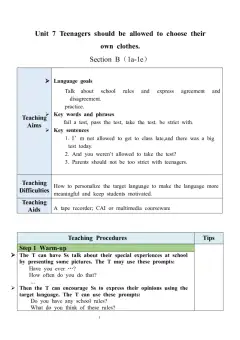
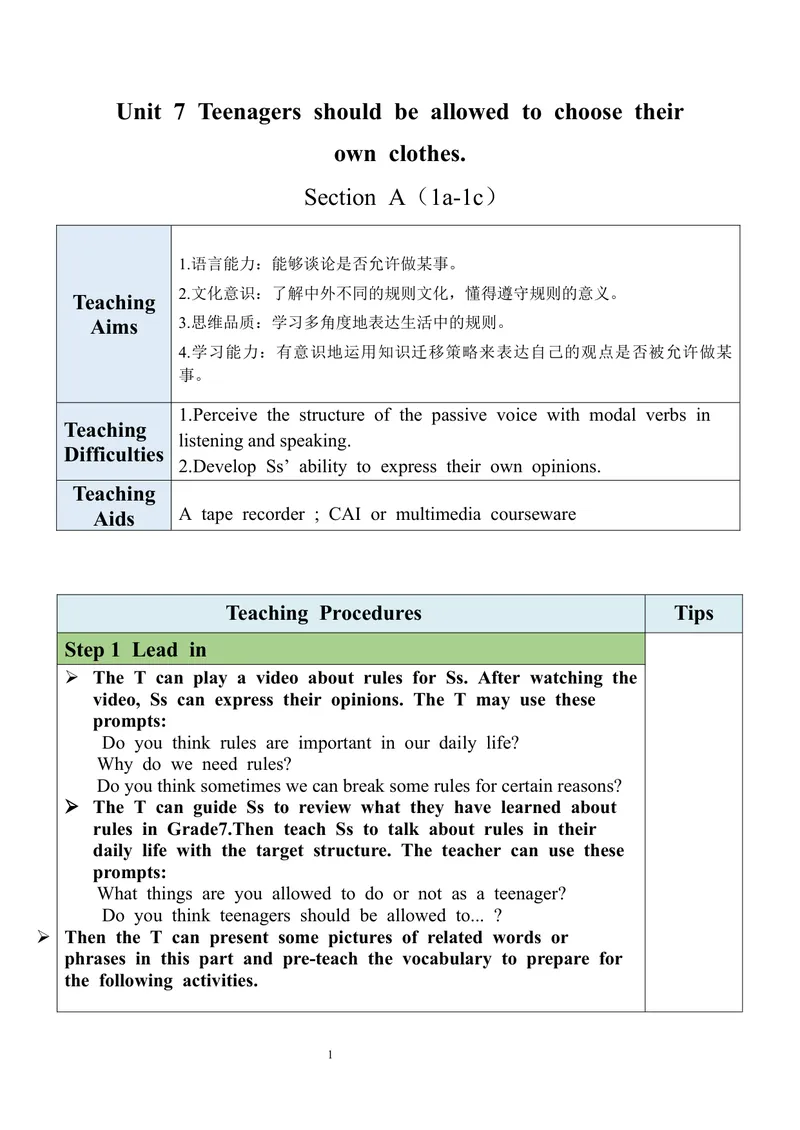
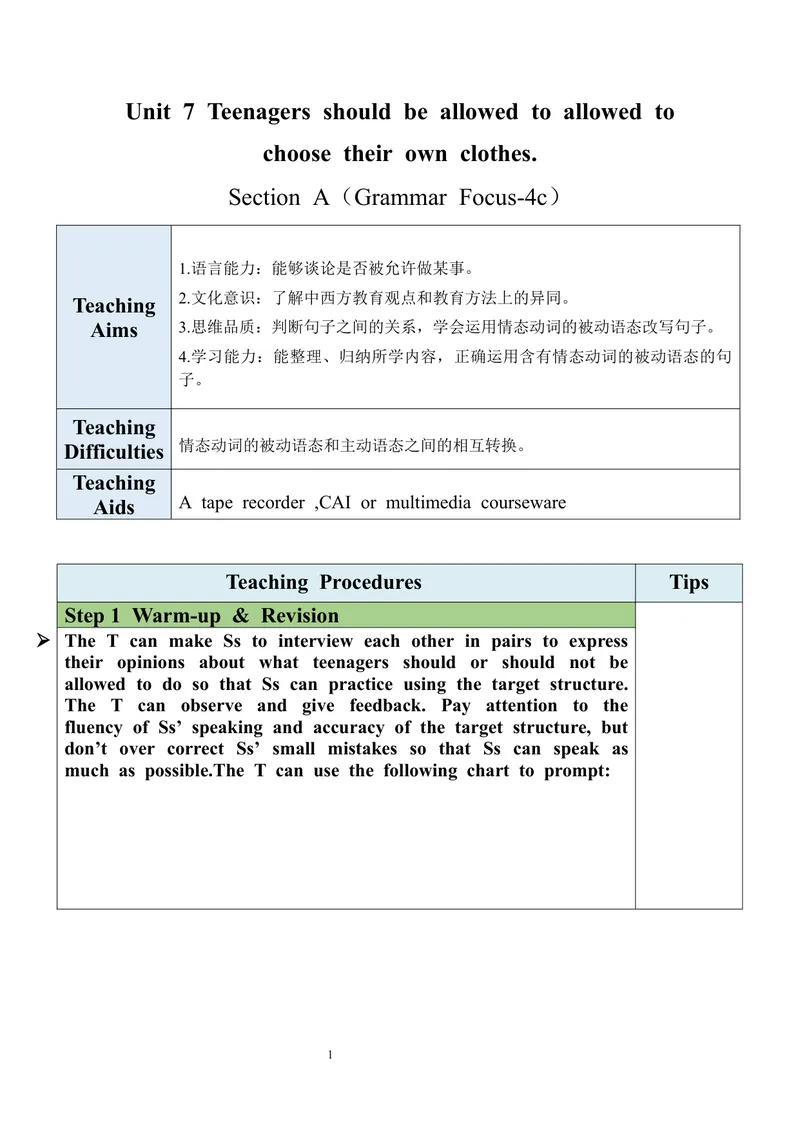
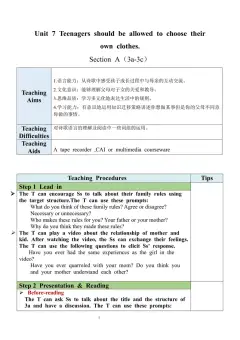
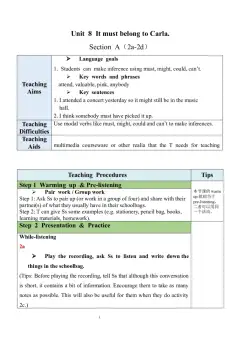
Unit 7 Teenagers should be allowed to allowed to
choose their own clothes.
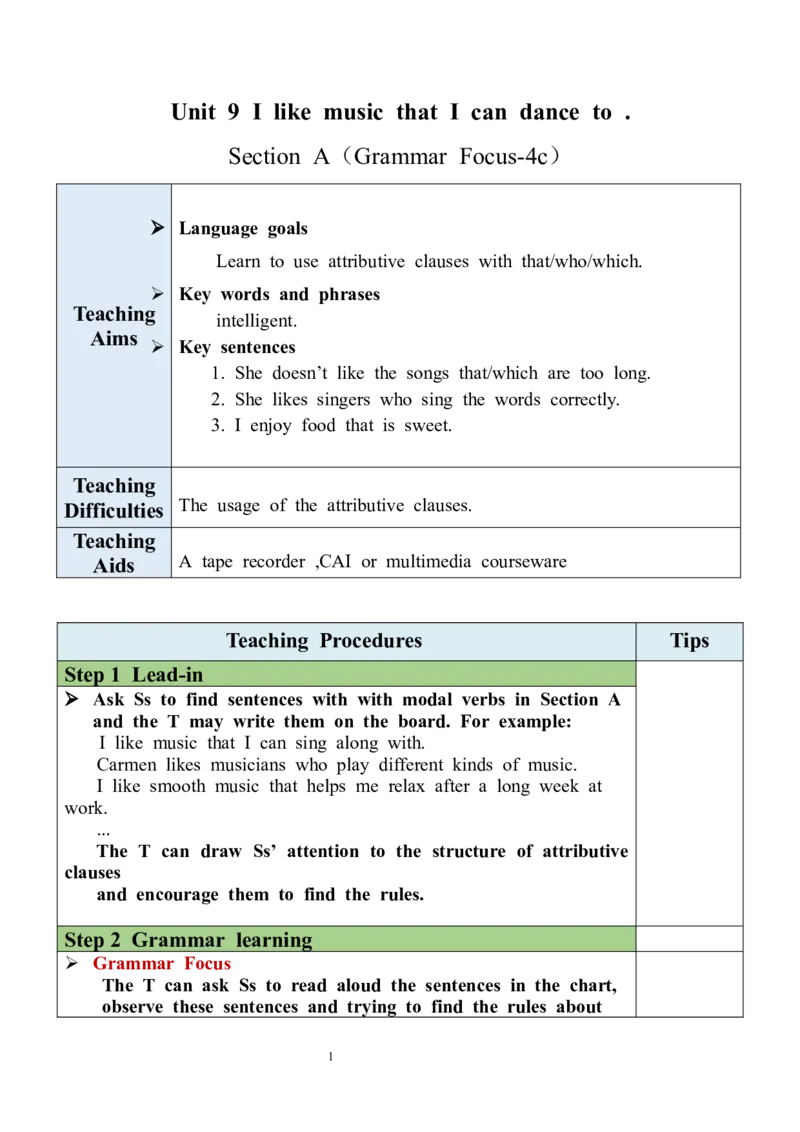
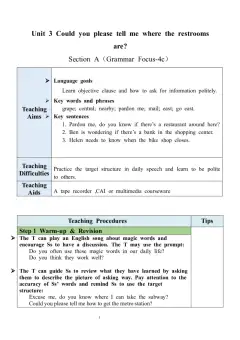
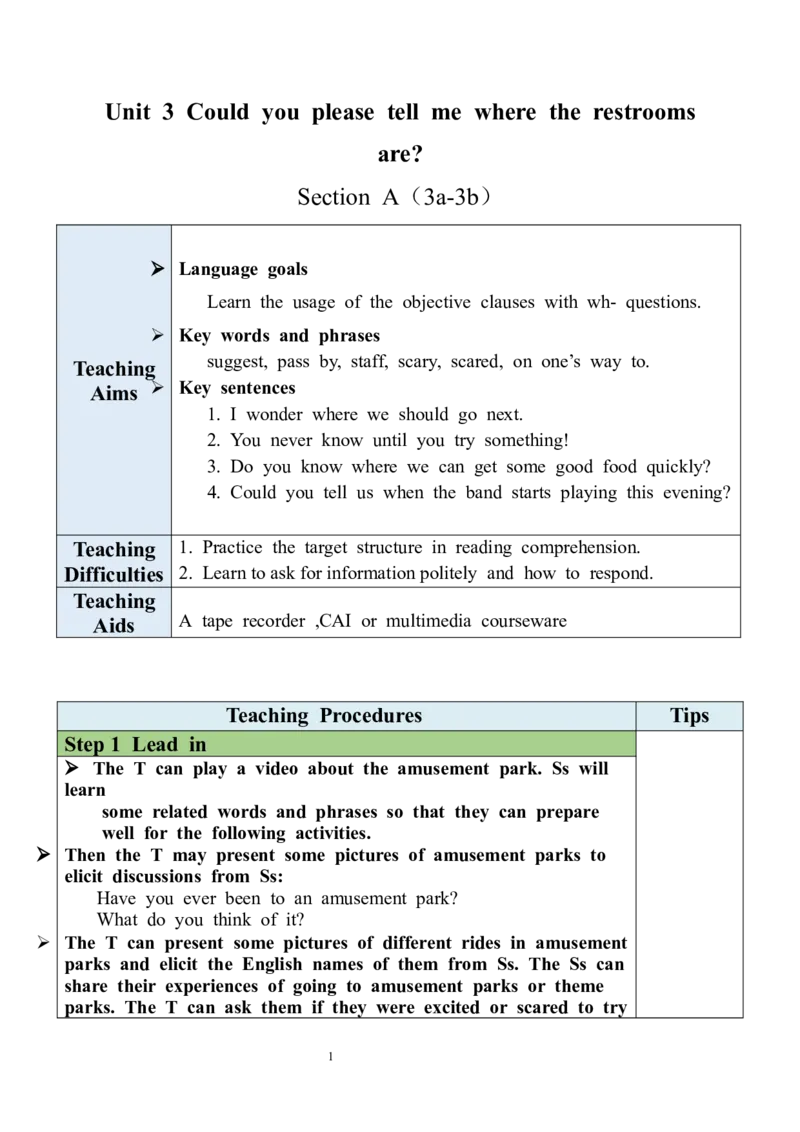
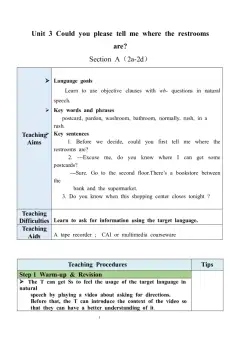
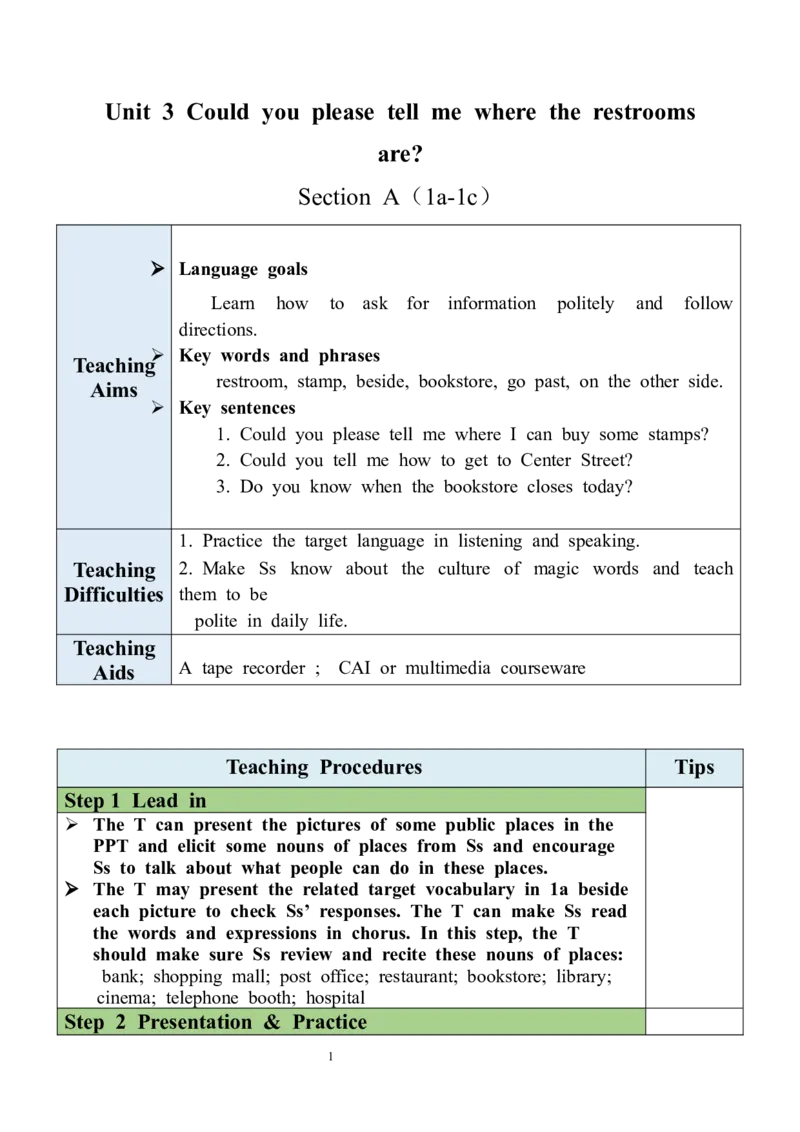
Section A(Grammar Focus-4c)
Language goals
learn to use passive voice with modal verbs.
Key words and phrases
community, keep...away from, chance, make one’s own
decision,
educate, manage, society.
Teaching
Key sentences
Aims
1. Should teenagers be asked to move out when they start
working?
2. Their parents believe that they should be educated to take
care of
themselves from a young age.
3.That is why many Chinese adults continue to live with their
parents.
Teaching
The mutual transformation of active voice and passive voice with
Difficulties
modal verbs.
Teaching
Aids A tape recorder ,CAI or multimedia courseware
Teaching Procedures Tips
Step 1 Warm-up & Revision
The T can make Ss to interview each other in pairs to express
their opinions about what teenagers should or should not be
allowed to do so that Ss can practice using the target structure.
The T can observe and give feedback. Pay attention to the
fluency of Ss’ speaking and accuracy of the target structure, but
don’t over correct Ss’ small mistakes so that Ss can speak as
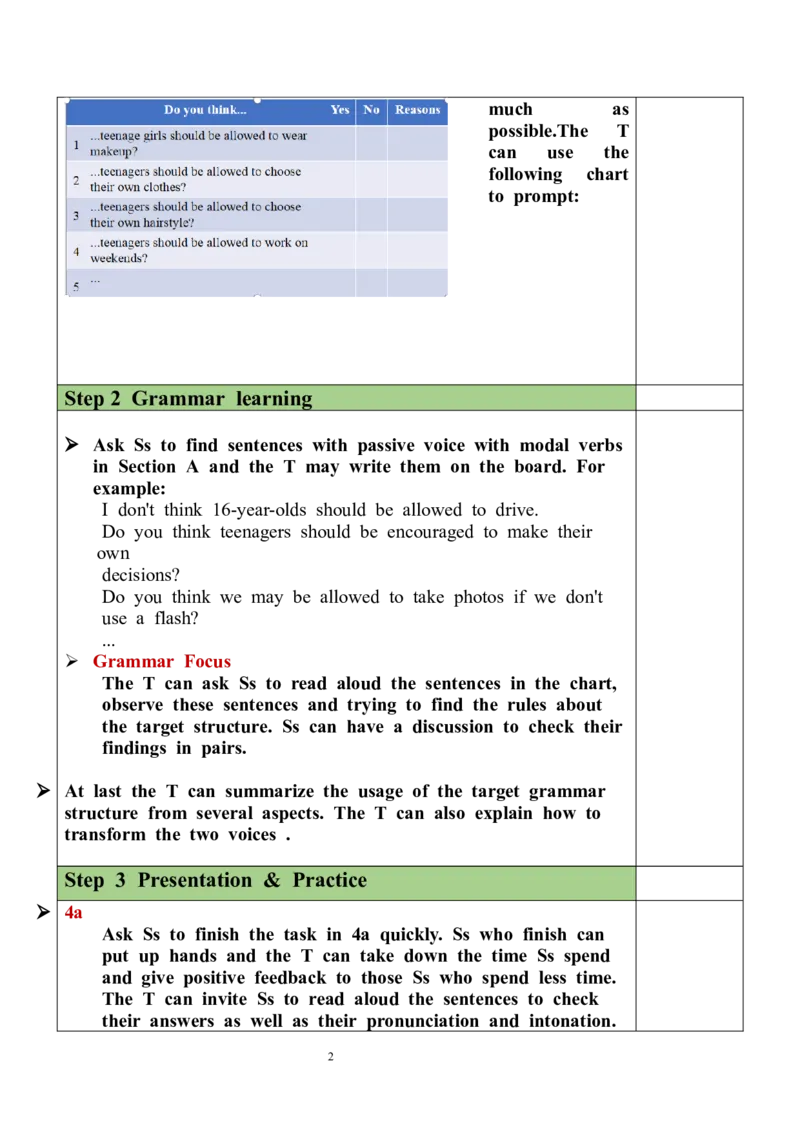
1much as
possible.The T
can use the
following chart
to prompt:
Step 2 Grammar learning
Ask Ss to find sentences with passive voice with modal verbs
in Section A and the T may write them on the board. For
example:
I don't think 16-year-olds should be allowed to drive.
Do you think teenagers should be encouraged to make their
own
decisions?
Do you think we may be allowed to take photos if we don't
use a flash?
...
Grammar Focus
The T can ask Ss to read aloud the sentences in the chart,
observe these sentences and trying to find the rules about
the target structure. Ss can have a discussion to check their
findings in pairs.
At last the T can summarize the usage of the target grammar
structure from several aspects. The T can also explain how to
transform the two voices .
Step 3 Presentation & Practice
4a
Ask Ss to finish the task in 4a quickly. Ss who finish can
put up hands and the T can take down the time Ss spend
and give positive feedback to those Ss who spend less time.
The T can invite Ss to read aloud the sentences to check
their answers as well as their pronunciation and intonation.
2Answers:
1. Your bedroom must be cleaned every day.
2. The housework will be done in the afternoon.
3. Children should be encouraged (by their parents) to do social
work
for their community.
4. Do you think teenagers must be kept away from the Internet?
5. Teenagers should be given chances to make their own decisions.
4b
Ask Ss to look through the passage in 4b to grasp the main
idea. The T can also introduce the cultural background
information if necessary. Then Ss finish the task in 4b
individually and talk with their partners to check answers.
At last the T can present the correct answer.
Answers:
be asked, are allowed, be educated, start, move,take, continue.
4b
The T can also assess Ss’ understanding of the passage by
asking some questions:
What are teenagers allowed to do in western countries when
they are eighteen? Why do they do this?
Do teenagers move out in most Asian societies?
What do Chinese parents think about it?
What is common for teenagers in China? Why?
4c
The activity is to reinforce the target language for talking
about what should or should not be allowed. The T can first
have Ss brainstorm: What do we always do in an English
club? The T can prompt Ss to use different phrases to list
different activities such as attending English corner, acting
out English plays, singing English songs, watching English
movies, reading English newspapers and so on.
4c Group work
Then the T can divide Ss into different groups and each
group discuss one activity listed before and decide on the
rules of doing these activities. Every group leader take down
the rules they have discussed. Then each group share their
group results and Ss take some notes so that every student
can list rules of the English club.
Step 4 Language Points
chance n. 机会;可能性 常用搭配:
3①by chance 偶然;意外
② have a chance to do sth.
=have a chance of doing sth.有机会做某事
③ have no chance to do sth.没有机会做某事
拓展:chance 作名词还可意为“可能性”,此时既可作可数名词,
又可作不可数名词。后常接 of doing sth. 或 that 引导的同位语从
句,表示“做某事的可能性”。
make one’s own decision 自己做决定
make one’s own decision to do sth.= make up one’s mind to do sth.=
decide to do sth. for oneself 意为“自己决定做某事”。其中的 one’s
要根据主语的不同换成适当的形容词性物主代词。
manage v. 完成( 困难的事);应付 (困难局面) 其词形变化有:
manager n . 经理 management n . 经营
常用结构:
manage to do sth. 设法做成某事,多指目标明确、经过努力成功地
做成某事。
Step 5 Summary & Homework
Summary The T can encourage Ss to summarize the key points The
of this class to help Ss consolidate the knowledge. homework
Homework: can vary
Preview the new words and phrases in Section B(1a-1e). with the
Do the exercises in students’ book. specific
conditions.
The group work activity in 4c can help achieve the following purposes:
1) check the students' attention in class and whether they listen to the
students' report carefully. 2) Cultivate students' short-term attention and
shorthand skills, and train them to record key words while listening. 3)
Teaching Check and cultivate students' awareness of lexical chunks and their ability
Reflection to form words into sentences. All in all, to enable students to master the
grammatical structure, they should practice and use the grammatical
structure repeatedly in different contexts for the purpose of communication.
We must effectively improve students' participation and frequency, carry
out various activities and ensure students' real participation.
4