文档文本内容
Unit 6 When was it invented?
Section A(2a-2d)
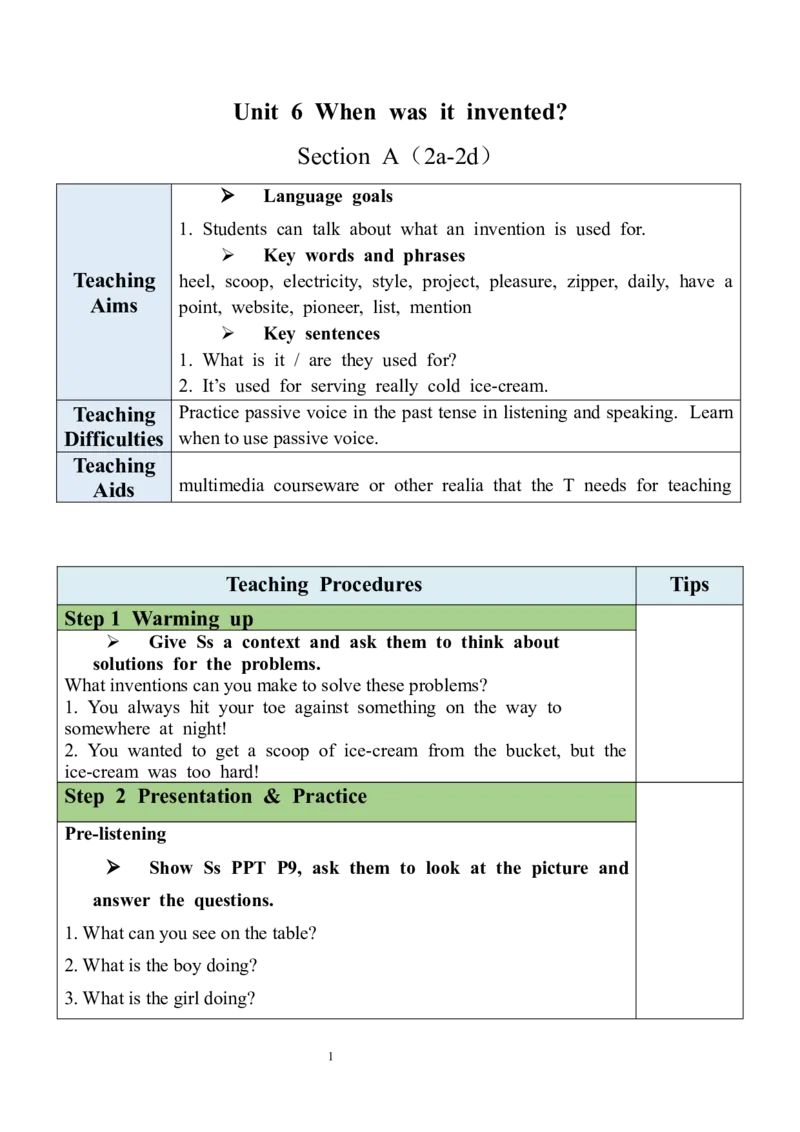
Language goals
1. Students can talk about what an invention is used for.
Key words and phrases
Teaching heel, scoop, electricity, style, project, pleasure, zipper, daily, have a
Aims point, website, pioneer, list, mention
Key sentences
1. What is it / are they used for?
2. It’s used for serving really cold ice-cream.
Teaching Practice passive voice in the past tense in listening and speaking. Learn
Difficulties when to use passive voice.
Teaching
Aids multimedia courseware or other realia that the T needs for teaching
Teaching Procedures Tips
Step 1 Warming up
Give Ss a context and ask them to think about
solutions for the problems.
What inventions can you make to solve these problems?
1. You always hit your toe against something on the way to
somewhere at night!
2. You wanted to get a scoop of ice-cream from the bucket, but the
ice-cream was too hard!
Step 2 Presentation & Practice
Pre-listening
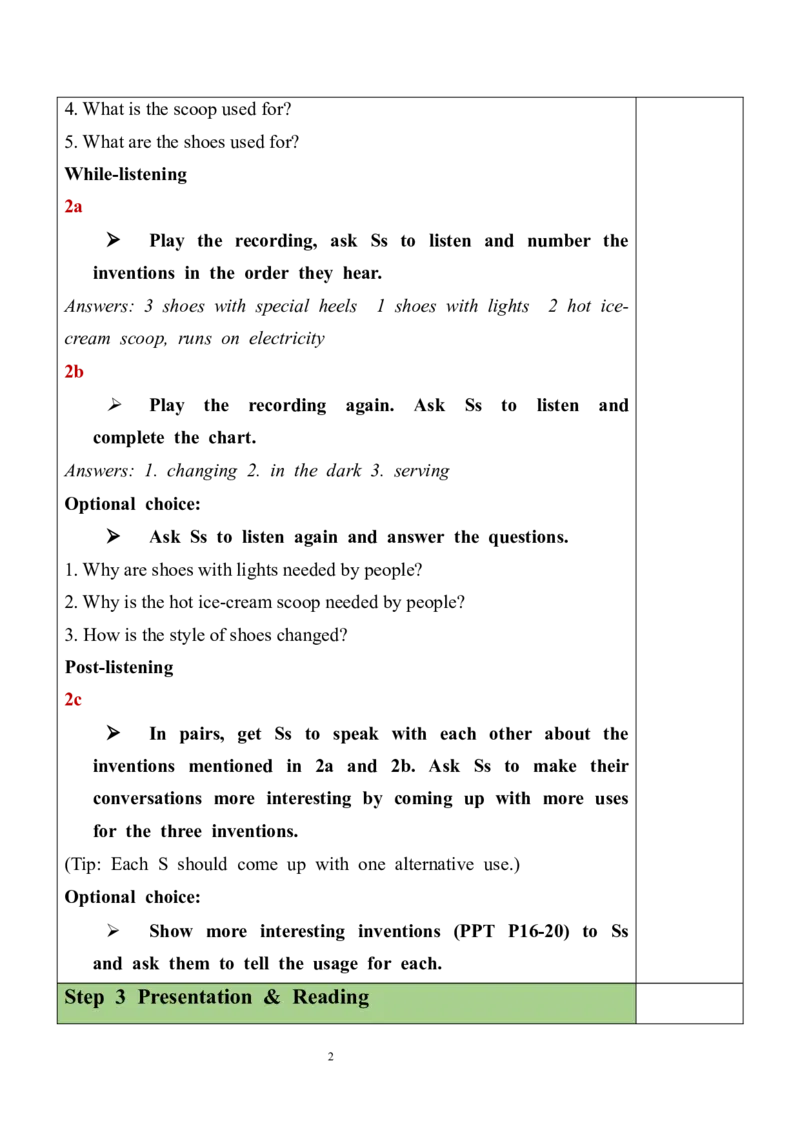
Show Ss PPT P9, ask them to look at the picture and
answer the questions.
1. What can you see on the table?
2. What is the boy doing?
3. What is the girl doing?
14. What is the scoop used for?
5. What are the shoes used for?
While-listening
2a
Play the recording, ask Ss to listen and number the
inventions in the order they hear.
Answers: 3 shoes with special heels 1 shoes with lights 2 hot ice-
cream scoop, runs on electricity
2b
Play the recording again. Ask Ss to listen and
complete the chart.
Answers: 1. changing 2. in the dark 3. serving
Optional choice:
Ask Ss to listen again and answer the questions.
1. Why are shoes with lights needed by people?
2. Why is the hot ice-cream scoop needed by people?
3. How is the style of shoes changed?
Post-listening
2c
In pairs, get Ss to speak with each other about the
inventions mentioned in 2a and 2b. Ask Ss to make their
conversations more interesting by coming up with more uses
for the three inventions.
(Tip: Each S should come up with one alternative use.)
Optional choice:
Show more interesting inventions (PPT P16-20) to Ss
and ask them to tell the usage for each.
Step 3 Presentation & Reading
2Pre-reading
Show a picture of zipper and ask where they can see
it. Give some examples to Ss (backpack, jacket, wallet, key
chain) and encourage them to think about more things with
zippers.
While-reading
Ask Ss to read the conversation in 2d and answer the
questions.
1. Who invented the zipper?
2. When was the zipper invented?
3. When was it first used widely?
Play the video for Ss. Ask them to role-play the
conversation.
Post-reading
Ask Ss to think and answer the questions: Are there
any other inventions that have great influence on people’s
lives? How do they change people’s lives?
(Tip: T can also treat these questions as a project. T can ask Ss to
work in groups, look up some information about “inventions which
have influence on people lives” on net and make a presentation in
next class.)
Step 4 Language points learning
3be used for sth. / doing sth. 意为“被用来做某事”,表示用途或目
的,后接名词或动名词,相当于be used to do sth.
be used for, be used by和be used as的区别是:
be used for意为“用来做......”,后面跟名词、代词或者是v-ing形
式,表示目的、用途,相当于be used to do sth。
be used by意为“被......使用者”,后面跟使用者。
be used as意为“被当做......使用”。
My pleasure也可说成It’s a / my pleasure.或 A pleasure.意思是
“我的荣幸;愿为你效劳;这是件愉快的事”。
mention表示“提到;提及”,是及物动词,其后接名词或代词作宾
语时,无需用任何介词;另外注意不接双宾语。若后接动词,要用
动名词,不能用不定式。not to mention意为“更不用说;还不
算”。口语中说Don’ t mention it. 主要用来回答感谢,有时也用来回
答道歉。
Step 5 Summary & Homework
Summary
Ask Ss to do the exercises on PPT P35.
Homework:
Preview the passage in 3a.
Do the exercises in students’ book.
In this lesson, the most important thing is to learn the passive voice in the
past tense and teach students past participle forms.We should learn some
Teaching
new words about this topic in 2d.We can get the students to practice the
Reflection
structure “be used for ... ” “Who was it invented by?” and “It was
invented by ...”.
4