文档文本内容
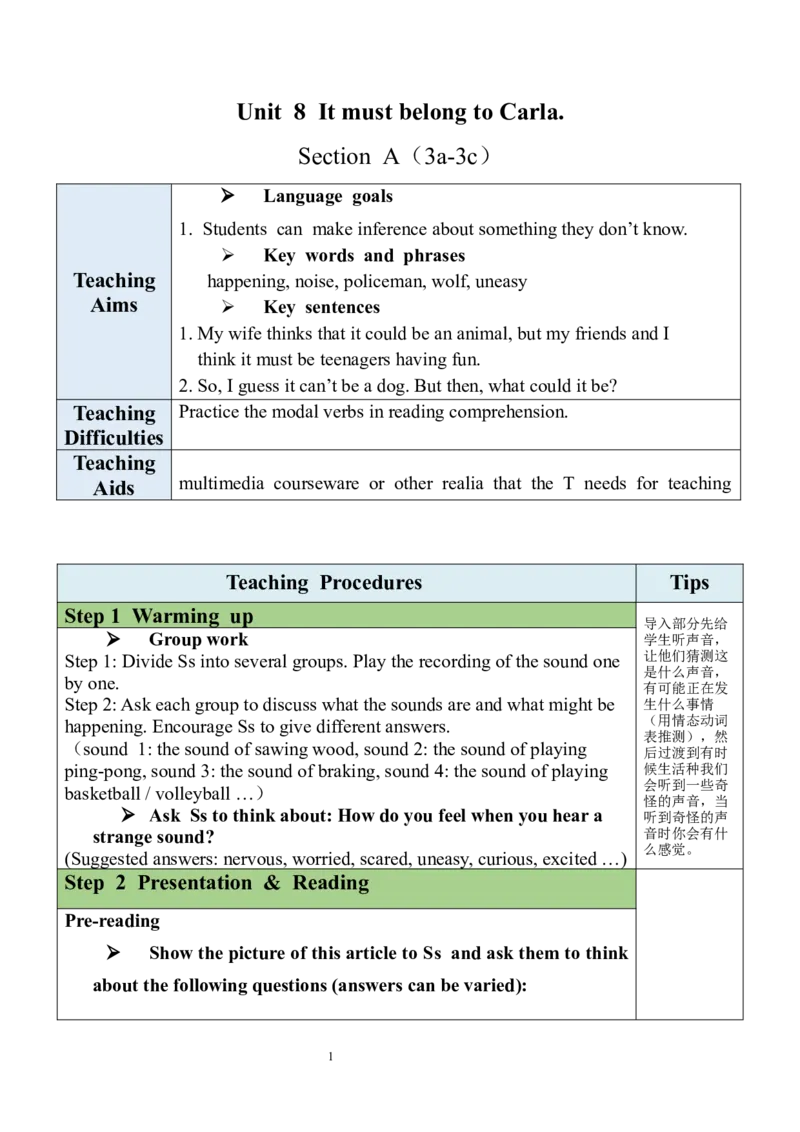
Unit 8 It must belong to Carla.
Section A(3a-3c)
Language goals
1. Students can make inference about something they don’t know.
Key words and phrases
Teaching happening, noise, policeman, wolf, uneasy
Aims Key sentences
1. My wife thinks that it could be an animal, but my friends and I
think it must be teenagers having fun.
2. So, I guess it can’t be a dog. But then, what could it be?
Teaching Practice the modal verbs in reading comprehension.
Difficulties
Teaching
Aids multimedia courseware or other realia that the T needs for teaching
Teaching Procedures Tips
Step 1 Warming up
导入部分先给
Group work 学生听声音,
Step 1: Divide Ss into several groups. Play the recording of the sound one 让他们猜测这
是什么声音,
by one.
有可能正在发
Step 2: Ask each group to discuss what the sounds are and what might be 生什么事情
(用情态动词
happening. Encourage Ss to give different answers.
表推测),然
(sound 1: the sound of sawing wood, sound 2: the sound of playing
后过渡到有时
ping-pong, sound 3: the sound of braking, sound 4: the sound of playing 候生活种我们
会听到一些奇
basketball / volleyball …)
怪的声音,当
Ask Ss to think about: How do you feel when you hear a 听到奇怪的声
strange sound? 音时你会有什
么感觉。
(Suggested answers: nervous, worried, scared, uneasy, curious, excited …)
Step 2 Presentation & Reading
Pre-reading
Show the picture of this article to Ss and ask them to think
about the following questions (answers can be varied):
11. When is it?
2. What is the woman looking at?
3. How might the woman feel?
Then, ask Ss to read the article and think about: What’s happening in
the town.
While-reading
3a
Ask Ss to read the article and decide which might be the
best title.
Answers: Strange Happenings in My Town
While-reading
3b
Ask Ss to write down the words as many as they can based
on the meanings. After all of them have finished, T can ask them to
check their answers by reading the article again.
(Tip: The goal of this exercise isn’t to get all the answers correct but to try
to deduce the word from its meaning. This will also ensure that Ss truly
understand the meaning of the words. So, give Ss a few minutes to fill in
the answers before allowing them to read the article again.)
Show the table on PPT P14 to Ss, ask them to find out the
person who gives opinion in each paragraph.
Post-reading
3c
Ask Ss to read the article carefully and write what people
think about the strange noises.
(Tip: For stronger classes, T can ask Ss to fill in the answers without
looking at the passage and only based on what they can remember from
the first reading. Tell Ss that it is all right if they can’t remember a lot.
Next, get Ss to share their answers with a partner to see how much each
2one remembers. Then, get Ss re-read the passage and go through the
questions again.)
Answers:
Group Work
Divide Ss into several groups and ask them to discuss the following
questions:
1. After reading the article, what do you think the strange noises
are? Who is the noise-maker?
2. Have you ever heard any strange noise (or encountered any
strange things) before? What was it?
Step 3 Language points learning
nothing / not much的意思是“没什么; 不多; 不怎么样”,一般用于
否定句中,表示并不那么重要、有趣、好等。
unusual adj. 意为“特别的;不寻常的”,由否定前缀“un-”加形
容词 usual 构成。否定前缀 un-表示“不”。当其后加 adj.时,构成
原词的反义词。
noise n. 意为“声音;噪音”,其形容词形式为noisy,意为“吵闹
的”,常用短语有make noise“制造噪音”。
noise, voice和sound的区别为:
noise多指不悦耳的吵闹声、嘈杂声。
sound泛指各种声音,不带有任何感情色彩。
voice多指人说话、唱歌的声音,即人的嗓音。
There must be sb. / sth. doing sth. 的意思是“一定有某人 / 某物在
做某事”。情态动词must和there be句型的连用,表示肯定推测。
其中sb.和do之间是主动关系,用v-ing形式。
3Step 4 Summary & Homework
Summary
Ask Ss to do the exercise on PPT P23.
Homework:
Preview the grammar points in U8.
Do the exercises in students’ book.
In this period, we should practice making inferences with must, might,
Teaching could and can’t in reading and the situation. Students must finish every
Reflection activity by their own reading. The teacher should let the students feel how
to use these modal verbs instead of teaching and explaining.
4