Unit 3 Could you please tell me where the restrooms
are?
Section B(2a-2d)
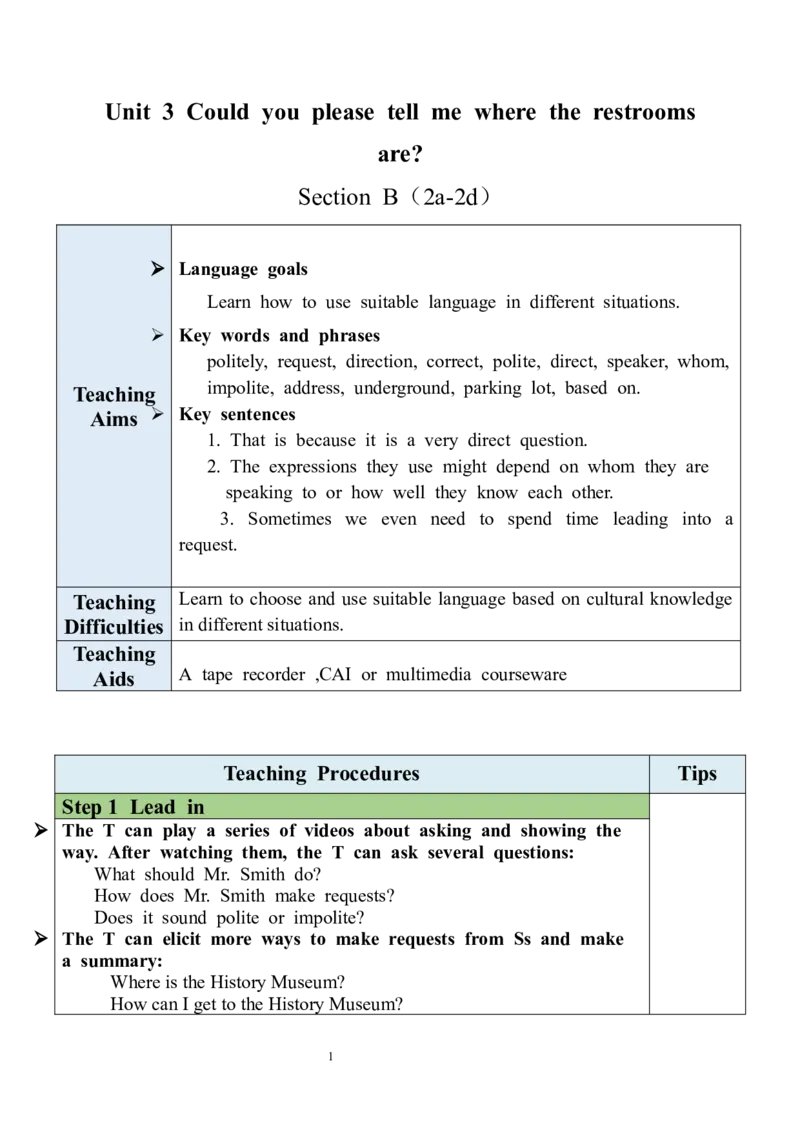
Language goals
Learn how to use suitable language in different situations.
Key words and phrases
politely, request, direction, correct, polite, direct, speaker, whom,
impolite, address, underground, parking lot, based on.
Teaching
Aims Key sentences
1. That is because it is a very direct question.
2. The expressions they use might depend on whom they are
speaking to or how well they know each other.
3. Sometimes we even need to spend time leading into a
request.
Teaching Learn to choose and use suitable language based on cultural knowledge
Difficulties in different situations.
Teaching
Aids A tape recorder ,CAI or multimedia courseware
Teaching Procedures Tips
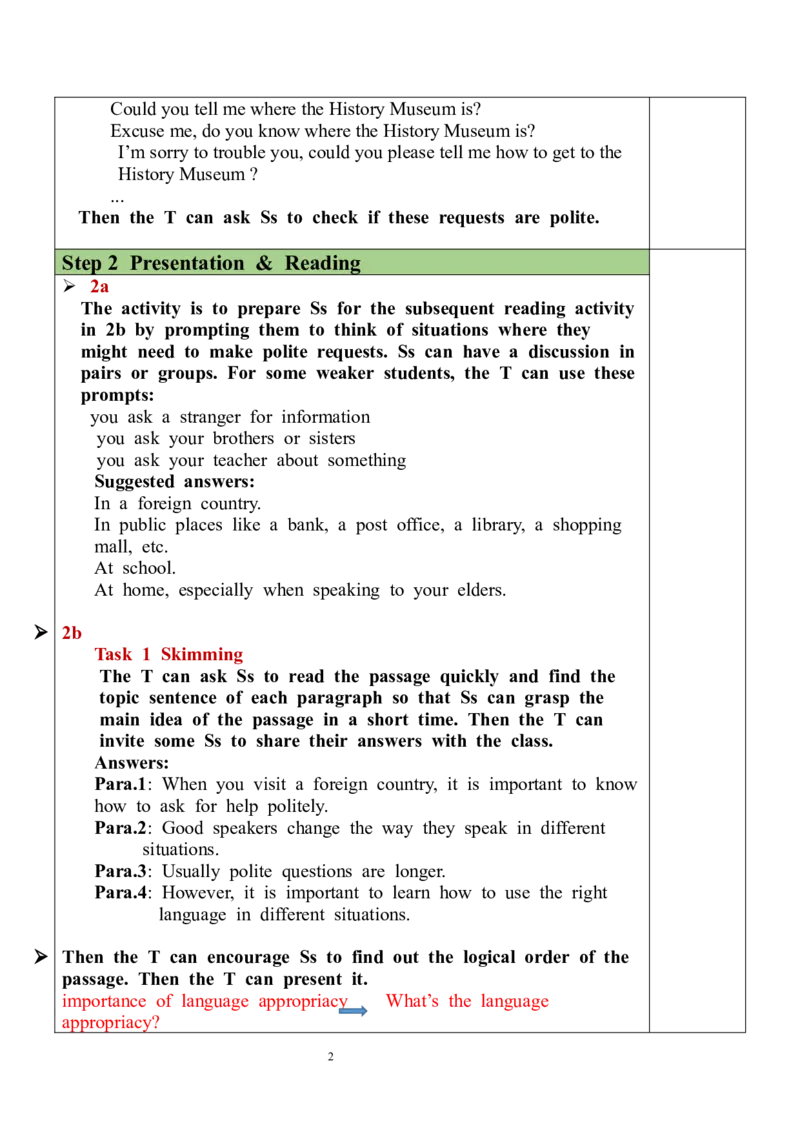
Step 1 Lead in
The T can play a series of videos about asking and showing the
way. After watching them, the T can ask several questions:
What should Mr. Smith do?
How does Mr. Smith make requests?
Does it sound polite or impolite?
The T can elicit more ways to make requests from Ss and make
a summary:
Where is the History Museum?
How can I get to the History Museum?
1Could you tell me where the History Museum is?
Excuse me, do you know where the History Museum is?
I’m sorry to trouble you, could you please tell me how to get to the
History Museum ?
...
Then the T can ask Ss to check if these requests are polite.
Step 2 Presentation & Reading
2a
The activity is to prepare Ss for the subsequent reading activity
in 2b by prompting them to think of situations where they
might need to make polite requests. Ss can have a discussion in
pairs or groups. For some weaker students, the T can use these
prompts:
you ask a stranger for information
you ask your brothers or sisters
you ask your teacher about something
Suggested answers:
In a foreign country.
In public places like a bank, a post office, a library, a shopping
mall, etc.
At school.
At home, especially when speaking to your elders.
2b
Task 1 Skimming
The T can ask Ss to read the passage quickly and find the
topic sentence of each paragraph so that Ss can grasp the
main idea of the passage in a short time. Then the T can
invite some Ss to share their answers with the class.
Answers:
Para.1: When you visit a foreign country, it is important to know
how to ask for help politely.
Para.2: Good speakers change the way they speak in different
situations.
Para.3: Usually polite questions are longer.
Para.4: However, it is important to learn how to use the right
language in different situations.
Then the T can encourage Ss to find out the logical order of the
passage. Then the T can present it.
importance of language appropriacy What’s the language
appropriacy?
2features of polite language seems difficult but still important
Task 3 Scanning
The T can ask Ss to read each paragraph carefully and
answer the
questions of each paragraph.
Para.1
Q:Is it enough to speak correctly?
A:No.It is not enough to just ask a question correctly. We also need to
learn how to be polite when we ask for help.
Para.2
Q: Is it necessary to ask all the people around you indirect questions?
A: No.It is all right to ask your classmates direct questions because you
know them well.
Para.3
Q: What are the features of polite language?
A: Usually polite questions are longer. They include expressions
such as “Could you please ...?” or “May I ask ...?”
Para.4
Q: In the second picture, why does the man say “Sorry, I
can’t help you.”? Can you change the question to a more
polite one?
A: Because the man is too impolite, he asks directly.
I may say…
2c
The activity is to give Ss practice in identifying direct questions
and polite requests. The T can make Ss read the passage again
carefully and finish the task in 2c. Then the T can ask Ss to
check answers in pairs.
Answers:
Direct questions: Where are the restrooms?
When is the school trip?
Where’s the post office?
Polite requests:Could you please tell me where the restrooms are?
Excuse me, Mr. West. Do you know when the school trip is?
Peter, could you please tell me your e-mail address?
Pardon me, could you please tell me where to park my car?
2c
After finishing the task, the T can highlight these common ways
of making direct questions more polite:
By adding “excuse me ”or “pardon me”at the beginning of the
question
3 By using “could” instead of “can” in questions
By adding “please” at the end of a question
2d
The activity is to provide Ss with practice in identifying suitable
situations for different ways of making requests. The T can
make Ss read the sentences in the first column and then check
whether these questions are polite or not. Then Ss can work in
pairs to do the task in 2d and have a discussion if they have
different opinions.
Suggested answers:
1. A; restaurant/home
2. B;street
3. A/B; any public place/home
4. B; street
5. B;movie theatre/concert hall
6. A; home
7. B; street
2d
After finishing the task, the T may point out that another
factor that is very important when making polite requests is the
speaker’s tone of voice. Generally, a higher tone tends to sound
more polite. To illustrate this point, the T could encourage Ss to
practicing reading the requests using different tones and give
feedback on whether they sound polite or impolite in each case.
The T could also remind Ss to smile when making requests.
Step 3 Language points learning
request 作可数名词,意为“要求;请求”,其后常接“for +名间”, The
意为“……的要求/请求”。 language
request用作及物动词,意为“要求;请求”。 常见用法: points are
①request sth. ( from/of sb.) 意为“(向某人)请求某物”。 for
reference
②request sb. to do sth. 意为“请求某人做某事”。
only.
③request + that从句(从句用虚拟语气,谓语动词用“ should +动
词原形 should可省略)意为“请求/要求……”。
include作及物动词,意为“包括;包含”。
① including用作介词,意为“包括;包含在内”,后接名词、代词或
动词-ing形式。
② included形容词,意为“包括在内的”,通常置于名词之后。
4 lead v. (led, led)领导;带领;过(某种生活) 常用结构:
lead into 引入,导入
lead to 导致
lead sb. to sp. 带领某人到某地
lead a ... life过……的生活
Step 5 Summary & Homework The
homework
Summary The T can encourage Ss to summarize the key points can vary
of this class to help Ss consolidate the knowledge. with the
Homework: specific
Read and recite the passage in 2b. conditions
Do the exercises in students’ book. .
In this period,the most important thing is reading.And also we learn
how to make appropriate and polite requests as well as we make a request
correctly.It is a good time to train the students' ability of reading quickly and
efficiently.Today's reading task is to find the topic sentences for the
Teaching
paragraphs.And students should learn the culture and how to make polite
Reflection
requests after they have read the text.
After reading,we can talk about the reading passage and discuss some
questions to check how well the students learn from the passage.Students are
given some written work to do after class.
5