文档文本内容
Unit 10 You’re supposed to shake hands.
Section B(1a-1d)
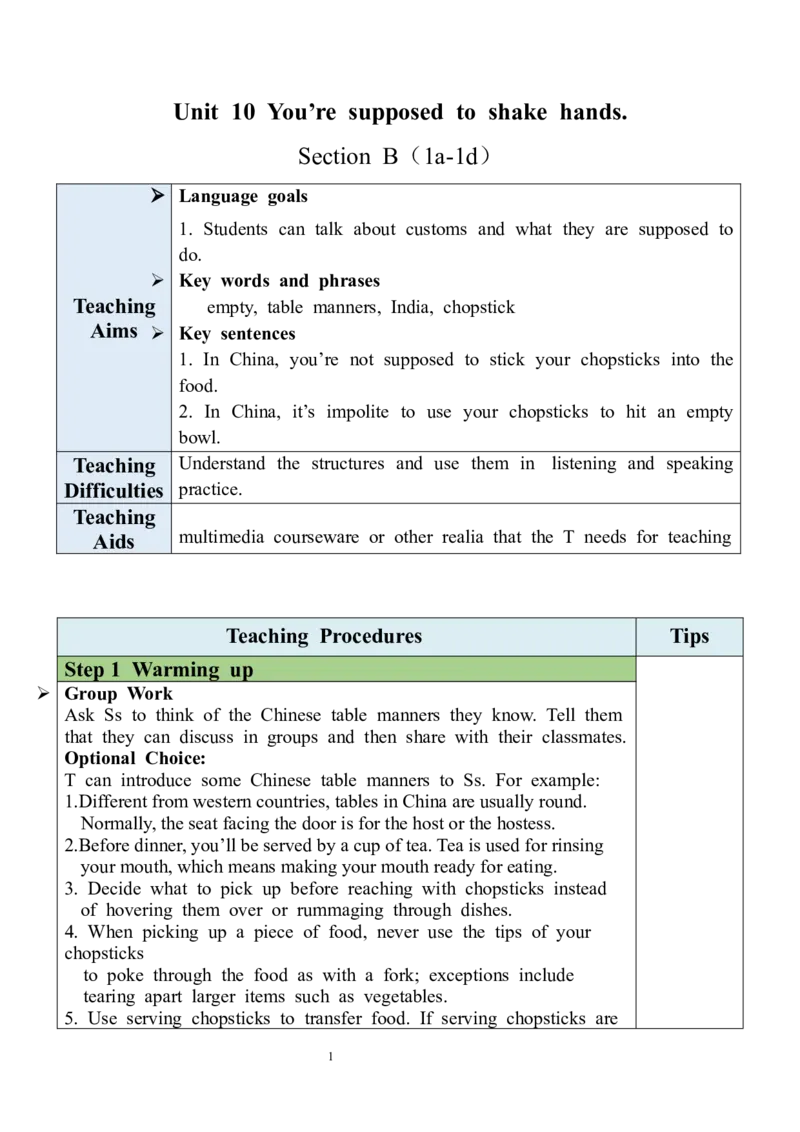
Language goals
1. Students can talk about customs and what they are supposed to
do.
Key words and phrases
Teaching empty, table manners, India, chopstick
Aims Key sentences
1. In China, you’re not supposed to stick your chopsticks into the
food.
2. In China, it’s impolite to use your chopsticks to hit an empty
bowl.
Teaching Understand the structures and use them in listening and speaking
Difficulties practice.
Teaching
Aids multimedia courseware or other realia that the T needs for teaching
Teaching Procedures Tips
Step 1 Warming up
Group Work
Ask Ss to think of the Chinese table manners they know. Tell them
that they can discuss in groups and then share with their classmates.
Optional Choice:
T can introduce some Chinese table manners to Ss. For example:
1.Different from western countries, tables in China are usually round.
Normally, the seat facing the door is for the host or the hostess.
2.Before dinner, you’ll be served by a cup of tea. Tea is used for rinsing
your mouth, which means making your mouth ready for eating.
3. Decide what to pick up before reaching with chopsticks instead
of hovering them over or rummaging through dishes.
4. When picking up a piece of food, never use the tips of your
chopsticks
to poke through the food as with a fork; exceptions include
tearing apart larger items such as vegetables.
5. Use serving chopsticks to transfer food. If serving chopsticks are
1not provided, use the blunt end of your chopsticks to serve a
guest by transferring food.
6. Don’t suck your chopsticks!
Step 2 Presentation & Practice
Pre-listening
1a
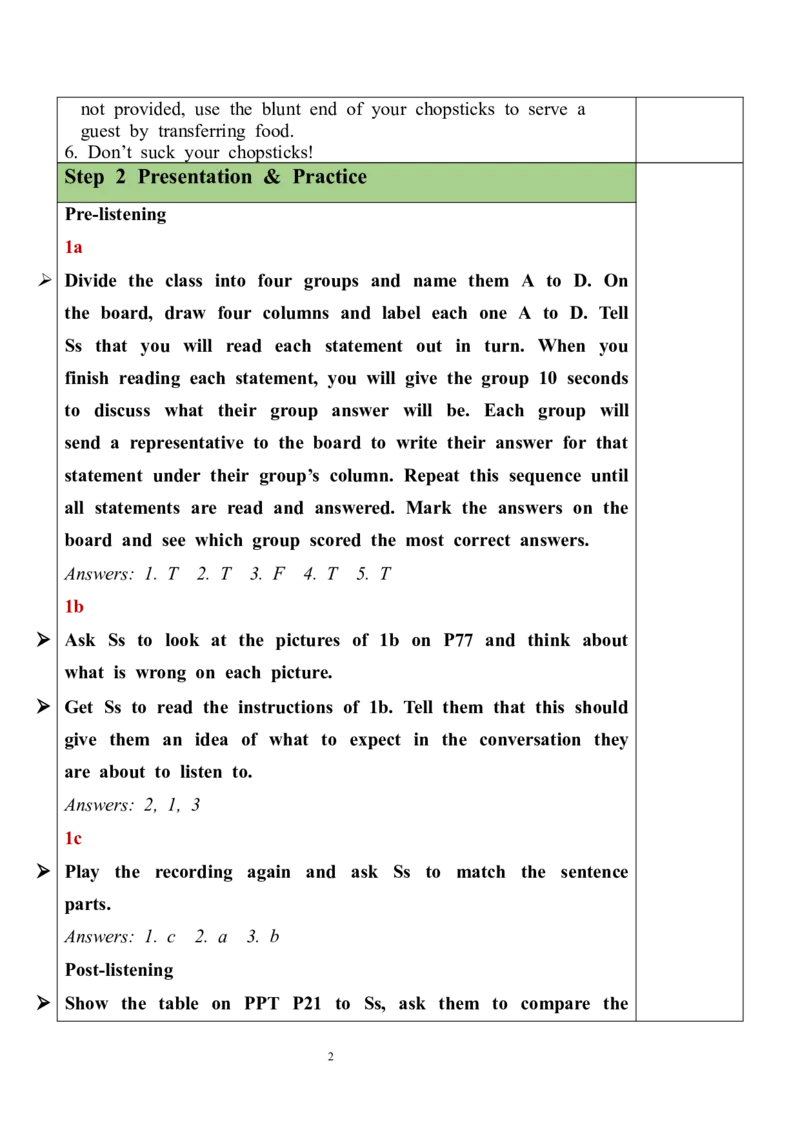
Divide the class into four groups and name them A to D. On
the board, draw four columns and label each one A to D. Tell
Ss that you will read each statement out in turn. When you
finish reading each statement, you will give the group 10 seconds
to discuss what their group answer will be. Each group will
send a representative to the board to write their answer for that
statement under their group’s column. Repeat this sequence until
all statements are read and answered. Mark the answers on the
board and see which group scored the most correct answers.
Answers: 1. T 2. T 3. F 4. T 5. T
1b
Ask Ss to look at the pictures of 1b on P77 and think about
what is wrong on each picture.
Get Ss to read the instructions of 1b. Tell them that this should
give them an idea of what to expect in the conversation they
are about to listen to.
Answers: 2, 1, 3
1c
Play the recording again and ask Ss to match the sentence
parts.
Answers: 1. c 2. a 3. b
Post-listening
Show the table on PPT P21 to Ss, ask them to compare the
2table manners between China and America based on listening.
In China: You are not supposed to start eating first if there are
older people at the table. It’s impolite to stick your chopsticks into
your food. It’s impolite to stick your chopsticks into your food. You
are not supposed to talk when you’re eating dinner.
In America: It doesn’t matter who eats first. People use forks or
knives to stick into their food. It’s not polite to talk with your
mouth full.
1d
In groups of three or four, ask Ss to discuss some of the table
manners that they follow in their own home. Ask them to share
what is strictly enforced and what is frowned upon. Also get
them to compare their family’s table manners with general
customs.
Step 3 Language points learning
stick v. 粘贴; 将......刺入,常与 in或into搭配。stick还可以作名词,
意思是“枝条;棍”。stick to 坚持; 固守, 后接名词、代词或动名
词。
empty作形容词, 意为“空的”, 其反义词为 full。empty作及物动词,
意为“使倒空”, 反义词为fill。
point at, point to与point out的区别在于:
point at指习惯上指离说话人较近的事物, 侧重于指的对象。
point to多用来指离说话人较远的事物, 侧重于所指的方向。在事物
名词作主语时,多用point to。
point out意为“指出”,表示给某人指出方向、要点或错误等,属于
“动副”结构的短语,虽可跟宾语,但若宾语是代词,须放在 point
和out之间。
Step 4 Summary & Homework
Summary
Ask Ss to do the exercises on PPT P29.
Homework:
Preview 2a-2e in Section B.
3 Do the exercises in students’ book.
In this period, the students should try to express the eating manners in
different countries. The teacher should get the students to practice the key
structures — be supposed to; should / shouldn’t;it’s impolite to do sth.
Teaching — in listening and speaking. They will improve their capacity of language
Reflection organization and oral output while listening and speaking practice. The
teacher should get them to do enough listening and oral practice before they
can write some sentences.We can ask them to surf the Internet to search for
the information about manners in foreign countries. It’s useful to do that.
4