Unit 3 Could you please tell me where the restrooms
are?
Section B(1a-1e)
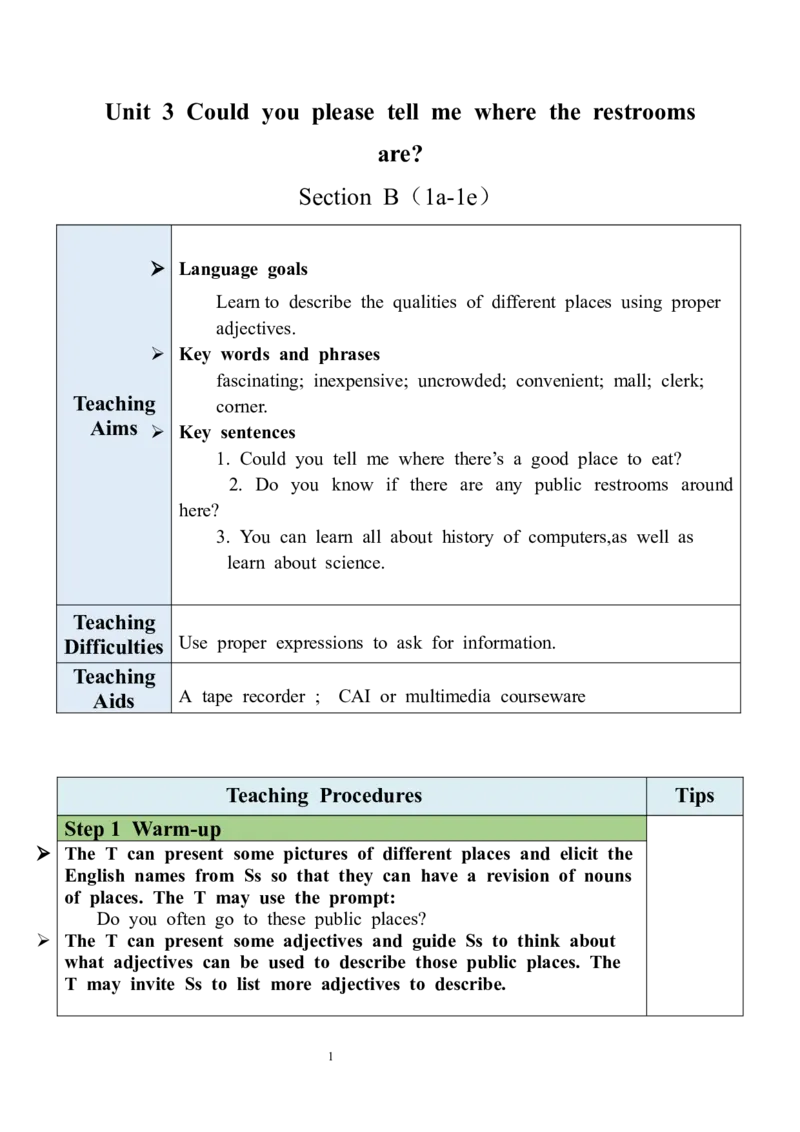
Language goals
Learn to describe the qualities of different places using proper
adjectives.
Key words and phrases
fascinating; inexpensive; uncrowded; convenient; mall; clerk;
Teaching
corner.
Aims
Key sentences
1. Could you tell me where there’s a good place to eat?
2. Do you know if there are any public restrooms around
here?
3. You can learn all about history of computers,as well as
learn about science.
Teaching
Difficulties Use proper expressions to ask for information.
Teaching
Aids A tape recorder ; CAI or multimedia courseware
Teaching Procedures Tips
Step 1 Warm-up
The T can present some pictures of different places and elicit the
English names from Ss so that they can have a revision of nouns
of places. The T may use the prompt:
Do you often go to these public places?
The T can present some adjectives and guide Ss to think about
what adjectives can be used to describe those public places. The
T may invite Ss to list more adjectives to describe.
1 The T can make Ss have a free talk in pairs. For example:
I think /an... should be ....
Step 2 Presentation & Practice
1a
This activity is to enrich Ss’ vocabulary by introducing
adjectives to describe the qualities of places. At first, the T
can make Ss read the words in the blue box in 1a and pay
attention to their pronunciation. And then ask Ss to identify
the part of speech these words belong to (They are all
adjectives). At last make sure Ss understand the meanings of
these words.
1a
Have Ss work in pairs to do the activity, then elicit responses
from different pairs. Where answers are different, encourage Ss
to give reasons for their choices of adjectives and their ranking
of the adjectives based on importance.
Suggested answers:
1. clean, uncrowded, convenient
2. uncrowded, interesting, fascinating, quiet
3. quiet, clean, inexpensive, uncrowded
4. beautiful, safe, clean, big
5. uncrowded, safe, convenient
6. convenient, interesting, inexpensive, safe, big
1b
This activity is to give Ss practice in using the words they
learned in the previous activity. The T can guide Ss to talk
about their familiar places and check if they use these
adjectives properly. To extend Ss’ vocabulary, the T may
get Ss to brainstorm more adjectives for describing places.In
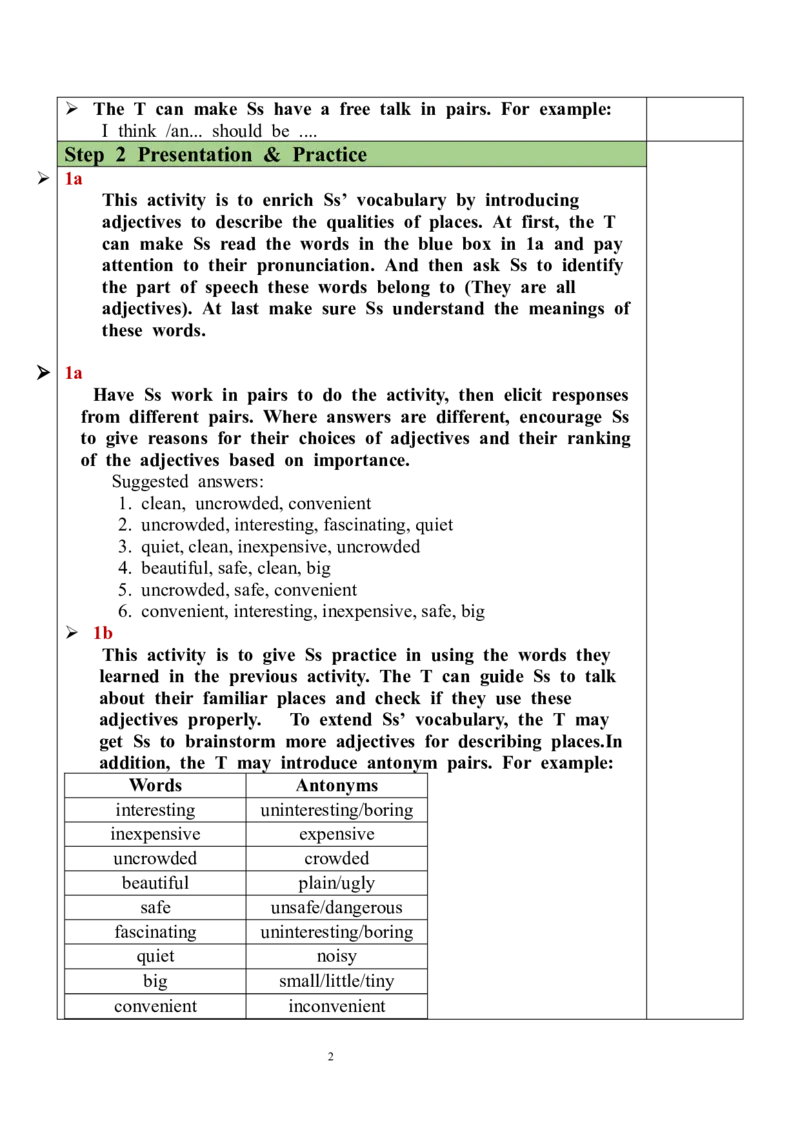
addition, the T may introduce antonym pairs. For example:
Words Antonyms
interesting uninteresting/boring
inexpensive expensive
uncrowded crowded
beautiful plain/ugly
safe unsafe/dangerous
fascinating uninteresting/boring
quiet noisy
big small/little/tiny
convenient inconvenient
2clean dirty
1c
Before-listening, the T can ask Ss to look through the
pictures and the context in 1c to predict. The T may use
these prompts:
What is the name of the place shown in the picture?
What are these people doing there?
What is the man from Sunville Tourist Information doing ?
How many conversations are we going to listen?
1c
This activity is to give Ss practice in listening for details and
taking simple notes. The T can play recording of the three
conversations
once a time to make it easier. When the first conversation
recording is done , the Ss fill in the blanks in Conversation 1
and so on. For weaker classes, the T may write the answers
in a jumbled order on the board and have Ss choose the
appropriate answer to fill in each blank.
Answers:
Conversation 1: a good place to eat
Conversation 2 : public restrooms
Conversation 3: a good museum, history, science, children’s, art,
computer.
1d
This activity is to give Ss the opportunity to listen to the
same conversation again to confirm the information they
heard earlier. Before playing the recording again, the T can
have Ss work in pairs to discuss their answers. If they have
blanks they have not yet filled in, they can try to recall what
they heard in activity 1c or make guesses using contextual
clues.
1d
The T can play the recording again and ask more questions
to help Ss to understand more details. For example:
Conversation 1
1.Are there many restaurants in Sunville?
2.What kind of restaurant is the boy looking for?
3.What food does Green Land serve?
Conversation 2
1.Where are the public restrooms?
2.Are they clean?
3Conversation 3
1. Do they often go to science museum?
2. What museum does the family finally decide to go?
1e
To provide Ss with speaking practice using the target
language, the T can invite Ss to role-play the conversations
between the clerk and the tourists. Or make them work in
closed pairs. The T can observe the Ss’ performance and
make assessments.
Other options:
The T may want to have Ss work in groups to write their
own conversations and then present them to the class.
Alternatively, the T may print the tapescript and have Ss
read the conversations in pairs or groups.
Step 4 Language points learning
fascinating作形容词,常在句中作表语或定语。作表语时,主语通常 The
为物。其名词形式是fascination,意为“魅力;入迷”;动词形式 language
fascinate,意为“迷住,深深吸引”;fascinated也是形容词形式,意 points are
为“入迷的,极感兴趣的”。 for
reference
convenient形容词,意为“便利的;方便的”,其主语不能是表示人 only.
的词,常用于句型:
It’s convenient for sb. to do sth.意为“对于某人来说做某事是方便
的”。
convenience是convenient的名词形式,既可作可数名词,意为
“便利的设施”,也可作不可数名词,意为“方便,便利”。
前缀以否定前缀(negative prefixes)un-, in-, im-, il-, ir-, non-,
dis-, mis-, mal-等为主,使延伸出来的派生词变成反义词。
形容词派生词: accurate → inaccurate;patient → impatient;
regular→ irregular;legal → illegal;native → non-native;orderly→
disorderly;common → uncommon.
Step 5 Summary & Homework
The
Summary The T can encourage Ss to summarize the key points homework
of this class to help Ss consolidate the knowledge. can vary
Homework: with the
Preview the passage in Section B 2b. specific
4Do the exercises in students’ book. conditions
.
In this period,the students review and learn more adjectives to describe
the places.They should practice the adjective sentence pattern——to be+
Teaching adj. Listening and oral practice are important in this period.Students should
Reflection develop a good listening habit and they need to take notes when they have
heard something.The teacher should give them some written work to do
after they do the listening practice and make conversations.
5