文档文本内容
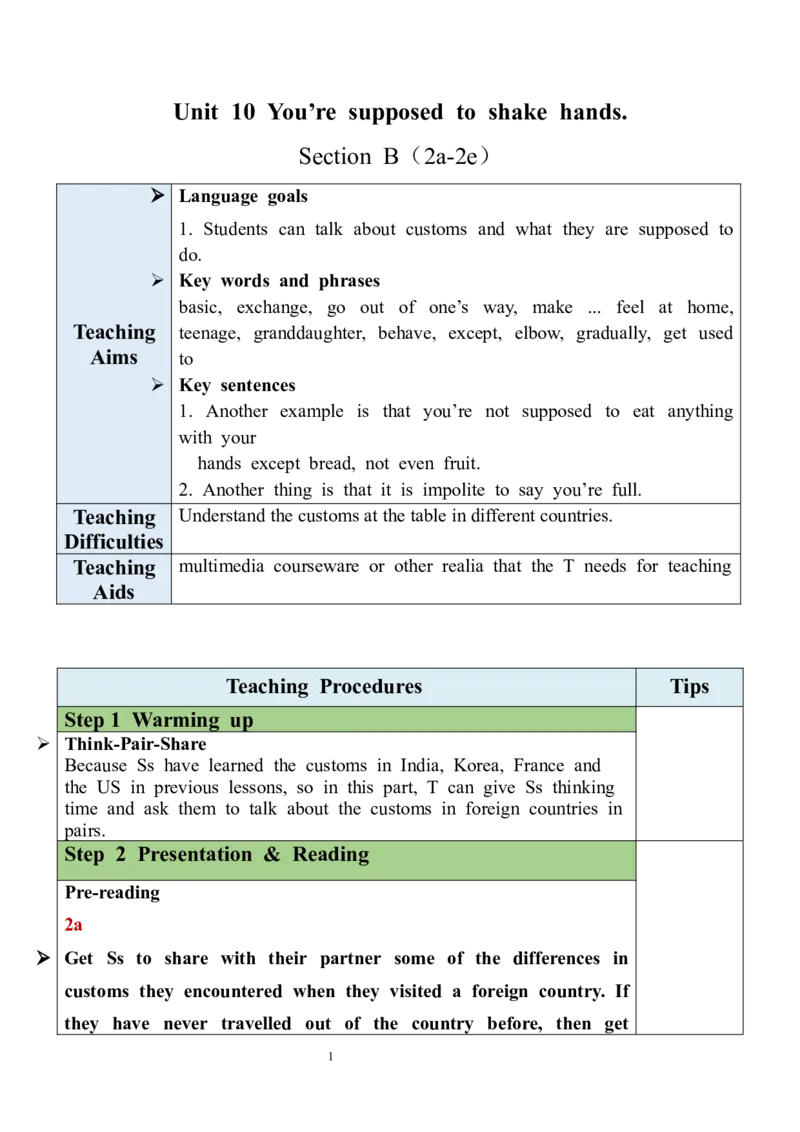
Unit 10 You’re supposed to shake hands.
Section B(2a-2e)
Language goals
1. Students can talk about customs and what they are supposed to
do.
Key words and phrases
basic, exchange, go out of one’s way, make ... feel at home,
Teaching teenage, granddaughter, behave, except, elbow, gradually, get used
Aims to
Key sentences
1. Another example is that you’re not supposed to eat anything
with your
hands except bread, not even fruit.
2. Another thing is that it is impolite to say you’re full.
Teaching Understand the customs at the table in different countries.
Difficulties
Teaching multimedia courseware or other realia that the T needs for teaching
Aids
Teaching Procedures Tips
Step 1 Warming up
Think-Pair-Share
Because Ss have learned the customs in India, Korea, France and
the US in previous lessons, so in this part, T can give Ss thinking
time and ask them to talk about the customs in foreign countries in
pairs.
Step 2 Presentation & Reading
Pre-reading
2a
Get Ss to share with their partner some of the differences in
customs they encountered when they visited a foreign country. If
they have never travelled out of the country before, then get
1them to share about something they have read about and why
they think it might be a challenge.
While-reading
2b
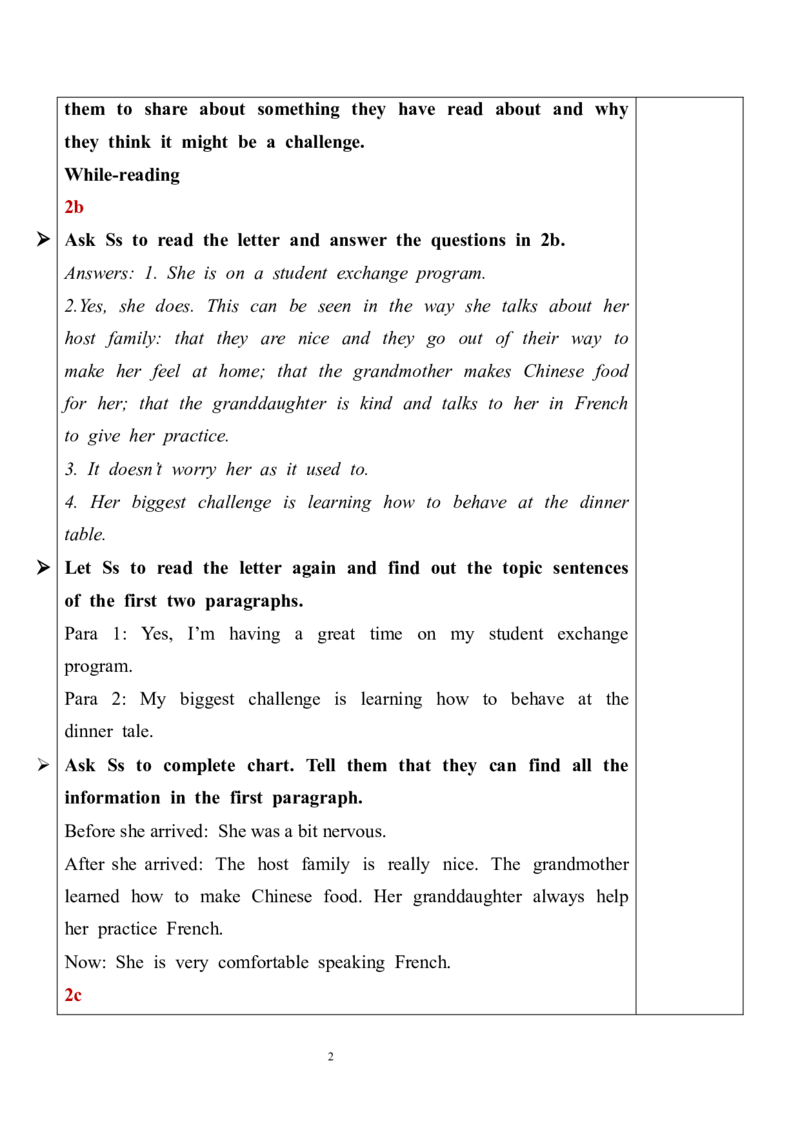
Ask Ss to read the letter and answer the questions in 2b.
Answers: 1. She is on a student exchange program.
2.Yes, she does. This can be seen in the way she talks about her
host family: that they are nice and they go out of their way to
make her feel at home; that the grandmother makes Chinese food
for her; that the granddaughter is kind and talks to her in French
to give her practice.
3. It doesn’t worry her as it used to.
4. Her biggest challenge is learning how to behave at the dinner
table.
Let Ss to read the letter again and find out the topic sentences
of the first two paragraphs.
Para 1: Yes, I’m having a great time on my student exchange
program.
Para 2: My biggest challenge is learning how to behave at the
dinner tale.
Ask Ss to complete chart. Tell them that they can find all the
information in the first paragraph.
Before she arrived: She was a bit nervous.
After she arrived: The host family is really nice. The grandmother
learned how to make Chinese food. Her granddaughter always help
her practice French.
Now: She is very comfortable speaking French.
2c
2 Ask Ss to look at the phrases in the boxes. In pairs, get them
to decide which two each S would like to explain to their
partner. In addition to their explanation, they should also
construct another sentence that clearly illustrates the meaning
and is unrelated to the passage they have just read.
Answers: 1. (something) worry (someone) 2. be comfortable (doing)
3. went out of their way 4. gradually gotten used to being
2d
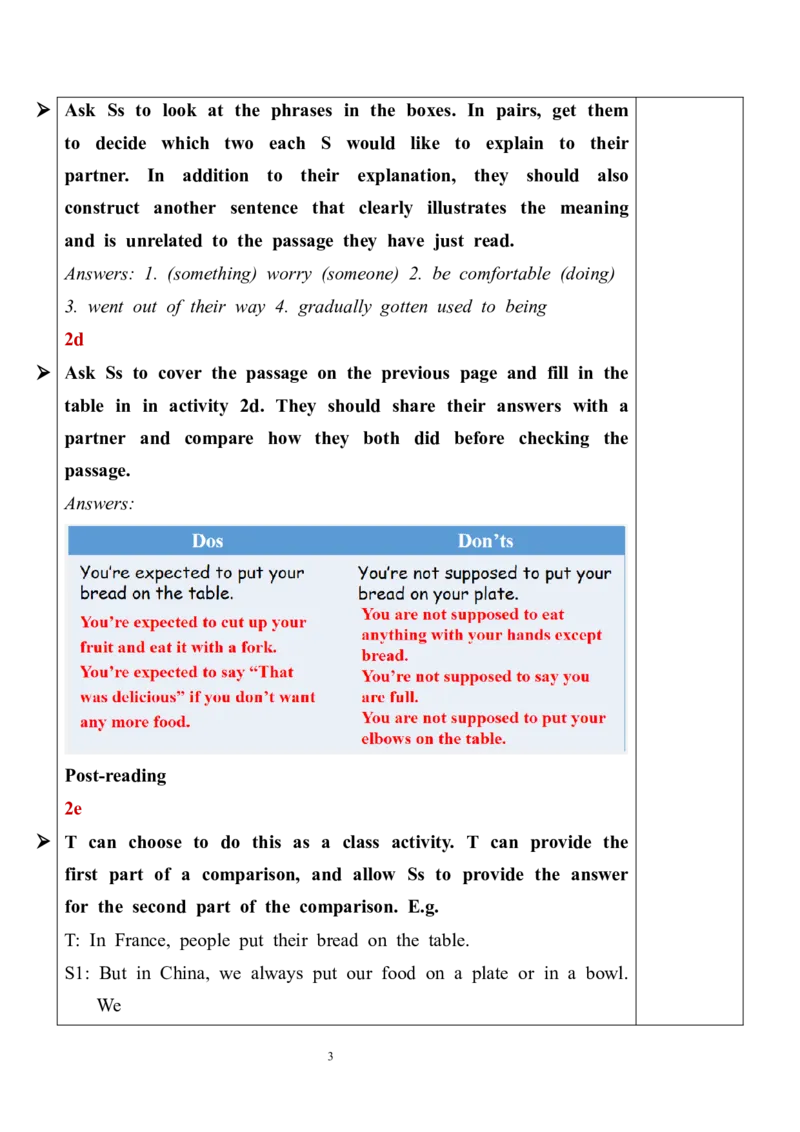
Ask Ss to cover the passage on the previous page and fill in the
table in in activity 2d. They should share their answers with a
partner and compare how they both did before checking the
passage.
Answers:
Post-reading
2e
T can choose to do this as a class activity. T can provide the
first part of a comparison, and allow Ss to provide the answer
for the second part of the comparison. E.g.
T: In France, people put their bread on the table.
S1: But in China, we always put our food on a plate or in a bowl.
We
3never put food on the table.
Step 3 Language points learning
exchange既可以作名词也可以作动词,意思是“交换”。作名词时 此处呈现部分
语言点
其常用搭配有:an exchange of 交换……, in exchange (for) 交换
(......)
作动词时,其常用搭配有:exchange ... for ... 用......交换......
exchange ... with sb. 与某人交换......
go out of one’ s way 特地; 格外努力
make . . . feel at home 使 (某人) 感到宾至如归。需要注意的是make
表示“使……处于某种状态,使成为”时,其宾语之后可接名词、
容词、不定式(不带to)、过去分词、介词短语等作宾语补足语。
“疑问词 + 动词不定式”结构常位于以下动词后作宾语:tell,
remember,
know, learn, teach, forget, wonder等。
“疑问词+动词不定式”结构相当于一个名词性从句, 无论在句子中
什么成分, 常常可用同等成分的从句替代。改为从句时只要在疑问
后面加一个适当的主语, 并将动词不式改为适当形式的谓语即可。
You wouldn’t believe ...意为“你无法想象 / 你想都想不到 / 你绝不
相信......”,表示所陈述的事情超出想象之外,与此类似的表达还有
You
would never / hardly believe ...
cut up 的意思是“切碎”,cut up 为动副结构的短语,后接名词时,
名
放在中间或后面均可;后接代词时,代词只能放在中间。
Step 4 Summary & Homework
Summary
Ask Ss to do exercises on PPT from P34-35.
Homework:
Preview 3a-Self Check in Section B.
Do the exercises in students’ book.
In the reading practice, it is important to have students learn how to get the
main ideas quickly. It is a good time to train the students’ ability of reading
Teaching
quickly and efficiently. We help the students deal with new words and
Reflection
phrases while they are reading. And the students should learn to catch the
main and the most important ideas and find the supporting sentences.
4After reading, students talk about the reading passage and discuss some
questions to check how well they learn from the passage. We can ask them
to write the manners in France and China in the exercise books. In this way
they would pay more attention to the key points.
5