九年级英语教学设计
Teaching 课时 共 6 课时 主备教师
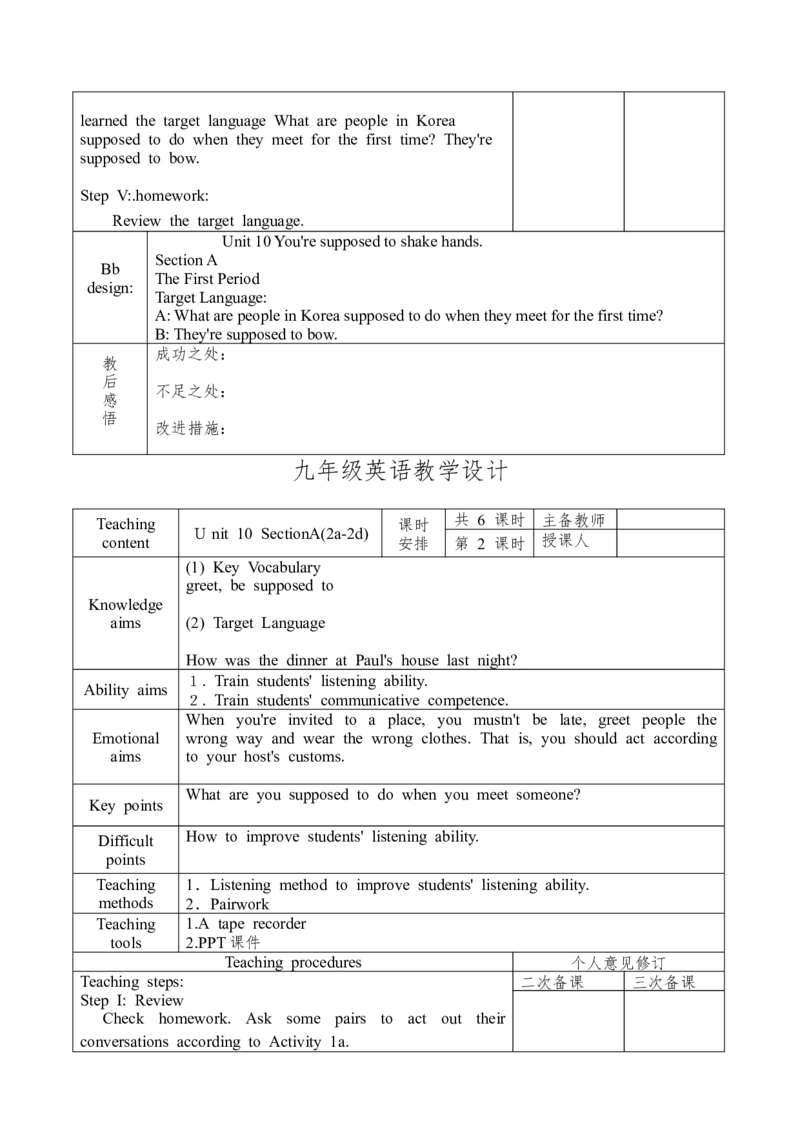
Unit 10 SectionA(1a-1c)
content 安排 第 1 课时 授课人
(1) Key Vocabulary
bow, kiss, be supposed to, shake hands, customs
Knowledge
(2) Target Language
aims
What are people in Korea supposed to do when they meet for the first
time?They're supposed to bow.
1. Train students' listening ability.
Ability aims
2. Train students' communicative competence.
Before you meet foreigners, you should some customs. In this way, you
Emotional
can act politely and properly.
aims
Talk about customs and what you are supposed to do.
Key points
Difficult Know about customs of different countries.
points
1.Scene teaching method
Teaching
2.Listening-and-answering activity to help the students go through with the
methods
listening material.
Teaching 1.A tape recorder
tools 2.PPT课件
Teaching procedures 个人意见修订
Teaching steps: 二次备课 三次备课
Step I: Review
1.Yesterday we finished Unit 9. In this unit, we learned some
ways of asking for information politely and express
preferences.
Make conversations with your friends.
A: What kind of music do you like?
B: I like music that ____________.
2.Write your own sentence:
I like music that________________________.
I like musicians ________________________.
Step II :New lesson
1.Presentation:
Step 1 1a
This activity introduces some target language.
Let students read the instructions.
Point to the two lists of words. Read each word and
ask students to repeat it.
Put up a map of the world on the board. Ask students
to explain where each of the countries is.
Suggested answers1.Brazil is in South America, next to Peru.
2.The United States is in North America, next to
Canada.
3.Japan is in East Asia, to the east of China.
4 . Mexico is in North America, on the south of
America.
5.Korea is in East Asia. It is our neighbor.
Look at the sample answer. Tell students to guess if
they aren't sure.
Answers
1.c 2.b 3.a 4.b 5.a
Step Ⅲ 1b
This activity gives students practice understanding the
target language in spoken conversation.
Play the tape for the first time. This time, students
only listen.
Play the tape a second time. Ask them to listen to the
recording and check their answers to Activity 1a.
Check the answers with the class. Invite a student to
read the answers.
Step Ⅳ 1c
This activity provides guided oral practice using the
target language.
Read the instructions to the whole class. Point out the
example in the box. Ask two students to read it to the
class.
Step III:Practice:
1. In Japan, the people are supposed to _________(鞠
躬) when they meet for the time.
2. It's not polite ____________(亲吻) the others in
public in China.
3. I was supposed to arrive at 8 : 00, but I
(到达) at 9:00.
4. When we meet Americans for the first time, we
should _________(握手)with them.
5. You must know some __________(习俗) before you
go to some foreign countries.
Step IV:summary:
In this class, we've learned some important words, such
as bow, kiss, be supposed to, shake hands. We've alsolearned the target language What are people in Korea
supposed to do when they meet for the first time? They're
supposed to bow.
Step V:.homework:
Review the target language.
Unit 10 You're supposed to shake hands.
Section A
Bb
The First Period
design:
Target Language:
A: What are people in Korea supposed to do when they meet for the first time?
B: They're supposed to bow.
成功之处:
教
后
不足之处:
感
悟
改进措施:
九年级英语教学设计
Teaching 课时 共 6 课时 主备教师
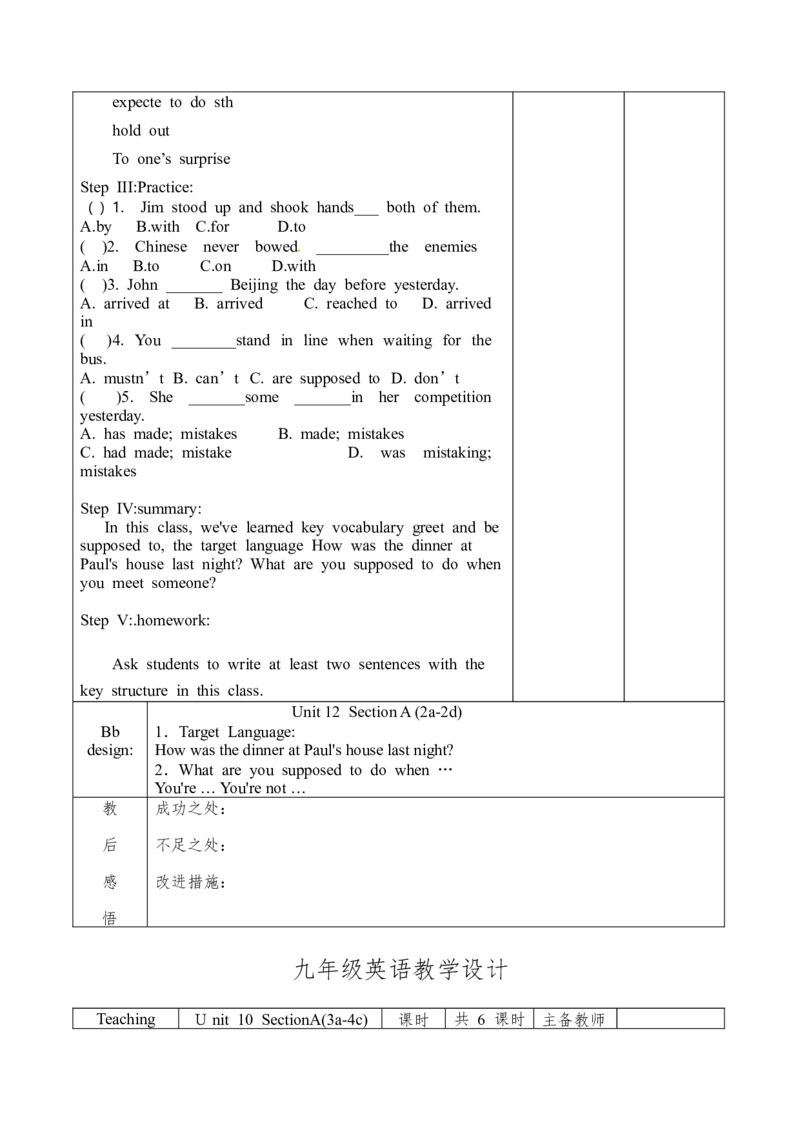
Unit 10 SectionA(2a-2d)
content 安排 第 2 课时 授课人
(1) Key Vocabulary
greet, be supposed to
Knowledge
aims (2) Target Language
How was the dinner at Paul's house last night?
1. Train students' listening ability.
Ability aims
2. Train students' communicative competence.
When you're invited to a place, you mustn't be late, greet people the
Emotional wrong way and wear the wrong clothes. That is, you should act according
aims to your host's customs.
What are you supposed to do when you meet someone?
Key points
How to improve students' listening ability.
Difficult
points
Teaching 1.Listening method to improve students' listening ability.
methods 2.Pairwork
Teaching 1.A tape recorder
tools 2.PPT课件
Teaching procedures 个人意见修订
Teaching steps: 二次备课 三次备课
Step I: Review
Check homework. Ask some pairs to act out their
conversations according to Activity 1a.A: What are people in Mexico supposed to do when they
meet for the first time?
B: They're supposed to bow.
Step II :New lesson
1.(2a)This activity provides guided listening practice using
the target language.
Look at the picture and ask students to tell What is
happening.
Help students understand that the people are at a picnic.
Read the instructions and point to the four mistakes on the
list. Ask different students to read the mistakes to the class.
Ask different students to explain the meaning of each
line in their own words. Listen to Maria talking to a boy
about what happened at the picnic. She made several
mistakes. Listen to the recording and check the mistakes
she made.
Play the recording. Students only listen the first time.
Play the recording again. Get students to check the
mistakes Maria made.
Check the answers with the class.
Answers
√ arrived late
________ ate wrong food
√ greeted Paul's mother the wrong way
√ wore the wrong clothes
2.(2b)This activity gives students practice in
understanding the target language in spoken conversation.
Go through the instructions with the class. Point out
the blanks in the four sentences. Invite a student to read
the first sentence.
Play the recording again. Let students fill in the blanks
with the words they hear alone.
Correct the answers with the class.
3.(2c)This activity provides guided oral practice using
the target language.
Read the instructions for the activity to the class.
Look at the example in the box. Ask two students to
read the conversation to the class.
4.Role-Play conversation
Show key points:expecte to do sth
hold out
To one’s surprise
Step III:Practice:
( )1. Jim stood up and shook hands___ both of them.
A.by B.with C.for D.to
( )2. Chinese never bowed _________the enemies
A.in B.to C.on D.with
( )3. John _______ Beijing the day before yesterday.
A. arrived at B. arrived C. reached to D. arrived
in
( )4. You ________stand in line when waiting for the
bus.
A. mustn’t B. can’t C. are supposed to D. don’t
( )5. She _______some _______in her competition
yesterday.
A. has made; mistakes B. made; mistakes
C. had made; mistake D. was mistaking;
mistakes
Step IV:summary:
In this class, we've learned key vocabulary greet and be
supposed to, the target language How was the dinner at
Paul's house last night? What are you supposed to do when
you meet someone?
Step V:.homework:
Ask students to write at least two sentences with the
key structure in this class.
Unit 12 Section A (2a-2d)
Bb 1.Target Language:
design: How was the dinner at Paul's house last night?
2.What are you supposed to do when …
You're … You're not …
教 成功之处:
后 不足之处:
感 改进措施:
悟
九年级英语教学设计
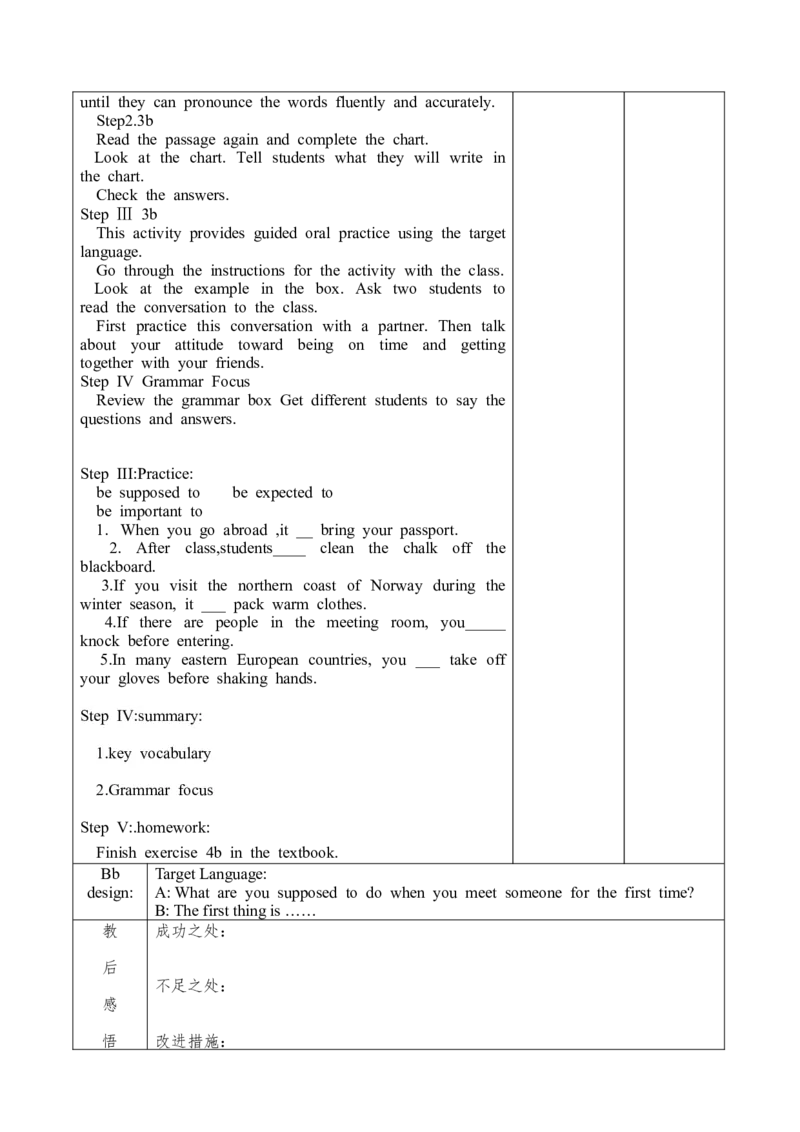
Teaching Unit 10 SectionA(3a-4c) 课时 共 6 课时 主备教师content 安排 第 3 课时 授课人
(1) Key Vocabulary
land, drop by, after all, relaxed, a bit
Knowledge
aims (2) Target Language
Can you tell me the things I'm supposed to do?
1. Train students' integrating skills.
Ability aims
2. Train students' communicative competence.
Different countries have different customs. So you are supposed to do in
Emotional
Rome as the Romans do.
aims
Talk about customs and what you are supposed to do.
Key points
Difficult Know about customs of different countries.
points
1.Fast reading to let students get the general idea of the text.
Teaching
2.Pairwork
methods
Teaching 1.A tape recorder
tools 2.PPT课件
Teaching procedures 个人意见修订
Teaching steps: 二次备课 三次备课
Step I: Review
Step Ⅰ Revision
T: In last period, we summed up the expressions for
telling what you are supposed to do. Now I'll check your
homework. I'll ask some pairs to act out the conversations
before the class.
Step II :New lesson
Step 1. 3a
This activity provides reading and writing practice using
the target language.
Show the key words on the screen by a projector.
Cali n.卡利(哥伦比亚西部城市)
Colombia n. 哥伦比亚(南美洲西北部一国家)
drop by 访问;拜访
Lausanne n. 洛桑(瑞士西部城市)
Switzerland n. 瑞士(欧洲中部国家)
land n. 国家;国土
after all 毕竟
Read the words and have students repeat again and againuntil they can pronounce the words fluently and accurately.
Step2.3b
Read the passage again and complete the chart.
Look at the chart. Tell students what they will write in
the chart.
Check the answers.
Step Ⅲ 3b
This activity provides guided oral practice using the target
language.
Go through the instructions for the activity with the class.
Look at the example in the box. Ask two students to
read the conversation to the class.
First practice this conversation with a partner. Then talk
about your attitude toward being on time and getting
together with your friends.
Step IV Grammar Focus
Review the grammar box Get different students to say the
questions and answers.
Step III:Practice:
be supposed to be expected to
be important to
1. When you go abroad ,it __ bring your passport.
2. After class,students____ clean the chalk off the
blackboard.
3.If you visit the northern coast of Norway during the
winter season, it ___ pack warm clothes.
4.If there are people in the meeting room, you_____
knock before entering.
5.In many eastern European countries, you ___ take off
your gloves before shaking hands.
Step IV:summary:
1.key vocabulary
2.Grammar focus
Step V:.homework:
Finish exercise 4b in the textbook.
Bb Target Language:
design: A: What are you supposed to do when you meet someone for the first time?
B: The first thing is ……
教 成功之处:
后
不足之处:
感
悟 改进措施:九年级英语教学设计
Teaching 课时 共 6 课时 主备教师
Unit 10 SectionB(1a-1d)
content 安排 第 4 课时 授课人
(1) Key Vocabulary
wipe, napkin, stick, chopstick, rude, point, pick up
Knowledge
(2) Target Language
aims
We're supposed to eat with chopsticks.
Yes, and it's rude to eat with our hands.
(1) Train students' ability to understand the target language in spoken
Ability aims conversation.
(2) Train students' ability to use the target language.
Emotional In order to behave politely at the dinner table, you're supposed to learn
aims some talbe manners.
Target language.
Key points
Difficult 1.How to improve students' listening ability.
points 2.How to use the target language.
Teaching 1.Listening method
methods 2.Pairwork
Teaching 1.A tape recorder
tools 2.PPT课件
Teaching procedures 个人意见修订
Teaching steps: 二次备课 三次备课
Step I: Review
Check homework. Get some students to read out their
conversations using the target language in Section A 4c.
Collect their conversations and help correct their errors.
Step II :New lesson
Part 1
This activity introduces new vocabulary and provides
reading practice using the target language.
Look at the picture and ask students to say what is
happening in it. (A family is eating a meal.)Look at the title, Mind your manners!
Ask: What do you think it might mean?
(It means be careful of how you act.)
Read the instructions and point to the five statements
about manners. Ask students to read the statements.
Review the five statements to be sure students understand
what each one means. Ask students to act out them. Then
ask students to complete the quiz on their own.
Part2.2a
This activity gives students practice in understanding the
target language in spoken conversation.
Read the instructions to the class. Review what an
exchange student is and what table manners are. If
necessary, translate them into Chinese.
Play the recording the first time.
Students only listen.
Play the recording a second time. As they listen to the
recording this time, let students number the pictures.
Correct the answers with the class.
Step Ⅳ 2b
This activity provides listening practice using the target
language.
Read the instructions and point to the numbered list of
sentence starters and the lettered list of sentence endings.
Ask different students to read the two lists.
1.You aren't supposed to … a. to stick your chopsticks
into your food.
2.It's impolite to… b. point at anyone with your
chopsticks.
3.You shouldn’t …c.start eating first if there are older
people at the table
You will hear the same recording again. This time as
you listen, write the letter of the correct sentence ending
after each sentence starter.
Look at the sample answer. Read the correctly completed
sentence to the class:
Step Ⅵ Summary
In this class, we've learned some key vocabulary, such as
wipe, rude, point, pick up. We've also learned the target
language by listening and speaking.
Step Ⅶ Homework
Talk about the table manners in your country using the
sentence starters in Activity 1a.
Step III:Practice:
Step Ⅴ 2c
This activity provides guided oral practice using the target
language.
Go through the instructions for the activity with the class.
Have students work in pairs. Ask one or two pairs of
students to say their conversations to the class.
Step IV:summary:Step V:.homework:
1.Sentences in Activity 2b:
Bb
2.Target language:
design:
A: We're supposed to eat with chopsticks.
B: Yes, and it's rude to eat with our hands.
教 成功之处:
后
不足之处:
感
悟 改进措施:
九年级英语教学设计
Teaching 课时 共 6 课时 主备教师
Unit 10 SectionB(2a-2b)
content 安排 第 5 课时 授课人
(1) Key Vocabulary
Knowledge
table manners, behave, be/get used to, cut up, full, fork, You should …
aims
(2) Practise reading an article.
(1) Train students' reading ability.
Ability aims
(2) Train students' writing ability.
With the development of society, table manners are more and more
Emotional
important. Sometimes they can help people succeed. So you have to learn
aims
more table manners.
Practise reading and writing using the target language.
Key points
Difficult How to write an e-mail message.
points
1.Reading comprehension to help students grasp the main idea of the text.
Teaching
2.Writing method
methods
3.Groupwork to make every student work in class.
Teaching 1.A tape recorder
tools 2.PPT课件
Teaching procedures 个人意见修订
Teaching steps: 二次备课 三次备课
Step I: Review
Step Ⅰ Revision
Review the target language presented in this unit. Check
homework.
Ask two students to read out their sentences.
SA: You aren't supposed to visited a friend's house withoutcalling first.
SB: It's polite to be on time.
Step II :New lesson
1.Ask and answer.
What do you know about customs in foreign countries?
What do you think is the biggest challenge when visiting a
foreign country?
2.2bThis activity provides reading practice using the target
language.
Teach the new words. Show the following new words on
the screen by a projector.
manner n. 礼貌;风格;习惯
table manners 餐桌礼仪
behave v. 行为表现;举止
be/get used to 习惯于……
cut up 切开;切碎
fork n. 叉;餐叉
full adj. 饱的;吃胀了的
lap n. (人坐着时)腰以下到膝为止的部分;大腿
elbow n. 肘;肘部
gradually adv. 逐渐地;渐渐地
compliment n. 称赞;恭维
toast v. 敬酒
Call attention to the e-mail message. Invite a student to
read the article aloud to the class. Correct any pronunciation
errors to make sure the student is providing a good model
for the rest of the class.
Now read the e-mail. Answer the questions in your
exercise book. As students work, move around the
classroom and offer help as necessary.
Step 3.Read the sentences in 2c and replace the underlined
words with the phrases in the box.
1.Making mistakes in French used to make Lin Yue
nervous.
2.It was quite hard for her to feel good abou t speaking
French.
3.The host family tried very hard to help Lin Yue.
4.Lin Yue has slowly learned how to be like her French
friends.
Step 4.Review the passage and make notes about French
customs in the chart.
This activity provides writing practice using the target
language.
Read the instructions and ask students to finish theexercise.
Get students to finish the activity on their own. As
students work, move around the room offering help as
needed. Ask a student to read his or her message to the
class. Have other students add any information that is
missing from the first student's report.
Step III:Practice:
Your pen pal is coming to China on an exchange
program.He/She is asking you about Chinese customs and
what he/she is supposed to do or not. Make notes in the
chart.
Step IV:summary:
In this class, we've done a lot of reading, writing and
speaking practice using the target language.
Step V:.homework:
Read the e-mail message in Activity 2b again
Bb Unit 12 You're supposed to shake hands. Section B(2a-3a)
design: 1.What do you know about customs in foreign countries?
2.Read the letter and answer the questions in 2b.
教 成功之处:
后
不足之处:
感
悟 改进措施:
九年级英语教学设计
Teaching Unit 10 SectionB(3b- 课时 共 6 课时 主备教师
content selfcheck) 安排 第 6 课时 授课人
(1) Key Vocabulary
be excited about doing sth 、some suggestions 、some advice、at the table
Knowledge
(2) Target Language
aims
You are supposed to …..
You are not supposed to ….
Ability aims 1. Train students' writing ability.2. Train students' communicative competence.
Before you meet foreigners, you should obey some rules. In this way, you
Emotional
can act politely and properly.
aims
Talk about customs and what you are supposed to do.
Key points
Difficult Write a short passage about table manners.
points
1.Task-based teaching
Teaching
2.Pairwork
methods
Teaching 1.A tape recorder
tools 2.PPT课件
Teaching procedures 个人意见修订
Teaching steps: 二次备课 三次备课
Step I: Review
1.manner n. _________
2.table manners _________
3.behave v. _________
4.be/get used to _________
5.cut up _________
6.fork n. _________
7.full adj. _________
8.elbow n. _________
9.gradually adv. _________
10.compliment n. _________
toast v. _________
Step II :New lesson
1.Talk about some table manners in China.
2.Write a letter to your pen pal to give him/ her advice
and suggestions on how to behave properly in China.
This activity provides writing practice using the target
language.
Read the instructions and ask students to look back at
Activity 2
3a.
Remind students that they made conversations about table
manners in their own country.
3.Writing practice.
Dear Jenny.
You must be excited about coming to China soon. Let
me give you some suggestions and advice about Chinese
customs. When you’re eating at the table. It’s impolite to
stick your chopsticks into the food.
In our house ,you’re supposed to watch TV and play
computers.
When you go out with people , you should tell
somebody who is home.
Have a safe trip,and I look forward to meeting you soon!
Best wishes.Step 3.Selfcheck.
1.Fill in the blanks with the words in the box.
Worth capital basic traffic
Empty mad knocking
2.Think about your culture and make statements.
In my culture, when you….
You’re supposed to …..
You’re not supposed to ……
You’re expected to …….
It’s impolite to …….
It’s important to …..
Step III:Practice:
Have conversations with your partner.
In my culture, you’re supposed to … .. you’re not
supposed to ……..
Step IV:summary:
In this class, we've done a lot of writing and speaking
practice using the target language.
Talk with your partners after class.
Step V:.homework:
Talk about the table manners in your country using the
sentence in Selfcheck.
Bb Unit 10 You’re supposed to shake hands.
design: 1.Write a letter to your pen pal to give him/her advice about table manners.
2.Selfcheck.
教 成功之处:
后
不足之处:
感
悟 改进措施: