第一课时
班级 姓名 小组 时间
课 题
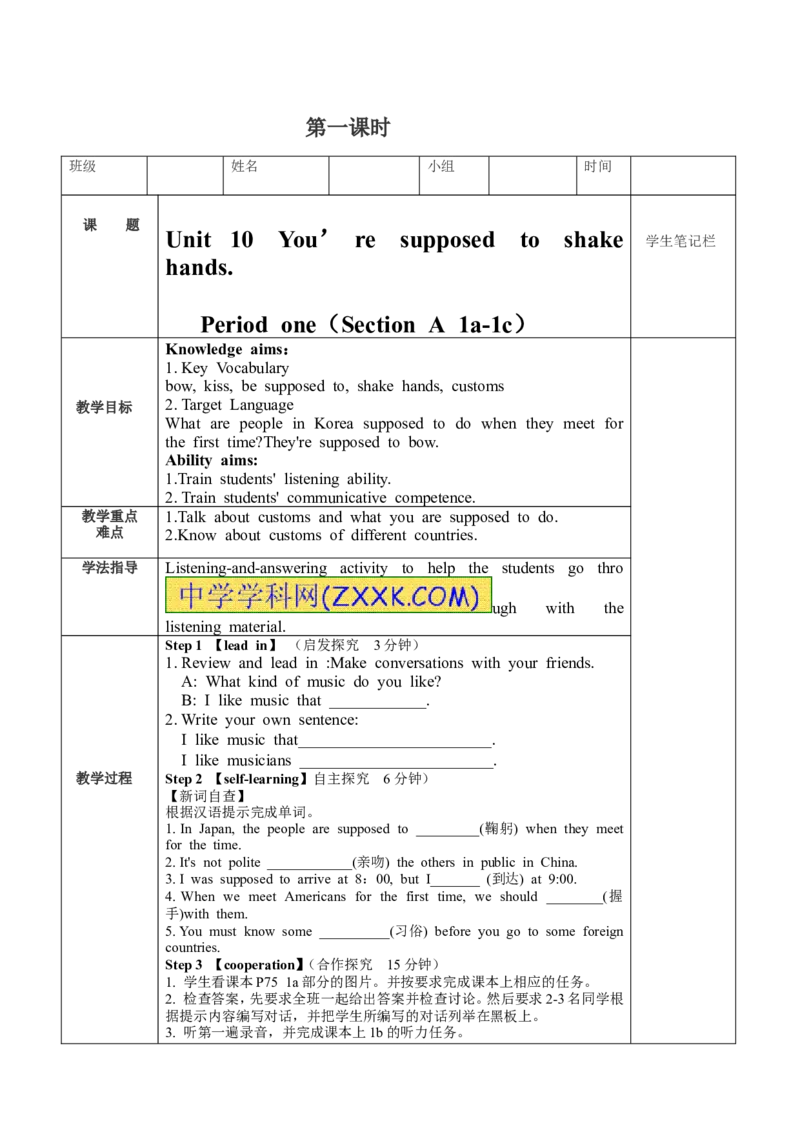
Unit 10 You’ re supposed to shake
学生笔记栏
hands.
Period one(Section A 1a-1c)
Knowledge aims:
1. Key Vocabulary
bow, kiss, be supposed to, shake hands, customs
教学目标 2. Target Language
What are people in Korea supposed to do when they meet for
the first time?They're supposed to bow.
Ability aims:
1.Train students' listening ability.
2. Train students' communicative competence.
教学重点 1.Talk about customs and what you are supposed to do.
难点 2.Know about customs of different countries.
学法指导 Listening-and-answering activity to help the students go thro
ugh with the
listening material.
Step 1 【lead in】 (启发探究 3分钟)
1. Review and lead in :Make conversations with your friends.
A: What kind of music do you like?
B: I like music that ____________.
2. Write your own sentence:
I like music that________________________.
I like musicians ________________________.
教学过程 Step 2 【self-learning】自主探究 6分钟)
【新词自查】
根据汉语提示完成单词。
1. In Japan, the people are supposed to _________(鞠躬) when they meet
for the time.
2. It's not polite ____________(亲吻) the others in public in China.
3. I was supposed to arrive at 8:00, but I_______ (到达) at 9:00.
4. When we meet Americans for the first time, we should ________(握
手)with them.
5. You must know some __________(习俗) before you go to some foreign
countries.
Step 3 【cooperation】(合作探究 15分钟)
1. 学生看课本P75 1a部分的图片。并按要求完成课本上相应的任务。
2. 检查答案,先要求全班一起给出答案并检查讨论。然后要求2-3名同学根
据提示内容编写对话,并把学生所编写的对话列举在黑板上。
3. 听第一遍录音,并完成课本上1b的听力任务。4. 听第二遍录音,并逐句进行跟读。
5. 完成教材1c的任务,要求学生模仿听力内容,使用“—What are people
in _____ supposed to do when the meet for the first time? —They’re
supposed to …”进行对话练习。
Step 4 【summary】(引深探究 15分钟)
be supposed to do...
①当be supposed to... 的主语是“人” 时,意为“应该…… ”;“被期
望……”,相当于情态动词should。eg: Everyone is supposed to wear a seat-
belt in the car. 每个人在汽车里都应该系安全带。
②.当be supposed to... 的主语是“物”时,它表示“本应;本该”,用于表示
“某事本应该发生而没有发生”。
eg:The new laws are supposed to prevent crime. 这些新法令本应该起到防止
教学过程
犯罪的作用。
③: be supposed to后面接“have + 过去分词”时,表示“本应该做某事而
没做”。eg:You are supposed to have handed in your homework by now.现在
你应该已经把作业交上来了。
④: be supposed to... 的否定结构为be not supposed to ..., 它常用于口语
中,意为“不被许可;不应当”。
eg:She was not supposed to be angry about that. 她本不该为那件事而生气的。
Step 5 【self-check】(包含“考点链接” 应用探究 6分钟)
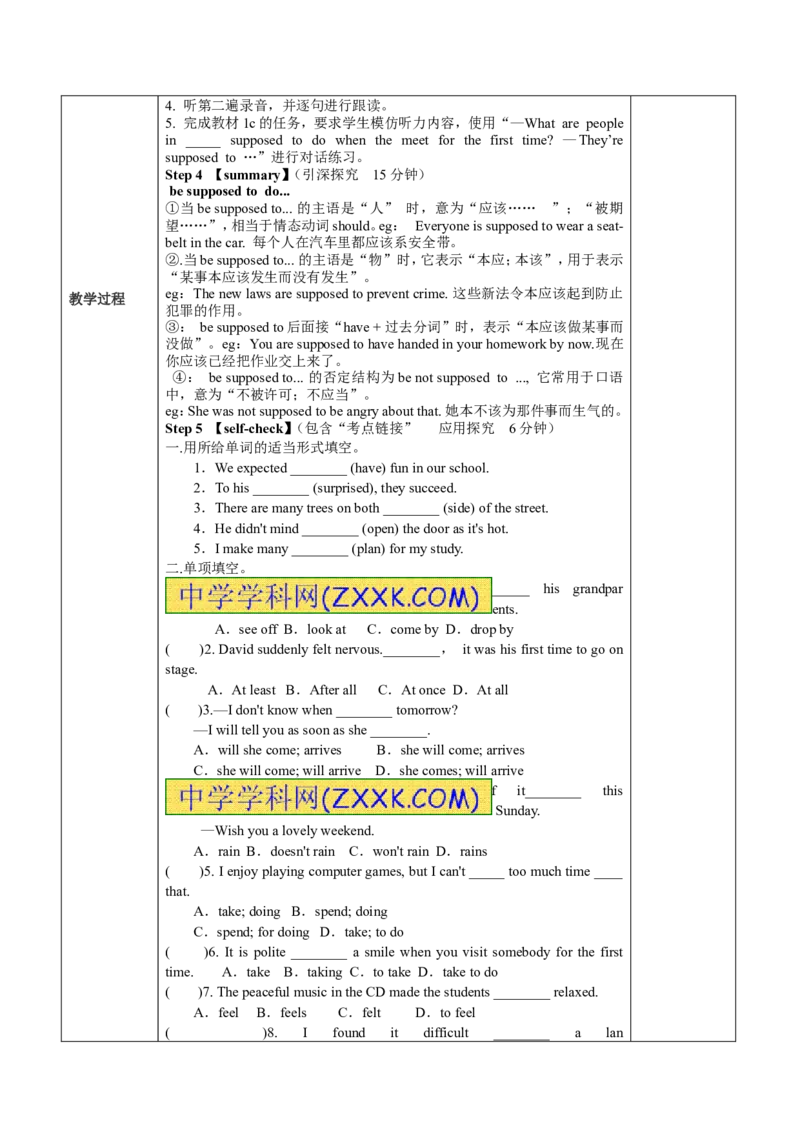
一.用所给单词的适当形式填空。
1.We expected ________ (have) fun in our school.
2.To his ________ (surprised), they succeed.
3.There are many trees on both ________ (side) of the street.
4.He didn't mind ________ (open) the door as it's hot.
5.I make many ________ (plan) for my study.
二.单项填空。
( )1. Tomorrow is Sunday. He will ________ his grandpar
ents.
A.see off B.look at C.come by D.drop by
( )2. David suddenly felt nervous.________, it was his first time to go on
stage.
A.At least B.After all C.At once D.At all
( )3.—I don't know when ________ tomorrow?
—I will tell you as soon as she ________.
A.will she come; arrives B.she will come; arrives
C.she will come; will arrive D.she comes; will arrive
( )4.—We'll go for a picnic if it________ this
Sunday.
—Wish you a lovely weekend.
A.rain B.doesn't rain C.won't rain D.rains
( )5. I enjoy playing computer games, but I can't _____ too much time ____
that.
A.take; doing B.spend; doing
C.spend; for doing D.take; to do
( )6. It is polite ________ a smile when you visit somebody for the first
time. A.take B.taking C.to take D.take to do
( )7. The peaceful music in the CD made the students ________ relaxed.
A.feel B.feels C.felt D.to feel
( )8. I found it difficult ________ a language.
A.mastering B.master C.to master D.mastered
( )9.—Jane, when did you come here?
—In 2010. I ________ here for two years.
A.have been to B.have gone to
C.have come D.have been
( )10. Excuse me, would you mind________ your voice down, please?
A.to keep B.keeping C.keep D.kept
第二课时
班级 姓名 小组 时间
课 题
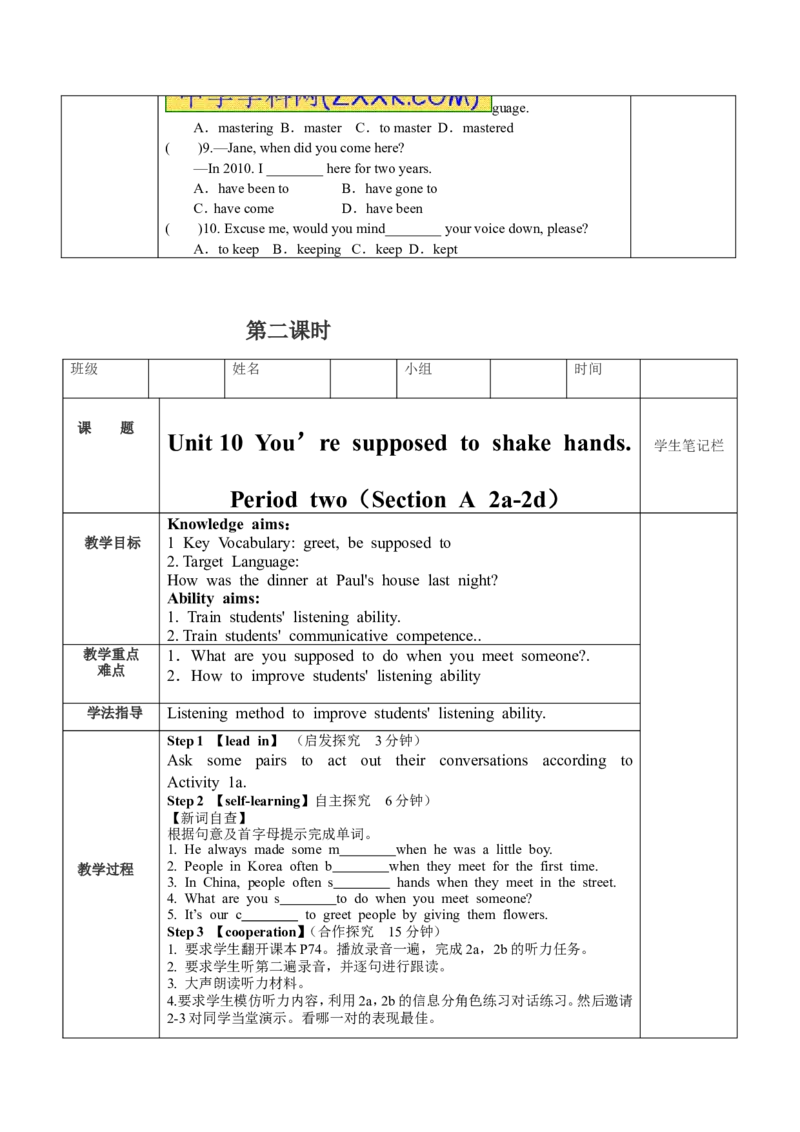
Unit 10 You’re supposed to shake hands.
学生笔记栏
Period two(Section A 2a-2d)
Knowledge aims:
教学目标 1 Key Vocabulary: greet, be supposed to
2. Target Language:
How was the dinner at Paul's house last night?
Ability aims:
1. Train students' listening ability.
2. Train students' communicative competence..
教学重点 1.What are you supposed to do when you meet someone?.
难点 2.How to improve students' listening ability
学法指导 Listening method to improve students' listening ability.
Step 1 【lead in】 (启发探究 3分钟)
Ask some pairs to act out their conversations according to
Activity 1a.
Step 2 【self-learning】自主探究 6分钟)
【新词自查】
根据句意及首字母提示完成单词。
1. He always made some m when he was a little boy.
教学过程 2. People in Korea often b when they meet for the first time.
3. In China, people often s hands when they meet in the street.
4. What are you s to do when you meet someone?
5. It’s our c to greet people by giving them flowers.
Step 3 【cooperation】(合作探究 15分钟)
1. 要求学生翻开课本P74。播放录音一遍,完成2a,2b的听力任务。
2. 要求学生听第二遍录音,并逐句进行跟读。
3. 大声朗读听力材料。
4.要求学生模仿听力内容,利用2a,2b的信息分角色练习对话练习。然后邀请
2-3对同学当堂演示。看哪一对的表现最佳。5 . 播放 2d 的对话录
音,让学生跟读,模仿并理解大意。然后让学生分角色朗读并表演2d的对话。
Step 4 【summary】(引深探究 15分钟)
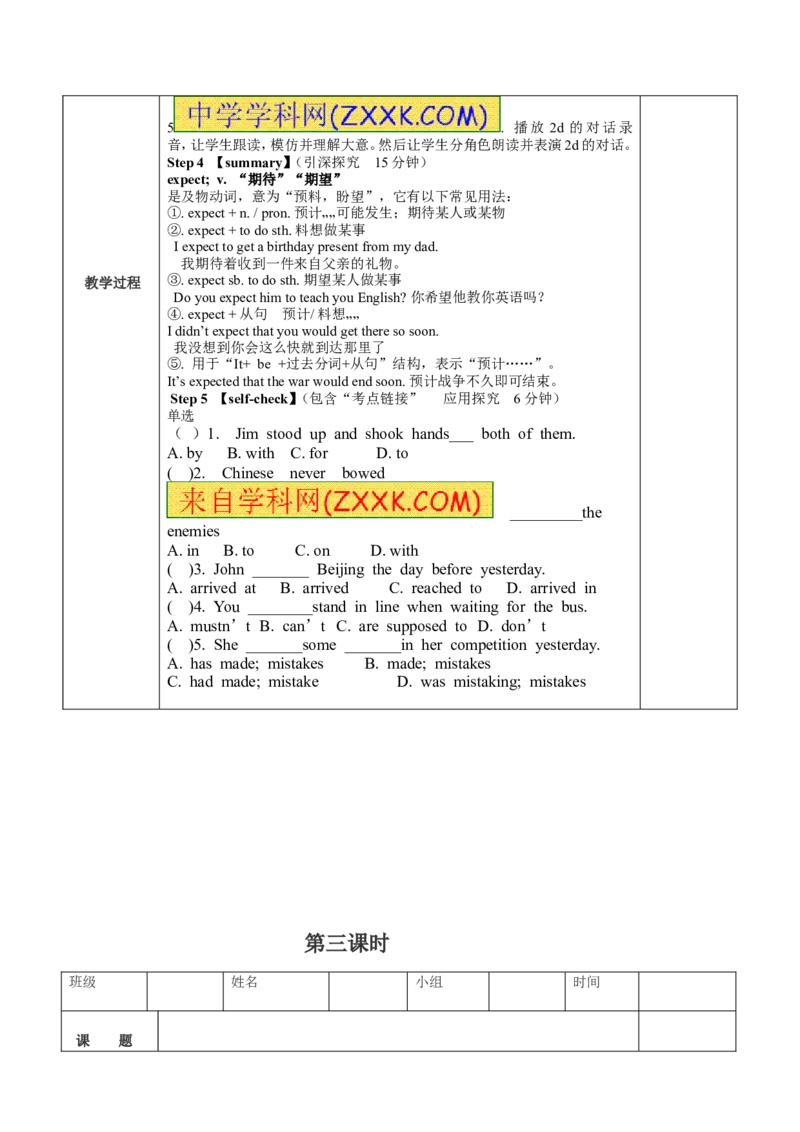
expect; v. “期待”“期望”
是及物动词,意为“预料,盼望”,它有以下常见用法:
①. expect + n. / pron. 预计„„可能发生;期待某人或某物
②. expect + to do sth. 料想做某事
I expect to get a birthday present from my dad.
我期待着收到一件来自父亲的礼物。
教学过程 ③. expect sb. to do sth. 期望某人做某事
Do you expect him to teach you English? 你希望他教你英语吗?
④. expect + 从句 预计/ 料想„„
I didn’t expect that you would get there so soon.
我没想到你会这么快就到达那里了
⑤. 用于“It+ be +过去分词+从句”结构,表示“预计……”。
It’s expected that the war would end soon. 预计战争不久即可结束。
[来源:学_科_网]
Step 5 【self-check】(包含“考点链接” 应用探究 6分钟)
单选
( )1. Jim stood up and shook hands___ both of them.
A. by B. with C. for D. to
( )2. Chinese never bowed
_________the
enemies
A. in B. to C. on D. with
( )3. John _______ Beijing the day before yesterday.
A. arrived at B. arrived C. reached to D. arrived in
( )4. You ________stand in line when waiting for the bus.
A. mustn’t B. can’t C. are supposed to D. don’t
( )5. She _______some _______in her competition yesterday.
A. has made; mistakes B. made; mistakes
C. had made; mistake D. was mistaking; mistakes
第三课时
班级 姓名 小组 时间
课 题Unit 10 You’re supposed to shake hands. 学生笔记栏
Period three(Section A 3a-3c)
Knowledge aims:
教学目标 1. Key Vocabulary: land, drop by, after all, relaxed, a bit
2. Target Language:
Can you tell me the things I'm supposed to do?
Ability aims:
1. Train students' integrating skills.
2. Train students' communicative competence.
教学重点 1. Talk about customs and what you are supposed to do.
难点 2. Know about customs of different countries.
学法指导 Fast reading to let students get the general idea of the text.
Step 1 【lead in】 (启发探究 3分钟)
播放一段介绍哥伦比亚和瑞士风光的影片,使学生熟识这两个国家的情
况。
Step 2 【self-learning】(自主探究 6分钟)
【新词自查】
根据汉语提示完成单词。
1. As teenagers, we should (珍视)the friendship between our classmates.
2. My parents are planning to travel to Beijing, the (首都) of
China.
教学过程 3. We often have a short break at _______ (中午) at school.
4. I will make an _______ (努力)to improve my listening skills.
5. On weekends . I often go out for a picnic with my friends ______ (一
起)。
Step 3 【cooperation】(合作探究 15分钟)
完成教材3a 的任务
1. 要求学生快速默读短文,熟知大意,并完成课本3a的任务。然后邀请几位
同学给出自己的答案,全班一起检查讨论。
2. 先邀请几位同学朗读短文,教师要注意语音,及时纠正。然后播放录音,全
班同学一起跟读。
Step 4 【summary】(引深探究 15分钟)
1. value v.重视,珍视;n. 价值;
value做名词。表示价值。
value做动词。意思是“珍惜”“重视”“估价”等。
value sth 认为....有价值。
Eg;This book will be of great value to him in his study.
这本书将对他的研究有很大价值。
【课堂变式】
We should _____the time we spend with our family
and friends.
A. hold B. value C.
valuable D. notice
2. When we see each other, it’s polite for boys to shake hands and for
girls to kiss each other on the side of the face. 当我们彼此见面时,男孩
教学过程
们应当握手而女孩则相互亲吻脸颊。
本句包含“It is +形容词+for sb+ (not) to do sth”结构,其中it是形式主语,真正的主语是后面的 (not) to do sth,其中sb与to…之间是逻辑上的主谓关系。
该句型中的for也可改为of,究竟用of sb还是用for sb,取决于前面的形容
词。
(1)若形容词仅仅是描述事物,不是对不定式行为者的品格进行评价,用for
sb,这类形容词有difficult, easy, hard, important, dangerous, (im)possible等。
It's very dangerous for children to cross the busy street .对孩子们来说,穿过繁忙
的街道很危险。
(2)若形容词是描述不定式行为者的性格、品质的,如kind, good, nice, right,
wrong, clever, careless, polite, foolish等,用of sb。
It's very kind of you to help me.你能帮我,真好。
It’s clever of you to work out the math problem. 你真聪明,解出了这道数学题。
【提示】
of sb的句型通常都可转换为不定式作状语的句子,但for sb句型不可以。
Eg:It’s very nice of you to offer me a seat. =You are nice to offer me a seat.
十分感谢你给我让座。
It’s very important for you to practice your oral English in daily life.
在日常生活中练习你的英语口语非常重要的。
这句话不能说成:It is very important of you to practice…
【课堂变式】
1._______ generous _______ the little girl to share her toys
with the other kids.
A. It’s; of B. That’s; of C. It’s; for D. That’s; for
2. It's important ______the piano well.
A. of him to play B. for him to play
C. of him playing D. for him playing
Step 5 【self-check】(包含“考点链接” 应用探究 6分钟)
一.用所给单词的适当形式填空。
1. Thanks for ________ (give) me the message.
2. Before ________ (go) home, we did some shopping in the supermarket.
3. There are many different ________ (manner) in different areas.
4. You have to ________ (cut) it off.
5. I find it difficult ________ (remember) French.
二.根据句意及首字母提示完成单词。
1. You should s the bottle before pouring the orange juice.
2. If you want to go to the teacher’s office, you are supposed to k at
the door before enteri ng.
[来源:Z&xx&k.Com]
3. It’s good m to say “hello” when you meet each other.
4. After exercising in the morning, I usually feel quite r . [来源:学科
5. Julie k her mother good night before she went to bed.
第四课时班级 姓名 小组 时间
课 题
Unit 10 You’ re supposed to shake
学生笔记栏
hands.
Period four (Grammar focus - 4c)
学习目标 Knowledge aims:
1.Key Vocabulary:
northern adj. 北方的,北部的 season n.季节;eastern adj. 东方的,东部
的 knock v. 敲击 worth adj. 值得,有…价值; clean the chalk off the
blackboard 擦黑板 northern coast 北海岸 pack warm clothes 带暖和的
衣服 take off the gloves 脱掉手套 social situations 社交环境be worth
the trouble 麻烦一点也是值得的 table manners餐桌礼仪
2.Target Language:
1)It’s very impolite to keep others waiting. 让别人等候是不礼貌的。
2)It’s important to be on time.准时很重要
Ability aims:
1. Train students' integrating skills.
2. Train students' communicative competence.
学习重点 1. Review key vocabulary in section A and get ss use them
难点 correctly.
2. Enable ss to summarize how to use “be supposed to, be
expected to and be important to”.
学法指导 Summarizing Method
Step 1 【lead in】 (启发探究 3分钟)
复习不同国家见面问候的礼仪习惯,
What are people in Mexico supposed to do when they meet for the
first time?
Step 2 【self-learning】自主探究 6分钟)
【新词自查】
根据汉语提示完成单词。
1. Carmen found she had left her ______ (护照)at home just before
教学过程 getting on the plane.
2. The teacher asked me to get some ______ (粉笔) for her in the
office.
3. We found there was no ______ (黑板) in the classroom on the
first day in school.
4. On this island, there is only one ______(季节),it’s spring.
5. You should pay attention to your table ______(礼仪)when you are
living with a foreign family.
Step 3 【cooperation】(合作探究 15分钟)
1,回顾语法重点.
要求学生分角色问答并翻译表格中的句子。出说 be supposed to do句型
结构的用法。并能造出相仿的句子。
2.完成教材4a-4c的任务
1). 要求学生翻开课本 P76,选择4a方框中所给的be supposed to, be
expected to, be important to 完成句子。.给出5分钟的时限,然后请5组
同学朗读句子,全班集体核对答案。2).用括号中所给单词的恰当形式完成短文。给出5分钟的时限,然后请1
同学朗读短文,全班集体核对答案。
3)依照4c方框中的提示,结即将第一次来中国作交换生的外国学生提一
些建议。
4)要求学生在规定的时间内完成一个小练习。并请若干学生给出自己的
答案。
用所给词的适当形式填空。
1. Japan is an (east)Asian country w
h
ich are form of many island
2. When the teacher is in the classroom, you should
knock before (enter).
教学过程
3. It’s (help) to learn some table manners
when you go abroad.
4. Although he is not sure to succeed, he think it is
worth
1 (take )a risk.
5. A traveler (not expect) to know all of
these rules.
Step 4 【summary】引深探究 15分钟)
worth的用法:
worth,worthy都为adj,意为“值得”。
Worth:
1. be worth + n. 当名词为金钱时,表示“……值得……”
2. be worth doing sth.“……某事值得被做”
eg:The question is not worth discussing again and again.
worthy:
1. be worthy of +n. 当名词为抽象名词时表示“……值得……”
2. be worthy to be done“某事值得被做”
eg: The question is not worthy to be discussed again and again.
Step 5 【self-c heck
【(包含“考点链接” 应用探究 6分钟)
单项选择。
( )1. When ________ you supposed to ________ the meeting yesterday?
A.were; had B.was; had C.were; have D.was; have
( )2. Drivers shouldn't be supposed ____
____ after
drinking, or they will break the law.
A . drive B . driving C .
to drive D.to be
driven
( )3.—Peter has changed a lot, hasn't he?
—Yes. He used to ________ the guitar, but now he is more ________ in
playing soccer.
A.plays; interested B.play; interested
C.play; interesting D.playing; interest
( )4. It's nice of you ________ me.
A.help B.helping C.to help D.helps
( )5. The plane will __ from Beijing Capital Airport and land in London.A.take on B.take off C.take out D.take away
( )6.________ wonderful to spend our summer on the island.
A.We're B.It's C.That's D.What
( )7. You may ________ the book for two weeks.
A.keep B.borrow C.lend D.buy
( )8. The man ________ his shoes before entering the room.
A.cleaned dirt off B.cleaned dirt in
C.dropped dirt off D.dropped dirt in
( )9._____ is really hard ________ them to climb such a high mountain.
A.This; to B.It; to C.This; for D.It; for
( )10. Your Tshirt is so cool. Could you please _______?
A.telling me what you bought it B.tell me where you bought it
C.telling me what you buy it D.tell me where you buy it
第五课时
班级 姓名 小组 时间
Unit 10 You’re supposed to shake hands.
学生笔记栏
课 题
Period five(Section B 1a-1c)
Knowledge aims:
1 Key Vocabulary:
wipe, napkin, stick, chopstick, rude, point, pick up
2.Target Language:
学习目标 ①We're supposed to eat with chopsticks.
[来源:学科网ZXXK]
Yes, and it's rude to eat with our hands.
②
Ability aims:
1. Train students' ability to understand the target language in
spoken conversation.
2. Train students' ability to use the target language.
学习重点 1.How to improve students' listening ability.
难点 2.How to use the target language.
学法指导 Listening method to improve students' listening ability.
Step 1 【lead in】 (启发探究 3分钟)
不同的国家有不同的餐桌礼仪和饮食文化。你都了解哪些国家的餐桌礼仪
呢?它们有什么特点呢?请几位同学尝试回答下面的问题。
1. Where are you supposed to put your napkin?
2. When are you supposed to leave the table?
3. Is it polite to make noise while eating food?
4. Are you supposed to stick your chopsticks into food?
Step 2 【self-learning】自主探究 6分钟)
教学过程 【新词自查】
根据句意及首字母提示完成单词。1. It’s i to speak loudly in public.
2. The bag is e and I can’t find anything in it.
3. It’s not polite to s your chopsticks into your food.
4. The oldest person is supposed to start e first in China.
5. Don’t p at anyone with your chopsticks while eating.
Step 3 【cooperation】(合作探究 15分钟)
1. 要求学生翻开课本P76,迅速阅读1a部分的内容。并按要求完成课本上相
应的任务。
2. 要求学生看1b的图片,口头叙述一下图片所表示的内容。
[来源:学_科_网]
3. 听第一遍录音,完成课本上1b部分的任务。并要求学生写下每段对话中游
客所问到的地方。
4. 听第二遍录音,完成课本上1c部分的任务。
5. 听第三遍录音,并打开听力材料,全班逐句进行跟读。
6. 要求学生模仿听力内容,利用1b,1c的信息分角色练习对话练习。然后邀
请2-3对同学当堂演示。看哪一对的表现最佳。
7. 请学生利用1d方框中所提供的句式,编对话谈论自己国家的餐桌礼仪。
Step 4 【summary】(引深探究 15分钟)
expect; v. “期待”“期望”
是及物动词,意为“预料,盼望”,它有以下常见用法:
①. expect + n. / pron. 预计„„可能发生;期待某人或某物
②. expect + to do sth. 料想做某事
I expect to get a birthday present from my dad.
我期待着收到一件来自父亲的礼物。
教学过程 ③. expect sb. to do sth. 期望某人做某事
Do you expect him to teach you English? 你希望他教你英语吗?
④. expect + 从句 预计/ 料想„„
I didn’t expect that you would get there so soon.
我没想到你会这么快就到达那里了
⑤. 用于“It+ be +过去分词+从句”结构,表示“预计……”。
It’s expected that the war would end soon. 预计战争不久即可结束。
Step 5 【self-check】(包含“考点链接” 应用探究 6分钟)
用所给单词的适当形式填空。
1. I used ________ (pick) up him by bike.
2. The mountain is ________ (water) by plane.
3. The Chinese is ________ (translate) into Japanese.
4. I was made ________ (do) many things.
5. I ________ (spend) five days in Nanjing last month.
第六课时
班级 姓名 小组 时间
Unit 10 You’ re supposed to shake 学生笔记栏
课 题
hands.Period six(Section B 2a-2d)
Knowledge aims:
1 Key Vocabulary:
学习目标 table manners, behave, be/get used to, cut up, full, fork,
Ability aims:
1. Train students' reading ability.
2. Train students' writing ability.
学习重点 Practise reading and writing using the target language.
难点
学法指导 Reading comprehension to help students grasp the main idea of
the text.
Step 1 【lead in】 (启发探究 3分钟)
1. What do you know about customs in foreign countries?
2. What do you think is the biggest challenge when visiting a foreign
country?
Step 2 【self-learning】(自主探究 6分钟)
【新词自查】
根据句意和提示完成句子。
1. You are supposed to learn some______ (基本的) talking skills before
教学过程 starting work.
2. I decided to have an ______ (交换) with your collections.
3. Mary is the______ (外孙女) of the old man who taught us to play
games.
4. Jack is down because he ______ (表现) badly at his job interview.
5. You can take away anything in this room ______ (除…之外)that
clock.
Step 3 【cooperation】(合作探究 15分钟)
1. 要求学生快速默读短文,熟知大意,并找出各段的主题大意并回答短文前
的 4 个问题。 然后邀请几位同学给出自己的答案,全班一起检查
讨论。
2. 先邀请几位同学阅读短文(可一人一段),然后播放录音,全班同学一起
跟读。
3.让学生再细读2c的句子并用适方框中所给的短文替换句子中的划线单
词。
4. 让学生2a的短文。在3c的表格中列举出法国人的习俗。
5. 让学生两人一组合作,比较中国与法国的餐桌礼仪,列举出哪些是相同
的,哪些是不同的。
Step 4 【summary】(引深探究 15分钟)
except prep.除…之外;
except 该词为介词,意为“除……之外(表示不包括所说的在内)。常用句
型:
1 .except +名/代
2.except +不定式 ;此用法时,如果前面有动词do 的某种形式,介词except
之后的不定式一般不带 to ,反之则须带to 。
教学过程 eg:1)I couldn’t do anything except just sit there and hope .我除了坐在那儿空
盼以外,什么也做不。2)There is no choice except to wait till it stops raining .
[来源:学#科#网] 除了等雨停,别无他法。
3. except + 介词短语 I looked everywhere except in the bedroom .除了寝室之
外,我哪儿都找了。
4. except + that 从句 I know nothing about him except that he lives next door .
我除了知道他住在隔壁,其它毫无所知。【辨】except for , except, besides,but
1. except 一般不放在句首,但except for 没有这种限制。
eg:Except for John ,the whole class passed the test .
除了约翰,全班都考及格了。
2. except for 表示从某个事物中除去一点不足之外(不属同类的细节),其他
尚可,往往含有惋惜之意。
eg:He is a good student ,except for his illness .
他是个好学生,只是身体有病。
3. besides 意为“除…之外(包括)
eg:He has other people to take care of besides me .
除我之外(包括我),他还要照顾其他人。
4. but 做 “ 除 … … 之 外 ” 解 时 , 常 与 all, anything, nothing,
anywhere ,no ,nobody ,who, where 等词连用。
eg:1)They are all wrong but him.
除他之外,大家都错了。
2)No one but him is interested in the suggestion .
除他之外,没有一个人对这个建议感兴趣
Step 5 【self-check】(包含“考点链接” 应用探究 6分钟)
一.用except或except for填空
1. She usually goes to work on her bike ________ when it rains.
2. The office is empty ________ Alice.
3. I would go ________ it's too late.
4. All the essays are good ________ John's.
5. The wall was bare ________ a map of the world.
二.用 besides, except, but填空:
1. Everyone is here ________ him. 除了他每个人都在这里。
2. We have classes ________ Saturday and Sunday. 除了周六和周日我们都要
上课。
3. Nobody______ Li Lei knows the secret.除了李磊没有人知道这个消息。
4. ________ Jenny, you should also sweep the floor . 除了Jenny外,你们也要
扫地。
三.用所给词的适当形式填空。(5分)
1. He (gradual)understood the text with the help of his teacher.
2. —Who can carry the big bag? —I can. It’s an (full)bag.
3. I have many difficulties in learning English. Who can give me some
(suggest)?
4. —Is it worth (spend)much time to learn about the customs?
—Yes, it is.
5. It’s (polite)for you to start eating first at the table.
第七课时
班级 姓名 小组 时间
学生笔记栏
Unit 10 You’ re supposed to shake
课 题
hands.Period seven(Section B 3a-3c)
Knowledge aims:
1 Key Vocabulary: be excited about 对…感到激动 give sb some
suggestions and advice 给某人一些建议 look forward to doing sth期望做
某事 show up 出现 knock on the door 敲门 make sb mad 使某人生气
2. Target Language:
学习目标
You must be excited about coming to China soon.
In many countries, it is impolite to show up at someone’s house for the
first time with empty hands.
Ability aims:
Train students' writing ability.
学习重点
难点
How to write an e-mail message.
学法指导 Writing method
Step 1 【lead in】
Ask some pairs to act out their conversations according to
Activity 1a.
Step 2 【self-learning】
【新词自查】
根据句意及首字母提示完成单词。
1. I gave the girl a beautiful gift with my best w .
2. Koreans use c when they have meals like Chinese.
教学过程
3. The doctor gave us some s and advise about how to keep our
eyes.
4. These visitors have to learn about the c about the country which
they are traveling to.
5. It’s impolite to enter s
omeone’s room
without k at the door.
Step 3 【cooperation】(合作探究 15分钟)
1. 你的笔友即将来中国作交流学习,他要向你打听一些中国的礼仪,哪些是
他应当做的,哪些是不能做的,列一个提纲填入课文79页3a的表格中告诉
他。
2.根据3a 写的提要以及3b方框中所给的的提示给你的笔友写一封信告诉
他怎样在中国才能行为得体。
3.完成后评出优秀的作文在班上展示。
Step 4 【summary】(引深探究 15分钟)
1.有关文化礼仪的写作常用句型
You’re (not) supposed to….You are expected to It’s polite/impolite
to…It’s important to…You should….
2.Give Ss an example:
Dear Tony
You must be excited about coming to China soon. Let me give you
some suggestions and advice about Chinese customs. When you are
eating at the table, it’s impolite to stick your chopsticks into your food.
You are not supposed to point at anyone with your chopsticks. In our
教学过程 house, you’re supposed to shake hands with my father for the first
time. You are not supposed to kiss when you meet my mother. You
can say hello to her with a big smile. When you go out with people,you are expected to call first, it’s important to make plans to do
something interesting or go somewhere together.
Have a safe trip and I look forward to meeting you soon.
Best wishes!
Lin Jie
Step 3 【self-check】
( )1. When he went to Guangzhou, he dropped ______his uncle.
A.by B.on C.off D./
( )2.—Jim, would you please clean your clothes? ______.you are
no longer a child. —All right, I'm coming.
A.First of all B.After all C.As a result D.For example
( )3. It is polite ________ a smile when you visit somebody for the
first time.
A.take B.taking C.to take D.take to do
( )4. I found it difficult ________ a language.
A.mastering B.master C.to master D.mastered
( )5.—Jane, when did you come here?
—In 2010. I ________ here for two years.
A.have been to B.have gone to C.have come D.have been
( )6. Lucy is expected ________ to the celebration today.
A.to come B.comes C.coming D.came
( )7. It is polite ____a gift when you visit somebody for the first
time. A.take B.taking C.to take D.took
( )8. When ______you supposed to ________ the meeting
yesterday?
A.were; had B.was; had C.were; have D.was; have
( )9. Drivers shouldn't be supposed ________ after drinking, or they
will break the law.
A.drive B.driving C.to drive D.to be driven ( )10. It's
nice of you ________ me.
A.help B.helping C.to help D.help
第八课时
班级 姓名 小组 时间 [来源:Zxxk.Com]
学生笔记栏
Unit 10 You’ re supposed to shake
课 题 hands.
Period eight(Self check)
Knowledge aims:
1.Review key Vocabulary in the unit.
学习目标 2.Enable the ss to master how to talk about customs and what you are
suppose to do.
Ability aims:1.Develop the students ability to use the important language points.
2.Get the students to turn what they have learned into ability and put it into use.
学习重点 Get the students to turn what they have learned into ability and put it into use.
难点
学法指导 Summarizing method
Step 1 【lead in】 (启发探究 3分钟)
Talk about some table manners in China.
Step 2 【self-learning】(自主探究 6分钟)
Task 1 :复习下列短语:
1. for the first time第一次 2. the first time第一次…就…
3. be supposed to do… 应该做… 4. be expected to do sth 被期望做…
5. shake hands with sb和…握手 6. hold out伸出
7. to one`s surprise令…意外的是 8. be relaxed about … 对……感到放松
9. rush around 匆 忙 赶 路 10. value the
time珍惜时间
教学过程
11. in one`s everyday
life 在日常生活中 12. drop by 顺便拜访;随便进入
13. after all毕竟、终究 14. get mad with sb生…的气
15. make an/every effort to do sth 努力做… 16. heavy traffic繁忙的交通
17. It`s no big deal!小事一桩! 18. clean… off把…擦掉
19. take off脱下、(飞机)起飞、(事业)腾飞 20. as…as possible尽可能…
21. be worth the trouble 值得麻烦 22. be worth doing值得做
23. table manners 餐桌礼仪 24. stick…into…把…伸进 25. point at 指着
26. point to指向 27. go out of one’s way to do sth 特地/努力做…
28. make sb. feel at home 使…感到宾至如归 29. be comfortable doing sth自
在地做… 30. feel good about doing sth做…感觉良好
31. behave well表现好 behave badly表现不好
32. good behavior良好举止/表现 33. bad behavior恶劣行为/举止
34. Chinese customs 中国的习俗 35. at the table 在桌上 36. at table 就餐
37. show up 出现、赶到、显现、使…出丑 38. show off 炫耀、显摆
39. show…around… 带…参观…
Task 2:经典范文
请你写一篇文章来介绍一下中国一些方面的风俗习惯,可以包括以下这些方
面:
1. Greeting 2. eating meals with other people 3. attending a party
目标句型:be supposed to do
China is a country with a long history, so there are many customs in it.
Firstly, you are supposed to shake hands when you meet someone for the first
time. Secondly, when you eat dinner with other people, it's rude to point at others
with your chopsticks. Besides, if you are going to a party. you are supposed to
教学过程 arrive at the party on time, or a few minutes late. You are not
supposed to give a clock or a watch to your friends as a present, because it
means "death" in Chinese. "When in Rome, do as the Romans do." If you are
going to China, please follow the rules.
Step 5 【self-check】(包含“考点链接” 应用探究 6分钟)
用所给单词的适当形式填空。
1.We expected ________ (have) fun in our school.
2.To his ________ (surprised), they succeed.
3.There are many trees on both ________ (side) of the street.
4.He didn't mind ________ (open) the door as it's hot.5.I make many ________ (plan) for my study.
6.Thanks for ________ (give) me the message.
7.Before ___(go) home, we did some shopping in the supermarket.
8.There are many different ________ (manner) in different areas.
9.You have to ________ (cut) it off.
10.I find it difficult ________ (remember) French.
11.I used ________ (pick) up him by bike.
12.The mountain is ________ (water) by plane.
13.The Chinese is ________ (translate) into Japanese.
14.I was made ________ (do) many things.
15.I ________ (spend) five days in Nanjing last month