初中英语
2023年广东省广州市中考一模英
语试题
新东方教育科技集团2023年广东省广州市中考一模英语试
题
一、语法选择
1 语法选择
Madelenie King, an Australian student studying at Communication University of China, had his
(1) ________ birthday last month with his host family. For him, living in (2) ________ foreign land
makes him enjoy varied special experiences. To (3) ________ surprise, Chinese people love vegetables
very much.
Although many vegetables in China are not new to Madelenie, the way they cooked is much
(4) ________ . For example, Madelenie has eaten tomatoes before. (5) ________ , as soon as he tries the
Chinese-style dish, he feels (6) ________ he is eating a new type of vegetable. Madelenie thinks his
Chinese grandma makes delicious dish in the world, because she always puts some magical sauce when she
(7) ________ food. So far, he has learnt (8) ________ cook some special dishes from his grandma.
Besides (9) ________ , growing vegetables is one of Chinese favorite (10) ________ in their free
time. They like growing vegetables so (11) ________ that they grow vegetables on the farmland and in
their greenhouses. Madelenie also started to grow vegetables last year, including carrots and beans. “When
working (12) ________ the farm, I am in my own little world,” Madelenie said to the reporter
(13) ________ . “And I can forget about the world’s problems for a brief period.”
Madelenie plans to tell his friends (14) ________ he experienced in China by making videos. He
hopes more people can (15) ________ him and enjoy planting.
(1)
A. twenty
B. twenties
C. the twentieth
D. twentieth
(2)
A. a
B. an
C. the
D. /
(3)
A. he
B. his
C. him
D. he’s
(4)
A. more different
B. different
1/11C. differently
D. more differently
(5)
A. Anyway
B. What’s more
C. However
D. Although
(6)
A. what
B. why
C. which
D. /
(7)
A. prepare
B. prepared
C. is preparing
D. has prepared
(8)
A. how she
B. what she
C. how to
D. what to
(9)
A. cooks
B. cook
C. cooker
D. cooking
(10)
A. activity
B. activities
C. act
D. actor
(11)
A. little
B. much
C. many
D. few
(12)
A. in
B. at
2/11C. on
D. by
(13)
A. serious
B. seriously
C. seriousness
D. more serious
(14)
A. who
B. whose
C. that
D. what
(15)
A. attend
B. take part in
C. join
D. join in
二、完形填空
2 完形填空
阅读下面短文,掌握其大兹,然后从所给的A、B、C和D项中,选出最佳选项,并在答题卡上将该
项涂黑。
Ma Li is a dessert shop owner in Yinchuan, Ningxia. On a cold morning, she received an online
1 , but it took an hour for her to wait for the deliveryman.
When the deliveryman came, Ma was a little 2 . “It is too cold outside and my motorbike didn’t
work,” explained the deliveryman. After she heard his words, her anger was 3 . She invited him to
sit for a while and offered him a cup of hot water.
At that moment, Ma noticed the deliveryman’s face and hands were dark purple because he was
working outside for too long. She felt 4 for him. While they were talking, Ma knew that the
deliveryman 5 wanted to buy her daughter a birthday cake, but he thought it was a little expensive.
After the deliveryman left, Ma 6 what happened just now on her WeChat Moments with two
photos of the deliveryman.
Heartwarming comments poured in, such as “Life is not easy but none of us 7 !” “Thumbs up
for hard-working people!” and “Showing understanding to deliverymen.” Some even offered money for a
8 .
The next day, Ma got in touch with the deliveryman and invited him to her shop. When they met, Ma
expressed people’s 9 to him and gave him a cake for his daughter’s birthday. The deliveryman was
3/1110 .
Ma received more than 600 yuan in donations from her friends and customers. She said she would use
the money to offer some help to people in need.
(1) A. bill B. order C. ticket D. reply
(2) A. excited B. nervous C. happy D. angry
(3) A. gone B. stopped C. lost D. broken
(4) A. lucky B. sorry C. relaxed D. tired
(5) A. widely B. actually C. really D. hardly
(6) A. found B. checked C. shared D. heard
(7) A. give up B. grow up C. take up D. keep up
(8) A. bag B. cake C. coat D. bike
(9) A. feelings B. suggestions C. expectation D. kindness
(10) A. helpful B. careful C. thankful D. wonderful
三、阅读理解
3 阅读理解
Chinese Immersion(沉浸)Camps for Kids
Join us for a wonderful summer at Yew Chung International School Silicon Valley. Campers will take
part in creative, hands-on activities while building their language skills and confidence.
Camp highlights(亮点)
*Camp hours: 9:00 a.m. to 3:00 p.m., morning care from 8:00 a.m. to 9:00 a.m., afternoon care from
3:00 p.m. to 6:00 p.m.
*Excellent Chinese speaking teachers
*Daily outdoor sports or PE
*Camp T-shirts
*A final class performance recorded for parents
Four camps from June 14 to July 30, 2021
*Discovery of habitats (June 14 to June 21, 2021)
Interested in animals, their habitats and how humans influence them? Join us to search for habitats
around the world. Like scientists, we will discover all about landforms(地貌), climates, bodies of water,
plants, animals and more. At the end of the camp, we will show our findings and the models we create.
Telephone: 8988-0599
*Passports to Fun (June 23 to July 6, 2021)
Let’s take our passports and started journey from East to West. On our trip around the earth, we will
create travel brochures about the countries we visit, exploring customs, food, fashion, history, music and
holidays. We will discover that, even with our differences, people have a lot in common.
Telephone: 8898-8858
*Festival of Games (June 8 to July 17, 2021)
In every culture and every country, children love to play games. We will enjoy games and sports
4/11around the world. We will also create our own games and competitions with different cultural features. And
on the final day of the camp, we will compete in a mini-Olympic competition in a park. Let’s get fit and
enjoy a summer sunshine!
Telephone: 8898-0088
*Fun of arts (July 19 to July 30, 2021)
We will create friendly environment for children’s creativity. By using the latest materials and
technology, our teachers will guide them in drawing, film-making, photo-taking, colorful sand work and
much more.
Telephone: 8988-5599
(1) According to the passage, which camp is the best choice for the kids?
A. Anna, interested in travelling, can spend 10 days on her hobbies in the mid June — Passports to Fun.
B. Judy who likes paper cutting best can have time in the late July — Fun of Arts.
C. Louise, interested in music, can enjoy the summer sunshine in the early June — Festival of Games.
D. Kathy, interested in creatures around the world, can afford time in the early July — Discovery of Habitat
s.
(2) What do Passports to Fun and Festivals of Games have in common?
A. They both help campers make friends with the other people.
B. They both offer prizes to campers at the end of the camps.
C. They both help campers learn more about different culture.
D. They both offer campers chances to travel around the world.
(3) What can we infer from the passage?
A. The summer camp is really a good chance to visit China.
B. The summer camp is good for teachers who speak Chinese well.
C. The activities in the summer camp asks children to join in the camp.
D. The activities in the summer camp asks parents and children to join in the camp.
(4) The main purpose of Fun of Arts is to ________.
A. produce a movie
B. learn how to take photos
C. test children’s art ability
D. develop children’s creativity
4 阅读理解
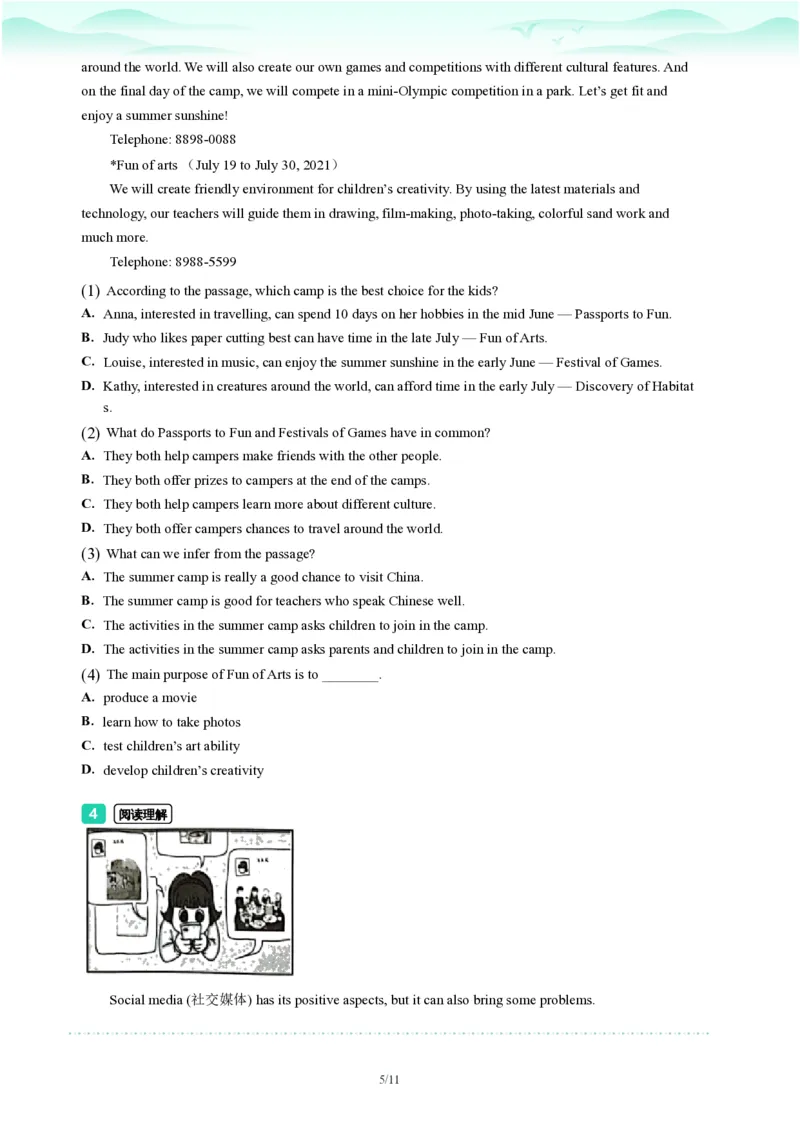
Social media (社交媒体) has its positive aspects, but it can also bring some problems.
5/11Have you ever been bored and decided to check your WeChat moments, only to find out that your best
friend is at the Great Wall, or one of your classmates is eating delicious noodles at your favorite restaurant,
or one of your basketball teammates is visiting the giant pandas in Sichuan? Have you had the feeling that
others are enjoying life more than you are? If your answers are both “Yes”, you are experiencing FOMO —
the fear of missing out.
Researchers have found that over 75% of young people are experiencing FOMO from time to time.
Social media is the main culprit for it. Because it is so easy today for people to see what their friends are
doing, eating, buying and talking about. And they are afraid of missing out on important and new
information when they are away from social networks. However, it is impossible for us to enjoy the same
activities others are enjoying on social media. Failing to realize this truth, we often let FOMO lead us to
compare our lives with those of others. This comparison leaves us feeling dissatisfied. Why? Because our
lives have both good and bad moments, but all we see on social media are the picture-perfect moments
others share. FOMO also makes us check social media more often, which can cause feelings of sadness,
loneliness and boredom.
So what should we do if we have FOMO? Researchers advised that we face it and change our way of
thinking. They also explained that taking part in social activities could help us realize that nothing bad was
happening. What’s more, they suggested finding the joy in the here and now and not believing the unreal
information or news on the Internet. “Take it as a chance to do what you really love, and turn your FOMO
into your JOMO -- joy of missing out,” one researcher said.
(1) What is the main purpose of Paragraph 2?
A. To show what FOMO is with examples.
B. To find out if people suffer from FOMO.
C. To ask questions about people’s daily lives.
D. To give examples about people’s using social media.
(2) What does the underlined sentence “Social media is the main culprit for it.” in Paragraph 3 mean?
A. Social media helps people get used to FOMO.
B. Social media is useful for fighting against FOMO.
C. Social media is mainly responsible for causing FOMO.
D. Social media makes people worried about having FOMO.
(3) According to the last paragraph, what are the right ways to deal with FOMO?
①Join a voluntary group.
②Accept what you are having now.
③Check your friends’ WeChat moments from time to time.
④Develop your hobbies.
⑤Stop believing the news on the Internet.
A. ③④⑤
B. ②③⑤
C. ①④⑤
D. ①②④
(4) What can be the best title of this passage?
6/11( )
A. Social media: Good or bad?
B. FOMO: Friend or enemy?
C. FOMO: Get out of it!
D. Social media: Guard against it!
5 阅读理解
Few would have expected that viewers at the 2022 Beijing Winter Olympics would include animals.
And yet, besides the exciting events, news reports also focused on several sightings of wildlife, especially
leopard cats.
On Jan 31, on the alpine ski slopes in Yanqing district, 90 kilometers northwest of Beijing, a leopard
cat was found walking through an award-ceremony rehearsal. The event caught the attention of volunteers
and staff, with many snapping photos. Three days later, a Chinese photographer captured another leopard
cat in the woods near the Olympic ski slopes. The creature ran past him, jumped over a fence and looked
back.
Leopard cats are wild felids (猫科动物), slightly larger than house cats, and they mostly keep clear of
human activity. However, according to Luo Shujin, a skier and a conservation biologist at Peking
University, the frequent appearance of the animals close to the ski runs shows that the species has lived in
this area relatively close to Beijing where human takes charge. Strangely, their calm manner suggests they
are not frightened by human activity.
Without any research date, it is too early to draw any conclusions that the creation of the Olympic
skiing venue (体育场馆) has not influenced the surrounding forests and wildlife. However, it’s possible
that the wild cats have already got used to living with humans, likely because people at the venue have not
shown an aggressive attitude toward the animals since it started being built.
According to Luo, wild cats are seldom seen so close to big cities. “I think this is a little-known side
of Beijing,” says Luo, who is proud that such wildlife can be found so close to the capital city. “Such an
event causes me to hope that we can try our best to ensure the balance between wildlife and human.”
(1) Which of the following best describes the presence of leopard cats around the venue?
A. Embarrassing.
B. Unexpected.
C. Frightening.
D. Common.
(2) What is the natural characteristic of a leopard cat?
A. Friendly to humans.
B. Interested in camera light.
C. Excited about sports.
D. Afraid of human activity.
(3) What does the underlined “it” (in Paragraph 4) refer to?
A. The venue.
B. The leopard cat.
C. The research.
7/11D. The ski slope.
(4) Which of the following may Professor Luo agree with?
A. Wildlife should not be influenced by humans.
B. Wildlife need to be kept away from big cities.
C. Humans should live peacefully with wildlife.
D. Humans need to get used to the wild lifestyles.
6 阅读理解
If you glue weak things together, can you get a much stronger one? The answer may be
“Yes” or “No”. Let’s see if it works when we do it with cardboard.
What to prepare?
•Thin cardboard from food box
•Ruler
•Scissors
•Glue
•Large bucket
•Rocks or stones
How to do the experiment?
Cut out 10 pieces of cardboard that are 5 cm wide and 10 cm long.
Fold one piece in half and make a square corner like corner this.
Fold two pieces in half and glue them together to make a corner. Do the same thing with
three or four pieces of cardboard. Let the glue harden for at least 4 hours.
★Put the center of the bucket on the single piece of cardboard and start adding rocks to the
bucket until the paper falls down. ★Set the bucket on the corner made from two pieces of
cardboard and see how much weight it can hold. ★Do the same thing with the corners made
from three and four pieces.
What to learn?
●The corners made of several pieces of paper are much stronger than a single piece.
●The paper gets stronger as you glue together more and more pieces.
●Gluing together many thin pieces of cardboard can become a much stronger one.
8/11(1) How many kinds of objects are needed for the experiment?
A. 5.
B. 6.
C. 7.
D. 8.
(2) Which shows the RIGHT steps of the experiment?
A. ①②④⑤③
B. ⑤②④③①
C. ⑤②①④③
D. ①⑤④②③
(3) In which column (栏目) of the newspaper can we most probably read this article?
A. Reading Fun
B. Teenagers’ Voices
C. Learning Discovery
D. Science Stories
7 阅读还原
阅读短文及文后的A~E选项,选出可以填入1~5各题空白处的最佳选项。
Which part of the world has the most nearsighted students? Just look around you—it’s East Asia. Nine
in ten school leavers in major East Asian cities are nearsighted according to the BBC. Experts say books
and video games are not to blame. (1)
People become nearsighted because their eyeballs grow out of shape and light entering their eyes
cannot focus correctly. (2) And guess what scientists have just discovered? Sunlight can help our
bodies produce more dopamine, reported AFP.
According to the study, primary school students in Singapore spend only 30 minutes outdoors every
day; in Australia, by contrast, kids spend about three hours a day outside. As a result, fewer children in
Australia—only 10 percent, compared with 90 percent in Singapore. “ (3) They study and they
watch television,” Ian Morgan of the Australian National University told AFP.
“ (4) As long as they get outside, it doesn’t seem to matter how much study they do,”
Morgan explained. “There are some kids who study hard and get outside and play hard and they are
generally fine. The ones who are at major risk are the ones who study hard and don’t get outside. As a
result of massive educational pressures and the construction of a child’s day, the amount of time they spend
outside in bright light is minimized”.
Experts suggest children should stay outside for two to three hours every day. (5)
A. But being a bookworm or a couch potato does not directly harm the eyes.
9/11B. This can include time spent in the playground and walking to and from school.
C. Children in East Asia just go to school, go home and stay inside.
D. The body can produce a chemical called dopamine (多巴胺) to stop eyeballs from changing shape.
E. East Asian students, they say, aren’t getting enough sunlight.
四、短文填空
8 首字母填空
阅读短文,根据上下文和所给的首字母写出所缺单词。注意使用正确形式,每空限填一词。答卷
时,要求写出完整单词。
In the 1960s, after returning from a busy and tiring trip to Europe, Norman Cousins got sick. He
discovered he had a rare disease. In less than a week after he got back, he could not stand. Every move that
he made was painful. He was not a (1) to sleep at night. The doctors told Mr Cousins that they did
not know how to cure his problem and he might never get over the illness. Mr Cousins, however, r (2)
to give up hope.
Mr Cousins thought that the illness could be caused by unhappy thoughts. He did not want to take
medicine to cure himself. I (3) , he felt that happy thoughts or laughter might cure his illness.
He began to try on himself while still in the hospital by watching funny shows on television. Mr
Cousins quickly found that ten minutes of real laughter during the day gave him two hours of pain-free
sleep at night. Then he continued his experiments with laughter. W (4) three weeks, he felt well
enough to take a vacation to Puerto Rico where he began running on the beach for exercise.
After a few months, Mr Cousins managed to carry on his work. He had laughed himself back to h (5)
.
五、完成句子
9 完成句子
老师问我们是否意识到预防压力的重要性。
The teacher asked the importance of guarding stress.
10 完成句子
别捉弄她,你们应该互相尊重。
Don’t her. You should respect each other instead.
六、未知
11 其他
我很想知道他是否为我买了电影票。
I really wonder a film ticket for me.
七、完成句子
10/1112 完成句子
自孩提时候起,Betty 就习惯了早起。
Betty has up early since her childhood.
13 完成句子
她做完作业才会睡觉。
She to bed she finishes her homework.
八、书面表达
14 书面表达
最近你校进行了一次“说出你的烦恼(Speak out your worries)的调查活动,请根据以下内容和提示
要求写一篇英语短文,汇报调查结果并向老师和父母提出建议。
注意:1. 词数80左右;2. 不得透露学校、姓名等任何个人信息
学生比例 烦恼 你的建议
50% 作业多,睡眠不足,压力大
30% 父母不理解,缺乏交流 ?
20% 活动少,体质差
Our school has made a survey— “Speak out your worries”. Here are the results.
__________________________________________________________________________________
______________________________________________________________________________________
______________________________________________________________________________________
______________________________________________________________________________________
______________________________________________________________________________________
______________________________________________________________________________________
______________________________________________________________________________________
______________________________________________________________________________________
______________________________________________________________________________________
______________________________________________________________________________________
___________
11/11