初中英语
2023年广东省广州市海珠区中考
一模英语试题
新东方教育科技集团2023年广东省广州市海珠区中考一模
英语试题
一、语法选择
1 语法选择
阅读下面短文,按照句子结构的语法性和上下文连贯的要求,从1~15各题所给的A、B、C和D项中
选出最佳选项,并在答题卡上将该项涂黑。
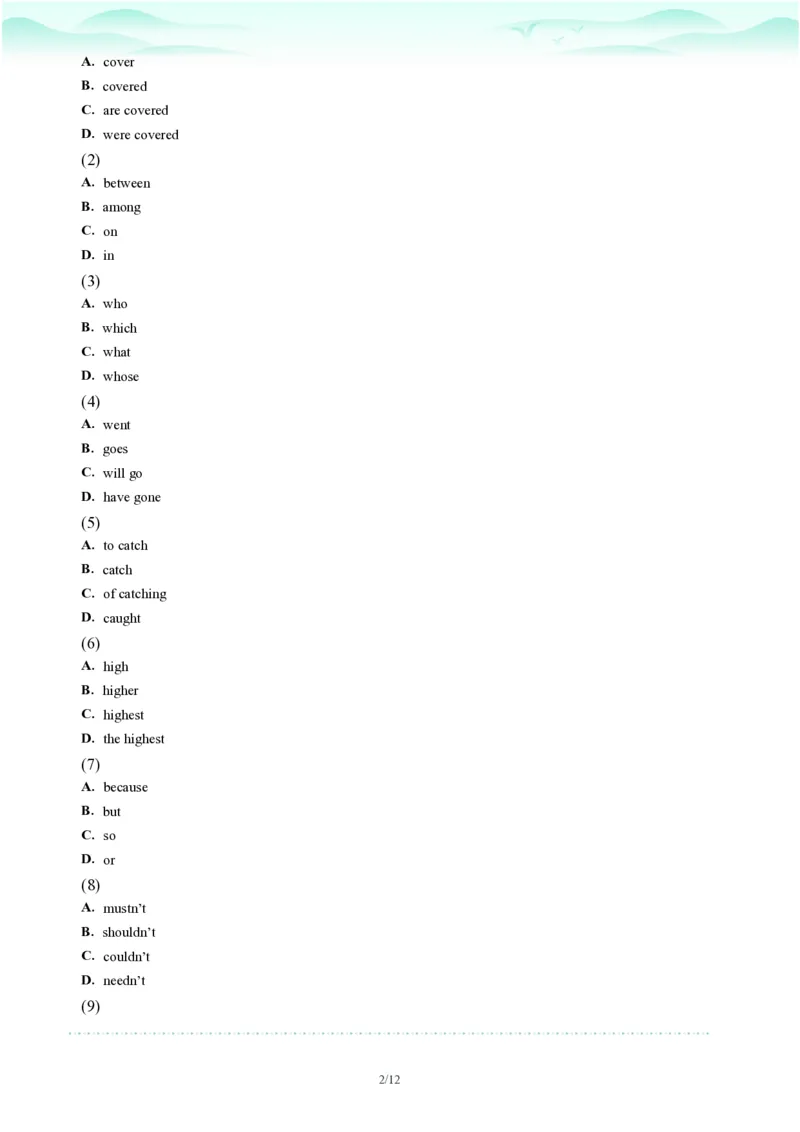
Once upon a time when Earth was young, Winter ruled. Mountains, rivers and forests (1) ________
with snow and ice. The floor(隔层) (2) ________ Earth and Sky was so hard that Sun couldn’t pass
through to warm the ground.
A big bear, called Fisher, had magic in his tail (3) ________ helped him catch fish. He decided to
bring Summer to Earth.
Fisher invited all of Earth’s creatures to a meeting.
“We will find a way to warm Earth,” he said. “Who (4) ________ with me to the place where Earth
is closest to Sky?”
Wolverine agreed to go with Fisher.
Fisher used his magical tail (5) ________ fish for them to eat along the way. After many days, they
reached the top of (6) ________ mountain on Earth, so high that it almost tickled Sky.
There Fisher tried his best to hit the Sky’s floor, (7) ________ he made only a tiny scratch (抓痕). He
(8) ________ break through to Sky.
“Let me (9) ________ ,” cried Wolverine. “I am the strongest.”
Wolverine hit against the Sky’s floor, once, twice, three times. Finally, a tiny crack appeared. He kept
jumping and (10) ________ widened the crack into a hole.
Soon Sun sent (11) ________ light through the hole, and they watched as the snow began to melt.
“We must make the hole bigger,” Fisher said. Then, using his sharp teeth, he bit off more pieces of the
Sky’s floor. Suddenly (12) ________ band of Sky People ran toward them.
By the time they reached him, he’d widened the hole enough (13) ________ Sun could warm Earth
for half of every year.
“Stop, thieves,” they cried. “Stop (14) ________ our warmth!”
Fisher ran away but one arrow struck his tail and he began falling. He hit the Sky’s floor and turned
into stars in the sky.
If you look up to Sky (15) ________ a clear night, you will see him there still.
(1)
1/12A. cover
B. covered
C. are covered
D. were covered
(2)
A. between
B. among
C. on
D. in
(3)
A. who
B. which
C. what
D. whose
(4)
A. went
B. goes
C. will go
D. have gone
(5)
A. to catch
B. catch
C. of catching
D. caught
(6)
A. high
B. higher
C. highest
D. the highest
(7)
A. because
B. but
C. so
D. or
(8)
A. mustn’t
B. shouldn’t
C. couldn’t
D. needn’t
(9)
2/12A. try
B. to try
C. tries
D. trying
(10)
A. succeed
B. success
C. successfully
D. successful
(11)
A. it
B. them
C. its
D. their
(12)
A. /
B. a
C. an
D. the
(13)
A. so that
B. as soon as
C. because of
D. even though
(14)
A. steal
B. stealing
C. to steal
D. steals
(15)
A. at
B. on
C. in
D. for
二、完形填空
2 完形填空
阅读下面短文,掌握其大意,然后从1~10各题所给的A、B、C和D项中选出最佳选项,并在答题卡
上将该项涂黑。
3/12Grayson didn’t want to talk to anybody. His friends were all discussing their class projects for the
weekend excitedly. Grayson’s cheeks grew warm with 1 . How could they understand his feelings
when their parents would help them? His parents worked all the time.
When school was over, Grayson ran out and raced home. He 2 his backpack on the floor, and
walked heavily to his room.
“How was school today, Grayson?” Grandpa asked.
“It was okay, I guess.”
“It doesn’t seem like that.”
Grayson told Grandpa about the 3 . Each student needed to build something with an adult, and
then made a report about it.
Grandpa listened 4 . “That sounds nice,” he said. “Why are you so 5 ?”
Grayson felt sadness rising inside him. “I don’t have anyone to help me.”
Grandpa raised his eyebrows. “What am I?” he asked. “A useless person?”
Grayson froze in 6 . “You will do it with me, Grandpa?”
“Sure!” Grandpa said.
Grayson’s heart seemed so light. Maybe this project wasn’t so bad.
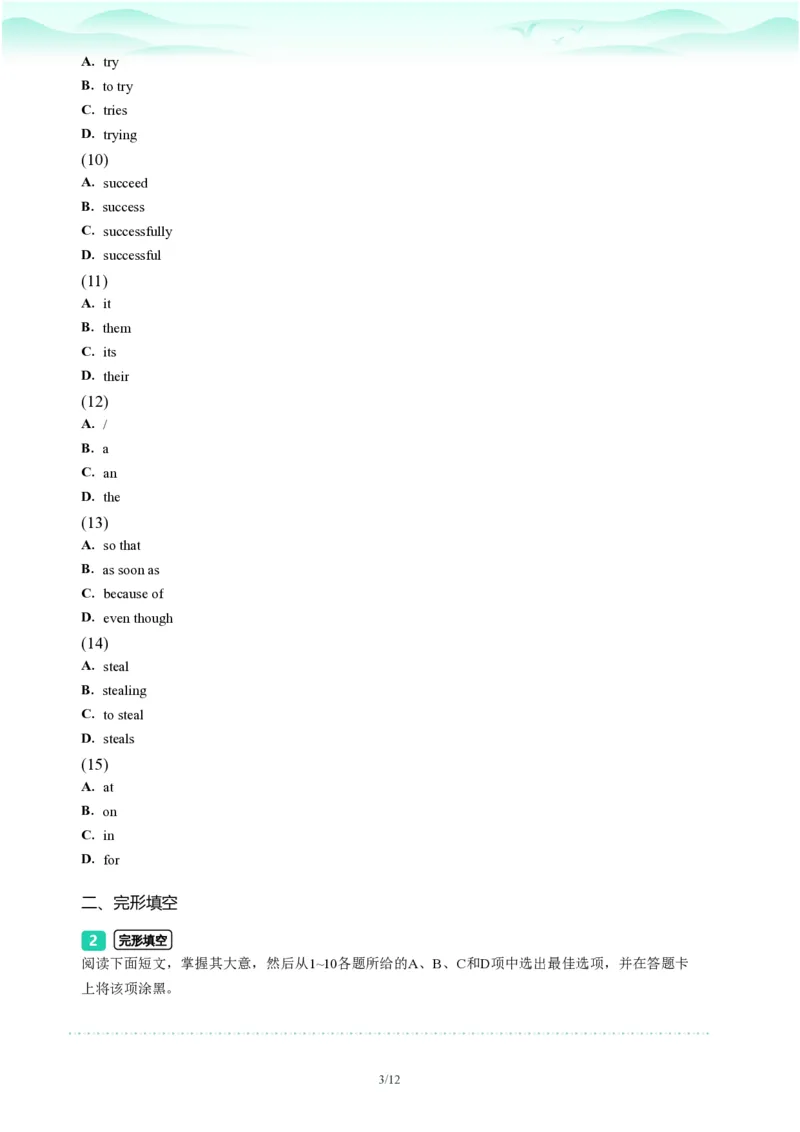
After dinner, they sat at the table and made a list of ideas. They settled on building a robot from old
boxes.
When they finished, the kitchen table was a mess. But Grayson couldn’t stop 7 .
“I think it’s the best robot I have ever built. Now I have to write my report,” Grayson said.
He ran to Grandpa’s side and hugged him. “Thank you, Grandpa. I had a lot of 8 .”
“Me, too. Maybe next time we can 9 something that explodes, like a volcano.” Grandpa said.
Grayson smiled again. He could 10 wait.
(1) A. happiness B. excitement C. embarrassment D. anger
(2) A. took B. dropped C. displaced D. reached
(3) A. project B. report C. bus D. school
(4) A. angrily B. quietly C. sadly D. rudely
(5) A. afraid B. upset C. excited D. cheerful
(6) A. silence B. fear C. surprise D. difficulty
4/12(7) A. smiling B. tidying C. thinking D. watching
(8) A. praises B. work C. problems D. fun
(9) A. buy B. draw C. build D. write
(10) A. suddenly B. hardly C. patiently D. easily
三、阅读理解
3 阅读理解
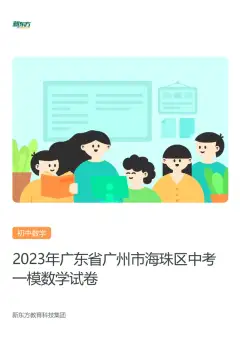
Miss Martha kept a little cake shop. Two or three times a week a customer came in who she began
taking an interest in. He was a middle-aged man. His clothes were worn but he looked neat, and had very
good manners. He always bought two loaves of stale bread. Never did he call for anything but stale bread.
Once Miss Martha saw a red and brown mark on his fingers. She was sure that he was a very poor
artist.
She wanted to add something good to eat to his stale bread, but her courage failed at the act. She knew
the pride of artists.
One day the customer came as usual, laid his coins on the showcase, and called for his stale bread.
While Miss Martha was reaching for them, a fire-engine came lumbering past. The customer hurried to the
door to look. Suddenly inspired, Miss Martha took the chance.
On the bottom shelf was a pound of fresh butter. With a bread knife Miss Martha made a deep cut in
each of the stale loaves, put in a lot of butter, and pressed the loaves tight again. When the customer came
again, she was tying the paper around them. When he had gone, Miss Martha smiled, not without a slight
beating fast of the heart.
For a long time that day she imagined the scene when he discovered her little kind trick.
Suddenly the front doorbell jangled viciously. Miss Martha felt a little scared and hurried to the front.
A young man and her artist were there. His face was very red, his hat was on the back of his head, and his
hair was in a mess.
“Silly!” he shouted loudly. “You have destroyed me!” He held his two fists and shook them angrily at
Miss Martha.
“Come on,” the young man said, “you’ve said enough.” He pulled the angry one out, and then came
back. “He’s an architectural draftsman,” he said. “He’s been working hard for three months drawing a plan
for a new city hall. It was a prize competition. He finished inking the lines yesterday. You know, a
draftsman always makes his drawing in pencil first. When it’s done, he rubs out the pencil lines with stale
5/12bread. That’s better than erasers. Well, today — well, you know, that butter isn’t — well, his plan isn’t
good for anything now.”
(1) Why did Miss Martha put fresh butter in the stale bread?
A. Because she wanted to help the man.
B. Because she wanted to make more money.
C. Because she wanted to make fun of the man.
D. Because she wanted to stop the man from winning the competition.
(2) What do the underlined words “jangled viciously” in paragraph 7 mean?
A. Rang gently.
B. Rang noisily.
C. Rang politely.
D. Rang nicely.
(3) What caused the middle-aged man to shout at Miss Martha?
A. Miss Martha hurt his pride.
B. He was too poor to buy anything but stale bread.
C. The butter Miss Martha gave him was not fresh.
D. The butter destroyed his drawing for the competition.
(4) What can we learn from the story?
A. Don’t help the artists.
B. Don’t put butter into the stale bread.
C. Help others at once when they’re in trouble.
D. Understand the real needs of others before helping them.
4 阅读理解
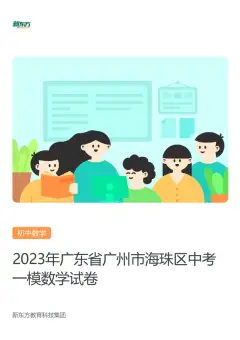
Marie was born in Poland on November 7, 1867.
Marie’s family had many troubles. Her mother was seriously ill. When Marie was 6, her father lost his
job and their home. They moved to a small flat. It was noisy and crowded. But the noise did not stop her
from studying.
In 1883, Marie finished high school. She dreamed of becoming a scientist. But in Poland, girls were
not allowed to go to college. And her family did not have enough money to send her to a university in
another country.
Reaching her dream seemed impossible.
Marie and her sister Bronya decided to study in France. Marie would work to pay for Bronya’s
schooling. Then, once Bronya left school, she would work and pay for Marie’s schooling.
6/12Finally, in 1891, Marie’s dream came true. She entered a university in Paris. In three years, she got
advanced degrees in Physics and Maths. She also met a scientist named Pierre Curie and they married in
1895.
Marie studied a metal element called uranium. She wanted to study uranium because scientists knew it
gave off unseeable rays of energy. She wondered where the rays came from.
Marie began testing rocks to find out if other elements gave off rays, too. Marie concluded two
elements (元素) found in the rocks were radioactive.They were thorium and uranium.
She called the energy “radioactivity”. Marie’s experiments were so exciting that she and Pierre soon
began working together. One day, Marie began testing a black rock. Marie discovered a new element in the
rock. She named it “polonium”. After Marie took away the polonium, the rock was still radioactive. She
knew another radioactive element was inside the rock. She called it “radium”.
In 1903, Marie and Pierre received the Nobel Prize in Physics. Marie was the first woman to receive a
Nobel Prize. In 1911, Marie accepted the Nobel Prize in Chemistry. She was the first person to receive two
Nobel Prizes.
Yet the work made her sick. On July 4, 1934, Marie Curie died of a blood disease that may be caused
by radiation.
Marie’s discoveries helped save millions of lives and changed the scientific world. Radiation has been
used to treat cancer. Her ideas about the atom helped lead to the discovery of nuclear energy.
(1) What happened to Marie?
A. She was born in a rich family in Poland.
B. She received the Noble Prizes in Physics and Maths.
C. She discovered the two new elements were radioactive.
D. She went to university in France because she loved France.
(2) What caused Marie to study uranium?
A. The experiment was very exciting.
B. The scientists knew nothing about uranium.
C. She wanted to know where the rays came from.
D. She wanted to work together with her husband.
(3) What’s the purpose of the passage?
A. To introduce Marie’s life.
B. To introduce Marie’s dream.
C. To introduce the Nobel Prize.
D. To introduce polonium and radium.
5 阅读理解
Parents and teachers know how difficult the teenage years can be. Teens have always been known to
do wild, even dangerous things. This was thought to be because of the “foolishness of youth”. Now, the
new technology allows scientists to study the physical development of the brain in more detail. Their
discoveries have led to a new theory of why teens act this way.
A Work in Progress
7/12Recently, scientists discovered that though our brains are almost at their full size by the age of 6, they
are far from fully developed. Only during youthhood our brains truly “grow up”. During this time, they go
through great changes, like a computer system being upgraded. Now, scientists have concluded that our
brains continue to change until age 25. Such changes make us better at balancing impulses(冲动) with the
following rules. But a still-developing brain can’t do it well. The result is the changeable behavior seen in
teenagers.
Pleasure Seekers
The studies say that teens probably take risks and behave badly. Luckily, as a brain scientist points
out, the teen brain encourages such behavior in order to help teens prepare for adult life.
One way the brain does this is by changing the way teens measure risk and reward. Researchers found
that when teens think about rewards, their brains produce more chemicals that create pleasure than an adult
brain does. Researchers believe this makes the rewards seem more important than the risks, and makes
teens feel more excited about new experiences than adults do.
Research also found that it makes social connections seem especially useful. The brain encourages
teens to have a wide circle of friends, which is believed to make us more successful in life.
Unluckily, this hunt for greater rewards can sometimes lead teens to make bad decisions. However, it
also means that teens are more possible, and less afraid, to try new things or to be independent, which can
help teens leave their parents’ care and live their own lives successfully.
(1) What can we know about our brains?
A. They don’t develop until age 25.
B. They are fully developed by the age of 6.
C. They grow bigger only during youthhood.
D. It’s not easy to act on impulse with developed brains.
(2) How does the teen brain help them prepare for adult life?
A. By making teens keep off new people.
B. By leading teens to make bad decisions.
C. By making teens braver to try new things.
D. By changing the way teens measure pleasure and reward.
(3) Which of the following best shows the structure of the passage?
A.
B.
C.
8/12D.
(4) What can be the best title of this passage?
A. The teens
B. The teenage brain
C. The pleasure seekers
D. The work in progress
6 阅读理解
Mary’s pumpkin cakes
Mary White, 68, is a retired teacher. She has lost weight at Keeping-fit World group in Walton,
Liverpool.
My cooking skills have improved since joining Keeping-fit World. I made a lot of vegetarian meals
and really enjoyed the dishes in the cookbook. So when the Free Food Fair came around, I challenged
myself to a vegan recipe, and my pumpkin cakes were born.
Steps
1. In a large bowl, add the pumpkin to half of the yogurt, and stir well. Spray a large baking plate with
cooking spray.
2. Meanwhile, microwave the sweet potato on high for 6 minutes. If you don’t have a microwave, you can
bake it with the pumpkin for 35-40 minutes.
3. Mash the sweet potato until smooth. Add the remaining yogurt, the pumpkin and chickpeas, mix them
together.
9/124. When cool enough to hold, divide the mixture into 12 and shape into thick pies.
5. Place on a large baking plate with baking paper, then bake for 25 minutes. Serve with the salad, extra
yogurt, and lemon wedges.
(1) Why did Mary challenge herself to pumpkin cakes?
A. To lose weight.
B. To teach students to make cakes.
C. To enjoy the dishes.
D. To take part in the Free Food Fair.
(2) What are necessary to make the pumpkin cakes?
A. High-calorie cooking spray and a pumpkin.
B. Low-calorie cooking spray and chickpeas.
C. Sweet dairy-free soya yogurt and lemon wedges.
D. Plain unsweetened dairy soya yogurt and a sweet potato.
(3) Which shows the correct steps to make pumpkin cakes?
a. Bake the thick pies for 25 minutes.
b. Shape the mixture into 12 thick pies.
c. Mix yogurt and pumpkin together, and then stir.
d. Add the yogurt, pumpkin and chickpeas to the smooth potato.
e. Spray with cooking spray, and microwave the sweet potato.
A. c-e-d-b-a
B. e-c-d-b-a
C. e-c-d-a-b
D. c-e-d-a-b
7 阅读还原
Dolphin therapy(疗法)is good for children who have special problems, for example, children who
cannot speak or move very well or children who cannot focus or remember things.
(1) Dolphin therapy cannot cure problems like autism (孤独症), but it can help children
focus and communicate better with other people. Dolphin therapy doesn’t replace other therapies that
children have at home or school. (2)
How does it work? Scientists have discovered that there is a connection between memory and
emotional experiences. Children have wonderful, emotional experiences with dolphins. (3)
Sometimes, children with special physical or mental problems do not feel confident. (4)
Dolphins accept children completely and so the children feel safe and secure. After spending time with
dolphins, children feel that they can do many things.
(5) Here are some of their comments. “My son Tim has autism. After one session of dolphin
therapy, he felt the days were the best of his whole life!” “My daughter Ann has problems focusing on her
lessons, but when she is with the dolphins she does better.”
A. It is an additional activity.
10/12B. What do parents think of dolphin therapy?
C. This helps them to remember things better.
D. What exactly can dolphin therapy help with?
E. Contact with dolphins gives children more confidence.
四、短文填空
8 首字母填空
根据短文及首字母提示,写出所缺单词,并注意使用适当形式。(每空限填一词)
Each different part of China has its own special forms of traditional art. These usually try to show the
things that are important in life, such as love, beauty, and family.
Sky lanterns were first used by Zhuge Kongming. He sent them out to ask for help when in t (1)
. Today, sky lanterns are used at f (2) and other celebrations. They are m (3) of
bamboo and covered with paper. They are seen as bright symbols of happiness and good wishes.
Paper cutting has been around for over 1,500 years. Paper cutting sounds very easy but it can be d (4)
to do. The paper, usually red, is cut with scissors. The most common pictures are flowers, animals
and things about Chinese history. They are put on windows, doors and walls as symbols of wishes for good
l (5) and a happy new year.
五、完成句子
9 完成句子
你知道永庆坊因什么而出名吗?
Do you know Yongqing Fang famous for?
10 完成句子
永庆坊充满岭南文化。
Yongqing Fang Lingnan culture.
11 完成句子
在永庆坊能够看到岭南风格的建筑。
Lingnan-style buildings in Yongqing Fang.
12 完成句子
如果你喜欢粤剧,为什么不去粤剧艺术博物馆呢?
you Cantonese Opera, go to the Cantonese Opera Art Museum?
13 完成句子
永庆坊是个多么美妙的地方!
wonderful place Yongqing Fang is!
11/12六、书面表达
14 书面表达
在“共建美丽多彩校园”活动中,校长鼓励全校学生为此活动提建议。假设你是九年级学生王
华,请根据以下提示,写一封信给校长,跟他谈谈学校存在的问题和你的建议。
注意:1.可在思维导图内容提示的基础上适当拓展信息;
2.词数80词左右(信件的基本格式和开头已给出,不计入词数);
3.不得透露学校、姓名等任何个人信息,否则不予评分。
Dear Headmaster,
I am a student of Grade 9. I am excited to participate in the “Building a Beautiful and Colourful
Campus Together”
activity._______________________________________________________________________________
______________________________________________________________________________________
______________________________________________________________________________________
______________________________________________________________________________________
_______________________________________________________________
Respectfully,
Wang Hua
12/12