初中英语
2025年⼴东省⼴州市天河区中考⼀
模英语试卷
新东⽅教育科技集团2025年⼴东省⼴州市天河区中考⼀
模英语试卷
⼀、语法选择
 语法选择
阅读下⾯短⽂,按照句⼦结构的语法性和上下⽂连贯的要求,从1〜15各题所给的A、B、C和D项
中选出最佳选项,并在答题卡上将该项涂⿊。
Karl was a cheerful farm boy except for one problem. He had a great love 1 cheese. Whenever he
saw cheese or food with cheese, he 2 stop eating it. His mother often warned him, “Cheese is
delicious, but too 3 of it may get you a stomachache.” However, Karl just laughed it off and didn’t
care about 4 his mother told him.
One night, while Karl 5 in bed, he thought about having cheese again. Suddenly he heard a soft
voice saying, “Just 6 with me and you’ll find a cheese mountain!”
Quickly, he rose up and followed 7 voice to a forest. When he stepped deeper into the forest, he
8 to a party where a large cheese mountain was in the middle. Hundreds of tree elves were dancing
9 around it. “Wonderful cheese for wonderful dancers!” All the elves welcomed him. “CHEESE!”
With joy in his heart, Karl joined them and didn’t stop dancing 10 the sun rose. The moment he
stopped, pieces of cheese came towards him. Karl became even 11 when he started to enjoy the tasty
cheese. As soon as he finished one piece, 12 came to him. Very soon, he was 13 full and tired to
eat any more. But the cheese kept coming — rolling closer, pushing him down… He got scared, shouting for
help but all the elves weren’t around!
“Karl, Karl! It’s time to get up…” Finding that it was just a dream, Karl felt relaxed. From then on, he
decided 14 cheese right because Karl had learned 15 lesson: love shouldn’t go too far!
(1) A. in B. for C. on D. with
(2) A. shouldn’t B. needn’t C. mustn’t D. couldn’t
(3) A. few B. much C. many D. little
(4) A. why B. how C. that D. what
(5) A. was lying B. am lying C. lies D. had lied
(6) A. come B. to come C. came D. coming
(7) A. a B. an C. the D. /
(8) A. invites B. invited C. is inviting D. was invited
(9) A. excite B. excited C. excitedly D. excitement
(10) A. if B. unless C. when D. until
(11) A. happy B. happily C. happier D. more happily
(12) A. another B. the other C. the others D. others
/(13) A. too B. still C. very D. so
(14) A. to eat B. eat C. ate D. eating
(15) A. he B. him C. his D. himself
⼆、完形填空
 完形填空
阅读下⾯短⽂,掌握其⼤意,然后从16〜25各题所给的A、B、C和D项中选出最佳选项,并在答题
卡上将该项涂⿊。
As a nature photographer, I often work in the wild. One of the most 1 things about it is that I can
watch animals in their natural environment. That’s what I like most about my job. My favourite place to take
photos is the national park, which is famous for its different wildlife. And it is probably best known for its
2 runners—bears. Though heavy, these animals can run almost 64 kilometres per hour. Besides, they
are also excellent swimmers.
Last 3 in the park, I went through a forest. The view there was breathtaking. With 4 wind
blowing, trees started to turn green and flowers danced from side to side. An eagle flew over the snow-capped
mountains, which were mirrored in the still lake below. When I was focusing on 5 this wonderful
scene, I suddenly felt that I was being watched. 6 , and with the camera still held to my eye, I turned a
little bit, and a little bit...and froze. A bear! Only metres away from me. With water falling off its thick, brown
hair, the bear 7 me. Time stood still as the bear and I both waited to see who would move first. My
legs started shaking. Somehow, I 8 my finger to press the button. A second later, the bear turned and
ran back into the forest. When I came to myself from the 9 , I looked at my camera. My most
frightening but magical experience was now recorded forever in a single picture.
From time to time I look at the photo as a reminder to show respect to all animals. In fact, we human
beings are the 10 of their world. They live here long before we come.
(1) A. comfortable B. amazing C. popular D. important
(2) A. ugly B. furry C. large D. fast
(3) A. spring B. summer C. autumn D. winter
(4) A. strong B. gentle C. hot D. terrible
(5) A. drawing B. reviewing C. copying D. photographing
(6) A. Sadly B. Easily C. Slowly D. Hurriedly
(7) A. stared at B. shouted at C. walked towards D. rushed towards
(8) A. held B. pushed C. touched D. forced
(9) A. trouble B. pain C. shock D. tiredness
(10) A. friends B. visitors C. masters D. helpers
三、阅读理解
/ 阅读理解
As we know, playing tug of war can help build your strength and raise your team spirit. But do you know
that you can win the game even if you are not the strongest? Today we will enter tug of war and explore how
winning the game might be a lot more than strength. And you will find it more than a competitive and
teamwork sport!
MATERIALS:
At least two kids
A strong but soft rope
A piece of tape
STEPS:
Place a colored tape on the ground to mark the center line, making sure it can be seen clearly by all
players. After that, divide the players into two equal teams and have them line up at opposite ends of the rope.
Next, provide gloves for players to protect their hands, and remind everyone to have a tight hold of the rope
and avoid suddenly letting go. Then the players hold each end of the rope and wait for the signal. As soon as
the judge shouts “Go!”, both teams will pull the rope backward as hard as they can.
MORE ABOUT THE GAME
When playing, each player on each side of the rope has four forces—ground, tension, friction, and
weight. If all forces add up to 0, the players won’t budge. And if they don’t add up to 0, the players will be
pulled forward. Therefore, you don’t have to be the strongest to win. Rather, it’s about friction. The frictional
force is between the person and the ground. The greater the friction, the better the team can hold its position
and pull the other team.
(1) Which is the correct order of playing tug of war?
a. Prepare a coloured tape. b. Offer gloves and safety tips.
c. Organize two groups of players. d. Hold the rope and wait for the start.
e. Try hard to pull the rope.
A. c-b-a-d-e
B. c-a-b-d-e
C. a-c-b-d-e
D. a-b-c-d-e
(2) What does the underlined word “budge” mean?
A. Pull.
B. Fall.
C. Stop.
D. Move.
(3) What does the writer mainly want to tell us about tug of war?
/A. Winning the game doesn’t depend on strength.
B. There’s science and maths behind the game.
C. You can exercise and have fun while playing it.
D. Knowing the steps clearly is important for the game.
 阅读理解
The Polos—Marco, his father Niccolò, and his uncle Maffeo—had been traveling for three and a half
years when they finally achieved their goal—a long-awaited meeting with the powerful Mongol leader, Kublai
Khan (忽必烈). The historic event happened in 1275 at the Khan’s capital in Shengdu.
Marco Polo’s trip had started more than 9,000 kilometers away in Venice when he was just a teenager.
His father and uncle knew Kublai Khan from a visit five years earlier, when they had spent a short time in
Shengdu. On this second trip, the Polos stayed for 17 years. They made themselves useful to the Khan and
took on different tasks for him.
During his time in Kublai Khan’s service, Marco Polo was able to learn and experience many things that
were new to Europeans. Later in his travel journal, he wrote that Kublai Khan’s palace was the greatest he
had ever seen. He admired the Khan’s recently completed new capital, Daidu, which was built in the shape of
a perfect square. Its streets were “so straight and so broad.” The city was located in what is now the center of
Beijing, and Kublai Khan’s city planning can still be seen in the streets of China’s modern capital.
We also learn from Marco Polo that Kublai Khan made use of a fast and simple message system. Horse
riders spaced every 40 kilometers allowed messages to cover 500 kilometers a day. As soon as one horse had
run 40 kilometers, the next horse would run the next 40 kilometers, and so on. Marco also learned the secret
of asbestos cloth, which is made from a mineral and doesn’t catch fire. Paper money also took him by
surprise, since it was not yet in use in the West at that time. Homes were heated with “black stones…which
burn like logs.” Those stones were coal—unknown in most of Europe—and were so plentiful that many
people had a hot bath three times a week.
Although the Khan did not want his visitors to leave, the Polos finally returned home in 1292. After he
returned home, Marco’s travel was written down in a book, full of details about his amazing cultural
experiences. It was probably the single greatest contribution to geographical knowledge ever made to the West
about the East.
(1) According to paragraph 1 and 2, what can we know about Marco Polo’s trip to China?
A. It took him five years to travel to China.
B. He had met Kublai Khan before.
C. He spent a short time staying in China.
D. He worked for Kublai Khan when visiting China.
(2) Why was Marco Polo impressed by Khan’s newly-built capital?
A. Because it had a modern palace.
B. Because of its city planning.
C. Because it was like Beijing today.
D. Because of its central location.
(3) What can we infer from Marco Polo’s experience in China?
/A. The East had learned technologies from the West.
B. The West already knew and used the technologies in the East.
C. The East was ahead of the West in some areas of technology.
D. The West needed fewer technologies than the East then.
(4) What is the passage mainly about?
A. The Polos’ relationship with Kublai Khan.
B. Why Marco Polo’s travel is important.
C. The Polos’ two useful travels to China.
D. How Marco Polo finished his book.
 阅读理解
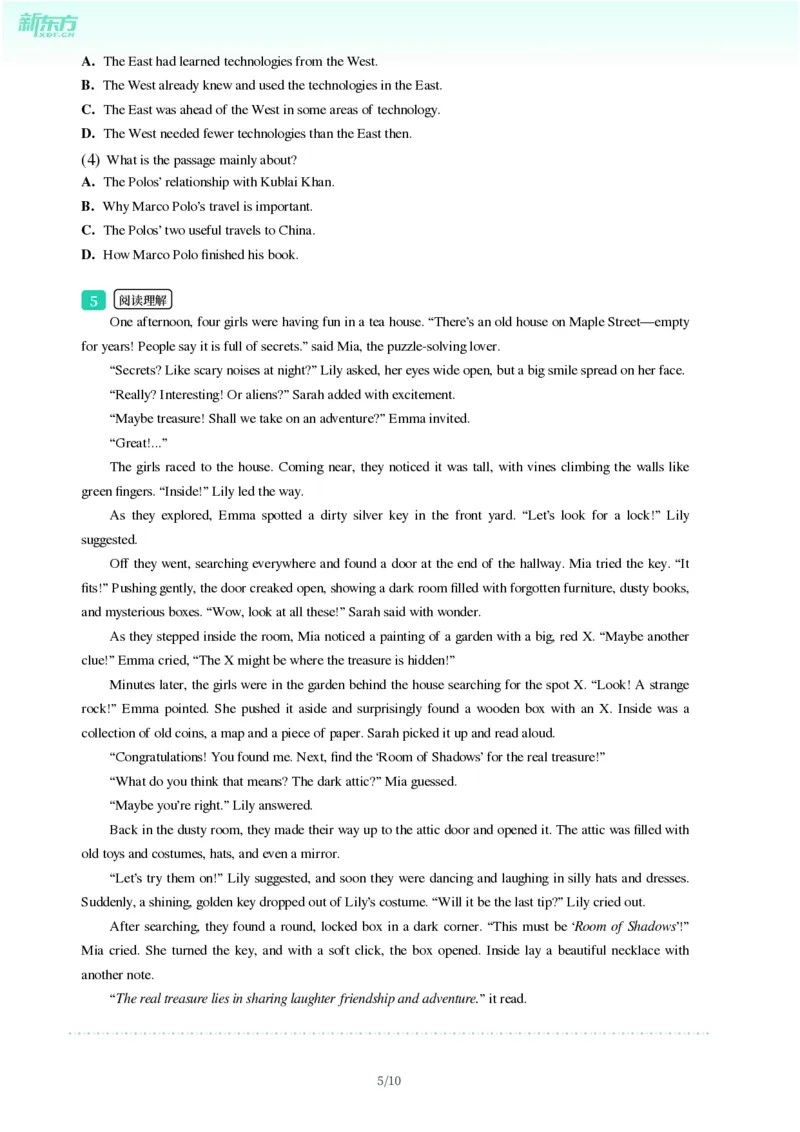
One afternoon, four girls were having fun in a tea house. “There’s an old house on Maple Street—empty
for years! People say it is full of secrets.” said Mia, the puzzle-solving lover.
“Secrets? Like scary noises at night?” Lily asked, her eyes wide open, but a big smile spread on her face.
“Really? Interesting! Or aliens?” Sarah added with excitement.
“Maybe treasure! Shall we take on an adventure?” Emma invited.
“Great!...”
The girls raced to the house. Coming near, they noticed it was tall, with vines climbing the walls like
green fingers. “Inside!” Lily led the way.
As they explored, Emma spotted a dirty silver key in the front yard. “Let’s look for a lock!” Lily
suggested.
Off they went, searching everywhere and found a door at the end of the hallway. Mia tried the key. “It
fits!” Pushing gently, the door creaked open, showing a dark room filled with forgotten furniture, dusty books,
and mysterious boxes. “Wow, look at all these!” Sarah said with wonder.
As they stepped inside the room, Mia noticed a painting of a garden with a big, red X. “Maybe another
clue!” Emma cried, “The X might be where the treasure is hidden!”
Minutes later, the girls were in the garden behind the house searching for the spot X. “Look! A strange
rock!” Emma pointed. She pushed it aside and surprisingly found a wooden box with an X. Inside was a
collection of old coins, a map and a piece of paper. Sarah picked it up and read aloud.
“Congratulations! You found me. Next, find the ‘Room of Shadows’ for the real treasure!”
“What do you think that means? The dark attic?” Mia guessed.
“Maybe you’re right.” Lily answered.
Back in the dusty room, they made their way up to the attic door and opened it. The attic was filled with
old toys and costumes, hats, and even a mirror.
“Let’s try them on!” Lily suggested, and soon they were dancing and laughing in silly hats and dresses.
Suddenly, a shining, golden key dropped out of Lily’s costume. “Will it be the last tip?” Lily cried out.
After searching, they found a round, locked box in a dark corner. “This must be ‘Room of Shadows’!”
Mia cried. She turned the key, and with a soft click, the box opened. Inside lay a beautiful necklace with
another note.
“The real treasure lies in sharing laughter friendship and adventure.” it read.
/(1) Why did the girls hurry to the house?
A. They wanted to find out who guessed right.
B. They wanted to prove the house had no secrets.
C. They were good at finding treasure and aliens.
D. They had interest in exploring the unknown.
(2) Where did the girls find the first note?
A. In the front yard.
B. In the dark room.
C. In the hallway.
D. In the back garden.
(3) Which picture is the “Room of Shadows”?
A.
B.
C.
D.
(4) Which is the best title for the passage?
A. The journey to the secret garden
B. The treasure of the adventure
C. The ancient treasure house
D. The girls’ forever friendship
/ 阅读理解
Today, in my fridge, there are a few grapes, some bananas and some juice. There is also a pizza, and
some burgers. I know what this food does to my body, but what does it do to the world around me? It’s time
to look at my carbon footprint and think about the good, the bad and the really ugly.
My first stop is the label. Labels give us lots of information: how long we can keep our food, how healthy
it is and where it comes from. A few hundred years ago, most of our food came from local places, but today,
food travels thousands of miles. We refrigerate it, and then transport it in planes and ships all over the world. I
look at the pizza and feel bad at once—not because it’s unhealthy, but because the seafood on it comes all the
way from Thailand. I take out a banana—it’s from Brazil, but that’s not too bad. It came here by boat, so the
carbon footprint is small.
The next stop is the packaging. Unlike bananas, food like grapes needs protection with package.
However, in the UK, we don’t recycle all our packaging. We throw away the plastic containers holding fruits
like grapes. More than 30% of packaging waste ends up in landfills instead of being sent to recycling centers.
Then I look at the grapes in my fridge—they’re in a plastic box and they’re from Spain. But at least they
grew in natural sunlight. In the UK, people grow grapes in greenhouses, which means our grapes use more
energy. But there is one other thing in my fridge, and if pizza and grapes are “bad”, then this food is “really
ugly”— the burgers. They have the biggest carbon footprint because they come from cows. In the USA, cows
create the same amount of greenhouse gases as 20 million cars!
As I close the fridge door, I make a new checklist for my next trip to the supermarket. Maybe I could
grow my own vegetables too.
(1) What does “carbon footprint” mean in the passage?
A. The cost of buying foreign food.
B. The possible health risks of daily food.
C. The distance food travels from places to places.
D. The effect of food choices on the environment.
(2) What does the writer learn about the food in his fridge?
A. The pizza is bad because of its unhealthy seafood.
B. The bananas are good as they grow in Brazil.
C. The grapes are bad because they need to be packed.
D. The burgers are ugly as they need more energy.
(3) What question is most likely on the writer’s new supermarket checklist?
A. “Are these apples grown locally?”
B. “Does this fish have enough packaging?”
C. “Is this apple pie cheaper than the frozen one?”
D. “Will these pieces of beef stay fresh for three days?”
(4) What is the purpose of writing the passage?
A. To help people choose healthy foreign food.
B. To explain how different kinds of food are produced.
C. To teach people to count the carbon footprint of the food.
/D. To call on people to be eco-friendly when buying food.
 阅读还原
阅读短⽂及⽂后A~E选项,选出可以填⼊各题空⽩处的最佳选项,并在答题卡上将该项涂⿊。
Printing is one invention that has changed the modern world. The latest form of printing technology is
3D printing. (1) It uses materials such as different plastics to create objects. The 3D printer builds
the object by adding layer after layer of the material till it finishes building the object.
In fact, 3D printing has already been used in many fields. A 3D printer can take any drawing and build it.
(2) Designers are making small models of houses. Families with their own 3D printers are building
fun objects like toys at homes. Artists are using 3D printers to create works of art as well. Sweet shops are
even using these printers to print chocolate candies!
(3) Doctors and hospitals now use 3D printing. No two people have exactly the same body
parts. 3D printing could build medical objects that can meet each person’s needs. In fact, it is already possible
to build personal devices to help people’s hearing. It can even print teeth or small parts that can go in teeth!
(4) It might take quite some time for it to be fully developed. However, people are quite confident
that in the near future, 3D printing can be used to build skin, bones, and other body parts. (5)
3D printing is changing the way we make things, and it’s an exciting technology that will keep surprising
us!
A. It is a method of creating objects from a computer drawing.
B. This will help sick people as well as further medical research.
C. However, 3D printing’s most useful purpose may be in the field of health.
D. The technology to use a 3D printer to “print” living cell is beginning as well.
E. That means the ability to make different objects using 3D printing has no end.
四、短⽂填空
 ⾸字⺟填空
根据短⽂的内容及⾸字⺟提⽰写出⽂中所缺单词。
Flying to Mars would be the farthest journey in human history. For the astronauts who visit Mars, they
would s (1) a lot because of the special environment there. Surviving this trip would not be easy.
Though space travel is never free of d (2) , it takes a lot more health risks to travel in space for a
long time. For one thing, staying in space for long periods makes the human body w (3) . Also, it puts
pressure on the back of the eyes and causes eye problems. Then there are space rays to w (4) about. It
might lead to a higher chance of health problems, especially for astronauts who will have long journeys.
Astronauts will have to pack l (5) to lift off from Earth. And they won’t be able to get things
they need like astronauts on the space station do. Instead, they will take fewer things and they might try
growing food and building tools as needed.
五、完成句⼦
/ 完成句⼦
为了改善⾝体健康,学校⿎励学⽣们参加不同种类的体育活动。
To improve students’ health, they join in different kinds of sports.
 完成句⼦
学⽣们每天花多点时间运动是⾮常明智的。
of students more time exercising every day.
 完成句⼦
同学们还计划分享他们将如何平衡学习和运动时间。
The students also plan to share the time of study and sports.
 完成句⼦
每天充⾜的运动真的对我们的健康产⽣影响。
Doing enough exercise every day really to our health.
 完成句⼦
每天运动是⼀个多么好的习惯啊!
it is to do daily sports!
六、书⾯表达
 书⾯表达
近期,你校将组织“传统⽂化进社区”的志愿服务活动,交换⽣Sally也报名参加。假如你是李
华,请你结合以下提⽰,写⼀份英⽂邮件,向她介绍活动安排。
要求:(1)邮件应包括图中要点,并适当拓展。
(2)词数80-120左右,邮件开头已经给出,不计⼊总字数,⽂中不得出现个⼈信息。
Dear Sally,
Thank you for joining us in our voluntary work.
______________________________________________________________________________________
__________
/__________________________________________________________________________________
______________________________________________________________________________________
______________________________________________________________________________________
______________________________________________________________________________________
______________________________________________________________________________________
______
Yours,
Li Hua
/