绝密★启用前
2005年全国硕士研究生招生考试
英语(一)
(科目代码:201)
试卷条形侶粘贴位置| 考生注意事项
1. 答题前,考生须在试题册指定位置上填写考生编号和考生姓名;在答题卡指定位
置上填写报考单位、考生姓名和考生编号,并涂写考生编号信息点。
2. 考生须把试题册上的“试卷条形码”粘贴条取下,粘贴在答题卡的“试卷条形码粘
贴位置”框中。不按规定粘贴条形码而影响评卷结果的,责任由考生自负。
3. 选择题的答案必须涂写在答题卡相应题号的选项上,非选择题的答案必须书写在
答题卡指定位置的边框区域内。超出答题区域书写的答案无效;在草稿纸、试题
册上答题无效。
4. 填(书)写部分必须使用黑色字迹签字笔书写,字迹工整、笔迹清楚;涂写部分必须
使用2B铅笔填涂。
5. 考试结束,将答题卡和试题册按规定交回。
(以下信息考生必须认真填写)
考生编号
考生姓名Section I Use of English
Directions:
Read the following text. Choose the best word (s) for each numbered blank and
mark A, B, C or D on ANSWER SHEET 1. (10 points)
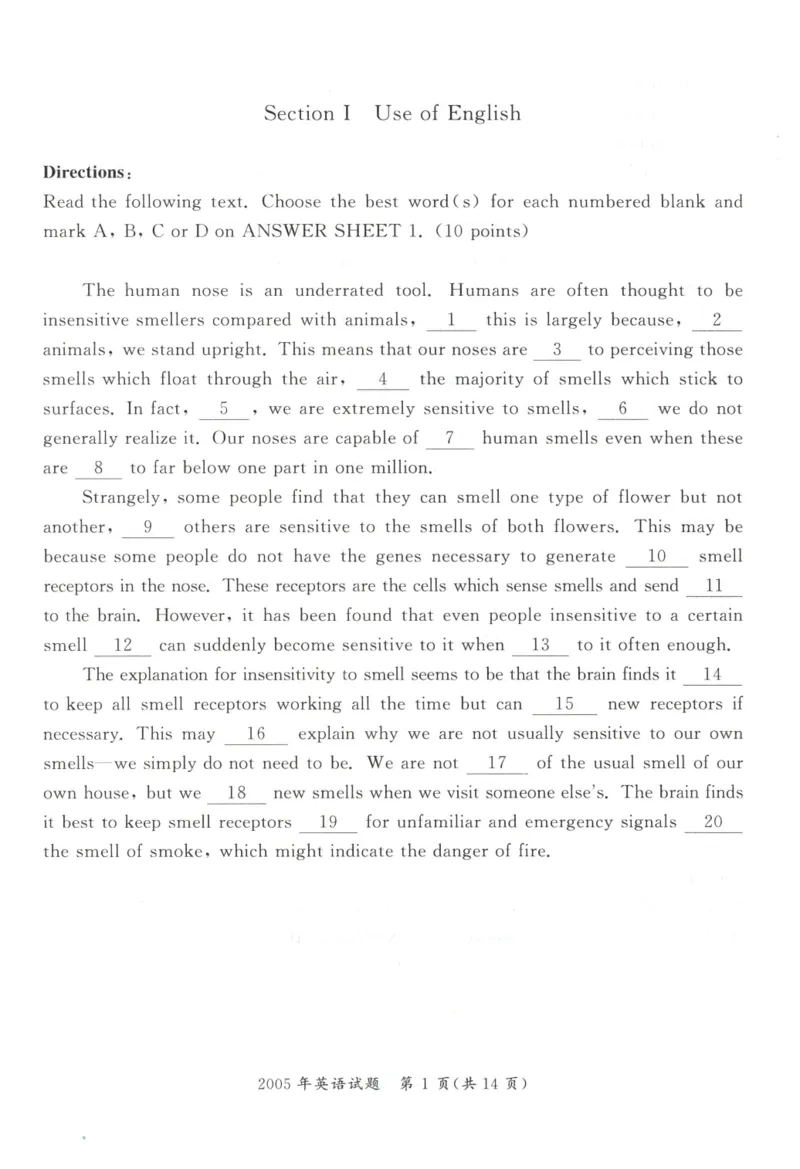
The human nose is an underrated tool. Humans are often thought to be
insensitive smellers compared with animals, ] this is largely because, 2
animals, we stand upright. This means that our noses are 3 to perceiving those
smells which float through the air, 4 the majority of smells which stick to
surfaces・ In fact, 5 , we are extremely sensitive to smells, 6 we do not
generally realize it. Our noses are capable of 7 human smells even when these
are 8 to far below one part in one million.
Strangely ? some people find that they can smell one type of flower but not
another, 9 others are sensitive to the smells of both flowers・ This may be
because some people do not have the genes necessary to generate 10 smell
receptors in the nose. These receptors are the cells which sense smells and send 11
to the brain. However, it has been found that even people insensitive to a certain
smell 12 can suddenly become sensitive to it when 13 to it often enough.
The explanation for insensitivity to smell seems to be that the brain finds it 14
to keep all smell receptors working all the time but can 15 new receptors if
necessary. This may 16 explain why we are not usually sensitive to our own
smells一we simply do not need to be. We are not 17 of the usual smell of our
own house? but we 18 new smells when we visit someone else's. The brain finds
it best to keep smell receptors 19 for unfamiliar and emergency signals 20
the smell of smoke 9 which might indicate the danger of fire.
2005年英语试题第1页(共14页)1. [A] although [B] as [C] but [D] while
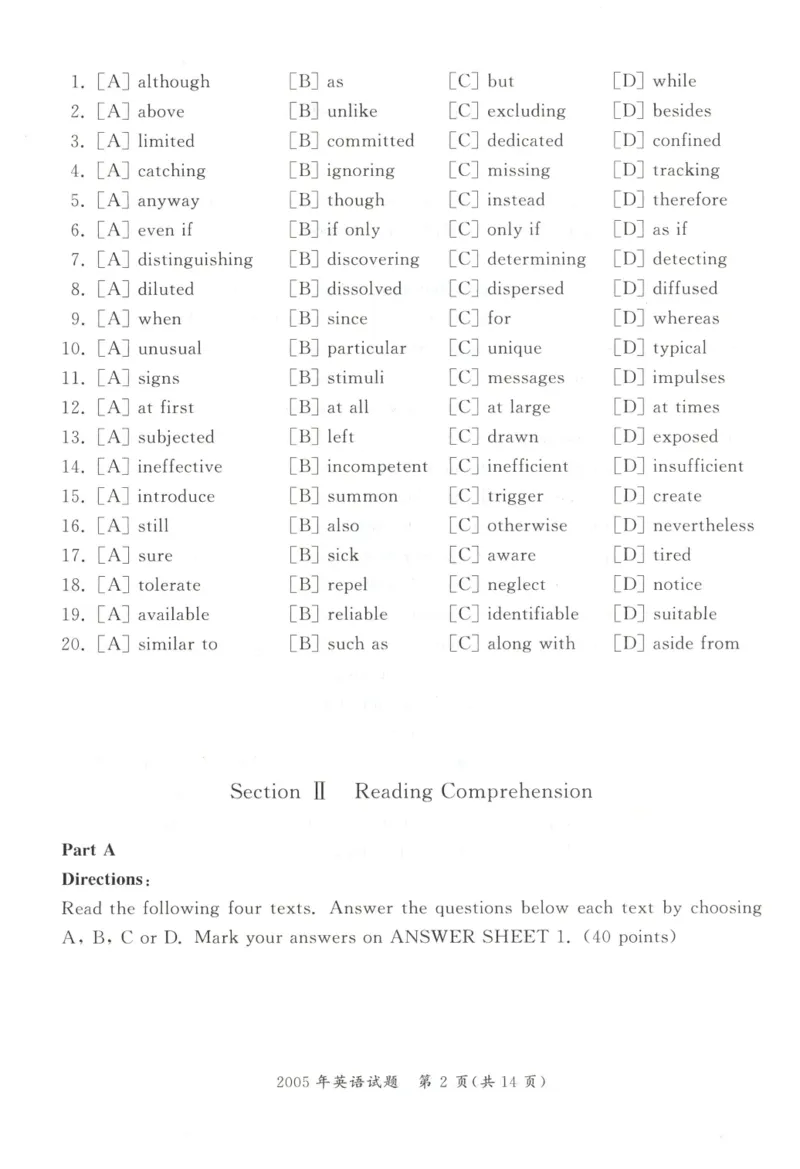
2. [A] above [B] unlike [C] excluding [D] besides
3. [A] limited [B] committed [C] dedicated [D] confined
4. [A] catching [B] ignoring [C] missing [D] tracking
5. [A] anyway [B] though [C] instead [D] therefore
6. [A] even if [B] if only [C] only if [D] as if
7. [A] distinguishing [B] discovering [C] determining [D] detecting
& [A] diluted [B] dissolved [C] dispersed [D] diffused
9. [A] when [B] since [C] for [D] whereas
10. [A] unusual [B] particular [C] unique [D] typical
11. [A] signs [B] stimuli EC J messages [D] impulses
12. [A] at first [B] at all [C] at large [D] at times
13. [A] subjected [B] left [C] drawn [D] exposed
14. [A] ineffective [B] incompetent [C] inefficient [D] insufficient
15. [A] introduce [B] summon [C] trigger [D] create
16. [A] still [B] also [C] otherwise [D] nevertheless
17. [A] sure [B] sick [C] aware [D] tired
1& [A] tolerate [B] repel [C] neglect [D] notice
19. [A] available [B] reliable [C] identifiable [D] suitable
20. [A] similar to [B] such as [C] along with [D] aside from
Section H Reading Comprehension
Part A
Directions:
Read the following four texts・ Answer the questions below each text by choosing
A, B, C or D. Mark your answers on ANSWER SHEET 1. (40 points)
2005年英语试题 第2页(共14页)Text 1
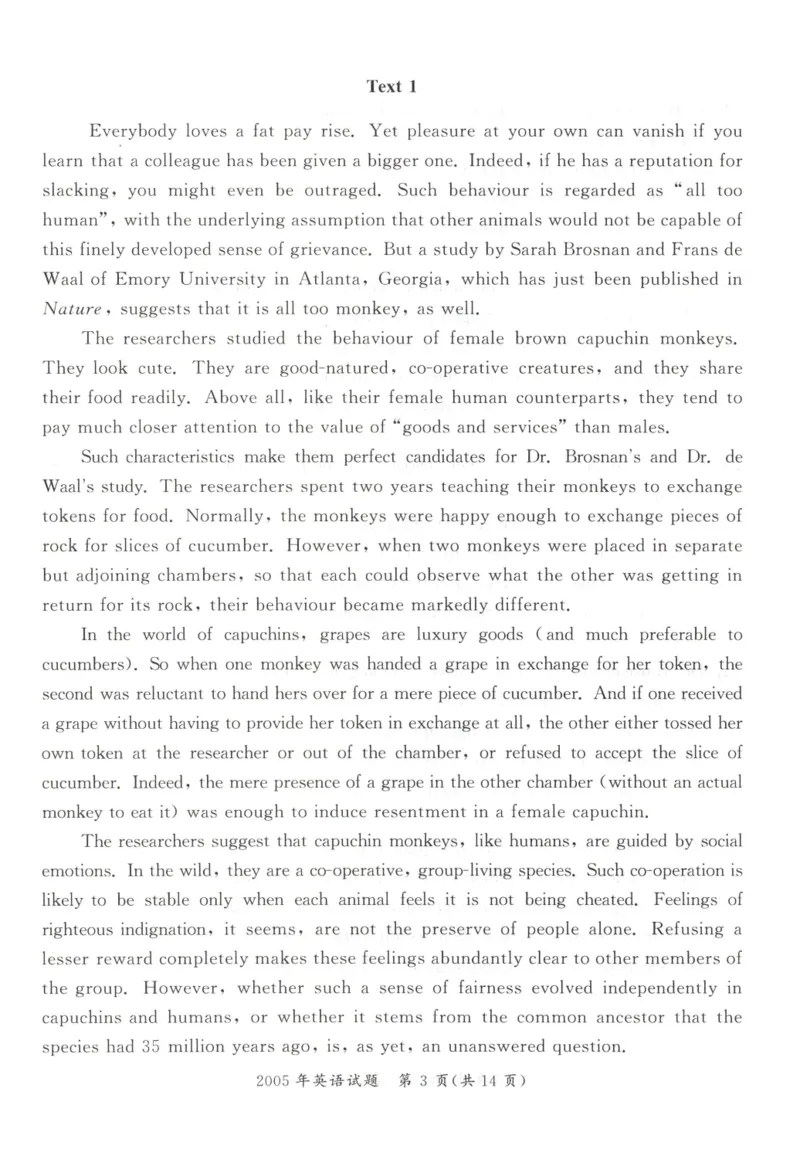
Everybody loves a fat pay rise・ Yet pleasure at your own can vanish if you
learn that a colleague has been given a bigger one・ Indeed 9 if he has a reputation for
slacking, you might even be outraged. Such behaviour is regarded as 44 all too
human", with the underlying assumption that other animals would not be capable of
this finely developed sense of grievance・ But a study by Sarah Brosnan and Frans de
Waal of Emory University in Atlanta, Georgia, which has just been published in
Nature 9 suggests that it is all too monkey, as well.
The researchers studied the behaviour of female brown capuchin monkeys・
They look cute・ They are good-natured, co-operative creatures and they share
their food readily・ Above all, like their female human counterparts, they tend to
pay much closer attention to the value of “goods and services" than males・
Such characteristics make them perfect candidates for Dr. Brosnan^ and Dr. de
Waal's study・ The researchers spent two years teaching their monkeys to exchange
tokens for food. Normally, the monkeys were happy enough to exchange pieces of
rock for slices of cucumber. However, when two monkeys were placed in separate
but adjoining chambers 9 so that each could observe what the other was getting in
return for its rock, their behaviour became markedly different.
In the world of capuchins 9 grapes are luxury goods (and much preferable to
cucumbers)・ So when one monkey was handed a grape in exchange for her token, the
second was reluctant to hand hers over for a mere piece of cucumber. And if one received
a grape without having to provide her token in exchange at all 9 the other either tossed her
own token at the researcher or out of the chamber, or refused to accept the slice of
cucumber. Indeed, the mere presence of a grape in the other chamber (without an actual
monkey to eat it) was enough to induce resentment in a female capuchin.
The researchers suggest that capuchin monkeys9 like humans, are guided by social
emotions. In the wild, they are a co-operative? group-living species・ Such co-operation is
likely to be stable only when each animal feels it is not being cheated・ Feelings of
righteous indignation, it seems, are not the preserve of people alone・ Refusing a
lesser reward completely makes these feelings abundantly clear to other members of
the group・ However, whether such a sense of fairness evolved independently in
capuchins and humans, or whether it stems from the common ancestor that the
species had 35 million years ago? is, as yet? an unanswered question.
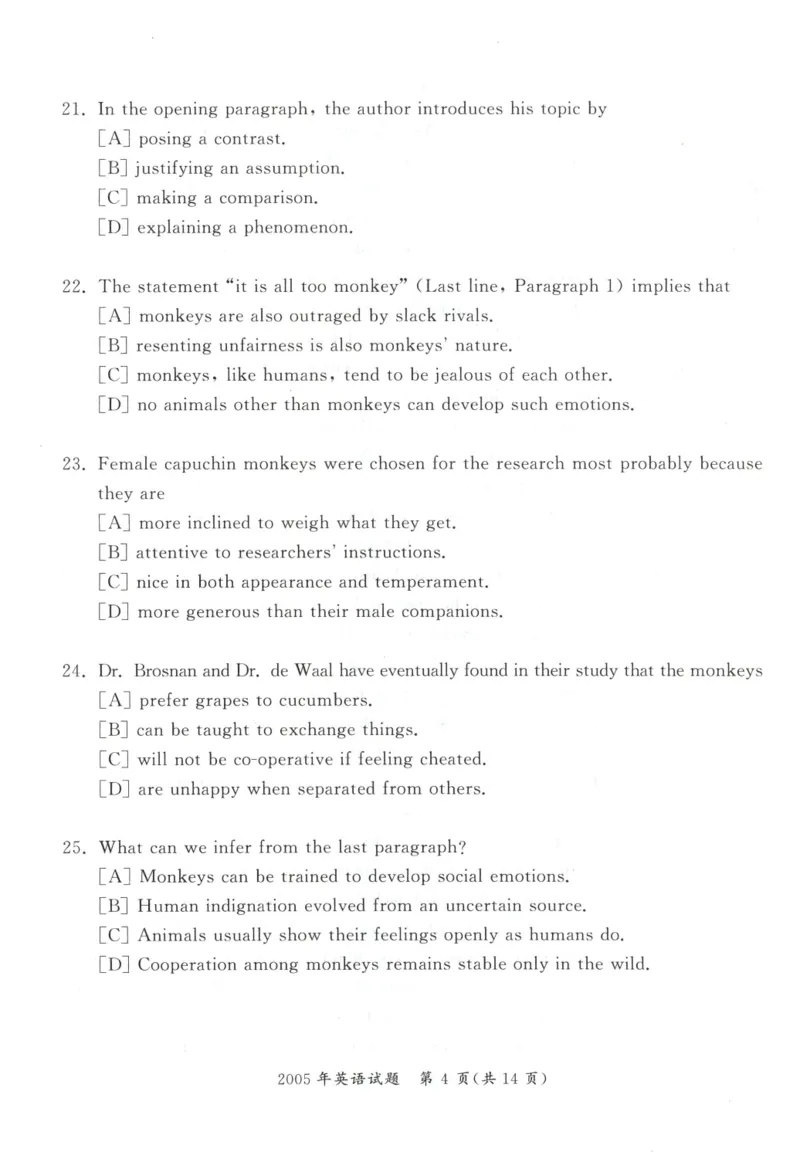
2005年英语试题第3页(共14页)21. In the opening paragraph, the author introduces his topic by
[A] posing a contrast・
[B] just讦ying an assumption.
[C] making a comparison.
[D] explaining a phenomen on.
22. The statement "it is all too monkey" (Last line? Paragraph 1) implies that
[A] monkeys are also outraged by slack rivals.
[B] resenting unfairness is also monkeys,nature・
[C] monkeys? like humans? tend to be jealous of each other・
[D] no animals other than monkeys can develop such emotions・
23. Female capuchin monkeys were chosen for the research most probably because
they are
[A] more inclined to weigh what they get.
[B] attentive to researchers5 instructions・
[C] nice in both appearance and temperament.
[D] more generous than their male companions・
24. Dr. Brosnan and Dr. de Waal have eventually found in their study that the monkeys
[A] prefer grapes to cucumbers・
[B] can be taught to exchange things.
[C] will not be co-operative if feeling cheated.
[D] are unhappy when separated from others・ 25
25. What can we infer from the last paragraph?
[A] Monkeys can be trained to develop social emotions.
[B] Human indignation evolved from an uncertain source・
[C] Animals usually show their feelings openly as humans do.
[D] Cooperation among monkeys remains stable only in the wild.
2005年英语试题第4页(共14页)Text 2
Do you remember all those years when scientists argued that smoking would
kill us but the doubters insisted that we didn t know for sure? That the evidence
was inconclusive 9 the science uncertain? That the antismoking lobby was out to
destroy our way of Kfe and the government should stay out of the way? Lots of
Americans bought that nonsense t and over three decades, some 10 million smokers
went to early graves・
There are upsetting parallels today, as scientists in one wave after another try
to awaken us to the growing threat of global warming・ The latest was a panel from
the National Academy of Sciences, enlisted by the White House, to tell us that the
Earth's atmosphere is definitely warming and that the problem is largely man
made ・ The clear message is that we should get moving to protect ourselves・ The
president of the National Academy, Bruce Alberts, added this key point in the
preface to the panel's report: "Science never has all the answers・ But science does
provide us with the best available guide to the future, and it is critical that our
nation and the world base important policies on the best judgments that science can
provide concerning the future consequences of present actions."
Just as on smoking, voices now come from many quarters insisting that the
science about global warming is incomplete, that it's OK to keep pouring fumes into
the air until we know for sure・ This is a dangerous game: by the time 100 percent
of the evidence is in, it may be too late・ With the risks obvious and growing, a
prudent people would take out an insurance policy now.
Fortunately, the White House is starting to pay attention. But it's obvious that
a majority of the president's advisers still don't take global warming seriously.
Instead of a plan of action, they continue to press for more research一a classic case
of u paralysis by analysis"・
To serve as responsible stewards of the planet, we must press forward on
deeper atmospheric and oceanic research. But research alone is inadequate・ If the
Administration won,t take the legislative initiative? Congress should help to begin
fashioning conservation measures・ A bill by Democratic Senator Robert Byrd of
West Virginia, which would offer financial incentives for private industry, is a
promising start・ Many see that the country is getting ready to build lots of new
power plants to meet our energy needs・ If we are ever going to- protect the
atmosphere, it is crucial that those new plants be environmentally sound・
2005年英语试题 第5页(共14页)26. An argument made by supporters of smoking was that
[A] there was no scientific evidence of the correlation between smoking and death.
[B] the number of early deaths of smokers in the past decades was insignificant.
[C] people had the freedom to choose their own way of life.
[D] antismoking people were usually talking nonsense・
27. According to Bruce Alberts, science can serve as
[A] a protector.
[B] a judge・
[C] a critic.
[D] a guide・
28. What does the author mean by "paralysis by analysis” (Last line. Paragraph 4)?
[A] Endless studies kill action.
[B] Careful investigation reveals truth.
[C] Prudent planning hinders progress・
[D] Extensive research helps decision-making.
29. According to the author, what should the Administration do about global warming?
[A] Offer aid to build cleaner power plants・
[B] Raise public awareness of conservation.
[C] Press for further scientific research・
[D] Take some legislative measures・
30. The author associates the issue of global warming with that of smoking because
[A] they both suffered from the government's negligence・
[B] a lesson from the latter is applicable to the former.
[C] the outcome of the latter aggravates the former.
[D] both of them have turned from bad to worse・
2005年英语试题第6页(共14页)Text 3
Of all the components of a good night's sleep, dreams seem to be least within
our control. In dreams, a window opens into a world where logic is suspended and
dead people speak. A century ago, Freud formulated his revolutionary theory that
dreams were the disguised shadows of our unconscious desires and fears; by the late
1970s, neurologists had switched to thinking of them as just umental noise"—the
random byproducts of the neural-repair work that goes on during sleep・ Now
researchers suspect that dreams are part of the mind's emotional thermostat,
regulating moods while the brain is “off-line. " And one leading authority says that
these intensely powerful mental events can be not only harnessed but actually
brought under conscious control, to help us sleep and feel better. "It's your
dream," says Rosalind Cartwright, chair of psychology at Chicago's Medical
Center・"If you don't like it, change it. ”
Evidence from brain imaging supports this view. The brain is as active during REM
(rapid eye movement) sleep一when most vivid dreams occur—as it is when fully awake,
says Dr. Eric Nofzinger at the University of Pittsburgh. But not all parts of the brain are
equally involved; the limbic system (the 44emotional brain^, ) is especially active? while
the prefrontal cortex (the center of intellect and reasoning) is relatively quiet. “We
wake up from dreams happy or depressed? and those feelings can stay with us all
day/' says Stanford sleep researcher Dr. William Dement.
The link between dreams and emotions shows up among the patients in
Cartwright's clinic・ Most people seem to have more bad dreams early in the night,
progressing toward happier ones before awakening, suggesting that they are
working through negative feelings generated during the day・ Because our conscious
mind is occupied with daily life we don't always think about the emotional
sign讦icance of the day's events—until? it appears9 we begin to dream.
And this process need not be left to the unconscious・ Cartwright believes one
can exercise conscious control over recurring bad dreams・ As soon as you awaken,
identify what is upsetting about the dream・ Visualize how you would like it to end
instead; the next time it occurs? try to wake up just enough to control its course・
With much practice people can learn to, literally, do it in their sleep・
At the end o£ the day, there's probably little reason to pay attention to our dreams at
all unless they keep us from sleeping or “we wake up in a panic," Cartwright says・
Terrorism, economic uncertainties and general feelings of insecurity have increased
people's anxiety. Those suffering from persistent nightmares should seek help from a
therapist. For the rest of us, the brain has its ways of working through bad feelings.
Sleep——or rather dreamon it and you ll feel better in the morning・
2005年英语试题 第7页(共14页)31. Researchers have come to believe that dreams
[A] can be modified in their courses・
[B] are susceptible to emotional changes・
[C] reflect our innermost desires and fears・
[D] are a random outcome of neural repairs・
32. By referring to the limbic system, the author intends to show
[A] its function in our dreams・
[E] the mechanism of REM sleep・
[C] the relation of dreams to emotions・
[D] its difference from the prefrontal cortex.
33. The negative feelings generated during the day tend to
[A] aggravate in our unconscious mind・
[B] develop into happy dreams・
[C] persist till the time we fall asleep・
[D] show up in dreams early at night.
34. Cartwright seems to suggest that
[A] waking up in time is essential to the ridding of bad dreams・
[B] visualizing bad dreams helps bring them under control.
[C] dreams should be left to their natural progression.
[D] dreaming may not entirely belong to the unconscious・
35. What advice might Cartwright give to those who sometimes have bad dreams?
[A] Lead your life as usual.
[B] Seek professional help・
[C] Exercise conscious control.
[D] Avoid anxiety in the daytime・
2005年英语试题第8页(共14页)Text 4
Americans no longer expect public figures? whether in speech or in writing? to
command the English language with skill and gift. Nor do they aspire to such command
themselves. In his latest book. Doing Our Own Thing: The Degradation of
Language and Music and Why We Should ? Like, Care, John McWhorter, a
linguist and controversialist of mixed liberal and conservative views, sees the
triumph of 1960s counter-culture as responsible for the decline of formal English.
Blaming the permissive 1960s is nothing new, but this is not yet another
criticism against the decline in education. Mr. McWhorter's academic speciality is
language history and change, and he sees the gradual disappearance of “whom", for
example, to be natural and no more regrettable than the loss of the case-endings of
Old English.
But the cult of the authentic and the personal, "doing our own thing"9 has
spelt the death of formal speech 9 writing, poetry and music. While even the
modestly educated sought an elevated tone when they put pen to paper before the
1960s, even the most well regarded writing since then has sought to capture spoken
English on the page・ Equally, in poetry, the highly personal, performative genre is
the only form that could claim real liveliness・ In both oral and written English,
talking is triumphing over speaking, spontaneity over craft.
Illustrated with an entertaining array of examples from both high and low
culture? the trend that Mr. McWhorter documents is unmistakable・ But it is less
clear, to take the question of his subtitle, why we should, like, care・ As a linguist,
he acknowledges that all varieties of human language? including non-standard ones
like Black English, can be powerfully expressive一there exists no language or
dialect in the world that cannot convey complex ideas・ He is not arguing 9 as many
do,that we can no longer think straight because we do not talk proper・
Russians have a deep love for their own language and carry large chunks of
memorized poetry in their heads, while Italian politicians tend to elaborate speech
that would seem old-fashioned to most English-speakers ・ Mr. McWhorter
acknowledges that formal language is not strictly necessary, and proposes no radical
education reforms一he is really grieving over the loss of something beautiful more
than useful. We now take our English "on paper plates instead of china”・ A shame,
perhaps, but probably an inevitable one・
2005年英语试题第9页(共14页)36. According to McWhorter, the decline of formal English
[A] is inevitable in radical education reforms・
[B] is but all too natural in language development.
[C] has caused the controversy over the counter-culture・
[D] brought about changes in public attitudes in the 1960s・
37. The word “talking” (Line 7, Paragraph 3) denotes
[A] modesty.
[B] personality.
[C] liveliness・
[D] informality・
38. To which of the following statements would McWhorter most likely agree?
[A] Logical thinking is not necessarily related to the way we talk.
[B] Black English can be more expressive than standard English.
[C] Non-standard varieties of human language are just as entertaining.
[D] Of all the varieties, standard English can best convey complex ideas・
39. The description of Russians5 love of memorizing poetry shows the author's
[A] interest in their language・
[B] appreciation of their efforts・
[C] admiration for their memory.
[D] contempt for their old-fashionedness・
40. According to the last paragraph, 4440p a*p *e r* plates" is to “china" as
[A] "temporary" is to upermanent
[B] “radical" is to uconservative"・
[C] "functional" is to “artistic".
[D] “humble" is to “noble"・
2005年英语试题 第10页(共14页)Part B
Directions:
In the following text, some sentences have been removed・ For Questions 41-45 9
choose the most suitable one from the list A-G to fit into each of the numbered
blanks・ There are two extra choices, which do not fit in any of the gaps・ Mark your
answers on ANSWER SHEET 1. (10 points)
Canada's premiers (the leaders of provincial governments) , if they have any
breath left after complaining about Ottawa at their late July annual meeting, might
spare a moment to do something, together, to reduce health-care costs・
They're all groaning about soaring health budgets, the fastest-growing
component of which are pharmaceutical costs・
41.
What to do? Both the Romanow commission and the Kirby committee on
health care一to say nothing of reports from other experts一recommended the
creation of a national drug agency・ Instead of each province having 让s own list of
approved drugs, bureaucracy? procedures and limited bargaining power, all would
pool resources? work with Ottawa, and create a national institution.
42.
But “ national ” doesn't have to mean that. “ National " could mean
interprovincial—provinces combining efforts to create one body.
Either way, one benefit of a "national" organization would be to negotiate better
prices, if possible, with drug manufacturers. Instead of having one province一or a series
of hospitals within a province一negotiate a price for a given drug on the provincial list,
the national agency would negotiate on behalf of all provinces・
Rather than, say9 Quebec? negotiating on behalf of seven million people, the
national agency would negotiate on behalf of 31 million people・ Basic economics suggests
the greater the potential consumers9 the higher the likelihood of a better price・
43.
A small step has been taken in the direction of a national agency with the
creation of the Canadian Co-ordinating Office for Health Technology Assessment,
funded by Ottawa and the provinces・ Under it, a Common Drug Review
recommends to provincial lists which new drugs should be included・ Predictably,
and regrettably> Quebec refused to join.
A few premiers are suspicious of any federal-provincial deal-making. They
(particularly Quebec and Alberta) just want Ottawa to fork over additional billions
with few, if any, strings attached. That's one reason why the idea of a national list
hasn't gone anywhere, while drug costs keep rising fast.
2005年英语试题第n页(共14页)44.
Premiers love to quote Mr. Romanow's report selectively? especially the parts
about more federal money・ Perhaps they should read what he had to say about
drugs: "A national drug agency would provide governments more influence on
pharmaceutical companies in order to constrain the ever-increasing cost of drugs・"
45.
So when the premiers gather in Niagara Falls to assemble their usual complaint
list, they should also get cracking about something in their jurisdiction that would
help their budgets and patients・
[A] Quebec's resistance to a national agency is provincialist ideology・ One of the
first advocates for a national list was a researcher at Laval University.
Quebec's Drug Insurance Fund has seen its costs skyrocket with annual
increases from 14. 3 per cent to 26. 8 per cent!
[B] Or they could read Mr. Kirby's report: "the substantial buying power of such
an agency would strengthen the public prescription-drug insurance plans to
negotiate the lowest possible purchase prices from drug companies・"
[C] What does nationaln mean? Roy Romanow and Senator Michael Kirby
recommended a federal-provincial body much like the recently created National
Health Council・
[D] The problem is simple and stark: health-care costs have been, are, and will
continue to increase faster than government revenues・
[E] According to the Canadian Institute for Health Information, prescription drug
costs have risen since 1997 at twice the rate of overall health-care spending.
Part of the increase comes from drugs being used to replace other kinds of
treatments・ Part of it arises from new drugs costing more than older kinds・
Part of it is higher prices・
[F] So, if the provinces want to run the health-care show, they should prove they
can run it, starting with an interprovincial health list that would end
duplication, save administrative costs, prevent one province from being played
off against another, and bargain for better drug prices・
[G] Of course, the pharmaceutical companies will scream. They like divided buyers;
they can lobby better that way・ They can use the threat of removing jobs from one
province to another. They can hope that, if one province includes a drug on its
list, the pressure will cause others to include it on theirs・ They wouldn't like a
national agency? but self-interest would lead them to deal with it.
2005年英语试题第12页(共14页)Part C
Directions:
Read the following text carefully and then translate the underlined segments into Chinese・
Your translation should be written clearly on ANSWER SHEET 2. (10 points)
It is not easy to talk about the role of the mass media in this overwhelmingly
significant phase in European history. History and news become confused, and
one's impressions tend to be a mixture of skepticism and optimism. (46) Television
is one of the means by which these feelings are created and conveyed——and perhaps
never before has it served so much to connect different peoples and nations as in the
recent events in Europe・ The Europe that is now forming cannot be anything other
than its peoples, their cultures and national identities・ With this in mind we can
begin to analyze the European television scene・(47) In Europe9 qs elsewhere,
multi-media groups have been increasingly successful: groups which bring together
television9 radio, newspapers9 magazines and publishing houses that work in
relation to one another・ One Italian example would be the Berlusconi group, while
abroad Maxwell and Murdoch come to mind・
Clearly, only the biggest and most flexible television companies are going to be
able to compete in such a rich and hotly-contested market. (48) This alone
demonstrates that the television business is not an easy world to survive in, 3 fact
underlined by statistics that show that out of eighty European television networks,
no less thdn 50% took a loss in 1989・
Moreover, the integration of the European community will oblige television
companies to cooperate more closely in terms of both production and distribution.
(49) Creating a “ European identity" that respects the different cultures and
traditions which go to make up the connecting fabric of the Old Continent is no easy task
and demands a strategic choice一that of producing programs in Europe for Europe・ This
entails reducing our dependence on the North American market, whose programs relate
to experiences and cultural traditions which are different from our own.
In order to achieve these objectives9 we must concentrate more on co
productions, the exchange of news, documentary services and training. This also
involves the agreements between European countries for the creation of a European
bank for Television Production which, on the model of the European Investments
Bank, will handle the finances necessary for production costs・(50) In dealing with
a challenge on such 3 scale,it is no exaggeration to say> “United we stand, divided
we fair,一and if I had to choose a slogan it would be “Unity in our diversity,A
unity of objectives that nonetheless respect the varied peculiarities of each country・
2005年英语试题 第13页(共14页)Section III Writing
Part A
51. Directions:
Two months ago you got a job as an editor for the magazine Designs &
Fashions. But now you find that the work is not what you expected・ You decide to
quit・ Write a letter to your boss, Mr. Wang, telling him your decision9 stating
your reason(s) ? and making an apology・
Write your letter with no less than 100 words. Write it neatly on ANSWER
SHEET 2. Do not sign your own name at the end of the letter; use “Li Ming"
instead・ You do not need to write the address・(10 points)
Part B
52. Directions:
Write an essay of 160-200 words based on the following drawing. In your
essay, you should first describe the drawing 9 then interpret its meaning, and give
your comment on it.
You should write neatly on ANSWER SHEET 2. (20 points)
养老“足球赛”
2005年英语试题 第14页(共14页)绝密★启用前
2006年全国硕士研究生招生考试
英语(-)
(科目代码:201)
考生注意事项
试卷条形码粘貼位置
1. 答题前,考生须在试题册指定位置上填写考生编号和考生姓名;在答题卡指定位
置上填写报考单位、考生姓名和考生编号,并涂写考生编号信息点。
2. 考生须把试题册上的“试卷条形码”粘贴条取下,粘贴在答题卡的“试卷条形码粘
贴位置”框中。不按规定粘贴条形码而影响评卷结果的,责任由考生自负。
3. 选择题的答案必须涂写在答题卡相应题号的选项上,非选择题的答案必须书写在
爹题卡指定位置的边框区域内。超出答题区域书写的答案无效;在草稿纸、试题
册上答题无效。
4. 填(书)写部分必须使用黑色字迹签字笔书写,字迹工整、笔迹清楚;涂写部分必须
使用2B铅笔填涂。
5. 考试结束,将答题卡和试题册按规定交回。
(以下信息考生必须认真填写)
考生编号
考生姓名Section I Use of English
Directions:
Read the following text. Choose the best word (s) for each numbered blank and
mark A, B, C or D on ANSWER SHEET 1. (10 points)
The homeless make up a growing percentage of America's population. 1 ,
homelessness has reached such proportions that local governments can't possibly 2 ・
To help homeless people 3 independence the federal government must support job
training programs? 4 the minimum wage, and fund more low-cost housing.
5 everyone agrees on the number of Americans who are homeless・
Estimates 6 anywhere from 600,000 to 3 million. 7 the figure may vary,
analysts do agree on another matter: that the number of the homeless is 8 ・ One
of the federal government's studies 9 that the number of the homeless will
reach nearly 19 million by the end of this decade・
Finding ways to 10 this growing homeless population has become
increasingly difficult. 11 when homeless individuals manage to find a 12
that will give them three meals a day and a place to sleep at night, a good number
still spend the bulk of each day 13 the street. Part o£ the problem is that many
homeless adults are addicted to alcohol or drugs・ And a significant number of the
homeless have serious mental disorders・ Many others 9 14 not addicted or mentally
ill, simply lack the everyday 15 skills needed to turn their lives 16 ・ Boston Globe
reporter Chris Reidy notes that the situation will improve only when there are 17
programs that address the many needs of the homeless. 18 Edward Zlotkowski,
director of community service at Bentley College in Massachusetts, 19 it.
"There has to be 20 of programs. What's needed is a package deal. ”
2006年英语试题第1页(共14页)1. [A] Indeed [E] Likewise [C] Therefore [D] Furthermore
2. [A] stand [B] cope [C] approve ED] retain
3. [A] in [B] for [C] with [D] toward
4. [A] raise [B] add [C] take CD] keep
5. [A] Generally [B] Almost [C] Hardly [D] Not
6. [A] cover [B] change [C] range [D] differ
7. [A] Now that [B] Although [C] Provided :D] Except that
& [A] inflating [B] expanding [C] increasing [D] extending
9. [A] predicts [B] displays [C] proves [D] discovers
10. [A] assist [B] track [C] sustain [D] dismiss
11. [A] Hence [B] But [C] Even [D] Only
12. [A] lodging [E] shelter [C] dwelling [D] house
13. [A] searching [B] strolling [C] crowding CD] wandering
14. [A] when [B] once [C] while CD] whereas
15. [A] life [B] existence [C] survival [D] maintenance
16. [A] around [B] over [C] on [D] up
17. [A] complex [B] comprehensive [C] complementary [D] compensating
1& [A] So [B] Since [C] As [D] Thus
19. [A] puts [B] interprets [C] assumes [D] makes
20. [A] supervision [B] manipulation [C] regulation [D] coordination
Section If Reading Comprehension
Part A
Directions:
Read the following four texts・ Answer the questions below each text by choosing
A9 B, C or D. Mark your answers on ANSWER SHEET 1. (40 points)
2006年英语试题第2页(共14页)Text 1
In spite of u endless talk of difference,v American society is an amazing
machine for homogenizing people・ There is "the democratizing uniformity of dress
and discourse, and the casualness and absence of deferencecharacteristic of
popular culture・ People are absorbed into "a culture of consumption,, launched by
the 19th-century department stores that offered "vast arrays of goods in an elegant
atmosphere・ Instead of intimate shops catering to a knowledgeable elite” these were
stores u anyone could enter, regardless of class or background. This turned
shopping into a public and democratic act. " The mass media? advertising and sports
are other forces for homogenization.
Immigrants are quickly fitting into this common culture ? which may not be
altogether elevating but is hardly poisonous・ Writing for the National Immigration
Forum, Gregory Rodriguez reports that today's immigration is neither at unprecedented
levels nor resistant to assimilation. In 1998 immigrants were 9. 8 percent of the
population; in 1900, 13. 6 percent. In the 10 years prior to 1990, 3. 1 immigrants arrived
for every 1,000 residents; in the 10 years prior to 1890, 9. 2 for every 1,000. Now,
consider three indices o£ assimilation——language» home ownership and intermarriage.
The 1990 Census revealed that "a majority of immigrants from each of the fifteen
most common countries of origin spoke English ° well,or 6 very well,after ten years of
residence・ ” The children of immigrants tend to be bilingual and proficient in English・"Ey
the third generation, the original language is lost in the majority of immigrant families.
Henc^lhe description of America as a ugraveyardv for languages. By 1996 foreign-born
immigrants who had arrived before 1970 had a home ownership rate of 75. 6 percent,
higher than the 69. 8 percent rate among native-born Americans・
Foreign-born Asians and Hispanics “have higher rates of intermarriage than do U・ S.-
born whites and blacks. ” By the third generation, one third of Hispanic women are married
to non-Hispanics9 and 41 percent of Asian-American women are married to non-Asians・
Rodriguez notes that children in remote villages around the world are fans of
superstars like Arnold Schwarzenegger and Garth Brooks, yet some Americans
fear that immigrants living within the United States remain somehow immune to
the nation's assimilative power. ”
Are there divisive issues and pockets of seething anger in America? Indeed・ It
is big enough to have a bit of everything. But particularly when viewed against
America's turbulent past, today's social indices hardly suggest a dark and
deteriorating social environment.
2006年英语试题第3页(共14页)21. The word "homogenizing” (Line 2 9 Paragraph 1) most probably means
[A] identifying・
[B] associating.
[C] assimilating.
[D] monopolizing・
22. According to the author, the department stores o£ the 19th century
[A] played a role in the spread of popular culture・
[B] became intimate shops for common consumers・
[C] satisfied the needs of a knowledgeable elite・
[D] owed its emergence to the culture of consumption.
23. The text suggests that immigrants now in the U・ S・
[A] are resistant to homogenization.
[B] exert a great influence on American culture・
[C] are hardly a threat to the common culture・
[D] constitute the majority of the population.
24. Why are Arnold Schwarzenegger and Garth Brooks mentioned in Paragraph 5?
[A] To prove their popularity around the world.
_ -
[B] To reveal the public's fear of immigrants・
[C] To give examples of successful immigrants・
[D] To show the powerful influence of American culture・
25. In the author's opinion, the absorption of immigrants into American society is
[A] rewarding・
[B] successfu 1.
[C] fruitless・
[D] harmful.
2006年英语试题第4页(共14页)Text 2
Stratford-on-Avon, as we all know, has only one industry一一William Shakespeare一
but there are two distinctly separate and increasingly hostile branches・ There is the
Royal Shakespeare Company ( RSC) , which presents superb productions of the
plays at the Shakespeare Memorial Theatre on the Avon. And there are the
townsfolk who largely live off the tourists who come, not to see the plays, but to
look at Anne Hathaway's Cottage, Shakespeare's birthplace and the other sights・
The worthy residents of Stratford doubt that the theatre adds a penny to their
revenue. They frankly dislike the RSC s actors ? them with their long hair and
beards and sandals and noisiness・ It's all deliciously ironic when you consider that
Shakespeare9 who earns their living, was himself an actor (with a beard) and did
his share of noise-making.
The tourist streams are not entirely separate・ The sightseers who come by bus一
and often take in Warwick Castle and Blenheim Palace on the side一don't usually see the
plays9 and some of them are even surprised to find a theatre in Stratford. However, the
playgoers do manage a little sight-seeing along with their playgoing. It is the playgoers,
the RSC contends ? who bring in much of the town's revenue because they spend the
night ( some of them four or five nights) pouring cash into the hotels and
restaurants・ The sightseers can take in everything and get out of town by nightfa 11.
The townsfolk don't see it this way and the local council does not contribute directly
to the subsidy of the Royal Shakespeare Company. Stratford cries poor traditionally.
Nevertheless every hotel in town seems to be adding a new wing or cocktail lounge・
Hilton is building its own hotel there, which you may be sure will be decorated with
Hamlet Hamburger Bars, the Lear Lounge, the Banquo Banqueting Room, and so
forth, and will be very expensive・
Anyway, the townsfolk can't understand why the Royal Shakespeare Company
needs a subsidy・(The theatre has broken attendance records for three years in a
row. Last year its 19 431 seats were 94 per cent occupied all year long and this year
they'll do better. ) The reason, of course? is that costs have rocketed and ticket
prices have stayed low.
It would be a shame to raise prices too much because it would drive away the
young people who are Stratford's most attractive clientele. They come entirely for
the plays, not the sights・ They all seem to look alike (though they come from all
over)——lean, pointed, dedicated faces, wearing jeans and sandals, eating their buns
and bedding down for the night on the flagstones outside the theatre to buy the 20
seats and 80 standing-room tickets held for the sleepers and sold to them when the
box office opens at 10 : 30 a. m.
2006年英语试题第5页(共14页)26. From the first two paragraphs, we learn that
[A] the townsfolk deny the RSC's contribution to the town's revenue.
[E] the actors of the RSC imitate Shakespeare on and off stage・
[C] the two branches of the RSC are not on good terms・
[D] the townsfolk earn little from tourism.
27. It can be inferred from Paragraph 3 that
[A] the sightseers cannot visit the Castle and the Palace separately.
[B] the playgoers spend more money than the sightseers・
[C] the sightseers do more shopping than the playgoers・
[D] the playgoers go to no other places in town than the theater・
28. By saying “Stratford cries poor traditionally” (Line 2, Paragraph 4),the author
implies that
[A] Stratford cannot afford the expansion projects.
[B] Stratford has long been in financial difficulties・
[C] the town is not really short of money・
[D] the townsfolk used to be poorly paid・
29. According to the townsfolk, the RSC deserves no subsidy because
[A] ticket prices can be raised to cover the spending.
[B] the company is financially ill-managed.
[C] the behavior of the actors is not socially acceptable・
[D] the theatre attendance is on the rise・
30. From the text we can conclude that the author
[A] is supportive of both sides・
[B] favors the townsfolk's view・
[C] takes a detached attitude・
[D] is sympathetic to the RSC・
2006年英语试题第6页(共14页)Text 3
When prehistoric man arrived in new parts of the world 9 something strange
happened to the large animals: they suddenly became extinct. Smaller species
survived. The large? slow-growing animals were easy game, and were quickly
hunted to extinction. Now something similar could be happening in the oceans・
That the seas are being overfished has been known for years・ What researchers
such as Ransom Myers and Boris Worm have shown is just how fast things are
changing. They have looked at half a century of data from fisheries around the
world. Their methods do not attempt to estimate the actual biomass (the amount of
living biological matter) of fish species in particular parts of the ocean, but rather
changes in that biomass over time. According to their latest paper published in
Nature ? the biomass of large predators (animals that kill and eat other animals) in
a new fishery is reduced on average by 80% within 15 years of the start of
exploitation. In some long-fished areas, it has halved again since then.
Dr. Worm acknowledges that these figures are conservative・ One reason for
this is that fishing technology has improved・ Today's vessels can find their prey
using satellites and sonar, which were not available 50 years ago. That means a
higher proportion of what is in the sea is being caught, so the real difference
between present and past is likely to be worse than the one recorded by changes in
catch sizes・ In the early days, too, longlines would have been more saturated with
fish. Some individuals would therefore not have been caught, since no baited hooks
would have been available to trap them, leading to an underestimate of fish stocks
in the past・ Furthermore9 in the early days of longline fishing, a lot of fish were
lost to sharks after they had been hooked・ That is no longer a problem, because
there are fewer sharks around now.
Dr. Myers and Dr. Worm argue that their work gives a correct baseline, which future
management efforts must take into accouni:. They believe the data support an idea current
among marine biologists, that of the "shifting baseline・ The notion is that people have
failed to detect the massive changes which have happened in the ocean because they have
been looking back only a relatively short time into the past. That matters because theory
suggests that the maximum sustainable yield that can be cropped from a fishery
comes when the biomass of a target species is about 50 % of its original levels. Most
fisheries are well below that, which is a bad way to do business・
2006年英语试题 第7页(共14页)31. The extinction of large prehistoric animals is noted to suggest that
[A] large animals were vulnerable to the changing environment.
[B] small species survived as large animals disappeared・
[C] large sea animals may face the same threat today・
[D] slow-growing fish outlive fast-growing ones
32. We can infer from Dr. Myers and Dr. Worm's paper that
[A] the stock of large predators in some old fisheries has reduced by 90 %・
[B] there are only half as many fisheries as there were 15 years Qgo.
[C] the catch sizes in new fisheries are only 20% of the original amount.
[D] the number of large predators dropped faster in new fisheries than in the old.
33. By saying uthese figures are conservative^, (Line 1, Paragraph 3), Dr. Worm
means that
[A] fishing technology has improved rapidly.
[B] the catch-sizes are actually smaller than recorded.
[C] the marine biomass has suffered a greater loss.
[D] the data collected so far are out of date・
34. Dr. Myers and other researchers hold that
[A] people should look for a baseline that can work for a longer time.
[E] fisheries should keep their yields below 50 % of the biomass.
[C] the ocean biomass should be restored to its original level.
[D] people should adjust the fishing baseline to the changing situation.
35. The author seems to be mainly concerned with most fisheries,
[A] management efficiency.
[B] biomass level.
[C] catch-size limits・
[D] technological application.
2006年英语试题第8页(共14页)Text 4
Many things make people think artists are weird・ But the weirdest may be
this: artists' only job is to explore emotions? and yet they choose to focus on the
ones that feel bad・
This wasn't always so. The earliest forms of art, like painting and music? are
those best suited for expressing joy. But somewhere from the 19th century onward,
more artists began seeing happiness as meaningless? phony or, worst of all,
boring, as we went from Wordsworth's daffodils to BaudelaireJs flowers of evil・
You could argue that art became more skeptical of happiness because modern
times have seen so much misery. But it's not as if earlier times didn't know
perpetual war 9 disaster and the massacre of innocents・ The reason, in fact 9 may be
just the opposite: there is too much damn happiness in the world today・
After all, what is the one modern form of expression almost completely
dedicated to depicting happiness? Advertising. The rise of anti-happy art almost
exactly tracks the emergence of mass media? and with it, a commercial culture in
which happiness is not just an ideal but an ideology・
People in earlier eras were surrounded by reminders of misery. They worked
until exhausted, lived with few protections and died young. In the West, before
mass communication and literacy, the most powerful mass medium was the church,
which reminded worshippers that their souls were in danger and that they would
someday be meat for worms・ Given all this,they did not exactly need their art to be
a bummer too.
Today the messages the average Westerner is surrounded with are not religious
but commercial, and forever happy・ Fast-food eaters, news anchors, text
messengers, all smiling, smiling, smiling. Our magazines feature beaming
celebrities and happy families in perfect homes・ And since these messages have an
agenda一to lure us to open our wallets一they make the very idea of happiness seem
unreliable. 44Celebrate!commanded the ads for the arthritis drug Celebrex, before
we found out it could increase the risk of heart attacks・
But what we forget一what our economy depends on us forgetting—is that
happiness is more than pleasure without pain. The things that bring the greatest joy
carry the greatest potential for loss and disappointment. Today, surrounded by
promises of easy happiness? we need art to tell us9 as religion once did, Memento
mori : remember that you will die,that everything ends? and that happiness comes
not in denying this but in living with it. It's a message even more bitter than a clove
cigarette, yet, somehow9 a breath of fresh air・
2006年英语试题第9页(共14页)36. By citing the examples of poets Wordsworth and Baudelaire, the author intends
to show that
[A] poetry is not as expressive of joy as painting or music.
[E] art grows out of both positive and negative feelings・
[C] poets today are less skeptical of happiness・
[D] artists have changed their focus of interest.
37. The word “bummer" (Line 6, Paragraph 5) most probably means something
[A] religious・
[B] unpleasant.
[C] entertaining.
[D] commercial.
38. In the author's opinion, advertising
[A] emerges in the wake of the anti-happy art.
:B] is a cause of disappointment for the general public・
[C] replaces the church as a major source of information.
[D] creates an illusion of happiness rather than happiness itself・
39. We can learn from the last paragraph that the author believes
[A] happiness more often than not ends in sadness・
[B] the anti-happy art is distasteful but refreshing. —
[C] misery should be enjoyed rather than denied・
[D] the anti-happy art flourishes when economy booms・
40. Which of the following is true of the text?
[A] Religion once functioned as a reminder of misery・
[B] Art provides a balance between expectation and reality・
[C] People feel disappointed at the realities of modern society・
[D] Mass media are inclined to cover disasters and deaths.
2006年英语试题 第10页(共14页)Part B
Directions:
In the following article, some sentences have been removed. For Questions 41-45 ?
choose the most suitable one from the list A-G to f让 into each of the numbered
gaps. There are two extra choices, which you do not need to use・ Mark your
answers on ANSWER SHEET 1. (10 points)
On the north bank of the Ohio river sits Evansville, Ind. , home of David
Williams 9 52 9 and of a riverboat casino (a place where gambling games are played)・
During several years of gambling in that casino, Williams, a state auditor earning
$ 35,000 a year9 lost approximately $ 175 ?000. He had never gambled before the
casino sent him a coupon for $ 20 worth of gambling.
He visited the casino, lost the $ 20 and left. On his second visit he lost $ 800.
The casino issued to him, as a good customer, a "Fun Card,” which when used in
the casino earns points for meals and drinks, and enables the casino to track the
user's gambling activities. For Williams, those activities became what he calls
^electronic heroin."
(41) . In 1997 he lost $219 000 to one slot
machine in two days・ In March 1997 he lost $ 72,186・ He sometimes played two
slot machines at a time, all night, until the boat docked at 5 a. m. 9 then went back
aboard when the casino opened at 9 a. m. Now he is suing the casino, charging that
it should have refused his patronage because it knew he was addicted・ It did know
he had a problem.
In March 1998 a friend of Williams's got him involuntarily confined to a
treatment center for addictions, and wrote to inform the casino of Williams's
gambling problem. The casino included a photo of Williams among those of banned
gamblers, and wrote to him a "cease admissions,^ letter. Noting the 44 medical/
psychological” nature of problem gambling behavior, the letter said that before
being readmitted to the casino he would have to present medical/psychological
information demonstrating that patronizing the casino would pose no threat to his
safety or well-being.
(42) ____________________________ .
The Wall Street Journal reports that the casino has 24 signs warning: "Enjoy
the fun***and always bet with your head, not over it. " Every entrance ticket lists a
toll-free number for counseling from the Indiana Department of Mental Health.
Nevertheless, Williams's suit charges that the casino, knowing he was “helplessly
addicted to gambling,intentionally worked to "lure” him to uengage in conduct
against his will. " Well・
2006年英语试题第11页(共14页)(43) ____________________________ .
The fourth edition o£ the Diagnostic and Statistical Manual of Mental Disorders
says upathological gambling^, involves persistent, recurring and uncontrollable pursuit
less of money than of the thrill of taking risks in quest of a windfall・
(44) ・ Pushed by science? or what claims to be
science, society is reclassifying what once were considered character flaws or moral
failings as personality disorders akin to physical disabilities.
(45) ____________________________ .
Forty-four states have lotteries9 29 have casinos, and most of these states are
to varying degrees dependent on—you might say addicted to~ revenues from
wagering. And since the first Internet gambling site was created in 1995 ?
competition for gamblers1 dollars has become intense・ The Oct. 28 issue of
Newsweek reported that 2 million gamblers patronize 1,800 virtual casinos every
week ・ With $ 3. 5 billion being lost on Internet wagers this year, gambling has
passed pornography as the Web's most profitable business・
[A] Although no such evidence was presented, the casino's marketing department
continued to pepper him with mailings・ And he entered the casino and used his
Fun Card without being detected・
[B] It is unclear what luring was required 9 given his compulsive behavior・ And in
what sense was his will operative?
[C] By the time he had lost $ 5 9 000 he said to himself that if he could get back to
even, he would quit・ One night he won $ 5,500, but he did not quit・ ~
[D] Gambling has been a common feature of American life forever, but for a long
time it was broadly considered a sin, or a social disease・ Now it is a social
policy: the most important and aggressive promoter of gambling in America is
the government.
[E] David Williams's suit should trouble this gambling nation. But don't bet on it.
[F] It is worrisome that society is medicalizing more and more behavioral
problems, often defining as addictions what earlier, sterner generations
explained as weakness of will.
[G] The anonymous, lonely, undistracted nature of online gambling is especially
conducive to compulsive behavior・ But even if the government knew how to
move against Internet gambling, what would be its grounds for doing so?
2006年英语试题 第12页(共14页)Part C
Directions:
Read the following text carefully and then translate the underlined segments into Chinese・
Your translation should be written clearly on ANSWER SHEET 2. (10 points)
Is it true that the American intellectual is rejected and considered of no account in his
society? I am going to suggest that it is not true. Father Bruckberger told part of the
story when he observed that it is the intellectuals who have rejected America. But they
have done more than that. They have grown dissatisfied with the role of the intellectual・
It is they? not America? who have become anti-intellectual.
First, the object of our study pleads for definition. What is an intellectual?
(46) I shall define him as an individual who has elected as his primary duty and
pleasure in life the activity of thinking in a Socratic(苏格拉底的)way about morml
problems・ He explores such problems consciously, articulately9 and franklyfirst
by asking factual questions, then by asking moral questions, finally by suggesting
action which seems appropriate in the light of the factual and moral information
which he has obtained. (47) His function is analogous to that of a judge? who must
accept the obligation of revealing in as obvious a manner as possible the course of
reasoning which led him to his decision. .
This definition excludes many individuals usually referred to as intellectuals一
the average scientist, for one. (48) I have excluded him because, while his
accomplishments may contribute to the solution of moral problems, he has not been
charged with the task of approaching any but the factual aspects of those problems・
Like other human beings, he encounters moral issues even in the everyday
performance of his routine duties—he is not supposed to cook his experiments?
manufacture evidence? or doctor his reports・(49) But his primary task is not to
think about the moral code which governs his activity 9 any more than a
businessman is expected to dedicate his energies to an exploration of rules of
conduct in business・ During most of his waking life he will take his code for
granted, as the businessman takes his ethics・
The definition also excludes the majority of teachers, despite the fact that
teaching has traditionally been the method whereby many intellectuals earn their
living. (50) They may teach very well, and more than earn their salaries,but most
of them make little or no independent reflections on human problems which involve
moral judgment. This description even fits the majority of eminent scholars・ Being
learned in some branch of human knowledge is one thing; living in u public and
illustrious thoughts/' as Emerson would say, is something else・
2006年英语试题 第13页(共14页)Section HI Writing
Part A
51. Directions:
You want to contribute to Project Hope by offering financial aid to a child in a
remote area・ Write a letter to the department concerned, asking them to help find a
candidate・ You should specify what kind of child you want to help and how you will
carry out your plan.
Write your letter in no less than 100 words. Write it neatly on ANSWER
SHEET 2.
Do not sign your own name at the end of the letter; use "Li Ming” instead・
Do not write the address・(10 points)
Part B
52. Directions:
Study the following photos carefully and write an essay in which you should
1) describe the photos briefly?
2) interpret the social phenomenon reflected by them, and
3) give your point of view. -
You should write 160-200 words neatly on ANSWER SHEET 2. (20 points)
把崇拜写在脸上 花300元做个“小贝头”
注:Beckham(贝克汉姆),英国足球明星。
2006年英语试题 第14页(共14页)绝密★启用前
2007年全国硕士研究生招生考试
英语(一)
(科目代码:201)
考生注意事项
试卷条形码粘贴位置
1. 答题前,考生须在试题册指定位置上填写考生编号和考生姓名;在答题卡指定位
置上填写报考单位、考生姓名和考生编号,并涂写考生编号信息点。
2. 考生须把试题册上的“试卷条形码”粘贴条取下,粘贴在答题卡的“试卷条形码粘
贴位置”框中。不按规定粘贴条形码而影响评卷结果的,责任由考生自负。
3. 选择题的答案必须涂写在答题卡相应题号的选项上,非选择题的答案必须书写在
答题卡指定位置的边框区域内。超出答题区域书写的答案无效;在草稿纸、试题
册上答题无效。
4. 填(书)写部分必须使用黑色字迹签字笔书写,字迹工整、笔迹清楚;涂写部分必须
使用2B铅笔填涂。
5. 考试结束,将答题卡和试题册按规定交回"
(以下信息考生必须认真填写)
考生编号
考生姓名Section I Use of English
Directions:
Read the following text. Choose the best word(s) for each numbered blank and
mark A, B, C or D on ANSWER SHEET 1. (10 points)
By 1830 the former Spanish and Portuguese colonies had become independent
nations. The roughly 20 million 1 of these nations looked 2 to the future・
Born in the crisis of the old regime and Iberian colonialism, many of the leaders of
independence 3 the ideals of representative government, careers 4 to
talent, freedom of commerce and trade, the 5 to private property, and a belief
in the individual as the basis of society・ 6 there was a belief that the new
nations should be sovereign and independent states, large enough to be economically
viable and integrated by a 7 set of laws.
On the issue of 8 of religion and the position of the Church, 9 , there
was less agreement 10 the leadership・ Roman Catholicism had been the state
religion and the only one 11 by the Spanish crown. 12 most leaders sought
to maintain Catholicism 13 the official religion of the new states, some sought
to end the 14 of other faiths. The defense of the Church became a rallying 15
for the conservative forces.
The ideals of the early leaders of independence were often egalitarian, valuing
equality of everything. Bolivar had received aid from Haiti and had 16 in return
to abolish slavery in the areas he liberated・ By 1854 slavery had been abolished
everywhere except Spain's 17 colonies・ Early promises to end Indian tribute
and taxes on people of mixed origin came much 18 because the new nations still
needed the revenue such policies 19 ・ Egalitarian sentiments were often tempered
by fears that the mass of the population was 20 self-rule and democracy・
2007年英语试题第1页(共14页)1. [A] natives [E] inhabitants [C] peoples [D] individuals
2. [A] confusedly [B] cheerfully [C] worriedly [D] hopefully
3. shared [B] forgot [C] attained [D] rejected
4. [A] related [B] close [C] open [D] devoted
5. [A] access [B] succession :C] right [D] return
6. [A] Presumably [B] Incidentally [C] Obviously [D] Generally
7. [A] unique [B] common [C] particular [D] typical
& [A] freedom [B] origin [C] impact [D] reform
9. [A] therefore [B] however [C] indeed [D] moreover
10. [A] with [B] about [C] among CD] by
11. [A] allowed [B] preached [C] granted [D] funded
12. [A] Since [B] If [C] Unless [D] While
13. [A] as [B] for [C] under [D] against
14. [A] spread [B] interference [C] exclusion [D] influence
15. [A] support cry [C] plea [D] wish
16. [A] urged [B] intended [C] expected [D] promised
17. [A] controlling [B] former [C] remaining [D] original
1& [A] slower [E] faster [C] easier [D] tougher
19. [A] created [B] produced [C] contributed [D] preferred
20. [A] puzzled by [B] hostile to [C] pessimistic about [D] unprepared for
Section H Reading Comprehension
Part A
Directions:
Read the following four texts・ Answer the questions below each text by choosing
A, B, C or D. Mark your answers on ANSWER SHEET 1. (40 points)
2007年英语试题第2建(共14页)Text 1
If you were to examine the birth certificates of every soccer player in 2006's World Cup
tournament, you would most likely find a noteworthy quirk: elite soccer players are more
likely to have been born in the earlier months of the year than in the later months・ If you
then examined the European national youth teams that feed the World Cup and professional
ranks, you would find this strange phenomenon to be even more pronounced・
What might account for this strange phenomenon? Here are a few guesses: a)
certain astrological signs confer superior soccer skills; b) winter-born babies tend to
have higher oxygen capacity, which increases soccer stamina; c) soccer-mad parents
are more likely to conceive children in springtime, at the annual peak of soccer
mania; d) none of the above・
Anders Ericsson, a 58-year-old psychology professor at Florida State
University, says he believes strongly in "none of the above・"Ericsson grew up in
Sweden, and studied nuclear engineering until he realized he would have more
opportunity to conduct his own research if he switched to psychology・ His first
experiment, nearly 30 years ago9 involved memory: training a person to hear and
then repeat a random series of numbers・"With the first subject, after about 20
hours of training, his digit span had risen from 7 to 20,” Ericsson recalls・"He kept
improving, and after about 200 hours of training he had risen to over 80 numbers・"
This success, coupled with later research showing that memory it self is not
genetically determined? led Ericsson to conclude that the act of memorizing is more
of a cognitive exercise than an intuitive one・ In other words? whatever inborn
differences two people may exhibit in their abilities to memorize, those differences
are swamped by how well each person "encodes” the information. And the best way
to learn how to encode information meaningfully, Ericsson determined, was a
process known as deliberate practice・ Deliberate practice entails more than simply
repeating a task・ Rather, it involves setting specific goals? obtaining immediate
feedback and concentrating as much on technique as on outcome・
Ericsson and his colleagues have thus taken to studying expert performers in a
wide range of pursuits, including soccer. They gather all the data they can, not just
performance statistics and biographical details but also the results of their own
laboratory experiments with high achievers・ Their work makes a rather startling
assertion: the trait we commonly call talent is highly overrated・()1*9 put another
way, expert performers一 whether in memory or surgery, ballet or computer
programming一are nearly always made, not born.
2007年英语试题第3页(共14页)21. The birthday phenomenon found among soccer players is mentioned to
[A] stress the importance of professional training.
[B] spotlight the soccer superstars in the World Cup.
[C] introduce the topic of what makes expert performance・
[D] explain why some soccer teams play better than others・
22. The word "mania" (Line 5, Paragraph 2) most probably means
[A] fun.
[B] craze・
[C] hysteria・
[D] excitement.
23. According to Ericsson, good memory
[A] depends on meaningful processing of information.
[B] results from intuitive rather than cognitive exercises・
[C] is determined by genetic rather than psychological factors・
[D] requires immediate feedback and a high degree of concentration.
24. Ericsson and his colleagues believe that
[A] talent is a dominating factor for professional success・
[B] biographical data provide the key to excellent performance・
[C] the role of talent tends to be overlooked・
[D] high achievers owe their success mostly to nurture・
25. Which of the following proverbs is closest to the message the text tries to convey?
[A] "Faith will move mountains・"
[B] “One reaps what one sows・”
[C] "Practice makes perfect."
[D] 44Like father, like son. ”
2007年英语试题 第4页(共14页)Text 2
For the past several years? the Sunday newspaper supplement Parade has
featured a column called 44 Ask Marilyn. " People are invited to query Marilyn vos
Savant, who at age 10 had tested at a mental level of someone about 23 years old;
that gave her an IQ of 228一the highest score ever recorded・ IQ tests ask you to
complete verbal and visual analogies ? to envision paper after it has been folded and
cut, and to deduce numerical sequences? among other similar tasks・ So it is a bit
confusing when vos Savant fields such queries from the average Joe (whose IQ is
100) as, What's the difference between love and fondness? Or what is the nature of
luck and coincidence? It's not obvious how the capacity to visualize objects and to
figure out numerical patterns suits one to answer questions that have eluded some of
the best poets and philosophers・
Clearly, intelligence encompasses more than a score on a test・ Just what does
it mean to be smart? How much of intelligence can be specified? and how much can
we learn about it from neurology9 genetics ? computer science and other fields?
The defining term of intelligence in humans still seems to be the IQ score 9 even
though IQ tests are not given as often as they used to be. The test comes primarily
in two forms: the Stanford-Binet Intelligence Scale and the Wechsler Intelligence
Scales (both come in adult and children's version)・ Generally costing several
hundred dollars? they are usually given only by psychologists? although variations
of them populate bookstores and the World Wide Web・ Superhigh scores like vos
Savant's are no longer possible, because scoring is now based on a statistical
population distribution among age peers, rather than simply dividing the mental age
by the chronological age and multiplying by 100. Other standardized tests, such as
the Scholastic Assessment Test (SAT) and the Graduate Record Exam (GRE),
capture the main aspects of IQ tests・
Such standardized tests may not assess all the important elements necessary to
succeed in school and in life, argues Robert J. Sternberg. In his article "How
Intelligent Is Intelligence Testing?", Sternberg notes that traditional tests best
assess analytical and verbal skills but fail to measure creativity and practical
knowledge? components also critical to problem solving and life success・ Moreover,
IQ tests do not necessarily predict so well once populations or situations change・
Research has found that IQ predicted leadership skills when the tests were given
under low-stress conditions, but under high-stress conditions, IQ was negatively
correlated with leadership—that is, it predicted the opposite・ Anyone who has
toiled through SAT will testify that test-taking skill also matters? whether it's
knowing when to guess or what questions to skip・
2007年英语试题 第5页(共14页)26. Which of the following may be required in an intelligence test?
[A] Answering philosophical questions・
[E] Folding or cutting paper into different shapes・
[C] Telling the differences between certain concepts・
[D] Choosing words or graphs similar to the given ones・
27. What can be inferred about intelligence testing from Paragraph 3?
[A] People no longer use IQ scores as an indicator of intelligence・
[E] More versions of IQ tests are now available on the Internet.
[C] The test contents and formats for adults and children may be different.
[D] Scientists have defined the important elements of human intelligence・
28. People nowadays can no longer achieve IQ scores as high as vos Savant's because
[A] the scores are obtained through different computational procedures・
[B] creativity rather than analytical skills is emphasized now.
[C] vos Savant's case is an extreme one that will not repeat.
[D] the defining characteristic of IQ tests has changed.
29. We can conclude from the last paragraph that
[A] test scores may not be reliable indicators of one's ability・
[B] IQ scores and SAT results are highly correlated・
[C] testing involves a lot of guesswork.
[D] traditional tests are out of date・
30. What is the author's attitude towards IQ tests?
[A] Supportive・
[B] Skeptical.
[C] Impartial.
[D] Biased.
2007年英语试题第6页(共14页)Text 3
During the past generation, the American middle-class family that once could count
on hard work and fair play to keep itself financially secure has been transformed by
economic risk and new realities・ Now a pink slip, a bad diagnosis? or a disappearing
spouse can reduce a family from solidly middle class to newly poor in a few months.
In just one generation, millions of mothers have gone to work, transforming
basic family economics・ Scholars, policymakers? and critics of all stripes have
debated the social implications of these changes, but few have looked at the side
effect: family risk has risen as well・ Today's families have budgeted to the limits of
their new two-paycheck status. As a result, they have lost the parachute they once
had in times of financial setback——a back-up earner (usually Mom) who could go
into the workforce if the primary earner got laid off or fell sick. This uadded-worker
effect" could support the safety net offered by unemployment insurance or disability
insurance to help families weather bad times. But today, a disruption to family fortunes
can no longer be made up with extra income from an otherwise-stay-at-home partner.
During the same period, families have been asked to absorb much more risk in
their retirement income・ Steelworkers? airline employees, and now those in the
auto industry are joining millions of families who must worry about interest rates,
stock market fluctuation, and the harsh reality that they may outlive their
retirement money. For much of the past year, President Bush campaigned to move
Social Security to a savings-account model, with retirees trading much or all of their
guaranteed payments for payments depending on investment returns・ For younger
families? the picture is not any better. Both the absolute cost of healthcare and the
share of it borne by families have risen—and newly fashionable health-savings plans
are spreading from legislative halls to Wal-Mart workers 9 with much higher
deductibles and a large new dose of investment risk for families,future healthcare・
Even demographics are working against the middle class family, as the odds of
having a weak elderly parent―and all the attendant need for physical and financial
assistance一have jumped eightfold in just one generation.
From the middle-class family perspective, much of this, understandably? looks
far less like an opportunity to exercise more financial responsibility, and a good deal
more like a frightening acceleration of the wholesale shift of financial risk onto their
already overburdened shoulders・ The financial fallout has begun, and the political
fallout may not be far behind・
2007年英语试题第7页(共14页)31. Today's double-income families are at greater financial risk in that
[A] the safety net they used to enjoy has disappeared・
[B] their chances of being laid off have greatly increased.
[C] they are more vulnerable to changes in family economics・
[D] they are deprived of unemployment or disability insurance・
32. As a result of President Eush's reform, retired people may have
[A] a higher sense of security・
[B] less secured payments・
[C] less chance to invest.
[D] a guaranteed future・
33. According to the author, health-savings plans will
[A] help reduce the cost of healthcare・
[B] popularize among the middle class・
[C] compensate for the reduced pensions・
[D] increase the families,investment risk.
34. It can be inferred from the last paragraph that
[A] financial risks tend to outweigh political risks.
[B] the middle class may face greater political challenges・
[C] financial problems may bring about political problems・
[D] financial responsibility is an indicator of political status.
35. Which of the following is the best title for this text?
[A] The Middle Class on the Alert
[E] The Middle Class on the Cliff
[C] The Middle Class in Conflict
[D] The Middle Class in Ruins
2007年英语试题第8页(共14页)Text 4
It never rains but it pours・ Just as bosses and boards have finally sorted out their
worst accounting and compliance troubles ? and improved their feeble corporation
governance ? a new problem threatens to earn them—especially in America一the sort of
nasty headlines that inevitably lead to heads rolling in the executive suite: data insecurity.
Left, until now? to odd, low-level IT staff to put right, and seen as a concern only
of data-rich industries such as banking, telecoms and air travel? information
protection is now high on the boss's agenda in businesses of every variety.
Several massive leakages of customer and employee data this year一from
organizations as diverse as Time Warner, the American defense contractor Science
Applications International Corp and even the University of California, Berkeley一
have left managers hurriedly peering into their intricate IT systems and business
processes in search of potential vulnerabilities・
"Data is becoming an asset which needs to be guarded as much as any other
asset," says Haim Mendelson of Stanford University's business school. 44 The
ability to guard customer data is the key to market value? which the board is
responsible for on behalf of shareholders"・ Indeed, just as there is the concept of
Generally Accepted Accounting Principles (GAAP), perhaps it is time for GASP,
Generally Accepted Security Practices, suggested Eli Noam of New York's
Columbia Business School. u Setting the proper investment level for security,
redundancy, and recovery is a management issue, not a technical one," he says・
The mystery is that this should come as a surprise to any boss. Surely it should be
obvious to the dimmest executive that trust, that most valuable of economic assets, is
easily destroyed and hugely expensive to restore一and that few things are more likely to
destroy trust than a company letting sensitive personal data get into the wrong hands・
The current state of affairs may have been encouraged一though not justified—
by the lack of legal penalty (in America, but not Europe) for data leakage・ Until
California recently passed a law? American firms did not have to tell anyone, even
the victim, when data went astray・ That may change fast: lots of proposed data-
security legislation is now doing the rounds in Washington, D. C・ Meanwhile, the
theft of information about some 40 million credit-card accounts in America,
disclosed on June 17th,overshadowed a hugely important decision a day earlier by
America's Federal Trade Commission (FTC) that puts corporate America on notice
that regulators will act if firms fail to provide adequate data security.
2007年英语试题第9页(共14页)36. The statement "It never rains but it pours" is used to introduce
[A] the fierce business competition.
[B] the feeble boss-board relations・
[C] the threat from news reports・
[D] the severity of data leakage・
37. According to Paragraph 2, some organizations check their systems to find out
[A] whether there is any weak point.
[B] what sort of data has been stolen.
[C] who is responsible for the leakage・
[D] how the potential spies can be located・
38. In bringing up the concept of GASP the author is making the point that
[A] shareholders' interests should be properly attended to.
[B] information protection should be given due attention.
[C] businesses should enhance their level of accounting security.
[D] the market value of customer data should be emphasized・
39. According to Paragraph 4, what puzzles the author is that some bosses fail to
[A] see the link between trust and data protection.
[B] perceive the sensitivity of personal data.
[C] realize the high cost of data restoration.
[D] appreciate the economic value of trust.
40. It can be inferred from Paragraph 5 that
[A] data leakage is more severe in Europe・
[B] FTC's decision is essential to data security.
[C] California takes the lead in security legislation.
[D] legal penalty is a major solution to data leakage・
2007年英语试题 第10页(共14页)Part B
Directions:
You are going to read a list of headings and a text about what parents are supposed
to do to guide their children into adulthood・ Choose a heading from the list A-G that
best fits the meaning of each numbered part of the text (41-45)・ The first and last
paragraphs of the text are not numbered・ There are two extra headings that you do
not need to use・ Mark your answers on ANSWER SHEET 1. (10 points)
[A] Set a Good Example for Your Kids
[B] Build Your Kids, Work Skills
[C] Place Time Limits on Leisure Activities
[D] Talk about the Future on a Regular Basis
[E] Help Kids Develop Coping Strategies
[F] Help Your Kids Figure Out Who They Are
[G] Build Your Kids' Sense of Responsibility
How Can a Parent Help?
Mothers and fathers can do a lot to ensure a safe landing in early adulthood for
their kids・ Even if a job's starting salary seems too small to satisfy an emerging
adult's need for rapid content, the transition from school to work can be less of a
setback if the start-up adult is ready for the move・ Here are a few measures, drawn
from my book Ready or Not, Here Life Comes 9 that parents can take to prevent
what I call u work-life unreadiness^^:
41.
You can start this process when they are 11 or 12. Periodically review their
emerging strengths and weaknesses with them and work together on any shortcomings,
like difficulty in communicating well or collaborating. Also, identify the kinds of interests
they keep coming back to, as these offer clues to the careers that will fit them best・
42
Kids need a range o£ authentic role models—as opposed to members of their
clique, pop stars and vaunted athletes. Have regular dinner-table discussions about
people the family knows and how they got where they are・ Discuss the joys and
downsides of your own career and encourage your kids to form some ideas about
their own future・ When asked what they want to do, they should be discouraged
from saying "I have no idea・ ” They can change their minds 200 times, but having
only a foggy view of the future is of little good・
2007年英语试题第11页(共14页)43.
Teachers are responsible for teaching kids how to learn; parents should be
responsible for teaching them how to work. Assign responsibilities around the
house and make sure homework deadlines are met. Encourage teenagers to take a
part-time job・ Kids need plenty of practice delaying gratification and deploying
effective organizational skills? such as managing time and setting priorities.
44.
Playing video games encourages immediate content. And hours of watching
TV shows with canned laughter only teaches kids to process information in a
passive way・ At the same time, listening through earphones to the same
monotonous beats for long stretches encourages kids to stay inside their bubble
instead of pursuing other endeavors・ All these activities can prevent the growth of
important communication and thinking skills and make it difficult for kids to
develop the kind of sustained concentration they will need for most jobs・
45.
They should know how to deal with setbacks, stresses and feelings of
inadequacy・ They should also learn how to solve problems and resolve conflicts,
ways to brainstorm and think critically. Discussions at home can help kids practice
doing these things and help them apply these skills to everyday life situations・
What about the son or daughter who is grown but seems to be struggling and
wandering aimlessly through early adulthood? Parents still have a major role to
play» but now it is more delicate・ They have to be careful not to come across as
disappointed in their child・ They should exhibit strong interest and respect for
whatever currently interests their fledging adult (as naive or ill conceived as it may
seem) while becoming a partner in exploring options for the future. Most of all,
these new adults must feel that they are respected and supported by a family that
appreciates them.
2007年英语试题 第12页(共14页)Part C
Directions:
Read the following text carefully and then translate the underlined segments into Chinese・
Your translation should be written clearly on ANSWER SHEET 2. (10 points)
The study of law has been recognized for centuries as a basic intellectual
discipline in European universities・ However, only in recent years has it become a
feature of undergraduate programs in Canadian universities・ (46) Traditionally,
legal learning has been viewed in such institutions as the special preserve of
lawyers, rather than a necessary part of the intellectual equipment of an educated
person. Happily, the older and more continental view of legal education is
establishing itself in a number of Canadian universities and some have even begun to
offer undergraduate degrees in law・
If the study of law is beginning to establish itself as part and parcel of a general
education, its aims and methods should appeal directly to journalism educators・
Law is a discipline which encourages responsible judgment. On the one hand, it
provides opportunities to analyze such ideas as justice, democracy and freedom.
(47) On the other, it links these concepts to everyday realities in a manner which is
parallel to the links journalists forge on a daily basis as they cover and comment on
the news・ For example? notions of evidence and fact, of basic rights and public
interest are at work in the process of journalistic judgment and production just as in
courts of law. Sharpening judgment by absorbing and reflecting on law is a
desirable component of a journalist's intellectual preparation for his or her career.
(48) Eut the idea that the journalist must understand the law more profoundly
than an ordinary citizen rests on an understanding of the established conventions and
special responsibilities of the news media ・ Politics or, more broadly, the
functioning of the state, is a major subject for journalists・ The better informed they
are about the way the state works, the better their reporting will be. (49) In fact,
it is difficult to see how journalists who do not have a clear grasp of the basic
features of the Cdnadian Constitution can do 3 competent job on political stories・
Furthermore, the legal system and the events which occur within it are primary
subjects for journalists. While the quality of legal journalism varies greatly, there is an
undue reliance amongst many journalists on interpretations supplied to them by lawyers・
(50) While comment and reaction from lawyers may enhance stories? it is preferable for
journalists to rely on their own notions of significance and make their own judgments・
These can only come from a well-grounded understanding of the legal system.
2007年英语试题第13页(共14页)Section IH Writing
Part A
51. Directions:
Write a letter to your university library, making suggestions for improving its
service ・
You should write about 100 words on ANSWER SHEET 2.
Do not sign your own name at the end of the letter. Use "Li Ming" instead.
Do not write the address・(10 points)
Part B
52. Directions:
Write an essay of 160-200 words based on the following drawing・ In your
essay,you should
1) describe the drawing briefly,
2) explain its intended meaning, and then
3) support your view with an example/examples・
You should write neatly on ANSWER SHEET 2. (20 points)
2007年英语试题 第14页(共14页)绝密★启用前
2008年全国硕士研究生招生考试
英语(一)
(科目代码:201)
考生注意事项
试卷条形码粘骷位置
1. 答题前,考生须在试题册指定位置上填写考生编号和考生姓名;在答题卡指定位
置上填写报考单位、考生姓名和考生编号,并涂写考生编号信息点。
2. 考生须把试题册上的“试卷条形码”粘贴条取下,粘贴在答题卡的“试卷条形码粘
贴位置”框中。不按规定粘贴条形码而影响评卷结果的,责任由考生自负。
3. 选择题的答案必须涂写在答题卡相应题号的选项上,非选择题的答案必须书写在
答题卡指定位置的边框区域内。超出答题区域书写的答案无效;在草稿纸、试题
册上答题无效。
4. 填(书)写部分必须使用黑色字迹签字笔书写,字迹工整、笔迹清楚;涂写部分必须
使用2B铅笔填涂。
5. 考试结束,将答题卡和试题册按规定交回。
(以下信息考生必须认真填写)
考生编号
考生姓名Section I Use of English
Directions:
Read the following text. Choose the best word (s) for each numbered blank and
mark A, B, C or D on ANSWER SHEET 1. (10 points)
The idea that some groups of people may be more intelligent than others is one
of those hypotheses that dare not speak its name・ But Gregory Cochran is 1 to
say it anyway・ He is that 2 bird, a scientist who works independently 3
any institution. He helped popularize the idea that some diseases not 4 thought
to have a bacterial cause were actually infections? which aroused much controversy
when it was first suggested.
5 he? however, might tremble at the 6 of what he is about to do.
Together with another two scientists? he is publishing a paper which not only 7
that one group of humanity is more intelligent than the others, but explains the
process that has brought this about. The group in 8 are a particular people
originated from central Europe・ The process is natural selection.
This group generally do well in IQ test, 9 12-15 points above the 10 value
of 100, and have contributed 11 to the intellectual and cultural life of the West, as
the 12 of their elites? including several world-renowned scientists, 13 ・
They also suffer more often than most people from a number of nasty genetic
diseases, such as breast cancer. These facts, 14 , have previously been thought
unrelated・ The former has been 15 to social effects, such as a strong tradition
of 16 education. The latter was seen as a (an) 17 of genetic isolation. Dr.
Cochran suggests that the intelligence and diseases are intimately 18 ・ His
argument is that the unusual history of these people has 19 them to unique
evolutionary pressures that have resulted in this 20 state of affairs・
2008年英语试题第1页(共14页)1. CA] selected [B] prepared CC] obliged [D] pleased
2. [A] unique [B] particular [C] special CD] rare
3. [A] of [E] with :C] in [D] against
4. [A] subsequently [B] presently [Cl previously [D] lately
5. [A] Only [B] So [C] Even CD] Hence
6. [A] thought LB] sight Cc] cost •:D] risk
7. [A] advises [B] suggests [C] protests [D] objects
& [A] progress [E] fact need [D] question
9. [A] attaining [B] scoring reaching [D] calculating
10. LA] normal [B] common EC] mean [D] total
11. [A] unconsciously [B] disproportionately [C] indefinitely [D] unaccountably
12. LA] missions [B] fortunes EC] interests [D] careers
13. [A] affirm [BJ witness [C] observe [D] approve
14. [A] moreover [B] therefore CC] however [D] meanwhile
15. [A] given up [B] got over :c] carried on CD] put down
16. [A] assessing [B] supervising administering [D] valuing
17. [A] development [B] origin consequence [D] instrument
1& [A] linked [B] integrated [C] woven [D] combined
19. LA] limited [B] subjected [C] converted [D] directed
20. [A] paradoxical [B] incompatible EC] inevitable [D] continuous
Section H Reading Comprehension
Part A
Directions:
Read the following four texts・ Answer the questions below each text by choosing
A, B, C or D. Mark your answers on ANSWER SHEET 1. (40 points)
2008年英语试题第2页(共14页)Text 1
While still catching up to men in some spheres of modern life, women appear
to be way ahead in at least one undesirable category. "Women are particularly
susceptible to developing depression and anxiety disorders in response to stress
compared to men/' according to Dr. Yehuda, chief psychiatrist at New York's
Veteran's Administration Hospital.
Studies of both animals and humans have shown that sex hormones somehow
affect the stress response9 causing females under stress to produce more of the
trigger chemicals than do males under the same conditions・ In several of the
studies, when stressed-out female rats had their ovaries (the female reproductive
organs) removed, their chemical responses became equal to those of the males・
Adding to a woman's increased dose of stress chemicals? are her increased
“opportunities” for stress・"It's not necessarily that women don't cope as well. It's
just that they have so much more to cope with9” says Dr. Yehuda・ “Their capacity
for tolerating stress may even be greater than men's," she observes? "it's just that
they're dealing with so many more things that they become worn out from it more
visibly and sooner・”
Dr. Yehuda notes another difference between the sexes・ “I think that the kinds
of things that women are exposed to tend to be in more of a chronic or repeated
nature・ Men go to war and are exposed to combat stress・ Men are exposed to more
acts of random physical violence. The kinds of interpersonal violence that women are
exposed to tend to be in domestic situations, by,unfortunately, parents or other family
members ? and they tend not to be one-shot deals. The wear-and-tear that comes from
these longer relationships can be quite devastating.
Adeline Alvarez married at 18 and gave birth to a son,but was determined to
finish college・"I struggled a lot to get the college degree・ I was living in so much
frustration that that was my escape? to go to school9 and get ahead and do better・”
Later, her marriage ended and she became a single mother. "It's the hardest thing
to take care of a teenager, have a job, pay the rent, pay the car payment, and pay
the debt. I lived from paycheck to paycheck."
Not everyone experiences the kinds of severe chronic stresses Alvarez describes・ But
most women today are coping with a lot of obligations, with few breaks, and feeling
the strain. Alvarez's experience demonstrates the importance of finding ways to
diffuse stress before it threatens your health and your ability to function.
2008年英语试题第3页(共14页)21. Which of the following is true according to the first two paragraphs?
[A] Women are biologically more vulnerable to stress・
[B] Women are still suffering much stress caused by men.
[C] Women are more experienced than men in coping with stress・
[D] Men and women show different inclinations when faced with stress・
22. Dr. Yehuda's research suggests that women
[A] need extra doses of chemicals to handle stress・
[B] have limited capacity for tolerating stress・
[C] are more capable of avoiding stress・
[D] are exposed to more stress・
23. According to Paragraph 4, the stress women confront tends to be
[A] domestic and temporary.
[B] irregular and violent.
[C] durable and frequent.
[D] trivial and random・
24. The sentence "I lived from paycheck to paycheck・"(Line 6, Para. 5) shows that
[A] Alvarez cared about nothing but making money・
[B] Alvarez's salary barely covered her household expenses・
[C] Alvarez got paychecks from different jobs・
[D] Alvarez paid practically everything by check・
25. Which of the following would be the best title for the text?
[A] Strain of Stress: No Way Out?
[B] Responses to Stress: Gender Difference
[C] Stress Analysis: What Chemicals Say
[D] Gender Inequality: Women Under Stress
2008年英语试题第4页(共14页)Text 2
It used to be so straightforward・ A team of researchers working together in the
laboratory would submit the results of their research to a journal. A journal editor would
then remove the authors' names and affiliations from the paper and send it to their peers
for review・ Depending on the comments received, the editor would accept the paper for
publication or decline it. Copyright rested with the journal publisher, and
researchers seeking knowledge of the results would have to subscribe to the journal.
No longer・ The Internet一and pressure from funding agencies, who are
questioning why commercial publishers are making money from government-funded
research by restricting access to it一is making access to scientific results a reality.
The Organization for Economic Co-operation and Development (OECD) has just
issued a report describing the far-reaching consequences of this・ The report, by
John Houghton of Victoria University in Australia and Graham Vickery of the
OECD, makes heavy reading for publishers who have, so far, made handsome
profits. But it goes further than that. It signals a change in what has, until now,
been a key element of scientific endeavor・
The value of knowledge and the return on the public investment in research
depends? in part, upon wide distribution and ready access・ It is big business・ In
America, the core scientific publishing market is estimated at between $ 7 billion
and $11 billion. The International Association of Scientific, Technical and Medical
Publishers says that there are more than 2,000 publishers worldwide specializing in these
subjects. They publish more than 1. 2 million articles each year in some 16,000 journals.
This is now changing・ According to the OECD report, some 75% of scholarly
journals are now online・ Entirely new business models are emerging; three main
ones were identified by the report's authors・ There is the so-called big deal, where
institutional subscribers pay for access to a collection of online journal titles through
site-licensing agreements・ There is open-access publishing, typically supported by
asking the author (or his employer) to pay for the paper to be published・ Finally,
there are open-access archives, where organizations such as universities or
international laboratories support institutional repositories・ Other models exist that
are hybrids of these three, such as delayed open-access9 where journals allow only
subscribers to read a paper for the first six months, before making it freely available
to everyone who wishes to see it. All this could change the traditional form of the
peer-review process, at least for the publication of papers・
2008年英语试题第5页(共14页)26. In the first paragraph, the author discusses
[A] the background information of journal editing.
[B] the publication routine of laboratory reports・
[C] the relations of authors with journal publishers・
[D] the traditional process of journal publication.
27. Which of the following is true of the OECD report?
[A] It criticizes government-funded research・
[B] It introduces an effective means of publication.
[C] It upsets profit-making journal publishers・
[D] It benefits scientific research considerably.
28. According to the text, online publication is significant in that
[A] it provides an easier access to scientific results・
[B] it brings huge profits to scientific researchers.
[C] it emphasizes the crucial role of scientific knowledge・
[D] it facilitates public investment in scientific research.
29. With the open-access publishing model, the author of a paper is required to
[A] cover the cost of its publication.
[B] subscribe to the journal publishing it.
[C] allow other online journals to use it freely.
[D] complete the peer-review before submission.
30. Which of the following best summarizes the text?
[A] The Internet is posing a threat to publishers・
[B] A new mode of publication is emerging.
[C] Authors welcome the new channel for publication.
[D] Publication is rendered easier by online service・
2008年英语试题第6页(共14页)Text 3
In the early 1960s Wilt Chamberlain was one of the only three players in the National
Basketball Association (NBA) listed at over seven feet. If he had played last season,
however, he would have been one of 42. The bodies playing major professional sports
have changed dramatically over the years, and managers have been more than willing to
adjust team uniforms to fit the growing numbers of bigger, longer frames・
The trend in sports, though, may be obscuring an unrecognized reality:
Americans have generally stopped growing. Though typically about two inches
taller now than 140 years ago, today's people一especially those born to families who
have lived in the U・ S・ for many generations—apparently reached their limit in the
early 1960s・ And they aren't likely to get any taller. “In the general population
today, at this genetic9 environmental level, we've pretty much gone as far as we
can go," says anthropologist William Cameron Chumlea of Wright State
University. In the case of NBA players» their increase in height appears to result
from the increasingly common practice of recruiting players from all over the world・
Growth, which rarely continues beyond the age of 20, demands calories and
nutrients—notably protein——to feed expanding tissues・ At the start of the 20th
century, under-nutrition and childhood infections got in the way. But as diet and
health improved, children and adolescents have, on average. increased in height by
about an inch and a half every 20 years 9 a pattern known as the secular trend in
height. Yet according to the Centers for Disease Control and Prevention, average
height一5’9" for men, 5‘4〃 for women—hasn't really changed since 1960.
Genetically speaking, there are advantages to avoiding substantial height.
During childbirth, larger babies have more difficulty passing through the birth
canal. Moreover, even though humans have been upright for millions of years, our
feet and back continue to struggle with bipedal posture and cannot easily withstand
repeated strain imposed by oversize limbs. 4<There are some real constraints that are
set by the genetic architecture of the individual organism," says anthropologist
William Leonard of Northwestern University.
Genetic maximums can change, but don't expect this to happen soon. Claire C・
Gordon, senior anthropologist at the Army Research Center in Natick, Mass・,ensures
that 90 percent of the uniforms and workstations fit recruits without alteration. She says
that, unlike those for basketball, the length of military uniforms has not changed for
some time. And if you need to predict human height in the near future to design a piece
of equipment, Gordon says that by and large9 "you could use today's data and feel fairly
confident.
2008年英语试题第7页(共14页)31. Wilt Chamberlain is cited as an example to
[A] illustrate the change o£ height of NBA players・
[B] show the popularity of NBA players in the U・ S・・
[C] compare different generations of NBA players・
[D] assess the achievements of famous NBA players・
32. Which of the following plays a key role in body growth according to the text?
[A] Genetic modification.
[B] Natural environment.
[C] Living standards・
[D] Daily exercise・
33. On which of the following statements would the author most probably agree?
[A] Non-Americans add to the average height of the nation.
[B] Human height is conditioned by the upright posture・
[C] Americans are the tallest on average in the world.
[D] Larger babies tend to become taller in adulthood・
34. We learn from the last paragraph that in the near future
[A] the garment industry will reconsider the uniform size・
[E] the design of military uniforms will remain unchanged・
[C] genetic testing will be employed in selecting sportsmen.
[D] the existing data of human height will still be applicable・
35. The text intends to tell us that
[A] the change of human height follows a cyclic pattern.
[B] human height is becoming even more predictable・
[C] Americans have reached their genetic growth limit・
[D] the genetic pattern of Americans has altered・
2008年英语试题第8页(共14页)Text 4
In 1784, five years before he became president of the United States, George
Washington, 52, was nearly toothless・ So he hired a dentist to transplant nine teeth
into his jaw—-having extracted them from the mouths of his slaves・
That's a far different image from the cherry-tree-chopping George most people
remember from their history books・ But recently, many historians have begun to
focus on the roles slavery played in the lives of the founding generation. They have
been spurred in part by DNA evidence made available in 1998, which almost
certainly proved Thomas Jefferson had fathered at least one child with his slave
Sally Hemings. And only over the past 30 years have scholars examined history
from the bottom up. Works of several historians reveal the moral compromises
made by the nation's early leaders and the fragile nature of the country's infancy・
More significantly, they argue that many of the Founding Fathers knew slavery was
wrong——and yet most did little to fight it.
More than anything? the historians say? the founders were hampered by the
culture of their time. While Washington and Jefferson privately expressed distaste
for slavery, they also understood that it was part of the political and economic bedrock of
the country they helped to create・
For one thing, the South could not afford to part with its slaves・ Owning
slaves was “like having a large bank account," says Wiencek, author of An
Imperfect God : George Washington , His Slaves 9 and the Creation of America ・
The southern states would not have signed the Constitution without protections for
the "peculiar institution,including a clause that counted a slave as three fifths of a
man for purposes of congressional representation.
And the statesmen's political lives depended on slavery. The three-fifths
formula handed Jefferson his narrow victory in the presidential election of 1800 by
inflating the votes of the southern states in the Electoral College・ Once in office,
Jefferson extended slavery with the Louisiana Purchase in 1803; the new land was carved
into 13 states, including three slave states・
Still, Jefferson freed Hemings's children一though not Hemings herself or his
approximately 150 other slaves・ Washington, who had begun to believe that all
men were created equal after observing the bravery of the black soldiers during the
Revolutionary War, overcame the strong opposition o£ his relatives to grant his
slaves their freedom in his will. Only a decade earlier, such an act would have
required legislative approval in Virginia・
2008年英语试题第9页(共14页)36. George Washington's dental surgery is mentioned to
[A] show the primitive medical practice in the past.
[B] demonstrate the cruelty of slavery in his days・
[C] stress the role of slaves in the U・ S・ history.
[D] reveal some unknown aspect of his life・
37. We may infer from the second paragraph that
[A] DNA technology has been widely applied to history research.
[B] in its early days the U・ S・ was confronted with delicate situations.
[C] historians deliberately made up some stories of Jefferson's life.
[D] political compromises are easily found throughout the U・ S・ history.
38. What do we learn about Thomas Jefferson?
[A] His political view changed his attitude towards slavery・
[B] His status as a father made him free the child slaves・
[C] His attitude towards slavery was complex・
[D] His affair with a slave stained his prestige・
39. Which of the following is true according to the text?
[A] Some Founding Fathers benefit politically from slavery.
[B] Slaves in the old days did not have the right to vote・
[C] Slave owners usually had large savings accounts・
[D] Slavery was regarded as a peculiar institution.
40. Washington's decision to free slaves originated from his
[A] moral considerations・
[B] military experience・
[C] financial conditions・
[D] political stand・
2008年英语试题第10页(共14页)Part B
Directions:
In the following text, some segments have been removed. For Questions 41 -45,
choose the most suitable one from the list A-G to fit into each of the numbered
blanks・ There are two extra choices, which do not fit in any of the blanks. Mark
your answers on ANSWER SHEET 1. (10 points)
The time for sharpening pencils, arranging your desk, and doing almost
anything else instead of writing has ended・ The first draft will appear on the page
only if you stop avoiding the inevitable and sit, stand up, or lie down to write・(41)
Be flexible・ Your outline should smoothly conduct you from one point to the
next, but do not permit it to railroad you. If a relevant and important idea occurs to
you now? work it into the draft. (42) Grammar, punctuation, and
spelling can wait until you revise・ Concentrate on what you are saying. Good
writing most often occurs when you are in hot pursuit of an idea rather than in a
nervous search for errors・
(43) Your pages will be easier to keep track of that way? and, if
you have to clip a paragraph to place it elsewhere? you will not lose any writing on
the other side・
If you are working on a word processor, you can take advantage of 让s capacity
to make additions and deletions as well as move entire paragraphs by making just a
few simple keyboard commands・ Some software programs can also check spelling
and certain grammatical elements in your writing. (44)_______________ These
printouts are also easier to read than the screen when you work on revisions・
Once you have a first draft on paper, you can delete material that is unrelated
to your thesis and add material necessary to illustrate your points and make your
paper convincing. The student who wrote "The A &• P as a State of Mind” wisely
dropped a paragraph that questioned whether Sammy displays chauvinistic attitudes
toward women. (45)_____________
Remember that your initial draft is only that. You should go through the paper
many times——and then again——working to substantiate and clarify your ideas・ You
may even end up with several entire versions of the paper・ Rewrite・ The sentences
within each paragraph should be related to a single topic・ Transitions should
connect one paragraph to the next so that there are no abrupt or confusing shifts・
Awkward or wordy phrasing or unclear sentences and paragraphs should be
mercilessly poked and prodded into shape・
2008年英语试题第11页(共14页)[A] To make revising easier, leave wide margins and extra space between lines so
that you can easily add words, sentences, and corrections・ Write on only one
side of the paper・
[B] After you have clearly and adequately developed the body of your paper? pay
particular attention to the introductory and concluding paragraphs・ It's
probably best to write the introduction last, after you know precisely what you
are introducing. Concluding paragraphs demand equal attention because they
leave the reader with a final impression.
[C] It's worth remembering, howeverthat though a clean copy fresh off a printer
may look terrific? it will read only as well as the thinking and writing that have
gone into it. Many writers prudently store their data on disks and print their
pages each time they finish a draft to avoid losing any material because of
power failures or other problems・
[D] It makes no difference how you write? just so you do. Now that you have
developed a topic into a tentative thesis? you can assemble your notes and
begin to flesh out whatever outline you have made・
[E] Although this is an interesting issue, it has nothing to do with the thesis,
which explains how the setting influences Sammy's decision to quit his job・
Instead of including that paragraph, she added one that described Lengel's
crabbed response to the girls so that she could lead up to the A P "policy”
he enforces・
[F] In the final paragraph about the significance of the setting in “A & P,” the
student brings together the reasons Sammy quit his job by referring to his
refusal to accept LengeTs store policies・
[G] By using the first draft as a means of thinking about what you want to say, you
will very likely discover more than your notes originally suggested・ Plenty of
good writers don't use outlines at all but discover ordering principles as they
write. Do not attempt to compose a perfectly correct draft the first time
around・
2008年英语试题 第12页(共14页)Part C
Directions:
Read the following text carefully and then translate the underlined segments into Chinese.
Your translation should be written neatly on ANSWER SHEET 2. (10 points)
In his autobiography, Darwin himself speaks of his intellectual powers with
extraordinary modesty. He points out that he always experienced much difficulty in
expressing himself clearly and concisely, but (46 ) he believes that this very
chfficulty may have held the compensating advantage of forcing him to think long and
intently about every sentence, and thus enabling him to detect errors in reasoning
and in his own observations・ He disclaimed the possession of any great quickness of
apprehension or wit, such as distinguished Huxley・(47) He asserted, also, that
his power to follow a long and purely abstract train of thought was very limited, for
which reason he felt certain that he never could have succeeded with mathematics・
His memory, too, he described as extensive, but hazy・ So poor in one sense was it
that he never could remember for more than a few days a single date or a line of
poetry. (48) On the other hand, he did not accept as well founded the charge made
by some of his critics that9 while he was a good observer, he had no power of
reasoning・ This, he thought, could not be true, because the uOrigin of Species" is
one long argument from the beginning to the end, and has convinced many able
men. No one, he submits, could have written it without possessing some power of
reasoning. He was willing to assert that "I have a fair share of invention, and of
common sense or judgment, such as every fairly successful lawyer or doctor must
have, but not, I believe, in any higher degree・ ” (49) He adds humbly that perhaps
he was usuperior to the common run of men in noticing things which easily escape
attention, and in observing them carefully・”
Writing in the last year of his life, he expressed the opinion that in two or three
respects his mind had changed during the preceding twenty or thirty years・ Up to
the age of thirty or beyond it poetry of many kinds gave him great pleasure・
Formerly, too, pictures had given him considerable, and music very great, delight.
In 18819 however, he said: <4Now for many years I cannot endure to read a line of
poetry. I have also almost lost my taste for pictures or music. " (50) Darwin was
convinced that the loss of these tastes was not only a loss of happiness 9 but might
possibly be injurious to the intellect, and more probably to the moral character・
2008年英语试题 第13页(共14页)Section HI Writing
Part A
51. Directions:
You have just come back from Canada and found a music CD in your luggage
that you forgot to return to Bob, your landlord there・ Write him a letter to
1) make an apology, and
2) suggest a solution.
You should write about 100 words on ANSWER SHEET 2.
Do not sign your own name at the end of the letter. Use "Li Ming” instead.
Do not write the address・(10 points)
Part B
52. Directions:
Write an essay of 160-200 words based on the following drawing. In your
essay, you should
1) describe the drawing briefly?
2) explain its intended meaning, and then
3) give your comments・
You should write neatly on ANSWER SHEET 2. (20 points)
你-条腿,我一条腿;
你我一起,走南闯北。
2008年英语试题 第14页(共14页)