<
2022 � =!JiJ �1tlliilffl fnRffl )
PART I LISTENING COMPREHENSION
SECTION A
Fields and Branches of Anthropology
Good morning, everyone. In today's lecture, I'm going to talk about anthropology. It sounds a
complicated word, right? You may want to know the origin of the word, or anything about anthropology.
Actually, the Greek word for "man" is "anthropos". And to tell you the truth, the word anthropology has been
in the English language for centuries. But just what does the word anthropology mean? Literally, anthropology
means "the study of man". As Paul Bohannan, who is a renowned anthropologist, pointed out a number of
years ago, "Each science that deals with people has its own definitions of human. [l]An economist," he
explains, "defines a human as a choice-making animal. Philosophers define man as a rationalizing animal. .. "
And then, how does anthropology define humans? Well, [2]anthropology attempts to be all-inclusive in the
study of human behavior in all places and throughout time. Anthropology specializes in the description of
humanistic, scientific, biological, historical, psychological and social views of humans.
To paraphrase Barbara Miller's statement in her textbook, Cultural Anthropology, the popular
impression of anthropology is based mainly on movies and television shows that depict anthropologists
as adventurers and heroes. Well, some do have adventures and discover treasures in Egyptian tombs and
elsewhere, [3]but mostly, their work is less glamorous and involves rather repetitive and tedious activities.
Today, I'm not going into anthropologists' adventures. What I'm going to do is to explain to you all the
fields and branches of anthropology. Let's begin by stating once again the anthropology is the study of
human behavior in all places and at all times.
Western civilization takes credit for the development of anthropology, which, as a matter of fact, was
a relatively late science. [4]Earlier Greek and Roman philosophers were more interested in speculaµng
about the ideal society rather than describing those known to them.
[5]After the onset of the Age of Exploration, which included the discovery of the Americas, as well
as travel to other distant places, the study of non-Western people began in earnest. In modern day,
anthropology is a recognized social science with two broad fields and several branches or subfields.
OK. First, [6]what are the two broad fields? They are physical anthropology and cultural anthropology.
Let me give you a brief description of each. Physical anthropology is concerned with the development of
man as a mammal. Related subjects are anatomy, biology and paleontology. Physical anthropologists study
the evolution of the human species. [7]One way they do this is by examining the fossils of what were
once living creatures and living primates. Those include human beings. Common fossils are shells, bones
and molds and imprints. These are found buried in the earth or permanently frozen in glaciers. Living
primates are analyzed in order to study the mechanics of evolution and genetic differences among human
populations.
OK, next, let's talk about cultural anthropology. [8]This field is the study of learned behavior in
human societies. Most cultural anthropologists will limit themselves to a few geographic areas, for
example, Margaret Mead in Samoa and New Guinea, and Clyde Kluckhohn with the Navajo Indians in
the Southwestern United States. [9]1 should mention that Kluckhohn's work, which is Mirror for Man,
is considered one of the best introductions to anthropology. Cultural anthropology and the scientific
study of human culture will be discussed in more detail in our next lecture. [IO]Today, we just take a
•brief look at the subfields of cultural anthropology. They are archaeology, linguistics and ethnography.
So, what is archaeology? It is the study of different cultures through material sources, through historical
objects that still remain today, rather than direct interviews or observations of the group under study. One
famous example of archaeological study is King Tot's Tomb near Luxor, Egypt, which was discovered in
1922. Another subfield of cultural anthropology is linguistics, as I said just now. As you probably know,
linguistics is the study of language as communication among humans. Culture is learned and transmitted
primarily through language. [ll]And ethnography, a subfield of cultural anthropology, is on the whole
the systematic description of human societies, mostly based on gathering the firsthand information about
something in a real natural environment, rather than in a place of study, such as a laboratory or classroom.
Based on ethnographies, anthropologists can provide explanations of the behavior of different peoples.
�A 2022 -1[12]Let me also mention very briefly psychological anthropology, which deals with human personality
and feelings. These are greatly influenced by an individual's biological and mental characteristics as well as
physical surroundings and personal experiences. Related subjects are psychology and psychiatry. [13]And it
is important to note that there are several universal features common among all societies; for example, the
basic similarities in human biology and the existence of two sexes. Another of these universal features is
education - either formal or informal or both. Education is necessary to provide the young with the skills
and attitudes needed to carry on as adults.
[14]So, you might ask, what are the practical applications for such a broad field of anthropology? [14]/[15]
The answer is that anthropology helps us plan the future and helps us contribute to the solution of human
problems. You know, the newest area of the study of man is applied anthropology. Formerly, anthropology
was limited to the academic field, and most anthropologists were teachers or museum curators. But for
the past several decades, large numbers of "anthro" graduates have been employed in other fields, such as
urban planning and administration, health care and international development. This shows that anthropology
is not just an academic discipline. It has social and practical applications.
OK, to wrap up, we have briefly talked about the definition, development and the fields and branches
of anthropology. I hope after today's lecture, you will understand that anthropology is not a scholarly
field only. What's more important is that although anthropologists have taken up the task of recording the
processes and changes of cultures past and present, they also provide the necessary insights into where the
human species is heading.
1. economist ing the fossils), ti!{Jlt�±l examining the fossilso
[ w• ]MiJt*:JtfiJBohannan�ffi/:lj:;f!P]$f4xtA. 8. learned behavior
��J£5l, Jtq:ir.}r!r$lUEA�J£5lj;J1ttJZl;ff:�:;u [W•lM**•�xitA�$-¾MA�tt�
�(defines a human as a choice-making animal), 9" J31-fJ.fi jg 89 ?itf �, JiJr I:,,( J't:?itf� •-� 8",/t¾ learned
ioi:Jit�±l economisto behavior in human societies, Jlt � :l;l learned
2. all-inclusive study behavioro
[W•lft*�A�$��J£5lA�flif.M**•� 9. Mirror for Man
A�$ iJt 00 ¥fJiJr 1f A�f r j;J, ::f :5t flit i'eJ:!& - � , :ffi5 � [ VF• ] M ijj: * t£ flj Kluckhohn � � 8b Mirror for
A ?itf � � 9" (all-inclusive in the study of human Man�iA.1-J¾A�$:!B::lff-�A i'li#�.z-, JiJr l:,,(Jlt
behavior), JiJrVJA�$;lH'c'f A�fij;J��OO?itf�, �:!:}i;-=f:5� Mirror for Mano
ti!{Jlt� ±l all-inclusive study o 10. linguistics
3. repetitive and tedious [ w• 1•**•t1Jx1-tA�$�?txlf.=:1--, :,t3,1J
[W•lM**•�A�$-�I�*B:5t¾m�. ¾ � ti" $(archaeology). i-\3· 1f $(linguistics) fll A
#i � � fis :;h(their work.. . involves rather repeti #$(ethnography) o � � rnJ §B ;ff archaeology�
tive and tedious activities), i5.9: Jlt � ±l repetitive ethnography, JiJrl:,,( Jit�:J;l linguisticso
and tediouso 11. the firsthand information
4. the ideal society [W•lM**�ffA#$¾-l'l�'fB3!ff�--¥
[W•lM**•��®ffl�B��tt�.•-• �;j!:..j.(mostly based on gathering the firsthand
•����fi$*M••mmmtt��lf�• information) xt A�tt�:i1H-r ]U!Etla�� $f4, ti!{Jlt
(more interested in speculating about the ideal �:!:Ji: the firsthand informationo
society), ioi:Jit� ±l the ideal society o 12. personality and feelings
5. non-Western people [ W• lM iJt*:Jtfi J ,i:.,f£A�$¾?itf�A�1'- tt��
[W•lM**•�ft:!&R*�Rflifft*�§.M ��(deals with human personality and feelings),
��W:1If±��A�?itf�Jll:.iE3f:MIT(the study of ioi:Jit� :l;l personality and feelingso
non-Western people began in earnest), JiJrl:,,(jjgf£ 13. two sexes
*�R5l®TM��W:1Jtt��A��?itf�, Jlt�:!:}i; [W•lM**•�.lf-��filftJiJrlftt�9"¾•
non-Western peopleo :i�fff ft � , § ffi A�� � f£ J3 ti (human biology),
6. physical M#tl:3,lj �Hft (the existence of two sexes) �;tt
[W•lM**•�A�$ffl•:5tj;JM*�-� �(education)o 1W § �/:lj T�-��.::':1'-�fil, JiJr
ff!t A�$ (physical anthropology) � X it A�$ l:,,(Jit�:J;l two sexeso
(cultural anthropology), § 00 � 1W § B � � /:lj T 14. Practical applications
cultural anthropology, ioi:Jit�±l physicalo [W•lftM*��F.M**ffiiliA�$���ill
7. examining the fossils ffl (the practical applications for such a broad
[ w• 1•**•t1J�mtA�$•1tt?itf��:1Jr!z field of anthropology)§ffiM 1!/Jf!lff]t]iltl**Chelps
¾:t&�1tncone way they do this is by examin- us plan the future) fll�tk:A�l'oJIW, ll.iH§�fFT
�J\.. 2022 -2µlij :ii o EE mIT § Fo i'l{J Helping future planning PJ 9;0 [�Ml EE 14m1JPJ9;0, A?R�B���i/ili:fflz-¾MIIJJ
Jlt � /ili: W: :!Jti! $ :5t pg � i'l{J 1]\f,i[\ �, Mr J:J :!:Ji; Practical ffJ/H:k:A?Ri'iiJmIT(helps us contribute to the solution
applications o of human problems) o helpJ§iffiPJ1ftiR&zs/Jiii.l/JKJf;,
15. solve human problems ii�±l solve human problems
o
SECTION B
Interview 1
M: Today we are having Harriet Sanford on our program to hear about her career in education and her
current work supporting public teachers and students through the NEA foundation. Good morning,
Harriet. Nice to have you here!
W: Good morning, James.
M: Harriet, why did you go into education?
W: I began my career about 40 years ago as a public school teacher at an elementary school. Although I
did not remain in the classroom for many years, [l]my commitment to improving lives in under-served
communities for the better never faltered. It has been a privilege to work in education philanthropy for
the last 12 years.
M: Why have you been involved in education philanthropy, that is, supporting teachers and students
through a foundation?
W: Well, to answer your question, I have to start with my parents. Neither my mother nor father completed
their education, but [2]they were adamant that their children take advantage of all of the opportunities
that a public education offers both in and out of school time. My parents fully expected their children
to pursue higher education and ensured that we could immerse ourselves in our studies, service, sports,
and more. Now many communities, schools and families are facing insufficient resources, just like what
we faced those days. My work and the foundation's work is to do all we can to ensure that every
student has access to a high-quality education and finds his or her own joy in learning.
M: Um, I see. Now, Harriet, can you tell us what the NEA foundation is and what support it gives
teachers?
W: OK. The NEA foundation is an independent public charity. It was created in 1969 by educators for
educators, to improve public education for all students. We distribute grants to· educators three times
each year to fund their creative and innovative classroom projects. Last year, all grants empowered
more than 6,000 educators, reaching more than 186,000 students.
M: That's wonderful.
W: We also have annual awards for teaching excellence, honoring the challenging but crucial work that
public school educators do every day.
M: Your work is really appreciated.
W: (3)In addition, we have a global learning fellowship. Educators can go abroad as part of a year
long professional development program. Participating educators return from their travels with fresh
knowledge, skills and perspective needed to teach in the global age. And they are better equipped to
deliver globally focused curriculum in their home schools and communities.
M: I have heard that you have a partner called EverFi. How do EverFi and the NEA foundation work
together?
W: Yeah, the NEA foundation and EverFi work together to increase educator and student access to
technology and digital learning tools. We collectively strive to support critical skill areas that will
enhance students' ultimate academic and life success.
M: Could you give us some details about your work?
W: Yeah. OK. The partnership currently supports NEA school districts across the country, providing free
access to EverFi's digital resources and accompanying professional development. A number of school
districts have participated. [4)Our partnership is leading us to work on more programming to develop
initiatives in social and emotional learning.
M: What encouragement would you give teachers who are working to integrate critical skills' education
into their classrooms?
�J\. 2022 -3W: My key piece of advice to educators, no matter what or whom they teach, is almost always the same.
(5]Excellence is what you are after. And you are not going to let anything, or anyone stand between
your students and excellence. Be gentle, kind and caring with your students, but be fierce about their
education.
M: OK, thank you very much, Harriet, for talking to us about your work.
W: Pleasure!
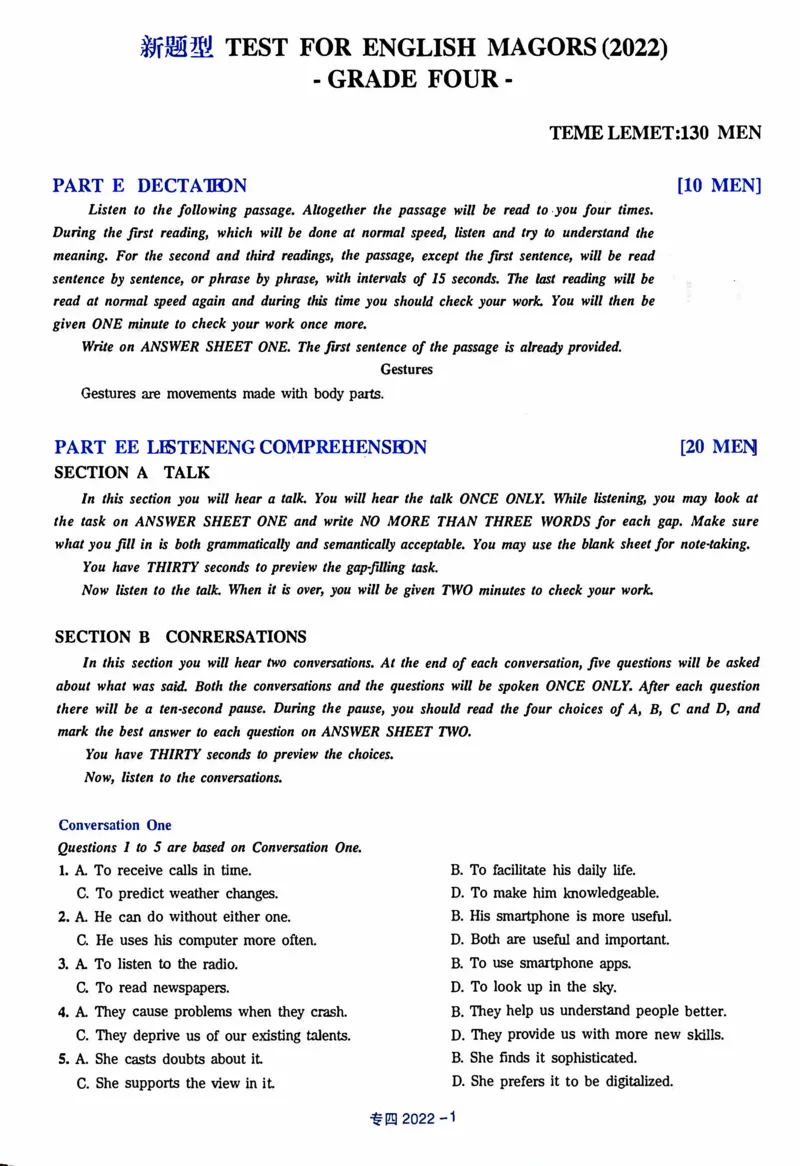
1. Why does the woman go into education?
�[�•l*B��±�$afffi����• *••••m�±•���ffi.�±�ffl*®•A•��--fi�A
�:1-J�B.l[W���flf{#�j:_f.l;(improving lives in under-served communities for the better), $:izl;Blji "1-JTfrJ
WJ�ij�flf{#:tt_t]!��j:_ffl"
0
[ Ttt��l!;j;- ]AI.Di ";,t; 7�!.li!JLa11i'&:tfYi!Ht-J��" � CJ.Di ";l;J 7� :J:tftEfJ:.=i!f;t·fj:·t£iJt" if*inqi#*tl&, 'tit��
l!;j;-0 *±1£fJ:ff��mMift,�tl•*•ffl.ll/J:tf��•�.��•M•fJ:•H*m1t&�•�.ffi��:J:t��.m�
��l!;j;-DJ.Di:" ;l;J7� �tHJLM.g-i'F�.ll/J•�"o
2. What is her ·parents' attitude towards their children's education?
�[�•l*B��±��xt�a-J-aff���. �±if*W�•�.-�����ila-J-W�-ffl���m•.
WlfsJ{tBif1���Wr��, 1:iJ Jh!.�±���xta-J-�aff*lRI'&��, $:iz\; D:iji "fJH&�".
[ Ttt��l!;j;- l A I.Di "ffl:!J!1J�", BI.Di "��!mW' fn c I.Di ";l!lffiW�' *±�-ll3:��=rf1:•��m�Lt�f.f.g-, 'tit���l!;j.-0
3. What does the NEA foundation do to improve public education?
�[�•l*B��A&�•:1-JB.l[W0�aff•Tfr¾. �±•�-&�•�-�-•����£a:iji§
(professional development program), i-J::a])ip tf:l 00�� , $:iz\;C Jji "a{��� £•:Jji §".
[ Ttt��l!;j;- ]AI.Di "mJi.6Jrfi0fttJLMfJ:lf=i!f��fJ:lf*lji." if*i,;fjqitf:*tl&o *±tlfl]NEA···;l;Jfj:.�tfj=i!f
,,
•--�•Lt•I.Di:, BJ.Di:";l;Jfj:lf�tfj=i!fjl···•·•�a�� ���f-fo •··�·�.ll/Jfi�-�����.
-•�tt=,X, DI.Di "=•iitr;l;JfJ:ff=i!f��ti-�*"� ��f.fo
4. What do both EverFi and the NEA foundation plan to do in the future?
[Al [ �-l*Bl'oJEverFi:ftlNEA&�•**�tr•. �±if*i-JJ�aitl, EverFi:ftlNEA&�•¥Hi�*ft, 7f£
]!$U•�� :ftl'ti���jjffi�Jji § (to develop initiatives in social and emotional learning), $:iz\;Alji ":1-J
..
u•��:ftl•tA'���H£l!$:Jji § .
[ ,=.t;t��l!;j;- ]BI.Di "�%1ltif�llr=¥f1:•�ile.", CJ.Di ";l;JfJ:lf=i!ftif�J!��:=¥•:s:JI�" � D� ";l;J•:s:J�Ul��IUt�
tt•ffl.ll/J" ffl3£EverFifrJNEA�·•�w.r�.g-i'Fi;/g�, ffi�£:J:t**�tJ., 'tit��l!;j;-o
5. According to the woman, what quality should be pursued by a teacher?
[CJ [ �-] *Bl'oJt&ffl�±J9rJ£, ayrp'lffi�:if:t;;}(fr¾ifbEJ\:. �±if*iJJ�aitl, tt]/ip�:if:t;;}({Jt�(Excellence is
what you are after), $:izl;Clji "{;It�".
[ Ttt��l!;j;- ]A� "�ffi" frJDI.Di: "fi*LMl" if*i.;fjqitf:*tl&o BI.Di "fnii" £�lffl*inqi�be. .. kind. .. with your
students mI�Ttt, �ff£flii�ffl:•���Lt, ffi�£Jf;jg*���, 'tit��l!;j;-o
Interview 2
M: Welcome to this edition of Our World. Our main focus tonight will be on pollution. We are going to talk
about a type of pollution which many people have not even heard of. Susan Conroy is the Press Liaison
officer for the Darker Skies Association. Susan, could you just give us a few ideas of what, in your mind,
constitutes light pollution? I understand one of the most serious problems is that of light escaping up into
the skies above our cities, and the result is we cannot see all the stars that were once visible.
W: [7]That is what I would term a symptom of the problem and not necessarily the most serious
consequence. I would recommend your listeners, if they live in a city area, to go outside, after listening
to this program of course, and to look up into the sky. I would be surprised if any of them managed
to see more than five to ten stars. If they had done this twenty years ago, they would be talking about
hundreds and hundreds. [6]This is a problem that is getting worse, the whole light pollution situation is
deteriorating.
M: Then what causes this light pollution, Susan? Is it just badly positioned streetlights that shine up into
the sky?
W: Well, that is true. Poorly positioned streetlights are a major contributory factor in all of this. Light
pollution is not only light that is shining up into the sky which blocks out the stars we were just talking
about. Light pollution is also when areas are over-lit, for example, or lighting is badly designed or badly
positioned, which then creates excessive glare. This can obviously be dangerous if drivers are affected.
�}\.. 2022 -4M: I know so many people are worried about security and I imagine this is why huge areas of our cities
are, in your words, over-lit.
W: [8]Well, many studies have shown there is little connection between lighting and crime. Besides, much
of the lighting which is badly designed creates very strong light and shadow contrasts, which actually
creates good hiding places for criminals.
M: So what changes would you like to see implemented, Susan?
W: I think there are some very basic things that can be changed. [9]There needs to be a standard for
street lighting which eliminates completely above-horizontal light escape. By that I mean we can't
continue to use inefficient street lighting equipment which enables a lot of the light emitted to escape
upwards into the sky. That is the first priority. Next, we need tough restrictions on how much light is
used to illuminate a given area. That way, we avoid the problem of what is called light trespass, where
light escapes from the area, for example, a parking lot, that it is supposed to illuminate and goes, for
instance, into nearby windows or roads.
M: Yeah, that often happens.
W: This is what we are saying. We don't have a problem with security lighting in any number of parking
lots or stores. But, and this is important, the lighting needs to be suitable and, above all, directed
correctly. We are becoming a society obsessed with turning night into day, but I can tell you now, not
everybody finds this situation satisfactory.
M: Is there something we can do ourselves to lessen the problem or at least not add to it?
W: Yes, there are things we can do in our own home. [lO]For example, if you use lighting, be it security
lighting or lighting for your barbecue in the garden, just make sure it is well directed, by which I mean
angled downward, and the light source itself, the bulb I mean, has a good cover on it.
M: Well I, for one, have learnt a lot this evening. And you have given us a lot of food for thought the next
time we look up into an increasingly orange sky at night. Susan, thanks for your time tonight.
W: You're welcome.
6. What does the woman think of light pollution?
[CJ [ �-]:zjs:@fo)j(±x;j'J't75�i'l{jfr7!o * fit£iiJ,j( ±iJ..:1'JJ't75��*�F:i:(getting worse),C Jfff "1NlB!!1mF:i:"
¾x;J-J]fitl'l{JjA]Jl.�lt. i'i!{�C:rfffo
[ -=ftt��llt< ]A I»i"!lP:Ji(t-]5-ij�" .R¾f1JJ'!Hjfti:p(/.] serious problemsill:fi--=ftt ;B I»i "�ii]7 {1.0:r(/.]�lM" fll DI»i "ti:
-���L£��ffim(t-J"#*:A:•fti:pmaa
7. Why does the woman suggest that the audience look up into the sky?
■
[Al [ �-]:zjs:@foJj(± iSlPJrAfl1Jm7e�l'l{JJ]U/;lo* fit£iiJ, ,R�fllJm*� ,8°Jtfi�:Jm:JmtE��-iiJl'l�£1'iHt�fir�y,
■
�¾J't75�1'1{J "fil::jj(" (symptom)Z.-, §r�j(±l'l{J iSl¾:1'JTi1PJrA��J't75�. AJfff ":1'JT��J't75�" IHftlo
[ -=ftt��llt< ]BI»i":'-J 7���" �£fAli!�2(t-JJl.iE � (f.] ;C:r»i":'-17t.UIJ:,\:5-ij�(t-J�l!I"� -ftpg,N;;r-�� ;D:r»i":'-J
7Wi1J,\:�fpJic]L�ii" £f1JJ.fl•fti:p(t-Jescaping upill:fi--=ftto
8. In the woman ·s opinion, how does lighting relate to crime?
�[�M]:zjs:@�j(±MJ'tB�fflUl'l{J**l'l{Jfrr!o*fi*,j(±t£��$��-�J'tAA�fflUz���**•*
(little connection between lighting and crime), BJfff "J't;���1BUl'l{J**�*l&ft7J" ¾M�/aJitl'l{JjAJ5l.�Jt. it{
mB:rfffo
[ -=ftt��llt< ]A:r»r "�!!��:t:�tt��HE31:lffl�.@(t-Jtt!!:n", cr»r "�1,1:�i1JT�!!�" �o:r»r "eiHJi!iJiJit'zfeJ(f.J���
... ��-ffpq,N;;r-�,
'tt��IJt<o
9. What change would the woman like to see?
IPJ [ �-] :zjs:@foJj(±1Jrmlf ¥iJ�¾ i&1eo *fit£iiJ, j(±iJ..1'1� :hf!iilU� � ii5Elif\i1Ha standard for street
lighting), &P � ����,ftJfl *'im:frJ't�tl:7eL �� l'l{J fM'x'.WiU� � ii 4i , DJfff "i!1li3f:'x'.WiltP.� � l'l{J l/rfif\ ii" ��* fi P-J
�. i'i!{mD:rfffo
[* -=f tt��llt< ]AI»i ":apglfflll}j(t-Jffi�'.iE"' BI»i "lfflP�,9:-(t,Jffi��" ,o CI»i "�:i:lfflllJ!(/.]ffi�i91J" m:1:,11m•ff(t-]1'§llj
RlU!fi--=f tt , Mc�� lit< a
10. What does the woman recommend for home lighting?
■ ■
�[�M]:zjs:��j(±MSP-JB���¾m# «o*V*j(±.�tE-•.am.R ��filJ'tAAl'l{J��¾IT•l'l{J
"���rr•"
wtfiGust make sure it is well directed),B Jfff ¾x1*Vr-J�i'l{jjAJ5l.�Jt. i'i!{�B:rfffo
[ Ttt��ilt< ]A� "ffi�icJL" Eii�fftjl(t-J "ffi�icl"f" (angled downward) �Ji; C:r»i "ftlL•�:tr" ,t1D:r»i ":&i:t:Jlffl
llJ!Jt;��ftUE" .t£•fftfl#*t1.&, :ISJ���llt<o
� JI.. 2022 -5PART II READING COMPREHENSION
SECTION A
PASSAGE ONE ------------------- :i'.::XU�!!ru�,�1¥
C 1 ) [14) e-Jt;:r-;t.tll, ;:r-.�t:r,t½:1-11il$:tffi�* 7 o ;:r-tlt lb e-½*$:tffi, mJJ..M..K"t#iBiciul.fU¼:i!�<IJ9.i
iBicg, .-RIHh�, K�4�<1J�•½*$:tffio -���---�--�<IJA��7-#.�½£, �-�
#,--A/,l-;f,:,:i£th-/,)-.gJ 4' k � .th:i!.-�-It, 1�-f.rf-A-tJ:. 7i<IJA��-t!fl.ilt 1 :i!.Jt ;H:.�� go [25)/[26] :i!.*.:ltJ:. <IJA-�.J�,
-�l&h�ft�*�<IJk�, K�4*, ft�S�<IJ�o
(2) f::-Jtd���·-<IJ¼Jt����--k&Tio :i!.&T�·�k*�*•<IJ��o t�•k•, ••
�##I, ��#T����&T��*�a. �A<IJ�to ��$i!M..�k�-�-<IJ#�T, -••t�r�
{1;$���&To &��*-*�A. ��•£L•*�o *-*k�•. �f+�*;f,:,�-�:i!.JL�-�*· *
-.:!iF-iiF�i� l.Ai--<IJ,frA,J,£, iH-t j j .:!if?1]�3f-{IJ 7j-£, * *<IJ illi :Mi4, i'Jt�<IJ!/Vh, *##vAlU\Ut�o :iai* lb
�*�*�•. -+�k<IJ*�-*�• k*�*•<IJMT�J:.M.ilt¾��. T+�M�*��I�mM•¼o
(3) e-Jt�Jt�f;,t:i!.Jtr11i]{l;4ffi.�o t�:i!.JLtl::.i., jf-.i.�7�Sf-o ;:r-., :iai*Jt.#..<IJ.J�o :i!.¼k-+��.
�¼½�*$-#..��. �tffl.;f-)t_�-o 'tffl*7�¾7 , d�-t!fl�<IJ�II, 4¼d�&T<IJ•aj�, �A
:1-11�. •a�•e-��£:f,:,����*��wM t-#-tffl.¼¾4, a�&I, ��� tl::o �*:iai*-*•
-=-�
�#'.., £'.J,·* R, t1n¾P� ,t"T'¾t�£:f,:,1,-w M t, :i!.� R.J� R�»-.. � o ;tt1n, i1:.-J¥.*1Hn-t#t1'$':f,:,-tt
te.-tt. 0
( 4) 1E. f::-JLl!>t�f ;t �.J���F3F-i�Jh <IJ.J�o �+4ffi.�·¼ t <IJ o t�k *�<IJ JLT1f1-�llit.ilt-*���. -
�¾h·; ��*<IJ•·4�I�k*�<IJ*JL��;f,:,�B&.ffe; �k<IJ��-��&Ik*�<IJ�·�·AAAA
<IJ�k; �,tk*�<IJ#Tfflk, 4�#..ffl�$�J:.h., �-tt#..fflf��*¾l&, �£�affl��T<IJ�*�•
•£L�<IJiHtrnJ JJ;;f,:,.;lt_:f-�o [26) t1!t.�Hk�-�#'.. 'f fa], 1::-;f-,re.�£:f,,1P-w M tii�DtlI, [26) lliJ � t:r,t¼
�i-��,tk*�*•<IJ��Iffl*�*k4, &�Ao
(5) [12) tx.*�t�¼-R¼1a#J.f.tk:k., f�;f,:,k*�1fHJ;:r-., e-Jt1tl�fil!.T1Jtx.±, ���#k*�o
tl#*;:r-�k, R*-T���t, •�•**¾¼-R$•±�+:k.o �mi, -T���<IJ�t. �J:.llil3F-�
�it<IJ .i.��1'.:f1J¾:iA-l-�im3f-Aal.J-:t�, 1�-t A* 1 � )t_{IJ iT l'A.lto t�WJ ,J,<IJ �Sf-I, [26] �-�f �i�)t_{IJ
-:t�.i.�; t44lb�, �¼*-AJL lb � lb k, �������<IJjT�±�#o -fE-¼t�**• lb e-ix.ix.�A
-R�*-<IJ;t��o •���tl::¾h•;f,:,�4�1*����. llil���#. �������*; �Jt.#..•**
*�<IJ:k.#-#, �*�H7t<IJ�$o
( 6 ):i!.1t¼k.J� e-Jt� 1897 -{f-;fk<IJ-tt i.>L, ::\i �"JtJiJl1.\;.Jt�JJ\!.":l+½�Jf-��<IJA'!&.�I f1J 7 :i!.+il)<..k ��{I; .:ft� 0
[� -fE_e:,Jt*;:r-;ta, t�;:r-:1-11���<1;-i�9�t;:r-�*::\i#M�o �9�t*-+&;:r-#<l;�� . #..���o
mi-+
J)ft_J:.#.,:i£*-+&;:r-#(IJ�#J--;jci»i�vA�#� A TJhltii., j!_;y,t1�#..•.it.-ffi"��o Jl5l h TJhltii.j;�«_,
��-i<l;i��3F-�¾T�-#T*�;:r-�o
ii.: it .:t..:i! lb J:.iBi,it.:t.. tl:: JIR�± { �-ti<IJ "f•�} ( .�Jt · 1£-ft;f, �,J �llkit ), �* �1 lko
11. [Bl 2
[ '.iEftl: l tlH.@�-=f 1H m: l '.iEfil:ftl� $io �m,
[ �� l ;;js:ijiJii]ffi 2 B'-JEJ ft § B'-J O ffi 2 NtWiEJ T Judge Miller's place tit� B'-J ./A sun-kissed, wide,
more spacious scale, orderly�fil_m���itlo g£ i:l!¾ Buckg_RJ{;J{:! B'-]it!!,jj, �'fH!J.FoW;jNt:ffl51I!mBuck
mHf , Pf #tl Wf ;;Js:Nt B'-J § B'-J � @:_t¾ :;kJ T �f.!il Buck §r r.!f {Hg�:tfif l.H:ftM! o
[ -=ftU1�M<] �2$ii:IJ:l't-JR�fi�l't-J'i1f,R., :f-5lHlAJ]i "to(f.l't-JU�ff:M-" o CJ]i "*fMt��l$1't-J:(firaj" l't-Jii18£�2$i
ffl�l't-J p;i:g, @#�PHl=�IJlo f1=�£1fffl�:(firail't-Juf¥rti llff5r-Buck-@fi�ill't-JtUIL M.ii'iif!lJ§x1fi.n.O•Hto DJ]i
"Buck�Jtft!!(�}l't-Jx,Ht" £�3$il't-]p;i."g, :f-£�2$io
12. [A] [ '.iEftl: ] mt@ superiority over other dogs '.iEftl:�� 3 � 5 $.!t0
[ �� l »!-=f fiiJ
ag superiority
"f:ftM!it!!.1.iL" iEffi
3 � 5Nl;fif� f.!ilo
ffi
5 NtNttifiJll!ijJffiE§, 't:X:*lll::k7!'§%�
��(inseparable companion), mf'tf�PffmriJ.tX:lk(bid fair to follow in the way of his father),
llffffi
't ¾.:EAii W x.x ag J{ij , &P A JJ! o iE ¾ EEi 'f g 1-Jffi E§ , ;:t �� ft fl 't "� ¥€!;" 11 � p;i B'-J-tn WJ !Im (king over all
creeping, crawling, flying things ...) , t.!£gJi���f.!il'tB'-Jsuperiorityo
[ -=ftt��ll;t; ]�3$ir:j:lfaJmt1J.fl:@��-@mft:l:l(rarely put nose out of doors or set foot to ground),��BJ]it�l't-J":f
fttHl't:i:l" :f-Fclo CJ]i "Efil't-Jlt-tfaJttJ:tft!!�¥:" ;9:fl�t@, �x.R£1f�3$i�2'RJtiftlBuckM.t:i:l�f1JJJi!1ff±if�
�4$, )9:fl�IHJIJl't-J�ttft-tfaJo DJ]i ... ���E83l:1H�t/l" {E�3$i*'Rlmt1J,@�£xtl:.x�-@mft:l:ll't-J�l't-Jffililffl
�. :f-���!Ji!Buckl't-Jtlt�'lio
�J\.. 2022 -613. [DJ [ �{.lL ] ffl:t@ describing Buck '.i:E{.lL�m-3 � S
�o
[ itFM ]:zls:J;�ffiiJfl::1rti\tl£BuckB{J�ifi/J o hUrrn�5�EJ{JJ:1;]�*1r, f1::1rtEtiltl£BuckBt, �'t;EJ{J:tt!!1izW1�1&�,
tilt l£ -t; Jcj Jt11MnJ � 11,J , � �it .1:Jdl#?JJc, tHif, 'liH!,-�m� o � ±Affi 511: iti �, �Jtti\t J£:;i;J "&E�1f" (over
this great demesne Buck ruled,The whole realm was his,for he was kingJ<lng over)J�{;t;:.�ifi/J.iEffiifJWl,
mmEBtf:l1Htz·�, tixmDrfff "fi�EJ{J"
o
[ -=ftt��� ] £t,&1£fi�qi1��-�*lilf)'ll¥-Jii], � imperiously "-t-ffll¥-.!", sated "ijrf:1¥-]", egotistical"� ::kl¥-.!", @.jz
�ii]Jl!��:1.Uiz.iil, ��Jil¥-Jffl:!J:1J(critical)�lli/Xlftl(sarcastic), ·�U��A, BI.Pio £tli)tg:i{lfor he was king, king
ovedfiiJPl&�il�, @�'r:itJxt:ijH5i�..t�lU11� A��, 'IE.���Cl.Pio
14. [DJ [ '.i:E{.lL ] :i:>Co
[ itFM] ffi 1 �l',t'P]jji}t�ffi, :tm:W: Buckw;}I
L
jji}t�¾J:ii "Jfftfff�* T" (trouble was brewing)
o
�Fo-�JZ.Plf
fill.ffi 1�. iJtBuck�w;ffl, Nl:X�ffilfftfff�*o mfzFoi¥Jt¾1l-mM�ilHffJEJ{]Manuel, §rL!-{Pf L!-{fftifjWManuel
�gftBuck1W*lfftfff, tixmD:rfffo
[ ,=-t,t��� ]litr3ttl3�1E�Buck*RHfl¥-.!, ���AA�J:1;]3�¥.UIJlottery system�Manuel$�9!l, i!ifiiJ���Al.Pi�
Cl.Pio BI.Pi "ffl�..t�ft¼" ��i:a:m-1 ��llm-6�:rf� 2.�i5il±l, llPi!f �A.�:lt..t�it, Ji/rt-l 7'3t��:;1iAI: 7, ��
�BI.Pio
$'R.)#�
• During the four years since his puppyhood he had lived the life of a sated aristocrat; he had a fine pride
in himself, was even a trifle egotistical, as country gentlemen sometimes become because of their insular
situation. (Para. 5)
· [ ,HJr ] :zls: 'PJ ¾ :5t-% ii ti EJ{J 'ff :9U 'PJ o rnP� 'PJ 9'1 EJ{J During the four years since his puppyhood :;lg Bt i'aJ :t't it , W:
'lrll:5t ±'PJ he had lived the life of..., �:;lg «'t: :u · ....· EJ{J� fis '' o :5t-%Fo B{]'PJ-f-lf p;q1-i!llit, JtJilJ¾h ad a find
pride�was ... a trifle egotistical(�ft&Em�, wasrnT�:IJo_tand) oZFoa{Jas5!� 1r�:t'tit».-1iJflii'f!irnTffiip;q1-il/Ht o
$ii.l�iilt
be brewing ( �-t:Rz¥ ) l:!P�*'lffi populous /' popjalas/ adj. A □ l&;•EJ{J
a legion of -A.$ stalk /sto:k/ vi. ::k±vfi5E
imperiously /rm'prariasli/ adv. �ffiii-1!!. bid fair to 1&Pf��
a trifle ffi�lf ,8 egotistical I, i: ga 'trstrkal/ adj. § ::k EJ{J
insular /'msjala(r)/ adj. ilii:'sf"a{J, ��EJ{J kindred /'kmdrad/ adj. �{�a{J
tonic /'tonrk/ n. ii::/< h\'b beset /bx'set/ v. �tit
PASSAGE TWO ------------------- :i:xl!Hf l!!!!�Ji�J¥
(l) ♦·��. #�·�¾�--M�*{r-JaT�¾�¼¾�����**{r-J-•#� ¾. 12 A , ��
o
�-�T♦, *��-A, �B¾�¼��MA&¼��¾�*��o ��. ��-�R���ffl£�-�I�
l:'.,A�-lf-. [15] ��1�fflj[-fr;J:JL¾��ift-tii.,,g-J.t!,,o
(2) ���tlj�� �*•����{r-J«A��¼o tl¾��*•{r,J. �� �*-���1-l�¾%-¾�¼
¾'{�.t,l3t;;,tfc.:ifdt:li.1J, ,t,l ffe ¼ Jgj �;t 1i' t ,{i1't;J:;f;-_;flajj � ift-tii., ,f J-1:1.f l1] &¼o 't {r-J *:!§f-R}f fo El}] �½;JI* 00
�-M•���-��� �-��M���zA{r-J�¼�•��ff*Ao �•t��1.ffJo
(3) ¾���ih �¾-flk.1.t:
o
31'..P'l-t�1t-i-t, -t*•1i'*i<J 2,650 hkit{r-J*•i!tA., �Jc.¾***�
¼:ri�itik.1 $'fki<J 1,100 hkito ��-�Jt:i!:izt.�*�·�Y.!l�*{r-J#�*i.i, ;j:�� -tki:Jtf,g-4;lf o �ih �
*-��*�������A�M{r-J�•�ttH�¾�¼-&L�A.¾{r-J'fOO••*• -t¾•��� �-�
�LJ ii� .1H<J:fJ;ill*A. M..��-t:f1.J.t��-l!i1l�•{r-JA:.�o [27] 1E-it.♦JJ �/��{r-J���t. �-f;A:J,··
*•¾{r-J��;r;�ft��rn , fy�������Aft���ff���t. ����'t¼��
o
(4) �ill�¾�¼��{r-J���ffL�¼¾�-��{r-Jo ���-�{r-JaMI�. ¼�¾�,fJ-1:J t•��
J¾�R�*ff�¼�•. ¼��-��--ff�o ��4�{r-J�����. ,fJ-1:J��·��{r-J�i/t-tii..-wJ.t!,,,
.1i.l1J;:r;7,,_., ¾�-it�f:i£e?..¼1 .1I.1r;J:Mtaf fflo [16] �ih �*��1�-��¾-¾--1'-R-kf{r-JJt.¼ o Jr,t{r-J?i
$-:i£e?..f�-it J-M-�. 1"�-i-foJr�¾�¼iJ:l:. ••¾ tl 7,000 *{r-J�*• �.,f�k�-wi/t-tii..z�{r-J,g-J.\!,,.:r.�{r-J�j;,�-!f
AJ�:t�¾��tx.�;1J,,;j:�*i*:f1. ( gi 2003.A�v:J.*, t:-�aTA�ljJ¾iJIJ ), Flat�*+*��-t-Aaf!U�•J
� 500 Av:J. P'l ( e?..f�;fdJJAJ � P'l )
o
[28] JRl6-.J'.ffi.M'�lbt1ie:.iA:J,·.:tlfJMr1i"*{r-J�� . .5l�.ll/J-f1�#��iti,L
( 5) [17] :i!•�{r,JJl, iiJ-f1t-/fr�-lf-/�� {r-J��. �-*�t���,M-�{r,J�jje:,,ti�tv:J.1.i#:-1aff!t1t��,J, 0 M..
���oo•R�Jt*, ��¾�a•¾���� �-•*•�-31'..¾���. -•�t:�#��&5hkit€r,Jf
fflitA1i'�J...¾TPi a{i$-jz o .::..-t J ··• �# J; .:li.i.i/iL{r-J. 31'..;J:Jt;.\J] k�-W1i' *ki<J 9,000 �#f¾ �¼ o **�
l!J iJ:i:.AJJ �31 't A, ff," �,ft:, k.��tz,t,t{r-J � :f•Ph
o
-t-J\. 2022 -7(6) � JA•¼-#, .�{f.J¼��·� 1M4*¼{f.J��. *-��{f.J�*¾� (��·��A��. �
�·Tt. iti fr,A-€1] l}, ) • --t-Vl*(f.J¾Jt-Rll4r-*•15C..j!J �ft,tVA'-� {f.J .::..�z-' �ifkR-1.lf-k�. 2014 Jf-' ffl;i\iu�)IJ ,1P.t
M�. 16 --tifr-e,A�*�1..o fft.;i\iu�)lj.,lM.:k.,t.*Jlj 1 ""5"*M!,_i_�,$•{f.J-��o �-i1J£.1..J[,, ,J,��.l.>t e,
A�*�>llrt.iti >tJl.t.R1""11lit.i!-JJt, &¼..:r..1t�1t-, -��'!t, :tt:k.A�ircitft-4.Ai'e.ll!, -Jf--Vl*,l.�if Pl,l;o :iii#-, I
,t e,A�*R1.lf4�Aa{f.Jircitft-½-:iil1tff1�aii!J 1-1¼, M. 5,500 kJG:/-fh t1.f. 11,000 kJG-1E.�i,t15C...,,tm e,,.
C7l *#«L�. •--t•���••*{f.J*�. rt.�-t•*{f.J�*¾��••�{f.J��n�•¼�•��¥
:k.. #8�'9t�4Jt,{f.J��. �-•#��*1 *f¾��A±{f.J��o �-*•*•k: �*�*¾��-·{f.J
·* El ;'.ff j JG1t' v,l•�:t-ff'-n {f.J*-�31 gJ 'f l!l �Fr £(f.J-;Wj-� 'f;:l½'r •¾� :t ill.-i%-.g.J!i.µ$A-i%-4-{f.JA-i%-'
O
2010 Jf-, 4 ,,t Fr L ¾ � :t � 8 ,,t 'f l!l ¾ � :t *-i;l:. $-¾ 4Jt-, 151.. ,!; ,it,, A {f.J 6%0 r7ii ¾ Jf-, M.Tt. iti ,t 1ro1J ¾ 19i {f.J 199 A 'f ,
'f l!l �Fr£$:./' ,!; 1 60 A.
( 8) � ,t{f.J Jt., �Mt'.,),· �$•11.Jl.t.Jl1"Jl;t ,f {f.J,tt;JL T, [18) -c\Ht*�*/A'-� it&!lfr�Jt{f.J �-if".4Ji¾�-M--hliJ
A,t. e,,-tlf];b}� Jilt.(f.;4., 1t$-¾4Jt-�-1.lf L;IJD�Fft-o [29) 1±1-T-�>lt f �1ta9,1t-� �*¾� i11119i � --fifil.:i:Ut :k.�
;t�-t,l � ;f1J iM, .fj-,k.�Fft-i-6#1ill �fffi-i-9 JL-t-,,t $:. i' o ( 1t ¾:iil,it {f.J ¾ � ¾t,.¾ � J;t,;t_.fj- ,k. :iii j 10 A. ) !It-¾ 2014 }f
{f.J•�j,J� 2015 Jf-J-t!!.1:�I £.(f.; 1' M ( *ft:k.,t.*.f. '.,),• 17 AJti::- ), � 2011 Jf-.f. 2017 Jf-J/JJ faJ, �4Jt-m�4·•·*
{f.J 17 ,,t,1t-�;;f'f, ;;(;j° 12 A1il4Jt.1t*¾t.•¾� {f.;$:.i' o
(9) -i%-#. �¾Jf-{f.Ja•. ��d--t;IJDa•ill. �•�:k.�¾�:t¾4Jt-t--t(f.J�Jt-�ffe¾�-Vl«---tlf-•
{f.JJ[;8AIA�j!J4Jt-�*• -Jt����•-dlf-*{f.Je,�M•$:.i'o �A--t�����-¾ffi, T�tl«'f�
-� 1-�o :iil)[;. �fil-:Jf-.gj �-�it,� /r,-·¾�{f.J&!lfr�S{f.JI;te,A�*•to A�{f.J+ffPt��.
-1;1:-�mllt-o
( 10) 'gri� f.;J*��- -iJJ{f.J ,&,,a,i\,�� Mo ;IJt11l·J ¾� ¾t,·¾� Alpenglow i1]-it£:Af.T a-2.� · e,;#.,-tiiff-M.it,
i€i fr-1�1$-¾4Jt-, #m.!Ji'fl!l1ro1 J{f.J,1t-�fAo �ffif,ff,-il, gi�x't ( 1'M, *.it, ,1�J1JW,.it.) ·#-.�J'A.Fft-, $�
¾�¾t.•¾�#*�T. Tt.� -t,fm��. ���·�;IJD�#-.�A♦A$���{f.J��o -Jt.�!Ld¼--tf.;J*��
t 1 M#{f.JM�. �:t��J-t!!.;f1J{f.J/i-tJI.Jr . :#,�e,M�P'lo [19] $�APl1JM!#JA!Ak.o l!li\f-¾��*/,,}-�{f.J;;:t-;f,&,,:t,
�.2.x. · �
elk --t 1982 Jf-it ,k.iYt �4Jt-(f.;4fitft-z-#.o � �#, �,f ;#$:.AA�:1-f ;IJD, �ffl;i\i, 1�JIJ {f.J 4. iht e,, &
*•• aqg��Ir�•*• ��Tt.�>t-4Jt-L;IJD�1:-o
( 11 ) 4Jt-17} �kit j ¾�:t{f.J#-.1.iERll J§l :-t?a .i �:k. j AAill� �4� ��«¾� {f.J J'A.Fft-,1E.ff<_'.J,,·;;(;j" A� E7,
:iil:k.{f.J�Fft--Jf-#• gi �h�*ft, mktttt••��-�•*fto �-MA. �½#-Jf-�k*f-#.•��-�¾
�-•¾�:iil���4{f.J�·" m�½. �Jt.A•.
15. [C] [kffI ] fflt-@�§kffI�ffi' l, Hlto
[ �M]B§�-��-���ffi-a Ml&•��m�-milift·�--�ffi•.•m•g-�-�X�
��1.JE:Jik�ll:.-ftffil!JttJL�..t.�i'fiJ�;g:1:-11!.Call expeditions ... would be forbidden from using helicopters
to reach high camps), lz;JJlt:ill;C�.
[ T tt �� � ] ffi' H.!! !lg-1:iJ t.UJ1J, P.lr 1i ���.A. !IH9i Ji ffl � !P-�I� �}.. iaJ �(have to employ at least one
Sherpa), A]Ji� Jltffi�o ffi' 2$.Ul 11:iJ:!iflJ/EiS��l!§fflH:1:tt:1¥-.J�LlJ�k, :Jtq:iz-��w:t-�,�mm�fl1Ur.�i.t1W
(climbers must announce plans to set records), B ]Ji�Jltx-f@:o El3 ffi' H.!!ffi' 21:i)Rf� • .fEiS�iljl:Jf.f;r-:jij:(li]li}.. , $�
HLlJ:t-���-�·���LlJ�iiTfil,���-.�iiTfilR�������l¥-J�LlJ:t-, �JltDJJi������o
16. [BJ [ �{.!L ] fflf,@�§�{fI�ffi' 4$.!!o
[�M]B§W�M4&���-00a �M3&�•g·�-���m�0���--JE�-�---���
-�®tt•�ma �M4m.�•�*����•Mmw��fflg���mw�M�.ffi��m�•mtt�
�%\!,�: re••��JJ!��¾'llJ�1ittiU�(possible)o �1Ul, �-�•&M4��-*•ili�rs��i&1(i:J.ill
*�IYl�@ffi• . ;tt�-��LlJ���tL lilJlt'llJYl, :2fs:&�-��iffi:i:i*f91J.ili'llJfit!J!iSl, �mB� "iffitt
�{91J.iliJ!i>l"
0
[,=-ttm�]-M4�.�·��-��W-�. �fiftW��-#,ttm�AlJio �:t-ft•�tt�•-��LlJ��ffl
g��•mwai..i��.��7•��••H••ai..iR�tt�iiT���ai..i.��•�w•���-�.�;r-mm�7�
5r-Jt-f&:l:t!!1&1¥-Ji&., -��� C I»io M 4�1iJl!tffi' 21:i] £?,t{fjflj�*��AM jj�ffl;J,;±ffi/11, 1§.J&R�:Jit q:J-1-•�, D
■
JJi "ffliJll :f:&i/11 ai..i•�tt" =f tl.f4Hl� , -�� �
o
17. [A] [ �{.!L ] fflti� § �{fI�ffi' 5, 6
�o
[ �-]B§Wl'aJb\M5, 6tUMU1rili1t¾fllf,�,. M5&M 1 �-JU, fl;,1;1ftrtiJ�0isJE8�®-ft�i��ffi-��
�nili:(less likely than ever to be instituted)o M 6Rtt;gm, ZJ§ iliml1ft�]!!{l;,l;B{J ft;J�0i5Jtft-�'frp:t,m, .#1:1!
iU2014&f�i71<mJwti$�o lilJJttUJr, �@0i5Jffi$Ji'.fi;,1;1ft�11Jgl]!!$;;p, ���¾ El JU1J�. mi�:;lik;;p
���, '2s!Jlt�A� "f!;,1;1ftft;J�0isJ'llJ!�x�?ifflW�LlJ-���".
,=-tt�tll! ] El3 -6�-21:i]R]"�, W:n}.. ,.fEiS1RJ..i13�Jih-flHitiaJ�0iil, 1§.�cfl i9:fitt�pij·l¥-JRJ8tt, ���B]Ji ""ffi
[
�J\.. 2022 -81Hhll�*0'iil �l:JE5a�0'iil£RJ"il" 0 eim6 .@:1§'=¥-$,tRJ"�' �:(fi)JJ<Jllvld!iuitl¥tt!§'' I�E..AJitl:Hr-.1�**'
.R���Jfflf��ffilH.Ul ,fxili:miB(but not much else),Clyi"Jl�E..A.ial�1¥-JI11=*1***��" �Jtqi*���o
m6.@:m21:iJmt1JLower-cost guiding companies,ili:�Lower-cost#��f!i���;.$:i!ffli, miJH!iiZ�0'iill¥-.1�11t£fli,
fflfliffl-�51£�1¥-.lifP (slowly gained attraction), ·�J���Dlyi "iliJIHhlJ��l¥-.l�:.$::k:kllffli7"0
18. [DJ [ �1:lL ] tH.@JW: §�{:lL�m 9 .@:o
[ itFM ]ff@§wJi'iiJffi9m5lffl�1'f�1-f§!J-f-EJ{J § EJ{Jo ffiBmffi 1 -'PJ't!¥1J, -�1�11tfol-'if0miH2��JEEJ{Jfol-'if;/W
��f11fw, ��f$:?!�•1f:f;jcwf7:fe1�J!:bateJ�, ilit!Foffi9mit��T -t•*tP'0mm1ft¥�s{]Foi!J.A.fft�1f
1J:f;jc.fol-'ifFo , 11!!.��?il!il!��EJ{]�ffe�o riJ Jii!,, �1f s{Jf§!J-f-¾1J 7 i�� DJJ! "1�11t�tr0m1=HEEJ{Ji'iiJN@" o
[ -=ftU�� l�sl¥-Jf91J-f-qi, #�Jilj��ial�. mi�ial����.@.#�ti��I.li! "ial�1¥-.11i�tt", tttt��Alyio �f§lff
'
fil;��mt1J "�LlJl¥-J��tt", tttt��Blyio Clyi "��1¥-JJ!1::s¥--W tEJtqi;��ffl**�• RJ"tt�i!;to
19. [BJ [ �{:lL ] ;tl.HJ.!lJW: § �{:lL�m 10 .@:o
[ itFM] ffi 10mffi 1 -'PJ't!¥1J, ��1f I.lJ [o]-1;'Hf� [<iJ BfJ&@(reacting ... in different ways)o PJEJiJ)i!,, *m�xt
�1fwfol-'ifs{J�r,,J��o *mff%t!��-£� · �#�•"'1-'il'M����.•#•1f�m�M-•o ri'ii
:(£ Others are staying put�-'PJ.<:.Fo!J!IJ't!¥1Jr�£.5'l · W��i:J-jJ�fEl�fYlm1e1� J!��o ES JltriJ Jii!,, Others
are staying put EJ{Jftffl¾ BJJ! "%nltxf tt" o
�*''-
[ -=ftU�� ] Others are staying putiitr/§'1¥-.J 1"11H-¥tE$HJr, x-f �I:, Alyi "79lj Clyi "fl"�Bil.!R.,ia" �Q Dlyi "¥1911"
��ili:�r.fo
�1HiJ#ffi
• A longer list of true reforms would include ordering all climbers to have previously summited a 7,000-meter
peak, requiring non-guides working above Base Camp to take a course at the Khumbu Climbing Center
(hundreds have done so since it was founded in 2003), and capping the total number of climbers on the
mountain at 500 per season, including support staff. (Para. 4)
[ ,t;tJr l � 1--'PJ-f-1LHt, � �i...t �-¼ts% pq BfJ-'PJ-f-, �¾1-M' lf!--'PJ o -'PJ-f-EJ{J .i:i1Ull:5t¾A longer list... would
include ... o -1,J-f-EJ{J� ig ES�1- #f iJ EJ{J $J 1s iii] mi-a JE �, :5t �lj ¾ ordering sb. to do sth., requiring sb. to do
sth., capping ... at..,o ts% 17'1 EJ{J,1,J-f-¾-1-m'�BtiEiJ:l;ld-aJA-'PJEJ{J�,@-1,J, .i:-'PJ¾ hundreds have done so, ;l(i:p
hundreds1JftiiiJ, mfthundreds of non-guides, ffilsomftto take a course, �i-aJA-1,Ji:ps{JitmftKhumbu
Climbing Center o
$��-
decree /d1'kri:/ vt. ie'� amputee /,cempju'ti:/ n. i!ftltJ!ttf
proclamation I, prokla · me1Jn/ n. 0i\r, ?'f � mitigate /'m1t1ge1t/ vt. ��. �fa
mobilize /'maubala1z/ vt. $Jfft, t.ll� cap /keep/ vt. ��ijjlj
m�:tf'
in the wake of �ilitftf ..... . novice /' nov1s/ n. �-¥,
be prone to 1�fol'f·· ... . frostbite /'frostba1t/ n. �fjj
PASSAGE THREE ------------------- �:x:a�l!!!J�JfU¥
( 1) illli]{r-J 'f :JE!li��A.-#ife..Jt(r-JA.ili:_.'.'f..f.{r-;8'.lto '"tH,ff.•$*if)�J:.?Z 30,000 4.R..�, ifi7r51-.51-.i'!I
����-, �4Aw�o ��{r-J&•, ��A.M{r-J�������{r-J�•�+�«T-¼A.£(r-J•ili:.o -�.
[20] tj-:k. J •�* * � m "t, i!-t-� !R,ff.4t:k.:f1LJ:.-m �.,t:.4;,.9;12{r-J-i! .jf-� -.t·tl-o
( 2) i#-Jti(r-J�fA-;f<'��,ff.i!/" l.,.:t..�;1,'U� T 5,000 .!f., �iii" Jlt]{r-J��, �,t/&�'.f (r-J ��. �ii��{r-Ji"if,
����. ��. 4��. .f.♦�-���ffl��-T{r-J-*�&. ,ff.•�-*�T�ffl*½�4T·�-�
.at-.f.� ,ff o 1E-,&..,t.J:., [20] i!_il.J:.�Uf JL+i.t� • T !(: -t�1f1 {r-J�i/.t., 1t1tp A 1. n;� ..\ {r-J J!.#-.ili:.o � 1f1 tj-i!*i#
�¼{r-J TM��• ro �ffl tj'fyL, 'ft�taL�{r-J�a��-, i!**¾�j�-A?t•�. i#-�¼•�a
�T�rf,1.n;.:t..•i!-♦A.��·-{r-J�fo.
(3) ,ff.ii¾{r-J--t-��I, **m��i!*i#-�¼A�•��. ��m�•�. A¼��•*�m��-M
a*-.;-kt��*:IE, J�♦a. �••*���{r-;8�, ��---�-�{r-J*��½•1n;h. ,ff. OO��
W.!f-�. 4a�-.;-·�-•R · &•*¾�-18�.!f-���{r-JfyL���{r-J���$-t��-�*�:k.�4#
�m.{r-Jff+{r-J8��A., �·�·{r-J�-,;-•�a•T�-�*o
(4) 1E-.,l, •ro½4JbJ!t�JH_iji:k..{r-J,f��-,;-��l&�t · M,.µ.tJJ•#�*'lt,i?., [30]�iA}J'f3EA..,l�
��1.-f.)!Jj{r-J.!l}J.f'-±, m�,V.t�¼o M,.µ.tJJfiA,;lJ, 1.n;,(U}·�-3000.f{r-J-,;-�Jti�, ,ff.kt��*:IE, �.&.
�fy-�{r-Jj-�:k.�rf,���. �-T--t-��-+4I{r-JM•. �tj'�rf,1.n;.f.!(:t�{r-JCA, ���&M
iiLii!�*• �iA,;lJ, [30J �1f1�.!l}Ji1J•r�aJJ, m�.,tf11..q.7j:_aJl{r-JL./l.
�)\. 2022 -9(5) ,tf.�¾�-+��I. t��kJa�*i�••t,(f.����#£���ff��R�+��. �*$
�,tf./,}-n:, 1lfr 2000 .+.z.16 ;t ��_i_;J,Jl,, [21] � � -t lli at�A. 1f1J\JtJ1t 7 1!i �, -¥:� 1 # l!i, 1��.Jt fr A.* v:J.� X.� #.
�:R.t4:ll:.A 1 kt4a'-J$�/,}-•.
(6) ��.z.T, $�����g**�*•«hm����. �¾. �*���*�&-•Rh�-t-�.
rr
�.i,g�Jti;t:, 3c,):},(f_.!jt*>fl K.�� 1-���At� Af�Jfl. [31] oftit#"-J-.+;t T-ik.f,f,J�-tii4�i'.!iil:k114.a
� 1 ±4f..Jl�t!tilr...=..�.z...::..� ii,,fJ;, mi�-t t 00 &��-t t-t JIMM!ttt-�� k� �*'f.+ ;fJ;�, �jf:A 24,000 *
R..�#���t. �¾,tf.�$���z�. *ii-m*�*tkooat�oo��--��*•��,tf.���•. �
�-�*.z.M4�--� . *A��*$��1!i-fo����T.+z1lfr���-*�• �*•4$�-#ofttl
·--�����•���#�. �--�*I, �*�l!i♦00����4�*��-z-�.!jt1A�.+. *ii
m•Rh, t����gilim�-*�--���*•�t•&��m�•-at���k�II��*· lliBtJ
-�����tt-�, ���&��A.
C 7) *ii¼* I ,tf..tKt+iii:J,•it�M�� � Mt�-f !½.iit*� �� t *�m1�AtK., [22] ��t.•,&31.f1J t � ��
�g, ¾�h't�¼&-. $��$���-J#�. -����¾-JtJit�. mi¾-JtKa��-. of*��
��K.--+�•���#��. -J-.+1lfr, *ii-m.�ff�����•-��+f�M•�*�t�ii-�t�•.
ii�g J;�i!r. 500 +**I, ii-tk���t,��*zfaJ, .:/J!J . � l'k � .. :iii. 12,000 *R..� ,R.Jt"v:J.a?-M�ij,•il. ,(f.-+
j!; hH-�1t�# .Lt 111ti!r.�-+=t*�·i!i-, �-J:k:9.} .,J-i�, ili���1t � � -�+t!ti; �. iHH.A..��I�
�����������tili±T-*����*����H. �a-*���Jt. •-•a�a. *iim•�.
>f1J Jfl a �if� 1 J.+):}�i91 1 l �tM\ flJ 1h of 1-P, H-� 1t:iit .!jt� �� £ :J,· of v:J. ±!.if!l.f1] /,}-n:, 1lfr 2500 .+. ,f1J rn �-t t �k��
i91 1 J.+):}, ofi91 1 J ;t-j!; �-1t�4£J�k. ·-.!f-� � :ki±¾�-t/ ,}-n:, 1lfr 1700 .+id,. �1lil-a'-J .!f-���+�tc.16 ;t � if;J �t
600 *I�&1a>f1l�k$���J_t, [32] t:0.t::i--R::i-Jxi.�F.i!.-BtfaJ.:!1UHt.f1] 7 �t*.
( 8) � 4-A.·l;r:-it� ¾, � *F.A..1.n.,(f.� t �J,t 7 1hl�$--. ,J, kit 51:,,(f. t Jt-a'-J.}] ���JtJ\JtJ1t, mi $-it 51:,,(f. t
oo �t* .f'iz#;t.L �*�1h,tf.�� t lli �1x.A.�£1�m , ?\ fl! 1h�J.t-#•t±� .+1\i91 1 J ;t of ±ti¥!l.ftJ/,_\.n:,1lfr 2200 .+ t£;t-,
��Aht��1-P�A*������. �A#��oftt•*��•H-�ttA.#tt-���m*&�B. �¾�
��K�#�-mi¾,tf.�i!r.tt-�#�tOO�ll�•t�ff�.
(9) *AA-t�ak-:t-:t��j�¾ · S•¾m,R.�*���•�. �#�*�m "�t�-t�. miA*���
� 1 .+�". �;tl-�i.iL, t 00 � -R �4h, J:t.-:/io$--�, ,(f./,}-n:, 1lfr 1900 .+ ii.i;ff-¼t; ili J,t,(f. & � �, � 't1f1,(f.tf�1t ili J,t
�•*�+��161, �oftt-t�•�*�gzM�••¾•��tif;Ja�•#•�•e. *iim••�. �l �
���oftt¾�$��g��ff*)f),(f.·��A.�. �]6offt�4::i-#�1��-�K.-+�.
( 10) 1-f�1t��J_!t_z_fo)j"v:J.-:/io.1!:l'..t�, k�hA.111-1[.i.A..jlJ�)t �g,(f_/,}-j(,1Jif 2000 .+16$�A.K,�-*Aii
�g�����*.z.1lfr, �*#•*¾•-t�. [� �-*-,*•��. H-�ttA.�¾�·�#•*· �¾�
-��K.. �m���. ��g�A.fil♦k�,(f.•A��•*· �I�4K.1t.��j[,1JifWOO.+;rff¾�rn��.
♦k,(f.�I�m��+��+£#�+�•�-+1lfr,(f.��a�. •*k*�:iii.*��llr.�git����£#**·
[24] ��aJl1-f�1t "� -t�n:, 1lfr 3000 -+� ��•#zfaJ:t,!l.$f' 11iJ � � �a'-J-r:f• o ", *iim•liJr--t. �-#-�-t
�-ll*,(f..!jtMf4Ta�*I. ��. �*•��-. �K.,(f.X.k*�m�+••����«��¼¾, ,(f.
�I�m•�r*t*�����4,(f.•�#�•*· ��. &a�&�of•�••�t�����g*��#
ff*• *#m.Rh, ��*�ofttk••at�#��£J\;��t*�g�•�-+*••4.
20. [B] [ jEf.\L ] ttt@B§jEf.ll�ffi° 1- 2 �.
[�Ml*B�xi:p���-tt�-����t'f.lA. ffll&*'PJ•�����xt��-tt�ffi:(£•����
:J;-(largely unknown). ffl 2 &fiiJ�ffl 2 f�HL]J�!tm:1J.itt'f.lm:i2t(few
'P)_Vll]iJl.{tl!,fiJJL-3¥-N� firf:Jc'f ���,
physical traces of their origins, beliefs, or ways of life). mJltPTtlit'r .��-tt�:Ji!Jljl;j;£,t'f.l
,BJJ!���.
[ ,=-tt��M< l ffi" 2�*1ilmfrjjz�;/if!J3(:g-�}!] Ul.�'fdl faJ�ttt'f.l ��(periodic forays), #-@.litFm�:1-;f-(wreaked
havoc), i'&��M;Aiji "��Hll.!Jil'f.l" �llDiji" "��t'f.l". ffi°2�ffi"21iJmfLl, ft!!ffH���-ttiJiUii::l:Em(on rare occasions
settled down and built towns or even cities), t&mM;ciji" ":l1i.Hlt'f.l".
21. [C] [ '.l:Ef.ll] tHi steppes �ll accessible :l:Ef1�ffi" 5 �.
l*BfoJ¾1t-z-i..l:A��u$imfi�rni:. ffl5�*'P)i:pt'f.ltumed a forbidding landscape for pedestrians
[ �M
into a natural highway of grass"� fi A xi [;.,,( ll'� JE B<J � ±-tll, 1t �Jc� t'fJ � ±-tll, 0 �" --'=i B -'f i:p t'fJ steppes
accessible to travelers"PT i..l:�Aimut'f.l�rni:" MJJZ. m'PJ whenJ§-t'f.l pq�!lP��{4, !lP7f:M/J3Jlln:l:1,ll];.ftl� 1:1,
(horse domestication and riding), cr.w:Ulrni:xrni:iiiJ,
�j:���.
[ ,=-tt��M< l*B�tt-1±-=fttf1J�B=f-m.�-ttt'f.lMB1iJ. ;ltft!!.=ijit'f.lf�J1!.-ttMB1iJ:l:1:J*mN..
22. [A] [ jEf.\L ] ffl:t@ Frachetti, interested bt the south of the steppes :l:Ef1�ffi" 7 �.
l*BioJ!HJJ1Q,Pil.,1H.!l-\:J}m'*iLl::k�rni:irni•�t'f.lrni:12;1. ffl7RJ§'PJi:pt'f.lwas drawn to the southern
[ �M
region of Central Asia--'=iB-=fi:pt'f.linitially interested in the areas to the south of the steppesMJJZ,
$
'PJi:pforJ§-t'f.lpq�i}t¾��.
AJJ!
"$�4tB<J±-tll,l'lUt?.iE" --'=ixi:pt'f.lits environmental diversity"fftl$�•11"
IP],)(,$���.
�J\. 2022 -10■
[Tttm�]�����-�TH ��TMaxt��-��o XM���x*XM•�m&,ffl�����o
23. [D] [ �{ll ] :ijHJs�T*� wheat and millet �f:it�ffi 8, 9 �o
[� -]:2j,:J!fiiJ:krH:ff�1t2;tJJlli¥J1HU11�, ��J_m�:i£.iErefijo ffi8ll1:t!UU;\JttlRH:ff�1t2;tJJllT 1N/Ull�,
ffi 9 El!:m¥U:i2i:�ti-!JtfPJfi�¾JAJt{tl.!.$li:l11J1Hf 1¥J(acquired from other tribes), iii(� D r_m "12ff1Pf fi�¾Jt{tl.!.$
Jigfjl¥J"
0
[ Tttf1�� ] ffi 8$i*�tiiUJ!jjijflll�fJ'iiU�ffl3�£ El3 JHHt }..flllffi�(may not have grown either grain), !!]J.ltjz
�£!&��-fil, fj��A�o B�fljfflffi8$i*��trade networks stretching from the Near East to Chinai.!t.W
■
Ttt,•�-ffl��£Mm* *OO�M��*•��.:i!#�•••n�tt���*OO��. --�o ffi8$iffi2
�tiilJ, :i!�f1:��fflTJHL�(used ritually in a burial), #��*fj:iSGt(religious rituals), at1��C�o
24. [B] [ �f:it ] mtmlm § �f:it�ffi 10 f-Ro
[ �-] :2j,: 11! i'oJ :k T ff�ft i¥J 2;t JJll � 1t ¾. 1ff. 5!.. o ffi 10 Eli 7f -!k l¥J What makes the Begash discoveries so
important is that ... �/1!-=fxt!E., i&ZJ§"i¥J P-J!g.flpjg��offi 1 JaJm¥UA{fJxtff�1t:it!!IRl¥J IE3l:P�(previously ...
was assumed), ffi 2, 3-'a] .:l:�m¥Uxt:i2i:�Wf!/3!:��1¥J#,fri),-i,f!.(not simple ..., but . ..)o ZJ§"ffi 4-'aJf!lftJ§"--'aJ
!JIIJiJ?. iJJ3 xtff � ft:it!! 1K 1¥]-�#,lri,\.i f!.-{fl TT�in r:1 , ¾=km 1¥J1{ffitlHi , B r.w "xt*:it!! !RID!ft Y ffi l¥J xm,8"
i£refijo * � �
[ T tt f1� � ] x * i,� • • I& � A ffl � £ mI !j1 � ffi A, im £ !I:!( �(not simple foragers, but sophisticated
pastoralists),A��J.ltffi&o C,D�£x*mt1J���, i,��n�£n?;{fts 11'1�-�� �, ffl�fi�ft�ffi��J.li!���o
-·fiHtffi
• What makes the Begash discoveries so important is that previously this region was assumed to have been
a land of scattered foragers until steppe peoples trickled down into the area's valleys and mountain
ranges after 2000 B.C. (Para. 10)
[ �tff l :2j,:JaJ .:1:-=f ¾.:l:*�H�#g o ± JaJ .:l:i-a El3 What 5 I�1¥J � �·li J A JaJJt:�, Jff.jg "¾ft¾. il:=k'Tff JMt l¥J ,c;tJJll
:i2i: ¾. :i: �" o that� Ja]* jg * i! JA Ja] o * JA Ja] :2j,: �¾.±JA� ii-Ja] , .± Ja] jg this region was assumed to have
been ... , -}cJ!,jg "*:it!!IRfJfiJ..jg'/&�¾ ......" ; until 51 �B,J-fs]:t'(i!JA Ja], iJ?.IJJ3A{fJiJ,.jgit:it!!!Rt£1t¾.BtfsJ,�ztiJ¾
a land of scattered foragerso untilJA-'aJl¥J.±.:P¾steppe peoples trickled down into ... , -JcJ!,jg "1\'l:ffiJ:.1¥JA
-li]'tl�'tl-urA · · · · · ·
"o
nomadic /nau'mred1k/ adj. Wf!/3(1¥] pastoralist /'pa:staralrnt/ n. !&�
periodic l,p1ari'od1k/ adj. ieJ&x'i¥J, JE:AAl¥J foray /'fore1/ n. ��� *,
x*,
havoc /'hrevak/ n. fi'8L demise /di' ma1z/ n. rift:
perpetually /pa· petJuali/ adv. 7J<.�:it!!, 7J<'tg:it!! pasture /'pa:stJa(r)/ vt. )J�!/3( n. !/3(:f:m
artifact /'a:t1frekt/ n. AI11i'J£ conduit /' kondju1t/ n. :im:i!!
SECTION B
PASSAGE ONE
25. Because dogs could toil for people.
m m
[ � M ] ffl 11! -=f l¥J No rthland PJ JE {fr ¥U ffi 1 Eli ft }§"-Ja] o * Ja] ¥1J ::! L J:. #riJ � i¥J A tl\ � �£ tl:: i¥J � * 'f 'a' iJ (by
which to toil) o ��PT VJ.f!Jfflffi� toil*§Jl.�JaJ-=f o
26. Muscular, furry; proud, noble.
[ �-] ;$:J!�:,:JU� l:l:lID!g.iiiJ*1it:iiBuck 1¥J5'r*fll'lif� o :kT Buck 1¥J5'r*, PT JAffi l El!:l'sJ*1il:l:l o ffi 1131:iJ?.::!L
J:.i¥JA��i¥J��strong musclesf!lfurry coats, lmBuck.iE¾:i2i:�1¥J�, iii(jjJ�fflstrong, muscular, furry:i2i:
�1¥Jiii]*ft�o Buck 1¥J·li:m1it:ii.±�H:ffi 4, 5131:o ffl 4131:r:p i¥J imperiously, king over l�Uitffi 5131:r:p i¥J dignity,
aristocrat, a find pride�Pftf 1:1:lt'.�:!1'1:��&, ��F, �{tt�, ti",!z�proud, aristocratic, noble, egotistical�
�:lt,JPJ
0
PASSAGE TWO
2 7 . e h T
M � [
-fi 1fr
ht o n
el u r
M ]g
O
g ni
c s
§
§
o t
m t' n a
ft � W
ru e h t
a gi ti m
a gi ti
M *
s el
ht e t
h t e t
B 0o
n n a
a d e
e
u
n
d
�
c n
e g
f o s r e g n a1¥J
• • §
ar f · o s d e
mil c f o s r
c
JE
�
b
g ni b mil
� tf l¥J o
h t r:p )(
m o Q g ni
m o Q
ffl
ru e
al o
m g n al o
3 J§" ft El!:
n n a s el
a m g n &
a-o
EJ
.
• JaJ
e c n u
jg p �
d
�
� fto
t
�
*d
o
a
� t x
e t t x
m$. �
, �
,c;t �ht
e
l¥J
r
-u
el
•s •
...
§w
o
•u JEdl l¥Jd
o
1£J\.. 2022 -1128. It would reduce dangerous crowding and keep the mountain clean.
[ i¥:M ]lill§mJl'i:iJ�ilvJ�1-1!-L.l.J*,g,,AttlWW-lzL Jill§ 9'1a limit on the total number of climbers per season
!!jffiH�:fftJttffi21ijc apping the total number of climbers. .. per seasonxrf.iil, lm:i!JJ!tlifi&IW § IW:e:*Elbi:J§"
-1,JiliU: �ffllffe:llt!WW�(reduce dangerous crowding), f�J�L.l.J...tffi'�(keep the mountain clean)
o
29. To gain profits by increasing the number of climbers.
[ i¥: M ] Im § ml l'i:iJ ffi 8 � 9'I bolster profits through scale 1W xif-,f�,
o
...t JC ii iU � � 1!-LlJ 0 µ_) i& !/Jt J! ff£ (c harging
less), rXiliU�?X�iltfiJ!�JL+��P(booking dozens of clients), PJ"�:i!�0µJ*Joc!W¾��J$ffi!W��.
f!Pii:i:i�:h□.AttYHlJ!$�rnfJ to bolster profitsilJ"IR]5CM'�:1'Jto gain profits, lmthrough scaleilJ":f11!fuif:1'Jby
o
increasing the number of climbers:gzby booking more clients
o
PASSAGE THREE
30. Central Asians played a positive role in creating civili 1tion. // Central \sians helped rrea," d,ili ·.1fi 1 •
[ i¥:M ]JiJrl'i:iJ1Dr!W'=¥im5l¾ "9'1.illi:A¾JCllJH§f��MIWWJf'±", midwifexif-1'; "Wlf'±, ���", EBX9'1*1DJ§"
*1DIW ":::f:J�UU*f ;J!t" (rather than a destructive force) A]"�, mi 1'l dw * if e{E1ij9'15i $1'; "®fJlt&f'Fffl!Wftl�" o :;$:
/ill-t:11 ey � ffl they helped create civilization *f'F� :i!¾ I;§ 1ij 9'I 1W rather than hindering it !!j rather
o
than a destructive force¾xrf.iil!W
o
31. The Karakum Desert and Tian Shan Mountains.
[ i¥:M ] ffi 6 �� j)}g 1ij iliU � fill 12,( � :i& lR 1W J:f Ji;:!rnfiiJ � � , ll.ift]§"ffi 31,J tJt* T Wg 1-f91J r :ha 12,( iJl � , :5HJIJ¾f&l.t:9 ffi
*
s{J i;fi'r/!tMJ:tt'rJ (The Karakum Desert) f!l'/it 1:f:fJl* 1W LlJ (Tian Shan Mountains), �1';��
o
32. Styles of Begash moved north over time.
[ i¥:M] *ffl discovery of the earrings'.i:Ef.i'.i:�ffi 7 �:8:J§"-1,J *1DIW hinting at__lc!j/ill=f lW indicatefflxrf.iil, �
o
z)§"s{Jpg�1'J��, f!Pl+J:f!W�:im:c&�;&� Jxt:m¾�Wr(m �filt�$)ft .A�t:1:f!W(styles that moved north over
time), :;,f,;:Jmf«Jltfflfilt:::C*ttiiilf'F�f!PPJ"
o
PART III LANGUAGE USAGE
1. Whether ----> Although
[ i¥: M ] :;$: 1D iru * 1ij unbelievable ":::fey ii ft 1W" fll
J§" * 1D research actually supports "� � � �.if ...t 3t
W ', =;J!tzl'eJ#:e:�mSl ...t IW�tfr*.¥, �:iiiiiJ
Whether J.iii:r-!:J..1'; Although
o
2. /I are -+ and
[i¥:M]:;,t;:1DMTJLfi, JiSJ§"�:im:;,t;:1D±=fJ.iii:1'J
bilinguals... interpret situations differently, ± i;
ZlaJ:1'J who 51-W<IWJEHtM.1,J, f!:l.JA 1D 9'11fWg1-i;m
are... bicultural fll are... involved, JiJr 12,( J.iiI * {I: are
actively involved iru:h□.l.1f9tl:iiiii1 and
o
3. are ----> is
[ i¥: M ] JJt � � l!4f fta A $ :5t monolinguals and
bilinguals "!f!. iif fll � iif ;J!t" � fF are able to ... 1W ±
iif' jt�1i:Jr!WJt:iE±ffl¾:::f 5:Ef-tiiiJ everyone "�-t
A" , jt J§" 1W i; iif ;iJ iiil !JZ, � 1'J ffi :::: .A f$ lf!. tt % it , �
J.iii:)j4f are r-!:1..1'; is o
4. switched ----> switching
m
[ � ffi!i] :;$: 1ij when 51 .W, 1W :friiij iitf'F �i-B-, EB 'f
switch "tJJ�, ��" £!i ±ffl biculturals "�j(-ft;j!t"
:l!.1:;IJ*,¥, �J.iii:fE*;{f�;/J*,¥*Sl !Ws witched
r-!:J..1'] ±;/J 1W switchingo
5. Interesting -+ Interestingly
[ � - ] In te r e s tin g e n o u g h f.i'.i: 'f 1D 1t , {E 1ij 9" J.iil f'F �
[ �-] :;$:1,Ji;iMa:ttJ:1'Jlooked. .. as. .. , �:c&:it!Wxif
"mu
ffl' ffi11i•-t-1Dr' J.iii:ffliUiiiJ Interestingly' Jt:1'J
;{f�s{J:J!" o
6. looked ----> saw/judged
\!!- , ¾: " 1E . . . . · · � f'F . . . · . ·" , f§ . Io o k e d ::;f ff � ffl {E :i! 1-
� ;ttl 9'I , * ffl iru im 1W judge the main characters fll
saw the main character as. .. ii�, A]" )j4f looked r-!:J..
1'J saw :gz1'f judged
o
7. alone ----> lonely
[ �-]alone!Wi!S(fJN:i: "-1-.A, !f!.J!I!" IW�AA\�
�. lmlonelyJiliJ@W:i: "ill!.!f!., ;iii[�" IW±AA\�s}'.: o JJt
� fll independent, extroverted, hopeless -¥-f , J.iiI
1'Jxr.1:ftl IW1-ti, ·tW�IW11a:l£1m��jt�AAJ.��, �J.iii:
l!4f alone r-!:1..1'; lonely
o
8. _out
■
r�•l*1D*•:1'J "• �£:im:e::::f!R)x1tr•iW
fi:1'J:c&3J,11.:::f!R)", $1ti!MJJt�IW "�lJ,\1." f.iiI*:!!fM�
IW, fflfindf!PPJ" find out"11:�, =ffif" *;(ff-tlfj�
o
iJZJt, �J.iii:l!4foutlJ�o
9. fact /I ----> that
[ �-] :;$:1i] 1W ± T 1'J I am aware of the fact, 1m
when I speak ... English speakers��...t:l!fact!W
IR]f.i'.i:i!, 1/a:i£fact "$�" s{Jpg$, lz;!Jlt��{EfactJ§"
□ ffim:h that 5 I-W<IR] {.i'.i:iit ,M.1i]
o
10. more /\----> than
[�M]1D9"i1Rf'F1'f:e:__lc!jmffm!WAM��.ffl�
£!ii3l�iif!W.AM�, jt,:1Jif�ffl1t*-�, -¥�-t:11�
$-�, I;§ JltJlt���{E])}g-t,jf9U 1W tt�� louder
fll more J§" ffi m :ho than 5 I ili tt � M � when I talk
to English speakers
o
�A 2022 -12PART IV TRANSLATION
#x��e•��*•••�•x <r•�·�ll;f:m•> *. �, •�•�•. •�•@. •�•ffiTr•��mz�ffl
1L 1&1¥�3c* lim-tr�::Jc�' Jilr§ tJJ 9'1��' 4-AillH!!- xEJtJiJrj£j;J �Jruml*, ffilwBt fflmltEBt��p
0 0
PT, ffl1".l��ffl tt�iE:i:-t�1".liH.
"�m" "�m" �
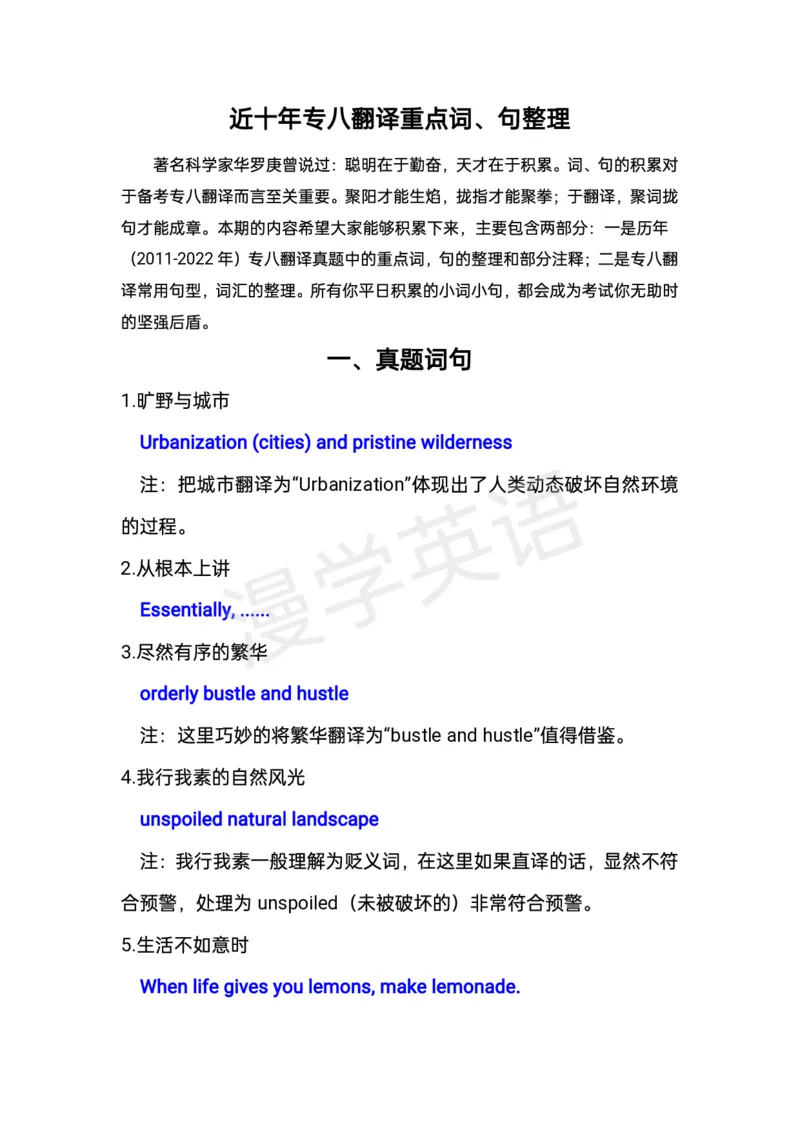
1. ffi l'iD�41-1MHD, hA.iH5C.t#, U¾V) 1 -J.i:iH, P]"ffl$1-#ftlilllHHd:lll!. �-lim-¥r "Bf
ti" xt•. �£� "�m" ¾»---••••�k®1 f�. »--Fox��1".l "�B" � "•$" *•· �•�¾M
W®::f¾�*• i&ffilwBt*ffl city, '&ffl*MW�, Ml�� urbanization.
2. ".$" w1-J disfigure, .,\!!-¾ to spoil the appearance "ffl�7r�" , ��m��ikffl�TBttiffi��;,r*
,, '
ffl�it-. "�� wjg hustle and bustle, ikml�m9'1,lffllffiitll�f'I:�. "ftfr'!Ut" ::f¾ffi having ones
own style, !1!$¾s.!i\• "ffi�*��. ufilft�, 1'r�W' , ii1wjg unspoiled, .,W,¾ (of a place) beautiful
because it has not been changed or built on, �ifX.
o
,,
3. ffi2ElttllmlT 1 i1- "rti" , ffilwBtffi-1-fflthe wilderness, jl;�fflit�{�, :i!l!�I� o "�� � "�m"
t£�ift9'1�1&$1"JP]"l;J.*�• WXffl neglect� ignore �p;l;j1-�if�ffl{l!.l�iaJ*il !AJBttf ignore Jru�1J□ much
,, o
less, *ffi "!1!::f�� , 311-�«-mlp;,;j1-1"JZlaJJiu1��$1i:o "ffl*ffl"r" ffi!m 7 ffiX�%:i:-t, •wjg�l"]ffiiH
live in harmony "/B]il!Jt" t£�£�--W,¾ "�/B]" , wjg space, ::fwjg gap
o o
� "•�rtiM¾-�A�§�" ¾Am�x.i:'iD, lllw�.i:*��ffl�*� jg«-mlffiX�ffiMtt, wx¥tffi
o
X��l"] ... � .. 1fl"i��jg�ia] kind treatment, #¥fjl;ffl�.i:ift
o
5. :fi:Fo-'iD� "�/tt" ::f1LRwjg defeatZ��1".I, �£#��ffi ttJf, ��9'1� "/ttfi&" , ®¾�m�rtiim�1-i:!ik!Xt,
1fwjg prevail, !1!9!�:ili:ffixiHm
o
#��Jt
Urbanization has caused the displacement of original inhabitants in the pristine wilderness, disfigured
its age-old scenery, and increasingly substituted its unspoiled natural landscape with the orderly hustle and
bustle.
Nowadays, the wilderness is shrinking with each passing day. However, it should not be neglected,
much less ignored. Instead, we are supposed to seek out the optimum space where we may live in
harmony with it. Kind treatment of it is equivalent to the same treatment of humanity. It is noteworthy that
humankind will never be able to prevail over it through urbanization.
PART V WRITING
liH'�tiifi
Im§ t&{:tli�p;qm-x•m�N ":l!□{iiJ�:fitlc*" m-m-rmw;M�fifi15£TWT$:l�i!�Jl� �P'tR*¾tff� !Hf
0 >
�ffi;pfl*� �#lll!��p;q1-£;;'js:ffiJltl: -¾�'a'ilrA {fHt�¾t£ili'J § B::Jcr!t£ili'J�$:-!f; :'13-1-ff°l¾$:-if:,,js:�
o 1
.R¾���:(ftf, ¾A1fJxt$>1f�i5fl!J!1J51�7 e ��•lfm&1iiZ
o
m=m-1�w;M�iA.1-J·l':lc*ilrxt e ��7!��«-�
t£ili'J, -t�Jl¾Jiu'&� § BX'tJiJr�::t!J•lf�#r!t;.Uk:tif�fil!*�!:tmJJ'l:Bt*�:fi·l':lc*• ffi;pfl*�iifu�¾�n(,iJ·l';/c*�
��. @�«-nffi���m::fPT�m �!:EPI!;J.*�l;J.�x•��:
o
ffi-Elt: ,g,�p;qm-x•�*•• t&tll § B��-�: fJiH��1L'fil!*¾'l':ic*�il*•
ffi=Eli: fifi15£:f&$�'a'ilr1-A��r!, �Jlt{�H�fil!*�,i:.,J11!¾t&f\-·l':lc*�I���
�m) o
m.:::EJt: fifi]j£fil!*ioJ/m ( :l! □ ��-!:Elll!�ffi;pjl��'a', i1"i�Pl"J1-A�¥Wi�
1 o
ffiriYElt: ,g,��x. m:$�.�
o
mx
The first reading material mentions Stoic philosophy as a means of achieving happiness. The Stoic
wisdom for living a happy life is to avoid attempting to control things that, in fact, cannot be controlled
and to refrain from passing negative judgements on value-neutral things. The second reading passage holds
that happiness can be achieved by conquering our minds and bodies. I would take the view that besides
cultivating a healthy mind, maintaining a healthy body is also a source of happiness.
On the one hand, much of human happiness or unhappiness originates from cognitive patterns, the
way we see ourselves and the world around us. One poor cognitive pattern is to aspire for perfectionism.
�}\. 2022 -13As we lrnow, perfectionists tend to be dissatisfied with what they have done and feel that they could have
done better. Stuck in a negative thinking pattern, perfectionists are less likely to be happy. By contrast,
people who are easily contented are inclined to be cheerful. As the Chinese saying goes, a contented mind
is a perpetual feast. Moreover, our reaction to what happens determines how happy or unhappy we are.
An optimist sees an opportunity in every calamity, while a pessimist sees a calamity in every opportunity.
Therefore, it is important to "manage" our minds.
On the other hand, physical well-being cannot be ignored when it comes to a happy life. There is no
denying that people afflicted with health problems tend to be more stressed and less happy. One case in
point is that people with incontinence tend to feel distressed and hopeless. In addition to causing physical
pain, some physical problems can even restrict interpersonal relations. For instance, obese people might
find it hard to be integrated into groups because they feel inferior to others and obesity stops them from
taking part in some group activities that require a lot of movements. How are they supposed to feel happy
without social connection? Obviously, being physically healthy would reduce the chance of unhappiness.
Overall, I feel that physical health is the basis for happiness. Meanwhile, learning how to respond
positively to what happens is also significant, as much of life's pleasure derives from a positive mentality.
.-a
:fE jql j[
refrain from :iM�, 5l $1 value-neutral adj. ffr{i\ixW.�lfl31.�
perpetual /pa'petJual/ adj � . * 1]( • .0-. �, 1Xt1!� feast /fi:sU n. {t,Ax_x·l;lc�$� ( �fis?W )
calamity /ka'lcemati/ n. w\,1!. be afflicted with {t�fttE, ifrM
derive from • § , • -'f
�A 2022 -14