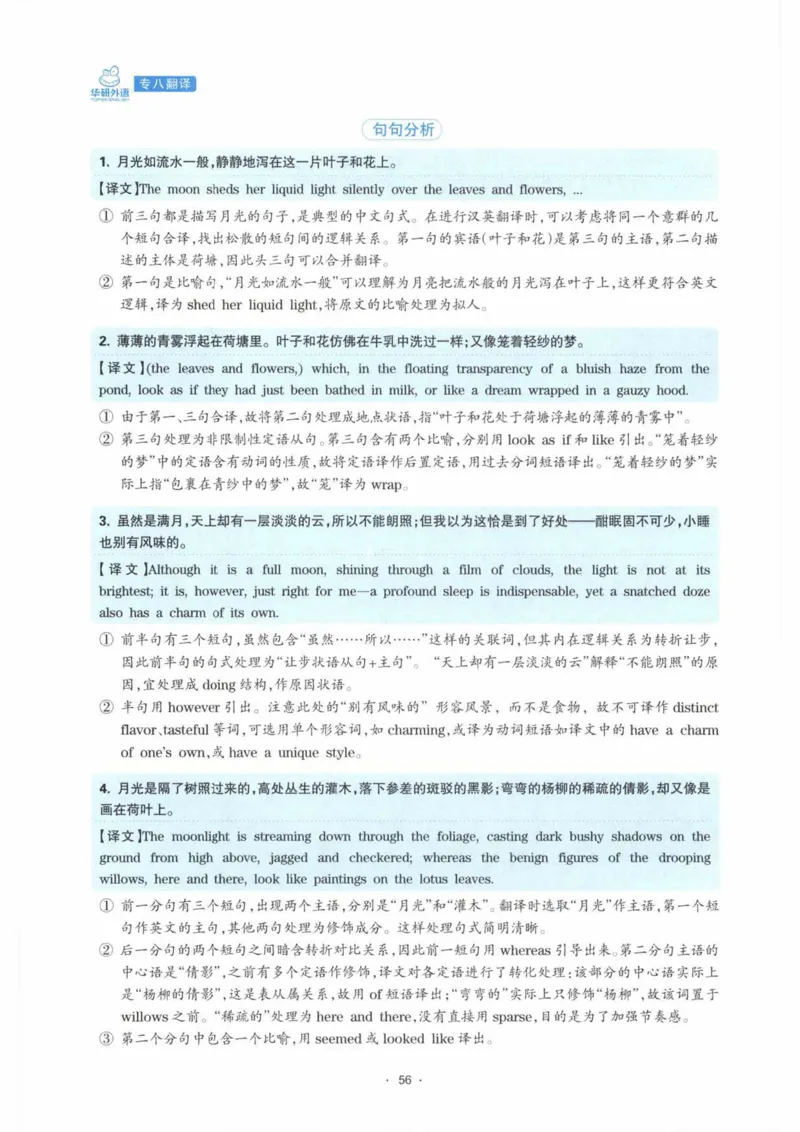
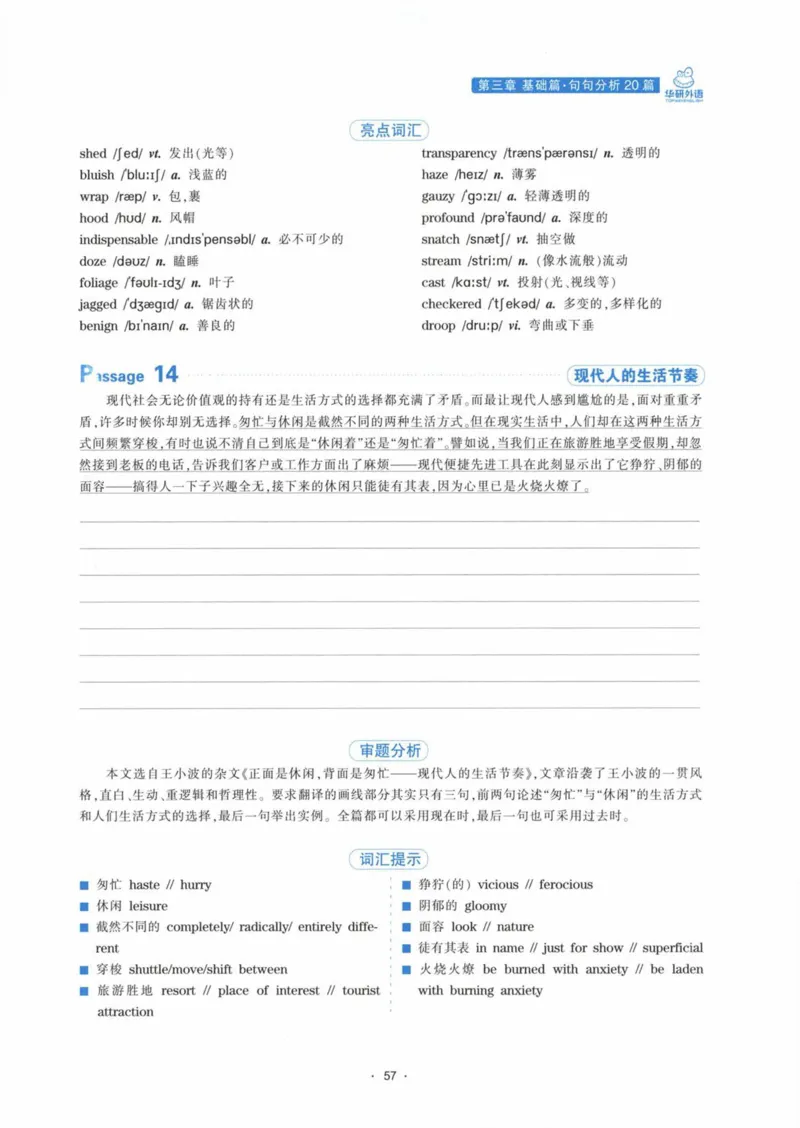
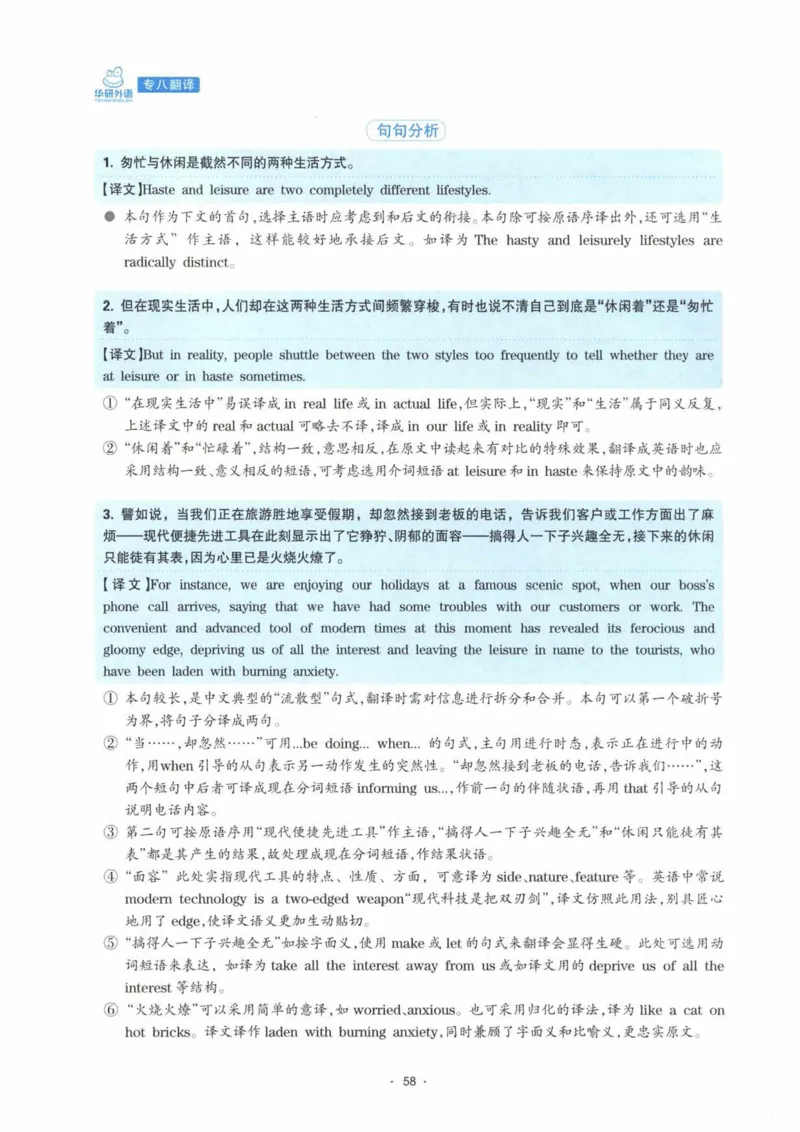
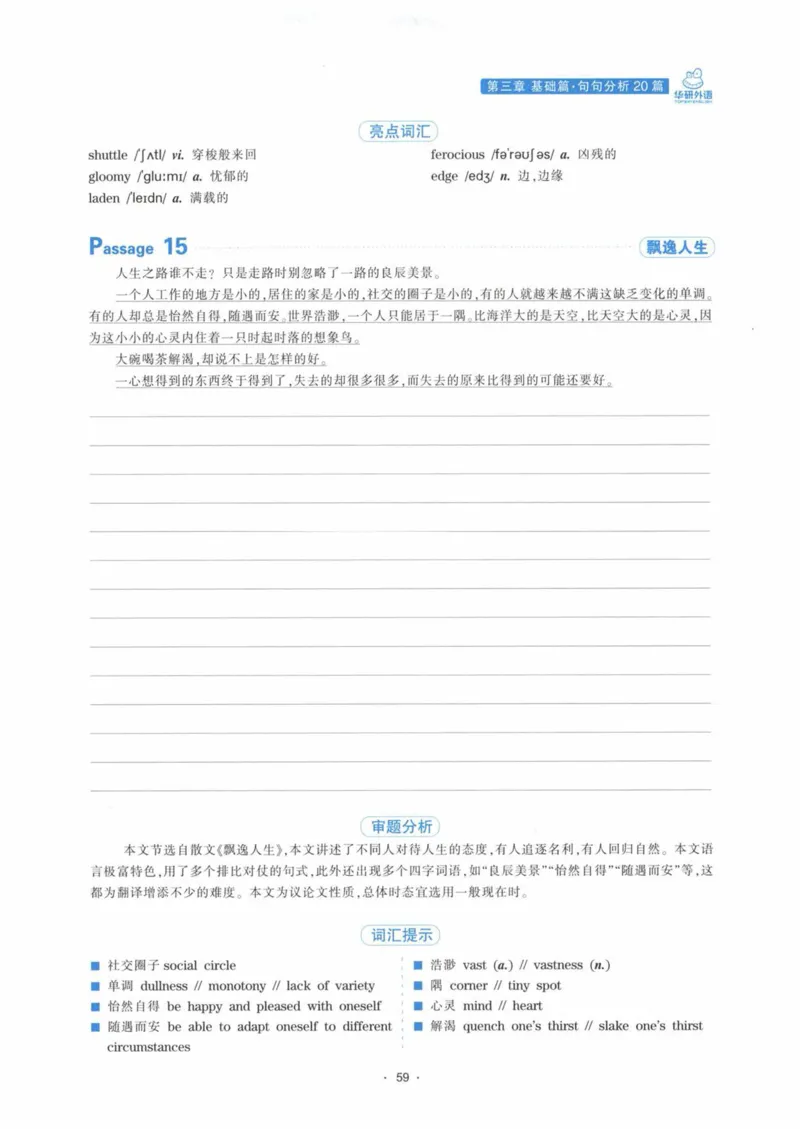
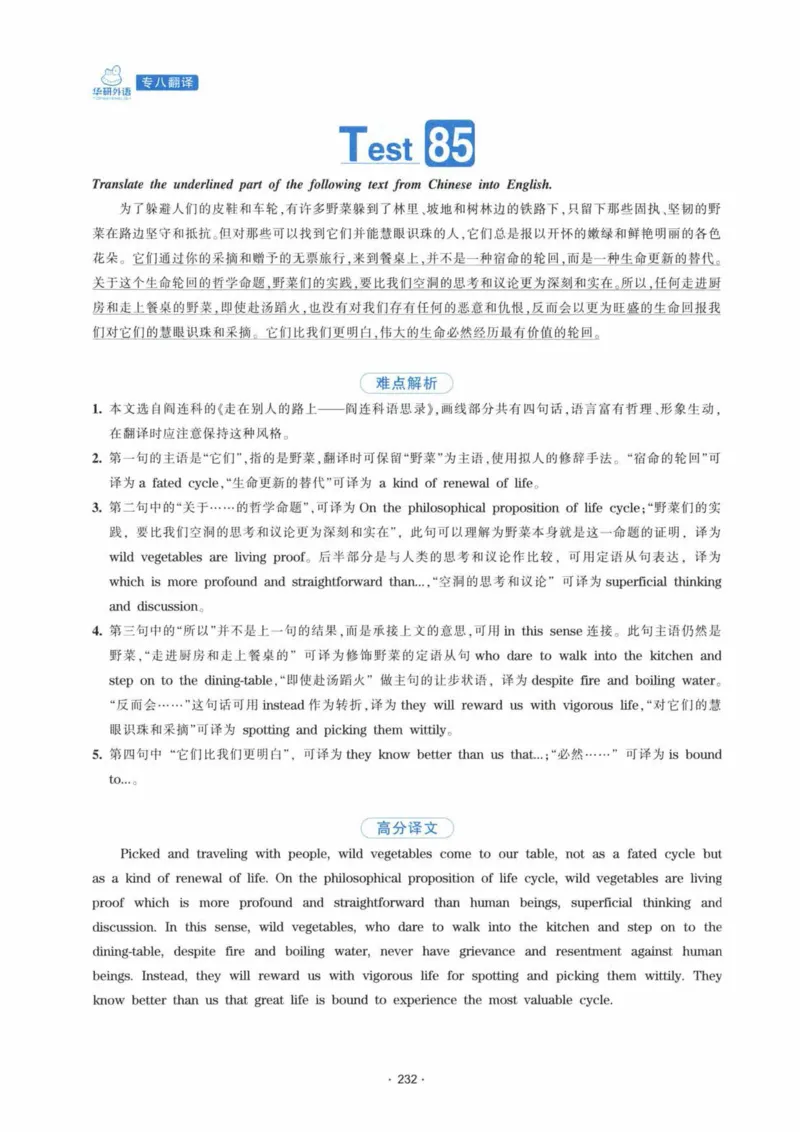
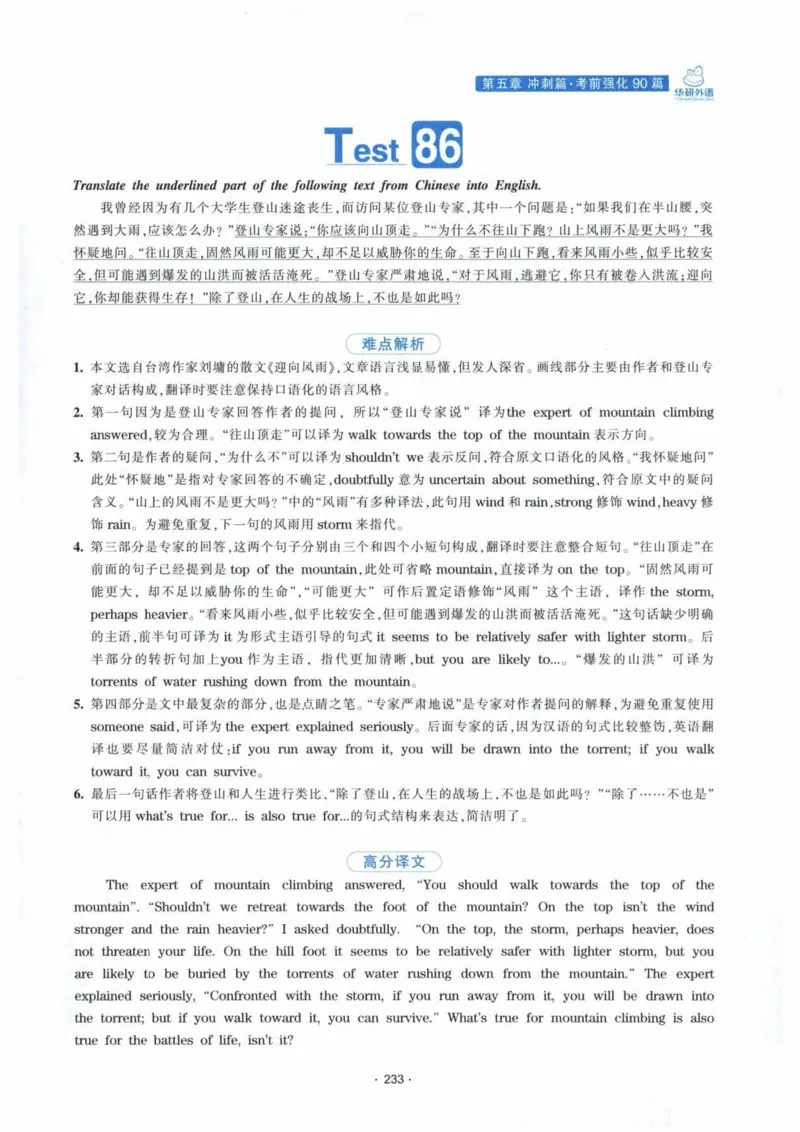
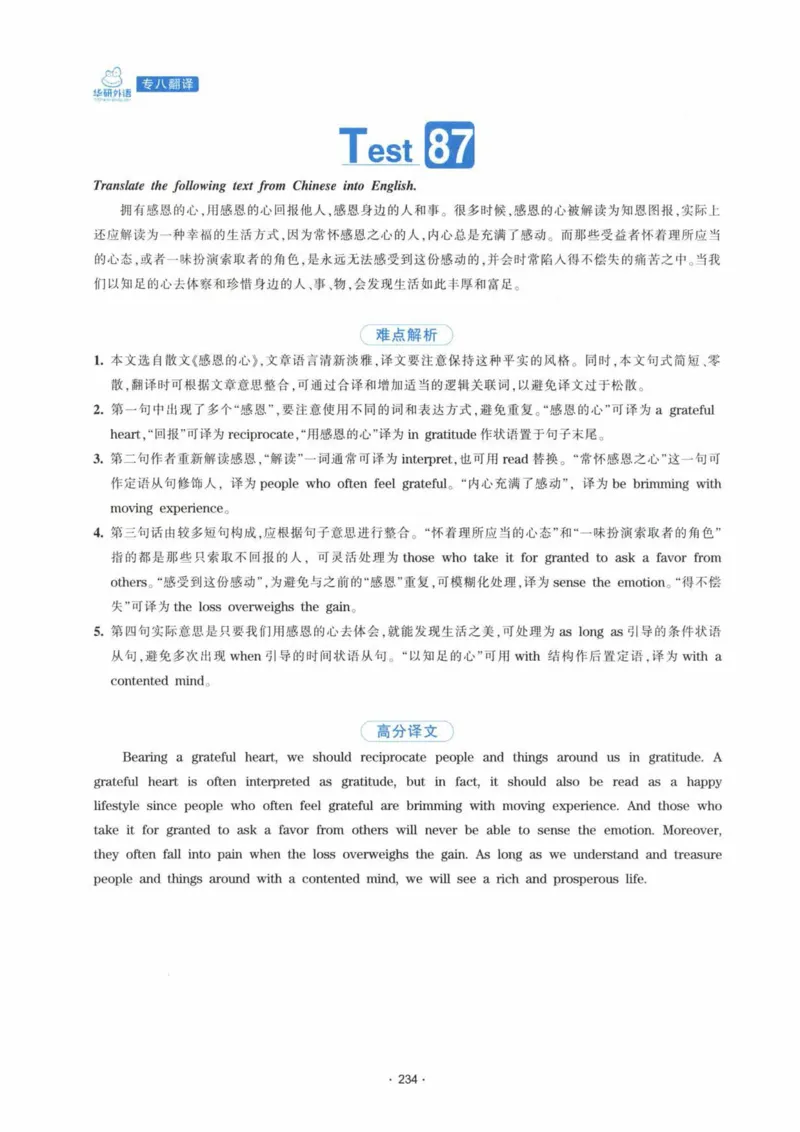
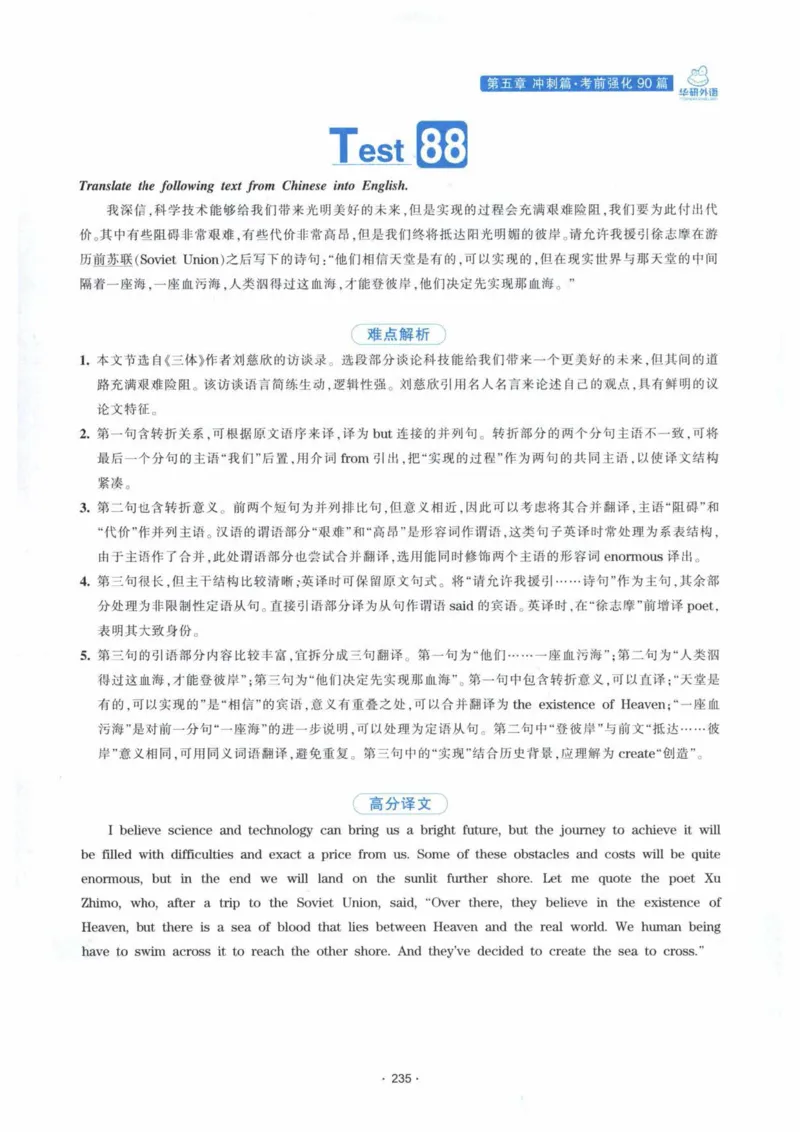
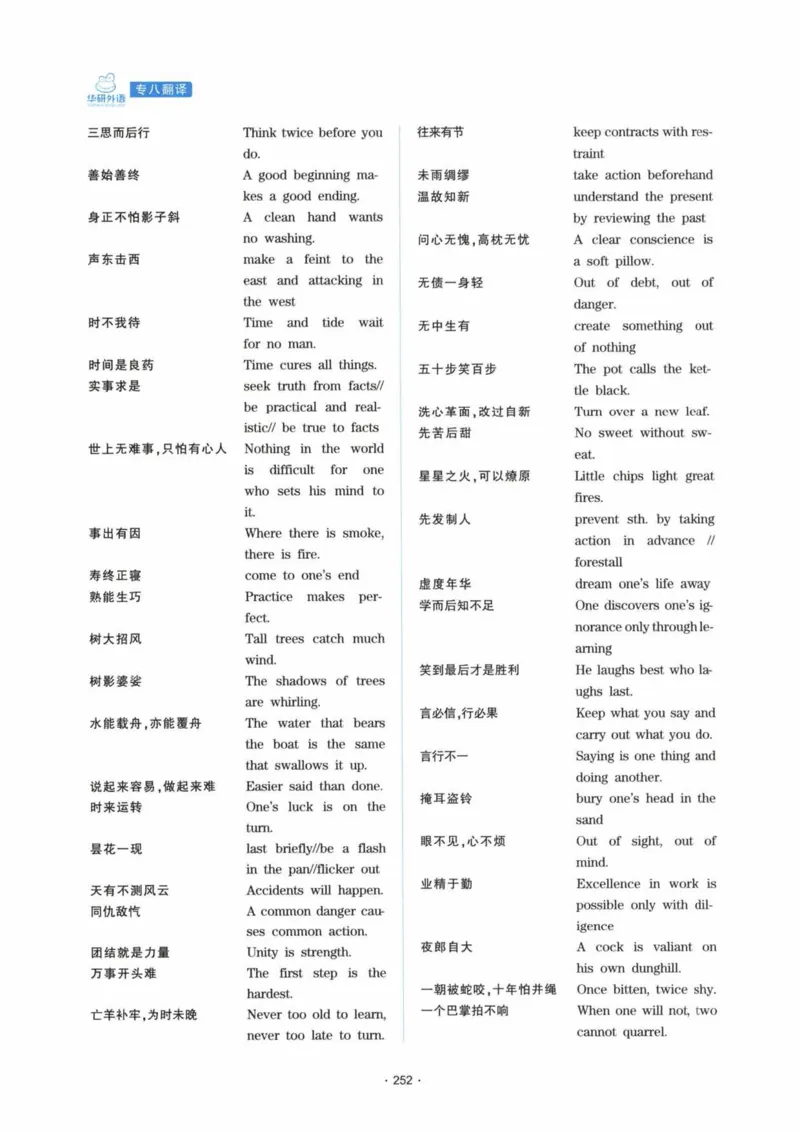
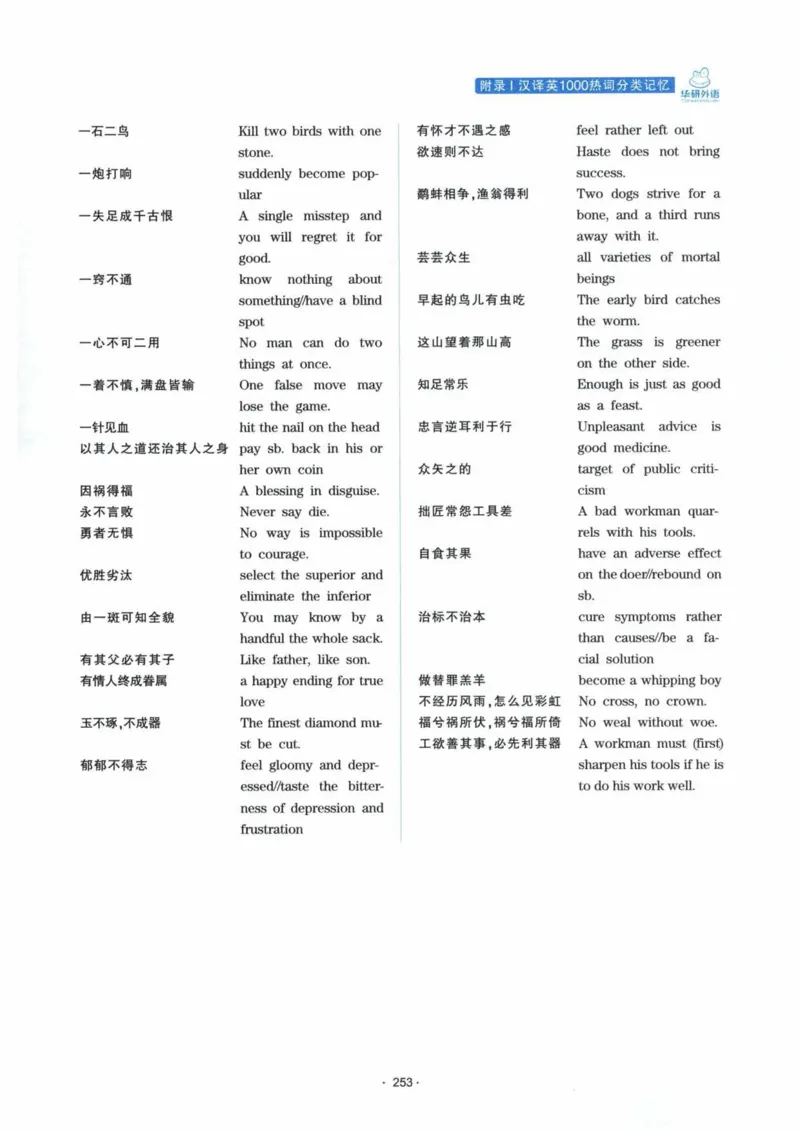
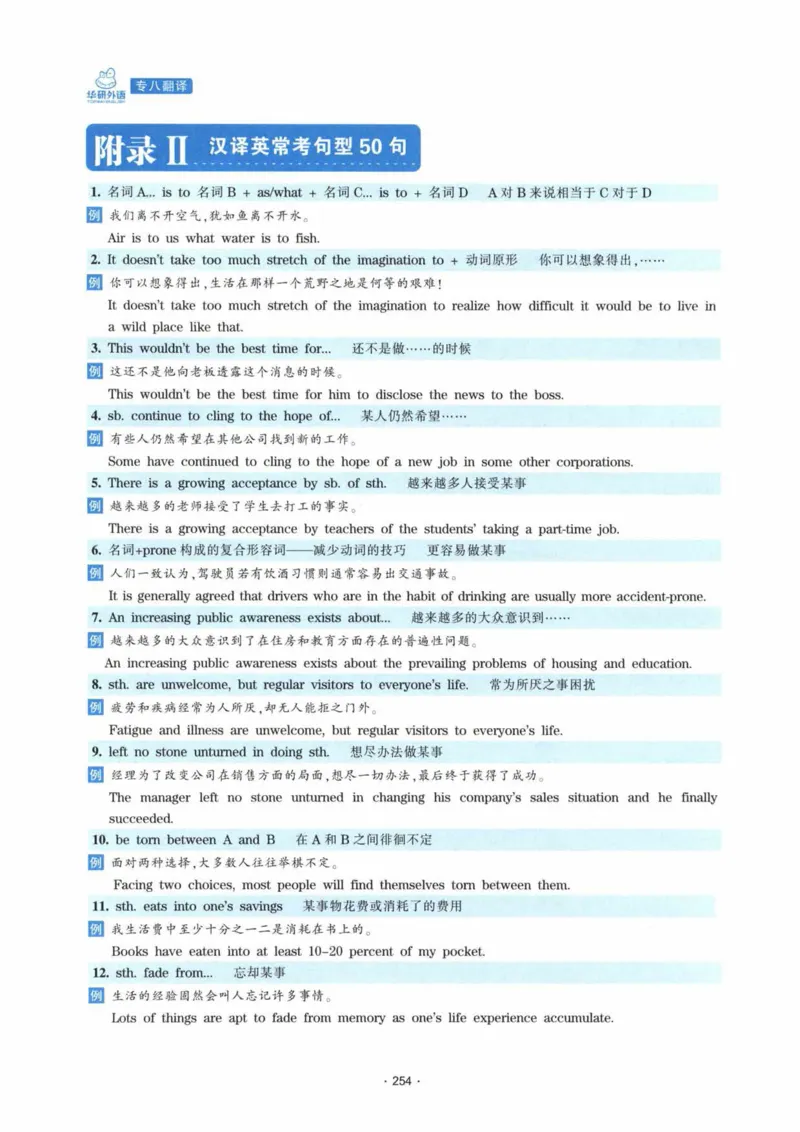
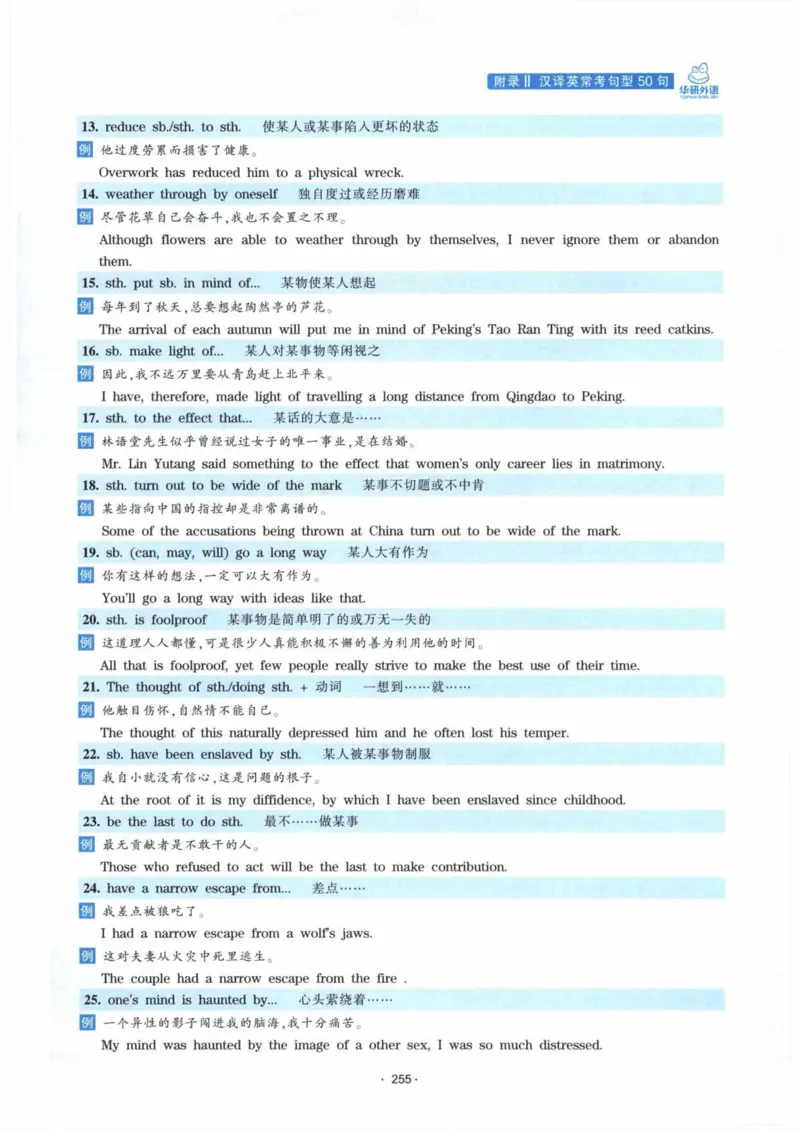
文档内容
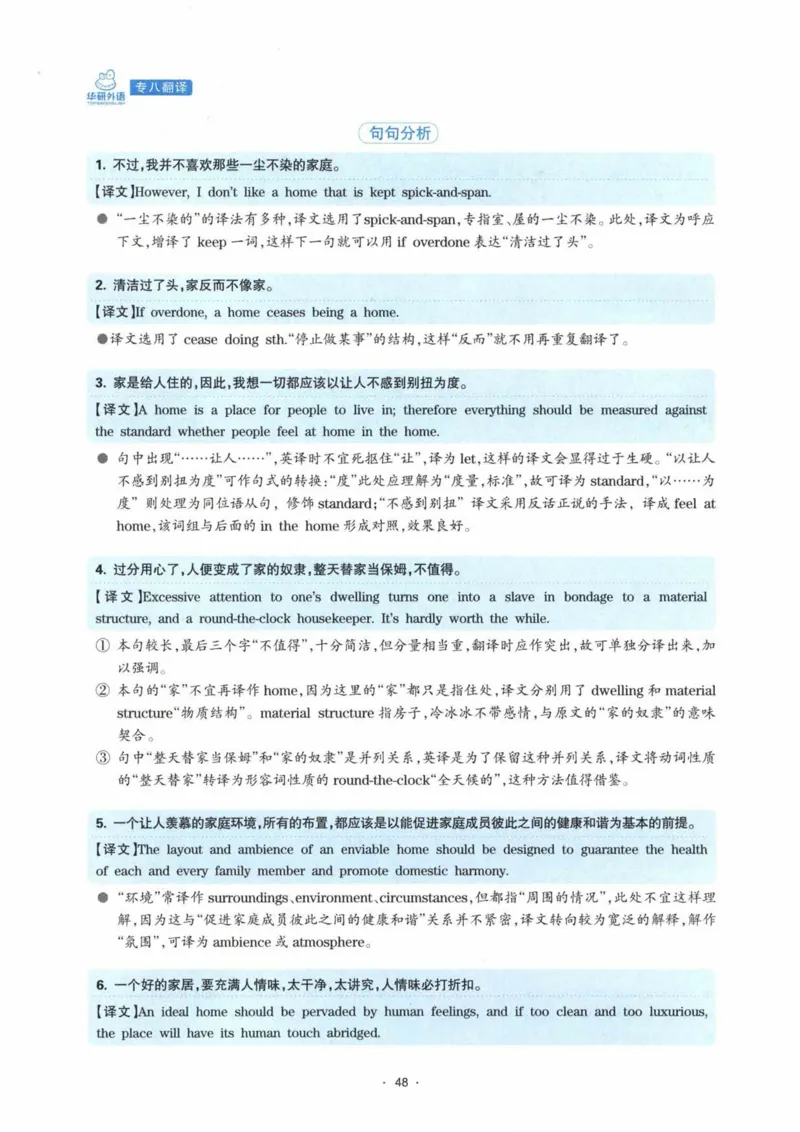
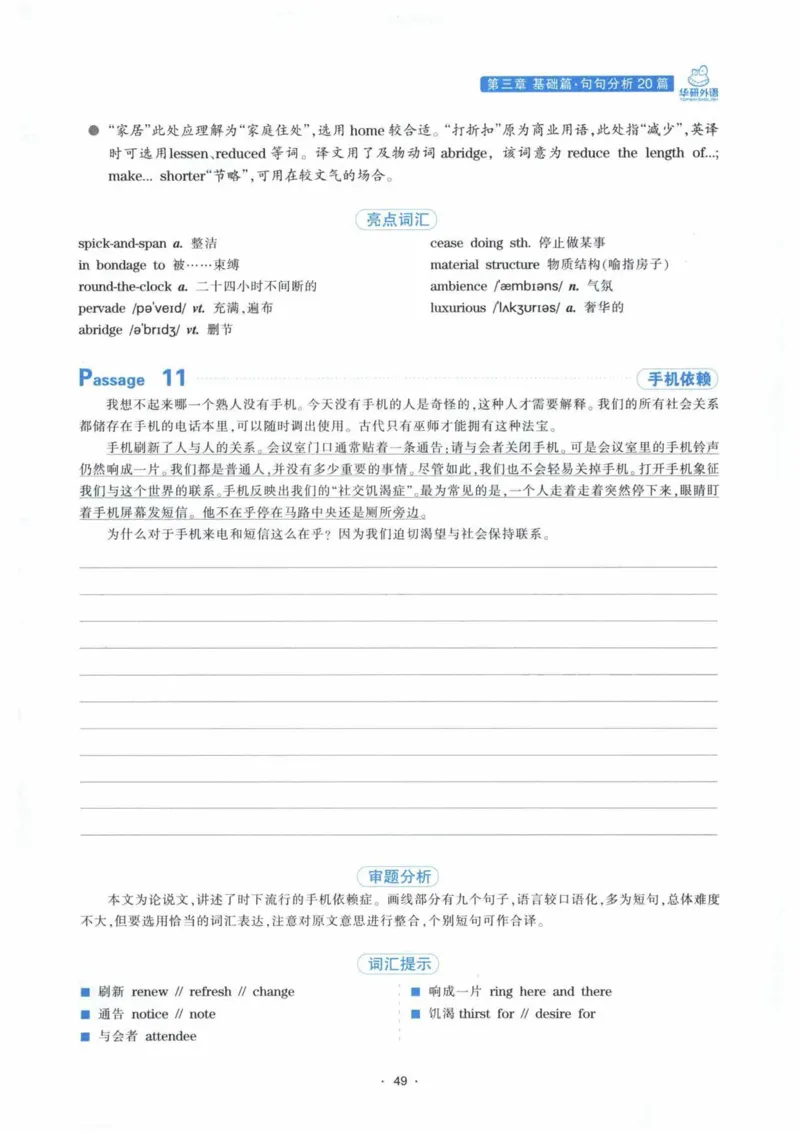
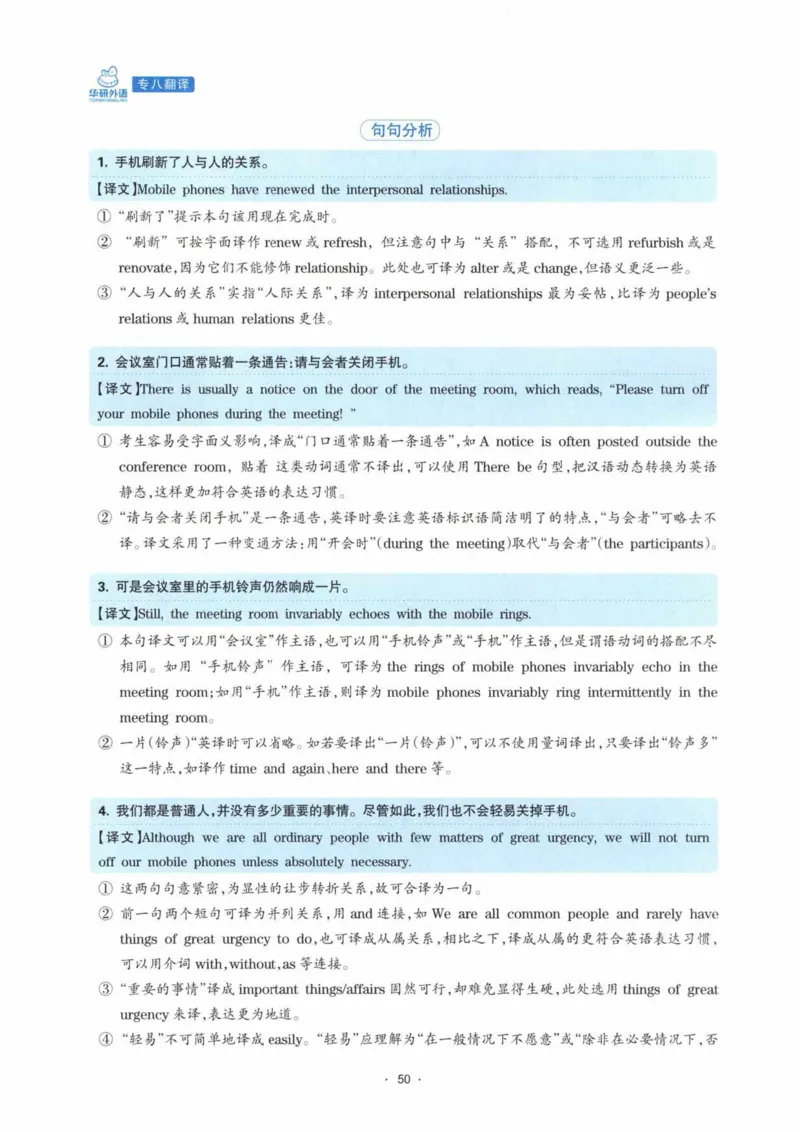
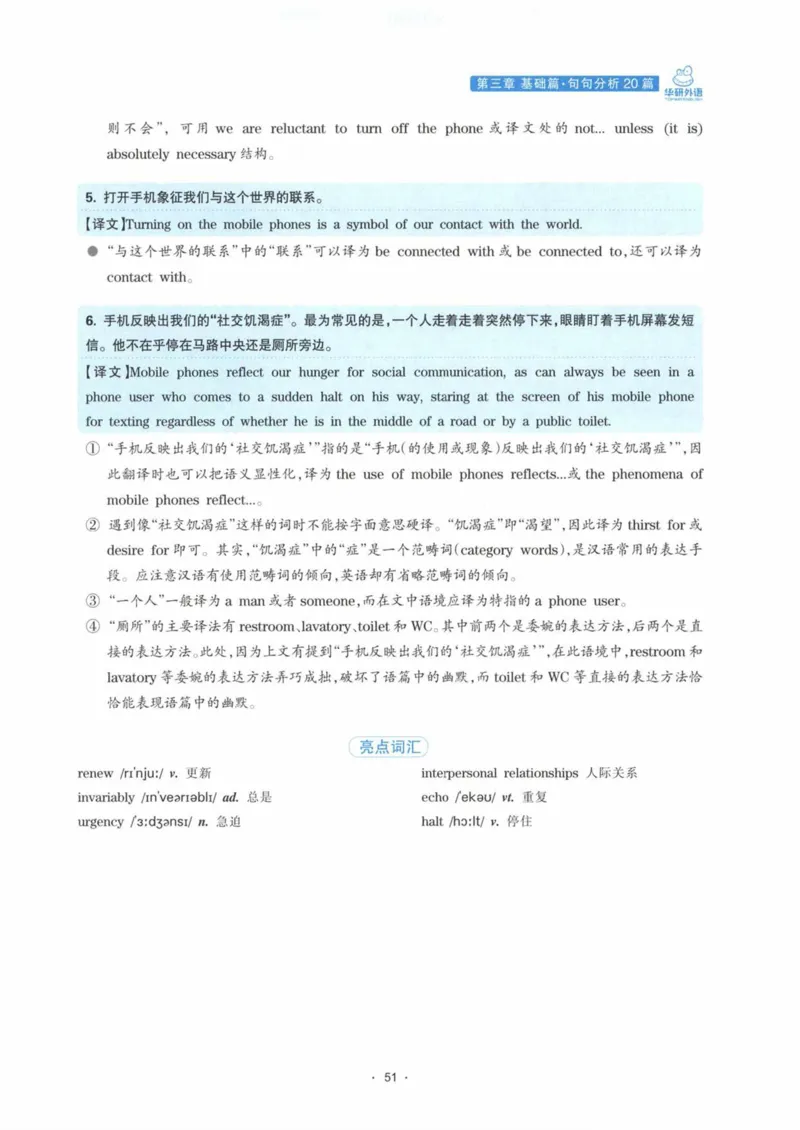
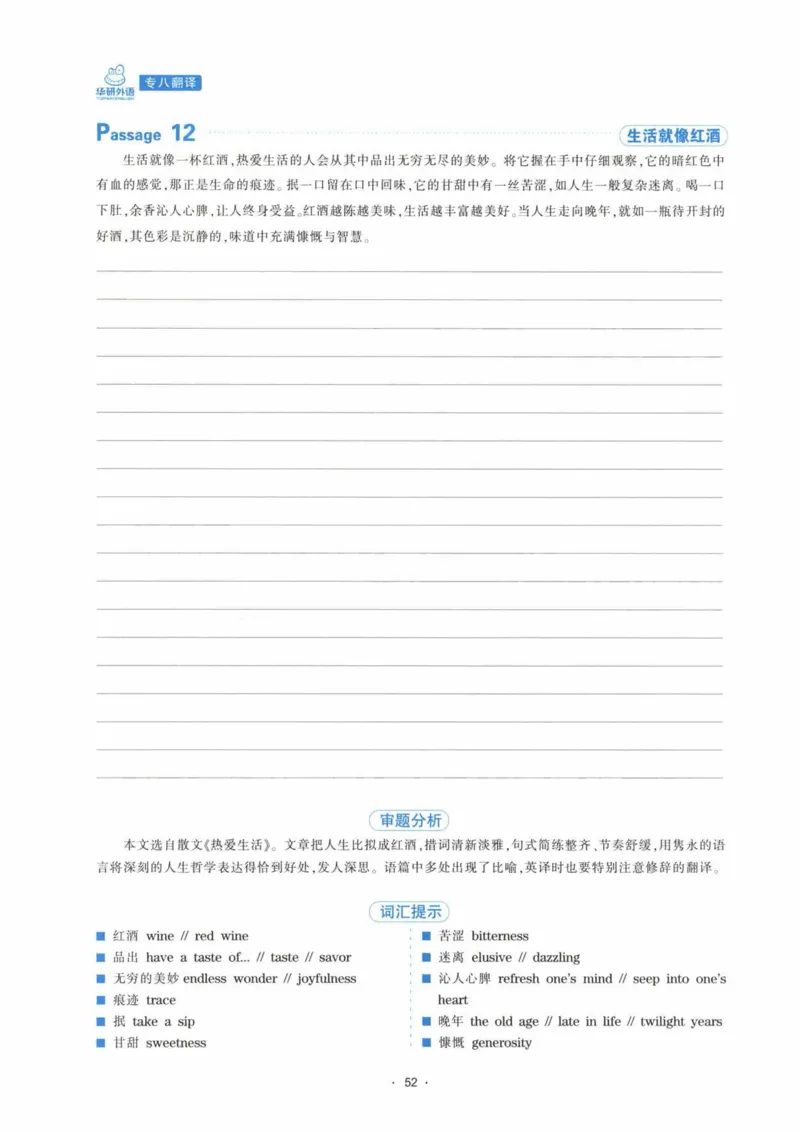
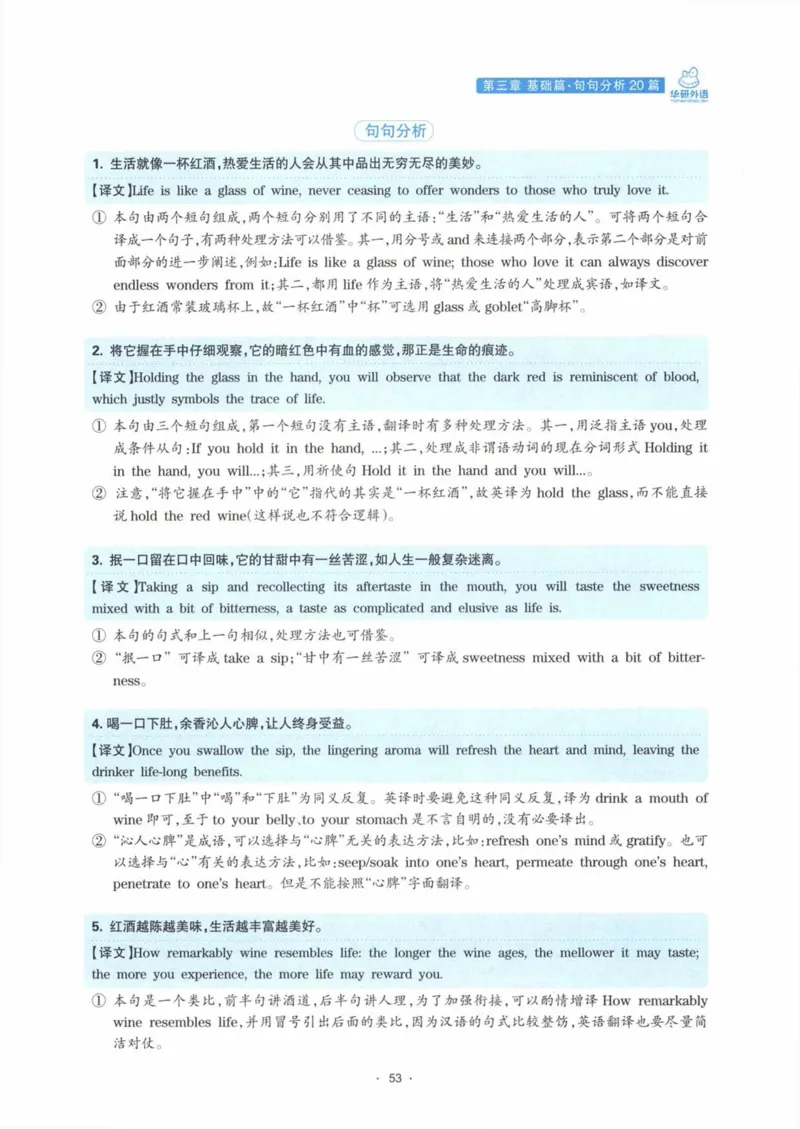
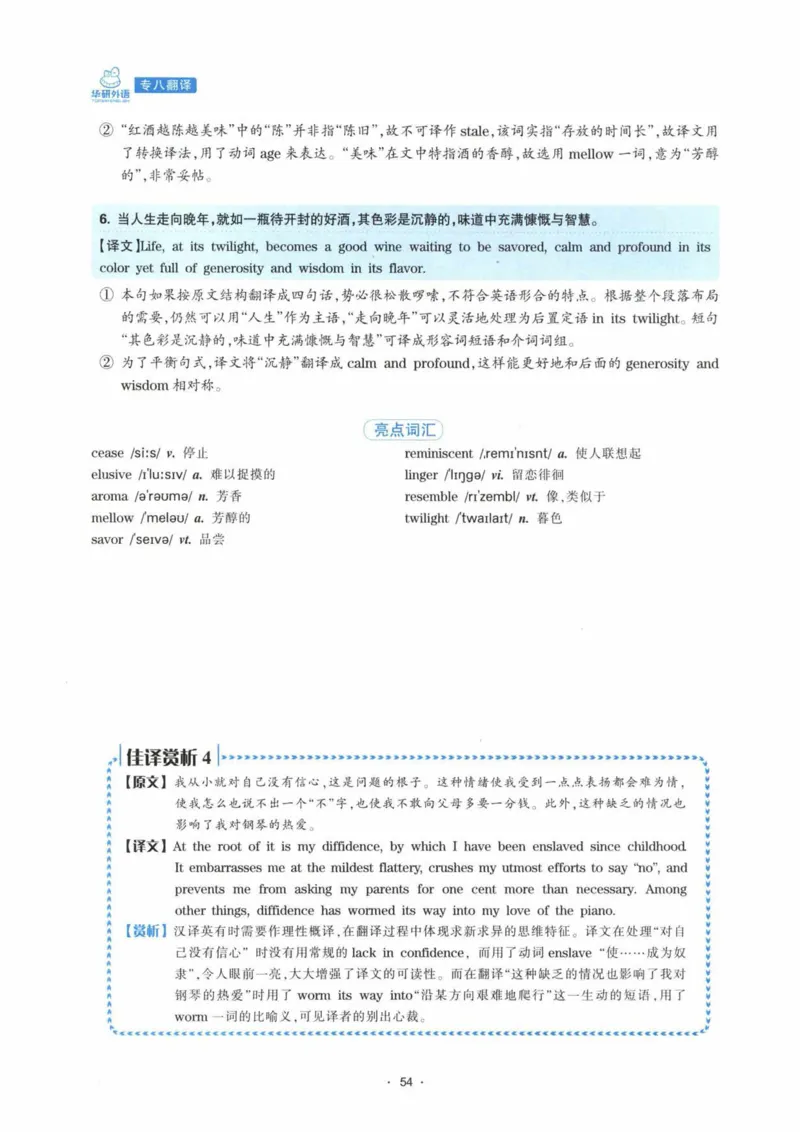
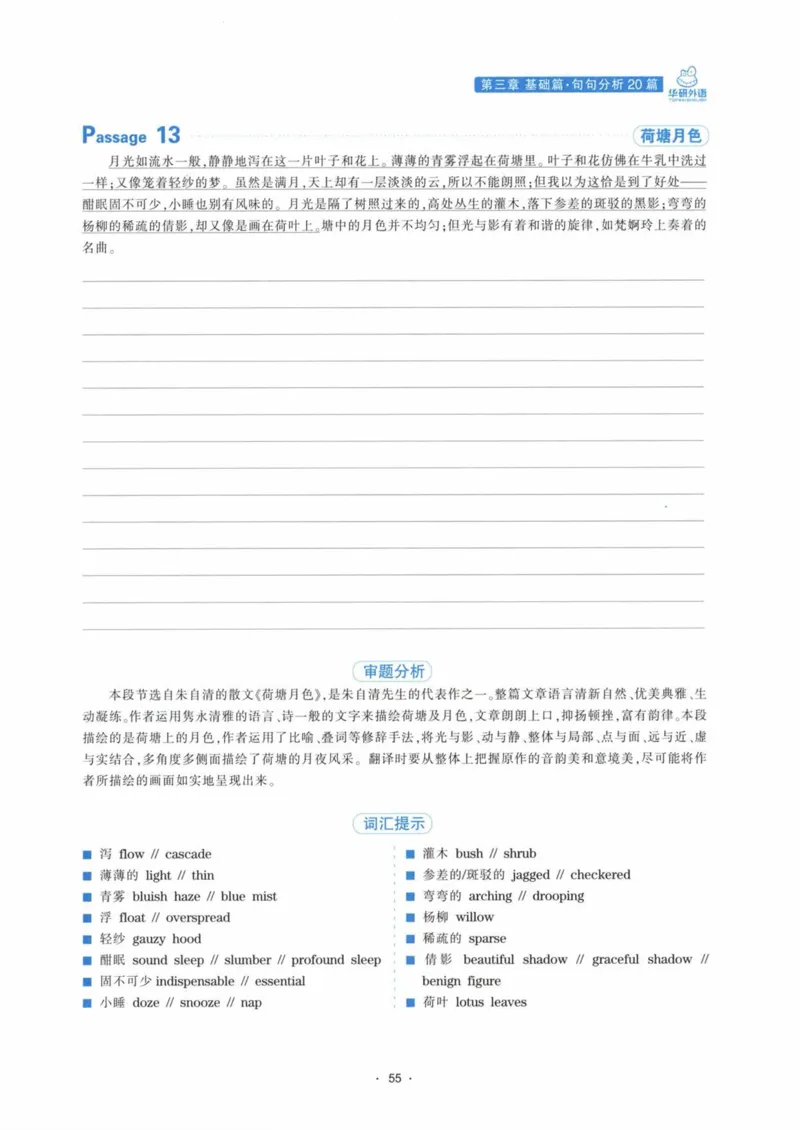
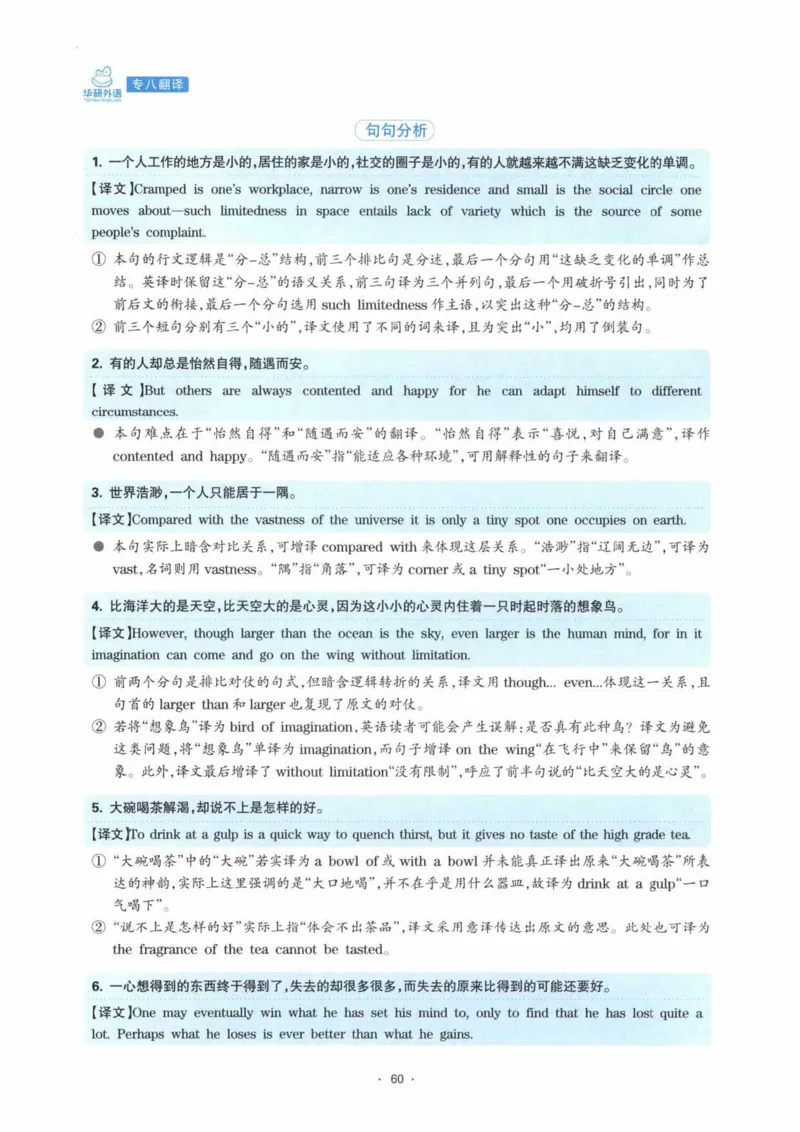
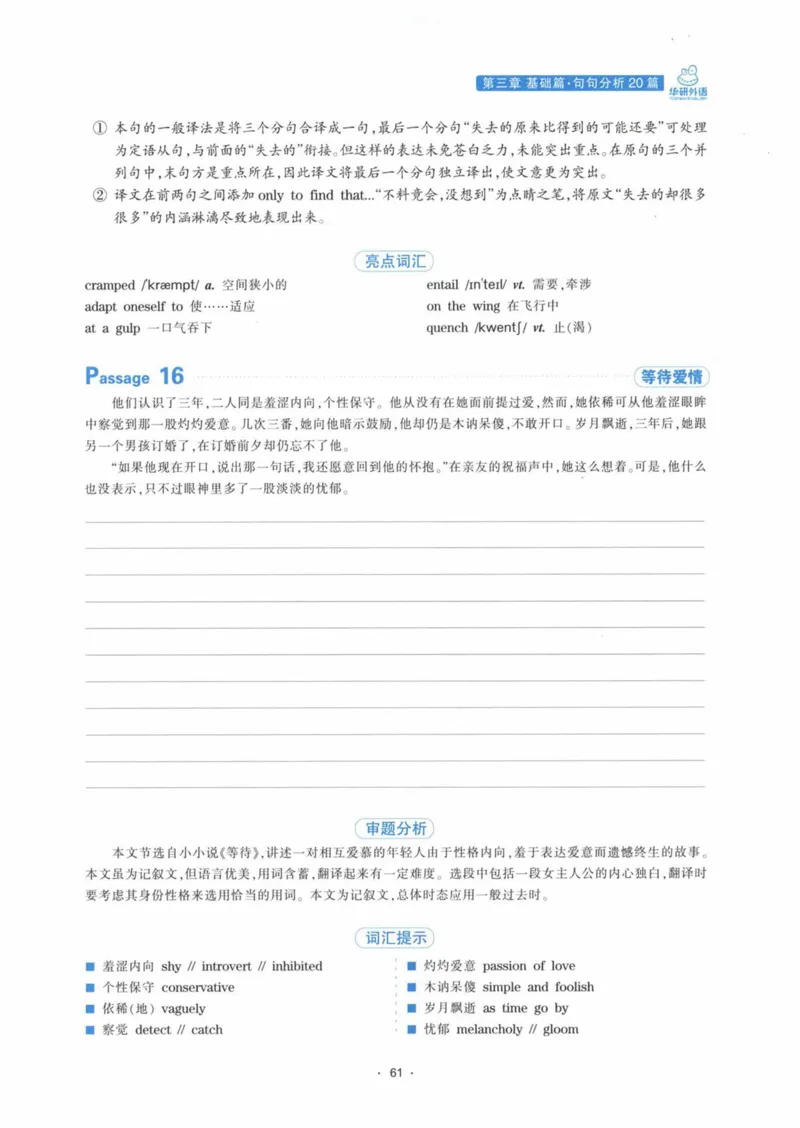
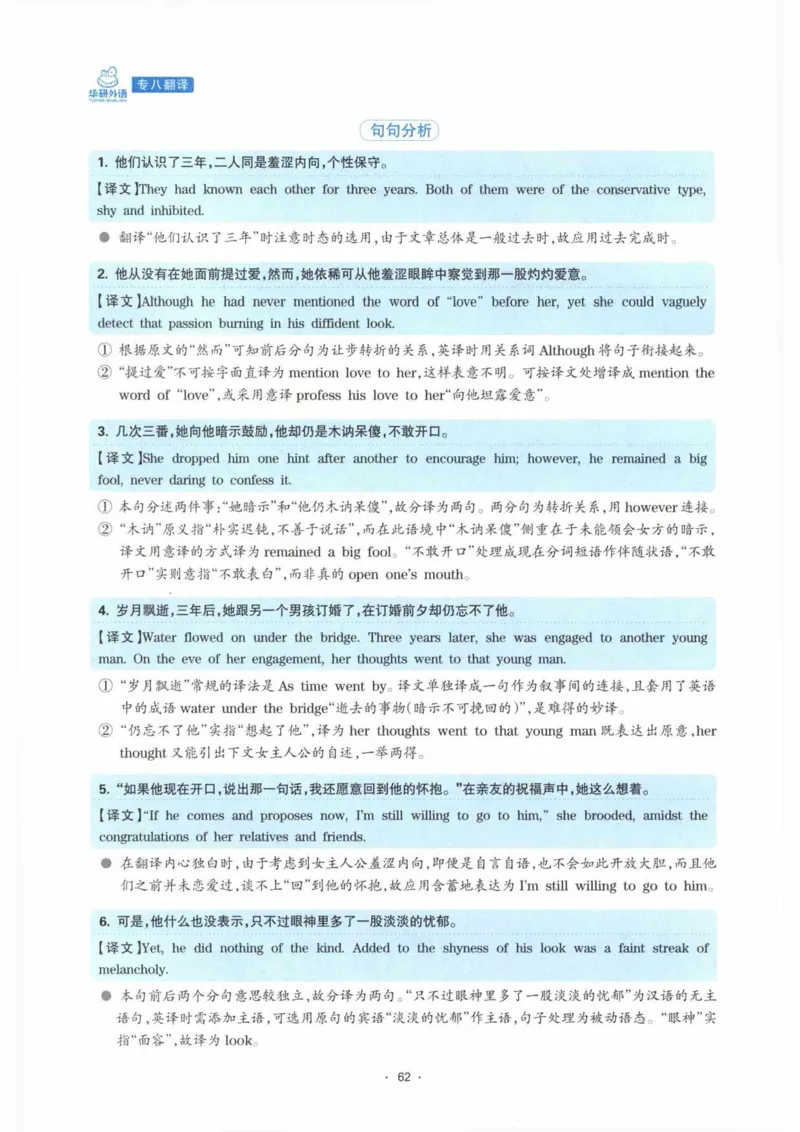
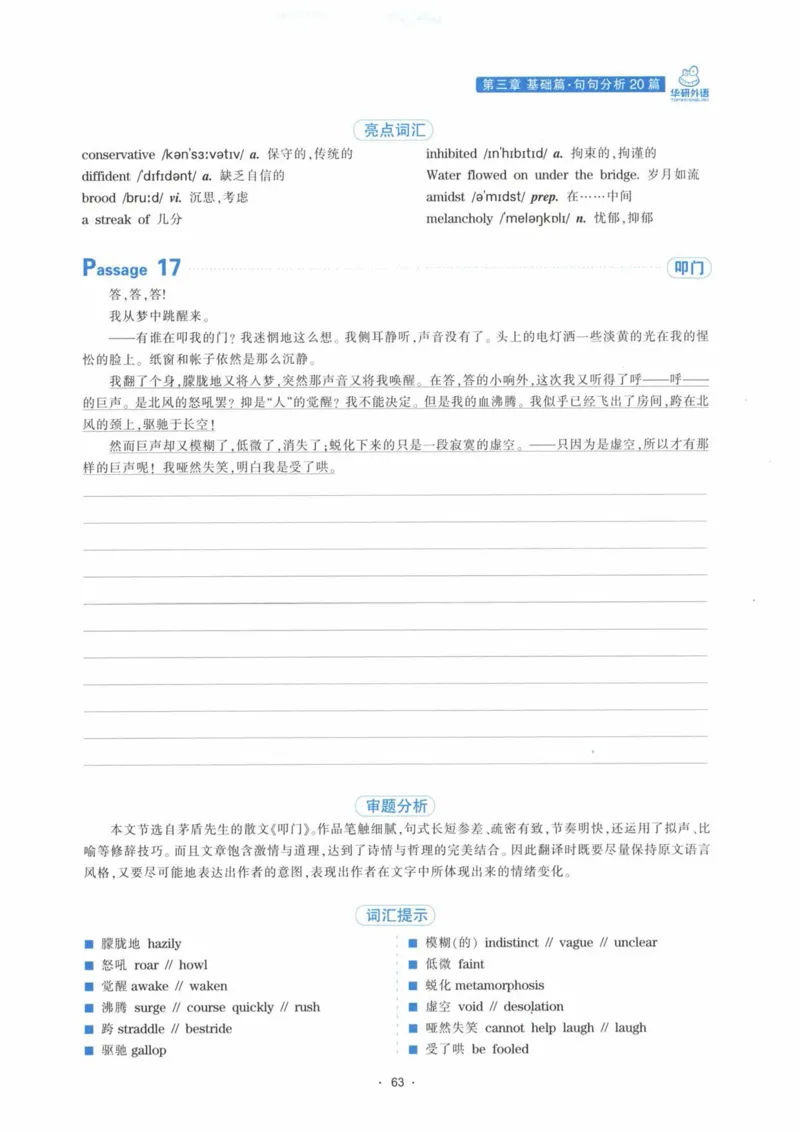
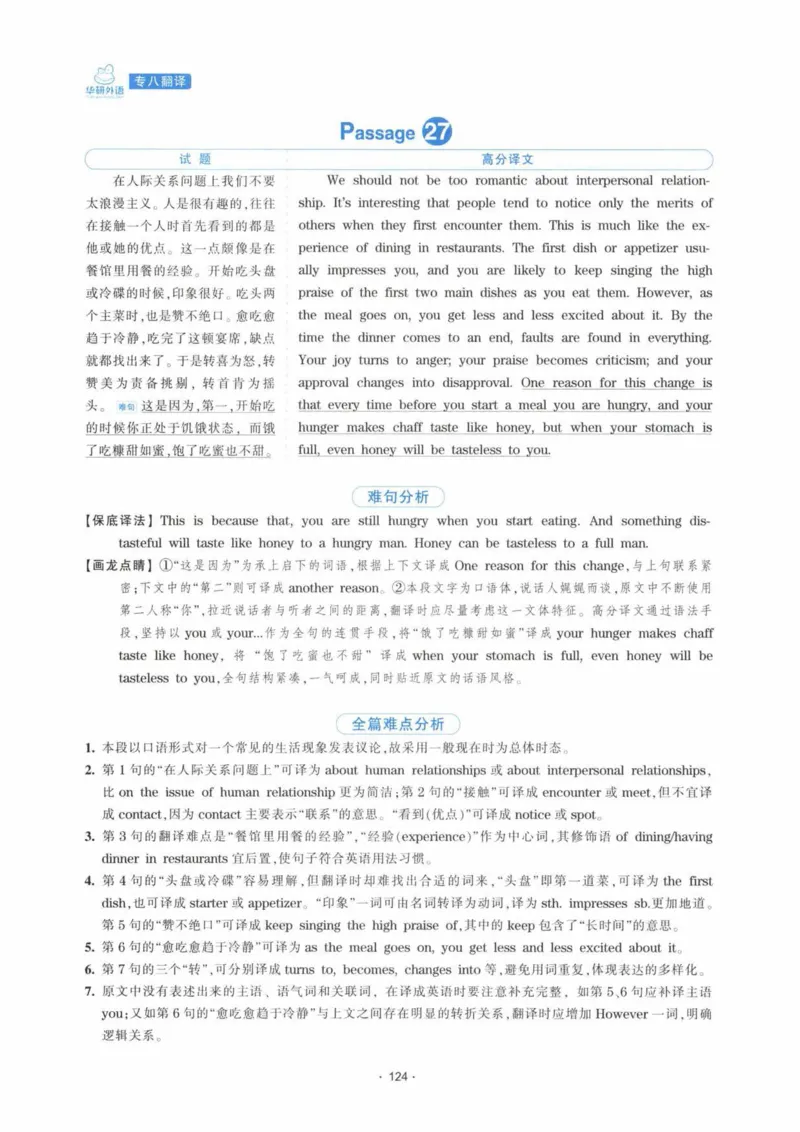
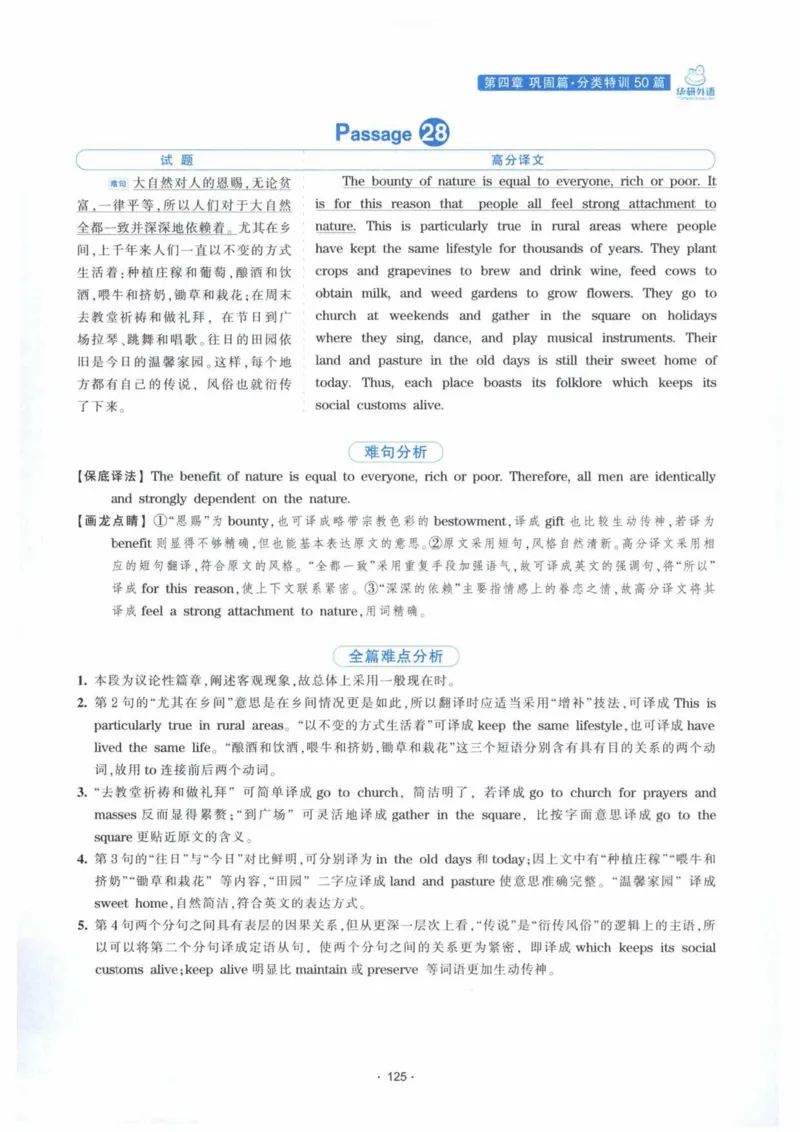
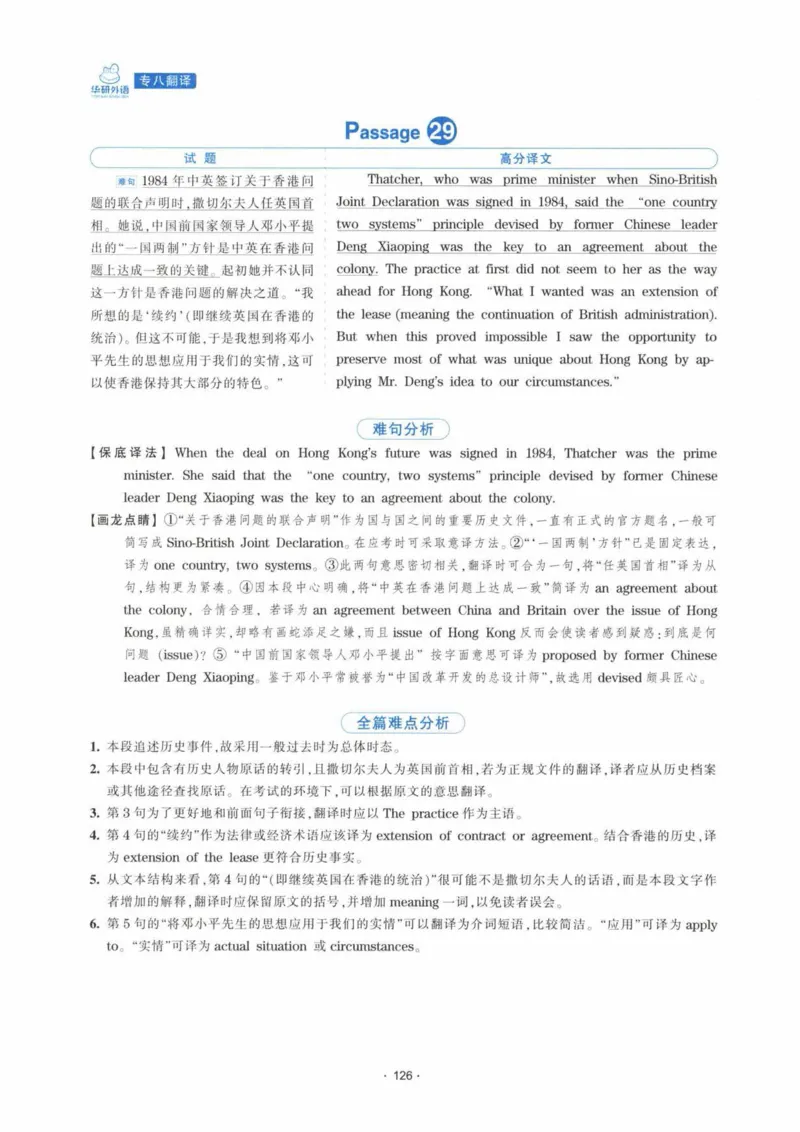
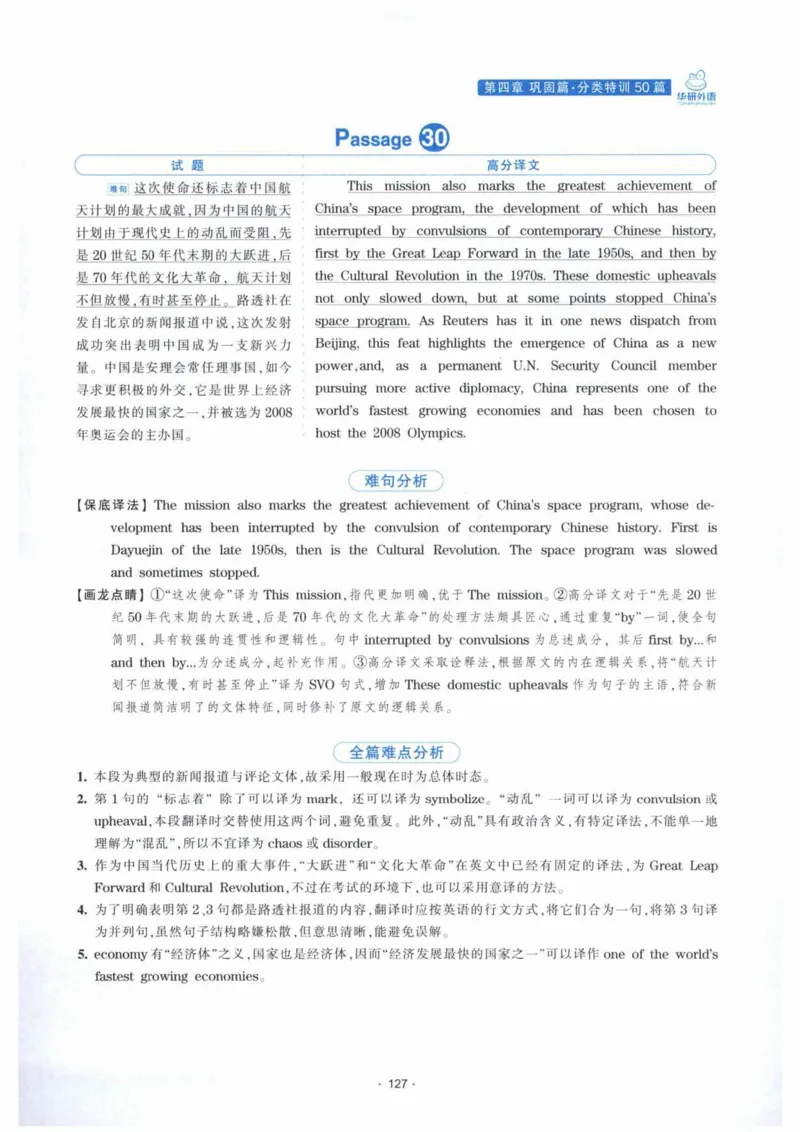
专八翻译题n 2016年起只考汉译英,而答题时间从原来的25分钟缩短到20分钟,对考生
的翻译速度提卨了要求。汉译英是很多英穿学生感到練手的题型,主要原W 如下:词汇jft不足,
用词过于简中-或不够准确地道;英文句嗤单一,只会词对词,句对句£[译,译文生搬硬套,出现较
多Chinglish的表达;平时训练址不足,不能把课堂上学到的翻译技巧运川到实践中,只会纸上
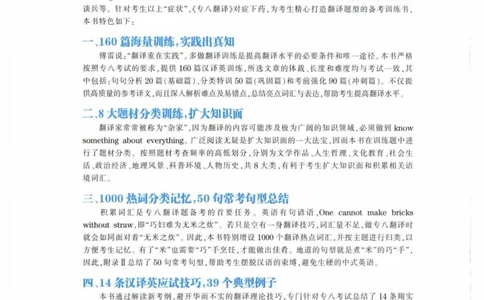
谈兵等针对考生以上“症状”,(专八翻译》对症下药,为考生梢心打造翻译题塑的备考训练书,
本书特色如下:
160篇海缺卯练,实践出真知
一 、
傅宙说:“翻译_®:在实践”。多做翮汴训练是提商翮译水平的必要条件和唯一途径本书严格
按照专八考试的要求,提供160篇汉译英训练,所选文章的体战、长度和难度均与考试一致,其
中包括:句句分析20篇(基础篇)、分类特训50篇(巩间篇)和考前强化90篇(冲刺篇)。不仅提
供高质W 的参考译文,而且深入解析难点及易错点,总结亮点同汇与表达,帮助考生提高翻译水平
二、 8 大题材分类卯练,扩大知识面
翻译家常常被称为“杂家",W 为翻译的内容可能涉及极为广阔的知识领域,必须做到know
something about everything广泛阅读无疑是扩大知识面的一大法宝,W 而本书在训练题中进
行了题材分类。按照题材考査频率的高低划分,分別为文学作品、人生竹理、文化教育、社会生
活、政治经济、地理风景、科普环境.人物历史,共8 大类,有利于考生扩大知识面和积累相关沿
境同汇。
三、 1000热聞分类记忆,50句常考句敢总结
积累词汇是专八翮i?题备考的滓要任务..英语有句诗语,One cannot make bricks
without straw.即“巧妇难为无米之炊”。若只是空有一身翮译技巧,间汇W 不足.做专八翻译时
就会如同面对符“无米之炊”。因此,本书特別增设1000个翻译热点间汇,并按主题进行归类,以
方便考生记忆。有了“米”也需要“巧”手烹饪,才能做出佳# 。地道的句铟就是煮“米”的巧“手”,
因此,附录II总结了 50句常考句型,帮助考生摆脱汉语的朿缚,避免生硬的中式英语。
四、 14条汉译英应试技巧,39个典艰例子
本书通过解读新考纲,避开华而不实的翻译理论技巧,专门针对专八考试总结了 14条翔实
的翻译技巧,在理解原文、间汇的选择、如何确定主语和谓语以及句式的选择这几个椎点上,为
考生提供应试技巧。同时,本书选用了 39个典型例子加以讲解,并且大多以历年M 题为例,让考
生在实践运用中掌捤技巧,从而学会举一反三,具正把翻译技巧用到实处。
五、 100句姑错句卯练,16条佳译赏析
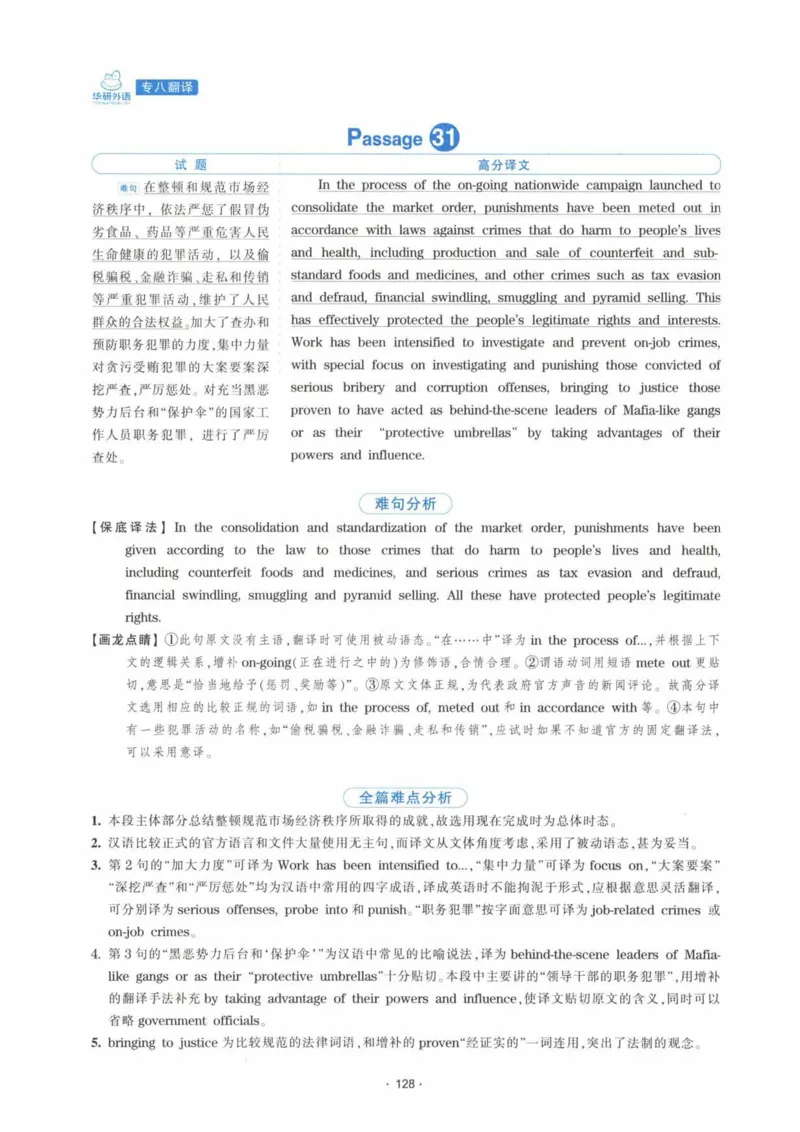
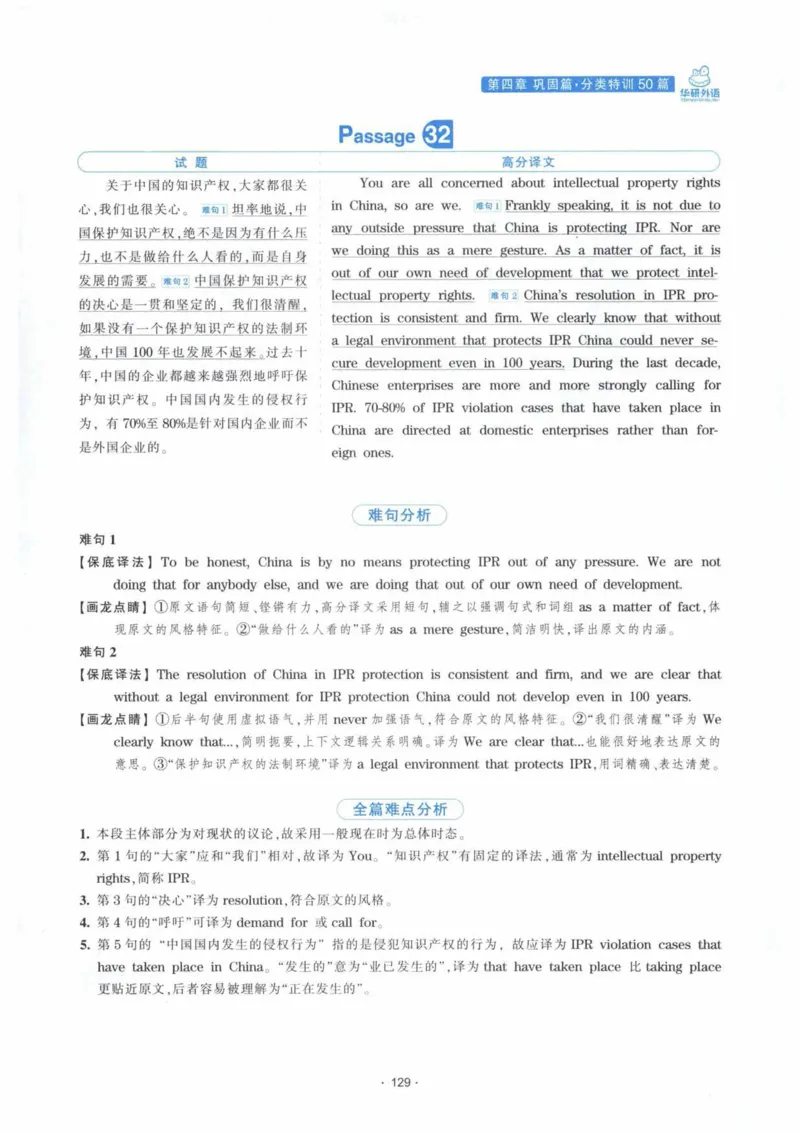
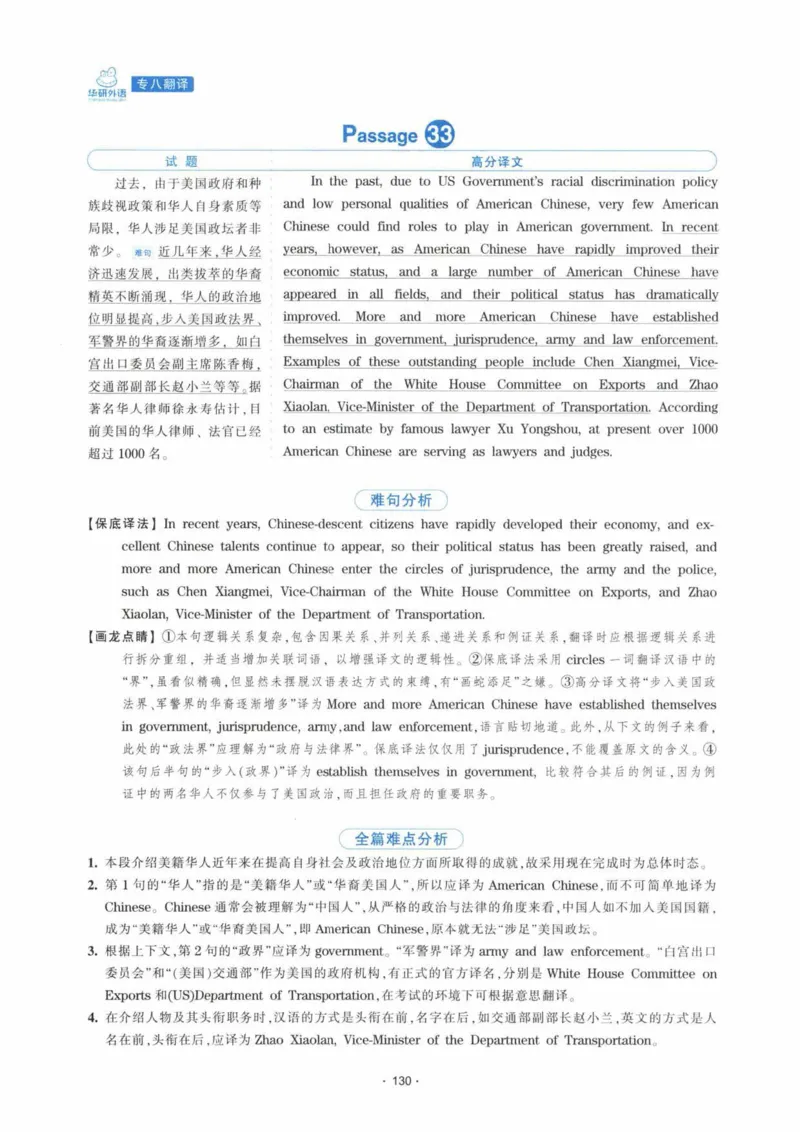
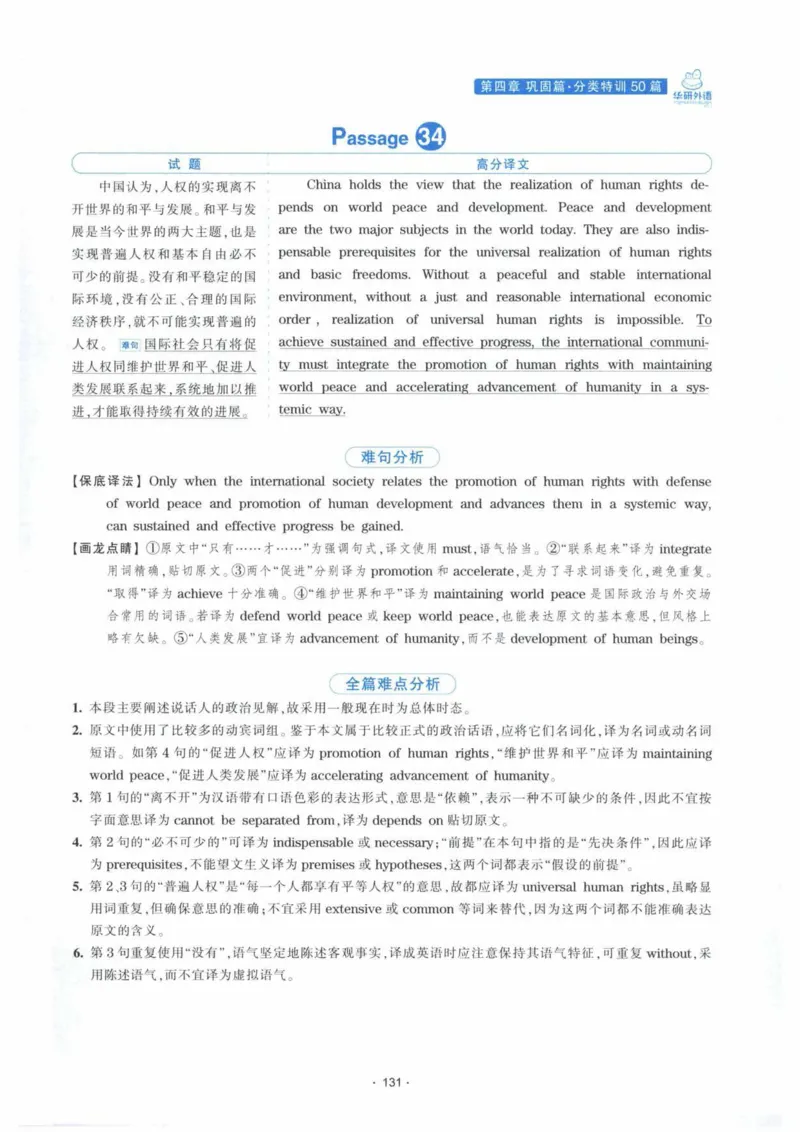
由于受到母语思维的束缚.有些考生在翻译时往往是错而不知错。本书收集了 100句常见
的易错句,错译与解析分开编排,有助于考生进行n 测。通过分类强化测验,引起考生注意,在翻
译过程中避免此类错误。同时,本书为考生楮选16条佳译赏析,均出自翻译名家之手,短小粘
悍,有利于考生通过鉴赏翻译佳作,加深对汉英两种语言特质的理解,从而提岛翮译能力。
编者C
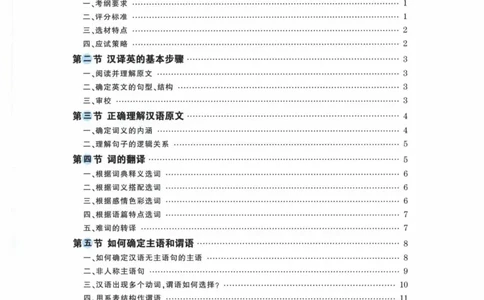
第一章专八翻译应试指南)
第一节大纲解读及历年真题剖析…+ 1
—、考纲要求.......................... 1
二、 评分标准...................... 1
三、 选材特点...................... 2
四、 应试策略...................... 2
第二节汉译英的基本步骤........ 3
一、 阅读并理解原文............... 3
二、 确定英文的句型、结构......... 3
三、 审校........................... 3
第三节正确理解汉语原文........ 4
一、 确定词义的内涵.............. 4
二、 理解句子的逻辑关系.......... 5
第四节词的翻译................. 5
一、 根据词典释义选词............ 6
二、 根据词义搭配选词............ 6
三、 根据感情色彩选词............ 6
四、 根据语篇特点选词............ 7
五、 难词的转译................... 7
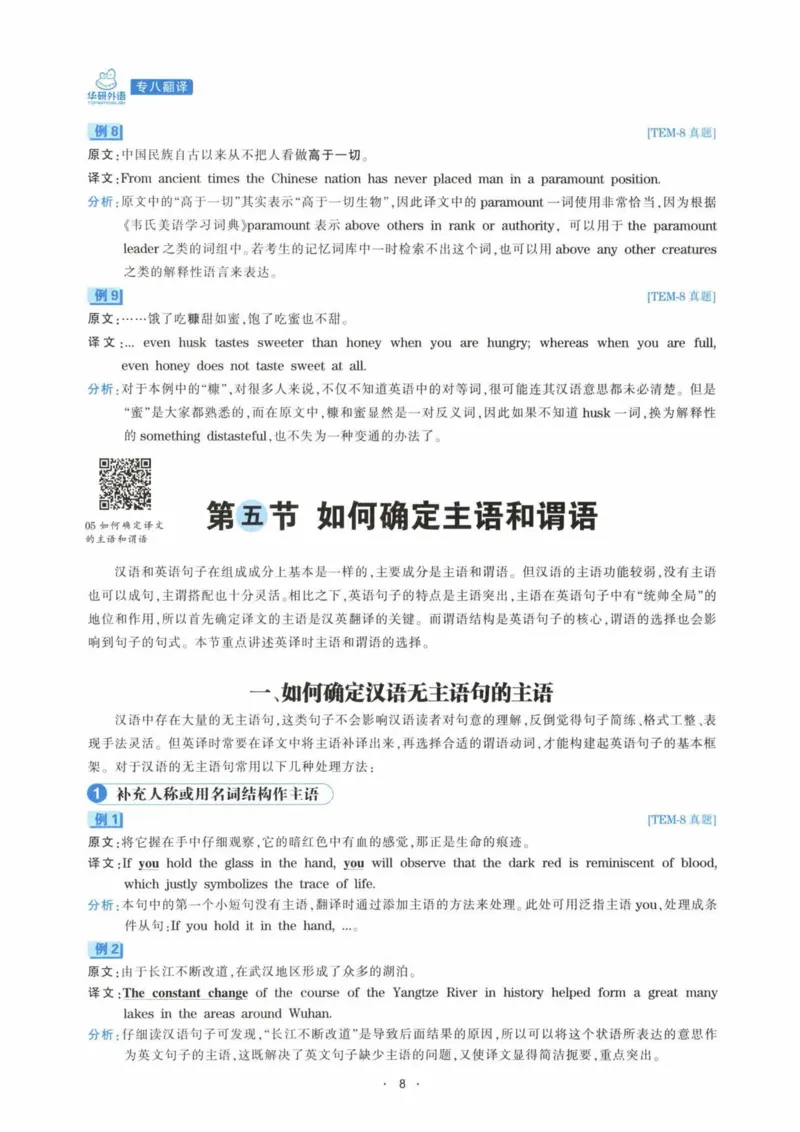
第五节如何确定主语和谓语...... 8
一、 如何确定汉语无主语句的主语…… ■ 8
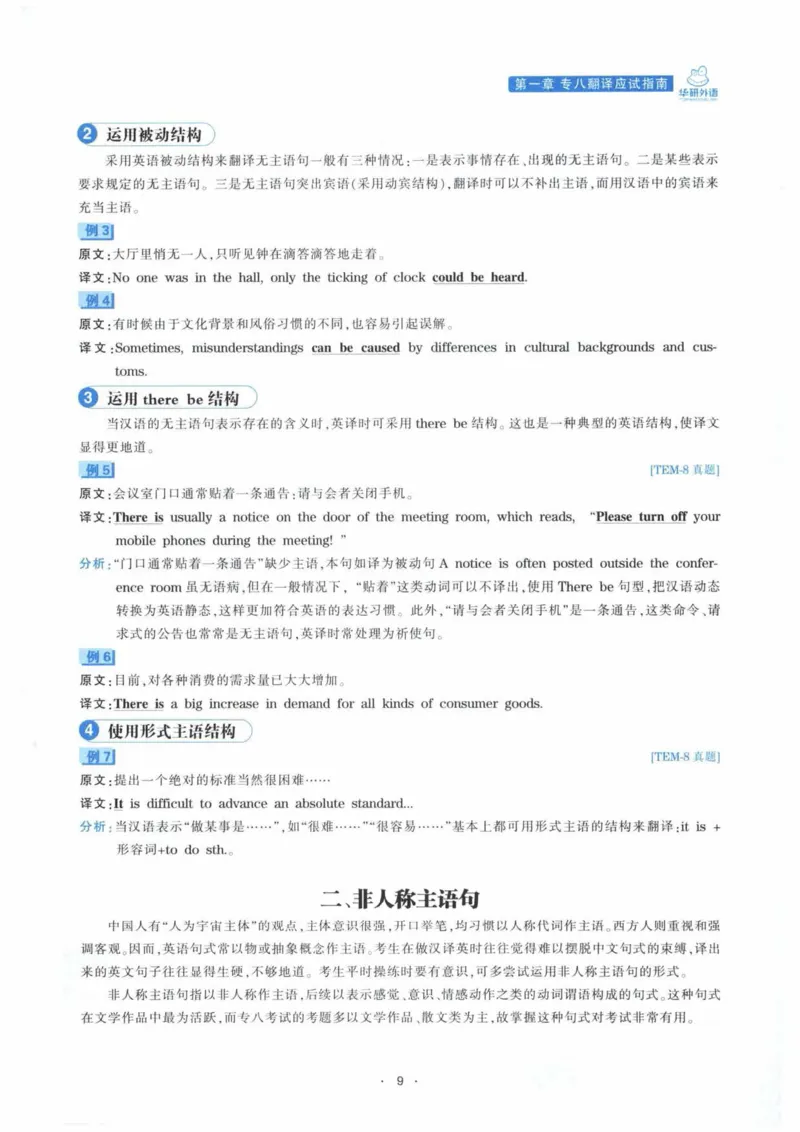
二、 非人称主语句................. 9
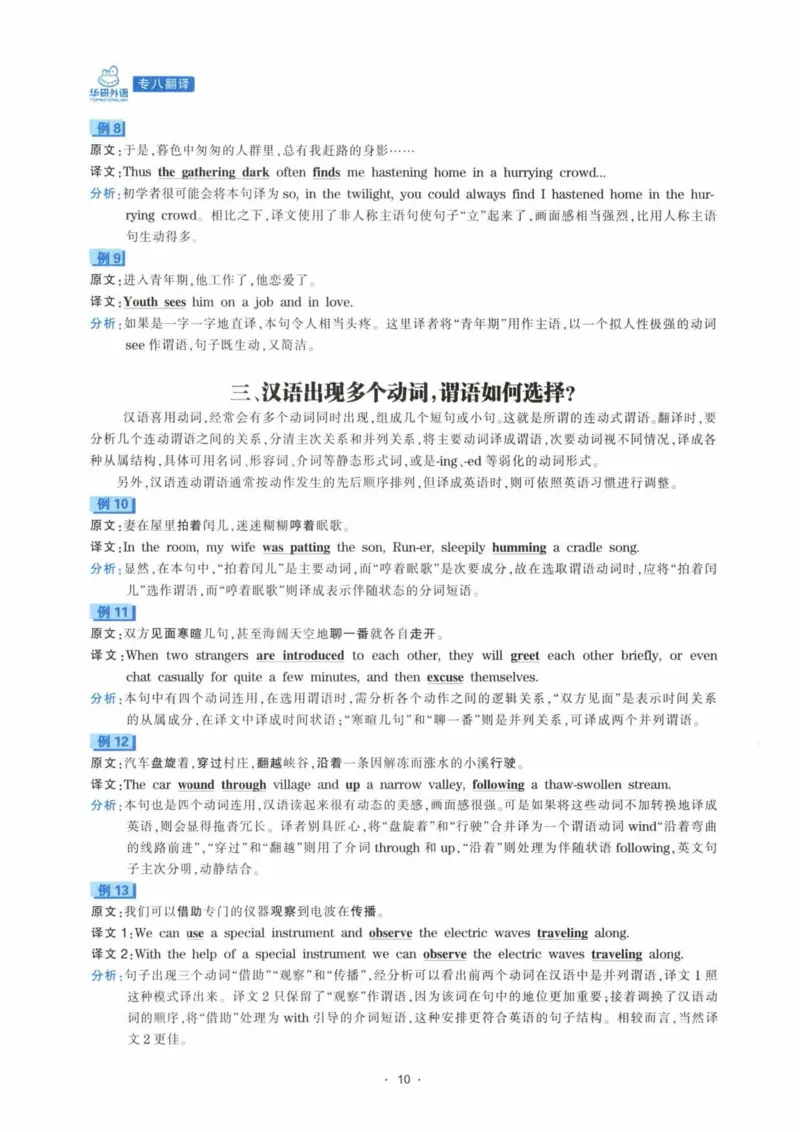
三、 汉语出现多个动词,谓语如何选择? 10
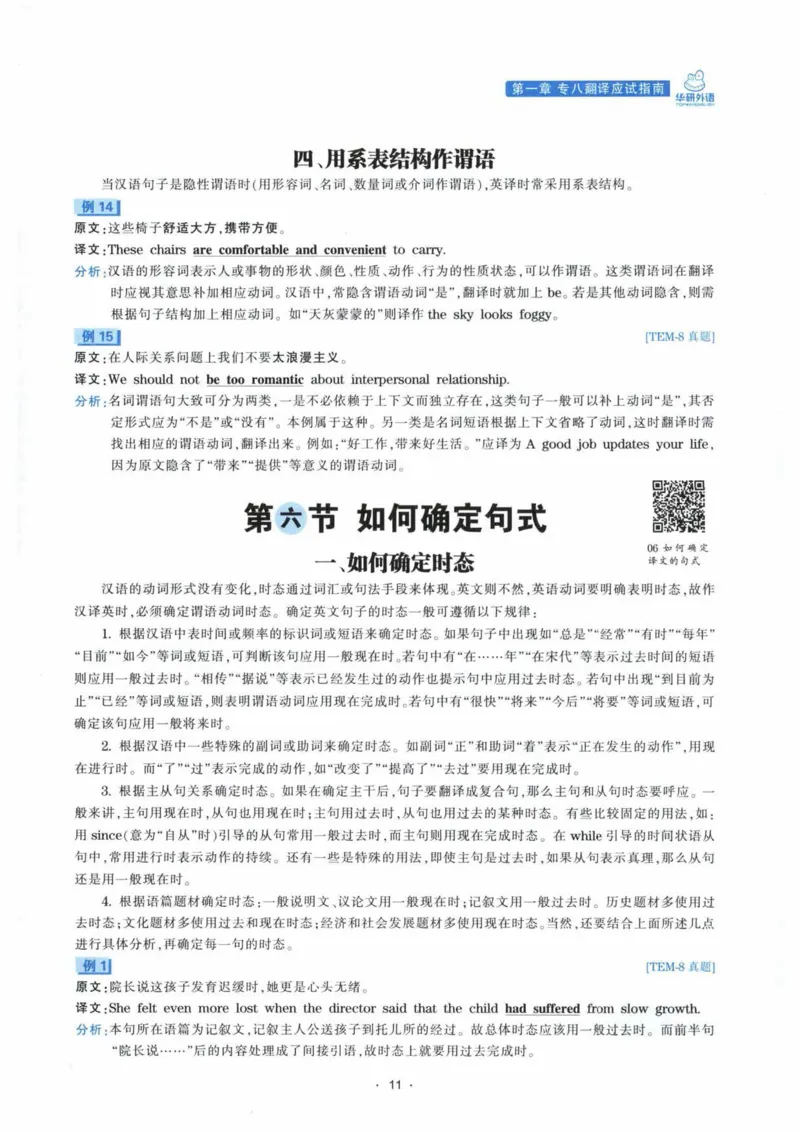
四、 用系表结构作谓语............ 11
第六节如何确定句式............ 11
一、 如何确定时态................. 11
二、 如何确定语态................. 12
三、 分译和合译................... 13
视频课
胃 0 1 专八翻译题型介绍/1 0 4 如何正确理解汉语词汇,5
02 ixi?細 S 本步骤/ 3 0 5 如何确定译文的主语和谓语/8
^ 0 3 如何正确理解汉语原文/4 0 6 如何确定译文的句式y loo
( 第二章汉译英易错句 丨丨练 句0
- 、i§-法 關 ...........................................................................15
二、囿于原文...........................................................................17
三'重复冗余...........................................................................20
四、 词不达意.........................................................................21
五、 形似义异.........................................................................25
C
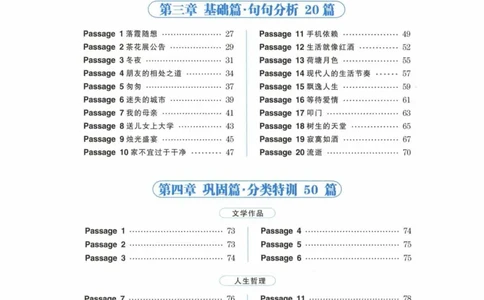
第三章基础篇•句句分析2 0 篇 )
Passage 1 落霞随想..................27 Passage 11手机依赖.................49
Passage 2 茶花展公告............... 29 Passage 12生活就像红酒............52
Passage 3 冬夜...................... 31 Passage 13荷塘月色.................55
Passage 4 朋友的相处之道...........34 Passage 14现代人的生活节奏......57
Passage 5 匆匆...................... 37 Passage 15飘逸人生.................59
Passage 6 迷失的城市............... 39 Passage 16等待爱情.................61
Passage 7 我的母亲..................41 Passage 17 叩门..................... 63
Passage 8 送儿女上大学.............43 Passage 18树生的天堂.............. 65
Passage 9 烛光盛宴..................45 Passage 19寂寞如酒.................67
Passage 10家不宜过于干净......... 47 Passage 20 流逝..................... 70
W
(第 四 章 巩 篇 分 类 特 训 5 0 篇)
文学作品
Passage 1 ............ .............73 Passage 4 ............. ............74
Passage 2 ............ .............73 Passage 5 ............. ............ 75
Passage 3 ............ .............74 Passage 6 ............. ............ 75
人生哲理
Passage 7 ............ .............76 Passage 11 ............ ............78
Passage 8 ............ .............76 Passage 12 ............ ............78
Passage 9 ............ .............77 Passage 13 ............ ............79
Passage 10 ........... .............77
文化教育
Passage 14 ........... ............. 79 Passage 18 ............ ............81
Passage 15 ........... ............. 80 Passage 19 ............ ............82
Passage 16 ........... ............. 80 Passage 20 ............ ............82
Passage 17 ........... ............. 81
■ 2社会生活
••83 Passage 25 85
••83 Passage 26 85
...84 Passage 27 86
.••84 Passage 28 86
政治经济
...87 Passage 33 89
...87 Passage 34 89
… 88 Passage 35 90
"•88
地理风景
...90 Passage 39 92
"•91 Passage 40 92
.••91
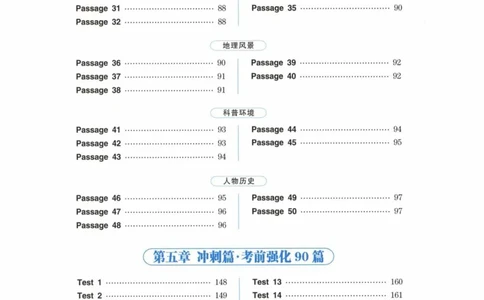
科普环境
… 93 Passage 44 94
… 93 Passage 45 95
94
人物历史
......................95 Passage 49 ......... 97
......................96 Passage 50 ......... 97
......................96
( 第五章冲剌篇•考前强化9 0 篇 )
.148 Test 13 • 160
•149 Test 14 • 161
•150 Test 15 • 162
•151 Test 16 • 163
•152 Test 17 • 164
•153 Test 18 • 165
• 154 Test 19 • 166
•155 Test 20 • 167
•156 Test 21 • 168
•157 Test 22 • 169
•158 Test 23 • 170
•159 Test 24 • 171
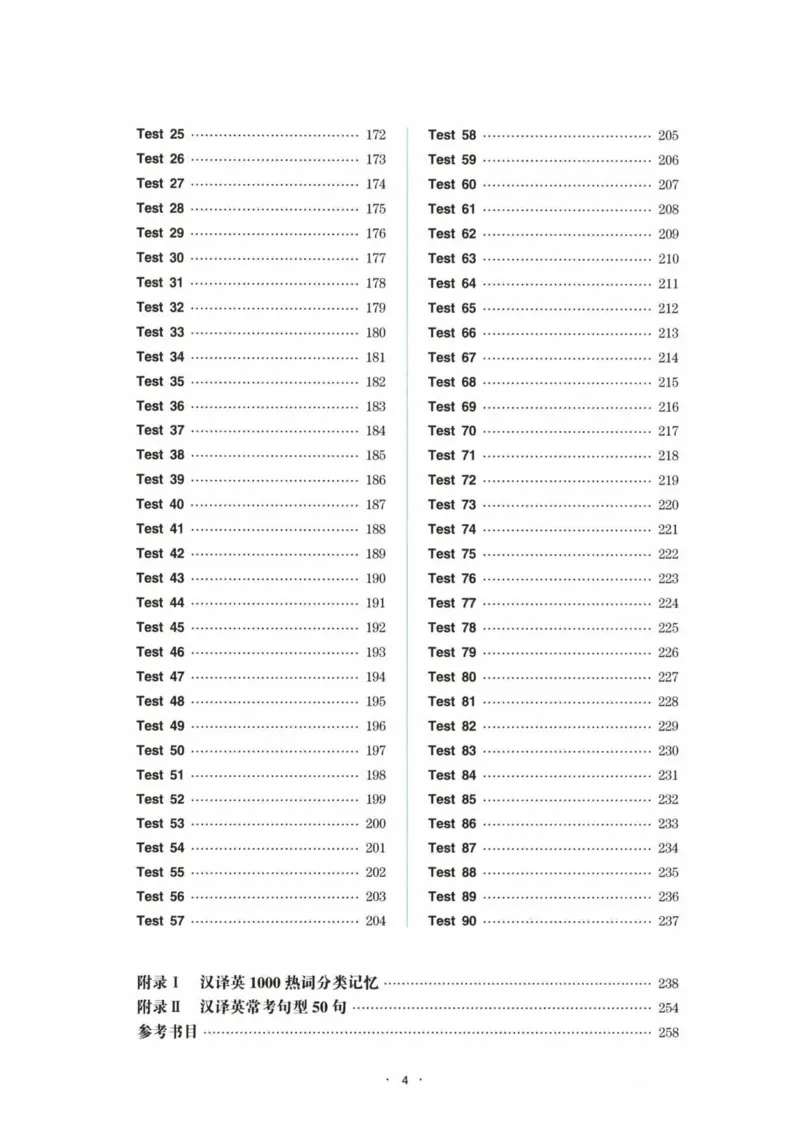
3Test 25 ............................. 172 Test 58 ............................. 205
Test 26 ............................. 173 Test 59 ............................. 206
Test 2 7 ............................. 174 Test 60 ............................. 207
Test 28 ............................. 175 Test 61 ............................. 208
Test 29 ............................. 176 Test 62 ............................. 209
Test 30 ............................. 177 Test 63 ............................. 210
Test 31 ............................. 178 Test 64 ............................. 211
Test 32 ............................. 179 Test 65 ............................. 212
Test 33 ............................. 180 Test 66 ............................. 213
Test 34 ............................. 181 Test 67 ............................. 214
Test 35 ............................. 182 Test 68 ............................. 215
Test 36 ............................. 183 Test 69 ............................. 216
Test 3 7 ............................. 184 Test 70 ............................. 217
Test 38 ............................. 185 Test 71 ............................. 218
Test 39 ............................. 186 Test 72 ............................. 219
Test 40 ............................. 187 Test 73 ............................. 220
Test 41 ............................. 188 Test 74 ............................. 221
Test 42 ............................. 189 Test 75 ............................. 222
Test 43 ............................. 190 Test 76 ............................. 223
Test 44 ............................. 191 Test 77 ............................. 224
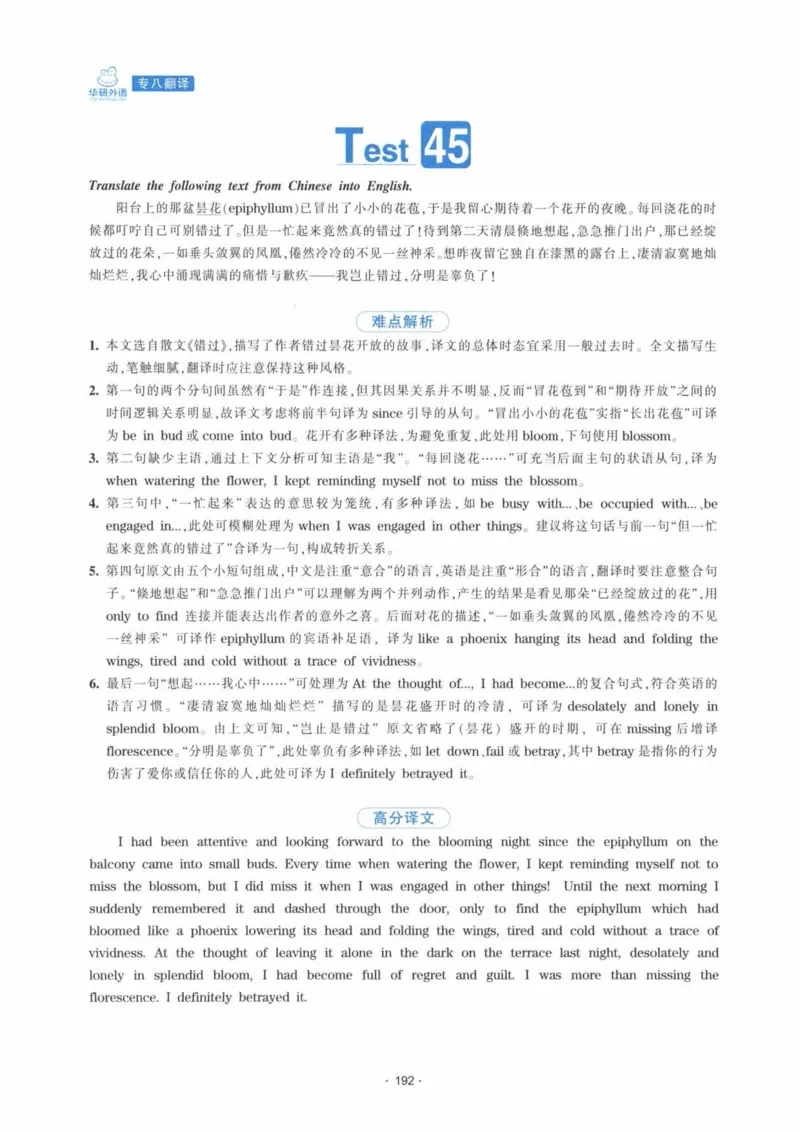
Test 45 ............................. 192 Test 78 ............................. 225
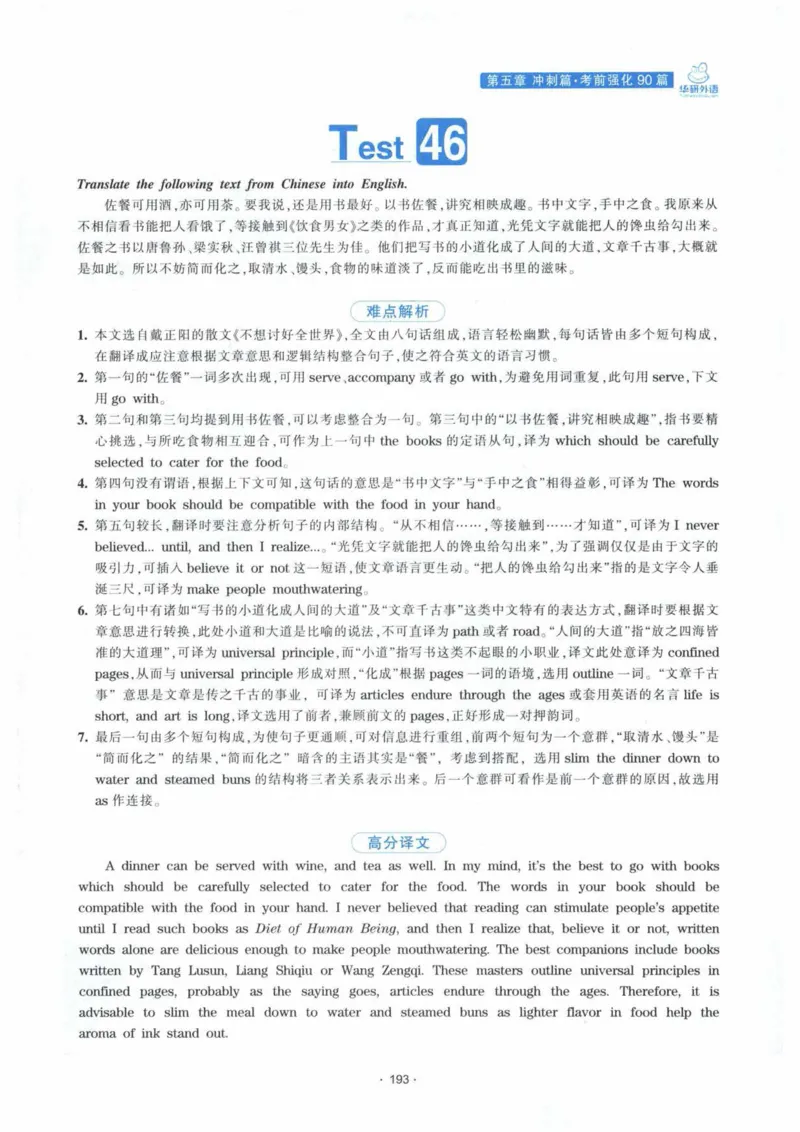
Test 46 ............................. 193 Test 79 ............................. 226
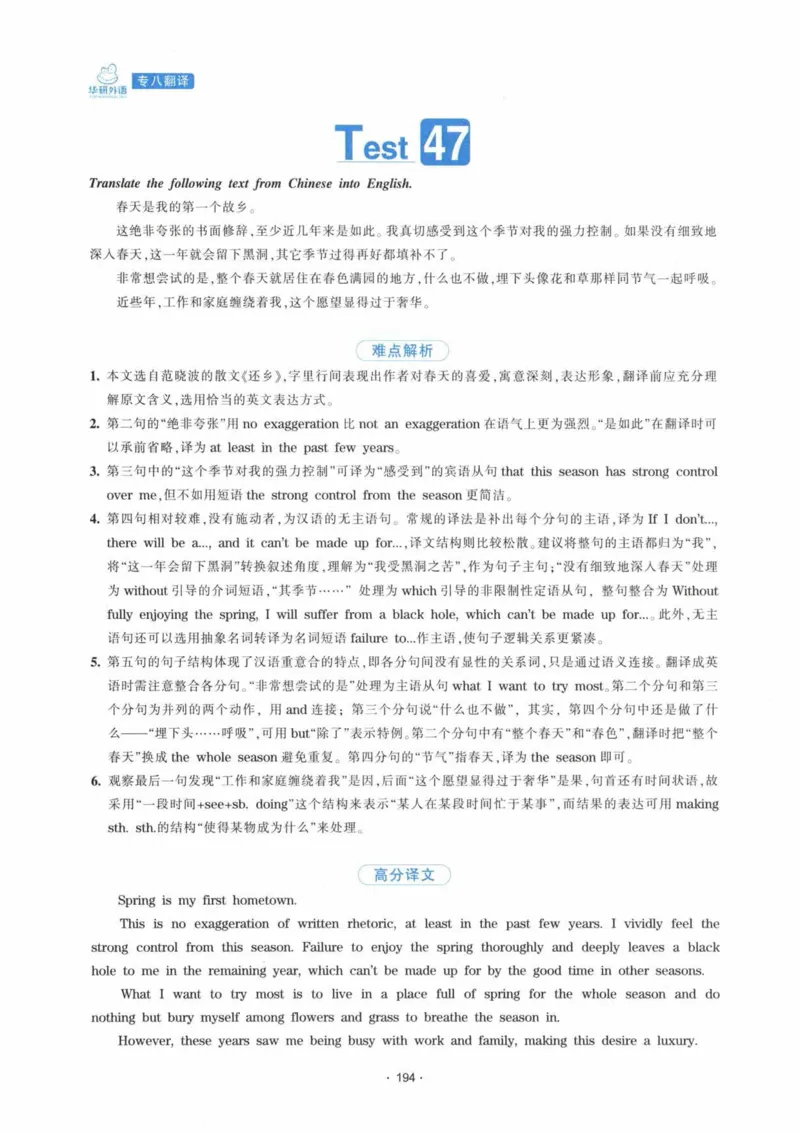
Test 47 ............................. 194 Test 80 ............................. 227
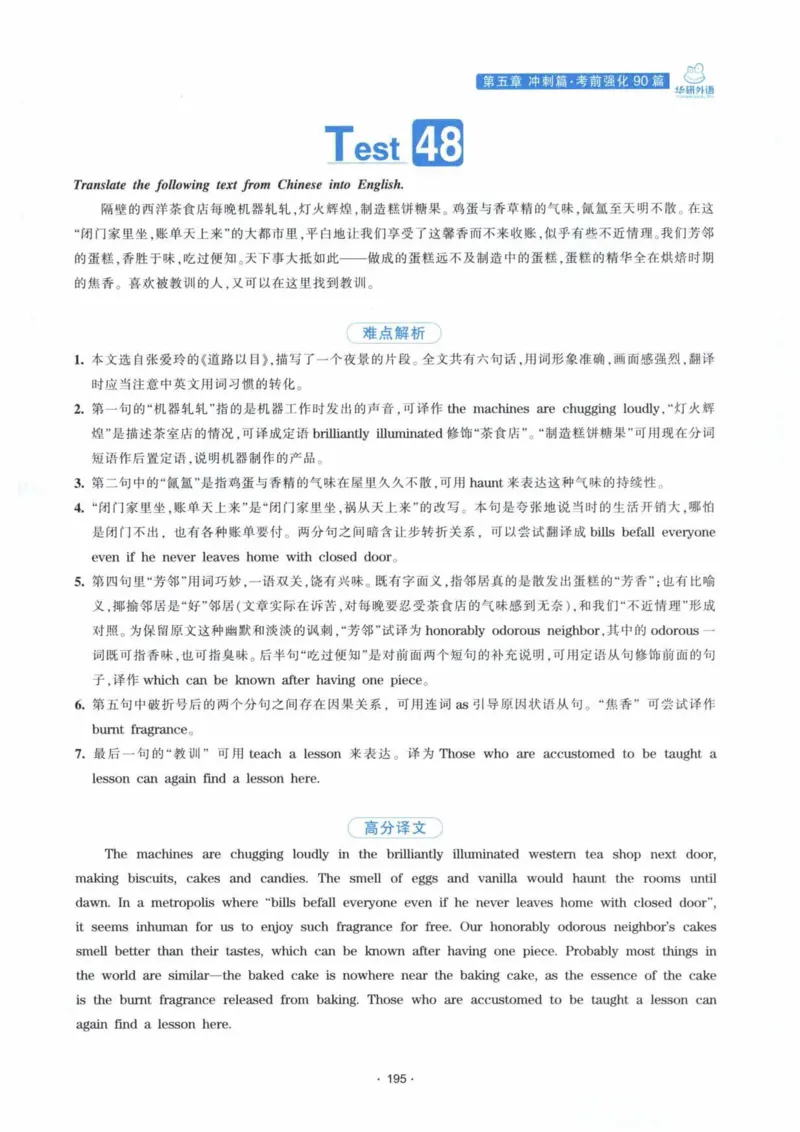
Test 48 ............................. 195 Test 81 ............................. 228
Test 49 ............................. 196 Test 82 ............................. 229
Test 50 ............................. 197 Test 83 ............................. 230
Test 51 ............................. 198 Test 84 ............................. 231
Test 52 ............................. 199 Test 85 ............................. 232
Test 53 ............................. 200 Test 86 ............................. 233
Test 54 ............................. 201 Test 87 ............................. 234
Test 55 ............................. 202 Test 88 ............................. 235
Test 56 ............................. 203 Test 89 ............................. 236
Test 57 ............................. 204 Test 90 ............................. 237
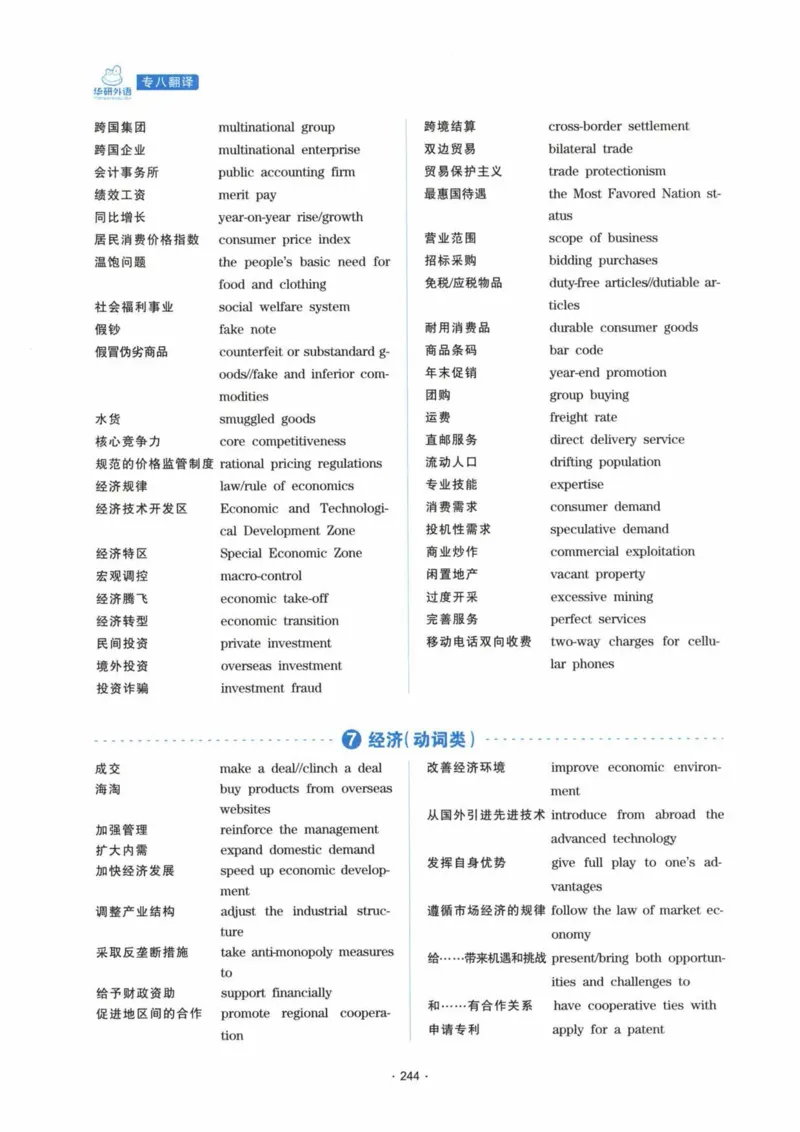
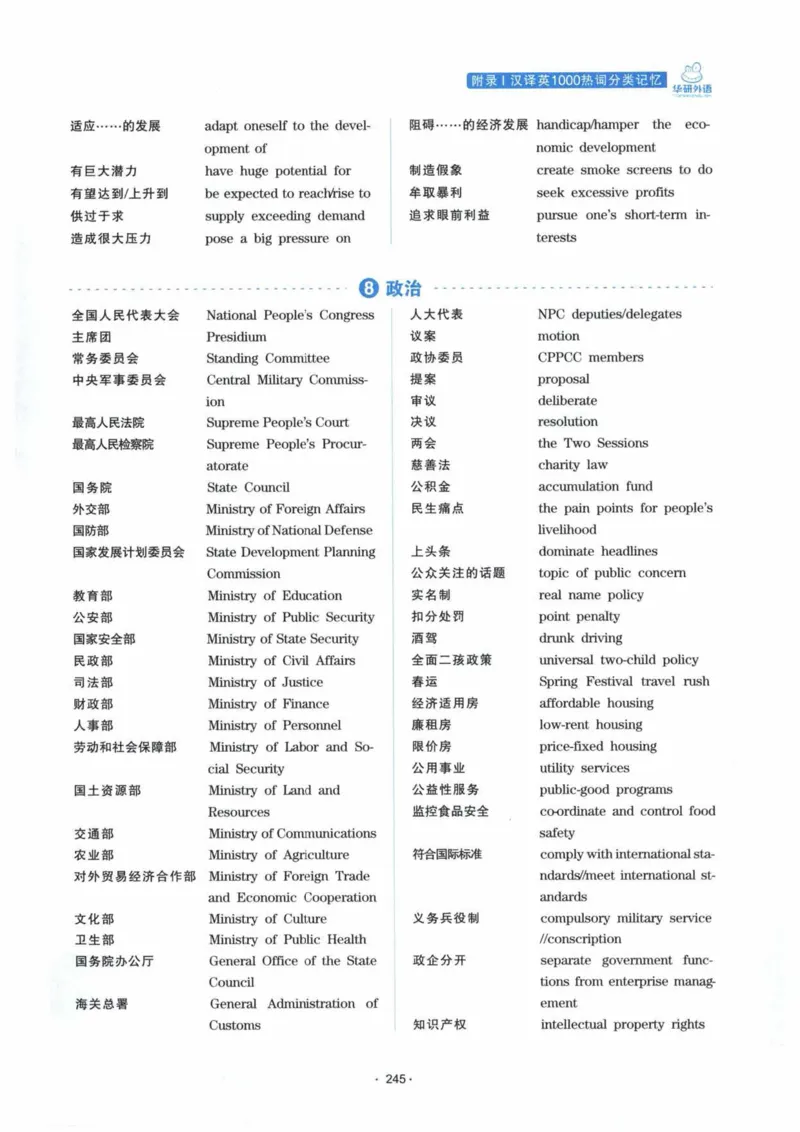
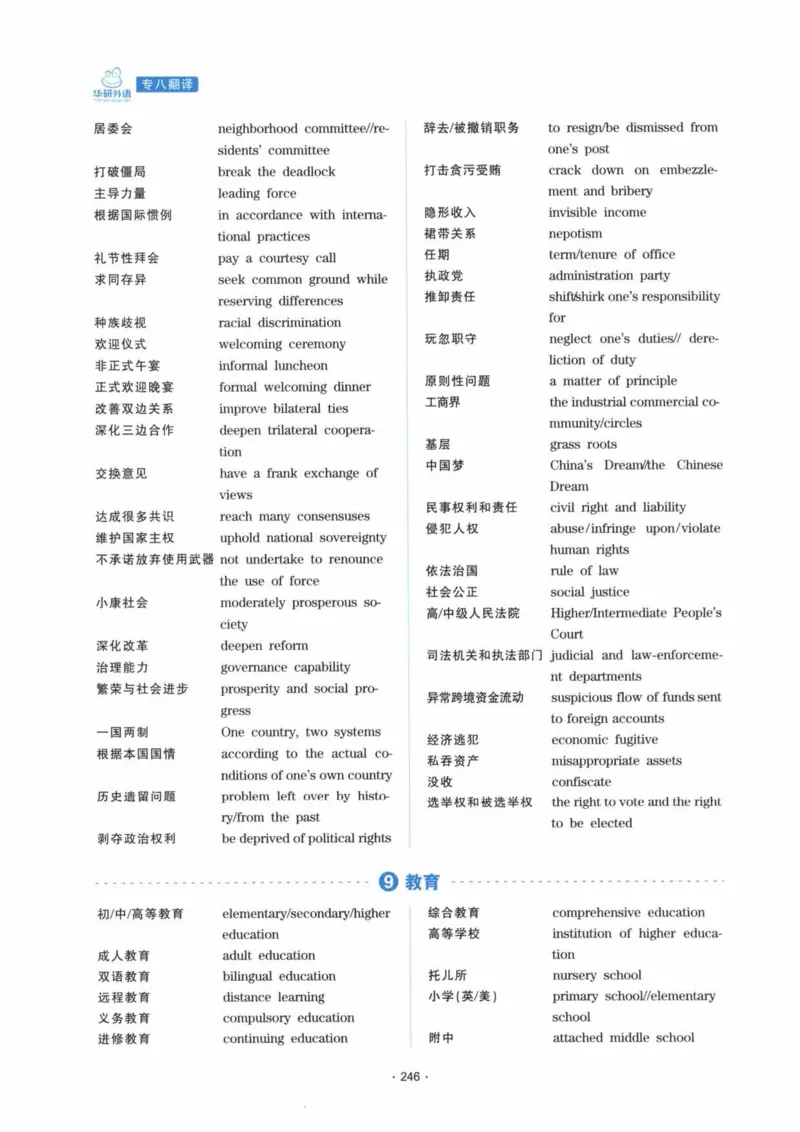
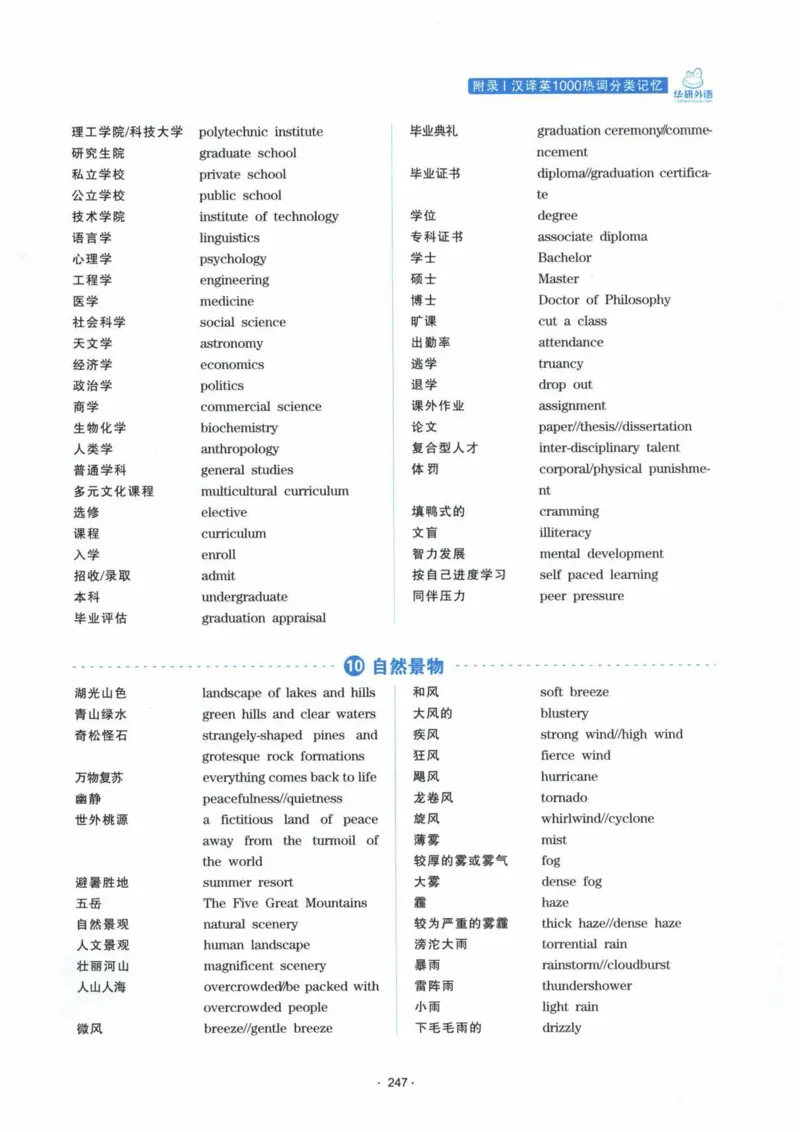
附斌I 汉译英1000热M 分类id忆 238
附录n 汉译英常考句增50句 …… 254
参考书目....................... 258
• 4 •(第二章专八翻译应试指
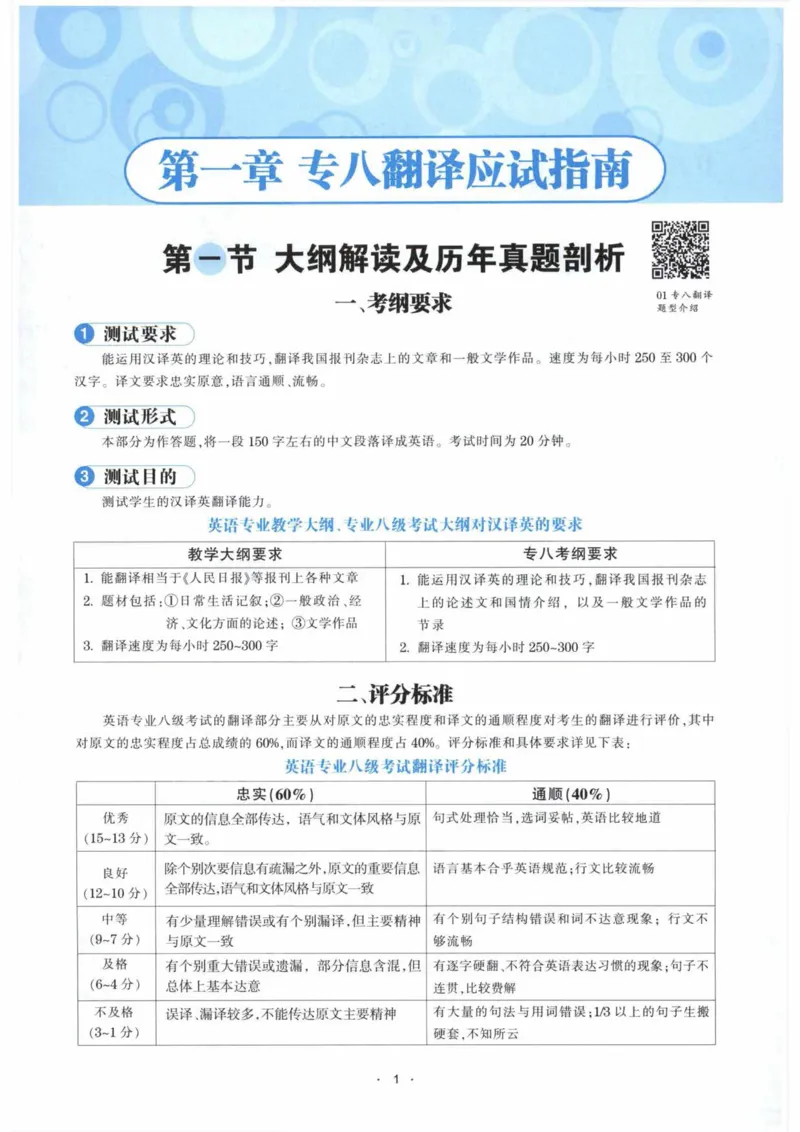
第-节大纲解读及历年真题剖析
01专八翻译
一 考 纲 要 求
题螌介绍
〇 测试要求
能运用汉译英的理论和技巧,翻译我国报刊杂志上的文章和一般文学作品。速度为每小时250至300个
汉字。译文要求忠实原意,语言通顺、流畅
© 测试形式
本部分为作答题,将一段150字左右的中文段落译成英语。考试时间为20分钟。
G
测试丨丨的
测试学生的汉译英翻澤能力。
英i/fd k 教7:人纲、(Hk八级考试人纲对U 译英的势求
教学大纲要求 专八考纲要求
1. 能翮译相当于〈人民日报》等报刊上各种文章 1. 能运用汉译英的理论和技巧,翮译我国报刊杂志
2. 题材包括:①日常生活记叙;②一般政治、经 上的论述文和闰悄介绍,以及一般文学作品的
济、文化方面的论述;③文学作品 节录
3. 翮译速度为每小时250-300字 2. 翮译速度为每小时250〜300字
二 、评分标准
英语专业八级考试的翻译部分主要从对原文的忠实程度和译文的通顺程度对考生的翻译进行评价,其中
对原文的忠实程度占总成绩的60%,而译文的通顺程度占40% 。评分标准和具体要求详见下表:
英W Hk八级考试翻译if分标准
忠实(60%) 通顺(40%)
优秀 原文的信息全部传达,语气和文体风格与原 句式处理恰当,选词妥帖,英语比较地道
(1543 分) 文一致〇
除个别次要信息有疏鉍之外,原文的歡要倍息 语言基本合乎英语规范;行文比较流畅
良好
(12-10 分) 全部传达,语气和文体风格与原文一致
中等 有少M 理解错误或有个別漏译,但主要褚神 有个别句子结构错误和词不达意现象;行文不
(9~7 分) 与原文一致 够流畅
及格 有个別重大错误或遗澜. 部分信息含混,但 冇逐字硬翻、不符合英语表达习惯的现象;句子不
(6〜4 分) 总体上基本达意 连贯,比较费解
不及格 误译、漏译较多.不能传达原文主要楮神 有大ft的句法与用词错误;1/3以上的句子生搬
(3~1 分) 硬套,不知所云a
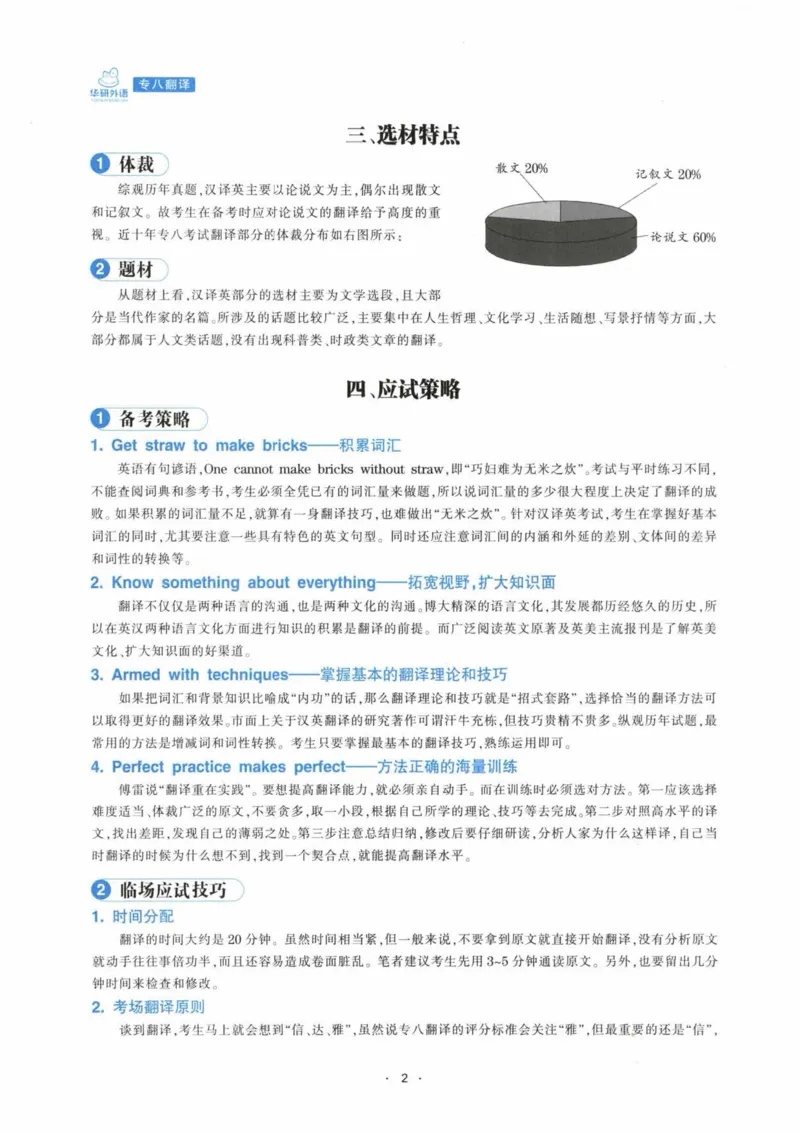
三、选衬特点
0 体饯
散文20%
记叙文20%
综观W 年真题,汉译英主要以论说文为主,偶尔出现敗文
和记叙文。故考生在济考时应对论说文的翻译给予高度的m
视近卜年专八考试翻译部分的体饯分布如右阁所示:
论说文60%
〇 题材
从题材上苻,汉译英部分的选材主要为文学选段,且大部
分是当代作家的名篇:所涉及的话题比较广泛,主要集中在人生哲理、文化学习、生活随想、写景抒情等方面,大
部分都丨4 亍人文类话题.没有出现科普类、时政类文章的翻译,
四 、应试策略
© 济考策略
1. Get straw to make bricks-----积累词汇
英有句砖语,One cannot make bricks without straw,即“巧妇难为无米之炊”考试与平时练习不间,
不能査阅词典和参考书,考生必须全凭已有的词汇K 来做题,所以说词汇1 的多少很大程度上决定了翮译的成
败如果积累的词汇M 不足,就算有一身翻译技巧,也难做出“无米之炊”。针对汉译英考试,考生在常捉好基本
词汇的同时,尤其要注意一些具有特色的英文句型。同时还应注意同汇间的内涵和外延的差别、文体间的趋异
和词性的转换等。
2. Know something about everything-----拓宽视野,扩大知识面
翻译不仅仅是两种言的沟通.也是两种文化的沟通博大楮深的语言文化,其发展都历经悠久的历史,所
以在英汉两种语言文化方面进行知识的积累是翻译的前提,而广泛阅读英文原著及英美主流报W 是了解英美
文化、扩大知识面的好渠道。
3. Armed with techniques------掌握基本的翻译理论和技巧
如果把词汇和背撗知识比喻成“内功”的话,那么翮译理论和技巧就是“招式套路”,选择恰当的翻译方法可
以取得史好的翻译效果。市面上关于汉英翻译的研究著作可谓汗牛充栋,但技巧贵精不贵多。纵观历年试题,最
常用的方法是增减词和间性转换。考生只要攀握域基本的翮译技巧,熟练运用即可。
4. Perfect practice makes perfect-----方法正确的海量训练
傅71?说“翮译重在实践”,要想提高翻译能力,就必须亲自动手。而在训练时必须选对方法。第一应该选择
难度适当、体裁广泛的原文,不要贪多.取一小段,根据自己所学的理论、技巧等去完成。第二步对照高水平的译
文,找出差距,发现自己的iW弱之处。第三步注意总结归纳,修改后要仔细研读,分析人家为什么这样译,自己当
时翻译的时候为什么想不到,找到一个契合点,就能提高翻译水平。
❷ 临 场应试技巧
1 . 时间分配
翮译的时间大约是20分钟。虽然时间相当紧,但一般来说,不要拿到原文就直接开始翻译.没有分析原文
就动手往往車倍功半,而且还容易造成卷面脏乱。笔者建议考生先用3~5分钟通读原文。另外,也要留出几分
钟时间来检査和修改。
2 . 考场翻译原则
谈到翮译,考生马上就会想到••信、达、雅",虽然说专八翻译的评分标准会关注“雅”,但最® 要的还是“信”,
• 2 •a
第一章专八翻译应试指南
牮研外遇
针对专八翮译考试,只需做到两点:忠实原文,译文通顺 T 万別为了“雅”而牺牲“信”
考场上遇到不认识的阗和无法理解的语法结构.要尽M 避免“硬译”。若碰到的障碍㈣汇并不是该句话的核
心词汇,可干脆不翻译出来或MIM丨其说地意译过去,不要在某个间上耽误太多时间
3. 避免低级语言错误
常见的低级语言错误包括:常见词汇的拼写错误.大小写错误、标点符号错误、词性运用错误和基本的语法
错误(如时态,人称,性、数不一致等)。一旦出现这些“硬伤”,阅卷老师对译文的锒体印象必定大打折扣,导致打
分偏低。笔者逑议在完成翻译后,必须M 杏一遍,允其是对译文的开头、结尾等关键部分。
第二节汉译英的基本步骤
«•衣步《
汉译英为一段150字左右的文字,考生在答题及平时训练时可遵循以下的步骤:
1. 通读并透彻理解汉语原文,分析语篇的语言K 格及逻辑(如中心思想,句与句之间的逻辑关系)
2. 原则上逐句进行翻译..同时考虑上下文,明确逻辑关系,添加合适的连接结构,并 避 免 句式长短句
结合。
3. 进行全文的审校,对各句进行逐一审校的同时,宏观地检査全文的风格、逻铒是否与原文吻合。
至于笮句的翻译过程,一般可遵循以下的步骤:
一 、阅读并理解原文
通读并透彻理解汉语句子,分析汉语句子的风格、逻辑和句型确定关键同的词义内涵,
1. 风格:正式还是非正式,
2. 逻辑:短语与短语之间的逻辑,分句间的逻辑关系
3. 句塑:分析汉语句型,有时汉语句ffii和英语句型有揞特定的对应关系。
1. 确定基本时态,能够避免犯大的语法错误,比如,记叙文一般用一般过去时。议论文和说明文一般用一
般现在时。
2. 确定主语、确定句型,确定修饰语(定、状、补)的位骰
3. 译文句子的组织、表达。
三 、审校
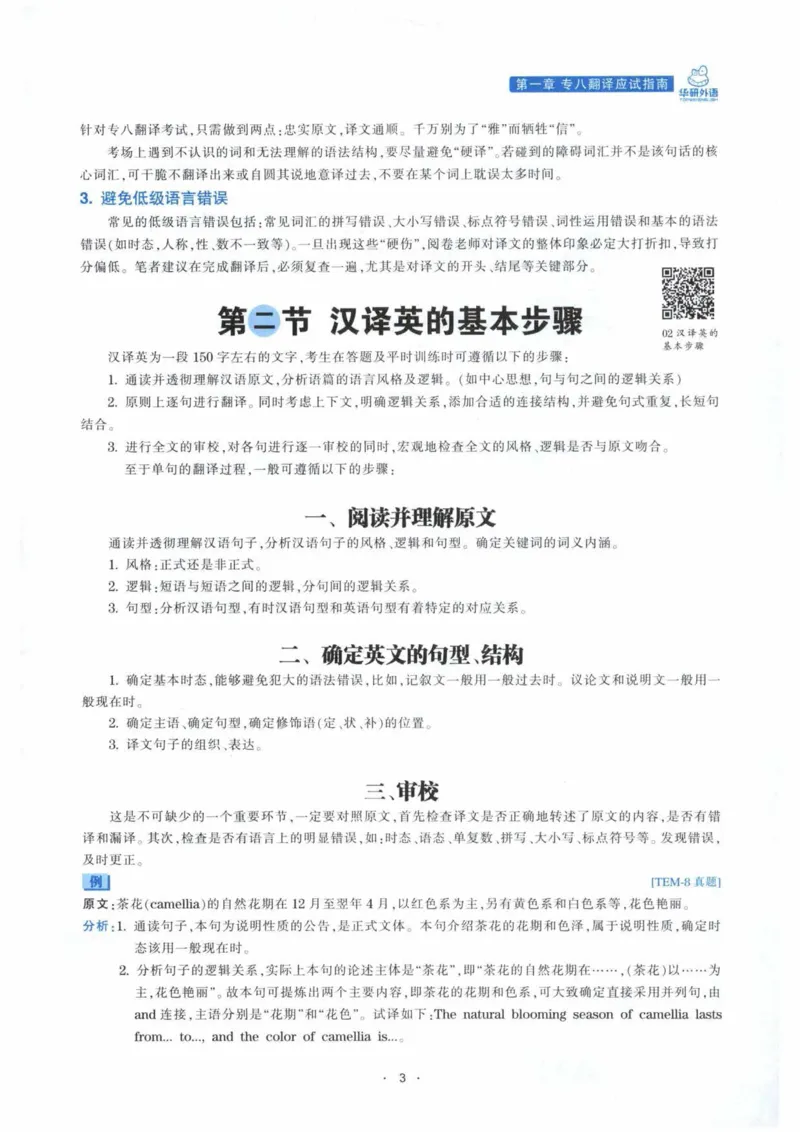
这是不可缺少的一个ffi要环节,一定要对照原文,首先检査译文是否正确地转述了原文的内容,是否有错
译和漏译。其次,检査是否有语言上的明显错误,如:时态、语态、单复数、拼写、大小写、标点符号等发现错误,
及时更正。
J U ITEM-8
原文:茶花(came出a)的『丨然花期在12月至翌年4 月.以红色系为主,另冇黄色系和内色系等,花色绝HH
分析:1.通读句子,本句为说明性质的公告,是正式文体本句介绍茶花的花期和色泽,厲于说明性质.确定时
态该用一般现在时3
2.分析句子的逻辑关系,实际上本句的论述主体是“茶 花 即 “茶花的A 然花期在……,(茶花)以……为
主,花色艳丽”。故本句可提炼出两个主要内容,即茶花的花期和色系,可大致确定直接采用并列句,由
and连接,主语分别是“花朗"和“花色” 试译如下:The natural blooming season of came出a lasts
from… to..., and the color of camellia is…c
* 3 ■专八翻译
班W外诵
3. 考虑到上述试译为并列句句式较松散冗长,故对句式进行整理。可选取其中一部分作主句,另一部分
译为修饰成分. 由于本篇主题是介绍“茶花展",为突出® 点,故考虑选取Camellia作主语,将“茶花花
色艳丽”作为主句;关于花期的描述处理为定语从句,将“以红色系为主,另有黄色系和白色系等"处理
为with引导的伴随状, ivi于句末,译句优化为:Came出a, whose natural blooming season is
from December to next April, has splendid colors, with red as its main category, yellow,
white and other colors as its secondary category.
4. 对上述译文进行润色,“某琪物拥有某些美好的特征”可用boast或bear之类的词表达,故可将译文
中的 has 改为 boast 而根据 ft、略的原则 yellow, white and other colors as its secondary
categoiy 实际上可简化为 yellow, white and other colors secondary
5. 对照原文南读译文,发现“ 然花期”译为natural blooming season,似在英文中blooming season
实际上就暗示T 是 “天然的”而非人为干扰的花期,故natural实际上应略i 。至此,译文确定为
Camellia, whose blooming season is from December to next April, boasts splendid colors,
with red as its main category, yellow, white and other colors secondary
第三节正确理解汉语原文
03如何正确理
解汉语原文
在汉英翮译中,虽然汉i?j足我们的母语且对其理解的难度低于英语,但这并不总味^考生不存在理解方而
的闲难。事实上,从考生的平时学习和考试中,可以将理解难点归纳为:
1. 确定汉语词语意义。不同语境F的同一个汉语间语的意义常冇细微左別,而这些差別是准确翮译的大码
2、 汉语句子之间逻辑关系的确定。汉语厲于® “意合”的语言,较之T(“形合”的英语来说,汉语小句之间的
逻辑关系常常是隐含的,W 此需耍考生根据© G 结构的发展方向等线索来加以判断。
一 、确定词义的内涵
任何语言中的词都有一般含义和深层含义一个词的深层含义是指这个词在具体的语境或者上下文中所
蓬含的意义。尤其在做汉译英时,一般怙况下,由于上下文的作用,笮个同汇的意义有时候并不是字典中可以査
到的一般含义,而是与上下文紧密结合的深层意思,如果以- 般词义替代深层词义.就可能使人不知所云,并且
影响对整个语篇的理解,从而导致考生难以获得满意的分数。
例 1 | [TEM>8真賊1
原文:(人学,要交十元的保证金这是一笔巨款!)母亲作了半个月的难,把这巨款筹到,而后含泪把我送
出门去。
译文:For about two weeks, Mother suffered much and finally managed to raise the money, and then
she sent me off to school with tears in her eyes.
分析:“作了半个月的难”中的“作难”既有“费了很大劲去做……",也暗含“为难”之义,故可译成suffer much
或用struggle to do sth.的句沏.体现出母亲筹钱的垠难
« 2 J [TEM-8
原文:手机刷新r人与人的关系。
译文:Mobile phones have renewed the interpersonal relationships.
分析:“刷新”此处是指“Si新.换成新的”,故应译作renew或refresh。此处不可按字面义译为refurbish”重新装饰”
或是renovate “修 或 whitewash “粉刷"。因为“人与人的关系”实 指 “人际关系”,应译为
interpersonal relationships,而不应直译为 people’s relations 或 relationship among human beings.
. 4 .a
例3| ITEM-8 ft 题 |
原文:得病以前,我受父母宠爱,在家横行霸道,……
译文:Before I was taken ill, I had been a spoiled child of my parents, getting things my way in the
family.
分析:“横 行 道 ”一词的一般含义是“任意欺凌他人”之义,怛是本例是以孩子的口气写的,W 此限定了该同的
具体含义是“为所欲为,想干什么就干什么”,主要反映了孩子的••椎气”和“顽皮”,因此没有任何“簕气”,
可译为 be so arrogant, be so aggressive 或 played my important role..但是考虑到上下'文,此处的
“横行筋道”译为 getting everything my own way 或 getting all things my own way 更为妥当。
二 、理解句子的逻辑关系
一般认为,汉语属于竹状语言结构(bambooshaped),换言之,汉语的小句之间的关系不是通过使用连词
或关系词进行衔接的,而是用逗号将小句连接在一起,小句与小句之间的关系是隐含的。通常汉语句子之间不
需要使用显性的连词或副词来加以连接,句子之间的关系要读# 自己去分析和理解,因此汉语也被认为
意合的语言。相比之下.英语一般被肴作是树状(tree^shaped〉语言,句子的不同成分之间需要用明显的表示各
个成分(主要是从句〉关系的连词或副间来进行连接,使句子内部的意义和不同成分之间的逻辑关系一目了然.
因此被认为是ffl形合的语言。
汉译英的另一个理解难点就在于对句子关系的分析和梳理。对句子关系的正确理解是否有据可依呢?答案
是肯定的。这是因为一个语篇单位,一个A 然段或一个完整的语篇,一般只谈论一个问题或者只叙述一个爭件胃
如果谈论两个或更多的问题,叙述多个铒件,必然有主有从,否则语篇的主题就不突出了。通过研究近几年的真
题,我们发现,原文主题都非常突出,内容都紧密闱绕主题展开。
理解了这一点,对我们分析汉译英的原文,尤其是正确把握原文中的句间关系非常宥益。
供4| 【TEM4 11越1
原文:可是,我也愿意升学。我偷偷地考人了师范学校一 -制服,饭食,书锫.宿处,都由学校供给
W X : However, I would also like to further my study, so without telling my mother, I took the exam
and was admitted to a normal school where all expenses including uniforms, meals, books
and accommodation were provided by the school.
分析:这两句句式简单,内容也较短。分析后可发现,这两句实际上隐含w 果关系我想意升学”是w, “我考
人师范学校”是果,故可将这两句合译为so连接的并列句。
例51 [TEM-8 il®]
原文:还是热,心里吋镇定多了。凉风,即使是一点点,给了人们很多希翅。
译文:It was still hot but everyone feh: much better, for the breeze, though slight, brought them
hope.
分析:从意义上宥,后一句的“凉风”是il:人们心电镇定的原此在翮译时,可用表示W 果关系的连接同for.
来加强前后文的语义联系.
第四节词的翻译
04如付正磯翻
译汉语词汇
由于汉语和英语普遍都冇一 W 多义现象,这就会给理解和表达带来W 难 此 外 ,由于iej语
随着其搭配、上下文等的不同,会产生意义的不同.所以对于词的英译.有必要了解词语的引申意义、搭配意义
等,甚至要跳出字面,方能选择合乎怡理、合乎逻辑的正确间ift。
• 5 •专八翻译
»__.»» «
rO OuO
一根据閫典释义选词
虽然在考场中不能査阅同典,但考生在平时练习时遇到生僻的词语,不能想当然地敷衍了事,而务必要査
阅W 典或其他参考T.ft,明确该M 的准确意思。这样才能扩大汉语的词汇It,为上考场作充分的准备此外,要
注怠的是间典在编排时一般会将M 常丨丨丨的释义(也就是该同条的M 基本意义)放前面.选义时首先判断一
下基本意义是卉符合原文语境,若不能.则耑要寻找更符合逻辑的释义(引中义)
例 1| [TEM-8
原文:整个舟叫只冇一阐窗.谢外树影婆娑
译文:The room had only one window, out of which the tree shadows were dancing.
分析:“婆娑”为书ifriifi,较 文 雅 《现代汉语词典(第6 版>>对“婆娑”一同给出了三种释义,①盘旋舞动的样子;
②枝叶扶疏的样f ;③眼?丨_丨"K滴的样子..对比原文的ift境,此处适将原本作形容同的“婆娑”用作动间,故
合理的释义应该是第一个择义“婆娑”一词ft似难译,但实际上它是指“盘旋舞动的样子",故可简中-译
作 dancing 或 whirling
二 、根据词义搭紀选词
英语中n 存习惯的搭配关系英译时必须摆脱汉访的习惯,按照英i/i的搭配习惯来处理汉语的某些搭K,
不能把汉语的搭配用法生搬硬套到英语中如同样的“大”,放在不同的搭配,译法就不一样了:大城市(a big
city)、大雨(heavy rain)、大志(a high ambition)、大人物(an important person)、大ifl 理(general princi-
pie)。W 此.在选择同语的时候,要找准其“配偶",才不会译出怪腔怪调的译文。
例 2| [TEM^8 真®|
原文:这孩子是她的秘密.她将秘密留在这树林掩映的达筑里。
译文:The child was her secret, and she wou丨d bury the secret in the building shaded by trees.
分析:“留”字的译法很多,如••留在原地”丨H remain或stay、“留咏:位”川reserve /•留学”用study.此处动作
“沼”的发出荇是secret"秘密",译文没有选用常见的leave,而根据secret - 间粘心选用了 buiy‘埋藏”
—间,非常妥帖。
三 、根锯感情色彩选词
在英语中,有些间汇会W 褒贬色彩的K 分,如“著名的”褒义词M famous,贬义词则是notorious; “政治家”
褒义同是statesman.贬义词则是politician在汉译英中,有时耑根据语境的:要做出褒贬色彩的选择。
侧3|
原文:其实中年人是人生盛华的开始,不应贪婪.不应享受
译文:In actual fact, middle age represents the prime of one's life, allowing no indolence, no self
indulgence.
分析:“1?•受”本身没冇贬义,但在本例的上下文语境屮含有贬义,W 此英译时不赏按照字面义译为er\joy one’s
life,译文选用self-indulgence “自我放纵”译出了原文的贬义色彩。
jl u ITEM-8 A题 1
原文:可是,我也愿意升学。我偷偷地考人了师范学校—— 制服,饭食,书籍,宿处,都由学校供给
译文:However, I would also like to further my study, so without telling my mother, I took the exam
and was admitted to a normal school where all expenses including uniforms, meals, books and
accommodation were provided by the school.
分析:“偷偷地"一 W 本来含有贬义,何在此例语境中,作者(老舍先生)为了不让母亲伤心而偷偷应试,并没有贬
义,故“偷偷地"不宜按字曲译作furtively或secretly,此处可根据ift境,将“偷偷地”转译为without
telling niy mother,从而避免了感情色彩上的误用
_ 6 _第一章专八翻译应试指南
牮”外i吾
四 、根据语篇特点选词
英汉语中都存在大a 的同义词、近义词现象,而英语中的同义现象更明® 在汉译英时,有时茁要结合语》
的风格特点、文体特点,从众多的同义间、近义词中选抒M 合适的用同。
供 5| [TEM-8 «lg]
原文:手机反映出我们的“社交饥渴症” M 为常见的是,一个人走# 走# 突然停下來,眼睹盯符乒机屏描发短
信。他不在乎停在马路中央还是厕所旁边。
译文:Mobile phones reflect our hunger for social communication,as can always be seen in a phone
user who comes to a sudden halt on his way, staring at the screen of his mobile phone for
texting regardless of whether he is in the middle of a road or by a public toilet.
分析:“脷所”译法有很多,如restroom、lavat〇ry、toilet和W C 。其中前两个是委婉的表达方法,后两个是贞接的
表达方法。此处,因为上文有提到“手机反映出我丨N 的‘社交饥渴症’”,在此语境中,restroom和丨avatory
等委婉的表达方法反而会#巧成拙,破坏语篇中的幽默,ifi丨toilet和W C 等直接的表达方法恰恰能衣现
语篇中的幽默^
五 、难词的转译
〇 使川I 义i«1
上义词包括下义词(唞物的具体表现形式)的一般特征,翮译时使川上义词可以表达下义词的具体意义,w
此如果在翻译中遇到不确定或者不知道如何翻译的单词时,可以使用具有一般意义的上义词,以确保译文基本
正确。
供6 I 丨TEM>8真® I
原文:每个人都无比关注A 己及至亲至爱之人心脏的饨损,以至于稍冇微疾便惶惶不可终曰
译文:Everyone is so concerned about the physical health of his heart and the hearts of his beloved
ones that a slight disease would cause great anxiety.
分析:本例中的“惶惶不可终日"是一成语,意为“惊慌得一天都过不下去;惊恐不安到了极点”这个成语可以翻
译为be on a tenterhook,即使不知道上述表达方式,但只要理解了这个成语表达的是“拘忧”或“惊慌”
的意思,就可以选用比较笼统的great anxiety来衣达原文的意思
© 换州近义M
就单闾层面来说,汉语和英坍并不完全是一一对应的.因此对于翻译中遇到的練手.难译的单词,可以考虑
俾换为其他意义相近的单词,如换用近义词。
侧 7 | |TEM-8 ftSfi]
原文:W 此我们的苦闷,基本上比两方人为少为小:W 为苦闷的强弱原是随欲礓4 野心的大小而转移的
译文:Thus our depression is basically weaker and less than westerners', because the degree of
depression varies according to how strong people's desires and ambitions are.
分析:熟知的一些汉语表达,如“郁闷"和“帅呆了”等,考生常常不知如何恰当地翻译,这需要考生在平时的学习
中加以积累,但足加果在考试屮突然遇到,可以选用•拽虽不是特別贴切但是总义相近的N 或短语来表
示如本例中的“苦闷”一同,如果不知道depression,可以换 bitterness或disturbance之类的中-itfj
ffl
© 侦川解样忡的衣达友式
除了上述两种方法之外,当对正确表达没有把扼的时候,也可以换用解释性的说法
• 7 •& 专八翻译
华研外话
▼*
araw
例 8| ITEM-8 AgS]
原文:中闰民族(4古以来从不把人秆做高于一切。
译文:From ancient times the Chinese nation has never placed man in a paramount position.
分析:原文中的“高于一切”其实表示“岛于一切生物",因此译文中的paramount —词使用非常恰当,W 为根据
<韦氏尤•〖/丨 学 典 》paramount 表示 above others in rank or authority,可以用于 the paramount
leader之类的iii]组中名1考生的i己忆同库中一时检索不出这个词,也可以丨丨丨above any other creatures
之类的解释性语言来表达。
例9| 【TEM-8真翅1
原文:……饿了吃糠甜如蜜,饱了吃蜜也不甜。
译文:... even husk tastes sweeter than honey when you are hungry; whereas when you are full,
even honey does not taste sweet at all.
分析:对于本例中的"楝”,对很多人来说,不仅不知道英语中的对等词,很可能连K 汉语意思都未必淸楚但是
“蜜”是大家都熟悉的,而在原文中.糠和蜜敁然是一对反义词,W 此如果不知道husk—词,换为解释性
的something distasteful,也不失为--种变通的办法了。
第£节如何确定主语和谓语
的主语和谓语
汉语和英语句子在组成成分上基本是一样的,主要成分是主语和谓语。但汉语的主语功能较弱,没有主语
也可以成句,主谓搭況也十分灵活,相比之下,英语句子的特点是主语突出,主语在英语句子中有“统帅全局”的
地位和作用,所以首先确定译文的主语是汉英翻译的关钺。而谓语结构是英语句子的核心,谓语的选择也会影
响到句子的句式。本节® 点讲述英译时主语和谓语的选择„
一如何确定汉语无主语句的主语
汉语中存在大M 的无主语句,这类句子不会影响汉语读者对句意的理解,反倒觉得句子简练、格式T.整、表
现手法灵活。但英译时常要在译文中将主语补译出来,再选择合适的谓语动同,才能构诖起英语句子的基本框
架。对于汉语的无主语句常用以下几种处理方法:
〇 补充人称或用名词结构作
例 1| [TEM-8 ftg]
原文:将它捤在手中仔细观察,它的暗红色中冇血的感觉,那正是生命的痕迹,
译文:If you hold the glass in the hand, you wiH observe that the dark red is reminiscent of blood,
which justly symbolizes the trace of life.
分析:本句中的第一个小短句没有主语,翻译时通过添加主语的方法来处理。此处可用泛指主语you,处理成条
件从句:If you hold it in the hand,…。
原文:由p 长江不断改进,在武汉地k 形成r 众多的湖泊。
译文:The constant change of the course of the Yangtze River in history helped form a great many
lakes in the areas around Wuhan.
分析:仔细读汉语句子可发现,“长江不断改逍”是导致后面结果的原W ,所以可以将这个状语所表达的意思作
为英文句子的主语,这既解决了英文句子缺少主语的问题,又使译文显得简洁扼要,®:点突出。
• 8 •第一章专八翻译应试指南
❷ 运川被动结构
采用英语被动结构来翻译无主语句一般冇〈种悄况:一是表示車怡存在、出现的无主语句。二是某些表示
耍求规定的无主语句。 是无主语句突出宾语(采用动宾结构),翮译时可以不补出主语,而用汉语中的宾语来
充当主语。
侧3|
原文:大厅里悄无一人,只听见钟在滴答滴答地走荇
译文:No one was in the hall, only the ticking of dock could be heard.
例41
原文:有时候由于文化背拔和W 俗习惯的不同,也容易引起误解
译文:Sometimes, misunderstandings can he caused by differences in cultural backgrounds and cus
toms.
〇 运用there be结构
当汉语的无主语句表示存在的含义时,英译时可采用there be结构这也是一种典塑的英语结构,使译文
显得更地道。
侧 5l (TEM-8
原文:会议室门口通常贴符一条通告:请与会者关闭手机
译文:There—is usually a notice on the door of the meeting room, which reads, ** Please turn off your
mobile phones during the meeting!"
分析:“门丨J 通常贴矜一条通告”缺少主语,本句如译为被动句A notice is often posted outside the confer
ence room虽无语病,但在一般情况下,“贴养”这类动词以不译出,使用There be句型,把汉语动态
转换为英语静态,这样更加符合英语的表达习惯。此外,“请与会者关闭手机”是一条通告,这类命令、请
求式的公告也常常是无主语句,英澤时常处理为祈使句。
例6|
原文:目前,对各种消费的需求1 已大大增加
W : There is a big increase in demand for all kinds of consumer goods.
© 使川形式主语结构
W 7l |TEM>8 良题j
原文:提出一个绝对的标准当然很闲难……
译文:U is difficult to advance an absolute standard...
分析:当汉语表示“做某車是……”,如“很难……"“很容易……”基本上都可用形式主语的结构来翮译:it is +
形容词+to do sth.
中W 人有"人为宇宙主体”的观点,主体意识很强,幵ri举笔,均惯以人称代词作主语。西方人则車:视和强
调客观。因而,英语句式常以物或抽象概念作主语考生在做汉译英时往往觉得难以摆脱中文句式的束缚,译出
来的英文句子往往P.得生硬,不够地道考生平时操练时® 冇意识/可多尝试运用非人称主语句的形式。
非人称主语句指以非人称作主语,后续以表示感觉.怠识、怙感动作之类的动词谓语构成的句式。这种句式
在文学作品中M 为活跃,而专八考试的考题多以文学作品、散文类为主,故卞握这种句式对考试非常有用。
* 9 •专八翻译
»0>*__1,_1氣_
例81
原文:于是,荇色屮匆匆的人群里,总有我赶路的身影……
译文:Thus the gathering dark often finds me hastening home in a hurrying crowd...
分析:初学荇很能会将本句译为 so, in the twilight> you could always find I hastened home in the hur
rying c r o w d 相比之下,译文使川了非人称主语句使句子“立”起 来 面 感 相 当 强 烈 ,比用人称主语
句生动得多。
ffljJ
原文:进人许年期,他工作了,他恋爱了。
译文:Youth sees him on a job and in love.
分析:如果是一字一字地红译.本句令人相当头疼,这里译者将“青年期”用作主语,以一个拟人性极强的动词
see作谓语,句子既生动,乂简洁。
三 、汉语出现多个动词,谓语如何选择?
汉语喜用动N ,经常会有多个动W M 时出现.组成几个短句或小句。这就是所谓的连动式谓语。翮译时,耍
分析几个连动谓语之间的又系,分淸主次关系和并列关系,将主® 动间译成谓语,次要动词视不同情况,译成各
种从诚结构,具体可用名词.形容is]、介M 等静态形式诃,或是-ing、*ed等弱化的动词形式。
另外,汉语连动谓语通常按动作发生的先后顺序排列,但译成英语时,则可依照英语W 惯进行调整.,
例1〇1
原文:妻在屋里拍着闰儿,迷迷糊糊哼着眠歌
译文:In the room, my wife was patting the son, Run*er, sleepily humming a cradle song.
分析:显然,在本句中,“拍笤阔儿”是主要动词,而“哼矜眠歌”是次要成分,故在选取谓语动间时,应将“拍# w
儿”选作谓语,而“哼荇眠歌”则译成表示伴随状态的分词短语,
侧111
原文:双方见面寒暄儿句,甚至海阔天空地聊一番就各自走开。
译文:When two strangers are introduced to each other, they will greet each other briefly, or even
chat casually for quite a few minutes, and then excuse themselves.
分析:本句中有四个动间连用,在选丨丨]谓语时,笛分析各个动作之间的逻辑关系,“双方见面”是表示时间关系
的从厲成分,在译文中译成时间状语;“寒陏儿句”和"聊一番”则是并列关系,可译成两个并列谓语。
侧12|
原文:汽车盘旋.穿过H 丨主.翻越峡谷,沿着一条W 解冻而涨水的小溪行驶,
译文:The car wound through village and up a narrow valley, following a thaw-swollen stream.
分析:本句也是四个动词连fll,汉语读起来很有动态的美感,iwi而感很强,可是如果将这些动词不加转换地译成
英语,则会M 得拖涔冗长译者別具肝.心,将“盘旋# ”和“行驶”合并译为一个谓语动词wind“沿着弯曲
的线路前进”,“穿过”和"翻越”则用了介间through和up,“沿着”则处理为伴随状语following,英文句
子主次分明,动静结合。
供13i
原文:我丨N 可以借助G 门的仪器观察到电波在传播。
i? 1 : We can use a special instrument and observe the electric waves traveling along.
译文 2:With the help of a special instrument we can observe the electric waves traveling along.
分析:句子出现三个动词“借助”“观察"和“传播”,经分析可以看出前两个动词在汉语中是并列谓语,译文1 照
这种模式汗出来译文2 只保留了“观察"作谓语,因为该词在句中的地位更加1 要;接右调换了汉语动
词的顺序.将“借助”处理为with引导的介词短语,这种安排更符合英语的句子结构。相较而言,当然译
文2 更佳。
. 10 •华研nis
四 、用系表结构作谓语
当汉语句子是隐性谓语时(用形容同、名词、数1 词或介间作谓语),英译时常采用系表结构。
例141
原文:这些椅子舒适大方,携带方便。
译文:These chairs are comfortable and convenient to carry.
分析:汉语的形容词表示人或亊物的形状、颜色、性质、动作、行为的性质状态,可以作谓语。这类谓语词在翻译
时应视其意思补加相应动词。汉语中,常隐含谓语动同“是”,翻译时就加上be。若是其他动词隐含,则需
根据句子结构加上相应动词。如“天灰蒙蒙的”则译作the sky looks foggy,,
« J 5 | [TEM-8 AiS]
原文:在人际关系问题上我们不要太浪漫主义。
译文:We should not be too romantic about, interpersonal relationship.
分析:名间谓语句大致可分为两类,一是不必依赖于上下文而独立存在,这类句子一般可以补上动词“是”,其否
定形式应为“不是”或“没有”。本例域干这种。另一类是名词短语根据上下文省略了动词,这时翻译时需
找出相应的谓语动词,翻译出来。例如:“好工作,带来好生活。”应译为A good job updates your life,
因为原文隐含了“带来”“提供”等意义的谓语动词。
第六节如何确定句式
06如何磯定
译文的句式
汉语的动词形式没有变化,时态通过间汇或句法手段来体现,英文则不然,英语动词要明确表明时态,故作
汉译英时,必须确定谓语动词时态。确定英文句子的时态一般可遵循以下规律:
1. 根据汉语中表时间或频韦的标识词或短语来确定时态。如果句子中出现如“总是"“经常”“有时”“每年”
“目前”“如今”等词或短语,可判断该句应用一般现在时若句中有“在……年”“在宋代”等表示过去时间的短语
则应用一般过去时。“相传”“据说”等表示已经发生过的动作也提示句中应用过去时态。若句中出现“到目前为
止”“已经”等词或短语,则表明谓语动词应用现在完成时。若句中有“很快”“将来”“今后”“将要”等词或短语,可
确定该句应用一般将来时。
2. 根据汉语中一些特殊的副词或助词来确定时态。如副词"正”和助词“着”表示“正在发生的动作”,用现
在进行时。而“了"“过”表示完成的动作,如“改变了”“提高了”“去过”要用现在完成时。
3. 根据主从句关系确定时态。如果在确定主干后,句子要翻译成复合句,那么主句和从句时态要呼应。一
般来讲,主句用现在时,从句也用现在时;主句用过去时,从句也用过去的某种时态。有些比较固定的用法,如:
用since(意为“自从”时)引导的从句常用一般过去时,而主句则用现在完成时态。在while引导的时间状语从
句中,常用进行时表示动作的持续,还有一些是特殊的用法.即使主句是过去时,如果从句表示真理,那么从句
还是用一般现在时。
4. 根据语篇题材确定时态:-•般说明文、议论文用一般现在时;记叙文用一般过去时。历史题材多使用过
去时态;文化题材多使用过去和现在时态;经济和社会发展题材多使用现在时态。当然,还要结合上面所述几点
进行具体分析,再确定每一句的时态。
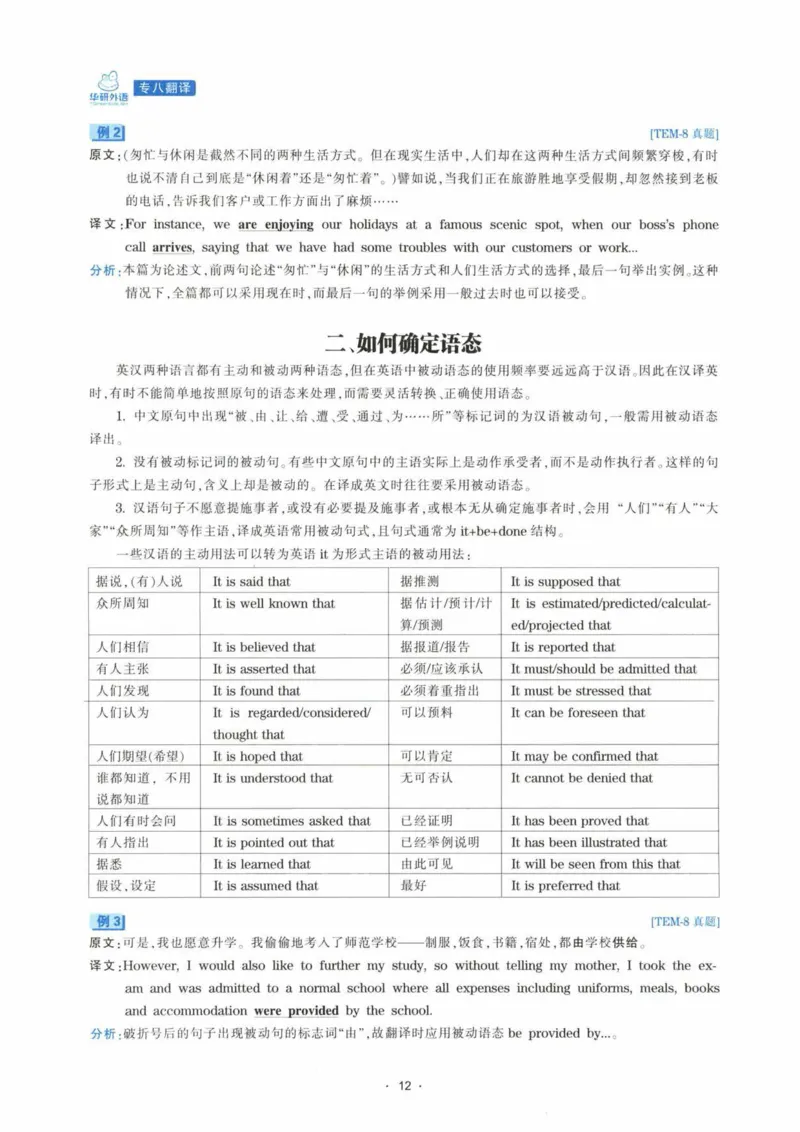
例 1| (TEM-8 ASfi]
原文:院长说这孩子发育迟缓时,她£ 是心头无绪。
译文:She felt even more lost when the director said that the child had suffered from slow growth.
分析:本句所在语篇为记叙文,记叙主人公送孩子到托儿所的经过。故总体时态应该用一般过去时。而前半句
“院长说……”后的内容处理成了间接引语,故时态上就要用过去完成时。
• 11 •八翻译
牮研外iS
划 1TEM>8 ft 题1
原文:(匆忙与休闲是截然不同的两种生活方式。但在现实生活中,人们却在这两种生活方式间频繁穿梭,有时
也说不淸『丨己到底M “休闲IT还是“匆忙荇”。)钟如说,当我们正在旅游胜地皁受假期,却忽然接到老板
的电话,告诉我们客户或T 作方面出了麻烦……
译文:For instance, we are enjoying our holidays at a famous scenic spot, when our boss's phone
call arrives, saying that we have had some troubles with our customers or work...
分析:本© 为论述文,前两句论述“匆 忙 “休闲”的生活方式和人们生活方式的选择,最后一句举出实例。这种
情况下,全篇都可以采用现在时,而最后一句的举例采用一般过去时也可以接受。
二 、如何确定语态
英汉两种语n 都有主动和被动两种沿态,但在英语中被动语态的使用频率要远远高于汉语。W 此在汉译英
时,有时不能简单地按照原句的语态来处理,而耑要灵活转换、正确使用语态。
1. 中文原句中出现“被、由、让、给、逍,受、通过、为……所”等标记词的为汉语被动句,一般诺川被动语态
译出。
2. 没有被动标记i»]的被动句。有些中文原句中的主语实际上是动作承受者,而不是动作执行者这样的句
子形式上是主动句,含义上却是被动的。在译成英文时往往要采用被动语态。
3. 汉语句子不愿意提施It者,或没有必要提及施饵者,或根本无从确定施饵者时,会用“人们”“冇人”“大
家”“众所周知”等作主语,译成英语常用被动句式,且句式通常为it+be+done结构..
•些汉语的主动用法吋以转为英语it为形式主语的被动用法:
据说,(有)人说 It is said that 据推测 It is supposed that
众所周知 It is well known that 据估计/预计八十 It is estimated/predicted/calculat-
算/预测 ed/projected that
人们相信 It is believed that 据报道/报告 It is reported that
有人主张 It is asserted that 必须/应该承认 It must/shoiild be admitted that
人们发现 It is found that 必须若®指出 It must be stressed that
人们认为 It is regarded/considered/ 可以预料 It can be foreseen that
thought that
人们期望(希望) It is hoped that 可以肯定 It may be confirmed that
淮都知道,不用 It is understood that 无可否认 It cannot be denied that
说都知道
人们有时会问 It is sometimes asked that 已经证明 It has been proved that
有人指出 It is pointed out that 已经举例说明 It has been illustrated that
据悉 It is learned that 由此可见 It will be seen from this that
假设,设定 It is assumed that M 好 It is preferred that
例3| ITEM』《越1
原文:可是,我也瓰意升学。我偷偷地考人了师范学校—— 制服,饭食,书锫,宿处,都由学校供给
译文:However, I would also like to further my study, so without telling my mother, I took the ex
am and was admitted to a normal school where all expenses including uniforms, meals, books
and accommodation were provided by the school.
分析:破折号后的句子出现被动句的标志间“I丨I”,故翮译时应用被动语态be provided by...。
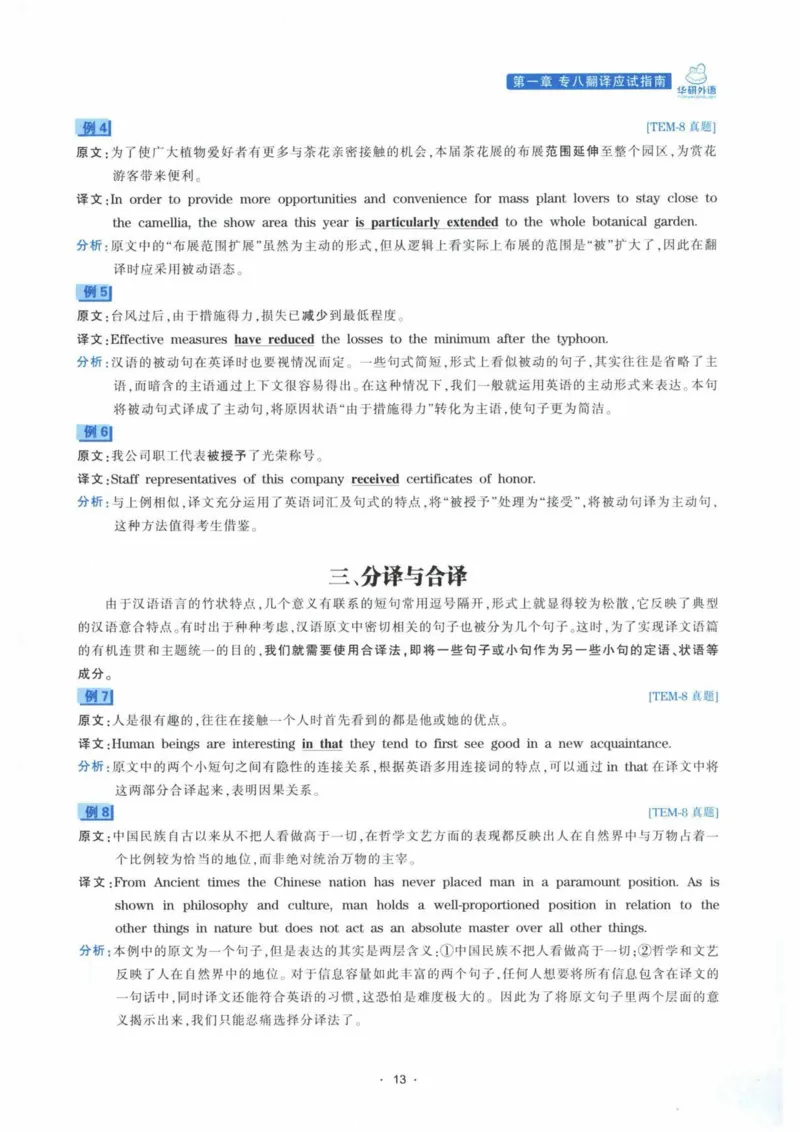
. 12 .第_章专八翻译应试指南
IgHI [TEM-8 A8S]
原文:为了使广大植物爱好者有更多与茶花亲密接触的机会,本届茶花展的布展范围延伸至幣个园K ,为赏花
游客带来便利。
译文:In order to provide more opportunities and convenience for mass plant lovers to stay close to
the camelliA the show area this year is particularly extended to the whole botanical garden.
分析:原文中的“布展范m 扩展”虽然为主动的形式,但从逻辑上肴实际上布展的范闹是“被”扩大了,w 此在翻
译时应采用被动语态。
m si
原文:台风过后,由于措施得力,损失已减少到最低程度
译文:Effective measures have reduced the losses to the minimum after the typhoon.
分析:汉语的被动句在英译时也要视情况而定一些句式简短,形式上看似被动的句子,其实往往是省略r 主
语,而暗含的主语通过上下文很容易得出。在这种M 况下,我们一般就运用英语的主动形式来表达.本句
将被动句式译成了主动句,将原W 状 “由于措施得力”转化为主语,使句子更为简洁。
原文:我公司职丁.代衣被授予了光荣称号。
译文:Staff representatives of this company received certificates of honor.
分析:与上例相似,译文充分运用了英语词汇及句式的特点,将“被授予”处理为“接受”,将被动句译为主动句,
这种方法值得考生借鉴。
三 、分译与合译
由于汉语语言的竹状特点,几个意义有联系的短句常用逗号隔开,形式上就!a 得较为松散,它反映了典型
的汉语意合特点。有时出于种种考虑,汉语原文中密切相关的句子也被分为几个句子。这时,为了实现译文语篇
的有机连贯和主题统一的目的,我们就需要使用合译法,即将一些句子或小句作为另一些小句的定语、状语等
成分。
侧 7| 1TEM*8 A:超 1
原文:人是很有趣的,往往在接触一个人时首先看到的都是他或她的优点。
译文:Human beings are interesting in that they tend to first see good in a new acquaintance.
分析:原文中的两个小短句之间有隐性的连接关系,根据英语多用连接同的特点,可以通过in that在译文中将
这两部分合译起来,表明因果关系。
例 8| |TEM-8
原文:中国民族自古以来从不把人石做高于一切,在竹学文艺方面的表现都反映出人在ft然界中与万物,1 f荇一
个比例较为恰当的地位,而非绝对统治万物的主宰.
译文:From Ancient times the Chinese nation has never placed man in a paramount position. As is
shown in philosophy and culture, man holds a well-proportioned position in relation to the
other things in nature but does not act as an absolute master over all other things.
分析:本例中的原文为一个句子,但是表达的其实是两层含义:①中同民族不把人ft做高于一切;②ff学和文艺
反映了人在N 然界中的地位。对于信息容M 如此丰?:T的两个句子,任何人想要将所有信息包含在译文的
—句话中,同时译文还能符合英语的习惯,这恐怕娃难度极大的。因此为了将原文句子里两个层面的意
义揭示出来,我们只能忍痛选择分译法了
• 13 •专八翻译
牮研外iS
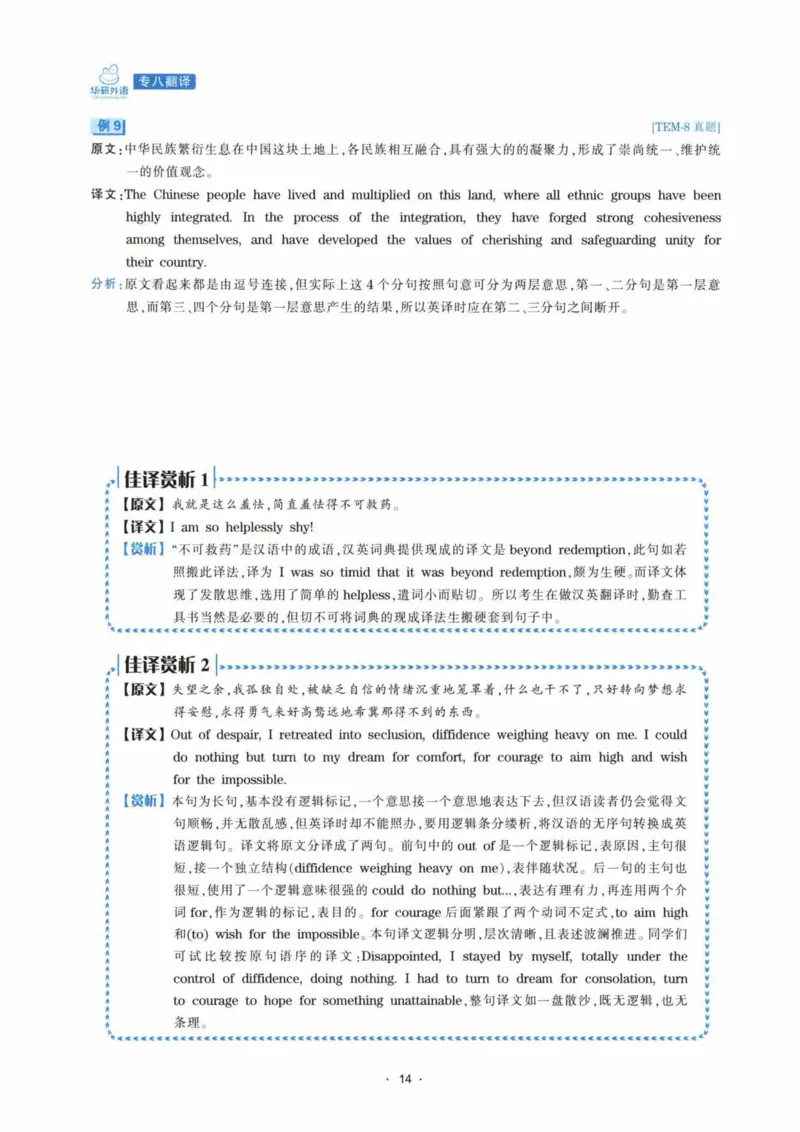
例 9| |TEM>8 爽-题 1
原文:中华民族繁衍生息在中国这块土地上,各民族相互融合,具有强大的的凝聚力,形成了崇尚统一、维护统
—的价值观念。
译文:The Chinese people have lived and multiplied on this land, where all ethnic groups have been
highly integrated. In the process of the integration, they have forged strong cohesiveness
among themselves, and have developed the values of cherishing and safeguarding unity for
their country.
分析:原文看起来都是由逗号连接,但实际上这4 个分句按照句意可分为两层意思,第一、二分句是第一层意
思,而第三、四个分句是第一层意思产生的结果,所以英译时应在第二、H 分句之间断开。
*fi
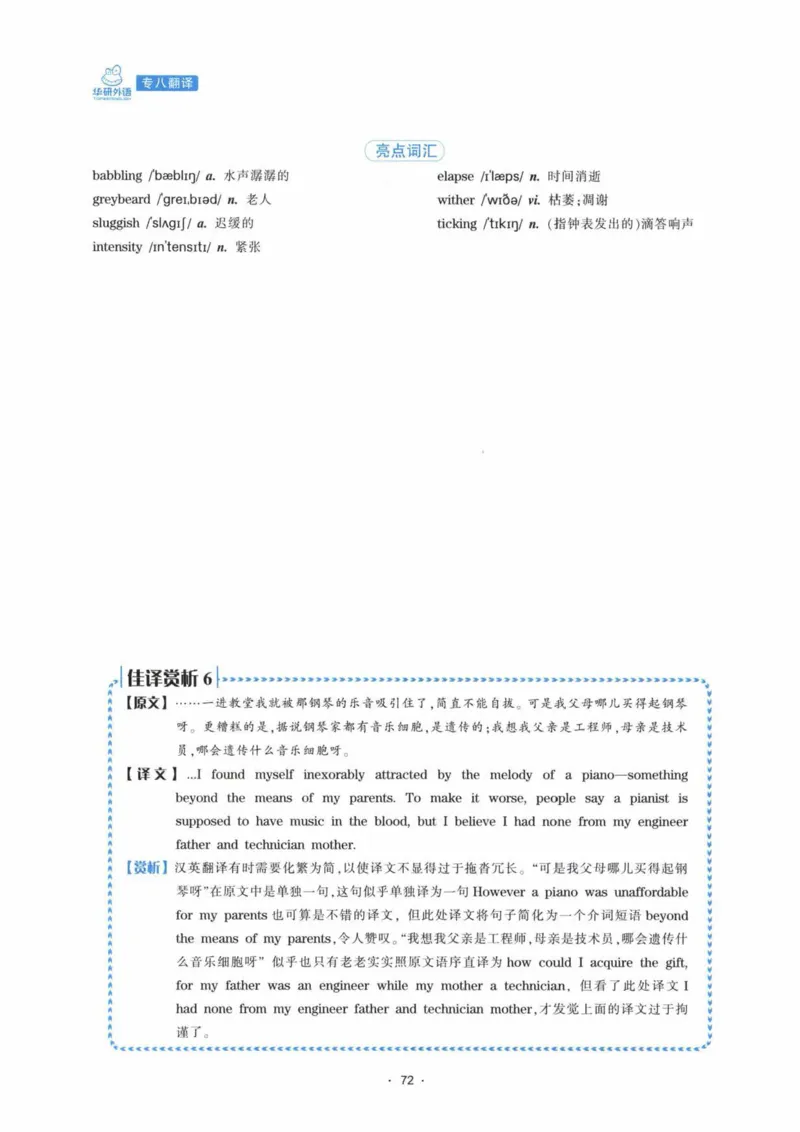
诖译赏 1卜… … … … … … … … … … … … … … … … … … …
i 【原文】我就是这么羞怯,简直羞怯得不可救药。
: lifxli am so helplessly shy!
; 【窃斬】“不可救药”是汉语中的成语,汉英词典提供现成的译文是beyond redemption,此句如若
照搬此译法,译为I was so timid that it was beyond redemption,颇为生硬。而译文体
现了发散思维.选用了简单的help丨ess,遣同小而貼切。所以考生在做汉英翻译时,勤査工
\ 具书当然是必要的,但切不可将词典的现成译法生搬硬套到句子中。
,丨佳 译 當 断 2 丨… … … … … … … … … … … … … … … … … … … …
【原x l 失望之余,我孤独自处,被缺乏自信的情绪沉重地笼革着,什么也干不了,只好转向梦想求
得安慰,求得勇气来好高骛远地希冀那得不到的东西,,
【译交】Out of despair, I retreated into seclusion^ diffidence weighing heavy on me. I could
do nothing but turn to my dream for comfort, for courage aim high and wish
for the impossible.
【贫斬】本句为长句,基本没有逻辑标记,一个意思接一个意思地表达下去,但汉语读者仍会觉得文
句顺畅,并无散乱感,但英译时却不能照办,要用逻辑条分缕析,将汉语的无序句转换成英
语逻辑句。译文将原文分译成了两句。前句中的out of是一个逻辑标记,表原因,主句很
短,接一个独立结构(diffidence weighing heavy on me),表伴随状况。后一句的主句也
很短,使用了一个逻辑意味很强的could do nothing but...,表达有理有力,再连用两个介
同for,作为逻辑的标记,表目的。for courage后面紧跟了两个动同不定式,to aim high
和(to) wish for the impossible。本句译文逻辑分明,层次清晰,且表述波澜推进同学们
可试比较按原句语序的译文:Disappointed, I stayed by myself, totally under the
control of diffidence, doing nothing. I had to turn to dream for consolation, turn
to courage to hope for something unattainable,幣句译文如一盘散沙,既无逻辑,也无
条理。
• 14 •100
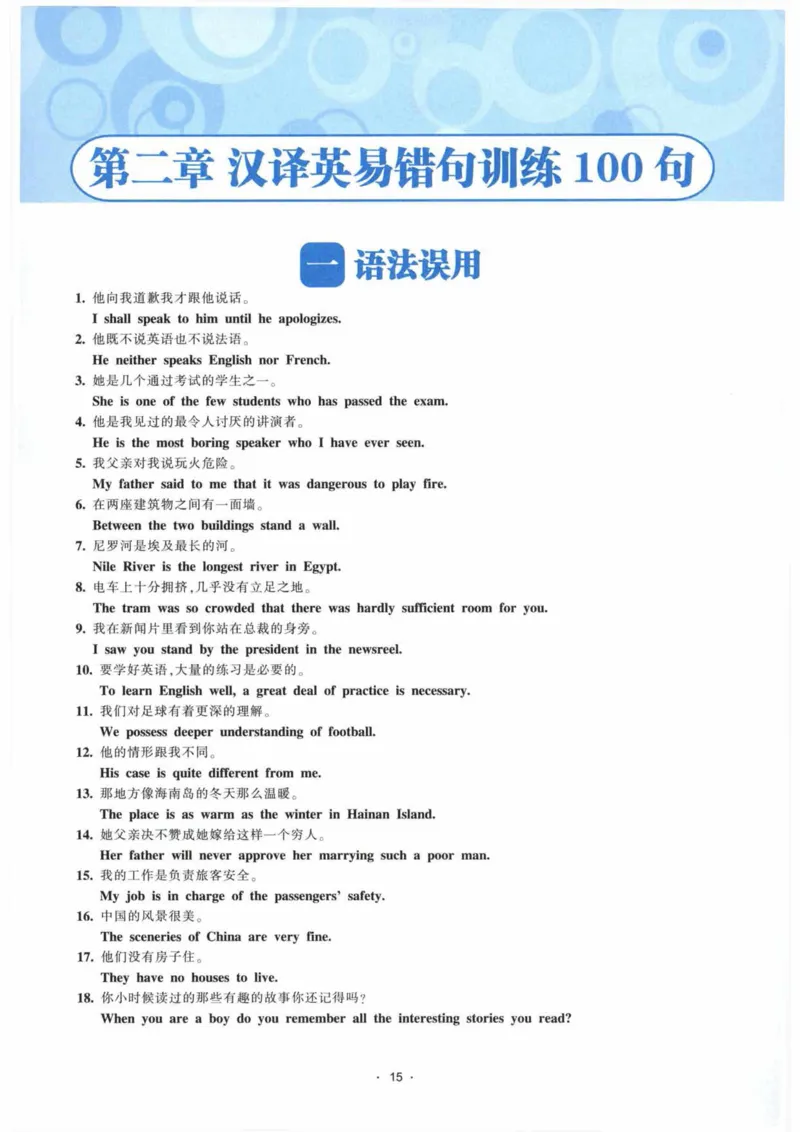
( 第 二 章 汉 译 英 易 错 句 训 练 句 )
〇 语法误用
1. 他向我道歉我才跟他说话。
I shall speak to him until he apologizes.
2. 他既不说英语也不说法语。
He neither speaks English nor French.
3. 她是几个通过考试的学生之一。
She is one of the few students who has passed the exam.
4. 他是我见过的最令人讨厌的讲演者。
He is the most boring speaker who I have ever seen.
5. 我父亲对我说玩火危险。
My father said to me that it was dangerous to play fire.
6. 在两座建筑物之间有一面墙3
Between the two buildings stand a wall.
7. 尼罗河是埃及最长的河。
Nile River is the longest river in Egypt.
8. 电车上十分拥挤,几乎没有立足之地。
The tram was so crowded that there was hardly sufficient room for you.
9. 我在新闻片里看到你站在总裁的身旁。
I saw you stand by the president in the newsreel.
10. 要学好英语,大量的练习是必要的。
To learn English well, a great deal of practice is necessary.
11. 我们对足球有着更深的理解。
We possess deeper understanding of football.
12. 他的情形跟我不同。
His case is quite different from me.
13. 那地方像海南岛的冬天那么温暖。
The place is as warm as the winter in Hainan Island.
14. 她父亲决不赞成她嫁给这样一个穷人。
Her father will never approve her marrying such a poor man.
15. 我的工作是负责旅客安全。
My job is in charge of the passengers' safety.
16. 中国的风景很美。
The sceneries of China are very fine.
17. 他们没有房子住。
They have no houses to live.
18. 你小时候读过的那些有趣的故亊你还记得吗?
When you are a boy do you remember all the interesting stories you read?
• 15 •a
专八翻译
牮研n遇
19. 我对他的正直不能信赖
I have no reliance in his honesty.
20. 如你所知道的,人生常比作航海。
As you know, life is often compared with a voyage.
21. 他除了发财之外別无他愿。
He has no other desire but to make a fortune.
22. 他是从后门进来的。
He enters from the back door.
23. 中国人是刻苦耐劳的民族。
The Chinese are hard-working and industrious people.
24. 不锈钢面盆比塑料面盆贵。
A basin made of stainless steel costs more than that of plastic.
正确译法
1. I shanV speak to him until he apologizes.
【点评】not... until是固定搭配,表示“到……时候才……”,本句中speak的动作要等到他道歉时才发生,
2. He speaks neither English nor French.
【点评】either... or,not only... but also等连闾所连接的部分应是相同词性或起相同作用
3. She is one of the few students who have passed the exam.
【点评】本句的先行词few students作主语,定语从句的谓语动同应与先行词保持数的一致
4. He is the most boring speaker that I have ever seen.
【点评】当先彳i同被形容词最高级或the only(唯一的),the same(同一的),the veiy(正是那个),all(全部),
any (任何),no(无一),every (每一个),much(多),little(少),none(无一)等词修饰时,常川关系代词
that,而不用 who 或 which。
5. My father said to me that it was dangerous to play with fire.
【点评】play后接运动、球类比赛时是及物动词;后接玩的东西时是不及物动词,与with连用。
6. Between the two buildings stands a wall.
【点评】本句是倒装句,主语是a wall,故谓语动词应用单数。
7. The Nile River is the longest river in Egypt.
【点评】在河流,山脉等名称前要用定冠词。
8. The tram was so crowded that there was scarcely sufficient room for you.
【点评】副词hardly和scarcely虽然都含有“几乎不”等否定含义,但在某些情况下是不能互换的,如在强调
数tt “不足”时只能Mj scarcely.这时它常与enough sufficient等词连川
9. I saw you stand beside the president in the newsreel.
【点评】stand by someone是“支持某人"的意思,to stand beside someone才是指“立于某人旁边”。但是
如果stand by后面的宾语不是人,则可与stand beside互换,表示“在……之旁”。
10. To learn English well, one needs to have a great deal of practice.
【点评】英语中非谓语动间的逻辑主语要与句子的主语一致,本例句中不定式to learn English well的逻
辑主语应该是“人”,而句子的主语却是practice,所以必须将句子的主语改为one,并作其他相应
的调整。
11. We possess a deeper understanding of football.
【点评】此处的underetanding是可数名词,常用单数形式。
12. His case is quite different from mine.
【点评】本句实际上是“他的情形和我(的情形)不同”的省略说法,be different from前后连接的亊物应为
同一性质,故不能ft;接按汉语的表达逐字翻译。
• 16 •第二章汉译英易错句训练100
脚外谦
13. The place is as warm as Hainan Island in winter.
【点评】在“be as... as.••”的比较句式中,相比的应是同类事物、,不能用place跟winter比较〇
14. Her father will never approve of her marrying such a poor man.
【点评】approve—词在此处是不及物动词•常与of连用。
15. My job is to help ensure the passengers safety.
【点评】原译按照中文直译,但in charge o f 的行为主体应该是“人”,不能是“工作”。此外,in charge of
one’s safety的说法也不妥。
16. The scenery of China is very fine.
【点评】scenery是集合名词,不可用复数。
17. They have no houses to live in.
【点评】live表示居住时是不及物动同,常与介词in连用,不可省略。
18. Do you remember all the interesting stories you read when you are a boy?
【点评】时间状语从句应置于它所修饰的动词附近。本句中的when you are a boy修饰的是动词read,所
以应紧接在read之后。
19. I have no reliance upon his honesty.// I have no confidence in his honesty.
【点评】“信赖某事”的表达应为 have reliance upon sth.或 have confidence in sth.〇
20. As you know, life is often compared to a voyage.
【点评】同种类的东西相比用compared with,不同种类的东西相比则用compared to,本句中的life和
voyages是完全不同种类,故应用compared to。
21. He has no desire but to make a fortune.// He has no other desire than to make a fortune.
【点评】原译将 have no desire but to do sth•和 have no other desire than to do sth.这两个句式杂糅
在一起。
22. He enters at the back door.
【点评】at the… door是固定搭配,“出去”也要说是go out at the door。
23. The Chinese are a hard-working and industrious people.
【点评】当people表示民族的意义时,是可数名词,前面需加冠词a,
24. A basin made of stainless steel costs more than one of plastic.
【点评】指代带有定冠词的单数名词用that,而指代不定冠同的单数名词则应改用代间one。
s
囿于原文
25. 我终于看出了你的心事。
Finally, I can see your mind.
26. 从他的话音里,我能听出东两来。
I can hear something from the tone of his voice.
27. 类似的观点目前还有市场
Viewpoints like this still have some markets at present.
28. 许先生正在® 门大学读傅士学位。
Mr. Xu studies the doctors* degree at Xiamen University.
29. 这是一条步行街。
This is a walking street.
30. 她英语教得很好。
She teaches English well.
31. 我们大家都必须不断充电提高ft己。
We all must constantly recharge so as to improve ourselves.
• 17 •专八翻译
华研n a
32. 我的钥匙忘在了家里
I forgot the key at home.
33. 阿米莉亚是个很像男人的女人。
Amelia is a woman who looks like a man.
34. 里奇先生怕老婆,
Mr. Leech is afraid of his wife.
35. 记者招待会上,人们向他提r许多问题。
People asked him a lot of questions at the press conference.
36. 桂林环境优雅,物产丰富。
Guilin’s environment is elegant and the resources are rich.
37. 我们市有许多中小型企业。
There are many medium-sized and small enterprises in our city.
38. 我认为教师的待遇不好。
In my opinion, the treatment of teacher is bad.
39. 假期从明天开始。
The vacation begins from tomorrow.
40. 此君饱尝了人间酸甜苦辣。
This man tasted to the full the bitterness, hotness, sourness, and sweetness of life in the human
world.
41. 別听他们胡说八道,根本就没那回亊。
Don’t listen to their babbling. Nothing of the sort.
42. 眼下政府需要解决的就是就业问题。
Employment problem is what the government has to solve at present.
43. 我们中国人常说:早餐要吃饱,午餐要吃好,晚餐要吃少。
We Chinese often say: breakfast should be full, lunch should be good, and dinner should be little.
44. 一些条件较好的地区,作物一年可以收获三次。
In some area with better conditions, it is possible to have three crops a year.
正确译法
25. Finally, I can read your mind.
【点评】汉语里“看出心事”是约定俗成的说法,但从严格意义上讲,“心诉”是无法被“看”到的,英语的语义
结构并不认可这种说法。
26. I can (ell something from the tone of his voice.
【点评】汉语里“从……中听出……”中,实际上“听”也就是“悟出,识別出”,英语里表达这一意思时不用
hear,而是用 tell。
27. Viewpoints like this still have some appeal at present.
【点评】本句中的“还有市场”实际上是指还有一些人依然相信他们,和market没有关系,改用still have
some appeal则从语意到语味都很贴近原文。
28. Mr. Xu is working for the doctors degree at Xiamen University.
【点评】原译按字照搬将“读博士学位”译为study the doctor’s degree,但英语里并无此种表达。
29. This is a pedestrian street.// This is a vehicle-free street.
【点评】原译是典型的中式思维译法,英文中的walking与“能够行走”有关,如walking catfish指“能在地
上爬行的貼鱼”,walking wounded指“虽然受了伤仍能行走”。而“步行街"走的是行人,不是“街”。
• 18 •第二章汉译英易错句训练100
30. She is a good teacher of English.
【点评】英美人一般不会说She teaches English well,这种表达语意含糊,且稍K 造作,对这个意思的^惯
说法说是 a good teacher of...
31. We all must constantly renew our knowledge so as to improve ourselves.
【点评】这里的“充电”是指“通过继续学习增长才干”。而recharge则是指物理学意义上的“充电”。
32. I left the key at home.
【点评】本句的真正意思是“钥匙留在了家里”或“忘了把钥匙带在身上”,译成英文时只笛表达出其中一层
意思就够了,而不能把两层意思杂糅在一个句子中。
33. Amelia is a man of a woman.
【点评】汉语的“很像男人的女人"有多层含义,包括性格、身高体貌、行为举止等方面,原译译得t•分拘il
却依然语焉不详。英语里有个说法:a man of a woman包括了原文的所有语义内涵。
34. Mr. Lee is henpecked.
【点评】中英文均有“怕老婆”的说法,其中“怕”直译成be afraid of one’s wife有失偏颇,其实英语对此自
有特色的说法---henpecked
35. He was asked a lot of questions at the press conference.
【点评】句中的“人们”系泛指主语,其所表示的是不确定的施事者,译成英语时宜拆略此外,为丫凸显信息
本身,这类句子的英译最好使用被动语态。
36. Being rich in resources, Guilin is surrounded by favorable environment.
【点评】原译将“优雅”译为elegant十分不妥,该同一般只用于修饰人或与人有关的事物。中文实际h 是指
桂林的环境宜人,故不妨译为favorable environment。
37. There are many small and medium-sized enterprises in our city.
【点评】汉语说“中小型企业"是按从大到小的顺序,但英文中的正确说法却不一样,应为small and medi
um-sized enterprises 。同 样的 ,“ 高新技 术”也 不能说 high and new technology , 而是 new and
high technology aH advanced high technology
38. In my opinion, teachers are poorly paid.
【点评】翮译本句的关键在于确定“待遇不好”是指什么,原译迕接译为the treatment of teachers is bad,
让读者不知所云。此处待遇应该是指I 资福利偏低,应译为poorly paicL
39. The vacation begins tomorrow.
【点评】原译逐字将原文翻译出来,但其实“从”字在这种场合是无妬翻译出来的〇而且,此处的tomorrow
是一个副词,副词前是不可以加介词的。
40. This man tasted to the full the bitterness of life in the human world.
【点评】成语“酸甜苦辣”极易让人項.文生义,但这个成语在运用中未必与“酸”“甜”“苦"“辣”有关,本句实际
上指的是“受尽了苦”。
41. DonTt be fooled by their babbling. Nothing of the sort.
【点评】原文中的“听”不能用listen t o 来表示,W 为 !isten t o 指“听”的动作,而原文中的“別听”不是不
让他“听”,而是劝告他“不要听信”,因此,用 not be fooled b y 才史达意
42. Employment is the problem the government has to solve at present.
【点评】考生很容易将“就业问题”译为employment problenu实际上,原文的“就业问题”就是指没有丁.作
的人找工作的问题,也就是失业问题,改译后的句子摆脱原文柬缚,更加淸晰易慷
43. We Chinese often say: have a full breakfast, a nice lunch, and a light dinner.
【点评】原译沿袭汉语思维,厲填入式对等直译,译文M 得生硬。
44. In some favored areas, three crops a year are possible.
【点评】“条件较好的地K ”其实指的就是favored areas原译In some area with better conditions给人
一种浓烈的翻泽腔。
• 19 •专八翻译
ifanifl
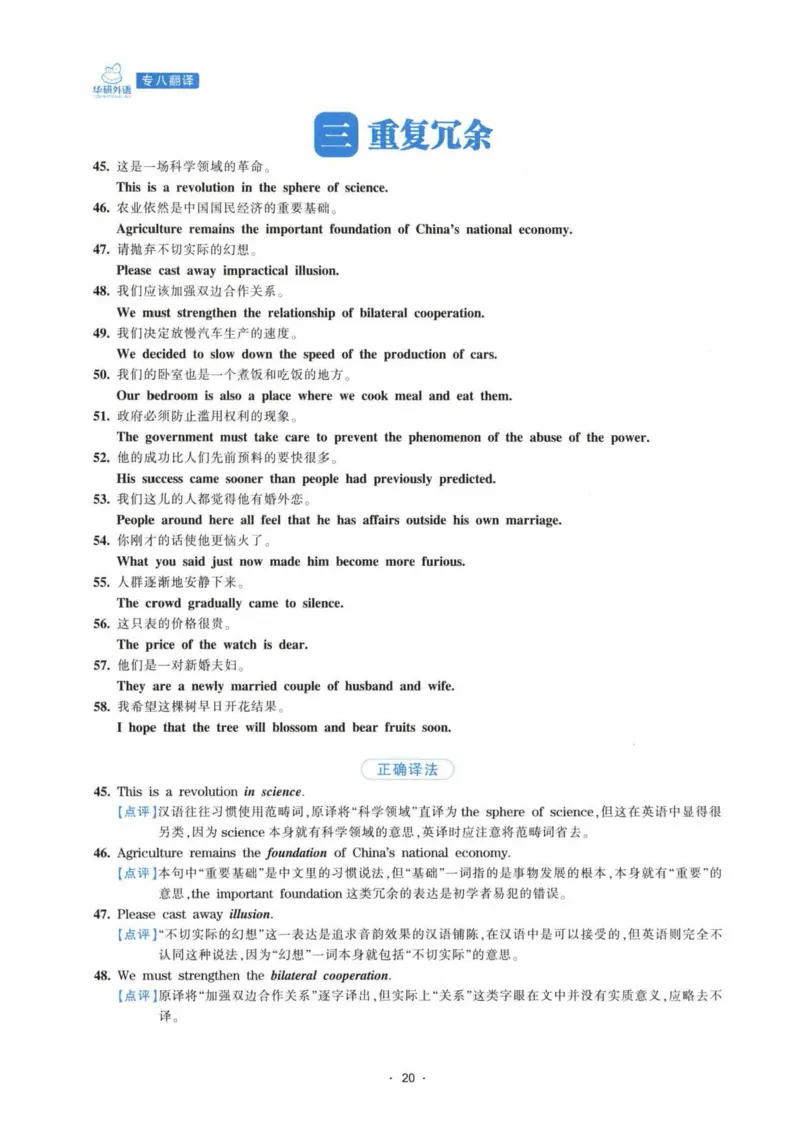
G
重复冗余
45. 这是一场科学领域的革命。
This is a revolution in the sphere of science.
46. 农业依然是中闻闻民经济的e 要基础。
Agriculture remains the important foundation of China's national economy.
47. 请抛弃不切实际的幻想:
Please cast away impractical illusion.
48. 我们应该加强双边合作关系
We must strengthen the relationship of bilateral cooperation.
49. 我们决定放慢汽车生产的速度。
We decided to slow down the speed of the production of cars.
50. 我们的卧室也是一个煮饭和吃饭的地方。
Our bedroom is also a place where we cook meal and eat them.
51. 政府必须防止滥用权利的现象。
The government must take care to prevent the phenomenon of the abuse of the power.
52. 他的成功比人们先前预料的要快很多。
His success came sooner than people had previously predicted.
53. 我们这儿的人都觉得他有婚外恋
a
People around here all feel that he has afTairs outside his own marriage.
54. 你刚才的话使他更恼火了。
What you said just now made him become more furious.
55. 人群逐渐地安静F来
The crowd gradually came to silence.
56. 这只表的价格很贵。
The price of the watch is dear.
57• 他们是一对新婚夫妇。
They are a newly married couple of husband and wife.
58.我希望这棵树早日开花结果。
I hope that the tree will blossom and bear fruits soon.
Q 正确译法
45. This is a revolution in science.
【点评】汉语往往习惯使用范畴间,原译将“科学领域”直译为the sphere of science,但这在英语中显得很
另类,因为science本身就有科学领域的意思,英译时应注意将范畴词省去。
46. Agriculture remains the foundation of China's national economy.
【点评】本句中“重要基础”是中文里的习惯说法,但“基础”一词指的是事物发展的根本,本 身 就 有 要 ”的
j£思,the important foundation这类冗余的表达是初学者易犯的错误。
47. Please cast away illusion.
【点评】“不切实际的幻想”这一表达是追求音韵效果的汉语铺陈,在汉语中是可以接受的,但英语则完全不
认同这种说法,因为“幻想”一词本身就包括“不切实际”的意思。
48. We must strengthen the bilateral cooperation.
【点评】原译将“加强双边合作关系”逐字译出,但实际上"关系”这类字眼在文中并没有实质意义,应略去不
译。
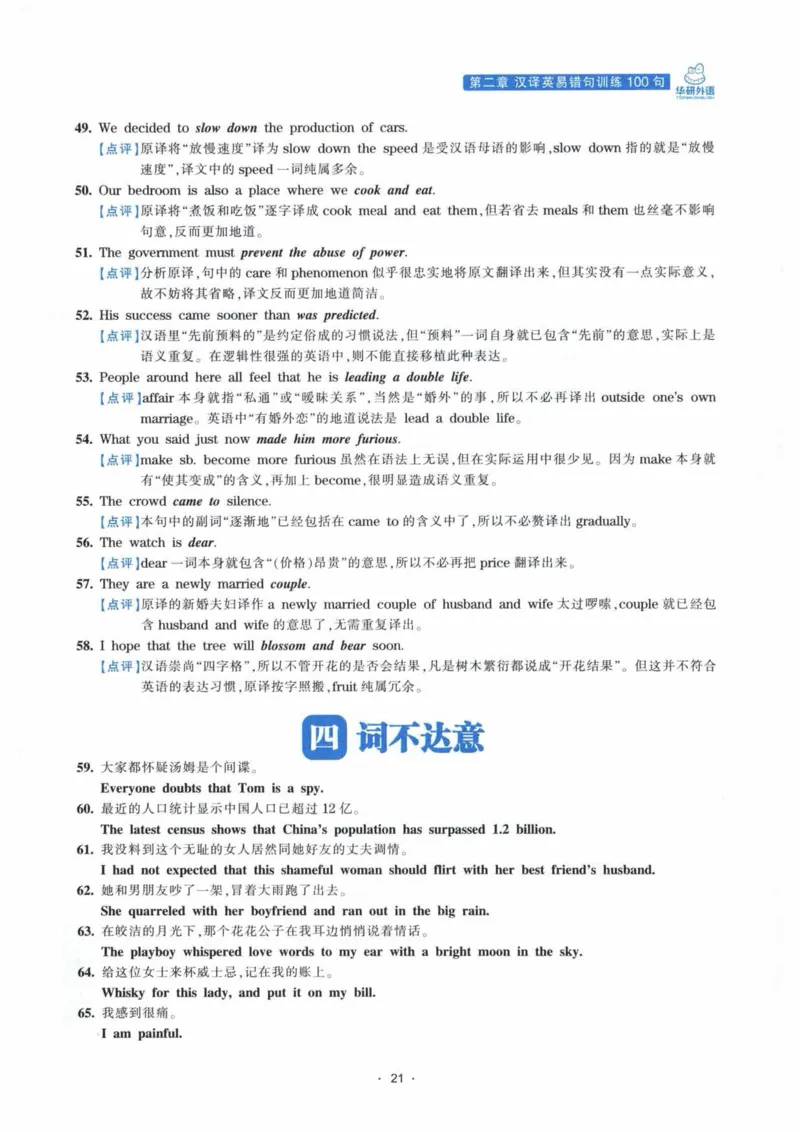
• 20 .第二章汉译英易错句训练100句
绝W外谨
49. We decided to slow down the production of cars.
【点评】原译将“放慢速度”译为slow down the speed是受汉语母语的影响,slow down指的就是“放慢
速度”,译文中的speed —同纯丨4 多余。
50. Our bedroom is also a place where we cook and eat.
【点评】原译将“煮饭和吃饭”逐字译成cook meal and eat them,但若省去meals和them也丝奄不影响
句意,反而更加地道。
51. The government must prevent the abuse of power.
【点评】分析原译,句中的care和phenomenon似乎很忠实地将原文翻译出来,但其实没有一点实际意义,
故不妨将其省略,译文反而更加地道简洁。
52. His success came sooner than was predicted.
【点评】汉语里“先前预料的”是约定俗成的习惯说法,但“预料”一词自身就已包含“先前”的意思,实际上是
语义重复。在逻辑性很强的英语中,则不能直接移植此种表达。
53. People around here ail feel that he is leading a double life.
【点评】affair本身就指“私通”或“暧昧关系”,当然是“娇外”的事,所以不必再译出outside one’s own
marriage> 英语中“冇婚外恋”的地道说法是lead a double life。
54. What you said just now made him more furious.
【点评】make sb. become more furious虽然在语法上无误,但在实际运用中很少见。因为make本身就
有“使其变成”的含义,再加h become,很明显造成语义重复。
55. The crowd came to silence.
【点评】本句中的副同“逐渐地”已经包括在came to的含义中了,所以不必赘译出gradually
56. The watch is dear.
【点评】dear —词本身就包含“(价格)昴贵”的意思,所以不必再把price翻译出来。
57. They are a newly married couple.
【点评】原译的新婚夫妇译作a newly married couple of husband and wife太过喷味,couple就已经包
含husband and wife的意思了,无需重复译出。
58. I hope that the tree will blossom and bear soon.
【点评】汉语崇尚“四字格”,所以不管幵花的是否会结果,凡是树木繁衍都说成“开花结果”。但这并不符合
英语的表达习惯,原译按字照搬,fruit纯厲冗余。
Q
) 词不达意
59. 大家都怀疑汤姆是个间谍
Everyone doubts that Tom is a spy.
60. M 近的人口统计显示中国人口已超过12亿。
The latest census shows that China's population has surpassed 1.2 billion.
61. 我没料到这个无耻的女人居然同她好友的丈夫调情。
I had not expected that this shameful woman should flirt with her best friend's husband.
62. 她和男朋友吵了一架,冒着大酎跑了出去。
She quarreled with her boyfriend and ran out in the big rain.
63. 在皎洁的月光下,那个花花公子在我耳边悄悄说着情话。
The playboy whispered love words to my ear with a bright moon in the sky.
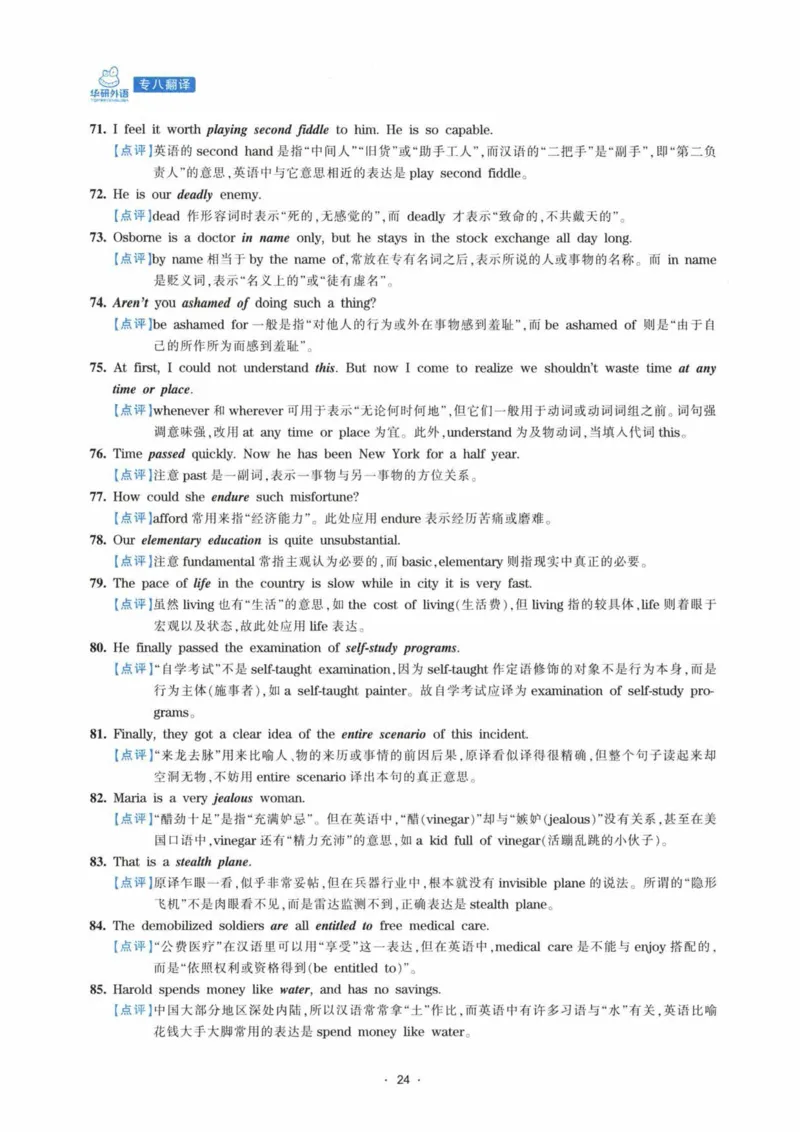
64. 给这位女士来杯威士忌,i己在我的账I:。
Whisky for this lady, and put it on my bill.
65. 我感到很痛。
I am painful.
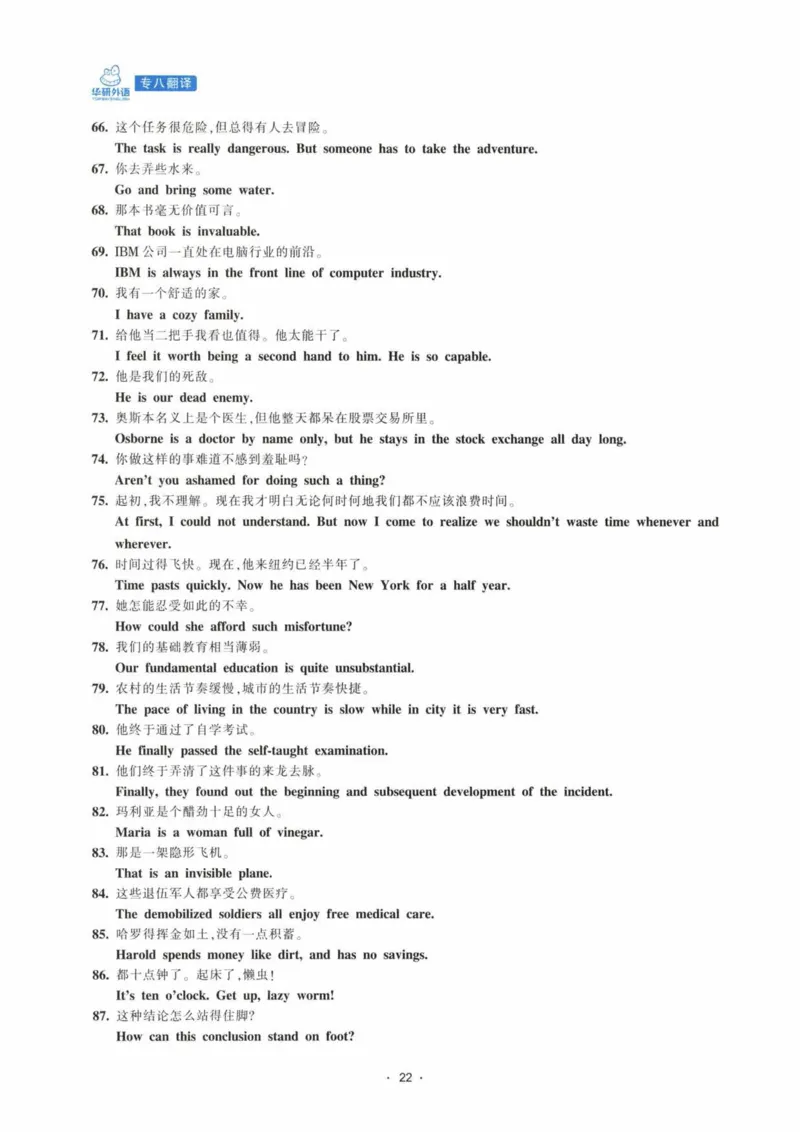
• 21 •专八翻译
66. 这个任务很危险,但总得有人去肾险、
The task is really dangerous. But someone has to take the adventure.
67. 你去弄些水来。
Go and bring some water.
68. 耶本ti奄尤价值可言。
That book is invaluable.
69. IBM公S)—直处在电脑行业的前沿。
IBM is always in the front line of computer industry.
70. 我有一个舒适的家。
I have a cozy family.
71. 给他当二把手我肴也值得。他太能干了。
I feel it worth being a second hand to him. He is so capable.
72. 他是我们的死敌。
He is our dead enemy.
73. 奥斯本名义上是个医生,但他整天都呆在股票交易所里。
Osborne is a doctor by name only, but he stays in the stock exchange all day long.
74. 你做这样的事难道不感到羞耻吗?
Aren't you ashamed for doing such a thing?
75. 起初,我不理解。现在我才明A 无论何时何地我们都不应该浪费时间^
At first, I could not understand. But now I come to realize we shouldn't waste time whenever and
wherever.
76. 时间过得飞快现在,他来纽约已经半年了。
Time pasts quickly. Now he has been New York for a half year.
77. 她怎能忍受如此的不幸。
How could she afford such misfortune?
78. 我们的基础教育相当薄弱t
Our fundamental education is quite unsubstantial.
79. 农村的生活节奏缓慢,城市的生活节奏快捷
The pace of living in the country is slow while in city it is very fast.
80. 他终于通过了自学考试
He finally passed the self-taught examination.
81. 他们终于弄清了这件事的来龙去脉。
Finally, they found out the beginning and subsequent development of the incident.
82. 玛利亚是个醋劲十足的女人。
Maria is a woman full of vinegar.
8丄 那是一架隐形飞机。
That is an invisible plane.
84. 这些退m 军人都享受公费医疗。
The demobilized soldiers all enjoy free medical care.
85. 哈罗得挥金如土,没有一点积蓄。
Harold spends money like dirt, and has no savings.
86. 都十点钟了。起床了,懒虫!
It’s ten o’clock. Get up,lazy worm!
87. 这种结论怎么站得住脚?
How can this conclusion stand on foot?
• 22 •a
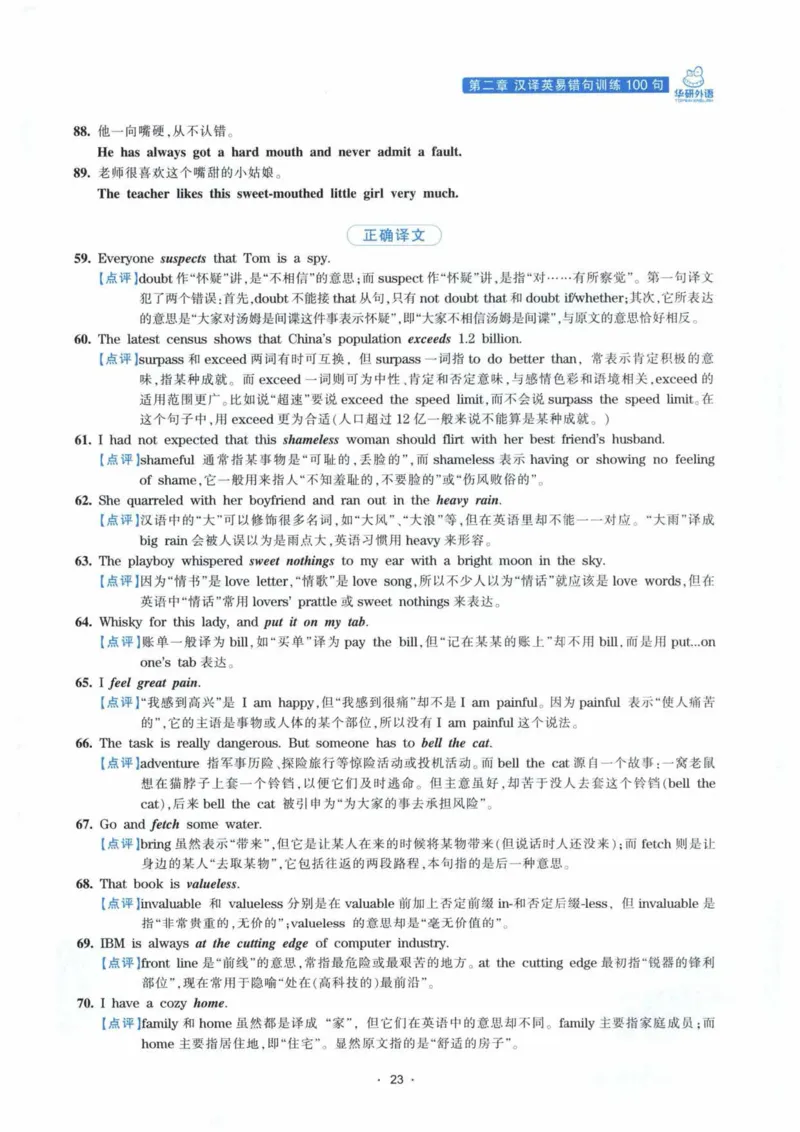
第二章汉译英易错句训练100句
牮研外iS
88. 他一向嘴硬,从不认错。
He has always got a hard mouth and never admit a fault.
89. 老师很喜欢这个嘴甜的小姑娘5
The teacher likes this sweet-mouthed little girl very much.
正确译文
59. Everyone suspects that Tom is a spy.
【点评】doubt作“怀疑”讲,是“不相信”的意思;而suspect作“怀疑”讲,是指“对……有所察觉”。第一句译文
犯了两个错误:首先,doubt不能接that从句,只有not doubt that和doubt if\vhether;其次,它所表达
的意思是“大家对汤姆是间谍这件事表示怀疑”,即“大家不相信汤姆是间谍”,与原文的意思恰好相反
60. The latest census shows that China^s population exceeds 1.2 billion.
【点评】surpass和exceed两词有时可互换,但surpass—词指to do better than,常表示肯定积极的意
味,指某种成就。而exceed —词则可为中性、肯定和否定意味,与感情色彩和语境相关,exceed的
适用范围更广。比如说“超速”嬰说exceed the speed limit,而不会说surpass the speed limit在
这个句子中,用exceed更为合适(人口超过12亿一般来说不能箅是某种成就)
61. I had not expected that this shameless woman should flirt with her best friend's husband.
【点评】shameful通常指某事物是“可耻的,丢脸的”,而shameless表示having or showing no feeling
of shame,它一般用来指人“不知羞耻的,不要脸的”或“伤风败俗的”
62. She quarreled with her boyfriend and ran out in the heavy rain.
【点评】汉语中的“大”可以修饰很多名词,如“大风”、“大浪”等,但在英语里却不能一一对应。“大雨”译成
big rain会被人误以为是雨点大,英语习惯用heavy来形容。
63. The playboy whispered sweet nothings to my ear with a bright moon in the sky.
【点评】因为“情书”是love letter,“情歌"是love song,所以不少人以为“情话”就® 该是love words,但在
英语中“情话"常用lovers’ prattle或sweet nothings来表达。
64. Whisky for this lady, and put it on my tab.
【点评】账单一般译为bill,如“买单”译为pay the bill,但“记在某某的账上”却不用bill,而是用put...on
one’s tab 表达。
65. I feel great pain.
【点评】“我感到高兴”是 I am happy,但“我感到很痛”却不是I am painflil W 为painful表W “使人痛苦
的”,它的主语是亊物或人体的某个部位,所以没有I am painful这个说法。
66. The task is really dangerous. But someone has to bell the cat.
【点评】adventure指军事历险、探险旅行等惊险活动或投机活动。而bell the cat源自一个故車:一窝老鼠
想在猫脖子上套一个铃铛,以便它们及时逃命。但主意虽好,却苦于没人去套这个铃钓(bell the
cat),后来bell the cat被引申为“为大家的事去承担风险”。
67. Go and fetch some water.
【点评】bring虽然表示“带来”,但它是让某人在来的时候将某物带来(但说话时人还没来);而fetch则是让
身边的某人“去取某物",它包括往返的两段路程,本句指的是后一种意思。
68. That book is valueless.
【点评】invaluable和 valueless分别是在valuable前加上否定前缀in-和否定后缀-less,fM. invaluable是
指“非常贵重的,无价的”;valueless的意思却是“毫无价值的”。
69. IBM is always at the cutting edge of computer industry.
【点评】front line是“前线”的意思,常指最危险或最艰苦的地方。at the cutting edge AV初指“锐器的锋利
部位”,现在常用于隐喻“处在(高科技的)最前沿”。
70. I have a cozy home.
【点评】family和home虽然都是译成“家”,但它们在英语中的意思却不同。family主要指家庭成员;而
home主要指居住地,BI丨“住宅”。显然原文指的是“舒适的房子”。
• 23 •专八翻译
71. I feel it worth to him. He is so capable.
【点评】英语的second hand是指“中间人”“旧货”或“助手工人”,而汉语的“二把手”是“副手”,即“第二负
责人”的意思,英语中与它意思相近的表达是play second fiddle。
72. He is our deadly enemy.
【点评】dead作形容词时表示“死的,无感觉的",而 deadly才表示“致命的,不共戴天的”。
73. Osborne is a doctor in name only, but he stays in the stock exchange all day long.
【点评】by name相当丁 by the name of,常放在专冇名间之后,表示所说的人或亊物的名称。而 in name
是贬义词,表示“名义上的"或“徒有虚名”。
74. Aren't you ashamed of doing such a thing?
【点评】be ashamed for—般是指“对他人的行为或外在琪物感到羞耻”,(W be ashamed o f 则是“由于自
己的所作所为而感到羞耻"。
75. At first, I could not understand this. But now I come to realize we shouldn't waste time at any
time or place.
【点评】whenever和wherever可用于表示“无论何时何地”,但它们一般用于动词或动M 词组之前。词句强
调意味强,改用at any time or place为宜。此外,understand为及物动词,当填入代词this
76. Time passed quickly. Now he has been New York for a half year.
【点评】注意past是一副词,表示一亊物与另一事物的方位关系。
77. How could she endure such misfortune?
【点评】afford常川来指“经济能力”。此处应用endure表示经历苦痛或磨难。
78. Our elementary education is quite unsubstantial.
【点评】注意fundamental常指主观认为必要的,而basic,elementary则指现实中啟正的必要。
79. The pace of life in the country is slow while in city it is very fast.
【点评】虽然living也有“生活”的意思,如the cost of living(生活费),但living指的较具体,life则着眼f
宏观以及状态,故此处应用life表达。
80. He finally passed the examination of self-study programs.
【点评】“自学考试”不是self-taught examination,因为self-taught作定语修饰的对象不是行为本身,而是
行为主体(施亊者),如 a self-taught painter。故自学考试应译为 examination of self-study pro
grams 0
81. Finally, they got a clear idea of the entire scenario of this incident.
【点评】“来龙去脉”用来比喻人、物的来历或唞悄的前因后果,原译看似译得很精确.但整个句子读起来却
空洞无物,不妨用entire scenario译出本句的真正意思。
82. Maria is a very jealous woman.
【点评】“醋劲十足”是指“充满妒忌”。但在英语中,“醋(vinegar)”却与“嫉妒(jealous)”没有关系,甚至在美
国口语中,vinegar还有“梢 充 沛 ”的意思,如a kid full of vinegar(活蹦乱跳的小伙子)。
83. That is a stealth plane.
【点评】原译乍眼一看,似乎非常妥帖,但在兵器行业中,根本就没有invisible plane的说法。所谓的“隐形
飞机”不是肉眼看不见,而是雷达监测不到,正确表达是stealth plane。
84. The demobilized soldiers are all entitled to free medical care.
【点评】“公费医疗”在汉语里可以用“享受”这一表达,但在英语中,medical care是不能与enjoy搭配的,
而是“依照权利或资格得到(be entitled to)”。
85. Harold spends money like water, and has no savings.
【点评】中W 大部分地区深处内陆,所以汉语常常令“土”作比,而英语中有许多习语与“水"有关,英语比喻
花钱大手大脚常用的表达是spend money like water
24
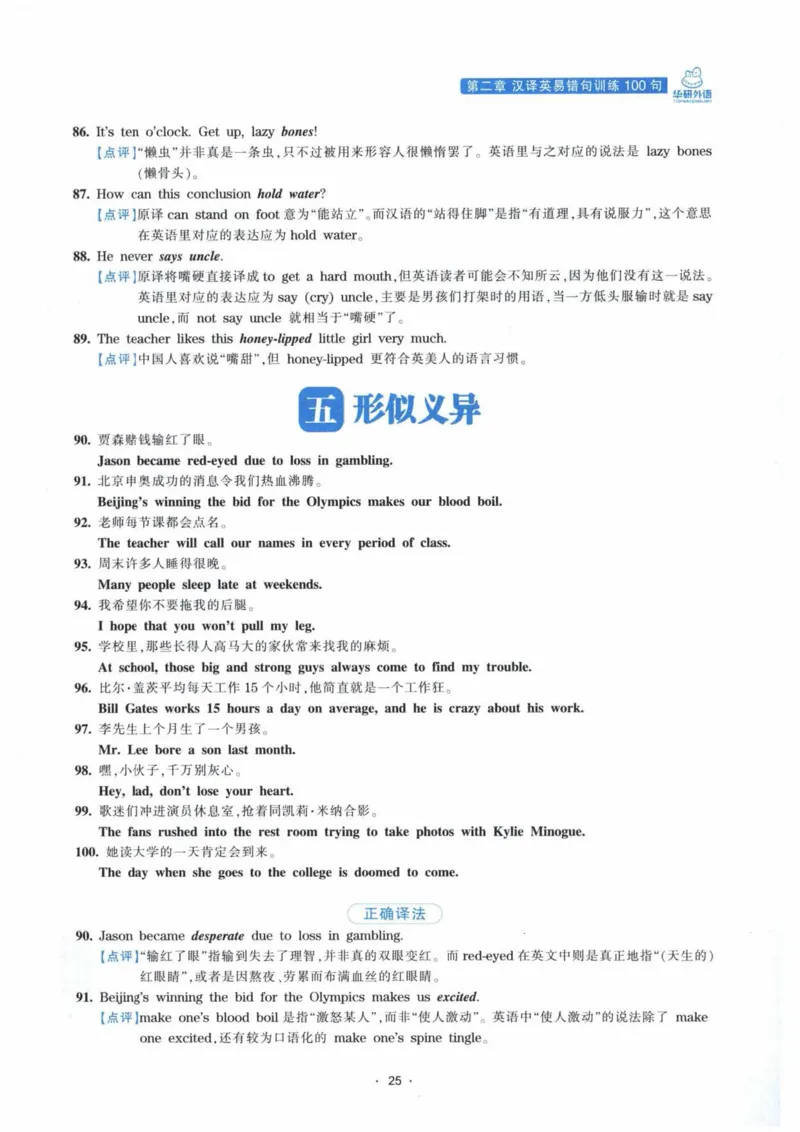
• •第二章汉译英易错句训练100句
i^iRnifl
86. It's ten o'clock. Get up, lazy bones'.
[点评】“懒虫”并非真是一条虫,只不过被用来形容人很懒惰罢了。英语里与之对应的说法是丨azy bones
(懒骨头)。
87. How can this conclusion hold waters
【点评】原译can stand on foot意为“能站立"。而汉语的“站得住脚”是指“有道理,具有说服力”,这个意思
在英语里对应的表达应为hold water。
88. He never says uncle.
【点评]原译将嘴硬直接译成to get a hard mouth,但英语读者可能会不知所云,因为他们没有这一说法。
英语里对应的表达应为say (cry) uncle,主要是男孩们打架时的用语,当一方低头服输时就是say
unde,而 not say uncle就相当于“嘴硬”了。
89. The teacher likes this honey-lipped little girl very much.
【点评】中国人喜欢说“嘴甜”,但 honey-lipped更符合英美人的语言习惯。
形似义异
90. 贾森赌钱输红了眼
Jason became red-eyed due to loss in gambling.
91. 北京申奥成功的消息令我们热血沸腾>
Beijing's winning the bid for the Olympics makes our blood boil.
92. 老师每节课都会点名。
The teacher will call our names in every period of class.
93. 周末许多人_得很晚。
Many people sleep late at weekends.
94. 我希望你不要拖我的后腿
I hope that you won't pull my leg.
95. 学校里,那些长得人高马大的家伙常来找我的麻烦。
At school, those big and strong guys always come to find my trouble.
96. 比尔•盖茨平均每天工作15个小时,他简直就是一个工作狂。
Bill Gates works 15 hours a day on average, and he is crazy about his work.
97. 李先生上个月生了一个男孩。
Mr. Lee bore a son last month.
98. 嘿,小伙子,千万別灰心。
Hey, lad, donH lose your heart.
99. 歌迷们冲进演员休息室,抢着同凯莉•米纳合影。
The fans rushed into the rest room trying to take photos with Kylie Minogue.
100. 她读大学的一天肯定会到来
The day when she goes to the college is doomed to come.
正确译法
90. Jason became desperate due to loss in gambling.
【点评】“输红了眼”指输到失去了理智,并非真的双眼变红。而red^eyed在英文中则是真正地指“(天生的)
红眼目ff”,或者是因熬夜、劳尜而布满血丝的红眼睛。
91. Beying^ winning the bid for the Olympics makes us excited.
【点评】make one’s blood boil是指“激怒某人”,而非“使人激动”。英语中“使人激动”的说法除了 make
one excited,还有较为口语化的 make one’s spine tingle。
• 25 •C3 专八翻译
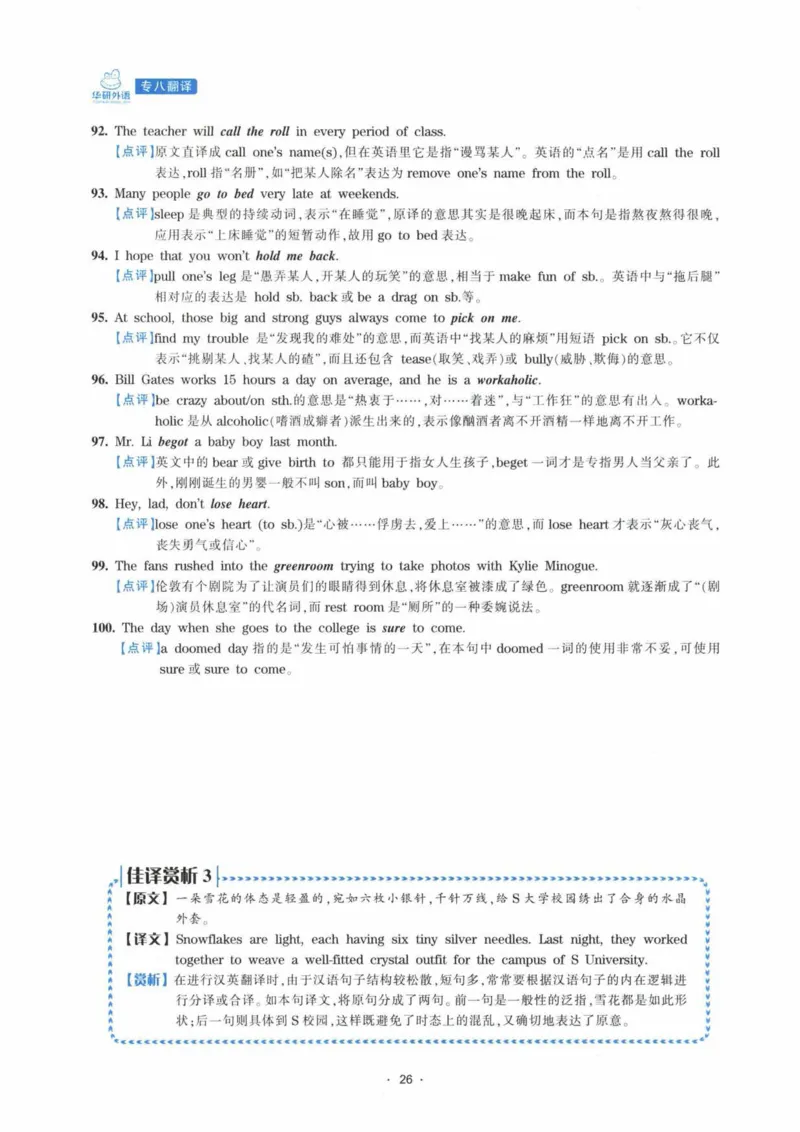
92. The teacher will call the roll in every period of class.
【点评】顷文直译成call one’s name(s),似在英语里它造指“漫骂某人”。英语的“点名”是用call the roll
表达,roll指“名册”,如“把某人除名"表达为remove one’s name from the roll
93. Many people go to bed very late at weekends.
【点评】sleep足典墦的持续动词,表示“在睡觉”,原译的意思其实是很晚起床,ifi丨本句是指熬夜熬得很晚,
应川表氺“上床睡觉”的短暂动作,故IH go to bed表达a
94. I hope that you won^t hold me back.
【点评】pull one’s leg是“愚弄某人,幵某人的玩笑”的意思,相当于make fiin of sb.。英语中与“拖后腿"
相对应的表达是hold sb. back或be a drag on sb.等。
95. At school, those big and strong guys always come to pick on me.
【点评】find my trouble是“发现我的难处"的意思,而英语中“找某人的麻烦”用短语pick on sb.它不仅
表术“挑剔某人、找某人的碴”,而且还包含tease(取笑、戏弄)或 bully(威胁、欺侮)的意思。
96. Bill Gates works 15 hours a day on average, and he is a workaholic.
【点评】be crazy about/on sth.的意思是“热衷于....,对....荇迷”,与“T 作狂”的意思有出入;worka-
holic是从alcoholic(嗜酒成癖者)派生出来的,表示像酗酒者离不幵酒梢一样地离不开I 作。
97. Mr. Li begot a baby boy last month.
【点评】英文中的bear或give birth to都只能用于指女人生孩子,beget—词才是专指男人当父亲了。此
外,刚刚诞生的男婴一般不叫son,而叫baby boy 5
98. Hey, lad, don't lose heart.
【点评】lose one’s heart (to sb.)是“心被....俘虎去,爱上....”的意思,而lose heart才表示“灰心丧气,
丧失勇气或信心”。
99. The fans rushed into the greenroom trying to take photos with Kylie Minogue.
【点评】伦敦有个剧院为了il:演员们的眼睹得到休息,将休息室被漆成了绿色。greenroom就逐渐成了“(剧
场)演员休息室”的代名词,而rest room是“厕所”的一种委婉说法。
100. The day when she goes to the college is sure to come.
【点评】a doomed day指的是“发生可怕唞情的一天”,在本句中doomed—词的使用非常不妥,可使用
sure 或 sure to come 〇
,丨佳译赏断3 1.
【IS x 】一朵雪花的体态是轻盈的,宛如六枚小银针,千针万线,给 S 大学校园绣出了合身的水晶
外套。
[ifx] Snowflakes are light, each having six tiny silver needles. Last night, they worked
together to weave a well-fitted crystal outfit for the campus of S University.
【窃妬】在进行汉英翻译时,由于汉语句子结构较松散,短句多,常常要根据汉语句子的内在逻辑进
行分译或合译。如本句译文.将原句分成了两句。前一句是一般性的泛指,宵花都是如此形
状;后一句则具体到s 校闶,这样既避免了时态上的混乱,乂确切地表达了原意。
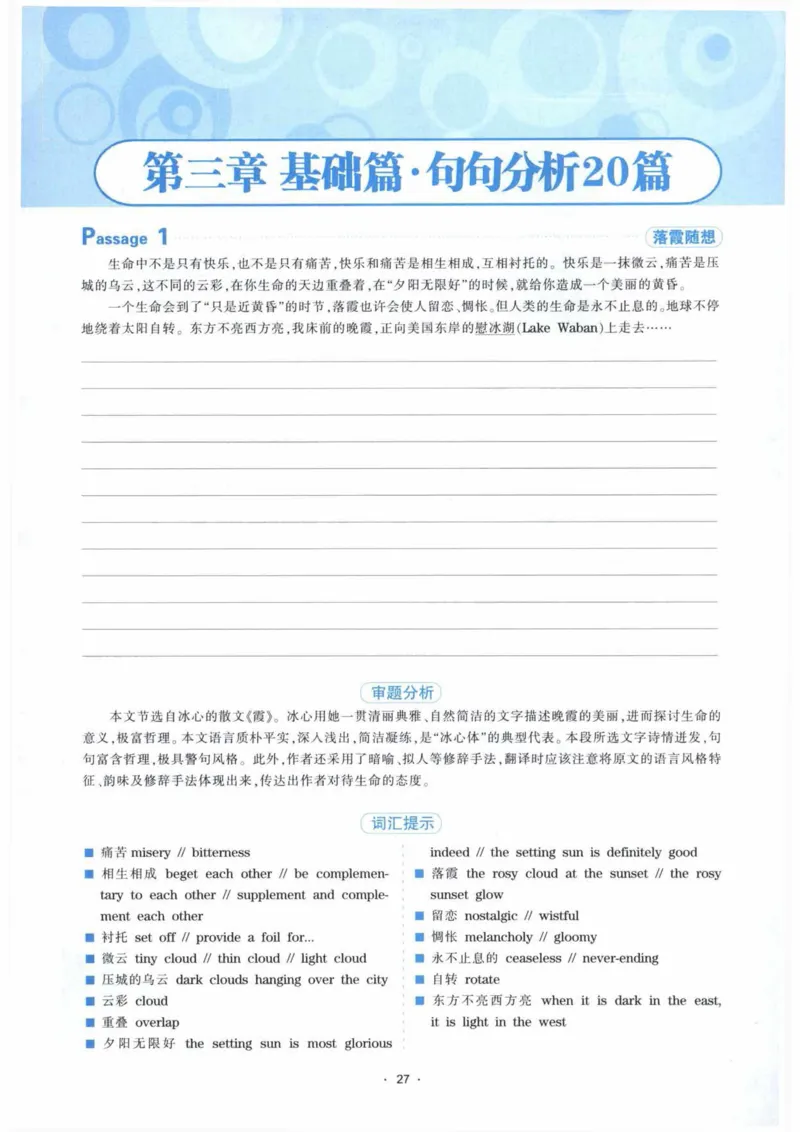
• 26 •( 第三章基础篇•句旬分析20篇 )
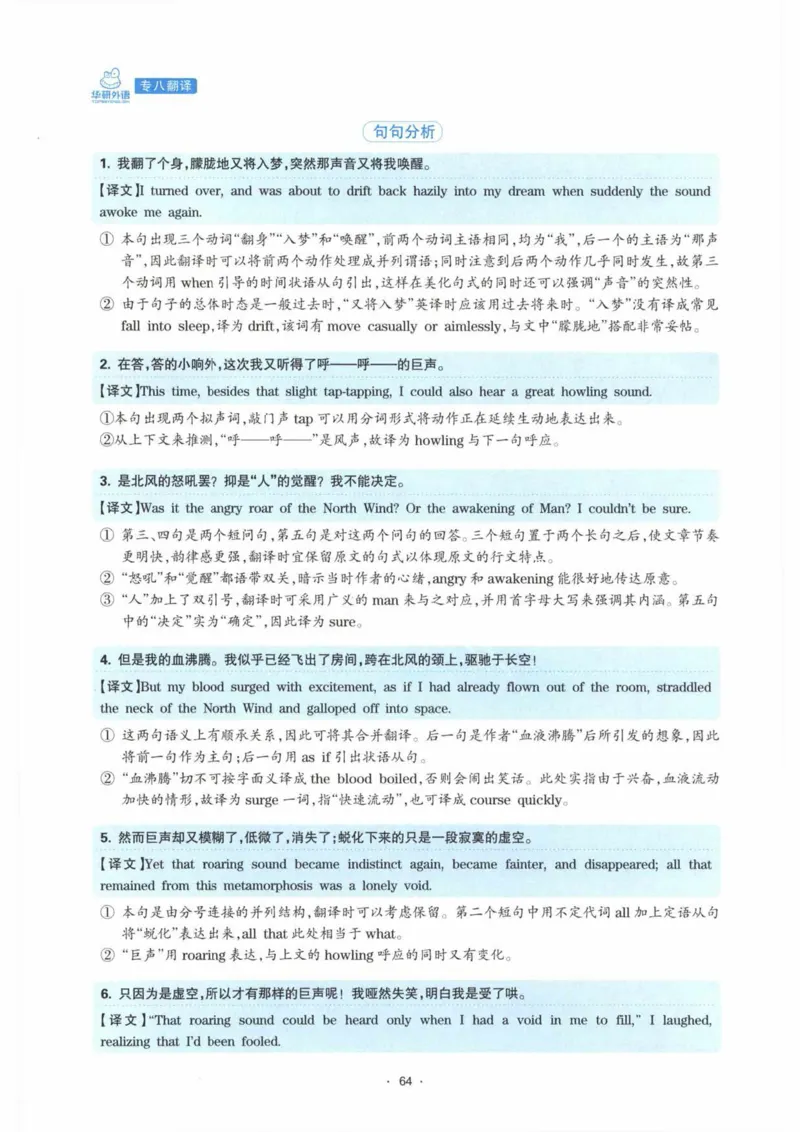
Passage 1 落II 随想
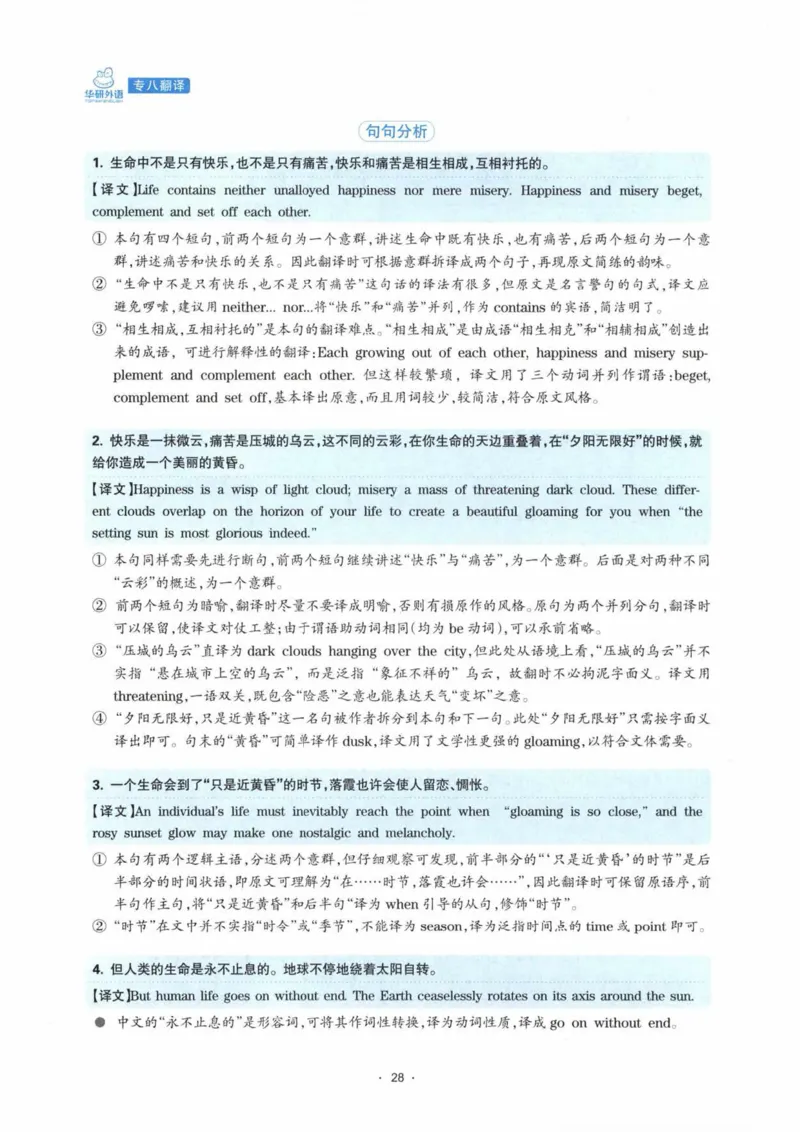
生命中不是只有快乐,也不是只有痛苦,快乐和痛苦是相生相成,互相衬托的。快乐是一抹微云,痛苦是压
城的乌云,这不同的云彩,在你生命的天边1 费宥,在“夕阳无限好”的时候,就给你造成一个美丽的黄昏。
一个生命会到了“只是近黄昏”的时节,落蒞也许会使人留恋、惆怅,但人类的生命是永不止息的。地球不停
地绕笤太阳Pi转。东方不亮西方亮,我床前的晚霞,正向美国东岸的歷[述翅(Lake Waban)上走去……
G审题分析
本文节选自冰心的散文《敢>。冰心用她一贯淸丽典雅、自然简洁的文字描述晚霞的美丽,进而探讨生命的
意义,极富哲理。本文语言质朴平实,深入浅出,简洁凝练,是“冰心体”的典型代表。本段所选文字诗情迸发,句
句富含哲理.极具霣句风格,此外.作者还采用了暗喻、拟人等修辞手法,翻译时应该注意将原文的语言风格特
征、韵味及修辞手法体现出来,传达出作者对待生命的态度。
词汇提示
■痛苦 misery // bitterness indeed // the setting sun is definitely good
■相生相成 beget each other // be complemen ■ 落® the rosy cloud at the sunset // the rosy
tary to each other // supplement and comple- sunset glow
merit each other ■留恋 nostalgic // wistful
■衬托 set off // provide a foil for… ■倘怅 melancholy // gloomy
■微云 tiny cloud // thin cloud // light cloud ■永不止息的 ceaseless // never-ending
■压城的乌云 dark clouds hanging over the city ■自转 rotate
■ 云彩cloud ■东方不亮西方亮 when it is dark in the east,
■重叠 overlap it is light in the west
■夕阳无限好 the setting sun is most glorious
27
• •专八翻译
句句分析)
1. 生命中不是只有快乐,也不是只有痛苦,快乐和痛苦是相生相成,互相衬托的。
【译文】Life contains neither unalloyed happiness nor mere misery. Happiness and misery beget,
complement and set off each other.
① 本句有四个短句,前两个短句为一个意群,讲述生命中既有快乐,也有痛苦,后两个短句为一个意
群,讲述痛苦和快乐的关系。因此翻译时可根据意群拆译成两个句子,再现原文简练的韵味。
② “生命中不是只有快乐,也不是只有痛苦”这句话的译法有很多,但原文是名言螯句的句式,译文应
避免啰嗦,建议用neither... nor...将“快乐"和“痛苦”并列,作为contains的宾语,简洁明了。
③ “相生相成,互相衬托的”是本句的翻译难点3“相生相成"是由成语“相生相克”和“相辅相成”创造出
来的成语’可进行解释性的翻译:Each growing out of each other, happiness and misery sup
plement and complement each other.但这样较繁琐,译文用了三个动词并列作谓语:beget,
complement and set off,基本译出原意,而且用词较少,较简洁,符合原文风格
2. 快乐是一抹微云,痛苦是压城的乌云,这不同的云彩,在你生命的天边重叠着,在"夕阳无限好"的时候,就
给你造成一个美丽的黄昏。
【译文】Happiness is a wisp of light cloud; misery a mass of threatening dark cloud. These differ
ent clouds overlap on the horizon of your life to create a beautiful gloaming for you when “the
setting sun is most glorious indeed."
① 本句同样需要先进行断句,前两个短句继续讲述“快乐”与“痛苦”,为一个意群> 后面是对两种不同
“云彩"的概述,为一个意群。
② 前两个短句为暗喻,翻译时尽量不要译成明喻,否则有损原作的风格,原句为两个并列分句,翻译时
可以保留,使译文对仗工整;由于谓语助动词相同(均为be动词),可以承前省略。
③ “压城的乌云”直译为dark clouds hanging over the city,但此处从语境上看,“压城的乌云”并不
实指“悬在城市上空的乌云”,而是泛指“象征不祥的”乌云,故翻时不必拘泥字面义。译文用
threatening,—语双关,既包含“险恶”之意也能表达天气“变坏”之意。
④ “夕阳无限好,只是近黄昏”这一名句被作者拆分到本句和下一句此处“夕阳无限好”只需按字面义
译出即可。句末的“黄昏”可简单译作dusk,译文用了文学性更强的gloaming,以符合文体需要3
3. —个生命会到了“只是近黄昏"的时节,落霞也许会使人留恋、惆怅。
【译文】An individual’s life must inevitably reach the point when "gloaming is so close," and the
rosy sunset glow may make one nostalgic and melancholy.
① 本句有两个逻辑主语,分述两个意群,但仔细观察可发现,前半部分的“‘只是近黄昏’的时节”是后
半部分的时间状语,即原文可理解为“在……时节,落霞也许会……",因此翻译时可保留原语序,前
半句作主句,将“只是近黄昏”和后半句“译为when引导的从句,修饰“时节”。
② “时节”在文中并不实指“时令”或“季节",不能译为season,译为泛指时间点的time或point即可。
4. 但人类的生命是永不止息的。地球不停地绕着太阳自转。
【译文】But human life goes on without end The Earth ceaselessly rotates on its axis around the sun.
參中文的“永不止息的”是形容词,可将其作词性转换,译为动词性质,译成go on without end..
• 28 •第三章基础篇•句句分析20篇
i^wnis
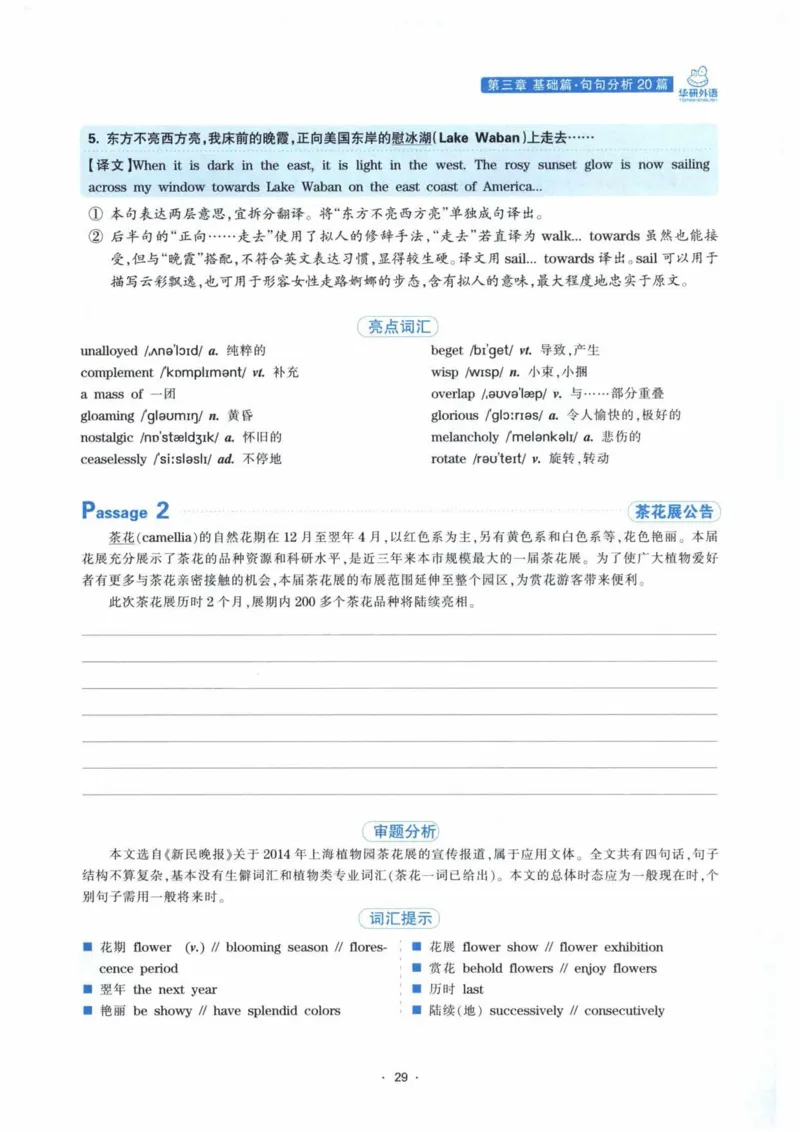
5.东方不亮西方亮,我床前的晚霞,正向美国东岸的慰冰湖(Lake Waban)上走去……
【译文】When it is dark in the east, it is light in the west. The rosy sunset glow is now sailing
across my window towards Lake Waban on the east coast of America...
① 本句表达两层意思,宜拆分翻译。将“东方不亮西方亮”单独成句译出。
② 后半句的“正向....走去”使用了拟人的修辞手法,“走去”若直译为walk... towards虽然也能接
受,但与“晚霞”搭配,不符合英文表达习惯,显得较生硬。译文用sail… towards译出。sail可以用于
描写云彩枫逸,也可用于形容女性走路婀娜的步态,含有拟人的意味,最大程度地忠实于原文。
亮点词汇
unalloyed A/vna'Ioid/ a.纯粹的 beget /bi’get/ v/• 导致,产生
complement /"kDmplimant/ W•补充 wisp /wisp/ n• 小束,小捆
a mass of —团 overlap /.auva’laep/ v•与....ff 分重叠
gloaming /gleumiQ/ n•黄昏 glorious /glo:ri9S/ fl.令人愉快的,极好的
nostalgic /nostaeld3ik/ a•怀旧的 melancholy /Vnelankali/ a•悲伤的
ceaselessly ,si:slasli/ a汶 不停地 rotate /rau'teit/ v• 旋转,转动
Passage 2 茶花展公告
茶花(camellia)的自然花期在12月至翌年4 月,以红色系为主,另有黄色系和白色系等,花色绝丽。本届
花展充分展示了茶花的品种资源和科研水平,是近三年来本市规模ft大的一届茶花展^为了使广大棺物爱好
者有更多与茶花亲密接触的机会,本届茶花展的布展范围延伸至整个园区,为赏花游客带来便利。
此次茶花展历时2 个月,展期内200多个茶花品种将陆续亮相
q 审题^
本文选自《新民晚报》关于2014年上海植物园茶花展的宣传报道,W 于应用文体。全文共有四句话,句子
结构不算复杂,基本没有生僻同汇和植物类专业词汇(茶花一词已给出)。本文的总体时态应为一般现在时,个
別句子需用一般将来时。
词汇提示
■花期 flower (v.) // blooming season // flores- ■花展 flower show // flower exhibition
cence period ■赏花 behold flowers // ei\joy flowers
■翌年 the next year ■历时 last
■ 艳 be showy // have splendid colors ■ 陆续(地)successively // consecutively
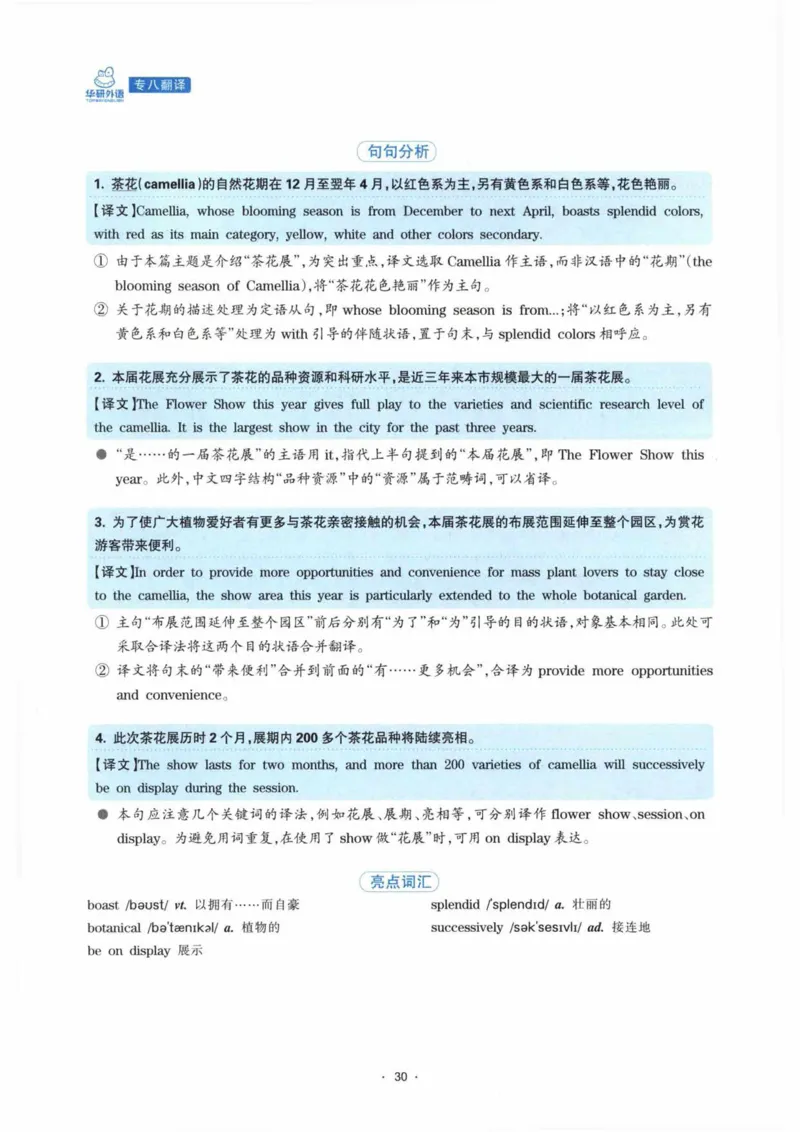
• 29 •〇]§分适
1•茶花(camellia)的自然花期在12月至翌年4 月,以红色系为主,另有黄色系和白色系等,花色艳丽。
【译文】Camellia^ whose blooming season is from December to next boasts splendid colors,
with red as its main categoiy, yellow, white and other colors secondary.
① 由于本篇主题是介绍“茶花展”,为突出重点,译文选取Camellia作主语,而非汉语中的“花期"(the
blooming season of Camellia),将“茶花花色艳丽”作为主句。
② 关于花期的描述处理为定语从句,即whose blooming season is from...;将“以红色系为主,另有
黄色系和白色系等”处理为with引导的伴随状语,置于句末,与splendid colors相呼应。
2. 本届花展充分展示了茶花的品种资源和科研水平,是近三年来本市规模最大的一届茶花展。
【译文】The Flower Show this year gives full play to the varieties and scientific research level of
the camellia It is the largest show in the city for the past three years.
• “是……的一届茶花展”的主语用it,指代上半句提到的“本届花展”,即The Flower Show this
year。此外,中文四字结构“品种资源”中的“资源”属于范畴词,可以省译。
3. 为了使广大植物爱好者有更多与茶花亲密接触的机会,本届茶花展的布展范围延伸至整个园区,为赏花
游客带来便利。
【译文】In order to provide more opportunities and convenience for mass plant lovers to stay close
to the camellia, the show area this year is particularly extended to the whole botanical garden.
① 主句“布展范围延伸至整个园区”前后分别有“为了 ”和“为”引导的目的状语,对象基本相同。此处可
采取合译法将这两个目的状语合并翻译。
② 译文将句末的“带来便利”合并到前面的“有....更多机会”,合译为provide more opportunities
and convenience,,
4. 此次茶花展历时2 个月,展期内200多个茶花品种将陆续亮相。
【译文】The show lasts for two months, and more than 200 varieties of camellia will successively
be on display during the session.
• 本句应注意几个关键词的译法,例如花展、展期、亮相等,可分别译作flower show、session、on
display。为避免用词重复,在使用了 show做“花展”时,可用on display表达。
亮点词忙
boast /baust/ v/.以拥有....而自豪 splendid /splendid/ a.壮丽的
botanical /ba'taenikal/ a. 植物的 successively /sek’sesivli/ a忒 接连地
be on display 展示
• 30 •第三章基础篇•句句分析20篇
w w e
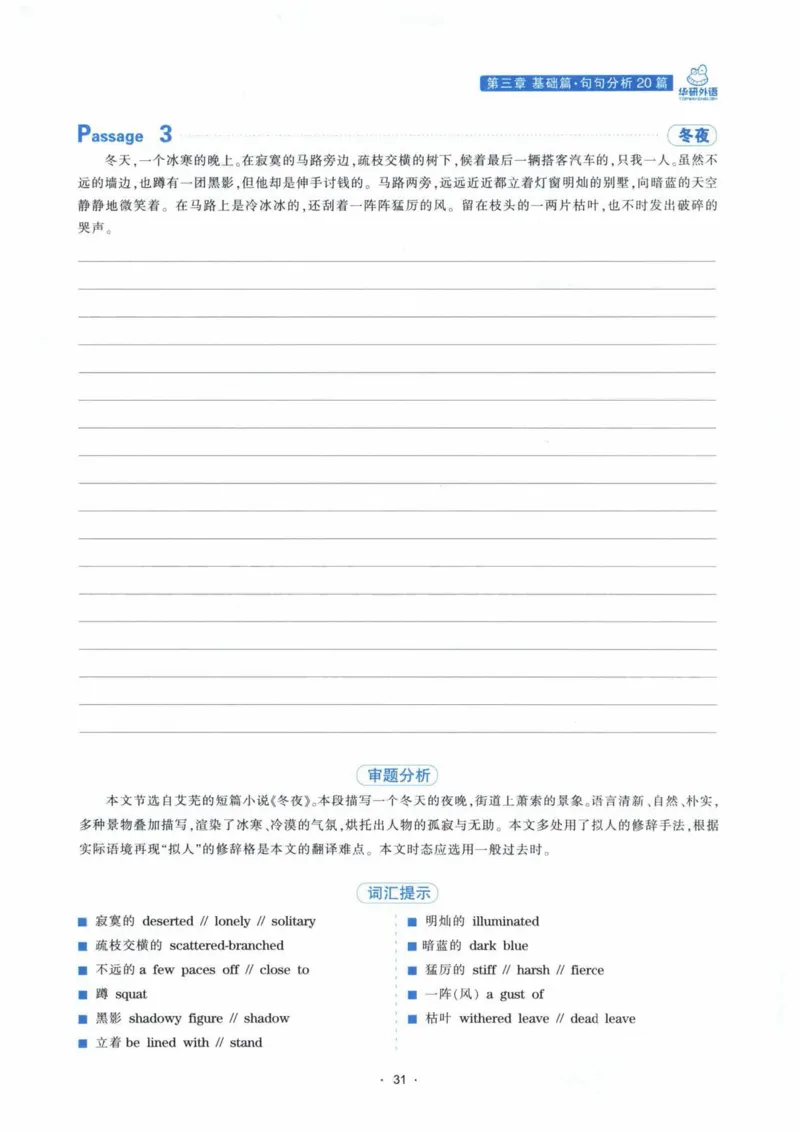
Passage 3 冬夜
冬天,一个冰寒的晚上。在寂寞的马路旁边,疏枝交横的树下,候着最后一辆搭客汽车的,只我一人。虽然不
远的墙边,也蹲有一团黑影,但他却是伸手讨钱的。马路两旁,远远近近都立着灯窗明灿的別幣,向暗蓝的天空
静静地微笑着。在马路上是冷冰冰的,还刮着一阵阵猛厉的风。留在枝头的一两片枯叶,也不时发出破碎的
哭声。
审题分析
本文节选自艾芜的短篇小说《冬夜 >。本段描写一个冬天的夜晚,街道上萧索的累象。语言淸新、自然、朴实,
多种景物ft加描写,值染了冰寒、冷漠的气氛,烘托出人物的孤寂与无助。本文多处用了拟人的修辞手法,根据
实际语境冉现“拟人”的修辞格是本文的翻译难点。本文时态应选用一般过去时。
(词汇提示)
■寂寞的 deserted // lonely // solitary ■明灿的 illuminated
■疏枝交横的 scattered-branched ■暗蓝的dark blue
■ 不远的a few paces off // close to ■猛厉的 stiff // harsh // fierce
■蹲 squat ■ 一阵(风)a gust of
■黑影 shadowy figure // shadow ■枯叶 withered leave // dead leave
■立着 be lined with // stand
31
• •专八翻译
牮研外» is »
Tnweweeuw
:、旬句分析
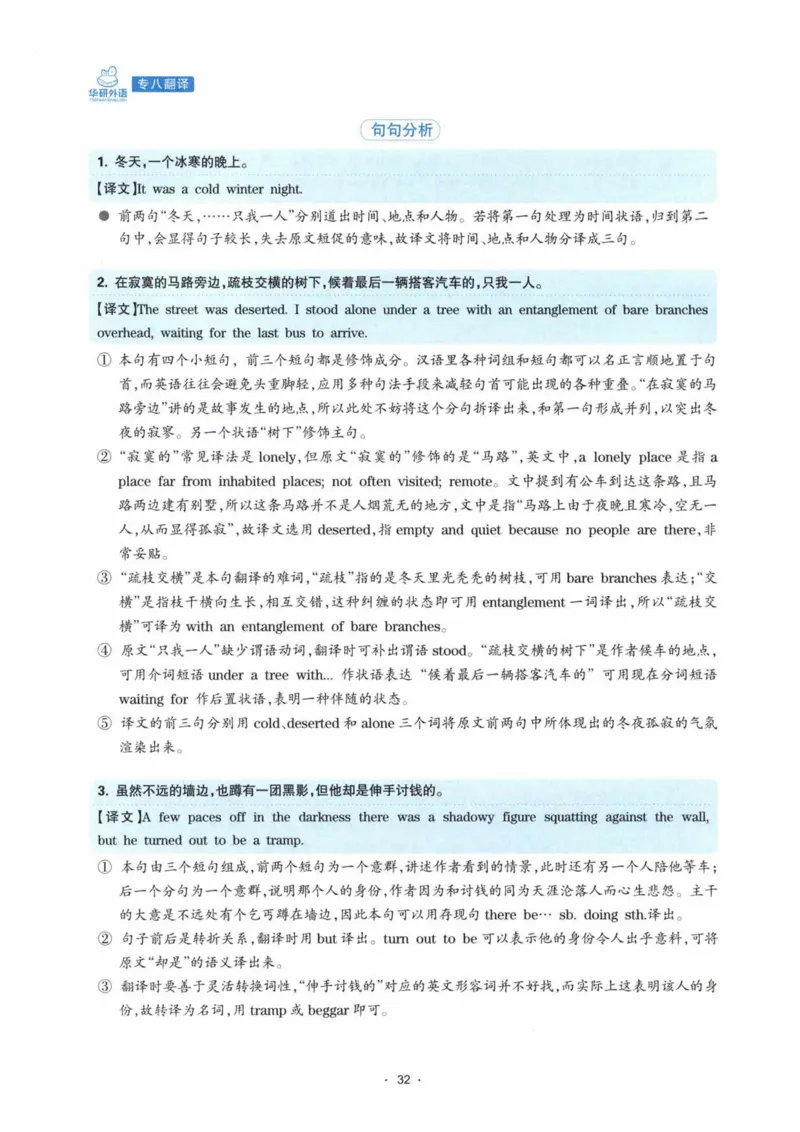
1. 冬天,一个冰寒的晚上。
【译文】It was a cold winter night.
參前两句“冬天,……只我一人”分别道出时间、地点和人物。若将第一句处理为时间状语,归到第二
句中,会显得句子较长,失去原文短促的意味,故译文将时间、地点和人物分译成三句。
2. 在寂寞的马路旁边,疏枝交横的树下,候着最后一辆搭客汽车的,只我一人。
[i?^t]The street was deserted. I stood alone under a tree with an entanglement of bare branches
overhead, waiting for the last bus to arrive.
① 本句有四个小短句,前三个短句都是修饰成分。汉语里各种词组和短句都可以名正言顺地置于句
首,而英语往往会避免头重脚轻,应用多种句法手段来减轻句首可能出现的各种重叠。“在寂寞的马
路旁边”讲的是故事发生的地点,所以此处不妨将这个分句拆译出来,和第一句形成并列,以突出冬
夜的寂寥。另一个状语“树下”修饰主句。
② “寂寞的”常见译法是lonely,但原文“寂寞的”修饰的是“马路”,英文中,a lonely place是指a
place far from inhabited places; not often visited; remote.:文中提到有公车到达这条路,且马
路两边建有别墅,所以这条马路并不是人烟荒无的地方,文中是指“马路上由于夜晚且寒冷,空无一
人,从而显得孤寂'故译文选用 deserted,指 empty and quiet because no people are there,非
常妥贴。
③ “疏枝交橫”是本句翻译的难词,“疏枝”指的是冬天里光秃先的树枝,可用bare branches表达;“交
橫”是指枝千横向生长,相互交错,这种纠缠的状态即可用entanglement —词译出,所以“疏枝交
横”可译为 with an entanglement of bare branches。
④ 原文“只我一人”缺少谓语动词,翻译时可补出谓语stood。“疏枝交橫的树下”是作者候车的地点,
可用介词短语under a tree with...作状语表达“候着最后一辆搭客汽车的”可用现在分词短语
waiting for作后置状语,表明一种伴随的状态〇
⑤ 译文的前三句分别用cold、deserted和alone三个词将原文前两句中所体现出的冬夜孤寂的气氛
渲染出来。
3. 虽然不远的墙边,也蹲有一团黑彩,但他却是伸手讨钱的。
【译文】A few paces off in the darkness there was a shadowy figure squatting against the wall,
but he turned out to be a tramp.
① 本句由三个短句组成,前两个短句为一个意群,讲述作者看到的情景,此时还有另一个人陪他等车;
后一个分句为一个意群,说明那个人的身份,作者因为和讨钱的同为天涯沦落人而心生悲怨。主干
的大意是不远处有个乞丐蹲在墙边,因此本句可以用存现句there be", sb. doing sth.译出。
② 句子前后是转折关系,翻译时用but译出。turn out to b e 可以表示他的身份令人出乎意料,可将
原文“却是”的语义译出来。
③ 翻译时要善于灵活转换词性,“伸手讨钱的”对应的英文形容词并不好找,而实际上这表明该人的身
份,故转译为名词,用tramp或beggar即可。
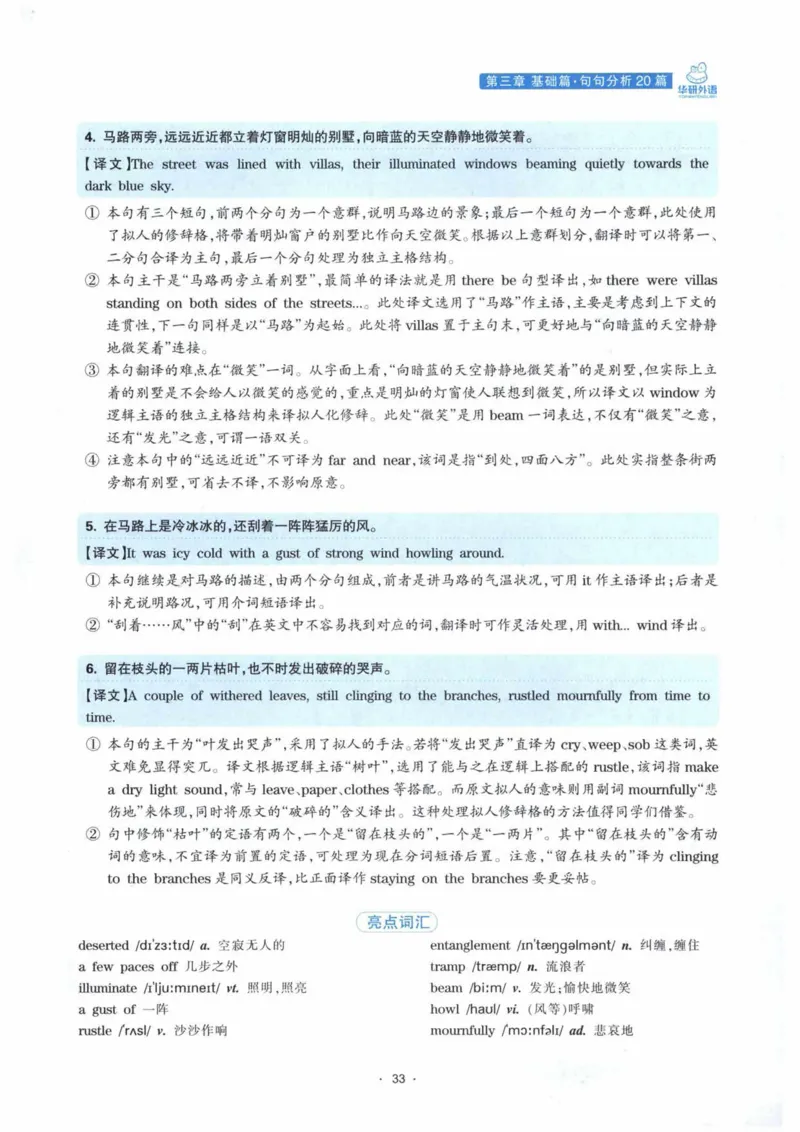
• 32 •4.马路两旁,远远近近都立着灯窗明灿的别墅,向暗蓝的天空静静地微笑着。
【译文】The street was lined with villas, their illuminated windows beaming quietly towards the
dark blue sky.
① 本句有三个短句,前两个分句为一个意群,说明马路边的景象;最后一个短句为一个意群,此处使用
了拟人的修辞格,将带着明灿窗户的别墅比作向天空微笑。根据以上意群划分,翻译时可以将第一、
二分句合译为主句,最后一个分句处理为独立主格结构。
② 本句主干是“马路两旁立着别墅”,最简单的译法就是用there b e 句型译出,如 there were villas
standing on both sides of the streets…。此处译文选用了“马路”作主语,主要是考處到上下文的
连贯性,下一句同样是以“马路”为起始。此处将villas置于主句末,可更好地与“向暗蓝的天空静静
地微笑着”连接。
③ 本句翻译的难点在“微笑”一词。从字面上看,“向暗蓝的天空静静地微笑着”的是别墅,但实际上立
着的别墅是不会给人以微笑的感觉的,重点是明灿的灯窗使人联想到微笑,所以译文以window为
逻辑主语的独立主格结构来译拟人化修辞,此处“微笑”是用beam —词表达,不仅有“微笑”之意,
还有“发光”之意,可谓一语双关。
④ 注意本句中的“远远近近”不可译为far and near,该词是指“到处,四面八方”。此处实指整条街两
旁都有别墅,可省去不译,不影响原意。
5. 在马路上是冷冰冰的,还刮着一阵阵猛厉的风。
【译文】It was icy cold with a gust of strong wind howling around.
① 本句继续是对马路的描述,由两个分句组成,前者是讲马路的气温状况,可用it作主语译出;后者是
补充说明路况,可用介词短语译出。
② “刮着....风”中的“刮”在英文中不容易找到对应的词,翻译时可作灵活处理,用with... wind译出。
6. 留在枝头的一两片枯叶,也不时发出破碎的哭声。
[i$A]A couple of withered leaves, still clinging to the branches, rustled mournfully from time to
time.
① 本句的主干为“叶发出哭声”,采用了拟人的手法若将“发出哭声”直译为cry、weep、sob这类词,英
文难免显得突兀。译文根据逻辑主语“树叶”,选用了能与之在逻辑上搭配的rustle,该词指make
a dry light sound,常与leave、paper、clothes等搭配。而原文拟人的意味则用副词mournfully"悲
伤地”来体现,同时将原文的“破碎的”含义译出。这种处理拟人修辞格的方法值得同学们借鉴。
② 句中修伸“枯叶”的定语有两个,一个是“留在枝头的”,一个是“一两片”。其中“留在枝头的”含有动
词的意味,不宜译为前置的定语,可处理为现在分词短语后置。注意,“留在枝头的”译为dinging
to the branches是同义反译,比正面译作staying on the branches要更妥帖
亮点词汇
deserted /di’Z3:tid/ a.空寂无人的 entanglement /in'taeQgalmant/ n .纠91,缠住
a few paces off儿步之外 tramp /traemp/ /I•流浪者
illuminate /i’lju:mineit/ v/• 照明,照兑 beam /bi:m/ v.发光;愉快地微笑
a gust of —阵 howl /haul/ vi (风等)呼啸
rustle /VasI/ v•沙沙作响 mournfully /mwnfali/ 悲哀地
• 33 •a 专八翻译
华研外ii
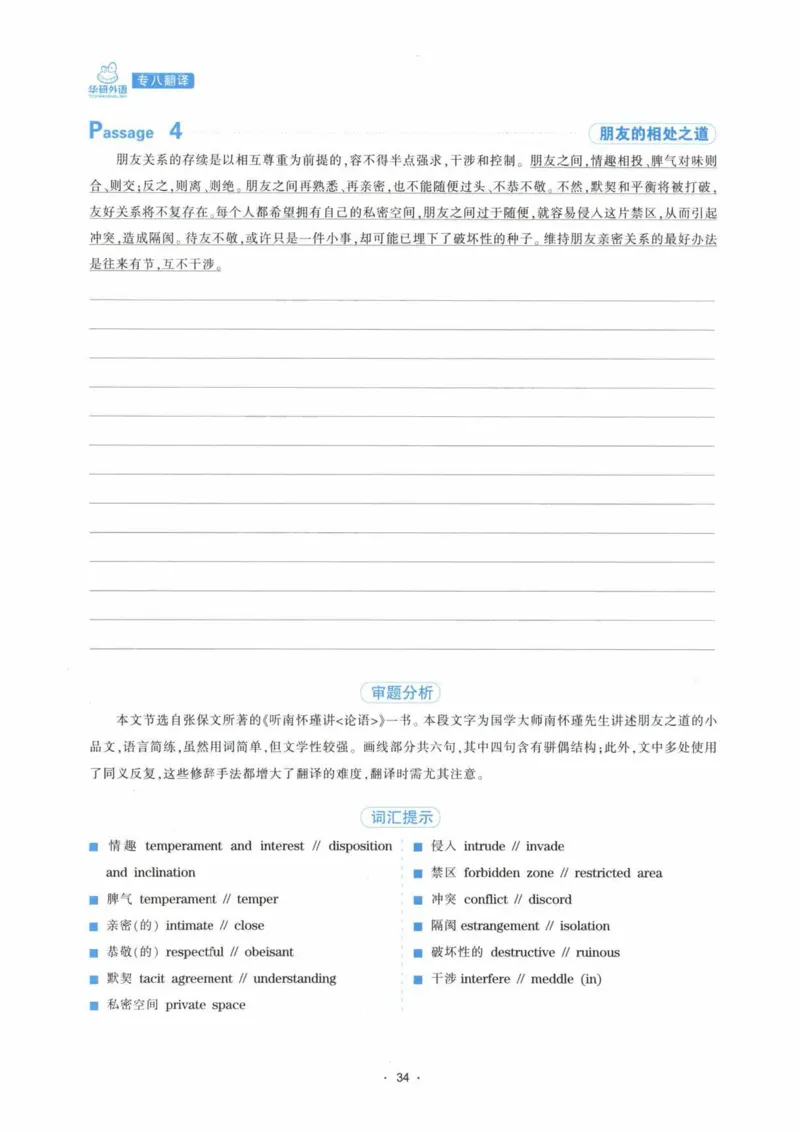
Passage 4 朋友的相处之道
朋友关系的存续是以相互尊《为前提的,容不得半点强求,干涉和控制。朋友之间.情趣相投、脾气对味则
合、则交:反之.则离、则绝>'朋友之间再熟悉.再亲密.也不能随便过头、不恭不敬„不然.默契和平衡将被打破.
友好关系将不复存在■'毎个人都希望拥有自己的私密空间.朋友之间过T 随俾,就容易侵人这片禁区.从而引起
冲突.造成隔阂,待友不敬.或许只是一件小事.却可能已埋下了破坏性的种子„维持朋友亲密关系的姑
是往来有节.互不干涉。
(审题分析
本文节选自张保文所著的 < 听南怀埯讲< 论语>>-•书。本段文字为国学大师南怀瑾先生讲述朋友之道的小
品文,语言简练,虽然用词简单,但文学性较强。_ 线部分共六句,其中四句含有骈偶结构;此外,文中多处使用
了同义反复,这些修辞手法都增大了翻译的难度,翮译时® 尤其注意。
词汇提示
■情趣 temperament and interest // disposition ■侵入 intrude // invade
and inclination ■禁区 forbidden zone // restricted area
■脾气 temperament // temper ■冲突 conflict // discord
■ 亲密(的)intimate // close ■隔阂 estrangement // isolation
■ 恭敬(的)respectful // obeisant ■破坏性的 destructive // ruinous
■默 53 tacit agreement // understanding ■干涉 interfere // meddle (in)
■私密空间private space
• 34 •第三章基础篇•句句分析20篇
牮研nii
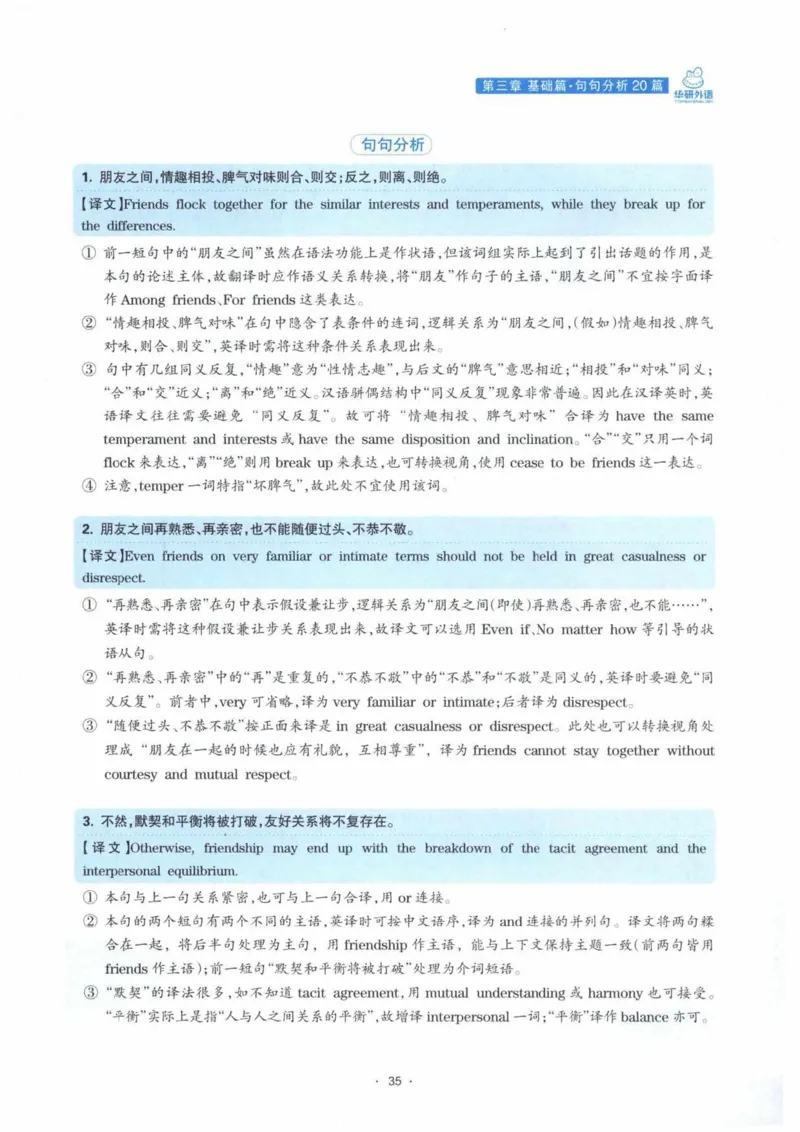
句句分析
1. 朋友之间,情趣相投、脾气对味则合、则交;反之,则离、则绝。
【译文】Friends flock together for the similar interests and temperaments,while they break up for
the differences.
① 前一短句中的“朋友之间”虽然在语法功能上是作状语,但该词组实际上起到了引出话题的作用,是
本句的论述主体,故翻译时应作语义关系转换,将“朋友”作句子的主语,“朋友之间”不宜按字面译
作 Among friends、For friends 这类表达
② “情趣相投、脾气对味”在句中隐含了表条件的连词,逻辑关系为“朋友之间,(假如)情趣相投、脾气
对味,则合、则交”,英译时需将这种条件关系表现出来。
③ 句中有几组同义反复,“情趣”意为“性情志趣”,与后文的“脾气”意思相近;“相投”和“对味”同义;
“合”和“交”近义;“离”和“绝”近义。汉语骈偶结构中“同义反复”现象非常普遍,因此在汉译英时,英
语译文往往需要避免“同义反复”。故 可 将 “情趣相投、脾气对味” 合译为have the same
temperament and interests 或 have the same disposition and inclination “合”“交”只用一个词
flock来表达离”“绝”则用break u p 来表达,也可转换视角,使用cease to be friends这一表达。
④ 注意,temper—词特指“坏脾气”,故此处不宜使用该词。
2. 朋友之间再熟悉、再亲密,也不能随便过头、不恭不敬。
【译文】Even friends on very familiar or intimate terms should not be held in great casualness or
disrespect.
① “再熟悉、再亲密”在句中表示假设兼让步,逻辑关系为“朋友之间(即使)再熟悉、再亲密,也不能……”,
英译时需将这种假设兼让步关系表现出来,故译文可以选用Even if、No matter h o w 等引导的状
语从句。
② “再熟悉、再亲密”中的“再”是重复的,“不恭不敬”中的“不恭”和“不敬”是同义的,英译时要避免“同
义反复”。前者中,very可省略,译为very familiar or intimate;后者译为disrespect
③ “随便过头、不恭不敬”按正面来译是in great casualness or disrespect此处也可以转换视角处
理 成 “朋友在一起的时候也应有礼貌,互相尊重”,译为friends cannot stay together without
courtesy and mutual respect
3.不然,默契和平衡将被打破,友好关系将不复存在。
【译文】Otherwise, friendship may end up with the breakdown of the tacit agreement and the
interpersonal equilibrium.
① 本句与上一句关系紧密,也可与上一句合译,用or连接
② 本句的两个短句有两个不同的主语,英译时可按中文语序,译为and连接的并列句译文将两句糅
合在一起,将后半句处理为主句,用friendship作主语,能与上下文保持主题一致(前两句皆用
friends作主语);前一短句“默契和平衡将被打破”处理为介词短语。
③ “默契”的译法很多,如不知道tacit agreement,用mutual understanding或 harmony也可接受。
“平衡”实际上是指“人与人之间关系的平衡”,故增译interpersonal —词;“平衡”译作balance亦可。
• 35 •4.每个人都希望拥有自己的私密空间,朋友之间过于随便,就容易侵入这片禁区,从而引起冲突,造成隔阂。
【译文】Everyone wishes to keep his privacy, which is a forbidden zone that may be easily intrud
ed into by the extreme casualness between friends, thus triggering off conflicts and estrangement.
① 本句的短句较多,句式分散,英译时要注意观察其中的逻辑关系,尽量避免流水式地将本句译为多
个句子。首先可观察到,“私密空间”和“这片禁区”指代的是同一事物u 故可考虑将第一个子句处理
为主句,第二、三个子句的内容处理为which引导的定语从句,与主句的“私密空间”连接^ “过于随
便”在句中表示条件,逻辑关系为“朋友之间(假如)过于随便,就容易……”,英译时要将这层逻辑关
系译出。句末的“从而引起”表结果,可处理为现在分词短语作结果状语。
② 本句中的“空间”属于汉语中常见的范畴词,用来表达行为、现象、属性等概念所属的范畴,是汉语常
用的特指手段,但英语通常避免使用范畴词。故此处“私密空间”可译为抽象名词privacy ,
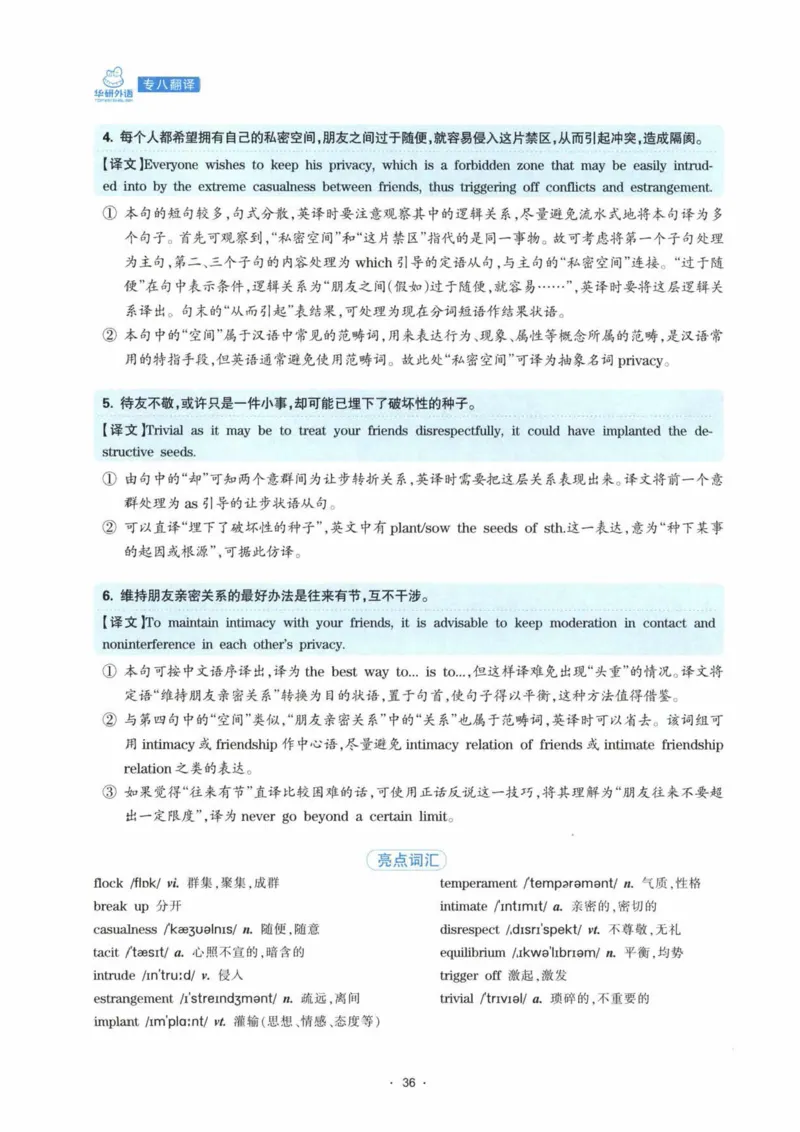
5.待友不敬,或许只是一件小事,却可能已埋下了破坏性的种子。
【译文】Trivial as it may be to treat your friends disrespectfully, it could have implanted the de*
structive seeds.
① 由句中的“却”可知两个意群间为让步转折关系,英译时需要把这层关系表现出来,译文将前一个意
群处理为as引导的让步状语从句。
② 可以直译“埋下了破坏性的种子”,英文中有plant/sow the seeds of sth.这一表达,意为“种下某事
的起因或根源”,可据此仿译。
6.维持朋友亲密关系的最好办法是往来有节,互不干涉。
【译文 iTo maintain intimacy with your friends,it is advisable to keep moderation in contact and
noninterference in each other’s privacy.
① 本句可按中文语序译出,译为the best way to... is to...,但这样译难免出现“头重”的情况。译文将
定语“维持朋友亲密关系”转换为目的状语,置于句首,使句子得以平衡,这种方法值得借鉴。
② 与第四句中的“空间”类似,“朋友亲密关系”中的“关系”也属于范畴词,英译时可以省去。该词组可
用 intimacy 或 friendship 作中心语,尽量避免 intimacy relation of friends 或 intimate friendship
relation之类的表达。
③ 如果觉得“往来有节”直译比较困难的话,可使用正话反说这一技巧,将其理解为“朋友往来不要超
出一定限度”,译为 never go beyond a certain limit。
亮点词汇
flock /fInk/ W . 群集,聚集,成群 temperament/*tempar8mant//i.气质,性格
break up 分开 intimate /intimit/ a.亲密的,密切的
casualness /*kae3ualnis/ n.随便,随意 disrespect Adisri’spekt/ v/• 不尊敬,无礼
tacit/taesit/fl.心照不宣的,暗含的 equilibrium /.ikwa'libriam/ n• 平衡,均势
intrude /in.tru:d/ v•侵人 trigger off激起,激发
estrangement /i'streind3m 0nt/ n .疏远,离间 trivial /trivial/ a.琐碎的,不® 要的
implant /im.pla:nt/ v/• 灌输(思想、情感、态度等)
• 36 •第三章基础篇•句句分析20篇
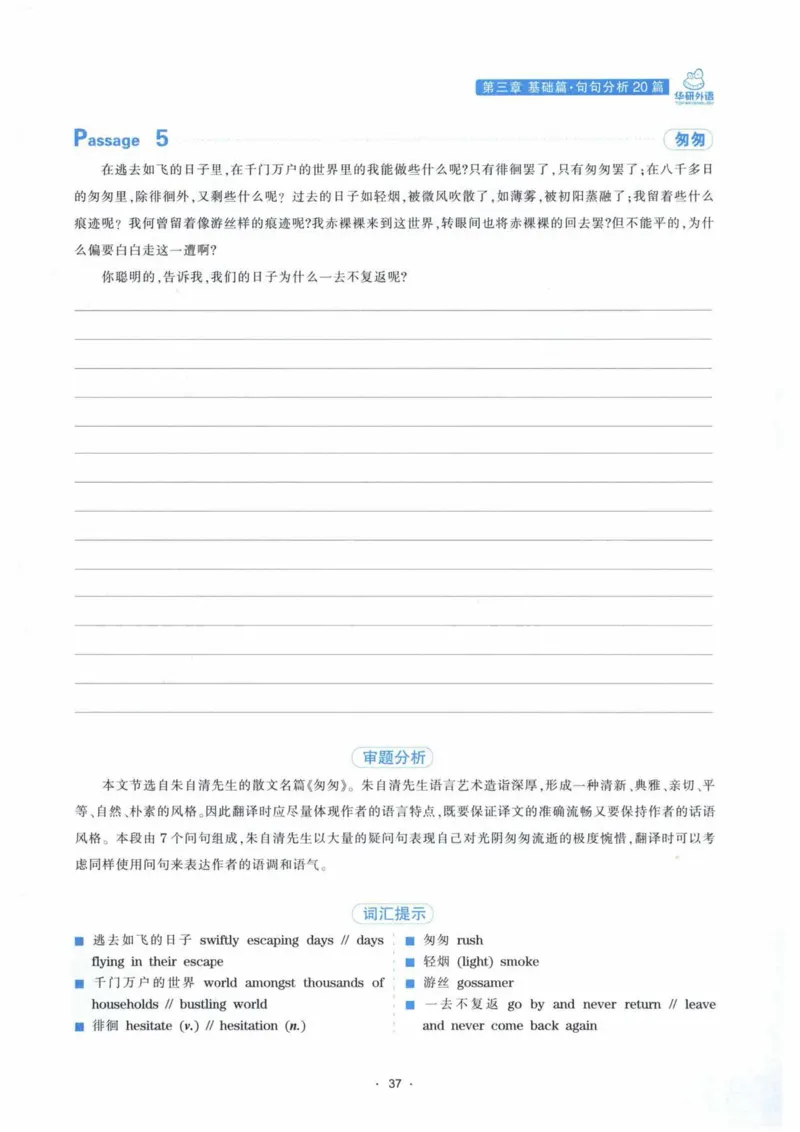
Passage 5 匆匆
在逃去如飞的日子里,在千门万户的世界里的我能做些什么呢?只有徘徊罢了,只有匆匆罢了;在八T 多日
的匆匆里,除徘徊外,又剩些什么呢?过去的日子如轻烟,被微风吹散了,如薄雾,被初阳蒸融r ;我留着些什么
痕迹呢?我何曾留着像游丝样的痕迹呢?我赤棵裸来到这世界,转眼间也将赤裸裸的回去罢?但不能平的,为什
么偏要白白走这一遭啊?
你聪明的,告诉我,我们的日子为什么一去不复返呢?
G审题分析
本文节选自朱自清先生的散文名篇《匆匆 >。朱自清先生语言艺术造诣深厚,形成一种清新、典雅、亲切、平
等、自然、朴系•的风格。因此翻译时应尽坫体现作者的语言特点,既要保证译文的准确流畅乂要保持作者的话语
风格。本段由7 个问句组成,朱自淸先生以大fft的疑问句表现A 己对光阴匆匆流逝的极度惋惜,翻译时可以考
虑同样使用问句来表达作者的语调和语气。
词汇提示
■逃去如飞的日子 swiftly escaping days // days ■ 匆匆rush
flying in their escape ■ 轻烟(light) smoke
■千门万户的世界 world amongst thousands of ■游丝 gossamer
households // bustling world ■ 一去不复返 go by and never return // leave
■徘徊 hesitate (v.) // hesitation (n.) and never come back again
• 37 •专八翻译
牮研外is
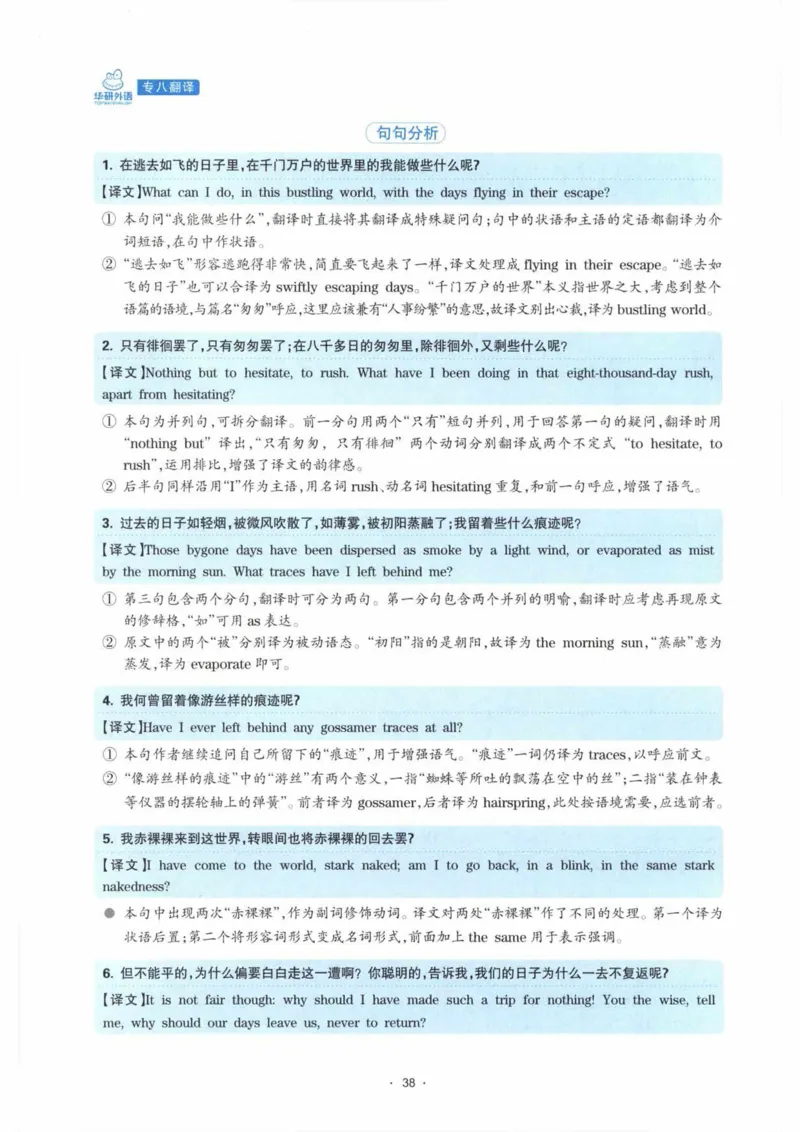
句句分析
1. 在逃去如飞的日子里,在千门万户的世界里的我能做些什么呢?
【译文】What can I do, in this bustling world, with the days flying in their escape?
① 本句问“我能做些什么”,翻译时直接将其翻译成特殊疑问句;句中的状语和主语的定语都翻译为介
词短语,在句中作状语,
② “逃去如飞•’形容逃跑得非常快,简直要飞起来了一样,译文处理成flying in their escape “逃去如
飞的日子”也可以合译为swiftly escaping days . “千门万户的世界”本义指世界之大,考虑到整个
语篇的语境,与篇名“匆匆”呼应,这里应该兼有“人事纷繁”的意思,故译文别出心裁,译为bustling world。
2. 只有徘徊罢了,只有匆匆罢了;在八千多日的匆匆里,除徘徊外,又剩些什么呢?
【译文】Nothing but to hesitate, to rush. What have I been doing in that eight-thousand*day rush,
apart from hesitating?
① 本句为并列句,可拆分翻译前一分句用两个“只有”短句并列,用于回答第一句的疑问,翻译时用
“nothing but”译出,“只有匆匆,只有徘徊”两个动词分别翻译成两个不定式“to hesitate, to
rush”,运用排比,增强了译文的韵律感。
② 后半句同样沿用T 作为主语,用名词rush、动名词hesitating重复,和前一句呼应,增强了语气。
3. 过去的日子如轻烟,被微风吹散了,如薄雾,被初阳蒸融了;我留着些什么痕迹呢?
【译文】Those bygone days have been dispersed as smoke by a light wind, or evaporated as mist
by the morning sun. What traces have I left behind me?
① 第三句包含两个分句,翻译时可分为两句。第一分句包含两个并列的明喻,翻译时应考虑再现原文
的修辞格,“如”可用as表达>
② 原文中的两个“被”分别译为被动语态。“初阳”指的是朝阳,故译为the morning sun,“蒸融”意为
蒸发,译为evaporate即可。
4. 我何曾留着像游丝样的痕迹呢?
【译文】Have I ever left behind any gossamer traces at all?
① 本句作者继续追问自己所留下的“痕迹”,用于增强语气3 “痕迹”一词仍译为traces,以呼应前文,
② “像游丝样的痕迹”中的“游丝”有两个意义,一指“蜘蛛等所吐的飘荡在空中的丝”;二指“装在钟表
等仪器的摆轮轴上的弹簧” 前者译为gossamer,后者译为hairspring,此处按语境需要,应选前者
5. 我赤裸裸来到这世界,转眼间也将赤裸裸的回去罢?
【译文】I have come to the world, stark naked; am I to go back, in a blink, in the same stark
nakedness?
• 本句中出现两次“赤裸裸”,作为副词修饰动词。译文对两处“赤裸裸”作了不同的处理。第一个译为
状语后置;第二个将形容词形式变成名词形式,前面加上the same用于表示强调。
6. 但不能平的,为什么偏要白白走这一遭啊?你聪明的,告诉我,我们的日子为什么一去不复返呢?
【译文】It is not fair though: why should I have made such a trip for nothing! You the wise,tell
me, why should our days leave us, never to return?
• 38 •① 前一句中的“平”是口语化词语,意为“公平”,因此可以译为fair。翻译时译为感叹句以加强语气。
② 后一句“你聪明的”表面上看是主谓结构,但实为偏正结构“聪明的你”,因此译为同位语结构you
the wise 或 you the genius。
亮点词汇
bustling /bAsalii]/ a.繁忙的,热闹的 bygone /"baigmV 过去的,以往的
disperse /di’sp3:s/ vi••使分散,散开 evaporate /iVaepareit/ v/.蒸发,挥发
gossamer /gDsama/ /I.蛛丝,游丝 stark /sta:k/ 十足地,完全地
in a blink —瞬间
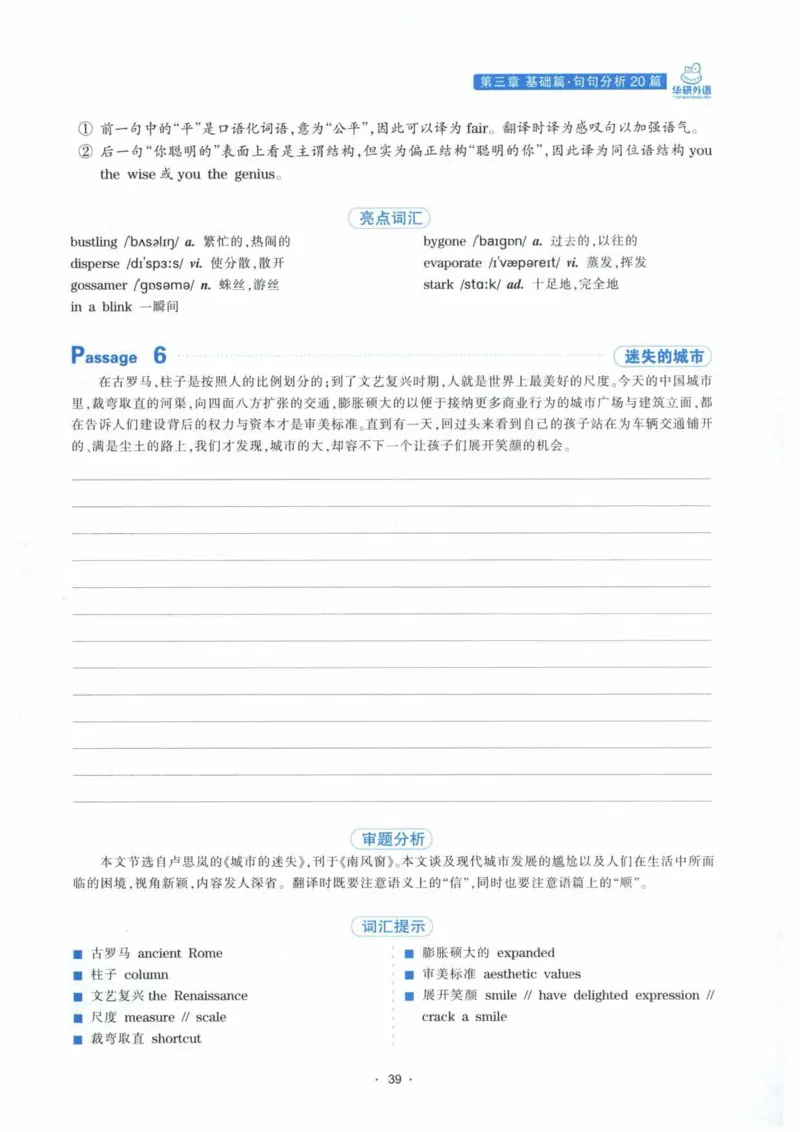
Passage 6 迷失的城市
在古罗马,柱子是按照人的比例划分的;到了文艺发兴时期,人就是世界上最美好的尺度。今天的中国城市
里,裁弯取a 的河渠,向四面八方扩张的交通,膨胀硕大的以便于接纳更多商业行为的城市广场与违筑立面,都
在告诉人们建设背后的权力与资本才是审美标准。直到有一天,回过头来看到自己的孩子站在为车辆交通铺开
的、满是尘土的路上,我们才发现,城市的大,却容不下一个让孩子们展开笑颜的机会
审题分析
本文节选自卢思岚的《城市的迷失 >,刊于《南风窗》。本文谈及现代城市发展的尴尬以及人们在生活中所面
临的闲境.视角新颖,内容发人深省。翻澤时既要注意语义上的“信”,同时也要注怠篇上的“顺”。
词疟提示
■古罗马 ancient Rome ■膨胀硕大的expanded
■柱子 column ■审美标准 aesthetic values
■文艺复兴 the Renaissance ■展开笑颜 smile // have delighted expression //
■尺度 measure // scale crack a smile
■裁弯取直shortcut
39 •专八翻译
牮* 研*外遇*>
w iaMkjp
(句句分析)
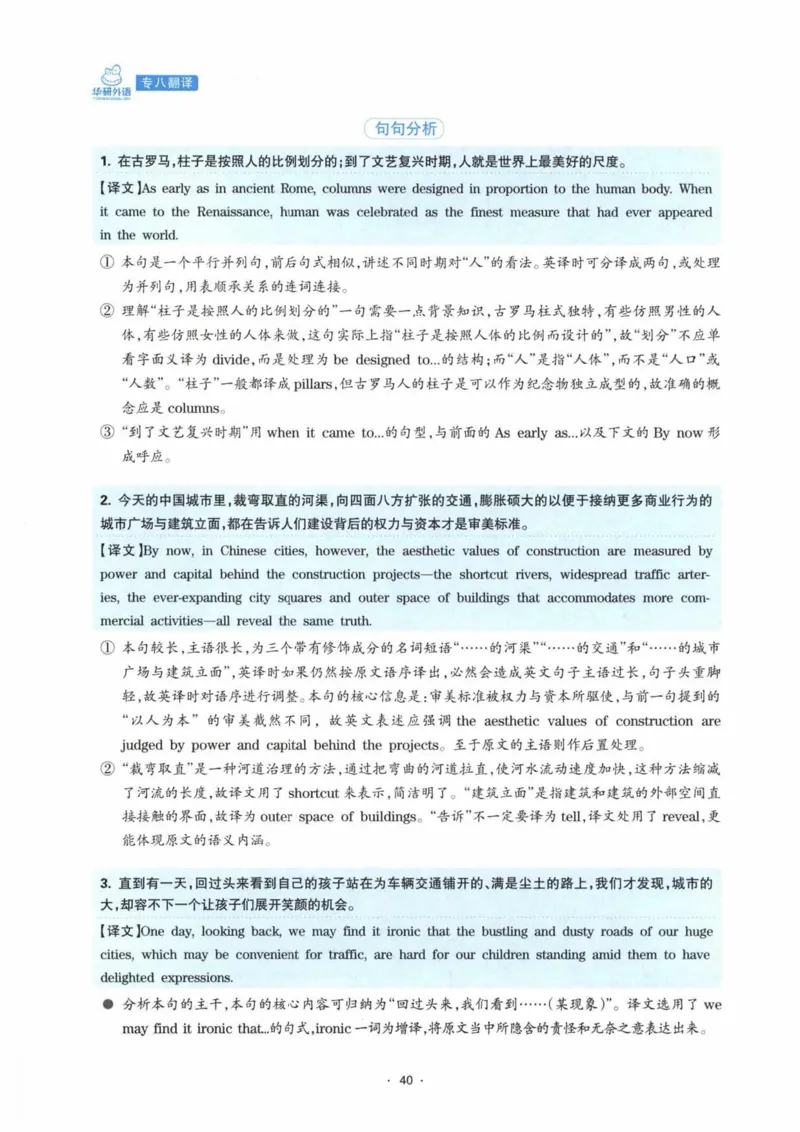
1.在古罗马,柱子是按照人的比例划分的;到了文艺复兴时期,人就是世界上最美好的尺度。
]As early as in ancient Rome, columns were designed in proportion to the human body. When
it came to the Renaissance, human was celebrated as the finest measure that had ever appeared
in the world.
① 本句是一个平行并列句,前后句式相似,讲述不同时期对“人”的看法。英译时可分译成两句,或处理
为并列句,用表顺承关系的连词连接。
② 理解“柱子是按照人的比例划分的”一句需要一点背景知识,古罗马柱式独特,有些仿照男性的人
体,有些仿照女性的人体来做,这句实际上指“柱子是按照人体的比例而设计的”,故“划分”不应单
看字面义译为divide,而是处理为be designed to...的结构;而“人•’是指“人体”,而不是“人口”或
“人数”。“柱子”一般都译成pillars,但古罗马人的柱子是可以作为纪念物独立成型的,故准确的概
念应是columns
③ “到了文艺复兴时期”用when it came to...的句型,与前面的As early as...以及下文的By n o w 形
成呼应。
2. 今天的中国城市里,裁弯取直的河渠,向四面八方扩张的交通,膨胀硕大的以便于接纳更多商业行为的
城市广场与建筑立面,都在告诉人们建设背后的权力与资本才是审美标准。
【译文】By now, in Chinese cities, however, the aesthetic values of construction are measured by
power and capital behind the construction projects—the shortcut rivers, widespread traffic arter
ies, the ever-expanding city squares and outer space of buildings that accommodates more com
mercial activities—all reveal the same truth.
① 本句较长,主语很长,为三个带有修饰成分的名词短语“……的河渠”“……的交通”和“……的城市
广场与建筑立面”,英译时如果仍然按原文语序译出,必然会造成英文句子主语过长,句子头重脚
轻,故英译时对语序进行调整。本句的核心信息是:审美标准被权力与资本所驱使,与前一句提到的
“以人为本”的审美戴然不同,故英文表述应强调the aesthetic values of construction are
judged by power and capital behind the projects。至于原文的主语则作后置处理
② “裁弯取直”是一种河道治理的方法,通过把弯曲的河道拉直,使河水流动速度加快,这种方法缩减
了河流的长度,故译文用了 shortcut来表示,简洁明了。“建筑立面”是指建筑和建筑的外部空间直
接接触的界面,故译为outer space of buildingsa “告诉”不一定要译为tell,译文处用了 reveal,更
能体现原文的语义内涵。
3. 直到有一天,回过头来看到自己的孩子站在为车辆交通铺开的、满是尘土的路上,我们才发现,城市的
大,却容不下一个让孩子们展开笑颜的机会。
【译文】One day, looking backj we may find it ironic that the bustling and dusty roads of our huge
cities, which may be convenient for traffic, are hard for our children standing amid them to have
delighted expressions.
參分析本句的主干,本句的核心内容可归纳为“回过头来,我们看到...(某现象)”。译文选用了 we
may find it ironic that..的句式,ironic—词为增译,将原文当中所隐含的责怪和无奈之意表达出来。
• 40 •第三章基础篇•句句分析20篇
块> 供__丨外_遇
ra 11_._1
亮点词汇
column /"kDlam/ n• 柱,圆柱 in proportion to sth•与某物成比例
aesthetic/i:s_0etik/a.美学的,审美的 artery Ai:t8ri/n.干线,要道
accommodate /a'kr>madeit/ v/.容纳;向....提供空间 ironic /ai'mn丨k/ a. M 刺的
bustling /"bAsalir]/ a.繁忙的,热闹的
Passage 7 我的母亲
当我在小学毕了业的时候,亲友一致的愿意我去学手艺,好帮助母亲。我晓得我应当去找饭吃,以减轻母亲
的勤劳困苦。可是.我也思意升学。我偷偷地考人了师范学校一 制服.饭食.书籍.宿处.都由学校供给。只有
这样我才敢对母亲提升学的话。人学.要交十元的保证金。这是一笔R 款!母亲作了半个月的难.把这巨款筹
到.而后含泪把我送出门去。她不辞劳苦.只要儿子有出息。当我由师范毕业.而被派为小学校长.母亲与我部一
夜不曾合眼。我只说了句:“以后.您可以歌一歇了! ”她的回答只有一串串的眼泪。
审题分析
本文节选自老舍的敗文《我的母亲》。本文的语言朴实直白,生活气息浓郁。因此,翮译时不仅要注意忠实于
原文的意思,还要忠实地冉现原文的语言风格,避免用过于晦涩的词汇和复杂的句子结构,应该用平实的语句
表达出原文的桁神面貌。同时,本文句式简短、零散,翻泽时可整合句意,多利用合译和增加适当的逻辑关联词,
以避免译文过于松散。
词汇提示
■升学 continue to study // further one’s study ■不辞劳苦 spare no pains // made nothing of
■师范学校 normal school hardships
■保证金 deposit ■有出息 have a bright future
41
• •专八翻译
牮研外通
(旬句f 析
1. 可是,我也愿意升学。我偷偷地考入了师范学校—— 制服,饭食,书籍,宿处,都由学校供给。
【译文】However, I would also like to further my study, so without telling my mother, I took the
exam and was admitted to a normal school where all expenses including uniforms, meals, books
and accommodation were provided by the school.
① 前两句句式简单,且隐含因果关系,故将这两句合译为so连接的并列句第二句破折号后的内容处
理成where引导的定语从句,修饰“师范学校”。
② “升学”可以有多种表达,比如to continue one’s study或to further one’s study等
2. 只有这样,我才敢对母亲提升学的话。
【译文】It was only under this condition that I dared to break the news to my mother.
① 原文强调了条件“只有这样”,故选用强调句型It was only under this condition that...来翻译
② “才敢对母亲提升学的话”需结合此处语境来翻译,此处实指“才敢将考上师范学校的消息告诉母
亲”,故译为 dared to break the news to my mother,
3. 入学,要交十元的保证金。这是一笔巨款!
【译文】Yet I had to hand in 10 Yuan as deposit for enrollment, which was a huge sum of money
to us then.
• 这两句均与“十元的保证金”有关,故合译为一句。后一句是感叹句,为了加强语气,也可单独译出,
可以用“what+名词+主语+其他成分”或者是“How+形容词+主语+其他成分”的结构来翻译,如译
作 what a huge sum of money to us!
4. 母亲作了半个月的难,把这巨款筹到,而后含泪把我送出门去。
【译文】For about two weeks, Mother suffered much and finally managed to raise the money,and
then she sent me off to school with tears in her eyes.
• “作了半个月的难”中的“作难”既有“费了很大劲去做……”,也暗含“为难”之义,可译成suffer much
或用 struggle to do sth.的句型。
5. 她不辞劳苦,只要儿子有出息。
[i?Sc]So far as I, the son, could win a bright future, Mother would spare no pains.
• “有出息”可以翻译成to win/have a bright future,或者是更口语化的to get somewhere:
6. 当我由师范毕业,而被派为小学校长,母亲与我都一夜不曾合眼。
【译文】On the day when I was appointed as the headmaster of a primary school after graduation,
Mother and I did not sleep a wink all night.
• “不曾合眼”可简单译作sleepless,译文用了较为委婉文雅的not sleep a wink,更符合原文的文体
风格
• 42 •第三章基础篇•句句分析20篇
^wna
7.我只说了句:"以后,您可以歇一歇了! ”她的回答只有一串串的眼泪。
【译文】All I could say was, “Mother, you can rest a bit now! ” And her reply was beads of tears.
• “歇一歇”可译为take a rest或rest,或根据其在本句的语境意译为lead a life of leisure
f
亮点词
admit sb. to/into sth.允许某人加入(组织等) accommodation /akDma'deiJan/ /i.[常〆•]住处,瞒宿
deposit /di'pozit/ /i. 押金 break the news to sb.告诉某人消息
send sb. off送走某人 spare no pains doing/to do sth•不遗余力地做某事
not get/have a wink of sleep 完全没布睡觉 bead /bi:d/ /i. 小珠子
Passage 8 …(送儿女上大学
九月新生进校,我又看见许多父母的脸。
送儿女来上学的以父亲居多.有些是父母同来.父母们本来千差万别的脸.个人化特征在此时得到淡化而
呈现出相同的气质:劳碌、疲惫.初到异地的怯懦.和谨值.以及惟恐儿女吃亏的心态。
那样长而素人的旅途.那样繁琐耗人的手续.太能磨蚀人的锐气了。18岁的孩子跟在父母身后.满校园地
跑.毎办一项手续都得走很多路.问很多人.父母到处陪着笑脸n
审题分析
本文刊登在 < 扬子晚报》副刊,作者是麦琪。作者以独特的描写视角和表达方式,为读者描绘了一篇新生报
到的全景W 。文章也有催人泪落之效。本文文学味浓,描述性强,难度较大。选段部分为作者常年视察所得,具
有普遍性,翮译时宜用一般现在时
G
词汇提示)
■千差万別的 vastly different ■ i箏愤 cautiousness // prudence
■淡化 fade away // weaken ■吃亏 suffer a loss // be treated unfairly
■气质 appearance // look ■繁琐 complicated // complex
■劳碌 fatigue // exhaustion ■磨蚀 corrode // weaken
■疲愈 tiredness ■锐气 dash // vigor // 会lan
■怯懦 timidness // timidity ■手续 procedure // formality
43 •专八翻译
牮 nniB
句句分析
1. 送儿女来上学的以父亲居多,有些是父母同来,父母们本来千差万别的脸,个人化特征在此时得到淡化
而呈现出相同的气质:劳碌、疲惫,初到异地的怯懦,和谨慎,以及惟恐儿女吃亏的心态。
【译文】It’s mostly the male parents who take their children to college. Sometimes both parents
come. The highly personalized faces which usually differ in a thousand and one ways fade at this
moment into each other, and display the same look: fatigue, exhaustion, the timidness and
cautiousness of a new comer, and fear that their offspring might be treated unfairly.
① 此处为单句成段,英译时宜作拆句处理。本句中,前两个短句为一个意群,后半部分为一个意群,可
按此逻辑来拆译u
② “送儿女来上学”不可直译为send their children to college“把....打发到.....”,此处实为“带儿
女上学”,故译作 take their children to college。
③ 翻译后半句时切忌逐字对号入座,使译文冗长无味千差万别”和“个人化特征”指的是同一回事,
译时宜按逻辑调整合并、统一处理。文中的“气质”不是“个性特征”,而是“脸部表情”,故“气质”一词
不可按字面直译。译文将“千差万别的”套用了英语中的成语one thousand and one ways,该词组
原意为“千方百计地”,这样译既保留了汉语的意象,又符合英文表达,一举两得。
④ “吃亏”一词十分常用,一 般译作suffer或suffer a loss,但是“吃亏”在这里的意思比较含糊,也许
是指受人刁难、报到受阻,或多缴费用等不公的待遇,译为be treated unfairly ,
2. 那样长而累人的旅途,那样繁琐耗人的手续,太能磨蚀人的锐气了。
【译文】Such long and exhausting journeys over here! So many complicated and time-consuming
procedures! They corrode people’s 谷lan.
① 本句两个并列的“那样……,那样……”实际上是感叹句。故译文处理成感叹句。“耗人的”也可以译
Yf energy-consuming
② “锐气”译成了 Man,该词指 a quality or type of behavior that is both energetic and confident,
与学生考入大学时的状态符合,且61an语体正式,用在此处,较合适。
3. 18岁的孩子跟在父母身后,满校园地跑,每办一项手续都得走很多路,问很多人,父母到处陪着笑脸。
【译文】Close on the heels of their parents, eighteen-year*old youngsters shuffle from place to place
in campus. To go through one formality, they have to walk long distances and ask many
questions of many people, and their parents have to smile politely all the time.
# 本句中的“跑”不宜译作 run 译文选用 shuffle from place to place in the campus,用 shuffle —
词来描写他们初到大学,小心冀翼、胆怯迟疑状U
亮点词汇
in a thousand and one ways千方百计地 fade /feid/ W . 逐渐消失,变微弱
fatigue /fa’ti:g/ n.疲劳,劳累 timidness /timidnis/ n• 羞怯,胆小
corrode /ka’reud/ W• 腐蚀,侵蚀 dlan n• 活力,锐气
shuffle v•拖着脚步走 formality /fo:'maeliti/ n.程序,手续
• 44 •第三章基础篇•句句分析20篇
Passage 9 :败光盛宴
泊珍到偏远小镇的育幼院把生在那里养到1 岁的孩子接回来。但泊珍看他第一眼,仿似一声雷劈头而来。
令她荤头胀脑,这 1岁的孩子脸型长得如此熟悉,她心里的第一道声音是,不能带回去!
痛苦纠聚心中.眉心发烫发热.胸口郁闷难展.胃里一股气冲喉而上。院长说这孩子发育迟缓时.她更是心
头无绪,她在孩子所待的房里来回踱步.这房里还有其他小孩,,整个房间只有一扇窗.窗外树影婆娑就让孩子
留下来吧.这里有蕃心的神父和修女.这里将来会扩充为有医疗作用的看护中心.这是留住孩子最好的地方。这
孩子是她的秘密!她将秘密留在这树林掩映的建筑里。
她将秘密留在心头。
审题分析
本文选自台湾著名女作家蔡素芬的长篇小说《烛光盛宴》。小说以独特的书写方式、完美的架构、如诗般的
语言和文字,真实再现乱世中女性的强韧与强大的求生意志,被资为华人文坛的又一部“女性史诗”。选段的内
容为人物情感活动描写,文学色彩浓厚,用词文雅,翮译难度较大。选段为文学性叙1K,总体应用一般过去时。
词汇提示
■痛苦 pain // agony // misery // bitterness ■ 心 头无络 lost // be at a loss // restless with
■纠聚 accumulate // gather // simmer anxiety
■眉心 between eyebrows ■踱步 walk back and forth // pace up and down
■郁闷 gloom // depression // melancholy ■婆姿 dance // whirl
■ 一股气 a gust of gas // a flow of gas ■看护中心 nursery center
■发育迟缓 underdevelopment // slow growth
45 •专八翮译
华研外a
句句分析
1. 痛苦纠聚心中,眉心发烫发热,胸口郁闷难展,胃里一股气冲喉而上。
【译文】She was simmering with agony, her brow burning, her breast swelling with pervading gloom,
her stomach getting gas toward her throat.
① 本句总共四个短句,句号前一逗到底,且分别有四个不同的主语,本句的切分方法有多种,译文将其
译成一句,以“她”作主语,后面三个短句分译成独立主格结构。此外,本句还可以切分成两句,前两
个短句为一句,后两个短句为一句,如:She was simmering with agony, feeling burning in the
brow. She felt the gloom swelling in the heart, getting gas in the stomach toward her
throat.或用非人称作主语,如 Agony was stricken to her heart and her brow was burning
② 英译时,本句的主语可统一用人称作主语(She或 Bozhen),或统一用非人称作主语,如Agony、her
eyebrow、her breast、a gush of gas
丨
③ “发烫发热”是同义反复,英译时无需译为burning and hot,只译为burning即 可 “一股气”中的
“气”指的是胃里的气,故用gas,而不用表泛指的air ,
2. 院长说这孩子发育迟缓时,她更是心头无绪。
【译文】She felt even more lost when the director said that the child had suffered from slow
growth.
① 译文没按原语序译出,而将前半句“院长说……”处理成时间状语,是为了突出以女主角作为主语的
描述重点。注意此处的间接引语要用过去完成时。
② “发育迟缓”虽为医学术语,但由于本文是文学作品,只需按其字面义译作underdevelopment或
slow growth即可,无需用hypoplasia这一术语
3. 她在孩子所待的房里来回踱步,这房里还有其他小孩。
【译文】She paced up and down in the room where her child had lived along with other children.
• 本篇中多处出现了重复用词,如本句出现两次“房里”,下一句的“窗”等,对于这类重复用词可采取
替代的原则。如本句将第二个“房里”用where进行了替代。
4. 整个房间只有一扇窗,窗外树影婆娑。
【译文】The room had only one window, out of which the tree shadows were dancing.
① 与上句相似,译文对重复出现的“窗”进行了替代。
② 《现代汉语词典》对“婆要”的解释是“盘旋舞动的样子”,故可译为dancing或whirling。
5. 就让孩子留下来吧,这里有善心的神父和修女,这里将来会扩充为有医疗作用的看护中心,这是留住孩
子最好的地方。
【译文】Leave the child here, she thought to herself. There are kindhearted priests and nuns here.
The place wiU be developed into a nursery center with medical care. This is the best place for
the child.
丨本句与第一句类似,也属于汉语中的流水句,但与第一^不同的是,本句描写主人公的心理活动,而
她正处于极度痛苦郁闷中。如果按照常规方法,将几个分句聚合在一起,反而显得人物思维过分连
贯,不合常理。因此此处译文建议只将各个分句单独译出,以再现人物的纠结的心理状况。
②本句是泊珍的心里话,故可酌情增译she thought to herself >
• 46 •第三章基础篇•句句分析20篇
6.这孩子是她的秘密,她将秘密留在这树林掩映的建筑里。
【译文】The child was her secret, and she would bury the secret in the building shaded by trees.
① 句中的“秘密”出现了两次,英译时可用替代的原则以衔接句子。但此处更多是修辞性的重复,以强
调主人公的决心,因此此处译文重复以体现原文重复的修辞效果。
② “树林掩映的建筑”中的定语“树林掩映的”含有强烈的动词意味,故将其译为动词的过去分词作后
置定语。
亮点词汇)
simmer /sima/ v• 内心充满(怒火等) agony /aegam/ n•(极度的)痛苦,创痛
swell /swel/ W•膨胀 pervade /pa’veid/ v/•充满
gloom /glu:m/ /i•忧郁 bury the secret 埋藏秘密
Passage 10 ( 家不宜过于干摩)
用拆字先牛的办法.错文牛义.家最初敁然和诸阍有关.而家的发展.当然是让它越来越不像诸阍„不过.我
并不甚欢那些一尘不染的家庭■'清洁过了头.家反而不像家。家是给人住的.因此.我想一切都应该以让人不感
到别扭为度„过分用心了.人便变成了家的奴隶.整天替家当保姆.不值得。一个让人羡慕的家庭环境.所有的布
置.都应该是以能促进家庭成员彼此之间的健康和进为基本的前提。一个好的家居.要充满人情味.太干净.太
讲究.人情味必打折扣。
审题分析
本文节选自作家叶兆言的小品文《家》,刊于(扬子晚报》副刊“繁星"。本文阐述作者对“家”的看法,语言简
单朴素,但從T 生活的真理。选段中多次出现“家” 一同,但有不同的侧t ,有的若® 居室房屋,有的强调人怙趣
味,有的兼指述筑风格,有的旅指住处,翻译时要注意选词。英语中最常用的“家”是house和home。house强
凋的是房子,尤其是独立的平房;home是个人的住处,可以是各式各样的house,常含家庭温* 、人情味
词汇提示
■ 一尘不染的 spotless // spick-and-span // free ■让人羡慕的 enviable // desirable
l
from dust ■以....为前提 be premised on
■过了头 overdo // go too far _ 人情味 human feeling // human touch
■别扭 uncomfortable // awkward ■打折扣 lessen // reduce
■保姆 housekeeper
47 •专八翻译
牮研外ifi
_句句分析
1. 不过,我并不喜欢那些一尘不染的家庭。
【译文】However, I don’t like a home that is kept spick-and-span.
• “一尘不染的”的译法有多种,译文选用了spick-and-span,专指室、屋的一尘不染。此处,译文为呼应
下文,增译了 keep—词,这样下一句就可以用if overdone表达“清洁过了头”。
2. 清洁过了头,家反而不像家。
【译文】If overdone, a home ceases being a home.
•译文选用了 cease doing sth.“停止做某事”的结构,这样“反而”就不用再重复翻译了。
3. 家是给人住的,因此,我想一切都应该以让人不感到别扭为度。
[i? ] A home is a place for people to live in; therefore everything should be measured against
the standard whether people feel at home in the home.
•句中出现“……让人……”,英译时不宜死抠住“让”,译为let,这样的译文会显得过于生硬。“以让人
不感到别扭为度”可作句式的转换:“度”此处应理解为“度量,标准”,故可译为standard,“以……为
度”则处理为同位语从句,修饰standard;“不感到别扭”译文采用反话正说的手法,译成feel at
home,该词组与后面的in the home形成对照,效果良好。
4. 过分用心了,人便变成了家的奴隶,整天替家当保姆,不值得。
【译文】Excessive attention to one’s dwelling turns one into a slave in bondage to a material
structure, and a round-the-clock housekeeper. It*s hardly worth the while.
① 本句较长,最后三个字“不值得”,十分简洁,但分量相当重,翻译时应作突出,故可单独分译出来,加
以强调。
② 本句的“家”不宜再译作home,因为这里的“家”都只是指住处,译文分别用了 dwelling和material
structure“物质结构”。material structure指房子,冷冰冰不带感情,与原文的“家的奴隶”的意味
契合。
③ 句中“整天替家当保姆”和“家的奴隶”是并列关系,英译是为了保留这种并列关系,译文将动词性质
的“整天替家”转译为形容词性质的round-the-clock“全天候的”,这种方法值得借鉴。
5. —个让人羡慕的家庭环境,所有的布置,都应该是以能促进家庭成员彼此之间的健康和谐为基本的前提。
【译文】The layout and ambience of an enviable home should be designed to guarantee the health
of each and every family member and promote domestic harmony.
• “环境”常译作surroundings、environment、circumstances,但都指“周围的情况”,此处不宜这样理
解,因为这与“促进家庭成员彼此之间的健康和谐”关系并不紧密,译文转向较为宽泛的解释,解作
“氛围”,可译为 ambience 或 atmosphere。
6. —个好的家居,要充满人情味,太干净,太讲究,人情味必打折扣。
【译文】An ideal home should be pervaded by human feelings, and if too clean and too luxurious,
the place will have its human touch abridged.
.48 •第三章基础篇•句句分析20篇
牮研外«
• “家居”此处应理解为“家庭住处”,选用home较合适。“打折扣”原为商业用语,此处指“减少”,英译
时可选用lessen、reduced等词。译文用了及物动词abridge,该词意为reduce the length of...;
make... shorter“节略”,可用在较文气的场合。
亮点词汇I
spick-and-span a. 整洁 cease doing sth.停止做某事
in bondage to 被....束缚 material structure物质结构(喻指房子)
round-the«clock a.二十四小时不M 断的 ambience /*aembians/ /i•气氛
pervade /pa'veid/ v/• 充满,遍布 luxurious /*lAk3urias/ a.奢华的
abridge /9’brid3/ v/•删节
11
Passage 手机依赖
我想不起来哪一个熟人没有手机今天没有手机的人是奇怪的,这种人才X 要解释我们的所有社会关系
都储存在手机的电话本里,可以随时调出使用。古代只有巫师才能拥存这种法宝。
手机刷新r 人与人的关系„会议室门口通常貼着一条通告:请与会者关闭手机。可是会议室里的手机铃声
仍然响成一片■'我们都是普通人.并没有多少重要的事情■'尽管如此.我们也不会轻易关樟手机■'打开手机象征
我们与这个世界的联系^手机反映出我们的“社交饥渴症'最为常见的是.一 个人走着走着突然停下来.鼴請盯
着手机屏幕发短信。他不在乎停在马路中央还是厕所旁边。
为什么对于手机来电和短信这么在乎? w 为我们迫切渴望与社会保持联系。
审题分析
本文为论说文,讲述了时下流行的手机依赖症。购线部分冇九个句子,语言较口语化,多为短句,总体难度
不大,但要选用恰当的词汇表达,注意对原文意思进行整合,个別短句可作合译。
词汇提示
■刷新 renew // refresh // change ■响成一片 ring here and there
■通告 notice // note ■饥渴 thirst for // desire for
■ 与会者attendee
49 •专八翻译
牮▼〇研^«外i *8<
arMau
句句分析
1.手机刷新了人与人的关系。
【译文】Mobile phones have renewed the interpersonal relationships.
① “刷新了”提示本句该用现在完成时。
② “刷新”可按字面译作renew或 refresh,但注意句中与“关系”搭配,不可选用refurbish或是
renovate,因为它们不能修饰relationship此处也可译为alter或是change,但语义更泛一些
③ “人与人的关系”实指“人际关系”,译为interpersonal relationships最为妥帖,比译为people’s
relations 或 human relations 更佳
2. 会议室门口通常贴着一条通告:请与会者关闭手机。
【译文】There is usually a notice on the door of the meeting room, which reads,“Please turn off
your mobile phones during the meeting! M
① 考生容易受字面义影响,译成“门口通常贴着一条通告”,如A notice is often posted outside the
conference room,贴着这类动词通常不译出,可以使用There b e 句型,把汉语动态转换为英语
静态,这样更加符合英语的表达习惯,
② “请与会者关闭手机”是一条通告,英译时要注意英语标识语简洁明了的特点,“与会者”可略去不
译译文采用了一种变通方法:用“开会时"(during the meeting)取代“与会者”(the participants)
3. 可是会议室里的手机铃声仍然响成一片。
【译文】Still,the meeting room invariably echoes with the mobile rings.
① 本句译文可以用“会议室”作主语,也可以用“手机铃声”或“手机”作主语,但是谓语动词的搭配不尽
相同。如 用 “手机铃声”作主语,可译为 the rings of mobile phones invariably echo in the
meeting room;如用“手机”作主语,则译为 mobile phones invariably ring intermittently in the
meeting room〇
② 一片(铃声)“英译时可以省略如若要译出“一片(钤声)”,可以不使用量词译出,只要译出“玲声多”
这一特点,如译作 time and again、here and there 等。
4. 我们都是普通人,并没有多少重要的事情。尽管如此,我们也不会轻易关掉手机。
【译文】Although we are all ordinary people with few matters of great urgency, we will not turn
off our mobile phones unless absolutely necessary.
① 这两句句意紧密,为显性的让步转折关系,故可合译为一句。
② 前一句两个短句可译为并列关系,用and连接,如 We are all common people and rarely have
things of great urgency to do,也可译成从属关系,相比之下,译成从属的更符合英语表达习惯,
可以用介词with,without,as等连接。
③ “重要的事情”译成important things/affairs固然可行,却难免显得生硬,此处选用things of great
urgency来译,表达更为地道。
④ “轻易”不可简单地译成easily “轻易”应理解为“在一般情况下不愿意”或“除非在必要情况下,否
• 50 •则不会”,可用 we are reluctant to turn off the phone 或译文处的 not... unless (it is)
absolutely necessary 结构
5. 打开手机象征我们与这个世界的联系。
【译文】Turning on the mobile phones is a symbol of our contact with the world.
• “与这个世界的联系”中的“联系”可以译为be connected with或 be connected to,还可以译为
contact with〇
6. 手机反映出我们的“社交饥渴症”。最为常见的是,一个人走着走着突然停下来,眼睛盯着手机屏幕发短
信。他不在乎停在马路中央还是厕所旁边。
【译文】Mobile phones reflect our hunger for social communication, as can always be seen in a
phone user who comes to a sudden halt on his way, staring at the screen of his mobile phone
for texting regardless of whether he is in the middle of a road or by a public toilet.
① “手机反映出我们的‘社交饥渴症’”指的是“手机(的使用或现象)反映出我们的‘社交饥渴症’”,因
此翻译时也可以把语义显性化,译为the use of mobile phones reflects.••或 the phenomena of
mobile phones reflect...<
② 遇到像“社交饥渴症”这样的词时不能按字面意思硬译。“饥渴症”即“渴望”,因此译为thirst for或
desire for即可。其实,“饥渴症”中的“症”是一个范畴词(category words),是汉语常用的表达手
段。应注意汉语有使用范畴词的倾向,英语却有省略范畴词的倾向。
③ “一个人”一般译为a m a n 或者someone,而在文中语境应译为特指的a phone user。
④ “厕所”的主要译法有restroom、lavatory、toilet和W C 。其中前两个是委婉的表达方法,后两个是直
接的表达方法。此处,因为上文有提到“手机反映出我们的‘社交饥渴症’”,在此语境中,restroom和
lavatory等委婉的表达方法弄巧成拙,破坏了语篇中的幽默,而toilet和 W C 等直接的表达方法恰
恰能表现语篇中的幽默
亮点词汇
renew /ri'nju:/ v•更新 interpersonal relationships 人际关系
invariably /in’veariebli/ ck/.总是 echo /ekau/ vt. Efi
urgency /*3:d33nsi/ n. 急迫 halt /ho:It/ v. 停住
• 51 •专八翻译
牮研外ifi
Passage 12 生活就像红酒
生活就像一杯红洒,热爱生活的人会从其中品出无穷无尽的美妙。将它捤在手中仔细观察,它的暗红色中
有血的感觉,那正是生命的痕迹。抿一口留在口中回味,它的甘甜中有一丝苦涩,如人生一般复杂迷离喝一口
下肚,余香沁人心脾,让人终身受益。红酒越陈越美味,生活越丰富越美好。当人生走向晚年.就如一瓶待开封的
好酒,其色彩是沉静的,味道中充满慷慨1 i智M 。
审题分析
本文选C彳敗文《热爱生活》。文章把人生比拟成红酒,措词清新淡雅,句式简练整齐、节奏舒缓,用隽水的语
言将深刻的人生衍学表达得恰到好处,发人深思。语篇中多处出现了比喻,英译时也要特别注意修辞的翻汴。
词汇提示
■红酒 wine // red wine ■苦潘 bitterness
■品出 have a taste of... // taste // savor ■迷离 elusive // dazzling
■无穷的美妙endless wonder // joyfulness ■ K•、人心睥 refresh one’s mind // seep into one’s
■痕迹trace heart
j
■报 take a sip ■晚年 the old age // late in life // twilight years
■甘甜 sweetness ■懷慨 generosity
52 •第三章基础篇*句句分析20篇
牮*研* n语
TQP v«NauaH
句句分析
1. 生活就像一杯红酒,热爱生活的人会从其中品出无穷无尽的美妙。
【译文】Life is like a glass of wine, never ceasing to offer wonders to those who truly love it.
① 本句由两个短句组成,两个短句分别用了不同的主语:“生活”和“热爱生活的人”。可将两个短句合
译成一个句子,有两种处理方法可以借鉴。其一,用分号或and来连接两个部分,表示第二个部分是对前
面部分的进一步阐述,例如:Life is like a glass of wine; those who love it can always discover
endless wonders from it;其二,都用life作为主语,将“热爱生活的人’处理成宾语,如译文。
② 由于红酒常装玻璃杯上,故“一杯红酒”中“杯”可选用glass或goblet“高脚杯”
2. 将它握在手中仔细观察,它的暗红色中有血的感觉,那正是生命的痕迹。
【译文】Holding the glass in the hand, you will observe that the dark red is reminiscent of blood,
which justiy symbols the trace of life.
① 本句由三个短句组成,第一个短句没有主语,翻译时有多种处理方法。其一,用泛指主语you,处理
成条件从句:If you hold it in the hand,…;其二,处理成非谓语动词的现在分词形式Holding it
in the han(丨,you will...;其三,用祈使句 Hold it in the hand and you will...。
② 注意,“将它握在手中”中的“它”指代的其实是“一杯红酒”,故英译为hold the glass,而不能直接
说 hold the red wine(这样说也不符合逻辑)
3. 抿一口留在口中回味,它的甘甜中有一丝苦涩,如人生一般复杂迷离。
【译文】Taking a sip and recollecting its aftertaste in the mouth, you will taste the sweetness
mixed with a bit of bitterness, a taste as complicated and elusive as life is.
① 本句的句式和上一句相似,处理方法也可借鉴。
② “抵一口” 可译成 take a sip;“甘中有一丝苦溫’可译成 sweetness mixed with a bit of bitter-
ness〇
4.喝一口下肚,余香沁人心脾,让人终身受益。
【译文】Once you swallow the sip, the lingering aroma will refresh the heart and mind, leaving the
drinker life-long benefits.
① “喝一口下肚”中“喝”和“下肚”为同义反复。英译时要避免这种同义反复,译为drink a mouth of
wine即可,至于to your belly、to your stomach是不言自明的,没有必要译出。
② “;心人心脾”是成语,可以选择与“心脾”无关的表达方法,比如:refresh one’s mind或gratify也可
以选择与“心”有关的表达方法,比如:seep/soak into one’s heart, permeate through one’s heart,
penetrate to one’s heart。但是不能按照“心脾”字面翻译,
5.红酒越陈越美味,生活越丰富越美好。
【译文】How remarkably wine resembles life: the longer the wine ages, the mellower it may taste;
the more you experience, the more life may reward you.
①本句是一个类比,前半句讲酒道,后半句讲人理,为了加强衔接,可以酌情增译How remarkably
wine resembles life,并用冒号引出后面的类比,因为汉语的句式比较整伤,英语翻译也要尽量简
法对仗。
• 53 •a 专八翻译
牮»0■ 研— ! ■外—iS
t-MH
② “红酒越陈越美味”中的“陈”并非指“陈旧”,故不可译作stale,该词实指“存放的时间长”,故译文用
了转换译法,用了动词age来表达。“美味”在文中特指酒的香醇,故选用mellow—词,意为“芳醇
的",非常妥帖
6,当人生走向晚年,就如一瓶待开封的好酒,其色彩是沉静的,味道中充满慷慨与智慧。
【译文】Life, at its twilight, becomes a good wine waiting to be savored, calm and profound in its
color yet full of generosity and wisdom in its flavor.
① 本句如果按原文结构翻译成四句话,势必很松散啰嗦,不符合英语形合的特点。恨据整个段落布局
的需要,仍然可以用“人生”作为主语,“走向晚年”可以灵活地处理为后置定语in its twilight。短句
“其色彩是沉静的,味道中充满慷慨与智慧”可译成形容词短语和介词词组。
② 为了平衡句式,译文将“沉静”翻译成calm and profound,这样能更好地和后面的generosity and
wisdom相对称
亮点词汇
cease /si:s/ v•停止 reminiscent /.remi'nisnt/ n•使人联想起
elusive "’III:siv/ a.难以捉摸的 linger /liqga/ vi 留恋徘徊
aroma /a’rauma/ /i.芳香 resemble /ri’zembl/ w : 像,类似于
mellow /melau/ a•芳醇的 twilight /twailait/ n. R-fe
savor /*seiva/ v/•品尝
,l I
佳译赏斩4 »»»»>>»>»»»»»»»»»»»»»»»»»»»»»»»>»»»»»»»»»»>>»»»»»»»»»»»»>»»»>^
【ISx】我从小就对自己没有信心,这是问题的恨子这种请绪使我受到一点点表扬都会难为情,
使我怎么也说不出一个“不”字,也使我不敢向父母多要一分钱,此外,这种缺乏的情况也
影响了我对钢琴的热爱3
【译 5t】At the root of it is my diffidence, by which I have been enslaved since childhood
It embarrasses me at the mildest flattery, crushes my utmost efforts to say '*no", and
prevents me from asking my parents for one cent more than necessary. Among
other things, diffidence has wormed its way into my love of the piano.
【贷斬丨汉译英有时需要作理性概译,在翻译过程中体现求新求异的思维特征。译文在处理“对自
己没有信心”时没有用常规的丨ack in confidence,而用了动间enslave “使....成为奴
隶”,令人眼前一亮,大大增强了译文的可读性。而在翻译“这种缺乏的悄况也影响了我对
钢琴的热爱”时用了 worm its way into“沿某方向艰难地爬行"这一生动的短语,用广
worm —同的比喻义,可见译者的別出心饯。
• 54 •第三章基础篇•句句分析20篇
Passage 13 荷塘月色
月光如流水一般,舴舴地泻在这一片叶子和花上.薄薄的青雾浮起在荷塘里,,叶子和花仿佛在牛乳中洗过
—样:又像笼着轻纱的梦。虽然是满月.天上却有一层淡淡的云.所以不能朗照:但我以为这恰是到了好处一
酣眠固不可少.小睡也别有风味的。月光是隔了树照过来的.高处丛生的灌木.落下参差的斑驳的黑影:弯弯的
杨柳的稀疏的倩影.却又像是画在荷叶上。塘中的月色并不均匀:但光与影有着和谐的旋律,如梵婀玲上奏着的
名曲。
审题分析
本段节选A 朱f-丨清的散文《荷塘月色》,是朱冉清先生的代表作之一。整篇文章语言清新自然、优美典雅、生
动凝练。作者运用隽水淸雅的语言、诗一般的文字来描绘荷塘及月色,文章朗朗上口,抑扬顿挫,富有韵律。本段
描绘的是荷塘上的月色.作者运用了比喻、務同等修辞手法,将光与影、动与静、整体与局部、点与面、远与近、虚
与实结合,多角度多侧ifti描绘了荷塘的月夜风采。翻译时要从幣体上把握原作的音韵美和意境美,尽可能将作
荇所描绘的圃面如实地呈现出来。
词汇提示
■泻 flow // cascade 灌木 bush // shrub
■薄碑的 light // thin 参差的/斑驳的jagged // checkered
■靑雾 bluish haze // blue mist 弯弯的 arching // drooping
■浮 float // overspread ■ 杨柳willow
■轻纱 gauzy hood 稀疏的sparse
■酣眠 sound sleep // slumber // profound sleep ■ 倩影 beautiful shadow // graceful shadow //
■固不可少 indispensable // essential benign figure
■小 _ doze // snooze // nap 荷叶 lotus leaves
55 •专八翻译
华研外ifi
句句分析)
1. 月光如流水一般,静静地泻在这一片叶子和花上。
【译文】The moon sheds her liquid 丨ight silently over the leaves and flowers, ...
① 前三句都是描写月光的句子,是典型的中文句式,在进行汉英翻译时,可以考虑将同一个意群的几
个短句合译,找出松散的短句间的逻辑关系.,第一句的宾语(叶子和花)是第三句的主语,第二句描
述的主体是荷塘,因此头三句可以合并翻译,
② 第一句是比喻句,“月光如流水一般”可以理解为月亮把流水般的月光泻在叶子上,这样更符合英文
逻辑,译为shed her liquid light,将原文的比喻处理为拟人
2. 薄薄的青雾浮起在荷塘里。叶子和花仿佛在牛乳中洗过一样;又像笼着轻纱的梦。
【译文】(the leaves and flowers,) which, in the floating transparency of a bluish haze from the
pond, look as if they had just been bathed in milk, or like a dream wrapped in a gauzy hood.
① 由于第一、三句合译,故将第二句处理成地点状语,指“叶子和花处于荷塘浮起的薄薄的青雾中"。
② 第三句处理为非限制性定语从句,第三句含有两个比喻,分别用look as if和like引 出 “笼着轻纱
的梦”中的定语含有动词的性质,故将定语译作后置定语,用过去分词短语译出“笼着轻纱的梦”实
际上指“包衷在青纱中的梦”,故“笼”译为wrap ,
3. 虽然是满月,天上却有一层淡淡的云,所以不能朗照;但我以为这怡是到了好处—— 酣眠固不可少,小睡
也别有风味的。
[译文】Although it is a full moon, shining through a film of clouds, the light is not at its
brightest; it is, however, just right for me—a profound sleep is indispensable, yet a snatched doze
also has a charm of its own.
① 前半句有三个短句,虽然包含“虽然……所以……”这样的关联词,但其内在逻辑关系为转折让步,
因此前半句的句式处理为“让步状语从句+主 句 ' “天上却有一层淡淡的云"解释“不能朗照”的原
因,宜处理成doing结构,作原因状语。
② 半句用however引出。注意此处的“别有风味的”形容风景,而不是食物,故不可译作distinct
flavor、tastefu丨等词,可选用单个形容词,如 charming,或译为动词短语如译文中的have a charm
of one’s own,或 have a unique style。
4. 月光是隔了树照过来的,高处丛生的灌木,落下参差的斑驳的黑影;弯弯的杨柳的稀疏的倚影,却又像是
画在荷叶上。
【译文】The moonlight is streaming down through the foliage, casting dark bushy shadows on the
ground from high above, jagged and checkered; whereas the benign figures of the drooping
willows, here and there, look like paintings on the lotus leaves.
① 前一分句有三个短句,出现两个主语,分别是“月光”和“灌木”翻译时选取“月光”作主语,第一个短
句作英文的主句,其他两句处理为修饰成分。这样处理句式简明清晰。
② 后一分句的两个短句之间暗含转折对比关系,因此前一短句用whereas引导出来第二分句主语的
中心语是“倩影”,之前有多个定语作修饰,译文对各定语进行了转化处理:该部分的中心语实际上
是“杨柳的倩影”,这是表从属关系,故用of短语译出;“弯弯的”实际上只修饰“杨柳”,故该词置于
willows之前。“稀疏的”处理为here and there,没有直接用sparse,目的是为了加强节奏感.
③ 第二个分句中包含一个比喻,用seemed或looked like译出
• 56 •第三章基础篇•句句分析20篇
牮研外语
亮点词汇
shed /Jed/ v/• 发出(光等) transparency Araens’paeransi/透明的
bluish /blu:iJ7 fl. 浅蓝的 haze /heiz/ n.
wrap /raep/ v• 包,奥 gauzy /go:zi/ cr•轻薄透明的
hood /hud/ n•风帽 profound /pra’faund/ a.深度的
indispensable Aindis'pensebl/ a•必不可少的 snatch /snaetJV v/.抽空做
doze /dauz/ /I.瞌睡 stream /stri:m/ /i•(像水流般)流动
foliage /*fauli-id3/ if•叶子 cast /ka:st/ w• 投射(光、视线等)
jagged /*d3aegid/ a•锯齿状的 checkered /*tjekad/ a.多变的,多样化的
benign /bi'nain/ a.善良的 droop /dru:p/ vf.弯|11丨或下垂
Pissage 14 现代人的生活节奏
现代社会无论价值观的持有还是生活方式的选择都充满r 矛盾。而最让现代人感到尴尬的是,面对liii矛
盾.许多时候你却別无选择。匆忙与休闲是截然不同的两种生活方式。但在现实生活中.人们却在这两种生活方
式间频繁穿梭.有时也说不清自己到底是“休闲着”还是“匆忙着' 謇如说.当我们正在旅游胜地享受假期.却忽
然接到老板的电话.告诉我们客户或工作方面出了麻烦一 现代便捷先进工具在此刻显示出了它狰狞、阴郁的
面容一 搞得人一下子兴趣全无.接下来的休闲只能徒有其表.因为心里已是火烧火燎了 n
审题分析
本文选A 王小波的杂文《正面是休闲,背面是匆忙—— 现代人的生活节奏》,文章沿袭了王小波的一贯风
格,直白、生动、® 逻辑和饵理性。耍求翮译的_ 线部分其实只有句,前两句论述“匆忙”与“休闲”的生活方式
和人们生活方式的选择,最后一句举出实例。全篇都可以采用现在时,最后一句也可采用过去时。
词汇提示
■匆忙 haste // hurry ■ 睁狩(的)vicious // ferocious
■休闲 leisure ■ 阴郁的gloomy
■截然不同的 completely/ radically/ entirely diffe ■面容 look // nature
rent ■徒有其表 in name // just for show // superficial
■穿梭 shuttle/move/shift between ■火烧火僚 be burned with anxiety // be laden
■旅游胜地 resort // place of interest // tourist with burning anxiety
attraction
•57专八翻译
牮■ , 研ni _ l
i
句句分析
1. 匆忙与休闲是截然不同的两种生活方式。
【译文】Haste and leisure are two completely different lifestyles.
• 本句作为下文的首句,选择主语时应考虑到和后文的衔接。本句除可按原语序译出外,还可选用“生
活方式” 作主语,这样能较好地承接后文。如译为The hasty and leisurely lifestyles are
radically distinct
2. 但在现实生活中,人们却在这两种生活方式间频繁穿梭,有时也说不清自己到底是"休闲着”还是“匆忙
着”〇
【译文】But in reality,people shuttle between the two styles too frequently to tell whether they are
at leisure or in haste sometimes.
① “在现实生活中”易误译成in real life或in actual life,但实际上,“现实”和“生活”属于同义反复,
上述译文中的real和actual可略去不译,译成in our life或in reality即可。
② “休闲着”和“忙碌着”,结构一致,意思相反,在原文中读起来有对比的特殊效果,翻译成英语时也应
采用结构一致、意义相反的短语,可考虑选用介词短语at leisure和in haste来保持原文中的韵味。
3. 譬如说,当我们正在旅游胜地享受假期,却忽然接到老板的电话,告诉我们客户或工作方面出了麻
烦—— 现代便捷先进工具在此刻显示出了它狰狞、阴郁的面容—— 搞得人一下子兴趣全无,接下来的休闲
只能徒有其表,因为心里已是火烧火燎了。
【译文】For instance, we are ei\joying our holidays at a famous scenic spot, when our boss’s
phone call arrives, saying that we have had some troubles with our customers or work. The
convenient and advanced tool of modem times at this moment has revealed its ferocious and
gloomy edge, depriving us of all the interest and leaving the leisure in name to the tourists, who
have been laden with burning anxiety.
① 本句较长,是中文典型的“流散型”句式,翻译时需对信息进行拆分和合并。本句可以第一个破折号
为界,将句子分译成两句。
② “当…… ,却忽然……”可用…be doing... when...的句式,主句用进行时态,表示正在进行中的动
作,用when引导的从句表示另一动作发生的突然性。“却忽然接到老板的电话,告诉我们……”,这
两个短句中后者可译成现在分词短语informing us...,作前一句的伴随状语,再用that引导的从句
说明电话内容。
③ 第二句可按原语序用“现代便捷先进工具”作主语,“搞得人一下子兴趣全无”和“休闲只能徒有其
表”都是其产生的结果,故处理成现在分词短语,作结果状语。
④ “面容”此处实指现代工具的特点、性质、方面,可意译为side、nature、feature等。英语中常说
modem technology is a twoedged weapon“现代科技是把双刃剑”,译文仿照此用法,别具匠心
地用了 edge,使译文语义更加生动贴切
⑤ “搞得人一下子兴趣全无”如按字面义,使用make或let的句式来翻译会显得生硬。此处可选用动
词短语来表达,如译为take all the interest away from us或如译文用的deprive us of all the
interest等结构。
⑥ “火烧火燎”可以采用简单的意译,如 w o m e d 、anxious。也可采用归化的译法,译为like a cat on
hot bricks,译文译作laden with burning anxiety,同时兼顾了字面义和比喻义,更忠实原文
• 58 •第三章基础篇•句句分析20篇
华研n i
tm
l
'
TfinrnTirr^M
亮点词i匚
shuttle //Atl/ v/.穿梭般来回 ferocious /faraujas/ a. W 残的
gloomy ,glu:mi/ a•忧郁的 edge /ed3/ w• 边,边缘
laden /'leidn/ a.满载的
Passage 15 飘逸人生
人生之路谁不走?只是走路时别忽略f一路的良辰美景。
一个人工作的地方是小的.居住的家是小的.社交的圈子是小的.有的人就越来越不满这缺乏变化的单调n
有的人却总是怡然自得.随遇而安„世界浩渺.一个人只能居于一隅。比海洋大的是天空.比天空大的是心灵.因
为这小小的心灵内住着一只时起时落的想象鸟n
大碗喝茶解渴.却说不上是怎样的好„
一心想得到的东西终于得到了.失去的却很多很多.而失去的原来比得到的可能还要好。
(审题分析)
本文节选自散文《飘逸人生》,本文i并述了不同人对待人生的态® ,有人追逐名利,冇人W 归自然。本文语
言极富特色,用了多个排比对仗的句式,此外还出现多个四字词语,如“良辰美景”“怡然自得”“随遇而安”等,这
都为翻译增添不少的难度。本文为议论文性质,总体时态宜选用一般现在时
词汇提示
■社交圈子 social circle ■浩渺 vast (a.) // vastness (/i.)
■单调 dullness // monotony // lack of variety ■隅 comer // tiny spot
■怡然向得 be happy and pleased with oneself ■心灵 mind // heart
■随遇而安 be able to adapt oneself to different ■解渴 quench one’s thirst // slake one’s thirst
circumstances
• 59 •a 八翻译
牮 wmii
句句分析
1. 一个人工作的地方是小的,居住的家是小的,社交的圈子是小的,有的人就越来越不满这缺乏变化的单调。
【译文】Cramped is one’s workplace, narrow is one’s residence and small is the social circle one
moves about—such limitedness in space entails lack of variety which is the source of some
people’s complaint.
① 本句的行文逻辑是“分-总”结构,前三个排比句是分述,最后一个分句用“这缺乏变化的单调”作总
结。英译时保留这“分-总”的语义关系,前三句译为三个并列句,最后一个用破折号引出,同时为了
前后文的衔接,最后一个分句选用such limitedness作主语,以突出这种“分-总”的结构。
② 前三个短句分别有三个“小的”,译文使用了不同的词来译,且为突出“小”,均用了倒装句。
2. 有的人却总是怡然自得,随遇而安。
【译 文 】But others are always contented and happy for he can adapt himself to different
circumstances.
• 本句难点在于“怡然自得”和“随遇而安”的翻译。“怡然自得”表示“喜悦,对自己满意”,译作
contented and happy。“随遇而安”指“能适应各种环境”,可用解释性的句子来翻译>
3. 世界浩渺,一个人只能居于一隅。
【译文】Compared with the vastness of the universe it is only a tiny spot one occupies on earth.
• 本句实际上暗含对比关系,可增译compared with来体现这层关系。“浩渺”指“辽阔无边”,可译为
vast,名词则用vastness “隅”指“角落”,可译为comer或a tiny spot “一小处地方”。
4. 比海洋大的是天空,比天空大的是心灵,因为这小小的心灵内住着一只时起时落的想象鸟。
【译文】However, though larger than the ocean is the sky, even larger is the human mind, for in it
imagination can come and go on the wing without limitation.
① 前两个分句是排比对仗的句式,但暗含逻辑转折的关系,译文用though... even...体现这一关系,且
句首的丨arger than和larger也复现了原文的对仗。
② 若将“想象鸟”译为bird of imagination,英语读者可能会产生误解:是否真有此种鸟?译文为避免
这类问题,将“想象鸟”单译为imagination,而句子增译on the wing“在飞行中”来保留“鸟”的意
象。此外,译文最后增译了 without limitation“没有限制”,呼应了前半句说的“比天空大的是心灵”。
5. 大碗喝茶解渴,却说不上是怎样的好。
【译文]To drink at a gulp is a quick way to quench thirsty but it gives no taste of the high grade tea
① “大碗喝茶”中的“大碗”若实译为a bowl of或with a bowl并未能真正译出原来“大碗喝茶”所表
达的神韵,实际上这里强调的是“大口地喝”,并不在乎是用什么器皿,故译为drink at a gulp“一口
气喝下”。
② “说不上是怎样的好”实际上指“体会不出茶品”,译文采用意译传达出原文的意思。此处也可译为
the fragrance of the tea cannot be tasted
6. —心想得到的东西终于得到了,失去的却很多很多,而失去的原来比得到的可能还要好。
【译文】One may eventually win what he has set his mind to, only to find that he has lost quite a
lot. Perhaps what he loses is ever better than what he gains.
• 60 •第三章基础篇•句句分析20篇
华〇»研*«外«话
T WVXU«H
① 本句的一般译法是将三个分句合译成一句,最后一个分句“失去的原来比得到的可能还要”可处理
为定语从句,与前面的“失去的”衔接,但这样的表达未免苍白乏力,未能突出重点。在原句的三个并
列句中,末句方是重点所在,因此译文将最后一个分句独立译出,使文意更为突出。
② 译文在前两句之间添加only to find that..."不料竞会,没想到”为点睛之笔,将原文“失去的却很多
很多”的内涵淋漓尽致地表现出来、
亮点词?I;)
cramped /kraempt/ a. 空间狹小的 entail /in'teil/ W• 需要,牵涉
adapt oneself to 使....适应 on the wing在飞行中
at a gulp —口气吞下 quench /kwentjV v/.止(渴)
Passage 16 等待爱情
他们认识r 三年,二人同是羞涩内向,个性保守。他从没有在她面前提过爱,然而,她依稀可从他羞涩眼眸
中察觉到那一股灼灼爱意。儿次三番,她向他暗示鼓励,他却仍是木讷呆傻,不敢开口岁月飘逝,三年后,她跟
另一个男孩订婚r ,在订婚前夕却仍忘不了他。
“如果他现在开丨」丨,说出那一句话,我还愿意冋到他的怀抱。”在亲友的祝福声中,她这么想普。可是,他什么
也没表示,只不过眼神里多了一股淡淡的忧郁、
审题分析
本文节选自小小说《等待》,讲述一对相互爱慕的年轻人由于性格内向,羞于表达爱意而遗憾终生的故事。
本文虽为记叙文,但语言优美,用词含港:,翻译起來有一定难度.,选段中包括一段女主人公的内心独闩,翮译时
耍考虑其身份性格来选用恰当的用词。本文为记叙文,总体时态应用一般过去时,
词汇提示
■羞潘内向 shy // introvert // inhibited ■灼灼爱意 passion of love
■个性保守 conservative ■木讷呆傻 simple and foolish
■ 依稀(地)vaguely ■ 岁月飘逝as time go by
■察觉 detect // catch ■忧郁 melancholy // gloom
61 •专八翻译
牮研 ,外ii
▼iyi
句句分析
1. 他们认识了三年,二人同是羞涩内向,个性保守。
【译文】They had known each other for three years. Both of them were of the conservative type,
shy and inhibited.
• 翻译“他们认识了三年”时注意时态的选用,由于文章总体是一般过去时,故应用过去完成时
2. 他从没有在她面前提过爱,然而,她依稀可从他羞涩眼眸中察觉到那一股灼灼爱意。
【译文】Although he had never mentioned the word of “love” before her, yet she could vaguely
detect that passion burning in his diffident look.
① 根据原文的“然而”可知前后分句为让步转折的关系,英译时用关系词Although将句子衔接起来。
② “提过爱”不可按字面直译为mention love to her,这样表意不明可按译文处增译成mention the
word of “love”,或采用意译profess his love to her“向他坦露爱意”
3. 几次三番,她向他暗示鼓励,他却仍是木讷呆傻,不敢开口。
【译文】She dropped him one hint after another to encourage him; however, he remained a big
fool, never daring to confess it
① 本句分述两件事:“她暗示”和“他仍木讷呆傻”,故分译为两句。两分句为转折关系,用however连接
② “木诉”原义指“朴实迟钝,不善于说话”,而在此语境中“木讷呆傻”側重在于未能领会女方的暗示,
译文用意译的方式译为remained a big fool, “不敢开口”处理成现在分词短语作伴随状语,“不敢
开口”实则意指“不敢表白",而非真的open one’s mouth,
4. 岁月飘逝,三年后,她跟另一个男孩订婚了,在订婚前夕却仍忘不了他。
【译文】Water flowed on under the bridge. Three years later, she was engaged to another young
man. On the eve of her engagement, her thoughts went to that young man.
① “岁月飘逝”常规的译法是As time went b y 译文单独译成一句作为叙事间的连接,且套用了英语
中的成语water under the bridge“逝去的事物(暗示不可挽回的)”,是难得的妙译,
② “仍忘不了他”实指“想起了他”,译为her thoughts went to that young m a n 既表达出原意,her
thought又能引出下文女主人公的自述,一举两得。
5. “如果他现在开口,说出那一句话,我还愿意回到他的怀抱。”在亲友的祝福声中,她这么想着。
【译文】“If he comes and proposes now, I’m still willing to go to him,” she brooded,amidst the
congratulations of her relatives and friends.
• 在翻译内心独白时,由于考虑到女主人公羞涩内向,即便是自言自语,也不会如此开放大胆,而且他
们之前并未恋爱过,谈不上“回”到他的怀抱,故应用含蓄地表达为I’m still willing to go to him
6. 可是,他什么也没表示,只不过眼神里多了一股淡淡的忧郁。
【译文】Yetj he did nothing of the kind. Added to the shyness of his look was a faint streak of
melancholy.
• 本句前后两个分句意思较独立,故分译为两句。“只不过眼神里多了一股淡淡的忧郁”为汉语的无主
语句,英译时需添加主语,可选用原句的宾语“淡淡的忧郁”作主语,句子处理为被动语态。“眼神”实
指“面容”,故译为look
• 62 •第三章基础篇•句句分析20篇
牮研外通
亮点词汇
conservative /k9fVs3:vetiv/ a• 保守的,传统的 inhibited /in'hibitid/ a• 拘束的,拘谨的
diffident /difidant/亿缺乏自信的 Water flowed on under the bridge.岁月如流
brood /bru:d/ v/.沉思,考虑 amidst /amidst/ prep, ft....中间
a streak of 儿分 melancholy /"melagkDli/ w.忧郁,抑郁
Passage 17 叩门
答,答,答!
我从梦中跳醒来。
—— 有淮在叩我的门?我迷惘地这么想。我侧耳静听,声音没有了,头上的电灯洒一些淡黄的光在我的惺
忪的脸上。纸窗和帐子依然是那么沉静
我翻了个身.朦胧地又将人梦.突然那声音又将我唤醒。在答.答的小响外.这次我又听得了呼—— 呼——
的巨声。是北风的怒吼罢?抑是“人”的觉醒?我不能决定■'但是我的血沸腾。我似乎已经飞出了房间,跨在北
风的颈上.驱驰于长空!
然而巨声却又模糊了.低微了.消失了:蜕化下来的只是一段寂寞的虚空。—— 只因为是虚空,所以才有那
样的巨声呢!我哑然失笑.明白我是受了哄。
@题 分 析
本文节选自茅肮先生的散文《叩门》,作品笔触细腻,句式长短参差、疏密有致,节奏明快,还运用了拟声、比
喻等修辞技巧。而且文章饱含激悄与道理,达到了诗悄y 竹理的完美结合:W 此翻译时既要尽M 保持原文语言
风格,又要尽可能地表达出作者的意图,表现出作者在文字中所体现出來的情绪变化
词汇提示
■朦胧地hazily ■ 模糊(的)indistinct // vague // unclear
■怒吼 roar // howl ■ 低微faint
■觉醒 awake // waken ■脱化 metamorphosis
■沸腾 surge // course quickly // rush ■廉空 void // deso.lation
■跨 straddle // bestride ■哑然失笑 cannot help laugh " laugh
■驱驰 gallop ■受 了 哄 be fooled
63 •专八翻译
华研外ii
句句分析
1. 我翻了个身,朦胧地又将入梦,突然那声音又将我唤醒。
【译文】I turned over, and was about to drift back hazily into my dream when suddenly the sound
awoke me again.
① 本句出现三个动词“翻身”“入梦”和“唤醒”,前两个动词主语相同,均为“我”,后一个的主语为“那声
音”,因此翻译时可以将前两个动作处理成并列谓语;同时注意到后两个动作几乎同时发生,故第三
个动词用when引导的时间状语从句引出,这样在美化句式的同时还可以强调“声音”的突然性。
② 由于句子的总体时态是一般过去时,“又将入梦”英译时应该用过去将来时“入梦”没有译成常见
fall into sleep,译为drift,该词有move casually or aimlessly,与文中“朦脱地”搭配非常妥帖
2. 在答,答的小响外,这次我又听得了呼一呼—— 的巨声。
[i#^t]This time, besides that slight tap-tapping, I could also hear a great howling sound.
① 本句出现两个拟声词,敲门声tap可以用分词形式将动作正在延续生动地表达出来、,
② 从上下文来推测,“呼----呼---- ”是风声,故译为howling与下一句呼应。
3 . 是北风的怒吼罢?抑是“人”的觉醒?我不能决定。
【译文】Was it the angry roar of the North Wind? Or the awakening of Man? I couldn’t be sure.
① 第三、四句是两个短问句,第五句是对这两个问句的回答。三个短句置于两个长句之后,使文章节奏
更明快,韵律感更强,翻译时宜保留原文的句式以体现原文的行文特点。
② “怒吼”和“觉醒”都语带双关,暗示当时作者的心绪,angry和awakening能很好地传达原意。
③ “人”加上了双引号,翻译时可采用广义的m a n 来与之对应,并用首字母大写来强调其内涵。第五句
中的“决定”实为“确定”,因此译为sure。
4. 但是我的血沸腾。我似乎已经飞出了房间,跨在北风的颈上,驱驰于长空!
【译文】But my blood surged with excitement, as if I had already flown out of the room, straddled
the neck of the North Wind and galloped off into space.
① 这两句语义上有顺承关系,因此可将其合并翻译:后一句是作者“血液沸騰”后所引发的想象,因此
将前一句作为主句;后一句用as if引出状语从句。
② “血沸騰”切不可按字面义译成the blood boiled,否则会闹出笑话。此处实指由于兴奋,血液流动
加快的情形,故译为surge—词,指“快速流动”,也可译成course quickly。
5. 然而巨声却又模糊了,低微了,消失了;蜕化下来的只是一段寂寞的虚空。
【译文】Yet that roaring sound became indistinct again, became fainter, and disappeared; all that
remained from this metamorphosis was a lonely void.
① 本句是由分号连接的并列结构,翻译时可以考虑保留第二个短句中用不定代词all加上定语从句
将“悦化”表达出来,all that此处相当于what。
② “巨声”用roaring表达,与上文的howling呼应的同时又有变化。
6. 只因为是虚空,所以才有那样的巨声呢!我哑然失笑,明白我是受了哄。
【译文】“That roaring sound could be heard only when I had a void in me to fill,” I laughed,
realizing that Yd been fooled.
• 64 •第三章基础篇•句句分析20篇
① 最后两句“明白”的具体内容,因此可以合并翻译,使行文更紧凑。后一句两个动词中的后一个处理
成分词形式,作状语。
② “虚空”和“巨响”此处保留与上文一致用于强调。哑然失笑指感情激动得不能控制因而笑出声来,可
译cannot help laughing。“受了哄”此处是指受了愚弄,故可译为be fooled。
亮点词汇
drift /drift/ vf.漂流,游荡 hazily /heizili/ 似/•模糊地
howl /haul/ vi (风等)呼啸 roar /ro:/ v/.怒号,咆哮
surge /s3:d3/ v/.(感情等)洋溢,奔放 straddle /straedl/ v.跨坐或跨立在(某物)上
gallop ,gaelap/ v.(马等)飞跑 indistinct /.indi'stirjkt/ a• 不沾•晰的
faint /feint/ 微弱的 metamorphosis /,met8’mDrf9Sis/ /*•蚁变
Passage 18 树生的天堂
和树生在一起的时候,他总是提起他的村子。
他说村里的房子都是用木头搭建的.年代久远黑漆漆的木头甚至会生出很多蘑菇来n石板路从村里一直延
伸至山里的泉边.复天光着脚走在冰凉湿滑的石板路上就像喝了泉水一样舒坦。吃过晚饭.乡亲们都聚到村里
的老榕树下.听村里的邴老师给大家讲山外面的故事n 而他和一帮淘得能上天的小子三下两下就窜上了树丫.
一边听树下邴老师的故事.一边瞪為眼a m ……
审题分析
本文选自《2014中国小小说楮选》中于艳丽的作品《树生的天堂》,行文自然流畅,每长句较多,翻译时应注
;§:根据句意进行断句拆译.深人理解原文的真正含义后,找出相对应的英语表达方式。
词汇提示
■ 年代久远(的)ancient // ageold ■湿滑的 wet and smooth
■黑漆漆 black // dark ■榕树 banyan
■石板路 stone path // stone-slabbed path ■窜上 skip up
■泉 spring
65 •专八翻译
牮*〇—研nil
a nri^i
句句分析
1.他说村里的房子都是用木头搭建的,年代久远黑漆漆的木头甚至会生出很多蘑菇来。
【译文】As he said, all houses in his village were built of wood, some of which, blackened with
the passage of time, were even covered with a lot of mushrooms.
① 选段内容均为引述树生的谈话,故“他说”处理为As he said,单独译出,用以引出下文。本句出现了
两次“木头”,英译时为避免重复,可用替代原则将第二个“木头”用which或 where来替代,将后半
句处理为定语从句,从而将两个分句连接起来。
② “年代久远黑漆漆的木头”指随着时间的流逝木头逐漸变黑,可用with短语译成blackened with
the passage of time。“木头生出磨蒜”不应直译为wood gave birth to nuishroom,这么说不合逻
辑,易闹出笑话此处从正面不好译的话,可转换译法,译为mushrooms grew on the wood或
the wood were covered with mushrooms。
2. 石板路从村里一直延伸至山里的泉边,夏天光着脚走在冰凉湿滑的石板路上就像喝了泉水一样舒坦。
【译文】There was a stone-slabbed path extending from the village all the way to the spring in the
mountain. In summer, the path being cool, wet and smooth, walking barefoot on it is as
comfortable as drinking spring water.
① 本句介绍树生村里的石板路前后两个分句内容较多,故分译为两句。前一分句处理为there b e 句
型引出“石板路”,这样过渡较自然,有娓娓道来的感觉避免前后句转换突兀,“延伸”可用extend...
from… to结构来处理,强调“一直”则加上all the way,表达为extend from… all the way to."。
② 第二个分句的主干是“光脚走在……上就像喝了泉水一样舒坦”,为明喻,用as... as结构来处理比
较对象是两个动作,均译为动名词此处,由于本句实际上论述的主体为“石板路”,为突显其特点,
将“冰凉湿滑的石板路”处理为独立结构,单独译出,这样更能突出“石板路”。“湿滑的”若简单理解
为slippery,似乎不合逻辑,若道路容易让人滑倒,不易行走,又何来“舒坦”呢?故此处将“湿滑”理
解为“湿润、平滑”较为合理,故译文译为wet and smooth
3. 吃过晚饭,乡亲们都聚到村里的老榕树下,听村里的邴老师给大家讲山外面的故事。
【译文】After dinner, the villagers would gather under the old banyan tree, listening to stories
happened outside the mountain, told by Mr. Bing, the teacher in the village.
① 本句为典型的多动词句,句中出现多个动词,包括“吃”“聚”“听”“讲”,英译时要对这些动词区别处
理。本句可选取“都聚到”作句子的谓语;“听....故事”处理为“聚”的伴随动作,译为listening to...;
“吃过晚饭”转换为时间状语After dinner;“讲”的执行者是“邴老师”,对象是“故事”,处理为后置定
语,修饰stories
② “邮老师”译为Mr. Bing, the teacher in the village,用同位语解释Mr. Bing的身份更符合英文
表达习惯。“山外面的故事”如果译为stories outside the mountain,则不够达意,中文意为“发生
在山外面的故事”,故翻译时可增译happened —词。
4. 而他和一帮淘得能上天的小子三下两下就窜上了树丫,一边听树下邴老师的故事,一边瞪着眼睛
看星星……
【译文】But Shusheng, with a group of very naughty boys, would swiftly skip up to the tree and
perch on the branches, listening to the stories while staring at the stars...
• 66 •第三章基础篇•句句分析20
① “他和一帮...”可译为he and a group of,但过于平淡,为了突出“他”,可处理为Shusheng,with
a group of...。注意此处的“他”指代树生,而非“邴老师”,为避免指代错误,直接译为Shusheng。
② “淘得能上天”是指“非常淘气”,译为very naughty;“三下两下”既指“很快”,也暗指“身手敏捷”,译
为swiftly最为妥帖。
③ “一边听故事”和“一边瞪眼睛”不是孩子们在爬树时发生的,而是窜上树丫后躺在树枝时的伴随动
作,故可增译and perch on the branches,用while来连接这两个分句,用现在分词短语作伴随状
语。“邴老师的故事”可以省译“邴老师”,因为前文已交待是邴老师讲故事,故不必再重复。
亮 _ 【)
blacken /blaekan/ v. 变黑 the passage of time 时间的流逝
slab /slaeb/ w•厚板 barefoot ,beafut/ 光着脚
swiftly /swiftli/ flt/.迅速的;敏捷的 skip /skip/ vi• 跳,赖跳
Passage 19 寂寞如酒
寂寞需要时间,也需要心情。面对生活节奏越来越快的现代人,寂寞似乎少有藏身之地。但是,寂寞却是深
刻认识自我、凸现个性的必不可少的前提。不过,寂寞如酒,在长时间的封存和孤独中,不但没有消失它原有的
火一般的烈性,反而增添了几分浓邯的芳# 。它是人们心灵中的一粒生命旺盛的种子,在被世俗和骚动所忽视
下,艰难而又坚强地、痛苦而乂愉悦地孕育着生命的辉煌。
审题分析)
本文节选自《扬子晚报》,原文题为《寂寞》。本文为议论文,篇幅虽短,只有5 句话,但读来津津有味,济有哲
理性。选段的最后两句均为长句,且用了两个很美的比喻,对长句的断译是本篇的要点,翻译时需吃透全文,把
握整体文意之后再进行断句分译。
词汇提示
■藏身之地hiding place ■芳香 aroma // fragrance
■ 深刻(地)profoundly ■生命力旺盛的 exuberant // vigorous
■凸现 bring out ■世俗 secular
■火一般的fiery ■骚动 turbulent
■烈性 strong character ■孕育 breed // raise
■浓郁的 intense // strong
67 •专八翻译
场痛外通
句句分析
1. 寂真需要时间,也需要心情。
【译文】It takes much time and right mood to be solitary.
① “寂寞”按《现代汉语词典》有两种解释,一是“孤单冷清”,一是“清静,寂静”,而在本文中,“寂寞”意
思较接近后者,且有“独处”之意,故译为solitary,而不选用lonely
,
② “心情”实指一种“恰当的情绪”,故增译为right mood。为使两部分形成对仗,在time前加上much。
2. 面对生活节奏越来越快的现代人,寂寞似乎少有藏身之地。
【译文】Confronted with the increasingly-rapid pace of life, people today seem to have less and
less privacy.
① 本句翻译时需要对信息进行重组,汉语原文主语似乎是“寂寞”,采用了拟人的手法,如照搬原文可
译为solitude seems to find no home,但这种译文不易理解a “面对生活节奏越来越怏的现代
人”,实际上是指“现代人面对越来越快的生活节奏”,故译文摆脱原文语序的局限,采用“现代人”为
主语,“寂寞”实指“独处寂寞似乎少有藏身之地”意译为have less and less privacy ,
② 注意,“现代人”不宜译作modem people,用副词today后置修饰people即可。
3. 但是,寂寞却是深刻认识自我、凸现个性的必不可少的前提。
【译文】But to be private is the indispensable prerequisite for deepening the understanding of
oneself and bringing out one's personality.
• 本句主干是“寂寞却是……前提”,可按原语序译出,“前提”前有一大串的定语,处理为for引导的
介词短语,置于句末,修饰prerequisite。
4. 不过,寂寞如酒,在长时间的封存和孤独中,不但没有消失它原有的火一般的烈性,反而增添了几分浓郁
的芳香。
【译文】Like wine having been stored away in a cellar for a long time, solitariness will not lose
her fiery character, on the contrary, she will acquire more pervasiveness of aroma.
① 本句用酒的“封存”和“孤独”来作比喻,据常识可知,葡萄酒不仅要密封,而且还要窖藏,所以说酒会
经过“长时间的封存和孤独”,所以前半部分将“密封”和“窖藏”的内涵表达出来,译为having been
stored away in a cellar for a long time 〇
② 第二 、三 分句之间逻辑关系是“不但....,反而.....”,译文用on the contrary来体现这层关系增
添”不宜译作add,该词是指“往……上加…… ”,原文中“增添”指“有了更多的”,故译文选用
acquire “获得”〇
③ 原文一直将“寂寞”拟人化,故译文使用she来作替代,将“寂寞”比作女性,更为亲切。
5. 它是人们心灵中的一粒生命旺盛的种子,在被世俗和骚动所忽视下,艰难而又坚强地、痛苦而又愉悦地
孕育着生命的辉煌。
【译文】She is an exuberant seed buried deep in one’s soul. Although disregarded by the noisy and
turbulent world, the seed will develop and embark on a life of glory, arduous but determined,
painful but happy.
• 68 •① 本句很长,内容繁复,翻译时需适当进行断句。此处可将“它是人们心灵中的一粒生命旺盛的种子"
单独译为一句。该部分主干是“它是种子”,而“种子”的定语较长,“心灵中”有动词的意味,故增译
biuy,该定语处理为现在分词短语作后置定语。
② “世俗的喧哗和骚动”可理解为"喜寂寞、爱清静的人常远离浮华和动乱的世界”,所以译文译作the
noisy and turbulent world 〇
③ “孕育”原意指“怀胎生育。比喻存在的事物酝酿着新事物”,而在文中,种子出土,就是新生命已经开
始,就不再是“酝酿阶段”,故译文没有作直译,而意译作develop and embark,或可译为raise。
④ “艰难地而坚强地、痛苦而又愉悦地”是副词结构,原文是前置在动词“孕育”之前。英译时按英语习
惯改为形容词,作后置处理:a life of glory, arduous but determined, painful but happy
亮点词汇
solitary /sDlitari/ a.孤独的,隐居的 indispensable /川€115>6门5913丨/ a• 必不可少的,必需的
prerequisite /pri’rekwizit/ /!•先决条件 fiery /faiari/ a. 似火的
pervasiveness /pa’veisivnis/•弥漫 aroma /a'rauma/ w.芳香,香味
exuberant /ig'zju:tyrant/ a•(植物等)范壮的 disregard /,disri'ga:d/ v/.不理会,漠视
embark on sth.开始从 _ arduous /aidjuas/ a .费力的
I
佳译赏断5 1
【原X 】(我们宿舍里没有穿衣铣,饭厅门口倒是有一面。每当我穿上一件漂亮的新连衣裙,我就禁
不住暗暗地想往镜子里瞧瞧自己。)但总是在要去瞧的时候就感到特别不自在而踉跄离
去—— 总是在关键时刻打了退堂鼓。
【译文】 However, each time when it comes to the fulfillment, I get seized with such an
uneasiness that I literally stagger away—backing out at the critical moment.
【贫w 】英语多用抽象名词,汉语则不然,汉译翻译有时思维需要从具体到抽象,而译文中恰当使
用抽象名同使译文增色不少。“但总是在要去瞧的时候"若译成whenever I was on the
point of going there having a look at myself虽然也能达意,但比之现译文的抽象化
处理each time when it comes to the fulfillment,显得逊色不少。此外,“感到特别不自
在”译文也作了抽象化处理,用抽象名词uneasiness代替了一般译者会用的uneasy(—般
可能会译为 I would feel uneasy)。
• 69 •a 专八翻译
牮研nts
Passage 20 流逝
流逝,表现了南同人对时间最早的感觉。“子在江上曰:逝者如斯夫。”他们发现无论是潺潺小溪.还是浩荡
大河.都一去不复返.流逝之际靑年变成了老翁而绿草转眼就枯黄.很自然有错阴的紧迫感■^流逝也许是缓慢
的.但无论如何缓慢.对流逝的恐惧使人们必须用“流逝”这个词来时时警戒后人.必须急匆匆地行动.给这个词
灌注一种紧张感,
(审题§铒)
本文选IT著名作家韩少功的长篇小说(马桥词典》。小说采用了特殊的词典形式,生动描述了野性的马桥传
奇和別具特色的马桥人的思考、生活和说话方式,表餺出对时间流逝的感叹与无奈。W 线部分仅由两句话组成,
译文应注意根据句群进行拆分翻译。
词汇提示
■潺解小溪babbling stream // murmuring stream ■老翁 greybeard // old man
■浩荡大河grand river// mighty river ■错阴 waste time
■ (时间)流逝 pass // elapse ■ 臀戒alert
■ 一去不复返go forever // go by and never ■灌注 infuse
return // leave and never come back again
• 70 •第三章基础篇•句句分析2〇;
华研n语
句句分析
1. 他们发现无论是潺潺小溪,还是浩荡大河,都一去不复返,流逝之际青年变成了老翁而绿草转眼就枯黄,
很自然有错阴的紧迫感。
【译文】They find that flowing water passing away never returns, be they babbling streams or grand
rivers. With the elapse of time, a youth turns into a greybeard as the green grass withers and
yellows in a flash, naturally urging people not to waste time.
① 本句由五个短句组成,前三个短句是以自然景物“小溪”“大河”的“一去不复返”开篇;后两个短句
则是由此引出的对时光匆匆,青春易逝的人生思考。故不妨考虑按这两层意思拆译成两句。
② “一去不复返”有多种表达方式,如go forever、go by and never return等,同时结合前文,这里
具体指“时间和流水一样,一去不复返”,故此处增译为flowing water passing away never
returns,以更明其意。“小溪”可译为brook、creek、rivulet、rill等,但考虑到“游港”的效果,建议用
stream;而“浩荡”亦有 magnificent、vast and mighty、broad 等表达方式,美国有一名曲 Grand
River,这里不妨借用一下,译为grand river。
③ “流逝之际青年变成了老翁而绿草转眼就枯黄”指的是人生易老,如同青草枯萎,转眼间青年变老
年3“流逝之际”具体指“时间的流逝”,可选用pass、passage或elapse与time搭配。此处的“而”是
动词,表示“如同”之意,故“而绿草转眼就枯黄”可译为as引导的方式状语从句。
④ “错阴”一词在文中可理解为“错过光阴”,“很自然有错阴的紧迫感”可理解为由于时间如飞,使人
觉得时间紧迫,生怕错过光阴,翻译时可对原文作灵活处理,将“紧迫感”处理为动词,该部分译为
现在分词短语作伴随状语,译成urging people not to waste time,或简单译作imposing a
sense of urgency,略去“错阴”不译,也能达意。
2. 流逝也许是缓慢的,但无论如何缓慢,对流逝的恐惧使人们必须用“流逝’’这个词来时时瞀戒后人,必须
急匆匆地行动,给这个词灌注一种紧张感。
【译文】The term “elapse”,implying perhaps a slow process, regardless of how sluggish it is, has
to be employed for the fear that time is always ticking away. Meanwhile, given its implications
of intensity, the term may also be used to alert people of younger generations to act in a timely
manner.
① 本句也是由五个短句组成,前三分句解释用“流逝”形容时间的原因,后两个分句说明该词的作用,
第三个短句起到承上启下的作用,不妨在此处断句,拆译成两句。
② 本文是围绕时间的感知而展开的,其中心词为“流逝”,故将the term “elapse”作主语;“对流逝”
(的恐惧)实指“对消失的时间”而言,故可考虑用同位语从句说明恐惧的内容是time/clock is
ticking away。
③ 第五个短句中的“紧张感”呼应前文的“紧迫感”,都是因为时间“流逝”而引起的一种心理感知,但
为避免重复,可考虑译为(feeling) intensity。“警戒”为警示、告诫,若译成w a m 、guard against、
keep a close watch on等,语气都略重,不如用alert sb. to do...的结构。“急匆匆地行动”则不
宜用hurriedly、rushingly、hotfoot等带有贬义的词语,建议译为in a timely manner。“后人”似乎
可用posterity、thedescendants、futurity,但就文学作品中的口语化表述而言,译为people of
younger generations 更为贴切
• 71 •专八翻译
牮研外a
〔亮点词汇
babbling /"baeblir]/ a.水声潺潺的 elapse /I’laeps/ /i•时间消逝
greybeard /grei.biad/ n .老人 wither /"wi&a/ vi• 祜萎;凋谢
sluggish /*slAgiJ7 a•迟缓的 ticking Aikir]/ /i•(指钟表发出的)滴答响声
intensity /irTtensiti/ w•紧张
I
广诖 译 赏 6 卜…
; 【K x 】……一进教堂我就被那钢琴的乐音吸引住了.简直不能自拔...可是我父母哪儿买得起钢琴
呀。更螬糕的是,据说钢琴家都有音乐细胞,是遣传的;我想我父亲是工程师,母亲是技术
员,哪会遣传什么音乐细胞呀。
念 【译文】 ...I found myself inexorably attracted by the melody of a piano—something
beyond the means of my parents. To make it worse, people say a pianist is
A
supposed to have music in the blood, but I believe I had none from my engineer
A
father and technician mother.
J 【赏断】汉英翻泽有时需要化繁为简,以使译文不a 得过于拖沓冗长。“可是我父母哪儿买得起钢
琴呀”在原文中是单独一句,这句似乎单独译为一句However a piano was unaffordable
for my parents也可剪是不错的译文,但此处译文将句子简化为一个介词短语beyond
the means of my parents,令人赞叹。“我想我父亲是丁.程师,母亲是技术员,哪会遗传什
么音乐细胞呀”似乎也只有老老实实照原文语序直译为how could I acquire the gift,
A
for my father was an engineer while my mother a technician,但看了此处译文 I
had none from my engineer father and technician mother,才发觉上面的译文过于拘
: 谨了。
* 72 •( 第四章巩固篇.分类特训 篇)
5 0
Passage 〇 ........................................................................................
太阳醒过来了,披上红妆,在东山之巅冉办升起.她容光焕发,笑容可掬,向人们问候晨安。快活的百灵一向
早起,在枝条间婆娑起舞,向太阳娇嘀婉转, /f颂歌向日葵鉞若亮闪闪的谣珠点缀的花冠,争先恐后地迎着
朝阳盛开。一群群多情的密蜂,哼若轻快的恋歌,飞人绿丛之中与可心的花儿喁喁私语。接着便是缕缕炊烟,缭
绕空际,人欢马叫,汽笛长鸣,酣睡了 一夜的大地苏醒了。
(答案详解见P98)
Passage ❷ ■ 趙 ^ ■
夜是安静的.然而也是生动的狗儿活跃起来了,它们悄然无声地沿着院子围墙跑符,不时地停下来支支耳
朵,细察来Pi远近的一切动静,股行保卫主人的职贵。鼠儿活跃起来了,不放过任何机会往窝里拉拽着大意的人
们没有安放好的食物,尽!rt避免发出任何声响猫儿也活跃起来了,它们藏好r 身子,然而耳朵和眼睛都在紧张
地 r.作着,伺机捕捉这些夜里活动的窃贼
(答案汴解见
• 73 •a 专八翻译
牮 wmi吾
Passage
夜色中看这堵围墙,十分奇妙,颇有点诗意。『丨墙、黑瓦、宝蓝色的漏窗泛出晶莹的光辉,里面的灯光从漏窗
中透出来.那光线也变得绿莹莹的。清风吹来,树枝摇曳,灯光闪烁变幻,好像有一个竜话般的世界深藏在闱墙
的里面,抬起头来从墙顶上往里看,可以矜到主建筑的黑色屋顶翘在夜空里,闱墙也变得不像墙了,它带荇和主
建筑相似的风格进人了整体结构附近的马路也变样了,好像是到了什么风景区或文化宫的人口。
(答案详解见P100)
Passage 〇
当汽车在望不到边际的高原上奔驰,扑人你的视野的,是黄绿错综的一条大毯子—— 黄的,那是土,未开缺
的处女土,几十万年前由伟大的自然力所堆积成功的黄土高原的外壳;绿的呢,是人类劳力战胜自然的成果,是
麦田,和风吹送,翻起了一轮一轮的绿波—— 这时你会真心W 服昔人所造的两个字“麦浪",若不是妙手偶得.便
确是经过锤炼的语言的粘华<•
(芥案 ^ 解 1Al P101)
• 74 •第四章巩固篇•分类特训50
牮研Hi吾
Passage ❺.
这地方是个长潭的转折处,两岸是高大壁立千丈的山,山头上长着小小竹子,长年翠色逼人。这时节两山只
剩余一抹深黑,赖天空微明勾圃出一个轮廊。但在黄辟里看来如一种奇迹的,都是两岸高处去水已三千丈上下
的吊脚楼。这些房子莫不俨然悬挂在半空中,借着黄昏的余光,还可以把这些稀奇的楼房形体看得出个大略。
……这地方既好看,也好玩。
(答案沐解见P102)
Passage 〇 ............. 飯 趙
荇色中,河湾里落满云霞,与天际的颜色混合在一起,分不淸哪是流云哪是水湾。
也就在这一幅绚烂的图画旁边.在河湾之畔.一群羊正在低头觅食„它们几乎没有一个顾得上抬起头来.看
一眼这美丽的黄昏。也许它们要抓紧时间.在即将回家的最后一刻再次咀ijL这是黄河滩上的一幕。牧羊人不
见了 .他不知在何处歇息。只有这些生灵自由自在地享受着这个黄昏。这儿水草肥美.让它们长得肥滚滚的。如
果走近了.你会发现它们洁白的牙齿.以及那丰富而单纯的表情n ^
___________________________________________________________________________(答案详解见P103)
注:试题部分若对部分内容画线,則只要求翻译画线部分,下同。
• 75 • 专八翻译
Passage (J ) ....................................................... 氰篆1-1: ■
都市寸土千金,地价炒得越来越窃,今后将更高,拥有一个小小花闶的希望,对寻常之辈不啻是一种奢® ,
一种梦想。
的。人和动物的区别.除了众所周知的诸多方面.恐怕还在于人有内心世界„心不过是人的一个重要脏器.而内
心世界是一种景观.它是由外部世界不断地作用于内心渐渐形成的„毎个人都无比关注自己及至亲至爱之人心
脏的健损.以至于稍有微疾便惶惶不可终日■'但并非每个人都关注自己及至亲至爱之人的内心世界的阴晴„
值 紐 解 iP108j
Passage
—个人的生命究竟有多大怠义,这有什么标准可以衡《吗?提出一个绝对的标准当然很闲难;但是,大体t
ff 一个人对待生命的态度是否严肃认真,舂他对待工作、生活的态度如何,也就不难对这个人的存在意义做出
适当的估计了。
古来一切有成就的人,都很严肃地对待自己的生命,当他活着一天,总要尽a 多工作、多学习,不肯虚度年
华,不让时间内丨'丨地浪费掉。我国历代的劳动人民以及大政治家、大思想家等等都莫不如此,,
(答案详解!Al P109)
• 78 •第四章巩固篇•分类特训50篇
Passage _ 及 》 艰 _
乔羽的歌大家都熟悉但他另外两大爱好却鲜为人知,那就是钓鱼和喝酒。
晚年的乔羽喜爱垂钓.他说:“有水有鱼的地方大都是有好环境的.好环境便会给人好心情■'我认为最好的
钓鱼场所不是舒适的、给你准备好饿鱼的垂钓园.而是那极其有吸引力的大自然野外天成的场所。”钓鱼是一项
能够陶冶性情的运动.有益于身心健康。乔羽说:“钓鱼可分三个阶段:第一阶段是吃鱼:第二阶段是吃鱼和情趣
兼而有之:第三阶段主要是钓趣.面对一池碧水.将忧心的烦恼全都抛在一边.使自己的身心得到充分休息。”
(答案详解见P110)
Passage 敵獅纽_
中国是世界四大文明古国之一,地大物博,拥有茂密的深林、壮丽的山河、如利剑直插云筲的高峰、雄伟壮
丽的瀑布、秀丽的湖泊及富有中华文化光辉的名胜古迹,令世界各国人民神往。但是,更重要的是,中国具有五
千多年的历史,遗留下无数的历史文物,包括珍贵珠宝、古迹名胜、宫殿及数不尽的雄伟建筑,令人惊叹不已这
种种原因部促使中W 成为许多人梦寐以求的旅游胜地
(矜案汴解见P111)
. 79 •.:3 专八翻译
Passage 办 !紛 _
由小学到中学,所修习的无非是一些普通的基本知识。就是大学四年,所授课业也还是相当粗浅的学识。世
人常称大学为“最高学府”,这名称易滋误解,好像过此以上即无学问可言。大学的研究所才是初步研究学问的
所在,在这里做学问也只能算是初涉藩篱,注® 的是研究学问的方法与实习。学无止境,一生的时间都嫌太短,
所以古人皓首穷经,头发白了还是在继续研究,不过在这样的研究中确是有浓厚的趣味。
(答案详解见P112)
Passage 垂
“跳竹竿”原是黎族一种古老的祭祀方式。数百年前,当黎家人经过辛勒拼作换得新谷归仓时,村里男女老
少就会穿上节日盛装,家家户户炊制新米饭,酿造糯米酒,宰杀禽畜.祭祀祖宗和神灵。洒酣饭饱后,众人就会来
到山坡上,点燃篝火,跳起竹竿舞。竹声叮咚,庆祝稻谷丰登,祝愿来年有更好的收成。“跳竹竿”每年从开春之日
起,直至元宵,几乎夜夜簿火通明,欢跳不息,热烈气氛充溢着山坡村赛。
(rr案详解见Pii3)
• 80 .第四章巩固篇•分类特训50篇
牮研外语
Passage (^1 .........................................................................
不过新鲜好奇开洋荤,以及家庭聚会、恋人约会这一类在阎云祥文中成为“美国文化中国化”的要索,正在
逐渐消失于中国的沿海城市;最起码在繁忙时间,麦当劳的顾客群多由互不相识者组成,这正是美国快餐业者
的理想顾客。与此同时,麦当劳的选址也日益向商业区和写字楼区靠拢,一个成熟的市场正在形成。尽管如此,
我依然看不出中式快餐找到了与洋快餐一决雌雄的战机„
(答案详解见P114)
Passage
作为中国最早的教育中心和科学研究中心,北京大学聚集了中国优秀的专家学者,不断开拓创新,改造发
展,以培养出的高质M 人才所做出的岛水平科学成果深刻影响和推动f 中国高等教育的航程。一百年来,以北
京大学为代表的中国现代大学群,在中国走向现代化的历史中起了重要的先锋作用,形成了光荣的革命传统和
优良的学术传统。
(答案详解见P115)
• 81 •专八翻译
龙,在苗族人心目中是吉祥如意的象征。苗家姑娘最爱将龙的变形图案打制成银饰装点在头上,或刺绣在
衣裙中,编织于围腰上。苗族人民制作的龙船,十分精巧、美观。龙身由一只母船和两只子船捆扎而成,叫做“子
母船”。无论子船还是母船,皆为独木镂空。两米多长的龙头,用水柳木雕刻,装有一对一米多长的龙角龙头以
主色不同,分为赤龙、靑龙、黄龙。
(答案详解见P116)
Passage
中国民族自古以来从不把人看做高于一切.在哲学文艺方面的表现邡反映出人在自然界中与万物占着一
个比例较为恰当的地位.而非绝对统治万物的主宰„因此我们的苦闷.基本上比西方人为少为小:因为苦闷的强
弱原是随欲望与野心的大小而转移的。农业社会的人比工业社会的人享受差得多.因此欲望也小得多„况中国
古代素来以不滞于物.不为物役为最主要的人生哲学■'并非我们没有守财奴.但比起奠里哀与巴尔扎克笔下的
守财奴与野心家来,就小巫见大巫了。中W 民族多数是性情中正和平、淡泊、朴实,比西方人容易满足。
(答案详解见P117)
• 82 •第四章巩固篇•分类特训50篇
gW外i吾
Passage .................................................................................................箠;緣 sriva
广州人的平均收人在中W D:是很商的,小康之家越来越多,所以,广州人上馆子吃饭乃是常事:广州的教馆
整天顾客盈门,这是闽为,比起中国K 他地方來,广州人特别注重吃。不少广州人喜欢上馆子喝早茶。在那里,小
推车上装着各种“点心",从一个桌子推到另•个桌子.供位顾客每星期天一早,从七点开始.人们就起身h馆
子,边喝茶,边吃早饭,边和朋友聊天了。
(答案详解见P118)
Passage ............................................................................................._ 採东,
清晨的街道俨然成为自行车的“洪流”,上班去的人们都穿上了五颜六色的夏服。8 月盛夏,最高气温可达
到三十L•八度,不少姑娘穿起餺肩、低胸、尤袖的h 衣,有的小伙子把背心捋1•.肚皮在还用不起空调的普通人
家,人们特別关注电视台的天气预报和丨J历,不时地埋怨荇:“这天真太热啦!”在惊呼、叹息中,盛双似乎走得太
慢了。
(答案详解见P119)
• 83 .专八翻译
i^wnis
Passage -....................................... 箠 ;技 东
二十岁的时候,我穿# —条背心式牛仔裙在校园里走来走去,一说话就脸红。三十岁的我穿着名牌耷装,坐
在办公桌前,满脸冷酷地对下厲说:“这么愚蠢的问题你也敢问?也不先打个草稿”。
二十岁的妗假,在家乡的大街上偶遇自己的暗恋对象,听说他考上了研究生,被他的进步所打击,心如刀
绞,想到这辈子终于不能出色得让他看我一眼,不禁怆然泪下。三十岁之后,到处打听哪里可以花钱买个MBA ,
(答案详解见P120)
Passage
芙蓉镇街面不大。十几家铺子、几十户住家紧紧夹着一条许石板街。铺子和铺子是那样的紧密.以至一家煮
狗肉.满街闻香气:以至谁家娃儿跌跤碰脱牙、打了碗.街坊邻里心中都有数:以至姐妹家的私房话.年轻夫春的
打情骂俏.都常常被隔壁邻居听了去.传为一镇的秘闻趣搴.笑料谈资■'偶尔某户人家弟兄内讧.夫妻斗取.整条
街道便会騷动起来.人们往来奔走.相告相劝.如同一河受惊的鸭群.半天不得平息„
(答案详解见P121)
• 84 •第四章巩固篇•分类特训50篇
牮研ni吾
Passage
不同的人对退休持不同的态度。有些人认为退休后可享受晚年的生活。但真的退了下来,他们则有点失望。
看到自己就要被抛到废物堆里,他们不甘认命,设法另找垠干来发挥自己的余热,以继续得到收入。另一些人则
对一生中这样一个重大变动早有准备。他们一生为工作操劳,现在筋疲力尽了,渴望退休后能放松拉紧的弦,好
好休息。
(签案详解见P122)
Passage ^ ■ 脚 东 ,
同时,父母之命媒妁之言的旧式婚姻,却要比嫖妓更岛明。这制度之下,男人得到永久的终身的活财产。当
新妇人被放到新郎的床上的时候,她只有义务,她连yf价钱的自由都没有,何况恋爱。不管你爱不爱.在周公孔
圣人的名义之下,你得从一而终,你得守贞操„男人可以随时使用她,而她却要遵守圣贤的礼教,即使“只在心里
动了恶念,也要算犯奸淫”的。
(答案详解见P123)
• 85 .专八翻译
牮研外话
Passage级 • 猫 絲
在人际关系i‘w 题丨.我丨门+ 要太浪漫主义■'人是很有趣的,n:丨丨:作接触• 1、人n.m圯行到的都沾他戍她的优
点■'这一点颇像是在餐馆里用餐的经验开始吃头盘或冷碟的时候.印象很好„吃头两个主菜时.也是赞不绝口„
愈吃愈趋于冷静.吃完了这顿宴席.缺点就都找出来了。于是转喜为怒.转赞美为设辂挑剔.转首肯为摇头。这是
因为.第一.开始吃的时候你正处丁饥饿状态.而饿了吃糠甜如峦.抱r吃峦d M 〈甜s第二.你初到一个餐馆,开
始举筷时有新鲜感,新盖的茅房三天香,这也可以叫做“陌生化效应"p巴
(筏案洋解WP124)
Passage C 轉 1=邋
大A 然对人的恩賜,无论贫富,一律平等,所以人们对于大A 然全都一致并深深地依赖荇。尤其在乡间.上
T 年来人们一 W 以不变的方式电活矜:种怙庄稼和葡萄,酿洒和饮洒,喂牛和挤奶,锄# 和栽花;在周末去教堂
折祷和做礼拜,在节日到广场拉琴、跳舞和》丨丨歌往日的丨n 闶依il丨是今日的溢黹家w 这样,每个地方都冇内己
的传说,w 俗也就衍传r下来
(答案详解见P125)
• 86 •第四章巩固篇•分类特训50篇
Passage lasEas鏖
1984年中英签汀关于#港问题的联合声明时,撒切尔夫人任英国首相她说,中网前闽家领导人邓小平提
出的“一国两制”方针是中英在香港问题上达成一致的关键起初她并不认N 这一方针是香港问题的解决之道。
“我所想的是‘续约’(即继续英W在秃港的统治但这不"f能,于是我想到将邓小平先生的思想应W 于我们的
实情,这可以使#港保持其大部分的特色. ”
(荇案汴解见P126)
Passage ..........................................................................................................
这次使命还标志着中国航天计划的最大成就,因为中国的航天计划由于现代史上的动乱而受阻,先是20
世纪50年代末期的大跃进,后是70年代的文化大革命,航天计划不但放慢,布时甚至停止路透社在发1*1北京
的新闻报道中说,这次发射成功突出表明中国成为一支新兴力!rt. 中同是安理会常任理事同,如今寻求更积极
的外交,它是世界上经济发展最快的W家之一,并被选为2008年奥运会的主办R ,
(答案详解见P127)
• 87 •专八翻译
牮研外i吾
Passage ^
在粮顿和规范市场经济秩序中,依法严惩了假¥!伪劣食品,药品等严1 危害人民生命健谈的犯罪活动,以
及偷税骗税、金融诈骗、走私和传销等严® 犯罪活动,维护了人民群众的合法权益。加大了査办和预防职务犯罪
的力度,集中力M 对贪污受贿犯罪的大案要案深挖严査,严厉惩处。对充当黑恶势力后台和“保护伞”的闰家T
作人员职务犯罪,进行r 严厉査处。
i签 盤 眺 P128)
Passage ^
关于中_ 的知识产权,大家都很关心,我们也很关心。坦率地说,中国保护知识产权,绝不是因为有什么压
力,也不是做给什么人看的,而是A 身发展的需要。中闰保护知识产权的决心是一贯和坚定的,我们很淸解,如
果没有一个保护知识产权的法制环境,中国100年也发展不起来。过去十年,中国的企业都越来越强烈地呼吁
保护知识产权。中闰国内发生的M 权行为,有70%至80%是针对国内企业而不是外W 企业的。
(答案详解见P129)
• 88 •第四章巩固篇•分类特训50篇
Passage ❿ ................................... ..............................................................癱
过去,由于美国政府和种族歧视政策和华人自身索质等局限,华人涉足美国政坛者非常少。近几年来,华人
经济迅速发展,出类拔萃的华裔梢英不断涌现,华人的政治地位明M 提窃,步人美国政法界、军臀界的华裔逐渐
增多,如内宫出口委员会副主席陈香梅,交通部副部长赵小兰等等。据著名华人律师徐永寿估计,目前美国的华
人律师、法官已经超过1000名。
(答衆詳辦地丹即)
Passage .............................
中国认为,人权的实现离不开世界的和平与发展。和平与发展是当今世界的两大主题,也是实现普遍人权
和基本自由必不可少的前提没有和平稳定的国际环境,没有公正、合理的国际经济秩序,就不可能实现普遍的
人权。国际社会只有将促进人权同维护世界和平、促进人类发展联系起来,系统地加以推进,才能取得持续有效
的进展。
(答案详解见P131)
• 89 •专八翻译
Passage
加拿大的嚴裡空(Vancouver> 1986年刚刚度过百岁生日,但城市的发展令世界瞩目。以港立市,以港兴市,
是许多港11城市生存发展的逍路经过百年开发诖设,有符天然不冻良港的温舟华成为举世闯名的港丨丨城市,
同亚洲,大洋洲、欧洲、拉丁美洲均有定期班轮.年货物# 吐W 达到8000万吨,全市就业人口中冇= 分之一从
事贸易与运输行业。
温哥华的辉煌是温哥华人智慧和勤奋的结晶.其中包括多民族的贡献„ 加拿大地广人稀.国土面m 比屮n
还大.人口却不足3000万„ 吸收外来移民.是加拿大长期奉行的国策„可以说.加令大除f 印第安人外.无一不
玷外來柊W f M 的U 适时间长短而已„温哥华则更是世界上屈指可数的多民族城市„现今180万温哥华居民
中.有一半不是在本地出生的.毎4 个居民中就有一个是亚洲人„而25万华人对湿哥华的经济转型起着决定忭
的作用。他们其中有一半是近5 年才来到温哥华地区的.使温哥华成为亚洲以外最大的中国人聚居地„
(答案详解见H32)
Passage ■ U d 蹯
晚上的夜游活动堪称汛轴节H :夜幕降临,乐山上空礼炮轰鸣,彩灯光芒四溢河面各只彩船h 尤数K 颜六
色的莬虹灯、日光灯齐放光华,闪烁迷离,和水中倒影连成一片f漂灯点缀河面,似万点繁星吣落人间在奇光异
彩交相辉映中众多的龙舟如银河流星,顺河ifti下,千姿百态,令人叫绝在探照灯的扫射下,河曲激起变幻兑测
的五彩霞光。一时间,呈现出-•幅光的天地、色的ttt界„
(答 案 解 见 H 33)
. 90 •第四章巩固篇•分类特训50
络研nig
Passage ...............................................■冰,蠢 鏖
t 庆,地处中国内陆之i»r南,诚中亚热带季风气候,a u 阳光炽烈,故称“火炉”,城市依山而速.人谓“山
城”,冬春云轻雾重,又号"雾都” 1937年,抗日战争爆发,南京失陷,国民政府西迁重庆,又把这里定为“陪都”
由丁•第二次世界大战中取庆在反法两斯战肀中的取要地位,联合w 总部那幅巨大的丨it界地m 上,中闽版阁仅标
出四座城市:北京、上海、南京、重庆
(答案详解见F>134)
Passage ...................................辦
故宫建筑气势雄伟、豪华壮丽,是中丨《1古让筑艺术的楮华,« 规格之R 和独具特色的逑筑艺术享誉丨丨t界 A
这里保存的大摄珍贵文物、稀世绝宝,是研究明、清两代历史和历代艺术的1 要物证。1925年改名为故宫博物
院,它是t 界上最大的博物馆之一 1961年被公布为全国觅点文物保护单位,1987年为联合国教科文组织列人
“世界人类文化遗产”,新屮丨成立后人民政府拨R 款进行保护和修缮.现已成为久负盛名的旅游W•观
(答案汴解坫P135)
• 91 .专八翻译
块 wnii
Passage ..................................................................................................................
泰山的每个季节都有独特的魅力。春天,绿茵尚的山坡上,争奇斗艳的花朵到处可见„ H 天,泰山的雷暴雨
堪称奇观。秋天,枫树叶漫山遍野,蔚蓝色的河水穿流而行。冬天,赁盖群峰松披霜,贵观素雅悲壮,別有一番情
趣,喜逢艳阳日,极H 远眺,®:峦桡嶂,尽收眼帘,但遇天阴时,环顾四周,苍茫大地,尽人云海泰山的日出与日
落,闻名遐迩。
(答案详解见P136)
Passage
中国民俗文化村是闽内第一个荟萃各民族的民间、民俗风情和民居诖筑于一园的大型文化游览区。它坐落
在风光秀丽的深圳湾畔,占地18万平方米。您可以在一日之内,或乘车,或乘船,或步行在村寨里尽情游历。除
了可以了解各民族的逑筑风格之外,还可以欣赏和参与各民族的歌舞表演、民族手工艺品生产和民族风味含品
制作的表演,
(答案详解见P137)
• 92 .第四章巩固篇•分类特训50 圖
雄研外i吾
Passage
照相是一种既兼并客观世界,又表达独特自我的技术。照片描绘业已存在的客观现实,只有照相机才能揭
示这种客观现实。照片反映个别摄影者的气质,这种气质是通过照相机剪裁现实而显示出来的。那就是说,摄影
术有两个相互对立的观念:第一,摄影术是反映世界的,摄影者只不过是无足轻®:的观察者;第二,摄影术是无
畏探索的主观性的手段,摄影者决定一切。
(答案详解见P138)
Passage 趣 “
峨眉山下,伏虎寺旁,有一种蝴蝶,比最美丽的蝴蝶可能还要美丽些,是峨眉山最珍贵的特产之一。
当它阖起两张翅膀的时候,像生长在树枝上的一张干枯了的树叶。谁也不去注意它,谁也不会瞧它一眼
它收敛了它的花纹、阁案,隐藏了它的粉堪、彩色,逸出了繁华的花丛,停止了它翱翔的姿态,变成了一张憔
悴的,干枯了的,甚至不是枯黄的,而是枯搞的,如同死灰颜色的枯叶。
(荇絮详解见PW9)
. 93 •a 专八翻译
Passage ....................................................................................................................■ jU J!論
科技是人类文明进步的动力源泉。古老的中国,曾在世界科技史上占有® 要地位。今天的中国人民,不仅与
全t 界共亨•科技文明的成果,也在各个领域推动世界科技的进步科技奥运将反映科技M新进展,集成全闰科
技创新成果,推出屈商科技含世的体#盛会;提高北京科技创新能力,推进岛新技术成果的产业化及K 在人
K 生活中的广泛用,使北京奥运会成为展示高新技术成果和创新实力的窗U 。
案详解见P140)
Passage
张衡足中丨旬古代杰出的科学家- 他长期观察H 月和行星的运行规律.知道月亮本身不发光,月光只是月球
反射了太阳光他还正确地解择了“冬天日短夜长,夂天日K 夜短”的迫理,张衡在他写的书中,提出r •‘空间和
时间都是无限的”的理论t 他画出了中国第_ 张完备的星图,记录了 2500颗恒星,还记录了它们的亮度和出没
时间他的观测,与我们今天在同一个地点矜到的星空相近。
(答案详解见P141)
• 94 •第四章巩固篇•分类特训50
Passage 雛s域圯遍
中国科技馆的诞生来之不易与国际茗名科技馆和其他博物馆相比,它先天有些不足,后天也常缺乏营养,
但是它成长的步伐却是坚实而有力的它在闽阮上已被公认为后起之秀。
世界上第一代博物馆属于自然博物馆.它是通过化石、标本等向人们介绍地球和各种生物的演化历史a 第
二代属于工业技术博物馆.它所展示的是工业文明带来的各种阶段性成果n这两代网物馆虽然起到了传播科学
知识的作用.但是它们把参观者当成了被动的旁觇片
世界上第三代博物馆是充满全新理念的搏物馆■'在这里.观众可以自己去动手換作.自己细心体察,这抒,
他们可以更貼近先进的科学技术.去探索科学技术的奥妙n
中同科技馆n:.足这样的陴物馆!它汲取r w 际丨 些著名陴物馆的长处,设汁制作/ 力学、光学、电学、热
•.一
学、卢学、生物学等展品,展示了科学的原理和先进的科技成果
答案诈解圯P142J
Passage ..............................................................................M xm /fjk
岁月悠悠,沧桑巨变,历史是最生动的教材。法西斯发动的设略战争给人类带来了浩劫,也教育了世界人
民。世界人民廉得了战争的胜利,贏得了和平与进步。半个世纪过去了,痛苦的回忆,胜利的喜悦,深深的思考,
使人丨n更加淸醒历史证明,和平来之不易.批界大战的悲剧绝不能® 演 w 史衣明,人k 终究是A 己命运的主
人,是社会前进的推动者
(答案详解见P143)
• 95 •a 专八翻译
Passage ................. .......................................
那是动乱的第二年吧,我被划进了“黑帮”队伍里。我在那长长的“黑帮”队伍里倒不害怕,M 怕的就是游斗
汽车开到自己家门口,这一招太损了。嗨,越客怕还越有鬼,有一次汽车就真的开到了家门口。那八旬的老母亲
荇见了汽车上的我,嘴抖了几抖,闭了眼睹,扶若墙,身子像泥一样瘫了下去。妻子竞忘了去扶持母亲,站在那
儿,眼睹都直了,跟个傻子一般。
P144)
Passage ...................................................................... -
早年的艰辛生活磨炼了范仲淹坚忍不拔的毅力和不计利害得失、心怀天下的胸襟,,他一生仕途坎坷,几度
逍贬。他的朋友藤子京被贬岳州(今湖南岳阳),觅修岳阳楼,写信请他为岳阳楼写篇记,尽管那时范仲淹在政治
上逍到很大的打击,被贬在邓州,身体欠佳,但他还是答应了藤子京的要求,在邓州的花洲书院挥奄撰写了箸名
的《岳阳楼记>。
(.rrfca 斛见 m u
• 96 .第四章巩固篇•分类特训50
块研外语
Passage ....................................................
W XtlbfM
历史证明,在科学发展的进程中,一些杰出人物个人的作用不可忽视。杰出的科学家,既为人类物质文明做
出贡献,也以自己高尚的迫德怙操,为人类的楮神文明留下宝贵的财富。爱因斯坦在评价居里夫人时说过,一流
人物的道德品质对于时代和历史进程的意义,也许超过其才钙成就。中国科学院院士是国家设立的科学技术方
面的® 岛学术称号,具有崇高的荣誉和学术上的权威性。
(.答案详解!AIP146)
Passage mxvitafm
得病以前,我受父母宠爱,在家中横行簕道,一旦隔离,拘禁在花园山坡上一崦小房子里,我顿感打人冷
宫,十分郁郁不得志起来。一个存天的傍晚,阔中百花怒放,父母在阅中设宴,一时宾客云集,笑语四溢。我在山
坡的小屋里,悄悄掀起窗帘,窥见园中大千世界一片繁华,自己的哥姐、堂表弟兄也穿插其间,个个喜气洋洋。一
篓时,一阵被人摒弃、为世所遗的悲愤兜上心头,禁不住痛哭起来.
(答案详解 见 P147)
. 97 •专八翻译
牮 i»mis
答案详解
❶
Passage
、________逑题 高 碎 文
太阳醒过来了,披上红妆, The sun wakes up, throws on its red mantle and, rises gently
在东山之巅丨|}•冉升起她荇光焕 up the crest of the eastern mountain, radiating with glory, beaming
发,笑容可掬,向人们问候晨安。 with smiles,and greeting “Good morning" to everybody. »句 l The merry
»句1 快活的£[_乂 -向V.起,在 larks, habitual early risers, dance gracefully from twigs to twigs
枝条间婆娑起舞,向太阳娇嘀婉 and warble out sweet and melodious odes to the sun. Sunflowers,
转.唱着颂歌向丨丨葵赃亮闪 putting on their coronas decorated with twinkling dewdrops, vie
闪的露珠点缀的花冠,争先恐后 with each other to burst in all their glory toward the first gleams
地迎狞仞阳盛开一群群多怡的 of the morning sun. Swarms of amorous bees, humming out light
蜜蜂,哼荐轻快的恋歌,飞人绿 hearted madrigals, fly into green clusters to bill and coo with the
丛之中与可心的花儿喁喁私语。 blossoms after their hearts.雄句 2 Iminediately ensue puffing off of
*句2 接打便坫缕缕炊烟,汝绕 chimiu'y smoke4 in tin* air. laughter and iu*igh, and wailing of horns
空际.人欢马叫.汽丨iV R 鸣,ffl睡 l'rom passing \(、l“( lrs. T\w givat (*ai1h has come to hei*s(*lf from a
了一夜的大地苏醒了 - full night s lethargic slumber!
难句分析
难句i
【保底译法】The merry larks, habitual early risers, dance from twigs to twigs, warbling out an ode
to the sun.
【画龙点睛】①厗文句式简单,带有两个动态动词“起舞’’与“唱”,宜将它们译为并列谓语,使译文句式紧凑,貼
近原文意思,同时符合原文的文体特征
。 “一
向早起”虽含有动词,但在本句中表示习惯性行为,呈静态;
将其转化为名词结构充当同位语,既简化译文句式,又貼近原文的含义② “婆娑起舞’’译为dance
gracefully,把握原文优美的意境,③‘‘娇嘀婉转’’为佟饰语,考虑到原文优美华丽的风格,应选用相应的形
容词译出,用sweet, and melodious翻译,忠实于原文。
难句2
【保底译法】Then comes the chimney smoke in the air, the blending of laughter and neigh, and the
blowing of siren; the earth wakes up after one night's sleep.
【画龙点睛】①为貼切原文的风格特征,应注意适当选用意境优美的词汇,并注意词汇的外延意义如“汽笛"一
词,保底译法采用siren来翻译,甚为不妥,因为siren来源于古希猎抻话故事,具有浓郁的文化内涵,使
人会联想到死亡与危险,与原文文字所营造出的欢快氛围大相径庭缕缕炊烟,缭绕空际”可简化成
puffing off of chimney smoke in the air,单词puff在英文中含有‘‘轻5 ”之义,切合原文中“缕缕••和
*•缭绕” “苏醒”用短语come to oneself
( 全篇难点分析
1. 本段为试色描写.为使读者有身临其境的阅读感受,故采用一般现在时为总体时态,
2. 本段翻译的一个难点为众多华酣修饰语的恰^ 处ffl例如:“东山之巅”可简译为crest of the eastern
mountain;“内 •升起”可译为rise gently或rise slowly;“容光焕发,笑容可掬”在汉语中相ft对应,根据怠
思译为radiating with glory, beaming with smiles,保留其平行结构;“喁喁私语"颇具浪漫色彩,可译为
bill and coo 等 j
• 98 •第四章巩固篇•分类特训50
3. 第4 句的“向日葵”植物学学名为heliotrope,从本文的文体特征考虑,译为sunflower甚为妥当,富有诗意
4. 第5 句的“多情的蜜蜂”根据上下文译为amorous bees,符合原文的含义若译为sentimental bees,则不
妥 sentimental为“多愁善感”之义,与本段的意境相左。“轻快的恋歌”切不可译为gay songs现代英语中
gay的词义已发生变化,主要表示“同性恋”。
❷
Passage
( 试题 高分译文 〕
夜是安静的,然而也是生动的。*句 The night was serene but full of life. The dogs, becom
狗儿活跃起来了.它们悄然无声地沿着 ing active, ran silently along the courtyard wall to defend
除子围缠跑着. 不时地停下来支支耳 their masters dutifully. They stopped now and then, pricking
朵.细察来自远近的一切动鰺.雇行保 their ears up for any sound near or far. The rats, growing
卫主人的职崁鼠儿活跃起来了,不放 busy, ran hither and thither not to miss any chance to drag
过任M 机会汴兌1H.拉拽/f大总的人们 to their home any food those careless people left around,
没有安放好的食物,尽M 避免发出任何 trying their best not make any sound, while the crouch
卢响。描儿也活跃起来了,它们藏好了 ing cats, getting vigilant with their eyes and ears alert,
身子,然而耳朵和眼睛都在紧张地T.作 were waiting patiently for the chance to catch these night
符,伺机捕捉这些夜里活动的窃贼 thieves.
难句分析
【保底译法】The dogs were active, ran along the yard quietly, stopped from time to time, with their
ears alert, paid attention to any sound, near or far, and performed the duty of defending their
masters.
【画龙点睛】①汉语原文为典型的流水句,带有好几个动词,其逻辑关系也较复杂,翻译时需要根据其内在联系
进行重组与整合。“活跃起来”译为becoming active,貼近原文中的“起来”,隐含有“白天不如此活跃”的
意思,译出狗的习性,优于were active。用lively翻译“活跃”不妥,因为lively通常表示“活泼可爱”,与
原文的含义有些出入。②“不时地泮下来支支耳朵,细察来自远近的_ 切动静"是对狗儿们跑动过程的细
节动作描写,译为独立的并列分句十分妥当。“稷行保卫主人的职贵”可理解为目的,将其与句中最主要
的动词紧密相连,使句子的意思更为明确.,
全篇难点分析
1. 本段兼有描写与叙嗔的性质,以一般过去时作为总体时态比较妥当。
2. 本段总体结构为先总述,后分述段落主题体现在第1 句的“生动”二字,其后分别描写狗、鼠和描的夜间活
动。原文作者敢尨使用“活跃”二字,使全文紧凑自然,连贯性强,翻译时应尽W 体现顷文的这一句式及段落
特征。问时为避免用ia】® 复,将第一个“活跃起来”译为becoming active,第二个“活跃起来”译为growing
busy.第三个••活跃起来”译为getting vigilant
3. 第 1 句的“安(IT译为serene,突出一个“安"字,并带有诗意,优于quiet,“生动”可译为full of life.贴近下
文的意思。
4. 第3 句的•‘窝”译为home较妥,不宜译为house
5. 第4 句的“藏好了身子”简译为crouching,译出猫科动物的典型化动作特点与习性。丐然译为hid
themselves,也能表达原文的基本意思:,
• 99 •a 专八翻译
牮研n诵
❸
Passage
(: i 题 高分译文 ')
夜色中看这堵m 墙,十分奇妙, Seen dimly through the moonlight, the boundary wail looked
颇有点诗意。内墙、黑瓦、宝眭色的 enchanting and full of poetry. The white wall, black tiles and
漏窗泛出晶莹的光辉,里面的灯光 sapphire windows were all suffused with sparkling brilliance
从澜窗中透出来,耶光线也变得绿 while the light that filtered out through the patterned blocks
莹莹的。淸风吹来,树枝摇曳,灯光 was transformed to a shining emerald green. A light breeze
闪烁变幻,好像有一个®话般的世 blew, swaying the tree branches and making the rays of light
界深藏在闱墙的里面。 itM glimmer and dance as if a fairytale world were hidden deep
头宋从墙顶丨:ft里看.可以看到主建 within. Above ilu4 wall one could see the black roof of the
筑的黑色屋顶翘在夜空里.围墙也 building inside julting into I lie night air, so that the wall
变得不像墙了,它带着和主建筑相 suddenly seemed to transform, melting into the main building
似的W 格 进 幣 迮 结 构 t 附近的 whose style it matched to perfection. The nearby road socmiumI
马路也变样了 J/•像是到r 什么风 to have changed too, as if it were the entrance to a scenic area
景区或文化宫的入口 or a cultural palace.
难句分析
【保底译法】Looking up from the wall, one could see that the dark roof of the main building rose
against the sky, and the wall seemed to change, and melted into the main structure with a
similar style to that of the main building.
【画龙点睹】①此句翻译时需补充主语,可以使用one,也可根据本段的整体风格采用第一人称“I”,以拉近作
者与读者之间的距离。© 高分译文中采取增补的翻译技巧,通过inside —词使位置关系更为明确。③原
文前后两个部分之间虽然没有关联词语,但因果关系明确,围墙变得不像墙,是翘在夜空里的主建筑的
黑色屋顶所造成的视觉效果。翻译时应根据英文的行文方式将此逻辑关系通过增补关联词so that表达
出来④“进入了整体结构”译为melting into one with the main building,表达清楚,符合段落风格
全篇难点分析
1. 本段为描写文,采用一般过去时或-般现在时为总体时态均可,但必须注总整个段落的时态要一致
2.第 1 句的主干为“IH墙卜分奇妙,颇有点诗, 此翮译时应该以“丨对墙"(the boundaiy wall)为主语,突
出段落的主题“奇妙”可译为enchanting,突出使人流连忘返的含义,也"I根据丨::下文译为mysterious或
attractive;“颇有点诗意”可略带夸张地译为full of poetry从全段的风格来看,这样的夸张合情合理
3. 第2 句主要描写丰富的色彩,营造出种神秘的氛围与意境,翮译这些颜色时可适当选用含冇诗意的词语,
以保留原文的风格“黑瓦”为black tiles;“宝蓝色”可译为sapphire,保留诗意,若译为blue或dark blue,
也能衣达原文的基本意思;“绿莖莖”可译为emerald green; “泛出品爱的光辉”译为were all suffused
with sparkling brilliance,充当前一个分句的ih1语;“透出来”译为filtered out,形象生动
4. 第3 句描写闪烁变幻的光影,加强神秘效果,“树枝摇曳,灯光闪烁变幻”是“清风吹来”的结果,所以n了译为
分词短语,使结构紧凑“清风”可if为light breeze,保留诗意,若译为light wind, M 意思准确,但意境略
差。“好像有一个竜话般的世界深藏在围墙的里面”中的“有”字,翻泽时没有必要用there is/there are的机
械句喂,直接用主谓结构,译为 as if a fairytale world were hidden deep within,比 as if there was a
fairytale world hidden deep within 史为简练
5. 第5 句的“马路也变样了”并非说马路真的变了,而是说一种视觉效果,所以翻译为seemed to have
changed比较稳妥,与后面的as if引导的虚拟句式形成呼应。
• 100 •第四章巩固篇•分类特训50篇
场W外通Mu
〇
Passage
f______________ i 题 高分译文 )
当汽车在望不到边际的高原上奔 As your truck bowls along the seemingly endless
驰,扑人你的视野的,是黄绿错综的一条 plateau a big yellow-green patchwork rug flashes intx) view.
大毯子—— 黄的,那是土,未开垦的处女 The yellow is virgin soil heaped up millions of years ago
土,几十万年前由伟大的自然力所堆积成 by great natural forces to form the crust of this loess
功的黄土高原的外壳;难句绿 的 人 steppe. The green, the result of men’s toil to conquer
类劳力战胜自然的成果,是麦田,和风吹 nature, is wheat fields blown by the breeze into green
送.翻起了一轮一轮的绿波—— 这时你会 waves—showing the aptness of the old phrase “a sea of
真心佩服昔人所造的两个字“麦浪",若 wheatw. If not coined by a genius, it at least represents a
不是妙手偶得,便确是经过锤炼的语言 fine example that demonstrates how well our language has
的梢华。 been refined.
难句分析
【保底译法】The green is the result of men’s labor to conquer nature and is wheat fields; it is blown
into green waves by the breeze.
【画龙点睛】①原文属于汉语中常见的流水句,长、短结构相互间隔,读起来抑扬顿错,富有诗意。翻译时应根据
英语的句法要求采用合适的连接手段〇②“人类劳力”可翻译为men’s labor (toil),也可译为human
efforts,賦予该词语以赞美之意。③“和风”是令人愉悦的轻风,译为breeze或pleasant breeze均可。④
‘‘一轮一轮的绿波”为汉语的表达形式,可以简单地译为green waves。根据原文的意境,也可以考虑采用
增补的翻译手段,将其译为endless green waves。
全篇难点分析
1. 本段描写一望无际的黄土高原上绿油油的走浪所产生的美丽景色,诗情_ 总浓郁,颇具敗文诗的风格,故采
用一般现在时为总体时态,为读者背造一个身临其境的美学感受。
2. 本段原文为一个长句,读起来一气呵成,描绘出-幅令人目不暇接的美好景色。翮译可以根据耑要,按照英
文的行文方式,拆分成几个短句,并采用适丐的语法手段增强连贾性。
3. “望不到边际”可译为endless,
4. “扑入你的视野的,是黄绿错综的一条大毯子”中,“毯子”是比喻,可译为rug或blanket,保留原文的生动形
象。可按字面意思译为 What enters into your vision is a yellow-green patchwork rug/blanket。但为了
突出描写的主体对象,即“黄绿错综的一条大毯子”,以yellow-green patchwork rug/blanket作为句子的主
语,将“扑人你的视野”转化成谓语,译为flashes into view,十分得体。
5. “未开昆的处女土”可借鉴英文中常见的间语virgin land(处女地),译为virgin soil , “几十万年前由伟大的
白然力所堆积成功”是定语结构,译为过去分同短语甚为简洁,符合英文的行文习惯;“堆积”可译为heaped
up,“ fl然力”即natural forces “卨原的外壳”作为地质学术if丨应该译为crust of this loess steppe,应考
时也可根据基本意思译为crust of this yellow^clay highland
6. “昔人”指古代人,或过去的人,因此以译为people in the past;也可以同后面的部分连在一起处理,将
“昔人所造的两个字‘麦浪’”,译为the old phrase “a sea of wheat”,虽省略了“人",但old—词,在下文
照应下,已经包含“人”的意思(词语原本为人之创造)。
7. “妙手偶得”是中文惯 1丨1语,可意译为 coined by a genius 或 coined by a master of language art;“锤
炼”可译为refine;“经过锤炼的语言的精华”可理解为“体现了汉语语言之精华的绝佳范例”,故可译为It
represents a fine example that demonstrates how well our language has been refined
• 101 •a 专八
l^WniS
Passage ©
(______________^ 题 高分译文
» 句这地//是个长潭的_转折 This place, at a bend in a long lake, was flanked by high
处.两岸是高大壁立千丈的山.山头 cliffs on the peaks of which grew little bamboos, an enc hant ing
上长着小小竹子.长年翠色逼人„这 emerald the whole year round. Now in the deepening darkness,
时节两山只剩余一抹深黑,赖天空 the cliffs were becoming barely visible, only their silhouettes
微明勾M 出一个轮廓。但在黄昏里 were outlined against the faintly glimmering sky. What we could
来如一种奇迹的,都足两岸高处 make out in the dusk, though, was amazing—high up the cliff,
去水已三千丈上下的吊脚楼。这些 thousands of feet above the water, was a duster of houses
房子莫不俨然悬挂在半空中,借# built on stilts. There they all seemed to hang majestically in
黄& 的余光,还可以把这》稀奇的 mid air, and in the fading light we could still see the outline of
楼房形体矜得出个大略……这地 these extraordinary buildings... So the place, besides being
方既好狞,也好玩。 attractive, provided distractions.
难句分析
【保底译法】This place lied in a bend of a long lake, and there were high cliffs on both sides. Small
bamboos were grown on the peaks, and they were green all year round.
【画龙点睛】①原文句子结构松散,含有四层意思,句法符合汉语的行文习惯。译成英文时可以按字面意思译出
其主要意思。© 如要获取高分,则需按句子各层次之间的逻辑关系和英文的句式规范,将四个层次进行
组合。髙分译文将“是个长澤的转折处”译为介词短语;将“山头上长着小小竹子”转化为定语从句,将“长
年翠色遥人”译为名词短语,充当补足语,从而使句子结构紧凑合理,连贯性强。③“两岸是”译为was
flanked by,形象逼真,颇具匠心;“高大壁立千丈的山"简译为high cliffs,虽然失去原文中“千丈"这一
夸张且模糊的表达,但也合情合理,因为cliff —词原本就有‘•高大壁立”的意思。④“长年"即••一年四季"
或“终年”,译为the whole year round或all year round均很貼切。“翠色”即好會的绿色,髙分译文将
其译为emerald,保留原文的诗意,优于green。“過人”意为“鲜艳迷人”,将其转换成形容词定语,译为
enchanting,十分精确得体
全篇难点分析
1. 本段为游记文体,描写与叙述交织在一起,相映成趣,故宜采用一般过去时为总体时态;根据译者的感受,采
用一般现在时作为总体时态也未尝不可。
2. 第2 句 的 “两山只剩余-抹深黑”可采用意译法,译为in the deepening darkness the cliffs were
becoming barely visible; “轮廓”指的是山的轮廊,可译为silhouettes; “勾i叫出”可译为outlined
3. 第3 句的“黄昏1 ”可译为in the dusk或in the twilight;“看”可译为make out,突出黄昏中万亊万物的
朦眺色彩;“如一种奇迹”可i予为were (looked) like miracles,或简单地译为were amazing;“两岸高处去
水巳三千丈上下”带有汉语的文化成分:“丈”是中国文化特有的长度单位,且汉语文学作品中的数tt词常常
汴不一定表达梢确的数字,所以采用比较模糊的数ht词thousands of feet来翻译,合情合理,确保了译文
的吋理解性。此句原文中的方位词十分梢确,翻评时需要准确把握,可译为high up the cliff, thousands
of feet above the water
4. 第3 句的“吊脚楼”是我国南方少数民族一种特有的逑筑形式,是建在竹子或木头桩子上的竹子或木头房
子,可采用解释性翻i予手法译为houses built on stilts
5. 第4 句的“莫不”是“所有”或“全部"的意思,译为all即可。“俨然悬挂在半空中”可译为seemed to hang
• 102 •第四章巩固篇•分类特训50篇
牮研外ig
majestically in mid air;“还可以把这些稀奇的楼房形体看得出个大略”是汉语中的无主句,翻译时谣要补
充主语,W 本段主要描写作者旅游过程中的感受,所以用w e 或I 作主语均可
6.第5 句的“这地方既好看,也好玩”可译为This place is both beautiful and enchanting,或译为This
place is not only beautiful but also enchanting但由于句子的R 点是“也好玩”,故也可以把“既好看”译
为短语,作为状语,使其处于次要地位,将“也好玩”译为谓语,成为句子的主要部分。全句可译为So the
place, besides being attractive, provided distractions
❻
Passage
C a m 高分译文 )
也就在这一幅绚烂的图画旁边, Beside this panoramic view of profuse colors, a few sheep
在河湾之畔,一群羊正在低头觅食。它 are grazing by the river bank. Hardly any of them would
们几乎没有•个顾得上抬起头来,看 spare a moment to raise their eyes for a glance at the
一眼这美丽的黄昏。也许它们要抓紧 beautiful dusk. They are, perhaps, making use of every minute
时间,在即将回家的M 后一刻再次咀 to eryoy their last chew before being driven home This is a view
嚼,这是黄河滩上的一幕。牧羊人不 of the Yellow River bank, in which the shepherd disappears,
见了,他不知在何处歇总。只有这些 and no one knows where he is resting himself. Only the sheep
生灵自由自在地享受舂这个黄昏。*句 are seen to be freely ei\joying the dusk. Here the exuberant
这儿水草肥美.让它们长得肥滚滚 water plants hav(、iuiUurmI the sh(、(*p and liaw (、"al)lr(l tiiem
I 如果走近了,你会发现它们洁白 to grow as fat as balls. On going nearer, you would spot their
的牙齿,以及那丰富而单纯的表情„ lily-white teeth and rich innocent impressions.
难句分析
【保底译法】Here the water plants are abundant and beautiful, making the sheep grow as fat as balls.
【画龙点睛】①保底译法按原文句序译出主要意思。②从上下文来看“水萆肥美"中的‘‘美"字主要指“味道鲜
美",是从“羊”的角度来看待事物,因此高分译文摆脱原文字面意思的束缚,用 exuberant water plants
作为句子的主语.使译文更简洁。③“肥滚滾的”译成as fat as balls形象生动,意思明确。
全篇难点分析
1. 本文描述黄昏时分黄河岸边的宁静安详的美丽景色,故宜采用一般现在时为总体时态。
2. 第1 句注意两个状语的排列。“也就在这一幅绚烂的图W 旁边”是整句话的状语,放在句首;“一幅绚烂的阁
是比喻说法,并非真正意义上的图片,译成picture可表示原文的基本意思。但根据上下文的意思和整个
段落用词优美的风格,可以译成 panoramic view of profuse colors 或 panorama of proftise colors,按
{简明牛津字典》.panorama意为picture of landscape,十分符合本段文字的风格与含义。“在河湾之畔”是
动同的状语,翮译时紧跟动词;“觅食”应译成graze,低头的形象应杏略,
3. 第2 句两个动词“抬起头”和“看"如果用and连接为两个并列动作,则略显呆板,可用介间短语来处理第二
个动作。
4. 第3 句的“即将冋家”用时间状语来翻译. “N 家”译为be driven home,要比if为主动式get back home
更合理。
5. 第4、5 句可用定语从句将两句合并为一句,体现英语重形合的特点。
6. 末句的“丰富而单纯的表情”,从汉语形式矜,两个形容词是并列关系,但从意义上分析,实际上是修饰关系,
应理解为“丰富的单纯表情”。
• 103 •a 专八翻译
场研nil
〇
Passage
(、______________! 题 — 二 高分译文 )
这种力,是一般人看不见的生命 It is an invisible force of life. So long as there is life,
力,只要生命存在,这种力就要显现, the force will show itself. The rock above it is not heavy
上面的石块,丝毫不足以阻挡,因为 enough to prevent the seed from growing, because it is a
它是一种“长期抗战”的力,有弹性,
force that keeps growing over a period of time, because it is
能屈能伸的力,有韧性,不达目的不
an elastic force that can shrink and expand, because it is a
止的力。
tenacious force that will not stop growing until it is grown.
种子不落在肥土而落在瓦砾中,
When the seed falls in debris instead of on fertile soil,
有生命力的种子决不会悲观和叹气,
the seed with life is never pessimistic or sad, for it has
因为有了阻力才有磨练。*句生命汗始
undergone resistance and pressure. The grass that begins to
的一瞬间就带了斗争来的草.才是
fight its way out right after its birth is strong and tenac ious,
坚轫的草.也只有这种才可以傲
and only that grass has the right to smile with pride at the
然地对那些玻璃棚中养育着的盆花
哄笑。 potted plants in glassed green houses.
难句分析
【保底译法】The grass that, begins with struggle after its birth is tougt^ and only that grass can laugh
at the potted plants in glassed green houses.
【画龙点睛】①照字面译出意义,语法正确,结构合理,即可保底。© “带了斗争来的草”意思是“一开始就通过斗
争而成长起来的萆”,所以译为the grass that begins to fight its way out..,③“坚韧” 一词译成tough
即可,选用strong and tenacious意在强调野草的品格。④“哄笑”与前文的“傲然”联系在一起译为
smile with pride是较贴切的译文。
全篇难点分析
1. 文饫主要描述野草的“力”,S 在突出野草坚忍不拔的品质,因而总体时态是一般现在时
2. “看不见"也可译为从句that peop丨e cannot see,但用invisible会显得史简洁,
3. 现”在此意为展露表现肖己,译成show oneself比较合适,,
4. 原文用“一泻千里”的汉语“流水"结构,盛赞野草的生命力,译文以整齐的排比结构.即because引导的三个
从句对应,效果相似。
5. “长期抗战”在此处是指“不断地生长”,所以译为keep growing较妥。考生在答题时应先分析原文信息,确
定之后再译。同样,“0 的”在此处指的是“长出地面”,即“长成”,所以译为it is grown
6. 将“悲观和叹气•’译为be pessimistic or sad或sigh in despair都是〇了行的
7. •‘冇了阻力才有磨练"也可以评为to meet with obstruction is to temper itself,其中temper存“锻炼、靡
炼”之义。
• 104 •第四章巩固篇•分类特训50篇
❽
Passage
I'_________________! 题 高分译文 ~ )
有时候,在工作中重要的倒是能否 Sometimes it is interpersonal skills rather than
处理好人际关系而不是有多大的才能。 professional skills that really count in your career.
人际关系就是一种善于听取别人意见,体 Interpersonal skills are nothing but the ability to be a good
察別人的需要.虚心接受批评的能力。善 listener, to be sensitive toward others* needs, and to take
于处理人际关系的人敢于承认错误,敢于 criticism well. People with skills in social relations admit
承担自己的贵任,这是对待错误的一种 their mistakes, and take their share of blame, which is a
成熟和负责任的态度。*句这就是为什么 mature and responsible way to handle an error. That’s why
许多平平庸庸的公司雇员在大调整中保 many mediocre employees survive violent corporate
住了位置.而有才能的人反而下岗„ upheavals while people of great talent are being laid oil
难句分析
【保底译法】This is why many ordinary employees keep their positions while talented people lose
their positions in the ac^justment.
【画龙点睛】①“下岗”(be laid off)这个词不知如何翻译时,可用lose one’s position, lose one’s job或 be
fired/dismissed来保底、代 替 © “在大调整中保住了位置“在文中意指在公司人事的巨大变动中不被解
雇反而幸存下来,故可译为survive violent corporate upheavals, 其中upheaval喻指激变或剧变;其
次,“而”有对比、转折之意,故可用while作为连接词。
C 全篇难点分析3
1. 本段为说明文体,总体时态为一般现在时
2. 第 1 句的“人际关系”一般译为 interpersonal relationships 或 human relationships。此处的“人际 Jt 系”实
指处理人际关系的能力或技巧,故可译为interpersonal skills,汉语的意合特征于此可见一斑
3. 第2 句的“能力”前有三个并列的定语,可译作动词不定式短语“体察”表示“心有所感"的意思,故可译为
be sensitive toward,
4. 第3 句的“善于处理人际关系的人”可理解为“具有处理人际关系技巧的人”,可译作with引导的介词短语
“这是对待错误的一种成熟和负责任的态度”可处理为非限制性定语从句。
佳译货訢7 卜… … … … … … … … … … … … … … … … … … …
fk
【原X 】鸿渐道:"我忘掉问你,你信上叫我•同情兄’,那是什么意思?”辛楣笑道:“这是董斜川想出来的,他
说,同跟一个先生念书的叫‘同师兄弟’,同在一个学校的叫‘同学’,同有一个情人的该叫‘同
情•〇 "
【译交】Hung^chien said, 4tI forgot to ask you. In your letter you called me ‘love mate.’
What do you mean by that?** Hsin-mei said with a grin, “That’s something Tung
Hsieh-chuan thought up. He says people who study under the same teacher are
called classmates, and people who go to the same school are called schoolmates,
so people who are in love with the same girl should be called ‘ lovemates. ’ ”
【赏新】原文根据“同学”“同师兄弟”的“同*”结构,新造了“同怡”一词。W 于文字游戏造成的语式错
配,译文用“-mate”译“同*”,可谓兄曲同工,1[塑/ 幽默线索,使译文具备J«i佳关联性。
• 105 •专八翻译
utmnm
❾
Passage
V.______________试题 离分译文_________________________ )
我的生活矜经是悲苦的,黑暗的。然 There was a time when my life was miserable and
而朋友们把多讪的M 怡.多fit的爱,多《 gloomy. My friends then gave me in large quantities
的欢乐,多w 的眼泪分给r 我,这些东西 sympathy, love, joy and tears—things essential for
都是生存所必耑的*句这些不要报答的 existence. It is due to their bountiful free gifts that I also
慷慨的施为,使我的中活里有了温暖.有 have my share of warmth and happiness in my life. I
T 幸福。我默默地接受了它们。我并不曾 accepted their kindness quietly without ever saying a word
说过一句感激的话,我也没有做过一件 of thanks and without ever doing anything in return. In
报答的行为。但是朋友们却不把14私的 spite of that, my friends never used the epithet **self-
形容同加到我的身上。对于我.他们太慷 centered” when referring to me. They are only too
慨了。 generous towards me.
难句分析
【保底译法】These generous acts that need not be repaid make my life warm and happy.
【画龙点睛】①按原文语序和字面翻译出意思,文法无错,就可以不失分或少失分。②高分译文中,用 It is...
that...句型来强调free gifts(同情、爱、欢乐、眼泪 突出了段落主題;“不要回报"译作free而非that
need not be repaid,较简洁有力;have my share of warmth and happiness in my 丨ife 将作者的情
感表现得更为婉转细腻。
全篇难点分析
1. 本段总体时态为一般过去时语菏简洁朴索
2. 第1句可把“符经”译作there was a time,以加强故11性,用gloomy来翻译“黑暗的",与life组合成地逍
的搭配a
3. 第5 句可理解为第4 句中“接受”的方式,故"T把这两句合译。
4. 第6 句的“但是”承上转折,故可用in spite of that衔接,也可以选抒nevertheless, however等问
5. 第7 句的“太”可译为only too(意同very,常与形容词或过去分词连用),以加强语气,也避免了语言使用过
于平淡。当然也可译作really very,单译作too则不妥。
»|诖译當折81
【K 夂】曲曲折折的荷塘上面,弥望的是田田的叶子。叶子出水很高,像亭亭的舞女的裙。
【译交】All over this winding stretch of water, what meets the eye is a silken field of leaves,
reaching rather high above the surface, like the skirts of dancing girls in all their
grace.
【贷*r n 原文出a 朱m 淸的名篇《荷塘月色》,叠卢词的频繁出现是该文的特色之一。原文运用铙卢词和
平等结构达到了音义相映,时空延绵,形象通感,译者试阁用不间的方法取得相应的效果翻译
“曲曲折折的荷塘”用了头韵法(winding*., water, what..),翻译“田田的叶子” 捕捉触觉和空
间印象(silken field);翻译“亭亭的舞女的裙”则从内容、意义荇手追求句法的节奏
.106.第四章巩固篇•分类特训50篇
iftmnm
Passage (J)
、_______________^题 高分译文
名声、财产、知识等等是身外之物, Fame, wealth, and knowledge are merely mundane
人人都可求而得之。但没有人能够代替 possessions which could be achieved by anybody striving for
你感受人生。你死之后,没有人能够代 them. But your experience and feelings concerning life are
替你再活一次。《句如果你真正意识到 your own and not to be shared. No one can live your life
了这一点.你就会明内.活在世上.M f ; once again after your death. A full awareness of this will
要il# 就是活出你自己的特色和滋味 dawn on you that the niost important thing in your life is
* i你的人生是否有意义.衡《的标准 your distincti\(k individuality or something typical of yourself.
不是外在的成功,而是你对人生意义的 What matters is not your worldly success but your peculiar
独特领悟和坚守,从而使你的自我闪放 insight into the significance of life and your commitment to
出个性的光华。 it, which can polish your personality.
难句分析
【保底译法】If you realize this fully you will see that it is of first-rate importance to live a life of
your own characteristics.
【画龙点睛】①按照原文结构形式(原因+结果)翻译可节省时间;“活出你自己的特色和滋味来”可简译为live
a life of your own characteristics。②高分译文中用名词短语a full awareness of this译原文的条件
状语从句,这是汉译英常用的一种处理方法。其次,主语调整了,谓语要跟着变化,故可用dawn on sb.,
也可意译为become evident to sb.,两者意义相同。
全篇难点分析
1.本段总体时态为一般现在时,原文具有典型的汉语意合的特征,翮译时要注意补充相关连词。此外原文中的
—些表达要在充分理解的基础上译出具体的含义。
2•第 1 句的“身外之物”可译为 mundane possessions 或 worldly possessions ,
3. 第2 句的“没有人能够代替你感受人生”是说每个人的人生阅历都是独一无二的,他人无法与你分享,故可
译为 But your experience and feelings concerning life are your own and not to be shared。
4.第 5 句的“领悟”可译为insight into sth.或understanding of sth.;“对人生的坚守”意指承担人生的义务,
故宜 为 commitment to life > 本句还可译作:whether your life is significant or not depends not
on." but on.” 〇
诖译赏断9 1
【原x 】老纪说:“爸爸现在正做饭,哪有工夫陪你玩?等吃完饭一定让你骑个够,撤谎是小狗。"
【译文】 j^o Ji replied, “I’m now preparing dinner. I’ll let you ride on me to your heart’s
content after dinner. Is that okay? If I don*t keep my word, Til be dammed! M
【窩断】“撒谎是小狗”是地逍的汉语,翻译时不能直译,应考虑上下文的意思,其中的“撒谎”是指“不
守信用,说话不箅数”,W 此不应译为lie,而是If I don’t keep my word “小狗”也不可直译
为ni be a dog,因为“狗”在英语中的形象与汉语并不对等,汉语中的“狗”是骂人的话,故译
文采用了 1’丨丨be dammed的意译手法。
•107.a 专八翻译
牮wmi吾
Passage
_______________a 题 高分译^
我想.其实谁都有一个小小花园, In my opinion, eveiyone in fact has a small garden,
这便是我们的内心M 界人的智力® 要 which is their inner world. Human intelligence needs to be
developed, so does the inner world. The difference between
开发,人的内心世界也是盅要开发的
men and other animals, in addition to many well-known
人和动物的区別,除了众所岡知的济多
ones, may also exist in their inner worlds. The heart is
方面,恐怕还在于人有内心世界*句
merely an important organ, but the inner woiid Is a view of
心不过是人的一个重要脏器,ifi丨内心III:
lilV thai gradually lak(、s shapt* under the constant influ(、n(.(»
界是一种景观.它是由外部批界不断地
〇f I hr 〇utsi(I(' world on one’s m entality. Everyone is so
作用 r 内心渐瓶肜成的.每个人邡尤比
concerned about the physical health of his heart and the
关注自己及至亲至爱之人心脏的健损,
hearts of his beloved ones that a slight disease would cause
以至于稍有微疾便惊惶不可终u 01并
great anxiety. But not everyone is concerned about the
非每个人都关注自己及至亲至爱之人 brightness or cloudiness of their own inner worlds and those
的内心世界的阴^ of their beloved ones.
难句分析
【保底译法】The heart is just an important organ, but the inner world is a landscape, and it gradually
takes shape under the constant influence of the outside world on the heart.
【画龙点睛】①翻译本句时需要准确把握三个分句间的逻辑关系,保底译法将第二和第三分句作为并列句处
理,表达了原文的基本意思。鉴于两仑分句间关系紧密,高分译文将第三个分句译成定语从句.使句子结
构更为紧凑。②“不过是”译成is mere丨y,意思更完整;原文中“景观’’是比喻说法,读起来略有“不得要领”
之感,可以按字面意思译成landscape,保留厍文之“不得要领’’之特色.,高分译文根据上下文将其译成a
view of life,与原文略有出入,但意思十分明确③原文中的••内心”与“心”所指完全不同,“心”为生理学
上的概念,“内心”则为心理学或社会学上的慨念,保底译法将“外部世界不断地作用于内心"译成
influence of the outside world on the heart有概念不清之憾,因此高分译文采用转换手法,将“内心"
译成mentality,意思更为准确
c 全篇难点分哲)
1. 本文为带有竹学思辨色彩的议论文体.故译文总体上采用一般现仵时
2. 第1 句的“内心世界”译为inner world.“其实”可译成in fact,需要注意的是它所修饰的是“谁都有一个小
小的花园”,所以翻译时应注意它的正确位置,11丨译成everyone in fact has a small garden
3. 第2 句的“人的内心世界也是需要开发的”用so does结构替代,避免重复
4• 第3 句的“人和动物”应译成men and other animals,将“人”和“动物”并列比较时,“人”不宜译成people
“众所周知的诸多方面”可译为many well-known ones.简沾地道
5.第5 句的“以至于”可译为英语so... that句型;W 为此句主要将作为生理学概念的“心脏健康”和作为心理
学概念的“心ffl健谈”进行比较,可将“心脏的健损”汗成physical health (well being) of his heart;将“内
心世界的阴晴"译成the brightness or cloudiness of their own inner world,即粘确表达原文的含义,乂
保留原文的修辞手段,符合原文的义体特征。
• 108 •第四章巩固篇•分类特训50篇
Passage
( 题 高分译文 )
—个人的生命究竞有多大意义,这 What is the significance of life? Are there any criteria
有什么标准可以衡址吗? *句提出一个绝 for its measurement? Difficult as it is to advance an
对的标准当然很困难:但是.大体上看一 absolute stand^dj it is not so hard to form a sound
个人对待生命的态度是否严肃认真.看他
evaluation of the very meaning of a pereon s existence by
对待工作、生活的态度如何.也就不难对这
roughly judging his attitude towards life and work.
个人的存在童义做出适当的估计了 „
Throughout the ages, all people of accomplishment
古来一切有成就的人,都很严肃地
took their lives seriously. As long as they were alive, they
对待自己的生命.当他活着一天,总要
devoted themselves to more work and study and would
尽tt多T.作、多学习,不肯虚度年华,不
not let a single minute slip by in vain. And the same is
让时间白地浪费掉。我国历代的劳动
人民以及大政治家、大思想家等等都莫 true of the common laboring people as well as the great
不如此。 statesmen and thinkers in our country over the centuries.
难句分析
【保底译法】Of course it is very difficult to put forward an absolute one; however,it will not be so
hard to judge the very meaning of one's existence generally from whether he is serious about
life and what his attitudes are towards work and life.
【画龙点睛】①本句原文为口语体,语法结构比较松散,包含了让步与转折两层逻辑关系,高分译文采用“形容
词+3S”引导的让步状语句式,兼顾了两层逻辑关系,同时简化了译文的句式结构。②英语行文注重简练
朴实,故翻译时应采用相应的手法对重复的信息或词语进行必要的调节处理如"困难”分别译成
difficult和hard;“对待生命的态度是否严肃认真”与“对待工作、生活的态度如何”在意思上重复,且“严
肃认宾”的含义在下文中将重新出现,故高分译文对此现象进行了简略化处理,将其译成his attitude
towards life and work,简练明了,意思准确③"看”在汉语中表示“评估、评判”的意思,故应译成
judging,若译成considering或looking at.也能表达原文的基本意思“适当的估计"译成a sound
evaluation,十分贴切。
全篇难点分析
1. 第1段为评论性文字,故宜采用一般现在时;第2 段追述历史,以古证今,故应转换成过去时。
2. 第1段第1 句的第1 个分句虽非一个独立的问句,但若将其单独译为问句.则与第2 个分句形成连续发问
的效果,发人深思。
3. 第2 段第1 句较长,可译为两句。“不肯……”可译为would not...;“古来”,亦即“古往今来”之意,可译成
Throughout the ages 或 Throughout the history,严肃地对待"可译成 take… seriously
4. 第2 段第2 句的“贷不如此”译为the same is true of
•109.专八翻译
牮W外ig
Passage (J)
( W 题 高分译文
晚年的乔别!■‘{•爱取钓,他 In his later years, Qiao Yu has developed a penchant fondness
说:“荇水冇to的地方大都是有 for fishing. He once remarked that 4*a place with water and fish are
好环境的,好环境便会给人好 normally blessed with a nice surrounding, which in return keeps
心情我认为M 好的钓鱼场所 you in a good mood, and I believe the best fishing places are not
不是舒适的、给你准备好饿鱼 commercial fishing centers where you are provided with all conve
的垂钓园,而是那极其有吸引 niences with fish kept hungry for easy capture, but those naturally-
力的大A 然野外天成的场所” formed places in the wilderness, which exert a special appeal." Ac
钓鱼是一项能够陶冶性情的运 cording to him, fishing is an activity conducive to the cultivation of
动,有益于身心健康 《句S good temperament and good physical as well as mental health. He
羽说:“钓鱼4 分三个阶段:3 luiilu r claims that ^the ph^asnn^ of fishing can be divided into three
一阶段是吃鱼:第二阶段是吃 stall's: llu' first consists of n\nv fish-rating: the second conil)iiu、s
仿和怡趣妆而有之:第 .阶段 11 sh eating witli the pk^asurt' ((、i\joyment) of fishing; while tlu、third
主要是钓趣.面对一池碧水.将 consists in the* pleasure of fishing alon(' vvlu»n, facing a pond of
愧心的烦恼全都抛作•边,使 clear water, you put aside all your vexations and annoyances and
m 的q 心^ 到充 分 休 ” er\i〇y the ramplete mental and physical relaxation."
难句分析
【保底译法】Qiao Yu claims, “Fishing can be divided into three stages. The first stage consists of
mere fisli-eating; the second a combination of fish-eating and the pleasure (eryoyment) of
fishing; the third primarily the pleasure of fishing when, confronted with a pond of clear
water, one puts aside all his troubling vexations and annoyances and er\joys the total
relaxation both mentally and physically."
【画龙点睛】①英文中使用直接引语时要特别注意标点符号的使用,在 say, remark, in one’s words等词语
的后面跟直接引语时,英文应使用逗号,而不是冒号。②乔羽先生的原话意义深远,切不可望文生义曲解
其含义。从上下文来看,“钓鱼可分三个阶段”实质是指垂钓的乐趣有三个境界:其一为物质境界;其二为
物质与精神兼而有之的境界,其三(即最高境界)为纯锖神境界。因此这里的“阶段”译成state,十分精确。
③ “面对一池碧水”实为一种莫大之精神享受,因此切不可译成confronted with a pond of clear
water,因confronted with通常指面对不愿面对的东西,如困准、危险、竞争对手、敌人等④句子的最后
部分为汉语的无主句,翻译时需要增加主语。为体现乔羽先生娓娓而谈的文体特色,用you作主语甚为
妥当,有一种亲切感、、
全篇难点分析
i.本文介绍乔羽的垂钓乐趣及他对垂钓乐趣的独到见解,故总体上采用一般现在时:
2• 第1句的“涔爱”可译为以下短语:become enamored of, be fond of, take to等 “有水行鱼的地方大邡
是有好环境的”中“大都”可译成normally,“有好环境”可淨成be blessed with a good surrounding,贴近
原文的风格,译出乔羽说话时的感tf*f色彩;这里的“环境”译成surrounding比较贴切,也可译成scenery;
“陶冶性情” n丨译为 conducive to the cultivation of good temperament 或 help refine/improve one’s
temperament;翻if “身心健谈”时应坊加 good -W , 即i予成 good physical and mental health
• 110 •第四章巩固篇•分类特训50
话研n通
Passage
(____________ 多题 高分译文 )
*句中国是世界四大文明 China is one of the four countries in the world with an an( i(、nt
古国之一.地大物博.拥有茂密 civilization. It has a vast territory with such abundant natural
的深林.壮丽的山河、如利剑直 resources as dense forests, magnificent waterfalls, majestic and
插云霄的商峰、雄伟壮面的瀑 beautiful rivers and lakes, and mountains whose peaks reach high
布、秀面的湖泊及富有中华文 ir\(〇 llu' skies like so many gargantuan swords. Besides, it contains
化光辉的名胜古迹.令世界各 historic n iuains of glorious C hin(4se anticmity. All these make China
国人民神往。但是.更重要的 a singularly attractive place to tourists around the world. But, most
是,中国具有五千多年的历史, importantly, China is possessed of a history of over five thousand
遗留下无数的历史文物,包括 years with innumerable historical relics left over from the long past,
珍贵珠宝、占迹名胜、宫殿及数 such as priceless pearls and jewels, historic sites and scenic spots,
不尽的雄伟逑筑,令人惊叹不已。 palaces and edifices of architectural richness, all of which have won
这种种原因都促使中同成为许 people’s admiration. You are sure to find great eryoyment of all
多人梦寐以求的旅游胜地1 these attractions in China, a much-admired dream land!
难句分析
【保底译法】China, one of the four countries in the world with the oldest civilization, with a vast
territory and abundant resources, witJi dense forests and majestic rivers and mountains whose
peaks pierce the clouds like so many gargantuan swords, with magnificent waterfalls and
beautiful lakes, with historical remains underlying her glorious past, attracts tourists from all
parts of the world.
【画龙点睛】①保底译法把原文语序稍作调整,译为China... attracts tourists from all parts of the world,
主轴(SAM3 结构)完整,但主语的同位成分太长,有“头重脚轻”之嫌。这种长句一般要分译成多个句子。
②高分译文分句译,用 besides区分层次,与后文but, most importantly自然呼应,构成语义梯度,并以
All these make China a singularly attractive place to tourists around the world 在逻辑上形成小
结,可获高分。
全篇难点分析
1.本段总体时态为一般现在时。原文介绍中N 人文地理情况,内容比较丰富,翻译时X 要尽可能保持原文信息
的完整,不可疏
2•第 2 句可先译出句子主千China is possessed of...,用介同短ift (with引导)修饰a history of over five
thousand years,继if丨丨用such as列举innumerable historical relics的具体内容,再以定从句作结,结
构上M 得有起伏。
3. “具有”用be possessed of译,是书面表达,常用于正式义体中这里也可选择动词possess或have来翻汴。
4. “惊叹”按 得 赞 赏 ”之意译为短语 win one’s admiration,不ffif 成 surprise, startle 或 take one’s breath
away〇
5.考虑到本文需要实现劝说外闻人来中W 旅游这一功能,最后一句可译为You are sure to find great
er\joyment of all these attractions in China, a much-admired dream land!
• 111 •专八翻译
场研«u«er. :«>•
Passage
— 试题 _ 高分译文 ~ ')
由小学到中学,所修习的无非是 Primary and secondary schools will impart to you only
—些普通的祛本知识。就是大学四 some rudiments of knowledge. Even what you learn during the
年,所授课业也还是相当祖浅的学 four years of university will be something quite superficial too.
识。世人常称大学为高学府",这 A university has often been misleadingly referred to as “the
名称易滋误解,好像过此以上即无学 highest seat of learning”,which sounds as if there were no
问可言。大学的研究所才是初步研究 more learning to speak of beyond it. The research institute of
学问的所在,在这里做学问也只能箅 a university, however, is the place for preliminary scholarship.
是初涉藩篱,注®的是研究学问的方 But even there you get only the first taste of learning and the
法与实习。 *句学无止境.一生的时 emphasis is on research methodology and practice. Art is long,
间都嫌太短. 所以古人皓首穷经.头 life is short. That is why some of our ancients continued to
发白了还是在继续研究.不过在这样 study classics into their old age. They were, of course,
的研究中确1是有浓厚的趣味 moti\at(Hl by an enormous interest in their studies.
难句分析
【保底译法】Learning is limitless and life is too short. Therefore, even when they were white-haired
ancient people went on with their study, because there was really strong interest in such kind
of studies.
【画龙点睛】① “皓首穷经”不知如何译时,用解释性语言even when they were white-haired ancient
people went on with their study来表达,也能保底②如要获取高分,可通过词语增译充分传达原文
意图,如:that is why强调古人皓首穷经的原因。其次,选择be motivated表达古人做研究的动机、
全篇难点分析
1. 本段总体时态为一般现在时,M 后一句话说“古人”,用一般过去时
2. 第 1句选择primary and secondary schools为主语,H 的是为了连结下文所讨论的a university和the
research institute of a university
3. 第 3 句的“学府”可译为 seat of learning 或 institution of higher learning
4. “这名称易滋误解”可译为非限制性定语从句which is misleading,卨分译文采川了 if•注性副i司mislead
ingly,结构更为紧凑。
5. 第4 句的“所在”和“在这里”是共指关系,可用where引导定语从句与之衔接;商分译文另起一句,前置
there以表强凋句中的“藩篱”一词原指篱笆,这里作比喻)|j,故“初涉藩篱”按“初步体验做学问的乐趣"译
为 the first taste of learning
io
,丨诖译赏断 |
i 【原义】三个臭皮匠,合成一个诸萬亮。
h 【译交】Three cobblers with their wits combined, equal Zhuge Liang the master mind.
\ 【贷斯】译文准确贴切、琅琅上口,更为难得的是保留了原文押韵的特点,是难得的佳译。现在我闻汉
英间典中“三个臭皮K , 赛过(顶个)诸莴兗”的译文大多照搬了这种译法。
• 112 •第四章巩固篇•分类特训50篇
2£HmiS
Passage
题 高分译文
“跳竹竿”原是黎族一种古 The bamboo dance originates from Li people's memorial cere
老的祭祀方式。 *句数百年前. monies for their ancestors several hundred years ago. They used
肖黎家人经过辛勤耕作换得新谷 to have a grand celebration for a bumper harvest when they
归仓时.村里男女老少就会穿上 would dr(»ss in bright clothes, cook newly c()llr(n、(i
节日盛装.家家户户炊制新米饭. rice, brew rice wine, and kiU domestic fowl and animals as offer
酿造檑米酒.宰杀禽畜.祭祀祖宗 ing for ^ods and their lort'fathi'i-s. After a big dinner, they would
和神專1 酒酣饭饱后,众人就会来 gather at mountain slopes for the bamboo dance. Around the
到山坡上,点燃裨火,跳起竹竿 bonfires and at the rhythmic and musical sound of the bamboo
舞竹声叮咚,庆祝稻谷丰登,祝 poles knocking, they danced merrily and anticipated another good
想来年有更好的收成“跳竹竿” harvest the following year. The game starting on the first day of
每年从开春之日起,直至元宵,几 spring would last fifteen days till the Lantern Festival. During the
乎夜夜掰火通明,欢跳不息,热烈 period the villages, lit up with bonfires every evening with people
气氛充溢着山坡村寨。 dancing and dancing, were immersed in a festival atmosphere.
难句分析
【保底译法】Several hundred years ago, when Li people had a great harvest after hard work, men
and women in the villages would put on splendid clothes, and every household would cook
new rice, brew rice wine, kill domestic fowl and animals and offer sacrifices to gods and their
ancestors.
【画龙点睛】①按原文语序和字面顺着译下来,语言和文法正确,主要内容不漏,就可保底(2)如要获取高分,译
文需充分利用英文构句的特点,如 :a grand celebration for a bumper harvest不 拘 泥时序;as
offering for gods and their forefathers 追求形式上的变化
全篇难点分析
1. 原文中包含大M 的文化特色词汇,需要在理解原文内涵意义的基础上,使用恰当的策略对其进行处理,如意
译或音译加解释的方法等。本段“数百年前”标志时间,当用一般过去时进行翻译。
2. 第 1 句的“祭祀”意为S 备供品对神佛或祖先行礼,“方式”按“仪式”解,故“祭祀方式”可译为memorial
ceremonies for their ancestors sSi a ritual in memory of their ancestors
3. 第 3 句的“酒酣饭饱”简译为 a big dinner,也"I译为 be fully satisfied with drinks and food
4. 第4 句的“竹卢叮時”按“竹竿敲击的声音很有& 乐的节奏感”译为the rhythmic and musical sound of
the bamboo poles knocking
5. 第5 句的“从幵春之日起,直至元宵"指从正月初-直至“元宵节"(正月十五),故增译了 last fifteen days,
ii
:,|诖译當断 卜…
: [原文】……合中国旧历的三伏,一年最热的时候。
A V
: 【译文】•• .equivalent to the **san-fuM period of the lunar calendar—the hottest days of the year. J
i
* 【窃斬】对这句的处理,译荇完全保沼了原文的语言,运用汉语的拼音来处理伏”这一中闻传统节
气。这一做法的怙妙之处就是不仅使译文的准确性得以提商,也使英语读者对异闽文化产生5
: 兴趣。 !!
• 113 •专八翻译
班《m遇
Passage
试题 离分译文 )
«句不过新鲜好奇开洋荤,以 However, what Yan Yiinxiang referred to as "elements of
及家庭聚会.恋人约会这一类在阎 localization of American culture in China ^ which include novelty
云祥文中成为“美国文化中国化” of exotic things, family reunions, and lovers, dating, are phasing
的要素,正在逐渐消失于中国的沿 out in McDonalds in ( hinas coastal cities. At least at its busy
海城市:最起码在繁忙时间.麦当 hours, diners at McDonalds there mainly consist of p(M)pl(» who
ffl«i m m 3 do not know each other, precisely what American fast food
这正是美国快餐业者的理想顾客。 industry views as its ideal toget customers. At the same time,
与此同时,麦当劳的选址也n 益向 McDonald’s increasingly tends to choose its location close to
商业区和写字楼区靠拢 个成熟 central business districts and areas with lots of office buildings.
,一
的市场正在形成。尽管如此,我依 All these indicate that a market in the real sense is taking
然看不出中式快餐找到了与洋快 shape. However, I still cannot see any good opportunities for
咎一决雌雄的战机。 Chinese fast food industry to compete with their foreign rivals.
难句分析
【保底译法】The curiosity for foreign things, family gatherings, and love dating—all are elements of
"localization of American culture in China" in Yan Yunxiang^ essay—are disappearing gradually
in Chinas coastal cities; at least in the busy hours, the customers of McDonald's are unknown
to each other, who are ideal customers for American fast food restaurants.
【画龙点睛】①此句较长,翻译时可按分句间的逻辑关系和英文的句式要求将其分为两个句子© 第一个分句
的主语结构复杂,其核心部分是“要素”,包含定语(在阎云祥文中成为“美国文化中国化”的)和三个例子
(新鲜好奇开洋荤,以及家庭聚会,恋人约会),翻译时需要在分析理解的基础上对句式进行整合 重 绍 ③
“新鲜好奇开洋荤"意思是对国外新奇事物的好奇,故译成novelty of exotic things貼切原文的意思;
“美国文化中国化”为带有学术性的语言,用英语的名词化手段译为localization of American culture
in China,符合文体特征;“文中"在英文里可以省略;“逐渐消失”可译为phasing out,既表达“逐渐性过
程”,也含有“时尚的衰退”的含义。® 第 二个分句中的“顾客”译成dinere,简明扼要,意思准确;“繁忙时
间”可译成at its busy hours,符合英文表达方式,“美国快餐业者”译成American fast food industry,
省略“者”,简洁明了。
全篇难点分析
1. 本段为叙述当前发生的社会现象,故总体上采用一般现在时。
2. 第2 句可根据意思断为两个短句。“选址”意指选择其所处位贤,可译为choose its location “日益”可译成
increasingly; “商业区”在闻际上通常成为business district,W 外现代城市规划中常用C B D 表示,即
central business district的缩写;“成熟的”可按字面译为mature,怛此处意指處正意义上的,译为短语in
the real sense作后置定语31为贴切;“形成"可译成taking shape或taking form,也可译成coming into
existence.
3.第 3 句“我看不出一决雌雄的战机”意为文章的作者认为竞争获胜的机会很小,故可译为I stil丨can not see
any good opportunities; “中式快餐”应淨成 Chinese fast food industry,与上文中的 American fast
food industry形成对等
• 114 •第四章巩固篇•分类特训50篇
Passage
( ^题 高分译文 )
*句作为中闻iil早的教背中 As China’s earliest education and research center, Peking
心和科学研究中心.北京大学聚 University, with a large number of China's most distinguished
集了中w 优秀的专家学者.不断 specialists and s(li(>lars among its faculty, has consistently
汁拓创新.改造发展.以培养出的 engaged itself in pioneering and development endeavors. With a
高质量人才所做出的高水平科学 large amount of high-level s(.i(、ntirir research achievements
成果深刻影响和推动着中国高等 prodiu ( (I l>y tolents trained therej Peking Umvereity has provided
教育的航程。一百年来,以北京大 a strong impetus to the development of China^ higher education
学为代表的中国现代大学群,在 system. Over the past one hundred years, a bunch of modem
中国走向现代化的历史中起了觅 Chinese universities as represented by Peking University have
要的先锋作用,形成了光荣的革 spearheaded China's historical advancement towards modernization
命传统和优良的学术传统。 and have formed a glorious revolution and academic tradition.
难句分析
【保底译法】As China’s earliest center of education and scientific research, Peking University gath
ered China*s excellent specialists and scholars, continuously opened up and innovated, per
formed reform and development, and deeply influenced and advanced the course of China's
higher education with its high-level scientific achievements by high-quality talents it trained.
【画龙点睛】①原文句子较长,高分译文根据逻辑关系将其分割成两句,并增加第2 句的主语(Peking
Univereity),使句子简明,主体突出,表达清楚。②原文前半句中有三个谓语,分别是“聚集”“开拓创新”和
“改造发展”,根据它们之间的逻辑关系,将第一个谓语转换成由with引导的状语,表示状态;保底译法将
其译成has gathered,虽然表达了原文的基本意思,但将“中国优秀的专家学者”作为收集(gather)的对
象,略显欠妥.翻译腔较浓•,高分译文根据其深层含义译成among its faculty,简洁明了。③“开拓创新”
和 “改造发展’’为典型的汉语四字表达式,翻译时应酌情简化处理。译成has consistently engaged
itself in pioneering and development endeavors,既表达原文的意思,也符合原文古朴庄重的风格保
底译法用了 opened, innovated和 performed三个动词稍嫌别扭累赘④原文后半句逻辑关系比较复
杂,谓语的核心部分是“深刻彩响和推动”,“以培养出的高质董人才所做出的高水平科学成果”是方式状
语,故译成with引导的短语;“彩响和推动航程”是比喻说法,高分译文将其译成的provided a strong
impetus,既表达原文的基本意思,也保留形象化特征。
全篇难点分析
1. 本段为描述性文字,强调北大等著名高校所取得的成就在中国教育淇业的发展过程中所起的1 要作川,总
体上宜采用现在完成时。
2. 第2 句较长,应分析清楚句子成分。主语应为中同现代大今:群,可译成a bunch of modem Chinese
universities;“起先锋作用”可译成have spearheaded,形象鲜明,总思明确,也可译成have played an
pioneering role in; “走向现代化的历史中”可译成 historical advancement towards modernization
• 115 •a
专八翻译
i|iRna
Passage
(______ _ 试题 - 高分译文 一 )
龙,在苗族人心目中是吉祥 In the minds of Miao people, the dragon is a symbol of good
如意的象征。 *句苗家姑娘最 luck. Girls like best to adorn their hair with silver adornments
爱将龙的变形图案打制成银饰 shaped like dragons, to embroider dragons on their skirts, and i〇
装点在头上. 或刺绣在衣裙中. weave dragon patterns on their “weiyao”一beautiful and delicate
编M i m r e 苗族人段制作的 traditional costumes in the shape of aprons. The Miaos build
龙船,十分稍巧、美观。龙身由一 exquisite dragon boats which, called *4Mother-and-Son Boat", consist
只母船和两只子船捆扎而成,叫 of three canoes—one large and two small—that are strung together.
做 “子母船”。无论子船还是母 Each of the carved boat head, more than two meters long
船,皆为独木镂空。两米多长的 decorated with a pair of horns over one meter long, is made from
龙头,用水柳木雕刻,装有一对 the trunk of a weeping willow tree. These dragon boats are
—米多长的龙角。龙头以主色不 classified into red dragons, blue dragons, and yellow dragons by
同,分为赤龙、青龙、黄龙 the dominant color of their heads.
难句分析
【保底译法】Miao girls like to adorn their hair with silver adornments made with various designs of
dragon, or embroider or weave the designs to clothes and aprons.
【画龙点睛】①原文含有三个并列的谓语(打制……装点,剌绣,编织),表达三个既关联又有区别的概念翻译
时应理清其脉络,以三个并列的动词一 一译出,既精确,又符合英文常用的修辞方式。②“头上”实指头
发,故译为hair。“变形图案”不能译为distorted designs.因为distort含 有 眨 义 “装点”可译为adorn或
ornament。③“围腰”是苗家妇女特有的一种服饰,形如围裙.但做工考究,装扮性强,与汉族人的围裙(即
英文的apron)具有本质性的区别,故不宜直接译成aprons。因其在英文中无直接对应词语,高分译文采
用“音译加解释”的翻译技法,保留原文的文化,避免误解,,
G 全篇难点分析;)
1. 本段为一般性说明文字,故应采用一般现在时。
2. 第1 句的“吉祥如意"为中文四字词组,意指好运,可简单译为good luck,
3. 第3 句的“精巧”可译为exquisite或artistic,但不宜译作delicate,因为后者还含有“纤细易损,需小心照
料”之意„
4. 为描述方便,第4 句与第5 句合译。"独木镂空”可译为canoe,贴切原文的意思,英文读者易于理解>
5. 第6 句突出龙头长度与壮观,可以以“龙头"(dragon head)为句子主语,将“两米多长”和“装冇一对一米多
长的龙角”译成补紧随其后;“装有”可译为decorated with,突出其装饰效果...
6. 第7 句的“分”指分类,译为classify,"主色”即主要的颜色,可译为dominant color。
7. 因本段文字的描述核心为“龙”,故翻译“赤龙、宵龙、黄龙”时应不惜® 复dragon -间,译成red dragons,
blue dragons, and yellow dragons,以保留丨京文的文体特征
•116.第四章巩固篇•分类特训50篇
牮 Hmus
❿
Passage
{____________ g 题 高分译文 ^
*句中国民族 古以f 从 From ancient times the Chinese nation has never placed man
不把人看做高于一切.在哲学文 in the paraniouni posiiion in the universe. As reflected both in
艺方面的表现都反映出人在自 philosophy and in art, man has always held a well-proportioned
然界中与万物占着一个比例较 position in relation to other objects in nature and has never acted
为恰当的地位.而非绝对统治万 as the absolute master over all other creatures. Thus we Chinese
物的主宰。因此我们的苦闷.基 people in general have suffered less from mental depression than
本上比两方人为少为小;因为苦 westerners, as the intensity of mental depression is generally
闷的强弱原是随欲望与野心的 determined by the magnitude of desires and ambition. People in
大小而转移的。农业社会的人比 agricultural societies eryoy much less material comfort than those
工业社会的人享受差得多,因此 in industrial societies, and accordingly they have much less desires.
欲望也小得多。况中国古代素来 Moreover, freedom from detainment or enslavement by material
以不滞于物,不为物役为最主要 possessions has always been taken as the philosophy of life
的人生哲学。 throughout China’s history.
难句分析
【保底译法】From ancient times the Chinese nation has never placed man in a paramount position,
and in philosophy and culture, man holds a well-proportioned position in relation to the other
things in nature but does not act as an absolute master over all other things.
【画龙点睛】①本句较长,属汉语的流水句,含有多重逻辑关系。翻译时应适当增补关联词,如高分译文中的As
和and,以加强连贯性。© 翻译汉语长句时可适当采取化整为零的方法。高分译文将本句译成两个句子,
避免译文句子冗长、难于理解。③“高于一切”译成the paramount position in the universe,通过增补
in the universe词组,加强了语气,符合汉语中“一切”的含义;“文艺”在汉语中是“文学艺术”的简化形
式,应译成art,不宜译成culture,因为culture的外延远大于art; “表现"可译为show或reflect。④“万
物”分别译成objects和creatures,用词准确,符合哲学思辨性文本的风格,同时避免重复。
全篇难点分析
1. 本段为哲学思辨性文本,对古往今来中西方哲学思想进行比较分析,故宜采用现在完成时为总体时态。
2. 第2 句的“为少为小”怠思是“小于和少于' 需要注怠的是less是不能作为表语的,例如“我的钱比你少"绝
不可译成My money is less than yours,而应i予成I have less money than you。同理,本句前半句不能
译成Our depression is weaker and less,而应该对它的主语进行调幣,改用“我们”为主语,增补动词词
组 suffer from 作为谓语,前半句则译成 Thus we Chinese people in general have suffered less from
mental depression than westerners;本句中的“基本h ”的实际意思是“大致h ”,不能墦文生义译成
basically,译成 in general 比较准确。
3. 根据本段文字的竹学思辨特征,第2 句的“苦闷的强弱”可译成intensity of mental depression;“欲望与野
心的大小”可译成magnitude of desires and ambition,形成相互对应;“随....而转移”在本句中可译成is
determined by〇
4. 第3 句的“享受”实指“物质享受",可译成动词ei\joy,增补material comfort为宾语,意思精确.同时与
mental depression形成鲜明对应
• 117 •专八翻译
5.第4 句在翻译时要注意正确理解个别词汇的现代汉语意思,如:“况”意为“况且”;“不滞于物”和“不为物役”
当中的“物”指的是“物 质 滞 ”可以理解为“因……而停止”或“被……所 束 缚 役 ”指的是“奴役”,这里的
意思是“被……奴役”。所以这句话翻译成现代汉语应该是“而且中闰古代一直以不被物质所束缚和奴役为
J5主要的人生竹学”,“素来"意为“从来”,所以可译成has always been
Passage
(、____________ ^_题 高分译文 )
*句广州人的平均收人在中 (Ompaivd with people in most other ( hineso cities, ix'ople in
国算是很高的.小康之家越来越 Guangzhou have quite high average income, and the number of
多.所以.广州人上馆子吃饭乃是 well-to-do families has been rising steadily. For this reason, it is
常负^ 广州的衽馆整天顾客盈门, very common for Guangzhou rosid(»nls to eat out. Restaurants in
这是W 为,比起中闻其他地方来, the city are congested with diners all day round, as the people in
广州人特別注® 吃。不少广州人 Guangzhou seem to be keener on having good food than those in
喜欢上馆子喝早茶。在那里,小推 any other parts of the country. The locals like to have their
车上装若各种“点心”,从一个桌 "morning teaM in restaurants, where a large variety of dim sum is
子推到另一个桌子,供应顾客每 served from carts wheeled from table to table. Early on Sunday
星期天一早,从七点开始,人们就 mornings, a lot of people in Guangzhou are up since 7 o*clock
起身上馆子,边喝茶,边吃早饭, and are already chatting with friends over tea and breakfast in
边和朋友聊天了。 various restaurants.
难句分析
【保底译法】The average income of Guangzhou residents is comparatively high, and the number of
well-to-do families is increasing. Therefore, going to restaurants to eat for Guangzhou residents
is quite common.
【画龙点睛】①本句由两个具有因果关系的分句组成,可译成并列句_,②本段的主题是广州人的生活习惯,故以
“广州人(people in Guangzhou)”作主语比较适宜;“算是很高”译成quite high貼近原文的语气与含
义;短语 compared with 通过••增补”的翻译手段(people in most other Chinese cities)对“高”进行了
界定,不致引起误解③“上馆子吃饭”译为eat out,简洁明快,符合英文的习惯表达方式;若译成
having their meals in restaurant,虽然表达原文的信息,但翻译腔较浓且显得相当累赘@ 考虑到本段
文字的口语化色彩,第二个分句用it作为形式主语相当合适。
全篇难点分析
1. 本段描述当代社会生活的某一个侧面,故采用一般现在时为总体时态。
2. 第2 句的“顾客”此处指食?!:,故可译为diner,比clients, customers等同iff意思更明确;“顾客& 门”是典® 的
汉语表达形式,可根据意思译成 be fiill of diners be crowded with diners 或 be congested with diners等。
3. “特別注重吃”指广州人对“吃”的重视程度,意思是广州人爱“吃”会“吃",可译为pay extraordinary
attention to food 或 are keen on having good food;但不能 i?成中同式的英 ei\joy eating
4. 第3、4 句意思联系紧密,可译为一句。“广州人”可译为the locals,以 避 免 “早茶”为当地特色,翻译时可
加上引烀;“点心”为dim sum,若不知,可译为dessert或snack,在从句中作主语,应译为被动语态
5. 第5 句表现广州人喝?•茶这一重要社交方式,呈现给我们一幅广州人悠然自得地边喝茶吃吃早点边聊天的
风俗_ ,可译成chat over their morning tea and breakfast,简洁明了,符合英文的表达方式<
• 118 •第四章巩固篇•分类特训50篇
^wnis
Passage
fv________________&题 高分译文
清核的街道俨然成为自行车的 The early-morning streets become rivers of cyclists clad in
“洪流”,上班去的人们都穿上了五 bright summer garments pedaling off to work. In the heat of
颜六色的夏服。8 月盛夏,敁高气温 August, when the temperature can climb as high as 38^, many
可达到三十七八度,不少姑娘穿起 a girl put on low-cut sleeveless dresses and some young men
餺肩、低胸、无袖的上衣,有的小伙 roll up their T-shirts to expose their chests. With air-conditioning
子把背心捋上肚皮。 *句在还用不 still being too luxurious in average faimlies! every one suddenly
起空调的普通人家.人们特别关注 develops a passionate interest in TV weather forecasts and the
电视台的天气预报和日历.不时地 calendar, while the hot summer days seem to crawl especially
埋怨着:“这天真太热啦! ”在惊呼、 slowly away amidst a chorus of sleepy complaints, exclaniations
叹息中.鎏夏似乎走得太惽了 „ and sighs about the scorching heat.
难句分析
【保底译法】With no air~conditioning in common families, people pay special interest in the weather
forecast and calendar, and cry out **It is too hot today!" The hot days seem to pass by slowly
in the exclamation and sigh.
【画龙点睛】® 本句较长,包含多层逻辑关系,翻译时应注意将这些关系译出。如“用不起空调”与“关注电视台
的天气预报和曰历”之间具有因果关系,故可用with引导的介词短语译出原因;“在惊呼、叹息中,盛夏似
乎走得太慢”与前句之间存在并列关系和深层次的转折关系,故用while为并列连词翻译甚为妥当。②为
在译文中保持原文的意境与风格,在选择词汇方面应有所讲究。如“特别关注”译成suddenly develops
a passionate interest in,既表达出“关注"的程度(passionate),也表达了“平时并不如此关注"的含义
(suddenly); “热”译成scorching heat,反映出“热”的程度^ ③“走得太慢了 ”译成to crawl especially
slowly away, 体现出人们吩望凉爽秋天的急切心情。若译成to pass slowly away,或to go slowly
away等词语,也能表达原文的基本意思。④原文含有“这天真太热啦!”这样的感叹句,符合中文的行文
规范,但英文中少见,故根据句子间的逻辑关系,遵守英文的行文习惯,将“埋怨”“惊呼”“叹息”合并组合
在一起,以about the scorching heat作为其宾语,既貼近原文的意思,同时也使译文简洁流畅
全篇难点分析
1. 本段为写实性描写,故采用一般现在时为总体时态。原文清新明快,翻译时应尽《保持其风格。
2. 本段的中心内容是人们在炎热M 天的感受,故翮译第1 句时应以“骑自行车、身着五颜六色的I[服去上班的
‘人’”为主要描写对象,将两个分句合二为一,译成rivers of cyclists clad in bright, summer garments
pedaling off to work
3. 第2 句的“达到”可译为climb,形象生动;“不少姑娘”可译成many girls或many a girl,表达出荇遍性,
“有的小伙子”则应译成some young men,与“不少姑娘”形成对比;“低胸”为low-cut;“露肩”“无袖”意思
相仿,即为sleeveless;“将上肚皮”意指把ff心卷起来蕗出肚皮,故译为roll up... to expose their chests
• 119 •专八翻译
i|iina
Passage
f 题 高分译文
二十岁的时候,我穿若一条背 At the age of twenty, wearing a jeans jumper, I moved
心式牛仔裙在校W 里走来走去,一 about on the campus, my face blushing the moment I had the
说话就脸红。 -:十岁的我穿笤名牌 inclination to make an utterance. At the age of thirty, I, wear
ing a famous-brand suit and a cold look, reproach my subordi
套装,坐在办公枭前,满脸冷酷地对
nate bluntly, "How can you go so far as to raise such a silly,
下诚说:“这么愚尨的问题你也敢
mindless question?M
问?也不先打个孕稿”。
At the age of twenty, during the summer holiday I ran into
难句二十岁的暑假.在家乡的大
llu、young man whom I IovimI in private in the (>1 m>
街上僞遇自己的暗恋对象.听说他
hometown. Tpon hraiin^ lhal lu* had been enrolled as a gradu
考上了研究生,被他的进步所打击.
ate, I was virtually dealt a heavy blow, believing reluctantly so
心如刀绞.想到这辈子终于不能出
painful a fact that I could never do weD enough to win his fa
色得让他看我一眼.不禁怆然泪下„
vor, biltt r tears streaming down my cheeks. After thirty, I busy
三十岁之后,到处打听哪1 可以花
myself here and there, inquiring where I could buy an MBA
钱买个MBA
diploma.
难句分析
【保底译法】At 20, during a summer holiday I encountered my beloved one on the street of my
hometown. I heard he was admitted to be a graduate. I was struck by his advance. I couldn^
help shedding tears in my extreme grief. I thought that for this life I could never achieve
much to let him see me in a new light.
【画龙点睛】①本句由六个小分句构成,各分句都含有完整的主谓结构,是汉语典型的“竹竿型”结构,保留译法
基本按照原文意思,逐一译出,基本能达到“信”和“达”的要求。而高分译文则作了整合处理,仅用了三
句。尤其是第二句,在一个较短的主干I was virtually dealt a heavy blow上,用了多个非谓语成分,如
介词短语(Upon hearing...)、现在分词短语(believing...)和独立结构(bitter tears streaming down...),
充分体现英语的句式枝节多的特点。© “暗恋对象”译成名词短语不太好处理,译文作了词性转换,处理
成了定语从句whom I loved in private
全篇难点分析
1. 本文讲述了作者二十岁和三十岁的K 别和转变,叙琪性质强,总体时态宜用一般过去时。
2. 服饰是翻译的难点之一,第1句中的“竹心式牛仔裙”在英语中有对应的译法,应译为jeans jumper或
denim jumper,不宜按意思译为 vest-like jean skirt 或 sleeveless jeans skirt,
3. 高分译文在翻译第2 句“穿符名牌套装,……满脸冷酷地对下诚说”时巧妙地将用动N wear将两个宾语“名
牌龚装”和“满脸冷酷”串起来,简化了句式,是难得的佳译。
4. 第2 句中的“也不先打个草稿"是典咽的中文,若这译为why didn’t you make a draft first,椎免让英
读者疑惑,故译文采用了意译,用mindless“没思想,未经思考的”一词来表达,既简洁,也不失丨京总
5. 最后一句中的“买个MBA”实指“买个M B A 学位”,故翮译时增译diploma -词
• 120-第四章巩固篇•分类特训50篇
块《外05
Passage
试题 高i 译文 ~~)
难句铺子和铺子是那样的紧密. These shops were so packed together that if one of them
以至一家煮狗肉.满街闻香气:以至 stewed dogmeat, the aroma filled the whole street^ if some
谁家娃儿跌踔磔脱牙、打了碗,街坊 child fell and knocked out_ a tooth or smashed a bowlj the
邻里心中都有数:以至姐妹家的私房 whole street knew of it^_ neighbours often jjverheard secret
话.年轻夫妻的打情骂俏.都常常被 words girls (onfided to each other and amorous jokes between
隔壁邻居听了去.传为一镇的秘闻趣 young married couples, then reg^ed the whole^ town with
事.笑料谈资n 偶尔某户人家弟兄内 these titbits. If brothers fell out or husband and wife came to
讧,夫妻斗殴,整条街道便会骚动起 blows, the whole place got in a turmoil as all rushed to
来,人们往来奔走,相告相劝.如同一 intercede and it would be quite some time before they calmed
河受惊的鸭群,半天不得平息。 down, just like a startled flock of wild ducks.
难句分析
【保底译法】 The shops were so close that if one shop cooked dogmeat, the whole street was filled
with the smell; if some child fell and knocked out a tooth or smashed a bowl, all people
knew it; the secret words among girls and the tease between young couples were often
overheard by neighbors, and then became the interesting topics when chatting.
【画龙点睛】(D 此句较长,为汉语文学作品中常见的“流水句”,作者如数家珍般地将“芙蓉镇"上的各种奇谈趣
事一一遒来。翻译此类长句时,应根据各分句之间的逻辑关系进行分隔重组。高分译文将全句译成三个
简单句,句式简明;也可译成并列句,用分号“;’’隔开。(D ‘‘满街闻香气”中的“香”字不可译成sm ell,该词
在英文中通常表示令人不揄快的气味,或奥味;尤其是西方人没有吃狗肉的习惯,译成smell使读者产生
误会的可能性极大。高分译文选用aroma,比较ft!;切。也可以将其译成enticing smell.增添译文的风趣
色彩。“煮”译成stew,精确具体,优于意思宽泛的cook,
全篇难点分析
1 . 本段选自文学作品,叙述某一历史时期所发生的氓情,故宜选用一般过去时为总体时态。
2 . 对于几个四字结构,翻泽时不应拘泥于原文的形式,可以采用意译法。“弟兄内讧,夫妻斗殴”可译成fights
between brothers and brawls between married couple; ••骚动起来”可译 get treimilous 或 get in a
turm oil往来奔走,相告相劝”可译成 rush to help make peace 或 to intercede。
【Kx】于是—— 洗手的时候,日子从水盆里过去;吃饭的时候,日子从饭碗里过去;默默时,便从凝然
的双眼前过去。
【译交】Thus~the day flows away through the sink when I wash my hands, wears off in the bowl
when I eat my meal, passes away before my day-dreaming gaze as I reflect in silence.
【贷新】原文是三个排比句,句 中 出 现 r “过去” •词,具有很强的艺术效果,英译时采用r 相同的
句式。似针对•:个“过去”所对应的对象,丨H r 不同的译法。第一个过去译成flow away“流
走”,对应sink“洗手盆";第二个“过去”译成wear off“失去光泽"针对bowr‘饭碗”;第三个
“过去”译为pass away “从眼前移开,移走”则与gaze “凝望”契合(
• 121 •a 专八翻译
Passage
_________试题 离分译文 、)
不间的人对退休持不m 的态 Attitudes toward retirement vary from person to person. Some
度有些人认为退休后可享受晚 people, before they retire, may think that they will be able to
年的生活ftl真的退了下来,他们 relax and er\joy their old age, but when they actually retire,
则有点失^ , 置 祖 M S disappointment sets in. Unwilling to resign themselves to ihr
被抛到废物堆,他们不甘认命. circumstance of being deemed “spent", being thrown onio ihr
设法另找事干来发挥自己的余 scrap heap, so to speak, they tiy to seek alternative employment
热.以继续得到收入。另一些人则 so as to continue making use of their energy, skill, and
对一生中这样一个重大变动早有 knowledge in return for extra inr〇im\ (MIuts have already
准备。他们一生为丨:作操劳,现在 prepared themselves for this significant change in their lives. After
筋疲力尽了,渴错退休后能放松 working hard for a m^jor part of their life, they feel exhausted
拉紧的弦,好好休息 and are eager to relax in retirement with all tlie strains relieved.
难句分析
【保底译法】They are unwilling to be put to the scrap heap, and tiy to do something else with their
remaining energy and get some income.
【画龙点睛】①本句包含因果关系,翻译时应采用语法或词汇手段将因果关系表现出来高分译文以现在分词
短语作为原因状语,符合英文的句法习惯。② “不甘认命" 按字面意思可译为unwilling to resign
themselves to fate,但考虑到本段文字并没有任何的迷信色彩,同时fate的语义略鳒沉重,故可译成
circumstance。③“被拋到废物堆里”为汉语中的形象性语言,高分译文采用“解释+移植”技法.将其译成
being deemed “spent”, being thrown onto the scrap heap, so to speak,既貼近原文的含义,确保
意思准确,又保留了原文的形象。spent在这里是形容词,意为drained of energy or effectiveness(作
用或精力粍尽,不再有用h ④“发挥余热”也是典型的汉语表达方式,“热”具有十分宽泛的意思,指的是
能力、体力、知识、技能、专长等,所以应采用“增补” 的翻译手法将其主要意思译出。译成continue
making use of their energy, skill, and knowledge十分貼近原文的意思,⑤“继续得到收入”实际意思
是在退休金以外增加收入,故应译成extra income。
G 全篇难点分析)
1. 本段以平铺叙的方法对当代社会生活发表议论,故采用一般现在时为总体时态t
2 . 原文第2 句和第3 句衔接紧密,带有转折关系,说明有些人退休前与退休后的不丨fil心态,翻译时应采州“增
补"的翻i學手法,补充出before they retire和when they actually retire,增强译文的逻辑性“认为退休
后可享受”译成may think that they will be able to relax and er\joy,通过一般现在时和一般将来时的
组合来明确时间关系,宵略“退休后”,避免retirement—同的过度复。
3. “这样一个承大变动”应译成this significant change,比the significant change衍代更明确
4 . 第6句的“一生为T.作操劳”兼有时间与W果两层逻辑关系,可译成After working hard for a m^jor part
of their life;“一生”译成a m冰)r part of their life比all their life史为准确,尤其是随狞生活条件的不
断改善,中国人的平均寿命不断增加,若译成all their life则含有“死之将近”的含义,略带悲观色彩,与全
文整体风格略有出入。
• 122 •第四章巩固篇•分类特训50
i£HWiI
Passage
I.___________竺题 高分译文 )
同时,父母之命媒妁之言的 At the same time, the old-style marriage made "at the behest of
旧式娇娴,却要比嫖妓更高明, the parents and after consultation between matchmakers” was
这制度之下,男人得到永久的终 superior even to whoring. Under this system, the man came into a
身的活财产。丐新妇人被放到新 piece of live property that was his to hold forever. FYom the time
郎的床上的时候,她只有义务. the bride was deposited on the bed of the bridegroom she had
她连讲价钱的自由都没有,何况 only duties and obligations to perform; even the freedom to haggle
恋爱, *句不管你爱不爱■:阓 over a price was denied her, let alone love. Love or without love,
公孔圣人的名义之下.你得从一 in the name of Duke of Zhou and 访e 专 Qonfyciy^ sM_ had tp
而终.你得守贞操。男人可以随 cleave to one man for all her days, and she had to preserve her
时使用她,而她却要遵守圣贤的 chasti^r. The man could use her whenever he pleased, yet she had
礼教,即使“只在心里动 了恶念, to abide by the morale teachings of the saintly fathers: even “to
也要符犯奸淫”的 conceive an unclean thought is to be guilty of adultery”.
难句分析
【保底译法】Love him or not, in the name of Mr. Zhou, a saint in ancient Chinese, and Confticius,
you had to be faithful all your life and preserve your virtue.
【画龙点睛】①“不管你爱不爱”译成Love or without love,精确简洁,与前文中的“何况恋爱”形成呼应。 ©
“周公”爵位相当于英语的Duke,译成Duke of Zhou符合英文的表达方式,同时忠实于原文,也可根据
意思使用解释性语言译成great moral teacher Lord Z h o u 译成Mr. Zhou则过于平淡,使读者无法理
解“周公”为何许人士。③在上下文的语境中,“你”字在这里译成she比较顺畅;也可以根据译者的感觉
译成you。④“ 贞操”译成chastity,意思准确,按 < 韦氏大字典》的解释,chastity意为the quality or
state of being chaste: as a: abstention from unlawful sexual intercourse b: abstention from all
sexual intercourse;在西方中世纪甚至有chastity belt;而virtue则意为“美德”,相比之下意思过于宽
泛,与原文之意出入较大。
全篇难点分析
1. 本段讲述封逮娇娴制度下妇女的悲惨命运,为历史性叙述,故采用一般过去时为总体时态。
2 . 第 1句 “父母之命媒妁之言”为中冈俗语,可采用意译法译成at the behest of the parents and after
consultation between matchmakers,或可译成 at the parents’ decree (order) and matchmakers*
advice 〇
3. “嫖妓”可译成whoring,简洁明了,符合英文的表达方式,也可根据意思译成visiting (frequenting) broth
els 或 taking prostitutes
4 . 第3 句“讲价钱"可译为haggle或bargain,突出封建娇姻制度的商业化本质。
5 . 第 5 句“圣贤”可译为 saintly fathers “犯奸淫”可译为 be guilty of adultery 或 commit adultery
• 123 •八翻译
Passage
t________— g 题 高分译文 + 一 '!
在人际关系问题上我们不要 We should not be too romantic about interpersonal relation
太浪漫主义人是很冇趣的,往往 ship. It's interesting that people tend to notice only the merits of
在接触一个人时符先n 到的都是 others when they first encounter them. This is much like the ex
他或她的优点。这一点颇像是在 perience of dining in restaurants. The first dish or appetizer usu
钱馆里用餐的经验,开始吃头盘 ally impresses you, and you are likely to keep singing the high
或冷碟的时候.印象很好。吃头两 praise of the first two main dishes as you eat them. However, as
个主菜时.也是赞不绝1 4 愈吃愈 the meal goes on, you get less and less excited about it. By the
趋于冷静,吃完了这顿宴席,缺点 time the dinner comes to an end, faults are found in everything.
就都找出来了。于是转爯为怒,转 Your joy turns to anger, your praise becomes criticism; and your
赞美为责备挑剔,转筲肯为摇 approval changes into disapproval. One reason for this change is
头。 《句这是因为.第一.开始吃 i ha! ik\(»iy linu4 lu'lon4 >〇u stall a m(、al you are hungry, and your
的时候你正处于饥饿状态.而饿 hunger mak(\s chalT taste like honey^ but when your stomach is
了吃糠甜如蜜.饱了吃密也也甜: full, even honey will be tasteless to you.
难句分析
【保底译法】This is because that, you are still hungry when you start eating. And something dis
tasteful will taste like honey to a hungry man. Honey can be tasteless to a full man.
【画龙点睛】①“这是因为”为承上启下的词语,根据上下文译成One reason for this change,与上句联系紧
密;下文中的“第二”则可译成another reason。②本段文字为口语体,说话人娓娓而谈,原文中不断使用
第二人称“你”,拉近说话者与听者之间的距离,翻译时应尽f 考虑这一文体特征。高分译文通过语法手
段,坚持以you或your...作为全句的连贯手段,将“俄了吃槺甜如蜜"译成your hunger makes chaff
taste like honey,将 “饱了吃蜜也不甜"译成 when your stomach is full, even honey will be
tasteless to you,全句结构紧凑 ,一 气呵成,同时貼近原文的话语风格,
( 全篇难点分析
1.本段以口语形式对一个常见的生活现象发表议论,故采用一般现在时为总体时态。
2•第 1 句的“在人际关系N 题丨:”可译为 about human relationships 或 about interpersonal relationships,
比on the issue of human relationship 91为简洁;第2 句的“接触” n丨译成encounter或meet,值不宜译
成contact,因为contact主要表示“联系”的 意 思 “符到(优点)”吋译成notice或spot:
3. 第3 句的翻译难点是馆里用的经验",“经验(experience)”作为中心词,其修饰语of dining/having
dinner in restaurants健后置,使句子符合英i/U I j法习惯
4. 第4 句的“头盘或冷碟”容易理解,但翻译时却难找出合适的同来,“头盘”即第…道菜,可译为the firet
dish,也可译成starter或appetizer “印象”一词可由名词转译为动词,译为sth. impresses sb.史‘加地道。
第5 句的“赞不绝口”可译成keep singing the high praise of,其中的keep包含r “长时间”的总思
5•第 6 句的••愈吃愈趋于冷静••丨11了译为 as the meal goes on, you get 丨ess and less excited about it
6. 第7 句的二:个“转”,可分別译成turns to, becomes, changes into等,避免用间取复,体现表达的多样化-
7. 原文中没有表述出来的主语、语气M 和关联词,在译成英iS时要注意补充完整,如第5、6 句应补译主语
you;乂如第6 句的“愈吃愈趋于冷静”与上文之间存在明® 的转折关系,翻译时应增加However—词,明确
逻辑关系。
• 124 •第四章巩固篇•分类特训50篇
Passage
(: 题 高石译文 )
•句大自然对人的恩賜.无论贫 The bounty of nature is equal to everyone, rich or poor. It
富•一律乎等.所以人们对于大自然 is for this reason that people all feel strong attachment to
全都一致并深深地依赖着。尤其在乡 nature. This is particularly true in rural areas where people
间,上下•年来人们一直以不变的方式 have kept the same lifestyle for thousands of years. They plant
生活If:种植庄稼和葡萄,酿酒和饮 crops and grapevines to brew and drink wine, feed cows to
酒,喂牛和挤奶.锄草和栽花;在周末 obtain milk, and weed gardens to grow flowers. They go to
去教堂祈祷和做礼拜,在节日到广 church at weekends and gather in the square on holidays
场拉琴、跳舞和唱歌。往日的田园依 where they sing, dance, and play musical instruments. Their
旧是今日的温馨家园。这样,每个地 land and pasture in the old days is still their sweet home of
方都冇自己的传说,风俗也就衍传 today. Thus, each place boasts its folklore which keeps its
了下来。 social customs alive.
难句分析
【保底译法】The benefit of nature is equal to everyone, rich or poor. Therefore,all men are identically
and strongly dependent on the nature.
【画龙点睛】①“恩賜”为bounty,也可译成略带宗教色彩的bestowment,译成gift也比较生动传神,若译为
benefit则显得不够精确,但也能基本表达原文的意思。②原文采用短句,风格自然清新。高分译文采用相
应的短句翻译,符合原文的风格。“全都一致”采用重复手段加强语气,故可译成英文的强调句,将“所以”
译成for this reason,使上下文联系紧密。③“深深的依赖"主要指情感上的眷恋之情,故高分译文将其
译成 feel a strong attachment to nature,用词精确
g
篇 析
1. 本段为议论性篇章,阐述客观现象,故总体上采用一般现在时
2. 第2 句的“尤其在乡间”意思是在乡间怙况更是如此,所以翮译时应适当采用“增补”技法,可译成This is
particularly true in rural areas, “以不变的方式生活着”可译成 keep the same lifestyle,也可译成 have
lived the same life。“酿酒和饮洒,喂牛和挤奶,锄孕和栽花”这三个短语分別含有具有目的关系的两个动
词,故用to连接前后两个动词。
3. “去教党祈祷和做礼拜”可简单译成go to church, 简洁明了,若译成go to church for prayers and
masses反而显得累赘;“到广场”可灵活地译成gather in the square,比按字面意思译成go to the
square更貼近原文的含义。
4. 第3 句的••往日”与"今日"对比鲜明.可分别译为in the old days和today;因上文中有“种棺庄稼”“喂牛和
挤奶”-锄草和栽花”等内容,“田阅”二字应译成land and pasture使意思准确完整。“温馨家闶”译成
sweet home,自然简浩,符合英文的衣达方式。
5. 第4 句两个分句之间具有表层的W 果关系,但从史深层次上苻.“传说”是“衍传风俗”的逻辑上的主语.所
以可以将第二个分句译成定语从句,使两个分句之间的关系更为紧密,即译成which ke印s its social
customs alive; keep alive明显比maintain或preserve等词语史'加生动传神
. 125 •专八翻译
Passage
(_______ 一 ^题 高分译文 ~ ~ )
'**' 1984年中英签订关于香港问 Thatcher, who was prime minister when Sino-British
题的联合声明时.撤切尔夫人任英国首 Joint Declaration was signed in 1984, said the “one country
+11她说,屮W M 家领导人邓小平提 two systems” principle (l(、\ist、ci by former Chinese k、a(l(r
出的“一 S 两制”方针是中英在香港问 Deng Xiaoping was the key to an agreement about the
题上达成一致的X;址起仞她并M 、'认M colony. The practice at first did not seem to her as the way
这一方计玷许港H 题的解决之逍“我 ahead for Hong Kong. "What I wanted was an extension of
所想的是‘续约’(即继续英W 在許港的 the lease (meaning the continuation of British administration).
统治)。但这不可能,于是我想到将邓小 But when this proved impossible I saw the opportunity to
平先生的思想应用丁•我们的实情,这可 preserve most of what was unique about Hong Kong by ap
以使香港保持其大部分的特色” plying Mr. Deng^ idea to our circumstances.M
难句分析
【保底译法】When the deal on Hong Kong’s future was signed in 1984, Thatcher was the prime
minister. She said that the “one country, two systems" principle devised by former Chinese
leader Deng Xiaoping was the key to an agreement about the colony.
【画龙点睛】①“关于香港问题的联合声明”作为国与国之间的重要历史文件,一直有正式的官方题名,一般可
简写成SinoBritish Joint Declaration在应考时可采取意译方法。②“ ‘一国两制’方针”已是固定表达,
译为one country, two systems3 ③此两句意思密切相关,翻译时可合为一句,将“任英国首相"译为从
句,结构更为紧凑。④因本段中心明确,将“中英在香港问題上达成一致”简译为an agreement about
the colony,合情合理,若译为 an agreement between China and Britain over the issue of Hong
Kong,虽精确详实,却略有画蛇添足之嫌,而且issue of Hong Kong反而会使读者感到疑惑:到底是何
问 题 (issue)?⑤ “中国前国家领导人邓小平提出"按字面意思可译为proposed by former Chinese
leader Deng Xiaoping鉴于邓小平常被誉为“中国改革开发的总设计师”,故选用devised颇具匠心。
全篇难点分析
1. 本段追述历史琪件,故采用一般过去时为总体时态。
2. 本段中包含冇历史人物原话的转引,且撒切尔夫人为英网前抟相,若为正规文件的翻译.译者应从历史忾案
或其他途径査找原话。在号试的环境下,可以根据原文的意思翻译
3•第3 句为了更好地和前面句子衔接,翮译时应以The practice作为主语、
4•第 4 句的“续约"作为法体或经济术if丨应该评为extension of contract or agreement结合# 港的丨万史,i予
为extension of the lease更符合历史亊实
5• 从文本结构来看,第4 句的“(即继续英国在香港的统治)"很可能不是撒切尔夫人的话语,而是本段文字作
者增加的解释,翻译时应保留原文的括号,并增加meaning —同,以免读者误会。
6.第5 句的“将邓小平先生的思想应用于我们的实悄”可以翻译为介词短语,比较简洁。“应用”可译为apply
to “实情"可译为 actual situation 或 circumstances ,
• 126 •第四章巩固篇•分类特训50&篇
Passage
r_______________ ^题 高七译文 场供外通」
罐旬这次使命还标志着中国航 This mission also marks the greatest achievement of
天计划的最大成躭.因为中国的航天 (’hina’s space program, the development of which has
计划由于现代史上的动乱而受阻.先 interrupted by convulsions of contemporary Chinese histon.
是20世纪50年代末期的大跃进,后 first by the Great Leap Forward in the late 1950sf and then by
是70年代的文化大革命,航天计划 the ('ultiiral Revolution in the 1970s. These domestic upheavals
不但放慢.有时甚至停止-路透社作 not only slowed down, but at some joints stopped ( hina's
发自北京的新闻报道中说.这次发射 space program. As Reuters has it in one news dispatch from
成功突出表明中国成为一支新兴力 Beying, this feat highlights the emergence of China as a new
中国是安理会常任理事国,如今 power,and, as a permanent U.N. Security Council member
寻求更积极的外交,它是世界上经济 pursuing more active diplomacy, China represents one of the
发展扱快的国家之一,并被选为2008 world’s fastest growing economies and has been chosen to
年奥运会的主办国。 host the 2008 Olympics.
难句分析
【保底译法】The mission also marks the greatest achievement of China’s space program, whose de
velopment has been interrupted by the convulsion of contemporary Chinese history. First is
Dayuejin of the late 1950s, then is the Cultural Revolution. The space program was slowed
and sometimes stopped.
【画龙点睛】® “这次使命”译为This mission,指代更加明确,优于The mission © 高分译文对于“先是20世
纪50年代末期的大跃进,后是70年代的文化大革命”的处理方法颇具匠心,通过重复“by”一词,使全句
简明,具有较强的连贯性和逻辑性。句中interrupted by convulsions为总述成分,其后first by...和
and then by...为分述成分,起补充作用。③高分译文采取诠释法,根据原文的内在逻辑关系,将“航天计
划不但放慢,有时甚至伴止”译为S V O 句式,增加These domestic upheavals作为句子的主语,符合新
闻报道简洁明了的文体特征,同时修补了原文的逻辑关系。
全篇难点分析
1. 本段为典型的新闻报进与评论文体,故采用一般现在时为总体时态
2. 第 1 句的“标志着”除了可以译为mark,还可以译为symbolize。“动乱” 一词可以译为convulsion或
upheaval,本段翻译时交替使用这两个同,避免重复。此外,“动乱”具有政治含义,有特定译法,不能笮一地
理解为“混乱”,所以不宜译为chaos或disorder。
3. 作为中国当代历史上的1 大事件,“大跃进”和“文化大革命”在英文中已经有固定的译法,为Great Leap
Forward和Cultural Revolution,不过在考试的环境下,也可以采用意译的方法。
4. 为了明确表明第2 、3 句都是路透社报道的内容,翻译时应按英语的行文方式,将它们合为一句,将第3 句译
为并列句,虽然句子结构略嫌松散,但意思淸晰,能避免误解,
5. economy有“经济体”之义,国家也是经济体,闪而“经济发展M 快的国家之一”可以译作one of the world’s
fastest growing economies
• 127 •a 专八翻译
i^wntg
Passage ^J)
(______________^_题 高分译文 +
•句在幣顿和规范市场经 In tin' pnu ( ss of the on-going nationwide campaign launched to
济秩序中. 依法严i x s h 伪 consolidate the inark('i (n.(i(T, pimishimvn1s lm\v h('(»n m(*tt、d out in
劣食品、药品等严重危害人民 accordance with laws against crimes that do harm to peopled lives
生命健康的犯罪活动. 以及偷 and health, including production and sale of counterfeit and sub
税碥税.金鼬诈骗、走私和传销 standard foods and mediciiu's, and otlu^r c rimes such as lax r\asi(⑴
等严® 犯‘tn活动,维护r 人民 and d(*fraii(l, fnuuicial swindling, smuggling and pyramid selling. Ihis
群众的合法权益加大/ 忾办和 has effectively protected the peopled legitimate rights and interests.
预防职务犯罪的力度,集中力M Work has been intensified to investigate and prevent on-job crimes,
对贪污受贿犯罪的大案要案深 with special focus on investigating and punishing those convicted of
挖严丧,严厉惩处对充q 黑恶 serious bribery and corruption offenses, bringing to justice those
势力后台和“保护伞”的闻家工 proven to have acted as behind-the-scene leaders of Mafia-like gangs
作人员职务犯罪,进行 了严厉 or as their “protective umbrellas" by taking advantages of their
査处 o powers and influence.
难句分析
【保底译法】In the consolidation and standardization of the market order, punishments have been
given according to the law to those crimes that do harm to people’s lives and health,
including counterfeit foods and medicines, and serious crimes as tax evasion and defraud,
financial swindling, smuggling and pyramid selling. All these have protected people's legitimate
rights.
【画龙点睛】①此句原文没有主语,翻译时可使用被动语态,在……中”译为in the process of...,并根据上下
文的逻辑关系.增补on-going (正在进行之中的)为修饰语,合情合理。②谓语动词用短语mete out更貼
切,意思是“恰当地给予(惩罚.奖励等)”。③原文文体正规,为代表政府官方声音的新闻评论。故高分译
文选用相应的比较正规的词语,如in the process of, meted out和 in accordance with等.,④本句中
有一些犯罪活动的名称,如“偷税骗税、金融诈骗、走私和传销”,应试时如果不知道官方的固定翻译法,
可以采用意译。
全篇难点分析
1. 本段主体部分总结整顿规范市场经济秩序所取得的成就,故选用现在完成时为总体时态。
2. 汉语比较正式的官方语言和文件大W 使用无主句,而译文从文体角度考虑,采用了被动语态,甚为妥当。
3• 第2 句的“加大力度"可译为Work has been intensified to...,“集中力量”可译为focus on,“大案要案”
“深挖严査”和“严厉惩处”均为汉语中常用的四字成语,译成英语时不能拘泥于形式,应根据意思灵活翻译,
可分别译为serious offenses,probe into和punish “职务犯罪”按字面意思n了译为j〇b~related crimes或
on-job crimes
4. 第3 句的“黑恶势力后台和‘保护伞’”为汉语中常见的比喻说法
like gangs or as their “protective umbrellas”十分贴切、本段中主要i并的“领导干部的职务犯罪”,用增补
的翻if f•法补充by taking advantage of their powers and influence,使译文贴切原文的含义,同时可以
省略 government officials
5. bringing to justice为比较规范的法律词语,和增补的proven“经证实的”一词连用,突出了法制的观念
•128-第四章巩固篇•分类特训50篇
Passage
i 题 高分译文 ______________ }
关于中国的知识产权,大家都很关 You are all concerned about intellectual property rights
心,我们也很关心。 »句1坦率地说.中 in China, so are we. 璨句 1 Frankly speaking, it is not due to
any outside pressure that China is protecting IPR. Nor are
闰保护知识产权.绝不是因为冇什么m
we doing this as a mere gesture. As a matter of fact it is
i H L 丑是做给什么人看的i 而逼fj身
out of oiir own need of development that we^ protect intel
发展的需要。•句2 中国保护知识产权
lectual property nghte. 瓖句 2 Qyna’§ resolution in IPR pro
的决心是一赏和坚定的. 我们很淸醒.
Ukrti〇n is consistent and fmn. We clearly know that without
如果没有一个保护知识产权的法制坏
a legal environment that protects IPR China could never se
境.中国100年也发展不起来过去十
cure development even in 100 years. During the last decade,
年,中闰的企业都越来越强烈地呼吁保
Chinese enterprises are more and more strongly calling for
护知识产权。中国国内发生的侵权行
IPR. 70-80% of IPR violation cases that have taken place in
为,有70%至80%是针对N 内企业而不
China are directed at domestic enterprises rather than for
是外闰企业的。
eign ones.
难句分析
难句i
【保底译法】To be honest, China is by no means protecting IPR out of any pressure. We are not
doing that for anybody else, and we are doing that out of our own need of development
【画龙点睛】①原文语句简短、铿锵有力,高分译文采用短句,辅之以强调句式和词组as a matter of fact,体
现原文的风格特征。②“做给什么人看的”译为as a mere gesture,简洁明快,译出原文的内涵,,
难句2
【保底译法】The resolution of China in IPR protection is consistent and firm,and we are clear that
without a legal environment for IPR protection China could not develop even in 100 years.
【画龙点睛】①后半句使用虚拟语气,并用never加强语气,符合厍文的风格特征。②“我们很清醒”译为We
clearly know that...,简明扼要,上下文逻辑关系明确。译为We are clear that...也能很好地表达原文的
意思。③“保护知识产权的法制环境”译为a legal environment that protects IPR,用词精确,表达清楚„
全篇难点分析
1. 本段主体部分为对现状的议论,故采用一般现在时为总体时态。
2. 第 1 句的“大家”应和“我们"相对,故译为You , “知识产权"有间定的译法,通常为intellectual property
rights,简称丨PR。
3. 第3 句的“决心”译为reso丨ution,符合原文的风格
4. 第4 句的“呼叮■”可译为demand for或call for
5. 第5 句的“中闻闰内发生的侵权行为" 指的是设犯知识产权的行为,故应译为IPR violation cases that
have taken place in China “发生的”总为“业已发生的”,译为 that have taken place 比 taking place
更贴近原文,后# 容易被理解为“正在发生的”
• 129 •专八翻译
Passage
、 ____________英 题 高分译文
过去,由于美闰政府和种 In the past, due to US Governments racial discrimination policy
族歧视政策和午人ft身索质等 and low personal qualities of American Chinese, very few American
局限,华人涉足美阗政坛者非 Chinese could find roles to play in American government. In recent
常少。 *句近儿年_来,华人绶 yrai-s, however, as American C'hinese have rapidly improvinl their
济迅速发展.出类拔萃的华裔 (H-onomic status, and a larg(* numlu'r of AmiMican lmv(、
精英不断涌现. 华人的政治地 appeared m all fields, and their political status has dramatically
位明显提高.步人美国政法界. improved. Mon* and more American ('hinese have establislunl
军警界的华裔逐渐增多.如白 thomseKes in government,.jiirispm(l(、n( (' army and law enf()n.(、iiu、nl.
宫出口委员会副主席陈香梅. Examples of these outstanding people include Chen Xiangmei, Vice
交通部副部长赵小兰等等 >'据 Chairman of the White Hous(k ( 〇mmitt(»e on Expoils and Zhao
著名华人律师徐永寿估计,目 Xiaolan, Vice-Minister of the Department of Transportation. According
前美闻的华人律师、法官已经 to an estimate by famous lawyer Xu Yongshou, at present over 1000
超过1000名。 American Chinese are serving as lawyers and judges.
难句分析
【保底译法】In recent years,Chinese>descent citizens have rapidly developed their economy,and ex
cellent Chinese talents continue to appear, so their political status has been greatly raised, and
more and more American Chinese enter the circles of jurisprudence, the army and the police,
such as Chen Xiangmei, Vice-Chairman of the White House Committee on Exports, and Zhao
Xiaolan, Vice-Minister of the Department of Transportation.
【画龙点睛】①本句逻辑关系复杂,包含因果关系、并列关系、递进关系和例证关系,翻译时应根据逻辑关系进
行拆分重组,并适当增加关联词语,以增强译文的逻辑性。© 保底译法采用circles—词翻译汉语中的
“界”,虽看似精确,但显然未摆脱汉语表达方式的束缚,有“画蛇添足”之嫌。© 高分译文将“步入美国政
法界、军警界的华裔逐渐增多”译为 More and more American Chinese have established themselves
in government, jurisprudence, army,and law enforcement,语言貼切地道此外,从下文的例子来看,
此处的“政法界"应理解为“政府与法律界”, 保底译法仅仅用了 jurisprudence,不能韁盖原文的含义u ®
该句后半句的“步入(政界)”译为establish themselves in government,比较符合其后的洌证,因为例
证中的两名华人不仅参与了美国政治,而且担任政府的重要职务。
全篇难点分析
1. 本段介绍美箱华人近年来在提岛自身社会及政治地位方面所取得的成就,故采用现在完成时为总体时态。
2. 第1 句的“华人”指的是“美籍华人”或“华裔美闻人”,所以应译为American Chinese,而不可简中地译为
Chinese. Chinese通常会被理解为“中国人”,从严格的政治与法渖的角度来ft,中国人如不加人美闰闻簖,
成为“美箱华人”或“华裔美同人”,即American Chinese,原本就无法“涉足”美闻政坛
3• 根据上下文,第2 句的“政界”应译为government “本?f界”译为army and law enforcement “内宫出口
委员会”和“(美国)交通部"作为关闻的政府机构,有正式的官方译名,分别是White House Committee on
Exports和(US)Department of Transportation,作:考试的环境下nj■根据意思翻译
4.在介绍人物及其头衔职务时,汉语的方式是头衔在前,名字在后,如交通部副部长赵小兰,英文的方式是人
名在前,头衔在后,应译为 Zhao Xiaolan, Vice-Minister of the Department of Transportation
• 130 •第四章巩固篇•分类特训50篇 a
Passage
r 试 题 高分译文
中国认为,人权的实现离不 China holds the view that the realization of human rights de
开世界的和平与发展。和平与发 pends on world peace and development. Peace and development
展是当今世界的两大主题,也是 are the two m^yor subjects in the world today. They are also indis
实现普遍人权和基本自由必不 pensable prerequisites for the universal realization of human rights
可少的前提。没有和平稳定的国 and basic freedoms. Without a peaceful and stable international
际环境,没有公正、合理的闺际 environment, without a just and reasonable international economic
经济秩序,就不可能实现普遍的 order , realization of universal human rights is impossible. To
人 权 难句国际社会只有将促 achieve sustained and effective progress, the international communi
进人权同维护世界和平i促进人 ty must integraltin' promotion of human rights with maintaining
裝发Li联系起來1 系魏地姐_以_推 world peace and accelerating advancement of humanity in a sys
进,才能取得持续有效的进展 temic way.
难句分析
【保底译法】Only when the international society relates the promotion of human rights with defense
of world peace and promotion of human development and advances them in a systemic way,
can sustained and effective progress be gained.
【画龙点睹】①原文中“只有……才……”为强调句式,译文使用must,语气恰当。②“联系起来"译为integrate
用词精确,阽切原文。③两个“促进”分别译为promotion和accelerate,是为了寻求词语变化,避免重复
“取得”译为achieve十分准确,④“维护世界和平”译为maintaining world peace是国际政治与外交场
合常用的词语。若译为defend world peace或 keep world peace,也能表达原文的基本意思,但风格上
略有欠缺。⑤“人类发展”宜译为 advancement of humanity,而不是 development of human beings^
全篇难点分析
1. 本段主要阐述说话人的政治见解,故采用一般现在时为总体时态.
2. 原文中使用了比较多的动宾词组,鉴于本文厲于比较正式的政治话语,应将它们名同化.译为名间或动名词
短语3 如第4 句的“促进人权”应译为promotion of human rights, “维护世界和平••应译为maintaining
world peace,"促进人类发展”应译为 accelerating advancement of humanity:
3. 第1 句的“离不开”为汉语带有口语色彩的表达形式,意思是“依赖”,表示一种不可缺少的条件,W 此不官按
字面意思择为cannot be separated from,译为depends on贴切原文。
4. 第2 句的“必不可少的"可译为indispensable或necessary;“前提”在本句中指的是••先决条件”,W 此应译
为prerequisites,不能增文生义译为premises或hypotheses,这两个M 都表氺“假设的前提”
5. 第2、3 句的“符遍人权”是“每一个人都享有平等人权”的意思.故都应译为universal human rights,虽略敁
用W ifi fi .但确保意思的准确;不宜采用extensive或common等词来替代,H 为这两个词都不能准确表达
原文的含义。
6. 第3 句® 复使用“没有”,语气坚定地陈述客观贺实,译成英语时应注意保持其语气特征,可® 铤without,采
用陈述语气,而不宜译为虚拟语气。
• 131 •专八翻译
任研外语
Passage
、 试题 萬分译文 ~ )
*句1_母肀的辉捣是温Hf华人忾 The prosperity of Vancouver, to which many ethnic groups
想和勤奋的结晶,其中包括多民族的 have contributed, is the ciystallization of its jjeople^s wisdom
贵献。加♦ 大地广人稀,闽土面fU比 and industriousness. Canada has a territory larger than that of
中闰还大,人I I却不足3000万,吸收 China, but is sparsely populated with a population of less than
外来移民,是加拿大长期奉行的国 30 million. Admitting immigrants has therefore been Canada’s
策。可以说,加拿大除了印第安人外, long-term national policy. It is safe io say that the Canadians,
无一不是外来移民,不同的只是时间 aside from the Indians, are all immigrants, who differ from
长短而已,温呀华则更是世界上屈指 each other only in how long they have lived in the country.
可数的多民族城市,现今180万温 Vancouver is one of the most multinational cities in the world.
绅华居民中,有•半不是在本地出生 Among the 1.8 million residents in Vancouver, half were bom
的,每4 个居民中就有•个是亚洲 outside the country, and out of every four residents one
人 而 25万华人对温哥华的经济转 comes from Asia. The 250 thousand Chinese immigrants have
型起着决定性的作用。他们其中冇一 played a decisive role in the economic transformation of
半是近5 年才来到温埒华地K 的,使 Vancouver. Half of them have come to Vancouver within the
溢丨!f华成为亚洲以外最大的中W 人 past five years, turning it into the largest Chinese settlement
聚居地。 outside of Asia.
难句分析
【保底译法】The prosperity of Vancouver is the result of its people’s wisdom and hard work, includ
ing many ethnic groups’ contribution.
【画龙点睛】①本段主要论述各民族对溫哥华的辉煌做出的贡献,“其中包括多民族的贡献”相对而言是比较重
要的信息,因此高分译文将其译成定语从句,置于句子的前面部分,通过语法手段使句子结构紧凑,中心
意思明确。② “勤奋” “结 晶 " 可 意 译 为 hard work, result保底,分 别 译 成 industriousness和
crystallization更符合原文的文体“多民族”译成many ethnic groups意思准确
全篇难点分析
1. 本文为述评性文字,故总体上采用--般现在时,根据原文的意思间杂使用过去时。
2. 第2 句的"地广人稀"是笼统的说法,其后的“闻土面积比中闻还大,人口却不足3000万”用‘丨f实与数据来加
以具体的描述,符合汉语的表达形式;似英文注敢简洁,所以可以在译文中将“地广人稀”的意思进行部分宵
略,即省略“地广”,将“人稀”与“人口却不足3000万”合并译成sparsely populated with a population of
less than 30 million,避免意义上的取复累赘
3.第 3 句的“吸收”意为允许外来人移居,W 此译为admitting较为贴切; 策”即网家政策,英文为national
policy,名:按字面意思将其译为national policy pursued by Canada,意思准确,但略砧尜赘;“奉行”二字
在译文中可以竹略
4. 第4 句较长,翻译时可根据英语重形合的特点灵活处理,将“不同的只是时间长短而已”译为定语从句,补充
先行词who
5. 从上下文及客观实际情况来看,第5 句的“屈指可数的"应理解为“排名十分锅前的”,而不是“为数不多的”
意思,因为国际上多民族城市并不少,所以应译成one of the most multinational cities in the world;而
不应该望文生义地译成 one of the few multinational cities in the world。
• 132 •第四章巩固篇•分类特训50篇 a
牮研nii
Passage
( a -题 高分译文
晚上的夜游活动堪称压轴节 The Evening Activity brings the climax of the festival * 句 1
目。 *句1 夜幕降临.乐山上空礼 As night falls, cannon salutes thunder across the sky of Leshan
炮轰鸣,彩灯光芒四溢河面各只 and countless bright lights flash alive on all the dragon boats
彩船上无数五颜六色的览虹灯 roaming up and down the river. These myriad-lighted boats give
光灯齐放光华.闪烁迷离.和水中 off a riot of colour which blends most subtly with the reflections
掮影连成一片n漂灯点缭河面.似 Ik^o w the water surface. Floating lights that embellish the river
resemble tens of thousands of stars on the Milky Way. • 句」知
万点繁星坠落人间。 *句2 在奇光
the dragon boats move leisurely and serenely downstream, they
异彩交相辉映中众多的龙舟如银
present a startling panorama of light and colour. Searc hlights
河流星.顺河而下.千姿百态.令人
along the shore create on the water surface a mysterious
叫绝n 在探照灯的扫射下.河面激
procession of sparkling beauty. For a moment, the spectators
起变幻奖测的五彩霞光。一时间,
both afloat and ashore are placed in front of a magic world of
呈现出一幅光的天地、色的世界。
brightness and colour.
难句分析
难句1
【保底译法】As night falls, there are fireworks thundering over Leshan and colourful lights. Various
neon lights flash on the colourful boats and become one with their reflection in the water.
【画龙点睛】①“礼炮"译为cannon solutes,简洁明快,貼近原文。考虑到一般情况下礼炮其实是烟花的一种,
故也可译为firework:②“闪烁迷离”可简单译为flash, “齐放光华,闪烁迷离"也可拔高译为give off a
riot of colour,用词优美恰当,再现了原文的意境,
难句2
【保底译法】As the dragon boats row slowly and quietly downstream, searchlights along the shore
highlight the procession of sparkling beauty.
【画龙点睛】①“如银河流星”与上句“万点繁星坠落人间”意义重合,为使译文简明,可将其省略。②“千姿百态,令
人叫绝”不宜直译,而应领会原文的意境,翻译为present a startling panorama of light and colour
③将“激起变幻莫測的五彩霞光”中的“变幻莫测”一词译为mysterious,貼近原文含义,匠心独具t
C 全篇难点分析D
1. 本段以观众的所见所闻为视角,描绘一幅集卢、光、色为一体的美妙夜横.故采用般现在时为总体时态.给
读者以身临其境的美感。
2. 本段为典型的描写文,间藻华丽、修饰语较多,若逐字翻澤,既有相当难度,也必定偏离英文质朴简明的风格
特征。闲此在翻译过程中应适当街略意思® 合或华而不实的修饰成分。
3. 第 1 句的“压轴疗目”在本段中为比喻,所以译为climax十分贴切.也很简明若使用解释性语言译为the
most exciting moment 也可保底。
• 133 •专八翻译
牮《mi8
4. 第4 句的“漂灯”译为floating lights, “点缀”可译为embellish或decorate, “似万点繁¥_吣落人间”不'A:译
为like stars falling to the earth。因为falling stars在英文里不是吉样的意象可以转换成resemble
tens of thousands of stars on the Milky Way,保留原文的优芙意境“万点”吋译为 myriad
5. 第5 句、第6 句可采用意译法不一定按字曲翻译。
6. 第7 句原文缺少主语。由于本段的视角为观众,增加spectator为主语,既能起到画龙点睛的作用,同时也满
足英文的语法要求。
Passage
;____________g 题 高分译文 )
•句重庆.地处中国内陆 Chongqing is located in the southwc sit m part of mainland China
之西南.厲中亚热带季风气 with a typi( al subtropical monsoon climat(\ It is hot in summer w iili
候.夏日阳光炽烈.故称“火 scorching sun. Hence it got the name of ' Furnace City”. Chongqing
炉城市依山而建.人谓“山 is also called “Mountain City” because it is a city built on liillsi(l(»s
城冬春云轻雾重.又号“雾 with mountains on its four sides. In winter and spring, ('hon^iing is
都",1937年,抗U 战争爆发. often enveloped in clouds and mist. It is therefore sometimes called
南京失陷,闽民政府两迁® 庆, “The Fog City". In 1937, soon after the occupation of Nar\jing by
又把这里定为“陪都”由于第 Japanese invading armies, Kuomintang government moved to
二次世界大战中:®庆在反法 Chongqing and officially proclaimed it as its “War-time Capital”. On
西斯战争中的® 要地位,联合 account of the important role played by Chongqing in the Second
闻总部那幅巨大的世界地图 World War, on the huge map of the world displayed in the United
上,中闻版阁仅标出四座城 Nations Headquarters, only four Chinese cities are marked and
市:北京,上海,南京、重庆》 named. They are Beying, Shanghai, Nai\jing, and Chongqing.
难句分析
【保底译法】Chongqing, located in southwest China, is subtropical, hot in summer, so it is called “a
furnace”; since it is built along hillsides, people call it **a mountain city"; in the winter and
spring, it is cloudy and foggy, so it has got the name of **a fog city".
【画龙点睛】①“中国内陆”可译为mainland China, ••厲中亚热带季风气候”逻辑关系松散,符合汉语习惯,深
层意义为“属于(地处)中亚热带季风气候区”,可译为with a typical subtropical monsoon dimate②
为了增加译文的逻辑性和连贯性,加上一些副词或短语,如hence, because, therefore等
全篇难点分析
1. 本段主体内容为一般性描述,故采用-般现在时为总体时态。
2. 第2 句的“陪都”是由于战乱,在首都以外另设的一个宵都,此处可简译为WaMime Capital; “把这【丨!.定为
•陪都可根据历史事实,译为 officially proclaimed it as its “War-time Capital",
3. ••第二次世界大战”和“反法西斯战争中"所指相同,所以翻译时可竹略K 中的一个,译为the Second World
War即可。
4. 第3 句的“联合W 总部”英文官方说法为United Nations Headquarters。原文中“世界地阁"和“中闻版阁”
之间的逻辑关系含糊,按本意应理解为“世界地图上的中国版阁部分”,为使译文简洁,可以将“中闰版阁”冇
略,后面“四座城市”增补为“四座中W 城市”.即译为four Chinese cities
.134.第四章巩固篇•分类特训50篇
Passage
里 题 高豆辞窆
*句故宮建筑气势雄伟、豪华 The Imperial Palace, grand and magnificent, represents the
壮丽.是中国古建筑艺术的精华. highest peak of ancient Chinese architecture and eryoys
其规格之巨和独具特色的建筑艺 worldwide fame for its scale and unicme architectural features.
术享誉世界„在这里保存的大M Preserved here are a large number of rare and precious cultural
珍贵文物、稀世绝宝,是研究明、 relics, which are of great significance to the study of Ming and
淸两代历史和历代艺术的取要物 Qing history and the arts of past dynasties. In 1925, the Imperial
证。1925年改名为故宫博物院,它 Palace was renamed Palace Museum and became one of the
是世界上M 大的博物馆之一。 largest museums in the world. It was listed as Historical
1961年被公布为全国fi点文物保 Monuments & Cultural Relics Under State Protection in 1961 and
护单位,1987年为联合国教科文 in 1987 UNESCO put it in the list of World Cultural Heritage.
组织列人“世界人类文化遗产”。 Since the founding of the Peopled Republic of China, the national
新中国成立后人民政府拨巨款进 government has allocated large funds for the protection and
行保护和修缮,现已成为久负盛 maintenance of the Imperial Palace. At present it is one of the
名的旅游景观。 most popular tourism sites in Bering.
难句分析
【保底译法】The Imperial Palace, with grand and luxurious buildings, is the essence of ancient
Chinese architecture, and its great scale and unique architecture are well-known all over the
world.
【画龙点睛】①翻译四字词组时不可拘泥其形式,需要适当裁减,重在实现原文的信息功能。如本段中“气势雄
伟、豪华壮丽”,译为grand and magnificent足以表达原文的基本信息,同时也十分简练明了。②“精华”
的基础译法为essence,也可译为highlight或cream,既把握原文的意思,也符合英文的表达方式,具有
鲜明的形象性。③“享誉世界”的逻辑主语是‘•故宫”,采用ei\joys worldwide fame既貼切,也符合英文
的表达习惯。
全篇难点分析
1. 本段主体内容为一般性描述,故采用一般现在时为总体时态。
2. 第2 句的“珍贵文物、稀世绝宝”意思相仿,W 此可简化翻泽为rare and precious cultural relics
3. 第 4 句的“全H ® 点文物保护单位”官方译法是 Historical Monuments & Cultural Relics Under State
Protection,也可简译为 a state-level historical site
4. 第5 句的“世界文化遗产”官方译法是World Cultural Heritage
5. 第6 句的“拨款”用动词allocate。
•,|诖译當断13卜…
5 【原x 】“那么,过一会爸爸趴在床上当马,让你骑上玩打仗,好不好?"
: 【译交】Well, then, what if I serve as a horse on a bed while you ride on me and play be- !
A V
ing a knight? _
; 【贷斬】译文在翻译“玩骑马打仗”这一槪念时,并没有拘泥于形式,保持与汉语字面上的对等,而是注三
意到了儿苋的心理,译成f play being a knight.既顺应英语的文化背软,又形象生动,便于!!
!1 英语读者理解 :
• 135 •八翻译
牮《rnii
症)
Passage
( I 题 高分译文 .;
泰山的每个季节都有独特的 Mount Tai has its own unique charm at each season. In
魅力。春天,绿尚尚的山坡上,争 spring, all types of bright and colorful flowers in full bloom cover
奇斗艳的花朵到处町见。H 天,泰 green mountain slopes. In summer, thunderstorms present
山的宙暴雨堪称奇观秋天,枫树 spectacular sights which can rarely be found anywhere else. In
叶漫山遍野,蔚蓝色的河水穿流而 autumn, blue rivers run across dales and vales overlaid with red
行。冬天,畀盖群峰松披祐,坎观尜 maple leaves. In winter, snow-capped mountain tops and frost-
雅悲壮,別有一番悄趣*6)肖jf cloaked pine trees stage a quiet grandeur of a particular beauty.
換MJi,极n 远眺,氓沒丄抒m ji On a clear day, the peaks rise one after another as far as the
收眼帘,ffl遇天阳b h 顾四周」 human eyes can see. When the sky is overcast, the horizon
苍茫大地.尽人云海。泰山的丨丨出 disappears into a sea of rolling clouds. Mount Tai is most famous
与H 落,闻名遐迩。 for its spectacular sunrise and sunset.
难句分析
【保底译法】When it is sunny, one can see many peaks far away; when it is cloudy, the vast earth
around disappears into the clouds.
【画龙点睛】①本句保底译法用one充当句子的主语,颇显突兀拘谨,影响了全文的流畅与连贯性。高分译文
以peaks充当主语,用 as far as the human eyes can see巧妙地表达了 “极目远眺”的意思,同时与后
半句之间也形成很强的对应关系。© 原文词藻华丽,句法对仗工整,翻译时应在传达原文语言信息的前
提下,尽釐保留原文的形式美,让目标读者(即游客)得到一种美的感受,如“重峦叠嶂”译为mountain
peaks rise one after another;“苍茫大地”译为 the horizon
全篇难点分析
1. 本段主体内容为一般性描述,故采用一般现在时为总体时态。
2. “独特”可译为peculiar或unique; “魅力”可译为charm或 attraction
3. 第2 句的“争奇斗艳”是中文的表达形式,意在表达“多种多样”与“鲜艳夺目”两层含义,故可译为all types
of bright and colorful flowers
4. “雪盖群峰松披霜”怠境优关,可译为 snow-capped mountain tops and frost~cloaked pine trees,既保持
原文的语言形式,贴近原文的怠思,也营造出与原文相对应的美感。两个M 合形容词snowcapped和frost-
cloaked 形成对应 ,相得益彰.
•,丨佳译赏断14 |
: 【原X 】上海博物馆展出一件铜镜—— “透光镜”,它是西汉时期的珍品,直径为11.5厘米。
• V
【译交】 In Shanghai Museum, one finds a treasure of the Western Han Period, the "penetra- •
tive bronze mirrormeasuring 11.5 cm. in diameter.
A V
J 【w(fi 】本句按原语序也可译成 In Shanghai Museum, a treasure of the Western Han Period— _
the “penetrative bronze mirror”,measuring 11.5 c m in diameter_is shown•,或将主语:
的修饰语用定语从句来表示,但上述两种译法都会使整个主语部分显得很累赘,整个句子搭配$
显得不协调。上面的译文用了不定代词one作主语,选用了主动语态,较好地避免了上述问题。 :
• 136 •第四章巩固篇•分类特训50篇
外4 ii
*„ »»»»<«务《
Passage
(____________連题 高芬译^ ^ ;
中国民俗文化村是国内第一个 China Folk Culture Villages, the first large culture-oriented
荟萃各民族的民间、民俗风情和民居 sightseeing spot in China, incorporates excellences of
建筑于一闶的大型文化游览区.、它坐 populace, folk customs and residential architecture of all
落在风光秀丽的深圳湾畔,占地18 nationalities. Located in the scenic splendor of the Shenzhen
万平方米。您可以在一日之内,或乘 Bay, it covers an area of 180,000 square meters. You may
车,或乘船,或步行在村赛里尽悄游 tour around the villages by car, by boat or on foot. Here, you
历〇 .句除了可以了解各民族的瘇筑 can not only get a first-hand knowledge of architecture styles
风格之外.还可以欣赏和参与各民族 and features of each nationality, but also watch or even
的歌鋒表演I民族手工艺品生产和民 pai1icipal(' in (Mhnic sinking an(i dancing rrritals, the making
族风味食品制作的表演„ of (^hnic crafts, and local-flavor cuisine performancH s.
难句分析
【保底译法】You can not only get to know the architecture style of each nationality, but also ei\joy
and participate in the ethnic singing and dancing performances, the making of the ethnic crafts
and the making of special food performance.
【画龙点睛】① 为增加译文的连贯性,可适当增加here—词作为过渡语。© 从深层含义上来看,“欣赏和参与”
具有递进关系,而不是单纯的平行关系,译为watch or even participate甚 为 得 体 ③ “歌舞表演”译为
singing and dancing recitals,精确表达原文的意思;“风味食品制作”可意译为the making of special
food保底,高分译文充分考虑本段的文体特征与传播文化信息的篇章目的,将其译为local-flavor cuisine
performances;句中两处“表演”分别译为recitals和performances,不仅避免了用词重复,而且意思精确。
全篇难点分析
1. 本段主体内容为一般性描述.故采用一般现在时为总体时态。
2. n]■将第1 句的“大型文化游览|x:”i華为名词短语large culture^oriented sight seeing spot.作为主语China
Folk Culture Villages的同位语,从而简化句子的结构。“荟萃....于一闶” WJ■译为incorporates...,突出各
元素有机结合为一个整体;也可以简单地翻译为combines...。"于一闶”三字应省略译为in a garden反而
W 蛇添足,会使读者误以为“中国民俗文化村"只不过是“一园(a garden〉”而已。
3. 第2 句的“占地”常翻译为cover an area of。
,丨佳译赏断15
【原X 】饱经沧桑的20世纪仅剩下几个春秋,人类即将跨入充满希望的21世纪。
【译交】In a few years’ time, mankind will bid farewell to the 20th century, a century full
of vicissitudes, and enter into the 21st century, a century full of hopes.
【贷|fi】 1995年,联合国举办纪念成立50周年庆祝活动,江主席出席并发表演说。原文是该篇演说的第
一句,是地道的汉语翻译此句时,一般译者往往会亦步亦趋地将原文译为两个分句,分别以“饱
经沧桑的20世纪”和“人类”作主语。但译者吃透了原文的精神,选择mankind为主语统领全
句,以准确而地道的英语译出,确实是一则难得的佳译。
. 137 .专八翻译
ignna
Passage
>v 试题 高分译文 、:!
照相是一种既兼并客观世界, Picture-taking is a technique both for annexing the
乂表达独特自我的技术照片描绘 objective world and for expressing the unique self. Photographs
业已存在的客观现实.只有照相机 present existing objective realities that only the camera can
才能揭示这种客观现实照片反映 disclose. They also reveal an individual photographer’s
个別摄影者的气质,这种气质足通 temperament as reflected from the way he uses the camera to
过照相机剪裁现实而显示出来的 (r〇p reality. That is, photography involves two antithetical
濉句那就是说.摄影术有两个相互对 (oiuvpis On the one hand, photography presents the world and
立的观念:第一.摄影夂Y 反映丨丨t界 the photographer is a mere playing an insignifu ant
的.摄影者只不过是无足轻重的现 role. On the other hand, photography is an instrument of
察者:第二.摄影术是无畏探索的主 intrepid subjective quest while the photo^rapluM- (irtrnnines
观性的手段.摄影者决定一切„ everything.
难句分析
【保底译法】That is, photography has two independent ideas: first, photography reflects the world
while the photographer is an insignificant observer, second, photography is the subjective
instrument of fearlessness and exploration, and the photographer decides all.
【画龙点睛】①“无畏"可译为fearlessness或braveness保底②既然原文表达的是两个对立的观念,用 firet
和second表达就不如改用on the one hand和on the other hand更为貼切。③“无足轻重的观察者”
译为 insignificant observer 可以保底。高分译文中译为 a mere observer playing an insignificant
role,意在表达一个更深层次的信息:摄彩师作为一个人,绝非“无足轻重”,只不过在反映客观世界方面,
摄彩师所起的作用是“无足轻重”的。® 在 “无畏探索的主观性的手段"中,中心词是“手段”,“无畏”也可
以译为fearless, brave, courageous等;“探索”译为quest十分貼切,译为search可以保底、
全篇难点分析
1. 本段主体信息为科学描述与评论,故采川一般现在时为总体时态。
2. 第1句的“兼并”可译为annex “独特自我"可译为unique self或singular self
3. “通过照相机剪裁现实”按摄影专业术语应译为crop reality,当然,如果不知道这个术语,在考试环境下,也
可总译为recreate reality或represent reality,表达出原文的基本总思
4. 第4 句的“观念”应译为concept
Wf
厂|诖译赏 16卜…
【原夂】鲍小姐秀色可餐,你看饱了,不用吃饭了。
【译文】 Vliss Pao's beauty is such a feast to the eye, and you got your fill just looking at
her and didn’t have to eat.
【赏 此处采用了加注补义的方法,既保留了原作诙谐、戏谑的语气风格,乂完整准确地表达广语
用意义。英语中的a feast to the eye虽然可以槪括原文中“秀色可餐"的意思,但不免有点
原意效果缺失的遗憾但若是将原意归化法译出,如:someone is beautiful enough to be
eaten又会引起误解,会贻笑大方的为此加注法可很好的解决这一问题。
•138.第四章巩固篇•分类特训50篇
Passage
_______________^题 高分译文 ')
峨丨|1山下,伏虎寺旁,有一种蝴 At the foot of Mt. Emei, around Fuhu Temple, there lives
蝶. 比M 美HH'的蝴蝶可能还要美_ a species of butterfly—one of the rarest and most valuable
些,是峨洞山S 珍贽的特产之一。 rarities of the mountain that is probably even more beautiful
当它阖起两张翅膀的时候,像生 than the most beautiful butterflies in the world.
长在树枝上的一张干枯了的树叶= 谁 When it closes its wings, it resembles a withered tree
也不去注意它,谁也不会瞧它一眼 leaf hanging from a branch一scarcely noticeable to the human
*句它收敛了它的花纹.图案. eye.
隐藏了它的粉墨、彩色.逸出了繁华 When it gathers its wings full of exquisite patterns, it
的花丛.停止了它翱翔的姿态.变成 conceals its beautiful colors. When jt flutters out from a
了一张僬悴的.干枯了的.甚至不是 cluster of blooming flowers and alights somewhere in ilu*
枯黄的,而是枯槁的,如同死灰顔色 middle of its graceful flight, il turns into a dried leaf, not
的枯叶。 even of a withering yellow, but of a deathly grey.
难句分析
【保底译法】It conceals its pattern and color, flees from the flowers, stops its flying, and turns into
a dried leaf, not even of a withering yellow, but of a deathly grey.
【画龙点睛丨①翻译难句中包含了两对意思相仿的词语,即“花纹”与“图案’’、“粉墨”与“彩色”。高分译文分别将
它们合二为一,译为patterns和colore,使译文显得简洁明快,保持原文的节奏,传递作者的意图。© 原
文前一部分描写枯叶蝴蝶的美丽,用了好几个优美的词语,如“逸出”“繁华的花丛”“翱翔的姿态"等,但
最后一句突然转向,使用与死亡相关的意象与色彩,如“枯搞"“死灰”来预示作者的真实意图:蝴蝶虽善
于伪装,但其高明的伪装技艺反而加速其死亡的来临。高分译文选用与之相应的词语,如:flutter,
cluster, blooming, alight, graceful等描述枯叶蝴蝶的美丽。最后一句使用withering yellow,又因“槁”
含有“死亡"的意思,所以将“枯槁”译为deathly grey甚为传神。
全篇难点分析
1. 本文为客观描写性文体,故总体时态为一般现在时。
2. 第1段的“有”此处译为there lives比there is史为生动。“枯叶蝴蝶"之所以珍贵.是因为其稀少,所以本段
的“珍贵的特产”可译为rare and valuable rarities;而不能權文生义译为special products/produce
3. 第2 段 的 “阖起翅膀”根据意思可译为closes its wings, “像”可译为looks like, appears to be,
resembles,也可译为appeare as if it were;“生长在树枝上的一张干枯了的树叶”可根据字面意思译为a
dry (withered) leave grown on a branch但考虑到原文所刻意营造的“枯萎"与“死亡”的氛ffl ,若译为
a dry (withered) leave hanging (lingering) upon a branch,则能更好地传递原文的情趣
4,|诖译當断17卜 … … … … … … … … … … … … … … … … … … …
: 【原X 】不爱红装爱武装。
: 【译交】 '〇 face the powder and not to power the face.
: 【窃*fi】原文的“红装”和“武装”是一个对称的结构,且均用了“提喻"的修辞手法。译文匠心独运地用
了 face the powder和powder the face,也是一个提喻的用法,这译文可谓巧妙之极
• 139 •专八翻译
达W外ii
Passage ®
试题 高分译文 ':‘
科技是人类文明进步的动 Science and technology empowers the progress of human
力源采。古老的中闽,矜在世界 civilization. Ancient China held an important place in the history of
科技史上占有:®要地位,,今天的 world’s scientific and technological development. Today, while
中闻人民,不仅与全世界共享科 sharing the technological accomplishments with the rest of the
技文明的成果.也在各个领域推 world, the Chinese people are making their contribution to the
动世界科技的进步〇 *句a 技奥 advancement of the world’s science and technology in all fields.
运将反映科技最新进展.集成全 The “Technology Olympics•’ 2〇()S ()lympics——will showcase
国科技创新成果.推出一届A 科 the latest development of science and technology. Drawing upon
技&I,〖的体灯盛公;议。北ifi the whole nation^ technological iun〇\aii〇n a(.hi(、\(、丨m 、丨丨丨s, it will
技 创 新 能 新 U 七成# prove to be an unprecedented technology-intensive Olympic Games.
的产业化及Jtft人 活 屮 的 It will (、i山;mrt、I^'ijing's Itclmolo^ical innovation capability, promolt4
广泛应用.使北京奥运会成为展 induslrializalion of hi^h-UM-h fruils and llu'ir applicalions in people’s
示高新技术成果和创新实力的 daily livrs, and srr\v as a show-vviiulovv lor high-t(H*h ac*hitk\vments
窗口。 and innovation progress.
难句分析
【保底译法】The technology Olympics will show the latest development of science and technology,
integrate the new achievements of technical innovation, and present a sports gathering with
high technology; it will enhance Beijing’s ability of technical innovation, promote the
industrialization of high-tech achievements and their wide application in people's life, and make
the Beying Olympics a show-window for displaying high-tech achievements and innovation
abilities.
【画龙点睛】①翻译时不拘泥干原文,适当调整句子结构,理顺其逻辑关系,确保译文符合英语表达习惯,自然
流畅。②本段的主题是2008年北京奥运会。原文并未出现“2008年北京奥运会”字样,而是使用了 “科技
奥运”作为其代名词,符合中文的表达方式,对汉语读者不至于形成理解障碍高分译文将“科技奥运”译
为Technology Olympics,用引号加以标记,其后增补出2008 Beijing Olympics,从而明确了整个句子
的中心。③在明确句子中心的基础上,将全句分解成三个并列句,用it充当后续分句的主语,使译文连贯
性强,逻辑性清晰。④“集成全国科技创新成果”意为“将全国科技创新成果都集合起来”,以此作为“推出
一届高科技含董的体育盛会”的资源或技术保障,故译为draw upon...或take advantage of,突出“集
合”并“利用”之意,充当方式状语,使句子逻辑清楚,表达明确,不宜简单译为integrate。⑤“高科技含量
的”译为technology-intensive,贴近原文意旨,符合英文表达习惯
全篇难点分析
1.本段主体部分为对未来唞件的预测与宜传,故总体时态为一般将来时,
2•第 1句的“是动力源泉"此处可译为empower“授权 ' 若按字面总思译为source of (pushing) power,也较
怡当„ “世界科技史"是简练的说法,应理解为“世界科技发展史",所以译为history of world’s scientific
and technological development 十分恰出。
3.第3 句的* 心在句子的后半部分“也在各个领域推动世界科技的进步”,所以尽管原文用了“不仅”“也”,但
是译文处理为主从复合句,用while引导句子的前一部分,比较适宜。此句强调目前正在做的琪情,宜用现
在进行时。
• 140 •第四章巩固篇•分类特训50篇
« a m a
Passage
( _ __________« 题 高分译文 I
张衡1 中国古代杰出的科学 Zhang Heng was an outstanding scientist in ancient China.
家。•句,他长期观察日月和行星的 •句 l After spending many years observing the laws of the move
运行规律.知道月亮本身不发光.月 ment of the moon, the sun, and the planets, he knew that the
光只是月球反射了太阳光旬2 他 moon itself does not shine but only reflects the light from the
还正确地解释了“冬天日短夜长.夏 sun. •句 2 民 he clearly explained why in winter days are
天日长夜短”的道理张衡在他写的 short and nights are long whi丨e in 名号r
书中,提出了“空间和时间都是无限 and nights shorter. In his works, he put forward the theory
的”的理论。他_ 出了中国第一张完 that both time and space are infinite. He produced ChinaTs first
备的星图,记录了 2500颗恒星,还 complete star chart which recorded 2,500 stars, including their
记录了它们的亮度和出没时间。他 brightness and their time of appearance and disappearance. His
的观测,与我们今天在同一个地点 observations were quite similar the observations made today
肴到的星空相近。 at the same place.
难句分析
难句1
【保底译法】He observed the regular pattern of the movement of the sun, the moon, and the stars
for a long time, and knew that the moon does not give out light and just reflects the light of
the sun.
【画龙点睛】①汉语通常通过行文顺序体现句与句之间的逻辑关系,而英文则更注重使用关联词语来突显逻
辑。高分译文使用after,将两个分句之间的逻辑关系显现出来,增强其紧凑感。②“规律”可译为rule或
regular pattern,用law表示科学规律更为精确。发光可以解怿为give out light。曰月和行星按严格的
科学意思应译为the moon, the sun, and the planets; 从科学的角度来肴,star通常就是指恒星,即
fixed star:③第2 个分句与第3 个分句之间有转折意味,所以加上but更贴切。④“反射了太阳光"译为
reflect the light from the sun,比保底译法中的reflects light of the sun更为精确,符合科普文章的
特征。
难句2
【保底译法】He soundly explained the phenomenon of “longer nights and shorter days in the winter,
longer days and shorter nights in the summer,\
【画龙点睛】①Besides —词译出原文中的逻辑关系,使加强连贯性。© “解释……道理”译为explained why...
简明扼要,符合英文的行文习惯,汉语中“道理”指的就是理由(或原因)。保底译法拘泥于原文的形式
“explained the phenomenon of...”虽然能表达原文的基本意思,但颇显不自然。
全篇难点分析
1. 本段主体内容为对科学界敢要历史人物的介绍.故总体时态为一般过去时
2. “杰出的”还可以译为prominent, distinguished等,若是简单地译作great也是可以的。
3. 第4 句的“提出...理论”可译为advance/put forward the theory。从科技文体角度考虑,“无限的”应译为
infinite,译为limitless可以保底。翻译此句时不宜拘泥于原文的形式,译为he put forward the theory
that both time and space are infinite
• 141 •专八翻译
场研外遇
Passage
__________ 题 高分译文 j
此界上第一代博物馆M 于14然 The first generation museums in the world are those of
博物馆.它记通过化石、标本等向人 natural history, which, by displaying fossils and specimens,
们介绍地球和各种生物的演化历 show the evolution of the earth and various organisms. The
史第二代W f l : 业技术博物馆,它 second generation museums are those of industrial technologies.
所展示的是工业文明带来的各种阶 They demonstrate the fruits of industrialization at various stages.
段性成果*句 这 物 然 Although nuis(Mims of the firs! l\v〇 ^('iHMations luivt、play(、(i the
起到了传播科学知识的作用.但是 role in disseminating scientific knowledge, they are_jn fact
它们把#观者当成了被动的旁观 places where visitors are mere passive spectators.
者n The tliird generation museums in the world are those
tit界上第i 代博物馆足-允满全 designed with brand-new concepts where visitors can operate
新理念的博物馆在这s u 观众"r以 the exhibits with their own hands and observe with their own
自己去动手操作,自己细心体察。这 eyes the way they function. In this way, they are brought closer
样,他们珂以史贴近先进的科学技 to advanced science and technology, and offered more
术,去探索科•学技术的奥妙 opportunities to explore its mysteries.
难句分析
【保底译法】Although museums of the first two generations have played a role in spreading scientific
knowledge, visitors become passive spectators there.
【画龙点睛】①“传播知识”为disseminate knowledge,译为spread也能表达基本意思“起到了作用”译成
played the role比played a role指代更明确②“它们把参观者当成了被动的旁观者”不能照汉语直
译,可按英语重形合的特点将其译为由where引导的定语从句,使句子结构更为紧凑。are mere
passive spectators在意思上比become passive spectators更为准确,因为become有“原来不是,后
变化成为”的含义,mere —词加强了全句的意思此句也可译成where visitors are reduced to mere
spectators
全篇难点分析
1 . 本文对比并描述了各代博物馆的不同之处,为描述性文字,故总体上采用一般现在时
2. 第1段第1句较长,后半部的主语“它”指代全句的主语“第一代陴物馆”,故II丨将艽译为定语从句,使句子结
构紧凑;“通过”可译成by或throughjn.根据本段文字的总体意思.采用增补的方法译成by displaying,总
思更为明确,与下文中的mere spectator形成呼应;“介绍”在本段文字中实际意思为“展示”,故可译成
illustrate或show, ifti不宜嗜文虫义译成introduce; “各种生物”按科学同i/i可译成organisms,译成living
things也能准确地表达原文的意思
3. 第1段第2 句的“工业文明带来的各种阶段性成果”可译为the fruits brought about by industrialization
at various stages,或简单译为 the fruits of industrialization at various stages.
4.第 2 段?(5 1 句的“充满仝新念”可译成designed with brand-new concepts,语;丫简洁地道,坊补
designed —词,意为“按全新理念设计的”,贴切原文的深层次含义。
5. 第2 段第2 句的“在这里”意为“在第三代搏物馆里”与上一句关系紧密,所以可译成where引导的定语从
句,与上句绀成复合句;原文中“动T•操作"和“细心体察”没冇宾语,考虑到英文语法形式严滿,故可采用增
补的翮汗乒法分别if 成 operate the exhibits 和 observe the way they function,使.S思史'为明确
• 142 •第四章巩固篇•分类特训50
牮]wnii
Passage
g 题 高㉞ 文 )
•句丨岁月悠悠.沧桑H 变。丨万史 *句 i The world changes dramatically as time draws on History
是M 生动的教材. 法《斯发动的位 is indeed the most vivid textbook. The war of aggression
略战争给人类带来f 浩劫,也教育 launched by fascists has brought scourges to mankind and en
了世界人民。世界人民飆得/ 战争 lightened people throughout the world. People have not only
的胜利,贏得了和平与进步。*句2生 won the war but also achieved peace and progress. *句 2 Half a
个世纪过去了.痛苦的回忆.胜利的 (vntiiry lak、r, \\w painful mrm〇ri(\s, joys 〇l' victory, and soul
喜悦.深深的思考.使人们更加淸 searching reflections have made people more sober-minded.
I 历史证明,和平来之不易< 世界 History has proven that peace does not come about easily. The
大战的悲剧绝不能® 演,历史衣明, tragedy of world war shall never be allowed to repeat itself.
人民终究是A 己命运的主人,是社 History has demonstrated that people are, in the end, masters
会前进的推动者 of their destiny and powerful forces promoting scx*ial progress.
难句分析
难句i
【保底译法】As time moves on, everything changes in the world.
【画龙点睛】①以draws on译“悠悠”,用dramatically保留“巨”,十分貼切②高分译文顛® 原文顺序,突出
篇章之主題—— “变”。
难句2
【保底译法】Half a century has passed, and the painful memories,victorious joy, and deep thinking
have made people more clear-headed.
【画龙点睛】①“清醒”可简单译为clear或clear-headed②高分译文翻译优美,soul-searching reflections和
sober-minded用词恰当,reflection —词的核心意思为“反思”,十分貼近原文意蕴
全篇难点分析
1. 叙述历史通常使川一般过去时,本段使丨丨丨现在完成时突出衣示历史事件产生的影响与后果,
2. 第3 句的•‘设略战争•• "Ti?•为war of aggression “浩劫”可汴为scourge,若不知也可用近义id calamity,
disaster或catastrophe代 替 “教 含 有 “教导、启迪”的意思,故可译为enlighten,比较贴切。
3. 第4 句的“祕得了战争的胜利”可译为won the war,若译为won the victory of the war则略机械粜
赘;“廠得了和平与进步”中的“ttt得”其实是“取得”之意,故可译为achieve两个“fit得”译为不同的英文词
语,既准确现解和表达了原文的意思,也使译文符合英文搭配习惯,同时避免用间取鉍。
4. “历史证明”和“丨刀史表明”可分別if为history has proven和history has demonstrated;既把拥意思1:的
差别,也保留形式上的对应。
5. 最后一句可用助动词shall以突出“人民意愿”之含义c
广|佳译■断18卜…
J 【ISx】如果说构想,这就是我们的构想。
2 【译文】Well, those are our plans.
J 【贷新】原文出自邓小平同志1984年会见第二次中日民间人士会议曰方委员会代表团时的谈话,这 三
J! 次谈话的部分内容后收入《邓小平义选》 译文选n 外文出版社《邓选》英译本这句译文简 !;
« 洁、生动而乂恰到好处。well—词尽人宵知,可谁会这样用呢?
• 143 •专八翻译
牮研nig
Qf
Passage
::_____________试题 高分译文 )
那是动乱的第i 吧,我被划 In the second of those tumultuous years, I was labeled as a
进了“黑帮”队伍里我在耶长长的 member of the so-called reactionary gang. What I feared most
“黑帮”队伍里倒不宄怕,设怕的就是 was not being forced to queue up among this gang of so many,
游斗汽车开到A 己家门口,这一招太 but the horrible fate of being publicly denounced on a truck in
front of my own house. This would be a terribly vicious trick!
损了。嗨,越脔怕还越打鬼,有一次汽
Well, fear or no fear, the lot fell on me soon enough. When the
车就真的幵到了家门口。*句
truck drove to the gate of my house, my mother, already over
旬的老母亲看见了汽车上的我.嘴
eighty, spoitrd me on the truck. With lips trembling and eyes
抖了几抖.闭了眼睹.扶着墙.身子
shui, slu' fir-si loaned against the wall, then collapse^ weak and
像泥一样瘫了下去。杳子盘忘了去
limp, like soft mud on the ground. Meanwhile, my wife just
扶持母亲,站在那儿,眼阽都直了,
stood there dumbfounded like a blockhead, forgetting even to
跟个傻子一般。 help my mother up.
难句分析
【保底译法】When my mother, already in her eighties, saw me on the truck, her lips trembled, she
closed her eyes, leaned against the wall, and collapsed on the ground like mud.
【画龙点睛】①此句有几个分句,可按原文的颟序译为并列成分。②“嘴枓了几抖,闭了眼睛”译为介词短语,充
当句子的状语,使句子更简洁^③“老母亲看见了汽车上的我”实际指老母亲认出了我,故使用spot—词
较好地反映原文意思,也很生动形象。®高分译文用简单句翻译句子的前一部分,行文更为流畅,克服了
原文分句过多给可能译文带来的“拖泥带水"的感觉in her eighties平铺直叙,already over eighty更
突出“年迈”之含义。
i
篇难奏全哲)
1. 本段体裁为叙事文,以一般过去时翻译妥 $。
2. 第 1 句的“动乱”本意为“动乱年代”,即卜年文革,故可意译为tumultuous years;“划进"英语可表达为be
labe丨ed;“黑帮"此处指文革中的所谓的反动派,可译为reactionary gang。汉语常用引号来表示“所谓的”之
意.故英文增补socalled —词„
3. 第2 句“这一招太损了 ”也是中文表达习惯,可采用意译法“这一招”可以译为practice或trick, “损”在汉
语1 意为“邪恶"“缺德”等,泽为vicious或wicked均很贴切。若翻译为bad或 evil也可保底。全句译为
This would be a terribly vicious practice (trick).用 would be 而不用 was,是为了体现作# 当时害怕
这类事情的发生。
4. 第3 句的“嗨,越佴怕还越有鬼”是个承上启下的句子,翻译时不应拘泥于词句形式上的对应,这!P.总译为
Well, fear or no fear, the lot fell on me soon enough,其中丨ot是英语中的幽默表达,意思是“命运,运
气”。
5• 第 5 句翻译时加上过渡性间语meanwhile衔 接 更 紧 密 “眼睹郎直了,跟个傻子一般” SJ译为
dumbfounded like a blockhead,符合英文的习惯表达方式;“忘了去扶持母亲”是结果,可译为分阆短语作
状语。
• 144 •a
第四章巩固篇•分类特训50
班«外暹
Passage
tiT® 高分译文 二
早年的艰辛生活磨炼了范 The hardships he (Fan Zhongyan) had experienced in childhood
仲淹坚忍不拔的毅力和不计利
had toughened his willpower and endowed him with such
害得失、心怀天下的胸襟。他一
broadmindedness that he began to concern himself about the
生仕途坎坷,几度遭贬。*句他
affairs and future of the state, regardless of personal gains or
的明友藤f直被贬S 州(今湖南
losses. When his friend Teng Zying, relegated to Yuezhou (where
虽J S U : 修虽W 良为
Yueyang in Hunan Province stands today), decided to renovate the
岳阳樓写篇记.尽管那时范仲淹
Y"( yang Town :m(l wrote to ask him to write a memorial note of
在政治上遭到很大的打击.被贬
the renovated tower, Fan Zhongyan, though in poor health, agreed
作邓州,a 体 欠 他 还 坞 答
应了藤子京的要求.在邓州的花 and gladly composed the famous "Note of the Yueyang Tower^at
洲书院挥毫撰写了著名的(岳阳 Iluazhou AccuU^my in Dengzhou where he himself had been
relegated following a series of setbacks in his political career.
难句分析
【保底译法】When his friend, Teng Zijing,who was assigned to Yuezhou (Now Yueyang in Hunan
Province), decided to rebuild Yueyang Tower and asked him to write something in memory of
it, Fan Zhongyan, though being stricken in his political career, assigned to Dengzhou, and in
poor health, still agreed and wrote the famous “Note of the Yueyang Tower” at Huazhou
Academy.
【画龙点睛】①“贬"比较确切的翻译为relegate,若不知可意译为assign to a remote place;此句“记”实指一
种纪念性文字,可采用意译法.②翻译汉语的长句时,应捕捉句子的中心,将一些并列成分转换为从句。
此句的中心要棄为“范仲淹答应了藤子京的要求,在邓州的花洲书院挥毫撰写了著名的(岳阳楼记>”,高
分译文以此部分为主句,突出了句子的中心;“他的明友藤子京被貶岳州(今湖南岳阳),重修岳阳楼,写
信请他为岳阳楼写篇记”和“尽管那时范仲淹在政治上遭到很大的打击,被貶在邓州”均为次要部分,可
分别译为时间状语从句和让步状语从句
C 全篇难点芬说~)
1. 本段叙述历史人物的生平亊迹.故应采用一般过去时为总体时态。
2. 第1 句的“坚忍不拔的毅力”通常可译为indomitable或strong willpower,本句中前面有“磨炼",连在一起
可译为 toughened his willpower,也可译为 had formed his indomitable/strong willpower
3. “利害得失”是汉语四字词组,“利害”和“得失”意思相仿,译为英语时只需翻译其一,即译为personal gains
or losses,简洁明了,贴切原文的意思
4. “心怀天下”也是典咽的四字语,总思M “关心W 家大啦”.此处息译为concern oneself about the affaire
and future of the state,使读荇一 H 了然
5. 第2 句和第3 句的怠思联系紧密,"丨以把前荇作为后荇的原因,译文中使用following连接,这样处理较为
妥当。following在这里是个介問.意为“ I丨丨于,W 为”
6. “挥奄”完全是汉语的表达形式与意象,描述朽写时的滿洒与洒脱形象,也可指书写时的兴奋心态,其中“奄”
指的是毛笔,英语中没行对应荇贞译成wield one’s brush反而不妥,故将其省略而不译,可以保底。译作
gladly composed可作为-种拔岛译法生动形象地表现出范仲淹的大家气派
• 145-专八翻译
娜 外 fll
Passage
( 试 题 - 高分译文
历史证明,在科学发展的进 History bears proof that the prominent role outstanding figures
程中,一些杰出人物个人的作用 play in the advancement of science should not be ignored. 罐句 i
不可忽视::»句丨杰出的科学家, Distinguished s(.i(、ntists not only make conlrihulions l〇 tlu* accu-
既’匆人类物质文明做出贡献.也 mulaiion of material wealth with their sritMitific achievements, but
以自己高尚的道徳情操.为人类 also leave behind them rich cultural heritages with their exemplary
的精神文明留下宝贵的财富。爱 integrity. In his appreciation of Madam Marie Curie, Albert Einstein
因斯坦在评价居里夫人时说过, once remarked that •句 j the moral qualities of otitstainiini* |Mi〇plc
*句2 一流人物的道德品质对于 aiv perhaps of signifiriuuv to Hump (inu\s and lo 丨lu* ad
时代和历史进程的意义.也许超
vancement of human civilization than their intellectual accom
过其才智成就中闰科学院院七 plishments. The “Academician of Chinese Academy of Science”
是国家设立的科学技术方面的 (“Academia Sinica”) is the nation’s highest academic title granted
M 髙学术称号,具有崇高的荣誉 by the Government in science and technology, a title of great hon
和学术上的权威性 or and academic authority.
难句分析
【保底译法】Distinguished scientists not only contribute to human material civilization,but also leave
precious treasure of human spiritual civilization with their noble morality.
【画龙点睛】①翻译本句时,将“做出”翻译为动词contribute可以保底,翻译为make contribution更符合原
文的风格,更为正式。②“物质文明”实指物质财富,故译为material wealth更准确.高分译文加上with
their scientific achievements和后面“以自己高尚的道德情操”形成对应,同时意思也更为清楚
难句2
【保底译法】The moral qualities of its leading personalities are perhaps of even greater significance
for a generation and for the course of history than purely intellectual accomplishments.
【画龙点睛】①“一流人物”译为outstanding people简洁明了,符合英文的表达方式,②“历史逬程”译为
course of history,基本达意,为保底译法。从深层含义上来看,“历史逬程"在本段中应该理解为人类文
明历史的发展或逬步,译为advancement of human civilization更贴切
全篇难点分析)
1. 本篇章以一般性议论为主,故总体时态为一般现在时。
2. “历史证明"还可以译作 History has demonstrated that…或 History has proved that...
3. “高尚的道德情操”可以直译为noble moral sentiment,本段译文则译作exemplary integrity,史强调杰出
人物作为一个人(整体)的作用和品质a
4. 第3句引述他人话语,但原文并未用引号,因而无法确认爱因斯坦所使用的原始词汇,W此从“信”的娃本要
求出发,译文应保留原文的间接引语句式
5. 根据爱因斯坦所说的话可以知逬,他对居里夫人的评价是积极的高度赞扬,W 此“评价”一词不宜简中.译成
estimate 或是 evaluation •而应译为 appreciation 或是 commendation
6. •‘中闻科学院院士”的权威英i予是Academician of Chinese Academy of Science,在考试的环境F ,芯1 if
为member of Chinese (China’s Science Institute)也可保底在本段中,“中闻科学院院丨"jii•作为头衔名
誉称号出现的,译文中M 好用引号加以标记。
• 146 •第四章巩固篇•分类特训50篇 C 3
脚 外通
Passage
(____________竺题 高分译文 ^ ^ j
*句得病以前.我受父母宠 Before I was taken ill, I had been spoiled by my parents and
爱.在家中横行簕道。一丨1.隔离. had formed the habit of getting everything done in my own way in
拘禁在花园山坡上一幢小房子 the family. Once isolated and confined to a small house on the
里.我禳感打人冷宮.十分部郁 slope of the family garden, I suddenly felt myself cast into disfavor
不得志起来^' 一个春天的傍晚. and my wings clipped. One spring evening, when myriads of
园中百花怒放,父母在园中设宴, flowers were in full bloom in the garden, my parents gave a
—时宾客云集,笑语四溢。我在 banquet in the garden attended by many guests, whose arrival at
山坡的小屋里,悄悄掀起窗帘, once filled the garden with laughter. In the small house on the
窥见园中大千世界一片繁华,自 slope, I quietly lifted the curtain and caught a glimpse of the
己的钟姐、堂表弟兄也穿捕其间, exciting and prosperous world outside with my elder brothers,
个个# 气洋洋。一荽时,一阵被 sisters and cousins among the guests, all in high jubilation. All at
人摒弃、为世所遗的悲愤兜上心 once, seized by a fit of forlorn rage at being deserted, I could not
头,禁不住痛哭起来。 help bursting into sad tears.
难句分析
【保底译法】Before I was ill, I had been a spoiled child of my parents, being a tyrant in the family.
Once isolated and confined to a small house on the slope of a garden, I suddenly found
myself in a place where nobody cared, feeling so depressed.
【画龙点睛】①“橫行霸道”“冷宫”为中文惯用语,保底译法采用意译法,译出了原文的基本意思。®高分译文将
“受父母宠爱,在家中撗行霸道”译成并列的谓语动词,增强了句子的连贯性;采用“增补”的翻译技法,补
充had formed the habit of,译出‘•习惯性”的含义;everything和o w n 实起强调作用③“花园"译成
the family garden比a garden意思更加明确。“打入冷宮”在古代汉语中意为“失宠”,译成cast into
disfavor形象生动。“十分郁郁不得志起来”译成my wings clipped形象鲜明,风趣盎然;也可根据字面
意思译成 I fell into utter melancholy/depression/frustration 等
公 全 篇 难 点 分 析 )
1. 本段叙述作者衆年时代的一段经历,故总体丨1采用一般过去时。
2. 第3 句的“百花怒放”“宾客云集”“笑语四溢”均为汉语四字同组,翻译时不能拘泥于原文的形式,可采用意
译法,但要注意前后衔接3 “百花怒放"与前面的“春天的傍晚”关系紧密,可译成由when引导的定语从句,
即when myriads of flowers are in full bloom;“宾客云集”意为前来赴宴的客人很多,可以和“设荽”连
在一起处理,译成 gave a banquet in the garden attended by many guests;“笑语四溢”可评成 fills the
garden with laughter,“语”字在译文中可宵略;“在闶中设宴”不宜采用“移楢”的翮译手段译成held a
garden party.因为西方人的garden party与中N 人的“宴”冇籽本质上的丨><:別
3. 第4 句的汉语四字i>0组“大千世界”和“ 片繁华”可以合并为an exciting world of prosperity; “苒气洋
洋”是哥姐、堂表弟兄的状态,可用介同短语in high jubilation译出,充当主语补足语;••窥见”是“悄悄ft到"
的意思,可译成 caught a glimpse of 或 caught a glance ofc
4. 第5 句的“被人摒弃,为世所遗"意思耽复,符合汉语的修辞方式,翻译时要适当裁减,避 免 累 赘 ,可译成
being deserted; “禁不住”英语短语为cannot help doing...; “悲愤”为既伤心乂愤怒之怠,可译成forlorn
rage
. 147 •( 第五章冲刺篇•考前强化9 0 ^ )
T e s t O
Translate the following text from Chinese into English.
文人是可卨奖的,W 为他虚心,知道上进,并不拿身份,并不安本分。it的,文人对于自己,有时比旁人对于
他还看得轻贱;他只恨ft己是个文人,并且不惜费话、费力、费时、费纸来证明他不愿意做文人,不满怠做文人。
在这个年头儿,这还谇不得识时务的俊杰么?所谓文人也者,照理应该指一切投稿.著书、写文饫的人说。但是,
在事实上,文人一个名词的应用只限于诗歌、敗文d 、说、戏曲之类的作者
难点解析
1. 本文选A 钱钝书的敗文《论文人>,文笔诙谐幽默,译文应尽摄保持原文的幽默风格全文共有五个句子.短
句较多,翻译时可根据逻辑关系整合句子。
2. 这篇文章的核心词语是“文人英语里意思句“文人"相近的有scholar、academic、literary man.intellectual
等〇 man of letters 在(柯林斯英语间里》中解释为 a writer、scholar .editor esp_ one whose work
is in the field of literauire.般能体现文中“文人”的槪念„第一句中的“盗奖”一词,文中并没有提到有奖励
之意,不可生硬译为reward或praise,此处可理解为“认同”“认可”,用recognition —间较为恰当。"虚心”
“不拿身份”可用 humility 和 unpretentiousness 表达,“知道上进”用名词短iS desire for upward mobility
表达,可放于句子末尾,以平衡句式。
3. 第二句主要谈及文人白轻自贱的想法,“文人”一词可用these poor souls指代,避免用词® a “文人对于
自己,比旁人还看得轻贱"是指文人自己轻贱自己,比别人更胜,可以ffl in excess of ...来表达。“他只恨自
己是个文人”中“恨”一词表示文人对自身身份的抱怨,哀叹,并不是简笮的hate,翻译时应注意词义的准确
表达,此处可译为bemoan their fate“自叹命苦”。“不惜费话、费力、费时、费纸”可理解为花费口舌和笔塌
来表达自己不愿做文人的情络,可译成go out of way to devote long speech and copious ink,译文简
洁明了。
4. 第三句缺少主语,但仔细分析后可以理解为文人的种种行为特征可以说明他们是“识时务的俊杰”,翻译时
应当适当增加主语,使句子结构完整。
5. 第四句是作者对文人这一槪念广义的解释,“文人”作为一个专有名词,n了插人the term来进行解释说明>
6. M 后一句话中,“事实上”指的是在实际运用当中,in practice比in fact衣达更为准确为避免® 复冗余,
“文人一个名词”可用the title来指代。
高分译文
Men of letters deserve recognition because of their humility, their unpretentiousness, their
dissatisfaction with what they have ended up doing, and their desire for upward mobility. These
poor souls love belittling themselves, often in excess of what others would say of them. They
bemoan their fate, and would go out of way to devote long speech and copious ink to declaring
their unwillingness and unhappiness to be men of letters. In this age, such traits should be
sufficient proof that they are exceptionally talented individuals who truly understand the world. If
used appropriately, the term, men of letters, should refer to all those who write articles or books.
In practice, however, that title seems to be reserved only for poets, essayists, novelists, dramatists
and the like.
• 148 •第五章冲刺篇•考前强化90
场研外通
Test F I
Translate the following text from Chinese into English.
还历史以真实,还生命以过程—— 这就是人类的大明智。当然,并非所有的废墟都值得留存,否则地球将
会伤痕斑斑。废墟是古代派往现代的使节,经过历史的挑剔和筛选。废墟是祖辈曾经发动过的壮举,会聚t 当
时的力M 和稍梓。废墟是一个磁场,一极古代,一极现代,心灵的罗盘在这里感应强烈。失去了磁力就失去了废
墟的生命,它很快就会被人们淘汰。
难点解析
1. 本文选自余秋雨先生所写《还生命以过程》,内容极常情感,文字激昂。在翻译时应注意作者原有的写作手
法,如多用拟人和暗喻在翻译时应丐调整原文的句式以符合英文表达习惯。
2. 首句的“还历史以真实”在文中实际指“用 实 (的证据)来还原历史A 相”,或理解成“用A 实的事物(文中指
废墟)来体现W 史”,故译文可表达为 Restore history with the truth 或 Illustrate history with truth3 同
理还生命以过程”可以理解为“通过人生的历程体现生命的价倩”,故“过程”可意译为experience或
course,
3. 第二句中“当然”的实际意义是转斩,所以翻泎时要使用表转折关系的连同。“将会伤痕斑斑”可以改成被动
语态的动词词组 be covered with scars and wounds。
4. 第三句使用了一个隐喻。“古代派往现代的使节”可译成the envoys sent by the ancient to the modem,
“挑剔和筛选•’译成 careftilly selected and screened。
5. 第四句“祖辈曾经发动过的壮举”可使用过去分词短语作后置定语,译成the feats launched by our
ancestors.后半句建议用现在分词短语表示废墟的状态,译成accumulating sth.的结构
6. 第K 句中的“一极古代,一极现代”也可用定语从句译成one pole of which is the ancient times, the
other modem times。“心灵的罗盘”参考译作compass of spirits或者compass of soul,感应强烈•’指的
是人们的心灵受到废墟这一磁场的感应,可译成being strongly induced。
7. 最后一句的“它”指的是“废墟”,前后分句的主语其实都是“废墟”,翻译时应将主语补进来。由于前后两分句
间隐含因果关系,前一分句可译成as引导的原W 状语从句,其中出现了两个“失去了”,为了避免® 复,“失
去了废墟的生命”可用形容词lifeless表达,这样的译文更简洁明了。
高分译文
Restoring history with the truth, and life with experience, is the great wisdom of human being.
However, not all of ruins are worth preserving, otherwise the earth will be covered with scars and
wounds. The ruins are the envoys sent by the ancient to the modem, carefully selected and
screened by history. The niins are the feats launched by our ancestors, accumulating the power and
the essence back then. The coUection of ruins is like a magnetic field, one pole of which is the
ancient times, the other modem times, with the compass of human spirits being strongly induced.
As ruins losing magnetic force are lifeless, they will soon be eliminated.
• 149 •a
专八翻译
牮研niS
T e s tH
Translate the underlined part of the following text from Chinese into English.
中秋时节的成都已有少许寒意。深夜拥被独坐.脑海和心怀一派空虚„ 突然间.一个念头不期而至—— 你
何 时 才 能 炅 的 流 浪 ?_
就在这个深夜.在经历了轰轰烈烈之后.在极度的倦怠和百无聊赖屮.在不经意不设防时.这一念头引发
了一系列强烈的情绪。久违的无以言喻的失落感.无可名状的孤寂感和无以复加的苦难感涨潮般匐然袭来.汪
洋恣肆, 至此我才明白.它ff】从未离我而 去 _它丨n 与生俱来,坚如磐石地坐落在心灵幽秘处,伺机ifii现
难点解析
1. 本文节选自马丽华《走过w 藏》一书第七章“何处是你灵魂的故乡”,w 于--般文学作品。_ 线部分共六句话,
选文的文字优美,流畅,译文应尽可能冉现其韵味。
2. 第一句应把捤好译文主语,原文是“成都”,而译文用“中秋时节”作主语,一来避免动同“有”的生硬翻译,取
而代之用拟人化的send“送来”,二来“中秋”比“成都"史能带动译文的感情基调,,
3. 第二句与第三句合译成以and连接的并列句,使行文更为紧凑“拥被独坐”包括两个动作,不妨将前者作为
第一个分句的主动闾,后# 以现在分词形式作伴随状语;第三句的动词“不期而至"转译为形容词
unexpected, “念头”译为thought电贴近“你何时才能结束心:>1的流浪?”译文效果史佳,,
4. 第四句中的“在经历了轰轰烈烈之后”可作介㈣状语处理,“轰轰烈烈"此处译者理解为现实生活中的“忙碌
与哨8T,故译为hustle and bustle;同时将“在极度的倦怠和无聊赖中”稍作转化,添加主语I,dead
tired与sheer boredom分別对应“极度的倦怠”和“百无聊赖”。“一系列”的翻译采川a wave of达到形象
的效果.并且为后文作铺热
5.第 五句的翻译难度较大,但只要仔细观察,会发现“无以言喻的”与“无可名状的"意 思 •失落感”与“孤
寂感”相似度也颇大,可以合并,故可考虑将“失落感”“孤寂感”和 “冷难感”作主语,译为loss and
loneliness和pain and bitterness, 可尽W:推敲描辞. 达到押韵效果。“久违的....感”译为my old
acquaintances 0
6. 第六句否定句nj■以转化为肖定句,“从未离去" 译为constant companion
高分译文
The advent of mid-autumn season sent an air of chill to Chengdu City. Late at night, I wrapped
in a quilt, sitting all alone with my mind being vacant, and suddenly an unexpected thought came
to me—when can my wandering soul be settled?
At this very night, after an experience of hustle and bustle, as I was dead tired and suffered
from the sheer boredom, I had no defence against this uninvited visitor who raised a wave of
strong sentiments in my mind. My old acquaintances, a sense of loss and loneliness beyond
description and a surge of pain and bitterness to its utmost, poured into my bosom like the rising
tide, deep and boundless. It was until this moment that I finally realised their constant companion.
• 150 •第五章冲剌篇•考前强化90篇
Test E l
Translate the following text from Chinese into English.
在四时中,我于秋是有偏爱的,所以不妨说说秋是代表成熟,对于春天之明媚娇艳,S H 的茂密浓深,都
是过来人,不足为奇了。所以其色淡,叶多黄,有古色茌茏之槪,不单以葱翠争荣了。这是我所谓秋天的意味。大
槪我所爱的不是晚秋,是初秋,耶时晡气初消,月正脚,蟹正肥,挂迤(osmanthus)皎洁,也未陷人骧冽萧瑟气态,
这是最值得赏乐的,耶时的温和,如我烟上的红灰,只是一股熏熟的温许罢了。
难点解析
1. 本文选自林语堂所写敗文(秋天的况味>。内容丰富,意境优美,在翻译时应该注意理解中文词语的真正含
义,使用恰当的措辞将汉语文化里的一桦怠象转变为适合英文语境的内容,1 组芩散的中文句子。
2. 第一句是总起,说明作者对秋情有独钟。“四时”所指是四季;“于秋是有偏爱的”应该适当调整语序,“冇《
爱”可译为have a preference for “不妨说说”可用对应的结构might as well do sth.表达。
3 . 第二句描写秋天的性质代表”可译为symbolize:^ “舂天之明媚娇绝”可译为the radiance of spring,
日之茂密浓深”译为the luxuriance of summer,“过来人”和“不足为奇”说明秋天已经经历过春夏,且超脱
于二者之上,可用动词experience and detach from...表达。
4 . 第三句动闾较多,找出主干“以……争荣”作谓语动同,译为is honored for...。 其他部分可处理为介词短语。
“色淡”“多黄”指秋天的性质,可用with短语译为with light color and golden leaves。“古色苍茏”可译为
an air of ancient deep green “葱翠"译为 verdancy。
5 . 第四句承上启下。“秋天的意味”实指秋天的味逍、怡趣,故“意味"用flavor—词。
6. 第五句较长,提到初秋的几个特点,其中M 前面的“W 气初消"和M 后面的“也未陷人澳冽黹瑟气态”讲天气
特点,中间的“月正圆,蟹正肥,桂花皎洁”则是该时节的撗物特点,故翻澤时按此逻辑作语序调整,分译成两
个when引导的定语从句,修饰early autumn。 “桂花皎洁”此处“皎洁”应该指的是桂花颜色“白”,可译为
brightly white
高分译文
Of the four seasons, I have a preference for the autumn. We might talk about it as well.
Autumn symbolizes maturity in that it has experienced and detached from the radiance of spring
and the luxuriance of summer. Therefore, with light color and golden leaves, autumn is honored for
an air of ancient deep green as well as its verdancy. This is what I call “the flavor of autumn”.
Rather than late autumn, what I may love is early autumn, when the summer heat gradually fades
away but not yet falls into the state of cold bleakness, and when the moon is just full, crabs just
deliciously fat and osmanthus still brightly white. This is most worthy of appreciation. The mild
atmosphere then, just like the red dust on my pipe, is a share of smoked warm fragrance.
• 151 •专八翻译
牮研nil
Test 0
Translate the following text from Chinese into English.
有位竹人说:“真正的财访,坫健康的身体、简申的生活和心怡上的海阔天空。”在诸多示顺与不平时,此话
使人垮然觉解:原来我们对生活的牢骚满腹,首先是由于我们自己的生活太复杂;我们怀疑外部唞情是否合
理,首先是由于我们对自己的生活本身是否合理有怀疑!真正值得珍惜的不是其他,而是不为物所累的睿智、
平淡隽永的自得、真诚无欺的爱.简言之,即简单的生活。
难点解析
1. 本文选自散文<简单的生活》。选文共由三句话组成,措间淸新淡雅,句式简练幣齐.节奏舒缓,用隽永的语言
将深刻的人生竹学表达得恰到好处,发人深思。
2. 第一句话是哲人说的话,按照原句中主语、谓语、宾语的语序翻译即可,“心怙上的海阔天空”指的是开放包
容的心境,不妨将它译为the open and tolerant mind
3. 第二句前半段“在诸多示顺与不平时”缺少主语,为了与后面的“此话使人釋然觉醒”整合,可将第一人称we
作为主语,前半句可译为状语从句,为表强调,套用it is... that的强调句型,主句部分是we are suddenly
awakened by this remark。“原來我们对生活的牢骚满腹,首先是由于我们自己的生活太复杂”可用“...be
due to...”的句子结构“原来”并不是表示过去,而是表示作者发现的结果,可译为“it turns out..."。“怀疑”有
多种译法,为 避 免 前 半 句 “我们怀疑外部1K情是否合理"用be skeptical about,"我们对A 己的生活本
身是否合理有怀疑”用doubt—词。中文当中具有多个动词,可将“对……有怀疑”译为动宾结构"doubt
the validity of...”,避免堆砌多个动同。
4. 第三句的主干“真正值得珍惜的不是...而是....”,可译为What really matters is not about anything
but...的结构,后面的宾语由三个名词短语组成,其中n丨将••平淡隽永的得、真诚无欺的自爱”译为名词短语
the modest and long-lasting self^content, sincere and honest self-love 放在前面,“不为物所岽的 f?转••
译为the wisdom not to be bothered by vanity放在句末,使句子结构平衡
高分译文
A philosopher once said: The real wealth is the healthy body, the simple life and the open and
tolerant mind.'* It is when we are forced to give in or treated unfairly that we are suddenly
awakened by this remark: It turns out that our complaints about life are first due to our own
complicated life; we are skeptical about whether external things are reasonable because we doubt
the validity of our life! What really matters is not about anything but the modest and long-lasting
self-content, sincere and honest self-love and the wisdom not to be bothered by vanity. In short,
that is, a simple life.
• 152 •第五章冲刺篇•考前强化90篇
T e s tH
Translate the following text from Chinese into English.
我越来越思念我的故乡,也越来越梓®我的故乡。前不久,我写信给一位青年作家说:“写文章得罪人,是
免不了的。但我甚不愿W 为写文章,得罪乡里( 遇有此等悄节,一定请你提醒我注意!”M 近有朋友到我们村里
去了一趟,给我几间老屋拍了照片,在村支书家里吃了一顿饺子。关于老屋,支书对他说:“前几年,我去信问
他,他回信说:也不拆,也不卖,听其自然,倒了再说。看来,他对这几间破房,还是有感W 的。”
难点解析
1. 本文选自孙犁的敗文《老家>,表达了作者对老家的思念之情,W T —般的文学作品。全文共有四句话,句子
结构不算复杂,基本没有生僻间汇和专业同汇。此文平实朴素,译文应保持这种风格,
2. 第一句中“思念”和“终 ®”是两个并列的谓语动词,由于英语中表示感觉和感情的形容词往往具有动词意
义,这里不妨将这两个动词转换为相应的形容词,译为homesick和 respectful。原文出现两次“越来
越……”,强调随猜时间的流逝这些感受逐步加深,述议可在句首增译With the passing of days,增强译
文的逻辑性。
3 . 第二句由多个短句组成,应根据句意进行整合。引号内的包含六个短句,前四个短句是表示原因的一个意
群,故可合译为一个句子< M 后两个短句是结果,可增译so表明其中的W 果关系。“得罪人”可用offend sb.
表达。
4 . 第三句有三个并列的谓语动词:“去了”“拍了”和“吃了表示朋友所进行的一系列动作,不妨按照原文的语
序,译为 went to... took a picture of... and had some dumplings—。“村支书”可译为 village party
secretary
5. 敁后一句转述了村支书的话,句式较芩散,笛按语义加以整合,**也不拆,也不卖”是指作者对他的老屋的做
法,可译为 did not want his home pull down or sold.., “听其自然”可译为 Let nature take its own
course, “倒了再说”是指老M 倾倒之前不采取任何行动,可译为He would do nothing until it collapsed
高分译文)
With the passing of days I become more and more homesick and more and more respectful of
my old home. Not long ago I wrote to a young writer saying: “Offending people by writing is
unavoidable, but I do not want to offend my fellow villagers. So if you see this occasion, please
remind me of it! M Lately, a friend of mine went to my village and tx>ok a picture of my old houses
and had some dumplings at the home of village party secretary. Talking about my old home, the
secretary told him: "Several years ago I wrote him about this. He replied that he did not want his
home pull down or sold. Let nature take its own course. He would do nothing until it collapsed. It
seems that he still holds a deep affection for these houses in decay.M
• 153 •a 专八翻译
牮研外ii
Test Q
Translate the underlined part of the following text from Chinese into English.
以/:、人怵1丨惊心的-N Jf,坫 /f钟及I.的秒针一下一下的移动.毎移动一下就是表示我们的寿命己经
缩短了一部分■'再看看墙上挂着的可以一张张撕下的日历.每天撕下一张就是表示我们寿命又缩短了一天.因
为时间即生命.没有人不爱惜他的生命.但很少人珍视他时间„如果想在有生之年做一点什么事.学一点什么
学问.充实自己.帮助别人.使生命成为有意义.不虚此生.那么就不可浪费光阴„这道理人人都怖.》丨是很少人
真能积极不懈的裨为利丨丨丨他的时间.,
G 难点解O
1. 本文节选自梁实秋先生的散文<时叫即生命 >,语言淸新淡雅,富冇幽默感;用语古朴简洁.常见四字句杂陈
于长短句中,错落有致,形成了独特的语言风格.翻译时应予以体现,
2. 第一句中第二个短句为句子的真正主语,主语较长,翮译时可用it作形式主语,不定式引出的真正主语后
咒 “秒针一下一下的移动”可译为click away the seconds,第= 个短句用独立主格结构表达,动词“缩短”
ife议转换成名词同性,if为the shortening of...,作indicate的宾语。
3. 第二句由五个短句组成,包含三层意义,W此宜拆开翮译。前两个短句顺承第一句,用具体唞例阐述生命时
时刻刻在消逝,可以独立翻译,用丨ikewise表示顺承;第三个短句是前两个短句的结果,W 此用therefore ft
接译出,M 后两个分句与上文是转折关系,用nevertheless作为关联词译出,原文是将爱惜生命和珍惜时间
作对比,可用as... as...比较人们的两种不间做法。
4. 第-:句较长,有七个分句。逻辑结构比较复杂,按其意义可分为两个层次:第一层次为“如果想……帮助別
人,那么就不可浪费光阴”;第二层次是将“使生命成为有意义.不虚此生”理解为第一层次的结果第一层译
为if引导的条件状语从句;前两个短句可处理为并列结构;第三、四个短句处理为目的状语,使句型史加紧
凑 第 二层次作为第一层次的结果用so that引出;“有意义,不虚此生”可以翮if-为significant and
fruitful
C
高乡译
It is most startling to hear a watch or clock clicking away the seconds, each click indicating
the shortening of one^s life by a little bit. Likewise, with each page tom off the wall calendar, one*s
life is shortened by another day. Time, therefore, is life. Nevertheless, few people treasure their
time as much as their life. Time must not be wasted if you want to do your bit in your remaining
years or acquire some useful knowledge to improve yourself and help others, so that your life may
turn out to be significant and fruitful.
• 154 •第五章冲剌篇•考前强化90篇
法■外«
Test 0
Translate the underlined part of the following text from Chinese into English,
聪明人要理解生活,M S 人要习惯生活。聪明人以为目前并不完全好,一切应比目前更好,且竭力追求那
个理想愚蠢人对习惯完全满意,安于现状.保证习惯两种人即同样有个“怎么来耗费这几十个年头”的打算.
要从人与人之间寻找生存的意义和价值.即或择业相同.成就却不相同。同样想征服顔色线条作画家.同样想
SL1 乐器卢音作音乐家.同样想征服木石铜牙及其他材料作雕刻家.甚至于同样想征服人身行为作帝王.同样
想延服人心丨A仰作思想家或教主
• 一
切结果都不会相卜!L _W此世界上有大诗人.同样也就有蹩脚诗人.有伟大
革僉家i 时也有虛伪革_命家:
难点解析
1. 本文选自沈从文的散文〈时间用词朴素,笔触细腻wi线部分共有三句话,有几个排比句.基本没有生僻词
和专业词汇。此文平实朴索,译文应保持这种风格
2. 第一句中“两种人”根据上文可知指的是聪明人和愚盎人.所以此处可用the brainy and the dumb指代这
两种人。“怎么来耗费这几十个年头”实指怎样度过他们享有的这儿十年,可译为how best they can
spend the years they ei\joy。“即或....”有让步转折之意,可译为even引导的让步状语从句。“抒•业”有多
种译法,根据上下文,译文选用take career path来 表 达 “成就却不同”一般可译为their achievement
could be different,稍 ©.平淡,可尝试译为 their achievement gap could be large,强调聪明人和思蠢人
的巨大差距。
3. 第二句中有五个“同样想征服……”的排比句,都是决心想做某事的意思,如果都译为want to conquer...,
译文太多® 复,不符合英文表达多样化的特点,译文选用不同的表达方式,分别译成bent on conquering、
exploring the outer limits、craving to、obsessed with 和 yearning for,使译文内容富于变化。
4. 第三句中“因此世界上有...”不一定非要译为therefore, there are... in the world,英文当中可用the
world之类的客观事物作主语,表达更为地道,That’s why the world has seen...。“大诗人”和“蹩脚诗人”
丨1r译为great poets和lousy ones; “伟大革命家•’和“虚伪革命家”则可译为great revolutionaries and
sham ones
高夯译
Both the brainy and the dumb have to figure out how best they can spend the years they
ei\joy, and search for meaning and value in their existence. Even for those who take the same
career path, their achievement gap could be large. The outcomes could vary dramatically, for those
painters bent on conquering color and lines, musicians exploring the outer limits of instrumental or
vocal music, sculptors craving to shine in the world of sculpture in wood, stone, bronze, or any
other materials imaginable, kings obsessed with controlling the behavior of their subjects, and
thinkers or spiritual leaders yearning for shaping peopled thoughts and beliefs. Thafs why the world
has seen great poets and lousy ones, and great revolutionaries and sham ones.
• 155-a 专八翻译
达研外遇
Test 0
Translate the following text from Chinese into English.
去年t —月四H,我到了纽约,这是世界上M 大的城市之一。傍晚,我住进了蛀哈顿K 的一家旅馆,地处纽
约最繁华的市区。夜晚,我漫步在银行、公司、商店、啪务所密集的街头。岛楼耸立夜空,像陡峻的山峰;墙壁是
透明的玻璃,好像水晶宫。五颜六色的街灯闪闪烁烁,远远近近,高高低低,时隐时现。走在路上,就像浮游在布
满繁星的天空。
难点解析;)
1. 本文选自丁玲的敗文<曼哈顿街头夜铽>,描绘了纽约曼哈顿车水马龙的繁华读象,丨4 于一般的文学作品。全
文共有五句话,句子结构不算复杂,堪本没冇生僻间汇和专业间汇。
2. 第一句由三个分句组成,第三个分句“这是世界上M 大的城市之一”是对纽约的解择说明,可译为同位语
one of the world's greatest metropolitan cities
3 . 第二句中"住进了 ”可译为stayed in, ••地处纽约M 繁华的市区”指出了旅馆的地点,可译为定语从句,修饰
hotel,,
4. 第三句出现多个并列名词“银行”“公司”“商 和 •力 务 所 ”修饰“街头”,为避免头®脚轻的现象,可将这些
名词后置,利用定语从句表达,译为 which was crowded with banks, companies, department stores
and agencies。
5 . 第四句话包括两个分句,运用了比喻的修辞格将高楼比作山峰、墙楗比作水品宮,此处可按这两个比喻进行
拆译。“陡峻的山峰”可译为precipitous cliffs,"水品宫”译为a world of crystal palace
6 . 第五句中出现四个四字词语描述街灯的景象,“闪闪烁烁”是指灯发光的动作,可译作ifi语动词twinkled,
“远远近近,高商低低,时隐时现”都是描绘灯光,的用形容词短语后孜译为far and near, high and low,
distinctive and dim
7. M后一句描写了行走在玆哈顿大街的感受原文缺少主语,可按文意补出主语I 本句使用了比喻的修辞格,
可用as though引导方式状i/丨从句“浮游在布满繁单的天空”译为floating in the sky with millions of
stars around
C
高分译文
On 4th last November, I arrived in New York, one of the worlds greatest metropolitan cities. In
the evening I stayed in a hotel in Manhattan which was located in the busiest part of New York.
At night I took a stroll along the street which was crowded with banks, companies, department
stores and agencies. The high buildings rising against the night sky looked like precipitous cliffs.
The walls, made of transparent glass, were like a world of crystal palace. The colourful street
lamps twinkled far and near, high and low, distinctive and dim. I walked along the street as though
floating in the sky with millions of stars around.
•156.第五章冲剌篇•考前强化90篇
Test (E
Translate the underlined part of the following text from Chinese into English.
保护绿水宵山,留住蓝天白云,是全体人民福祉所系,也是对子孙后代义不容辞的逭任。必须始终把建设
生态文明、保护生态环境放在突出位置.强化科学治理.推广使用技术.实行最严格的源头保护制度.严守生态
保护红线.以重点区域和关键领域为抓手.实施重大战略性生态T.程.充分发挥市场作用.调动各类社会主体
投身生态保护和逑设的积极性.坚持在发展中保护.在保护中发展.让当代人受益.为中华民族永续发展驾!
坚实基础,
难点解析
1. 本文节选自李克强总理的政府工作报告,W 于事务性应用文书,具有汇报性、陈述性、严讳性、周密性等书面
语的特征;又具有通俗性、简洁性、凝练性的口语语体特征。选段_ 线部分仅由一句话组成,但意义层次复
杂,因此翮译时应该按其意义拆分翮澤;译文应考虑原文的排比句式,尽» 再现其风格,本段译文后三个句
子用we should排比体现原文语气。
2. 第一层次划分到“……突出位置",是一个含“把”字的无主句。无主句英译时可以考虑译为被动语态、补全主
语、复合结构或者译为存现句(there be句型)等其他特殊句型。本层次处理为被动语态,把“突出位JT’译为
high priority,作为主语。
3. 第二层次包含四个动宾结构:“强化……推广……实行……严守……' 本句采用补全主语的方式,保留原文
的四个动词并列结构,分別译为strengthen .promote、practice和ensure: “科学治理”抵指采用合理的举
措,其中的“科学”可译为in a well-pl_ed way、“严守生态保护红线”指不能逾越这一条红线,可增译
is not crossed"使句意更完整。
4. 第三层次包含“以重点区域……的积极性"。本句也采用补全主语的方式,使译文沿用w e 作为主语,保持一
致性;“以重点区域和关键领域为抓手”译为方式状语,原文中的其余三个并列动词“实施”“发挥” •‘调动”保
持原文形式可译为并列谓语launch... leverage… and motivate...。
5. 第四层次包含三个短句,后两个短句为第一个短句的结果,W 此可将第一短句补出主语we.译为主句;后两
个短句用so that引出结果状语从句。第一短句中的“在发展中保护、在保护中发展”的冋环结构可用a
mutually reinforcing process译出,指出其相互关系。
高分译文
High priority should be given to building a sound ecology and protecting the environment at all
time. We should strengthen environmental improvement in a well-planned way, promote the use of
applicable technologies, practice the strictest possible protection at the source, and ensure that the
red line in ecological protection is not crossed. With focus on key regions and sectors, we should
launch m^jor ecological projects of strategic significance, fully leverage the role of the market, and
motivate all entities in the society to engage in ecological protection and development. We should
make economic development and ecological protection a mutually reinforcing process so that they
will both benefit the current generation and lay a solid foundation for sustaining the development of
the Chinese nation.
• 157 •专八翻译
牮研外通
Test D
Translate the following text from Chinese into English.
我觉得读丨5好比串f丨儿—— “隐身”的串门儿。要参见钦佩的老师或拜谒有名的学者,不必If前打招呼求
见,也不怕搅扰主人翻开书面就闯进大门,翻过儿页就升堂人室;而且可以经常去,时刻去,如果不得要领,还
«r以不辞而別,或荇另找a 明.和他对质不问我们要拜见的主人住在闻内闻外,不问他w 于现代古代.不问他
讲正经大道理或聊天说笑,都吋以挨近前去听个足够
难点解析
1. 本文节选自著名学者杨绛的散文《读书苦乐>,作者在文中将读书比喻成拜访老师和学若,文中有多处明喻
和隐喻,翻译时要注怠其中的类比关系。
2. 第1句中的“申门儿”可按其意思译为visiting friends或dropping in/by s b . 破折号后的“隐身”指的是虚
拟的、褚神上的,并非亲身经历,“隐身的串门儿”可译为in the spiritual rather than physical sense或
not physically, but for a meeting of minds
3. 第2 句中的“拜退”有“拜访、谒见”的意思,常译作pay homage to sb.。
4. 第3 句中的“翻开书面就闯进大门”是暗喻,翻译时可将这层比喻关系现出来,用doing sth. is like
doing sth.的句型澤出译文没有将“升觉入室”笼统地在译为inside chambers,而将其具体化地译为study
“书房'study与上下文提到的“读书”“学习”语境更贴切。
5. 第3 句中的后一个分句“而且可以经常去,时刻去,如果不得要领,还可以不辞而別,或者另找A 明,和他对
质”内容较多,语义独立,宜分译成两句“不得要领”除了译成get the pith of his argument外,还可译为
grasp the gist; “不辞而別"英文中有间定短take French leave,也可按原总,译为leave without
saying “good-bye”0
6. 最后一句包含三个并列“不问……”,翻译时译为no matter引导的让步状语从句。
G
高分译文
I would compare reading to visiting friends—in the spiritual rather than physical sense. Visiting
a well-respected teacher or paying homage to a renowned scholar doesn't necessarily require ap
pointment in advance and we won't feel as if we were disturbing him. Opening the book is like
getting into the door uninvited; and turning a few pages, we may find ourselves in his study. Be
sides, we can go visit him as frequently as we want and at any time we wish. If we fail to get the
pith of his argument, we can just leave without saying **good-byeM or turn to someone else for help,
and come back to challenge him. We can get close to the host and listen to every word he has to
say, no matter where he resides, at home or abroad, what a person he was or is, a contemporary
or a man of the past,or whether he is talking about a serious subject of importance or simply
chatting plus cracking jokes.
• 158 •第五章冲刺篇•考前强化90篇
Test |E
Translate the following text from Chinese into English.
冬天您若怕冷的话可以到没有酷捭和严冬的“# 城”—— 昆明,那里有引人人胜的石林和湞池,还可以到西
双版纳去欣赏亚热带风光。也可以去桂林,沿狞漓江顺水而下到阳朔,“桂林山水甲天下,阳朔山水甲桂林”,这
个旅游项目不会使你失望。
没有见过冰雪的港澳同胞,不妨在一二月份去哈尔滨,那里是冰育的世界,可以观雪欤,看冰灯,
滑雪,滑冰。
难点解析
1. 本文是一篇旅游介绍。英文的旅游文体应倾向于简明、流畅,介绍内容® 点突出,使读者一目了然这类说明
性文章采用一般现在时。
2. 第 1句由两个分句构成,第一分句讲述昆明的气候特点;第二个分句讲述昆明的旅游景点。两个分句意思较
独立,可分译为两句。句中的“没有酷妗和严冬”按字面翻译较难,译文用了抽象化处理,译成is spared
temperature extremes “没有极端的气温”;也口r意译为 Kunming which is known for its year-round
spring weather ,,
3. 译文将“那里有引人人胜的石林和滇池”用A closer look引出。根据h 下文,英译文内含••仔细看,那里还布
惹人注目的名胜”。接舂很然地引出了昆明附近两处胜试—— 石林和滇池。这类译法不但传达了原作的意
境,而且还使得上下文协调,旅游® 点随之突出。
4. “桂林山水甲天下”中的“天下”实际上指的是“中国国内”,而不指“全世界”。
5. 第一段最后一句中的“不会使你失望_”直译为won’t make you disappointed不符合英芙人的习惯他丨fj习
惯使用正面或吉利的语言,固避那些反面或不吉利的语言,译为rewarding experience颇合习惯
高分译文
If you dislike the cold in winter, you can visit Kunming, the "Spring CityM which is spared tem
perature extremes. A closer look takes you to the fascinating Stone Forest and the Dianchi Lake.
You can also go to Xishuangbanna to ei\joy subtropical scenery. Guilin in south China lies on the
banks of the Li River. Downstream Yangshuo stands by. "Guilin has the most beautiful scenery in
China, while Yangshuo is the most fascinating part of a Guilin tour.M A tour of these places will be
a most rewarding experience for you.
Harbin is particularly good for sightseeing in January and February. Those who have never seen
any snow in Hong Kong or Macao may either view the ice festival or go skiing and skating in this
world of snow.
•159.专八翻译
筚研ni君
Test E
Translate the underlined part of the following text from Chinese into English.
不消说,相识的人数足随r年龄增加的,一个人年龄越大,走过的地方当过的职务越多,相识的人理该越增
加了。可是相识的人并不就是朋友。我们和许多人相识.或是因了事务又系,戍是因了偶然的机缘—— 如在别人
请客的时候同席吃过饭之类-■见面时点头或握手.有事时走访或通信.口头上彼此也称为“朋友笔头上有时或
你•• f :兄”.诸如此类,其实只是一种社交上的客套.和“顿首”“百拜”同是仪式的虚伪。这种交际可以说是社交.
扭真正的友位相弟似茫很远。
难点解析
1. 本文节选自夏丐作的《中年人的寂宽>,原文发表在1934年11月的《中学生》杂志上,文章用平淡的语言诉
说了中年人的苦恼,感叹“真实的友谊”不可多得文孩语言简单平实,但出现r 如“顿首”“百拜”等文言文用
词,翮译时应准确理解其意思
2. 首句中的“相识的人”在文中指的并非真正朋友,而是泛泛之交.英文中的acquaintance正好与之对应,注怠
要用M 数形式的acquaintances
3. 第2 句中的“或是W 了……,或是W 了……”是两个并列原W 状语,可用either... or...连接。“因了”含有“因
为”和“为了”的意思,n丨选川in the way of来翻译,作“为了”解 in the way of有若干不同的意思,如“关
于”“以……的方法”“为了”等,须由上下文来决定其此处语义。
4. 第3句中的“口头上彼此也称为‘朋友”’是针对“见面时点头或握戶”而言的;ifti“笔头上有时或称‘仁兄’,诸
如此类”则是针对“有事时走访或通信”而言的,故译文对原文语序作了调整。
5. 译文将“广兄”译为了 so-and-so,该词原意指“菜•某人”,在不知道某人的具体名字时使用。在写给初次相识
的人的信中可以用Dear Soand-So汗头。
6. “ If丨‘顿首’ ‘百拜 ’ M 是仪式的你伪”译为 as hypocritical as the polite formula dunshou (kowtow) or
baibai (a hundred greetings) used after the signature in old-fashioned Chinese letter-writing 其中
kowtow、a hundred greetings 以及used after the signature in old fashioned Chinese letter-writing 均
为译者的补充说明,14于一种释义译法,
高分译文」)
But not all acquaintances are friends. We come to know many people either in the way of
business or by mere chance—say, having been at the same table at a dinner party. We may be on
nodding or hand-shaking terms, call each other “friend”,sometimes write to each other with the
salutation of "Dear So-and-So", and the like. All these are, in fact, nothing but civilities of social
life,as hypocritical as the polite formula “dunshou”(kowtow) or “baibai”(a hundred greetings) used
after the signature in old-fashioned Chinese letter-writing. We may call them social intercourse, but
they seem to have very little in common with genuine friendship.
• 160 •第五章冲刺篇•考前强化90篇
Test |E
Translate the following text from Chinese into English.
在中国,孩子的满月酒是其人生中第一个a 要仪式。孩子满月耶天,家人邀请亲朋好友来一起庆祝。通常孩
子穿上狗头帽、虎头鞋,象征衣孩子能幸运生。孩子周岁那天的抓周仪式也很有特色。家里人会摆上书、笔、
墨、纸、钱币、食物、玩具等物品任孩子随意挑选。根据孩子抓的东西来预测孩子可能存在的兴趣爱好和将来从
亊的职业。
难点解析
1. 在第2 句中,状语“孩子满月那天”中的“孩子满月”可处理为定语从句,整个状语表达为On the day when
a baby is one month old;主语“家人”指的是“孩子的家人”,故采用增译法,将其译为the families of
the baby;“一起庆祝”的后面省略;T “(孩子)满月”,故翻译时也要增译,但这里不必拖杏啰嗦地译成to
celebrate that the baby is one month old,f[接表达为 celebrate the occasion 更简洁明了。
2. 第3 句中的“象征笤孩子能幸运一生”可处理成非限制性定语从句which symbolizes/indicates that the
baby will be lucky for the whole life,或处理成分词短语 symbolizing/indicating the baby’s being
lucky for the whole life,作伴随状语〇
3. 第4 句中的定语“孩子周岁那天的”可处理为后时的介词短语on the firet birthday of the baby,修饰中
心词“抓周仪式”。
4. 倒数第2 句中的“摆上书、笔、壤、纸、钱币、食物、玩具等物品”,如果直译为lay out books, toys and
other things会使译文显得冗长,宜用中心词“物品”作宾语,具体物品名称则作补充说明,译为lay out
such things as books, and toys,使表达史为清晰顺畅
5. M 后一句“根据……预测……”是一个无主语句,但根据上下文可知,此处“预测”的施动者是孩子的家人,故
翻译时应增译主语the families。“根据……东两”可套用短语According to...来表达;其中“东西”的定语
“孩子抓的”可后S , 用定语从句the baby picks u p 来表达。“兴趣爱好”的定语“孩子可能存在的”可译为
the baby’s potential,因前半句已有baby—词,为避免®:i£,the baby’s 可用物主代词his来代替。
高分译文
In China, the One-Month-Old Feast of a baby is the first significant ceremony in his life. On the
day when a baby is one month old, the families of the baby invite their relatives and friends to
celebrate the occasion together. Usually, the baby wears a dog hat and tiger shoes, which indicates
that the baby will be lucky for the whole life. The ceremony of One-Year-Old Catch on the first
birthday of the baby is also of great characteristics. The families of the baby will lay out such
things as books, pens, ink, paper, money, foods, and toys for the baby to choose at will. According
to the articles the baby picks up, the families will make some predictions about his potential inter
ests and future career.
• 161 •专八翻译
雄w n遇
Test |E
Translate the underlined part of the following text from Chinese into English.
现在越来越盛行送十几岁的小孩子到国外留学。可是.把小孩子送到国外学习并不一定会带来好的结果^
许多学生缺乏适应性和灵活性.他们很难踺人国外的新环塊a 由于在文化上难以适应.缺乏在国外陌生环境下
'I."的能力,他们往往会受到所谓“文化震荡”的冲击。缺乏必要的观察能力.使他们难以理解东进主㈤家人民
的行为表现.他们也就无法与当地人打成一片乏适应性以及交流和交往能力必然会使自己感到孤立-
难点解析
1. 本文是关于出国适应性的论说性文章,时态宜采用一般现在时,理解中文基本无难度,内容也是生活中比较
常见的,因此翻译起来比较容易中文多次出现“缺乏”这样的字眼,在译的时候,注意尽tt变换说法
2. “不一定”译作not necessarily,“好的结果”应该㈣弃good result这种太过平r丨丨f的说法,可译作desirable
result; desirable意思是“理想的;合意的,令人满意的;优良的'
3. “适应性”译成adaptability, “灵活性”译作flexibility; “融入”可用integrate into这个词组表示;fall short
of意思是“缺乏,达不到”。
4. “在....上有闲难”用固定短语have difficulty in...,“文化谋荡”即cultural shock
5. ••观察能力"译为 ab出ty of observation 或者 observation ability,“东道主闻”即 host country,“与....打
成一片”用词组mix with 81).表>丨:\ “感到孤立”译为feel isolated
高分译文;)
However, sending kids abroad to study doesn't necessarily bring out desirable results. Plenty of
students fall short of adaptability and flexibility, and accordingly it is rather difficult for them to in
tegrate into the new surroundings. Having difficulty in adapting to foreign cultures, or lacking the a
bility of living in an alien environment, they often suffer from the so-called "cultural shock". Lacking
the essential ability of observation, they find it rather difficult to understand peopled behavior in the
host country, thus they can't mix well with the local people. Lack of adaptability and communica
tive competence makes them feel isolated from otliers.
• 162 •第五章冲剌篇•考前强化90篇
牮研n il
T〇»*evwi*L*»
Test 0E
Translate the following text from Chinese into English.
接读朋友的来信,尤其是远自海外犹带着异闻风云的航空信,确是人生一大快事,如果无须回信的话。N
信,是读信之乐的一大代价。久不回信,屡不回信,接信之乐必然就相对减少,以至于无,这时,友情便饵告中
断了,直到有一天在赎罪的心情下,你毅然冋起信来。蹉跎了这么久,接信之乐早变成欠信之苦,我便是这么
一位累犯的罪人,交游子百,几乎每一位朋友都数得出我的前科来的。
难点解析
1. 本段为抒情敗文,总体时态为一般现在时。
2. “接读朋友的来信”可以处理为动同不定式作主语To get letters from friends, especially...;定语“远自海
外犹带荇异国风云的(航空信)”英译时宜后置以便符合英语习惯,其中需要综合地使用介词短语(from
overseas)和定语从句(that bear the stamp of exotic climes)。“如果无须冋信的话”在原文中是起补充
说明作用,并非特地强调条件,所以在译文中仍可放在句尾,译为provided that....。
3. 第2 句中译文宜用动名词形式Answering letters/Reading letters来简化句子结构。“为...付出代价”可
以译为 pay a (heavy) price for...。
4. 第3 句句式较长,分句较多且散2 “久不回信,屡不回信,接信之乐必然就相对减少,以至于无”是因果句,翻
译时可译为“....的结果是....”,即 the inevitable consequence of... is...;“这时”可译为 in which case
以连接上下分句。“在赎罪的心情下”可套用俗语in sackcloth and ashes “毅然回起信来”可译为
summon up the willpower to put pen to paper ,
5. 第4 句需要拆分成两个句子来译。“我便是这么一位累犯的罪人”是比喻的说法,翻译时宜使用意译,表达I
am an old lag in this respect不失为佳译;“(交游)千百”为泛指的数字而非实指,用以形容交的朋友很
多,可以意译并处理为 friends 的后 K 定语:...every one of the friends I have made in my comings
and goings
高分译文
To get letters from friends, especially airmail letters from overseas that bear the stamp of
exotic climes, is unquestionably one of life's greatest pleasures, provided that they do not call for a
reply. Answering letters is a heavy price to pay for the eryoyment of reading letters. The inevitable
consequence of tardiness or infrequency in answering letters is a corresponding reduction in, and
ultimate cessation of the pleasure of receiving letters, in which case friendship is prematurely
broken off, until the day in sackcloth and ashes you summon up the willpower to put pen to paper
again. Through this dilly-dallying the pleasure of receiving letters has turned to the miseiy of owing
letters. I am an old lag in this respect: practically every one of the friends I have made in my
comings and goings can recite from my crime sheet.
• 163 •a 专八翻译
Test ffi
Translate the underlined part of the following text from Chinese into English.
诸位毕业同学:你们现在要离开母校了,我没有什么礼物送给你们,只好送你们一句话罢:
这一句话是:“不要抛弃学问。”以前的功课也许有一大部分是为了这张文凭.不得已而做的^'从今以后.你
们可以依自己的心想去自丨I丨研究了。趁现在年富力强的时候.努力做一钟G-门学问少年是一去不釔返的.等到
精力衰竭时.要做学问也来不及了。即为吃饭计.学问绝不会辜负人的■'吃饭而不求学问.三年五年之后.你们都
耍被后来少年淘汰掉的到那时再想做点学问来补救.恐怕已太晚了。
〔难点解析
1. 本文是胡适1929年对公学中业学生所做的演讲,语言比较通俗,在理解中文上没有障碍,只是在翮译的时
候要力求用网准确,用M 格炼的语言来表达。翻译的总体时态为一般现在时。
2. “不要抛弃学问”作者在这里的意思是“不要放弃对学问的追求”,因此不宜直译为Never give up learning,
必须增评成 Never give up the pursuit of learning
3. 第2 句的“功课"是广义上的“功课”,实指“学业,课程”,故应译作courees而非homework。“为了这张文凭”
也即“为了获得这张文凭”,译为for obtaining the diploma。“不得已而做的”从正面不好译,可转换视角,
用反说法译为out of sheer necessity(纯粹出丁•需要)
4. “依自己的心應去自由研究了”译为 follow your personal bent in the choice of studies,其中 to follow
one’s bent是成语,和to follow one’s inclination同义,意思是“做ri己感兴趣或爱做的私”。
5. “年富力强的时候”可以译为in the prime of life,还可以译成in one’s prime。译文将“努力做一种专门学
问”译成反问句,更能体现原作者劝告毕业生追求学问的语气^
6. “精力衰揭”刚好与“年富力强”形成对比,作者在这里的意思是说“年龄老去”,并非单纯指“无精打采”,W 此
译作习语in one’s declining years( flf•年;晚年),同时也与前文的in the prime life形成对照
7. “即为吃饭汁”意思是“即使作为吃饭(生活)的手段”,“生活、生计”用subsistence;to do one a good turn
是成语,怠思是“对某人有益的事”,与学问“不会辜负人"怠思一致。
高分译文
My advice is, "Never give up the pursuit of learning.M You have perhaps finished your college
courses mostiy for obtaining the diploma, or, in other words, out of sheer necessity. However, from
now on you are free to follow your own bent in the choice of studies. While you are in the prime
of life, why not devote yourselves to a special field of study? Youth will soon be gone never to
return. And it will be too late for you to go into scholarship when in your declining years.
Knowledge will do you a good turn even as a means of subsistence. If you give up studies while
holding a job, you will in a couple of years have had yourselves replaced by younger people. It will
then be too late to remedy the situation by picking up studies again.
• 164 •第五章冲剌篇•考前强化90篇
牮w nis
Test iE
Translate the following text from Chinese into English.
路上只我一个人,背着手踱着。这一片天地好像是我的;我也像超出了平常的自己,到了另一个世界里。我
爱热闹,也爱冷静;爱群居,也爱独处。像今晚上,一个人在这苍茫的月下,什么都可以想,什么都可以不想,便觉
是个自由的人。白天里一定要做的事,一 定要说的话,现在都可不理。这是独处的妙处,我且受用这无边的荷香
月色好了。
难点解析
1. 本文的作者是以第一人称来叙述的,主体时态为一般现在时。本文句子短小楮悍,用词凝练,意境优美,翻译
时应力求传达出原文的神韵。
2. “踱着”英译时可处理为分词短语形式,表示伴随状况,而“背着手”英译时也可处理为伴随状语。
3. 第2 句中,“天地”可译为“universe”,1*超出了平常的自己”意即实现了一种超脱,故可译为“be uplifted
from my ordinary life"。
4. 理解“热闹"与“冷舴”时,若结合前一句的“超出了平常的自己.到了另一个世界里”来看,“爱热闹,也爱冷
静”意指“爱(平时的)热闹,也爱(现在的)冷舴”,所以在“热闹”与“冷静”两者之间,似乎作者强调的是现在
在另一个世界里的“冷静”,故译文中如使用as much as...”句型,“冷胙”(a serene and peaceful life)
应前置以示强调;同理,“独处"(being in solitude)也应该前贤。
5. 第4 句中省略了主语“我”和宾语“自己”,即“像今晚上,(我)一个人在这苍茫的月光下……便觉(自己)是个
自由的人",在译文中应补充出来。“便觉(自己)是个自由的人”与该句的前半部分在逻辑上似有因果关系,
故在译文中不妨按照英语“先说果,后释W ”的习惯来组织分句:“...,I feel丨am a free man, free to think
of anything, or free to think of nothing.”其中第二个“free to think”可省略,这样可使译文更加简洁。
6. 第5 句中“现在都可不理”即“不被理会",是汉语中无标志的被动语态.在译文中可以相疢地处理成被动语
态,译为“can be very well cast aside now”。
7. 最后一句的翮译难在措辞。将“妙处”译为“beauty”不失为佳译;“且” 暂且",可译为“for the moment”;
“受用’’可以译为“indulge”或“ei\joy” ; “无边的"可以意译为“the profusion of1’ ; “荷香月色”则不妨直译。
高分译文
I am on my own, strolling, hands behind my back. This bit of the universe seems in my
possession now; and I myself seem to have been uplifted from my ordinary self into another world.
I like a serene and peaceful life, as much as a busy and active one; I like being in solitude, as
much as in company. As it is tonight, basking in a misty moonshine all by myself, I feel I am a
free man, free to think of anything, or of nothing. All that one is obliged to do or to say, in the
daytime, can be very well cast aside now. That is the beauty of being alone. For the moment, just
let me indulge in this profusion of moonlight and lotus fragrance.
• 165 •专八翻译
牮研n il
Test fE
Translate the underlined part of the following text from Chinese into English.
我的第一个先生就是我母亲、我已经说过使我认识“爱”字的是她在我幼儿的_时_候 我 的 世 界 的 中心。
她很完满地体现了一个“爱”字■'她使我知道人间的溫B : 她使我知道爱与被爱的幸福„她常常用温和的口气.对
我解释种种的事情■'她教我爱一切的人.不管他们贫或富:她教我帮助那些在困苦中需要扶持的人:她教我同情
那莖境遇+ 好的俾丨卜__怜倘他丨丨’] 3 要把ft己看得 他 (门n 辄将他们m
难点解析
1. 本文冋忆儿时母亲对丨'彳己的教导,翻译时应总体以过去时态处理。原文不难理解.m翻译时会有以下闲难:
一是如何再现原文用词平实而情感典笮的文风;二是如何在英语中准确选抒相应的表达方式来表现原文精
当的用词;三是如何处理最后一个排比式的长句。
2. 前两句语义紧凑,如果分开译会影响译文的连尻性;同时幣段文字基本都是以••她”(母亲)为主语,合译可以
减少一次不必要的简单® a ,避免句式M 得很碎。
3. 在翮译两个“她使我知道”时,可以考虑改用it was... that这种强调句型;在这个全部以“她”为主语的段落
中这点小小的变化可以说是点睹之笔。
4. “知道”指体会到、意识到,可简单译成“know"。但基于原文的基调,若译成“beware of the fact”则更传神
5. 第4 句的译文用了感叹句,不仅很好地表达出了作者对母亲强烈的感情,也丰富了译文的句式。
6. 在处理最后的排比句时,由于前两个分句中“教"的内容比较笼统,而M 后一个分句中“教的内容”则比较具体
且信息W 较大,故将两个分句合为一句,M 后一句乂拆成两句。体现在用词的相应变化上:前面的“教”译为
“told”,后一个则译为“advised”。后一个分句在拆分的时候还进行了语义上的觅组:“同情……婢仆”与“怜悯
他们”的 含 义 近 而 后 者 与 “(不要)动辄将他们打骂”乂被组合成另外一个独立的句子,在结构上就形成
了比较和强调尤其注意婢仆的“境遇不好”实际上隐含着“相对于我们而言”的含义,译文通过增同表明了这
点。“不要把自己看得比他们商”指“不要# 不起他们”,用反译法,采用‘look down upon sb.”这个句型来表达。
高分译文
She was the center of the world in my early childhood, the very image of love itself. It was to
her that I owed my awareness of the fact that there is warmth in the world and that to show love
is of no less happiness than to be loved. How tenderly and gently she explained to me all sorts of
things! She told me it was good to love people, whether poor or rich, and be always ready to give
a helping hand to those in need or in trouble. She advised me to give a sympathetic thought to
servants and maids, who were not so fortunate as we were in their circumstances, and never look
down upon them like a superior, they deserved compassion, rather than maltreatment on the
slightest pretext.
• 166-第五章冲剌篇•考前强化90篇
Test S 9
Translate the underlined part of the following text from Chinese into English.
生活开始变得复杂. 然而,无论自己是否变得谢俗,变得伟大,盼头依然天天有:盼信件,盼稿件被采用,盼
发奖金,盼某事有满意结果,盼一次聚会、一次旅行……人就在盼中找到了依托。
没有盼头的日子是苍内不可想象的,人.得天天有点什么盼头.生活才不至于暗淡。有了盼头.会觉得太阳
每天都是新的不管是望梅止渴,还是_ 饼充饥.它都会激励你不停手中的桨,去追逐哪怕一星撤小的火光t
地去掉水分.就成了沙漠:人没有了盼.还剩什么?小盼头支撑人的一天.大盼头支撑人的一生》人.是绝不能没
有盼头的。
难点解析
1. 本文为生活小品文,幣体时态应为- 般现在时。汉语的意思比较明确,很好理解,在译的时候,注意“盼头”
“望梅止渴”“W 饼充饥”等俗语的表达。
2. “盼头”译成something to look forward to或者hope,为避免用词重复,根据具体情况,可以交转使用不
同的译法。“苍白不可想象的”可转译成偏正短语的unimaginably pale。
3. brighten one’s life 意为 make one’s life cheerful,为使“不至于暗淡”史为形象,后加 keep it out of
shadows。shadow既有字面义乂有引申义。
4. 第3 句可直译成if从句,译文对两个分句进行调合,合译成新的句式,更显简洁、地道。
5• “塑梅止渴”译成a fantasy,“丨田丨饼充饥”译成an illusion,在此,这两个成语只能意译;插入so long as it
shows a ray of hope是为了让句子的逻辑更为清晰,“不停手中的桨”是修辞说法,译文译作without
letup,符合原意3
6. “土地去掉水分”和“人没有了盼”这两个短语在各自分句中成分作用一样,且句式相近,故选择译成结构相
同的分词短语,用deprived o f 引 导 第 6 句中,“大盼头……”采用省略译法,显得简洁而地道。
高分译文
A day without hope would be unimaginably pale. There must be something to look forward to
each day to brighten one’s life and keep it out of shadows. To a person cherishing hopes every
morning rises a new sun. E3ven if it is a fantasy or an illusion, so long as it shows a ray of hope it
still urges you on in pursuit of that little sparkle without letup. Deprived of moisture content, soil
turns into desert. Deprived of hope, what is there left to a person? A small hope sustains a person
for a day, a great one for a lifetime. Human beings cannot do without something to look forward
to.
• 167 •a 专八翻译
i^wnig
田
Test
Translate the following text from Chinese into English.
择书比择友简单得多。不善辞令、厌恶应酬的人,可以ft由自在地徜徉于书林之中,游目四顾,俯拾皆友。
看书,可以博览,可以细嚼,没有人会怪你嵙新厌旧,也没有人要求你从一而终。你大可以从一本换到另一
本,苒爱的书,不妨一读再读;不耐希的书,又可随手抛下,谁也不会W 此而伤心失塑。人际关系错综复杂,那“书
际关系”呢?只要花点时间去了解,再高深的学问也弄得明白。
难点解析
1. 这两段为论说性小品文,幣体时态应为一般现在时,句子较长且意群较多,翮译的时候注意分译句子,同时
注意在逍词造句上要力求达意、简明。
2. 第1段第2 句中“……的人”定含义丰富.故译成定语从句;“厌恶应酬”可以理解为“因厌恶而t■丨避社交”,
W 此译作shuns socializing;该句W 内在的转折关系,翻淨时增译转折词nevertheless,
3. “游目四頋,俯拾皆友”只需将**俯拾皆友”译出来,8卩feel like being surrounded by friends,“徜徉于书林
之中”已包含了“游口四顾”这层意思。在译的时候.注意中文的内在逻辑关系,以安排句式以及结构。
4. 第2 段酋句有两个意群,可以分译成两个句子。“狞书,可以博览,可以细嚼”可以参考培根《论读书>(0/
汾wdies) 中的名句 “Some books are to be tasted, others to be swallowed, and some few to be
chewed and digested" 博览”与其后的“细嚼”相对,指有些书可以粗略地(cursorily)读 fickle-minded总
思是“(在感情、喜好上)不专一的”。
5. “你大可以....ifi丨伤心失矩”这一句较长,同样可以按意群分译成几个分句“人际关系”是interpersonal relations.
“书际关系”在这里并非指书与书的关系,而是指人与书之间的关系,故可译成your re丨ation with books
高分译文
It is much easier to choose a book than a friend. One who is poor at speech and shuns
socializing will nevertheless feel like being surrounded by friends while sauntering freely in the
midst of books.
Some books are to be read cursorily, and some are to be chewed and digested. None will ever
call you fickle-minded, and none will ever demand that you be constant in your affection. You can
go from one book to another. And you can read your favorite book over and over again. When you
lay aside the book you dislike, none will ever feel hurt or disappointed. While interpersonal relations
are very complicated, what about your relations with books? Devote your time to studies, and you
will be able to acquire any knowledge no matter how profound it is.
• 168 •第五章冲刺篇•考前强化90
场碾外通
涵
Test
Translate the underlined part of the following text from Chinese into English.
我到这个城市出差,昨天下午下榻在这家旅馆。他和他的妻子就住在我的隔壁这家旅馆的条件不太好,隔
,一 , .
墙很薄 点都不隔音。他们说话的声音总是很淸晰地传过来。很快 我就凭直觉得到了一个印象,那女人很懒
不管什么亊情都爱支使丈夫:给我倒杯水;给我找双袜子……
女人发号施令的手段很高明.使)H的都足口气柔和的祈使句„ 伹不管怎样.事无巨细都要男人效劳是很不
应该的。他对妻子总是百依W 顺.我从未听到过那有什么不耐烦的表示.而且.我听得出来.他极其恭顺而温存.
仿佛这么奴役般地被老婆支使得团团转是一种挛受似的■'于是我猜测:他的妻子很潔亮.因为大凡漯亮的女人
靜頗布些ft命不凡.总把自己当做高贵的公主
难点解析
1. 从第一段内容可知,这是作者对发生在“昨天”的啪件的描述,W 此整体采用过去时态。本段理解起来没有椎
度,但是翻译起来不是那么容易,特别是第3 句,句子很长,:要学生理顺各分句的内在逻辑.根据意群进行
拆分,并选择适当的逻辑性连词进行翻译。
2. 开头的“女人”指前面提到的那个女人,需要译成表特指的the woman;“发号施令”用动iej command表示,
“手段很高明”可以转化成“很善于……”;“口气柔和的”可用soft-toned表示,“祈使句”译为imperative
sentences 〇
3. “事无巨细”简单地说就是指•‘每件爭情”,“效劳"即“做”,第2 句译起来比较容易翮译中添加了插入语I
thought使逻辑吏清晰,语言更客观。
4. 原文第3 句很长,可以在“而且”处进行拆分,译成两个句子。“对老子总是百依百顺’’译文巧妙地转化成“对
妻子的号令从不说‘不 后 用 Nor巧妙地连接两层含义;“而且……”进一步直接从正面描述男人的“恭顺”
(“极其恭顺而温存”比“百依百顺”意思吏递进> , 由于之前译文中出现表否定的never和Nor,根据英语习
惯,此处的“而且”实际上是指“相 反 地 即 on the contrary,译文用了 as meek as a lamb•‘像羊羔一样温
顺”这个习语来描述“极其恭顺而温存”,his slave master则巧妙地将“奴役般地”进行转化、移位
5. “ft命不凡”可译成4 惯用语be stuck up; “把ft己当做……"按照字面意思容易让人想到consider/regard
themselves as/to be...,译文用的是 imagine —词,吏贴切。
高分译文
The woman was very good at commanding: her orders were all couched in soft-toned impera
tive sentences. However, it simply wasn*t right, I thought, for her to ask her husband to do every
thing. But to these orders of hers, he never said a word of MNoM, nor did he reveal any sign of im
patience. On the contrary, his response showed that he was as meek as a lamb, seeming to regard
it as a great pleasure to busy his head off for his slave master. Therefore I came to the conclusion
that his wife must be a great beauty, for beautiful women without exception are stuck up, imagin
ing themselves to be noble princess.
• 169 •专八翻译
牮wm«
•Q^emrs«eu»i
Test @0
Translate the underlined part of the following text from Chinese into English.
我不是做发财的梦为了发财我的几个好朋友都r 海r,当了个体商贩。她们手指上戴的金戒指脖子丨烛
的精美项链有时也比我r,得眼花缭乱.但是透过这些东西我仿佛看见她们也有难言之隐.使我对这种发财狂望
而生畏退避三舍。失望之余.我孤独自处.被缺乏自信的情绪沉重地笼罩着.什么也干不了.只好转向梦想求得
安慰.求得勇气来好高鹜远地希货那得不到的东西>■我深信我要想实傅起《贵物品.首先必须在学业上求上进.
力求学历尽设高些n
难点解析)
1. 翻译的总体时态宜选用一般过去时,这可以由“都下海了,当了个体商贩”看出来。难点在于对“难言之隐”
“发财狂”“好高鹜远”等词语的翻译。
2. 原文中虽然冇“手指上戧的”“脖子上載的”这样的字眼,但在翮译的时候可以不译出on their finger及on
their neck这样的字眼,W 为这些纯W 为多余佶息让……眼花缭乱”可以ffl dazzle —词表示。由于后面的
句子有“透过这些东西”,因此,可以将“金戒指”和“稱美项链”置于第一个分句句尾,并通过定语从句将前后
两个分句连接起来注意这里的“透过”应该译成behind而非though,因为behind含有“与表而看到的不一
样的背后車实”之意。
3. skeletons in their cupboards是习语,指不可告人的家丑,此处借译“难言之隐V ‘望而生畏退避:舍”译作
be frightened away from...。这里的“发财狂”是指发财犴热,W 此译为the craze for fortune
4. “失® 之余”实阿上S 指“由于失望,Mi于失塑”,W 此译为out of despair/disappointment, “孤浊H 处"就是
指一个人待着,没有与外界的接触,因此选用seclusion—词。这里的“孤独”是指外在的客观状态,不可理解
成内心的孤独感之类的;“缺乏I■丨信”译作diffidence。
5. “好卨筠远”一词实际是同义并列,“好高”与“骛远"意义相同,翻译时译出其中一个的意思即可,可译成aim
high
6. 译文最后将“学业”“学历”合并起来,使用了一个形象词汇the academic ladder,译文简洁到位
高分译文
I was sometimes dazzled by their gold rings or elegant necklaces behind which, however, I
seemed to catch sight of skeletons in their cupboards and was frightened away from the craze for
fortune. Out of despair, I retreated into seclusion, diffidence weighing heavy on me. I could do
nothing but turn to my dream for comfort, for courage to aim high and wish for the impossible. I
was convinced that before I could afford anything expensive, I should climb up the academic ladder
as high as possible.
• 170 •第五章冲刺篇•考前强化90篇
班w n诵
田
Test
Translate the following text from Chinese into English.
学校教育给我们的好处不但只是灌输知识,m 大的好处恐怕还在给与我们求友的机会上。这好处我到r 离
学校以后才知道,这几年来更确切地体会到,深悔当时毫不自觉,马马虎虎地就过去了。近来每日早晚在路上见
到两两三三的携宥书包、携了手或挽了肩膀走着的青年学生,我总绝羡他们有朋友之乐,暗暗地要在心中转他
们祝福。
难点解析
1. 该文是论述性小品文,翻译时总体时态可选择现在时,但是值得注意的是,由于作者叙述时候有些动作发生
在过去,w 此,文中需适当穿插过去时态。
2. “灌输知识”中“灌输”指“教授、传授”,可译作impart,还可以译作instill。“恐怕”常译作perhaps或者I am
afraid这样的字眼;“求友”BP“交朋友”。译文将原文首句的主语和宾语调换了位置,并将“灌输知识”动名
同化。
3. “这好处我到了离学校以后才知道"容易想到用not... until...句型,可以用It was not until... that… 的强
调句型,以强调作者的后知后觉。其中“离开学校”和“体验到……”都是过去动作,且“离开学校"动作还在
先,因此.在时态上要稍加留意;“更确切地体会到”实际上是指“更深刻地……”,所以译文中不宜出现像
exact这样的字眼。“深悔当时奄不自觉”是指作者后悔当时W 没有认识到学校的这个最大好处而没有交很
多的朋友,“马马虎虎地就过去了”译作carelessly frittered away my school days为佳,
4. “每日早晚”不应该是指“每天早上和晚上”,理解成“每天早上或者晚上”为宜。“三三两两”译作in twos
and threes, “携務书包”的“携"是指“背着、拿着”,可以用with结构表示;“携了手”的“携”是指“牵着,挽
菥”,可以用hand in hand这个习语,"挽r 肩膀”译作shoulder to shoulder,这样的短语可以放在中心动
作后面,作状语。该句是整段翻译的难点,关键是要合理地安排句子结构,
5. “艳羡”B卩“羡慕”,用envy表示;原文“暗暗地”与“在内心”语义上重复,故翻译时可略去“暗暗地”不译。
高分译文
The imparting of knowledge is not the sole advantage of school education. Its greatest
advantage is perhaps the opportunity it affords us for making friends. It was not until I had already
left school that I began to realize this advantage. And in recent years I have come to understand it
even more deeply. I much regret having carelessly frittered away my school days without making
many friends. Recently, every morning or evening, whenever I see school kids with satchels walking
in twos and threes, hand in hand or shoulder to shoulder, I always envy them for eryoying happy
friendship, and inwardly offer them my best wishes.
• 171 •c 3 专八翻译
达研外iS
Test FH
Translate the following text from Chinese into English.
对生命没有寄托的人年时代和“儿时”对他格外宝贵.,这种罗曼蒂克的M 忆其实并不是发现了“儿时”的
真正了不得,而是•感觉到“中年”以后的衰退_,本来,生命只有一次,对于淮都是宝贵的但是,假使他的也命溶化
在大众里面,假使他天天在为这世界干些什么,那么.他总在生长.虽然袞老病死仍旧是避免不了的.然而他的
窜业—— 大众的事业是不死的,他会领略到“永久的舞年”,
G 难点解析
1. 本文为议论文,整体时态应为一般现在时。
2. “寄托”在英文里难以找到i!£接对应的中.词,它指支撑我们的生活的® 要东W ,通常是褚神上的,可以冋答
“我们为什么而活因此,译文将“寄托”译作something to live for i 年时代和‘儿时’对他格外宝贵”如
果直译成his youth and childhood are very precious for him没冇错,但是这就很难与下文的“这种罗
曼蒂克的回忆”在意思上连接上。因此在译这一句的时候,可以提到“回忆过去”这个动作,译文的look back
with nostalgia堪称巧妙,很好地引出丫下句的“这种罗曼蒂克的回忆'
3. 注意正确理解“了不得"的含义,根据语境,此处意思应该是指“……其实并不是发现r ‘儿时’的正好处/美
妙",因此可用sweetness表示;“不是发现了……而娃感觉到……”可以采用not... but...的结构,同时,应
该将“发现”“感觉到”这些动词转化成相应的名㈤discovery和awareness,这样的译文就比较简洁、地逍
4. “生命只有一次”译作One has but one life to live,其中的but起加强语气作用
5. “生命溶化在大众里面"是一种形象说法,意思实际上是“将生命奉献给大众(亊业)”,由下文出现的“大众的
事业”可知,此处应增加“琪业"(cause)这个含义make a point of doing sth.意思是“很视做某识,把做菜
事作为准则”等。
6. 原文虽然说的是“衰老病死”,但根据下文的“大众的ir业是不死的”"丨揣摩此处重点意思是“死”;“他的唞
业”之所以译作the cause he lives for而非his cause是为了呼应本段开头对“寄托”一词的翻译形式。
高分译文
When one has nothing to live for in life, he tends to look back with nostalgia for the days
gone by—his youth and childhood. The romantic memory of the past is not at all a discovery of
the sweetness of "childhoodbut an awareness of life beginning to fade after “middle age”. One
has but one life to live and, naturally, it is treasured by all. However, if one's life is dedicated to
the cause of the people, if he makes a point of doing something every day for the world, he is
growing and, though eventually he will die, the cause he lives for—the cause of the people will
never die. In other words, he will gain a sense of "eternal youth".
• 172 •第五章冲剌篇•考前强化90篇
函
Test
Translate the following text from Chinese into English.
车从这里的地铁爬上天桥,颤颤巍巍地从又乱又脏的街区开过去,往下一望,有时会突然看到一栋破极了
的大楼的窗子里,有一些脸色神秘的东方人,穿着日式的大黑衣服,在练拳。再往下一望,看到一个穿脏花裙子
的黑老女人,摇摆着生了痛风病的胖腿,拿着一个大塑料袋,气息奄奄地走过去。要是心情恍惚的话,会以为自
己走到好莱坞的影城里去了,这里正好是在拍犯罪片。
难点解析
1. 本段为描述性文字,故采用一般现在时为总体时态。翻译汉语的无主句时应注意补充主语,以符合英语的句
式规范。
2. 第1 句较长,可根据意思断为两句。原文后半句省略了主语.翻译时应根据上下文补充主语passengers.或
者可用具有泛指意思的代词one。
3. “一栋破极了的大楼”不是指某一个特定的大楼,将其译成a certain extremely dilapidated building,和后
面的see by chance形成呼应,突出整个事情的“偶然性”。
4. 第2 句的“看到”可译成spot,突出“偶然性”。“气息奄奄”可译为breathing with much difficulty或
struggle to catch her breath;此处的“走”是摇摆若腿,走路不稳,故译为totter. “黑老女人”译成old
black w o m a n 比较适宜,比elderly black w o m a n 吏符合整段文字的风格与含义。
5. 第3 句的“要是”是汉语中常用的表示假设意义的词语,译成英语的虚拟语气Should a passenger happen
to be甚为得体。“心情恍惚”意指头脑不甚清解,像在做梦想象一样,故可译为in a dreamy and imagi
native mood, “走到”这里其实指不小心闯进, 可译成 blunder into。 “犯罪片 "可译成 crime movie。
高分译文
From here, the train is to climb up onto the overpass and wobble its way through this dirty
and messy block. Looking downward, in the window of a certain extremely dilapidated building,
passengers may see by chance some mysterious-looking Orientals dressed in J叩anese-style dark
suits practicing karate. Looking further downward, they may spot an old black woman, wearing a
dirty flowery skirt, with a big plastic bag in her hands, struggling to catch her breath as she totters
along on fat legs swollen with gout Should a passenger happen be in a dreamy and imaginative
mood, he might think he has blundered into Hollywood where a crime movie is just being
photographed.
•173.专八翻译
华研n 语
明
Test
Translate the following text from Chinese into English.
中华民族的传统文化博大楮深、源远流长,,早在2000多年前,就产生了以孔孟为代表的儒家学说和以老庄
为代表的道家学说,以及其他许多在中国思想史上有地位的学说流派,这就是有名的“诸子百家”。从孔夫子到
孙中山,中华民族传统文化有它的许多珍莳品质,许多人民性和民主性的好东西。比如,强调仁.爱.强调群体.强
调和而不同,强调天下为公。
难点解析
1.本段简要论述中N 文化的品质,总体时态用一般现在时;在追述过去事件时,用一般过去时。本篇文化语汇
较多,译文要力求准确
2• 第1 句以“源远流长”作为述题焦点,故nj"将K-i予为starts far back and runs a long, long course.充
句子谓语。
3. •‘孔孟”即孔子和孟子,英语有间定说法,为Confiicius和Mencius,若不知,可用拼音代替,
4. 如要获取A 分,必须准确翻译中国所特有的文化现象,如:“描家学说”译为Confticianism,“道家学说”译为
Taoism.两同的第一个字母均大写。•‘请子西家”坷译为the masters’ hundred schools或the hundred
schools of thought.,,
5. 第3 句的“孙中山”译为Sun Yatsen,是约定俗成;“人民性”按其内涵“代表人民利益的",可译为populist。
6. 第4 句的“天下为公”意谓政权为-般平民所共有,故可译为the world is for all
高分译文
The traditional Chinese culture, both extensive and profound, starts far back and runs a long,
long course. More than 2,000 years ago, there emerged in China Confucianism represented by
Confucius and Mencius, Taoism represented by Lao Zi and Zhuang Zi, and many other theories and
doctrines that figured prominently in the history of Chinese thought, all being covered by the
famous term “the masters’ hundred schools”. From Confucius to Dr. Sun Yat-sen, the traditional
Chinese culture presents many precious ideas and qualities, which are essentially populist and
democratic. For example, they lay stress on the importance of kindness and love in human
relations, on the interest of the community, on seeking harmony without uniformity and on the idea
that the world is for ail.
• 174 •第五章冲剌篇■考前强化90篇
牮研外遇
Test 5 3
Translate the following text from Chinese into English.
袁良是一位65岁的退休中学生物教师,从 1984年起他开始对天津地区的鸟类资源进行统计。天津是中闻
北方M 大的港口城市,东临渤海湾,北部有燕山山脉,东北部冇国家级湿地自然保护区,南部冇大面积的水域,
丰富的地貌使天津成为众多珍稀鸟类难得的柄息之地袁良的鸟类观测活动是在艰苦条件下进行的。15年来,
他积累了大贵观测笔记和闬片资料,为鸟类研究提供了宝贵的第一手资料,
难点解析
1. 本文主体信息为描述型,故采用一般现在时作为总体时态局部采用现在完成时表示结果
2. 第2 句某一地K 鸟类资源为avifauna,若不知可译为birds in Tiai\jing
3. 第3 句为汉语中常见的流水句,若按部就班逐字翮译,译文容易犯冗长琐碎的常见病,即所谓的翻译腔译
文将“中国北方最大的港口城市”用同位语的形式译出,使行文砥得简洁。同时将原文中四个方位的地理信
息分解成两组,用两个并列句翮译,是翮译汉语长句常用的技法。
4. 译文将“东临潮海湾,北部有燕山山脉”翻译为be bounded on the north by... and faces... on the east
更符合英语习惯^
5. “地貌”按地理学的专业术语应译为geomorphology,若译为landforms也比较贴切“丰富的”在本句中的
意思是“多种多样”,所以不宜译为rich或colourful.译为varied或diversified比较适宜.,
6. “柄息之地”从动物学或生态学的角度ft,应译为natural habitat但从本段的文体特征出发,译为home恰
到好处。“难得”在此句中意为“理想的”或“稀罕而不多见的”,根据上下文译为ideal, ideal home搭配恰当,
仿佛是从鸟儿们的视角来看天津,措辞恰到好处。
7. 第5 句的“观测活动”译为investigation或observation即可,若用activities —词将“活动”译出,则略W.机
械祺赘。
8. 第6 句强调主人公经过十五年的勤奋工作业已取得的成就,宜用现在完成时。“观测笔记”翮译时可根据前
文省略“观测”,只需译为notes或records即可;“阁片资料”按英文的表达习惯通常可译为pictures或photos,
本段主要介绍主人公身体力行的观测活动,W 而译为photos,并采用增补手法加上定语authentic,—词,明
确表明是主人公亲自拍摄的图片。若以materials, documents, literature等词语生硬地将“资料”二字译
出,则甚显机械累赘。
高分译文
Yuan Liang is a 65-year-old retired middle school biology teacher. He started to investigate the
avifauna in Tiaryin area in 1984. Tiai\jin, the largest port city in North China, is bounded on the
north by the Yanshan Mountain and faces the Bohai Sea on the east. In its northeast comer is the
National Wetland Nature Conservative Zone and in its south there is a vast water area Its varied
landforms provide an ideal home for many rare birds. Yuan*s investigation has been conducted in
difficult circumstances. Over the past 15 years, he has accumulated many authentic records and
photos, providing valuable first-hand information for avifauna study.
• 175 •专八翻译
迮研ni吾
函
Test ]
Translate the following text from Chinese into English.
随着火箭发动机的一阵轰鸣,人造卫星被送人太空。几分钟后,在300英里的岛空,这个极小的电子月亮开
始环绕地球轨逍运行了。卫星上的无线电装置开始发回多得令人惊愕的有关卫星轨逍情况的数据,以及探测到
的辐射线数据和陨星的情况。各种各样的资料都极迅速地发送回地球。世界上没有人能记录下这么多资料,更
別说把这些资料记住,整理出来了,而电子计箅机却能办到。
难点解析
1. 本段为科普说明,主体内容为一般性描述,故总体时态为一般现在时。
2.第 1 句的“轰鸣”可译为roar。“送人”可译为send into,表达原文的基本意思;但译为launch into更贴近
原文作为科普文章的风格。
3. 第2 句的“高空”从文体角度出发译为altitude比较精确,也符合文体特征,也可译为height “绕轨道运行”
可用orbit.这个词可作名词,也可用作动词。
4. 译文将第3 句的“发回”译成transmit,此为比较梢确的科技用语,符合篇章的文体特征。若按字面意思译成
send bac k 虽然能表达原文的意思,但比较通俗,与原文的风格略有出人。
5. “令人惊愕的”在原文中修饰的是“多",译文采用了 staggering amount of data,准确地表达了原文的意思。
6. 按严格的科学意思,“数据”是以数字形式出现的信息,因此译为data要比information准确得多。
7. 第4 句的“各种各样的资料都极迅速地发送回地球”从形式看,虽不是“被”字句,但带有明确的被动含义。可
根据意思译成被动语态:Huge amount of information/data are sent back to the earth at a
tremendous speed.也可以保留原文“形式上主动、意义上被动”的表达形式,译为information of all
kinds races back to the earth,既生动活泼,又简洁明快.race—词包含了“极迅速”的意思。
高分译文
With a tremendous roar from the rocket engine, the satellite is launched into the sky. Minutes
later, at an altitude of 300 miles, this tiny electronic moon begins to orbit around the earth. Its
radio begins to transmit a staggering amount of data of the satellite's orbital path, the amount of
radiation it detects, and the presence of meteorites. Information of all kinds races back to the earth.
No human beings could possibly copy down all these facts, much less remember and organize them.
But an electronic computer can.
• 176 •第五章冲剌篇•考前强化90篇
牮”外话
Test 0 9
Translate the following text from Chinese into English,
雨声渐渐地住了,窗帘后隐隐的透进淸光来。推开窗户一ft,呀!凉云散了,树叶上的残滴,映畚月儿,好似
荧光千点,闪闪烁烁的动# 。—— 真没想到苦雨孤灯之后,会冇这么一副清美的图iwi!
凭窗站了一会儿,微微地觉得凉意侵人。转过身来,忽然眼花缭乱,屋子里的别的东西,都隐在光云里;一片
幽辉,只浸着墙_hW中的安琪儿。—— 这A 衣的安琪儿,抱荇花儿,扬存翅儿,向肴我微微的笑。
难点解析
1. 本文以一种怀旧的心怙追述往事,故应选用一般过去时为总体时态,保留原文的情调。
2. 第 1 段第1 句的“雨声渐渐地住丫”可以译为The sound of rain gradually stopped,基本表达原文的意
思,但失去了原文的诗情_ 意。译为the rain gradually ceased to patter,卜分得体,富有诗意;用拟声词
patter取代普通的sound,使读者如闻其卢,与后面有关光的描写相映成趣,颇具匠心。“透进清光”译为a
glimmer of light began to filter into the room,十分得体」“清光”意为“清冷的光”,所以也可译为a
glimmer of cool light,
3. 第 1段第2 句原文无主语,汉语中常见翻译时应根据上下文意思补充主语以符合英语习惯。
4. 第2 句的“凉云”从上下文来狞,应该就是带来雨水的云本段文字描写的是夏天的夜晚,雨通常会带来些许
凉意,所以采用解释性的翻译手段,将“凉云”译为rain clouds,合情合理。此句中的“散”字,可译为
vanished 或 disappeared,若译为 scattered,也很贴切。
5. “残滴”此处指残留的雨滴,保底译法直接译为remaining raindrops即可。若把“树叶上的残滴”译为rain
drops lingering on the leaves 也很得体, 并颇具 诗意。
6. “闪闪烁烁的动着”,主要描写夜光映照下的雨滴,颇有美感,译为glisten比较贴切,突出“闪烁”二字的意
思。“千点”可译为myriads,也可译为countless。
7. 第 1段最后一句的“苦雨孤灯”厲形容同移就这一修辞格,翻译时应尽tt保持原文的风格,译为miserable
rain on the lonely evening十分销确“苦”字也可用melancholy翮译,突出原文作者的忧愁心态。
8•第 2 段第 2 句的“眼花维乱”可译为 I was dazzled and could not see anything clearly (distinctly)。“光
云”指的是雨后的霁云,在夜晚M 得分外明亮,故译为bright light;“幽辉”指的是清幽的冷光,故译为haze
of light,突出其朦脱美的内涵若加上pale—同,成为a haze of pale light,也十分妥当。
高分译文
As the rain gradually ceased to patter, a glimmer of light began to filter into the room through
the window curtain. I opened the window and looked out. Ah, the rain clouds had vanished and the
remaining raindrops on the tree leaves glistened tremulously under the moonlight like myriads of
fireflies. To think that there should appear before my eyes such a beautiful sight after the miserable
rain on the lonely evening!
Standing at the window for a while, I felt a bit chilly. As I turned round, I was suddenly
dazzled before the bright light and could not see things distinctly. Everything in the room was
blurred by a haze of light except the angel in a picture on the wall. The angel in white was smiling
on me with a bunch of flowers in his arms, his wings flapping.
• 177 •专八翻译
Test Rll
Translate the following text from Chinese into English.
书是我的良友,它给我一把金钥匙,诱导我打开浅短的视界,愚昧的头脑,闭塞的心灵。它从不吝惜对我帮
助书是我青存期的恋人,中年的知己,杵年的伴侣。有了它,我不再愁寂宽,不再怕人情冷暖,世态炎凉它使
我成为粘神世界的富翁。我* 的是“不可一H 无此君”。当我忙完了,粜极了;当我愤怒时,苦恼时,我就想亲近
它,W 为这是一种绝妙的安抚。
难点解析
1. 本段总体时态为一般现在时。翻译时要注意行文的抒情性.
2. 汉语名词单复数无形态变化,例如第1句中的“书"。这里译为a 数books表类厲所以,原文中出现“它”作
主语时需要相应地译为they。
3. “诱导我打幵浅短的视界,愚昧的头脑,闭塞的心灵”符合汉语行文习惯,具有排比气势译成英语时,不必逐
字翻译,如可译作(a key) to make me more broad-minded and cleverer。
4. 第3 句的“知己”可理解为“伴侣”,故译成companion伴侣”可理解为给人带来心灵安慰的‘P 物,所以译为
comfortert
5. 第4 句的“不再怕人情冷暖,世态炎凉”较难翻译,但通过意译说清原文的意思可保证少失分。这里是说“我
不再害怕人们出于势利对我在态度或感怡上的反复无常”。
6. 第4、5 句意思关系密切,可将两句合译,把“它使……”一句译成现在分词短语结构表示结果.以使句子紧凑
而富于变化,其次,可以用“书”作主语,保持话题一致。最后,在充分理解原文的基础上,将“不再怕……”意
译为 relieve sb. of worries…。
7. 第6 句的“不可一日无此君”中的“君”指15,故可译为things,
8. 第7 句的“安抚”根据上下文可译为panacea(万能药,解决一切问题的方法),一般后接for.例如:There’s
no single panacea for the country's economic ills.
9. 为了避免译文冗长,可适当省译原文某些字词,如“我就想亲近它”等,因为上下文中已包含了这个意思
高分译文
Books are the best friends of mine. They provide me with a key tx) the door out of ignorance
and into a new horizon. They never turn their backs upon me when I am in need. Books are my
sweetheart in youth, companion in mid-life and comforter in old age. They can divert me from
loneliness, relieve me of worries about people and their snobbish insensibilities in a fickle world,
making me a billionaire inwardly. Actually, they have become things without which I cannot live,
things that are a panacea when I am tired from work, when I feel distressed or in a bad mood.
• 178 •第五章冲刺篇•考前强化90篇
Test
Translate the following text from Chinese into English.
不同地域、不同时代的情诗,有荐多么差异的传统!男女相爱到处都是一样的,但不同的文化表达这种感悄
似乎各有各的特异方式。诗人也就曾用不同的方式去书写。古希腊、罗马的情诗写得那么秘谣、那么热情,致使
欧洲文化继承者读之脸红,对传统的中W 读者来说,很可能也会如此。对于整个欧洲文学有过深远影响的南欧
行吟诗人们则极端偏爱于描写铁石心肠的忠贞淑女,她们一方面残酷地报绝可怜的求爱者,另一方面却乂执狞
地要求这些不幸的人儿对她们表示出忠贞不渝的爱情,
难点解析
1. 本段前两句一般性说明,故应采用用一般现在时;其后为历史性描写,故应改用一般过去时。
2. 第1句为感叹句,翮译时应保留原文的句式.强调其差异性原句的主题为“情诗”,述题为“有着多么差异的
传统”,翮译时:要进行® 组;“不同地域、不同时代的情诗”可译成love poetry of different lands and
times 〇
3. 第2 句为带有转折关系的复句,译成英文时应注怠使用连词;由于原句的语义1:心在第二个分句,故可将第
一个分句译成比步状语,用if, though等词语翻译,与原文形成意义上的对等。
4. 第3 句的“也就曾用不同的方式去书写”形式上是独立句,但从意义来宥,是前一句所表达的内容的结果,故
可与前句整合,译成结果状语。
5. 第4 句的“域寐”意指率.(!i、坦内,可译为frankness; “热情”可译为ardor, fervor, passion, exuberance等
此句前半句“那么....致使....”可译为such a... that...句型或定语从句。
6. ft后一句为典型的汉语流水句,译成英文时应根据各分句之间的逻辑关系将其整合译文将第二个分句译
成定语从句;句中“可怜的求爱者”和“不幸的人儿”所指相间,译文将其合二为一,译成hapless lovers/
suitors,既简洁明快,逻辑淸楚,也符合英文的行文习惯。
7. “行吟诗人”的英访为minstrel, troubadour或bard,若不知这些表达,可以使用解释性语A',如travelling/
strolling poets, singers who traveled about ^
8. 如要获取A 分,应注意选词,将原文意思准确表达出来,如“偏爱”译为take a perverse(有悖常M 的)
delight in; “描写”译为depict,比describe或write about更贴切原文的风格;“铁石心肠的忠贞淑女”译成
lovely ladies who are cruelly chaste,意思准确,保留原文的风格特征:
9. “表示出忠贞不渝的爱怙”隐含一定的讽剌怠味,意为“表面上的忠贞不渝",译成tokens of devotion,把捤
住原文的双重含义。
高分译文
And how different indeed are the conventions of love poetry of different lands and times! If
men and women everywhere fall in love alike, each culture seems to have its own unique manner
of giving expression to this emotion, giving birth to the multiplicity of ways in which poets wrote
about it. Ancient Greeks and Romans wrote of love with such a frankness and exuberance that
brought blushes to their European cultural successors in later centuries, and would most certainly
have done the same to conventional Chinese readers. The troubadours of southern Europe, whose
works had such a profound influence upon the European literary tradition as a whole, seemed to
take a perverse delight in depicting lovely ladies who are cruelly chaste, forever demanding tokens
of devotion from their hapless lovers while withholding favors.
• 179 •{ 3 专八翻译
牮研nis
Test RSI
Translate the following text from Chinese into English.
今天承担家务的一些男人还在怀念昔日以男子为中心的年代。 时,他们下了班冋家,热腾腾的晚較已摆
好在桌上,友子儿女围上来问寒问暖;家中大亊小琪多由自己作主,因为男人作为一家之主承担了全家经济生
活的来源。妇女走出家门就业后,男人的供养职贵相对减小,在家庭的地位也变得不像从前那么举足轻逋了。夫
龙双方都打职业,在社会服务并不发达的中闰,繁1 的家务节r丨然应落在大# 二人身t 。
难点解析
1. 本段含有今皆对比的内咨,故交叉使用现在时和过去时;翮译时X 要适$ 采用悄态动词would表示过去的
习惯性或规律性行为或亊件
2. 第1 句的“昔日……年代"翻译时可根据上下文加上the good old days,和下文中的back at that time相
辅相成,表现出一些男人的怀旧情结。
3. 第2 句的“那时”译成back at that time,增补back —词,有助于表现男人的怀旧情怀。译文在本句中增加
情态动词would,以此突出习惯性和规律性,相当于汉语中的“总是”,符合原文的深层含义(一般过去时通
常表示一次性行为或唞件)。
4. “问寒问暖”在汉语里用来形容对別人的生活十分关切..用asked after (about) his health with deep
concern强调的坫他们对其健谈的关心,也〖|丨用enquired with concern about his well-being
5. 第3 句翻译时应注意前后衔接,可用and连接后两个分句。“走出家门就业”指外出求职,到社会上工作,故
可简明扼要地评为take jobs,若评成take jobs in the society则冇_ 蛇添足之嫌(既就业,理所肖然要进
人社会)。
6. 第4 句“夫妻双方……二人身上”是汉语“流水句",前两句说明夫妻二人共同承担家务的两个原W ••繁电的
家务事r丨然应落在夫妻二人身上”中包含有“A 然”和“应该”两层意思,可采用it作为形式主语的句子来翻译
高分译文
Some men still miss the good old days when man was the center of the family. Back at that
time, when the husband came home from work, a steaming hot meal would already be on the
table, and his wife and children would all come to greet him and ask after his health with deep
concern. Everything in the family, big or small, was up to him to decide, because he, as the sole
bread earner, held the purse strings. After women began to take jobs, men*s responsibility for
supporting the family was reduced and their status in the family became less dominant. With
husband and wife both working, and as social services are not so developed in China, it is natural
that household tasks should be shared between husband and wife.
• 180 •第五章冲剌篇•考前强化90篇
牮W外iS
Test 0 3
Translate the following text from Chinese into English.
近几年来,父亲和我都是东奔西走,家中光景是一日不如一日他少年出外谋生,独立支持,做了许多大
哪知老境却如此颓唐!他触fi伤怀,自然情不能自已。情郁于中,自然要发之于外;家庭琐屑便往往触他之怒他
待我渐渐不同往日。但最近两年的不见,他终于忘却我的不好,只是惦i己着我,惦记着我的儿子。
难点解析
1. 本段追述过去的生活与感受,逋于典咽的叙唞体钱,故选用一般过去时为主体时态。
2. 第 1 句的“东奔西走”是中文习惯表达法,可按英文的习惯表达法译为live an unsettled life;“家中光景”意
为“家庭的经济状况或条件”,所以可译为circumstances of our family; “一日不如英文有间定短语
from bad to worse
3. 第2 句的“谋生”可译为seek a livelihood;“做了许多大唞”意为取得很多成就,可译为achieved quite a
few(或many)things;与第3 句之间存在W 果关系:由于他年轻时的成就,他不可能想到年老时竟然会如此
“颓谢”,所以可以将“独立支持,做了许多大亊”译为现在分间短语having achieved quite a few things
all on his own,作为下一句的状语。
4. 第3 句的“哪知”意思是“他根本就不会想到",可译为he had hardly ever imagined (thought);“颓康”也
是中文习惯表达法,可译为downcast,也可采用英文中常用的生动活泼的成语down and out,"老境”是
“老年时的经济与生活状况或处境”的简略说法,可简化为in his old age
5. 第4 句包含好几个汉语中常见的四字词语.如"触目伤怀”“情郁于中”“发之于外翮译时应摆脱原文形式
的束缚,简略其® M 部分,照字面翻译出主要意思。"触丨3伤怀”从上下文中理解,“触丨丨”的内容主要是“家
境",所以译为 the sad state of affairs of the family 甚为妥当。
6. 第5 句的“家庭琐屑"一词说的是家里的琐碎不值一谈的小亊或不愉快,可译为mere domestic trivialiUes;
“触他之怒”意为使他发怒,甚至大发甫遂,可译为would provoke his anger(ftuy),也可以简争地译为
would make him furious 〇
7. 第7 句的“M 近两年的不见"翻译为名W 短语作主语,可以使句子简化,符合文体特征。“忘却我的不好”说的
是“忘记了我的不好的一面”,可以翮译为(become) more forgiving towards me,符合英文的习惯表达,简
洁A 然,若译为forget my bad aspects,则颇M 机械拘滿
高分译文
Over the past few years, father and I have both been living an unsettled life while the
circumstances of our family went from bad to worse. Father left home to seek a livelihood when
young. Having achieved quite a few things all on his own, he had hardly ever imagined that he
should become so downcast in old age. The sad state of affairs of the family drove him to utter
despair, and his pent-up emotion had to find a vent. This is why even mere domestic trivialities
would provoke his anger, and he became less and less nice with me. However, the separation of
the last two years has made him more forgiving towards me. He keeps thinking about me, and
about my son.
• 181 •专八翻译
堪0 wnis
>»»■_ •孃
Test @@
Translate the following text from Chinese into English.
改革开放胆子要大一些,耍敢于试验—定的风险是必要的。不B 点风险,办什么事情都有百分之百的把
握,万无一失,谁敢说这样的话?一开始就自以为是,认为百分之百正确,没耶回琪。我就从来没那么认为。每年
领导层都要总结经验,对的就坚持,不对的就丢掉或赶快改,新问题出来抓紧解决,无论是打仗还是搞改革,都
经不起慢腾腾的决策。在很多情况下,都要3 险试一试,然后一边前进一边改正自己的错误。
C 难点解析
1. 本段的主体内容为用口语体谈论客观规律和道理,故采用一般现在时为总体时态。
2. 第1 句翻译的难点是“胆子要大一些",在这里可以理解为“主动、积极”的意思,应采用带有褒义的词汇,不
能译为bold或是audacious.这两个词都含有“Vf失、ft莽”的意思据此可译为be courageous
3. 第3 句的“百分之百的把捤”和“万无一失”是一个意思,故合译;同时也与第4 句的“自以为是,认为百分之
百正确”意思相仿,故只译一个即可“万无一失"可译为There is no risk whatsoever,其中以whatsoever
对应汉语中的“万"。
4. 第6 句较长,厲典型的流水句,译文根据意思层次将其一分为三,符合英文的表达方式。“总结经验"译为
summarize the experience稍为书面化,而且中文的痕迹较®,针对本段口语体的特点译为review what
has been achieved更妥,“新问题出来抓紧解决”用whenever,突出紧迫性
5. “无论是打仗还是搞改革”厲典型的U 语体,译为whether in war or in reform,简洁明快“经不起”为典
喂的口语,译为cannot afford the luxury of,既符合原文的意思,也符合文体特征
6. 翻译第7 句时需根据英语习惯补充主语。这里使用w e 或you都很恰当。
7. “F!险试一试”可以选用 take a chance 或 take the plunge 来译
高分译文
We must be courageous enough to venture on experiments as far as reforms are concerned. A
certain amount of risk-taking is necessary. Who dares to claim that he is 100 percent sure of
success and there is no risk whatsoever right from the beginning of anything? There is no such a
thing as absolute certainty. I have never had such a notion. Every year, leaders should review what
has been achieved, stick to what works and discard what does not, or take immediate corrective
steps. Whenever new problems arise, we should lose no time in tackling them. No one can afford
the luxury of slow decision-making, whether in war or in reform. In many cases, we have to take
the plunge, and correct our mistakes as we go along.
• 182 •第五章冲剌篇•考前强化90篇
抑
Test
Translate the underlined part of the following text from Chinese into English.
你是否觉得劳生草草.身心两乏?我劝你T.余之暇,常到小巷里走走,那是最好的将息,会使你消除疲爱i紧
张的心弦得到调整。你如果有时情绪烦燥.心情悒郁.我劝你到小巷里负手行吟一阵.你一定会豁然幵朗.怡然
自得.物我两忘。你有爱人吗7我建议不要带她去什么名园胜景.还是利用展昏时节.到深巷中散散步。在那里,
你们俩e丨以随便谈谈,心貼得更近,在街上那种贪婪的睨视,恶意的斜觑,巷里是没有的;偶然呀的一声,墙门口
M 现出一个人影,又往往是深居简出的姑娘,看见你们,会娇羞地返身回避了。
难点解析
1. 本文是生活小散文,整体时态宜采用一般现在时.翮译的关键在于对“劳生草草”“豁然开朗"“怡然自得”“物
我两忘”几个四字短语的把握,
2. “劳生草草" 是形容人忙忙碌碌地辛劳一生,作者在此是想强调生活的“辛劳”,整句译成Aren’t you
weighed down with cares in this life of hard toil,其中,care 是指“(生活中的)操心—ll'weigh sb.
down意思是“使……感到沉fi”。
3. 第2 句有好几个分句,应根据意思进行拆分。“那是最好的将息”中“将息”即“休息”,此处最好补出“方式”一
同,因为若直接译成that is the best rest,便是奇怪、不地道的英语表达。“消除疲劳”可译作dissipate
your fatigue 〇
4. “情绪烦躁”可译作fidgety,**负手行吟一阵”意思是指背着手朗诵诗歌;“豁然开朗,怡然A 得,物我两忘”这
三个词虽然经常见到,但是要准确地翻译出来并不容易。由于之前说到“心情悒郁”;因此作者此处用“豁然
开朗”应指“突然间变得心胸明亮,情绪高昂”,而不是指“突然参透一件事情”;“怡然自得”形容“心情愉快(W
满足”。
5. “爱人”一般不译成lover.因为在英文里,它更多地是指“情人”;“名园”可译成famous park,"胜棋”译作
scenic spot;“烧昏时节••指“早摄或黄昏故可译成at dawn or dusk.:,
高分译文〕
Arenft you weighed down with cares in this life of hard toil and exhausted physically and
mentally? I would like to advise you often to take a walk in the lane in your off-duty hours. That
is the best way to take a rest. It will dissipate your fatigue and relieve your nervous tension. When
you are fidgety or depressed, go to the lane and wander around reciting or composing poenis with
your hands crossed behind your back. You will then suddenly fall into a bright mood and er\joy
inner peace, forgetting both yourself and the external world. Do you have a sweetheart? Let me
suggest that, instead of accompanying her on a visit to famous park or scenic spot, you take her
with you for a stroll in the lane at dawn or dusk.
• 183 •专八翻译
印
Test
Translate the following text from Chinese into English.
“开卷有益”是古人鼓励读书的一句成语。从前读到一册坏书,读后每觉得为古人所欺;现在多了一点智识,
反过来又觉得古人的不欺我r:总之,好is读了,原有所得,就是可以知逍它的好处在哪里。可是坏书读了,而知
道它的坏的原因与地方,岂不也是一得?从前孔子说的“三人行,必有我师”之意,也不一定是从正的--方面卷
想,反过来在负的一方面,也何尝不可以为鉴戒。
C
难点解析=)
1. 原文为关于读书议论文.在翻译的时候应采用一般现在时,,中文语言流畅,逻辑清晰.在译的时候注意深刻
领会作者的含义,用准确、清晰的语言表达出来即可„
2. “开卷存益”可以直译为 Open a book and you will be benefited,但译为 Reading is always beneficial
(profitable)更为简洁明快“鼓励读书" 这儿实质是指“鼓励多读书”,W 此译作to urge (encourage)
people to do more reading (to read more books),
3. “为古人所欺”是指被古人的思想、观点误导、欺骗,W 此,可用mislead这个词来表示。mislead的除了有“误
导”之意外,还可以表示“欺骗”;“现在多了一点智识,反过来乂觉得古人的不欺我了”如果是完全一字一句
进行翻译,会得很累赘,英语里面有一个习惯搭配know better than...意为“明亊理而不致于…… 有
头脑而不致于....”,能够很好地表达该句含义,因此译为Now I know better than to do that
4. “知道它坏的原W 与地方”也可译为know why it is bad and what makes it so bad,但不如译成know
all the whys and wherefores,成语 whys and wherefores 的意思是“原W 和理丨h”。
5. 文中所说的“正的一方面”“负的一方面”具体来说适指“正面例子”和“反面例子”,“可以为鉴成”B卩“可以使
人??保”或“可作为教训”,也可以译为to serve as a warning (a lesson)
高分译文
"Reading is always beneficialM is an old idiom first used by our ancients to urge people to do
more reading. I used to blame the ancients for misleading me whenever I finished reading a bad
book. Now I know better than to do that. Of course we profit from a good book because, by
reading it, we know why it is good. But, on the other hand, after reading a bad book, we know all
the whys and wherefores of its being bad. Isn^ that something of benefit to us too? Confucius says,
“When three walk together, there must be one who can be my teacher.M However, it doesn't
necessarily follow that one of the three is always a teacher by positive example; on the contrary,
he could be a teacher by negative example for us to take warning from.
• 184 •第五章冲剌篇•考前强化90篇
Test S 3
Translate the following text from Chinese into English.
淸M , 太阳还没有露脸。校园里静悄悄的.大多数人还在梦乡享受清M 难得的凉爽,偶有鉍练的老者在悄无
声息地舒筋活枒。一阵微风吹过,树叶上的雜珠嗖然滴落,空气中弥漫着一股湿漉漉的气息。在校园的一隅,一
棵柳树之下匍钝荐一个稚索,正在目不转腈盯笤树旁地h 的一个小洞。忽然,他发现了什么,先是拿树枝掏,接
若用嘴吹,继而用水灌,一只蝉的幼虫被他遥得走投无路.只得从洞里钻出来,成为孩子的猎物u
难点解析)
1. 本文为描写性记叙文,描写某天清晨校园的景致及一孩童树下玩耍的情摂,总体时态应为一般过去时。
2. “太阳还没露脸"指“还没日出",故“露脸”可以用appear, come 〇叫rise等表达。
3. 第2 句前两个分句隐含不太强烈的因果关系,可增译as使其连接更顺.,由第1 句可知,本句的“淸晨”实指
“H 出前”,故可考虑译作pre^dawn “舒筋活骨”可用短语flex one’s muscles表示。
4. “嗖然滴落"可以简单意译为drop/fall from the tree leaves。译文将“空气中弥漫着一股湿漉漉的气息”转
译成分词短语,“湿漉漉的”转换成名词的dampness,使句式更为简洁。
5. “一隅”指“一个角落”;“匍匐”可译作grovel, lie prostrate或lie on all fours等;“目不转目丨V ’可分译成两
层意思:眼睛睁大,集中精神地看。根据文意,< 适当增译curiously等词表达稚童的好奇之心。
6. “令树枝掏”“川嘴吹”“用水灌”H 个动作:根据英语的表达习惯灵活处理,可均增补“掏”“吹"“灌”的对象
4•洞”,译成 poke the hole with a tree wig and blowing air into it* Then he poured water into it。
7. “被他逍得走投无路”是拟人的手法,可译成伴随状语with nowhere to escape,译文译成“cornered in
the hole”表达更简明、地道,不失为佳译. 译文M 后一句的had no choice和surrender等同的译法沿袭了
原文的拟人手法,使译文读起来更生动有趣
高分译文
In the morning, the sun was yet to rise. All was quiet, as most people were still slumbering in
the soothing pre-dawn coolness. Here and there a few elderly people were flexing their muscles in
silence. A gentle breeze rose, and drops of morning dew fell from tree leaves to the ground, filling
the air with a refreshing dampness. In the comer of the campus a child was lying on all fours
under a tree, his eyes wide open as he peered curiously into a tiny hole in the ground. Suddenly,
as if having discovered something, he began poking the hole with a tree twig and blowing air into
it Then he poured water into it Cornered in the hole was the larva of a cicada, which had no
choice but to crawl out and surrender itself to its captor.
• 185 •专八翻译
Test R51
Translate the underlined part of the following text from Chinese into English.
徐范客一生周游考察广十六个宵,足迹几f•遍及全国。他在考察的过程中.从来不肓B 迷信丨5_韦k的结论
他发现前人研究的地理的id栽有许多不很可靠的地方■'为了进行真实细致的考察.他很少乘车坐船.几乎全靠
双脚翮山越岭.长途跋涉:为了弄淸大自然的真相.他总是挑选道路艰险的山区.人迹稀少的森林进行考察.发
现了许多奇山秀景:他常常选择不同的时间和季节.多次ffi游各地名山.反复埤穿变換的奇坟
难点解析
1. 本段是对历史人物徐潭客的介绍,因此幣体时态采用过去时。翮译的过程中,在句子的组织、安排上尚无难
度,但是对于学生的词汇M 是个不小考验
2. 第1 句中的“迷信”实际上指的是“接受”,故应译作accept为宜。“肓B 地”译作blindly;“不可你的地方”即
不正确、不精确之处,可译作inaccuracy; “前人研究的地理的id载”译作the travel notes on geography
written by his predecessors
3. “他很少乘车坐船”中的“车"特指那个年代的马车,故译作horse cart;“翻山越岭”用成语tramp over hill
and dale 表示;•‘长途跋涉”译作 trudge long distances
4. “道路艰险的山K ”译作 mountainous areas with the most treacherous trails,“人迹稀少的森林”译作
jungles seldom visited by human beings ,
5. 本段已冇很多的句子以he为主语,在翻译“发现了许多奇山秀廣"时译文变换了说法,同时将“发现"由动词
变成名i»(l形式,汴成The reward for such work 奇山秀景”重点是秀景,因为“奇山”也W 于“欤”,W
此译文笼统地译作广 fantastically beautiful scenes
6. “1 游”译作revisit;“反复观察变换的奇墩”带有结果、目的意味,W 此,可以用表示目的的不定式,译成to
observe the changing magnificent views time and again。
高分译文3
He never blindly accepted the conclusions given in books in his exploration. And he found
many inaccuracies in the travel notes on geography written by his predecessors. He seldom traveled
by horse cart or boat but tramped over hill and dale, and trudged long distances most of the time
with the aim of conducting a real and careful exploration. To find out the true features of the great
world of nature, he would walk into mountainous areas with the most treacherous trails and into
jungles seldom visited by human beings. The reward for such work was the discovery of many
fantastically beautiful scenes. He would revisit famous mountains at different time and in different
seasons to observe the changing magnificent views time and again.
• 186 •第五章冲剌篇•考前强化90
Test EB
Translate the underlined part of the following text from Chinese into English.
在® 复的岁月里,我们渐渐有点摸不着过年的幸福了,不少人觉得过年“没劲",还有几分无奈和麻木。这个
时候.检点我们的幸福感,就显得很有必要,对不同的人.幸榀的体验是大相径庭的,,但问题是.低层次的谣要得
到满足之后.高层次的耑要往往并不“从天而降”. 说白了 .我们还不太习惯培植源自情感、归属.自尊等层次的
幸福.对这些需要还比较朦胧和粗糙。所以.比如尽管我们对婚姻越来越挑剿.也有足够的勇气对窒息人的婚姻
说不.但对于如何经营一个完美的婚娴.我们往往束手无策所以.尽管有人说现在的日子如同天天在过年.但
我们心里却时常行点空I落落的.
难点解析
1. 本段厲于论说性小品文,时态宜采用一般现在时。
2. 对“幸福的体验”的理解需要斟酌一番,根据下文中的“低层次的需要”“岛层次的需要”可以看出,此处作者
其实是说人们对于幸福的滿求的层次是不一样的是以译作People have different needs for happiness,
这样与下文就能很好地衔接起来。
3. “满足需要”常常1丨]meet the need表示,低层次的需要即“基本需要”,故用basic needs;“高层次的需要”
译作advanced needs,当然也可以译作high-level needs “从天而降”可采用意译,译作dawn on us
from nowhere,其中dawn on/upon sb.的意思是“(某事)被某人想到、理解、意识到“,这个词组本身含冇被
动意味,常常以事物作主语。
4. “说白了”即“直白地说”,可用习语to put it straight表示,“朦胧”即“模糊",译成vague,“粗糙”是指“不敏
感”,译成insensitive; “归诚”其实是指“归诚感”,译作the sense of belonging,译文把the sense of
belonging放在三个名词的M 后说是为了让句子的节# 感好一些。
5. “对....挑剔”用be critical of sth.表/〗;•,“窒息的”译作stifling,这个间的动词是stifle“(使)室息";“现在的
曰子如同天天在过年”译作every day is spent like a Spring Festival,“有人说”则可简洁地译成as is
said, K 于人们说的话之后。
高分译文
People have different needs for happiness. The thing is, after our basic needs are met, the
advanced ones do not “dawn on us from nowhere”. To put it straight, we are still insensitive and
vague about these needs and unaccustomed to cultivating happiness in the level of affections, self
esteem and the sense of belonging. As in the case of marriage, we are increasingly critical of it,
and even bold enough to reject a stifling one. But no one can boast about how to manage a
perfect marriage. Although Mevery day is spent like a Spring Festivalas is said, we often feel
hollow at heart.
• 187 •专八翻译
T est ED
Translate the following text from Chinese into English.
爱对每个人而言始终亟要,但是我们需要的爱不是简中的相伴和生物性的繁衍不要把方式当成L1标,不
要iJ:自己处在一个死角。时常在最喧嚣的场所想起张爱玲的“人生如同一件华m的袍,上面爬满r 虱子”这句
话,似乎耶才是对繁华M美好的诠释人生没有长久,所以我们只能退ifi丨求其次选择彻底。在烟花还没有点燃前
我们就知道ft终会变成灰烬,但是假如不点燃烟花也就没有了存在的意义
难点解析
1. 这篇敗文闱绕#爱是什么,爱所引起的人生竹学来展幵。全文共有五句话,内容变化较多,但都紧扣爱所引
起的人生哲理来叙述。翮译时应该注意把握文宇的核心思想.保持译文的整体性
2. 第一句中“我们笛要的爱”可用定语从句the love we need来 表 达 “生物性的繁衍”可试译作biological
reproduction
3 . 第二句“把方式当H标”,在此处“方式”指的是表达爱的方式,如上文提到的“简单的相伴和生物性的繁衍”,
故可译为approaches to love, “不要”在此表述的是一种竹理,所以建议Wit is not wise来表达,•‘让[*■!己
处在一个死角”指的是“把方式当目标”导致的结果,翻译时可适当调整为定语从句。
4 . 第三句引用张爱玲的话暗示在繁华和喧嚣当中,总是存在不美好的东西.没冇什么是十全十美本句缺少主
语,由上下文可推测,其逻辑主语应为I “想起……”可套用sth. occur to sb.的句式,张爱玲的名言译为M
位语从句,修饰epigram,后贤以避免句子头ffi脚轻。"繁华”在这1 指的是熙熙捎捎的生活,故可译为
bustling life,
5. “人生没冇长久”应该理解成“没冇哪 -个 人的人生是永久的” “退而求其次”"丨译作have to take the
second best。
6. 最后一句用烟花的例子来表达这种人生短暂只求活在当下的总境。“我们就知道”有种命中注定的意味.逑
议用 be doomed to do sth.表达。
(;高分译:〇
Love is always important for every individual, but the love we need is not mere companionship
or biological reproduction. It is not wise to regard approaches to love as a target, which would trap
one in a dead comer. In the most clamorous places, Eileen Chang's epigram often occurs to me
that—life is dressed in a gorgeous robe covered with lice, which seems to be the best interpretation
of such bustling life. No single life is eternal, so we had to take the second best—to live a thor
ough life. The firework is doomed to turn into ashes before it is lit. However, had it not burnt it
self, its life would be meaningless.
• 188 •第五章冲剌篇•考前强化90篇
i^mnm
Test EE
Translate Ihe underlined part of the following text from Chinese into English.
北京秋天的下午.我偶尔去菜市场采买。以前.北京的四季.不但可以从天空的颜色和植物的生态上分辨出
来.还可以从市场上的蔬菜和水果上分辨 出 来 现在的北京.由于交通的便揸和流通渠道的通天南海北的
水果一夜之间就可以跨洋越海地出现在市上„尤其是农业科技的进步.使季节对水果的生长失去了制约■'比如
从前.中秋节时两瓜已经很稀 而IW着火炉吃两瓜史是一个梦想但现在,即便大宵飘飘的天气里,菜市场上,
照样有西瓜卖。大冬天卖海南岛生产的西瓜不算稀奇,大冬天卖京郊农村塑料大拥里生产的西瓜也不算稀奇
了。市上的水果蔬菜实在是丰富得让人眼花缭乩无所适从,东西多了,就没有好东西了。
难点解析
1. 本文选自莫言的散文(北京秋天下午的我>,逋于一般文学作品总体时态宜采用一般现在时;在对比过去的
悄况时,用一般过去时。W 线部分共有K 句话,句子结构不算复杂,基本没有生僻词汇和专业词汇此文平实
朴索,译文应保持这种风格。
2. 第一句简洁明晰,将时间状语以及主句的主语、谓语、宾语及补语按照语序翮译即可。
3. 第二句的主语为**北京的秋天”,谓语为“分辨出来”,可用tell apart... from或distinguish... from,注意使用
被动语态。此句中的“以前”译为Previously,而第五句中的“以前”则译为In the old days.避免用词ffi鉍
本句中的“生态”是指植物的生长态势,而不是指生态学,故应当译为growth status,
4. 第三句的主句为“天南海北的水果……出现在市上”,此处可将主句翮译在前,再以thanks to来连接原因状
语从句。“天南海北的水果”可意译为various kinds of fruit from different parts of the world,符合原文
中所强调的水果来自各地,跨洋越海”可译为travel across the oceans,保留原文的拟人修辞手法“一夜
之间”可理解为花费的时间少,意译为in a short time。之前第一、二句译文已出现market,为避免用词®
M , 本句中的“出现在市上”可宵略不译考虑到句子中同组的平衡对称,可将“交通”增译为transportation
system,以对应“流通渠道”的译文circulation channels
5. 第四句应注意它的主语是“农业科技的进步”,“使”是谓语动同,此处不必译作make sb. free from...的结
构,直接用free sb. from...即可,使川现在完成时,以强调科技对农产品的改变以及对日常生活的影响。将
“尤其”从主语中分离,译成in particular,作为插人语。
6. 第五句的两个短句的主语不同,分别是“西瓜”flrlf着火炉吃西瓜”,故可考虑将本句译为and连接的并列
句。而“西瓜已经很稀罕”和“……更是一个梦想”,暗含递进的关系,作递进的时间点实际上是“中秋节”和
“冬天”(由“Ifl着火炉”的暗示可知K 故前一分句可增译丨et alone in winter来体现这一递进关系。第二个
短语中,为体现时间上的寒冬,“火炉”增译为flaming stove;“更 是 -个梦想”中的“梦想”实指难以实现的
愿望,故译为daydream,比简中.译作dream史贴切t
高分译文
On the autumn's afternoon in Beying, I occasionally shop in the food market Previously, the
four seasons of Beying could be told apart not only from the color of the sky and the growth
status of the plants, but also from the vegetables and fruit in the market. Today, however, various
kinds of fruit from different parts of the world can travel across the oceans to Beying in a short
time thanks to the convenient transportation system and the smooth circulation channels. The
progress of agricultural technology, in particular, has freed the growth of fruit from the control of
the seasons. In the old days, watermelon was rarely available on the Mid-Autumn Day, let alone in
winter, and tasting watermelon by a flaming stove was more like a daydream.
• 189 •专八翻译
Test EE
Translate the following text from Chinese into English,
忘记在哪本书上读到的了,说每个城市都有独特的气味。你去旅游,如果带上灵敏度高、能辨识多种气味的
猝子.就能在看风景之外,多上一® 享受。对一个城市、一个地K 的印象.如果光凭眼睹,你会倾心于它的飫致,
但要真正喜欢上它,留恋它,还需嗅觉的认可。前者依赖于你的修养,从美学到对城市风俗和历史的把捤;但气
味仅仅诉感觉,它决定荇,你和城| II亲昵到哪种程度。
难点解析
1. 本文选f*:i刘荒田的敗文《城『打的气味>,选段共由四句话构成,句子结构不算a 杂,基本没有生僻同汇和专业
讨汇,原文表达较为含蓓,翻译时应吃透原文,准确传达出原文的意思。
2. 第一句原文没有出现主语,根据文意来看,前半句主语应当是“我”,后半句是指书,翻译时可处理为以“我”
为主语的贫合句,“忘记哪本书” ■以理解为忘记书名,译作插入语of which I’ve forgotten the name,后
ifin卖到的内容可以用that引导的宾语从句that every city has its unique smell来表达
3. 第二句可译为if引导的条件状语从句,“释子”之前有两个定语••灵敏度高.能辨识多种气味的”,如果按照原
文的顺序,会使描述的觅点被冗长的定语淹没,所以将“能辨识多种气味的”后?S作修饰nose的定语从句,
译为 a sensitive nose which can identify a variety of smellsa
4. 第三句比较通过眼睹和钕子来欣赏一座城市的差异,可以参照上一句话,继续用if引导的条件状语从句.理
解为对一个城rf丨'的印象足通过眼睛获得,译为If you acquire the impression of a city and a region
only through your eyes, “ftl要A 正苒欢上它,留恋它,还X 嗅觉的认可”,在中文里一句话可以有多个动
同,但英文当中只冇一个谓语动词,所以要将一些动词名词化,“喜欢它,留恋它"可译为丨ove and
fascination with a city,整句话可译为 your nose is a living proof of your real love and fascination
with a city
5. 第四句“前者”指的是对美景的欣赏能力,为避免指代不清,翮译时作具体指明。“从美学到对城市风俗和历
史的把握”是对“修养"的举例说明,照原文変用from... to...的结构即可。“但气味仅仅诉诸感觉”中的“诉诸”
词典的释义为“求助于,求之于”,但该释义搬到文中并不合适,此处可理解为“气味仅仅听从于感觉”,故译
为 follow your feelings “感觉”倾承:于 “tf丨感",可选用 feelings .emotion 或 sensibility
高分译文
I once read in a book, of which IVe forgotten the name, that every city has its unique smell. If
you go travelling witli a sensitive nose which can identify a variety of smells, then you can eryoy
another pleasure in addition to sightseeing. If you acquire the impression of a city and a region
only through your eyes, you will be enamoured with its scenery; but your nose is a living proof of
your real love and fascination with a city. While to what degree you can appreciate the scenic
beauty depends on your learning, from aesthetic values to customs and history of the city, smell,
only following your feelings, determines your intimacy with the city.
• 190 •第五章冲剌篇•考前强化90篇 (!3
牮研ni吾
Test EB
Translate the following text from Chinese into English.
从50年代开始传统文学一直受鄙视现在乂提“解构”“全球化”都是西方的东两。但新东两还是在旧东两
基础上演化出来的,、像现在总提的纳米(nano)杯子、纳米茶叶.东西还是老的陶瓷.是将老东西变成了新形态,,
现在提传统的经典是否重要,让我想起一位老先生的儿子说起想回国的事情。他说在美国下一代中国人没有中
国味儿,出去的中国人又满身吒气,只会作研究,不能代表中华文化,没有深广的底蕴,,
难句解析
1. 本文选自《新京报>,全文共有六句话,结构较为松散,翮译时要在充分理解句子和语篇意思的基础上,对中
文句式进行整合和衔接。
2. 第一句中的“鄙视”一词有多种译法,例如look down on、despise、neglect等,此处应该是表术传统文学被
轻视,不受重视,可用neglect—词表达。
3. 第二句中提到的“‘解构’‘全球化’都是西方的东西”,此处“东西”指的是“解构”“全球化”等西方的槪念或术
语,翻译时可具体指出是concept。文章中多次出现"提”这个词,不可简单地全部译为mention,要根据不同
的含义和上下文进行相应的处理。第一个“提”可以理解为现在人们谈论的话题,可用discuss来处理第二
句与第三句是转折关系,可用转折连词however衔接,避免句子结构过于松散。第四句提到的纳米杯子,是
对第= 句“新东西是从旧东西演化而来”的补充说明,可用such as举例,其中的纳米杯子Nano cup是由
老的陶瓷变成新状态,可将Nano tea和Nano cup顺序调幣,Nano cup后跟which引导的定语从句,使
从句的先行词指代更加清晰。
4. 第五句中出现的“提”传统是否ffi要,不是简单的说起,可理解为对传统的经典是否$:要的讨论,译为The
debate over the significance of...,其后ft然承接“让我想起”reminds me of... “老先生的儿子说起想lnl
国的事",根据下文可知是从美W 冋到中阔,可将信息补充完整,译为return to China from the US
5. 第六句中的“美国下一代中国人”和下文提到的“出去的中国人”指中国第二代移民和新移民,可译为the
second generation of Chinese immigrants 和 the new immigrants “没有中国味儿”是一种抽象的说法,
指的是不了解中闰的文化传统,可具体表达为be ignorant of Chinese culture M 后一句话由多个短句构
成,要进行适当的拆分整合。“出去的中国人……只会作研究”可与上一句“没有中闻味儿”作比较,用连词
while连接。“满身匠气”根据上下文意思可知,是指他们虽然是学术专家,但只会作研究而不懂中N 传统文
化,此处不宜査译为craftsman或者workman,应该适当处理为academic masters;"没有深广的底组”可
处理成 without 连接的后置定ift,译为 without, deep and profound cultural heritage
高分译文
Since the 1950s, Chinese traditional literature has always been neglected. The concept of
Deconstruction and Globalization we are discussing now are from western world, however, new
things are evolved from old ones, such as Nano tea and Nano cup which is transformed from long-
existing ceramics. The recent debate over the significance of Chinese traditional classics reminds me
of an old gentleman’s son who wanted to return to China from the US. He said the second
generation of Chinese immigrants in the US are ignorant of Chinese Culture while the new Chinese
immigrants, about research. Academic masters as they are, just do research, failing to stand for
Chinese culture without deep and profound cultural heritage.
• 191 •专八翻译
牮研n 语
T estE B
Translate the following text from Chinese into English.
阳台上的耶盆异花(epiphyllum)已3 出了小小的花苞,于是我留心期待符一个花开的夜晚每N 浇花的时
候都叮咛自己可别错过了 是一忙起来竞然“的错过了!待到第二天沾M 倏地想起,急急推N 出户,那巳经绽
放过的花朵,一如垂头敛興的凤M , 倦然冷冷的不见一丝神采想昨夜紹它独ft在漆黑的露台上,凄淸寂寞地灿
灿烂烂,我心中涌现满满的痛惜与馱疚一 -我岂止错过,分明是辜负了!
难点解析
1. 本文选自散文(错过>,描写了作者错过昙花开放的故事,译文的总体时态宜采用一般过去时全文描写生
动,笔触细腻.翻译时应注意保持这种K 格。
2. 第一句的两个分句间虽然布“于是”作连接,但其W 果关系并不明!ft,反而“Wf花苞到”和“期待开放”之间的
时间逻辑关系明敁,故译文考虑将前半句译为since引导的从句。“ FT出小小的花苞”实指“长出花苞"可译
为be in bud或come into b u d 花开有多种译法,为 避 免 ,此处HI bloom,下句使丨丨j blossom
3. 第二句缺少主语,通过上下文分析吋知主语是“我"。“每回浇花……”可充当后面主句的状语从句,译为
when watering the flower, I kept reminding myself not to miss the blossom
4. 第三句中,“ 一忙起来”表达的意思较为笼统,有多种译法,如be busy with...、be occupied with...、be
engaged in...,此处n丨模糊处理为when I was engaged in other things达议将这句话与前一句“但一忙
起来竞然真的错过了 ”合译为一句,构成转折关系。
5. 第四句原文由五个小短句组成,中文是注® “意合”的语言,英语是注® “形合”的语言,翻译时要注意幣合句
子。“倏地想起”和“急急推门出户”可以理解为两个并列动作,产生的结果是看见那朵“已经绽放过的花”,用
only to find连接并能表达出作荇的意外之喜后面对花的描述,“一如垂头敛翼的凤晛,倦然冷冷的不见
一丝神采”可译作 epiphy丨lum 的宾语补足语,译为 like a phoenix hanging its head and folding the
wings, tired and cold without a trace of vividness
6. 最后一句“想起……我心中……”可处理为At the thought of..., I had become...的复合句式,符合英语的
语 言 习 惯 “凄淸寂宽地灿灿烂烂”描写的是& 花盛开时的冷淸,可译为desolately and lonely in
splendid b l o o m 由上文可知,“岂止是错过”原文省略r (M 花)盛汗的时期,可在missing后增译
florescence。“分明是辜负了”,此处辜负有多种译法,如let down,fail或betray,其中betray是指你的彳f为
伤害了爱你或信任你的人,此处"丨译为丨definitely betrayed it。
高分译文〕
I had been attentive and looking forward to the blooming night since the epiphyllum on the
balcony came into small buds. Every time when watering the flower, I kept reminding myself not to
miss the blossom, but I did miss it when I was engaged in other things! Until the next morning I
suddenly remembered it and dashed through the door, only to find the epiphyllum which had
bloomed like a phoenix lowering its head and folding the wings, tired and cold without a trace of
vividness. At the thought of leaving it alone in the dark on the terrace last night, desolately and
lonely in splendid bloom, I had become full of regret and guilt. I was more than missing the
florescence. I definitely betrayed it
• 192 •第五章冲剌篇•考前强化90篇
Test E 0
Translate the following text from Chinese into English.
佐餐町用酒,亦可用茶。要我说,还是用书最好以书佐餐,讲究相映成趣。书中文字,手中之食。我原来从
不相信看书能把人看饿了,等接触到(饮食男女》之类的作品,才真』E知道,光凭文字就能把人的馋虫给勾出来。
佐餐之书以府鲁孙.梁实秋、汪曾棋三位先生为佳。他们把写书的小道化成了人间的大道,文章千古事,大槪就
是如此。所以不妨简而化之,取清水、® 头,食物的味道淡了,反而能吃出书里的滋味》
G
难点解析
1. 本文选m 敝正阳的散文(不想讨好全世界》,全文由八句话组成,语言轻松幽默,每句话皆由多个短句构成,
在翻译成应注总根据文章意思和逻辑结构整合句子,使之符合英文的语言习惯3
2. 第一句的“佐餐”一词多次出现,可用serve.accompany或者go with,为避免用同R M ,此句用serve,下文
用 go with。
3. 第二句和第= 句均提到用书佐转,可以考虑整合为一句第三句中的“以书佐餐,讲究相映成趣”,指书要梢
心挑选,与所吃食物相互迎合,可作为上一句中the books的定语从句,译为which should be carefully
selected to cater for the food
4. 第四句没有谓语,根据上下文可知.这句话的意思是“书中文字”与“手中之食”相得益彰,可译为The words
in your book should be compatible with the food in your hand〇
5. 第五句较长,翻译时要注意分析句子的内部结构。"从不相信……,等接触到……才知道”,可译为I never
believed... until, and then I realize...。"光凭文字就能把人的馋虫给勾出来”,为了强调仅仅是由于文字的
吸引力,可插人believe it or not这一短语,使文章语言更生动把人的馋虫给勾出来”指的是文字令人垂
诞三尺 , 可译为 make people mouthwatering。
6. 第七句中有诸如“写书的小道化成人间的大道”及“文贲千古It”这类中文特有的表达方式,翮译时要根据文
竞意思进行转换.此处小道和大道是比喻的说法,不可直译为path或者road “人间的大道”指“放之四海皆
准的大道理”,可译为universal principle,而“小道”指写书这类不起眼的小职业,译文此处意译为confined
pages,从而与universal principle形成对照,“化成"根据pages —词的语境,选用outline —词
.
“文章千古
帘”意思是文窃是传之丁-古的事业 , 可译为artides endure through the ages或套用英语的名言life is
short, and art is long,译文选用了前者,兼顾前文的pages,正好形成一对押韵词。
7. M 后一句由多个短句构成,为使句子更通顺,可对信息进行里组,前两个短句为一个意群,“取淸水、馊头”是
“简而化之" 的结果,“简而化之”暗含的主语其实是“餐”,考虑到搭配,选用slim the dinner down to
water and steamed buns的结构将三# 关系表示出来。后一个意群町看作是前一个意群的原因,故选用
as作连接
,.,
高分译文
A dinner can be served with wine, and tea as well. In my mind, it's the best to go with books
which should be carefully selected to cater for the food. The words in your book should be
compatible with the food in your hand. I never believed that reading can stimulate people's appetite
until I read such books as Diet of Human Being, and then I realize that, believe it or not, written
words alone are delicious enough to make people mouthwatering. The best companions include books
written by Tang Lusun, Liang Shiqiu or Wang 2^engqi. These masters outline universal principles in
confined pages, probably as the saying goes, articles endure through the ages. Therefore, it is
advisable to slim the meal down to water and steamed buns as lighter flavor in food help the
aroma of ink stand out
• 193 •专八翻译
堪肼外i8
• or
T estE B
Translate the following text from Chinese into English.
春天是我的第一个故乡。
这绝非夸张的书面修辞,至少近几年来是如此我真切感受到这个爷节对我的强力控制如果没宥细致地
深入春天,这一年就会留下黑洞,其它季节过得再好都填补不了。
非常想尝试的是,整个春天就居住在春色满闶的地方,什么也不做.埋下头像花和草耶样同节气一起呼吸
近些年,工作和家庭缠绕若我,这个愿望H 得过于奢华。
难点解析
1. 本文选自范晓波的敗文(还乡>,字里行间表现出作者对春天的齊爱,寓意深刻,表达形象,翻译前应充分理
解原文含义,选用恰当的英文表达方式,,
2. 第二句的“绝非夸张”用no exaggeration比not an exaggeration A•:语气上更为强烈是如此”在翻译时"I
以承前省略,译为 at 丨east in the past few years >
3. 第三句中的“这个季节对我的强力控制”了译为“感受到”的宾语从句that this season has strong control
over me,但不如用短语 the strong control from the season 吏简洁
4. 第四句相对较难,没有施动者,为汉语的无主语句。常规的译法是补出每个分句的主语,译为If丨don’t...,
there will be a..., and it can’t be made up for...,译文结构则比较松散违议将锒句的主ift都W 为“我”,
将“这一年会留下黑洞”转换叙述角度,理解为“我受黑洞之苦”,作为句子主句;“没冇细致地深人春天”处理
为without引导的介開短语,“其季节....”处理为which引导的非限制性定语从句,整句整合为Without
fully er\joying the spring, I will suffer from a black hole, which can’t be made up 此夕卜,无主
语句还可以选用抽象名词转译为名词短语failure to...作主语,使句子逻辑关系吏紧凑
5. 第五句的句子结构体现了汉语® 意合的特点,即各分句间没有显性的关系同,只是通过语义连接翻译成英
语时需注意整合各分句。**非常想尝试的是”处理为主语从句what I want to tiy most第二个分句和第三
个分句为并列的两个动作,用and连接;第三个分句说“什么也不做”,其实,第四个分句中还是做了什
么—— “埋下头……呼吸可用but“除了”表示特例。第二个分句中有“幣个春天”和M春色".翻译时把“整个
春天”换成the whole season避免Ifi。第四分句的“节气”指存天,译为the season即可。
6. 观察最后一句发现“T.作和家庭缠绕农我”是W , 后面“这个想铝®.得过于奢华”是果.句首还有时间状语,故
采用“一段时间+see+sb. doing”这个结构来表示“某人在某段时间忙于某审",而结果的表达可用making
sth. sth.的结构“使得某物成为什么”来处理
高分译文
Spring is my first hometown.
This is no exaggeration of written rhetoric, at least in the past few years. I vividly feel the
strong control from this season. Failure to er\joy the spring thoroughly and deeply leaves a black
hole to me in the remaining year, which can't be made up for by the good time in other seasons.
What I want to try most is to live in a place full of spring for the whole season and do
nothing but bury myself among flowers and grass to breathe the season in.
However, these years saw me being busy with work and family, making this desire a luxury.
• 194 •第五章冲剌篇•考前强化90篇
牮研nis
Test E E
Translate the following text from Chinese into English.
隔壁的西洋茶食店每晚机器轧轧,灯火辉煌,制造糕饼搪果。鸡蛋与香草楮的气味,轼氲至天明不散,在这
“闭门家里坐,账单天上来”的大都市里,平白地比我们享受了这馨香而不来收账,似乎有些不近情理我们芳邻
的蛋糕,香胜于味,吃过便知。天下事大抵如此—— 做成的蛋糕远不及制造中的蛋糕,蛋糕的楮华全在烘焙时期
的焦香。喜欢被教训的人,又可以在这里找到教训。
难点解析
1. 本文选自张爱玲的(道路以目>,描写了一个夜景的片段。全文共有六句话,用词形象准确,_ 面感强烈,翻译
时应当注意中英文用词习惯的转化。
2. 第一句的“机器轧轧”指的是机器T.作时发出的声音,可译作the machines are chugging丨oudly,“灯火辉
煌”是描述茶室店的情况,可译成定语brilliantly illuminated修饰“茶食店”。“制造糕饼糖果”可用现在分同
短语作后置定语,说明机器制作的产品。
3. 第二句中的“龈氳”是指鸡蛋与香挤的气味在犀里久久不散,可用haunt来表达这种气味的持续性
4. “闭门家里坐,账单天上来”是“闭门家里坐,祸从天上来”的改写。本句是夸张地说当时的生活开销大.哪怕
是闭门不出,也有各种账中要付。两分句之间暗含让步转折关系,可以尝试翻译成bills befall everyone
even if he never leaves home with closed door〇
5. 第四句里“芳邻”用同巧妙,一语双关,饶有兴味。既有字面义,指邻居真的是散发出蛋糕的“芳香”;也有比喻
义,揶揄邻居是“好”邻居(文章实际在诉苦,对每晚要忍受茶食店的气味感到无奈),和我们“不近情理”形成
对照。为保留原文这种幽默和淡淡的讽刺,“芳邻”试译为honorably odorous neighbor,其中的odorous —
词既可指香味,也可指臭味。后半句“吃过便知”是对前面两个短句的补充说明,可用定语从句修饰前面的句
子,译作 which can be known after having one piece。
6. 第五句中破折号后的两个分句之间存在因果关系,可用连词as引导原W 状语从句。“焦香”可尝试译作
burnt fragrance
7. M 后一句的“教训”可用 teach a lesson 来表达。译为 Those who are accustomed to be taught a
lesson can again find a lesson here.
高分译文
The machines are chugging loudly in the brilliantly illuminated western tea shop next door,
making biscuits, cakes and candies. The smell of eggs and vanilla would haunt the rooms until
dawn. In a metropolis where ^bills befall everyone even if he never leaves home with closed door",
it seems inhuman for us to ei\joy such fragrance for free. Our honorably odorous neighbors cakes
smell better than their tastes, which can be known after having one piece. Probably most things in
the world are similar—the baked cake is nowhere near the baking cake, as the essence of the cake
is the burnt fragrance released from baking. Those who are accustomed to be taught a lesson can
again find a lesson here.
• 195 .专八翻译
Test FE1
Translate the following text from Chinese into English.
一切似乎都发生在昨天,发生在时钟跳动的上一秒。记忆在不停地涌现。在门口的土堆中度过整个上午,吃
饭时,总是一双脏兮兮的小手,在大街上W —点小悄绪而大哭流涕,全然看不到他人投来的异样H 光。急于在别
人面前摆新学的文字时,却发现怎么也i己不起的小小尴尬,尽管,耶时,愁得小脸通红的A 己不備什么叫做尴
尬上学时,总是在听老师在给高年级的同学演讲,向ft己讲述时却脑中一片空白。
难点解析
1. 本文主要讲述了作者对童年的回忆,本段共六句话,语言优美,描述细致,有W 面感,翻译时注意适当地调幣
句子的语序,保持原文的语言风格,
2. 第一句总起,感叹时光易逝这句话由两个分句组成,后半句是在前一句的基础上进一步感叹时间流逝之
快,可考虑增加程度副同even,明确分句间的逻辑关系“昨天"实际上指的足刚刚逝去的一天,不妨译为
the day before “时钟跳动的上一秒”可以尝试译作the last ticking of the dock
3. 第二句是一个短句。“涌现”一词体现r 回忆如决堤的河水绵绵不断地涌上心头的状态,可将冋忆译成a
surge of memory,全句可译为 A surge of memory is constantly coming to my mind,-
4. 第三句开始描写回忆的内容,后文四个例子都是从作# 的角度描述,原文省略了主语,翮译时应补全主语1
“在N 口的土堆中度过幣个上午”指作者在玩泥巴,适当补人play with sand and stone有助于读者理解
“土堆”的意思。
5. 第 四 句 中 —点小情绪而大哭流涕”可将原因后F u “小情结”是指轻微的低落怡绪,不妨译成slightly low
spirits后面半句是讲作者大哭时的状态,可用形容词短语作伴随状语。“他人投来的异样眼光"是指路人不
赞i午的H 光,达议汗成disapproving glance
6. 第五句较长,这里冇个逻辑关系的转换,“急丁U ”和“却发现"说明悄况出子作者的意料,可用turn out
to do sth.结构译出原文的语气。后半部分“尽管,那时……什么叫做尴尬”描述作者当时的反应,也可另译
成一句。
7. M 后一句的前后分句实际上暗含一种对比关系,即岛年级的课程和自身课程的上课情况对比,可用while
连接两个分句u “头脑空可译作absent-minded。
高分译文
It seems that everything took place only the day before, or even in the last ticking of the
clock. A surge of memory is constantly coining to my mind. I always had meal with a pair of dirty
hands after playing with sand and stones around the mound in front of the house for a whole
morning. I wailed aloud in the open street just due to slightly low spirits, blind to others*
disapproving glance. The eagerness to show off the new-learned characters to others turned out to
be slight embarrassment as I drew a blank at the very moment. Though my face flushed crimson, I
had no idea of what is embarrassment at that time. At school, I often sneaked into the lectures to
the higher grades while in my own class I was usually absent-minded.
• 196 .第五章冲剌篇•考前强化90篇
团
Test ]
Translate the underlined part of the following text from Chinese into English.
关于地铁是否该禁含.这两三年来上海.深圳.北京等大城市.陆续有很多讨论。支持禁食者认为.在地铁车
厢里吃东西.不仅气味难闻.而且一旦翻撒还会影畈年厢粮沾.也会造成安全隐患:更有人发现.中国香港、台湾
以及新加坡等地的城市轨道都有严格的禁食规定.新加坡甚至严苛到就连矿泉水、瓶装饮料、含在嘴里的糖、花
生也不行>■不过.也有人对世界各大城市地铁做过详细的统计和分析.发现各地地铁都是因地制宜的:有的地铁
既禁吃东西.又禁饮料:有的只禁饮料。可见.不能一刀切地以“史上最严”的新加坡作为“标准答案"。
难点解析
1. 本文是节选自《新京报》的评论文$,Wj线部分共有两个长句,语言浅显易懂,诚于一般性新闻评论,翮译时
要注意保持这种风格,避免使用晦涩难懂的间语,另外要注总英文表达的流畅和地道,
2. 第一句提出了支持禁食者的观点,本句由两个分句构成,前一分句主要讲支持禁食者的观点。其中的“禁食”
指的是禁止在地铁里吃东西和喝饮料,“禁止”可用prohibit、ban、not allow等同或词组表达,尽W 避免t
复,此句可译为prohibiting eating and drinking in the subway a “认为” 一词有多种表达方式,可用
believe、thinkconsider等,此处是表达禁食者的一种观点,可译为believe “影响车厢幣洁”如直接译为
influence the neatness of the carriage,®.得非常生硬和不地道,不妨用leave... in a mess的句式,译为
leave the carriage in a mess来表达,较为生活化。“造成安全隐患”可按字面直译为cause potential
safety problem,也可意译为 lead to security risk ,
3. 第一句的后一分句是援引别国的例子,进一步支持禁食者的“中国香港……的城市轨道有严格的禁食规定”
不可硬译为some subways have strict notating regulations,此处还是指在地铁上禁止饮食,边议译为
food and drinks is strictly prohibited “城fp轨道交通”并非专有名丨司,泛指城市地铁、轻轨交通系统,译
成 public transit systems 较为合理
4. 第二句的“做过详细的统计和分析”,可译为have investigated and analyzed “发现”一词多次出现,在表
明研究成果时,可以用show、claim、fmd、conclude、point out等词表达,此处为避免与上句中的find ,
可译为point out3“W 地制宜”意思是和当地情况相符合,可译成be in line with local conditions,在翻译
此类四字词语或成语时,要考虑上下文意思,不可生搬硬套。
高分译文
Those who support prohibiting eating and drinking in the subway believe that food and drinks
give off unpleasant smells, and if falling over, will leave the carriage in a mess and even cause
potential safety problems; some people find that in some regions and countries, such as Hong Kong,
Taiwan and Singapore, eating and drinking are strictly prohibited in public transit systems. The
regulation in Singapore is so strict that even mineral water, bottled drinks, candies and peanuts are
banned. However, people who have investigated and analyzed subways in the m^jor cities around
the world pointed out that the regulations are in line with local conditions: in some subways, both
food and drinks are banned while in some other subways, only drinking is not allowed.
• 197 •专八翻译
Test 3 1
Translate the following text from Chinese into English.
午后,手捧一杯茶,静狰地阅读一本好书。这样的情景似乎只发生在早已远去的T.业时代。如今,在这个充
斥宥数字、网络和虚拟世界的21世纪,年轻人无时无刻不被机器联系在一起:上班时用电脑丨:作,购物时电脑
划卡,回家后的休息也许还是耑要与电脑、电视为伴。这样岛速运转的生活,让阅读成了快咎食品,也让很多学
者和教會学家开始忧心忡忡:难道21 丨丨t纪的孩子,不再需要阅读了吗?
难点解析
1. 这是一篇选ft(新京报》的评论性文章,全文共有四句话,句子结构不箅复杂,基本没有生僻词汇和专业词
汇。此文语言平实直闩,译文应保持这种W 格。
2. 第一句“午后,手棒一杯茶,舴静地阅读一本好书”是对传统阅读场景的一种描述,可与第二句话整合“这样
的情景”此类描述多W•于中文敗文中,如果迕接译为this scene only happened in industrial age,过于生
硬且不地道。可将前面的描述当作是一个发生在工业时代的故II,译成Holding a cup of tea and
reading a good book... is almost like an old stx>ry happening in the far-off industrial age
3. 为了与上句更好的衔接.可考虑在第三句将“如今”单独译出,表示古今怡况的对比“充斥符……的21
世纪”,n|■译为 in the 21st century filled with digital, network and virtual world;“年轻人无时无刻不
被机器联系在一起”,此处“联系在••起”冇多种译法,be linked with.be related to等,为表现年轻人与机
器的紧密联系,甚至是被朿缚,"〖译为young men are always bound by machine Ff号后的^•:个分句说
明年轻人对电脑的日常依赖,翻译时为了强调这一点,试译为倒装句,将与computer相关的介词短语前K ,
以突出主题,分别译为with computer...、via computer...和on computer and TV..., “电脑划卡”指当下流
行的“刷k ”消费,可译为pay electronically
4. 第四句中文的主语是“这样岛速运转的生活”,翻译时如果将生活作主语,那么“让阅读变成快餐,让学荇忧
心忡忡”都由主语引导,如直评成 the fast-paced life has turn reading into fast food and worry some
scholars and educationists,这样句子逻辑关系不淸楚,表达较为平淡:中文提到U:学者忧心忡忡的原W 其
实不是“萵速运转的生活”,ifi丨是“阅读变成快餐",故可考虑将“阅读变成快飪”作主句,然后洱川which引导
的从句译出后一分句。注意.which引导的非限制性定语从句,主句与从句常隐含因果关系“21世纪的孩
子”此处不一定指children,也〇]■指年轻人,可川young generation in the 21st century泛指年轻的一代
高分译文
Holding a cup of tea and reading a good book in a tranquil afternoon is almost like an old
stoiy happening in the far-off industrial age. Nowadays, in the 21st century filled with digital,
network and virtual world, young men are always bound by machine: with computer they work
with, via computer they pay electronically when shopping, and on computer and TV they rest even
at home. In the fast-paced life, reading has become fast food for modem people, which worries
some scholars and educationists: shouldn't the young generation in the 21st century read?
• 198 •第五章冲刺篇•考前强化90篇
困
Test
Translate the underlined part of the following text from Chinese into English.
我和两个朋友一起去海边拍照、写生,朋友中一位是摄影家,一位是_ 家,他们同时为海边的荒村、废船,枯
枝的美惊叹而感动了,白净绵长的沙滩反而被忽视。我看到他们拿出相机和素描簿.坐在废船头工作.那样深情
而专注n我想到,通常我们都为有生机的》物感到美好,眼前的》物生机早已断丧.为什么还会觉得美呢?恐怕
我们感受到的是时间.以及无常.孤寂的美吧!
然后.我得到一个结论:一个人如果愿意时常保有寻迅美好感觉的心.那么在事物的变迁之中.不论是生机
盎然或枯落沉寂都可以看见美。那美的原不在事物.而在心灵、感觉.乃至眼睹。
难点解析
1. 本文选自林清玄的散文《海边的白蝴蝶》,作者叙述了与朋友到海边的一次经历,W 于一般文学作品。_ 线部
分共有五句话,意境清新明快,文笔生动优美,译文应保持这种明朗的文风。
2. 第一句难度不大,此文中的“船”逮议译成boat. W 为根据上句得知,这艘“废船”是停放在沙滩上,而且脚家
和摄影师坐在船头进行创作,“废船"应该不大,因此选用boat而非ship;“那样深情而专注”是描述Pi家和
摄影家T.作时的状态,故可用伴随状语译为with deep affection and concentration
3. 第二句中“我想到”译为A thought came to my mind that更符合英语的表达习惯考生应注意同义词和
近义同的交替使用。比如,“为有生机的事物感到美好”中的“生机”译成full of vigor;而“生机早已断丧"则
译成lifeless,而非without vigor,这样既避免了用词重复,乂增加了译文词汇的丰富性。
4. 第三句中“以及无常,孤寂的美吧”,“无常”本是佛教用语,表示万亊万物迁流无暂停,并且根据第四句中的
“那么在事的变迁之中”进行判断得出,“无常”是指“变迁”,可译为change。
5. 第四句中“那么在艰物的变迁之中,不论是……或……都可以看见美”可理解“可以在每个变迁的阶段都发
现美”,翻译时对原文语序作调整,“不论是……或……”含有让步转斩的意味,可处理为让步状语从句,銳于
句末。本句再次出现“生机盎然”,且与“枯落沉寂”形成对仗,两者对比明显,此处可照字面译为no matter
the things are exuberant or wither译文为保留原文的对称美,用be引导的让步状语从句,译为be the
things in bloom or in doom, bloom和doom两词押韵,提升译文的可读性。
6. 翻译第五句并无太大难度,应注意“那美的原不在亊物,而在心灵、感觉,乃至眼睛”宵略了“心灵、感觉,乃至
眼睹”的主体“观察者”,翻泽时补上,使句愆更为淸楚完整。
高分译文
I saw them taking out their camera and sketchbook, working on the front of an abandoned
boat with deep affection and concentration. I thought to myself, we were usually amazed by the
things full of vigor, but since the things in front of us had already been lifeless, why did we still
consider them beauty? Perhaps what we felt was the beauty of time, changes and loneliness!
And then, I drew a conclusion: if one is willing to put his/her heart into searching beauty
constantly, he or she can find beauty in every stage of the alteration, be the things in bloom or in
doom. The beauty, actually, does not lie in the thing itself, but in the heart, the feeling and the
eyes of the beholder.
• 199 •专八翻译
i^wnts
困
Test
Translate the following text from Chinese into English.
我母亲M 则并不知书识字,却把她的全副希望放在我的教育上我是一个早总的小孩,不满•:岁时,就已认
了八百多字,都是我父亲每天用红笺方块教我的。我才满三岁芩点,便在学觉里念书。我当时是个多病的小孩,
没冇搀扶,不能跨一个六英寸高的门槛但我比学堂里所有別的学生都能读能丨己些,我从不跟荇村中的孩子们
一块儿玩,. 更因我缺少游戏,我五岁时就得了“先生”的绰号.
难点解析
1. 本文选自胡适自传{我的m 仰>,选段共七句话,本文语言简朴场惝.翻译时应注怠保持原文的语言风格。
2. 第一句“母亲虽则并不识字”与“把希矩放在我的教存上”是让步转折关系,在这里可用连同though连接两
个分句。在英文里place the hope on的对象应该是人,所以可用现在分词短语giving me the chance to...
引出母亲对我的期待.
3. 第二句中**我是一个早惹的小孩”可单独成句,W 为后面的三个短句都是对这句话的具体说明,“早葸(的>”
可译为precocious “都是我父亲每天用红笺方块教我的”可用定语从句译出,解释说明前文的“八百多字”。
“认字”违议使川learn或know来表达。红笺指的是红色笺纸,过去多用以题写诗词或作名片等,可译作red
paper
4. “三岁零点”可译作just over three years old,译文为体现上学早,用as early as I reached three来译.
在学堂里念书,其含义就是“上学",可以用attend schoo丨表达。
5. “所有别的学生”可用any other student,**能读能记”的“能"可以考虑使用be enable of doing sth. 来
表达。
6. M 后两句可谷略的部分,并补人一个表达因果关系的连词as a result,使逻辑史为通顺,也符合英文
简洁的表达习惯。绰号•‘先生”的翻译,应当联系上下文语境,表现出作者不爱游戏爱读书的特质,达议使用
antique来表达
(高分译文
Though my mother was not literate, she placed all her hope on me, giving me the chance to
receive the best education. I was a precocious child. Before I was three years old, I have already
learned more than eight hundred characters, which were taught one day after another by my father
with small pieces of red paper. As early as I reached three I attended school. I was such a sickly
child that without help I was not able to cross a six-inch high threshold. But I was more capable
of reading and reciting than any other student in the school. I never played with other boys in the
village. As a result, when I was five years old, I was dubbed **Mr. AntiqueM.
• 200 •第五章冲刺篇•考前强化90篇
团
Test ]
Translate the following text from Chinese into English.
沪港股票市场互通(沪港通)不仅是内地资本市场的利好,对香港而言,沪港通也是块“肥肉”。香港能在内
地资本市场开发和人民币国际化过程中扮演“独家中介”角色,是因为香港前还是最大的人民币境外交易中
心。但香港的中心地位并非不可撼动。10月14日,英闽政府宣布发行30亿元以人民币计价的政府债券,成为
首个发行人民币债券的西方闰家. 英国财政大K 随后宜布,“伦敦已成为人民币交易和投资的一大全球中心"。
难点解析
1. 本文是选自<北京青年报》的评论文章,分析了沪港通对香港市场的影响。报刊语言通常较为客观公正,多使
用非人称主语句式,翮译时应注意保持这种K 格。中文当中较多S S , 英语最忌1 复.翻译时要注意使用代
同。全文分为五个句子,译文基本保持原文的语序,准确传达出原文的信息。
2. 第一句中“沪港股票市场互通”译为Shanghai-Hong Kong Stock Connection较为妥当,此句当中随后乂出
现的“沪港通”可用it指代,避免重复。原句中“利好”表示“对……有利”,可用bode well表达。“沪港通也是
块‘肥肉’ 此处肥肉是比喻利润丰厚,有利可图的,可用lucrative deal来表达。
3. 第二句原文中“香港……扮演‘独家中介’角色的原因”在后面,翮译时可处理为is attributed to...的句式,
较because或since更为专业,符合报P]评论文章的文体特点。
4. 第= 句话紧接上句讨论“香港的中心地位”,W 第二句已经提到,英语翻译时应注意避免S:g,可用position
指代这一地位,避免重复用词,符合英语语言特点。“并非不可撼动”可译为is not unchallengeable。
5. 第四句中,“发行H 侦"应为issue the national bond,翻译时应注意动名词搭配;“以人民币计价的政府债
券”中,“人民币”除了可以用R M B 表^ ,还"丨用China’s currency si Chinese currency等多种表达方式,
6. M 后一句结构清晰明了,按原文的主语、谓语、宾语及宾语从句的顺序翮译即可.原文援引了英W 财政大臣
的话,注意要加上双引号。
高分译文
The Shanghai-Hong Kong Stock Connection not only bodes well for the mainland's capital mar
kets; it is also a potentially lucrative deal for Hong Kong. The exclusive intermediary role, played by
Hong Kong in the process of opening up the mainland^ capital markets and internationalizing the
RMB, is attributed to the fact that it is still China^ largest overseas center. But this position is not
unchallengeable. On October 14th, British government announced the successful issue of national
bonds denominated in China's currency worth three billion joian, which acclaimed Britain the first
western country to issue yuan-denominated bonds. British Chancellor of the Exchequer later pro
claimed that "London has become a m^jor global center for trading and investing the Chinese cur
rency. **
• 201 •专八翻译
困
Test
Translate the underlined part of the following text from Chinese into English.
而后,她放T 右手.仔细地把右手摊在桌子上,左手拿起一把切饼的刀,对准右手的无名指来回一锯,乂来
回一锯。她做得T 净利落,完全不像十岁的孩子。我傻了,忘了去夺她的刀。
“哦,天啊! ”这是旁边的人发出的惊叹,不是我3
我猛地烦躁起来.这一切太出乎我的意料.我对生活的构想完全不是这样。你想想.我的女儿.一向品学兼
优的漯亮的乖女儿.竞然会在大庭广众之下做出这种举动。她所破坏的不仅仅是我当时的心情.还涉及我从小
就形成的某种审美情趣,,我呆呆地看着她的手指.流血的手指因恐惧和伤害而颤抖着.显得更加变形了. 一层黏
鲑的_獻撢盖着手指.把一切都搞得不干净了 „
难点解析
1. 本文选自叶弥的小说集《混沌年代》,作#是以第一人称来叙述的,主体时态应为一般过去时M线部分共有
四句话.语言直打简单、口语化.翻译时应注葸调整语序,选用合适的句型结构以符合英语的表达习惯
2. 仔细观察第一句中的三个分句,第一个分句应处理为主句,第二和第-1个分句并列,为第一个分句中•‘烦躁”
的原W ,翻译时应补充出其中的逻辑关系,将because翻i予出来;“太出手我的意料”吋译为was absolutely
contrary to my expectations
3. 第二句中的“你想想”应译为think about it,而不能直译为you think,不符合英语表达习惯“漂亮的乖女
儿"为“我的女儿”的同位语,翻译时,“乖女儿”可译为good girl,避免与前面daughter ® 复;定语“品学兼优
的”用动名词短语being excellent both ia..译出。“竞然会”表达惊讶的语气,用情态动词should have
done来表达,“在大庭广众之下”意为“当众地”,可用短语in public译出。
4. 第丨句“她所破坏的”处理为主语从句what she destroyed;“心情"和“审美情趣”并列,用并列结构not
only... but also译出;定语“从小形成的”用分同短语developed from childhood来表达,作taste的后5S
定语。
5. M后一句较长,诖议采用拆译的方法,使译文结构更简洁明了。前三个短句为一个意群,译为一句,后两个短
句另译一句。在第一句,可把“我呆呆地看着她的手指”处理成主句;“流血的手指……颤抖着,显得更加变形
了”处理为which引导的定语从句,其中的“额抖着”和“变形”处理为从句的谓语;原因状语“因恐惧和伤害”
译为介词短语out of fear and pain “把一切都搞得不干净了”可用动词taint或stain,因为此处“搞得不
干净”既指“把地方弄脏",也暗含“玷污名声”的意味。
高分译文
I got irritated instantly because it was absolutely contrary to my expectations and was not my
idea of life at all. Think about it, my daughter, a lovely good girl, being outstanding both in virtue
and learning all the time, should have made such a move in public. What she destroyed was not
only my mood at that time, but also a certain aesthetic taste developed from my childhood. I stared
at her bleeding finger which was trembling and distorted out of fear and pain. Everything was
stained by the sticky blood covering on her finger.
• 202 •第五e 冲刺篇•考前强化90篇
Test ^ 3
Translate the underlined part of the following text from Chinese into English.
我想有必要在这里先谈一谈德国的与博士论文有关的制度。当我在德国学习的时候.徳国并没有规定学习
的年限.只要你有钱.你可以无限期地学习下去,德国有一个同儿是别的国家没有的.这就是“永恒的大学生'
德B 大学没有空洞的“毕业”这个概念,只有博士论文写成,口试通过,拿到博士学位.这才算是毕了业、
写博士论文也有一个形式上简单而实则极严格的过程.一切决定于教授.在德国大学里.学术问埋是教授
说了算。德闰大学没有入学考试。只要高中毕业,就可以进人任何大学。德国学生往往是先人几个大学,过了一
段时间以后,A 己认为某个大学、某个教授,对自己最适合,于是才安定下来。
难点解析
1. 本文选自季羡林的散文<假若我再上一次大学>,作者以第一人称叙述求学往事,整体时态应为一般过去时。
iwi线部分共有五句话,句子简明完整,语言通俗易惮,翻译时保留原文平直朴实的风格。
2. 第一句难度不大,“博士论文••可用doctoral dissertation或doctoral thesis表达。dissertation是非常正式、
古典的英语,现在一般专指博L•论文,或# ® 大研究项目报告。thesis表示比较严肃的文章,是带有一定目
的性和研究性的文章.指学位论文、研究报告。
3. 第二句中前两个短句和后两个短句之间存在W 果关系:由于德闰没有规定学习年限.因此只要有钱就能无
限期学习下去。汉语往往省略表逻铒关系的连词,英译时可适当添加逻辑词译文分译成两句,并用Thus作
连接。
4. 第三句中德国有一个词儿是别的国家没有的”意为“这个词只存在于德闰(实指德语),在别国找不到对应
物,”故可译为 the term... exists exc丨usively in German 或 the term… finds no equivalence...。**永恒的”
建议译为eternal或everlasting,比用forever更能表现“没有终结”的意思a
5. 第四句中的“德国大学没有……”的句式和上一句的“德国有……”是一致的,故译成英文,本句的句式与上
一句保存一致,故译文对原文作了转换,“德W 大学没有空洞的‘毕业’这个概念”实际上指“‘毕业这个槪念’
不是空洞的”,用the concept...作主语。之后的内容实际是对“毕业”这个概念的解释,故之后的内容用?f号
引出。该部分没有出现主语,但是通过上下文可以得知主语为“学生”,谓语动词为“毕了业"。“口试通过”中
的“口试”实则指论文答辩,所以译成dissertation defense
6. 第五句也比较长,可用it步状语从句、定语从句消晰地表达出原句的逻辑关系,“某人说了算”在英语中也有
对应的说法,译为sb. has the final say
高分译文
I think it is necessary to talk about the system of doctoral dissertation in Germany first. When
I studied in Germany, there was no limitation on the length of schooling. Thus, you could keep on
studying as long as you can afford to. The German term "eternal college student** finds no equiva
lence in other languages. And the concept "graduation" in German universities is never hollow: only
after finishing Ph.D dissertation, passing the dissertation defense and attaining the doctoral degree,
could the student successfully graduate.
The process of producing dissertation was actually very strict although it looked simple in form,
which was completely controlled by the professor who had the final say on the academic issues in
German universities.
• 203 •专八翻译
牮研nil
团
Test
Translate Ihe following text from Chinese into English.
我仿佛看见这世间有一个极大、极复杂的网,大大小小的一切事物,都被肀结在这网中。所以当我想把捤某
一种事物的时候,总要牵动无数根线,带出无数别的啪物来,使得本物不能独立而明晰地a 现在我的眼前,w 而
永远不能符见世界的真相。大娘與在大世界里,只将其与钱相连接的一根线卯断,已能得到满足而归来所以我
想找一把快剪刀,把这个网剪破.然后认识这个丨it界的尨相
难点解析
1. 本文选自丰子恺的散文<剪网》,全文共有四句话,语言较为抽象.翮译时要注意理淸文意,川准确的语言
表达。
2. 第一•句中“矜见”,除了常见的see .watch等间,还可以用perceive表达,perceive的意思是“注意、察觉不明
的亊物”。文章中提到的“网”是类似蛛网一般错综M 杂的生活之网,可用web—词表达。“大大小小
的唞情……被牢结在网中”,可理解所有的节情都被牢牢地织人网中,可译为in which everything, big
and small is woven,
3. 第二句,为与上句承接,可用As a result连接,这句话的难点在于既行柚象的“线”,也有具体的“电物'“牵
动无数根线”可译为countless threads will be tangled,“带出无数別的肀物来"用as well as与1:句连
接,译为as well as many other things that trai丨from the web “使得本物不能....”,这句作为上一句
“牵动....”的结果状语,译为 leaving the thing involved and veiled in front of me
4. 第三句中的“大娘ST指母亲的哥卅,可译为eldest maternal undent••大世界”理解应结合全篇敗文,本篇
敗文的开头提到大娘贸到上海游玩了一趟,“大世界”实指像h海这样的花花世界,故译文译成r
metropolitan world考生若不清楚这一点,也吋以将“大世界”译成glorious world “只将....”表示的是
条件,可译为a s 丨ong as句式,,
5. 第四句由几个短句组成.意思较简单“一把快剪刀”可译为a pair of sharp scissors认识这个世界的真
相,上句已经提到“看见世界的真相”,see the truth of the world,为避免® M , 0丨用同义词替换,译为see
through the world。
高分译文
I perceive as if there were a huge and complex web in the world in which everything, big and
small, is woven. As a result, when I want to grasp a certain kind of thing from the web, countless
threads will be tangled and numerous things will be drawn out from the web, leaving the thing
involved and veiled in front of me. Therefore, I can never see the truth of the world. Despite the
magnificence of the metropolitan world, my eldest maternal uncle got satisfied and was willing to
depart from it as long as his connection with money was cut off, so I want to find a pair of sharp
scissors to cut the web and see through the world.
• 204 •第五章冲剌篇•考前强化90篇
华研外遇
T e s t S 3
Translate the underlined part of the following text from Chinese into English.
我记忆中M 痛苦的一件事,就是跟着母亲去集体的地里拣麦穗,看守麦田的人来了,拣麦穗的人纷纷逃跑。
我母亲是小脚.跑不快.被捉住.那个身材高大的看守人扇广她-个耳光.睢播_基着身体跌铒在地,看_守A S 收
r我丨|‘ 1拣到的及丨出,吹/f【I哨扬Kifi丨上我岵亲嘴角流血.坐在地上.脸上那种绝望的神情使我终生难忘。多年
之后.当那个看守麦田的人成为一个白发苍苍的老人.在集市上与我相逢.我冲上去想找他报仇.母亲拉住了
我.平静地对我说:“儿子.那个打我的人.与这个老人,并不是二±人„二’
难点解析
1. 本文选自诺贝尔文学奖得主莫言的散文(讲故事的人》,《 T-—般文学作品。_ 线部分共有三句话,句子结构
不算复杂,基本没有生僻词汇和专业词汇。此文平实朴素,译文应保持这种风格。
2. 第一句由多个小短句组成.翻译时要根据语义和句子间的逻辑关系整合短句。“我母亲是小脚,跑不快”这句
话中,“是小脚”是“跑不快”的原因,可译为定语从句修饰主语“母亲"。“那个身材高大的看守人扇了她一个
耳光,她摇晃着身体跌倒在地”,这句中文有两个主语,但经过幣合句子意思可知是母亲被娲耳光导致跌倒
在地,不妨译为 she was caught and slapped so hard by the watchman, a hulk of a man, that she
fell to the ground, “身材高大的”译为a hulk of a man,作为插人语修饰这个看守人“吹着口哨扬长而
去”可译为walked off whistling/4吹着口哨”作“扬长而去”的伴随状语
3. 第二句中,“我母亲嘴角流血,坐在地上”可调整句子顺序,可将后半句译为时间状语从句As she sat on
the ground, “嘴角流血”处理为独立结构her lip bleeding接在从句后面“脸上那种绝望的神情使我终生
难忘”,不一定要用“神情”作主语,为了保持和从句的主语一致,可以继续用Mother作主语,不妨译为
Mother wore a look of hopelessness I’ll never forget,使句子结构逻辑性史强。
4. 第三句中,“当那个看守麦田的人成为一个白发苍苍的老人,在集市上与我相逢”按中文语序可译成when
the watchman grew to a gray-haired old man, I encountered him in the marketplace。但这样的译文
显得死板啰嗦,且这个看守人并非描述的重点,所以不妨译为when I encountered the watchman, then
a gray-haired old man, in the marketplace “ 母亲拉住了我....”可译为 Mother had to stop me
from going up to avenge her,“报仇”可以译为revenge或avenge,其中revenge是单纯出于对受到伤宵
的报复,而avenge有出于正义的报复之怠,所以此处可选avenge —词。
C 高分译文)
My mother, who had bound feet, could not run; she was caught and slapped so hard by the
watchman, a hulk of a man, that she fell to the ground. The watchman confiscated the wheat we*d
gleaned and walked off whistling. As she sat on the ground, her lip bleeding, Mother wore a look
of hopelessness Til never forget. Years later, when I encountered the watchman, then a gray-haired
old man, in the marketplace, Mother had to stop me from going up to avenge her. 4tSon,M she said
calmly, 4*the man who hit me and this old man are not the same person/'
• 205 •八翻译
iStmnm
西
Test ]
Translate the underlined part of the following text from Chinese into English.
人足会病的,孩子也不能幸免。生病是生活的一部分,父母不能包办一切我二裒袅承这二路,米.处理f!
己和孩子的关系
父U 爱孩子.是天性和本能。如何教育孩子.需要学习和实践.本能管不了那么多■'孩子一天天长大.能做的
事情.能思考的问題逐日增加.越来越多切都在潜移默化中发生.并没有什么人正儿八经地向我们宣告骤变
从囑一个时刻开始■'爸爸妈妈这个职务.是世界上最难胜任的角色之一.充满了艺术性和不确定性„
c w
难卓解
1. 本文选自毕淑敏的敗文集《教养的关系花园》,表达了作荇对亲子关系的思考。原文厲亍论说性小品文,主体
时态宜采用一般现仵时。_ 线部分共六句话,语言和句式简洁明了,翮译时应保持原文w 格。
2. 第一句话中“一直”用现在完成进行时结构have been doing来表示一个动作从过去持续到现在,并将继续
持续下去,此处是指作# 将姶终依据这一理念处理亲子关系.本句中的主要动作应是“秉承这一思路”,W 此
"I把"处理……关系"处理为不定式短语。
3. 第二句的翮译可用句SHt is+,是一篇随笔,行文松散,没有严格的W 果逻辑关系,翻译时应该注®根据语义整合
句子,选择准确的词汇传达出原文中的意境>
2. 第一句总起,其 中 “地方性”是指各地的云的特性不同,可译为vary from place to place或locally
characterized , 此处表达性质不宜用have表达“有"。
3. 第二句翻译难点在于“厚重”一词。云的厚重是从它的物理性质而言,可用thick and heavy表达;而人的厚
重指性格方面沉稳坚定,故译为steady and firn^注意由于中文用的是同一字眼,其所对应的译文应具有
明ffl的相关性。“活泼”译成vivid,该词既可形容物,也可形容人,故句式上可选用so...的省略句。
4. 第三句提到的是“海边的云”,本句包括三个短句,第一个是总起说明云的特性,“幻异"可用magically
changeable表达。第二短句可用胃号引出例子。摄后一个短句译为as引导的比较状语从句,和原文“正如”
保持一致。
5. 第四句说到河南河北两省的云,前两个短句描述云的性状,后两个短句是将云和人进行对比,诖议在此处断
开,进行拆译。“窝窗头"可用音译,后接同位语a kind of yellow steamed bread made from c o m 进行解
释说明。后半部分再次出现云和人具有相同的特点,都是“粗中有细"。为避免句式重复,译文采用resemble
一词来表达两者的共同点。
6. 最后一句较长,句式零散,可以拆分成两个层次来翮译。第一层要注意分淸主次信息,“长年挂在天空”实际
上更多强调的是“湖南的云长年都是一片灰",而“挂在天空"不言自明,译文选择省去不译“无性格可言”指
湖南的云缺乏个性,较单调.译文选用colorless的派生词,该词一语双关,既可指云本身色调暗淡,切合前
面的gray,该词又可指人的性格没特色,平淡无奇。后面三个短句是讲在这种天气下种植的食物影响了人们
的性格,“就在这种地方”可用强调句式译为it is under such circumstances that...,强调这种环境的中:要
性。最后用现在分词表示这些食物带来的结果,“生命的发展性”较难理解,译者结合上文的论述,此处理解
为:湖南单调沉闷的气候并不适宜生长发展,但像橘子、辣子这种味道浓重的食物都能适应,这无形中激发
湖南人要在这种环境生存,需要生命中多一份成熟度和进取,才能求得生存发展,故将“生命的发展性”译作
maturity
高分译文
Clouds are locally characterized. The clouds in Northern China are thick and heavy and people
three are steady and firm. The clouds in South China are vivid, so are the people there. The clouds
around the coastal areas are magically changeable: the clouds above the Bohai Sea and those above
the South China Sea are different, as the dispositions of residents in both places are distinctive. The
clouds in Henan and Hebei are yellowish and it seems that, if grabbed they could be made into
Wowotou, a kind of yellow steamed bread made from com. Most clouds are rough, but some are
refined, which resembles the character of people in both provinces that they are somewhat refined
in their rough ways. In Hunan, the clouds are gray all year around, representing colorlessness.
However, it is under such circumstances that the oranges and chilies thrive and ripen, bringing
Hunan people's life maturity and enterprising spirit.
• 207 •a 专八翻译
华研n il
Test S )
Translate the following text from Chinese into English.
老家的大胡同属南北走向,地势北高南低,逆筑设计独具陀心,从村南大街进入胡同头往里一看,有一个高
大的门洞,雄伟壮阔,设计精美,古香古色,就橡一个十分壮观的牌坊,门洞的两扇大门很大,木料很厚,很结实。
沿狞门洞再往里肴,以为就是那么几栋房犀,也看到头了,可再往深里走走,与当时的感觉大不一样了,胡同里
弯弯曲曲,拐来拐去.曲径通幽,走出一片新天地,
C系点解C )
1. 本文选自乔M 德所著<老家的大胡同>,文中对胡同的描写用词褚妙讲究。整段只有两句话,句式M 杂。在翻
译的时候要尽M 将句子拆分开来,简化间汇。必要时要加人一些补充说明以帮助读者理解,
2. 第一句可以拆分成三句话。第一个短句“老家的大胡同……设计独具匠心”介绍胡同整体的走向地势;第二
个短句“从村南大街进人胡同头……十分壮观的牌坊"介绍胡同里门洞;第孑个短句“门洞的两扇大门很大
……很结实”介绍门洞上的大门。“胡同”可以迕接用拼音Hutong表达。“南北走向”可澤作run from north
to south。“独具R 心”参考译作remarkable distinctive. “从....进人....往里一看”,因为缺少主语不妨用
被动语态译作...can be seen from... to...。原文用“雄伟壮阔,设计梢美,古香古色”这三个并列的四字成语
描述门洞,为避免头jfi脚轻,逮议译作定语从句which is magnificent, exquisitely designed and antique..
第= 个短句中的“木料”实际上是大门的制作材料,建议用be made of结构译出。
3. 第二句缺少主语,选文是从游客参观的视角来描述胡同,在此诖议补充visitore作主语。本句同样可以拆分
成三句,第一个短句“沿着门洞W 往里# ……也狞到头了”是游客原先的猜测;第二个短句“可再往深里走走
……不一样了”是胡同带给游客的意外体验。第三个短句“胡同里弯疗Itlllttl……走出一片新天地”总结了胡
同的粮体状态。“也费到头了”指的是游客以为自己已经一眼看到了胡同的终点,可译作see directly to
the end of it。“弯弯曲曲,拐来拐去,曲径通幽,走出一片新天地"这句话前-:个四字词语是形容胡同的样
貌,但“弯弯曲曲”“拐来拐去”和“曲径”是同义反复,实际上都是讲胡同弯曲,故翻译时选杼合译“走出一片
新天地”是 指 ■到一片新的景色”,译为a new enchanting vista
高分译文
The Big Hutong at my hometown runs from north to south, higher in the nortli and lower in
the south, whose architectural design is remarkably distinctive. A high gate way can be seen on the
way from Cunnan Street to the Hutx>ng, which is magnificent, exquisitely designed and antique, and
looks like a very spectacular memorial archway. The two doors on the gate, made of thick and
solid wood, are quite heavy. Looking inside the gate way, visitors may assume there are only a few
houses in the Hutong and they can see directly to the end of it. However, if they go further intx>,
they would have a quite different view. The winding path leads to a new enchanting vista^ quiet and
secluded.
• 208 •第五章冲刺篇•考前强化90篇
牮111>_研_!_外|叙通酶|
涵
Test
Translate the following text from Chinese into English.
“有一个人.终生在寻求生活的意义,直到M 后,他才明甶,人生的真谛实质是十分简单,就只是自食
其力。”
星星在很高很远的天上一闪一闪,端m 忽然想哭.她好久没哭了,生活里尽是好事,高兴的事,用不着眼泪。
“用自己的力M,将生命的小船渡到彼岸……。”
眼泪沿着细巧的菸梁流人嘴中,咸而且苦涩_
“这一路上风风雨雨,坎坎坷坷,他尝到的一切甜酸苫辣,便是人生的滋味……”
难点解析
1. 本文选自王安忆的小说《流逝》,语言风格清丽细腻,善用怙绪化的语言直抒胸臆。译文应注意避免使用过于
书面化的表达,保持其淸新的语言风格,节选部分共五句话,每一句均包含数层意义,翻译时应注意按内在
逻辑意义进行拆译。
2. 第一句包含两® 意义:第一层指出有一个人终生在寻求生活的意义;第二层指出人生真谛的具体内容,因此
可拆分翻译。第一层用there be句哦译出,保持原文的存现结构并用w h o 引导的定语从句强调“这个人”;
“才明白”指他终于找到了答案,可用figure sth_ out短语表达。“自食其力”按字面可译为supporting
oneself through one’s own labor,译文为体现人生真谛的简中.,化繁为简.i■予作self-supporting
3. 第二句由六个分句组成,包括景物描写、端m 的感受、事实及产生该感受的原W , W 此翻译时也应拆译。前两
个分句描写端丽看到的情读及她的感受,可合译为一句话;第三分句单独译为一句,“好久”译为for a long
time,作前置以强调在很长的一段时间里端丽都没有哭的事实;“她好久没有哭”转换译法,译成shed
teare,和后面“用不着眼泪”对应,形成连接点,将原本意思松散的最后三个分句连接起来〇
4. 第三句包含一个隐喻:将“生命”比作“小船”,翻译时可译为专有名词,用大写形式的Life Boot。
5. 第四句衔接第二句,讲述端SffW顿悟而哭泣,“咸而且苦涩”语带双关,表面上描述眼泪的味道,实则暗示端
丽的感受。翮译时宜保留其言外之意,因此译文保持原文句式及顺丨f,用“眼泪”作主语;“咸而且苦涩”用
salty and bitter i華出,后 作 为 主 补 足 语 ;bitter可体现出端M 的杂情感
6. 第五句包含两重意义:第一层讲述“他”在生活中尝到各种滋味;第二层指出这滋味便是人生的滋味。这两层
意义有所® 可作合译。翻译时可呼应上文的暗喻,将人生比喻为passage,和“坎坎坷坷”的译文twists
and turns呼应;"甜酸苦辣"用于描述人生,不宜直译,可采用意译的方法,用the sweets and bitters of
life...译出。
高分译文
"There was a person who had spent his whole life looking for the meaning of life, until one
day he suddenly figured it out. The true meaning of life is rather simple: self-supporting.”
Watching the stars in the sky twinkling, Duanli felt a sudden desire to burst out crying. For a
long time she hadn’t shed tears, which were normally absent in her life that was filled with
pleasure and happiness.
—
“Draw on your own strength to row the Life Boat to the other shore.... .’Tears rolled down past
her dainty nose and into her mouth, salty and bitter.
“On the stormy passage of life, with all its twists and turns, he has tasted the sweets and
bitters of life".”
• 209 •专八翻译
牮研外ifi
团
Test ]
Translate the following text from Chinese into English.
在旧书铺里买回来一本旧书,信手翻开,就肴见有趣的条u 它说,在法语里,喜乐(bonheur)—个名開是
“好”和"钟点”两字拼成,可见好唭多磨,只是个把钟头的玩意儿我们联想到我们本国话的说法,也间样的怠味
深长,譬如快活或快乐的快字,就把人生一切乐啦的飘W 难留.极淸楚地指示出来,所以我们乂慨叹说:“欢娱嫌
夜短!”因为人在高兴的时候.活得太快,一到闲苦无聊,愈觉得日脚橡跛了似的,走得特别慢
难点解析
1. 本文选自钱锺书的《论快乐选段共四句话,作者先解释了法语的喜乐一词,然后很巧妙地将中文的快乐拆
分开来,翻译时要注意用合适的词语来表达。
2. 第一句由三个短句组成,在中文丐中很常见,但英语句子偏好•较长句式,翻译时应当根据句子意思将短句整
合,可以将后两句译成一个定语从句,“信手翻开”的是“从旧书铺买回来的旧书”,译为定语从句...book
which I read at random
3. 第二句巧妙的将法语中喜乐(bonheur卜词拆开来解释,bon是好的意思,heur是hour“时间"的意思,意思
是快乐的亊情只能持续个把钟头,此处将好枣译为good things符合法语中bon的原义。“好取多磨”一词
有多种译法,如:The road to happiness is strewn with setbacks、Good things are a long time in
coming .The realization of good things is usually preceded by rough goings 此处强调的是好的7
耗费的时间较久,可借用英语中谚语Good things are a long time in coming “个把钟头的啪”译为
last only a few hours, bon和heur的怠思均有所体现
4. 第H 句话题转向中文里对快乐的解释,此句翻译较难作者将中文中“快乐”的“快”解释为时间过得很快,和
法语中喜乐的解释类似,可用释义的方式解释“kuai”的意思是rapid。“飘忤难留”意思是快乐漂浮不定,稍
纵即逝,可将乐事(buoyant)比作buoy浮标,较符合原文对中文“快乐”的阐释,又巧妙地将快乐中的“快”字
拆分开来。
5. M 后两句话在翻译时可将M 后一句表示的原因提前,将人们感慨的结果后置,使语义更为连贯原句中“快
乐的时候,活得太快”可套用英语中ffl语Time flies when we are having fun,译为when people are
happy and having fun,they feel time flies too fast后半句将时间比作跋足的人,可用与前句类似的结
构来表达,when people are..., they feel time limps too slowly
高分译文
FYom a secondhand book store I bought an old book which I read at random and soon found
something interesting. It says, in FYench, Bonheiir is a noun composed of t4bonM and “heur", which
is a proof that good things, a long time in coming, last only a few hours. Naturally we will think of
similar expressions in Chinese language which also have profound implication. For instance, in Chi
nese, the word “kuai(rapid)” in the phrase “Kuaile(happiness)” means happiness flies away rapidly.
Therefore, **kuaileM clearly indicates that anything buoyant in your life is like a floating buoy which
may drift away speedily. When people are happy and having fun, they feel time flies too fast; once
they are poor and getting bored, they feel time limps too slowly. In this case, we thus lament
44 Night is so short when we are er\joying ourselves.M
• 210 •第五章冲剌篇•考前强化90篇
绝碾外纽
Test @0
Translate the following text from Chinese into English.
关于南北差异的说法很多,比如南腔北调和南拳北腿,前者的意思是:北方方言只是声调不同,南方方言则
连读音都两样。后者的意思是:南方人打架喜欢用拳.北方人动武喜欢用腿南方人和北方人的区別,自然就成
了许多人津津乐道的话题。按照林语堂先生的说法,南人和北人在身体、性格和习俗上的差异,甚至不亚于地生
瘅(Mediterranean >人和日耳曼(Germanic)人的差异。至于原来的胡汉之別,可是一点都看不出来了。
G 难点解析
1. 本文选自易中天的杂文(南方和北方>,全文共有六句话,句子结构不算复杂,基本没冇生僻聞汇和专业词
汇。
2. 第一句谈到关于南北差异的说法,如“南腔北调”和“南拳北腿”,其中“腔”指的是方言的发音,可译为
pronunciation,“调”指的是声调,应评为intonation;“苹”和••腿”分別是fist,和leg„ “南腔北调”和“南苹北
腿”是两种相对应的说法,可以用 southern pronunciation vs. northern intonation 和 southern fists vs.
northern legs 来表达。
3. 第二句和第三句是对第一句话中的两个说法的进一步解释,两句中均出现“意思是”,为避免®fi,n丨分別译
成imply和mean后跟宾语从句。“不同”和“两样”可译为differ in sth.:第三句中“打架用举”译为fight
with their fists 〇
4. 第四句中“成为津津乐道的话题”指的是南北差异巨大,该话题可谈性较强,能引起人们的兴趣和好奇,故本
句套用so... that...的结构来整合句意逻辑“津律乐道”可译为take delight in talking about...或feel
interested in talking about.. 0
5. 第五句是一个较长的比较句型,比较的对象是“南人和北人……差异”和“地中海人和日耳曼人的差异”,主
句可译为the differences between... are no less than...。“在身体、性格和习俗上的差异”可用介词结构
in sth.译出,译为 the differences between the southerners and the northerners in their bodies,
personalities and customs
6. 第六句中的“胡汉之別”指的是南北钡时期胡人和汉人的分别,可用Hu people和Han people来表达。“一
点也看不出来了”是指差异消失不见了,有多种译法,如disappear,fade away .extinguish, vanish等.此处
指文化差异消失,可用vanish表达。
高分译文
There are a lot of sayings about the differences between the south and the north of China,
such as southern pronunciation vs. northern intonation, and southern fists vs. northern legs. The
former implies that the northern dialects are similar to each other except intonations while the
southern dialects even differ in pronunciations. The latter means that the southerners tend to fight
with their fists while the northerners prefer tx> their legs. The distinction is so great that people feel
interested in talking about it. According to scholar Mr. Lin Yutang, the differences between the
southerners and the northerners in their bodies, personalities and customs are no less than those
between Mediterranean people and Germanic people. However, the primitive differences between Hu
people and Han people have vanished.
• 211 •专八翻译
描
Test
Translate the following text from Chinese into English.
年轻人到纽约別只在夜店贪玩,只去百老汇苻戏。可以找一个短期课程,纽约大学有各种不给学位的短期
课程,可以在那里学英文、交朋友纽约附近常有短期出租公寓,租一个小房间,一个月、两个月皆可。房东可能
是当地艺术家,和他们聊天,肴他们追求艺术梦,白天创作.傍晚当苦力工作至深夜。没有人会在黑夜里哭泣,因
为他们清楚地知道,一切辛苦是为了岡自己的梦。
难点解析
1. 本文选自陈文茜的散文<纽约》,翻译时耍注意保持原文平实朴素的语体K 格。全文共有五句话,句子结构不
箅复杂,基本没有生僻N 汇和专业词汇
2. 第一句的难点在于••只在夜店贪玩,只去百老汇n 戏”,“只”字出现了两次,这里是强调沉溺于其中.可用
linger in 或 indulge in 表达。
3. 第二句中的短期课程"丨译为short-term programme或short-term course, “不给学位”可译成courses的
后K 定语without academic degree “可以在那里学英文、交朋友”说明参加课程的好处,不妨译作course
的定语从句 where you can learn English and make friends0
4. 第三句中“纽约附近”应该指纽约郊区,耶里的房租较低廉,可译为Around the suburb of New York “常
有短期出租公离”除了常丨H的there be句式,表示冇某物可利用常用available—间,更为地道,此处可译为
short lease is available,,
5. 第四句由较多短句组成,为了更符合英语的语言习惯,可进行适当整合。“和他们聊天,看他们……"是作者
对年轻人的迮议,故此处吋将该部分分解来看,译为祈使句以突出重点。“看他们……”实际上是“进行观察
并学习”,故该部分译为Chat with them and leam> “内天创作”指的是甶天进行自己的艺术创作,可译成
They produce art of their own during the daytime/4傍晚当苦力工作至深夜"并非真的做苦力,而是完
成别人的事,"1"译为 work for others in the evening till midnight
6. 第五句与上一句是转折关系,可用but连接,使h 下文更连贾“在黑夜里哭泣”译为ciy in the dark “1MI自
己的梦"指实现A 己的梦想,••实现”有多种表达方式,如fulfill、realize、come true等。
高分译文
Young people who travel to New York should not just indulge in night clubs and Broadway
theatres. Instead, you should attend a short-term programme. In New York University, there are a
variety of short-term courses not offering academic degree where you can learn English and make
friends. Around the suburb of New York, short lease is available to rent a room for a month or
two. The landlord may turn out to be a local artist who is pursuing dreams of art. Chat with them
and learn. They produce art of their own during the daytime and work for others in the evening till
midnight, but none of them cry in the dark because they know that all the hard work contribute to
fulfilling their dreams.
• 212 •第五章冲刺篇•考前强化90篇
l^wnii
西
Test
Translate the underlined part of the following text from Chinese into English.
朋友居五伦之末.其实朋友是极重要的一伦。所谓友谊实即人与人之间的一种良好的关系.其中包括了解i
欣常、信任、容忍、牺牲……诸多美德。如果以友谊作基础.则其他的各种关系如父子夫妇兄弟之类均可圆满地
建立起来。当然父子兄弟是无可选择的永久关系.夫妇虽有选择余地.但一经结合便以不再仳离为原则.而朋友
则是有聚有散可合可分的„不过.说穿了.父子夫妇兄弟都是朋友关系.不过形式性质稍有不同罢了。严格地讲.
凡是充分具备一个好朋友的人,他一定也是一个好父亲、好儿子、好丈夫、好妻子、好哥哥、好弟弟。反过来亦然。
难点解析
1. 本文选 丨':丨 梁实秋的散文《谈友谊》,作者将ft己对友谊的理解,对交友的标准娓娓道来,诚于一般文学作品。
画线部分共有五句话,句子结构淸晰简明,语言表达生动流畅,翻译时要对原文作认釭分析,尤其是要# ®
理解传统文化知识点,以免出现不必要的错误.
2. 第一句难度较大,“五伦”是翻译1 点所在,首先要1丨-:确理解“五伦”是什么?这是指古代汉族的五种伦理关
系. 即古人所谓君匝、父子、兄弟、夫妇、朋 友 "r译成英语Five Human Relationships (five cardinal
relationships in feudal China, i.e. ruler and subject, father and son, husband and wife, brothers
and friends),括号中的增译部分很冇必要,布助于目标读者更明确了解“五伦”的意思,为读者理解下文奠
定基础。
3. 第二句难度不大,“良好的关系"中的“良好的”逮议译成benign或harmonious
4. 第三句难度亦不大,“如果以友谊作基础”表条件可处理成过去分词短语作条件状语。呼应并强调作者在文
章一开始就表达的观点:“其实朋友是极要的一伦”
5. 第四句比较长,要准确理解原文中作者阐述的父子关系、手足关系、夫妻关系与朋友关系的显著区别.避免
因误解造成的误译。实际上作者主要是将父子夫妇兄弟之间相对稳定的关系和丨H 由的朋友关系作对比,故
本句分译成两句,用on the contrary连接.
6. 第五句在翻译时应注意,以all the former three kinds of relationship指代原文的“父子夫妇兄弟部是朋
友关系”,避免译文中的重釔。
高分译文
While the relationship between friends was listed on the bottom of Five Human Relationships
(five cardinal relationships in feudal China, i.e. mler and subject, father and son, husband and wife,
brothers and friends). Friendship, actually, is a kind of benign interpersonal relationship which
includes many virtues, such as understanding, appreciation, trust, tolerance and sacrifice. Based on
friendship, the other kinds of relationship will be perfectly built, including the relationship between
father and son, husband and wife, and among brothei-s. The relationship between father and son or
among brothers is eternal without any choices, and although we can choose our spouse, divorce is
the last choice once getting married. On contrary, friends can decide when and where to gather
together or depart, to unite or separate. Yet, after all, all the former three kinds of relationship
belong to friendship, and they just differ a little in formality and nature.
• 213 •a 专八翻译
班w n»
T e s t ®
Translate the underlined part of the following text from Chinese into English.
我爯欢两句诗:“山濟不解数屮子,一叶落知天下秋,”山上的和尚不知道如何计算甲子.只观察自然.看到
一片叶子落k ,就知迫l!坫秋人•厂现代都山人1丨:好相反丨以说沾“落叶满天不知秋.世人只会数甲子'对现
代人而言.时间就是日历.有时日历犹不足以形容.«只癘下钟表 了 若能与落叶飞花同呼吸.能让心保有在自
然中的谦卑.就是在最热闹的城市.秋天也不会远去■'如果眼里只有手表、金钱、工作.即使在路上被落叶击中.
也看不到秋天的美
难点解析
1. 本文选?彳林淸玄的《秋天的心》,文笔优雅淸新,作# 从和尚和都市人的角度描绘秋天,表达了对冉然和时间
的感悟,厲于一般文学作品(_ 线部分共有五句话,句子结构不算复杂,基本没有生僻词汇和专业同汇,此文
平实朴尜,译文应保持这种风格
2. 第一句由多个短句构成,翻译时应当注意整合句式。后面两个短句“看到一片叶子落下,就知道已是秋天了”
是对和尚通过观察n 然来计算日子的解释说明,与前两个短句用表解释的pf号隔开。原文中的“甲子”指六
-卜年一个轮冋.是中国古代计算年岁的方式,若译为a cycle of sixty years,两方读者却很难明白,“汁炸
甲子”实际丨•.通过日W 来ft年月,故"丨择作consult the calendar
3. 第二句描述都市人估算时间的做法,与首句类似,“可以说是……”是对都市人做法的具体解择,也同样用W
号引出。“数屮子”在前文的“计箅甲子”类似,也用calendar来替代“中子”。“满天落叶”是受都市人忽视的自
然变化,用形容间短语blind to引出,其中增译yellow,更为突出秋天落叶的特点。
4. 第= 句的理解椎点是“有时日历犹不足以形容”,此处是指“日历不足够梢细,日程安排不能按‘天’来箅,要•
按‘小时或分钟’来W ”,以此来形容都市人生活节奏快,翮译时可将这层意思补上。
5. M 后两句是并列的条件句,这两句《•都缺少主语,可加人主语w e 使句子完整“让心保有在自然中的谦卑”
译者理解为“以谦卑的心与大然接触”,故可译为commune with nature with a humble heart。
6. 第H 句中“眼里只有”,英语中有现成的表达keep an eye open/out for...看不到秋天的美”中的“看”即欣
赏秋天的美,可译为 appreciate the beauty of autmruv,
高分译文
Rather than consulting the calendar, the monks on mountains relate time to nature: a single
falling leaf heralds in autumn. But modem city dwellers do the opposite: blind to yellow leaving
flying around, they resort to calendar to identify autumn. For them, time equals calendar, or,
sometimes, even clock and watch when the calendar is not specific enough. If we breathe with the
falling leaves and fading flowers and commune with nature with a humble heart, we can catch
autumn even in the most bustling city. If we only keep an eye open for money and work, we
cannot appreciate the beauty of autumn even if struck by a falling leaf.
• 214 •第五章冲刺篇•考前强化90篇
Test 0 3
Translate the underlined part of the following text from Chinese into English.
的确,生活不会按照我们预想的方式进行。总有些情节非我们所望,却躲之不过。这或许才生活魅力的真正
所在。其实,在那天,身在1 庆的我,就已经开始相信这或许就是M 好的结局。如今我在西安,这里的一切我都很
喜欢。虽然一切都和我当初的设想不同。
“人生没有如果.命运不相信假设。”记得我在髙考百天宣誓大会上把这句话送给了我们年级所有同学。在
这个雨夜里.我要把这句话送给我自己就像滴在地丄:的雨无法冉冋到天际.有太多的遗憾,就让它被这场兩选
去■'因为.毕竞.明年还会在这里听到夜雨„到那时.我不想让那时的自己还梦想着要回到今天„人在此地.心归
故里.一切甚奸,满心欢喜••••"这就垦关于夜雨的麗个故啪的M W 的结局„
难点解析
1. 本文选自敗文《人生没有假设 >,描绘了作者在商考失败后的复杂心情。_ 线部分共有七个句子,结构松散,
多是由小短句组成,翻译时要根据句子之间的逻辑关系,整合短句。对意思模糊的句子可根据具体悄况进行
处理。
2. 第一句“人生没有如果,命运不相信假设”是瞥句式话语,译文应尽扯做到简洁、易记、便于传诵。本句中的
“如果”和“假设”实际上都是指同一事物,译文用了大写的IF来处理,将其名词化,以求通俗M 愫 “命运不
相信假设”可理解为“命运不会因假设而改变”,本句试译为Life is not made of IF, neither is fate
changed by it 〇
3. 第二句中的“高考百天宣锊大会"应该是在高考前一百天举行的集会,目的是鼓励即将参加高考的学生,所
以可以译为 the General Assembly held one hundred days before the college entrance e x a m “这句
话”有多种译法,为避免承复.此处用these words表达,第三句中用this piece of advice来表达,
4. 第三句由三个小短句组成,作者想表达的意思是即便有遗憾,也不能弥补,短句可用连词so连接,表示一种
顺势而为的做法。
5. 第六句“人在此地,心归故里,一切甚好,满心欢喜”有多个四字词语构成,根据上下文可知实际上句子的主
语是作者“我”,翻译前两个小句时可加上主语I和my heart,后面处理为so everything is fine and
enjoyable with me 较为合理。
高分译文
MLife is not made of IF, neither is fate changed by it,f These words, I recall, was said by me
to all seniors in the General Assembly held one hundred days before the college entrance exam. In
this rainy night, however, I would like to address this piece of advice to myself. The raindrops on
the earth will never return to the sky, so why not let the rain wash away the regret. After all, next
year I will be here to hear the rain dropping again. I hope I won’t dream of going back to tonight
by then. I am here, and my heart returns tx> the hometown, so everything is fine and enjoyable with
me... This is the best ending of the story about the rain of that night.
• 215 •专八翻译
印
Test ]
Translate the underlined part of the following text from Chinese into English.
过去狗仗人势,只要主人在,狗就要狷狂,就® 咬人,就耍燿武扬威。现在的情形大变.是人仗狗势.人把名
大牵出来显示自己的旮份,狗的品种越名贵.产地越遥远.价格越离谱.血统越纯正.市面上的拥有域和流通讀
越稀少.主人的面子就越大^'女人牵着名狗上路那感觉都不同.女人已经不是女人.而是贵妇。女人们过去显摆
的是时装.现在显摆的是狗的身价„ 没有名狗作为K 衬的女人肯定是小妇人.甚至连小妇人也要牵一只哈巴狗
张扬.即便不能提高身价.起码可以表明自己并非小保姆n 如今连小保姆也g 忍嘴省钱.买一只杂交的狗来蒙
养。越是穷闲的人越要依靠狗的身份来抬商自己的社会地位炒股、养狗,打麻将是都市里有闲女人干的三大正
负,別的帘怡都n了以算做歪门邪道
难点解析
1. 本文选自《成都晚报》的杂文<人仗狗势是一篇诙谐幽默的小品文。_ 线部分共四句话,多由短句构成,句
子结构不算鉍杂,基本没有生僻词汇和& 业同汇。
2. 第一句话较长,出多个短句构成,应通过分析句子内部逻辑结构来幣合句式,“人仗狗势”是讽剌人们炫燿ft
己的狗的名贵,可借用英文中的谚ift A dog bites on the strength of his master’s position,译为 people
show off on the strength of their dogs’ position,以保持原文风格这句话中对狗有多个修饰语,如“品
种、产地、价格、血统”等,如果“随文而行”,译成 the nobler the dog, the longer the distance of the
origin... the more prestigious the master is,Jt•结果是表述的®点被淹没在冗长的叙述中该句话的实质
是:人们的身份要骆狗来钐敁,故英文表述应强调Their status is judged by their dogs,至于“狗的品种
越名贵....”是对前面内容的具体化,可用Vlf弓引出:noble breed, distant origin, unreasonable price,
pure lineage, and scarce market circulation “主人的面子就越大"中的“曲子”是中文的典型说法,不宜
直译成 the more face the master has,可译为 all do credit to masters “使主人获得称赞”。
3. 第二句话转到遛狗的主体女人上来“……那感觉都不同”,实指女人自我感觉良好,“不是女人,而是贵妇”
可译为 ascend her from an average to a lady of quality,而其中的 an average“平凡(女)人”其意思不
言自明,from an average杏略不译也可以。
4. 第三句话中有两个“S 摆",为避免® 复,“显摆时装”有“炫耀”之意,可用flaunt—词表达, 后面“显摆”狗实
指遛狗到街上炫權,parade—词可形象地表达妇人们在街上招摇过市、趾高气扬的神态。
5. 第四句话中“没有名狗作为陪衬的女人肯定是小妇人……”,这句话可以译为以小妇人为主语,后面的句子
译为定语从句来修饰主句,幣合几个短句,“即便不能提高身价,起码可以表明A 己并非小保姆”作为B 的状
语后置3
高分译文
Now the story is so different that people show off on the strength of their dogs1 position. Their
status is judged by their dogs: noble breed, distant origin, unreasonable price, pure lineage, and
scarce market circulation, all do credit to masters. A woman feels that walking a famous dog on
the road ascends her to a lady of quality. Women used to flaunt their fashionable clothes, but now
what is worth parading is their dogs. A woman without a noble dog is considered a humble
woman, who attaches herself to a pug in public as an alternative if not to raise their social status,
at least to prove they are not nannies.
• 216 •第五章冲刺篇•考前强化90篇
的
Test
Translate the following text from Chinese into English.
生活越来越喧嚣,每个人都更大声地说话,捂畚耳朵拼命表达。音乐在一百年前比现在的音tf小得多,由于
世界本身安静,耳朵听了一样銳撼听六七十年代的音乐现场诂音,就箅® 噪的乐队,它的低音和总的音M ,比
起现在,也只算是浅吟低唱。耳朵跟我说:你年龄大了,能不能带我去个安静的地方—— 听听风吹竹林,雨打屋
瓦。M 天的飞鸟飞到你窗前,叫了一声,耳朵就醒了。
难点解析
1. 本文选自《外滩W 报>,全文共有五句话.原文的描述较为生动有趣,在翮译时应尽袖保持这种风格。句子结
构不算复杂,基本没有生僻词汇和专业同汇。
2. 第一句话讲到“生活越来越唷嚣",喧嚣指的是生活环境的嘈杂,熙熙捎捵,可用bustling—词表达。“捂若耳
朵”可用 cover one’s ears 表达:
3• 第二句话在翻译时,可以对句子顺序做出一定调整,先讲到the volume of music was much lower…再讲
but it shocked our ears as well,M 后提到原因 because the world was in tranquility,按此顺序,句子
逻辑结构更通顺。
4. 第三句由五个短句构成,要注意整合句子,“听六七十年代现场录音" 是作者举的例子,可加上if you
have the chance to...,you will find...使句子更加连贾“浅吟低指的是低碑柔情地歌昭,可用croon
一词表达。
5. 第四句用了拟人的修辞手法,译文可保留原文的修辞风格。“耳朵跟我说”,可译为my eare said to me,
“你年龄大了,能不能带我……”这两个分句间暗含W 果关系,可将前一分句处理为since引导的原W 状语从
句 “风吹竹林,雨打展瓦”可译为 the wind blowing in bamboo grove and rain dropping on roofing tiles
6. 第五句中“SI天的飞鸟”不可按字面直译为summer’s flying bird,此处“ffi天”作时间状语修饰的是整个句
子,应译为in summer, the flying bird...。“叫了一声,耳朵就解了”可译作主句的状语从句,译为singing
to wake your ears up,
高分译文
As the world is more and more bustling, people speak louder and louder while covering their
ears to make themselves heard. One hundred years ago, the volume of music was much lower than
that in these days but it shocked our ears as well because the world was in tranquility. If you have
the chance to listen to the live recording of the band in the 1960s or 70s, you will find even the
noisiest band with bass and its largest volume only to sound like crooning in our days. My ears
said to me: since you are getting old, please take me to a quiet place where I can hear the wind
blowing in bamboo grove and rain dropping on roofing tiles. In summer, the flying bird comes to
your window, singing to wake your ears up.
• 217 •专八翻译
牮研外i8
Test Q )
Translate the following text from Chinese into English.
2000多年前,#.欧太陆(Eurasia)上勤劳輿敢的人民,探索出多条连接亚欧非几大文明的贸易和人文交流
通路,后人将其统称为“丝绸之路”。千百年来,“和平合作、开放包容、互学互鉴、互利共嬴”的丝绸之路桔神薪火
相传,推进T人类文明进步,是促进沿线各阔繁荣发展的東要纽带,是东西方交流合作的象征,是世界各M 共有
的历史文化遗产
难点解析
1. 本文节选自《推动共迮丝绸之路经济带和21世纪海上丝绸之路的想读与行动》一文,与文学作品的语言相
比,公文具有权威性.庄® 性和规范性的特点,用词准确、梢炼、用语得体。另外,汉语公文包含众多具有中国
特色的政治、经济和文化词汇,惯用简称或缩写。在翮译这些特色表达时,X 要在形式和内容上找到敁住平
衡,这是翻译此类文章M 大的挑战,
2. 第一句主干为“……人民……探索出……通路…… 迮议直接译为译文主干...people ...explored and
opened up several routes...。原文当中修饰“通路”的定语“连接亚欧非几大文明的贸易和人文交流”用
that引导的定语从句带出;原文中的同位语部分“后人将其统称为‘丝绸之路”’可用过去分词called作后置
定语译出。
丄第二句是典型的公文句式,意义层次丰富,W 此建议分为两句翮译,翮译时需抓住主干。引语部分为四个并
列对偶的口号,谓语部分包含儿个并列谓语,排列整齐,句式工整,翮译时耑尽M 保持原文的语言风格。“丝
網之路精神”的具体内容用同位语由破折号引出;“互学互鉴、互利共贏”中“学"和“鉴”、“利”和“贏”意义相
同,翻汴时合并•翻译,丨叮译为mutual learning and mutual benefit。“薪火相传"翮译为has been passed
from generation to generation原文中“推进了人类文明进步……ffi要纽带”与主干部分谓语的并列,译文
也同样翻译为并列结构。
4. “是东西方交流合作的象征,是世界各国共有的历史文化遗产”另起一句翻译为使句式更加紧凑,本句主语
也使用the Silk Road Spirit作为主语,“是东西方交流合作的象征”可用现在分词短语作为状语译出,后一
短句译为主句。“世界各国共有的" 修饰主语,可用过去分同短语作后置定语,避免出现头脚轻,译为
shared by all countries around the world
高分译文
More than two millennia ago, the diligent and courageous people of Eurasia explored and
opened up several routes of trade and cultural exchanges that linked the m^jor civilizations of Asia,
Europe and Africa, collectively called the Silk Road by later generations. For thousands of years,
the Silk Road Spirit —“peace and cooperation, openness and inclusiveness, mutual learning and
mutual benefithas been passed from generation to generation, promoted the progress of human
civilization, and contributed greatly to the prosperity and development of the countries along the
Silk Road. Symbolizing communication and cooperation between the East and the West, the Silk
Road Spirit is a historic and cultural heritage shared by all countries around the world.
• 218 •第五章冲剌篇•考前强化90篇
Test
Translate the underlined part of the following text from Chinese into English.
冬天的寒潮到来的时候,南方雾状的天空上变得寒冷而明丽。看上去,蓝得不认识。阳光像锐利的箭一样.
冰凉地射过来,在路上走一圈,觉得前额已经被冻得昏起来了。这才是真正的冬天。
我想.我喜次四季鲜明.热就是热.冷就是冷有一年冬天在广州.看着那里的树T-辛万苦地支撑# 绿.所有
的叶子却绿得又旧又嫫.心里真正是惊异与遗撼.为它们觉得累.四季如春n 我想.春天是一定太黑太乏味。所
以.天虽然冷下来.大家走在路上虽然缩手缩脚.但还是可以感觉到季节的生动n 随之而来的春天.才会在这寒
风中千百次地被人幻想■'人生也是这样.有大起大落.才衬托出一种美丽与背景。
难点解析
1. 本文节选自散文《四季构思巧妙,语言精练,诚:F—般文学作品。M 线部分共有六句话,句子结构不算复
杂,基本没有生僻词汇和专业词汇。此文平实朴素,译文应保持这种W 格。
2. 第一句由多个小短句构成,翮译时要根据句意注意整合。“四季鲜明”指的是四季非常不同,各有特色,可译
为four distinct seasons,后面•‘热就是热,冷就是冷”对前一句四季鲜明进行补充说明,可用形容词短语
hot in summer and cold in winter 作后置定语。
3. 第二句包含两层意思:作者在广州看到的情景(前三个短句)和发出的感慨(后三个短句>,故此句分译为两
句。原文暗含的主语是作者,翻译时应当将主语补充完整。“看着"可用found.作句子谓语。“千辛万苦地支
撑狞绿"译为从句,作found的宾语,其中,“千辛万苦地”可套用struggle to do sth.的句型,“所有的叶子却
绿得又旧又累”置于该从句中,处理为独立结构。
4. 第三句中的“我想”为了避免和第一句* 复,可译为丨guess,表示作者的一种猜测“春天是一定太黑太乏
味”,根据上下文可知,本句的“春天”指的是广州的春天,所以可译为I guess the spring there must be
dark and tedious
5. 第四句和第五句原文主语较多,但经过分析可知,叙述的® 点是人们,并且前后两句存在让步转折关系,所
以可用连间although将这两个句子合并成一句“缩手缩脚”指的是人们因为寒冷而缩成一团,可译为
shrink with cold 〇
6. M 后一句将四季变化和人生类比,“大起大落”可译为substantial ups and downs,这句话可以处理为only
引导的倒装句,突出强调在大起大落的情况下,人们对生活的感悟。“衬托出一种美丽与背景”指的是只有经
历沉浮的人生,才能遇见生命的美丽与壮阔这里的“背煨”实际上暗含的是一种波涧壮阔的人生感悟,可译
为 magnificence。
高分译文
I think I favor the sort of weather with four distinct seasons, hot in summer and cold in
winter. In one winter in Guangzhou, I found that trees there struggled to remain green, their leaves,
though green, being old and weary. I was surprised and sorry for their strenuous effort to maintain
spring all the year round. I guess the spring there must be dark and tedious. In a sense, although
people may shrink with cold on the road when ifs getting cold, at least they can feel the vividness
of the season and fascinate with the coming spring in the chilly and bitter wind. Life is also like
this: only with substantial ups and downs can you sense its beauty and magnificence.
• 219 •{3
专八翻译
成
T est
Translate the underlined part of the following text from Chinese into English.
北京既是一座有着厚重历史的城市.又是一座包容性很强的城市„千百年来.丰富的文化在这里交鼬整合i
相映生辉.凝聚成别具韵味的京味文化。据考古发现:距今七十万年前.北京猿人曾生活在周口店地区的天然洞
穴中.点燃了北京文明的第一缕生辉- 当人类历史发展到距今1 万年前时.北京地区开始出现原始居民点.后
来.又伴随着社会生产力和文明的不断进步与发展.到了距今5000年前.人口密集的部落出现在这块土地上„
商周时期,北京地区演化出早期的城市—— 燕和蓟,# 秋战国时期又违立了封家—— 燕国,虽然其M 终被
秦国吞并,但是这一地区经过长期发展,城市和人口均达到了一定规模。
C c
母 解 * >
1. 本文选自王勇的(京味文化>—书,_ 线部分共有四句话,原文使用了较多具有中文特色的四字词语,翮〖¥时
要注意理顺句子含义,幣合句子结构。
2. 第一句简洁明晰,将完幣的主语.谓语,宾i/丨按照语序翻汗即可。翻译时应注意措辞,“厚亜历史”,不可硬译
成heavy history,此处实指“历史悠久,影响深远”,可译为long and rich history或massive history.
3. 第二句里有很多四字同语,如“交融整合"和“相映生辉”,可处理为blend and integrate here, forming a
glorious culture “京味文化”此处应该是指有北京Ml格的文化,可译为〇f Beying style
4. 第三句中,“点燃了北京文明的第一缕生辉”这句话的主语应该是北京猿人,此句可与前一分句整合为以“北
京猿人”为主语的定语从句,译为Bering Man who... kindled...。Bejjing Man特指“北京狱人",应大写首
字母。“点燃第一缕文明士辉”为汉语中的抽象衣达.kindle the flame of Beijing civilization可将抽象名
词具体化,用kindle—词搭配flame,表达更为地道
5. 第四句回顾了北京文明的发展历史,有两个时间节点,分別出现r 原始居民和部落,“出现”一词可用
emerge和begin to live,避免用同T(S<> “伴随荇....的发展与进步”可译为along with the progress
and development of...〇
高分译文〕
Beying is not only a city with massive history, but also a very inclusive city. For thousands of
years, rich and various cultures blend and integrate here, forming a glorious culture with unique
charm of Bering style. According to archaeological discoveries, dating back some 700,000 years ago,
the Bering Man, who has been found living in natural caves in Zhoukoudian area, kindled the first
flame of Beying civilization. The original settlements in Beying area emerged ten thousand years
ago. Later, along with the progress and development of the social productivity and civilization,
densely populated tribes began to live on this land five thousand years ago.
• 220 •第五章冲剌篇•考前强化90篇
Test 2 )
Translate the following text from Chinese into English.
在我抽烟的时候,我有这样一种感觉。那闪烁若的烟头在一点一点地燃烧着时间。幽幽帘出的白烟,如同往
事,,它们在我们肺腑和身体内轺下一种滋味,一种气息。纠结在我们的日子里。我们无法忘怀这种味道之后,
又在我们眼前缭绕不散,将眼前的现实朦胧起来;之后,我们就宥见了往事……许多往事就如此交替存在I就像
我们口中不断吐出的烟,一缕一缕,只要我们活着,往事就不会断绝。
难点解析
1. 本文选自韩新东的(往事>,用词简洁又有脚面感,同时运用大M 的比喻、拟人等修辞手法.翮译时应注意译
文合理的衔接,过渡。
2. 第一句话,“有这样一种感觉”可译为have such a kind of feeling第二句话是feeling的同位语,故可作
合译,用冒号引出。第二句话使用了比喻的修辞,将烟草比作时间。“一点一点”描述时间正一秒秒流逝的状
态,建议采用现在进行时,可译作burning the time bit by bit。
3. 第H 句话是明喻,可以直接使用丨ike或as这样的字词。“帘”的字义是乱跑、乱逃,文中是指白烟绵绵不绝地
从烟头¥1出,正如同众多往亊不断浦现一样,故不妨将“如同往車”译作like a string of past events。“往
亊”一词在文中出现了四次,为 避 免 用 闻 除 f past events,还可译作memories、bygone stories或
用代词指代。
4. 第四句里的“滋味”“气息”逮议翻译成taste and flavor而“肺贿”可直接译作bottom of one's heart,
5. 第五句和第六句存在因果关系,可用so...that...句型合译。第五句的主语是承前筲略,应补充被省略掉的主
语。“纠结”一词指的是往事与我们当下的生活相互交织.迮议译作entangle,
6. 第七句有“缭绕不散”和“朦胧起来”两个动同,诖议将后者译作现在分词,表示伴随状态。“在眼前”译作
before us或at present皆可。"缭绕不散”可用linger on,用现在进行时表达动作的持续不断
7. 第八句和第七句都出现了“之后”一词,可以分別使用then和after that避免用词里复u
8.第 九句较短可以和第十句合并“交替”可用alternately表达。最后两个短句“只要我们活往肀就不会断
绝”字面上看是带条件状语从句的复合句,但此处并不是强调“我们活着”这一条件,而是要说明“往亊绵绵
不绝”,故不妨用not., until结构译出更妥。
高分译文
When I smoke, I have such a kind of feeling: The shining cigarette is burning the time bit by
bit The white smoke quietly floating at end of the cigarette is like a string of past events. It leaves a
taste and a flavour in the bottom of our heart as well as our body. It is so entangled in our daily
life that we can never forget the taste. Then, it is lingering on before us, clouding the reality at
present; After that, we can see some memories... So many bygone stories herein appear alternately,
like the smoke continuously coming from our mouth, one stream after another, and it won^t fade
away until we meet our end.
• 221 •专八翻译
达研外遇
兩
Test
Translate the following text from Chinese into English.
畏惧是什么?畏惧就是心存制约,就是知道有些事自己是不能做的,就是知道世界上并非只你一个人存在,
就是知道世界上除r 你的愿望,还有另一种或另几种愿望物发展的方向除了你希望的可能以外,还有另一
种或另几种可能。于是,你会遇if三思,你会兼听四面八方,你会不为已甚,你会留有余地,你会克制自己。毘惧
就是知道自己的渺小和时间与空间的无限
难点解析
1. 本文选自王蒙的《畏惧也是一种美德>,体裁为议论文,有大M 的排比和对照,并且1 复出现某些名词.翻译
时应注意采取多种表达,避免译文单调乏味。
2. 第二句为问句的回答,由多个短句构成,原文包括三层含义,逑议进行拆句处理。第一层讲畏惧的定义。“心
存制约”可理解为“懞得自我克制,自我约束”,故译作self-restraint、self,选段共四句话,语言清新淡雅,但能于平淡中打动人心,给
人启迪。翻译时要注意保持这种平实的风格。
么 第一句即引用陈文茜的话,“坦言”意思是表达出自己真实的悄感,可用confession—词表达。“匮乏”此处指
在那个时代,物资缺乏,可用shortage of materials表达。“一天比一天”指逐日变化,可用day by day或
as time passed 表达。
3. 第二句“肓目闭塞”,指盲目无知,可译成blindly ignorant “并非……只是……"存在转折关系,可用but进
行连接。“忧患与安逸,悲剧与欢乐,永远并存”可以理解作“广袤的土地上”的同位语,用perceive sth.的结
构译出。
4. 第三句是作者表达自己对生活和对希错的理解“酷暑降冬”可译为hot summer和bleak winter
5. 第四句中“希望并非聊胜于无的东西”,意思是希望不是微不足道的东西,故译为hope is far from
unimportant and trivial。“它是所有生活的日常”与上一句有转折关系,可加人on the contrary承接上下
文,这句话意思表达较模糊,可理解为“它是生活的日常用品”或“它是生活的必:品”,故“日常用品”可译为
an everyday item 或 a necessity。
高分译文
I appreciate Chen Wenxi*s solemn confession, "through out the years of my growing up, I never
felt any shortage of materials, and instead, I became more hopeful as time passed. This is the
happiness of my generation.M She is not blindly ignorant but she perceives this vast land as
"constant coexistence of misery and comfort, and of tragedy and joyM. I also prefer to believe that
whether in hot summer or bleak winter and whether I am suffering or not, every day is a good
day. In our short life, hope is far from unimportant and trivial; on the contrary, it^ a necessity of
life.
• 223 •专八翻译
华研外ii
’l,_«,__L_
面
Test
Translate the underlined pari of the following text from Chinese into English.
外婆不识字.外公识一点.但他们感情很好n外公在屋前栽了两顆枣树(iuiube trees).几年后.树上便有了
茂盛的枝叶„到了开花发芽的季节.枣树上便会开出很多淡黄色的小花.风一吹.便落了一地„秋天的时候.枣树
上就会结出很多枣子(date).太阳热辣辣的晒着.隔天枣子就红了„ 外婆就会打落下一些好的枣子.洗净了.留
给我吃。那时候的我.总是容易生病■'外g 也不知道听到那里的传说.孩子要反着养.才会去病去灾„于是.外婆
便安心地把我丐作女孩子养了起來,留起了小辫子,衣服也是鲜艳的后来,给外婆家盖房子的师傅,-細结
束,都不知道我是男孩子。
难点解析
1. 本文选自散文(我的外婆》。本文的语言朴实迕甶,翮译时要用平实的语句表达出原文的语言风格. 同时,本
文句式简短、零散,翻译时可惟合句意,多利叫合译和增加适当的逻辑关联同,以避免译文过于松散。
2. 第一句意思很浅但翮译时要注意用地道的英文表达。“他们感怡很好”可以根据上下文,译为they
never lose feelings for each,
3. 第二句由两个短句构成,主语分別是“外公”和“枣树",前一句可译为Grandpa planted two jujube trees
“树上便有了茂盛的枝叶”可用 there be 句式,译为 there were wide spreading branches and luxuriant
leaves,表达更为形象s
4. 第三句中“开花发芽的季节”,实指万物生长的春天,翻译时可按原文作模糊处理,译为In the season of
sprouting and blooming 3 “枣树1:便会开出很多淡黄色的小花,风一吹,便落了一地”,这三个短句中有多个
动闾,如果都用 there be 句式,如 There would be masses of light yellow flowers 或 When there is a
gentle wind blowing, they would fell to the ground译文得平淡且动同过多。译文选用“开出”作句子
的谓语,其后的部分处理为定语从句,修饰“花”。
5. 第四句“结出很多枣子”有多种译法,be laden with、bear well等,考生要注意平时词汇积累,此处译为
were laden with dates “太阳热辣辣的晒符”为了与上一句整合,可译为动名同形式作为枣子的状语,
after one day’s basking)
6. 第五句,“那时的我,总是容易生病”,“那时”可译为during those days
7. M 后一句“不知逍听到耶里的传说”,这个传说指的是一种说法,可译为a saying.即后面说的“孩子要反笤
养,才会去病去灾”,可作为saying的同位语从句,译为my grandma heard of a saying that...。从句作为
—种假设,可将“去病去灾”这一希® 得到的结果提前,突出H 的性,译为it would spare me, a boy, from
diseases,此句可将a boy作为插入语补充说明什么是“反着养",实际上是将男孩当女孩养;后面是仵假设
的条件下,0Ti學为if I was raised up like a girl,语义上更为合理通顺,句子结构史紧凑,
高分译文
My grandma is not literate while my grandpa can read a little, but they never lose their
feelings for each other. Grandpa planted two ji\jube trees in front of the house. A few years later,
there were wide spreading branches and luxuriant leaves on the trees. In the season of sprouting
and blooming, the jujube trees were covered with light yellow flowers, which fell and scattered on
the ground whenever a gust of wind passed by. In autumn, the trees were laden with dates which
turned red after one day's basking. Grandma would knock down some good dates, washing them
and saving for me. I was easy to get sick during those days. My grandma heard of a saying that it
would spare me, a boy, from diseases if I was raised up like a girl.
• 224 •第五章冲剌篇•考前强化90篇
牮研外ii
Test E
Translate the following text from Chinese into English.
读书的一个好处是锻炼柚象思维能力我们今天已进人读图时代,我们反复在问a 己:读书有什么用?人类
文明之所以推进,是因为人类发明了文字。我们读文字,即便是象形文字,也是在锻炼抽象思维能力。所以读文
学书的时候,你的理解跟別人的理解可能完全不一样。我们今天进人了一个全球化的信息时代,开始大姑读图,
而大w 读图会限制一个人的抽象思维能力。读图的危险逐渐向人类靠拢.但我们浑然不觉。
难点解析
1.本文选自马未都的〈我是怎么读书的>一文,选段共有七个句子,文章语言浅® 易愧,厲一般评论性文章,翻
译时要注意保持这种风格,避免使用晦涩难傾的词语。
2• 第一句讲到读书的好处,可参考培根的《论读15》的句式study serves for...,译作reading books severs
for abstract thinking
3. 第二句讲到“进入读图时代”,人们质疑读书的作用,与第一句有转折关系,可用but连接,合译为一句。“我
们今天已经进入读图时代”,考生较容易按中文逐字逐句译为we are entering an era of reading
images,此处可处理为时间状语,用with the advent of引出。
4. 第丨句中“人类文明……推进,是因为人类发明了文字” n〖译为Human civilization is advanced by the
invention of writing, 不宜生硬的将“之所以推进"译为 why human civilization is advanced is
because...。其中“文字”在此处应指书面文字,可明确译为writing,下文为避免重复,可将“文字”译为
words ,
5. 第四句中的“象形文字”应译为hieroglyphics words3 “锻炼抽象思维能力”可译为train your abstract
thinking >
6. 第K 句“你的理解和別人的理解n了能完全不一样”,此处理解指对文学的理解,可译为our understanding of
literature,“完全不一样”,注意两荇比较的对象是理解,而不是人,应译为our understanding of the
words in the book could be dramatically different from that of others。
7. 第六句中又出现了 “进入...时代”,为避免与第二句重复,可译为we have been in a globalized
Information Age , “开始大M 读图”,如果译为 we begin to read quantities of images,较为生硬、为了更
好的与上句整合,可处理为定语从句when great quantities of images poured in,,
8. M 后一句的“危险”是指读图产生的一些风险、危害,并非直接导致伤害的危险,译作risk of...比danger
of...更合适。“向人类靠扰”译为approaching human beings “浑然不觉”可译为without our notice。
高分译文
Reading books serves for abstract thinking, but with the advent of picture-reading era, we con
stantly ask ourselves: what can we benefit from reading books? Human civilization is advanced by
the invention of writing. Reading words, even hieroglyphics words, trains your abstract thinking. As
a result, our understanding of the words in the book could be dramatically different from that of
others. Today we have been in a globalized Information Age when great quantities of images poured
in. Our ability to think abstractly will be limited by massive picture-reading, the risk of which, how
ever, is gradually approaching human beings without our notice.
• 225 •(3
专八翻译
明
Test
Translate the following text from Chinese into English.
我小的时候在幼儿园表演截族舞蹈.每个小姑娘都要扎一条花闱裙,那是藏族女装MW.著的标志,我们都
喜欢得不得厂可那么多的小朋友,到哪里去找正的藏族小闹裙呢?幼儿园的阿姨很会想办法,买来内毛巾,
贴上彩色蜡光纸的窄条,一条五光十色的藏族小闱裙就做好了。
我把这条毛巾和纸做的围裙扎在腰间,对# 落地的穿衣镜一照,哈!美丽极了。雪山上的仙女就是这个样
子啊!
难点解析
1. 本文选自毕淑敏的散文集《我喜欢辽阔的地方>,作者回忆了小时候表演藏族舞蹈的往唞,翻译的总体时态
为一般过去时。故亊娓娓道来,语气轻快,结构松敗,翮译时要注意逻辑关系的处理,
2. 第一句的主干部分应为“我表演藏族舞蹈,每个小姑娘都要扎一条花闱捃”,可译为并列句,但如果直译为I
was to perform the Tibetan dance and each girl would wear...,则主语逻辑关系不淸楚,边议将“我•’
改为we girls•‘我们女孩"。将“我小的时候幼儿阅”处理成时间状语when I was a kid in the nursery
“那是藏族女装最54著的标志”作为“花闱捃”的同位语the most significant symbol...。“我们與欢得不得
了”则为“花围裙”的定语从句,用which引导,,
3. 第二句中的“到哪里去找”译为how could we get。“真正的藏族小丨W裙”冇几个形容闾修饰m裙,定语有-
定的排列顺序:限定+大小+颜色+地 故 译 为 real small Tibetan apron;同理,下文的“五光卜色的藏族小
It;!裙”则为 small multicolored Tibetan apron
4. 第三句有四个短句,前面三个并列 动 作 想 ”“买”“貼”,翻译时不宜直译。“很会想办法”意为“很有创造性”,
用be creative来表达。“买”和“贴”是两个实义动作,可作为主干部分,根据上文,“白毛巾”应用复数形式,
而后面是“一条……小围裙就做好了”为单数形式,为保持逻辑上的统一,翻译时可补译为“在每条毛巾贴上
彩色蜡光纸"。“一条五光十色的藏族小闱裙就做好了"可直译为then a small... apron was made,但将其
处理为结果状语则更符合英文的表达惯,用介词短语to make a small...译出
5. 第四句“对荐落地的穿衣镜一照”为前面主句的伴随动作,译为现在分词短语looking into the ftxll-length
dressing mirror 0
6. 扱后一句以叹号结M , 强调裙子的龙丽,故翻译时可用反问句句型Didn’t...译出,以达到同样效果
高分译文
When I was a kid in the nursery, we girls were to perform the Tibetan dance and each would
wear a floweiy apron, the most significant symbol of Tibetan lady dress which we liked very much.
But there were so many girls, how could we get enough real small Tibetan aprons? The teachers in
the nursery were so creative to buy some white towels, paste on every towel strips of colorful
glazed paper to make a small multicolored Tibetan apron.
I tied the apron made of towel and paper to the waist, looking into the full-length dressing
mirror. Ha! Terrific! Didn^t the fairy on the snow mountain look like this?
• 226 •第五章冲刺篇•考前强化90篇
Test 0 3
Translate the underlined part of the following text from Chinese into English.
夏同轩向记者介绍,国外绘本已经有100多年的历史,但在中国大陆因为战争和意识形态的问题,把国外
的给私隔绝在外七八十年了。绘本和小人书相比.画面占的比例很大.有的甚至没有文字■'绘本是以绘画为主表
现人类故枣、人类情感的阁书。通过讲故事、# 图_ ,使孩子在阅读当中.获得美的感受,获得人生JS理,获得各
种知识^'他说:“不要要求孩子去阅读.我们教育的目的是让孩子有处理问题的能力.而不是像工厂制作商品.按
照我们的要求生产出来的东西都一模一样。"
难点解析
1. 本文选自杂志《绿色中国》的采访报道《M 国轩ih阅读成为乐趣>,厲于应用文体.其结构和语言都不复杂,但
翮译时X 注意表示对比意义的表达。
2. 第一句中,主语为“绘本”,与“小人书”对比,可采用compared with结构。“脚面占的比例很大”虽然没有出
现“更”之类的词语,但实际上隐含了比较的意义,宜译为larger paintings,为了避免里复多次使用picture,
故选用painting—词。“有的甚至没有文字”可用独立结构译出some of them even being wordless,使译
文结构紧凑明了。
3. 翻译第二句时,“人类故亊、人类情感”可译为并列结构human stories and human emotions,但逆议将第
二个human改为their,避免用词重复。为了使译文简洁,“图书”可省略不译。
4. 第飞句原文没有主语,翻译时应调整句型补充主语children,翻译三个“获得”时,可根据后面的宾语,分别
选用不同的单词:develop a sense of beauty、understand the truth in life、and acquire a variety of
knowledge
5. 第四句中的“要求”有强迫之意,可用force sb. to do sth.的结构译出,比ask sb. to do sth.史具有逼迫孩
子读书的味道。“让孩子有...能力做某事”用结构empower sb. sth. to do sth来表达。此处的比较可用
rather than结构来表达,需要注意的是后面所接的结构要与前者一致,所以“像工厂制作商品”应译为(to)
manufacture goods as the factories do “生产出来的东西都一模一样”处理为定语从句whose
products are identical .
高分译文
Compared with picture-story ones, picture books boast larger paintings, some of them even
being wordless. Picture books narrate human stories and their emotions through drawings. By
reading stories and looking at pictures, children can develop a sense of beauty, understand the truth
in life, and acquire a variety of knowledge. He said: 4*Do not force children to read. The purpose of
our education is to empower the children the ability to deal with the problems, rather than
manufacture goods as do the factories, whose products are identical according to our requirements."
• 227 •专八翻译
达研nis
Test RH
Translate the following text from Chinese into English.
过去,经济增长的根本动力在于技术,在于人才,现在,不同了—— 在于消费。没有消费,生产何用?以及一
系列的中间环节—— 销俜,运输,原材料供应等都失去了意义。然而,推动消费确非易若靠放宽信贷条件,鼓
励借贷刺激消费,1【实证明,会引起通货膨胀,人不敷出,是不可持续的。最根本的,还是要解决好他们的社会保
险、医疗、养老等问题,使其没有后顾之忧,于是他们才能消费,才敢消费。
难点解析
1. 本文选自短文(“消费”的难题>,专业术语较多,应注意相关术语的准确翮译。原文短句较多,句式零散,译文
应根据文章的逻辑关系进行整合。
2. 第一句,对于“过去,...;现在,不同丫”的句式,不一定要:采用in the past,... now is quite different...等
译法,可将其意融合在较为平叙的表达中,把“在于……”的介宾结构转换成主谓结构更符合英文表达习惯,
“根本动力”可用dynamos或driving force来表达。“现在,不同了”是指技术和人才并不像过去那样能强有
力地推动经济增长,可用powerless表达,,
3. “没有消费.生产何用?以及一系列的中间环节……意义”这里是用反问语气强调消费的®要性翮译时不妨
以叙述形式译出。“一系列的中间环节”是指和生产和消费冇关的环节,破折号后是对这些环节的举例,可用
intermediate activities, such as...表达。
4. “若靠放宽信贷条件……持续的”,表面狞上去是一假设句,但实际上只是对这种情况的说明,不一定要用英
文的假设语式if、supposing等,不妨用动名词短语Spending money作主语表达得更为直A 和肯定,句子
Spending money obtained by easy credit from a government stimulation package has proved
inflationary, debtxlriven and unsustainable。“引起通货膨胀,人不敷出,是不可持续的”是动词结构,翻译
时可转换词性,全部转换成形容词,并列译为inflationary, debt-ridden and unsustainable, K 得铿销有力,
简洁明了。
5. “最根本的”不一定是the most fundamental cause,此处是指涵盖社保、医疗和保险在内的综合举措,不妨
译为 the comprehensive approach。**使其没有后顾之忧”可译为 to eliminate people’s worries。“ 于是他
们才能消费,才敢消费”是指采取以上措施的结果,直接用现在分同短语后置作目的状语,译为enabling
and encouraging them to consume,显得简中•明了...
高分译文
Technology and talents, which used to be the dynamos for economic growth, have now become
powerless; consumption, instead, is the true driving force for the economy. Without consumption,
production and intermediate activities, such as marketing, transportation and resource supply, would
lose their meaning. However, promoting consumption is not an easy task. Spending money obtained
by easy credit from a government stimulation package has proved inflationary, debt-ridden and un
sustainable. Improving social security, health care, retirement system and so on, would be a com
prehensive approach to eliminate peopled worries, enabling and encouraging them to consume.
• 228 •第五章冲剌篇•考前强化90篇
明
Test
Translate the following text from Chinese into English.
海水那么近,浪打上岸,飞溅起一地水花。海潮汹涌,一波一波如各路驶来的轰降火车,那视觉,听觉,触觉
的銳撼,瞬间要将人吞噬似的。坐在半颓倾的护栏水泥块上,看天色将暗之际由晕红转橘橙而灰蒙。一轮光盘映
照在海面上,我以为那是即将隐落的夕阳,转念一想,不对,耶可是初升的月亮。天还透fr朦胧亮光呢。近晚月色
镶嵌在天海之间,像是谁刻意调了白色颜料_ 上的图案。
难点解析
1. 本文选自台湾旅行作家赖钰婷所著的<小地方>,全文共有六句话,用词优美,有很多的明喻、隐喻、排比。翻
译时应注意保持原文的语言风格。
2. 第一句为描写景色,出现“海水”*•浪"“水花"三个事物,“那么近”“打上岸”“飞溅起"三个动作,翻译时可采用
现在分词短语和介词短语作伴随状语。本句缺失一个主语,因为全文均是从作者的角度观肴海燉,译文应补
全主语“我”。“海水那么近”是指“海水离我那么近”,可译为the sea is so close to m e 3
3. 第二句同样是描写海景,“海潮汹涌……如各路驶来的轰隆火车”强调的是海潮奔涌的这个动作像火车呼啸
而过一样,可译为running like waves of roaring trains后半句重点在海潮带来的感官体验,可以单独拆
开来翻译为一个独立的句子。“那视觉,听觉.触觉的銳撼”是指这一情景给我的眼睛、耳朵以及身体带来的
震撼,可译为 The shocking sensation coming over my eyes, ears and body .
4. 第三句同样也省略r 主语“我”,在翻译时应当补上。“天色将暗之际由晕红转橘橙而灰朵”有几个颜色的递
变,可参考译作 the darkening sky turning from blushing red to orange and then to dim gray。
5. 第四句看到映在海面上的一轮光盘,作者有两次思考,两次辨识,如按原语序译为两句,句子逻辑结构则较
为松散,故译文使用倒装句,将原文的地点“在海面上”前說,“一轮光盘”置于句末,方便与下文衔接。“我以
为那是即将隐落的夕阳”处理为which引导的定语从句,修饰a flashing plate “转念一想,不对,那可是初
升的月亮。”则用only to的结构引出。实际上“光盘”是“即将隐落的夕阳”与"初升的月亮”的倒影,翻译时谣
补充出来,前者译为 the reflection of the sinking sun, 后者用 the rising moon falling on the sea 表
达,既避免了 t 复,也富有诗意。
6. ••朦胧亮光”可译作a bit bright light。
7. M 后一句把月光比喻成《家用白色颜料在天空中W 的一幅图案镶嵌”建议使用sew来表达。“像是谁刻意
调了白色颜料W 上的图案”翻译时可用后代定语来表达。参考择作looked like a picture painted by an
artist who deliberately used some kind of mixed white colour
高分译文
The sea was so close to me, waves beating the shore, one splash after another. The surging
tides, running like waves of roaring trains, were approaching me from all directions. The shocking
sensation, coming over my eyes, ears and body, seemed to be about to devour a person instantly.
Sitting on the half decadent cement block fence, I saw the darkening sky turning from blushing red
to orange and then to dim gray. On the surface of the sea was a flashing plate, which I first
thought was the reflection of the sinking sun, only to realize later that was the rising moon falling
on the sea The sky was still a bit bright light. The evening moon is sewed into the surface
between the sky and the sea, which looked like a picture painted by an artist who deliberately used
some kind of mixed white colour.
•229.< 3 专八翻译
TestQ B
Translate the following text from Chinese into English.
区别于其他形式的校园暴力,簕凌行为通常并不会造成严重的一次性肢体伤害,但却往往会给受害人带来
持久性隐形创伤如果没有受到专业的心理引导,受害者有可能转变为报复社会的人,进而从受害者转变为施
迗者,将自己的进遇原封不动或放大百倍地转嫁到他人身上。美国相关机构的统计a 示,在过去25年的37起
校园枪击案中,有三分之二的攻击者都曾是校园暴力或校园枥凌的受害者。
难点解析
1. 本文选自《中国教师报>,原文共有三句话,逻辑淸晰,但长句较多,翻译时应理清原文关系,适当进行拆译。
2. 第一句“不会...但却....”的句式建议使用 instead 表达,译为 bullying does not... instead, it would...。
“带来持久性隐形创伤"原句省略了宾语,译文可补上受害者victim,译作bring the victim a persistent
invisible trauma
3. 第二句中“转变为报复社会的人”可转澤成为动词结构“报复社会”译作take revenge on society “进而”可
用as a result来表达,独立成句。“将自己的逍遇原封不动或放大百倍”可用过去分词作状语,译为
completely or a hundred times amplified 〇
4. 第三句的状语较长,“在过去25年的37起校园枪击案中" 可译作in the 37 cases of school shootings
during the past 25 years
高分译文
Different from other forms of school violence, bullying does not usually result in a serious one-
off physical hurt; instead, it would often bring the victim a persistent invisible trauma. Lack of
professional psychological guidance the victims may have the tendency to take revenge on society.
As a result, the victims turn into the perpetrators, passing their unfortunate sufferings onto others,
exactly or a hundred times amplified. Statistics from relevant institutions in the USA show that in
the 37 cases of school shootings during the past 25 years, 2/3 of the attackers were once the
victims of school violence or campus bullying.
• 230 •第五章冲剌篇•考前强化90
场研外暹
防
Test 1
Translate the following text from Chinese into English.
我是个好动的人;每回我身体行动的时候,我的思想也仿佛就跟荇跳荡。我做的诗,不论它们是怎样的“无
聊”,有不少是在旅行期中想起的。我爱动,爱看动的事物,爱活泼的人,爱水,爱空中的飞鸟,爱车窗外犁过的田
野山水。星光的闪动,草叶上餌珠的额动,花须在微风中的摇动,雷雨时云空的变动,大海中波涛的汹涌.都是在
触动我感兴的情录。是动,不论是什么性质,就是我的兴趣,我的灵感,
难点解析
1. 本文选自徐志摩自传(自剖》。选段使用了大蛾排比,出现f 较多意象,翻译时应注意使用恰当的修辞手法。
本段强调一个“动"字,文中有多个和“动”相关的表达,应注意选取相应的同汇。
2. 第一句,“好动”的译法很多,可用active、energetic等,这里使用not a quiet m a n 从反面来突出特点,加深
印象。
3. 第二句中“身体行动”和“思想跳荡”形成对照。这里"跳荡"是指思维的跳跃,可用leap来表达。
4. 第三句“我做的诗……是在旅行期中想起的”指的是诗人在旅途中获得灵感,建议用sth. occur to sb.的结
构表达。
5. 第四句比较长,有出现“动的事物”“活泼的人”“水”“飞鸟”“田野山水"等意象。可以将前面三个大范围的意
象译成一句,后半部分的具体意象再另译一句。第一个“动”指的是生动力,生机和活力,不妨译作vitality。
“车窗外掣过的田野山水”的“犁过"指的是飞驰的车外风景一闪而过,可用fleeting表达,
6. 第五句有大tt的景色的排比,出现多个与“动”有关的词语,如“闪动"“顱动"“摇动”“变动”等,应注.§其在具
体语境中的意思以及和前面的名词的搭配,分别可译作flashing、vibrating、waving和moving ,
7. M 后一句是强调句,中文只是以一个“是”字作为谓语动词,实际上省略了“引起”和“激起”两个动词。原文是
指“(引起)我的兴趣,(激起)我的灵感”,可译作 arouse my interest and stimulate my inspiration。
高分译文
I am not a quiet man; whenever my body is in action, my mind seems to be leaping too. Many
of my poems, no matter how “boring” they are, are occurred to me on the road. I love vitality. I
love vigorous things and lively men. I love the flowing water, the flying birds in the sky, and the
fields and landscapes fleeting outside the train windows. I could be touched by such active scenes
as the flashing of stars, the vibrating of the dew on the grass, the waving of flowers in the breeze,
the moving of clouds in a thunderstorm, the surging of waves in the sea. It is activeness, no matter
what kind it belongs to, that arouses my interest and stimulates my inspiration.
• 231 •专八翻译
牮研外iS
面
Test
Translate the underlined pari of the following text from Chinese into English.
为了躲避人们的皮鞋和/4•:轮,有许多野菜躲到了林里、坡地和树林边的铁路F,只留下那些固执、坚轫的野
菜在路边坚守和抵抗。仴对耶拽可以找到它们并能恝眼识珠的人,它们总是报以开怀的嫩绿和鲜艳明丽的各色
花朵。它们通过你的采摘和贈f-的无粟旅行.来到餐桌上.并不是一种宿命的轮回.而是一种生命更新的替代n
关于这个生命轮回的哲学命題.野菜们的实践.要比我们空润的思考和议论更为深刻和实在■'所以.任何走进厨
房和走上餐桌的野菜.即使赴汤蹈火,也没布对我们存有任何的恶意和仇恨.反而会以更为旺盛的生命回报我
们对它们的葸眼识珠和采摘它们比我们更明伟大的生命必然经历最有价值的轮回
难点解析
1. 本文选A 闾连科的《走在別人的路i:—— 阏连科语思录线部分共有四句话,语言富有竹理、形象生动,
在翻译时应注意保持这种风格_>
2. 第一句的主语是“它们”,指的是野菜,翻译时可保留“Sf菜”为主语,使用拟人的修辞手法。“?&命的轮回”可
译为a fated cycle,“生命史新的替代”可译为a kind of renewal of life。
3.第 二句中的“关于...的竹学命题",可译为On the philosophical proposition of life cycle; “野菜们的实
践,要比我们空洞的思考和议论更为深刻和实在”,此句可以理解为野菜本身就是这一命题的证明,译为
wild vegetables are living proof。后半部分是与人类的思考和议论作比较,可用定语从句表达,译为
which is more profound and straightforward than...,“空洞的思考和议论”可译为 superficial thinking
and discussion
4. 第三句中的“所以”并不是上一句的结果,而是承接上文的意思,可用in this sense连接。此句主语仍然是
野菜,“走进W 房和走上餐枭的""〖译为修饰野菜的定语从句who dare to walk into the kitchen and
step on to the dining-table,“即使赴汤蹈火”做主句的让步状语,译为 despite fire and boiling water
“反而会....”这句话SJ用instead作为转折,译为they will reward us with vigorous life,“对它们的总
眼识珠和采摘”吋译为 spotting and picking them wittily
5. 第四句中“它们比我们更明白”,可译为they know better than us 必然……”玎译为is bound
高分译文
Picked and traveling with people, wild vegetables come to our table, not as a fated cycle but
as a kind of renewal of life. On the philosophical proposition of life cycle, wild vegetables are living
proof which is more profound and straightforward than human beings, superficial thinking and
discussion. In this sense, wild vegetables, who dare to walk into the kitchen and step on to the
dining-table, despite fire and boiling water, never have grievance and resentment against human
beings. Instead, they will reward us with vigorous life for spotting and picking them wittily. They
know better than us that great life is bound to experience the most valuable cycle.
• 232 •第五章冲剌篇•考前强化90篇
Test
Translate the underlined pari of the following text from Chinese into English.
我曾经因为有几个大学生登山迷途丧生,而访问某位登山专家,其中一个问题是:“如果我们在半山腰,突
然遇到大雨,应该怎么办? ”登山专家说:“你应该向山顶走。”“为什么不往山下跑?山上风雨不是更大吗? ”我
怀疑地问„ “往山顶走.固然风雨可能更大.却不足以威胁你的生命。至于向山下跑.看来风雨小些.似乎比较安
全.但可能遇到爆发的山洪而被活活淹死„ ”登山专家严肃地说对于风雨.逃避它.你只有被卷入洪流:迎向
它.你却能获得生存! ”除了登山.在人生的战场上.不也是如此吗v
难点解析
1. 本文选自台湾作家刘墉的散文{迎向风雨>,文章语言浅显易懂,但发人深省。_ 线部分主要由作者和登山专
家对话构成,翮泽时要注意保持口语化的语言风格„
2. 第一句因为是登山专家回答作者的提问,所以“登山专家说" 译为the expert of mountain climbing
answered,较为合理“往山顶走”可以译为walk towards the top of the mountain表示方向
3. 第二句是作者的疑问,“为什么不”可以译为shouldn’t w e 表示反问,符合原文口语化的风格。“我怀疑地问”
此处“怀疑地”是指对专家回答的不确定,doubtfully意为uncertain about something,符合原文中的疑问
含义。“山上的风雨不是更大吗?”中的“风雨”有多种澤法,此句用wind和rain,strong修饰wind,heavy修
饰rain。为避免重复,下一句的风雨用storm来指代。
4. 第三部分是专家的冋答,这两个句子分別由三个和四个小短句构成,翻译时要注意整合短句。“往山顶走”在
前面的句子已经提到是top of the mountain,此处可街略mountain,直接译为on the top, “固然风雨可
能更大,却不足以威胁你的生命”,“可能更大”可作后置定语修饰“风雨”这个主语,译作the storm,
perhaps heavier。“看来风雨小些,似乎比较安全,但可能遇到爆发的山洪而被活活淹死。”这句话缺少明确
的主语,前半句可译为it为形式主语引导的句式it seems to be relatively safer with lighter storm, 后
半部分的转折句加上you作为主语,指代更加清晰,but you are likely to...。“煤发的山洪”可译为
torrents of water rushing down from the mountain。
5. 第四部分是文中最复杂的部分,也是点睹之笔。“专家严肃地说”是专家对作者提问的解释,为避免重复使用
someone said,可译为the expert explained seriously(,后面专家的话,W 为汉语的句式比较整伤,英语翻
译也要尽tt简洁对仗:if you run away from it, you will be drawn into the torrent; if you walk
toward it, you can survive 〇
6. 最后一句话作者将登山和人生进行类比,“除了登山,在人生的战场上,不也是如此吗?”“除了……不也是”
可以用what’s true for... is also true for...的句式结构来表达,简洁明了
高分译文
The expert of mountain climbing answered, MYou should walk towards the top of the
mountainM Shouldn't we retreat towards the foot of the mountain? On the top isn't the wind
stronger and the rain heavier?,f I asked doubtfully. "On the top, the storm, perhaps heavier, does
not threaten your life. On the hill foot it seems to be relatively safer with lighter storm, but you
are likely to be buried by the torrents of water rushing down from the mountain." The expert
explained seriously, “Confronted with the storm, if you run away from it, you will be drawn into
the torrent; but if you walk toward it, you can survive.” What's true for mountain climbing is also
true for the battles of life, isn’t it?
.233 •a 专八翻译
Test Q5
Translate the following text from Chinese into English.
拥存感恩的心,用感恩的心回报他人,感恩身边的人和事。很多时候,感恩的心被解读为知恩阁报,实际上
还应解读为-•种幸福的生活方式,w 为常怀感恩之心的人,内心总是充满广感动。而那些受益者怀矜理所应当
的心态,或# 一味扮演索取者的角色,是永远无法感受到这份感动的,并会时常陷人得不偿失的痛苦之中。当我
们以知足的心去体察和珍惜身边的人, 、物,会发现也活如此厚和富足。
难点解析
1. 本文选自散文《感恩的心>,文章语言淸新淡雅,译文要注意保持这种平实的风格。同时,本文句式简短、零
敗,翻译时可根据文章意思整合,可通过合译和增加适当的逻辑关联词,以避免译文过于松散。
2. 第一句中出现了多个“感恩”,要注意使用不同的词和表达方式,避免重复。“感恩的心”可译为a grateful
heart,“回报”可译为reciprocate,**用感恩的心”译为in gratitude作状语置于句子末尾。
3. 第二句作者1 新解读感恩,“解读”一间通常可译为interpret,也可用read替换。“常怀感恩之心"这一句可
作定i/丨从句修饰人,译为people who often feel gratehil. “内心充满了感动”,译为be brimming with
moving experience 0
4. 第三句话由较多短句构成.应根据句子意思进行整合。“怀着理所应当的心态”和“一味扮演索取者的角色”
指的都是那些只索取不冋报的人,可灵活处理为those who take it for granted to ask a favor from
others ••感受到这份感动”,为避免与之前的“感恩”®:复,可模糊化处理,译为sense the emotion , 得不偿
失”可译为 the loss overweighs the gain
5. 第四句实际意思是只要我们用感恩的心去体会,就能发现生活之美,可处理为as long as引导的条件状语
从句,避免多次出现when引导的时间状语从句。“以知足的心”可用with结构作后置定语,译为with a
contented mind
高分译文
Bearing a grateful heart, we should reciprocate people and things around us in gratitude. A
grateful heart is often interpreted as gratitude, but in fact, it should also be read as a happy
lifestyle since people who often feel grateful are brimming with moving experience. And those who
take it for granted to ask a favor from others will never be able to sense the emotion. Moreover,
they often fall into pain when the loss overweighs the gain. As long as we understand and treasure
people and things around with a contented mind, we will see a rich and prosperous life.
• 234 •第五章冲刺篇•考前强化90篇
Test [•!•]
Translate the following text from Chinese into English.
我深信,科学技术能够给我们带来光明美好的未来,但是实现的过程会充满艰难险阻,我们要为此付出代
价。其中有些阻碍非常艰难,有些代价非常高昂,但是我们终将抵达阳光明媚的彼岸请允许我援引徐志摩在游
历前苏联(Soviet Union)之后写下的诗句:“他们相信天堂是有的,可以实现的,但在现实世界与那天堂的中间
隔着一座海,一座血污海,人类泅得过这血海,才能登彼岸,他们决定先实现耶血海。”
难点解析
1. 本文节选自<三体》作者刘慈欣的访谈录选段部分谈论科技能给我们带来一个更美好的未来,但其间的逍
路充满艰难险阻。该访谈语言简练生动,逻辑性强。刘慈欣引用名人名言来论述自己的观点,具冇鲜明的议
论文特征。
2. 第一句含转折关系,可根据原文语序来译,译为but连接的并列句。转折部分的两个分句主语不一致,可将
敁后一个分句的主语“我们”后置,用介间from引出,把“实现的过程”作为两句的共同主语,以使译文结构
•iR 供。
3. 第二句也含转折意义。前两个短句为并列排比句,但意义相近,W 此可以考虑将其合并翻译,主语“阻碍”和
“代价”作并列主语。汉语的谓语部分“艰难”和“高昂”是形容词作谓语,这类句子英译时常处理为系表结构,
由于主语作了合并,此处谓语部分也尝试合并翮译,选用能同时修饰两个主语的形容词enormous译出。
4. 第三句很长,但主干结构比较清晰,•英译时可保留原文句式。将“请允许我援引……诗句”作为主句,其余部
分处理为非限制性定语从句。直接引语部分译为从句作谓said的宾语。英译时.在“徐志摩”前增译poet.
表明其大致身份。
5. 第三句的引语部分内容比较丰富,宜拆分成= 句翮译。第一句为“他们……一座血污海";第二句为“人类泅
得过这血海,才能登彼岸”;第三句为“他们决定先实现那血海" 第一句中包含转折意义,可以斑译;“天堂是
有的,可以实现的”是“相信”的宾语,意义有® 脊之处,可以合并翻译为the existence of Heaven;“一座血
污海”是对前一分句“一座海”的进一步说明,可以处理为定语从句。第二句中“登彼岸”与前文“抵达……彼
岸”意义相同,可用同义词语翻译,避免® S 第三句中的“实现”结合历史背铁,应理解为create“创造”。
高分译文
I believe science and technology can bring us a bright future, but the journey to achieve it will
be filled with difficulties and exact a price from us. Some of these obstacles and costs will be quite
enormous, but in the end we will land on the sunlit further shore. Let me quote the poet Xu
Zhimo, who, after a trip to the Soviet Union, said, “Over there, they believe in the existence of
Heaven, but there is a sea of blood that lies between Heaven and the real world. We human being
have to swim across it to reach the other shore. And theyVe decided to create the sea to cross/*
• 235 .专八翻译
牮研外诵
Test
Translate the underlined part of the following text from Chinese into English.
有一晚碰到一位认识她的熟人,说起她父亲前两天走了。
—时不知说什么,想起那天她说的话,说她父亲走了.她不知如何办。
正是夏天.没过几天在水果摊碰到她。她正俯身在摊前挑选葡萄.一串串挑好.放在趙料袋里。她在和_主
说话.除了那袭短袖黑裙透露出一点与丧事有关的消息.她就像满街任何一位神色平静的女人。
深紫葡萄在正午阳光下像一幅静物画。这是葡萄上市的季节,没有任何理由能阻止人们品尝汁液丰沛的它们。
那些仔细挑出的葡葙表明生活又照常如旧了吗?我没叫她.怕惊动一些什么„
难点解析
1.本 文选自陈蔚文的散文集(又得浮生一日凉 >,讲述了作者与女主人公偶遇的故译文的主体时态应采用
一般过去时。1«线部分共七句话,语言朴实舄慷,句子结构亦不复杂,翮译时应注意根据语意恰当地进行拆
译。
2. 第一句中的“正是夏天"与后面主句关系不是很明a,逑议拆译,单独成句。此句没有主语.根据上下文可知
主语应为“我",翻译时应把I补充出来。“水果摊”译为fruit stand此处的“碰到”不宜直译为meet,根据下
文的“我没叫她”,可理解为“看到",故译为see比较贴切。时间状语“没过几天”译为just a few days
later, S 句末。
3. 第二句的并列动作为“俯身挑选”和“放”,直译为并列结构bend down to... and put...即可。“一串串挑好”
是为了突出女主人公的“平静”,与中文语序保持一致,用bunch by bunch表达。
4. 第三句中的第一个分句跟后面两个分句关系较疏远,宜拆译。第三个分句处理为主句,翻译“任何一位”时,
为了符合英语表达习惯,应译为every other,即“除了自己以外的其他任何一个"。第二个分句的“除了”用
except for译出,表明幣体中除去一点细许的东西;“消息”并不是ft正的news,用something表达较好。
5. 第五句可简单处理为两个并列的分句,“上市的季节”表达为in season即可;“阻止某人做某嗔”可译为
stop sb. (from) doing sth.〇
6. 第六句的“生活乂照常如旧了吗”为“表明”的宾语从句,翮译时为了使句子的逻辑史为清晰准确,应在“生
活”前面增译her。
7. 最后一句主句为“我没叫她”1 didn’t call her;“怕惊动一些什么”作原W 状语,用介词短语for fear of
译出。
高分译文D
It was summer. I saw her in front of a fruit stand just a few days later. She bent down to
choose grapes, bunch by bunch, and put them into a plastic bag. She was talking with the owner.
Except for the short-sleeve black dress showing something about funeral, she looked like every
other calm woman in the streets.
Deep purple grapes were like a still-life painting in the midday sun. The grapes were in season
and there was nothing to stx>p people tasting these juicy fruits.
Did those carefully selected grapes indicate that her life returned to normal? I didn^ call her,
for fear of disturbing something.
• 236 •第五章冲刺篇•考前强化90篇
络研外遇
»__丨 II
四
Test
Translate the following text from Chinese into English.
“第七届中国锊能车未来挑战赛”日前在常熟展开。常熟也成为连续三次举办我国无人驾驶钙能车辆发展
水平比赛的城市。
此次比赛主要测试无人驾驶智能车辆完成指定城市区域特定任务以及城郊、城区、快速道路和居民小区等
真实、开放的综合道路交通环境下自主驾驶的能力。着重考核无人驾驶智能车辆的安全性、舒适性、敏捷性和智
能性等智能水平,赛程全程约13.5公里。来自国内12家不同高校、科研院所的20支车队参加了比赛
难点解析
1. 本文选自《新民晚报>,报道了“第七届中闰智能车未来挑战赛”,向读者传递r 我国智能车发展的现状,厲于
常见新闻文体。_ 线部分共有五句话,句子结构不算复杂,基本没有生僻词汇和专业词汇。译文应保持原文
通俗易惮,简洁明了的风格。
2. 第一句译成英语时,要使用被动态。大赛名称译法较多,可译为The Seventh China’s Challenge Race of
Future Smart C a r ,只要符合原文意思即可。举办地为Changshu,后面增译Jiangsu Province.East
China,可方便国外读者明确常熟在中国的地理位K 。“举办”可译为ho丨d、host或organize
3 . 第二句注意使用定语从句,“连续”可译为in a row, in succession或consecutively。
4. 第三句比较长,分析后可得出主语为“此次比赛”,谓语为“测试”,宾语为“任务”和“能力”。因此主句可译为
The race required an unmanned smart car to complete a series of tasks in specific areas to test
its driving capability,后面接介词短语,后置修饰capability便可将原句的说明成分及修辞部分完整翻译
出来。
5. 在翻译第四句时应注意的是:原句中未出现主语,但可从上下文判断得出,“此次比赛”是主语,“考核”是谓
语动词,“着重”是副词修饰动词“考核”。但在翮译时,可进行词类转换,将“着1 ”作为谓语动词,译成
focused on testing,可让译文更加地道,“赛程全程约13.5公里"可译为词组in a 13.5km race circuit,与
前文衔接更流畅。
6 . 第五句没有太大难度,使用team翻译“车队”较为符合原文意思,即参赛以HI队为单位。
高分译文〕
The Seventh China^ Challenge Race of Future Smart Car was held recently in Changshu, Jiang
su Province, East China. This unmanned smart car development races of China has been held three
times in a row in Changshu.
The race required an unmanned smart car to complete a series of tasks in specific areas to
test its driving capability in real, open and comprehensive transportation environment such as sub
urb, city center, expressways or residential areas. The race focused on testing its intelligent level
including safety, comfort, agility and smartness in a 13.5km race circuit. There were 20 teams from
12 domestic universities and research institutes participating in the race.
• 237 •专八翻译
I
附录I
汉译英1000热词分类记忆
…〇 外貌神态…
五官端正的 well-featured 刘海 fringes
矮胖的 squat 马尾辫 ponytails
有曲线的(用于女性) curvaceous 齐肩的头发 shoulder-length hair
轮廓分明的(用于男性) chiseled 刮得光洁的脸 a clean-shaved face
长得好看的 good-looking 山羊胡子 a goatee beard
相貌平平的 plain 胡须茬儿 bristlesZ/stubble
美人痣 a beauty spot 精神饱满的 hearty
双下巴 a double chin 憔悴的 haggard
肤色暗淡 a pale complexion 冷漠的 apathetic
鹰钩鼻 a roman nose 笑里藏刀 cover the dagger with a
雀斑 freckles smile
淡褐色的眼睛 hazel eyes 朗声大笑 give a deep rumbling laugh
高高的顴骨 high cheek bones 笑容满面 a beaming face
胖乎乎的脸蛋 plump cheeks//chubby 露齿而笑 grin
cheeks 得意地笑 smirk
尖尖的下巴 pointed chin 眼含泪水的 teaiy-eyed
肤色较深的 slightly tanned 殷勤的 hospitable
浓密的眉毛 thick bushy eyebrows 恭顺的 humble
窈窕 gentle and graceful 恼怒的 irritated
健壮的 healthy and strong 懊悔的 remorseful
身材瘦小的 slight of figure 心烦意乱的 distracted
结实/矮胖的 stout 不知所措的 bewildered
直(发)的 straight 尴尬的 embarrassed
卷(发)的 curly 惊讶的 surprised
穿着得体 smartly dressed 紧张的 nervous
穿着漂亮 well dressed 生闷气 sulk
衣着干净整洁 neatly dressed 绝望 despair
秃头 bald 愤怒 rage
双马尾 bunches 歇斯底里的 hysterical
中分 center parting 沮丧/意志消沉的 depressed
偏分 side parting 失意/挫败的 frustrated
..................X3 i x ...........
八面玲珑 be all things to all men 尽职的 dutiful
老练/有策略的 diplomatic 多疑的 skeptical
谨憤的 discreet 反应灵敏的 responsive
238 •附录丨汉译英1000热词分类记忆
有洞察力的 discerning 客观的 objective
冲动的 impulsive 虚心的 open-minded
外向的 extroverted 务实的 practical
内向的 introverted 一丝不苟的 precise
情绪化的 moody 不屈不挠的 persevering
理智的 sensible 严守时刻的 punctual
感性的 emotional 可信赖的 reliable
世故的 sophisticated 无私的 selfless
性格暴躁的 grumpy 真诚的 sincere
淡定的 serene 生气勃勃的 spirited
自满的 complacent 意志坚强的 strong-willed
孤僻的 withdrawn 性情温和的 sweet-tempered
铁石心肠的 stone-hearted 稳健的 temperate
适应性强的 adaptable 孜孜不倦的 tireless
灵巧/机敏的 adroit 乐观的 optimistic
有雄心壮志的 ambitious 好争辩的 argumentative
和蔼可亲的 amiable 被惯坏的 pampered//spoilt
有理解力的 apprehensive 得体的 decent
有志气/抱负的 aspiring 幼稚/天真的 innocent
大胆/有冒险精神的 audacious 孩子气的 childish
正直的 candid 天真的 puerile
宽厚的 charitable 固执的 tenacious
体贴的 considerate 顽固的 stubborn
有合作精神的 cooperative 温文尔雅的 gentle
有奉献精神的 dedicated 果断的 purposeful
可靠的 dependable 刚毅勇敢的 manful
认真的 earnest 优雅的 elegant
精力充沛的 energetic 势利的 snobbish
充满热情的 enthusiastic 吝啬的 miserly
善于表达 expressive 受过良好教育的 well-educated
守倍/忠诚的 faithful 天才/神童 prodigy
直率/真诚的 frank 智力缺陷 mentally handicapped
俭朴的 frugal 智力迟钝 mentally retarded
宽宏大置的 generous 有教养的 genteel
公正的 impartial 有见识的 knowledgeable
有主见的 independent 精通某门学问的 learned
勳奋的 industrious 合格的 qualified
独出心裁的 inventive 多才多艺的 versatile
有条理的 logical 德高望重的 be of high prestige and
谦虚的 modest universal respect
239-能歌善舞 be good at singing and dancing 奋不顾身 dash ahead regardless of one’s
有识之士 people of insight safety
后起之秀 promising young people 有勇无谋 use brawn rather than brain
年富力强 in the prime of one’s life 以个人为中心 self-centered individualism
爱动脑筋 have an inquiring mind
• © 社会生活
寒暄 the usual exchange of greeting 文具店 stationery shop
社交媒体 social media 电器商店 electrical appliance shop
服务器 server 旧货店 second-hand goods store
邮费 postage 五金店 hardware store
邮政编码 zip code//postal code 皮肤护理 skin care
联络感情 foster relationships 化妆品 cosmetic
人际关系 human relationships//interperson- 闲置衣物 spare clothes
al relations 婴儿配方奶粉 baby formulas
乔迁喜宴 house-warming party
防腐剂 preservative
假唱 lip-synch//fake singing
微波炉食品 microwave food
好莱坞大片 Hollywood blockbuster
售后服务 after-sale services
票房收入 box-office retums//box-office in
数码产品 digital product
come
数码配件 digital accessories
纪录片 documentary
断货 out of stock
商业广告 commercial advertisement
曝光 make (sth. bad) public
盗版 piracy
异地恋 long-distance relationship
迎合低级趣味 pander to low tastes
性别偏见 sexual prejudice/bias
粉丝经济 fan economy
慈善活动 charitable activities
网剧 online series
隐私威胁 privacy threat
娱乐资讯 entertainment information
垃圾分类 garbage sorting
司仪 MC (master of ceremonies)
快节奏的社会 fast-paced society
脱口秀 talk show
压轴戏 grand finale 宅文化 culture of staying in dormitories
动漫 comic and animation //culture of staying indoor
现场直播 live broadcast 大男子主义 male chauvinism
古装片 costume drama 按揭贷款 mortgage loan
武打片 Chinese swordplay movie 保陳性住房 indemniflcatory housing
强迫购物 forced shopping 拆迁补偿费 compensation for demolition
囤积居奇 hoarding and profiteering 常住户0 permanent residency
押金 deposit 门禁设备 attendance & access system
食品杂货店 grocery 交通高峰 rush hours
卤味店 sauced meat shop 错峰出行 travel during non-rush hours
水产店 aquatic products shop 一线城市 first-tier cities
成衣店 ready-made clothes shop 国际化大都市 the international metropolis
药店 drug store//pharmacy 车牌摇号 license plate lottery
240 •附录丨汉译英1000热词分类记忆
达
<
碾
6
外通
牌照单双号限行 odd-even license plate sys 家庭开支 household expense
tem 旅行/居留签证 travel/residence visa
专车服务 chauffeur-driven car-on-dem 签证有效期 validity of visa
and service 身体素质 physical constitution
通勤 commute 外交/公务护照 diplomatic/service passport
〇 传统文化
孔子 Confucius 胡同 hutong
孟子 Mencius 亭/阁 pavilion//attic
代表人物 representative 四合院 quadrangle
懦家思想 Confucianism 古典山水园林 classical landsc^)e garden
道家 Daoism 皇家园林 royal garden
法家 Legalism 牌坊 memorial archway
思想学派 school of thought 阴阳平衡 a balance of yin and yang
思想核心 the core of ideology 文士 scholar
无为而治 govern by doing nothing that 乐师 musician
is against nature//govem by 才子佳人 gifted scholars and beautiful
non-interference ladies
礼节 etiquette 内阁(大)学士 (grand) secretary of the Gra
科举制 imperial examination system nd Secretariat
和亲 marriage of state^eacemak- 军机大臣 grand minister of state
ing marriage 太守(知州、知府) prefect
天干 Heavenly Stems 秀才 scholar//skillful writer
地支 Earthly Branches 举人 provincial graduate
五行 Five Phases 进士 metropolitan graduate
门当户对 perfect match 状元 the top scholar//chainpion
民间禁忌 folk taboos 祭酒 libationer//chancellor
二+ 四节气 24 solar terms 封疆大吏 provincial magnate
粽子 tsung^se^lutinous rice dump 翰林学士 Hanlin Academician
ling 丞相 grand counciloi>7counselor4n-
赛龙舟 dragon boat racing chief
辟邪 drive away evil spirits 刑部尚书 Ministry of Justice
三百六十行 all walks of life//all kinds of 工部尚书 Ministry of Works
jobs 户部尚书 Ministry of Revenue
风水 Fengshui 吏部尚书 Ministry of Personnel
烟花爆竹 fireworks and firecracker 六艺 six classical arts
孔庙 Confucius Temple 礼 rites
故宫 the Imperial Palace//the For 乐 music
bidden City 射 archery
故宫博物院 The Palace Museum 御 riding
天安门广场 Tiananmen Square 书 writing
• 241 •a 专八翻译
任研外遇
数 arithmetic 福 blessing
文武双全 be excellent both in the arts of 禄 prosperity
pen and sword 寿 longevity
武术 Chinese martial arts 喜 happiness
针灸 acupuncture 财 wealth//money
望闻问切 observing, listening and smelling, 和 harmony
inquiring, pulse taking 爱 love
中药 Chinese Materia Medica 美 beauty
重要文化遗产 major cultural heritage 吉 luck
墨 ink stick 德 virtue
毛笔 brush pen 十二生肖 Chinese Zodiac
砚台 inkstone 鼠 Rat
纸 paper 牛 Ox
四大发明 the Four Great Inventions 虎 Tiger
造纸术 paper-making 兔 Hare//Rabbit
火药 gunpowder 龙 Dragon
指南针/罗盘 compass 蛇 Snake
印刷术 printing 马 Horse
汉字 Chinese character 羊 Sheep
笔划 stroke 猴 Monkey
偏旁 radical 鸡 Rooster
象形文字 pictographic characters 狗 Dog
甲骨文 oracle bone script 猪 Pig
©文学艺术
《大学》 The Great Learning 《西厢记》 The Romance of West Chamber
《中庸》 The Doctrine of the Mean 元曲 Yuan opera
《论语》 The Analects of Confucius 八股文 eight-part essay//stereotyped writ
《孟子》 The Mencius ing
《春秋》 The Spring and Autumn Annals 民间故事 folk tale
四大名著 the four masterpieces 寓言 fable
《西游记》 Journey to the West 传说 legend
《红楼梦》 Dream of the Red Chamber//A 民l€工艺品 folk arts and crafts
Dream of Red Mansions 匠人的高超技艺 superb skills of the craftsmen
《三国演义》 Romance of the Three Kingdoms 古玩 antique
《水浒传》 Water Margin // Outlaws of the 剌绣 embroidery
Mash 剪纸 Paper Cutting
《史记》 Historical Records 唐三彩 Tri-color Pottery of the Tang Dy-
《山海经》 The Classic of Mountains and nasty//The Tang Tri-colored pot
Rivers tery
.242 •附录丨汉译英1000热词分类记忆
^wmis
秦腔 Crying of Qin People//Qin 敦煌壁画 Dunhuang frescoes
Opera 琵琶 Chinese lute
国粹 the quintessence of Chinese 乐器 musical instrument
culture 笛子 flute
木偶戏 puppet show 中国象棋 Chinese chess
皮彩戏 shadow play 围棋 Chinese Go
扭秧歌 perform Yanko Dance 对弈 play chess
耍龙灯 dragon lantern dancing 棋子 chess pieces
相声 Cross-talk//Comic Dialogue 棋盘 chessboard
花鼓戏 Flower Drum Song 中国书法 Chinese calligraphy
对联 couplet 盔甲 suit of armor
国画 Chinese (traditional) paint 中山装 Chinese tunic suit
ing 唐装 the Tang suit
山水画 landscape painting 旗袍 Cheongsam
写意画 free sketch painting 云锦 Narying brocade
© 经济(名词类}
产值 output value 市场化改革 market-oriented reform
附加值 added value 市场疲软 sluggish market
生产费用/营业成本 operating costs 市场调节 market regulation
固定成本 fixed costs 市场报告 market report
营业额 business volume//sale vol 市场营销 marketing
ume 市场份额 market share
出厂价 factory price 新兴市场 emerging market//new mar
建议零售价 recommended retail price ket
政府定价 government-set prices 短期/中期/长期贷款 shortAnediunVIong term loan
变相涨价 disguised inflation 恶意透支 malicious overdraft
季节性调价 seasonal price ac^justinents 非现金支付工具 non-cash payment instrume
战略目标 strategic goal nts
第一产业(农业> agriculture (primary industry) 点钞费 counting fee
第二产业(工业) manufacturing industry (se 货币贬/升值 currency devaluation/apprec-
condary industry) iation
第三产业(服务业) service industry (tertiary ind 借记卡 debit card
ustry) 富豪榜 rich list
劳动密集型产业 labor-intensive industry 个体户 self-employed households
知识密集型产业 knowledge-intensive indus 工业巨头 industrial giant
try 国有企业 stated-owned enterprise
实体经济 real economy 外资企业 overseas-funded enterprise
知识经济 knowledge-based economy 私营企业 private enterprise
生产关系 relations of production 合资企业 joint venture
生产力 productive forces 跨国公司 multinational corporation
.243.iswmig ■圓-
跨国集团 multinational group 跨境结算 cross-border settlement
跨国企业 multinational enterprise 双边贸易 bilateral trade
会计事务所 public accounting firm 贸易保护主义 trade protectionism
绩效工资 merit pay 最惠国待遇 the Most Favored Nation st
同比增长 year-on-year rise/growth atus
居民消费价格指数 consumer price index 营业范围 scope of business
温饱问题 the people’s basic need for 招标采购 bidding purchases
food and clothing 免税/应税物品 duty-free articlesZ/dutiable ar
社会福利事业 social welfare system ticles
假钞 fake note 射用消费品 durable consumer goods
假S 伪劣商品 counterfeit or substandard g- 商品条码 bar code
oods//fake and inferior com 年末促销 year-end promotion
modities 团购 group buying
水货 smuggled goods 运费 freight rate
核心竞争力 core competitiveness 直邮服务 direct delivery service
规范的价格监管制度rational pricing regulations 流动人口 drifting population
经济规律 law/rule of economics 专业技能 expertise
经济技术开发区 Economic and Technologi 消费霖求 consumer demand
cal Development Zone 投机性乘求 speculative demand
经济特区 Special Economic Zone 商业炒作 commercial exploitation
宏观调控 macro-control 闲置地产 vacant property
经济腾飞 economic take-off 过度开采 excessive mining
经济转型 economic transition 完善服务 perfect services
民间投资 private investment 移动电话双向收费 two-way charges for cellu
境外投资 overseas investment lar phones
投资诈骗 investment fraud
❼ 经济(动词类)
成交 make a deal//clinch a deal 改善经济环境 improve economic environ
海淘 buy products from overseas ment
websites 从国外引进先进技术introduce from abroad the
加强管理 reinforce the management
advanced technology
扩大内需 expand domestic demand
发挥自身优势 give full play to one’s ad
加快经济发展 speed up economic develop
vantages
ment
调整产业结构 acljust the industrial struc 遵循市场经济的规律follow the law of market ec
ture onomy
采取反垄断措施 take anti-monopoly measures 给....带来机遇和挑战 present/bring both opportun
to
ities and challenges to
给予财政资助 support financially
和....有合作关系 have cooperative ties with
促进地区间的合作 promote regional coopera
申请专利 apply for a patent
tion
• 244 •附录I 汉译英1000热词分类记忆
适应……的发展 adapt oneself to the devel 阻碍....的经济发展 handicap/hamper the eco
opment of nomic development
有巨大潜力 have huge potential for 制造假象 create smoke screens to do
有望达到/上升到 be expected to reachtise to 牟取暴利 seek excessive profits
供过于求 supply exceeding demand 追求眼前利益 pursue one’s short-term in
造成很大压力 pose a big pressure on terests
政治
❽
全国人民代表大会 National People’s Congress 人大代表 NPC deputies/delegates
主席团 Presidium 议案 motion
常务委员会 Standing Committee 政协委员 CPPCC members
中央军事委员会 Central Military Commiss 提案 proposal
ion 审议 deliberate
最高人民法院 Supreme People’s Court 决议 resolution
最高人民检察院 Supreme People’s Procur- 两会 the Two Sessions
atorate 慈善法 charity law
国务院 State Council 公积金 accumulation fund
外交部 Ministry of Foreign Affairs 民生痛点 the pain points for people’s
国防部 Ministry of National Defense livelihood
国家发展计划委员会 State Development Planning 上头条 dominate headlines
Commission 公众关注的话题 topic of public concern
教育部 Ministry of Education 实名制 real name policy
公安部 Ministry of Public Security 扣分处罚 point penalty
国家安全部 Ministry of State Security 酒驾 drunk driving
民政部 Ministry of Civil Affairs 全面二孩政策 universal two-child policy
司法部 Ministry of Justice 春运 Spring Festival travel rush
财政部 Ministry of Finance 经济适用房 affordable housing
人事部 Ministry of Personnel 廉租房 low-rent housing
劳动和社会保障部 Ministry of Labor and So 限价房 price-fixed housing
cial Security 公用事业 utility services
国土资源部 Ministry of Land and 公益性服务 public-good programs
Resources 监控食品安全 coordinate and control food
交通部 Ministry of Communications safety
农业部 Ministry of Agriculture 符合国际标准 comply with international sta-
对外贸易经济合作部 Ministry of Foreign Trade ndards^/meet international st
and Economic Cooperation andards
文化部 Ministry of Culture 义务兵役制 compulsory military service
卫生部 Ministry of Public Health //conscription
国务院办公厅 General Office of the State 政企分开 separate government func
Council tions from enterprise manag
海关总署 General Administration of ement
Customs 知识产权 intellectual property rights
•245.i3 ;:hl
研 ni8
居委会 neighborhood committee//re- 辞去/被撇销职务 to resign/be dismissed from
sidents’ committee one’s post
打破僵局 break the deadlock 打击贪污受贿 crack down on embezzle
主导力置 leading force ment and bribery
根据国际惯例 in accordance with interna 隐形收入 invisible income
tional practices 裙带关系 nepotism
礼节性拜会 pay a courtesy call 任期 term/tenure of office
求同存异 seek common ground while 执政党 administration party
推卸责任 shift/fehirk one’s responsibility
reserving differences
for
种族歧视 racial discrimination
玩忽职守 neglect one’s duties// dere
欢迎仪式 welcoming ceremony
liction of duty
非正式午宴 informal luncheon
原则性问题 a matter of principle
正式欢迎晚宴 formal welcoming dinner
工商界 the industrial commercial co
改善双边关系 improve bilateral ties
mmunity/circles
深化三边合作 deepen trilateral coopera
基层 grass roots
tion
中国梦 China’s DreanV/the Chinese
交换意见 have a frank exchange of
Dream
views
民事权利和责任 civil right and liability
达成很多共识 reach many consensuses
侵犯人权 abuse/infringe upon/violate
维护国家主权 uphold national sovereignty
human rights
不承诺放弃使用武器not undertake to renounce
依法治国 rule of law
the use of force
社会公正 social justice
小康社会 moderately prosperous so
高/中级人民法院 Higher/Intermediate People’s
ciety
Court
深化改革 deepen reform
司法机关和执法部门 judicial and law-enforceme
治理能力 governance capability
nt departments
繁荣与社会进步 prosperity and social pro
异常跨境资金流动 suspicious flow of funds sent
gress
to foreign accounts
—国两制 One country, two systems
经济逃犯 economic fugitive
根据本国国情 according to the actual co
私呑资产 misappropriate assets
nditions of one^s own country
没收 confiscate
历史遗留问题 problem left over by histo-
选举权和被选举权 the right to vote and the right
ry/from the past
to be elected
剥夺政治权利 be deprived of political rights
❾ 教育
初/中/高等教育 elementary/secondary/higher 综合教育 comprehensive education
education 高等学校 institution of higher educa
成人教育 adult education tion
双语教育 bilingual education 托儿所 nursery school
远程教育 distance learning 小学(英/美) primary school//elementary
义务教育 compulsory education school
进修教育 continuing education 附中 attached middle school
246附录丨汉译英1000热词分类记忆
班謂外谨
_ ■氣
理工学院/科技大学 polytechnic institute 毕业典礼 graduation ceremonyfcomme-
研究生院 graduate school ncement
私立学校 private school 毕业证书 diplomaZ/graduation certifica-
公立学校 public school te
技术学院 institute of technology 学位 degree
语言学 linguistics 专科证书 associate diploma
心理学 psychology 学士 Bachelor
工程学 engineering 硕士 Master
医学 medicine 博士 Doctor of Philosophy
社会科学 social science 旷课 cut a class
天文学 astronomy 出勘率 attendance
经济学 economics 逃学 truancy
政治学 politics 退学 drop out
商学 commercial science 课外作业 assignment
生物化学 biochemistry 论文 paper//thesis//dissertation
人类学 anthropology 复合型人才 inter-disciplinary talent
普通学科 general studies 体罚 corporal/physical punishme-
多元文化课程 multicultural curriculum nt
选修 elective 填鸭式的 cramming
课程 curriculum 文盲 illiteracy
入学 enroll 智力发展 mental development
招收/录取 admit 按自己进度学习 self paced learning
本科 undergraduate 同伴压力 peer pressure
毕业评估 graduation appraisal
/T|\ - .........
.......................u y 目热衆初
湖光山色 landscape of lakes and hills 和风 soft breeze
青山绿水 green hills and clear waters 大风的 blustery
奇松怪石 strangely-shaped pines and 疾风 strong wind//high wind
grotesque rock formations 狂风 fierce wind
万物复苏 everything comes back to life 飓风 hurricane
幽静 peacefulness//quietness 龙卷风 tornado
世外桃源 a fictitious land of peace 旋风 whirlwind//cyclone
away from the turmoil of 薄雾 mist
the world 较厚的霣或雾气 fog
避署胜地 summer resort 大雾 dense fog
五岳 The Five Great Mountains 霾 haze
自然景观 natural scenery 较为严重的霣霾 thick haze//dense haze
人文条观 human landscape 滂沱大雨 torrential rain
壮丽河山 magnificent scenery 暴雨 rainstorm//cloudburst
人山人海 overcrowdecWbe packed with 雷阵雨 thundershower
overcrowded people 小雨 light rain
微风 breeze//gentle breeze 下毛毛雨的 drizzly
• 247.专八翻译■
^W7hS
零星小雨 scattered rain 春耕 the Spring ploughing
雪花 snow flake 翻山越岭 climb mountains and hills
春雨贵如油 Rain in spring is as pre- 四处游历 travel around
cious as oil. 山顶 mountain top//peak
梅雨季 plum rain season 山坡/山腰 brae
梅花 plum blossoms 悬崖 cliff
竹子 bamboo 高原 plateau
松 pine 高地 highland
牡丹 peony 山脉 cordillera
莲花 lotus 山麓 piedmont
柏树 cypress 山口 mountain pass
白杨 poplar 三面环山 be surrounded by mountains
垂柳 willow on three sides
树梢 treetop 无垠的草原 vast grassland
树枝 branch 植物园 botanical gardens
树干 trunk 反常天气 freakish weather
新芽 sprout 春旱 spring drought
树苗 sapling 倒春寒 a cold speU in the late spring
树桩 stump 山体滑坡 landslide
年轮 ring 泥石流 mudslide
杜鹃花 azalea 防风/沙林 windbreak//sandbrt、ak
仙人掌 cactus 防护林 shelter belts
雏菊 daisy 游牧部落 nomadic tribes
兰花 orchid 瀕危珍稀动物 endangered rare animal sp
花瓣 petal ecies
丰收 good/bumper harvest 水土保持 water and soil conservation
踏责 go for an outing in spring 沙漠化 desertification
拔河 push-and-pull/Ztug of war 地质灾害 geological disasters
灌溉 irrigation 退耕还林还草 grain for green
命 财 枕 ______
..................... 明 科 孜
应用软件 application software 安全认证 security certificate
虚拟现实 artificial reality 网上交易平台 online trading platform
拍卖网站 auction house sites 压缩文件 compressed file
便携式电脑 portable computer/Zlaptop 群聊 group chat
操作系统 operation system 摄像头 webcam
触摸屏 touch screen 备份 backup
计算机犯罪 computer crime 加密 encrypt
储存能力 storage capacity 程序漏洞 bug
当前用户 active user 主页 homepage
二进制 binary 液晶显示器 LCD (Liquid Crystal Display)
人工智能 AI (Artificial Intelligence) 管理信息系统 MIS (Management Informa
平台 platform tion System)
• 248 •附录丨汉译英1000热词分类记忆
华研外遇
微波通信 microwave communication 闭路电视 close-circuit television
门户网站 portal 家庭彩院 home theater
点击率 clicks ratio 复印机 photocopier
访问置 page view 激光打印机 laser printer
半导体 semiconductor 光纤通信 Optical Fiber Communica
系统维护 systems maintenance tion
输入法 input method 手机用户 mobile phone userfeubscriber
蓝牙驱动 bluetooth driver 漫游 roaming
语音识别 voice/speech recognition 山寨手机 cottage mobile phoneWllegal
指纹识别 fingerprint identification mobile phone//copycat mo
语音聊天 voice chat bile phone
路由器 router 营业厅 business lobby
信息检索 information retrieval 手机实名制 mobile phone identification
办公自动化 OA (Office Automation) policy
三维 3-D ( Three-Dimension) 听筒 receiver
矢ft图像 vector image 座机 wire-line telephone
网上商城 web storefront 高温超导体 High-TC Superconductor
虚拟存款 window-dressing deposits 国防离技术 defense high technology
虚拟市场 virtual market 通信卫星 telecommunication satellite
移动办公 mobile officing 高科技园 high-tech park
数字图书馆 digital library 国家重点实验室 national key laboratory
电子出版 electronic publishing 基因工程 genetic engineering
数字钱包 digital wallets 基因突变 genetic mutation
电子商务 electronic commerce 基因图谱 genome
电子货币 electronic currency 高技术战争 high-tech warfare
电子政务 e-govemment 国际空间站 ISS (International Space Stat
视频点播 VOD (Video on demand) ion)
远程医疗 telemedicine 磁悬浮列车 Magnetically Levitated Train
有线电视 cable television
© 常用成语和俗语
百花怒放 All flowers bloom together. 不进则退 (one must) either advance
背道而驰 run in the opposite direc or fall behind
tion 表现出色 put on a good show
本末倒置 Put the cart before the
不入虎穴,焉得虎子 Nothing brave, nothing have,
horse.
不劳而获 reap the fruits of other peo
本性难移 The leopard cannot change
pled toil
its spots.
尘埃落定 after (or when) the dust set
冰冻三尺,非一日之寒 Rome is not built in one day.
博学多才 be learned and accomplished tles
不辞劳苦 make nothing of hardship 趁热打铁 Strike the iron while it is
不到黄河心不死 Until all is over one’s am hot.
bition never dies. 出师不利 get off on the wrong foot
•249.专八翻译
牮研外通
大千世界 the boundless world//a kalei 既来之,则安之 Take things as they
doscopic world come.
大起大落 feast or famine 家丑不可外扬 Wash your dirty linen
道不同,不相为谋 Those whose courses are at home.
different cannot lay plans 家家有本难念的经 There is a skeleton in
for one another. the cupboard.
道高一尺,魔高一丈 While the priest climbs a 坚持就是胜利 Success belongs to the
post, the devil climbs ten. perseverant.
滴水穿石 Water dropping day by day 骄傲使人落后 Pride goes before, and
wears the hardest rock away.
shame comes after.
鼎力相助 Put your shoulder to the
骄兵必败 Pride goes before a
wheel.
fall.
恶其始者必恶其终 A bad beginning makes a
绞尽脑汁 rack one’s brain
bad ending.
脚踏实地 be down-to-earth
耳听为虚,眼见为实 Words are but wind, but
今曰事今曰毕 Don't put off till to
seeing is believing.
morrow what should
凡人皆有得意曰 Every dog has his day.
be done today.
否极泰来 Things at the worst will mend.
金窝银窝不如咱的狗窝 There is no place like
福无双至,祸不单行 Troubles never come singly.
homey/East or west, h
福泽深厚 the blessing is overwhelm
ome is best.
ing
金无足赤,人无完人 Gold can’t be pure and
隔墙有耳 Walls have ears.
man can’t be perfect.
功过是非 rights and wrongs
静水常深 Still water run deep.
躬亲示范 Teach others by your ex
酒后吐真言 When wine is in truth,
ample.
wit is out.
光明磊落,胜券在握 A clear conscience is a sure
旧瓶装新酒 Put new wine in old
card.
bottles.
国泰民安 The country is prosperous
君子之交淡如水 The friendship between
and the people live in peace.
gentlemen is as pure
filth s continued to study even in
old age as crystaL//A hedge be
会十事不如精一事 Better master one than en tween keeps friendship
gage with ten. green.
好条不常在 Every day is not Sunday. 开卷有益 Reading is always prof-
浑然一体 integral whole itable.//Reading enrich
火上浇油 add fuel to the flame es the mind.
火烧火燎/坐立不安 restless with anxiety 开门揖盗 A bad padlock invites
几代同堂 consist of several genera a picklock.
tions 苦尽甘来 Pleasure comes through
己所不欲,勿施于人 What you do not want done toil.
to yourselt do not do to oth- 礼尚往来 Courtesy calls for re
ers. ciprocity.
• 250 •附录I汉译英1000热词分类记忆
聊胜于无 Something is better th 强中自有强中手 diamond cut diamond
an nothing. 强扭的瓜不甜 You can take a horse
烈火验真金 The fire is the test of to the water but you
gold, adversity of str cannot make him drink,
强强联手 win-win co-operation
ong maa
墙倒众人推 When a man is going
留得青山在,不怕没柴烧 Where there is life, th
downliill, everyone will
ere is hope.
give him a push,
路遥知马力,曰久见人心 Time tries all.
抢得先机 take the preemptive op
马到成功 achieve immediate vict-
portunities
ory/Avin instant success
勤工出巧匠 Work makes the wor
茅塞顿开 be suddenly enlightened
kman.
没有规矩,不成方圆 Nothing can be accom
勤劳之人不受穷 Poverty is a stranger
plished without norms
to industry.
or standards.
擒贼先擒王 capture the ringleader
妙语连珠 (of one*s speech) spa
first in order to cap
rkle with wit
ture all the followers
名利双收 gain in both fame and
沁人心脾 gladden the heart and
wealth
refresh the mind
磨刀不误砍柴功 Sharpening your axe
情话 sweet nothings
will not delay your
人多力置大 Many hands make light
job of cutting wood.
work.
谋事在人,成事在天 Man proposes, God di
人非圣贤,孰能无过 To err is human.
sposes.
人责有自知之明 To know oneself is true
木已成舟 The die is cast,
progress.
弄巧成拙 be too smart by half//
人间处处有温情 There is kindness to
Cunning outwits itself
be found everywhere.
爬得高,摔得惨 The higher up, the gr
人无远虑,必有近忧 If a man takes no
eater the fall.
thought about what is
旁观者清 The outsider sees the
distant, he will find
most of the game, sorrow near at hand.
拋砖引玉 throw a sprat to catch 人心不足蛇吞象 No man is content.
a whale 人巨可畏 The tongue is not steel,
破釜沉舟 cut off all means of yet it cuts.
retreat 人之初,性本善 Man’s nature at birth
千里之行始于足下 A thousand mile jour is good.
ney begins with the 人至察则无徒 no company can bear
first step.//The highest one whose requirements
eminence is to be gained are too critical
step by step. 入乡随俗 When in Rome, do as
前车之鉴 One man^ fault is oth the Romans do.
er man^s lesson, 瑞雪兆丰年 A timely snow promis
浅尝辄止 be content with the es a good harvest.
commonplace or su 若要人不知,除非已莫为 What is done by night
perficial appears by day.
251 •三思而后行 Think twice before you 往来有节 keep contracts with res
do. traint
善始善终 A good beginning ma 未雨绸缪 take action beforehand
kes a good ending. 温故知新 understand the present
身正不怕彩子斜 A clean hand wants by reviewing the past
no washing. 问心无愧,高枕无忧 A clear conscience is
声东击西 make a feint to the a soft pillow.
east and attacking in 无俵一身轻 Out of debt, out of
the west danger.
时不我待 Time and tide wait 无中生有 create something out
for no man. of nothing
时间是良药 Time cures all things. 五十步笑百步 The pot calls the ket
实事求是 seek truth from facts//
tle black.
be practical and real 洗心革面,改过自新 Turn over a new leaf.
istic// be true to facts 先苦后甜 No sweet without sw
世上无难事,只怕有心人 Nothing in the world
eat.
is difficult for one
星星之火,可以燎原 Little chips light great
who sets his mind to
fires.
it
先发制人 prevent sth. by taking
事出有因 Where there is smoke,
action in advance //
there is fire.
forestall
寿终正寝 come to one’s end
虚度年华 dream one’s life away
熟能生巧 Practice makes per
学而后知不足 One discovers one^ ig
fect.
norance only through le
树大招风 Tall trees catch much
arning
wind.
笑到最后才是胜利 He laughs best who la
树彩婆娑 The shadows of trees
ughs last.
are whirling.
言必信,行必果 Keep what you say and
水能载舟,亦能覆舟 The water that bears
carry out what you do.
the boat is the same
言行不一 Saying is one thing and
that swallows it up.
doing another.
说起来容易,做起来难 Easier said than done.
掩耳盗铃 bury one’s head in the
时来运转 One’s luck is on the
sand
turn.
眼不见,心不烦 Out of sight, out of
昙花一现 last briefly//be a flash
mind.
in the pan//flicker out
业精于勤 Excellence in work is
天有不测风云 Accidents will happen.
possible only with dil
同仇敌忾 A common danger cau
igence
ses common action.
夜郎自大 A cock is valiant on
团结就是力置 Unity is strength.
万事开头难 The first step is the his own dunghill.
一朝被蛇咬,十年怕并绳 Once bitten, twice shy.
hardest.
亡羊补牢,为时未晚 Never too old to learn, —个巴掌拍不响 When one will not, two
never too late to turn. cannot quarrel.
• 252 •附录丨汉译英1000热词分类记忆 a
一石二鸟 Kill two birds with one 有怀才不遇之感 feel rather left out
stone. 欲速则不达 Haste does not bring
一炮打响 suddenly become pop success.
ular 鹬蚌相争,渔翁得利 Two dogs strive for a
一失足成千古恨 A single misstep and bone, and a third runs
you will regret it for away with it.
good. 芸芸众生 all varieties of mortal
一窍不通 know nothing about beings
something^/have a blind 早起的鸟儿有虫吃 The early bird catches
spot the worm.
一心不可二用 No man can do two 这山望着那山高 The grass is greener
things at once. on the other side.
一着不慎,满盘皆输 One false move may 知足常乐 Enough is just as good
lose the game, as a feast.
一针见血 hit the nail on the head 忠言逆耳利于行 Unpleasant advice is
以其人之道还治其人之身 pay sb. back in his or good medicine,
her own coin 众矢之的 target of public criti
因祸得福 A blessing in disguise. cism
永不言败 Never say die. 拙匠常怨工具差 A bad workman quar
勇者无惧 No way is impossible rels with his tools,
to courage. 自食其果 have an adverse effect
优胜劣汰 select the superior and on the doei/A*ebound on
eliminate the inferior sb.
由一斑可知全貌 You may know by a 治标不治本 cure symptoms rather
handful the whole sack. than causes//be a fa
有其父必有其子 Like father, like son. cial solution
有情人终成眷属 a happy ending for true 做替罪羔羊 become a whipping boy
love 不经历风雨,怎么见彩虹 No cross, no crown.
玉不琢,不成器 The finest diamond mu 福兮祸所伏,祸兮福所倚 No weal without woe.
st be cut. 工欲善其事,必先利其器 A workman must (First)
郁郁不得志 feel gloomy and depr- sharpen his tools if he is
essed/Aaste the bitter to do his work well.
ness of depression and
frustration
•253.专八翻译
牮研外遇
Towewwweuwi
附录n
汉译英常考句型50
1 . 名词A_.. is to 名词B + as/what + 名词C... is to + 名词D A 对B 来说相当于C 对于D
E ]我们离不开空气,犹如鱼离不开水。
Air is to us what water is to fish.
2. It doesn’t take too much stretch of the imagination to + 动闾原形 你可以想象得出,.........
E3 你可以想象得出,生活在那样一个荒野之地是何等的艰难!
It doesn’t take too much stretch of the imagination to realize how difficult it would be to live in
a wild place like that.
3. This wouldn't be the best time fo r ...还不是做.........的时候
G] 这还不是他向老板透露这个消息的时候。
This wouldn't be the best time for him to disclose the news to the boss.
4. sb. continue to cling to the hope o f ...某人仍然希望.........
G] 有些人仍然希望在其他公司找到新的工作。
Some have continued to cling to the hope of a new job in some other corporations.
5. There is a growing acceptance by sb. of s t h .越来越多人接受某事
is i越来越多的老师接受了学生去打工的事实。
There is a growing acceptance by teachers of the students' taking a part-time job.
6 . 名词+prone构成的复合形容词—— 减少动词的技巧更容易做某事
_ 人们一致认为,驾驶员若有饮酒习惯則通常容易出交通事故
It is generally agreed that drivers who are in the habit of drinking are usually more accident-prone.
7. An increasing public awareness exists a b o u t...越来越多的大众意识到.........
E3越来越多的大众意识到了在住房和教育方面存在的普遍性问題
An increasing public awareness exists about the prevailing problems of housing and education.
8. sth. are unwelcome, but regular visitors to everyone's l if e .常为所厌之率1 困扰
疲劳和疾病经常为人所厌,却无人能拒之门外。
Fatigue and illness are unwelcome, but regular visitors to everyone's life.
9. left no stone unturned in doing s t h .想尽办法做某事
经理为了改变公司在销售方面的局面,想尽一切办法,最后终于获得了成功。
The manager left no stone unturned in changing his company’s sales situation and he finally
succeeded.
10. be tom between A and B 在A 和B 之间徘徊不定
面对两种选择,大多教人往往举棋不定。
Facing two choices, most people will find themselves tom between them.
11. sth. eats into one's savings 某事物花费或消耗了的费用
这1 我生活费中至少十分之一二是消耗在书上的。
Books have eaten into at least 10-20 percent of my pocket.
12. sth. fade fro m ...忘却某事
_ 生活的经验固然会叫人忘记许多事情。
Lots of things are apt to fade from memory as one*s life experience accumulate.
• 254 •附录丨丨汉译英常考句型50句
牮研外遇
13. reduce sb./sth. to sth. 使某人或某事陷入更坏的状态
他过度劳累而损害了健康。
Overwork has reduced him to a physical wreck.
14. weather through by oneself 独自度过或经历磨难
y 尽管花草自己会奋斗,我也不会置之不理,
Although flowers are able to weather through by themselves, I never ignore them or abandon
them.
15. sth. put sb. in mind o f ...某物使某人想起
G3 每年到了秋天,总要想起陶然亭的芦花。
The arrival of each autumn will put me in mind of Peking's Tao Ran Ting with its reed catkins.
16. sb. make light of... 某人对某事物等闲视之
因此,我不远万里要从青岛赶上北平来。
I have, therefore, made light of travelling a long distance from Qingdao to Peking.
17. sth. to the effect th a t...某话的大意是..........
[U 林语堂先生似乎曾经说过女子的唯一事业,是在结婚-
Mr. Lin Yutang said something to the effect that women's only career lies in matrimony.
18. sth. turn out to be wide of the mark 某事不切题或不中肯
G3 某些指向中国的指控却是非常离谱的4
Some of the accusations being thrown at China turn out to be wide of the mark.
19. sb. (can, may, will) go a long way 某人大有作为
■ 你有这样的想法,一定可以大有作为。
You'll go a long way with ideas like that.
20. sth. is foolproof 某事物是简单明了的或万无一失的
这道理人人都懂,可是很少人真能积极不懈的善为利用他的时间。
All that is foolproof, yet few people really strive to make the best use of their time.
21. The thought of sth./doing sth. + 动 词 一想到.........就...........
I I 他触目伤怀,自然情不能自已。
The thought of this naturally depressed him and he often lost his temper.
22. sb. have been enslaved by s t h .某人被某事物制服
0 1 我自小就没有信心,这是问題的根子。
At the root of it is my diffidence, by which I have been enslaved since childhood.
23. be the last to do s t h .最不..........做某事
E3 最无贡献者是不敢干的人。
Those who refused to act will be the last to make contribution.
24. have a narrow escape from… 差点............
G3 我差点被狼吃了。
I had a narrow escape from a wolfs jaws.
0 1 这对夫妻从火灾中死里逃生。
The couple had a narrow escape from the fire .
25. one*s mind is haunted by...心头紫绕着..........
—个异性的影子闯进我的脑海,我十分痛苦。
My mind was haunted by the image of a other sex, I was so much distressed.
•255.专八翻译
华研外诵
26. be virtually dealt a heavy blow, believing reluctantly so painful a fact that...被打击而不愿相信
E3 我被重重地打击了,心如刀绞,想到这辈子终于不能出色地让他看我一眼,不禁怆然泪下。
I was virtually dealt a heavy blow, believing reluctantly so painful a fact that I could never do
well enough to win his favor, bitter tears streaming down my cheeks.
27. be (or become) inured to s t h . 使某人习惯于某事
131 —个人到了四十岁以后,在生活中大概都锻炼出宠辱不惊的本事,也不会在乎锦上添花或雪中送炭了。
People over forty are mostly inured to the vicissitudes of life, caring little about receiving
congratulations for success or getting help when in need.
28. sb./sth. ...with each passing day 某人或某事物日益....
天气一天比一天寒冷
It was getting colder with each passing day.
29. sth. spoke to... 某事物验证/证明了……
位 !那片废墟让我体验到此行游览的真正含义。
That ruin spoke to my experience as related to what I had come to see.
30. Let it be ever so...无论多么....
G3 无论怎样简陋,还是自己的家好。
Let it be ever so humble, there^ no place like home.
31. divest oneself of sth. 放弃....;摆脱....
我将永远无法忘却这种感觉。
I shall never be able to entirely divest myself of this feeling.
32. It needs no great sagacity to see that..很容易看得出来....
I I 很明显那位作家是刚从事写作的新手。
It needs no great sagacity to see that the writer is a novice in his task.
33. ...to be the established custom of sb. to do s t h . ....是某人做某事的固有习惯
我知道拒绝男子的第一次求婚是你们女性的习惯3
I know it to be the established custom of your sex to reject a man on the first application.
34. sb. take it into one*s head to do s t h . 某人(错误地)认定
他一直认为我在散播关於他的谣言。
He*s taken it into his head that I'm spreading rumors about him.
35. It is a blessing that.......是幸运的
in 所幸的是没有人受到重伤。
It?s a blessing that no-one was badly hurt.
36. sb. must see to it that 某人必须注意....
H i你必须注意不要伤害她„
You must see to it that no harm comes to her.
37. Rumor has it that...传言说....
传言说快要打仗了。
Rumor has it that there will be war.
38. It is in(with)...as in(with)...犹如;正好像
人生好比旅行一样。
It is in life as in a journey.
• 256 •附录II汉译英常考句型50句 C3
牮研外语
39. What with... and what with... 一半是因为....,一半是因为....
E] 半因生病,半因亏损,他几乎整个毀了〇
What with illness and what with losses, he is almost ruined.
40. in course of... / in process of... 正在....
[U 新港口正在建设中。
The new harbor is in course of constructing.
41. sb. have one’s head turned 某人得意忘形
1 1 这个女演员洋洋自得。
The actress has her head turned.
42. 名词+ of + one’s + 名词 像……那样的
[ 1 他是一个像你那样经验丰富的人。
He is a man of your experience.
43. leave somebody the choice of ... or . . . 要么....,要么.....
■ 年过三十,要么成婚,要么单身3
The age of 30s leaves you the choice of marriage or remaining a bachelor.
44. be the instrument of sth. 引来某事物的人或事
G3 能够让你幸福,我愿意付出我的一切。
If I can be the instrument of your happiness, I will sacrifice all my belongings.
45. it was the memoiy / memories of...(回忆类经典句) 追溯到....
■ 日韩两国发展的转折点或许可以追溯到1964年东京奥运会及1988年汉城奥运会。
Perhaps it was the memories of the 1964 Tokyo Olympics and the 1988 Seoul Olympics, which
were considered turning points in their nations, development
46. on the premise / ground that (假设类经典句) 基于一个前提....
0 1 对投资者的建议是以利率会继续下跌为根据的。
Advice to investors was based on the premise that interest rates would continue to fall.
47. This is the similar case with/when...(比较类经典句) 这恰如;正如;也会
老百姓的服务性消费,如教育,信息,旅游等消费也会大量增长。
This is also the case with the citizen^ expenditure such as education, information, traveling and
so on.
48. There is no saying.......还是未知数
战争还会持续多久仍是未知數。
There is no saying how long the war is going to last.
49. There is no accounting for.......是无法说明的
G3 嗜好各有不同,这是无法说明的.
There is no accounting for tastes.
50. not + so + 形容词+ but.......无论怎样,也不是不能....
E3 他的收入无论怎样少也能维持他一家的生活.
His income is not so small but he can support his family.
•257.& 专八翻译
参考书目
1. <中国翻译》编辑部编. 名家评点翮译佳作:“韩素音# 年翻译奖”竞赛作品与评析.
南京:译林出版社,2010.
2. 冯庆华主编. 汉英翻译基础教程. 北京:尚等教台'出版社,2008.
3. 居祖纯编著. 高级汉英语篇翻if.北京:清华大学出版社,2000.
4. 居祖纯编著. 新编汉英语篇翻译强化训练. 北京:淸华大学出版社,2002.
5. 陆闺强编. 汉译英常用表达式经典惯例. 上海:上海外语教育出版社,2012.
6. 毛荣贵编箸. 新世纪大学汉英翻译教程. 上海:上海交通大学出版社,2002.
7. 钱歌川著. 翻译的技巧. 北京:北京联合出版公司.2015.
8. 乔萍,等编著. 散文佳作108篇(第2 版).南京:译林出版社,2002.
9. 张传彪,缪敏编荠. 译海淘沙录:汉英英汉互译经典“陷 阱 北 京 :科学出版社,2010.
10. 张梦井,杜耀文编译. 中国名家散文精译. 青岛:青岛出版社,1999.
11. 张培基译注. 英译中国现代敗文选.1. L-.海:上海外语教ff出版社,2007.
• 258 •