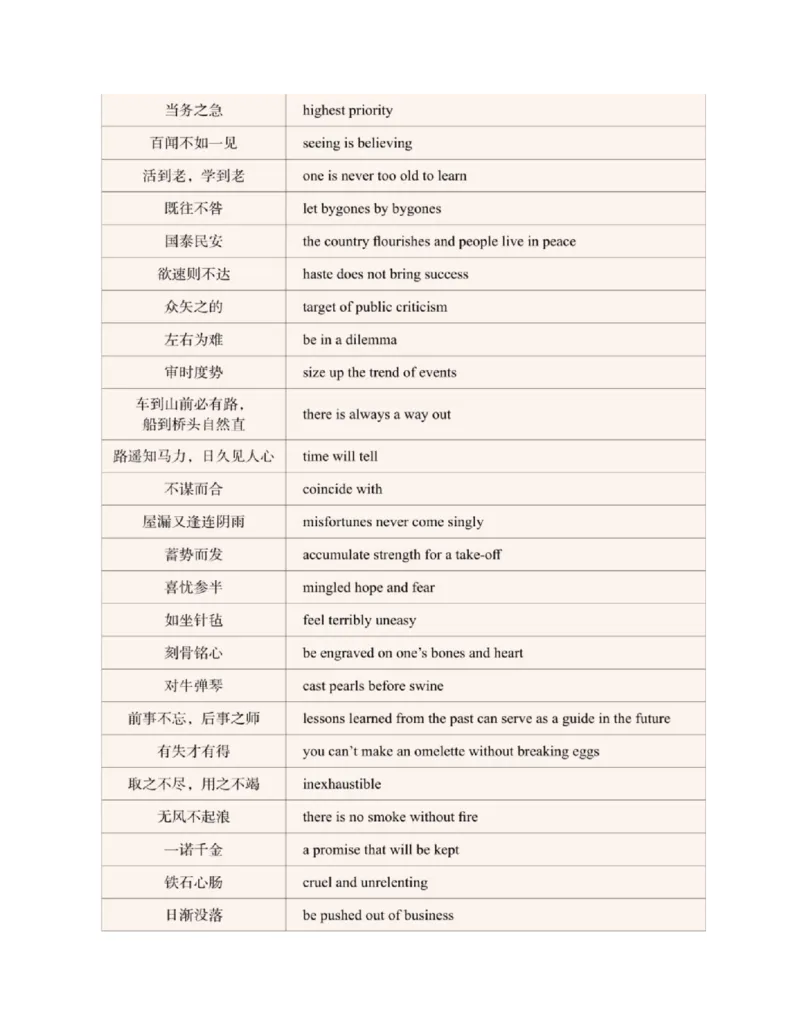
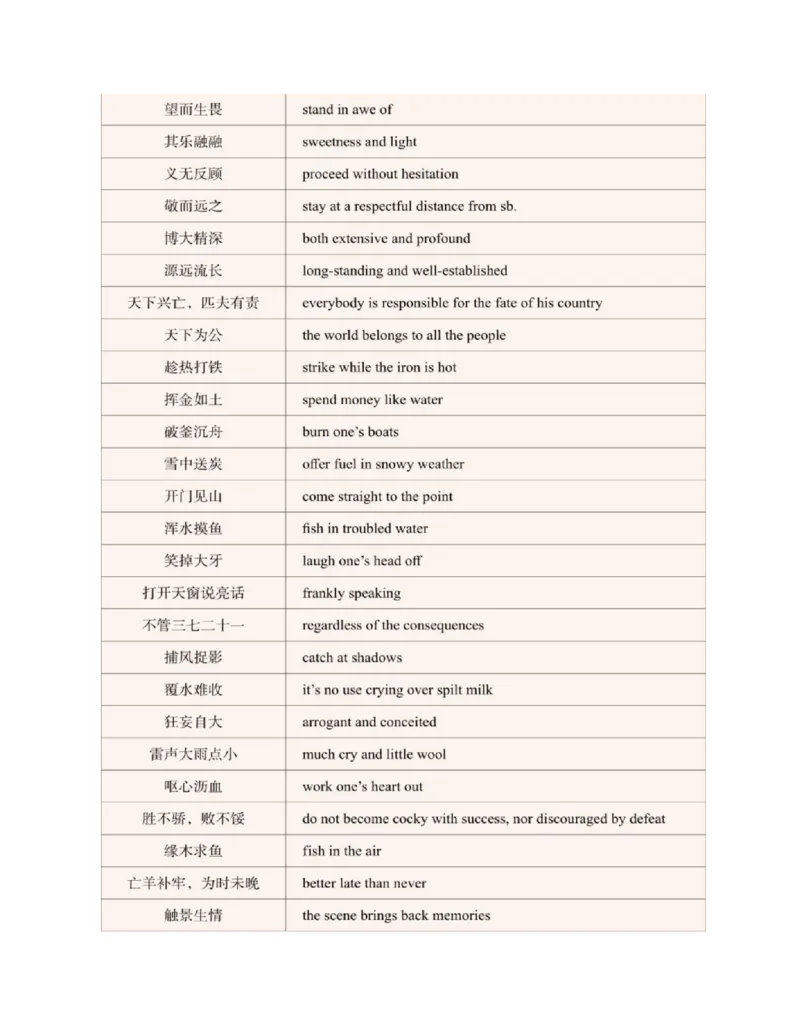
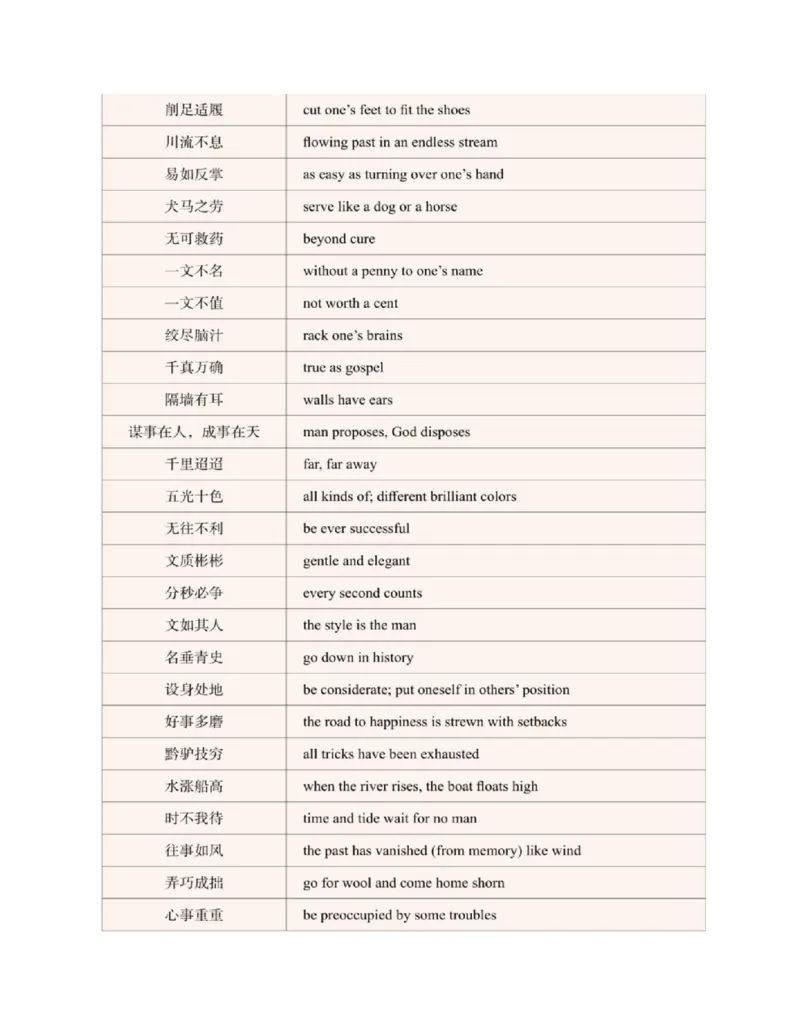
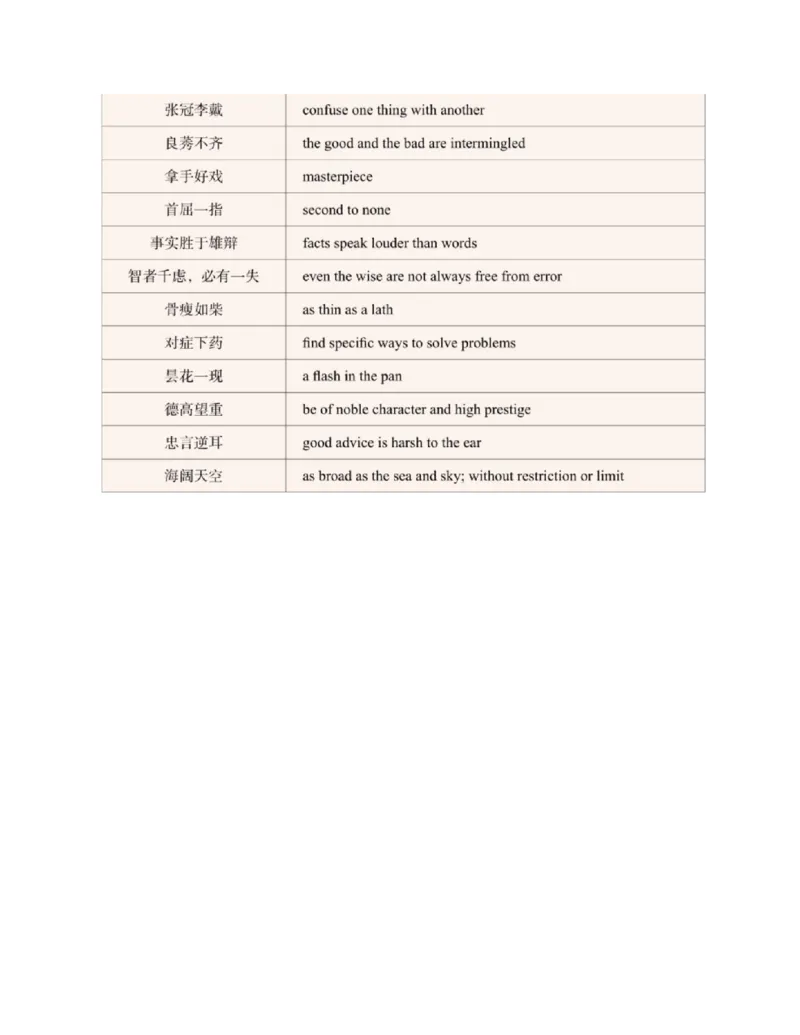
文档内容
版权信息
COPYRIGHT
书名:专八翻译提分训练
作者:新东方考试研究中心 编著
出版社:浙江教育出版社·新东方大愚文化
出版时间:2023年10月
ISBN:9787572265389
字数:183千字
本书由北京新东方大愚文化传播有限公司授权得到APP电子版制作与
发行
版权所有·侵权必究
前言
Preface
根据最新英语专业八级考试大纲及近几年英语专业八级考试翻译真题
考查趋势,我们精心编写了这本以“翻译指导+练习”为特色的《专八翻
译提分训练》,旨在帮助英语专业大学考生在较短时间内更好地掌握
英语专业八级考试翻译题型的特点及应试技巧,有效提高翻译考试成
绩。
《专八翻译提分训练》根据英语专业八级考试翻译题型的设题特点,
针对不同英语水平的专八考生,从考试介绍、方法指导、热点表达学
习到热门话题演练,全方位透析英语专业八级翻译。
书中技巧点拨易学实用,语言简单易懂,翻译选材贴合真题、紧跟当
下热点、话题新颖多样,旨在用最短的时间有效提升考生的学习效果
和得分率。本书特色总结如下:
► 科学的学习规划,提升专八翻译能力
本书分为三个部分:PART 1 备考技能和高分锦囊、PART 2 翻译提分
训练和PART 3 答案精析。从技巧提升到实战演练,为考生悉心规划专
八翻译学习内容。
PART 1为考生提供专八翻译理论指导,包括专八翻译考纲介绍、翻译
的步骤、翻译的常见问题、翻译应试技巧、七类汉译英热点表达、三
类常考文体翻译技巧以及词语、句子、篇章三个不同维度的翻译锦
囊。
PART 2为考生提供100篇翻译练习,全面提升考生的翻译水平,短期
内有效突击专八翻译。
PART 3为考生答疑解惑,提供参考译文和翻译难点解析,由点到面,
手把手教会考生翻译专八文章。
► 话题考查趋势预测,帮助考生精准备考
编者通过对历年专八真题的研究分析,总结出专八翻译考查的六大类
话题,分别为:心灵感悟、社会生活、人生经历、生活哲理、文化教
育以及文学作品,帮助考生精准备考。
► 翻译高分锦囊,提升备考技能
本书首先对翻译题型进行了深入解读,对翻译真题进行了全面剖析,
总结并图文并茂地呈现了翻译的步骤,归纳了汉译英常见的词语、句
子和篇章翻译的易错陷阱,提供了切合专八汉译英的词语、句子和篇
章翻译的技巧,精准、简洁的文字阐述,辅之以大量具体的真题示
例,进一步加深考生理解,让翻译学习变得更加有趣、高效。
同时,本书还为考生归纳总结了关于心灵感悟、社会生活、人生经
历、生活哲理、文化教育、文学作品以及通用表达七大类热点表达,
帮助考生突破翻译词汇的难关,在考试中快速、轻松地提取翻译词
汇。
此外,本书还专门介绍了专八翻译的三大常考文体:散文、论说文以
及应用文。从抽象的文体特征叙述,到具体的对应文体的真题示例解
读,让考生快速熟悉不同文体,轻松应对考试中的各种文体,使翻译
语言更加贴合原文风格。
► 100篇翻译练习,热点话题全覆盖
编者在认真研究最新真题的基础上,把握命题规律,精心编写了100篇
翻译练习文章。所选材料的题材、内容、词数和难易程度都遵照专业
八级考试真题的标准,力求为考生营造一个全真的翻译考试氛围,帮
助考生提前进行考试前的预热准备。
► 详细题目解析,助力学生备考
每篇翻译文章之后均配有【参考译文】和【翻译难点】,帮助考生逐
字逐句攻克翻译难点。考生可以自己先练习翻译,根据自己遇到的难
点,有针对性地与【参考译文】进行对照,从而更高效地提高自己的
翻译水平。
毋庸置疑,提高专八翻译的水平是提高专八考试分数的重要环节。我
们精心打造这本书的目的就在于,让所有考生都能在最短的时间里,
迅速掌握翻译技巧,结合充分的练习,真正提高翻译能力。
本书得以顺利完成,要特别感谢汇智博纳工作室的金利、何静、李岩
岩、高楠楠、晋显红等老师。是他们对英语教学和研究的热爱和投入
才使得本书能在第一时间与考生见面。
相信考生在掌握有效的技巧并进行科学的练习后,定可从容应对专八
翻译!最后,祝所有备战专八考试的考生都能取得理想的成绩!
编者
PART 1
备考技能和高分锦囊
第一章
带你了解专八翻译
一
大纲解读
1 测试要求
能运用汉译英的理论和技巧,翻译我国报刊、杂志上的文章和一般文
学作品。速度为每小时250~300个汉字。译文要求忠实原意,语言通
顺、流畅。
2 测试形式
本部分为作答题,将一段约150个汉字的段落译成英语,考试时间20分
钟。
3 测试目的
测试学生的汉译英翻译能力。
4 测试内容
从文体上看,汉译英主要涉及记叙、说明、散文和论说四种文体;从
主题上看,主要涉及人文思想、风俗习惯、城市及公共机构的介绍、
国际关系及国际政治、个人见闻及随想等方面,未涉及专门学术领域
的知识。
二
评分标准
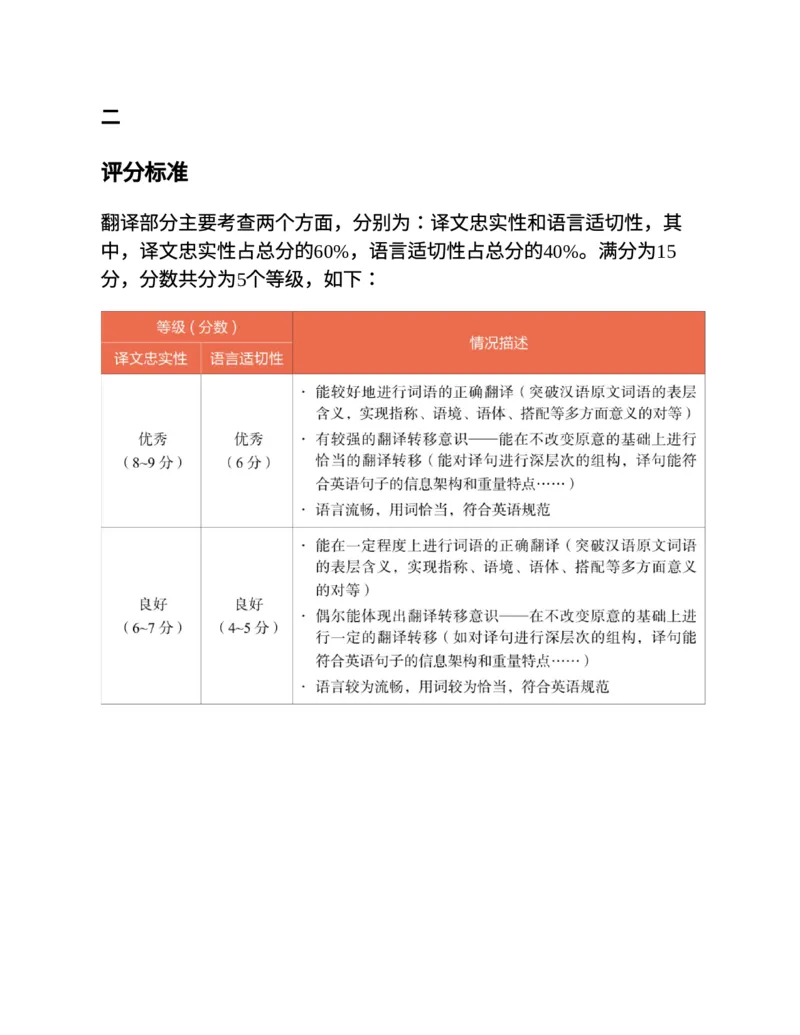
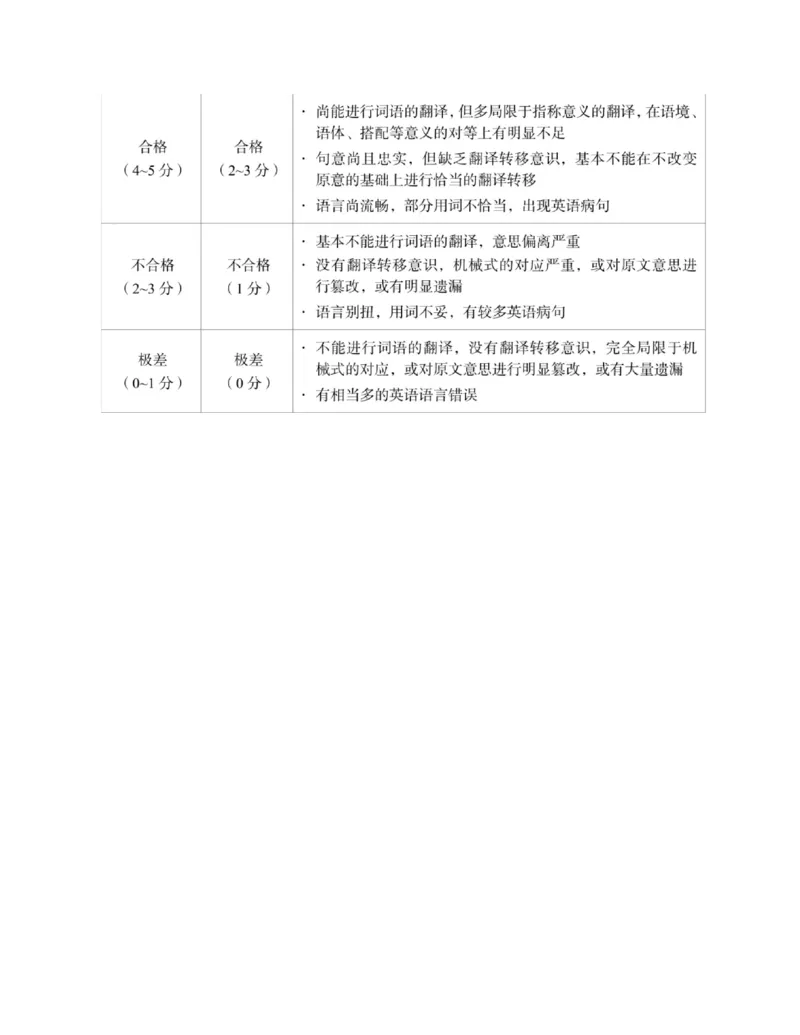
翻译部分主要考查两个方面,分别为:译文忠实性和语言适切性,其
中,译文忠实性占总分的60%,语言适切性占总分的40%。满分为15
分,分数共分为5个等级,如下:
第二章
翻译常见问题及应试技巧
一
翻译的步骤
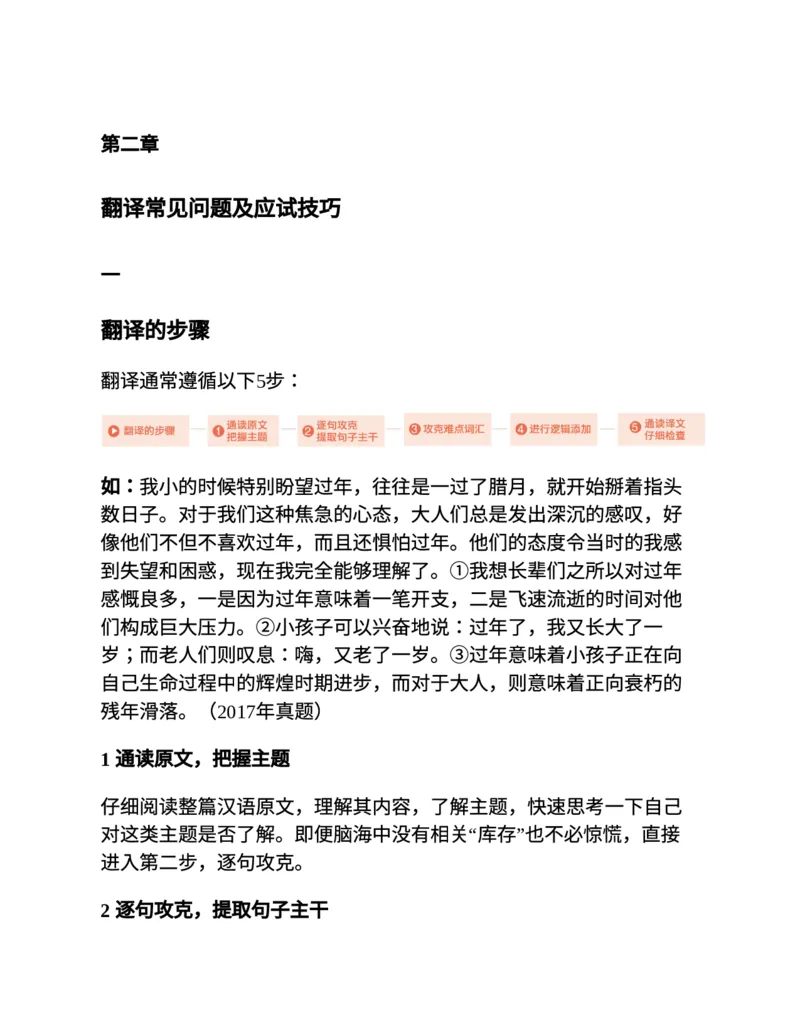
翻译通常遵循以下5步:
如:我小的时候特别盼望过年,往往是一过了腊月,就开始掰着指头
数日子。对于我们这种焦急的心态,大人们总是发出深沉的感叹,好
像他们不但不喜欢过年,而且还惧怕过年。他们的态度令当时的我感
到失望和困惑,现在我完全能够理解了。①我想长辈们之所以对过年
感慨良多,一是因为过年意味着一笔开支,二是飞速流逝的时间对他
们构成巨大压力。②小孩子可以兴奋地说:过年了,我又长大了一
岁;而老人们则叹息:嗨,又老了一岁。③过年意味着小孩子正在向
自己生命过程中的辉煌时期进步,而对于大人,则意味着正向衰朽的
残年滑落。(2017年真题)
1 通读原文,把握主题
仔细阅读整篇汉语原文,理解其内容,了解主题,快速思考一下自己
对这类主题是否了解。即便脑海中没有相关“库存”也不必惊慌,直接
进入第二步,逐句攻克。
2 逐句攻克,提取句子主干
对原文的每句话进行主干的提取,划分出主语、谓语、宾语等。
有时还需确认句子是简单句还是主从复合句,是主动语态还是被动语
态。
第①句的主干:我想……
第②句的主干:小孩子可以说……而老人们则叹息……
第③句的主干:过年意味着……而……则意味着……
3 攻克难点词汇
对于较难的词汇或表达,不必执着于选择最准确的英语表达,可以灵
活选取相近的词汇或表达。如例子中比较难的表达有:
第①句:感慨良多、飞速流逝的
第②句:又长大了一岁、又老了一岁
第③句:辉煌时期、衰朽的残年、滑落
4 进行逻辑添加
分析句子中每个成分间的逻辑关系,先翻译主干,再添加主干之外的
细节。
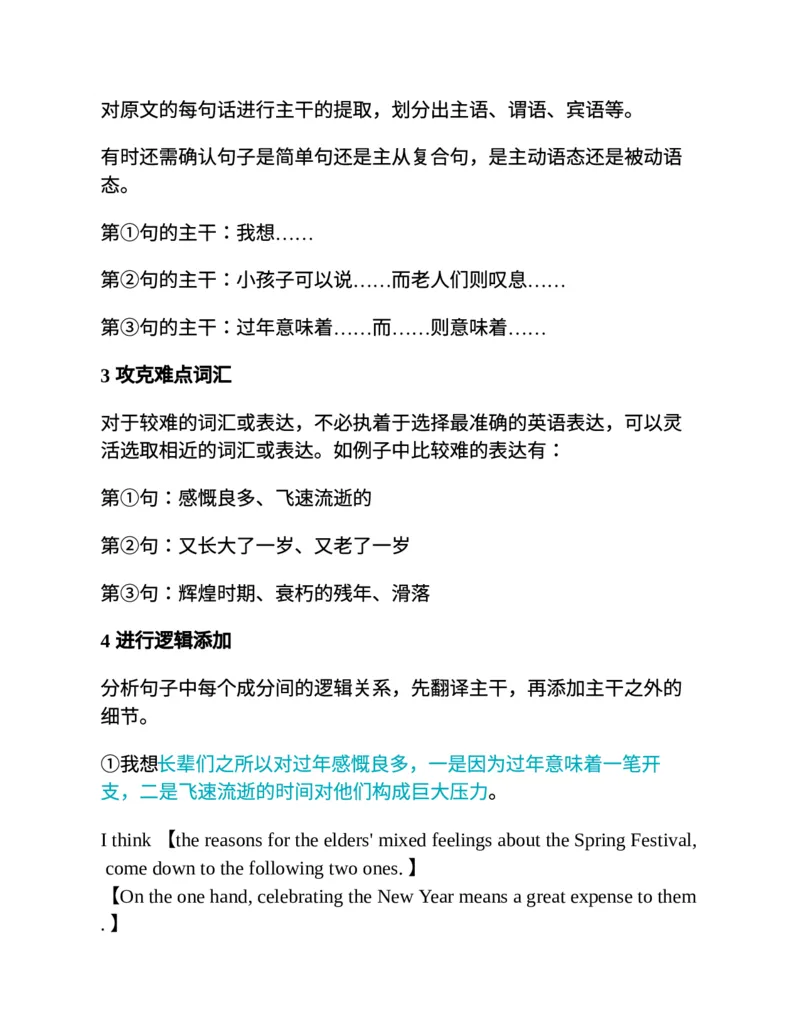
①我想长辈们之所以对过年感慨良多,一是因为过年意味着一笔开
支,二是飞速流逝的时间对他们构成巨大压力。
I think 【the reasons for the elders' mixed feelings about the Spring Festival,
come down to the following two ones. 】
【On the one hand, celebrating the New Year means a great expense to them
. 】
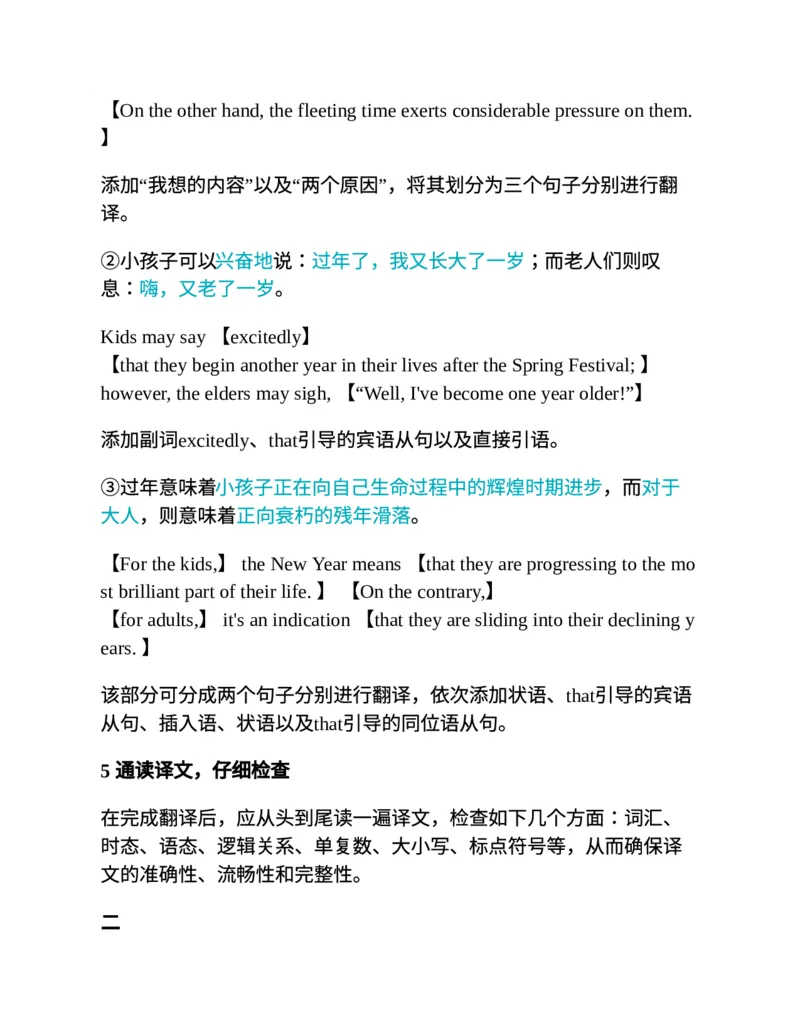
【On the other hand, the fleeting time exerts considerable pressure on them.
】
添加“我想的内容”以及“两个原因”,将其划分为三个句子分别进行翻
译。
②小孩子可以兴奋地说:过年了,我又长大了一岁;而老人们则叹
息:嗨,又老了一岁。
Kids may say 【excitedly】
【that they begin another year in their lives after the Spring Festival; 】
however, the elders may sigh, 【“Well, I've become one year older!”】
添加副词excitedly、that引导的宾语从句以及直接引语。
③过年意味着小孩子正在向自己生命过程中的辉煌时期进步,而对于
大人,则意味着正向衰朽的残年滑落。
【For the kids,】 the New Year means 【that they are progressing to the mo
st brilliant part of their life. 】 【On the contrary,】
【for adults,】 it's an indication 【that they are sliding into their declining y
ears. 】
该部分可分成两个句子分别进行翻译,依次添加状语、that引导的宾语
从句、插入语、状语以及that引导的同位语从句。
5 通读译文,仔细检查
在完成翻译后,应从头到尾读一遍译文,检查如下几个方面:词汇、
时态、语态、逻辑关系、单复数、大小写、标点符号等,从而确保译
文的准确性、流畅性和完整性。
二
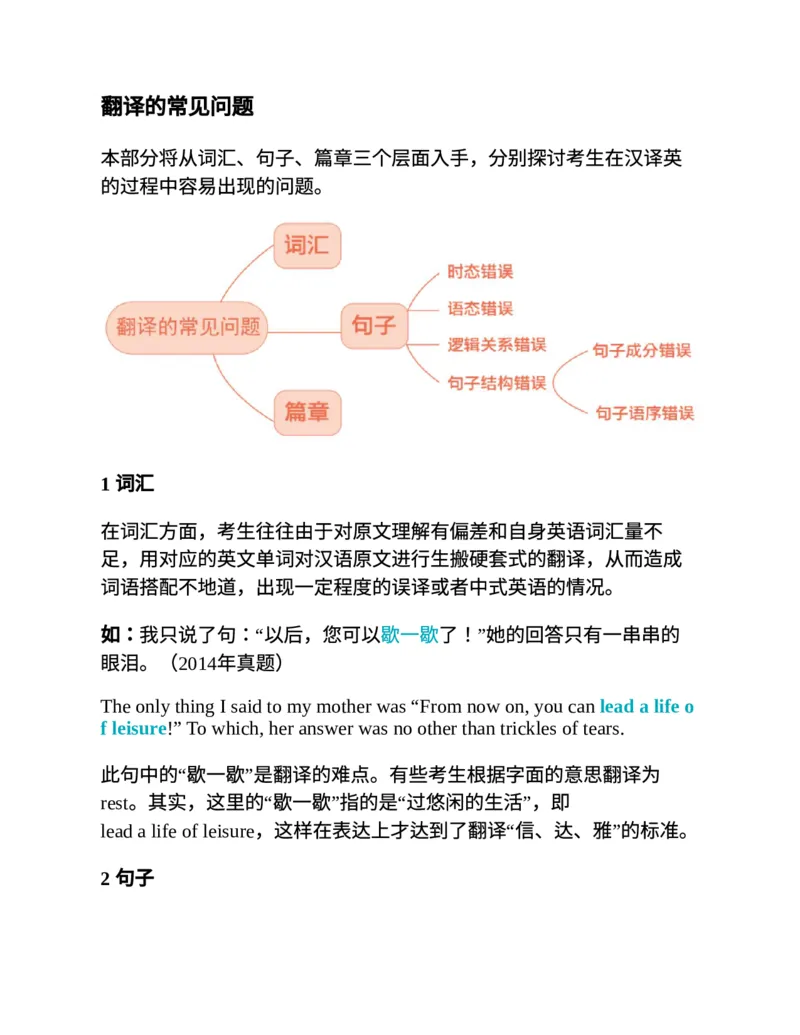
翻译的常见问题
本部分将从词汇、句子、篇章三个层面入手,分别探讨考生在汉译英
的过程中容易出现的问题。
1 词汇
在词汇方面,考生往往由于对原文理解有偏差和自身英语词汇量不
足,用对应的英文单词对汉语原文进行生搬硬套式的翻译,从而造成
词语搭配不地道,出现一定程度的误译或者中式英语的情况。
如:我只说了句:“以后,您可以歇一歇了!”她的回答只有一串串的
眼泪。(2014年真题)
The only thing I said to my mother was “From now on, you can lead a life o
f leisure!” To which, her answer was no other than trickles of tears.
此句中的“歇一歇”是翻译的难点。有些考生根据字面的意思翻译为
rest。其实,这里的“歇一歇”指的是“过悠闲的生活”,即
lead a life of leisure,这样在表达上才达到了翻译“信、达、雅”的标准。
2 句子
在句子层面上,考生易出现的错误涉及对时态、语态的把握,以及对
句间关系和句子结构的把握。
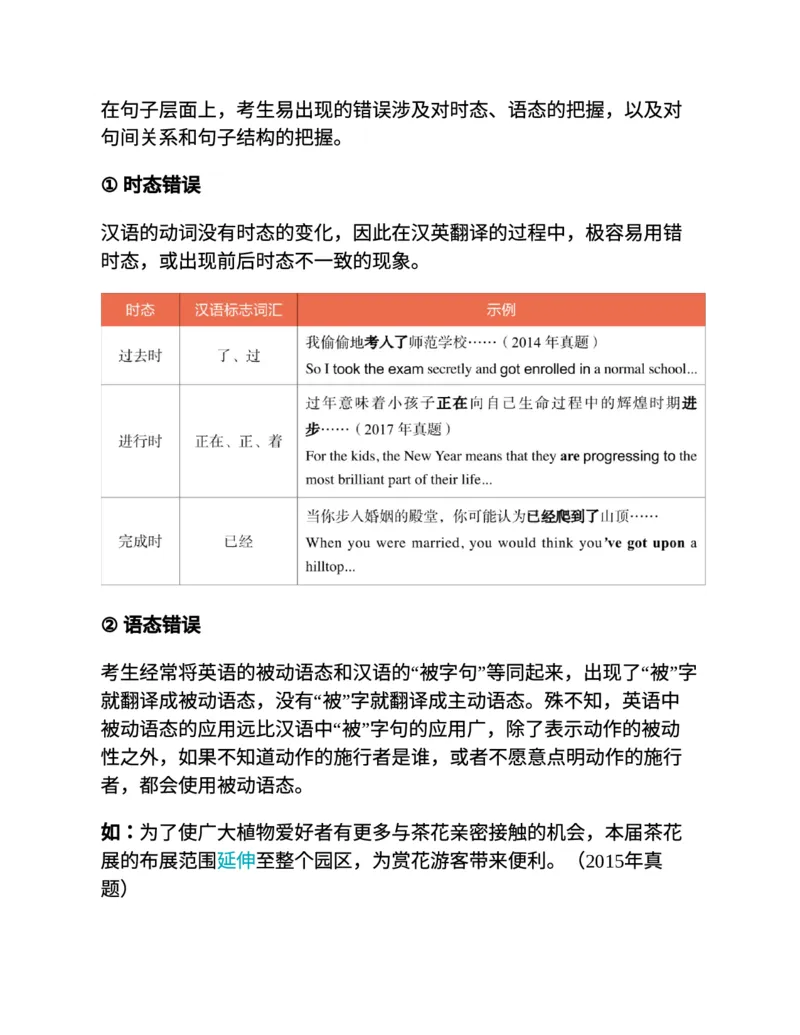
① 时态错误
汉语的动词没有时态的变化,因此在汉英翻译的过程中,极容易用错
时态,或出现前后时态不一致的现象。
② 语态错误
考生经常将英语的被动语态和汉语的“被字句”等同起来,出现了“被”字
就翻译成被动语态,没有“被”字就翻译成主动语态。殊不知,英语中
被动语态的应用远比汉语中“被”字句的应用广,除了表示动作的被动
性之外,如果不知道动作的施行者是谁,或者不愿意点明动作的施行
者,都会使用被动语态。
如:为了使广大植物爱好者有更多与茶花亲密接触的机会,本届茶花
展的布展范围延伸至整个园区,为赏花游客带来便利。(2015年真
题)
In order to offer plant enthusiasts more chances to enjoy the beauty of camel
lias closely, the exhibit area of the flower show is extended to the entire par
k, which brings the visitors a lot of convenience.
此句中的“布展范围延伸”即“布展范围被延伸”,需使用被动语态,译为
is extended。
③ 逻辑关系错误
对汉语中句与句之间逻辑关系的把握和处理也是考生极易出错的一个
地方。
和英语不同,汉语句法重“意合”,即词语或分句之间不用语言形式连
接,句中的语法意义和逻辑关系通过词语或分句的含义表达,故汉语
中使用逻辑关系词的情况要少得多。
而英语句法重“形合”,即句中的词语或分句之间用语言形式(如关联
词)连接起来,表达语法意义和逻辑关系。这样一来,在汉英转换的
过程中,考生有时就会由于对逻辑关系的理解有偏差而误译,导致译
文逻辑混乱。
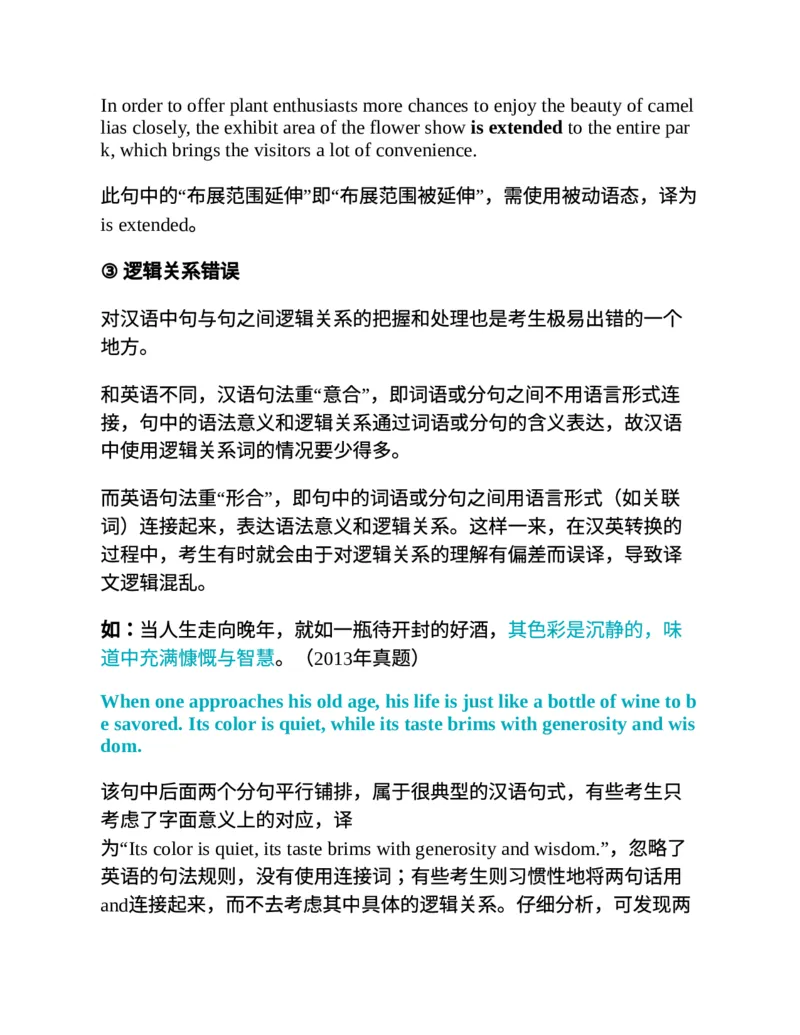
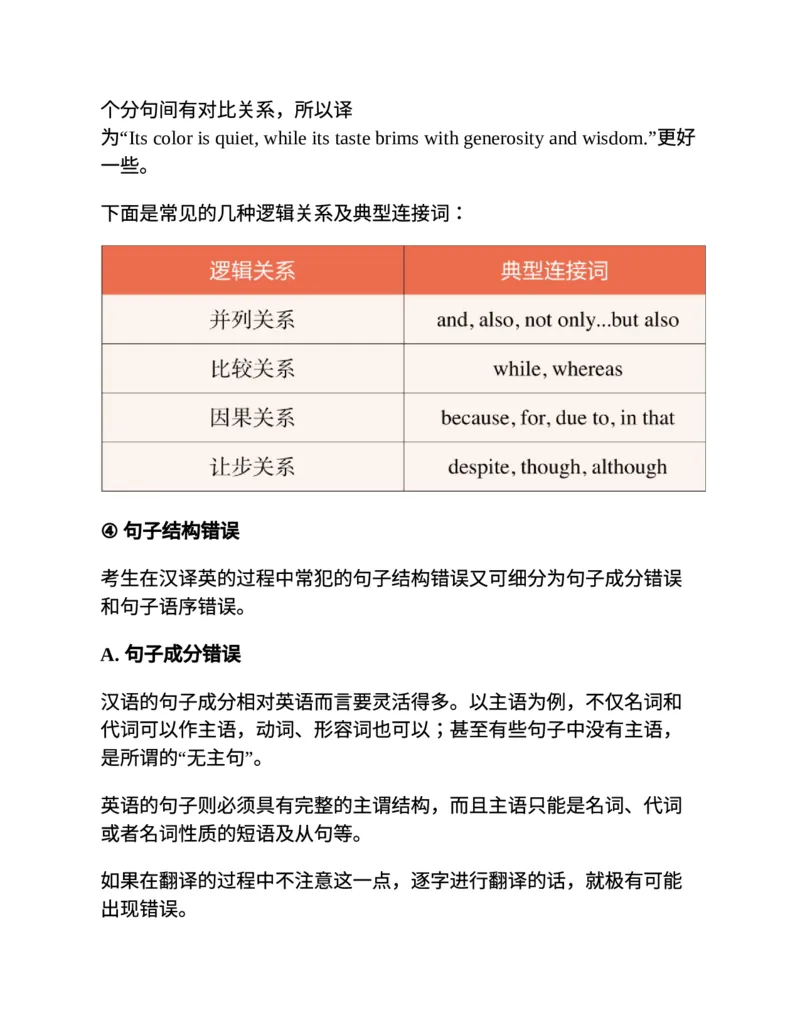
如:当人生走向晚年,就如一瓶待开封的好酒,其色彩是沉静的,味
道中充满慷慨与智慧。(2013年真题)
When one approaches his old age, his life is just like a bottle of wine to b
e savored. Its color is quiet, while its taste brims with generosity and wis
dom.
该句中后面两个分句平行铺排,属于很典型的汉语句式,有些考生只
考虑了字面意义上的对应,译
为“Its color is quiet, its taste brims with generosity and wisdom.”,忽略了
英语的句法规则,没有使用连接词;有些考生则习惯性地将两句话用
and连接起来,而不去考虑其中具体的逻辑关系。仔细分析,可发现两
个分句间有对比关系,所以译
为“Its color is quiet, while its taste brims with generosity and wisdom.”更好
一些。
下面是常见的几种逻辑关系及典型连接词:
④ 句子结构错误
考生在汉译英的过程中常犯的句子结构错误又可细分为句子成分错误
和句子语序错误。
A. 句子成分错误
汉语的句子成分相对英语而言要灵活得多。以主语为例,不仅名词和
代词可以作主语,动词、形容词也可以;甚至有些句子中没有主语,
是所谓的“无主句”。
英语的句子则必须具有完整的主谓结构,而且主语只能是名词、代词
或者名词性质的短语及从句等。
如果在翻译的过程中不注意这一点,逐字进行翻译的话,就极有可能
出现错误。
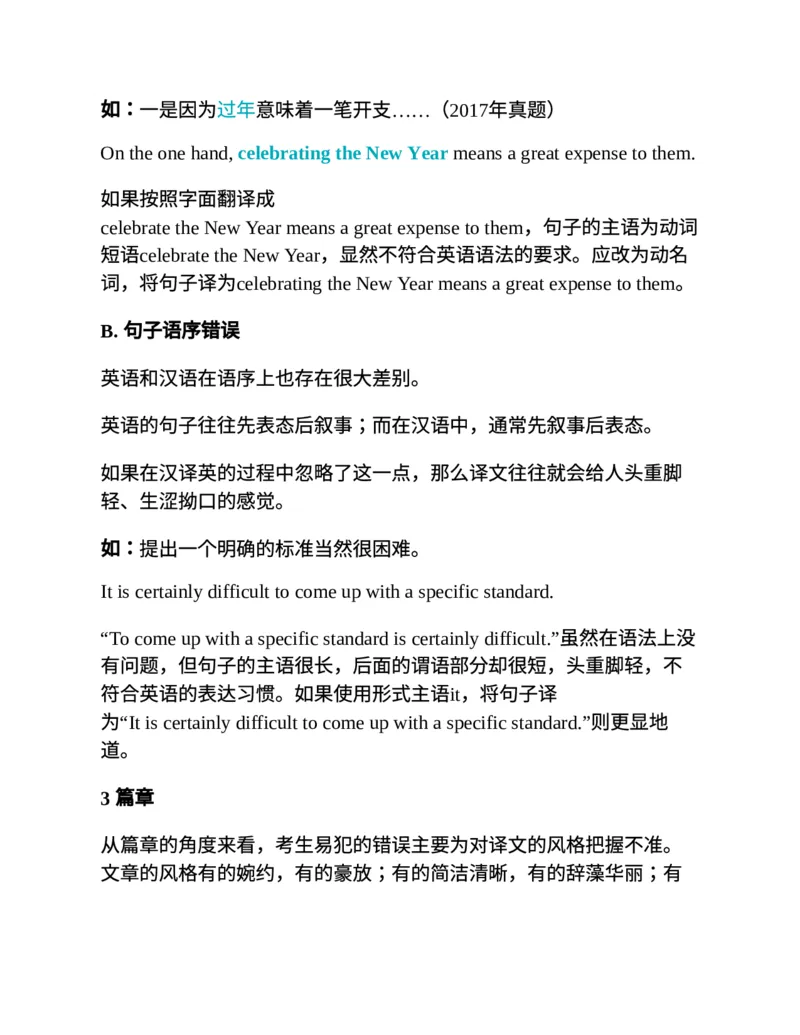
如:一是因为过年意味着一笔开支……(2017年真题)
On the one hand, celebrating the New Year means a great expense to them.
如果按照字面翻译成
celebrate the New Year means a great expense to them,句子的主语为动词
短语celebrate the New Year,显然不符合英语语法的要求。应改为动名
词,将句子译为celebrating the New Year means a great expense to them。
B. 句子语序错误
英语和汉语在语序上也存在很大差别。
英语的句子往往先表态后叙事;而在汉语中,通常先叙事后表态。
如果在汉译英的过程中忽略了这一点,那么译文往往就会给人头重脚
轻、生涩拗口的感觉。
如:提出一个明确的标准当然很困难。
It is certainly difficult to come up with a specific standard.
“To come up with a specific standard is certainly difficult.”虽然在语法上没
有问题,但句子的主语很长,后面的谓语部分却很短,头重脚轻,不
符合英语的表达习惯。如果使用形式主语it,将句子译
为“It is certainly difficult to come up with a specific standard.”则更显地
道。
3 篇章
从篇章的角度来看,考生易犯的错误主要为对译文的风格把握不准。
文章的风格有的婉约,有的豪放;有的简洁清晰,有的辞藻华丽;有
的风趣幽默,有的严肃谨慎。译文要想完全反映出原文的风格确实有
很大的难度,但是译者一定要竭尽所能地使译文接近原文的风格。
三
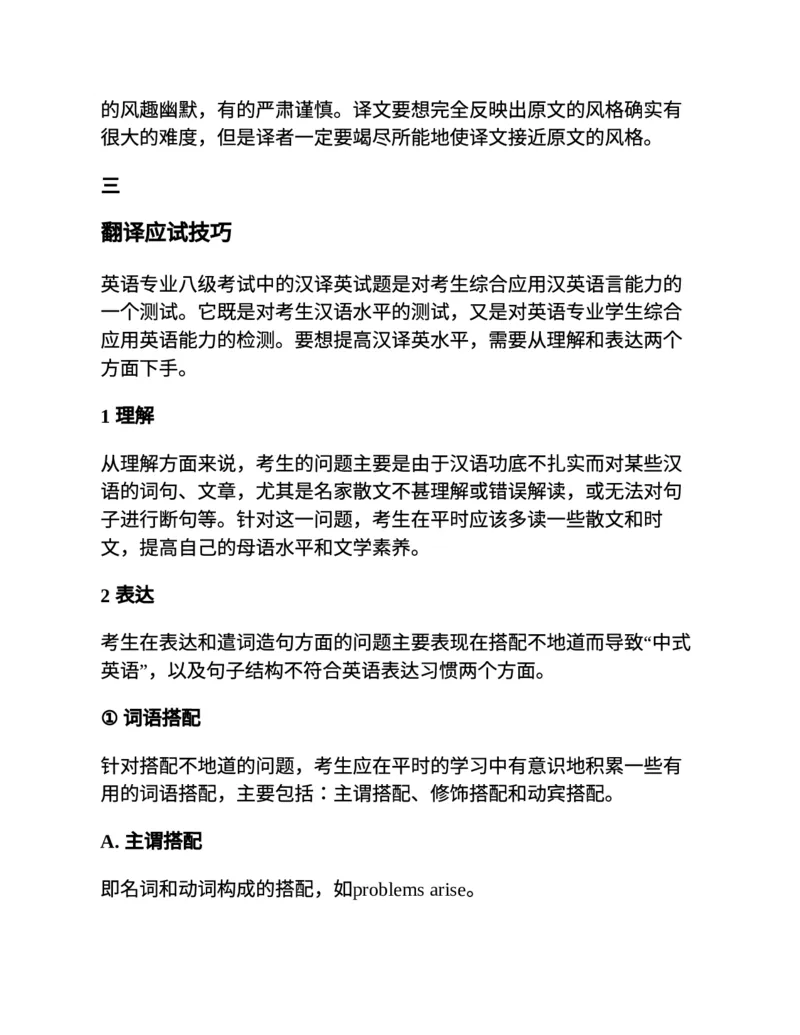
翻译应试技巧
英语专业八级考试中的汉译英试题是对考生综合应用汉英语言能力的
一个测试。它既是对考生汉语水平的测试,又是对英语专业学生综合
应用英语能力的检测。要想提高汉译英水平,需要从理解和表达两个
方面下手。
1 理解
从理解方面来说,考生的问题主要是由于汉语功底不扎实而对某些汉
语的词句、文章,尤其是名家散文不甚理解或错误解读,或无法对句
子进行断句等。针对这一问题,考生在平时应该多读一些散文和时
文,提高自己的母语水平和文学素养。
2 表达
考生在表达和遣词造句方面的问题主要表现在搭配不地道而导致“中式
英语”,以及句子结构不符合英语表达习惯两个方面。
① 词语搭配
针对搭配不地道的问题,考生应在平时的学习中有意识地积累一些有
用的词语搭配,主要包括:主谓搭配、修饰搭配和动宾搭配。
A. 主谓搭配
即名词和动词构成的搭配,如problems arise。
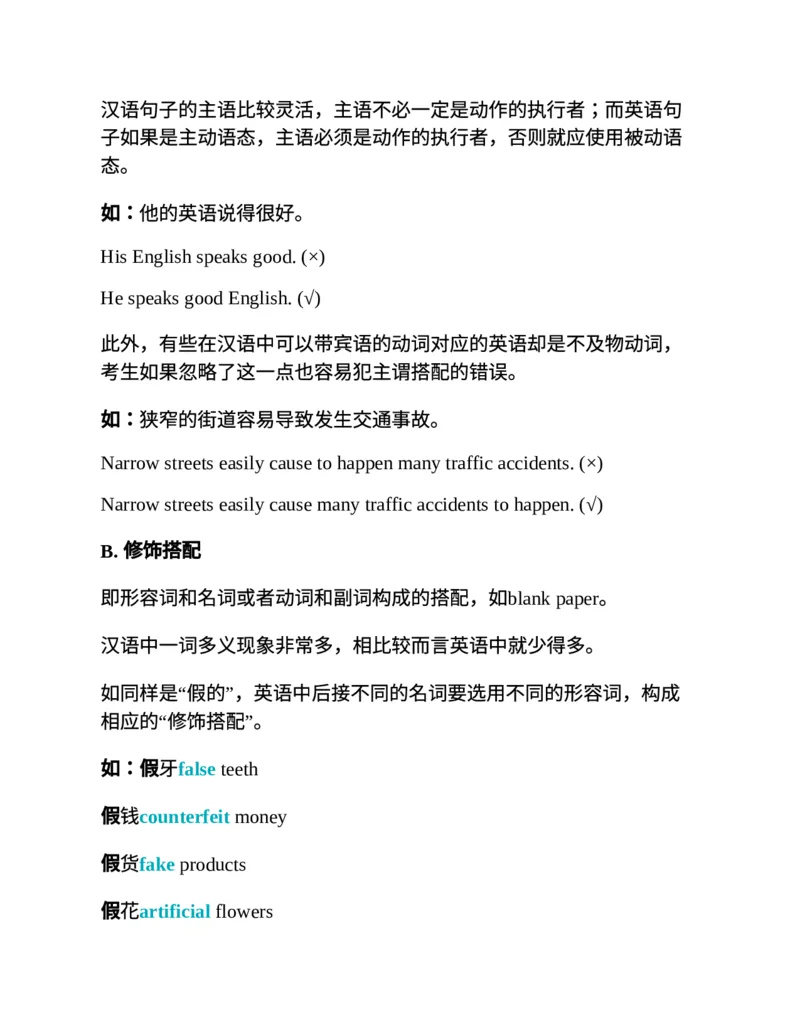
汉语句子的主语比较灵活,主语不必一定是动作的执行者;而英语句
子如果是主动语态,主语必须是动作的执行者,否则就应使用被动语
态。
如:他的英语说得很好。
His English speaks good. (×)
He speaks good English. (√)
此外,有些在汉语中可以带宾语的动词对应的英语却是不及物动词,
考生如果忽略了这一点也容易犯主谓搭配的错误。
如:狭窄的街道容易导致发生交通事故。
Narrow streets easily cause to happen many traffic accidents. (×)
Narrow streets easily cause many traffic accidents to happen. (√)
B. 修饰搭配
即形容词和名词或者动词和副词构成的搭配,如blank paper。
汉语中一词多义现象非常多,相比较而言英语中就少得多。
如同样是“假的”,英语中后接不同的名词要选用不同的形容词,构成
相应的“修饰搭配”。
如:假牙false teeth
假钱counterfeit money
假货fake products
假花artificial flowers
假医生 a quack doctor
C. 动宾搭配
即动词和宾语构成的搭配,如make progress。
汉语中一词多义现象的另外一个影响就是对应汉语中同一动词,由于
其后的宾语不同,英语中要使用不同的动词来构成相应的动宾搭配。
如:打开电视机turn on the TV
打开盒子open the box
打开礼物unwrap the present
打开信unfold the letter
总而言之,考生一定要在平时的练习中多积累这三种类型的搭配,以
期厚积薄发,使自己的译文更准确、地道。
② 句子结构
在句子结构方面,考生应该熟悉汉语句式结构和英语句式结构各自的
特点,要点如下:
A. 汉语句子成分没有英语句子严格
其中最主要的是汉语可以用动词作句子的主语或者宾语,句子还有可
能没有主语;而英语的句子一定要有主语(祈使句除外),且主语和
宾语必须是名词、代词或者名词性质的短语或从句。
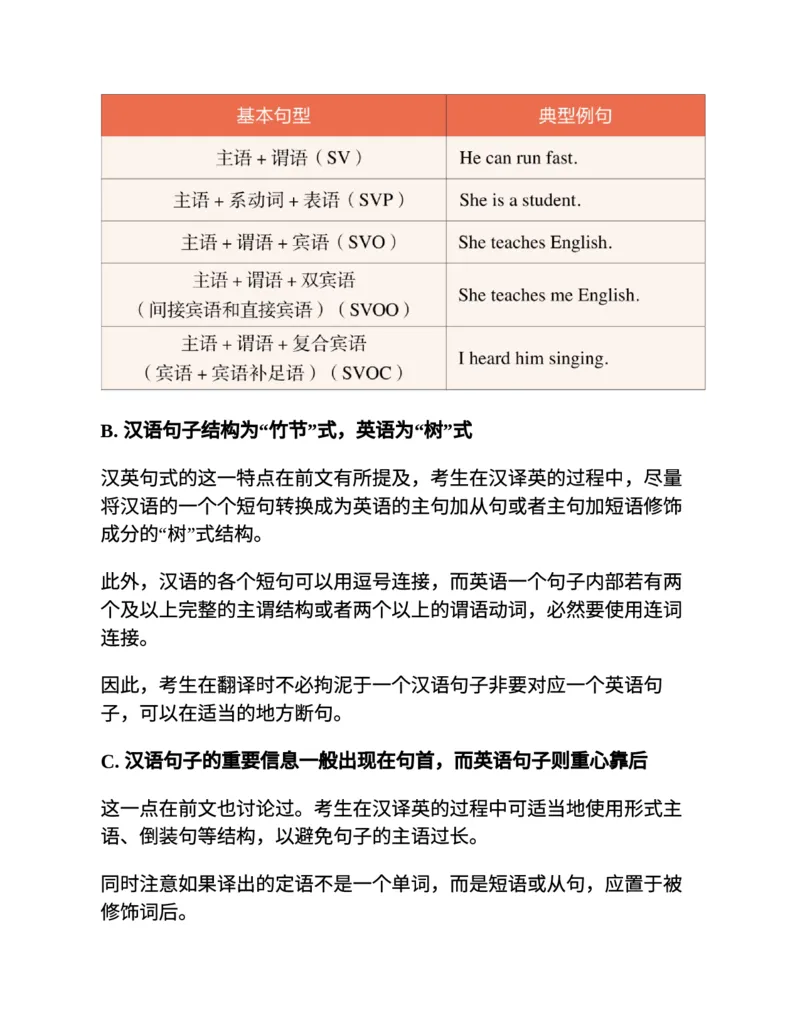
在汉译英的过程中,一定要注意这点,否则就容易犯语法错误。具体
说来,就是要熟悉英语句子的五种基本句型:
B. 汉语句子结构为“竹节”式,英语为“树”式
汉英句式的这一特点在前文有所提及,考生在汉译英的过程中,尽量
将汉语的一个个短句转换成为英语的主句加从句或者主句加短语修饰
成分的“树”式结构。
此外,汉语的各个短句可以用逗号连接,而英语一个句子内部若有两
个及以上完整的主谓结构或者两个以上的谓语动词,必然要使用连词
连接。
因此,考生在翻译时不必拘泥于一个汉语句子非要对应一个英语句
子,可以在适当的地方断句。
C. 汉语句子的重要信息一般出现在句首,而英语句子则重心靠后
这一点在前文也讨论过。考生在汉译英的过程中可适当地使用形式主
语、倒装句等结构,以避免句子的主语过长。
同时注意如果译出的定语不是一个单词,而是短语或从句,应置于被
修饰词后。
还有一种情况,就是在“主语+谓语+宾语+宾补”(SVOC)结构中,
如果宾语的定语过长,而宾补过短,则应该使用分隔结构进行翻译,
即将宾语的定语置于句末,也就是宾补之后,从而造成宾语及其定语
的分隔。
四
汉译英热点表达
1 心灵感悟
感慨良多 mixed feelings
飞速流逝的时间 fleeting time
生命的痕迹 the sign of life
大起大落 feast or famine
痛苦 bitterness
失意的 wistful
衬托 serve as a foil for
惆怅 melancholy
永不停息的 ceaseless
独处的 solitary
发光的 illuminated
空寂无人的 deserted
纠缠 entanglement
悲哀地 mournfully
侵入 intrude
脾气 temper
亲密的 intimate
隔阂 estrangement
尊敬 obeisance
默契 tacit understanding
随意 casualness
心照不宣的 tacit
平衡 equilibrium
琐碎的 trivial
灌输 implant
匆匆 rush
犹豫 hesitate
吃亏 suffer a loss
疲劳 fatigue
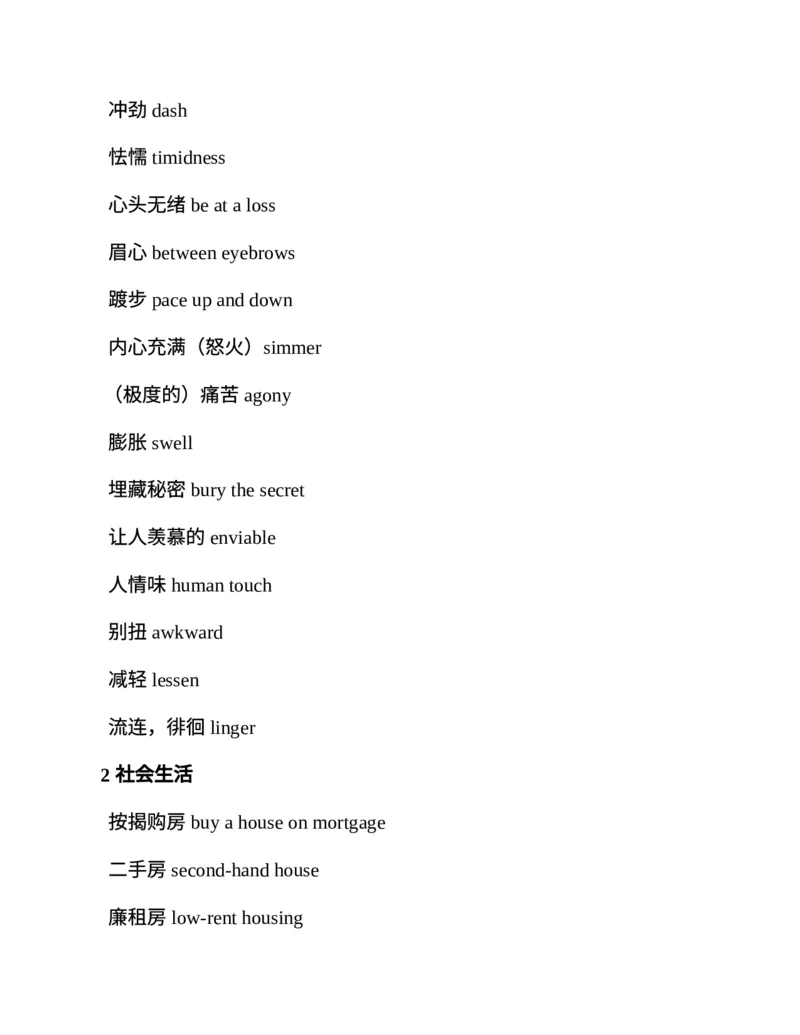
冲劲 dash
怯懦 timidness
心头无绪 be at a loss
眉心 between eyebrows
踱步 pace up and down
内心充满(怒火)simmer
(极度的)痛苦 agony
膨胀 swell
埋藏秘密 bury the secret
让人羡慕的 enviable
人情味 human touch
别扭 awkward
减轻 lessen
流连,徘徊 linger
2 社会生活
按揭购房 buy a house on mortgage
二手房 second-hand house
廉租房 low-rent housing
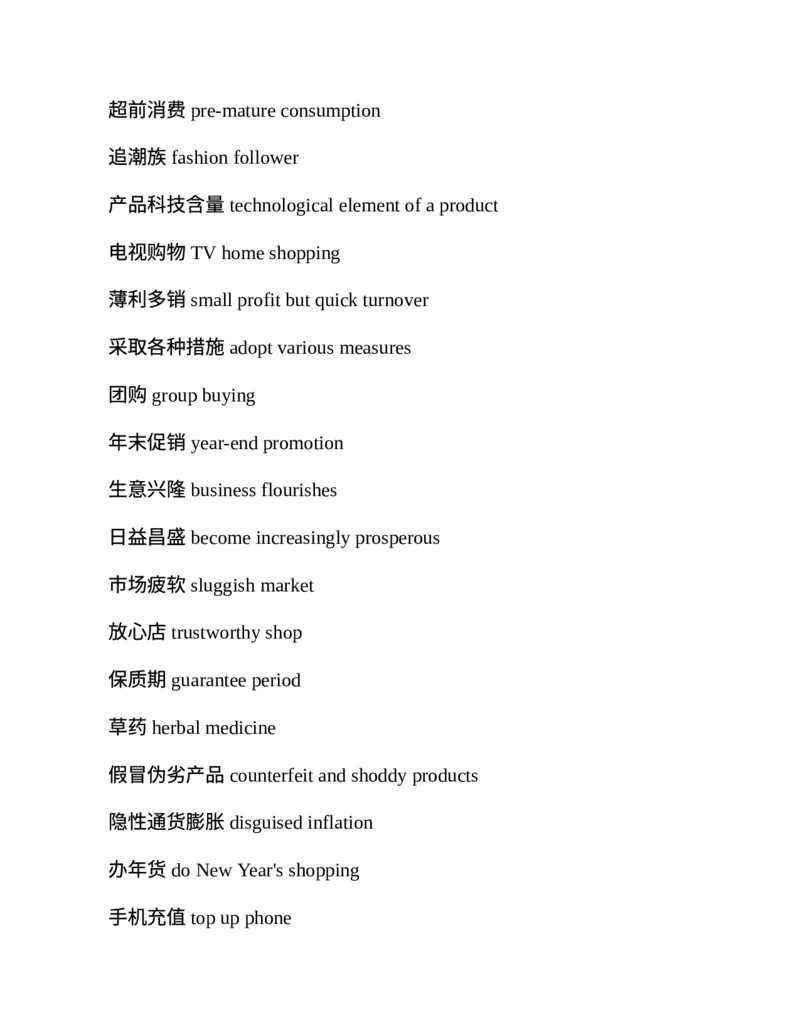
超前消费 pre-mature consumption
追潮族 fashion follower
产品科技含量 technological element of a product
电视购物 TV home shopping
薄利多销 small profit but quick turnover
采取各种措施 adopt various measures
团购 group buying
年末促销 year-end promotion
生意兴隆 business flourishes
日益昌盛 become increasingly prosperous
市场疲软 sluggish market
放心店 trustworthy shop
保质期 guarantee period
草药 herbal medicine
假冒伪劣产品 counterfeit and shoddy products
隐性通货膨胀 disguised inflation
办年货 do New Year's shopping
手机充值 top up phone
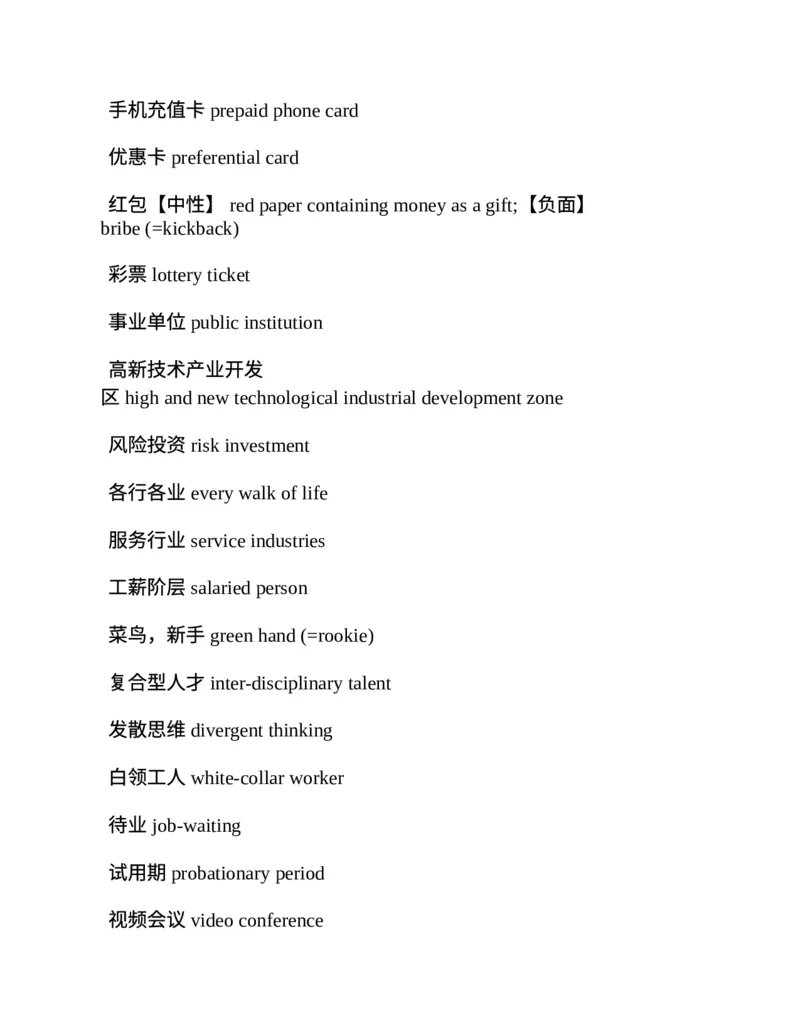
手机充值卡 prepaid phone card
优惠卡 preferential card
红包【中性】 red paper containing money as a gift;【负面】
bribe (=kickback)
彩票 lottery ticket
事业单位 public institution
高新技术产业开发
区 high and new technological industrial development zone
风险投资 risk investment
各行各业 every walk of life
服务行业 service industries
工薪阶层 salaried person
菜鸟,新手 green hand (=rookie)
复合型人才 inter-disciplinary talent
发散思维 divergent thinking
白领工人 white-collar worker
待业 job-waiting
试用期 probationary period
视频会议 video conference
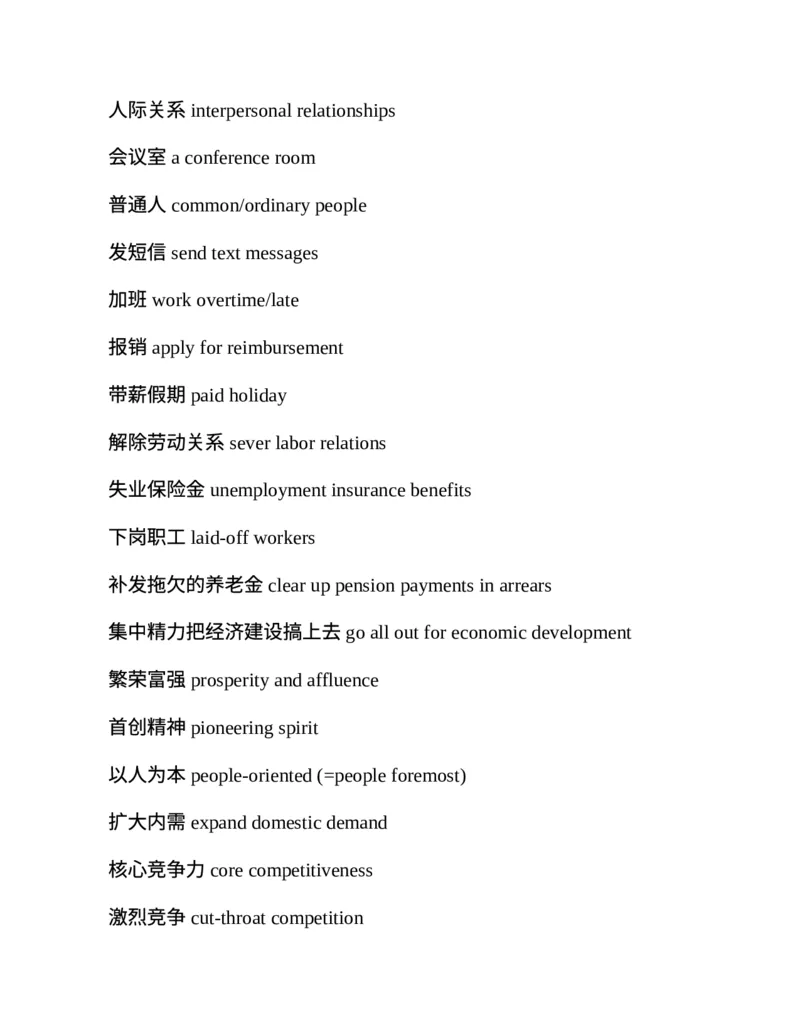
人际关系 interpersonal relationships
会议室 a conference room
普通人 common/ordinary people
发短信 send text messages
加班 work overtime/late
报销 apply for reimbursement
带薪假期 paid holiday
解除劳动关系 sever labor relations
失业保险金 unemployment insurance benefits
下岗职工 laid-off workers
补发拖欠的养老金 clear up pension payments in arrears
集中精力把经济建设搞上去 go all out for economic development
繁荣富强 prosperity and affluence
首创精神 pioneering spirit
以人为本 people-oriented (=people foremost)
扩大内需 expand domestic demand
核心竞争力 core competitiveness
激烈竞争 cut-throat competition
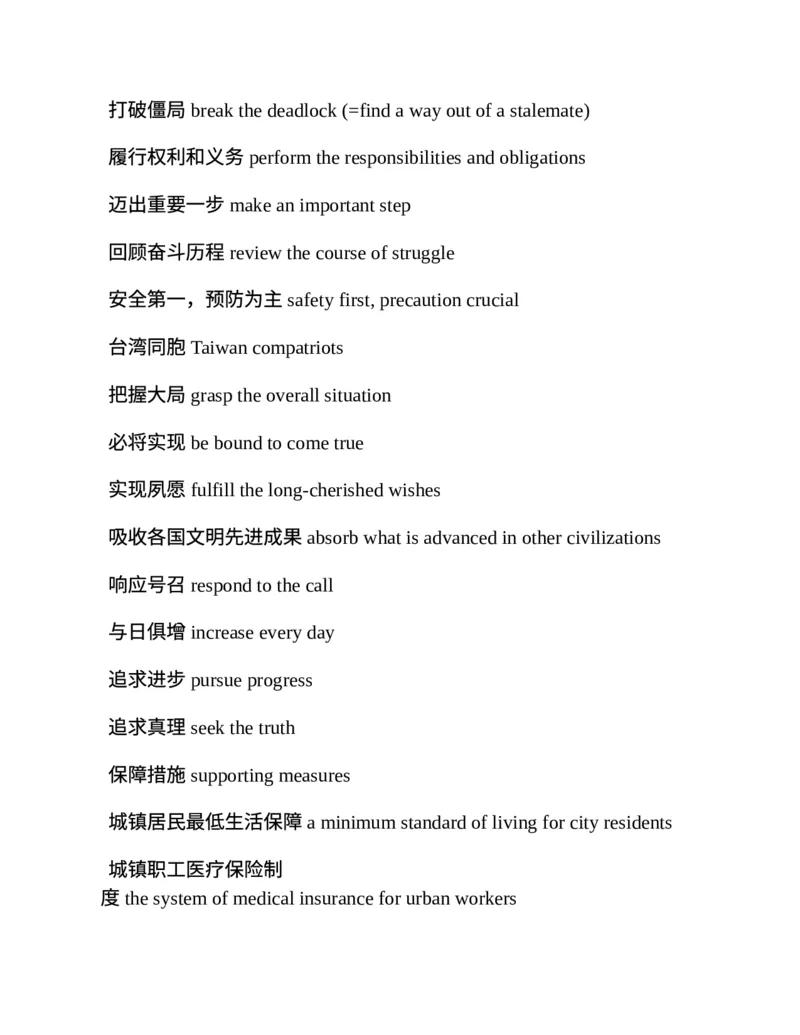
打破僵局 break the deadlock (=find a way out of a stalemate)
履行权利和义务 perform the responsibilities and obligations
迈出重要一步 make an important step
回顾奋斗历程 review the course of struggle
安全第一,预防为主 safety first, precaution crucial
台湾同胞 Taiwan compatriots
把握大局 grasp the overall situation
必将实现 be bound to come true
实现夙愿 fulfill the long-cherished wishes
吸收各国文明先进成果 absorb what is advanced in other civilizations
响应号召 respond to the call
与日俱增 increase every day
追求进步 pursue progress
追求真理 seek the truth
保障措施 supporting measures
城镇居民最低生活保障 a minimum standard of living for city residents
城镇职工医疗保险制
度 the system of medical insurance for urban workers
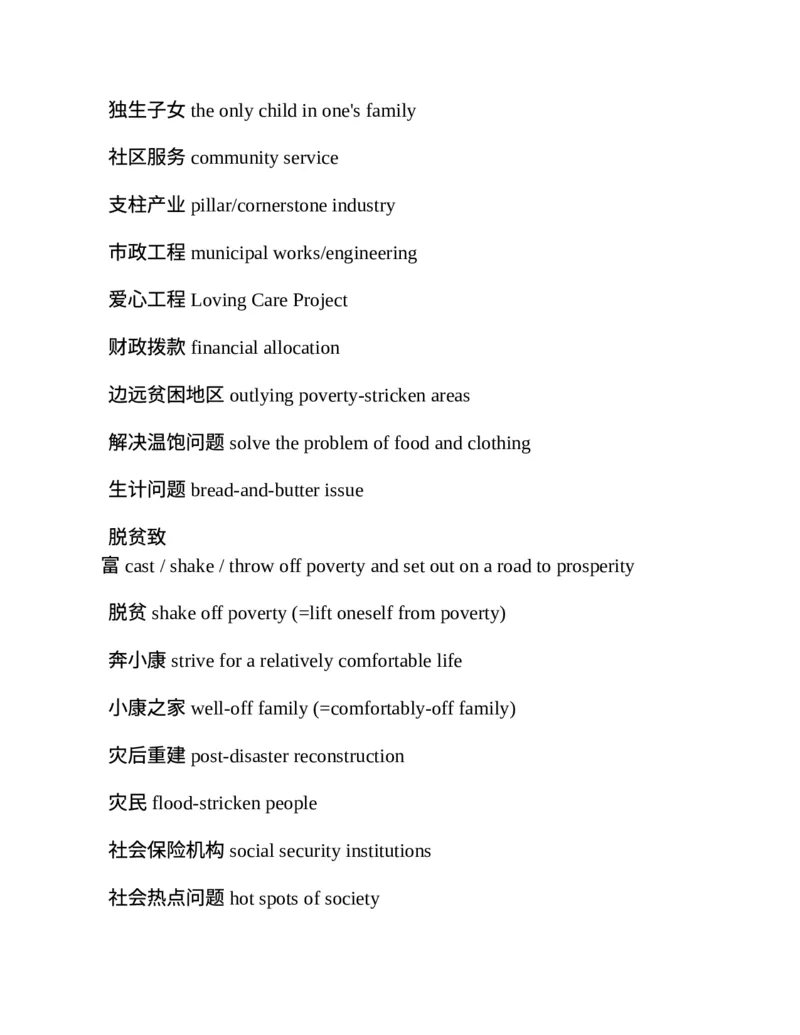
独生子女 the only child in one's family
社区服务 community service
支柱产业 pillar/cornerstone industry
市政工程 municipal works/engineering
爱心工程 Loving Care Project
财政拨款 financial allocation
边远贫困地区 outlying poverty-stricken areas
解决温饱问题 solve the problem of food and clothing
生计问题 bread-and-butter issue
脱贫致
富 cast / shake / throw off poverty and set out on a road to prosperity
脱贫 shake off poverty (=lift oneself from poverty)
奔小康 strive for a relatively comfortable life
小康之家 well-off family (=comfortably-off family)
灾后重建 post-disaster reconstruction
灾民 flood-stricken people
社会保险机构 social security institutions
社会热点问题 hot spots of society
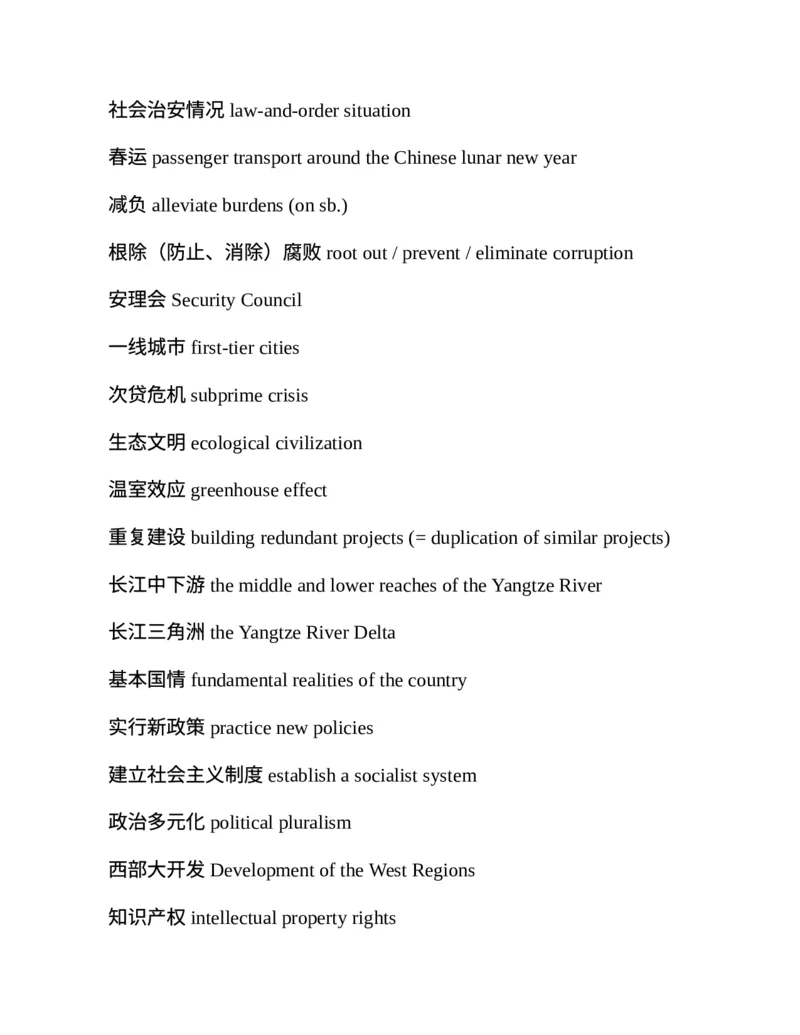
社会治安情况 law-and-order situation
春运 passenger transport around the Chinese lunar new year
减负 alleviate burdens (on sb.)
根除(防止、消除)腐败 root out / prevent / eliminate corruption
安理会 Security Council
一线城市 first-tier cities
次贷危机 subprime crisis
生态文明 ecological civilization
温室效应 greenhouse effect
重复建设 building redundant projects (= duplication of similar projects)
长江中下游 the middle and lower reaches of the Yangtze River
长江三角洲 the Yangtze River Delta
基本国情 fundamental realities of the country
实行新政策 practice new policies
建立社会主义制度 establish a socialist system
政治多元化 political pluralism
西部大开发 Development of the West Regions
知识产权 intellectual property rights
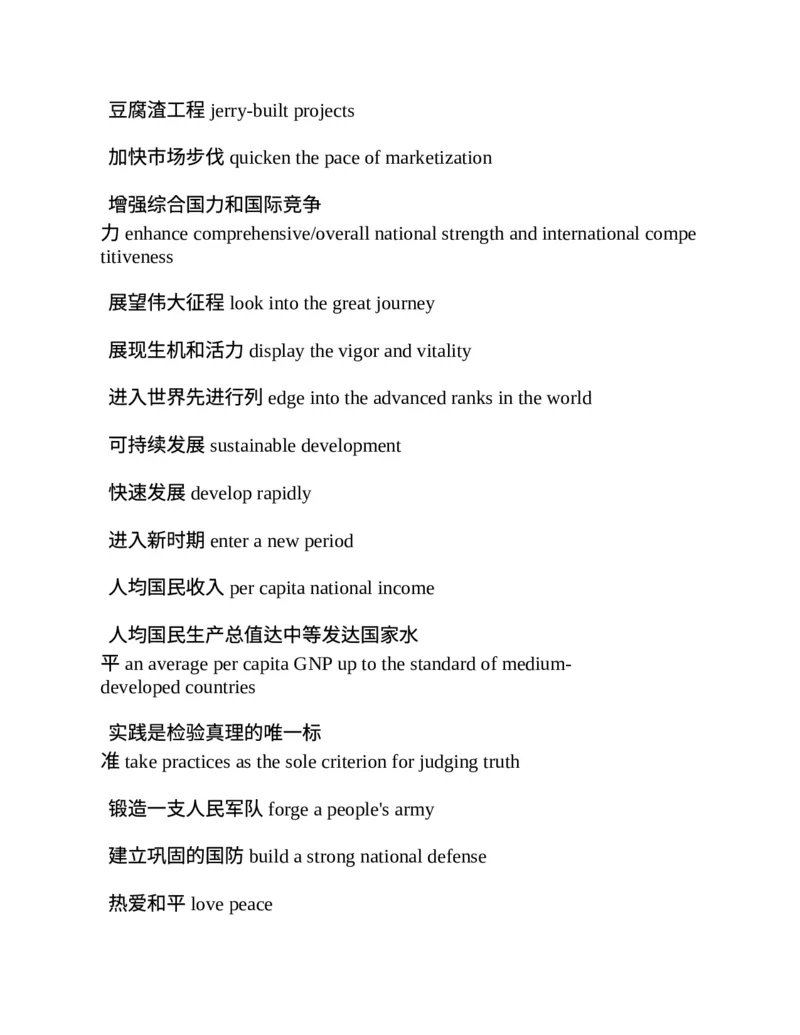
豆腐渣工程 jerry-built projects
加快市场步伐 quicken the pace of marketization
增强综合国力和国际竞争
力 enhance comprehensive/overall national strength and international compe
titiveness
展望伟大征程 look into the great journey
展现生机和活力 display the vigor and vitality
进入世界先进行列 edge into the advanced ranks in the world
可持续发展 sustainable development
快速发展 develop rapidly
进入新时期 enter a new period
人均国民收入 per capita national income
人均国民生产总值达中等发达国家水
平 an average per capita GNP up to the standard of medium-
developed countries
实践是检验真理的唯一标
准 take practices as the sole criterion for judging truth
锻造一支人民军队 forge a people's army
建立巩固的国防 build a strong national defense
热爱和平 love peace
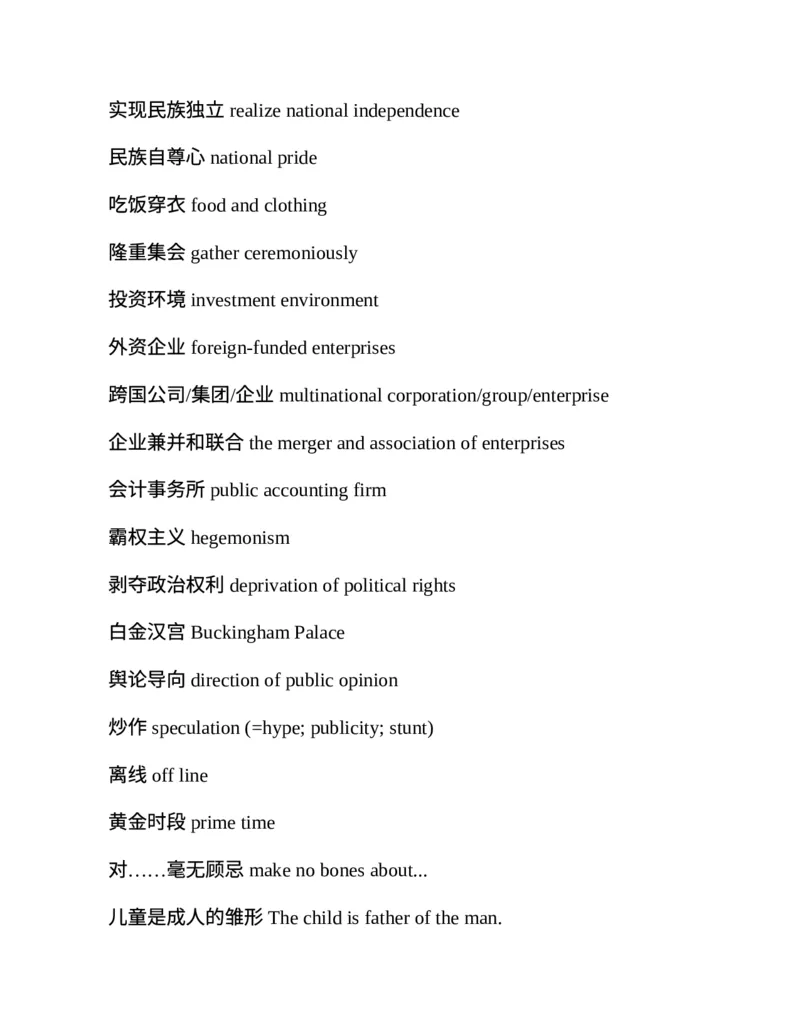
实现民族独立 realize national independence
民族自尊心 national pride
吃饭穿衣 food and clothing
隆重集会 gather ceremoniously
投资环境 investment environment
外资企业 foreign-funded enterprises
跨国公司/集团/企业 multinational corporation/group/enterprise
企业兼并和联合 the merger and association of enterprises
会计事务所 public accounting firm
霸权主义 hegemonism
剥夺政治权利 deprivation of political rights
白金汉宫 Buckingham Palace
舆论导向 direction of public opinion
炒作 speculation (=hype; publicity; stunt)
离线 off line
黄金时段 prime time
对……毫无顾忌 make no bones about...
儿童是成人的雏形 The child is father of the man.
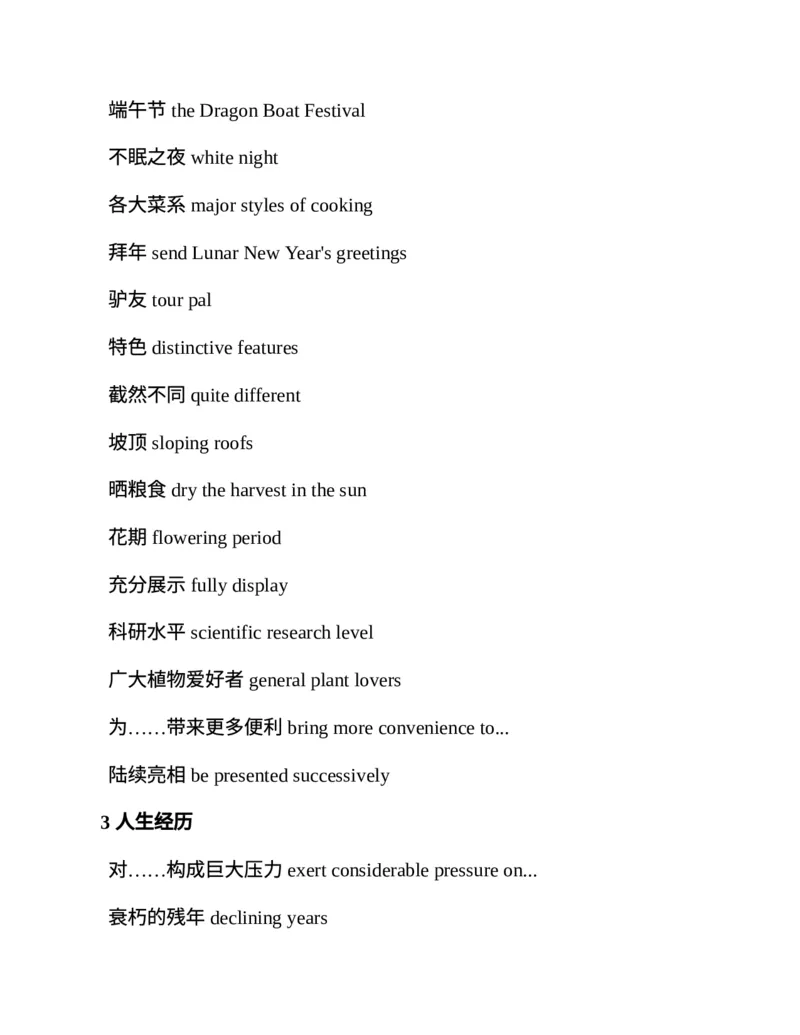
端午节 the Dragon Boat Festival
不眠之夜 white night
各大菜系 major styles of cooking
拜年 send Lunar New Year's greetings
驴友 tour pal
特色 distinctive features
截然不同 quite different
坡顶 sloping roofs
晒粮食 dry the harvest in the sun
花期 flowering period
充分展示 fully display
科研水平 scientific research level
广大植物爱好者 general plant lovers
为……带来更多便利 bring more convenience to...
陆续亮相 be presented successively
3 人生经历
对……构成巨大压力 exert considerable pressure on...
衰朽的残年 declining years
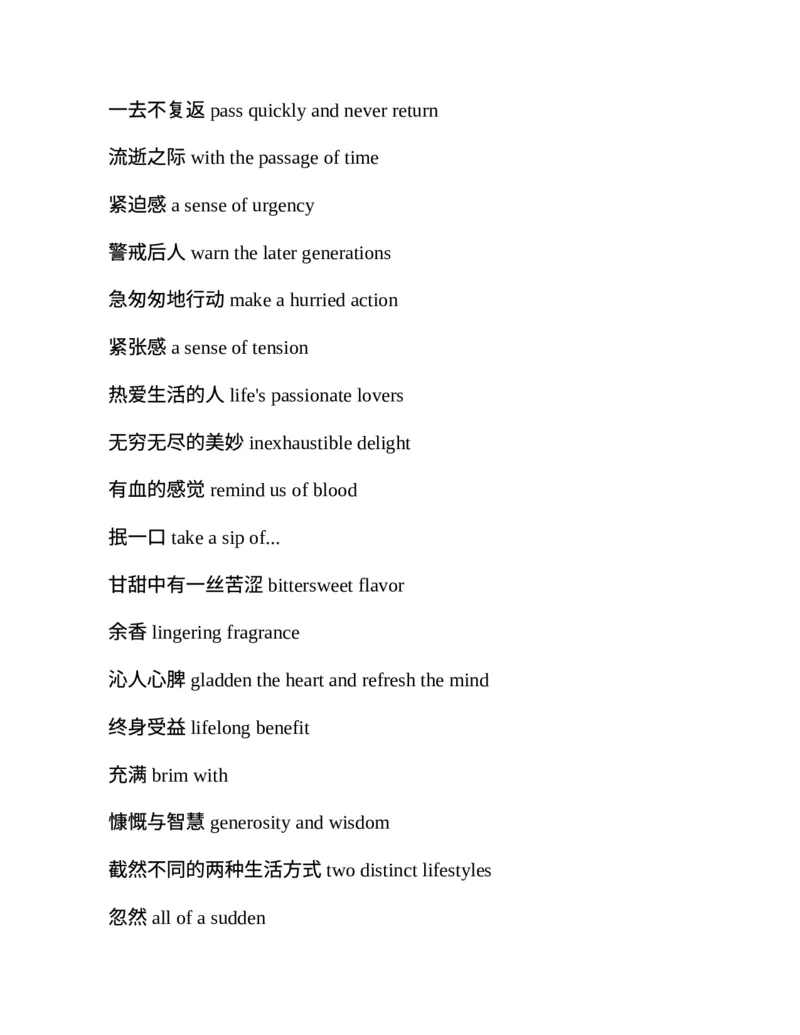
一去不复返 pass quickly and never return
流逝之际 with the passage of time
紧迫感 a sense of urgency
警戒后人 warn the later generations
急匆匆地行动 make a hurried action
紧张感 a sense of tension
热爱生活的人 life's passionate lovers
无穷无尽的美妙 inexhaustible delight
有血的感觉 remind us of blood
抿一口 take a sip of...
甘甜中有一丝苦涩 bittersweet flavor
余香 lingering fragrance
沁人心脾 gladden the heart and refresh the mind
终身受益 lifelong benefit
充满 brim with
慷慨与智慧 generosity and wisdom
截然不同的两种生活方式 two distinct lifestyles
忽然 all of a sudden
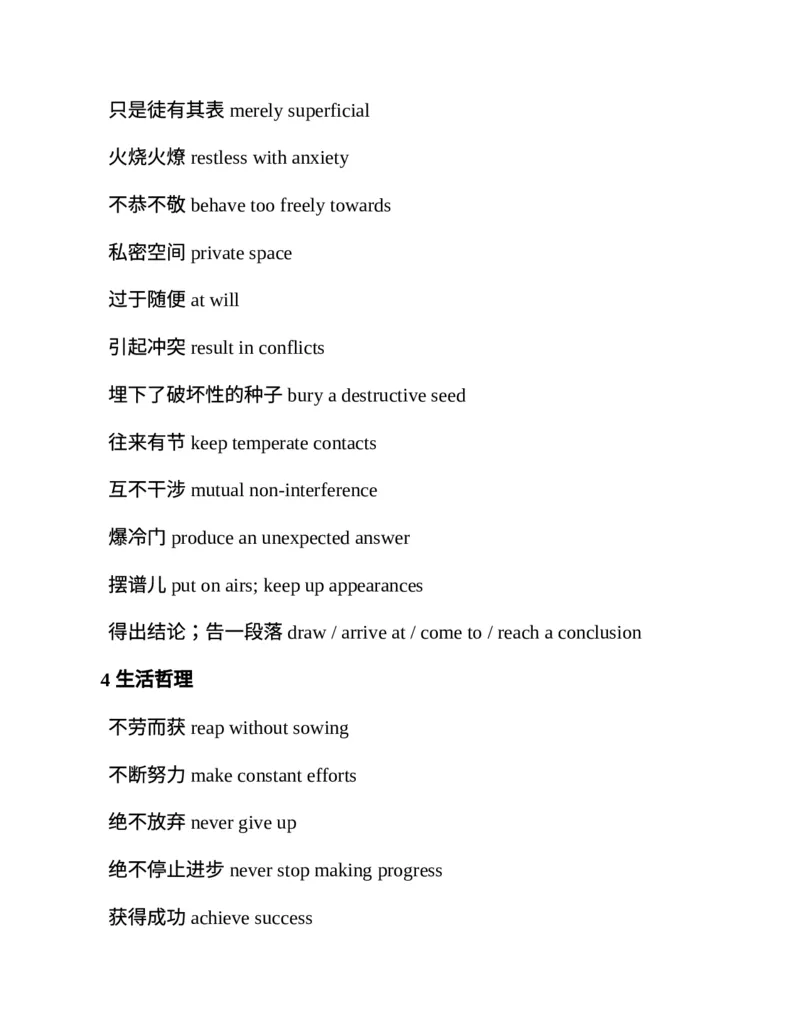
只是徒有其表 merely superficial
火烧火燎 restless with anxiety
不恭不敬 behave too freely towards
私密空间 private space
过于随便 at will
引起冲突 result in conflicts
埋下了破坏性的种子 bury a destructive seed
往来有节 keep temperate contacts
互不干涉 mutual non-interference
爆冷门 produce an unexpected answer
摆谱儿 put on airs; keep up appearances
得出结论;告一段落 draw / arrive at / come to / reach a conclusion
4 生活哲理
不劳而获 reap without sowing
不断努力 make constant efforts
绝不放弃 never give up
绝不停止进步 never stop making progress
获得成功 achieve success
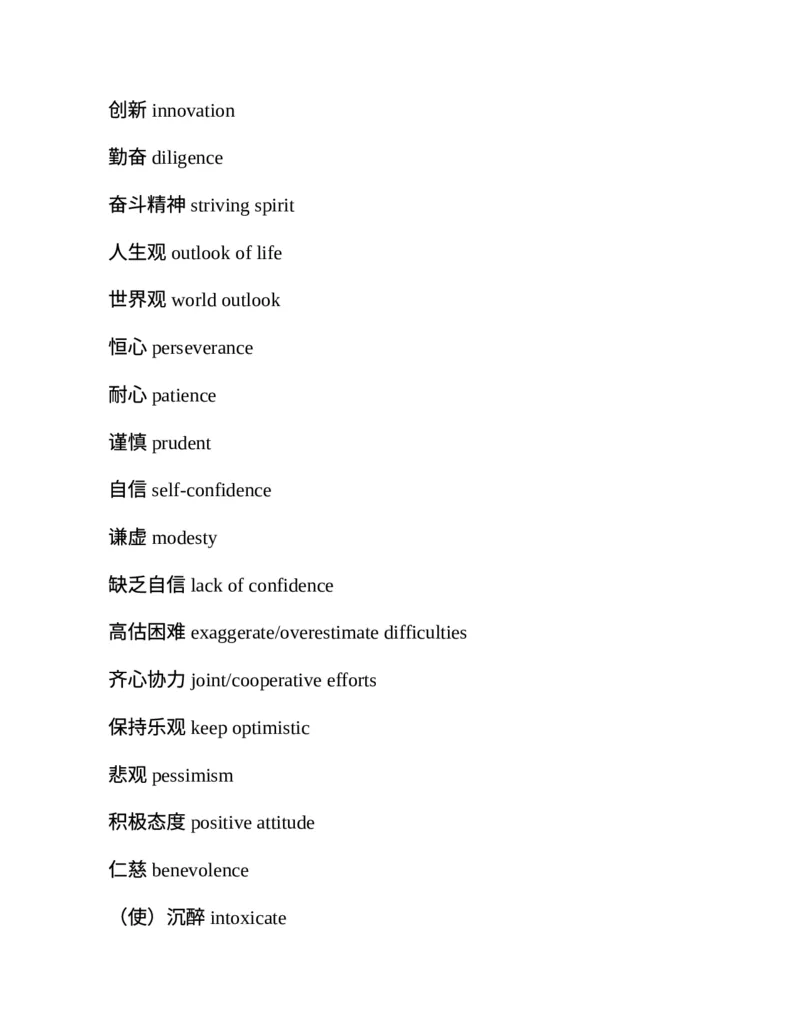
创新 innovation
勤奋 diligence
奋斗精神 striving spirit
人生观 outlook of life
世界观 world outlook
恒心 perseverance
耐心 patience
谨慎 prudent
自信 self-confidence
谦虚 modesty
缺乏自信 lack of confidence
高估困难 exaggerate/overestimate difficulties
齐心协力 joint/cooperative efforts
保持乐观 keep optimistic
悲观 pessimism
积极态度 positive attitude
仁慈 benevolence
(使)沉醉 intoxicate
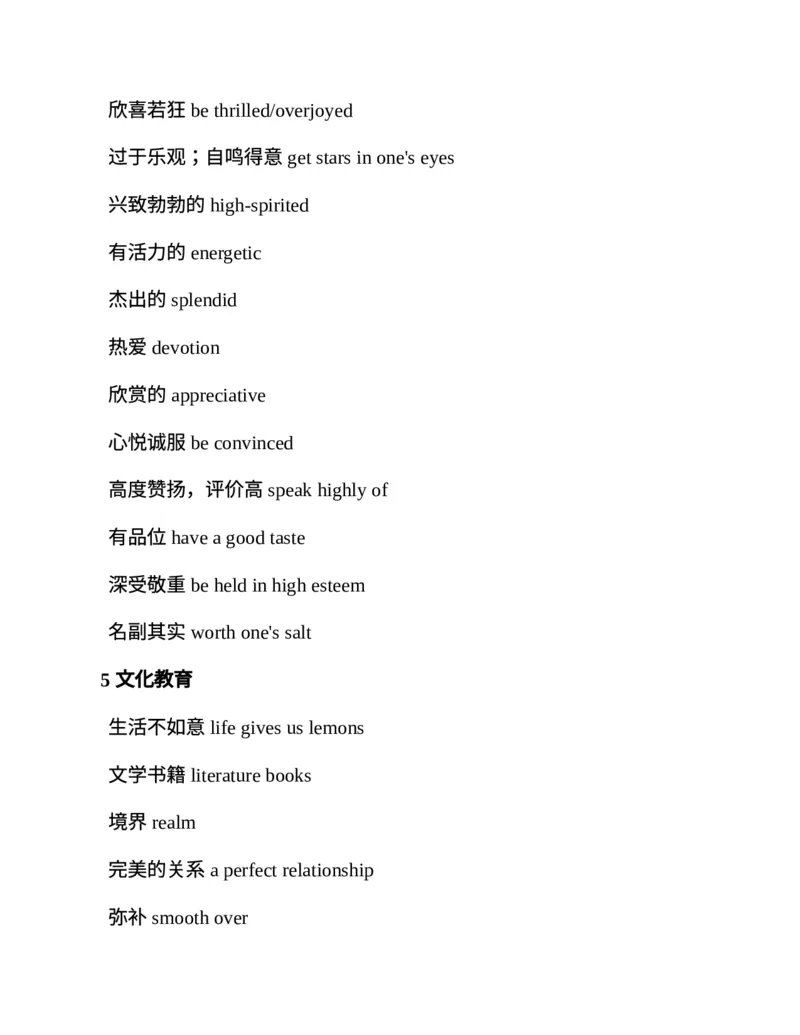
欣喜若狂 be thrilled/overjoyed
过于乐观;自鸣得意 get stars in one's eyes
兴致勃勃的 high-spirited
有活力的 energetic
杰出的 splendid
热爱 devotion
欣赏的 appreciative
心悦诚服 be convinced
高度赞扬,评价高 speak highly of
有品位 have a good taste
深受敬重 be held in high esteem
名副其实 worth one's salt
5 文化教育
生活不如意 life gives us lemons
文学书籍 literature books
境界 realm
完美的关系 a perfect relationship
弥补 smooth over
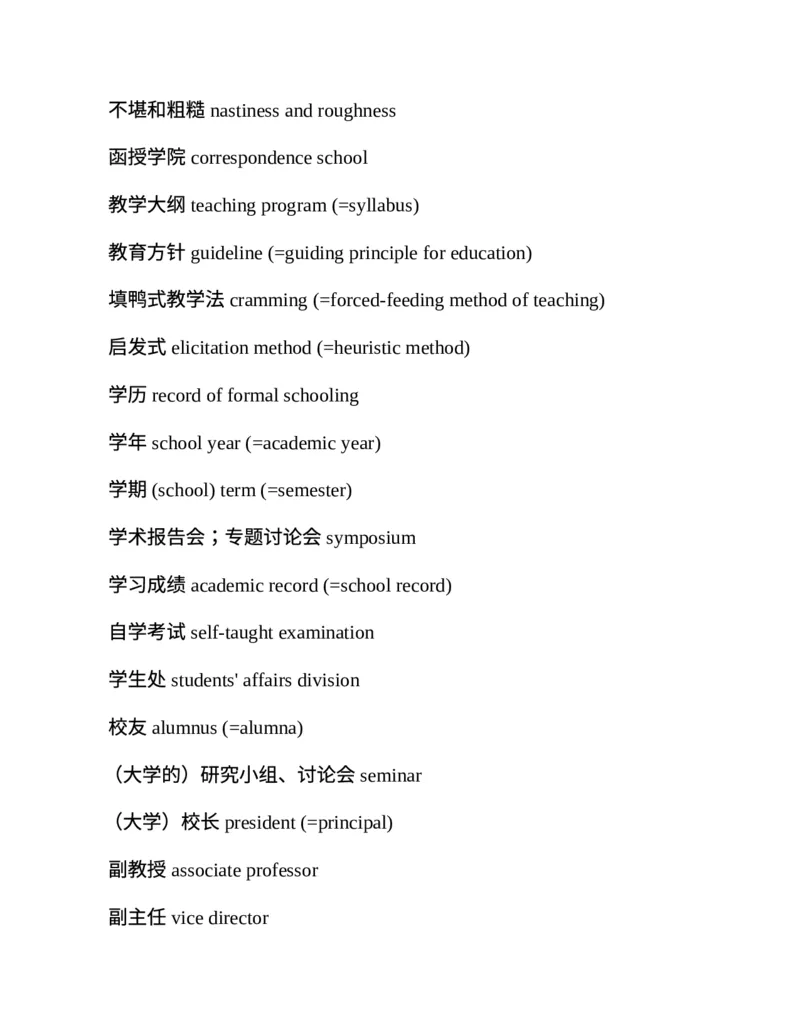
不堪和粗糙 nastiness and roughness
函授学院 correspondence school
教学大纲 teaching program (=syllabus)
教育方针 guideline (=guiding principle for education)
填鸭式教学法 cramming (=forced-feeding method of teaching)
启发式 elicitation method (=heuristic method)
学历 record of formal schooling
学年 school year (=academic year)
学期 (school) term (=semester)
学术报告会;专题讨论会 symposium
学习成绩 academic record (=school record)
自学考试 self-taught examination
学生处 students' affairs division
校友 alumnus (=alumna)
(大学的)研究小组、讨论会 seminar
(大学)校长 president (=principal)
副教授 associate professor
副主任 vice director
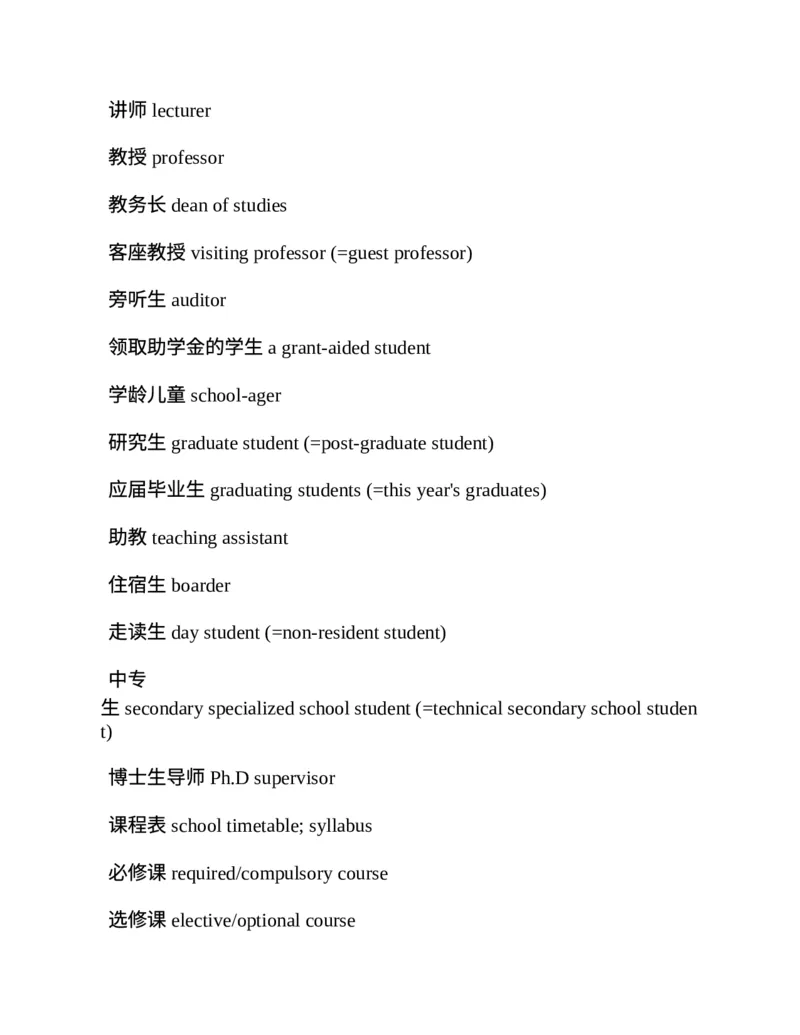
讲师 lecturer
教授 professor
教务长 dean of studies
客座教授 visiting professor (=guest professor)
旁听生 auditor
领取助学金的学生 a grant-aided student
学龄儿童 school-ager
研究生 graduate student (=post-graduate student)
应届毕业生 graduating students (=this year's graduates)
助教 teaching assistant
住宿生 boarder
走读生 day student (=non-resident student)
中专
生 secondary specialized school student (=technical secondary school studen
t)
博士生导师 Ph.D supervisor
课程表 school timetable; syllabus
必修课 required/compulsory course
选修课 elective/optional course
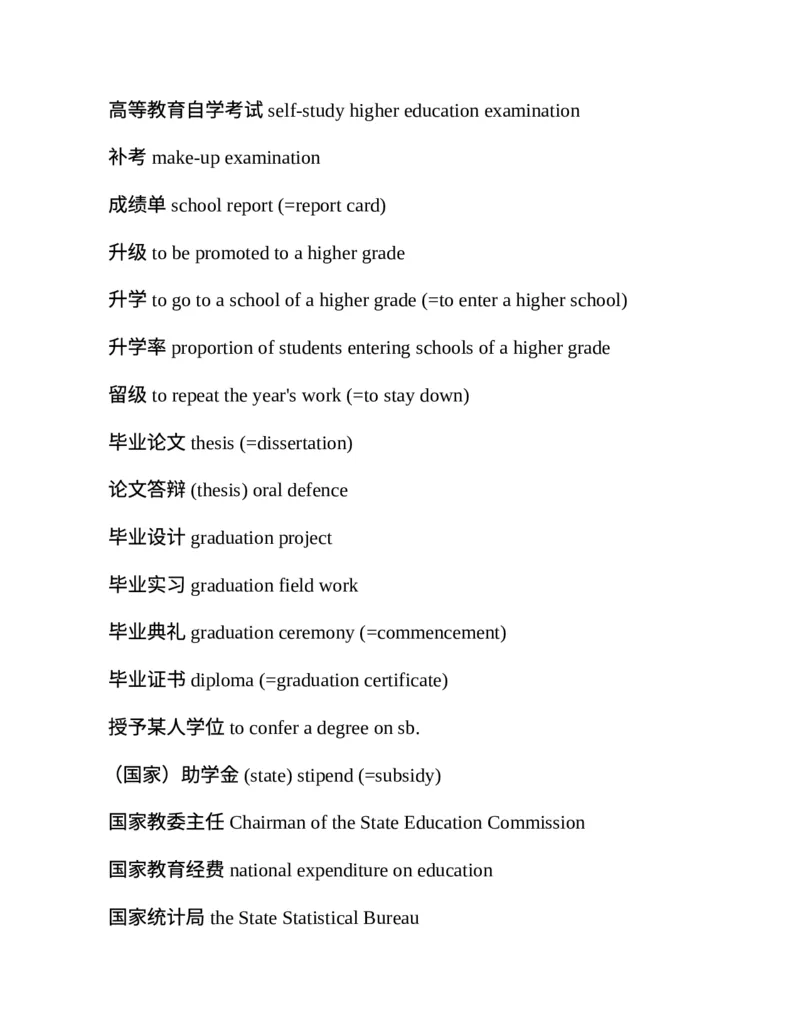
高等教育自学考试 self-study higher education examination
补考 make-up examination
成绩单 school report (=report card)
升级 to be promoted to a higher grade
升学 to go to a school of a higher grade (=to enter a higher school)
升学率 proportion of students entering schools of a higher grade
留级 to repeat the year's work (=to stay down)
毕业论文 thesis (=dissertation)
论文答辩 (thesis) oral defence
毕业设计 graduation project
毕业实习 graduation field work
毕业典礼 graduation ceremony (=commencement)
毕业证书 diploma (=graduation certificate)
授予某人学位 to confer a degree on sb.
(国家)助学金 (state) stipend (=subsidy)
国家教委主任 Chairman of the State Education Commission
国家教育经费 national expenditure on education
国家统计局 the State Statistical Bureau
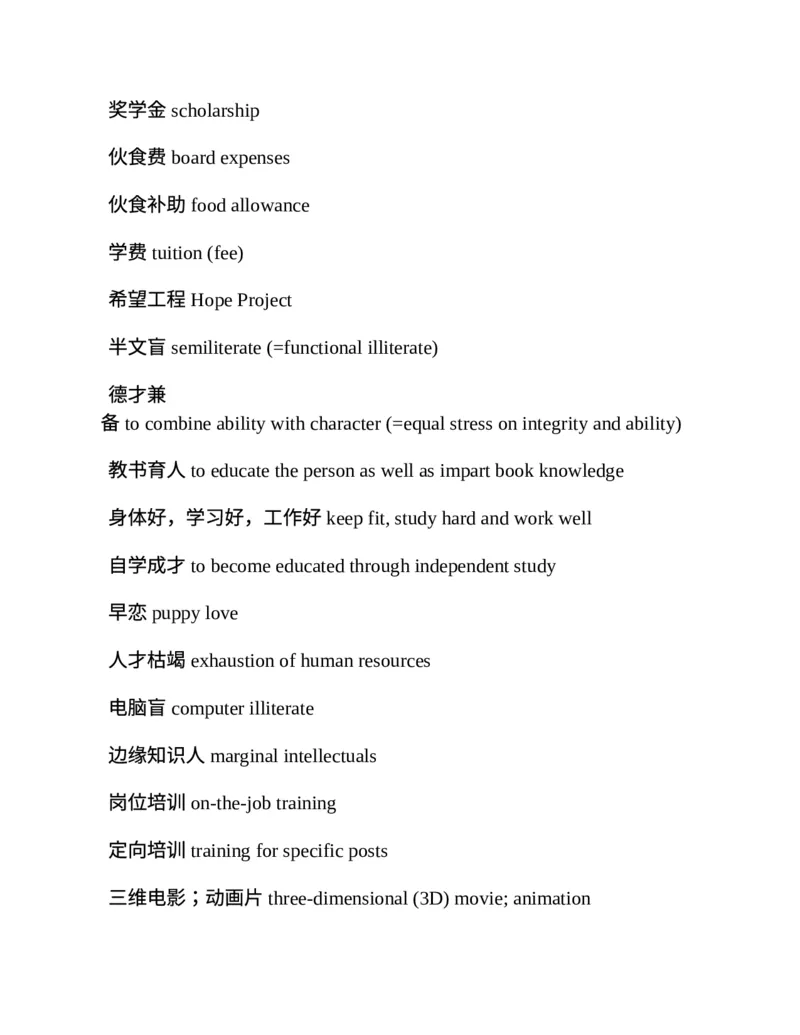
奖学金 scholarship
伙食费 board expenses
伙食补助 food allowance
学费 tuition (fee)
希望工程 Hope Project
半文盲 semiliterate (=functional illiterate)
德才兼
备 to combine ability with character (=equal stress on integrity and ability)
教书育人 to educate the person as well as impart book knowledge
身体好,学习好,工作好 keep fit, study hard and work well
自学成才 to become educated through independent study
早恋 puppy love
人才枯竭 exhaustion of human resources
电脑盲 computer illiterate
边缘知识人 marginal intellectuals
岗位培训 on-the-job training
定向培训 training for specific posts
三维电影;动画片 three-dimensional (3D) movie; animation
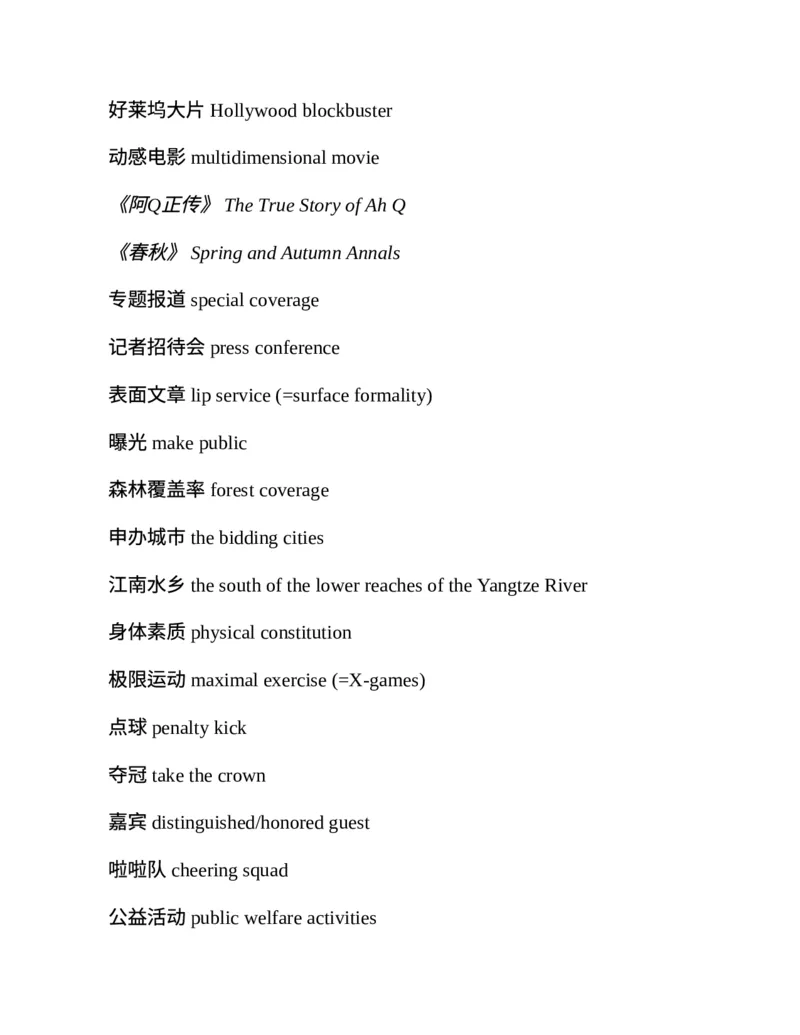
好莱坞大片 Hollywood blockbuster
动感电影 multidimensional movie
《阿Q正传》 The True Story of Ah Q
《春秋》 Spring and Autumn Annals
专题报道 special coverage
记者招待会 press conference
表面文章 lip service (=surface formality)
曝光 make public
森林覆盖率 forest coverage
申办城市 the bidding cities
江南水乡 the south of the lower reaches of the Yangtze River
身体素质 physical constitution
极限运动 maximal exercise (=X-games)
点球 penalty kick
夺冠 take the crown
嘉宾 distinguished/honored guest
啦啦队 cheering squad
公益活动 public welfare activities
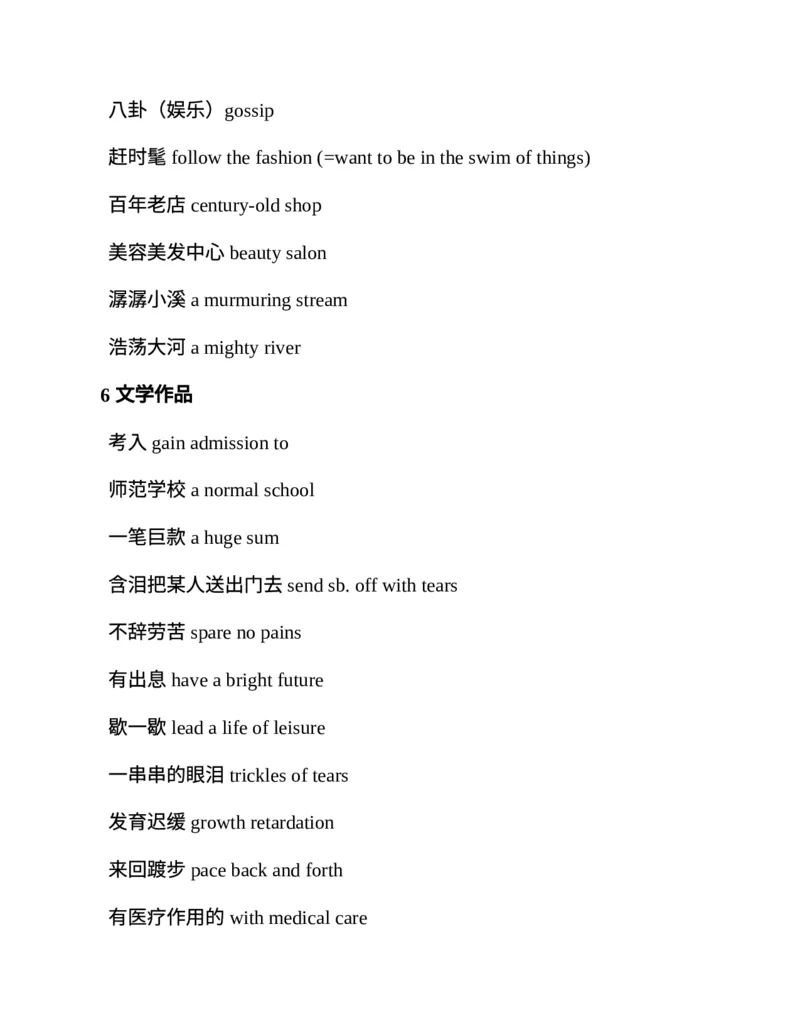
八卦(娱乐)gossip
赶时髦 follow the fashion (=want to be in the swim of things)
百年老店 century-old shop
美容美发中心 beauty salon
潺潺小溪 a murmuring stream
浩荡大河 a mighty river
6 文学作品
考入 gain admission to
师范学校 a normal school
一笔巨款 a huge sum
含泪把某人送出门去 send sb. off with tears
不辞劳苦 spare no pains
有出息 have a bright future
歇一歇 lead a life of leisure
一串串的眼泪 trickles of tears
发育迟缓 growth retardation
来回踱步 pace back and forth
有医疗作用的 with medical care
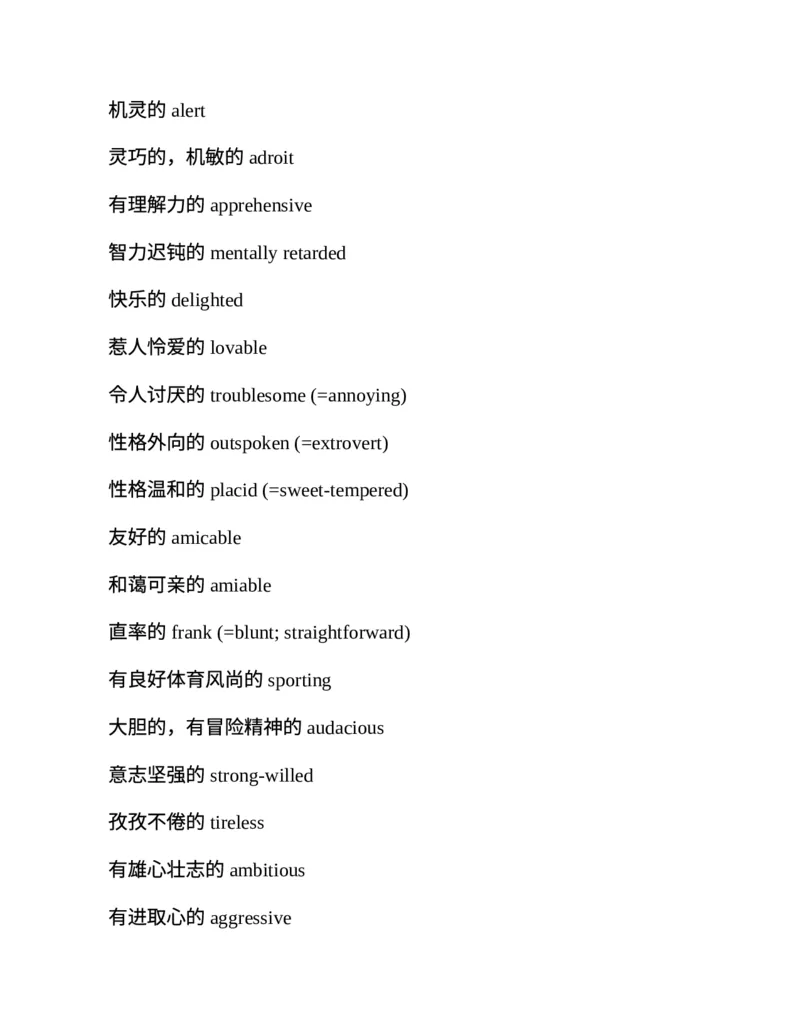
机灵的 alert
灵巧的,机敏的 adroit
有理解力的 apprehensive
智力迟钝的 mentally retarded
快乐的 delighted
惹人怜爱的 lovable
令人讨厌的 troublesome (=annoying)
性格外向的 outspoken (=extrovert)
性格温和的 placid (=sweet-tempered)
友好的 amicable
和蔼可亲的 amiable
直率的 frank (=blunt; straightforward)
有良好体育风尚的 sporting
大胆的,有冒险精神的 audacious
意志坚强的 strong-willed
孜孜不倦的 tireless
有雄心壮志的 ambitious
有进取心的 aggressive
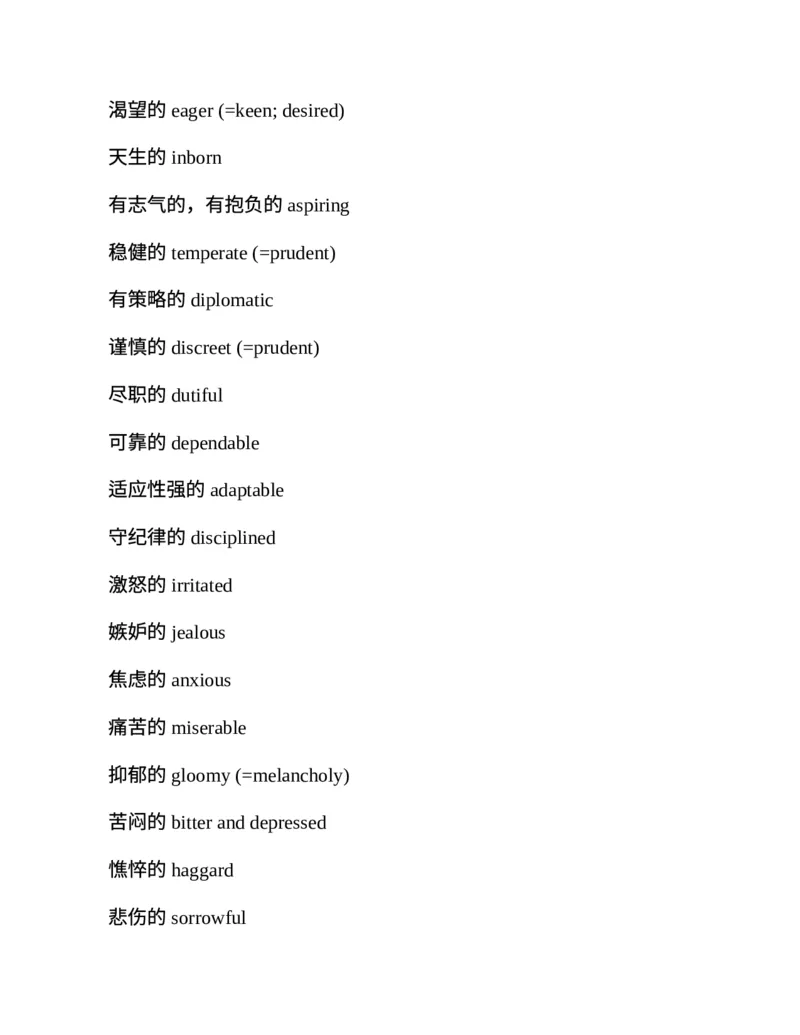
渴望的 eager (=keen; desired)
天生的 inborn
有志气的,有抱负的 aspiring
稳健的 temperate (=prudent)
有策略的 diplomatic
谨慎的 discreet (=prudent)
尽职的 dutiful
可靠的 dependable
适应性强的 adaptable
守纪律的 disciplined
激怒的 irritated
嫉妒的 jealous
焦虑的 anxious
痛苦的 miserable
抑郁的 gloomy (=melancholy)
苦闷的 bitter and depressed
憔悴的 haggard
悲伤的 sorrowful
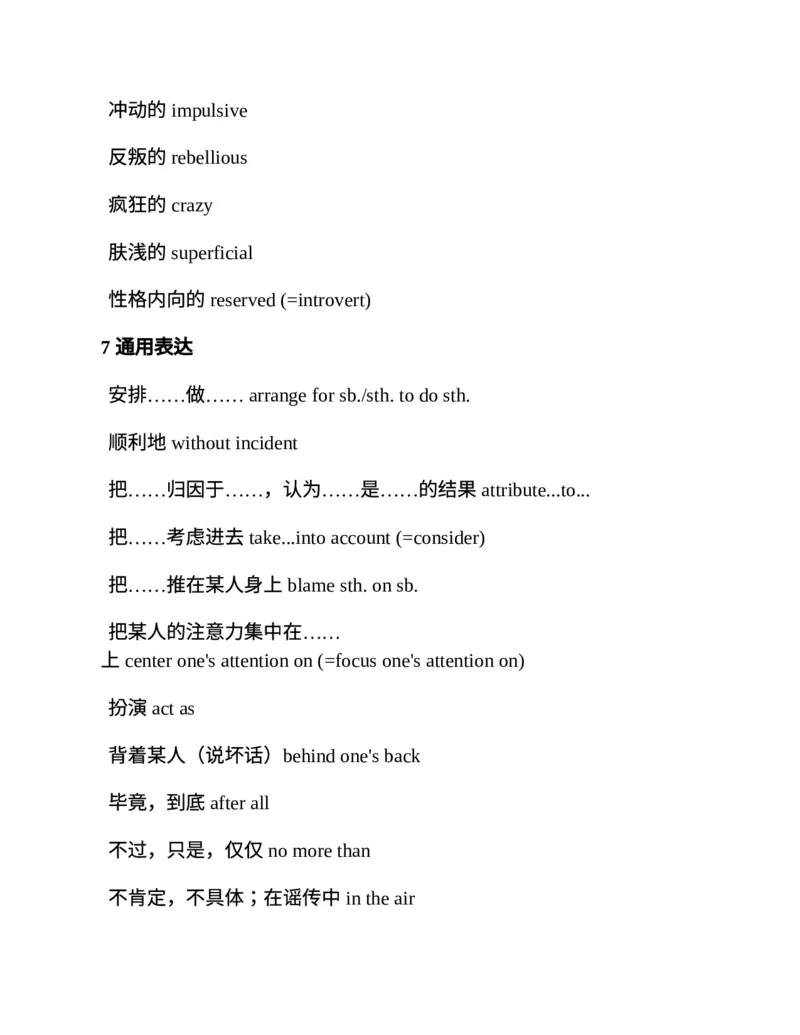
冲动的 impulsive
反叛的 rebellious
疯狂的 crazy
肤浅的 superficial
性格内向的 reserved (=introvert)
7 通用表达
安排……做…… arrange for sb./sth. to do sth.
顺利地 without incident
把……归因于……,认为……是……的结果 attribute...to...
把……考虑进去 take...into account (=consider)
把……推在某人身上 blame sth. on sb.
把某人的注意力集中在……
上 center one's attention on (=focus one's attention on)
扮演 act as
背着某人(说坏话)behind one's back
毕竟,到底 after all
不过,只是,仅仅 no more than
不肯定,不具体;在谣传中 in the air
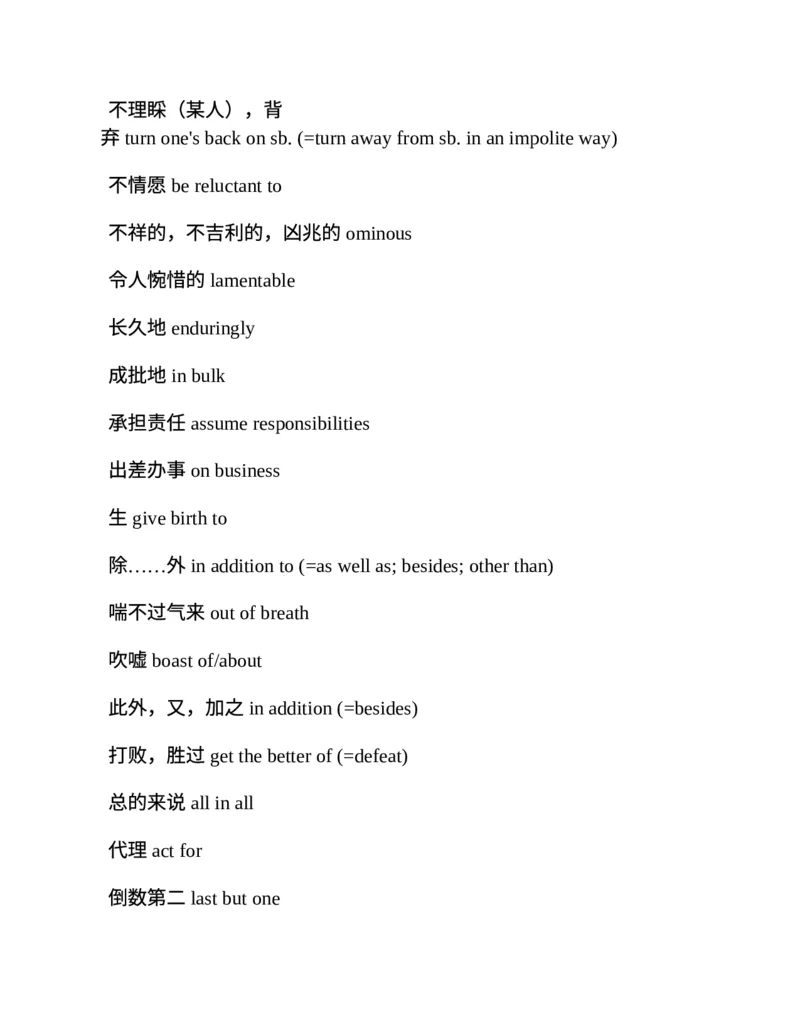
不理睬(某人),背
弃 turn one's back on sb. (=turn away from sb. in an impolite way)
不情愿 be reluctant to
不祥的,不吉利的,凶兆的 ominous
令人惋惜的 lamentable
长久地 enduringly
成批地 in bulk
承担责任 assume responsibilities
出差办事 on business
生 give birth to
除……外 in addition to (=as well as; besides; other than)
喘不过气来 out of breath
吹嘘 boast of/about
此外,又,加之 in addition (=besides)
打败,胜过 get the better of (=defeat)
总的来说 all in all
代理 act for
倒数第二 last but one
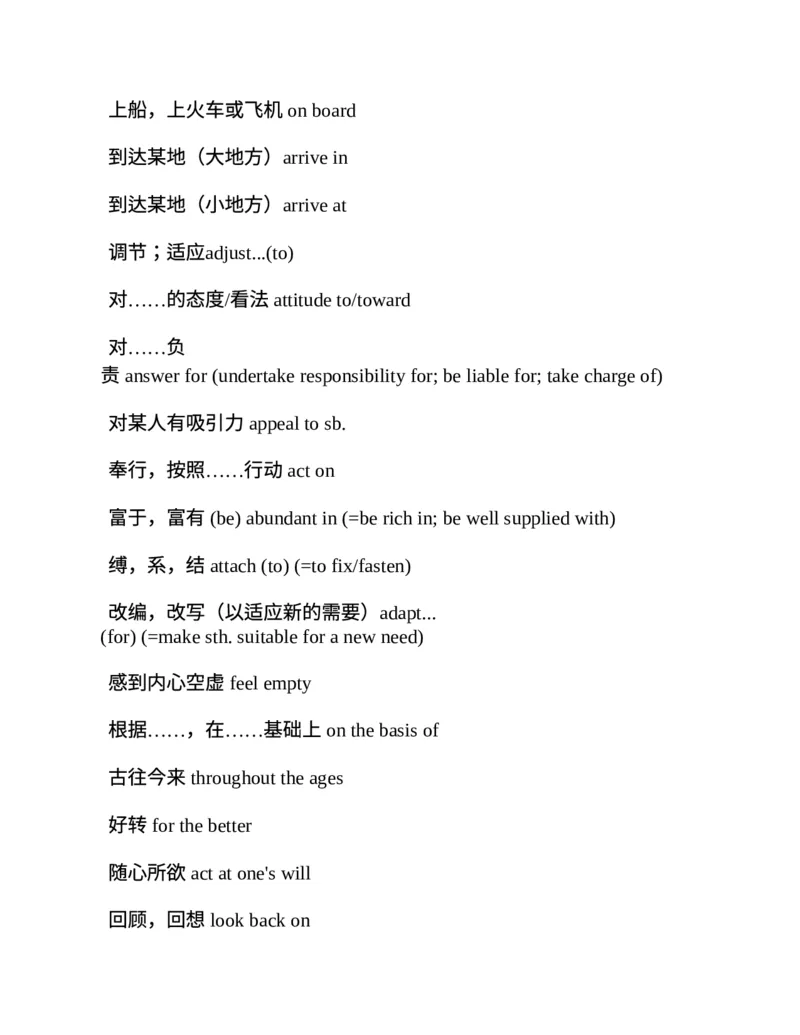
上船,上火车或飞机 on board
到达某地(大地方)arrive in
到达某地(小地方)arrive at
调节;适应adjust...(to)
对……的态度/看法 attitude to/toward
对……负
责 answer for (undertake responsibility for; be liable for; take charge of)
对某人有吸引力 appeal to sb.
奉行,按照……行动 act on
富于,富有 (be) abundant in (=be rich in; be well supplied with)
缚,系,结 attach (to) (=to fix/fasten)
改编,改写(以适应新的需要)adapt...
(for) (=make sth. suitable for a new need)
感到内心空虚 feel empty
根据……,在……基础上 on the basis of
古往今来 throughout the ages
好转 for the better
随心所欲 act at one's will
回顾,回想 look back on
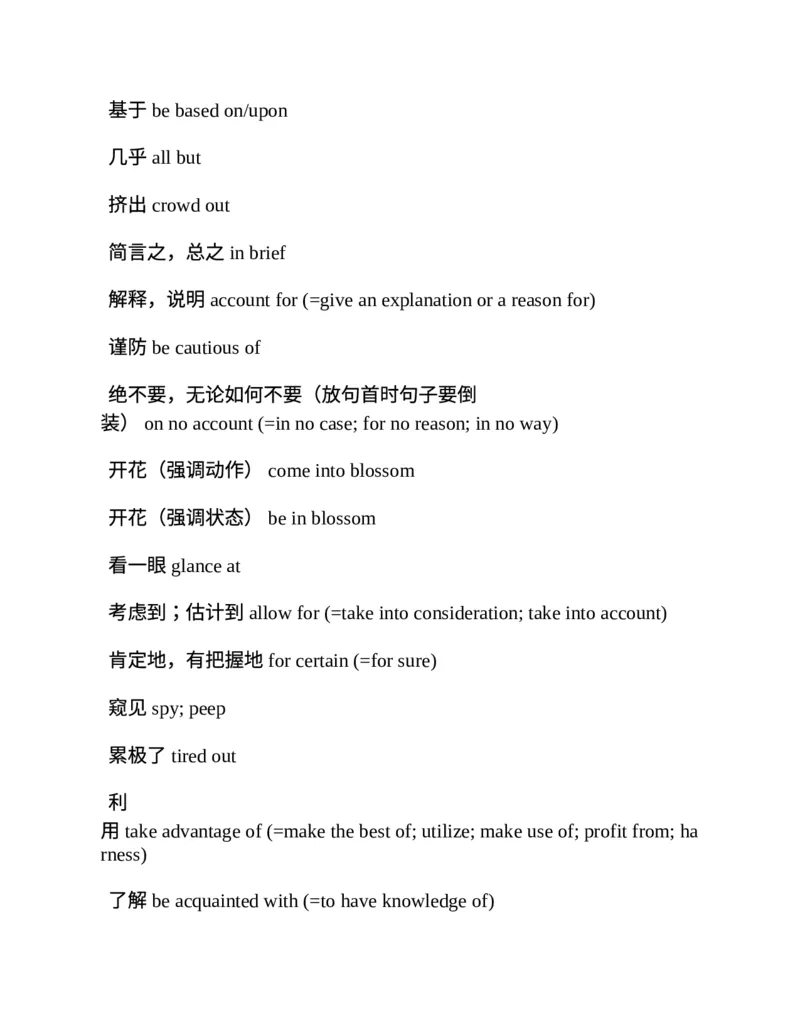
基于 be based on/upon
几乎 all but
挤出 crowd out
简言之,总之 in brief
解释,说明 account for (=give an explanation or a reason for)
谨防 be cautious of
绝不要,无论如何不要(放句首时句子要倒
装) on no account (=in no case; for no reason; in no way)
开花(强调动作) come into blossom
开花(强调状态) be in blossom
看一眼 glance at
考虑到;估计到 allow for (=take into consideration; take into account)
肯定地,有把握地 for certain (=for sure)
窥见 spy; peep
累极了 tired out
利
用 take advantage of (=make the best of; utilize; make use of; profit from; ha
rness)
了解 be acquainted with (=to have knowledge of)
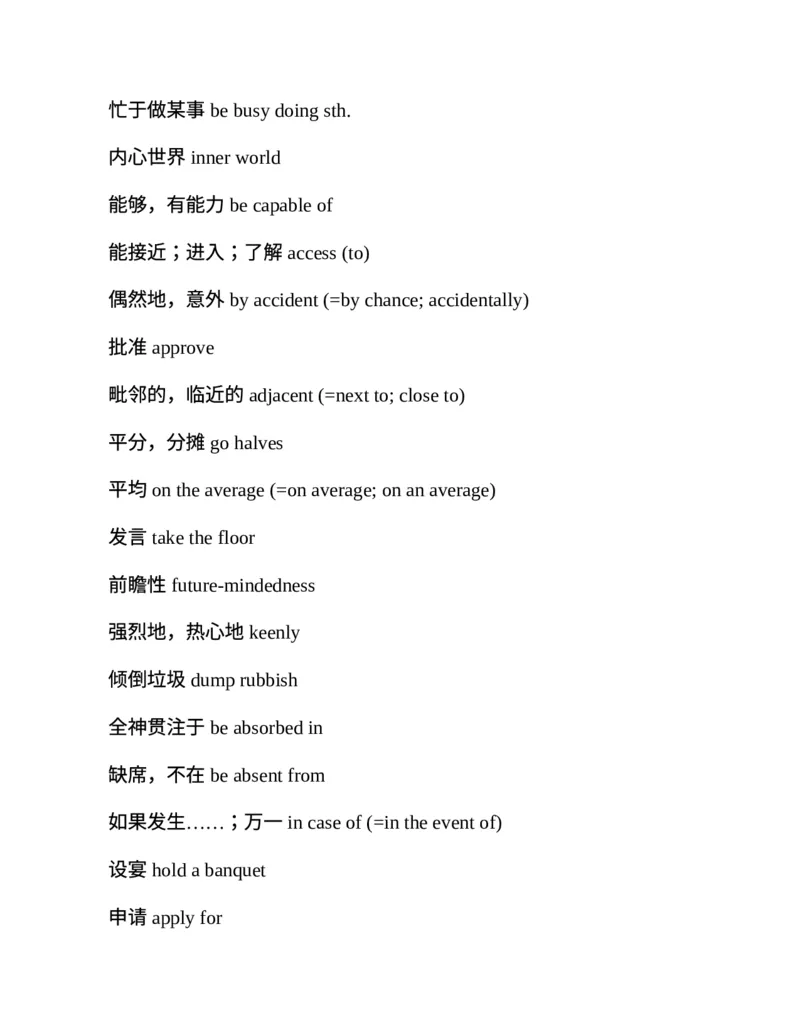
忙于做某事 be busy doing sth.
内心世界 inner world
能够,有能力 be capable of
能接近;进入;了解 access (to)
偶然地,意外 by accident (=by chance; accidentally)
批准 approve
毗邻的,临近的 adjacent (=next to; close to)
平分,分摊 go halves
平均 on the average (=on average; on an average)
发言 take the floor
前瞻性 future-mindedness
强烈地,热心地 keenly
倾倒垃圾 dump rubbish
全神贯注于 be absorbed in
缺席,不在 be absent from
如果发生……;万一 in case of (=in the event of)
设宴 hold a banquet
申请 apply for
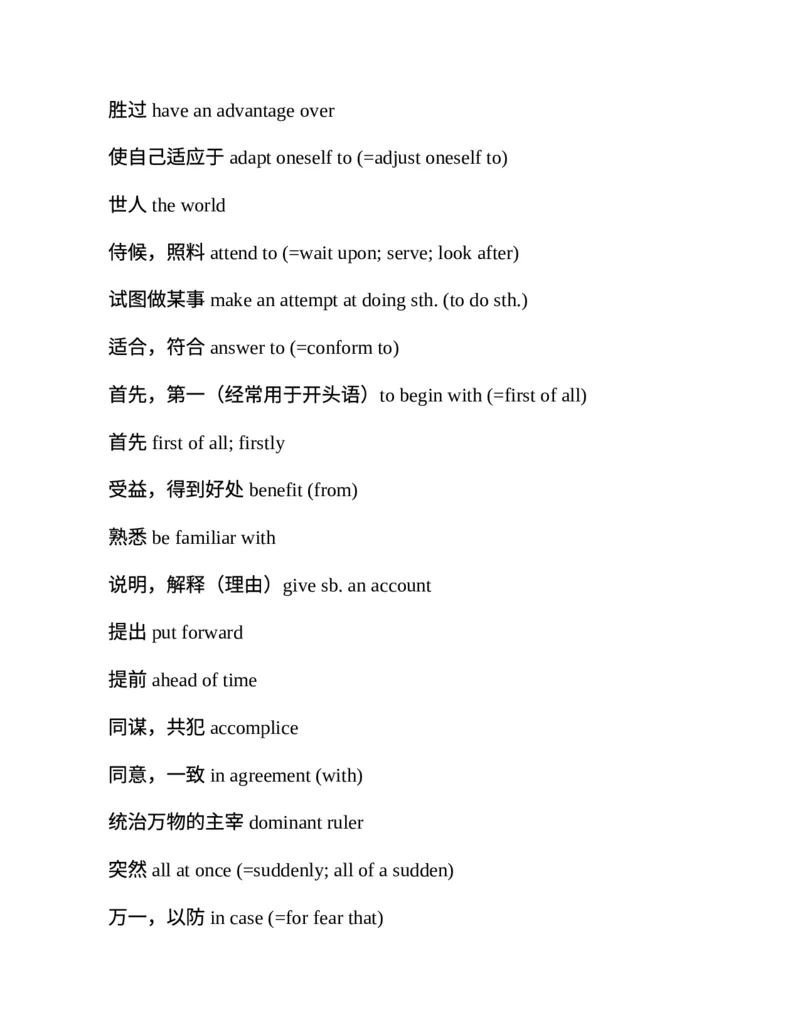
胜过 have an advantage over
使自己适应于 adapt oneself to (=adjust oneself to)
世人 the world
侍候,照料 attend to (=wait upon; serve; look after)
试图做某事 make an attempt at doing sth. (to do sth.)
适合,符合 answer to (=conform to)
首先,第一(经常用于开头语)to begin with (=first of all)
首先 first of all; firstly
受益,得到好处 benefit (from)
熟悉 be familiar with
说明,解释(理由)give sb. an account
提出 put forward
提前 ahead of time
同谋,共犯 accomplice
同意,一致 in agreement (with)
统治万物的主宰 dominant ruler
突然 all at once (=suddenly; all of a sudden)
万一,以防 in case (=for fear that)
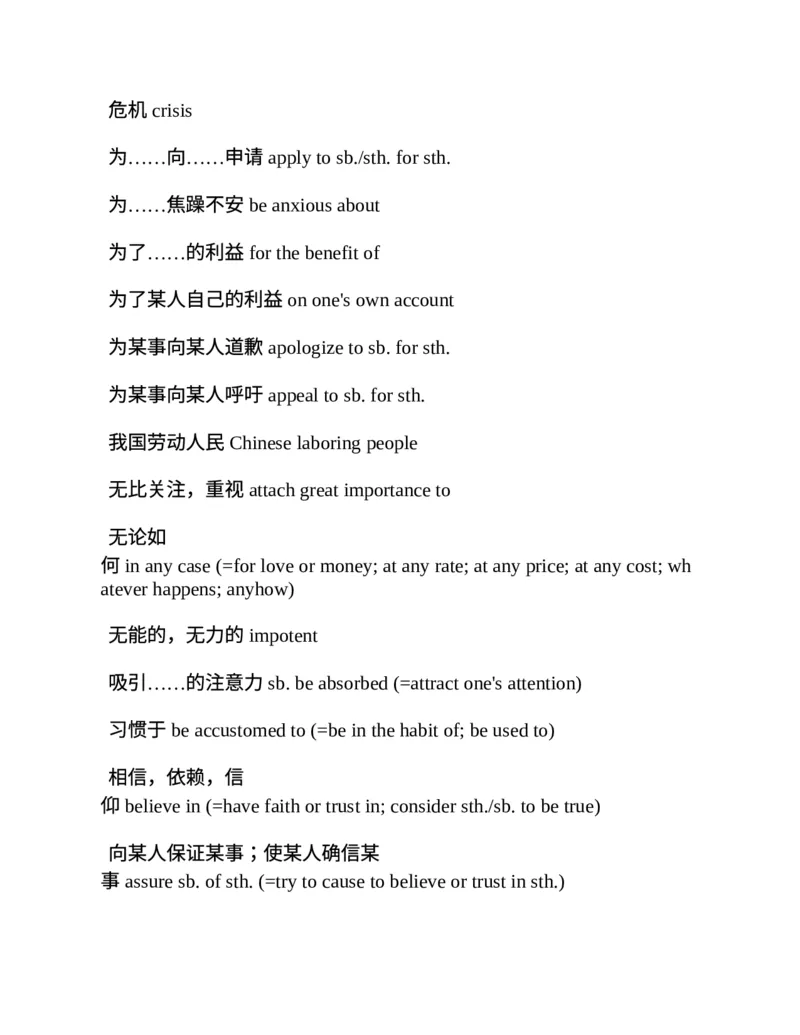
危机 crisis
为……向……申请 apply to sb./sth. for sth.
为……焦躁不安 be anxious about
为了……的利益 for the benefit of
为了某人自己的利益 on one's own account
为某事向某人道歉 apologize to sb. for sth.
为某事向某人呼吁 appeal to sb. for sth.
我国劳动人民 Chinese laboring people
无比关注,重视 attach great importance to
无论如
何 in any case (=for love or money; at any rate; at any price; at any cost; wh
atever happens; anyhow)
无能的,无力的 impotent
吸引……的注意力 sb. be absorbed (=attract one's attention)
习惯于 be accustomed to (=be in the habit of; be used to)
相信,依赖,信
仰 believe in (=have faith or trust in; consider sth./sb. to be true)
向某人保证某事;使某人确信某
事 assure sb. of sth. (=try to cause to believe or trust in sth.)
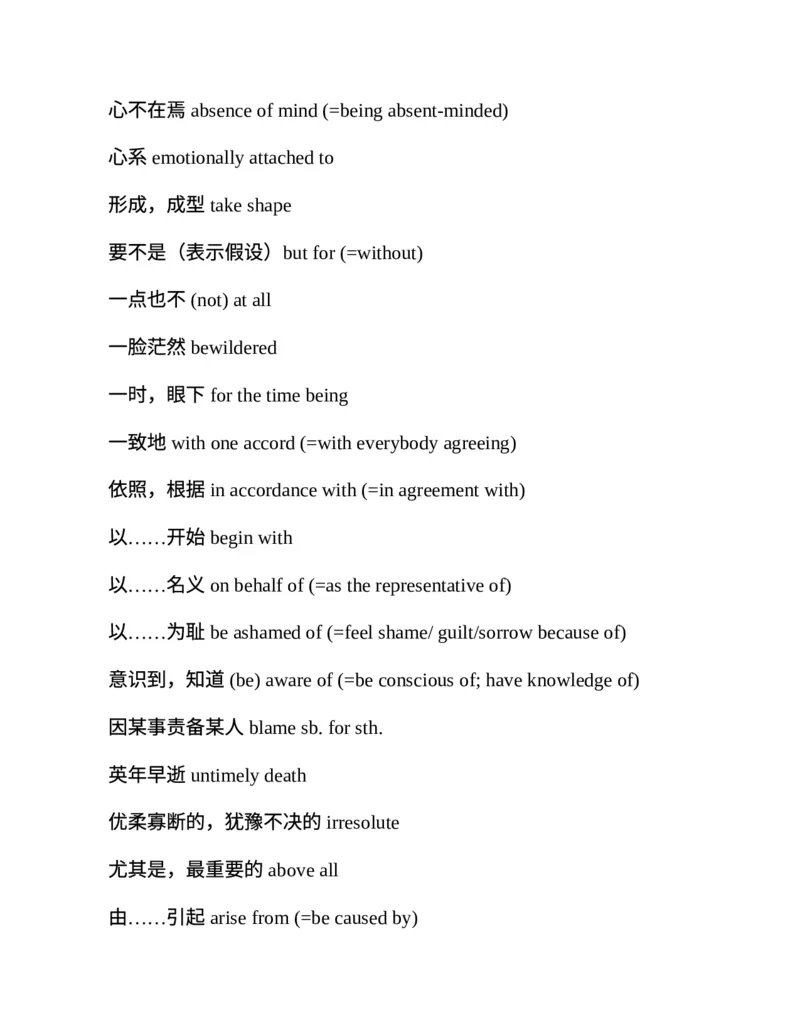
心不在焉 absence of mind (=being absent-minded)
心系 emotionally attached to
形成,成型 take shape
要不是(表示假设)but for (=without)
一点也不 (not) at all
一脸茫然 bewildered
一时,眼下 for the time being
一致地 with one accord (=with everybody agreeing)
依照,根据 in accordance with (=in agreement with)
以……开始 begin with
以……名义 on behalf of (=as the representative of)
以……为耻 be ashamed of (=feel shame/ guilt/sorrow because of)
意识到,知道 (be) aware of (=be conscious of; have knowledge of)
因某事责备某人 blame sb. for sth.
英年早逝 untimely death
优柔寡断的,犹豫不决的 irresolute
尤其是,最重要的 above all
由……引起 arise from (=be caused by)
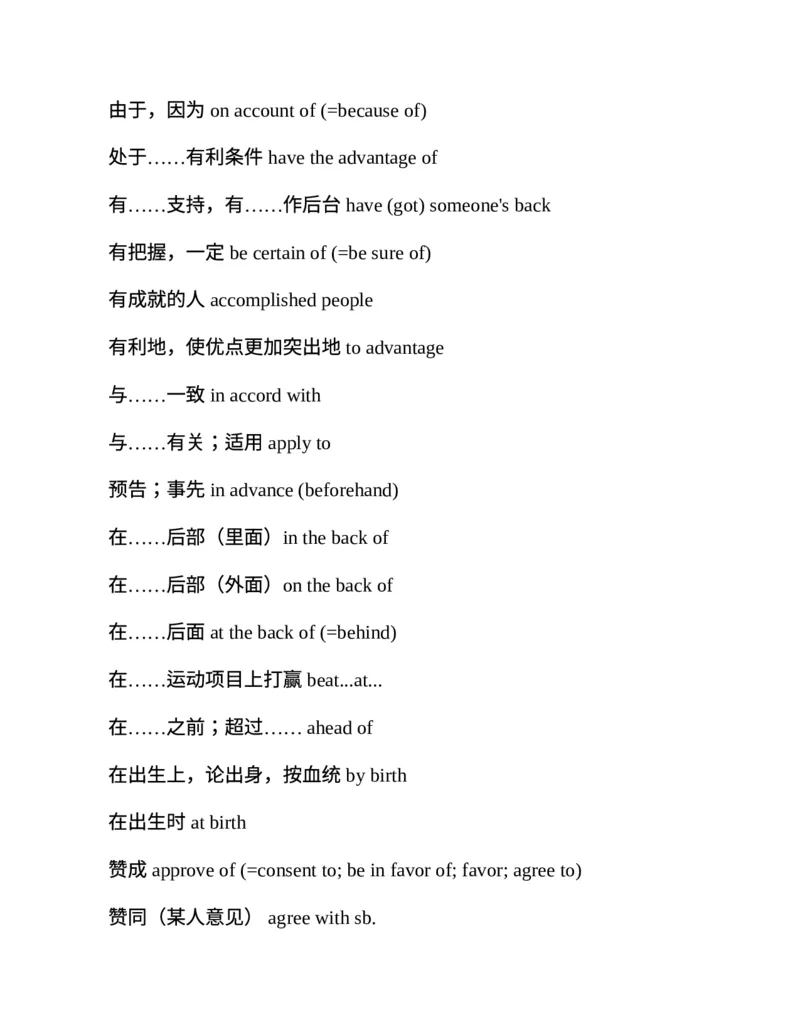
由于,因为 on account of (=because of)
处于……有利条件 have the advantage of
有……支持,有……作后台 have (got) someone's back
有把握,一定 be certain of (=be sure of)
有成就的人 accomplished people
有利地,使优点更加突出地 to advantage
与……一致 in accord with
与……有关;适用 apply to
预告;事先 in advance (beforehand)
在……后部(里面)in the back of
在……后部(外面)on the back of
在……后面 at the back of (=behind)
在……运动项目上打赢 beat...at...
在……之前;超过…… ahead of
在出生上,论出身,按血统 by birth
在出生时 at birth
赞成 approve of (=consent to; be in favor of; favor; agree to)
赞同(某人意见) agree with sb.
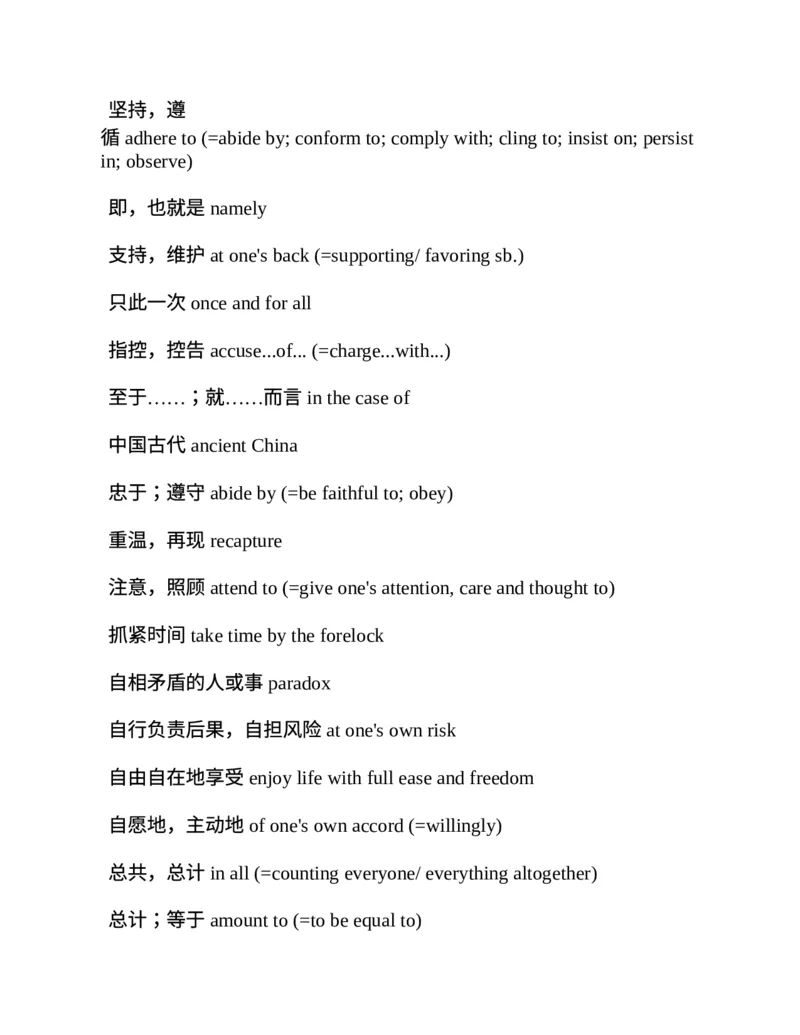
坚持,遵
循 adhere to (=abide by; conform to; comply with; cling to; insist on; persist
in; observe)
即,也就是 namely
支持,维护 at one's back (=supporting/ favoring sb.)
只此一次 once and for all
指控,控告 accuse...of... (=charge...with...)
至于……;就……而言 in the case of
中国古代 ancient China
忠于;遵守 abide by (=be faithful to; obey)
重温,再现 recapture
注意,照顾 attend to (=give one's attention, care and thought to)
抓紧时间 take time by the forelock
自相矛盾的人或事 paradox
自行负责后果,自担风险 at one's own risk
自由自在地享受 enjoy life with full ease and freedom
自愿地,主动地 of one's own accord (=willingly)
总共,总计 in all (=counting everyone/ everything altogether)
总计;等于 amount to (=to be equal to)
最重要的是;首先 above all
五
常考文体翻译技巧
通过对专八历年翻译真题考点的分析,我们知道汉译英的体裁以散
文、论说文以及应用文为主,下面我们就分别对这三种常见体裁的翻
译技巧进行分析。
1 散文
散文是与诗歌、小说和戏剧并称的一种文学体裁。它题材广泛,写法
灵活自由,多种多样。它可以叙事,可以抒情,可以描写,可以议
论,可以像小说那样描写形象、刻画心理、渲染环境、烘托气氛,也
可以像诗歌那样运用比喻、象征、拟人等手法创造意境,这就是散文
的“散”的特点。
但散文同时又通过“形散而神不散”的技巧,把深刻的思想、美好的情
怀凝聚为生动的画面。而且要做到内情与外物相融合,诗意与境界相
交织,精练优美、朴素自然、音节铿锵、情感浓郁,既具有时代的生
活气息,又具有个人的风格特点。
一般说来,散文是作者自己的独白,靠真情和文采打动读者。翻译时
自然也要尽量体现出其中的真情和文采,因而具有一定的难度。
具体说来,散文的翻译从措辞、造句到篇章的安排,都要能够体现原
作的神韵、风格、文采、节奏,同时又符合译入语的表达习惯,这样
的译文才能称得上是好的译作。
如:当我在小学毕了业的时候,亲友一致的愿意我去学手艺,好帮助
母亲。我晓得我应当去找饭吃,以减轻母亲的勤劳困苦。可是,我也
愿意升学。我偷偷地考入了师范学校——制服,饮食,书籍,宿处,
都由学校供给。只有这样,我才敢对母亲提升学的话。入学,要交十
元的保证金。这是一笔巨款!母亲作了半个月的难,把这巨款筹到,
而后含泪把我送出门去。她不辞劳苦,只要儿子有出息。当我由师范
毕业,而被派为小学校长,母亲与我都一夜不曾合眼。我只说了
句:“以后,您可以歇一歇了!”她的回答只有一串串的眼泪。(2014
年真题)
【参考译文】
However, I still aspired to continue my study. So I took the exam secretly an
d got enrolled in a normal school, which provided uniforms, books, room an
d board for free. Only then did I get the courage to bring up this topic to my
mother. To enter the school, a ten-
yuan deposit was required. What a large sum of money! My mother manage
d to raise the money after two weeks' tough effort, and then sent me off in te
ars. She would spare no pains for her son to win a promising future. After gr
aduating from the normal school, I was appointed the schoolmaster of a prim
ary school. That day, my mother and I spent a sleepless night. The only thing
I said to my mother was “From now on, you can lead a life of leisure.” To w
hich, her answer was no other than trickles of tears.
选段属于散文,选自老舍先生的《我的母亲》,选段描写了老舍先生
渴望继续学业,母亲虽生活艰难,但仍然不辞劳苦,默默为他奉献,
表达了老舍先生对母亲的感恩。文章语言很朴素平实,但处处流露真
情。译文没有使用太过复杂的词语和句型,和原文朴实无华的文风很
吻合。
文章中有几处口语化的表达,比如“母亲作了半个月的难”,“作难”的意
思是母亲为了帮“我”筹款,很为难,筹款的过程也很费劲,译文翻译
成after two weeks' tough effort,一个介词短语就将母亲筹款半个月的艰
难表达得淋漓尽致。
文章的句子比较简短,用到了倒装句、感叹句等句型,准确地将老舍
先生当时的艰难处境、对学业的渴望以及母亲的勤劳坚强表达了出
来,是一篇很好的译文。
2 论说文
与说明文类似,论说文大多结构严谨、逻辑严密。
从语言上来看,论说文的语言比较准确和简洁,既要准确地表达观
点,又要用简洁的语言高度概括文章要阐述的道理。
从逻辑上看,论说文的逻辑性强,而且思维严密,既摆事实也讲道
理,这样才能让人信服。
因此在翻译的时候,要注意以下三点:首先,要理清楚论说文的语言
以及前后句子的逻辑关系,保证对于原文理解的准确性;然后,再选
择对应的英文词汇以及句型;最后,对于有些抽象的词语,在翻译时
要根据上下文进行合理的词义选择或者词性转换。
如:朋友关系的存续是以相互尊重为前提的,容不得半点强求、干涉
和控制。朋友之间,情趣相投、脾气对味则合、则交;反之,则离、
则绝。朋友之间再熟悉,再亲密,也不能随便过头,不恭不敬。不
然,默契和平衡将被打破,友好关系将不复存在。每个人都希望拥有
自己的私密空间,朋友之间过于随便,就容易侵入这片禁区,从而引
起冲突,造成隔阂。待友不敬,或许只是一件小事,却可能已埋下了
破坏性的种子。维持朋友亲密关系的最好办法是往来有节,互不干
涉。(2010年真题)
【参考译文】
Friends tend to become more intimated if they have the same interests and te
mper, and they can get along well and keep contacting; otherwise they will s
eparate and end the relationship. Friends who are more familiar and closer ca
n not be too casual and show no respect. Otherwise the harmony and balance
will be broken, and the friendship will also be nonexistent any more. Everyo
ne hopes to have his own private space, and if too casual among friends, it is
easy to invade this piece of restricted area, which will lead to the conflict, res
ulting in alienation. It may be a small matter to be rude to friends; however, i
t is likely to plant the seeds of devastation. The best way to keep the close rel
ationship between friends is to keep contacts with restraint, and do not bothe
r each other.
这段文字论述了朋友关系的存续是以相互尊重为前提的。译文中使用
了一些从句和非谓语结构,使原文句子之间的关系一目了然。
3 应用文
应用文是人们在社会实践活动中逐渐形成的一种文体,是人们传递信
息、处理事务、交流感情的工具,有的应用文还用来作为凭证和依
据。随着社会的发展,人们在工作和生活中的交往越来越频繁,应用
文的功能也就越来越多了。
应用文有实用性的特点,并形成惯用格式。介绍词属于应用文的一种
文体,语言强调准确性、简明性,目的明确、解说性强,具有知识
性、信息性和客观性。
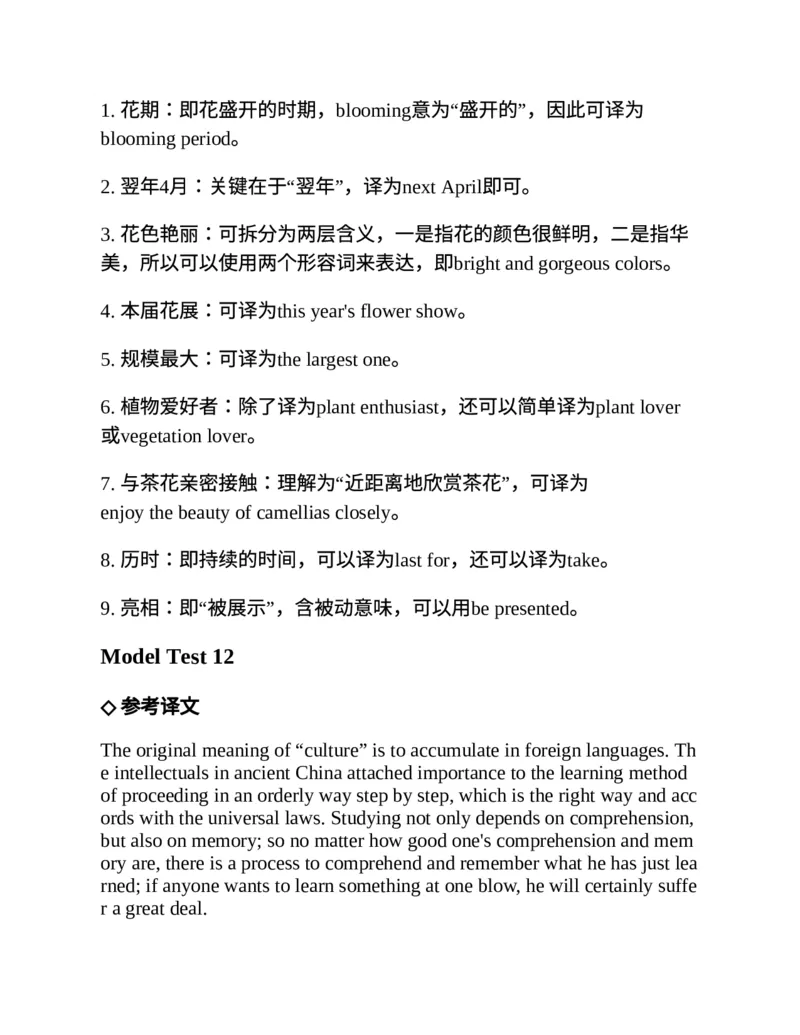
如:茶花(camellia)的自然花期在12月至翌年4月,以红色系为主,
另有黄色系和白色系等,花色艳丽。本届花展充分展示了茶花的品种
资源和科研水平,是近三年来本市规模最大的一届茶花展。为了使广
大植物爱好者有更多与茶花亲密接触的机会,本届茶花展的布展范围
延伸至整个园区,为赏花游客带来便利。
此次茶花展历时2个月,展期内200多个茶花品种将陆续亮相。(2015
年真题)
【参考译文】
The blooming period of camellias naturally begins from a year's December t
o next April, with its bright and gorgeous colors, mainly in red, sometimes in
yellow or white. This year's flower show, fully displaying the varieties and t
he level of scientific researches of camellias, makes itself the largest one in o
ur city in recent three years. In order to offer plant enthusiasts more chances
to enjoy the beauty of camellias closely, the exhibit area of the flower show i
s extended to the entire park, which brings the visitors a lot of convenience.
The camellia show will last for two months, during which more than 200 ca
mellia varieties will be presented successively.
本段节选自2014年上海茶花展介绍词,介绍了茶花的种类以及此次花
展的基本概况。原文内容很客观,语言通俗易懂、简明、朴实,目的
也很明确,就是为了解说2014年上海茶花展。译文的选词简单易懂,
符合文章的特征。译文还运用了状语、非谓语结构等,忠实地将原文
中陈述的信息一一翻译出来,保证了译文的客观性和信息性。
总之,为了达到专业八级考试对翻译部分的要求,考生应在平时多练
笔,在熟悉各种翻译技巧和各种文体特点的同时,扩大自己的词汇
量,提高英、汉两种语言的素养,进而从根本上提高自己的翻译水
平。
第三章
词语翻译锦囊
一
词义选择
由于汉语中存在大量的一词多义现象,所以应该合理地根据上下文判
断词语的含义,选择合适的英语词汇进行翻译。具体说来,需要注意
以下几点:
1 根据汉语词义的强弱选词
如:……每个人都无比关注自己及至亲至爱之人心脏的健损……
...everyone attaches great importance to the physical condition of his own
heart and that of his closest and dearest ones...
这里“无比关注”一词,含义强烈,故在译文中要用
attach great importance to,而不是表示一般含义的care。
2 根据汉语词义的广义或狭义选词
不论是中文还是英文,有些词(特别是表示名词概念的词)往往有广
义和狭义的区别。翻译时要注意选择与其相对应的词。
如:农业是国民经济的基础。
Agriculture is the foundation of the national economy.
农林牧副渔相互结合的方针
the principle of combining farming, forestry, animal husbandry, side occup
ations and fishery
第一句中,“农业”是广义,指一切农业经济,包括农业、畜牧业、林
业和渔业,故用agriculture。
第二句中,“农”的意思是狭义的,仅指耕作上的农业而已,故用
farming。
3 根据词的语体色彩(即场合、气氛)选词
如:禁止赌博。
Gambling is prohibited.
此句中的“禁止”为非常正式的语体,所以使用prohibit的被动语态进行
翻译,而并非“Don't gamble.”。
4 根据英语的表达习惯选词
词语搭配,包括主谓搭配、修饰搭配和动宾搭配,要使搭配符合英语
的表达习惯。
如:环境卫生:environmental sanitation
个人卫生:personal hygiene
公共卫生:public health
如果生硬地将上述短语中的“卫生”都翻译成hygiene,就会造成“中式英
语”。
二
词义引申
词义的引申就是把原文中暗含的意思在翻译时表现出来。依据主要有
两个:(1)词汇本身由于文化等因素有隐含的意思;(2)上下文对
词汇有影响,使得翻译成英语后搭配不协调。
词义引申的方法有变换表达方式、词义具体化和词义抽象化三种形
式。
1 变换表达方式
就是不按照字面翻译,而是用其他的词语更加通顺地表达同样的含
义。
如:生活不如意时,文学书籍给我们提供了可以达到一种比现实更美
好的境界……(2018年真题)
When life gives us lemons, literature books provide us with an achievable r
ealm that is better than reality...
此句中的“不如意”翻译成了gives us lemons,更符合英语的表达习惯。
2 词义具体化
就是根据上下文的情景将原文中比较抽象的词汇经过注释、增补等手
段译成比较具体的词汇。
如:……给这个词灌注一种紧张感。(2016年真题)
...thus endowing the word with a sense of tension.
此句中的“灌注”原意为“赋予”,译文用endow...with...表达出这层含
义。
3 词义抽象化
就是将表示具体形象的词作概括性的引申,翻译成意义抽象的词,通
常这类具体形象的词指代的是一种属性、一种概念或一个事物。
如:……母亲作了半个月的难,把这巨款筹到……(2014年真题)
...mother managed to raise the money after two weeks' tough effort...
此句中的“作了半个月的难”潜在含义为“筹钱的两周很艰难”,故用短
语two weeks' tough effort来表示。
三
词性转换
为了让译文通顺,有时要适当改变词性进行翻译。
汉语中动词用得多,除了动宾结构外,还有连动式、兼语式,动词还
可以作句子的主语。而英语的一个简单句只能有一个谓语动词,如果
要表示两个及以上的动作,则要使用非谓语动词、从句或含有动作意
义的名词和形容词。因此,在词性转换中,最常见的是在翻译时把汉
语的动词转换成英语的名词、形容词、介词短语。
此外,词性转换还有可能是汉语的名词转换为英语的动词,或者汉语
的形容词转换为英语的名词或动词。在考试中遇到此类问题时,考生
要灵活处理。
以下是四种翻译中常见的词性转换:
1 动词转名词
如:过年意味着小孩子正在向自己生命过程中的辉煌时期进步,而对
于大人,则意味着正向衰朽的残年滑落。(2017年真题)
For the kids, the New Year means that they are progressing to the most brilli
ant part of their life. On the contrary, for adults, it's an indication that they
are sliding into their declining years.
在这句话中,“意味”在汉语中作为动词,翻译的时候可译为名词
indication。
2 动词转形容词
如:现实中没有完美的爱情,但在书里有永恒的《梁山伯与祝英台》
和《罗密欧与朱丽叶》。(2018年真题)
The idea of a perfect relationship is impossible in reality. However, the love
stories in The Butterfly Lovers and Romeo and Juliet are eternal.
“没有”在汉语里是动词,翻译的时候可译为形容词impossible。
3 动词转介词
如:小孩子可以兴奋地说:过年了,我又长大了一岁;而老人们则叹
息:嗨,又老了一岁。(2017年真题)
Kids may say excitedly that they begin another year in their lives after the S
pring Festival; however, the elders may sigh, “Well, I've become one year ol
der!”
“过”在汉语里是动词,在翻译时可译为介词after。
4 名词转动词
如:流逝也许是缓慢的,但无论如何缓慢,对流逝的恐惧使人们必须
用“流逝”这个词来时时警戒后人……(2016年真题)
As time goes by, no matter how slowly it elapses, the fear of its transiency
makes people to use the word “flow” as an alert to the later generations that.
..
“流逝”在汉语里是名词,翻译的时候可译为动词短语goes by。
四
词语增补
汉语重“意合”,行文简洁,有很多省略。英语则重“形合”,句子必须
具备完整的主谓结构,若出现两个及以上的主谓结构时必须使用连
词。因此,在汉译英的过程中,常常要进行词语的增补,以使英语句
子结构完整。
词语增补有以下几种情况:
1 补充主语
汉语里存在大量的无主句,但是英语的句子除了祈使句,都要有主
语,因此汉语英译时多要补充主语。
如:活到老,学到老。
One is never too old to learn.
汉语中省略了主语“人”,在翻译成英语时要补充主语one。
2 补充连词
汉语的句子很少用连词,所以英译时也要补充连词。
如:房屋彼此挨得很近,有些屋顶几乎相连。(2019年真题)
These cottages are so close to each other and some of the roofs are almost c
onnected.
在这句话中,逗号前后两部分为并列关系,翻译时需要增加连词and。
3 补充介词
英语中的介词使用非常广泛。汉语不用介词的地方,英语却常常需要
使用。
如:……在这里,观众可以自己去动手操作,自己细心体察……
...where visitors can have a careful observation of the exhibits by touching t
hem and operating them...
“动手操作”是一种方式,即“通过动手操作”,需要用介词by,即
by touching them and operating them。
除了by之外,还有其他可能需要补充的介词,如:on、at、in、of、
to、with、for、from等。
4 补充冠词
如:他们发现无论是潺潺小溪,还是浩荡大河,都一去不复返……
(2016年真题)
They realized that no matter it was a gurgling brook or a mighty river, their
waters would flow on and would never return...
这句话在汉语里没有冠词,翻译时,需要补充冠词a,即
a gurgling brook和a mighty river。
5 补充代词
如:……一是因为过年意味着一笔开支……(2017年真题)
...On the one hand, celebrating the New Year means a great expense to the
m...
这句话中需要补充代词them。
6 补充动词
如:书里面的水可能比我们现实生活中的水要清,天比我们现实中的
天要蓝……(2018年真题)
The water described in the books may be clearer than that in our real life an
d similarly, the sky is bluer...
“书里面的水”即“书里面描述的水”,需要补充动词的过去分词
described。
五
词语省略
汉语原文中的一些词,根据语境可省略不译;而译文中虽无其词,但
已有其意,或是属于不言而喻,那么在汉译英时就要将这些词语省
略。词语省略的目的是为了使译文简明扼要、表达通顺。要特别注
意,省略法不是删去其中的内容,而是出于某种需要省略部分内容,
并不影响内容的完整性。
1 省略汉语中重复出现的词语
如:南方多雨,屋顶是坡顶……(2019年真题)
Village houses in the South have sloping roofs to stand the rainy weather...
在这句话中,“顶”出现两次,翻译时可只出现一次roofs,前面那个略
去。
2 省略汉语中意义相同的词语
如:这里的村舍则不同,屋顶是晒粮食的地方,而且历史上每逢水大
洪泛,村民就得把屋里的东西搬到屋顶上。(2019年真题)
While the cottages here have flat roofs to dry the harvest in the sun. And, ev
ery time the water flooded, the villagers had to move belongings in the roo
m onto the roof.
体会这句话的意思,“水大”和“洪泛”意义相同,可省去其一不译。
3 汉语中有些词语译成英文时常省略
表示范畴的词语和表示“任务”“工作”“情况”“状态”“问题”“制度”“事
业”“局面”等意义的词语常省略不译。
如:我们终于结束了手忙脚乱的局面。
We finally put an end to the rush.
这句话里,“局面”这个词在英文里没有单独翻译出来,因为“手忙脚
乱”已经能体现出局面的意思。
4 省略有些在汉语中起修饰作用的词语
如:我们应当减少一些不必要的浪费。
We should reduce waste.
这句话里,“一些不必要的”对“浪费”起到修饰作用,实际并无太大意
义,故将其省译。
如上例所示,汉语中,有时为了表示强调、增强气势或保持结构工
整,常用一些本身并无多少实际意义的修饰语,在翻译这类句子时,
某些词语往往省译,译出主要的和不可缺少的词语就可以了。
六
成语的翻译
汉语的成语非常多,一般由四字组成,言简意赅,比较典雅,而且往
往含有深厚的文化内涵。关于成语的翻译,如果平时学习中积累了约
定俗成的译法当然最好。如果没有遇到过一致认可的译法,一般可以
在正确理解汉语成语原义的基础上直接翻译。
如:但村舍的形制自具特色,与江南截然不同。(2019年真题)
But quite different from the village houses in the South of China, the desig
n and construction of the cottages here have their distinctive features.
在翻译的时候,“截然不同”直接译为quite different。
但是,对于文化差异较大的习语、典故、谚语、政治名词等,要在翻
译时适当加以注释。
如:白洋淀曾有“北国江南”的说法……(2019年真题)
Baiyangdian was once known as “Northern Jiangnan”, literally the souther
n type of water town in the North.
在翻译的时候,“北国江南”需要加以注释,即
literally the southern type of water town in the North。
第四章
句子和篇章翻译锦囊
一
句子的翻译
汉英两种语言在句式结构上存在很大的不同:汉语重“意合”,而英语
重“形合”;汉语的句子重心在前,而英语的句子重心靠后;汉语呈“竹
节”式句型,而英语呈“树”式句型。
因此,在汉译英的过程中,无论是从逻辑关系还是句子的结构上,译
者都要体现出英语句式的各种特点。
具体说来,要注意以下几个方面:
1 确定主干
① 定主语
汉语句子的主语较为灵活,不一定非要是动作的执行者,而且也不限
于某几种词性。
相比较而言,英语句子的主语就只能是名词、代词、非谓语动词、主
语从句等,而且一般是动作的执行者或承受者。
主语的选择和转换在汉译英中极为重要,因为在许多情况下汉语原句
中的主语不能直接与译文的主语相对应,这时就需要转换原句中主
语,然后再根据英语的表达习惯在句式上进行调整。
如:你的提议我一定会认真考虑。
I'm sure to give serious thoughts to your suggestion.
② 定谓语
谓语通常由系表结构或某动词构成。
如:她不辞劳苦,只要儿子有出息。(2014年真题)
She would spare no pains for her son to win a promising future.
2 调整语序
① 调整定语
当单词充当定语的时候,翻译时多处理为前置;当短语或者从句充当
定语的时候,翻译时多处理为后置。
如:这孩子是她的秘密,她将秘密留在这树林掩映的建筑里。(2012
年真题)
The child was her secret and she would stash this secret into the building hid
den in the forests.
在这句话中,短语“树林掩映”可译为后置定语,即
hidden in the forests。
② 调整状语
当单词作状语修饰动词的时候,翻译时多放在动词的后面;当短语或
者从句作状语的时候,翻译时可放在被修饰部分之前或者之后。
如:我到家时,他正在看书。
He was reading when I got home.
“我到家时”可处理为when引导的时间状语从句放在句末。
③ 汉英语言叙事重心
汉语句子前半部分叙事或论理,后半部分做出评论。翻译时,可以译
成It is...to do...结构。
如:提出一个具体的标准当然很困难。
It is certainly difficult to come up with a specific standard.
在这句话中,用It作形式主语,再翻译真正的主语“提出一个具体的标
准”。
3 注意语态
汉语中的很多句子隐含“被动”的意味,在翻译时,可将其译成被动语
态。
如:此次茶花展历时2个月,展期内200多个茶花品种将陆续亮相。
(2015年真题)
The camellia show will last for two months, during which more than 200 ca
mellia varieties will be presented successively.
“亮相”中隐含“茶花品种被展示”的意味,所以应译为被动形式
will be presented。
4 长句的翻译
① 拆分法
拆分法就是将一个结构复杂的长句子拆分成两个或两个以上结构简单
的短句子。运用此方法可以使译文更加简洁明了,层次清晰。
如:①当人生走向晚年,就如一瓶待开封的好酒,②其色彩是沉静的,
味道中充满慷慨与智慧。(2013年真题)
① When one approaches his old age, his life is just like a bottle of wine to b
e savored. ② Its color is quiet, while its taste brims with generosity and wisd
om.
在翻译本句的时候,可以将其拆分为2个短句:句①表达的是人生走向
晚年时与待开封的好酒的类比概述;句②表达的是类比的细节。
② 合并法
合并法就是将汉语里关系紧密的两个或两个以上的句子合起来译为英
语的一句,可以翻译为一个主从句,也可以翻译为成分略复杂的简单
句,如包含非谓语动词等,这样可以使内容更加紧凑。
如:除夕之夜吃年夜饭是必不可少的程序。全家人围坐着一张桌子一
同分享佳肴,人多的话兴许不止一张桌子。
Feast dinner on the New Year's eve is a must for the whole family that sit at
one or more tables.
在翻译时,可以根据前后内容的关系,将其译为一个包含that引导的定
语从句的句子。
③ 顺序法
顾名思义,顺序法即按照汉语原文本身的顺序进行翻译,这种情况较
适用于单一主语的句子。
如:最为常见的是,一个人走着走着突然停下来,眼睛盯着手机屏幕
发短信。他不在乎停在马路中央还是厕所旁边。(2009年真题)
We are familiar with the scene that a person suddenly stops while walking, t
o edit short messages with eyes fixed on his phone screen, regardless of his l
ocation, whether in the middle of the road or beside a restroom.
该句可根据中文顺序直接翻译。“最为常见的是”译为
We are familiar with the scene that;“一个人走着走着突然停下来,眼睛
盯着手机屏幕发短信”译为
a person suddenly stops while walking, to edit short messages with eyes fixe
d on his phone screen;“他不在乎停在马路中央还是厕所旁边”译为
regardless of his location, whether in the middle of the road or beside a restr
oom。
④ 主次信息句
由于汉语句子“竹节式”的特点,使得很多句子表面上看起来没有主次
之分,但实际上有主要信息和次要信息的差别。在翻译的时候,可以
把次要信息译成独立结构,例如非谓语动词短语、独立主格或从句,
以体现这种主次之分。
如:喝一口下肚,余香沁人心脾,让人终身受益。(2013年真题)
When we swallow the sip, the lingering fragrance gladdens the heart and refr
eshes the mind, leaving a person lifelong benefit.
翻译的时候,可以将“余香沁人心脾”作为主句,“喝一口下肚”可译为
when引导的状语从句,“让人终身受益”可译为伴随状语。
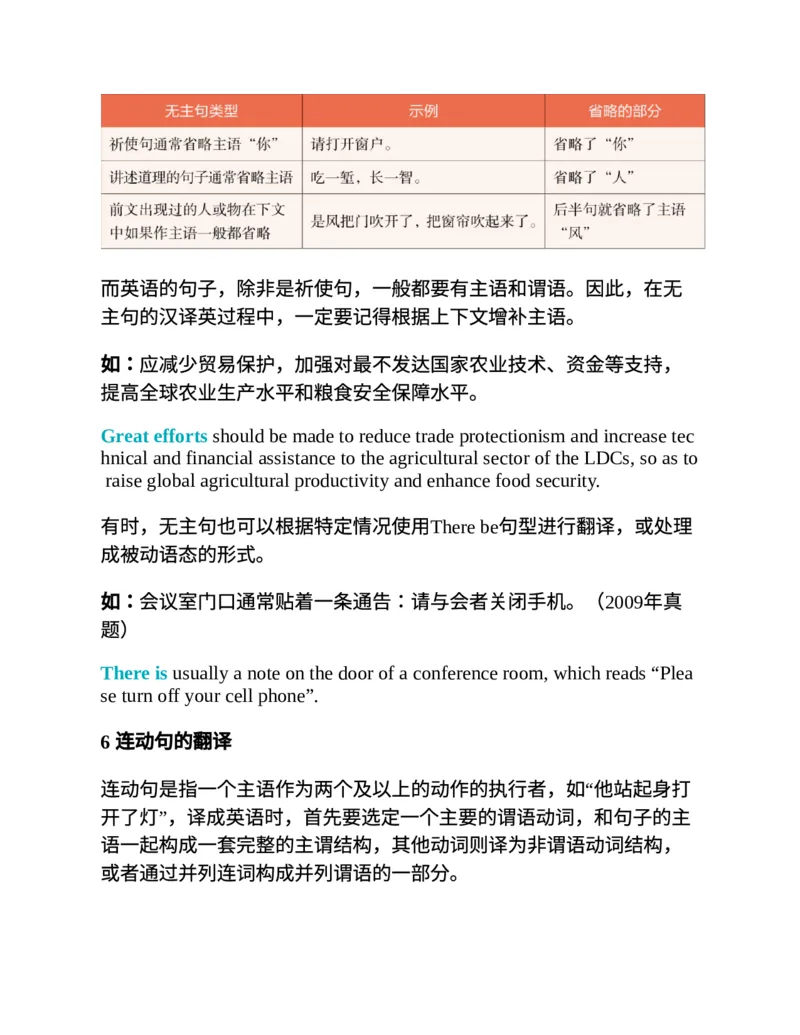
5 无主句的翻译
汉语中有大量的无主(语)句,应用广泛,常见的情况有:
而英语的句子,除非是祈使句,一般都要有主语和谓语。因此,在无
主句的汉译英过程中,一定要记得根据上下文增补主语。
如:应减少贸易保护,加强对最不发达国家农业技术、资金等支持,
提高全球农业生产水平和粮食安全保障水平。
Great efforts should be made to reduce trade protectionism and increase tec
hnical and financial assistance to the agricultural sector of the LDCs, so as to
raise global agricultural productivity and enhance food security.
有时,无主句也可以根据特定情况使用There be句型进行翻译,或处理
成被动语态的形式。
如:会议室门口通常贴着一条通告:请与会者关闭手机。(2009年真
题)
There is usually a note on the door of a conference room, which reads “Plea
se turn off your cell phone”.
6 连动句的翻译
连动句是指一个主语作为两个及以上的动作的执行者,如“他站起身打
开了灯”,译成英语时,首先要选定一个主要的谓语动词,和句子的主
语一起构成一套完整的主谓结构,其他动词则译为非谓语动词结构,
或者通过并列连词构成并列谓语的一部分。
如:将它(红酒)握在手中仔细观察,它的暗红色中有血的感觉,那
正是生命的痕迹。(2013年真题)
If we hold the wine in our hand and observe it closely, the dark red color re
minds us of the blood, which is the sign of life.
“握”和“观察”为两个动作,可将其译为由并列连词连接的并列谓语。
7 兼语句的翻译
兼语句是指谓语有两个动词,前一个动词的宾语是第二个动词的主
语,例如“我让他打开了门”。翻译时,可译成英语的SVOC结构。这种
方法适用于第一个动词是“叫、让、使、请、劝、派、催、逼、命令、
请求、引诱、迫使、号召、鼓励、禁止、阻挠……”等含有使役、命
令、建议或请求含义的动词,这也是最常见的一种句型翻译方法。
如:他们非得让我把整个事件再说一遍。
They made me repeat the whole story.
8 流水句的翻译
流水句指表面上看没有任何关联词语,由若干个小句子以逗号连接而
成的句子。翻译时注意要先弄清楚各个分句之间的逻辑和主次关系,
然后在翻译的过程中加上相应的英语连词或者副词。这样做主要是因
为英语是“形合句”,两个以上的主谓结构如果出现在同一个句子中,
一定要由连词连接。
如:他身残志坚,坚持学习,后来成为有名的学者。
He was a handicapped child, but he persevered in his studies, and later beca
me a well-known scholar.
二
篇章的翻译
汉译英在语篇层次上应注意以下几点:
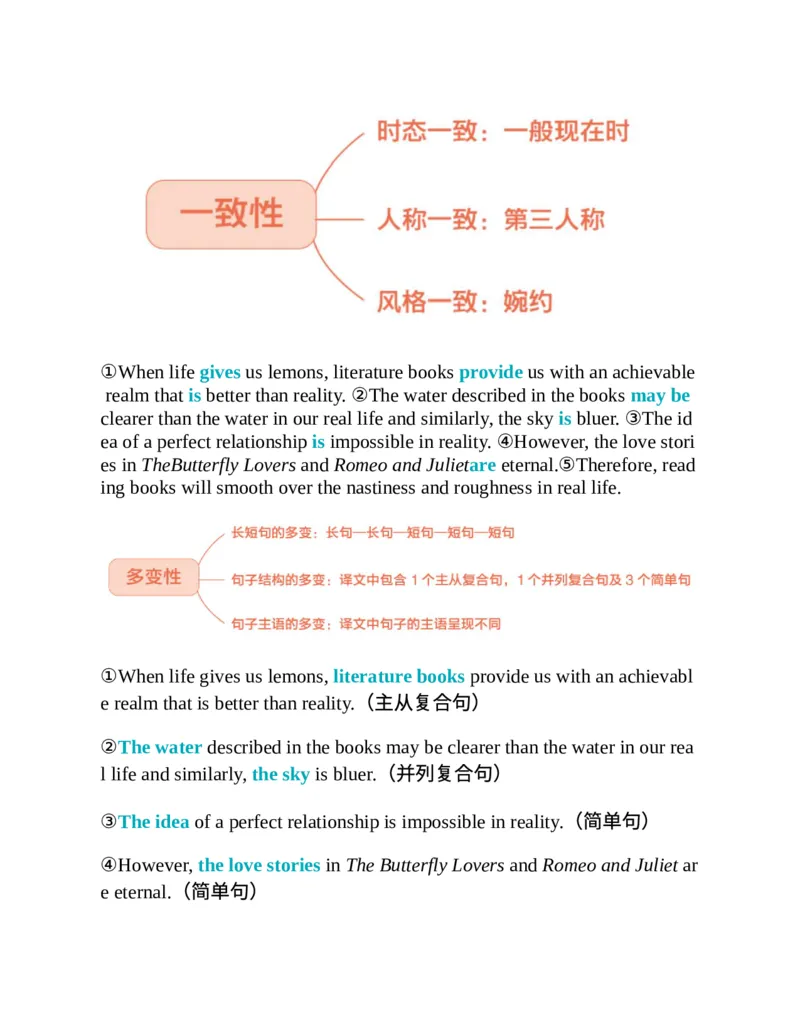
1 一致性
即译文前后是否时态一致、人称一致、语言风格一致,以及译文的遣
词造句是否和原文风格一致。
2 多变性
汉语篇章中的各个句子如果基本结构类似,可以给读者一种“整齐
美”;然而英语在篇章表达中较为注重句型的变化。因此在汉译英的过
程中,一定要注意译文中长、短句相结合,简单句、并列句、复合句
相结合,句型力求多样化。
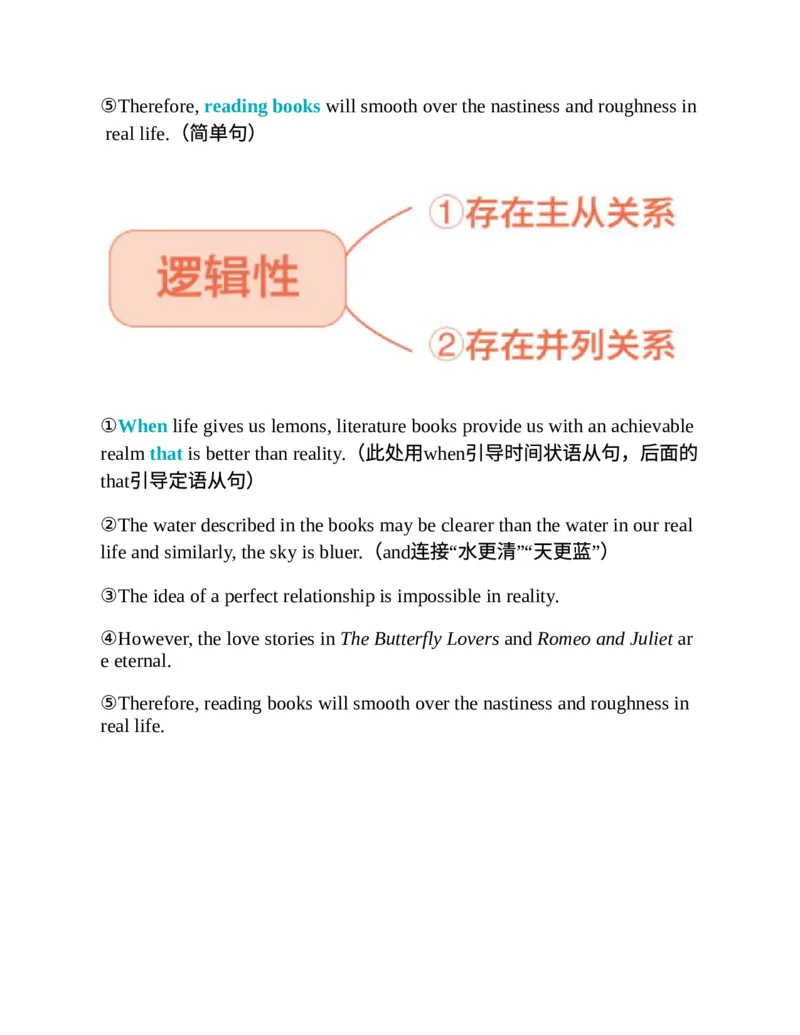
3 逻辑性
汉语的各个句子间很少使用连词或者表示逻辑关系的副词,句子间的
逻辑关系需要译者在阅读的过程中去体会。而英语句子之间往往有明
确的表示逻辑关系的词语,从而使得整篇文章的逻辑性得到很好的外
在表现。
下面通过一个真题例子来感受一下篇章翻译所需的三个特性:
如:文学书籍起码使我们的内心可以达到这样的三感:善感、敏感和
美感。生活不如意时,文学书籍给我们提供了可以达到一种比现实更
美好的境界——书里面的水可能比我们现实生活中的水要清,天比我
们现实中的天要蓝;现实中没有完美的爱情,但在书里有永恒的《梁
山伯与祝英台》和《罗密欧与朱丽叶》。读书,会弥补我们现实生活
中所存在的不堪和粗糙。(2018年真题)
①When life gives us lemons, literature books provide us with an achievable
realm that is better than reality. ②The water described in the books may be
clearer than the water in our real life and similarly, the sky is bluer. ③The id
ea of a perfect relationship is impossible in reality. ④However, the love stori
es in TheButterfly Lovers and Romeo and Julietare eternal.⑤Therefore, read
ing books will smooth over the nastiness and roughness in real life.
①When life gives us lemons, literature books provide us with an achievabl
e realm that is better than reality.(主从复合句)
②The water described in the books may be clearer than the water in our rea
l life and similarly, the sky is bluer.(并列复合句)
③The idea of a perfect relationship is impossible in reality.(简单句)
④However, the love stories in The Butterfly Lovers and Romeo and Juliet ar
e eternal.(简单句)
⑤Therefore, reading books will smooth over the nastiness and roughness in
real life.(简单句)
①When life gives us lemons, literature books provide us with an achievable
realm that is better than reality.(此处用when引导时间状语从句,后面的
that引导定语从句)
②The water described in the books may be clearer than the water in our real
life and similarly, the sky is bluer.(and连接“水更清”“天更蓝”)
③The idea of a perfect relationship is impossible in reality.
④However, the love stories in The Butterfly Lovers and Romeo and Juliet ar
e eternal.
⑤Therefore, reading books will smooth over the nastiness and roughness in
real life.
PART 2
翻译提分训练
第一章
心灵感悟话题演练
Model Test 1
Translate the underlined part of the following text from Chinese into Eng
lish.
都市寸土千金,地价炒得越来越高,今后将更高。拥有一个小小花园
的希望,对寻常之辈不啻是一种奢望,一种梦想。
我想,其实谁都有一个小小花园,这便是我们的内心世界。人的智力
需要开发,人的内心世界也是需要开发的。人和动物的区别,除了众
所周知的诸多方面,恐怕还在于人有内心世界。心不过是人的一个重
要脏器,而内心世界是一种景观,它是由外部世界不断地作用于内心
渐渐形成的。每个人都无比关注自己及至亲至爱之人心脏的健损,以
至于稍有微疾便惶惶不可终日。但并非每个人都关注自己及至亲至爱
之人的内心世界的阴晴。
——————
Model Test 2
Translate the following text from Chinese into English.
在盼中,日子真的流得飞快,转眼上了小学,继而初中,然后高中,
最后大学;盼的欲望更加强烈,盼的内容也渐渐丰富了:盼有好成绩
毕业,盼有一份好工作,盼事业有成,盼挣钱替父母分忧,盼有一个
爱人……不知不觉,天天踩着盼的石阶而上,自己竟成了一个大男
人,一个挣钱养家糊口的忙碌人了。
——————
Model Test 3
Translate the following text from Chinese into English.
对天真烂漫的孩子来说,跟着父母出游,得到一件漂亮的衣服,一件
精美的玩具,一些可口的糖果点心,就能满足他们对幸福的渴望。对
刚刚成年的年轻人而言,成绩优秀,学业有成,异性的爱恋,网上的
遨游,往往都是他们所憧憬的幸福。而人到中年所追求的,自然就应
当是事业的成功和家庭的幸福和美了。至于老年人,那“健康是金,平
安是福”也就道出了他们对幸福的企盼了。
——————
Model Test 4
Translate the underlined part of the following text from Chinese into Eng
lish.
流逝,表现了南国人对时间最早的感觉。“子在川上曰:逝者如斯
夫。”他们发现无论是潺潺小溪,还是浩荡大河,都一去不复返,流逝
之际青年变成了老翁而绿草转眼就枯黄,很自然有错阴的紧迫感。流
逝也许是缓慢的,但无论如何缓慢,对流逝的恐惧使人们必须用“流
逝”这个词来时时警戒后人,必须急匆匆地行动,给这个词灌注一种紧
张感。
——————
Model Test 5
Translate the following text from Chinese into English.
正是因为不停地追求进取,我们才感到生活幸福。一件事完成后,另
一件随之而来,如此连绵不绝,永无止境。对于往前看的人来说,眼
前总有一番新天地。虽然我们蜗居于这颗小行星上,整日忙于琐事且
生命短暂,但我们生来就有不尽的希望,如天上繁星,遥不可及。只
要生命犹在,希望便会不止。真正的幸福在于怎样开始,而不是如何
结束,在于我们的希冀,而并非拥有。
——————
Model Test 6
Translate the underlined part of the following text from Chinese into Eng
lish.
这样想了好几年,最后事情终于弄明白了:一个人,出生了,这就不
再是一个可以辩论的问题,而只是上帝交给他的一个事实;上帝在交
给我们这件事实的时候,已经顺便保证了它的结果,所以死是一件不
必急于求成的事,死是一个必然会降临的节日。
这样想过之后我安心多了,眼前的一切不再那么可怕。比如你起早熬
夜准备考试的时候,忽然想起有一个长长的假期在前面等待你,你会
不会觉得轻松一点?并且庆幸并且感激这样的安排?
剩下的就是怎样活的问题了,这却不是在某一个瞬间就能完全想透
的、不是一次性能够解决的事,怕是活多久就要想它多久了,就像是
伴你终生的魔鬼或恋人。
——————
Model Test 7
Translate the following text from Chinese into English.
不管是好习惯还是坏习惯,都是逐渐养成的。当一个人重复做某件事
时,一种看不见的力量驱使他去重复做同一件事,这样就养成了习
惯。习惯一旦形成,要改掉它是困难的,有时是不可能的。所以,我
们在形成习惯的时候要小心谨慎,这一点是非常重要的。小孩子常常
会养成坏习惯。这些坏习惯中有的一直保留到你死去为止。年纪大的
人也会养成坏习惯,在某些情况下,这些坏习惯能毁掉人。
——————
Model Test 8
Translate the underlined part of the following text from Chinese into Eng
lish.
如果你是一滴水,你是否滋润了一寸土地?如果你是一线阳光,你是
否照亮了一分黑暗?如果你是一颗粮食,你是否哺育了有用的生命?
如果你是一颗最小的螺丝钉,你是否永远守在你生活的岗位上?如果
你要告诉我们什么思想,你是否在日夜宣扬那最美丽的理想?你既然
活着,你又是否为了未来的人类生活付出你的劳动,使世界一天天变
得更美丽?我想问你,为未来带来了什么?在生活的仓库里,我们不
应该只是个无穷尽的支付者。
——————
Model Test 9
Translate the following text from Chinese into English.
人,能力有大小,水平有高低,既然出来打天下,既然要与人争高
低,输赢都是正常的。奥运会的百米赛场上,无论谁输给博尔特都是
再正常不过的,因为那小子是百年一出的短跑奇才;游泳馆里,败在
菲尔普斯手下,也是再正常不过的事,因为他是游泳天才。所以不管
你被落下多大差距,谁都不会笑话你;而你如果畏畏缩缩,因为害怕
而退赛,不战自败,那就丢人丢大了。
——————
Model Test 10
Translate the underlined part of the following text from Chinese into Eng
lish.
在一个偏僻遥远的山谷里,有一个高达数千尺的断崖。不知道什么时
候,断崖边上长出了一株小小的百合。百合刚刚诞生的时候,长得和
杂草一模一样。但是,它心里知道自己并不是一株野草。它的内心深
处,有一个内在的纯洁的念头:“我是一株百合,不是一株野草。唯一
能证明我是百合的方法,就是开出美丽的花朵。”有了这个念头,百合
努力地吸收水分和阳光,深深地扎根,直立地挺着胸膛。终于在一个
春天的清晨,百合的顶部结出了第一个花苞。
——————
Model Test 11
Translate the underlined part of the following text from Chinese into Eng
lish.
独处的确是一个检验,用它可以测出一个人的灵魂的深度,测出一个
人对自己的真正感觉,他是否厌烦自己。对于每一个人来说,不厌烦
自己是一个起码要求。一个连自己也不爱的人,我敢断定他对于别人
也是不会有多少价值的,他不可能有高质量的社会交往。他跑到别人
那里去,对于别人只是一种打扰,一种侵犯。一切交往的质量都取决
于交往者本身的质量。唯有在两个灵魂充实丰富的人之间,才可能有
真正动人的爱情和友谊。
——————
Model Test 12
Translate the following text from Chinese into English.
故我以为,寂寞还有更深层的定义,那就是——从早到晚所做之事,
并非自己最有兴趣的事;从早到晚总在说些什么,但没几句是自己最
想说的话;即使改变了这一种境况,另一种新的境况也还是如此,自
己又比任何别人更清楚这一点。这是人在人群中的一种寂寞。这是人
置身于种种热闹中的一种寂寞。这是另类的寂寞,现代的寂寞。
——————
Model Test 13
Translate the following text from Chinese into English.
如果偶尔听到有人指责你太不经意,未能做到未雨绸缪,防微杜渐,
要让它穿耳而过。尽管他的指责是善意的,可是在这个世界上,每个
人都是渺小的,谁也不能保证自己不踏入认识上的歧途。不要太过相
信“人无远虑必有近忧”的话,无论自己对将来有多少设想,可它终究
没有发生。最为紧要的是要抓住今天,要认认真真活在当下。
——————
Model Test 14
Translate the following text from Chinese into English.
家是一个可以为我们遮风避雨的地方,家是一个可以给我们温暖、给
我们希望的地方,家是一个可以让我们停靠的港湾,家也是我们精神
上的寄托。是家给了我们希望,让我们享受无尽的欢乐,家是人生旅
途歇息的驿站,人生是漂泊在大海里的一只航船,家就是最安全的港
湾。家为我们指引前进的方向,家给了我们一双自由飞翔的翅膀。梦
不论在何方,一生的爱唯有家,家才是我们幸福的港湾。
——————
Model Test 15
Translate the underlined part of the following text from Chinese into Eng
lish.
幸福无疑建立在一定的物质基础上,但人们不应以此误入歧途,转而
毕生追求财富。当人们把幸福全部寄托于此后,拜金主义兴起,消费
主义盛行。“欲急速致富者将不免于不义。”我们费尽心机,仅仅为增
加几枚银币;然而书内有黄金般的文字,历代最聪明的智者的话,我
们无视。我们终日忙碌,头脑里装满市场和物价;然而壮丽的日出和
春天等待观赏,我们无暇。有限的地球除了要养活人类,还要养活人
类的奢侈和虚荣。
——————
Model Test 16
Translate the following text from Chinese into English.
生存在功利社会,奔波劳顿,勾心斗角,若想做到从心所欲,难矣
哉!人自孩提时代起,求学、谋职、恋爱、成家、立业、功名、财
富……几乎无时不在追求,而且总也不能满足。当然,事业上的进取
与物欲上的贪婪,是两种截然不同的人生观,或可说是两种内涵迥异
的苦乐观。但有一点是共同的,即人生的道路并非平坦的康庄大道,
事物的发展往往不以人的意志为转移。
——————
Model Test 17
Translate the following text from Chinese into English.
对于有“自我”的人来说,独处是人生中最美好的时刻和最美好的体
验,虽则有些寂寞,寂寞中却又有一种充实。独处是灵魂生长的必要
空间。独自沉思的时候,我们从别人和事务中抽身出来,回到了自
己,这时候我们面对自己和上帝,开始了自己与心灵以及与宇宙中神
秘力量的对话。和别人一起谈古说今,引经据典,那是闲聊和讨论;
唯有自己沉浸于古往今来大师们的杰作之时,才会有真正的心灵感
悟。
——————
第二章
社会生活话题演练
Model Test 1
Translate the following text from Chinese into English.
“缅怀时刻”是奥运会闭幕式的重要环节,北京2022冬奥会的主题是“柳
枝”,呈现了这一具有中国特色的片段。柳枝是柳树的枝条。在汉语
中,“柳”与“留”同音,蕴含着在告别时挽留对方的含义。在中国传统
文化中,柳枝是赠予友人的离别礼物。在北京冬奥会闭幕式上,将“柳
枝”元素融入于送别各国运动员的仪式中再合适不过了。
——————
Model Test 2
Translate the underlined part of the following text from Chinese into Eng
lish.
参与并取胜,这就是奥林匹克精神。它表现于弱者敢于向强者挑战,
也表现于强者力争取得更好的成绩。胜而又胜,优而更优,这种理想
一直鼓舞着运动员奋力前进。他会尽其所能,永不松懈,永不罢休。
有人说竞技者终究会是失败者,即使是最佳运动员也终将被更强者淘
汰。成千上万个失败者才涌现一个胜利者,这个胜利者最终仍将被取
代,挤出光荣榜——这就是竞技运动的规律。然而运动员却从不为这
种不可避免的失败结局所沮丧,仍然力争最佳发挥。
——————
Model Test 3
Translate the underlined part of the following text from Chinese into Eng
lish.
中国的创新正以前所未有的速度蓬勃发展。为了在科学技术上尽快赶
超世界发达国家,中国近年来大幅度增加了研究开发资金。中国的大
学和研究所正在积极开展创新研究,这些研究覆盖了从大数据到生物
化学、从新能源到机器人等各类高科技领域。它们还与各地的科技园
合作,使创新成果商业化。与此同时,无论在产品还是商业模式上,
中国企业家也在努力争做创新的先锋,以适应国内外消费市场不断变
化和增长的需求。
——————
Model Test 4
Translate the following text from Chinese into English.
科学的杰出之处就在于它能创造人为的可控之物,科学和工程学使我
们能够建造我们今天得以生活在其中的部分人工化了的环境,在这个
环境里充满了无数大桥、卡车、飞机、抗生素和基因变异物种。我们
很有可能建造一个日益人为化,也因而日益可知的未来世界。
有两种局限性制约着预测能力的发展。首先,随着科学和工程学所创
造的东西越来越大,越来越复杂,这些东西本身很可能变得不可预
测。
——————
Model Test 5
Translate the underlined part of the following text from Chinese into Eng
lish.
我们总能听到父母和孩子之间存在“代沟”,在音乐、道德准则、时尚
以及很多事情上双方看法都不同。如今,又出现一个“代圈”,指年轻
人在技术应用方面的能力正逐步超过他们父辈。在技术应用方面,这
一代年轻人不只是超过了父辈,而且是已经远远领先在前,到了一个
全新的工作层面。所以芬兰才会有这样一个让人不可思议的举动,政
府精心挑选出5000名新生代网络达人,让他们教本国教师使用电脑。
学生变身为老师,而老师则变身为学生。
——————
Model Test 6
Translate the underlined part of the following text from Chinese into Eng
lish.
中国家庭一向尊老爱幼。在大家庭里,老一辈人的意见受到尊重,小
一辈的人得到全家的爱护。中国宪法规定赡养父母是成年子女义不容
辞的责任。在城市里,不和家里老人一起住的年轻夫妇给老人生活费
并帮助他们干家务活儿。在农村,尽管大家庭解体了,许多结了婚的
儿子和他的家人还与父母住在同一个院子里。对他们来说,分家不过
是分灶而已。结了婚的儿子往往把房子盖在父母家附近,这样父母和
子女互相帮助、探望都和过去一样方便。
——————
Model Test 7
Translate the underlined part of the following text from Chinese into Eng
lish.
中华民族历来尊重人的尊严和价值。还在遥远的古代,我们的先人就
已提出“民为贵”的思想,认为“天生万物,唯人为贵”,一切社会的发
展和进步,都取决于人的发展和进步,取决于人的尊严的维护和价值
的发挥。中国共产党领导人民进行革命、建设和改革,就是要确保全
中国人民获得广泛的自由、民主和人权。今天中国所焕发出来的巨大
活力,是中国人民拥有广泛自由、民主的生动写照。
——————
Model Test 8
Translate the following text from Chinese into English.
中国是一个发展中的沿海大国。中国高度重视海洋的开发和保护,把
发展海洋事业作为国家发展战略,加强海洋综合管理,不断完善海洋
法律制度,积极发展海洋科学技术和教育。中国积极参与联合国系统
的海洋事务,推进国家间和地区性海洋领域的合作,并认真履行自己
承担的义务,为全球海洋开发和保护事业做出了积极的贡献。
——————
Model Test 9
Translate the underlined part of the following text from Chinese into Eng
lish.
历史似乎总是充满戏剧性,面对荣誉的桂冠,求者不得,得者不求。
在诺贝尔奖获得者中,大多数人根本无意于得奖。这些人长期淡泊名
利,甘于寂寞。在科学的禁区,他们迈出的每一步都是前人没有走过
的,这种探索也可能意味着一生的徒劳和失败。而支撑着他们永不放
弃的,就是造福人类的伟大梦想。这正如爱因斯坦在悼念居里夫人时
曾说的:“第一流人物对于时代和历史进程的意义,在其道德品质方
面,也许比单纯的才智成就方面还要大。”
——————
第三章
人生经历话题演练
Model Test 1
Translate the following text from Chinese into English.
得病以前,我受父母宠爱,在家中横行霸道,一旦隔离,拘禁在花园
山坡上一幢小房子里,我顿感被打入冷宫,十分郁郁不得志起来。一
个春天的傍晚,园中百花怒放,父母在园中设宴,一时宾客云集,笑
语四溢。我在山坡的小屋里,悄悄掀起窗帘,窥见园中大千世界,一
片繁华。自己的哥姐,堂表弟兄,也穿插其间,个个喜气洋洋。一霎
时,一阵被人摈弃,为世所遗忘的悲愤兜上心头,禁不住痛哭起来。
——————
Model Test 2
Translate the underlined part of the following text from Chinese into Eng
lish.
乔羽的歌大家都熟悉。但他另外两大爱好却鲜为人知,那就是钓鱼和
喝酒。
晚年的乔羽喜爱垂钓,他说:“有水有鱼的地方大都是有好环境的,好
环境便会给人好心情。我认为最好的钓鱼场所不是舒适的、给你准备
好饿鱼的垂钓园,而是那极其有吸引力的大自然野外天成的场所。”钓
鱼是一项能够陶冶性情的运动,有益于身心健康。乔羽说:“钓鱼可分
三个阶段:第一阶段是吃鱼;第二阶段是吃鱼和情趣兼而有之;第三
阶段主要是钓趣,面对一池碧水,将忧心烦恼全都抛到一边,使自己
的身心得到充分休息。”
——————
Model Test 3
Translate the following text from Chinese into English.
生活就像一杯红酒,热爱生活的人会从其中品出无穷无尽的美妙。将
它握在手中仔细观察,它的暗红色中有血的感觉,那正是生命的痕
迹。抿一口留在口中回味,它的甘甜中有一丝苦涩,如人生一般复杂
迷离。喝一口下肚,余香沁人心脾,让人终身受益。红酒越陈越美
味,生活越丰富越美好。当人生走向晚年,就如一瓶待开封的好酒,
其色彩是沉静的,味道中充满慷慨与智慧。
——————
Model Test 4
Translate the following text from Chinese into English.
一个人的生命究竟有多大意义,这有什么标准可以衡量吗?提出一个
绝对的标准当然很困难;但是,大体上看一个人对待生命的态度是否
严肃认真,看他对待工作、生活的态度如何,也就不难对这个人的存
在意义做出适当的估计了。
古来一切有成就的人,都很严肃地对待自己的生命,当他活着一天,
总要尽量多工作、多学习,不肯虚度年华,不让时间白白地浪费掉。
我国历代的劳动人民以及大政治家、大思想家等等都莫不如此。
——————
Model Test 5
Translate the following text from Chinese into English.
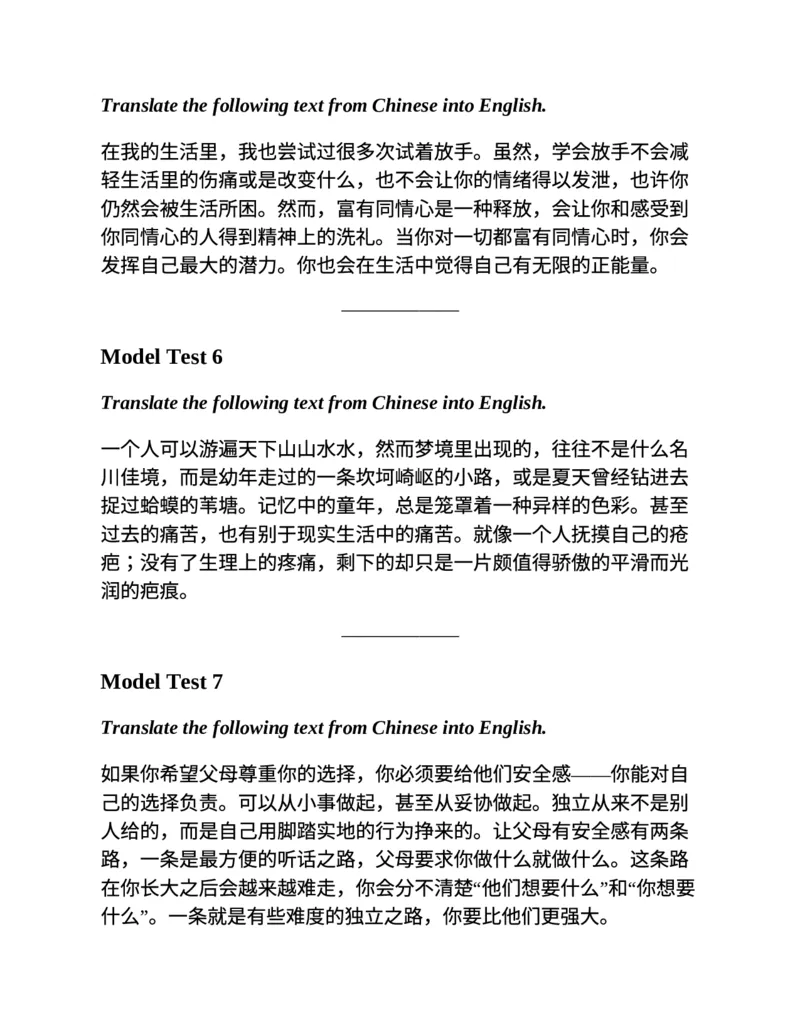
在我的生活里,我也尝试过很多次试着放手。虽然,学会放手不会减
轻生活里的伤痛或是改变什么,也不会让你的情绪得以发泄,也许你
仍然会被生活所困。然而,富有同情心是一种释放,会让你和感受到
你同情心的人得到精神上的洗礼。当你对一切都富有同情心时,你会
发挥自己最大的潜力。你也会在生活中觉得自己有无限的正能量。
——————
Model Test 6
Translate the following text from Chinese into English.
一个人可以游遍天下山山水水,然而梦境里出现的,往往不是什么名
川佳境,而是幼年走过的一条坎坷崎岖的小路,或是夏天曾经钻进去
捉过蛤蟆的苇塘。记忆中的童年,总是笼罩着一种异样的色彩。甚至
过去的痛苦,也有别于现实生活中的痛苦。就像一个人抚摸自己的疮
疤;没有了生理上的疼痛,剩下的却只是一片颇值得骄傲的平滑而光
润的疤痕。
——————
Model Test 7
Translate the following text from Chinese into English.
如果你希望父母尊重你的选择,你必须要给他们安全感——你能对自
己的选择负责。可以从小事做起,甚至从妥协做起。独立从来不是别
人给的,而是自己用脚踏实地的行为挣来的。让父母有安全感有两条
路,一条是最方便的听话之路,父母要求你做什么就做什么。这条路
在你长大之后会越来越难走,你会分不清楚“他们想要什么”和“你想要
什么”。一条就是有些难度的独立之路,你要比他们更强大。
——————
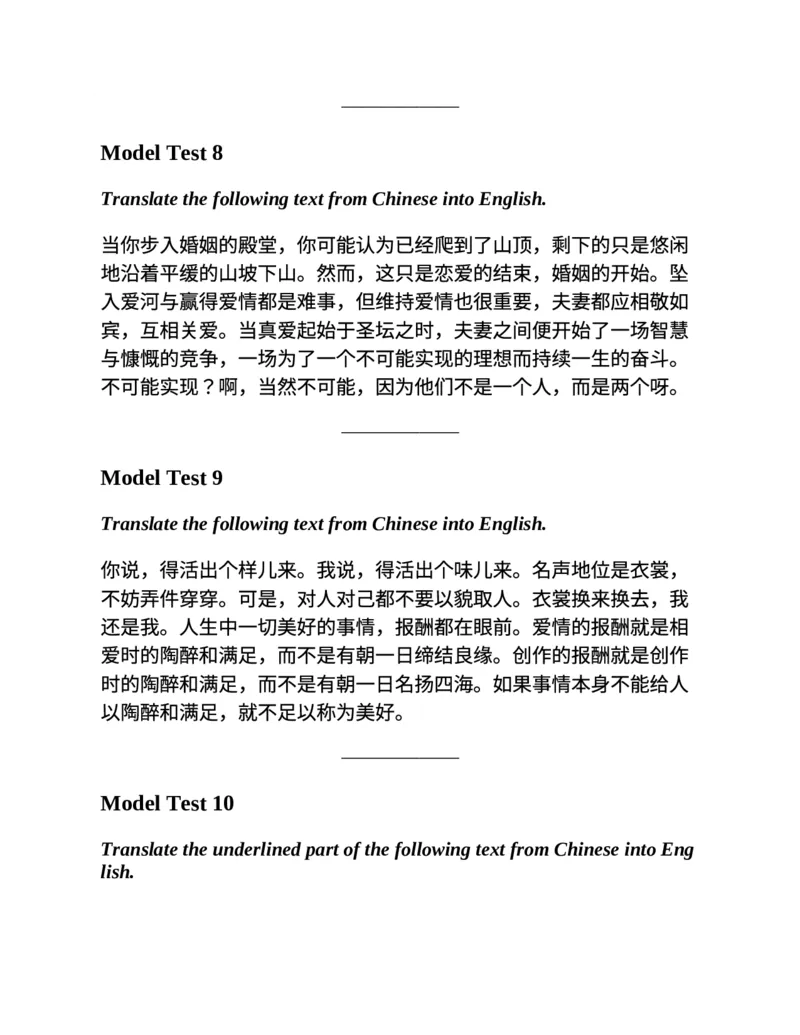
Model Test 8
Translate the following text from Chinese into English.
当你步入婚姻的殿堂,你可能认为已经爬到了山顶,剩下的只是悠闲
地沿着平缓的山坡下山。然而,这只是恋爱的结束,婚姻的开始。坠
入爱河与赢得爱情都是难事,但维持爱情也很重要,夫妻都应相敬如
宾,互相关爱。当真爱起始于圣坛之时,夫妻之间便开始了一场智慧
与慷慨的竞争,一场为了一个不可能实现的理想而持续一生的奋斗。
不可能实现?啊,当然不可能,因为他们不是一个人,而是两个呀。
——————
Model Test 9
Translate the following text from Chinese into English.
你说,得活出个样儿来。我说,得活出个味儿来。名声地位是衣裳,
不妨弄件穿穿。可是,对人对己都不要以貌取人。衣裳换来换去,我
还是我。人生中一切美好的事情,报酬都在眼前。爱情的报酬就是相
爱时的陶醉和满足,而不是有朝一日缔结良缘。创作的报酬就是创作
时的陶醉和满足,而不是有朝一日名扬四海。如果事情本身不能给人
以陶醉和满足,就不足以称为美好。
——————
Model Test 10
Translate the underlined part of the following text from Chinese into Eng
lish.
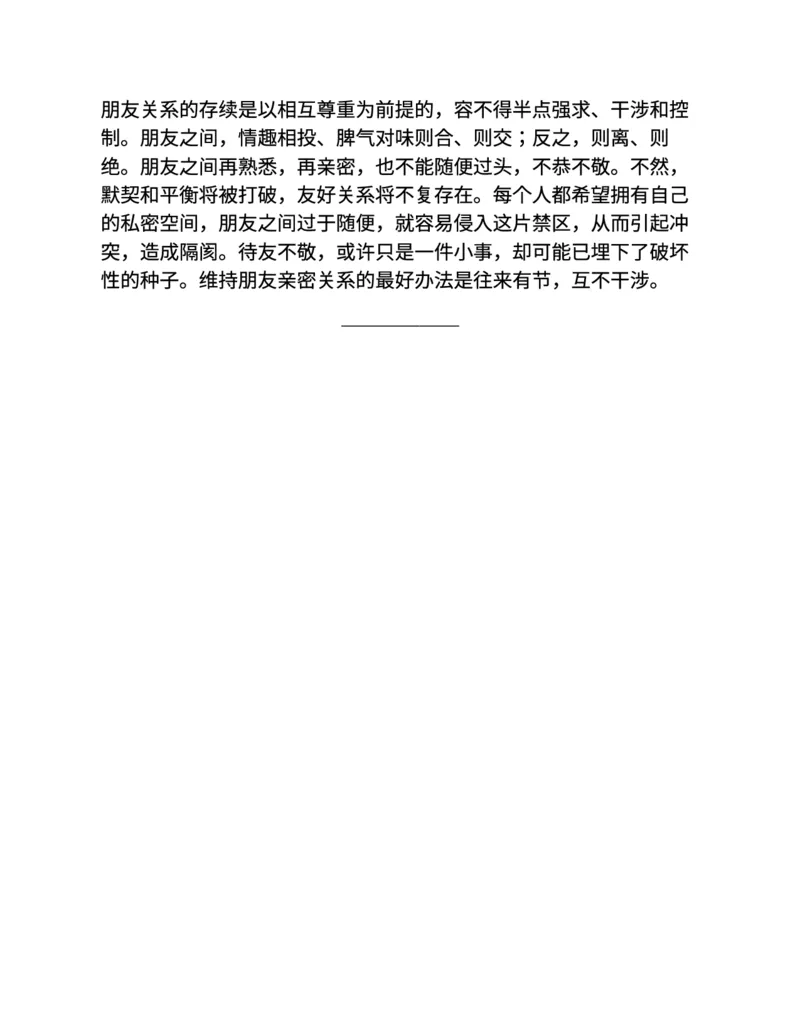
朋友关系的存续是以相互尊重为前提的,容不得半点强求、干涉和控
制。朋友之间,情趣相投、脾气对味则合、则交;反之,则离、则
绝。朋友之间再熟悉,再亲密,也不能随便过头,不恭不敬。不然,
默契和平衡将被打破,友好关系将不复存在。每个人都希望拥有自己
的私密空间,朋友之间过于随便,就容易侵入这片禁区,从而引起冲
突,造成隔阂。待友不敬,或许只是一件小事,却可能已埋下了破坏
性的种子。维持朋友亲密关系的最好办法是往来有节,互不干涉。
——————
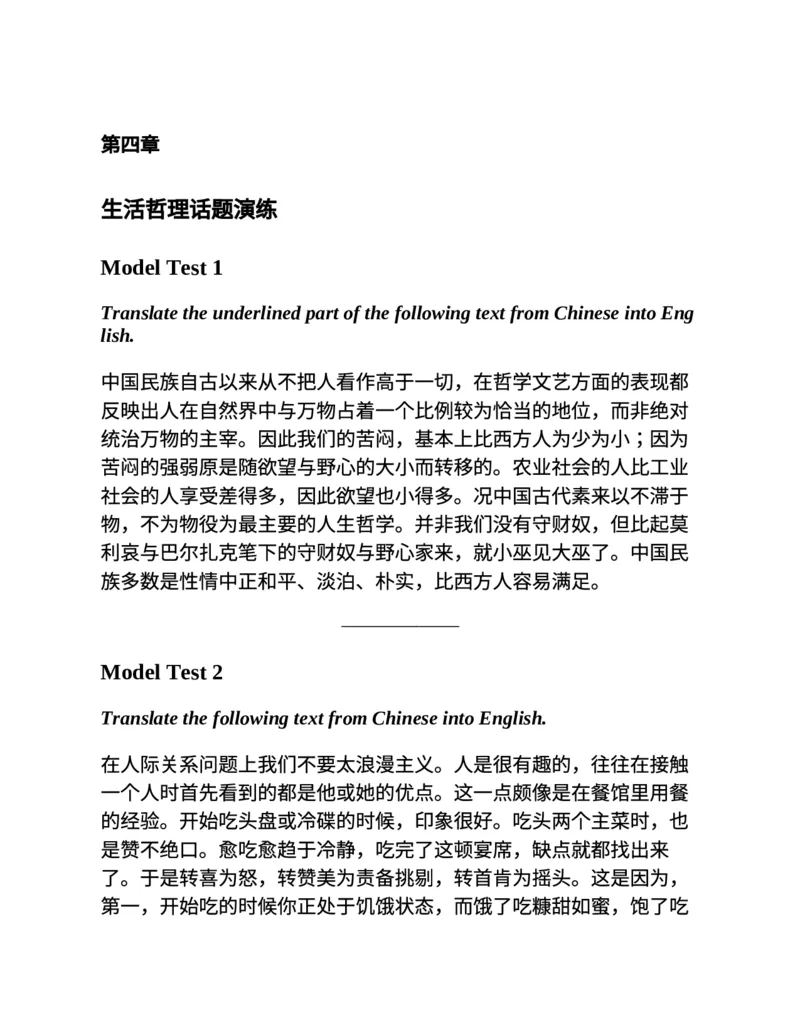
第四章
生活哲理话题演练
Model Test 1
Translate the underlined part of the following text from Chinese into Eng
lish.
中国民族自古以来从不把人看作高于一切,在哲学文艺方面的表现都
反映出人在自然界中与万物占着一个比例较为恰当的地位,而非绝对
统治万物的主宰。因此我们的苦闷,基本上比西方人为少为小;因为
苦闷的强弱原是随欲望与野心的大小而转移的。农业社会的人比工业
社会的人享受差得多,因此欲望也小得多。况中国古代素来以不滞于
物,不为物役为最主要的人生哲学。并非我们没有守财奴,但比起莫
利哀与巴尔扎克笔下的守财奴与野心家来,就小巫见大巫了。中国民
族多数是性情中正和平、淡泊、朴实,比西方人容易满足。
——————
Model Test 2
Translate the following text from Chinese into English.
在人际关系问题上我们不要太浪漫主义。人是很有趣的,往往在接触
一个人时首先看到的都是他或她的优点。这一点颇像是在餐馆里用餐
的经验。开始吃头盘或冷碟的时候,印象很好。吃头两个主菜时,也
是赞不绝口。愈吃愈趋于冷静,吃完了这顿宴席,缺点就都找出来
了。于是转喜为怒,转赞美为责备挑剔,转首肯为摇头。这是因为,
第一,开始吃的时候你正处于饥饿状态,而饿了吃糠甜如蜜,饱了吃
蜜也不甜。第二,你初到一个餐馆,开始举筷时有新鲜感,新盖的茅
房三天香,这也可以叫做“陌生化效应”吧。
——————
Model Test 3
Translate the following text from Chinese into English.
据说,上海男人是最好的丈夫。他们总是知道该如何讨妻子的欢心,
从而避免了矛盾,一家人其乐融融。所以从某种程度上讲,上海男人
是社会安定和谐的象征。当妻子快乐时,他也快乐,因而整个城市也
充满了快乐气氛。虽然上海男人被戏谑为“妻管严”,但他并不屈从于
妻子。在与妻子有争议时,他要么保持沉默,要么一笑置之。有时候
他会发火,但事后不久,他也会毫不迟疑地道歉。最终他妻子发现,
她还是按照他的想法行事。
——————
Model Test 4
Translate the underlined part of the following text from Chinese into Eng
lish.
文学书籍起码使我们的内心可以达到这样的三感:善感、敏感和美
感。生活不如意时,文学书籍给我们提供了可以达到一种比现实更美
好的境界——书里面的水可能比我们现实生活中的水要清,天比我们
现实中的天要蓝;现实中没有完美的爱情,但在书里有永恒的《梁山
伯与祝英台》和《罗密欧与朱丽叶》。读书,会弥补我们现实生活中
所存在的不堪和粗糙。
——————
Model Test 5
Translate the following text from Chinese into English.
时间是不会停留的,是不能收藏的,更不可能用金钱收买,对于那些
成功人士,有上进心的人来说,时间过得快,必须分秒必争,而对于
那些好吃懒做,不求上进的人来说,时间过得慢且枯燥无味。我们每
天其实要浪费很多时间(比如刷牙、洗脸、吃饭、打电话、看电视
等),真正用来创造价值的时间已经很少了。那我们要怎样抓住所剩
无几的时间呢?
——————
Model Test 6
Translate the following text from Chinese into English.
一个人的德,好比一张弓的木心是否在恰当的位置,决定射箭的方
向;一个人的才,好比一张弓是否有力,决定箭射的远近。有德有才
的人就像一张完美的弓,既刚劲有力,射得远,又箭无虚发,射得
准。有德无才的人就像一张有缺陷的弓,尽管木心在正中间,射出去
的箭走正道,但没后劲,射不远,最终还是难以命中目标。
——————
Model Test 7
Translate the following text from Chinese into English.
善良,不是容颜的闭月羞花,不是举止的温文尔雅,不是财富的腰缠
万贯,更不是权势的叱咤风云。善良,是黑暗凄冷中的如豆星火,是
干涸枯竭时的点滴甘露,是迷惘徘徊时的一句点化,是沉迷无助时的
一把搀扶。真正的善良是来自心灵深处的真诚的同情与怜惜,无私的
关爱与祝福。真正的善良,无须剪红刻翠,无须粉黛雕饰,它本身就
是人们内心最原始的一种纯朴的纯洁的感情精华。
——————
Model Test 8
Translate the underlined part of the following text from Chinese into Eng
lish.
修行就是舍得,修行就是舍去不好的,换上好的。舍得丢掉对生命体
每个粒子、细胞不好的、不利的因素,得到好的、有利的因素。舍得
付出自己的努力和辛勤的劳动,舍得付出时间和精力,舍得付出自己
的钱财得到健康、快乐和幸福。
修行就是舍得,舍得清理自己的忧郁、烦恼,得到祥和;舍得清理、
压缩自己大脑细胞储存的一切内容,舍得“空”掉一切,舍得以旧换
新,舍得洗刷立新,舍得取精华、去糟粕,舍得丢掉一切的常规思
维,换上超智慧思维。
——————
Model Test 9
Translate the underlined part of the following text from Chinese into Eng
lish.
中国有句俗话,叫做“一勤天下无难事”。唐朝大文学家韩愈也曾经说
过:“业精于勤。”这就是说,学业方面的精深造诣来源于勤奋好学。
勤,对好学上进的人来说,是一种美德。我们所说的勤,就是要人们
善于珍惜时间,勤于学习,勤于思考,勤于探索,勤于实践,勤于总
结。看古今中外,凡有建树者,在其历史的每一页上,无不都用辛勤
的汗水写着一个闪光的大字——“勤”。
——————
Model Test 10
Translate the following text from Chinese into English.
渴望是永远的乐趣,一笔如地产般真实稳固的财富,用之不尽,取之
不竭。每年我们都会因为拥有渴望而充满活力。一个人如有许多希
望,精神便会富足。人生只不过是一场单调乏味且编导拙劣的戏,除
非我们对这戏有些兴趣;对于既没有艺术细胞也没有科学细胞的人来
说,这个世界只不过是各种颜色的堆积,或者是一条崎岖小路,一不
小心就会摔伤小腿。
——————
第五章
文化教育话题演练
Model Test 1
Translate the following text from Chinese into English.
大自然对人的恩赐,无论贫富,一律平等。所以人们对于大自然,全
都一致并深深地依赖着。尤其在乡间,上千年来人们一直以不变的方
式生活着,种植庄稼和葡萄,酿酒和饮酒,喂牛和挤奶,锄草和栽
花;在周末去教堂祈祷和做礼拜,在节日到广场拉琴、跳舞和唱歌;
往日的田园依旧是今日的温馨家园。这样,每个地方都有自己的传
说,风俗也就衍传了下来。
——————
Model Test 2
Translate the following text from Chinese into English.
读书的要诀,全在于会意。如果根本不读书或者不喜欢读书,那么,
无论说什么求甚解或不求甚解就都毫无意义了。因为不读书就不了解
什么知识,不喜欢读也就不能用心去了解书中的道理。一定要好读
书,真正把书读进去了,越读越有兴趣,自然就会慢慢了解书中的道
理,这才有起码的发言权。对于这一点,陶渊明尤其有独到的见解,
所以他每每遇到真正会意的时候,就高兴得连饭都忘记吃了。
——————
Model Test 3
Translate the underlined part of the following text from Chinese into Eng
lish.
我常常听人说,他想读一点书,苦于没有时间。我不太同意这种说
法。不管他是多么忙,他总不至于忙得一点时间都抽不出来。一天当
中如果抽出一个小时来读书,一年就有365个小时,积少成多,无论研
究什么都会有惊人的成就。零碎的时间最宝贵,但也最容易丢弃。我
记得陆放翁有两句诗:“呼僮不应自升火,待饭未来还读书。”这两句
诗给我的印象很深。待饭未来的时候是颇难熬的,用来读书岂不甚
妙?我们的时间往往于不知不觉中被荒废掉。
——————
Model Test 4
Translate the underlined part of the following text from Chinese into Eng
lish.
读书的眼界,自然还取决于读书的宽度,这既关乎读书兴趣,亦关乎
读书效果。在有些人看来,终日埋头进行科学研究的科学家是一些不
近人情、枯燥乏味的“怪人”。事实上,对生活和事业的热爱,使不少
科学家逐步成为自然美的追求者与发现者。达尔文“常常几小时地阅读
莎士比亚的历史剧”和“拜伦、沃尔特·司各特的诗篇”;诺贝尔读过许
多名人大家的文学作品;我国数学家华罗庚、苏步青都非常喜爱古典
文学。
——————
Model Test 5
Translate the underlined part of the following text from Chinese into Eng
lish.
读了点书,胸中气象、眼中世界不会比一般人小,但现实生活中为什
么人们常常觉得读书人小气、纠结呢?这与读书人对词语的感觉敏
锐、表述精准有一定关系。一般人听不出的语音毛病、词语毛病,你
听出来了;一般人听不出的潜台词、弦外音,你听出来了,听出来就
听出来了呗,千万别较真!读书写文章应追求细腻精准,过日子嘛,
该模糊的地方就一定要模糊。读书要读出大气大度、读出潇洒豁达,
而非越读越小样。
——————
Model Test 6
Translate the following text from Chinese into English.
大学将是你人生最重要的时光,在大学里你会发现学习的真谛。你以
前经常会问到“这个课程有什么用”,这是个好问题,但是我希望你理
解:“教育的真谛就是当你忘记一切所学到的东西之后所剩下的东
西。”我的意思是,最重要的不是你学到的具体的知识,而是你学习新
事物和解决新问题的能力。这才是大学学习的真正意义——这将是你
从被动学习转向自主学习的阶段,之后你会变成一个很好的自学者。
——————
Model Test 7
Translate the underlined part of the following text from Chinese into Eng
lish.
中国科技馆的诞生来之不易。与国际著名科技馆和其他博物馆相比,
它先天有些不足,后天也常缺乏营养,但是它成长的步伐却是坚实而
有力的。它在国际上已被公认为后起之秀。
世界上第一代博物馆属于自然博物馆,它是通过化石、标本等向人们
介绍地球和各种生物的演化历史。第二代博物馆属于工业技术博物
馆,它所展示的是工业文明带来的各种阶段性结果。这两代博物馆虽
然起到了传播科学知识的作用,但是,它们把参观者当成了被动的旁
观者。
世界上第三代博物馆是充满全新理念的博物馆。在这里,观众可以自
己去动手操作,自己细心体察。这样,他们可以更贴近先进的科学技
术,去探索科学技术的奥妙。中国科技馆正是这样的博物馆。它汲取
了国际上一些著名博物馆的长处,设计制作了力学、光学、电学、热
学、声学、生物学等展品,展示了科学的原理和先进的科技成果。
——————
Model Test 8
Translate the following text from Chinese into English.
所谓研究,首先是一种凌空鸟瞰。这一鸟瞰不要紧,目光一下落到了
古希腊的柏拉图、亚里士多德和中国先秦诸子那里,原来两千多年前
这些麻袍飘飘的智者已经在为谣言大费脑筋了。一代代下来,谣言研
究渐次被纳入人性论领域、心理学领域、历史学领域,一旦纳入,这
些领域都因挖掘到了人人都能体验的精神暗窖而顿显丰盈。
——————
Model Test 9
Translate the following text from Chinese into English.
说到童年,我常常感谢我的好父母,他们养成我一种恬淡、“返乎自
然”的习惯,他们给我一个快乐清洁的环境,因此,在任何环境里都能
自足、知足。我尊敬生命,热爱生命,我对于人类没有怨恨,我觉得
许多缺憾是可以改进的,只要人们有决心,肯努力。我不但常常感念
我的父母,我也常常警惕我们应当怎样做父母。
——————
Model Test 10
Translate the underlined part of the following text from Chinese into Eng
lish.
实践证明,勤奋是点燃智慧的火把。一个人的知识多寡,关键在于勤
奋的程度如何。懒惰者,永远不会在事业上有所建树,永远不会使自
己变得聪明起来。唯有勤奋者,才能在无垠的知识海洋里猎取到真智
实才,才能不断地开拓知识领域,获得知识的酬报,使自己变得聪明
起来。高尔基说过:“天才出于勤奋”。卡莱尔也说过:“天才就是无止
境刻苦勤奋的能力”。这就是说,只要我们不怠于勤,善求于勤,就一
定能在艰苦的劳动中赢得事业上的巨大成就。
——————
Model Test 11
Translate the following text from Chinese into English.
茶花(camellia)的自然花期在12月至翌年4月,以红色系为主,另有
黄色系和白色系等,花色艳丽。本届花展充分展示了茶花的品种资源
和科研水平,是近三年来本市规模最大的一届茶花展。为了使广大植
物爱好者有更多与茶花亲密接触的机会,本届茶花展的布展范围延伸
至整个园区,为赏花游客带来便利。
此次茶花展历时2个月,展期内200多个茶花品种将陆续亮相。
——————
Model Test 12
Translate the following text from Chinese into English.
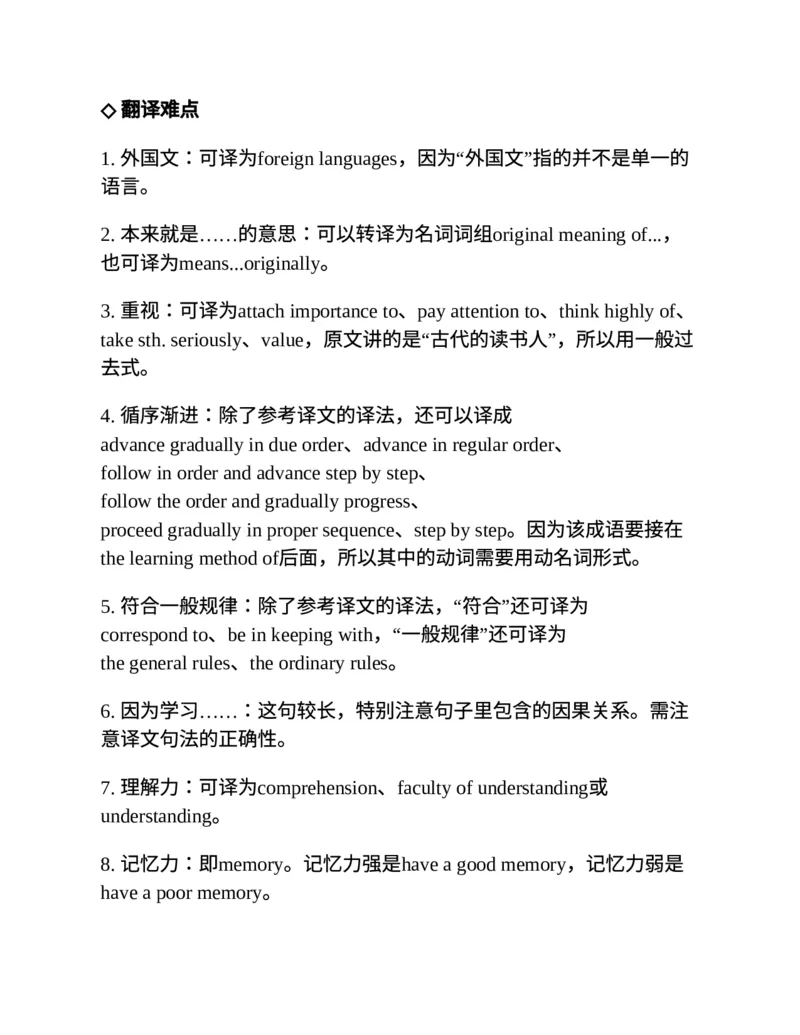
“文化”这个词在外国文里本来就是积累的意思。我国古代的读书人,
很早就重视循序渐进的学习方法,这是符合于一般规律的正确方法。
因为学习不但要靠理解力,还要靠记忆力,而无论一个人的理解力和
记忆力有多强,要理解和记住刚学会的东西,总要有一个过程;哪一
个人如果想一下子就把什么都学会,其结果必定要吃大亏。
——————
Model Test 13
Translate the following text from Chinese into English.
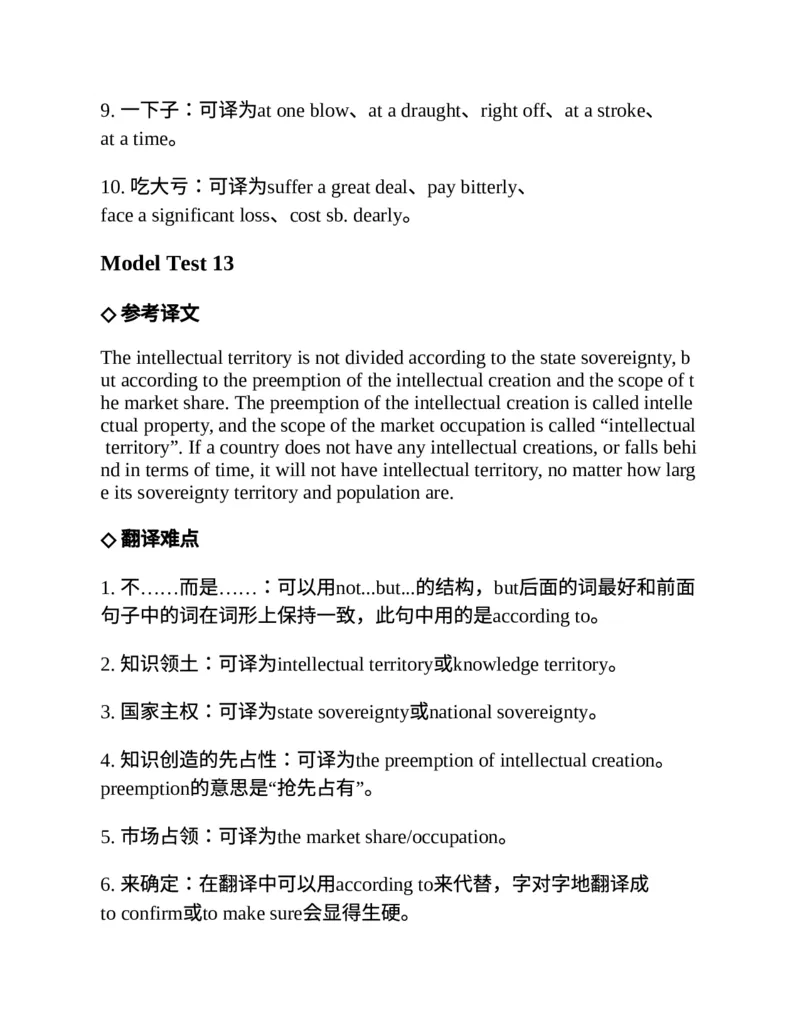
知识领土不按国家主权划分,而是依据知识创造的先占性和市场占领
的范围来确定。知识创造的先占性被称为知识产权,占领的市场范围
被称为“知识领土”。一个国家如果在知识方面没有创造,或在时间上
落后,那么无论这个国家主权领土的面积多么辽阔,人口多么众多,
也不能拥有知识领土。
——————
Model Test 14
Translate the following text from Chinese into English.
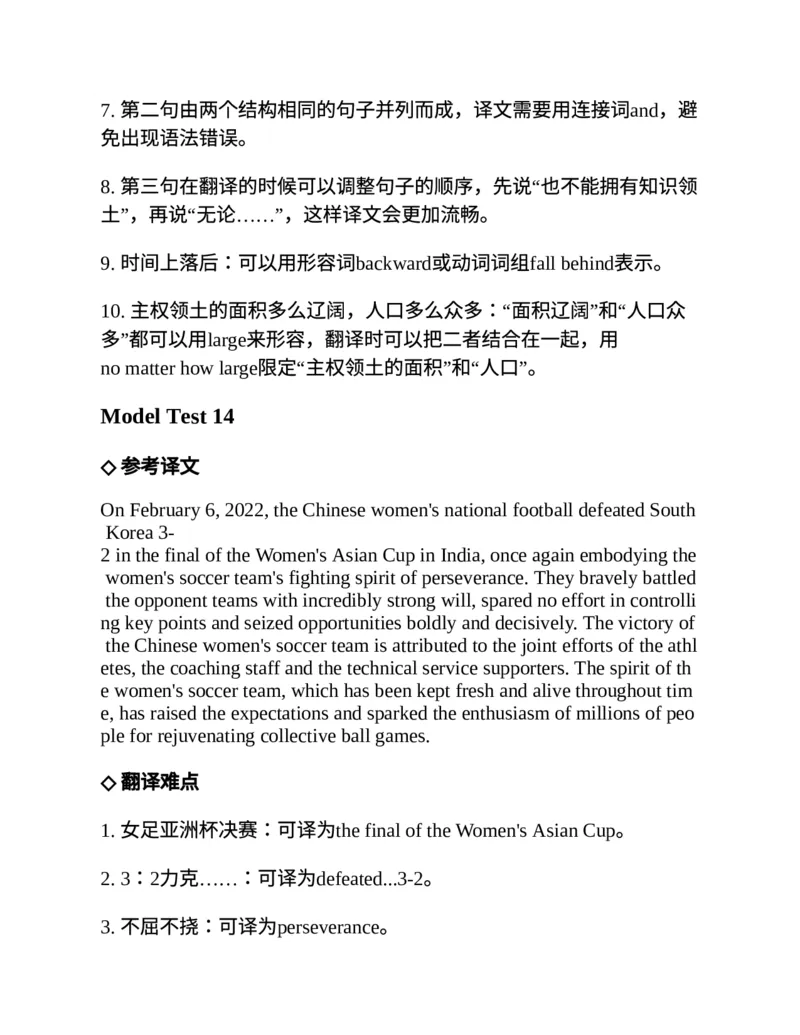
2022年2月6日,中国女足在印度举行的女足亚洲杯决赛中3:2力克韩
国队,再次展现不屈不挠的女足精神。她们面对强队敢打敢拼、意志
顽强,在关键点的掌控上不遗余力,在战机的捕捉上果敢勇毅。中国
女足的胜利是运动员队伍、教练员团队和技术服务保障人员共同奋斗
的结果。女足精神历久弥新,让亿万人重燃集体球类项目崛起的期盼
与热情。
——————
Model Test 15
Translate the underlined part of the following text from Chinese into Eng
lish.
由小学到中学,所修习的无非是一些普通的基本知识。就是大学四
年,所授课业也还是相当粗浅的学识。世人常称大学为“最高学府”,
这名称易滋误解,好像过此以上即无学问可言。大学的研究所才是初
步研究学问的所在,在这里做学问也只能算是粗涉藩篱,注重的是研
究学问的方法与实习。学无止境,一生的时间都嫌太短,所以古人皓
首穷经,头发白了还是在继续研究,不过在这样的研究中确是有浓厚
的趣味。
——————
Model Test 16
Translate the underlined part of the following text from Chinese into Eng
lish.
文明是什么意思?它意指一个建立在平民百姓舆论基础上的社会。它
意味着暴力、武士和暴君的统治、战争冲突、暴动暴政为立法议会所
取代,被法律得以长期维护的独立法庭所代替。这就是文明,在文明
的土壤里,自由、舒适和文化不断发展壮大。如果文明在任何一个国
家里占了支配地位,那么便可给人民群众提供一种更加宽松的较为平
静的生活,过去的传统则受人珍重,英明伟人或勇士们留下的遗产则
成为我们共同享用的丰富财产。
——————
Model Test 17
Translate the underlined part of the following text from Chinese into Eng
lish.
中国文化目前在国际文化竞争中处于弱势,原因很多。首先我们对西
方文化的了解,远比对方对我们的了解要多得多。还有历史原因,一
边是中国屈辱的近代史,一边是西方文艺复兴以来欧洲文明迅速勃兴
形成的优越感。也有技术原因,汉语太美太难掌握,世界上精通现代
汉语的学者相对还太少,这造成了交流的障碍。另外由于文化的差
异,有些西方学者也容易从某种印象出发做出主观的判断。这样的现
实,并非一日形成。
——————
Model Test 18
Translate the underlined part of the following text from Chinese into Eng
lish.
与舞蹈和音乐相伴的歌谣跟口头流传的神话,远在文字出现之前就已
大量产生。中国的文学正是发端于此。不过歌谣本是人们在生活中随
兴而发的东西,上古时代也没有保存和记载它们的手段,因此也就很
快湮灭,不留痕迹。我们只能从一些古籍书中推断它们的存在。古书
中记载了一些据称年代非常久远的歌谣,但是大多出于后人的伪托,
能够断定朝代的歌谣要到《诗经》里才能看见。从这点来看,古代神
话对中国文学的影响更为显著。
——————
Model Test 19
Translate the underlined part of the following text from Chinese into Eng
lish.
尽管中国古代神话没有十分完整的情节,神话人物也没有系统的家
谱,但它们却有着鲜明的东方文化特色,其中尤为显著的是它的尚德
精神。这种尚德精神在与西方神话特别是希腊神话比较时,显得更加
突出。在西方神话尤其是希腊神话中,对神的褒贬标准多以智慧、力
量为准则,而中国古代神话对神的褒贬则多以道德为准绳。这种思维
方式深植于中国的文化之中。几千年来,这种尚德精神影响着人们对
历史人物的品评与现实人物的期望。
——————
Model Test 20
Translate the following text from Chinese into English.
中医有五千多年的历史,是中国古代劳动人民几千年来对抗疾病的经
验总结。中医将人体看成是气、形、神的统一体,以“望、闻、问、
切”为其独特的诊断过程。中医使用中药、针灸以及许多其他治疗手
段,使人体达到阴阳调和。阴阳和五行是中医的理论基础。五行是自
然界中的五种基本物质,即金、木、水、火、土。
——————
Model Test 21
Translate the underlined part of the following text from Chinese into Eng
lish.
讲英语的人听到别人赞扬,一般说“谢谢”,表示接受,说明自己认为
对方的赞扬是诚心诚意的,所赞扬的事是值得赞扬的。因此不应“假装
自卑”或“故作谦虚”。但是,对于中国人来说,听到别人赞扬时,通常
要表示受之有愧,做得很不够;或者说自己的成就不过是由于侥幸,
或者说是客观条件造成的,等等,而接受赞扬则意味着有骄傲自满情
绪或“缺乏教养”。因此,上述两种回答引起不同反应是由于双方语言
习惯不同。
——————
Model Test 22
Translate the underlined part of the following text from Chinese into Eng
lish.
中华民族的传统文化博大精深,源远流长。早在2000多年前,就产生
了以孔孟为代表的儒家学说和以老庄为代表的道家学说,以及其他许
多也在中国思想史上有地位的学说和学派。这就是有名的诸子百家。
从孔夫子到孙中山,中华民族的传统文化有它的许多珍品,许多人民
性和民主性的好东西。比如,强调仁爱、强调群体、强调天下为公,
特别是“天下兴亡,匹夫有责”的爱国情操和吃苦耐劳、勤俭持家、尊
师重教的传统美德。所有这些,对家庭、对国家和社会都起到了巨大
的维系和调节作用。
——————
Model Test 23
Translate the underlined part of the following text from Chinese into Eng
lish.
北京这座千古名城是中国古代科学技术和文化艺术高度发展的杰作。
历朝历代帝王在这凝聚中华文明精髓的龙脉宝地君临天下、威仪四
海,陆续修建了雄伟壮观的八达岭长城、集天下园林之大成被选誉为
万园之园的圆明园、集全国的能工巧匠而修建的故宫以及保留最完整
的古代祭天建筑群,举世闻名的艺术珍品——天坛。北京这座历史文
化名城是中国皇家园林与宫殿建筑的代表和典范,是凝聚中华文明精
髓的世界文化遗产。
——————
Model Test 24
Translate the following text from Chinese into English.
科学家是以自己在某个专业领域的杰出才华作为谋生手段的,没有这
种才华,他就没有资格享有科学家可以享受的一切;但科学家同时也
是社会的一分子,有义务有责任参与公共事务、关注社会热点,使我
们这个社会变得更加理性、更加善良、更加正义、更加温暖。如果
说,专业技能是科学家的一只翅膀的话,公共精神则是他们的另一只
翅膀,缺少其中任何一只,他们都无法在岁月的深处翱翔。
——————
Model Test 25
Translate the following text from Chinese into English.
科学就是探求真理。在探求真理的过程中,人们对客观规律的认识要
经过艰苦曲折的过程。常常有这样的情形:由于研究的角度不同,掌
握资料的差异,认识方法的不同,就会出现“横看成岭侧成峰,远近高
低各不同”的情况,以至引起学术上的争论。因此,有作为的科学工作
者都把反对的意见看作对自己的莫大的帮助,把对自己的批评当作最
珍贵的友谊。
——————
Model Test 26
Translate the underlined part of the following text from Chinese into Eng
lish.
许多大科学家一生钟爱艺术,且懂艺术,从中汲取养料,善养浩然之
气,或得到人生最大安慰。相反,热爱自然科学并且理解工程技术的
文学艺术家真可谓凤毛麟角。艺术家对自然科学望而生畏,敬而远
之,原因之一是里面有一大堆高深的数学公式。其实,撇开数学,绕
过那一大堆公式,一门学科的基本思想还是可以被我们理解和欣赏
的。这恰如我们虽然看不懂莫扎特乐曲的总谱,却照样能同它的主旋
律产生共鸣,击节称赞。
——————
Model Test 27
Translate the following text from Chinese into English.
人类对研究蚂蚁极感兴趣。我们越研究它们,越觉得它们像我们自
己。字典告诉我们,蚂蚁是一种社会性昆虫。这就是说,蚂蚁是生活
在社会之中的,在这些社会中,它们相互依赖。这些社会并不都完全
一样。它们之所以有差别是因为蚂蚁种类繁多——事实上在一万五千
种以上。但是总的讲来,每一种蚂蚁都有三种主要类型:雌蚁、雄蚁
和工蚁。
——————
Model Test 28
Translate the underlined part of the following text from Chinese into Eng
lish.
根据外国一些科学家的实验结果,“用脑伤神”的旧说法已经不能成
立,应改为“用脑长寿”。人的衰老主要是脑细胞的死亡。中老年人的
脑细胞虽然天天死亡,但人一生中所启用的脑细胞只占细胞总量的四
分之一,而且在活动的情况下,每天还有新的脑细胞产生。只要脑筋
的活动不停止,新生细胞比死亡细胞数目还要多。勤于动脑筋,则能
经常保持脑中血液的流通状态,而且能通过脑筋协调控制全身的功
能。
——————
Model Test 29
Translate the underlined part of the following text from Chinese into Eng
lish.
中国人饮茶,注重一个“品”字。“品茶”不但是鉴别茶的优劣,也带有
神思遐想和领略饮茶情趣之意。在百忙之中泡上一壶浓茶,择雅静之
处,自斟自饮,可以消除疲劳、涤烦益思、振奋精神,也可以细啜慢
饮,达到美的享受,使精神世界升华到高尚的艺术境界。品茶的环境
一般由建筑物、园林、摆设、茶具等因素组成。饮茶要求安静、清
新、舒适、干净。中国园林世界闻名,山水风景更是不可胜数。利用
园林或自然山水间,搭设茶室,让人们小憩,意趣盎然。
——————
Model Test 30
Translate the underlined part of the following text from Chinese into Eng
lish.
“孔子曰:三人行,则必有我师。是故弟子不必不如师,师不必贤于弟
子。闻道有先后,术业有专攻,如是而已。”
韩愈的原意,是因为自己接受了门徒,为抵制当时舆论的非议,所以
写这篇文章自解。他的意思是说,自己虽然是作了先生,并不一定样
样贤于弟子,从他学的人也不一定不如他,人们不必因此而大惊小
怪。本来,只要是一个人闻道在先,不管他是什么人,都可以拜他为
师。
——————
第六章
文学作品话题演练
Model Test 1
Translate the underlined part of the following text from Chinese into Eng
lish.
我们住在一所山村学校,叫喊声未必能让远处的人家听见。忽然,我
想起了口哨——母亲上体育课时用的口哨。鼓起胸腔,我拼命地让全
部的气流吹出尽可能最大的声响。渐渐地,我听见了家门前由远及近
嘈杂的脚步声,大声说话的声音。窗外交织着手电筒的光亮。我听见
了乡亲们喊我的名字。开了门,一群人扛着锄头站在我家门前,他们
都是周围我熟悉的乡亲。善良的黑脸,热切的目光,一群人由衷的关
爱,驱散了我内心的恐惧。
——————
Model Test 2
Translate the following text from Chinese into English.
这以后的九个年头,为了保持求学(尤其是英语学习)的高昂斗志,
我压抑着对音乐的朦胧向往。我的这番努力取得了丰硕成果,我在家
乡读完了中学和大学,都很顺利。我还考上了首都北京的一家名牌大
学读第二学位。当我接到通知书时我真感动得热泪盈眶了。我懂英
语,我知道这就是我的本钱,我可以和有钢琴的人进行互助,我教他
英语,他让我弹琴。
——————
Model Test 3
Translate the following text from Chinese into English.
路上只我一个人,背着手踱着。这一片天地好像是我的;我也像超出
了平常的自己,到了另一世界里。我爱热闹,也爱冷静;爱群居,也
爱独处。像今晚上,一个人在这苍茫的月下,什么都可以想,什么都
可以不想,便觉是个自由的人。白天里一定要做的事,一定要说的
话,现在都可不理。这是独处的妙处,我且受用这无边的荷香月色好
了。
——————
Model Test 4
Translate the following text from Chinese into English.
见过一些社会底层的老人,这些人多是农家人,田间里辛劳一生,慢
慢地累弯了腰,在墙角路边聊度余生,那腰也就更像一棵藤。我还在
医院里看到一个老态女子,弯了的腰使头几乎垂于地面,走路时双手
撑在脚上,脚挪手也挪,身子像个甲壳虫。进了产房,你几乎忽略了
她是一个女人,可她确确实实地生出了一个孩子,成为一个母亲,那
是个大胖小子呢。
——————
Model Test 5
Translate the underlined part of the following text from Chinese into Eng
lish.
暮色中,河湾里落满云霞,与天际的颜色混合一起,分不清哪是流云
哪是水湾。
也就在这一幅绚烂的图画旁边,在河湾之畔,一群羊正在低头觅食。
它们几乎没有一个顾得上抬起头来,看一眼这美丽的黄昏。也许它们
要抓紧时间,在即将回家的最后一刻再次咀嚼。这是黄河滩上的一
幕。牧羊人不见了,他不知在何处歇息。只有这些美生灵自由自在地
享受着这个黄昏。这儿水草肥美,让它们长得肥滚滚的,像些胖娃
娃。如果走近了,会发现它们那可爱的神情,洁白的牙齿,那丰富而
单纯的表情。如果稍稍长久一点端详这张张面庞,还会生出无限的怜
悯。
——————
Model Test 6
Translate the following text from Chinese into English.
我看不见那个小子的脸,不知道他脸上的表情,但是从他刚才的话
里,我知道对于他另外有一个世界存在。没有家,没有爱,没有温
暖,只有一根生活的鞭子在赶他。然而他能够倔强!他能够恨!他能
够用自己的两只手举起生活的担子,不害怕,不悲哀。他能够做别的
生在富裕的环境里的小孩所不能够做的事情,而且有着他们所不敢有
的思想。
——————
Model Test 7
Translate the following text from Chinese into English.
你能怎么办呢?对于这个好老太太。邮差先生费了半天唇舌,终于又
走到街上来了。小城的阳光照在他的花白头顶上,他的模样既尊贵又
从容,并有一种特别风韵,看见他你会当他是趁便出来散步的。说实
话他又何必紧张,他手里的信反正总有时间全部送到,那么在这个小
城里,另外难道还会有什么事等候他吗?虽然他有时候是这样抱歉,
他为这个小城送来——不,这种事是很少有的,但愿它不常有。
——————
Model Test 8
Translate the following text from Chinese into English.
我们的潜意识里藏着一派田园诗般的风光。我们仿佛身处一次横贯大
陆的漫漫旅程之中。乘着火车,我们领略着窗外流动的景色:附近高
速公路上奔驰的汽车、十字路口处招手的孩童、远山上吃草的牛群、
源源不断地从电厂排放出的烟尘、一片片的玉米和小麦、平原与山
谷、群山与绵延的丘陵、天空映衬下城市的轮廓,以及乡间的庄园宅
第。
——————
Model Test 9
Translate the underlined part of the following text from Chinese into Eng
lish.
那就是白杨树,西北极普通的一种树,然而实在不是平凡的一种树!
那是力争上游的一种树,笔直的干,笔直的枝。它的干呢,通常是丈
把高,像是加过人工似的,一丈以内,绝无旁枝;它所有的丫枝呢,
一律向上,而且紧紧靠拢,也像是加过人工似的,成为一束,绝无横
斜逸出;它的宽大的叶子也是片片向上,几乎没有斜生的,更不用说
倒垂了;它的皮,光滑而有银色的晕圈,微微泛出淡青色。这是虽在
北方的风雪的压迫下却保持着倔强挺立的一种树!
——————
Model Test 10
Translate the underlined part of the following text from Chinese into Eng
lish.
泊珍到偏远小镇的育幼院把生在那里养到1岁的孩子接回来。但泊珍看
他第一眼,仿似一声雷劈头而来,令她晕头胀脑,这1岁的孩子脸型长
得如此熟悉,她心里的第一道声音是,不能带回去!
痛苦纠聚心中,眉心发烫发热,胸口郁闷难展,胃里一股气冲喉而
上。院长说这孩子发育迟缓时,她更是心头无绪。她在孩子所待的房
里来回踱步,这房里还有其他小孩。整个房间只有一扇窗,窗外树影
婆娑。就让孩子留下来吧,这里有善心的神父和修女,这里将来会扩
充为有医疗作用的看护中心,这是留住孩子最好的地方。这孩子是她
的秘密,她将秘密留在这树林掩映的建筑里。
她将秘密留在心头。
——————
Model Test 11
Translate the underlined part of the following text from Chinese into Eng
lish.
当我在小学毕了业的时候,亲友一致的愿意我去学手艺,好帮助母
亲。我晓得我应当去找饭吃,以减轻母亲的勤劳困苦。可是,我也愿
意升学。我偷偷地考入了师范学校——制服,饮食,书籍,宿处,都
由学校供给。只有这样,我才敢对母亲提升学的话。入学,要交十元
的保证金。这是一笔巨款!母亲作了半个月的难,把这巨款筹到,而
后含泪把我送出门去。她不辞劳苦,只要儿子有出息。当我由师范毕
业,而被派为小学校长,母亲与我都一夜不曾合眼。我只说了句:“以
后,您可以歇一歇了!”她的回答只有一串串的眼泪。
——————
Model Test 12
Translate the underlined part of the following text from Chinese into Eng
lish.
我的最大爱好是深思默想。我可以一个人长时间地独处而感到愉快。
独享欢乐是一种愉快,独自忧伤也是一种愉快。孤独的时候,精神不
会是一片纯粹的空白,它仍然是一个丰富多彩的世界。情绪上的大欢
乐和大悲痛往往都在孤独中产生。孤独中,思维可以不依照逻辑进
行。孤独更多地产生人生的诗情——激昂的和伤感的。孤独可以使人
的思想向更遥远更深邃的地方伸展,也能使你对自己或环境作更透彻
的认识和检讨。
——————
Model Test 13
Translate the underlined part of the following text from Chinese into Eng
lish.
徐霞客一生周游考察了十六个省,足迹几乎遍及全国。他在考察的过
程中,从来不盲目迷信书本上的结论。他发现前人研究地理的记载有
许多很不可靠的地方。为了进行真实细致的考察,他很少乘车坐船,
几乎全靠双脚翻山越岭,长途跋涉;为了弄清大自然的真相,他总是
在道路艰险的山区和人迹稀少的树林进行考察,发现了许多奇山秀
景;他常常选择不同的时间和季节,多次重游各地名山,反复观察变
换的奇景。
——————
Model Test 14
Translate the following text from Chinese into English.
七十五岁时重返文坛,丁玲没有时间为自己的遭遇呻吟叹息。她就像
年轻人一样急切地捧出了一枝报春的红杏——《杜晚香》,忘情地投
入新的生活和创作。她奔波于大江南北,游历于欧、美、澳大陆,会
见各种人,发表演说,奋笔疾书,写散文,写评论,每年都有十多万
字的新作,每年都有新书问世。晚年的丁玲,迎来了一个宝贵的创作
旺盛期。她珍惜夕阳的余晖,计划在有生之年再写三本书。
——————
Model Test 15
Translate the underlined part of the following text from Chinese into Eng
lish.
海风微微地吹过岛上,白日里剩下的热气全吹走了。夜晚是很静寂
的。整个岛落在一层柔软的黑暗的网里。只有深蓝色的天空中闪烁着
无数的明星,这里的星似乎比在别的地方都明亮。人们常常这样说:
白天的太阳使这个岛特别明亮,夜里是星子使这个岛特别灿烂。
灯光渐次地灭了。一些建筑稀落地耸立在黑暗里,被茂盛的树木掩盖
着。路是几条螺旋形的山路,交缠着,从岩石般的山顶蜿蜒地伸下
来,到了下面便是比较热闹的街市,这时沿街的商店已经大半关了
门。
——————
Model Test 16
Translate the following text from Chinese into English.
夜是静寂的,柔和的。从对面我听不见一点声音。香港似乎闭了它的
大口。但是当我注意到那一座光芒万丈的星的山的时候,我又仿佛听
见那许多灯光的私语了。因为船的移动,灯光也似乎移动起来。而且
电车、汽车上的灯也在飞跑。我看见它们时明时暗,就像人在眨眼,
或者像它们在追逐,在说话。我的视觉和听觉混合起来。我仿佛在用
眼睛听了。
——————
Model Test 17
Translate the underlined part of the following text from Chinese into Eng
lish.
作家有三种死法。一曰自然的死,二曰痛苦的死,三曰快乐的死。
自然的死属于心脏停止跳动,是一种普遍的死亡形式,没有特色,可
以略而不议。快乐的死和痛苦的死不属于心脏停止跳动,是人还活
着,作品已经或几乎是没有了!
作家没有了作品,可以看作个人艺术生命的死亡、职业的停顿。其中
有些人是因为年事已高,力不从心。这不是艺术的死亡,而是艺术的
离休,他自己无可自责,社会也会尊重他在艺术上曾经做出的贡献。
——————
Model Test 18
Translate the following text from Chinese into English.
窗子许里面人看出去,同时也许外面人看进来,所以在热闹地方住的
人要用窗帘子,替他们私生活做个保障。晚上访人,只要看窗里有无
灯光,就约略可以猜到主人在不在家,不必打开了门再问,好比不等
人开口,从眼睛里看出他的心思。关窗的作用等于闭眼。天地间有许
多景象是要闭了眼才看得见的,比如梦。假使窗外的人声物态太嘈杂
了,关了窗好让灵魂自由地去探胜,安静地默想。
——————
Model Test 19
Translate the underlined part of the following text from Chinese into Eng
lish.
我小的时候特别盼望过年,往往是一过了腊月,就开始掰着指头数日
子。对于我们这种焦急的心态,大人们总是发出深沉的感叹,好像他
们不但不喜欢过年,而且还惧怕过年。他们的态度令当时的我感到失
望和困惑,现在我完全能够理解了。我想长辈们之所以对过年感慨良
多,一是因为过年意味着一笔开支,二是飞速流逝的时间对他们构成
巨大压力。小孩子可以兴奋地说:过年了,我又长大了一岁;而老人
们则叹息:嗨,又老了一岁。过年意味着小孩子正在向自己生命过程
中的辉煌时期进步,而对于大人,则意味着正向衰朽的残年滑落。
——————
Model Test 20
Translate the following text from Chinese into English.
虎不惊扰僧人,却替他们守护庙宇。作为报酬,和尚把一些可吃的东
西放在庙门前。每天傍晚,夕阳染红小半个天空,虎们成群地走到庙
门口,吃了东西,跳跃而去。庙门大开,僧人们安然在庙内做他们的
日课,也没有谁出去看虎怎样吃东西,即使偶尔有一二和尚立在门
前,虎们亦视为平常的事情,把他们看作熟人,不去惊动,却斯斯文
文地吃完走开。
——————
Model Test 21
Translate the following text from Chinese into English.
我细细量过九十九次自己标高,实属“终生残废”系列。但那时年少,
血旺气盛,誓与凡俗抗争到底,于是连哄带骗将一净高1.74米女孩拐
回家做起了太太,这一壮举颇为“残废人”们扬了一段眉吐了半口气。
将太太置回家中后我才意识到自己的悲哀,这一愤世之举不仅未了
我“终生残废”而又平添我“终生遗憾”,我从未享受过将男人坚定有力
的胳膊窝勾着太太姣美柔滑的后脖子上街遛弯的幸福。
——————
Model Test 22
Translate the underlined part of the following text from Chinese into Eng
lish.
有一种人我最不喜欢和他下棋,那便是太有涵养的人。杀死他一大
块,或是抽了他一个车,他神色自若,不动火,不生气,好像是无关
痛痒,使你觉得索然寡味。君子无所争,下棋却是要争的。当你给对
方一个严重威胁的时候,对方的头上青筋暴露,黄豆般的汗珠一颗颗
地在额上陈列出来,或哭丧着脸作惨笑,或咕嘟着嘴作吃屎状,或抓
耳挠腮,或大叫一声,或长吁短叹,或自怨自艾口中念念有词,或一
串串地噎嗝打个不休,或红头涨脸如关公,种种现象,不一而足。这
时节你“行有余力”便可以点起一支烟,或啜一碗茶,静静地欣赏对方
的苦闷的象征。我想猎人追逐一只野兔的时候,其愉快大概略相仿
佛。
——————
Model Test 23
Translate the underlined part of the following text from Chinese into Eng
lish.
张恨水先生曾写过一篇《为人应当接受批评》,他说:“生平很少和人
打笔墨官司,就是人家指出我的名姓来教训一顿,我也不曾回复一个
字。这样做,我并非怯懦,也并非过分的容忍。我有个感想,我错
了,止谤莫如自修。我不错,最好借事实来答复。这是一个办法,也
许不适合他人,但至少我自己,在做人上纠正了不少错误。而三十年
来的写作生涯,略有寸进,一大半也就是根据别人的批评而得的。”恨
水先生对待批评的态度,很值得当今文化人学习。
——————
Model Test 24
Translate the following text from Chinese into English.
有人说,对文学,应让人们自由取用,不要划分高低。这是典型的“文
学民粹主义”,似是而非。就个人而言,不经过基本教育,何能自由取
用?鼠目寸光、井蛙观天,恰恰违背了“自由”的本义;就整体而言,
如果在精神文化上也不分高低,那就会失去民族的大道、人类的尊
严,一切都将在众声喧哗中不可收拾。
——————
PART 3
答案精析
第一章
心灵感悟话题演练
Model Test 1
◇ 参考译文
I think everyone, in effect, has a small garden of his own, namely, our inner
world. There is a need for human beings to tap into their own intelligence, s
o is the case with their inner world. What distinguishes between human bein
gs and animals, apart from the various aspects which are universally known,
may probably be in that human beings have an inner world. Heart is no mo
re than an important organ whereas the inner world constitutes a landscape,
which gradually takes its shape under the continuous influence from the out
side world. So great importance that everyone attaches to the physical condi
tion of his own heart or those of his closest and dearest ones that merely a
minor disease would enduringly weigh on his mind. But not everyone is con
cerned with the condition of his own inner world and that of his closest and
dearest ones.
◇ 翻译难点
1. 这便是:即“也就是”,可译为namely。
2. 内心世界:inner world或inward world。
3. 人的智力需要开发,人的内心世界也是需要开发的:“开发”用
exploit不恰当,它指的是开发能源。而这里指开发智力,可理解为“挖
掘”,即tap into,后一句的“也是需要开发的”若直接译成
there is also a need to tap into就显得啰嗦了,故用短语
so is the case with...(……也一样)。
4. 人和动物的区别……人有内心世界:整句用了一个主语从句,用转
性译法将“区别”转化为动词“把……区分开”,可以译为
distinguish...from...或distinguish between...and...。“在于”译为in that。
5. 不过:即“仅仅,只是”,可用only,但no more than更符合英语表达
习惯。
6. 它是由外部世界不断地作用于内心渐渐形成的:这一句是对内心世
界进行补充说明,用一个定语从句来译可使句子更加紧凑。“形成”译
为take shape。
7. 每个人都无比关注……,以至于稍有微疾便惶惶不可终日:“无比关
注……,以至于”可以用so...that...这个句型。若按中文顺序译为
everyone attaches so great importance to...that...,译文中将
so great importance提前了。“无比关注”指重视,故译为
attach importance to。“心脏的健损”指的是心脏的健康状况,故译为
the physical condition of heart。“微疾”指小病,故译为
minor disease。“惶惶不可终日”可以理解为整日担心,一直挂在心上,
故译为enduringly weigh on one's mind。
8. 但并非每个人都关注……的阴晴:最后这句话的“关注内心世界”与
前句的“关注心脏的健损”形成对比,故“内心世界的阴晴”译为
the condition of inner world。
Model Test 2
◇ 参考译文
Days spent in expectation came and went really very fast. Very soon I finish
ed primary school, went to junior and senior middle school, and finally to c
ollege; with ever greater desire for more varied things: for graduation with
honors, for an ideal job, for a successful career, for more earnings to share
my parents' burden, for a loving wife... Climbing the upward steps of hope,
I had become a fully grown man before I was aware of it, a busy bread-
winner with a family on my hands.
◇ 翻译难点
1. 在盼中,日子真的流得飞快:此句与后面内容的联系相对松散些,
因此可译成一个独立的句子。“盼”指的是“希望,期冀”,可译为
expectation。“流得飞快”可译为came and went very fast,或
fleeted away。
2. 转眼上了小学……最后大学:该部分需增译出主语I。“小学”“初
中”“高中”“大学”这几个求学阶段的译文分别为primary school、
junior middle school、senior middle school、college。
3. 盼的欲望更加强烈,盼的内容也渐渐丰富了:“盼”和“欲望”意思相
同,故译为desire一词即可。“盼的内容也渐渐丰富了”指“盼的东西多
种多样”,此处将两部分合译为
with ever greater desire for more varied things,使译文更为简洁。
4. 盼有好成绩毕业……爱人:此处是对前面盼的内容的具体说明,在
翻译时可转译为for引导的介词短语
for graduation with honors...for a loving wife。
5. 不知不觉……忙碌人了:这部分的语义重心在后,因此可考虑把“天
天踩着盼的石阶而上”译为分词短语,后面的内容译为主句。“一个挣
钱养家糊口的忙碌人”可译为a busy bread-
winner with a family on my hands。“大男人”不能直译为a big man,此
处指“长大成人”,可译为a fully-grown man。
Model Test 3
◇ 参考译文
For the innocent and artless children, travelling with their parents, getting pr
etty clothes, obtaining a fine toy or some delicious candies will satisfy their
eagerness for happiness. For the young people who are in their early adulth
ood, outstanding grades, excellent academic performance, affection from th
e opposite sex and surfing on the Internet are always the happiness they loo
k forward to. And the things that the middle-
aged pursue should naturally be the successful careers and happy families.
As for the senior, “health is gold, and peace is the blessing”, showing what t
hey expect for happiness.
◇ 翻译难点
1. 天真烂漫:可译为innocent and artless、have stars in one's eyes或
simple and unaffected。
2. 满足他们对幸福的渴望:可译为
satisfy their eagerness for happiness。“对……的渴望”可译为
thirst/pine/yearn/be eager for...。
3. 刚刚成年:可译为in one's early adulthood。
4. 爱恋:可用affection或love表示。
5. 而人到中年所追求的:这句话和之前的句子是递进关系,所
以“而”用and来表达。
6. 事业的成功和家庭的幸福和美:可以直接译为两个并列的“形容词
+名词”构成的短语,两相呼应,即
successful careers and happy families。
7. 至于:可译为as for / as to / concerning / with regard to。
8. 老年人:最好翻译为the senior,若译为the aged、elderly people、
old people也可。
9. 健康是金,平安是福:虽然是两个短句,用逗号并列,但是在译文
中应该用and连接,以免出现语法错误。
Model Test 4
◇ 参考译文
They realized that no matter whether it was a gurgling brook or a mighty riv
er, their waters would flow on and would never return. As time flied by, a y
oung man would grow old and green grass would wither in a flash, which w
ould naturally bring about a sense of time-
missing urgency. As time goes by, no matter how slowly it elapses, the fear
of its transiency makes people to use the word “flow” as an alert to the later
generations that they shall take prompt action, thus endowing the word wit
h a sense of tension.
◇ 翻译难点
1. 潺潺小溪:“潺潺”是一个象声词,英文中也有类似的用法,表达溪
流“汩汩”可以用gurgle或者babble。这里的“潺潺”作形容词,所以用
gurgling或者babbling。
2. 浩荡大河:形容水势“浩荡”一般用mighty,也可以用magnificent、
brimming、great。
3. 一去不复返:翻译时可以进行拆解,用and连接“一去”和“不复返”两
个动作。主语是“大河”,所以“一去”就是flow on,“不复返”则可直接
译为never return。本段文字讲述的是过去的事情,所以翻译时采用过
去时。
4. 绿草转眼就枯黄:这里的“黄”不能用yellow,原句是形容绿草枯
萎,所以直接用wither即可。“转眼”可译为in an instant、
in the twinkling of an eye、in a flash。
5. 错阴的紧迫感:“紧迫感”即sense of urgency。“错阴”即“错失光阴”,
在句中作定语,所以译为time-missing。
6. 对流逝的恐惧:为避免过于重复,此处的“流逝”选择使用
transiency,意为“稍纵即逝”。
7. 警戒:译为名词alert,也可以直接采用原文中的动词用法,译为
warn。
8. 急匆匆地行动:译为take prompt action,这里的“急匆匆”指的是“快
速”,而不是“匆忙”,因此应避免使用in a hurry或in haste这样的表达。
9. 灌注:译为endow with,意为“赋予……的含义”。
Model Test 5
◇ 参考译文
The reason why we can feel happy is that we keep forging ahead. When we
finish one thing, another will follow, thus leading to an endless series. For p
eople who look forward, there is always a new world in front of them. Thou
gh we dwell on this small planet, busy with trifles all day long and living a s
hort life, we are born with incessant hope, like the stars in the sky which are
beyond reach. As long as we are still alive, the hope will not cease. True ha
ppiness lies in how to start, but not how to end. It is about our hope, rather t
han possession.
◇ 翻译难点
1. 不停地追求进取:可译为keep forging ahead。
2. 随之而来:可以简单地用follow表示,仅仅这一个单词就能达到传
神的效果。
3. 连绵不绝,永无止境:这两个成语的意思是相似的,因此不必重复
翻译。
4. 往前看的人:译为people who look forward。
5. 新天地:“天地”即“世界”的意思,因此翻译为world。
6. 蜗居于:译为dwell on,比live on更文雅。
7. 忙于:译为busy with,也可以使用employ oneself in或engage in。
8. 不尽的:这里不宜翻译为endless,endless指“没有边界的”,而这里
指的是“不停的,不断的”,所以翻译为incessant。
9. 遥不可及:也可以译为unreachable,或者out of reach。
10. 在于……,而不是……:“在于”翻译成lie in最为贴切,“而不是”可
译为but not,也可译为rather than。
Model Test 6
◇ 参考译文
After thinking this through, I felt extremely relieved: nothing would ever be
so frightening again. Let me put it this way: just think, when you get up ear
ly and stay up late preparing for an examination, and abruptly it occurs to y
ou that a long vacation is waiting for you just ahead, don't you feel a little b
etter? And aren't you happy and thankful for this plan?
All that's left is the issue of how to live, but this is not something you can th
ink through immediately, not something that you can address once and for a
ll: you have to think about it your entire life, however long that is. It's a dem
on or a lover who is your lifelong companion.
(参考Karen Gernant & Chen Zeping译文)
◇ 翻译难点
1. 这样想过之后我安心多了:可以将其分为两部分来翻译,“这样想过
之后”可以翻译成时间状语,“想过”即“认真地考虑”,可译为
think...through;“安心多了”即“感到很安心”,可译为
felt extremely relieved,也可译为felt greatly/immensely relieved。
2. 眼前的一切不再那么可怕:“眼前的”可以省去不译。该句可直接译
为nothing would ever be so frightening again。
3. 比如你起早熬夜准备考试的时候,忽然想起有一个长长的假期在前
面等待你:“比如”等同于“让我这样说,就想想”,可译为
Let me put it this way: just think。逗号前后为并列关系,可用and连接,
整个句子可以翻译成when引导的时间状语从句,其中包含that引导的
主语从句that a long vacation is waiting for you just ahead。
4. 觉得轻松一点:即“觉得好一点”,可译为feel a little better。
5. 庆幸并且感激:“庆幸”即“高兴”,可译为happy;“感激”可译为
thankful或grateful。
6. 剩下的就是怎样活的问题了:“剩下的”可译为all that's left;“怎样活
的问题”可译为the issue/question of how to live。
7. 某一个瞬间:即“马上”,可译为immediately或in an instant。
8. 不是一次性能够解决的事:“一次性能够解决的”可以翻译成that引导
的定语从句,即that you can address once and for all。“一次性”即“彻底
地,一劳永逸地”,可译为短语once and for all。
9. 怕是活多久就要想它多久了:“活多久”可以翻译成however引导的让
步状语从句however long that is。
10. 就像是伴你终生的魔鬼或恋人:“伴你终生的”即“是你终生的伴
侣”,可以翻译成who引导的定语从句,即
who is your lifelong companion。
Model Test 7
◇ 参考译文
Habits, good or bad, are acquired gradually. A habit is developed by an invi
sible force which drives one to repeat an action. Once formed, it is hard, so
metimes even impossible to get rid of it. Therefore, it is of great importance
for us to take great caution in training a habit. Children are prone to bad ha
bits, some of which will remain throughout their life. Elderly people also te
nd to grow bad habits, which, under certain circumstances, may bring ruin t
o themselves.
◇ 翻译难点
1. 不管是好习惯还是坏习惯,都是逐渐养成的:语义重心在于“习惯是
逐渐养成的”,因此可译为Habits, good or bad, are acquired gradually。
2. 当一个人重复做某件事时……这样就养成了习惯:在翻译时需要调
整语序,该句强调的是习惯是如何养成的,因此把“这样就养成了习
惯”译为主句,且转译为被动句
A habit is developed by an invisible force which drives one to repeat an acti
on,其中“一种看不见的力量驱使他去重复做同一件事”本身已经包
含“当一个人重复做某件事时”这层含义,因此可省略不译。
3. 习惯一旦形成,要改掉它是困难的,有时是不可能的:“习惯一旦形
成”隐含条件之意,可译为完整的条件状语从句
Once a habit is formed,也可译为分词短语Once formed,从而使句子更
简洁。
4. 所以,我们在形成习惯的时候要小心谨慎,这一点是非常重要的:
在翻译时需要调整语序,使译文更符合英语“后重”和“先叙事后表
态”的特点,本句可译为it作形式主语的句子。“这一点是非常重要
的”可译为It is of great importance或It is very important。
5. 小孩子常常会养成坏习惯。这些坏习惯中有的一直保留到你死去为
止:这两句在语义和结构上都很紧凑,可合译为一句,其中后一句译
为定语从句。前一句中的“小孩子”和后一句中的“你”都是泛称,因而
译文的主语统一用children即可。
Model Test 8
◇ 参考译文
If you were a ray of sunlight, would you illuminate the dark hours? If you w
ere a grain of rice, would you feed some useful lives? If you were one of the
smallest screws, would you always stick to the post of your life? If you wa
nt to tell us some thoughts, are you advocating the most wonderful ideal da
y and night? Since you are alive, do you always keep contributing your effo
rt to the people in the future and making the world more and more beautiful
day by day? I would like to ask you, what have you brought about for the fu
ture? In the warehouse of our life, we should not just be endless spenders.
◇ 翻译难点
1. 原文大多数句子都是以“如果”开始的排比句,整段通读下来可以发
现,前三个“如果”的排比句都是不可能发生的情况,翻译时应采用虚
拟语气,用if you were...较为恰当。后面的“你是否”的问句也应该翻译
成相同的句式,体现排比句的气势。
2. 对量词的翻译需要谨慎,“一线阳光”“一颗粮食”“一颗最小的螺丝
钉”,由于“阳光”“粮食”在英语里面都是不可数名词,所以不能直接在
对应的名词前加冠词,而要翻译成a ray of sunlight、
a grain of rice;“螺丝钉”是可数名词,所以可以直接在名词前加冠词,
但原文中有修饰语“最小的”,所以翻译为one of the smallest screws。
3. 照亮:可以翻译成illuminate、light up或lighten,后面直接加
darkness。
4. 哺育了有用的生命:可译为feed/foster some useful lives。
5. 守在你生活的岗位上:可译为stick to the post of your life或者
remain at the post of your life。
6. 日夜宣扬:“日夜”可译为day and night、night and day或
round the clock;“宣扬”可译为advocate、propagate或advertise。此处用
现在进行时比较恰当。
7. 付出劳动:可译为contribute your efforts to或者work for。
8. 一天天:可译为day after day、day by day、every day、day-to-day。
9. 我想问你:可译为I would like to ask you、I should like to ask you、
My question for you is 或者 I want to ask you。
10. 生活的仓库:可译为the warehouse/storehouse of our life/lives。
Model Test 9
◇ 参考译文
People have different degrees of capabilities and different heights of levels.
Since they come out to make a living in the world and since they must com
pete with others, it is quite normal to win or lose. On the Olympics 100-
meter dash field, it is perfectly normal for anyone to lose out to Bolt, for tha
t guy is an extraordinary sprint talent only-one-in-a-
century; in the swimming pool, it is quite normal for anyone to lose out to P
helps, for he is a swimming genius. Therefore, no matter how farther you fa
ll behind others, no one will laugh at you; but if you have the jitters, quit the
games because of fear, and lose the battle without fighting, then you will be
very disgraced.
◇ 翻译难点
1. 第一句很长且结构较为复杂,可以拆分为两个具有完整意群的句子
进行翻译。
2. 出来打天下:这里的“出来”是指“从家里出来”,可译为
come out (of one's home);“打天下”的一个意思是“武力夺取政
权”(seize state power by armed forces),另一个意思是“创立事业”,
根据语境,原文表达的是后一个意思,所以可以翻译为make a living、
build up one's position、establish an enterprise、set up an enterprise。
3. 与人争高低:即与人竞争,所以可以翻译为compete with others。
4. 百米赛场:可译为100-meter dash field。
5. 输给:可译为lose out to sb.。
6. 再正常不过:可译为quite normal、perfectly normal、totally normal或
very normal。
7. 那小子:可以用that guy或that man表示。
8. “博尔特”和“菲尔普斯”这两个例子所在句是两个并列的分句,句式
结构相同,在翻译的时候也需要尽量保持一致。
9. 游泳馆:可译为natatorium,若不会拼写这个词,也可用
swimming pool代替。
10. 被落下多大的差距:可译为how farther you fall/lag behind...,或
how much distance that you fall/lag behind...。
11. 畏畏缩缩:可译为have the jitters。
12. 不战自败:可译为lose (the battle) without fighting。
13. 丢人:可译为be disgraced、be ashamed或lose face。
Model Test 10
◇ 参考译文
In a distant valley, there was a cliff a few thousand feet high. Since nobody-
knows-
when, on the edge of the cliff there grew a small lily. From the time it occur
red, it looked the same as a weed, but the lily itself knew that it was not a w
eed by nature. In the deepest recesses of its mind, it had a singular belief: “I'
m a lily, not a weed, and the only method that I can prove this is to produce
attractive flowers.”
(参考徐英才译文)
◇ 翻译难点
1. 一个偏僻遥远的山谷:可译为a distant valley或者a remote valley。
2. 有一个高达数千尺的断崖:需使用there be句型。“高达数千尺”可译
为a few thousand feet high。
3. 不知道什么时候:可译为Since nobody-knows-when。
4. 断崖边上:可译为on the edge of the cliff。
5. 百合刚刚诞生的时候:可译为From the time it occurred,其中“刚刚
诞生”即“刚出现”,可以翻译成省略that/when的定语从句,即
it occurred。
6. 长得和杂草一模一样:“长得和……一模一样”可译为
looked the same as,也可译为hardly looked different from。
7. 它心里知道自己并不是一株野草:“它心里知道”即“它自己知道”,
可译为the lily itself knew;“自己并不是一株野草”即“自己天生并不是
一株野草”,可以翻译成that引导的宾语从句
that it was not a weed by nature;“天生”可译为by nature。
8. 它的内心深处:可译为In the deepest recesses of its mind。
9. 内在的纯洁的念头:即“非凡的念头”,可译为singular belief。
10. 唯一能证明我是百合的方法:“能证明我是百合”可以翻译成that引
导的定语从句,即that I can prove this。
11. 开出美丽的花朵:可译为produce attractive flowers。
Model Test 11
◇ 参考译文
For each one of us, it is the least requirement that he is not sick of himself.
A person who even does not love himself, I dare to say, does not have much
value for other people either. It is impossible for him to have high-
quality social contacts. If he goes to others, it is a trouble and a violation for
others. The quality of all contacts depends on the quality of the person him
self. Only between two persons who have rich souls can truly touching love
and friendship exist.
◇ 翻译难点
1. 对于每个人来说:除了原文的译法,还可以翻译为
for everyone/everybody。
2. 我敢断定:除了原文的译法,还可以译作I am certain to conclude...、
I am sure that...。
3. 价值:可以翻译为名词形式value或worth,也可以翻译为形容词
worthy;“没有价值”可以直接翻译成worthless或者valueless。
4. 社会交往:可以译为social contact、social interaction、
social communication、social intercourse。
5. 跑到:可以翻译为go to或talk to,将原文的意思表达出来即可,不
一定非要生硬地照字面意思翻译为run to。
6. 一种打扰,一种侵犯:可译为a trouble/bother and a violation。不用
把“种”翻译出来,a kind of trouble显得啰嗦,而且也不地道。
7. 唯有……,才……:译文以only开头,强调状语,主句需要部分倒
装。
Model Test 12
◇ 参考译文
So I think there is probably a more profound definition of loneliness, which
is—
what one does from morning till night is not really what interests him most;
from morning till night, one is always saying something, but only a few wor
ds are what he most wants to say; although this situation has been changed,
another new condition is still the same. One knows this more clearly than a
nyone else. This is one's loneliness in the crowd. This is one's loneliness in
all sorts of jollification. This is a different, special and completely new type
of loneliness, the loneliness in the modern times.
◇ 翻译难点
1. 那就是——从早到晚……:这句除了译作定语从句以外,也可以译
成一句独立的话,即it is...。因为第一句话很长,所以在译文中也可以
译成两句话。破折号后面的句子采用what...is not what...的句式即可。
2. 从早到晚:可译为from morning till night,也可译为
from dawn till sunset或from sunup to sundown。
3. 总在说些什么:“在”表明“说”的时态是现在进行时,所以翻译为
is always saying...。
4. 境况:可以用situation、condition或circumstance表示。
5. 自己:全文的人称代词都用one,所以这里的“自己”也可以译成
one。
6. 这是……这是……这是……:这三个排比句应结合原句的结构,尽
量翻译成三个形式相似的句子。
7. 人群:可译为crowd、throng或people's world。
8. 热闹:此处译为jollification,指的是“欢跃,愉快”;“热闹”也可以翻
译成the situation where is abustle and astir、noise and excitement或者
boisterousness。
9. 另类:可用短语a different, special, completely new type表示,此处最
好表达出“另类”的三个特点,即“不同、特别、全新”。
10. 最后一句中,“现代的寂寞”和前面“另类的寂寞”是并列的,译文中
可以不用加连词,把“寂寞”作为同位语翻译出来,“现代的”就可以作
定语或状语放在最后,译成the loneliness of/in the modern times。
Model Test 13
◇ 参考译文
If you occasionally hear someone blaming you for being too careless, not ta
king precautions and checking erroneous ideas at the outset, do not pay atte
ntion to it. Even if his blame is out of goodwill, in this world, everyone is in
significant and no one can guarantee he will never take the wrong track of u
nderstanding. Do not totally believe the saying that those who do not plan f
or the future will find trouble at their doorstep. No matter how many tentati
ve plans you have for the future, it has not happened after all. What matters
most is to seize the day and live in the moment seriously.
◇ 翻译难点
1. 未雨绸缪:可以意译为take precautions、provide against the future或
plan ahead,直译的话可以说save against a rainy day或
put away for a rainy day。这里需要注意的是动词的形态,“未雨绸
缪”在句中作介词for的宾语,需用-ing形式。
2. 防微杜渐:可以译为check erroneous ideas at the outset、
be precautious beforehand、be cautious about small matters、
destroy evils before they become menacing、
guard against gradual creeping corruption。“防微杜渐”也作介词for的宾
语,需用-ing形式。
3. 穿耳而过:可以直译为go in one ear and out the other。“穿耳而过”可
以理解为“不要太在意”,故也可意译为not mind、not care about或者
not pay attention to。
4. 善意:可翻译为goodwill、good intentions,或用形容词well-
meaning、well-intended来表示。
5. 踏入歧途:可译为take the wrong track、go on the wrong track、
go astray或者go too far afield。
6. 人无远虑必有近忧:除了译文中的译法,也可以译为
he who has no anxious thoughts for the future will find trouble right at hand
;
if a man is not farsighted, he is bound to encounter difficulties in the near fu
ture;if one has no long-
term considerations, he can hardly avoid troubles every now and then,比
较简洁的意译为unpreparedness spells failure。
7. 无论……:以“无论”开头的句子,一般可用“no matter +疑问词”开
头,如no matter what、no matter who、no matter how、no matter when
等。
8. 设想:原文中的“设想”指“对未来预设的想法”,所以可以译为
tentative plans、tentative ideas。
9. 紧要:可以译为形容词critical、crucial、vital、important,也可以用
动词matter表达。
10. 抓住今天:可翻译为seize the present day、seize today或者
seize the day。
11. 活在当下:可翻译为live in the present或者live in the moment。
Model Test 14
◇ 参考译文
Home is a shelter which keeps out wind and rain for us; home is a place wh
ere we get warmth and hope; home is a harbor where we can berth; home is
also our spiritual sustenance. It is home that gives us hope, letting us enjoy
endless happiness. Home is the station where one can rest during the life jo
urney. Life is a ship drifting on the sea, and home is the safest harbor. Home
navigates us in the right direction and it gives us a pair of wings to fly freel
y. No matter where your dream is, the only love of our lives is home, which
indeed is our harbor of happiness.
◇ 翻译难点
1. 家是……,家是……,家是……,家也是……:这个排比句可以翻
译成独立的句子,用分号隔开。
2. 遮风避雨:可译为keep out wind and rain。home是单数,所以谓语动
词要用第三人称单数形式。
3. 港湾:可用harbor或port表示。这里用harbor更好,因为harbor本身就
有比喻意义,意为“避风港,躲避处”。
4. 精神上的寄托:可译为spiritual sustenance。“寄托”在此处不可以翻
译成entrust,entrust指的是“托付,交托”,而这里的“寄托”是精神层面
上的。
5. 是家给了我们希望……:这句话较长,需要根据意思分成几个句
子。第一句用强调句句式,后面可以处理成伴随状语。
6. 人生旅途:可译为life journey。
7. 漂泊在大海里的一只航船:可译为a ship drifting on the sea或者
a ship leading a wandering life on the sea。
8. 指引前进的方向:“指引”可译为navigate或guide;“前进的方向”可意
译为the right direction。
9. 自由飞翔:可译为fly freely或free to fly。
10. 一生的爱:可译为love of one's life或love for the whole life。
Model Test 15
◇ 参考译文
After people place all their happiness on this, money worship rises and cons
umerism prevails. “Those who want to become rich very fast will not avoid
wrongdoings.” We beat our brains just to own several more silver coins; ne
vertheless, we ignore the gold-
like texts in the books and the words said by the wisest men in all ages. We
are busy all day long and our minds are fully occupied by markets and price
s; however, we are too busy to enjoy the spectacular sunrise and the spring.
The earth, with her limited resources, needs to feed not only the human bein
gs, but also their extravagance and vanity.
◇ 翻译难点
1. 寄托:“寄托”有两个含义,一个是“托付”,另一个是“把希望、理想
等放在某人或某事上”,文中指的是第二个含义,可以译为
to place sth. on、to repose sth. in或者to find sustenance in。
2. 拜金主义兴起,消费主义盛行:译文的句子结构最好与原文保持一
致,可以译成两个并列分句,中间用and连接。拜金主义可以译为
money worship、cult of gold-worship;消费主义可以译为
consumerism、mass consumption。
3. 致富:可译为become rich、acquire wealth、achieve prosperity或者
become prosperous。
4. 不义:可以用形容词unrighteous、inequitable、unjust表示,也可以
用名词wrongdoing表示。
5. 费尽心机:可以直译为rack one's brains in scheming、
beat/ransack one's brains about/with...、cudgel/rack one's brains/wits,也
可以意译为struggle a lot to...、tax one's ingenuity、
exhaust all mental efforts、exhaust one's abilities或者
take great pains to...。
6. 然而书内……:在这句话里,“我们无视”在译文中可以提前到句
首。
7. 历代:可直译为successive dynasties、past dynasties,但本段并没有
涉及具体的“朝代”,所以最好采用意译,译为all ages。
8. 壮丽的日出和春天:在译文中应该分别体现出“壮丽的日出”和“春
天”,而不是“壮丽的日出”和“壮丽的春天”,所以spectacular只限于形
容日出,“春天”直接加定冠词the即可。
9. 无暇:可译为be too busy to...或have no time to...。
10. 奢侈和虚荣:luxury/extravagance and vanity。
Model Test 16
◇ 参考译文
In a business society, where people run about in pursuit of personal gains at
the expense of others, it is really difficult to do as you please. Ever since chi
ldhood we have always been pursuing, going to school, looking for a job, fa
lling in love, getting married, striving for success in career, seeking fame an
d accumulating wealth, but never have we seemed to be contented with ours
elves. However, striving for success in career and seeking material profits ar
e two different outlooks or two intrinsically different views on what hardshi
p is and what happiness is. But there is one thing that applies in either case,
that is, life is no plain sailing, and things go and grow independent of man's
will.
◇ 翻译难点
1. 生存在功利社会,奔波劳顿,勾心斗角,若想做到从心所欲,难矣
哉:此句所表达的重点是“在功利社会,很难做到从心所欲”。“奔波劳
顿,勾心斗角”可理解成是这种社会的特征,以定语从句的形式译出:
in a business society, where people run about in pursuit of personal gains at
the expense of others。“若想做到从心所欲,难矣哉”可灵活译为
it is really difficult to do as you please或
it is really hard to do things at one's pleasure。“难矣哉”中的“矣哉”为语
气词,无须译出。
2. 人自孩提时代起,求学、谋职、恋爱、成家、立业、功名、财
富……几乎无时不在追求,而且总也不能满足:可根据语义重心拆分
为“人自孩提时代起,几乎无时不在追求:求学、谋职、恋
爱……”和“而且总也不能满足”两部分进行翻译,并以but连接。“求
学、谋职……财富”可译为并列分词短语,在句中作状语,则前部分可
译为
Ever since childhood we have always been pursuing, going to school, looki
ng for a job, falling in love, getting married...。后部分可译为
but never have we seemed to be contented with ourselves。
3. 两种内涵迥异的苦乐观:可译为
two intrinsically different views on what hardship is and what happiness is
。
4. 但有一点是共同的:可译为but there is one thing in common,若译为
but there is one thing that applies in either case则更佳。
5. 人生的道路并非平坦的康庄大道:若直译为
the road of life is not a plain and safe one太过生涩拗口,应根据该句所
体现的意思“人生并非一帆风顺”意译为life is no plain sailing,简洁又
地道。
6. 事物的发展往往不以人的意志为转移:指事物的发展不依赖于人的
意志,可译为things go and grow independent of man's will。
Model Test 17
◇ 参考译文
For those people who have “egos”, solitude is the happiest moment and best
experience in their lives. Although it will be a little lonely, there is also enri
chment in the loneliness. Solitude provides the necessary space for the grow
th of souls. When we meditate alone, we get away from others and routine a
ffairs and return to ourselves. That's the very moment we face ourselves and
God, starting the conversation between ourselves and the souls, and the my
sterious power of the universe. It's small talk or discussion when talking ab
out the past and present with others and citing from the classics. Only when
one immerses himself into the masterwork of all ages can he achieve the rea
l sentiments from the heart.
◇ 翻译难点
1. 自我:ego。通读全文可以看出,“自我”所指的是心理层面上的,所
以用ego比用self更合适。
2. 最美好的时刻和最美好的体验:两个“最美好”最好用不同的译法,
这样译文会显得更加生动,参考译文中用了the happiest和(the) best。
3. 寂寞中却又有一种充实:“充实”可译为enrichment。这里的
enrichment是不可数名词,意思是“充实、丰富”。
4. 必要空间:可译为necessary room/space。
5. 独自沉思的时候……:这一句较长,应该拆分为两句来翻译。“独自
沉思”可译为meditate alone。“从……抽身出来”可译为
get away from...。
6. 谈古说今:可译为talk about the past and present或
discourse at random on things past and present。这个短语在译文中是
when引导的时间状语从句的谓语,省略了主语和be动词,所以要用-
ing形式。
7. 引经据典:可译为cite from the classics/ancient work、
give quotations from classics、make classical allusions、
quote the classics。这个短语在译文中与“谈古说今”并列,所以要用-ing
形式。
8. 和别人一起……:这一句译文的语序和原文不同,需要把“和别人一
起”放在“谈古说今”后面。
9. 大师们的杰作:译为the masterwork即可。如果把“大师们”译成
masters,然后再把“杰作”译成masterwork,则会显得啰嗦。
10. 真正的心灵感悟:可译为the real sentiments from the heart/mind。
第二章
社会生活话题演练
Model Test 1
◇ 参考译文
The “Moment of Remembrance” is a very important part of the Olympic Ga
mes' Closing Ceremony, and for Beijing 2022 Olympic Winter Games, the t
heme “A Willow Twig” presented the segment with Chinese characteristics.
The willow twig is a part of the willow tree. And the character for the willo
w tree is a homophone of the character “liu” in Chinese, which means askin
g a person to stay when bidding farewell. In traditional Chinese culture, the
willow twig is given as a parting gift between friends. At the closing cerem
ony of the Beijing Olympics, it was only fitting that the willow twig was inc
orporated into the ceremony to send off the athletes from respective countri
es.
◇ 翻译难点
1. 缅怀时刻:可译为Moment of Remembrance。
2. 闭幕式:可译为Closing Ceremony。
3. 柳枝:可译为a willow twig。
4. 具有中国特色的片段:可译为
the segment with Chinese characteristics。
5. “柳”与“留”同音:这里描述的是两个汉字,所以在用英语表述时,
后者“留”可用拼音,前者“柳”可解释一下是“柳树”的“柳”,并且加上
限定的词character表示“文字”,所以此句可译为
the character for the willow tree is a homophone of the character “liu”。
6. 在告别时挽留对方:“告别”在口语中可译为say goodbye,书面用语
中可译为bid farewell,所以翻译“在告别时”就可直接使用when引导的
时间状语从句,省略主语和谓语中的be动词,即
when bidding farewell;“挽留某人”即“让某人留下”,可用ask sb. to stay
来表示。故此句译为asking a person to stay when bidding farewell。
7. 柳枝是赠予友人的离别礼物:可译为
the willow twig is given as a parting gift between friends。
8. ……再合适不过了:可译为it was only fitting that...。
9. 融入:可译为be incorporated into。
Model Test 2
◇ 参考译文
Ever better—
the ideal always lures a sportsman forward. He will do everything he can fo
r it, never relax, never give up. It is said that none of the competitors can av
oid being defeated—
even the best is bound to be surpassed by someone still stronger. This is the
rule of sports—
thousands of losers to set off one victor who in turn will eventually be repla
ced by someone on the honour list. However, undaunted by the inevitable fa
ilure, he is always striving to do the best he can.
◇ 翻译难点
1. 胜而又胜,优而更优,这种理想一直鼓舞着运动员奋力前进:句
中“胜而又胜”“优而更优”表达的是同一个意思,属于概念重叠,只需
译后者,意译为ever better即可,“这种理想”即ever better,因此该句可
译为Ever better—the ideal always lures a sportsman forward。“鼓舞……
奋力前进”还可译为inspire/encourage...to go ahead/to fight one's way。
2. 他会尽其所能,永不松懈,永不罢休:句中“他会尽其所能”可译为
he will do everything he can for it或he will do his best for it。“松懈”还可
译为let up或slacken off。“永不罢休”即永不放弃,译为never give up即
可。
3. 有人说竞技者终究会是失败者:可译为
It is said that none of the competitors can avoid being defeated或
some say that it is inevitable for the competitors to be defeated in the end。
4. 终将:可译为is bound to。
5. 被淘汰:可译为be surpassed。
6. 更强者:若简单译为the stronger则容易产生歧义,因为the best已经
是最好的了,按照逻辑the stronger不可能超越。此处“更强者”在文中
显然指“后来者居上”的情况,故可译为someone still stronger或
the later comers who are even stronger。
7. 涌现:译文中意译为set off“衬托”。
8. 这个胜利者……光荣榜:是对“一个胜利者”的补充说明,因而可译
为定语从句
who in turn will eventually be replaced by someone on the honour list。
9. 从不为这种不可避免的失败结局所沮丧:可译为分词短语的形式,
从而体现译文的多样化,该部分可译为
undaunted by the inevitable failure或
never upset/discouraged by the inescapable failure。
10. 力争最佳发挥:可译为is always striving to do the best he can或
exerts himself to the utmost。
Model Test 3
◇ 参考译文
In order to catch up with and surpass developed countries around the world
in science and technology as soon as possible, China has dramatically incre
ased its research and development funds in recent years. Universities and re
search institutes in China are actively doing innovation research, which cov
ers a variety of high-
tech fields ranging from big data to biochemistry, and from new energy to r
obots. They are also cooperating with science and technology parks around
China to commercialize their fruits of innovation. Meanwhile, Chinese entr
epreneurs are also making pioneering efforts to innovate in an attempt to ad
apt themselves to the ever-
changing and growing needs of domestic and overseas consumer markets, b
e it in terms of products or business models.
◇ 翻译难点
1. 为了在科学技术上尽快赶超世界发达国家,中国近年来大幅度增加
了研究开发资金:“为了在科学技术上尽快赶超世界发达国家”作目的
状语,可以用in order to do sth.来表达,“尽快赶超”翻译为
catch up with and surpass as soon as possible,“在科学技术上”翻译为
in science and technology;“中国近年来大幅度增加了研究开发资金”为
主句,主干为“中国增加了研究开发资金”即
China has increased its research and development funds,“大幅度”可以翻
译为dramatically、drastically或significantly,“近年来”翻译为
in recent years即可。
2. 中国的大学和研究所正在积极开展创新研究,这些研究覆盖了……
各类高科技领域:用逗号隔开的第二个自然分句,可以翻译为由which
引导的非限制性定语从句,修饰第一个自然分句中的“创新研究”;“正
在积极开展创新研究”可翻译为
are actively doing innovation research;“覆盖了从大数据到生物化学、
从新能源到机器人等各类高科技领域”需要进行拆分,首先,核心部分
为“覆盖了各类高科技领域”,翻译为cover a variety of high-
tech fields,“从大数据到生物化学、从新能源到机器人”可以使用
ranging from...to...的结构,含义为“范围从……到……”,注意此处有两
个“从……到……”,因此,两个from...to...结构之间要用and连接;“大
数据(big data)” “生物化学(biochemistry)” “新能源
(new energy)”都是社会热点词汇,平时应注意积累此类词汇的英文
表达。
3. 它们还与各地的科技园合作,使创新成果商业化:主干是“它们还与
各地的科技园合作”,即
They are also cooperating with science and technology parks around China
,“与……合作”翻译为cooperate with即可;“使创新成果商业化”为目
的状语,表明合作的目的,故应翻译为不定式,注意“使商业化”翻译
为commercialize,“创新成果”翻译为fruits of innovation。
4. 与此同时,无论在产品还是商业模式上,中国企业家也在努力争做
创新的先锋,以适应国内外消费市场不断变化和增长的需求:本句较
长,需注意拆分意群,核心部分为“中国企业家也在努力争做创新的先
锋”,即
Chinese entrepreneurs are also making pioneering efforts to innovate;“以
适应国内外消费市场不断变化和增长的需求”表示目的,可以翻译为表
目的的短语in an attempt to do sth.,该目的状语本身较长,也需拆分一
下,核心部分是“适应需求”,即adapt themselves to needs,“不断变化
和增长的”即ever-changing and growing,“国内外消费市场”即
domestic and overseas consumer markets;“无论在产品还是商业模式
上”相当于插入语,可以翻译为表示让步的虚拟倒装结构“be it...or...”,
意为“无论……还是……”;“与此同时”可以翻译为meanwhile、
at the same time等。
Model Test 4
◇ 参考译文
It is in creating the artificial controllable things that science excels. Science
and engineering have enabled us to construct the partially artificial surround
ings where we live today, replete with huge bridges, trucks, airplanes, antibi
otics and genetically altered species. We are likely to build an increasingly a
rtificial and hence increasingly knowable world.
Two limitations constrain the development of the predictive ability. First, as
the artifacts of science and engineering grow ever larger and more complex
, they may themselves become unpredictable.
◇ 翻译难点
1. 第一句话前半句用强调句式突出状语,从而凸显了“科学的杰出之
处”。“科学的杰出之处”还可翻译为
what makes science prominent/outstanding。
2. 可控之物:直接翻译成controllable things。
3. 第一句话后半句的主语是“科学和工程学”,宾语主体是“环境”,后
面的“在这个环境里”则可以省略不翻译,用形容词短语“充满了无数大
桥、卡车、飞机……”来修饰“环境”,这样处理可使句子结构紧凑且简
洁。
4. 人为化:可译为artificial、man-made。
5. 预测能力:可译为predictive ability。
6. 越来越大,越来越复杂:这里有两个比较级的翻译,可以像译文中
一样把两个比较级合在一起ever larger and more complex,也可以翻译
为larger and larger, more and more complex。
Model Test 5
◇ 参考译文
Now there is a “generation lap”, the tendency for young people to be increa
singly more technically savvy than their parents and elders. They're not just
ahead of their parents in the way they use technology, but have lapped their
parents and are working with it at a whole new level. That's why Finland ha
s such an unbelievable move that the government has handpicked 5,000 ne
w-
generation net experts to train the country's teachers to use computers. The s
tudents are the teachers and the teachers will be the students.
◇ 翻译难点
1. 如今,又出现一个“代圈”,指年轻人在技术应用方面的能力正逐步
超过他们父辈:“代圈”可译为generation lap,“出现……”可翻译成
there be句式,“指……”可翻译成名词短语作“代圈”的同位语。
2. 领先在前:lap有“领先”的意思。
3. 一个让人不可思议的举动:可译为an unbelievable move。
4. 精心挑选:可译为handpick。
5. 新生代网络达人:可译为new-generation net experts。
6. 学生变身为老师,而老师则变身为学生:可直译为
The students are the teachers and the teachers will be the students.
Model Test 6
◇ 参考译文
China's constitution stipulates that grown-up children are duty-
bound to support their parents. In the cities, couples who do not live with th
eir aged parents give the latter living allowances and help them with the hou
sehold chores. In the countryside, though quite a number of extended famili
es have dissolved, many married sons and their families continue to live in t
he same yard with their parents. To them, breaking up the extended family
means cooking their meals separately. Married sons most often have their h
ouses built near their parents' home, making it convenient for parents and ch
ildren to help and visit each other as before.
◇ 翻译难点
1. 中国宪法规定赡养父母是成年子女义不容辞的责任:译为
China's constitution stipulates that grown-up children are duty-
bound to support their parents,此处是将名词短语“成年子女义不容辞的
责任”译成主谓结构。“宪法”译为constitution,“规定”译为
stipulate,“赡养父母”译为support their parents。
2. 生活费:译为living allowances。
3. 解体:译为dissolve。
4. 对他们来说,分家不过是分灶而已:此处的“分家”理解为“大家庭的
解散”,译为breaking up the extended family,“分灶”译为
cooking their meals separately。
5. 结了婚的儿子往往把房子盖在父母家附近,这样父母和子女互相帮
助、探望都和过去一样方便:此句较长,但结构清晰,“这样……”可
译为现在分词短语,即
making it convenient for parents and children to help and visit each other as
before。
Model Test 7
◇ 参考译文
Even in ancient days, our ancestors came up with the idea of people being t
he most important, believing that “man is the most valuable among all the t
hings that heaven fosters”. Progress and development of a society hinge on
human progress and development and depend on how well human dignity is
maintained and how much human value is realized. The Communist Party
of China has led the Chinese people in carrying out revolution, developmen
t and reform precisely for the purpose of ensuring the entire Chinese people
broad freedoms, democracy and human rights. The immense vitality display
ed by China today is a vivid reflection of the broad freedoms and democrati
c rights enjoyed by the Chinese people.
◇ 翻译难点
1. 提出思想:come up with the idea。
2. 天生万物,唯人为贵:此句采用解释的方法进行翻译,即
man is the most valuable among all the things that heaven fosters。
3. 取决于人的尊严的维护和价值的发挥:“取决于”译为depend on或者
hinge on,on是介词,所以后面必须要跟名词、动名词或者宾语从句作
宾语。“维护尊严”即maintain dignity,“发挥价值”即realize value,如果
此处译为宾语从句,应使用被动语态。
4. 确保全中国人民获得广泛的自由、民主和人权:“确保……获
得……”翻译成英语就是ensure sb. sth.,也即“获得”这个单词在翻译的
过程中被省略了,因为ensure本身即为“确保获得”的意思。
5. 中国所焕发出来的巨大活力:可译为
the immense vitality displayed by China。
6. 生动写照:可译为vivid reflection。
7. 广泛自由、民主:可译为broad freedoms and democratic rights。
Model Test 8
◇ 参考译文
As a major developing country with a long coastline, China attaches great i
mportance to marine development and protection, and takes it as the state's
development strategy. It is strengthening comprehensive marine manageme
nt, constantly improving its marine-
related laws, and actively developing science, technology and education per
taining to the oceans. China has made positive contributions to international
ocean development and protection by participating actively in UN marine a
ffairs, promoting cooperation between countries and regions and conscienti
ously carrying out its obligations in this field.
◇ 翻译难点
1. 中国高度重视……发展战略:可译为独立的句子。
2. 高度重视:可译为attaches great importance to或
pays great attention to。
3. 发展战略:可译为development strategy。
4. 加强海洋综合管理……技术和教育:增译主语China或It;“加强”可
译为strengthen或enforce;“海洋法律制度”可译为marine-related laws。
5. 中国积极参与联合国系统的海洋事务,……为全球海洋开发和保护
事业做出了积极的贡献:此句较长,需要调整语序,符合英语先表态
后叙事的特点。该句的语义重心在于“为全球海洋……做出了积极的贡
献”,可译为主句;“中国积极参与……承担的义务”体现了为全球做出
贡献的方式,可译为by引导的介词短语。
6. 为……做出积极贡献:可译为make positive contributions to。
7. 推进合作:在此译为promoting cooperation。
8. 认真履行自己承担的义务:译为
conscientiously carrying out its obligations。
Model Test 9
◇ 参考译文
History seems to be always full of drama. Facing the laurel of honor, the see
ker will not get it, but the owner did not seek it. Most of the Nobel Prize wi
nners had no intention of winning the prize at all. They have been indifferen
t to fame and wealth for a long time, and have been willing to be lonely. In t
he forbidden zone of science, each step they take is a step which no one has
ever taken. This exploration may lead to a futile effort and failure for a lifeti
me. However, what supports them to never give up is the great dream to bri
ng benefit to mankind.
◇ 翻译难点
1. 戏剧性:可译为dramatic,译文中用了be full of这个表达,of后要加
名词,所以这里用drama表示戏剧性。
2. 荣誉的桂冠:可译为the laurel of honor。
3. 求者不得,得者不求:这两个短句在翻译的时候需要用连词but连
接,表示对比。
4. 在诺贝尔奖获得者中,大多数人根本无意于得奖:本句中的“在诺贝
尔奖获得者中,大多数人”可直接翻译为
most of the Nobel Prize winners,显得译文简洁、不啰嗦。
5. 根本无意于:可译为have no intention of doing sth. at all或
be not inclined to do sth. at all。因为文中所说的诺贝尔奖获得者得奖是
过去的事件,所以用一般过去时。
6. 淡泊名利:可译为be indifferent to fame and wealth。因为所指的
人“长期”如此,所以用现在完成时。
7. 甘于:可译为be willing to、be ready to、be happy to。
8. 科学的禁区:可译为the forbidden zone of science、
the restricted zone of science、the out-of-bounds area of science。
9. 徒劳和失败:“徒劳”可译为futile effort或者fruitless labor;“失败”可
译为failure。
10. 而支撑着他们……:这句话的主语可以用what引出,注意be动词需
要用单数形式is。
11. 造福人类:可译为bring benefit to mankind、benefit mankind、
be a benefactor of mankind或promote the well-being of mankind。
第三章
人生经历话题演练
Model Test 1
◇ 参考译文
Before I was taken ill, I had been a spoiled child of my parents, acting at m
y will in the family. Once isolated and confined to a small house on the slop
e of the garden, I suddenly felt I was neglected and became very depressed.
One spring evening, my parents held a banquet in the garden where all sorts
of flowers were in full bloom in honour of many guests, whose arrival at o
nce filled the place with laughing chats. In the small cabin on the slope, I qu
ietly lifted the curtain, only to be met by a great and prosperous world with
my elder brothers and sisters and my cousins among the guests, each full of
rejoicing. All at once, seized by a feeling of being forgotten and abandoned
by the rest of the world, I could not help bursting into tears.
◇ 翻译难点
1. 得病以前,……十分郁郁不得志起来:为典型的流水句,结构松
散,可根据意群,采用拆译法将其分成“得病以前,……横行霸
道”和“一旦隔离,……郁郁不得志起来”两部分来翻译,力求使译文结
构紧凑。
2. 我受父母宠爱:可译成I had been a spoiled child of my parents。此处
要注意把握时态,本篇为回忆性散文,因而整体时态应为过去时。
3. 横行霸道:指的是“为所欲为,想干什么就干什么”,以分词短语的
形式译出,即acting at my will。
4. 隔离,拘禁:可合译为分词短语isolated and confined。
5. 被打入冷宫:表明一种被冷落的感觉,意译为I felt I was neglected。
6. 一个春天的傍晚,……笑语四溢:可拆分成两句话来翻译,但也可
译为一句,使译文更添多样性。首先可以将“父母在园中设宴”译为主
句,其他内容译为分词短语和从句。
7. 设宴:可译为hold a banquet或give a banquet。
8. 百花怒放:是对园子的描述,因而可译为where引导的定语从句
where all sorts of flowers are in full bloom,修饰garden。
9. 一时宾客云集,笑语四溢:指宾客的到来使得园子里人潮涌动,欢
声笑语一片,可意译为
whose arrival at once filled the place with laughing chats。
10. 我在山坡的小屋里:可转译为介词短语
in the small cabin on the slope。
11. 悄悄:指未引人注意,可译为quietly或without being noticed。
12. 窥见:译为meet/spy/peep都可。
13. 大千世界,一片繁华:可合译为a great and prosperous world或
a kaleidoscopic world。
14. 喜气洋洋:可译为each full of rejoicing或all in jubilation。
15. 一霎时,……禁不住痛哭起来:可将“禁不住痛哭起来”译为主语,
即I could not help bursting into tears。前部分译为过去分词短语作状
语。“兜上心头”是指心里产生某种情绪,可译为seized by a feeling of。
Model Test 2
◇ 参考译文
In his later years, Qiao Yu has become enamored of fishing. He asserts: “M
ostly speaking, a place with water and fish is usually a place with good envi
ronment, which in return keeps people in good mood. I believe that the opti
mum fishing places are not those commercial fishing centers which provide
the fishermen with all the conveniences and where fish are kept hungry for r
eady capture, but those naturally-
formed places in the wilderness which exert a special appeal.” According to
him, fishing can constitute an activity conducive to the cultivation of one's
temperament and to one's health, at once physical and psychological. Qiao
Yu claims: “Fishing can be divided into three stages. The first stage consists
of mere fish-eating; the second a combination of fish-
eating and the pleasure of fishing; the third primarily the pleasure of fishing
when, confronted with a pond of clear water, one puts aside all his troublin
g vexations and annoyances and enjoys the total relaxation both mentally an
d physically.”
◇ 翻译难点
1. 晚年的乔羽:不能译为old Qiao Yu,“晚年的”可转译为介词短语
in his later years或in his old age。
2. 喜爱钓鱼:有多种表达方式,在此可简单译为liked fishing,也可译
为be enamored of fishing或developed a special fondness for fishing,以添
文采。
3. 有水有鱼的地方大都是有好环境的:可译为
a place with water and fish is usually a place with good environment。
4. 给人好心情:是指使处于心情好的状态,不能译为
give one good mood,可译为keep one in good mood。
5. 最好的钓鱼场所……大自然野外天成的场所:可
用“I believe not..., but...”的结构。
6. 钓鱼场所:在文中泛指可供钓鱼的地方,而“垂钓园”则偏向于商业
性的钓鱼之处,故两者对应的译文要有所区别,可分别译为
fishing places和commercial fishing centers。
7. 大自然野外天成的场所:即浑然天成的野外之地,可灵活译为
those naturally-formed places in the wilderness。
8. 钓鱼是一项能够陶冶性情的运动,有益于身心健康:此句也是由乔
羽的观点而来的,故增译according to him。“陶冶性情”可转译为名词
短语the cultivation of one's temperament。
10. 吃鱼和情趣兼而有之:可译为a combination of fish-
eating and the pleasure of fishing。
11. 一池碧水:不宜译为a pool of green water,此处应指水清澈透明,
故译为a pond of clear water更贴切些。
12. 将忧心烦恼全都抛到一边:可增译主语one,译为
one puts aside all his troubling vexations and annoyances。
13. 身心:在此为名词,可转译为副词mentally and physically。
Model Test 3
◇ 参考译文
Life is like a glass of wine; people who enjoy it will taste endless wonders f
rom it. If we hold the wine in our hand and observe it closely, the dark red c
olor reminds us of the blood, which is the sign of life. Take a sip of it and ap
preciate the taste, the bittersweet flavor is just like life, which is complicate
d and blurred. When we swallow the sip, the lingering fragrance gladdens t
he heart and refreshes the mind, leaving a person lifelong benefit. The longe
r the wine is kept, the more delicious the taste becomes. Likewise, life gets
more wonderful as it becomes more abundant. When one approaches his ol
d age, his life is just like a bottle of wine to be savored. Its color is quiet, wh
ile its taste brims with generosity and wisdom.
◇ 翻译难点
1. 品出:可译为taste或savor,也可以译为find。
2. 无穷无尽的:译为endless或inexhaustible都可以。
3. 仔细观察:可以用observe closely或watch carefully。
4. 有血的感觉:可以理解为“使想起……”,即remind sb. of sth.。
5. 抿一口:通常译为take a sip of。
6. 回味:可以理解为“享受”,享受这种味道,即appreciate the taste。
7. 它的甘甜中有一丝苦涩:简单地理解为“又苦又甜的”,可以用
bittersweet。
8. 余香:就是“挥之不去的香”,即lingering fragrance,译成
remaining sweetness不是很准确。
9. 沁人心脾:有固定的译法,即gladden the heart and refresh the mind。
10. 终身受益:可以理解为“终身的益处,一生的好处”,可译为
lifelong benefit。
11. 晚年:可译为old age。
12. 一瓶待开封的好酒:可以理解为“一瓶等待品尝的好酒”,可以用不
定式to be savored作后置定语修饰wine。
13. 沉静的:可以理解为“平静的”,即quiet。
14. 味道中充满着慷慨与智慧:“充满……”可以用brim with表示。
Model Test 4
◇ 参考译文
As for the meaning of one's life, could there be any criterion to measure it?
It is difficult to put forward such an absolute one, but if we, on the whole, c
an find out whether his attitude towards his life is serious or not and what ar
e his attitudes towards his life and work, it would not be that difficult to ma
ke an appropriate evaluation of the meaning of his life.
Throughout the ages, all accomplished people take their lives seriously. As l
ong as they are alive, they would rather devote themselves to more work an
d study than let a single minute slip by in vain. Such examples have been se
t a lot by Chinese laboring people, as well as great politicians and thinkers o
f past dynasties.
◇ 翻译难点
1. 提出一个绝对的标准当然很困难:此处最好用形式主语来翻译,“提
出”可翻译为put forward。
2. 但是,大体上看……适当的估计了:这个句子较长,翻译时要注意
分清结构。分句内容含假设之意,可考虑译为含有if引导的条件复合
句;其中两个“看……”在结构上应是并列的,可译为两个由find out引
导的宾语从句;“做出适当的估计”可译为
make an appropriate evaluation。
3. 古来:也就是“历来,从古到今”,可以翻译为throughout the ages。
4. 有成就的人:可译为accomplished people或
people with great accomplishment。
5. 当他活着一天:也就是说只要他(们)活着,“一天”可以不翻,译
为as long as they are alive。
6. 不肯虚度年华,不让时间白白浪费掉:两句表达的是同一个意思,
因而可采用合句译法,译为not let a single minute slip by in vain。“虚度
年华”还可译为dream one's life away或spend time in vain。
7. 我国历代的劳动人民以及大政治家、大思想家等等都莫不如此:本
句采用倒序译法,“我国的劳动人民”译为Chinese laboring people。
Model Test 5
◇ 参考译文
In my life, I've tried many times to let it go. Learning to let it go will not eas
e one's suffering in life or change anything, neither will it help you to expre
ss your feelings; and maybe you are still pressed by life. However, having s
ympathy is a way of releasing, which will give you and the people who feel
your sympathy a spiritual baptism. When you are sympathetic to everything
around you, you will reach your full potential. Then you will find yourself
being full of endless positive energy in life.
◇ 翻译难点
1. 我也尝试过……:这句话宜翻译成现在完成时,不仅表示之前做过
这件事,也可以和后面的“很多次”联系起来,准确地表达作者的本
意。
2. 虽然:建议翻译时省去,直接翻译下个句子中的“然而”就可以。因
为这句话以“虽然”开始,后面接了两个结构相同的句子和一个并列
句,如果直接用although翻译,后面很可能会漏掉主语,形成语病。直
接翻译“然而”不但不会产生语病,而且也符合原句的意思。
3. 减轻……伤痛:可以翻译为ease/alleviate/relieve one's suffering。
4. 发泄:除了原文的译法,还可以用give vent to、let off、abreact等词
或短语来表达。
5. 富有同情心:可以翻译为动词短语have sympathy,也可以直接译为
形容词sympathetic、compassionate、kind-hearted。
6. 释放:可译为release。这里指的是情绪的释放,不可以翻译成
set free或者bail out这种表示“恢复人身自由”的“释放”。
7. 发挥最大的潜力:可译为
reach/achieve/realize/tap one's full potential。
8. 无限的正能量:可译为
endless/boundless/unlimited/limitless positive power/energy。
Model Test 6
◇ 参考译文
A man may have traveled all over the world, but what often emerge in his d
reams are not the famous rivers he has crossed nor the wonderful sceneries
he has ever seen, but the rugged and winding lanes he used to pass through
when he was a child or the marshes where he used to catch frogs in summer
days. Memories of one's childhood are invariably tinged with a peculiar col
or. Even remembered pain is quite different from actual, present pain. It is li
ke caressing one's scars; the physical pain has gone, leaving nothing but the
smooth scars to be rather proud of.
◇ 翻译难点
1. 游遍天下山山水水:可译为travel all over the world、
finish going on a world tour、travel round the world、
travel the world from end to end。
2. 出现:除了译文中的翻译,还可译为appear、arise、turn up。
3. 名川:即“著名的河流”,可译为famous/well-known rivers。
4. 坎坷崎岖的小路:可译为
bumpy/rough/rugged and winding lane/path。
5. 苇塘:除了译为marshes,也可译为reed pond或reed field。
6. 笼罩:表示“带有……色彩”,用be tinged with译出,还可译为
be enveloped/shrouded in。
7. 异样的:还可用unusual、strange来表示,但是由于原文是散文,所
以要注意措辞,此处用peculiar最有意境。
8. 抚摸:译为caress、stroke、fondle、soothe by hand均可。
Model Test 7
◇ 参考译文
If you hope that your parents respect your choices, you must give them the s
ense of security—
you are able to be responsible for the choices you made. You may start from
petty things, even from compromises. Independence is never given by othe
rs, but is gained by your down-to-
earth behaviors. There are two ways to make your parents feel secure. One i
s to be obedient, doing whatever they ask you to do, which is the most conv
enient way. It will be more and more difficult to keep this way as you grow
up, for you may not be able to distinguish “what they want” from “what you
want”. The other is the way to be independent—
you need to be more capable than them, which is a little difficult.
◇ 翻译难点
1. 第一句中有破折号,在翻译时也可以按照原文的语序并在译文中同
样使用破折号。
2. 安全感:可译为sense of security。sense of... 意为“……的感觉”。
3. 从小事做起:可译为start from petty/little things、start small、
start from small details。
4. 从来不是别人给的:可译为be never given by others。“从来不”即
never。
5. 脚踏实地:可译为down-to-earth或
keep one's feet firmly on the ground、steady oneself、
have one's feet planted on solid ground。别的译法中动词需要根据句中
时态和语态做出相应变化。
6. 挣来的:可译为to earn、to make或to gain。根据原文,翻译时要用
被动形式。
7. 听话:可译为be obedient、behave、heed what your parents say。
8. 父母要求你做什么就做什么:在译文中,“父母”可以用they来代
替,因为上文已经出现了your parents,再说一遍会显得啰嗦。
9. 越来越难走:除了译文中的译法,也可以用harder and harder来表
示“越来越难”。“走”也可以用follow来表示。
10. 分不清楚:除了译文中的译法,也可以用
tell the difference between A and B。
Model Test 8
◇ 参考译文
When you were married, you would think you've got upon a hilltop, and mi
ght begin to go downward by an easy slope. But you have only ended courti
ng to begin marriage. Falling in love and winning love are often difficult tas
ks but to keep in love is also a business of importance, to which both man a
nd wife must treat each other with respect and love. When the true love stor
y commences at the altar, there lies before the married pair a most beautiful
contest of wisdom and generosity, and a life-
long struggle towards an unattainable ideal. Unattainable? Ay, surely unattai
nable, from the very fact that they are two instead of one.
◇ 翻译难点
1. 当你步入婚姻的殿堂……平缓的山坡下山:“步入婚姻的殿堂”就
是“结婚”,译为be/get married即可;“爬到了山顶”译为
get upon a hilltop,“剩下的只是”不必逐字翻译,只要顺译
might begin to即可;“下山”译为go downward,“沿着平缓的山坡”译为
by an easy slope。
2. 然而,这只是恋爱的结束,婚姻的开始:译为
But you have only ended courting to begin marriage。此处增译出了主语
you,将原文的“形容词+名词”短语翻译成了动宾结构,即将“恋爱的结
束”翻译成end courting,将“婚姻的开始”翻译成begin marriage。
3. 坠入爱河与赢得爱情都是难事:此处“坠入爱河与赢得爱情”作主
语,故要译为动名词短语,即falling in love and winning love。
4. 相敬如宾,互相关爱:译为treat each other with respect and love。
5. 当真爱起始于圣坛之时……持续一生的奋斗:此句很长,但结构比
较简单,句子主干是“夫妻之间便开始了竞争与奋斗”,鉴于修饰成分
较多,最好用倒装句式翻译主干,即
there lies before the married pair a contest and a struggle,然后将修饰
contest和struggle的成分补充完整,将“一场智慧与慷慨的竞争”译为
a most beautiful contest of wisdom and generosity,将“一场为了一个不
可能实现的理想而持续一生的奋斗”翻译为a life-
long struggle towards an unattainable ideal。
6. 不可能实现:译为unattainable。
Model Test 9
◇ 参考译文
Must make a man of yourself, you said. Must have a style for yourself, I sai
d. The fame and social status are clothes, so you might get one and try it on.
However, do not judge others or yourself from the clothing. The outfit may
change, but people are still themselves. The rewards of all the wonderful th
ings in life are at present. The rewards of love are the intoxication and satisf
action when people are in love, not getting married some day. The rewards
of creations are the intoxication and satisfaction when one creates the work,
not becoming famous all over the world some day. If something cannot bri
ng intoxication and satisfaction to people, it is not good enough to be terme
d as good.
◇ 翻译难点
1. 第一句和第二句的结构相同,所以译文的两句需要同时把“你
说”和“我说”放在句首或者句末,且均采用一般过去式。
2. 活出个样儿来:应理解为“使某人成才/有出息”,可译为
make a man of sb.。
3. 活出个味儿来:“味儿”应理解成“品味,风格”,可译为
have a style for yourself。
4. 名声地位:可译为fame/reputation and social status。
5. 不妨弄件穿穿:没有主语,可以加上you或者one作主语。“不妨”可
用may或might表示。
6. 对人对己:可译为(to/about) others and oneself/yourself,这里指“对人
对己都不要”,所以用do not...others or yourself。
7. 以貌取人:可译为judge people from their clothing。
8. 衣裳换来换去,我还是我:这句话的逻辑是“(虽然/尽管)衣裳换
来换去,(但是)我还是我”,在译文中需要用but来连接。
9. 本色:可译为distinctive character、true/inherent quality、
the true color/look。
10. 报酬:是指“一切美好的事情”的“报酬”,在翻译时两个半句要合为
一句。
11. 有朝一日:译成some day、some day in the future、one day均可。
12. 缔结良缘:直接译为get married“结婚”即可。
13. 名扬四海:可译为become famous all over the world、become well-
known in the world、enjoy reputation everywhere、
one's fame has spread on all sides、become world-renowned。
Model Test 10
◇ 参考译文
Friends tend to become more intimated if they have the same interests and t
emper, and they can get along well and keep contacting; otherwise they will
separate and end the relationship. Friends who are more familiar and closer
can not be too casual and show no respect. Otherwise the harmony and bala
nce will be broken, and the friendship will also be nonexistent any more. Ev
eryone hopes to have his own private space, and if too casual among friends
, it is easy to invade this piece of restricted area, which will lead to the confl
ict, resulting in alienation. It may be a small matter to be rude to friends; ho
wever, it is likely to plant the seeds of devastation. The best way to keep the
close relationship between friends is to keep contacts with restraint, and do
not bother each other.
◇ 翻译难点
1. 朋友之间,情趣相投、脾气对味则合、则交;反之,则离、则绝:
这句话语言简短,但含义却很丰富。句子理解为“朋友情趣相投、脾气
对味是交、合的前提”,故译文用了条件状语从句进行翻译。“情趣相
投、脾气对味”,即有相同的兴趣和脾气,故译为
same interests and temper。“则合、则交”,译文理解为“相处得好,并
且友谊长存”,显得更加合理。“则离、则绝”指友谊结束,故译为
separate and end the relationship。
2. 随便过头:可译为too casual。
3. 不恭不敬:就是指“不尊敬”,故译为show no respect。
4. 默契:直译为tacit understanding,但不能说是“理解被打破了”,应理
解为“一种默契的(和睦的)局面被打破”,故译为harmony。
5. 私密空间:可译为private space。
6. 禁区:可译为forbidden area或restricted area。
7. 隔阂:可译为estrangement或alienation。
8. 埋下了破坏性的种子:直译成bury destructive seeds显得生涩难懂,
可以理解为“种下恶果”,故译为
plant/sow the seeds of devastation/destruction。
9. 往来有节,互不干涉:“节”是指“节制,限制”,故译为restrict。“互
不干涉”指不打扰对方的私密空间,故译为do not bother each other。
第四章
生活哲理话题演练
Model Test 1
◇ 参考译文
The Chinese people have never considered human beings as the highest cre
ature among everything else since ancient times, which is reflected in both
Chinese philosophy and arts a rather proper proportion with all others in the
natural world, but not an absolute dominant ruler. Therefore, our bitterness
and depression are basically less than those of westerners, because the degr
ee of bitterness and depression is growing with the expansion of one's desir
e and ambition. People in the agriculture society enjoyed far less than those
in the industry society, thus their wants are far less either. Besides, the ancie
nt Chinese always considered “not confined by material, nor driven by mate
rial” as the primary philosophy of life.
◇ 翻译难点
1. 中国民族自古以来……统治万物的主宰:这一句比较长且结构复
杂,翻译时首先要理顺句间关系。后半句“在哲学文艺方面的表
现……”是对前半句“中国民族……不把人看作高于一切”的进一步说
明,可考虑将其译为which引导的非限制性定语从句,而将前半句译为
主句。
2. 把……看作……:译为consider...as...。
3. 高于一切:是“最高”的意思,译为
the highest creature among everything else。
4. 统治万物的主宰:采用省译法,译为dominant ruler即可。
5. 苦闷:分解为“痛苦”“压抑”,译为bitterness and depression。
6. 为少为小:就是“少”的意思,直接译为less than。
7. 苦闷的强弱:指苦闷的强弱程度,采用增词法,译为
the degree/intensity of bitterness and depression。
8. 况:表递进,故译为besides。
9. 中国古代:不宜直译为the ancient china,应指“古代中国人”,可译
为the ancient Chinese。
10. 不滞于物,不为物役:“不滞于物”就是不停留在或局限在物质的东
西上,“不为物役”就是被物质的东西奴役或驱使,故译为
not confined by material, not driven by material。
Model Test 2
◇ 参考译文
We should not be too romantic in interpersonal relations. Human beings are
interesting in that they tend to first see good in a new acquaintance. It's just
like the experience of dining in a restaurant. The appetizers or cold dishes w
ill leave you a very good impression. You will be full of praise while eating
the first two main courses. However, the more you have, the more sober yo
u become until the dinner ends up with all the flaws exposed. Consequently,
your joy would give way to anger; your praises to criticism or even fault-
finding; and your nodding in agreement to shaking the head. What accounts
for all this is, in the first place, you are hungry when you start to eat. And
when you are hungry, the bran tastes as sweet as honey; however, when you
are full, even the honey is tasteless.
◇ 翻译难点
1. 人际关系问题:不宜译为interpersonal relationships problems,“问
题”指的是这个方面的话题,故可省略不译。
2. 人是很有趣的……他或她的优点:此句前后部分隐含因果关系,因
而可将前部分译为主句,后部分译为原因状语从句。“优点”可译为
good或merit。“有趣的”在此处指人本身有趣,因而不能译为
interested,而应译为interesting。
3. 开始吃头盘或冷碟的时候,印象很好:为汉语中常见的无主句,可
增译主语或译为被动句。“头盘或冷碟”在翻译时应注意英语中的对应
表达。“头盘”在西餐中指第一道菜,也称为开胃品,通常译为
appetizers。“冷碟”可译为cold dishes。
4. 吃头两个主菜……转首肯为摇头:是无主句,结合后面出现的第二
人称“你”,在翻译时可采用增译法,添加主语you,使译文上下一致。
其中,第五句与第六句构成转折关系,因而在句首增译表转折的
however。“愈……愈……”可译为the more...the more...的结构。而第六
句后部分“吃完了这顿宴席……”与前部分则存在时间先后顺序,含
有“直到……”之意,因而可译为until引导的时间状语从句。“冷静”可
译为sober或calm。“缺点”可译为flaw、shortcoming或defect。
5. 转喜为怒,转赞美为责备挑剔,转首肯为摇头:在翻译时可采用平
行结构,将原文含义及语言特点体现出来,“转……为……”可选用动
词词组give way to或turn...into...。“责备挑剔”可直接译为
scolding and nit-picking,若译为criticism or even fault-finding更佳。“首
肯”指点头赞同,可译为nodding in agreement。
6. 饿了吃糠甜如蜜,饱了吃蜜也不甜:“饿了”和“饱了”可分别转译为
when引导的时间状语从句。“不甜”在此若译为not sweet,则无法完全
表达句中所含“无味道,不好吃”之意,故应译为tasteless或insipid。
Model Test 3
◇ 参考译文
Shanghai men are said to be the best of husbands. They always know how t
o win the favor of their wives and avoid conflicts so that happiness pervade
s their families. To some extent, Shanghai men can be regarded as the symb
ol of social security and harmony. They are joyful whenever their wives are,
thus filling the whole city of Shanghai with happiness. Shanghai men are jo
kingly called henpecked husbands. However, they will never yield to their
wives but remain silent or smile away the quarrels. And they will apologize
without hesitation shortly after they lose their temper, which is a rarity. Fina
lly, their wives find themselves complying with what their husbands say.
◇ 翻译难点
1. 讨……的欢心:可译为win the favor of sb.。
2. 社会安定:译为social security较合适。
3. 快乐气氛:可译为happiness。
4. 妻管严:译为henpecked husbands。
5. 屈从于:译为yield to较合适。
6. 一笑置之:译为smile away,还可用dismiss sth. with a laugh/smile或
laugh off。
7. 发火:表达方式有多种,除lose temper之外,还有get angry、
flare up、hit the ceiling、fly into a rage和go through the roof等。
8. 毫不迟疑地:除译为without hesitation之外,也可用unhesitatingly。
Model Test 4
◇ 参考译文
When life gives us lemons, literature books provide us with an achievable r
ealm that is better than reality. The water described in the books may be cle
arer than the water in our real life and similarly, the sky is bluer. The idea of
a perfect relationship is impossible in reality. However, the love stories in T
he Butterfly Lovers and Romeo and Juliet are eternal. Therefore, reading bo
oks will smooth over the nastiness and roughness in real life.
◇ 翻译难点
1. 生活不如意时:即当生活中遇到不顺心的事或者困难时,可以翻译
为When life gives us lemons。该表达来自一个英语谚
语“When life gives you lemons, make lemonade.”,字面意思是“当生活
给了你酸溜溜的柠檬时,就把它做成酸甜的柠檬汁吧”,用lemons(柠
檬)比喻生活中的困难处境,而用make lemonade(做柠檬汁)来比喻
将困难努力转变成机遇的态度。这个谚语的寓意是“在不利的状况下尽
力而为”,类似于汉语里的“随遇而安,苦中作乐”。
2. 文学书籍给我们提供了可以达到一种比现实更美好的境界:是本段
翻译的难点。句中出现了“提供”和“可以达到”两个动词,在英文中一
个句子只能有一个核心谓语,而中文通常有多个谓语,所以在中译英
时,要将最重要的动词翻译为谓语动词,其他的动词可以转化为非谓
语、从句、介词短语,甚至名词等。在这句话中“提供”是重要的动
词,可将其译为provide,用动词短语provide...with表示,而“可以达
到”转译为形容词achievable。
3. 境界:是一个抽象名词,属于思想领域,所以用realm比较符合文章
意境,其英文释义是an area of activity, interest, or knowledge。
4. 现实:可以用reality表示,也可译为the real world。
5. 书里面的水可能比我们现实生活中的水要清,天比我们现实中的天
要蓝:是一个常见比较级的表达,本句连同分号后的一句话放在前句
话的后面,用破折号连接,起到补充说明的作用,但该部分内容较
多,所以可去掉破折号,单独成句。且前后两个半句的结构相同,故
整句可译
为“The water described in the books may be clearer than the water in our re
al life and similarly, the sky is bluer.”。
6. 但在书里有永恒的《梁山伯与祝英台》和《罗密欧与朱丽叶》:不
能用直译法,否则会造成歧义和句子不完整,所以在翻译时要考虑采
取意译的方法,将句子隐藏的意思翻译出来。而结合上下文,这句话
表达的意思就是,书中的爱情故事是不朽的,所以译
为“However, the love stories in The Butterfly Lovers and Romeo and Juliet
are eternal.”。
7. 弥补:即减轻或缓和,可用smooth over来表示。
Model Test 5
◇ 参考译文
Time will not stop, nor will it be collected, and it cannot be bought by mone
y. For the successful and self-
motivated people, time flies fast, so they must be against the clock. Howeve
r, for those who are fond of eating and averse to work and not motivated, th
e hour passes like aeons and life is as dull as ditch water. In fact, we waste l
ots of time every day (like brushing the teeth, washing the face, dining, calli
ng someone, watching television, etc.). There is really little time left for cre
ating value. So how do we seize the little-left time?
◇ 翻译难点
1. 第一句较长,所以翻译的时候可以按照逻辑顺序逐层把意思传达出
来。
2. 不会……不能……更不可能……:翻译时要注意递进的层次和越来
越强的语气,可以用not..., nor..., and...cannot...。
3. 成功人士:可译为successful people,也可以用单数
a successful person/man。
4. 上进心:可译为desire to advance、the desire to do better、
the urge for improvement。形容词“有上进心的”可以译为self-
motivated。
5. 时间过得快:可译为time flies (fast)。
6. 分秒必争:可译为be against the clock、
count every minute and second、cannot afford to waste a single minute、
every second counts、make every minute count、seize every second。
7. 好吃懒做:可译为be fond of eating and averse to work、
be gluttonous and lazy、be lazy and fond of good food、
eat one's head off。
8. 不求上进:可译为make no effort to seek progress、
have no desire to make progress、not to strive to go further ahead、
not motivated。
9. 枯燥无味:可译为as dull as ditch water、
as dry as chip/bone/mummy、cut and dried、sound flat、dry as dust、
dull and boring。
10. 比如刷牙、洗脸、吃饭……:like在此是介词,其后的动词短语应
该用动名词形式。
11. 所剩无几:可译为not much left、little left。
Model Test 6
◇ 参考译文
The virtue of a man is like the pith of the wooden bow whose position decid
es the direction of the arrow. The ability of a man is like the tension of a bo
w, which decides the range of the arrow. The man who has both virtue and a
bility is like a perfect bow: vigorous and forcible, can shoot far and never m
iss. The man who has only virtue but no ability is like a bow with defects: al
though the pith is in the center of the bow and the arrow can shoot off in the
right direction, there is no sustaining power, so it is not able to go very far
and will not reach the target eventually.
◇ 翻译难点
1. 第一句是难点,句中的“木心是否在恰当的位置,决定射箭的方
向”在译文中很容易出现语法错误。除了译文中的译法,也可以用
whether句式,需注意保证前后对应,如:
whether the pith is in the right position or not decides whether the direction
of the arrow is right or not。
2. 木心:可以用pith表示,或者也可以引申为“木头的纹理”,即
the grain of wood,不能译为wooden heart(wooden heart是cold-hearted
的意思)。
3. 是否有力:这里的“力”可理解为“拉力,张力”,故可以译为tension
或stretching force。
4. 前两句结构相似,在译文中,句子结构也最好采用相同的结构。
5. 有德有才:可译为have both virtue and ability、
have equal stress on virtue and ability、possess both virtue and ability、
be with both virtue and professional competence。需要注意的是,主语是
the man,谓语要用第三人称单数形式。
6. 刚劲有力:可译为vigorous and forcible或者vigorous and powerful。
7. 箭无虚发,射得准:篇章或段落翻译时,有时根据语境可不必将每
个词都翻译出来,因为这句和上一句“刚劲有力,射得远”结构相同,
可以合译并将此处译为never miss。
8. 最后一句有几个被逗号隔开的短句,在理解文意后可将连词although
和so翻译在一整句里,注意不要有语法错误。
9. 后劲:可译为staying power、sustaining power、reserve strength、
stamina,也可意译为ability to make further advances、
the strength for future progress。
Model Test 7
◇ 参考译文
Goodness, is not the beauty of one's appearance that would obscure the moo
n and make flowers blush; it is not the gentleness and elegance of one's beh
aviors; it is not the wealth that can wallow in money; it is not even the powe
r that can ride the whirlwind. Goodness is the bean-
like spark in the darkness and coldness; it is sweet dew drop when dried up;
it is the enlightenment when wandering confusedly; it is the helping hand
when helpless. The true goodness is the sincere sympathy and mercy, the se
lfless care and blessing from the depth of one's heart. The true goodness doe
sn't need the delicate modification of words, nor the deliberate embellishme
nt, for it is the most original, honest and purest emotion essence from peopl
e's hearts.
◇ 翻译难点
1. 从整体上看,本段文字以排比句为主,结构整齐。在翻译的时候,
尽量把句子也翻译出这种原有的气势。在选词上,也以四字词语居
多,所以要在理解了原词的含义后再进行翻译,直译或意译取决于前
后语境,切不可望文生义。
2. 善良:可以用goodness、kindheartedness或kindness表示。
3. 闭月羞花:除了原文的直译方式,也可以用
so beautiful as to cause the flowers to blush and the moon to hide,或意译
为incomparable beauty。
4. 温文尔雅:除了像译文一样翻译成名词形式,也可以用形容词
genial、cultured and elegant、gentle and cultivated表示,还可以用
gentle and quiet of disposition、cultured in manners表示,或用介词短语
with pleasant and courteous behavior表示。
5. 腰缠万贯:可意译为wealthy、very rich、wallow in money。
6. 叱咤风云:可译为be able to order nature、
command the sea and waves、ride the whirlwind、
shake heaven and earth。
7. 善良,是……,是……,是……,是……:排比句的处理方法和第
一句的排比句相同,用it is...; it is...; it is...; it is...的形式。其中需要注意
的是,这个排比句中出现了“……时”,可直接用when加上形容词表
示,如果不用省略形式,会显得啰嗦。
8. 一句点化、一把搀扶:分别译为the enlightenment和
the helping hand,不用刻意把“一句”“一把”翻译出来。
9. 剪红刻翠:即“刻翠裁红”,比喻极力修饰词藻。可译为
the delicate modification of words,注意避免和后面的“粉黛雕饰”采用
相同的翻译,保证翻译用词的多样性。
10. 粉黛雕饰:“粉”是脂粉,“黛”是女子画眉的青黑色颜料,“粉黛雕
饰”指“精心地打扮”,这里指“刻意的修饰”,故可译为
the deliberate embellishment。
11. 感情精华:可译为emotion essence。
Model Test 8
◇ 参考译文
Be willing to take one's efforts and work hard; be willing to pay out one's ti
me, energy, and money to get health, happiness and blessedness.
Practice is being willing to part with things. Be willing to part with one's m
elancholy, annoyance, and get harmony; be willing to clean up and compres
s everything that one's brain cells have stored; be willing to “empty” everyt
hing; be willing to trade old things for new; be willing to wash off and set u
p the new; be willing to select the essence and discard the dross; be willing t
o cast away all the conventional thoughts and have the super-
intellectual thoughts.
◇ 翻译难点
1. 舍得付出时间和精力,舍得付出自己的钱财……:这里的两个“付
出”只需在译文中出现一次,后面的“自己的钱财”可以和前面的“时间
和精力”并列翻译在一起。
2. 祥和:可译为harmony或peace。
3. 以旧换新:可译为trade old things for new。在be willing to后面,动
词要用原形。
4. 洗刷立新:可译为wash off and set up the new。
5. 取精华、去糟粕:除了参考译文的译法,还可用
absorb what is good and reject what is bad、
absorb the essence and reject the dross、
select the refined and discard the crude、
take the essence and discard the dross来表达。
6. 丢掉:可译为cast away、discard、drop、throw away。
Model Test 9
◇ 参考译文
That is to say, the profound accomplishment of study originates in diligence
.
Being diligent is a virtue to those who are hardworking and aspirant. The di
ligence that we are talking about means that people are good at cherishing ti
me and diligent in learning, thinking, exploring, practicing and summarizin
g. Past and present, at home and abroad, anyone who scored any achieveme
nts on each page of his history has conveyed the bright spirit—
Diligence (or Qin) with the sweat of hardwork.
◇ 翻译难点
1. 这就是说:可译为that is to say或this means that、namely、
in other words。
2. 第二段的第一句在译文中调整了语序,也可以按照先强调对象再陈
述主句的语序翻译,即
To those who are hardworking and aspirant, being diligent is a virtue.
3. 美德:最好译为virtue,也可以译为morality或goodness。
4. 珍惜时间:译为cherish time或value one's time均可。
5. 勤于学习,勤于思考,勤于探索,勤于实践,勤于总结:中文讲究
意合,英文讲究形合,在翻译排比句的时候千万不能为了把原句意思
翻译出来而犯低级的语法错误。这句话可以将每个短句里面的“勤
于”都翻译出来,但这样会显得较为啰嗦,所以参考译文中把“勤于”后
面的动词并列,比较简洁。
6. 古今中外:虽然只有四个字,但是每个字的意思都需要明确地翻译
出来。除了past and present、at home and abroad外,还可以译为
at all times and in all countries、both ancient and modern、
Chinese and foreign。
7. 建树:可译为score an achievement或make a contribution。
8. 最后一句结构比较复杂,在翻译时需要做出一些调整。由于中文和
英文的语法不同,所以当中文最后强调“勤”时,在英文翻译中“勤”字
的翻译可能并不在句末,而在句中,这时可以通过大写或者斜体(中
文拼音)来强调“勤”字。
Model Test 10
◇ 参考译文
Aspiration is an eternal joy, and a treasure as real and dependable as real est
ate. It can never be exhausted and will be in permanent supply. Every year,
we will be full of energy because of aspiration. A person will live a rich spir
itual life when he has many hopes. Life is nothing but a dull and ill-
directed play, unless we are interested in this play; for those who have neith
er sense of art nor science, this world is merely an accumulation of all sorts
of colors or a rugged path where you may easily hurt your legs.
◇ 翻译难点
1. 渴望:aspiration是最贴切的译法,表示“迫切的希望”,而desire则语
气略弱一些,表示“实现某事的想法”。
2. 永远的:用forever并不恰当,forever表示时间上的长久,而eternal
指“永恒的,无休止的”。
3. 乐趣:除了译为 joy,还可以译为delight、pleasure等。
4. 稳固:表达的是“地产”是一种可靠的财富,因此译为dependable较为
得当,若译为stable则不恰当,虽然stable也有“可靠的”之意,但一般
用于指人的性格。
5. 用之不尽:也可以用inexhaustible表示,译文中的exhaust是“使耗
尽”之意。
6. 只不过:译为nothing but,也可以译为merely。
7. 编导拙劣的戏:“编导拙劣的”译为ill-directed,“戏”还可以译为
drama。
8. 既没有……,也没有……:有较为固定的译法,即neither...nor...。
9. 艺术细胞:指的是一个人具有艺术的思维或者气质,所以直译为
act cell显然是不恰当的,只需译为sense of art。
10. 崎岖:除了参考译文的译法,还可以译为rough或bumpy。
第五章
文化教育话题演练
Model Test 1
◇ 参考译文
All human beings, whether they are poor or rich, are equally bestowed by N
ature. Therefore, everyone has become unanimously and profoundly depend
ent on it. This is particularly true in the countryside where people have been
living in the same styles for thousands of years—
planting crops and grapes; brewing and drinking wines; feeding and milkin
g cows; weeding and planting flowers; going to churches on weekends and
praying; playing music, dancing and singing in the square on holidays. The
past countryside remains their pleasant homesteads today. Thus, every place
, with its own legends and tales, has its traditions and customs passed on fro
m generation to generation.
◇ 翻译难点
1. 大自然对人的恩赐,无论贫富,一律平等:可译成被动句,
即“All human beings, whether they are poor or rich, are equally bestowed b
y Nature.”。“恩赐”可译为bestow或bless。
2. 全都一致:可译为unanimously。
3. 尤其在乡间,上千年来人们一直以不变的方式生活着……:此句较
长,但逻辑很清晰,主干部分就是“尤其在乡间,上千年来人们……生
活着”,其他部分用排比句列举了人们的不同生活方式,翻译时可用破
折号连接。
4. 酿酒:可译为brewing wine。
5. 喂牛和挤奶:可译为feeding and milking cows。
6. 祈祷和做礼拜:无须逐字译出,灵活译为pray即可。
7. 往日的田园依旧是今日的温馨家园:可独立译成一
句“The past countryside remains their pleasant homesteads today.”。
8. 传说:可译为legends and tales。
9. 风俗:可译为traditions and customs。
10. 衍传:可译为pass on from generation to generation。
Model Test 2
◇ 参考译文
The knack of reading all depends on comprehension. If one does not read or
does not like reading at all, then, it will be meaningless to say one seeks th
orough comprehension or not, for one will not know any knowledge if he d
oes not read; and one will not understand the meaning in the books with con
centrated attention if he does not like reading. One should like reading, and
if you really read in a book, you will find it more and more interesting and u
nderstand the points in the book gradually, then you will have the least right
to speak. Concerning this point, Tao Yuanming had his particularly unique
opinion, so every time when he really understood something, he was so hap
py that he forgot to have his meal.
◇ 翻译难点
1. 要诀:可译为knack或者secret。secret有“秘诀”的意思。
2. 会意:除了参考译文中的翻译,还可译为understanding或knowing。
3. 求甚解或不求甚解:没有必要把前后两处字面上的意思都翻译出
来,可以先翻译出一个词,然后用适当的否定形式来表示另一个词。
4. 求甚解:可供参考的译法很多,除了参考译文中
seek thorough comprehension的译法,还可以译为
seek deep understanding。“不求甚解”可译为
be content with superficial understanding、
read without thorough understanding或
not seeking to understand things thoroughly。
5. 用心:除了参考译文中的介词短语with concentrated attention,也可
以直接用副词diligently、attentively表示。
6. 了解:可译为understand或comprehend。
7. 有发言权:可译为have the right to speak、have a say(没发言权:
have no say)。
8. 对于这一点:除了参考译文中的译法,还可译为
with regard to this point或about this point。
9. 有独到的见解:“独到的”可译为unique、original。“见解”可译为
view、opinion、understanding、idea。除译文中的译法外,该部分还可
译为show unique ingenuity、have an inventive mind、
have one's special excellence、display/show one's unique ability。
10. 就高兴得连饭都忘记吃了:可以用“太……以至于……”这个句式来
翻译,即so happy that...。
Model Test 3
◇ 参考译文
I often hear someone saying that his reading scheme is always spoiled by th
e lack of time. I could not really approve this. It is impossible for someone t
o be too busy to find time to read. If one reading hour is available in a day, t
hree hundred and sixty-
five reading hours will be accumulated in a year. Many a little makes a mic
kle—
extraordinary achievements will be gained in any research field in that way.
Odd hours are most valuable but most easily be cast off.
◇ 翻译难点
1. 他想读一点书,苦于没有时间:除了参考译文中的译法,还可以译
为not that he does not want to read, he just haven't got the time或者用
too busy to read的表达。
2. 不太同意:可翻译为do not/cannot/could not really approve、
do not really agree with、be not sure about、do not quite agree with、
do not quite share the viewpoint on。
3. 抽时间:find time (to do)、spare time (to do)。
4. 积少成多:除了参考译文的说法,还可以翻译为
a penny saved is a penny earned、economy in trifles ensures abundance、
from small increments comes abundance、
penny and penny laid up will be many、
take care of the pence, and the pounds will take care of themselves。
5. 惊人的成就:可译为
extraordinary/astonishing/amazing achievement(s)。
6. 零碎的:可译为odd、fragmentary、piecemeal。
Model Test 4
◇ 参考译文
The outlook of reading naturally depends on the breadth of reading, which r
elates to both the interest in reading and the effect of reading. To some peop
le, the scientists who immerse themselves in scientific research from morni
ng till night are unreasonable and boring “freaks”. In fact, the passion for lif
e and career makes quite a few scientists gradually become the pursuers and
discoverers of the natural beauty.
◇ 翻译难点
1. 眼界:可译为outlook、field of vision/view或horizon。
2. 取决于:可译为depend on,还可译为be up to、be decided by、
hinge on。
3. 宽度:可译为breadth或width,两者均可以表示抽象意义上的“宽
度”。
4. 关乎:可译为be about、involve、relate to、touch upon或refer to;在
本段中,译为relate to最为恰当。
5. 终日:可译为from morning till night或all day long。
6. 不近人情:可译为be unreasonable,还可译为
be beneath the human character、not amenable to reason。参考译文中用
了unreasonable,因为可以与后面的“枯燥乏味”(boring)形成很好的对
应。
7. 怪人:译法很多,可以选择freak、eccentric、crank、aberrant、
oddity、weirdo、character、wack等。注意用复数形式。
Model Test 5
◇ 参考译文
If you are knowledgeable, you will not have a smaller tolerance or vision th
an others. But in reality, why do people always think that intellectuals are n
arrow-
minded and always find themselves in a dilemma? This has something to do
with their sharp feeling to the words and precise expressions. Ordinary peo
ple cannot figure out the phonetic defects or lexical errors, but you can. Ord
inary people cannot figure out the subtexts or implications, but you can. Ev
en if you can figure out all these, be sure not to be serious! You should purs
ue the exquisiteness and accuracy when you read and write, but in daily life,
what should be fuzzy needs to stay fuzzy.
◇ 翻译难点
1. 胸中气象、眼中世界:可以意译为tolerance and vision。
2. 一般人:可译为ordinary people。
3. 现实生活中:可译为in reality或in real life。
4. 读书人:可译为intellectual“知识分子”或scholar“学者”。这两种比较
而言,后者比前者更具体。
5. 与……有一定关系:可译为have something to do with、
have a bearing on、relate to、concern、be in relation to、
have relations with、in regard to、be connected with、
in connection with。
6. 感觉敏锐、表述精准:可以用形容词+名词的形式表达,即
sharp feeling and precise expression。
7. 第三句的两个分句结构相同,后面的“你听出来了”均可以翻译为
but you can。
8. 潜台词、弦外音:可译为subtexts or implications。
9. 千万别较真:“千万”可以译为do、be sure to;“较真”可译为:
be serious。
10. 追求细腻精准:是动宾格式,“细腻精准”可译为名词
exquisiteness and accuracy。
Model Test 6
◇ 参考译文
College days will be the most important time in your life. It is in college tha
t you will truly discover what learning is about. You used to question “What
can I get from this course?” This is a good question, but I want you to kno
w, “The true meaning of education is what is left after all the things that are
taught have been forgotten.” What I mean is that the most significant thing i
s not the detailed knowledge you have learnt, but the ability to learn new thi
ngs and solve new problems. That is the true meaning of studying in college
—this will be the period when your learning pattern goes from teacher-
taught to master-inspired, and you will certainly become a good self-
learner accordingly.
◇ 翻译难点
1. 大学:可译为college/university days。第一句中的“大学”指的是“大
学生活,大学时光”,需要和后面的“最重要的时光”对应。
2. 发现学习的真谛:可以用truly discover what learning is about,也可
译为discover the true meaning of learning。“真谛”可译为true meaning、
true essence。
3. 问到:question可以用作动词,在这里表示“问”,也可以翻译成
ask、inquire。
4. 有什么用:除了参考译文中的译法,还可以翻译成
What is this course for?
5. 教育的真谛……:这句话比较复杂,需要首先理清句子逻辑,然后
再翻译。句子的整体结构是“教育的真谛
the true meaning of education +就是is +剩下的东西what is left +你忘记一
切所学到的东西之后
after all the things that are taught have been forgotten”。注意“忘记”需要
用现在完成时。
6. 被动学习:除了翻译为teacher-taught,还可译为passive learning。
7. 自主学习:除了翻译为master-inspired,还可译为
autonomous learning。
Model Test 7
◇ 参考译文
The first generation of museums in the world are museums of natural histor
y, which make known the evolution of the earth and all kinds of living creat
ures by displaying to the audience fossils and specimens. The second-
generation museums are those of industrial technologies. What they exhibit
are achievements in different historical periods brought about by industrial
civilization. These two generations of museums have contributed to spreadi
ng the scientific knowledge; however, they have regarded visitors as passive
spectators.
The third-
generation museums in the world run on entirely new ideas, where visitors c
an have a careful observation of the exhibits by touching them and operatin
g them, which brings museum-
goers closer to the advanced science and technology, closer to where their
mystery lies.
◇ 翻译难点
1. 属于:不宜直译为belong to,在原文中含有“是”之意,故用are。
2. 介绍……的演化历史:可译为make known the evolution of,其中“历
史”可省略不译。“通过化石……”增译出动词displaying。
3. 各种阶段性结果:可译为achievements in different historical periods。
4. 起到了……的作用:可译为have contributed to...或
have played a role in...。
5. 把参观者当成了被动的旁观者:可译为
have regarded visitors as passive spectators或
have treated visitors as passive onlookers。
6. 充满全新理念:若直译为full of new concepts,则易产生博物馆里到
处都陈列着新理念的歧义,此处指的是博物馆以全新的理念进行运
营,故译为run on entirely new concepts更贴切。
7. 观众可以自己去动手操作,自己细心体察:指的是观众可以细细观
察和操作展览品,因而需增译出the exhibits,可译为
where visitors can have a careful observation of the exhibits by touching the
m and operating them。
Model Test 8
◇ 参考译文
What is called research is firstly a bird's-
eye view from high up in the air. It doesn't matter to look down from above,
but our view falls on Plato and Aristotle from ancient Greece and Chinese
pre-
Qin philosophers. In fact, more than two thousand years ago, rumors had bo
thered these wise men in linen robes. From generation to generation, the ru
mor study has been incorporated to the domains of the theory of human nat
ure, psychology and history gradually. Once incorporated, these domains be
come full and complete at once, for they have dig out the spirit cellar that a
nyone can experience.
◇ 翻译难点
1. 所谓研究:可译为what is called research、what they call research、
what you call research。
2. 凌空鸟瞰:“凌空”可译为be high up in the air;“鸟瞰”可译为
look down from above、get/have a bird's-eye view。
3. 这一鸟瞰不要紧:较好的选择是用“it doesn't matter to...”句型。
4. 先秦诸子:可译为pre-Qin philosophers、pre-Qin thinkers、
thinkers before the Qin dynasty、scholars in the pre-Qin period。
5. 原来:可译为in fact、turn out to be、so,不能翻译为originally这种
包含“原始地,最初”之意的词。
6. 智者:可译为wise man、sage、the wise,注意用复数形式。
7. 大费脑筋:可意译为beat/cudgel/rack one's brains、
take a whole lot of one's brains,或clutter one's mind up,也可直接翻译
成包含“烦扰”之意的词。
8. 一代代:可译为from generation to generation、
from one generation to another、generation after generation、
passed downward through the ages。
9. 人性论领域、心理学领域、历史学领域:如果严格按字面译为
the domain of the theory of human nature, the domain of psychology and th
e domain of history, domain出现三次,会显得重复、啰嗦,可以直接译
为domains of..., .... and...。“领域”还可译为field、sphere。
10. 一旦纳入:除了参考译文中的省略译法,还可译为
once the study of rumor has been included in these fields。
Model Test 9
◇ 参考译文
Talking of my childhood, I'm always grateful to my good parents. To them I
owe my habit of living a quiet and simple life and my “back to nature” pro
pensity. They gave me a happy and clean environment so that I am able to f
eel self-
contained and content under any circumstances. I have respect and love for
life and have no grievances against humanity. I think many human failings c
an be remedied so long as people strive with firm determination. Not only d
o I always remember my parents with gratitude, I also always bear in mind
how we should behave ourselves as parents.
◇ 翻译难点
1. 说到:可译为talking of、speaking of、as to、referring to。
2. 感谢:可译为be/feel grateful、be thankful、benedictory。
3. 他们养成……习惯:除了参考译文中的译法,还可译为
I have formed/developed a habit of...because of them。
4. 恬淡:除了参考译文中的译法,还可译为
being quiet in mind with few desires、being indifferent to fame or gain、
being contented and indifferent to worldly gain。
5. 尊敬生命,热爱生命:“尊敬生命”可译为have respect for life,或直
接用respect life deeply;“热爱生命”可译为have deep love for life、
love life heartily、ardently love life。
6. 怨恨:可译为grievances/grudge against或简单地译为hate。
7. 缺憾:除了翻译为failings,还可译为regret、defect、weakness、
drawback。
8. 我不但……做父母:最后一句可以用倒装句式,也可以不用倒装,
直接翻译
为“I not only always remember my parents with gratitude, but also always
bear in mind how we should behave ourselves as parents.”。
Model Test 10
◇ 参考译文
The practice proves that diligence is the torch which lights the wisdom. Wh
ether a person is knowledgeable or not mainly depends on how diligent he i
s. The lazy one will never make a contribution in his career, nor will he bec
ome smart. Only the diligent one can find the real wisdom and true talent in
the boundless ocean of knowledge and can explore the territory of knowled
ge ceaselessly, getting the reward from knowledge and making himself beco
me smarter.
◇ 翻译难点
1. 实践证明:可译为the practice proves that...,也可译为
the practice has proved that...、the practice shows that...、
it has been found that...。
2. 点燃:可译为light、ignite、enkindle、kindle。
3. 一个人的知识多寡……:除了参考译文的翻译,也可译
为“How much knowledge a person has crucially depends on how diligent h
e is.”。
4. 懒惰者:参考译文中用the lazy one,与后面的“勤奋
者”the diligent one相对应。“懒惰者”还可译为lazybones、sluggard、
idler。
5. 有所建树:可译为make a contribution,还可译为contribute、
score an achievement、have attainments。
6. 唯有勤奋者……:句子很长,需要合理地安排句式结构并用伴随状
语完成相应的翻译。
7. 开拓:除了参考译文中的翻译,还可译为open up、reclaim、
extend。
Model Test 11
◇ 参考译文
The blooming period of camellias naturally begins from a year's December t
o next April, with its bright and gorgeous colors, mainly in red, sometimes i
n yellow or white. This year's flower show, fully displaying the varieties an
d the level of scientific researches of camellias, makes itself the largest one
in our city in recent three years. In order to offer plant enthusiasts more cha
nces to enjoy the beauty of camellias closely, the exhibit area of the flower s
how is extended to the entire park, which brings the visitors a lot of conveni
ence.
The camellia show will last for two months, during which more than 200 ca
mellia varieties will be presented successively.
◇ 翻译难点
1. 花期:即花盛开的时期,blooming意为“盛开的”,因此可译为
blooming period。
2. 翌年4月:关键在于“翌年”,译为next April即可。
3. 花色艳丽:可拆分为两层含义,一是指花的颜色很鲜明,二是指华
美,所以可以使用两个形容词来表达,即bright and gorgeous colors。
4. 本届花展:可译为this year's flower show。
5. 规模最大:可译为the largest one。
6. 植物爱好者:除了译为plant enthusiast,还可以简单译为plant lover
或vegetation lover。
7. 与茶花亲密接触:理解为“近距离地欣赏茶花”,可译为
enjoy the beauty of camellias closely。
8. 历时:即持续的时间,可以译为last for,还可以译为take。
9. 亮相:即“被展示”,含被动意味,可以用be presented。
Model Test 12
◇ 参考译文
The original meaning of “culture” is to accumulate in foreign languages. Th
e intellectuals in ancient China attached importance to the learning method
of proceeding in an orderly way step by step, which is the right way and acc
ords with the universal laws. Studying not only depends on comprehension,
but also on memory; so no matter how good one's comprehension and mem
ory are, there is a process to comprehend and remember what he has just lea
rned; if anyone wants to learn something at one blow, he will certainly suffe
r a great deal.
◇ 翻译难点
1. 外国文:可译为foreign languages,因为“外国文”指的并不是单一的
语言。
2. 本来就是……的意思:可以转译为名词词组original meaning of...,
也可译为means...originally。
3. 重视:可译为attach importance to、pay attention to、think highly of、
take sth. seriously、value,原文讲的是“古代的读书人”,所以用一般过
去式。
4. 循序渐进:除了参考译文的译法,还可以译成
advance gradually in due order、advance in regular order、
follow in order and advance step by step、
follow the order and gradually progress、
proceed gradually in proper sequence、step by step。因为该成语要接在
the learning method of后面,所以其中的动词需要用动名词形式。
5. 符合一般规律:除了参考译文的译法,“符合”还可译为
correspond to、be in keeping with,“一般规律”还可译为
the general rules、the ordinary rules。
6. 因为学习……:这句较长,特别注意句子里包含的因果关系。需注
意译文句法的正确性。
7. 理解力:可译为comprehension、faculty of understanding或
understanding。
8. 记忆力:即memory。记忆力强是have a good memory,记忆力弱是
have a poor memory。
9. 一下子:可译为at one blow、at a draught、right off、at a stroke、
at a time。
10. 吃大亏:可译为suffer a great deal、pay bitterly、
face a significant loss、cost sb. dearly。
Model Test 13
◇ 参考译文
The intellectual territory is not divided according to the state sovereignty, b
ut according to the preemption of the intellectual creation and the scope of t
he market share. The preemption of the intellectual creation is called intelle
ctual property, and the scope of the market occupation is called “intellectual
territory”. If a country does not have any intellectual creations, or falls behi
nd in terms of time, it will not have intellectual territory, no matter how larg
e its sovereignty territory and population are.
◇ 翻译难点
1. 不……而是……:可以用not...but...的结构,but后面的词最好和前面
句子中的词在词形上保持一致,此句中用的是according to。
2. 知识领土:可译为intellectual territory或knowledge territory。
3. 国家主权:可译为state sovereignty或national sovereignty。
4. 知识创造的先占性:可译为the preemption of intellectual creation。
preemption的意思是“抢先占有”。
5. 市场占领:可译为the market share/occupation。
6. 来确定:在翻译中可以用according to来代替,字对字地翻译成
to confirm或to make sure会显得生硬。
7. 第二句由两个结构相同的句子并列而成,译文需要用连接词and,避
免出现语法错误。
8. 第三句在翻译的时候可以调整句子的顺序,先说“也不能拥有知识领
土”,再说“无论……”,这样译文会更加流畅。
9. 时间上落后:可以用形容词backward或动词词组fall behind表示。
10. 主权领土的面积多么辽阔,人口多么众多:“面积辽阔”和“人口众
多”都可以用large来形容,翻译时可以把二者结合在一起,用
no matter how large限定“主权领土的面积”和“人口”。
Model Test 14
◇ 参考译文
On February 6, 2022, the Chinese women's national football defeated South
Korea 3-
2 in the final of the Women's Asian Cup in India, once again embodying the
women's soccer team's fighting spirit of perseverance. They bravely battled
the opponent teams with incredibly strong will, spared no effort in controlli
ng key points and seized opportunities boldly and decisively. The victory of
the Chinese women's soccer team is attributed to the joint efforts of the athl
etes, the coaching staff and the technical service supporters. The spirit of th
e women's soccer team, which has been kept fresh and alive throughout tim
e, has raised the expectations and sparked the enthusiasm of millions of peo
ple for rejuvenating collective ball games.
◇ 翻译难点
1. 女足亚洲杯决赛:可译为the final of the Women's Asian Cup。
2. 3:2力克……:可译为defeated...3-2。
3. 不屈不挠:可译为perseverance。
4. 面对强队敢打敢拼:含义是“敢于对抗很强的对手”,可将这部分作
为整句的主干,译为bravely battle the opponent teams。
5. 意志顽强:可转译为介词短语with incredibly strong will,表示伴
随。
6. 在关键点的掌控上不遗余力,在战机的捕捉上果敢勇毅:两个分句
实际含义是“不遗余力地掌控关键点,果敢勇毅地捕捉时机”,可译为
两个并列的动宾短语,使整句结构统一;“不遗余力地做某事”对应固
定表达spare no effort in doing sth.或spare no effort to do sth.,“果敢勇
毅”可根据词义译为boldly and decisively,“捕捉战机”可译为固定搭配
seize opportunities。
7. 是……共同奋斗的结果:可译为be attributed to the joint efforts of...。
8. 历久弥新:是指“经历长久的时间而更加有活力”,可译为非限制性
定语从句which has been kept fresh and alive throughout time,修饰前面
的“女足精神”。
9. 让亿万人重燃集体球类项目崛起的期盼与热情:先译出分句的主干
has raised the expectations and sparked the enthusiasm,再添加介词短语
of rejuvenating collective ball games,注意固定搭配“对……的期盼”中
的介词是of。
Model Test 15
◇ 参考译文
Even when it comes to the four years' college career, what has been delivere
d to us is still rather superficial. People usually call university the “highest i
nstitution of learning”, which is likely to cause misunderstanding that as if t
here were no other knowledge above this level. It is the graduate school in a
university that is the place to do research work at a basic level. However, e
ven if you work in such places, you just touch the hedge slightly. What has
been stressed is the way to do research and practice. Knowledge is infinite,
and time is limited even though you devote your lifetime to it. In view of thi
s, the ancients learn to an old age in order to acquire knowledge, so much so
that as their hair grow all white, they still keep studying. Yet, it is really int
eresting to do such research work.
◇ 翻译难点
1. 粗浅的:指的是“粗浅的”知识,要用superficial,而不能用表示物理
上“浅的”之意的shallow。
2. 世人常称大学为“最高学府”,这名称易滋误解:后半句是对前半句
的总结评论,“这”指的就是世人称大学为“最高学府”这件事,所以可
以翻译成定语从句。
3. 大学的研究所才是初步研究学问的所在:在翻译过程中要注意:1)
汉语中明显有强调的成分,所以需要使用英语的强调句型进行翻译;
2)与后半句之间虽然没有表示逻辑关系的词语,但是两者之间明显是
转折关系,在翻译时要加上相应的词语。
4. 粗涉藩篱:可译为touch the hedge slightly。
5. 学无止境:可译为Knowledge is infinite。
6. 皓首穷经:可译为learn to an old age in order to acquire knowledge。
Model Test 16
◇ 参考译文
It means that a legislative council and an independent court maintained over
long periods by law will take the place of violence, warriors, the rule of tyr
ants, conflicts and wars, and riots and tyranny. This is civilization, and in its
soil, freedom, comfort and culture continue to develop and grow. If civiliza
tion takes a dominant position in any country, then its people can live a mor
e relaxing and peaceful life, the traditions of the past will be treasured, and t
he heritage left by great men or warriors will become our common rich prop
erty.
◇ 翻译难点
1. 立法议会:有固定的说法,即legislative council。
2. 代替:可以使用replace或substitute。
3. 在文明的土壤里:可以直译,用in its soil或者in the soil of...的结构。
4. 发展壮大:包含“发展”和“壮大”两个意思,译文都要表述出来。
5. 占了支配地位:动词“占”也可以用account for、occupy、hold等。
6. 珍重:还可译为value highly、hold dear或者cherish。
7. 共同享用的:还可译为shared by all、jointly owned等。
8. 丰富的:还可译为abundant、affluent,但是文中指的是“丰富的财
产”,用rich更合适。
9. 财产:有许多种译法,如possession、wealth、asset、fortune。
Model Test 17
◇ 参考译文
First of all, we know much more about the Western culture than they know
about ours. There are also historical reasons: on the one hand, we are facing
the national humiliation of the Chinese modern history; on the other hand, i
t is the superiority brought by the fast flourishing of European civilization si
nce the Western Renaissance. There are technical reasons too. Chinese lang
uage is so beautiful, but it is too difficult to master. There is relatively too fe
w scholars who are proficient at Chinese worldwide, which results in comm
unication barriers. Besides, because of the cultural differences, some wester
n scholars tend to make subjective judgments basing on certain impressions.
Thus, the reality doesn't form in one day.
◇ 翻译难点
1. 首先:可译为first、in the first place、firstly、first of all。
2. 一边是……一边是……:可译为on one side..., on the other side...,或
on the one hand..., on the other hand...。
3. 近代史:可译为modern history。相关表达还有古代史
ancient history,现代史contemporary history。
4. 也有技术原因:“也有”与上文“还有历史原因”中的“还有”尽量不要
用同一个词,最好分别用also、too或as well,保证译文用词的多样
性。
5. 汉语太美太难掌握:要注意逻辑,并不是汉语“太美”才“太难掌
握”,而是汉语“太难”才不容易掌握。在译文中需要体现这种句子的逻
辑性。
6. 交流的障碍:可译为communication barriers。
7. 文化的差异:可译为cultural difference或cultural diversity。
8. 主观的判断:可译为subjective judgment或judge from subjectivity。
Model Test 18
◇ 参考译文
Ballads accompanying dance and music and myths passed down by word of
mouth emerged in a large amount long before the written language. They ar
e the very origin of Chinese literature. However, ballads were just somethin
g that people created spontaneously in their daily life, and they disappeared
quickly and completely because they couldn't be recorded and preserved pr
operly in ancient times. Today, their existence can only be deduced from so
me ancient books. In these books, some said-to-
be very old ballads are recorded, but most of which are forgeries of later ge
nerations. Only in The Book of Songs can you find some ballads that can be
dated.
◇ 翻译难点
1. 口头流传:也可译为spread orally,不过翻译为
passed down by word of mouth更为地道。
2. 远在……之前:有比较固定的表达,即long before。
3. 文字:强调的是“书面的”文字,因此使用了written language这个短
语,而character则更多的是指“字”的本身。
4. 大量产生:“产生”不宜翻译为produce或者generate,因为这里指一种
相对自发的过程,翻译为emerge更合适。
5. 发端于:使用的是名词origin,也可以使用动词形式
originate from...。
6. 随兴而发:“兴”不是指兴趣,因此不能译为interest,强调的是其自
发性,使用spontaneously较为得当。
7. 很快湮灭,不留痕迹:表达了两个意思,一个是消失得“快”,一个
是消失得“彻底”,译文用了两个副词quickly和completely,很好地表达
了原文含义。
8. 据称:还可译为purportedly、allegedly等。
9. 后人的伪托:即这些歌谣是后人假冒古人而作,使用forgery较为恰
当。
10. 诗经:有固定的译法,即The Book of Songs。
Model Test 19
◇ 参考译文
Although ancient Chinese mythologies do not have relatively complete plot
s and the mythological figures do not have a systematic genealogy, they hav
e distinct features of oriental culture, among which the spirit of esteeming v
irtue is particularly significant. When compared with Western mythology, e
specially Greek mythology, this spirit of esteeming virtue is even more pro
minent. In Western mythology, especially in Greek mythology, the criteria f
or judging whether a god is good or not are mostly the god's wisdom and str
ength, while in ancient Chinese mythology, the criteria lie mainly in moralit
y. This way of thinking is deeply rooted in Chinese culture.
◇ 翻译难点
1. 中国古代神话:可译为ancient Chinese mythology。“神话”可翻译为
mythology、myth或者fairy tale。“希腊神话”译为Greek mythology。
2. 家谱:可译为genealogy,或译为family tree、genealogical tree都可
以。
3. 尤为:可译为even more,后面加形容词,也可译为particularly或
especially。
4. 这种尚德精神……:要注意结构的调整,可以把“比较”放在前面,
然后再说“特别是”,最后用this spirit of esteeming virtue作主语。
5. 褒贬标准:除了参考译文的翻译,也可以用
the criteria for complimentary or otherwise或
the criteria for praising or censuring。
6. 而中国古代神话……:句子与前半句是转折关系,“而”在这里翻译
为while比较合适,既表示了转折也对两种文化进行了对比。如果用but
或者however,语气会显得过强。
7. 准则,准绳:表达的意思基本相同,但可以用不同的翻译,如
criterion、norm、standard、rule、formula等。
8. 思维方式:翻译为way of thinking、mode of thinking、thinking mode
都可以。
9. 深植于:可译为is deeply rooted in。be rooted in是表示“扎根于;被
牢固地建立在……的基础上”的标准说法。除此之外,也可以用动词短
语take root in。
Model Test 20
◇ 参考译文
Traditional Chinese Medicine (TCM) has a long history of more than 5,000
years. It is a summary of the experience of the working people over many c
enturies of struggle against diseases. TCM considers human body as a unity
of QI, XING and SHEN. The diagnostic process of TCM distinguishes itsel
f by “observation, auscultation and olfaction, inquiry and pulse diagnosis”.
TCM uses traditional Chinese medicine, acupuncture and many other treat
ment means to make human body be harmony between YIN and YANG. Th
e concepts of YIN-
YANG and WU XING laid a theoretical foundation for TCM. WU XING re
fers to five basic substances in the nature, that is, metal, wood, water, fire, a
nd earth.
◇ 翻译难点
1. 中医:译为Traditional Chinese Medicine,缩写为TCM。
2. 气、形、神的统一体:“气、形、神”这种中文词汇在英文中鲜有恰
当的词汇与之对应, 翻译成拼音即可;“统一体”可译为unity。
3. 望、闻、问、切:“望”即“观察”,可译为observation;“闻”既
有“听”的意思,也有“嗅”的意思,在中医里也是如此,可译为
auscultation and olfaction;“问”即“询问”,可译为inquiry;“切”指“诊
脉”,可译为pulse diagnosis。
4. 阴阳调和:即阴阳平衡,可译为be harmony between YIN and YANG
或make YIN and YANG in equilibrium。
5. 金:五行中的“金”不是“金子”,而是“金属”,所以译成metal,不要
译成gold。
Model Test 21
◇ 参考译文
To English-
speaking people, praise is to be accepted, generally with a remark like “Tha
nk you.” It is assumed that the compliment is sincere, that the praise is for s
ome worthy achievement. Therefore, there should be no show of false humi
lity, no pretended modesty. To Chinese, however, the customary reply to a c
ompliment would be to claim that one is not worthy of the praise, that what
one has done is hardly enough, or that success was more a matter of luck or
some other circumstances. Acceptance of a compliment would imply concei
t and self-complacence or lack of manners.
◇ 翻译难点
1. 讲英语的人听到别人赞扬……是值得赞扬的:此句比较长,可断句
译为两个独立的句子。第一部分“讲英语……表示接受”的语义重心
是“赞扬”,因此可转换语态,译为被动句To English-
speaking people, praise is to be accepted。“一般说‘谢谢’”可转译为介词
短语generally with a remark like “Thank you.”,在句中作状语。后一部
分“说明自己……是值得赞扬的”并没有具体说明施动者,因此可译为
It is assumed that...is for some worthy achievement的结构。
2. 因此不应“假装自卑”或“故作谦虚”:动词词组“假装自卑”和“故作谦
虚”可分别转译为名词词组false humility和pretended modesty。
3. 但是,对于中国人来说,听到别人赞扬时……有骄傲自满情绪或“缺
乏教养”:此句较长,是典型的流水句,且没有主语,因此需要增译出
主语,“通常要……缺乏教养”说的都是中国人听到赞扬时的习惯性回
答,因此可增译the customary reply作主句的主语。
4. 表示:可译为claim,其后的“受之有愧……客观条件造成的,等
等”可译为claim的并列宾语从句,这些属于泛指的情况,故可用one作
从句的主语。
5. 受之有愧:可译为that one is not worthy of the praise。
6. 做得很不够:可译为that what one has done is hardly enough。
7. 不过是由于侥幸:可译为was more a matter of luck。
8. 骄傲自满情绪:可译为conceit and self-complacence。
Model Test 22
◇ 参考译文
Traditional Chinese culture, both extensive and profound, starts far back an
d runs a long, long course. More than 2,000 years ago, there emerged in Chi
na Confucianism represented by Confucius and Mencius, Taoism represente
d by Lao Zi and Zhuang Zi, and many other theories and doctrines that figur
ed prominently in the history of Chinese thoughts, all being covered by the
famous term, “the masters' hundred schools”. From Confucius to Dr. Sun Y
at-
sen, traditional Chinese culture presents many precious ideas and qualities,
which are essentially populist and democratic.
◇ 翻译难点
1. 博大精深:可译为extensive and profound或broad and profound。
2. 早在2000多年前,就产生了以孔孟……有地位的学说和学派:这是
汉语中典型的“无主句”,翻译时可选用英语中的there + emerge句型。
3. 孔子:译为Confucius,固定译法,不能用拼音翻译。
4. 孟子:译为Mencius,固定译法,不能用拼音翻译。
5. 这就是有名的诸子百家:虽然在原文中这是一句话,但在译文中却
可以作为前一句的附加成分,译为
all being covered by the famous term, “the masters' hundred schools”。
6. 孙中山:译为Dr. Sun Yat-sen,固定译法,不能用拼音翻译。
7. 从孔夫子到孙中山……民主性的好东西:“许多人民性和民主性的好
东西”是在描述“许多珍品”的性质,二者不是并列关系,“人民
性”和“民主性”可分别处理为形容词populist和democratic,由于前文已
提及“珍品”,所以同义词“好东西”可以省略不译。
Model Test 23
◇ 参考译文
Emperors of all dynasties conduct their rein in this precious royal place whi
ch agglomerates all Chinese civilization. In succession, they built those fam
ous constructions such as the grand BaDaLing Great Wall, the Old Summer
Palace, which has the merits of the gardens all over the country and is credit
ed with the honor of “the garden of all gardens”, the Forbidden City, which
was constructed by the skillful craftsmen of the whole country, and the best
preserved ancient flocks of the sacred buildings and the world-
famous art tidbit—
the Temple of Heaven. In a word, Beijing, a famous historical and cultural c
ity, is the zenith and apotheosis of the Chinese royal gardens and palace con
structions, and it is also a world cultural heritage site that embodies the soul
of Chinese civilization.
◇ 翻译难点
1. 历朝历代帝王:可译为emperors of all dynasties。
2. 凝聚:可译为agglomerate,也可译为gather或collect。
3. 龙脉宝地:可译为precious royal place。
4. 君临天下、威仪四海:译为conduct their rein即可。
5. 雄伟壮观的八达岭长城……天坛:中国著名景点的名称有约定俗成
的译法,平时要注意积累。其中“集天下园林之大成被选誉为万园之
园”可译为the Old Summer Palace作先行词的定语从句
which has the merits...is credited with the honor of “the garden of all garden
s”。“祭天建筑群”可译为flocks of the sacred buildings。
6. 北京这座历史文化名城……世界文化遗产:此句是对前面内容的总
结,可增译短语In a word,使上下文连接更紧密。“代表和典范”可译
为the zenith and apotheosis。
Model Test 24
◇ 参考译文
A scientist makes a living by his excellent talent in a certain professional fie
ld. Without the talent, he will be disqualified from what a scientist can enjo
y; but scientists are also a part of society, who have the obligations and resp
onsibilities of participating in public affairs and paying attention to the hot s
pots of society. In that way they'll make our society more rational, more virt
uous, more righteous and warmer. If the professional skill is a wing of a sci
entist, public spirit will be the other. Without either one of them, he will not
be able to soar in the depths of time.
◇ 翻译难点
1. 第一句中因为人称代词是“他”,在翻译的时候最好用单数
a scientist。
2. 某个专业领域:可译为a certain professional field。
3. 杰出才华:可译为
outstanding/distinguished/remarkable/prominent/excellent talents/gifts。
4. 谋生的手段:可译为a means of life/livelihood,为了避免头重脚轻,
采用make a living by... 的译法。
5. 科学家同时也是社会的一分子:“科学家”最好用复数scientists,因
为后面的“社会的一分子”是指“科学家”这个整体。
6. 参与公共事务、关注社会热点:“参与公共事务”可译为
participate in public affairs,“关注社会热点”可译为
pay attention to the hot spots of society。此处两个动词都要用-ing形式,
因为都在介词of后作宾语,而且是并列关系。
7. 更加理性、更加善良、更加正义、更加温暖:可译为
more rational, more virtuous, more righteous and warmer。
8. 专业技能:可译为professional/specialized skill。
9. 公共精神:可译为public spirit或spirit for the public。
10. 翱翔:可译为soar或hover。
Model Test 25
◇ 参考译文
Science is the exploration of truth. In the process of exploring truth, people
will have to experience tremendous hardships and difficulties before they u
nderstand the objective laws. It is often the case that the differences in the r
esearch perspectives, the materials available, and the ways of understanding
would lead to totally different results. As we might say, “a mountain becom
es a hill when viewed horizontally and a ridge when viewed vertically, and i
t assumes totally different shapes when viewed from a short or a long distan
ce, or from a high or a low position”, so it may even lead to academic dispu
tes. Therefore, an accomplished scientist would regard opposing arguments
as his most tremendous benefit and take others' criticism for him as the mos
t precious friendship that he can ever obtain.
◇ 翻译难点
1. 探求:除了参考译文中的名词外,还可以译为动名词,如seeking、
pursuing、searching after、hunting。
2. 艰苦曲折:tremendous hardships and difficulties或
arduous and tortuous (way)。
3. 常常有这样的情况:除了参考译文中的翻译,还可以译为
frequently、many times。
4. 研究的角度不同,掌握资料的差异,认识方法的不同:除了参考译
文将“不同”“差异”“不同”合并翻译为differences外,也可以分开翻译,
如
the different research perspective, the different materials available and the d
ifferent ways of understanding。
5. 横看成岭侧成峰,远近高低各不同:诗句的翻译重在理解,这两句
诗用直译即可表达作者的意思。有时候诗句里会省略一些词,在翻译
的时候为了意思明白,需要补译出省略的词,这两句省略了主
语“山”。
6. 学术上的争论:可译为
academic dispute/controversy/debate/argument。
7. 莫大的:可译为most tremendous、greatest、most significant、
utmost。
8. 帮助:可译为help、assistance、assist、aid、benefit。原文中侧重
于“对自己有益”,因此用benefit或help较为合适。
Model Test 26
◇ 参考译文
On the contrary, a literary artist who loves natural science and has some ide
a about engineering technology can be well regarded as a rarity of rarities.
One of the reasons why artists stand in awe before science or keep a respect
ful distance from it is that science involves a huge stack of abstruse mathem
atical formulas. In fact, the basic idea of a subject can still be understood an
d appreciated by us, leaving aside mathematics and bypassing that huge stac
k. It is as if we are still able to give a passionate response to its main melod
y, greatly admiring the music although we can read nothing of the score of
Mozart's musical pieces.
◇ 翻译难点
1. 热爱自然科学并且理解工程技术的文学艺术家真可谓凤毛麟角:显
然要用到定语从句。“自然科学”译为natural science,“工程技术”译为
engineering technology,“凤毛麟角”译为a rarity of rarities。
2. 望而生畏,敬而远之:“望而生畏”可译为
stand in awe before sth.,“敬而远之”可译
为 keep a respectful distance from sth.。
3. 一大堆高深的数学公式:“一大堆”可译为a huge stack of ,“高深
的”用来形容数学公式,可译为abstruse。
4. 其实,撇开数学……被我们理解和欣赏的:重点在后半句,可将“撇
开数学,绕过那一大堆公式”翻译成伴随状语。
5. 这恰如:可译为it is as if,后接句子。
6. 产生共鸣:可译为give a passionate response to。
7. 击节称赞:即赞赏,可译为greatly admire。
Model Test 27
◇ 参考译文
Human beings have great interest in studying ants. The deeper we study the
m, the more similar they seem to be to ourselves. According to the dictionar
y, the ant is a social insect. That is to say, ants live in societies in which they
are interdependent. These societies are not exactly the same. The reason w
hy they are different is that there are various kinds of ants—
over 15,000 kinds actually. But in general, there are three major types of ant
s in each kind: queens, males and workers.
◇ 翻译难点
1. 极感兴趣:参考译文中用了have great interest in doing sth.,也可以
表达为be full of interest in doing sth.。
2. 研究:译为study,而不是research,这两个词虽然都表示“研究”,但
是含义不同;study是一般意义上的研究,含有探索的意味,而research
是学术用语,比较正式。
3. 越……,越……:有固定的译法,译为“the + 比较级,the + 比较
级”结构。
4. 字典告诉我们:可译为according to the dictionary,也可以直译为
the dictionary tells us。
5. 相互依赖:可用形容词interdependent来表达,也可译为短语
depend on each other。
6. 它们之所以有差别是因为:“之所以……是因为……”的结构可译为
the reason why...is that...的句型。
7. 蚂蚁种类繁多:可译为there are various kinds of ants,也可以不用
there be句型,直接用ants作主语,译为ants are of many kinds。
8. 事实上:除了actually还有多种译法,如in fact、as a matter of fact。
9. 主要类型:“主要”可以用major表示,也可以用main表示;“类型”可
译为type,与kind和sort相比,type更正式一些。
10. 雌蚁:有专门的说法,一般不译为female ants,而要译为queens。
Model Test 28
◇ 参考译文
The process of aging refers, for the most part, to the death of brain cells. Th
ough brain cells in the middle-
aged and elderly individuals are being killed on a daily basis, they are merel
y 1/4 of the total cells used up in one's lifetime. Besides, brain cells can rege
nerate in an active state of mind. That is to say, as long as the brain keeps w
orking, the dead cells could be outnumbered by the new ones. Therefore, no
t only can the regular use of the head maintain the normal circulation of blo
od in the brain, but it can also get the whole bodily function under control v
ia brain coordination.
◇ 翻译难点
1. 人的衰老主要是脑细胞的死亡:“人的衰老”是一个过程,可译为
the process of aging,“主要”可用介词短语for the most part表达,“是”译
为refer to较贴切。
2. 中老年人:可译为the middle-aged and elderly individuals。
3. 而且在活动的情况下,每天还有新的脑细胞产生:“而且”可译为
besides;“在活动的情况下”指“思维活跃的情况下”,故译为
in an active state of mind;“新的细胞产生”也就是“脑细胞再生”,故译
为brain cells can regenerate。
4. 只要脑筋的活动不停止,新生细胞比死亡细胞数目还要多:此句是
对上一句的解释,为了使上下文连贯,最好增译出表示解释的连接词
that is to say。“新生细胞比死亡细胞数目还要多”有多种表达方式,但
译为the dead cells could be outnumbered by the new ones更生动。
5. 血液的流通:可译为the normal circulation of blood。
6. 能通过脑筋协调控制全身的功能:可译为
get the whole bodily function under control via brain coordination。
Model Test 29
◇ 参考译文
Snatching a bit of leisure from a busy schedule, making a kettle of strong te
a, securing a serene space, and serving and drinking tea by yourself can hel
p banish fatigue and frustration, improve your thinking ability and inspire y
ou with enthusiasm. You may also imbibe it slowly in small sips to apprecia
te the subtle allure of tea-
drinking, until your spirits soar up and up into a sublime aesthetic realm. Bu
ildings, gardens, ornaments and tea sets are the elements that form the ambi
ence for savoring tea. A tranquil, refreshing, comfortable and neat locale is
certainly desirable for drinking tea. Chinese gardens are well-
known in the world and beautiful Chinese landscapes are too numerous to c
ount. Teahouses tucked away in gardens and nestled beside the natural beau
ty of mountains and rivers are enchanting places of repose for people to rest
and recreate themselves.
◇ 翻译难点
1. 在百忙之中泡上一壶浓茶……:有多个动词短语,可以翻译成动名
词短语作主语,要注意动词的选用。
2. 百忙之中:除了参考译文中的翻译,还可译为while fully engaged、
in the thick of things。
3. 自斟自饮:还可译为enjoy the tea all by oneself。
4. 振奋:可译为inspire someone with enthusiasm、rouse oneself、
brace oneself up、uplift someone。
5. 不可胜数:还可译为形容词uncountable、countless、innumerable或
短语more than one can enumerate。
6. 意趣盎然:可译为full of interest、with abundant interest,参考译文
采用的是意译。
Model Test 30
◇ 参考译文
Han Yu wrote this essay to defend himself against the attack of his time on
his having accepted some disciples. In his opinion, having some disciples w
as not something to be surprised at because, as a teacher, he was not necessa
rily better than his disciples in every way, nor his disciples always inferior t
o him. As a matter of fact, one who has learned the truth earlier than you, n
o matter who he is, should be acknowledged as a teacher.
◇ 翻译难点
1. 韩愈的原意,是因为自己……这篇文章自解:在翻译时需要调整语
序,以符合果在前因在后的英语句式特点。“自解”指为自己辩解,可
对应译为defend himself;“抵制……非议”,可译为
against the attack of。
2. 他的意思是说,自己虽然是作了先生……大惊小怪:是一个典型的
流水句,各分句间结构比较松散,该句的语义重心在于最后一个分
句“人们不必因此而大惊小怪”,即
having some disciples was not something to be surprised at,其余的内容
则在说明“不必大惊小怪”的原因,故第二句可译为含有原因状语从句
的主从复合句。“大惊小怪”还可译为make a fuss about。
3. 他的意思是说:即他的观点,可灵活译为in his opinion,“不一
定……不一定”可采用not...nor的结构。“并不一定样样贤于弟子”指没
有必要各个方面都比学生好,即
was not necessarily better than his disciples in every way。
4. 本来,只要是一个人……拜他为师:语义重心在于“都可以拜他为
师”,因此可译为主句;该句没有明确的施动者,可进行语态转换,译
为should be acknowledged as a teacher;“闻道在先”可译为定语从句
who has learned the truth earlier than you;“不管他是什么人”可译为条件
状语从句no matter who he is;“本来”指“事实上”,可译为
as a matter of fact或in fact。
第六章
文学作品话题演练
Model Test 1
◇ 参考译文
Then I thought of the whistle—
the one used by my mom for her PE class. Breathing deeply, I mustered all
my strength to blow it as loud as possible. Soon I heard noisy footsteps and
loud voices from afar approaching the door of our home. I could see criss-
crossing beams from flashlights outside the window. I heard my name being
called by the villagers. When I opened the door, I saw standing there were
a group of familiar villagers, all with hoes on their shoulders. The very sight
of their swarthy faces glowing with kindness, and their earnest eyes filled
with sincere, deep concern, drove the fear away from my heart.
◇ 翻译难点
1. 鼓起胸腔:指深呼吸,故可译为分词短语breathing deeply。
2. 拼命地:可转译为动词mustered all my strength或
gathered all my strength。
3. 渐渐地:译为soon或gradually均可。
4. 家门前由远及近嘈杂的脚步声,大声说话的声音:指这些声音离我
家门口越来越近,可译为
noisy footsteps and loud voices from afar approaching the door of our home
。
5. 交织着手电筒的光亮:可转译为名词短语criss-
crossing beams from flashlights。
6. 开了门,一群人……熟悉的乡亲:“开了门”为无主句,同样要译出
主语I,该部分可译为when引导的时间状语从句。
7. 一群人扛着锄头站在我家门前,他们都是周围我熟悉的乡亲:该句
为我看到的情景,故也需增译出主谓语I saw。该部分可调整语序,译
为
I saw standing there were a group of familiar villagers, all with hoes on thei
r shoulders.。
8. 善良的黑脸:“黑脸”不宜按字面意思译为black faces,此处应指皮肤
黝黑,故译为swarthy faces更地道。
9. 热切的目光,一群人由衷的关爱:可合译为
their earnest eyes filled with sincere, deep concern。
10. 驱散了我内心的恐惧:“驱散”可译为drive...away。
Model Test 2
◇ 参考译文
For the next nine years I carefully smothered my budding aspiration for mu
sic to keep aflame my quest for learning, especially in English studies. My e
fforts were so rewarding that I went successfully through high school and c
ollege in my hometown. When I received the admission notice of a second
degree course from a prestigious university in Beijing, the national capital, t
ears welled up my eyes. I knew my command of English was my asset, for I
might make a deal with a pianist who would give me access to his piano in
exchange for English lessons.
◇ 翻译难点
1. 这以后的九个年头,为了保持求学(尤其是英语学习)的高昂斗
志,我压抑着对音乐的朦胧向往:此句的语义重心在于“我压抑着对音
乐的朦胧向往”,因此可译为主句,而“为了保持求学……高昂斗志”则
是目的,可译为不定式短语;“保持求学的高昂斗志”即保持求学的热
情,可译为keep aflame my quest for learning;“对音乐的朦胧向往”指
我对音乐的热爱处于萌芽状态,可译为
my budding aspiration for music。
2. 我的这番努力取得了丰硕成果,我在家乡读完了中学和大学,都很
顺利:第二句隐含因果关系,因此可译为含有so...that结果状语从句的
复合句。“取得了丰硕成果”可译为were so rewarding,“都很顺利”转译
为副词successfully。
3. 我还考上了首都北京的一家名牌大学读第二学位。当我接到通知书
时我真感动得热泪盈眶了:这两句在语义上承接紧凑,因此可合译为
一句,即把“我还……学位”译为时间状语从句,“当我……盈眶了”译
为主句;“考上”可译为received the admission notice of...;“名牌大学”可
译为a prestigious university或a famous university;“感动得热泪盈眶”简
洁译为tears welled up my eyes即可。
4. 我懂英语,我知道这就是我的本钱,我可以和有钢琴的人进行互
助,我教他英语,他让我弹琴:此句看似结构松散,实则暗含不太明
显的因果关系,即可把“我可以……让我弹琴”译为for引导的原因状语
从句,而“我懂英语,我知道这就是我的本钱”译为主句
I knew my command of English was my asset。“进行互助”若译为
help each other无法充分体现作者利用自己的特长和有钢琴的人进行互
惠学习的意思,故在此最好译为make a deal with。
Model Test 3
◇ 参考译文
I am on my own, strolling, hands behind my back. This bit of the universe s
eems in my possession now; and I myself seem to have been uplifted from
my ordinary self into another world. I like a serene and peaceful life, as mu
ch as a busy and active one; I like being in solitude, as much as in company.
As it is tonight, basking in a misty moonshine all by myself, I feel I am a fr
ee man, free to think of anything, or of nothing. All that one is obliged to do
, or to say, in the daytime, can be very well cast aside now. That is the beaut
y of being alone. For the moment, just let me indulge in this profusion of m
oonlight and lotus fragrance.
(参考朱纯深译文)
◇ 翻译难点
1. 路上只我一个人,背着手踱着:此句的语义重心在前半部分,译为
主句,后半部分“背着手踱着”则译为伴随状语成分
strolling, hands behind my back。
2. 超出了平常的自己:可译为have been uplifted from my ordinary self。
3. 爱冷静:指我喜欢平静祥和的生活,可译为
like a serene and peaceful life。
4. 爱群居,也爱独处:“群居”和“独处”分别转译为介词短语in company
和 in solitude。
5. 像今晚上,一个人在这苍茫的月下,什么都可以想,什么都可以不
想,便觉是个自由的人:此句的语义重心在“便觉是个自由的人”,可
译为主句,而“像今晚上”则可译为as引导的状语从句
as it is tonight,“一个人在这苍茫的月下”可译为现在分词短语
basking in a misty moonshine all by myself。“什么都可以想,什么都可
以不想”是对“便觉是个自由的人”的进一步说明,可译为
free to think of anything, or of nothing。
6. 白天里一定要做的事,一定要说的话,现在都可不理:此句中“一定
要做的事”为无主句,翻译时增译主语one,该句可译为
All that one is obliged to do;“一定要说的话”与前者结构相同,故可省
略译为or to say。
7. 这是独处的妙处,我且受用这无边的荷香月色好了:此句中,“妙
处”指“美妙,美好”,译为beauty即可。“受用”可译为enjoy或
indulge in。“无边的”不宜直译为rimless,其在文中表达的是一种抽象
的意义,更偏向程度上的数量多,故译为this profusion更好。
Model Test 4
◇ 参考译文
I've met some elder people from the bottom of society, most of whom are fr
om peasant families. They work in the field all their lives, becoming hunch
back by and by because of tiredness. They spend the rest of their lives chatti
ng at the wall corners or roadsides, their waists and backs looking more like
vines. I also saw an aging lady in the hospital, whose serious hunchback m
ade her head almost hang down to the ground. Her hands stayed on the feet
when she walked, so her hands had to move as the feet moved forward and
her whole body just looked like a beetle. After entering the delivery room, y
ou almost forgot that she was a woman, but she indeed gave birth to a baby
and became a mother. It was a plump baby boy.
◇ 翻译难点
1. 第一句很长,所以拆分为三个句子来翻译,显得更加自然、地道。
2. 社会底层:可译为the bottom of society、the lowest rung。
3. 累弯了腰:这里的“腰”不能仅仅翻译成waist,因为这里要表达的是
老人整体的体态,是被累得驼了背。所以要翻译成
becoming hunchback by and by because of tiredness/hard working。这部
分是伴随状语,所以动词用-ing形式。
4. 在墙角路边聊度余生:“墙角路边”可译为corner of walls or roadsides
或wall corners or roadsides;“聊度余生”可译为:
spend the rest of their lives chatting或
spend their remaining years chatting。
5. 那腰也就更像一棵藤:可译为
their waists and backs looking more like vines。同样地,这里的“腰”要译
为waists and backs。
6. 我还在医院里……:这一句有多个形容词和动词,需要谨慎处理。
翻译的时候一定要连贯且注意语法。
7. 老态女子:结合下文可知,这里的“老态女子”并不是“老太太”,只
是看起来苍老,所以译为aging lady。
8. 脚挪手也挪:可译为
her hands had to move as the feet moved forward。had to强调了两者移动
的同步性以及手是“很无奈地”跟着脚移动的。
9. 你几乎忽略了她是一个女人:这里的“忽略”是指“忘了”的意思,所
以应该翻译为forget。注意不要根据字面翻译为ignore,因为ignore所表
示的是to pay no attention to sth. (on purpose)或
to pretend that you have not seen sb.。根据语境,这里并不是“有意地”,
所以翻译为forget更为准确。
10. 大胖小子:可译为a plump/chubby/healthy baby boy。
Model Test 5
◇ 参考译文
Just beside this splendid picture, a herd of sheep are grazing with bent head
s by the riverside. However, none of them cares to look up and throw a glan
ce at the beautiful twilight. Perhaps they are taking time by the forelock, usi
ng the last moment for another chew before going home. This is a scene tak
ing place on the shore of the Yellow River. The shepherd, who is nowhere t
o be seen, is having a rest in an unknown place, leaving these living things t
o enjoy this moment of dusk with full ease and freedom. Here the water gra
ss is so fresh and tender that they feed themselves and become fat, like fat b
abies. If you approach them, you will see their cute looks, their snow-
white teeth as well as their rich and innocent expressions.
◇ 翻译难点
1. 绚烂的图画:如果译为beautiful picture稍显平淡,可译为
splendid/gorgeous picture。
2. 一群羊:可译为a herd of sheep;herd指牧群,不能用group(指人
群)。
3. 觅食:由原文可知是羊觅食,就是羊吃草,译为graze“吃草”。
4. 几乎没有一个顾得上:可以解释为没有一个关心或者在意,故可译
为none of them cares to。
5. 看一眼:理解为快速地看一眼、瞥一眼,故译为throw a glance,表
现出羊群无暇顾及美景的状态。
6. 抓紧时间:可译为take time by the forelock。
7. 自由自在地享受:可以用转性译法将“自由自在地”转化为介宾短
语,即enjoy with full ease and freedom。
8. 肥美:指水草鲜嫩,不可逐字译为fat and beautiful,译为
fresh and tender更好。
9. 长得肥滚滚的:指羊以这些水草为食会长膘,可译为
they feed themselves and become fat。
10. 丰富而单纯的表情:可译为rich and innocent expressions。
Model Test 6
◇ 参考译文
I couldn't read the boy's countenance without seeing his face. However, jud
ging from what he had said, he was evidently living in a world of his own—
bereft of home, love or warmth, and flogged by the scourge of life. But he a
cted unyieldingly and was filled with bitter hatred. He was using both hands
to bear the burden of life. He was never scared or discouraged. He could ac
hieve what children from well-to-
do families could not achieve, and he had ideas that they didn't dare to have.
◇ 翻译难点
1. 我看不见那个小子的脸,不知道他脸上的表情:此句暗含因果关
系,“看不见那个小子的脸”是因,可译为without seeing his face,“不知
道他脸上的表情”最好译为couldn't read the boy's countenance。
2. 但是从他刚才的话里,我知道对于他另外有一个世界存在。没有
家,没有爱,没有温暖,只有一根生活的鞭子在赶他:分析这两句,
后一句是对前一句中“另外一个世界”的解释,故两句可合并为一句,
用破折号连接,即
However, judging from what he had said, he was evidently living in a world
of his own—
bereft of home, love or warmth, and flogged by the scourge of life.。
3. 他能够倔强:译为he acted unyieldingly。
4. 他能够恨:可理解为“他充满着仇恨”,即译为
he was filled with bitter hatred。
5. 举起生活的担子:译为bear the burden of life。
Model Test 7
◇ 参考译文
What else could he do with this good old lady? After doing a lot of explaini
ng, Mr. Postman was finally on his way down the street again. With the top
of his greying head bathed in the small town sunlight, he looked dignified a
nd calm with a characteristic bearing of his own. People would probably thi
nk he was out taking a walk at his leisure. In fact, he had no need for hurryi
ng at all. He had plenty of time to finish delivering all the mail in his hand.
Could there be anything urgent in this town calling for his prompt attention?
Yes, once in a while, to his great regret, he did deliver a letter with a bit of
unhappy news. It was very seldom though, and he wished it would never ha
ppen again.
◇ 翻译难点
1. 你能怎么办呢?对于这个好老太太:两句可合译为一句
What else could he do with this good old lady?,这里的“你”指后面提到
的邮差先生,故译为he。
2. 费了半天唇舌:指经过一番解释,可译为
after doing a lot of explaining。
3. 他的模样既尊贵又从容:可转译为句子
he looked dignified and calm。
4. 并有一种特别风韵:指具有他自己的性格魅力,可转译为介词短语
with a characteristic bearing of his own。
5. 花白头顶:不宜译为white top of his head,“白发”对应的英语常为
grey hair,故此处应译为the top of his greying head。
6. 看见他你会当他是趁便出来散步的:句中的“你”为泛指,译为
people或you均可。“趁便”在此可灵活译为at his leisure。
7. 说实话他又何必紧张:可独立译为一句
In fact, he had no need for hurrying at all.。
8. 他手里的信反正总有时间全部送到:可译为主动句式
He had plenty of time to finish delivering all the mail in his hand.。
9. 虽然他有时候是这样抱歉:指他有时会感到遗憾,可译为
once in a while, to his great regret。
10. 他为这个小城送来:根据上下文,他送来的应该是坏消息,翻译时
应把这层意思体现出来,即
he did deliver a letter with a bit of unhappy news。
11. 但愿它不常有:施动者应该是邮差先生,故译文中可增添主语he,
该句可译为he wished it would never happen again。
Model Test 8
◇ 参考译文
Tucked away in our subconscious is an idyllic vision. We see ourselves on a
long trip that spans the continent. We are traveling by train. We drink in the
passing scenes out of the windows: cars running on nearby highways, child
ren waving at a crossing, cattle grazing on a distant hillside, smoke pouring
continuously from a power plant, row upon row of corn and wheat, flatland
s and valleys, mountains and rolling hills, city skylines against the sky, man
ors and mansions in villages.
◇ 翻译难点
1. 田园般的风光:idyllic/rural/countryside vision/scenery/landscape。
2. 横贯大陆:span the continent,或者译为traverse the continent、
run from east to west of the continent。
3. 领略:译文中选用了drink in这个短语,意为“尽情地看,入神地
听”。除了文中翻译,还可以译作have a taste of、appreciate、
get some idea of、enjoy、admire。
4. 流动的景色:这里的“流动”并非真正意义上的流动,而是指“一闪而
过”的意思,因此用passing最恰当。
5. 文中表示景色内容的列举应当采用同种结构:“名词+动词现在分
词”形式。表示看到的景色中的人物、动物和景物是一个持续的动态过
程。
6. 一片片的:row upon row of。
7. 绵延的丘陵:rolling hills或者 stretching and undulating hills。
8. 映衬下:这里的介词要用against,该词能很好地体现天空映衬着城
市的轮廓的画面。
Model Test 9
◇ 参考译文
It is a tree that aims high, its trunks straight, its branches straight. Their trun
ks are usually over ten feet tall and, as if wrought by human effort, utterly b
are of branches below ten feet. Their twigs, also like things artificially shap
ed, all reach out towards the sky and grow close together in a cluster withou
t any sideway growth. Their leaves are broad and point upwards with very f
ew slanting sideways, much less upside down. Their glossy barks are a faint
light green with hazy silver spots. They stand erect and unbending in face o
f North China's violent wind and snow.
◇ 翻译难点
1. 力争上游的:翻译成定语从句that aims high。
2. 丈把高:可译成over ten feet tall。
3. 一丈以内,绝无旁枝:此处的“一丈以内”意思是树干的一丈以下,
故要译成below ten feet。
4. 一律向上,而且紧紧靠拢……成为一束,绝无横斜逸出:可简单地
译为
all reach out towards the sky and grow close together in a cluster without an
y sideway growth。
5. 它的宽大的叶子也是片片向上,几乎没有斜生的:为了避免与上文
表述重复,此处的“向上”可译为point upwards,“几乎没有斜生的”可译
为with very few slanting sideways。
6. 更不用说:可译为much less。
7. 它的皮,光滑而有银色的晕圈,微微泛出淡青色:句中“光滑的”可
译为glossy,“微微泛出淡青色”简单地译为are a faint light green 即可,
有银色的晕圈译成“with+sth.”结构,即with hazy silver spots。
Model Test 10
◇ 参考译文
Pain gathered in the heart, hot burnt between the eyebrows, depression suff
used in the chest, a stream of gas rushed out of the stomach through the thro
at. The dean said that the child was in developmental delay, which made her
got lost in the messy mind. She walked up and down in the house where he
r child and other children stayed. There was only one window in the whole r
oom, and the shadows of the trees were whirling out of the window. Leave t
he child here. This was the best place for her child to live, because there we
re kind priests and nuns and it would be expanded and developed into a me
dical care center. The child was her secret and she would stash this secret in
to the building hidden in the forests.
◇ 翻译难点
1. 痛苦纠聚心中,眉心发烫发热,胸口郁闷难展,胃里一股气冲喉而
上:这是个排比句式,形容主人公的感受,可以译成几个“主语+谓语
+状语”结构的简单句。
2. 纠聚:其实就是“聚集”,可译为gather。
3. 眉心发烫发热:“眉心”不可译为heart of eyebrow,是指双眉之间的
地方,要译为between the eyebrows。整体可以理解为“热在眉心燃
烧”,即hot burnt between the eyebrows。
4. 胸口郁闷难展:可以理解为“胸口满是压抑”,即
depression suffused in the chest。
5. 一股气:可译为a stream of gas。
6. 发育迟缓:可译为developmental delay。
7. 心头无绪:可以理解为“心里茫然不知所措”,故可翻译为
get lost in the messy mind,也可以译为be at a loss what to do。
8. 来回踱步:就是走来走去,可译为walk up and down,也可译为
walk to and fro;to and fro意为“来回地”。
9. 树影婆娑:“婆娑”可译为whirling或dancing,因此“树影婆娑”译为
the shadows of the trees were whirling或
the shadows of the trees were dancing。
10. 善心的:可译为kind,也可译为benevolent。
11. 她将秘密留在:“留在”实际上表示“藏在”,可以译为keep...in...,或
stash...into...。
12. 树林掩映:“掩映”可以用hide表示,可以用过去分词短语
hidden in the forests作后置定语修饰building。
Model Test 11
◇ 参考译文
However, I still aspired to continue my study. So I took the exam secretly a
nd got enrolled in a normal school, which provided uniforms, books, room a
nd board for free. Only then did I get the courage to bring up this topic to m
y mother. To enter the school, a ten-
yuan deposit was required. What a large sum of money! My mother manage
d to raise the money after two weeks' tough effort, and then sent me off in te
ars. She would spare no pains for her son to win a promising future. After g
raduating from the normal school, I was appointed the schoolmaster of a pri
mary school. That day, my mother and I spent a sleepless night. The only th
ing I said to my mother was “From now on, you can lead a life of leisure!”
To which, her answer was no other than trickles of tears.
◇ 翻译难点
1. 升学:即“继续学业”,可译为continue my study。
2. 师范学校:固定译为normal school。
3. 制服,饮食,书籍,宿处:因为食宿有固定说法room and board,因
此参考译文中调整了四个词的顺序。
4. 保证金:固定译为deposit。
5. 把这巨款筹到:“筹款”译为固定词组raise money。
6. 不辞劳苦:有固定的译法,即spare no pains。
7. 有出息:可以理解为“获得一个前途远大的未来”,可译为
win a promising future。
8. 被派为:“派”指派某人担当某职位,应译为appoint。
9. 一夜不曾合眼:即“度过一个不眠之夜”,译为
spent a sleepless night。
Model Test 12
◇ 参考译文
Happiness enjoyed alone is a pleasure, so is sorrow tasted privately. In solit
ude, the mind is not a complete blank; it remains a rich and colorful world.
Solitude often induces ecstasy or anguish, and allows thinking to wander in
a random way. She inspires the mood for poems, passionate or pathetic. She
also enables people to think further and deeper and to have a more thoroug
h understanding and examination of themselves and their environment.
◇ 翻译难点
1. 独享欢乐是一种愉快,独自忧伤也是一种愉快:句子的主语可以直
接翻译成enjoying happiness和tasting sorrow,也可以灵活处理后译成
happiness enjoyed和sorrow tasted;后半句中有对前半句重复的地方,
所以可以使用“so + 助动词 +主语”的倒装形式来翻译,表示“……
也……”;此外,“独自忧伤”和“独享欢乐”在翻译时要避免用词重复。
此句译为:
Happiness enjoyed alone is a pleasure, so is sorrow tasted privately.。
2. 纯粹的空白:可译为a complete blank。
3. 丰富多彩的世界:可译为a rich and colorful world。
4. 大欢乐:可译为ecstasy。
5. 大悲伤:可译为anguish。
6. 不依照逻辑进行:可译为to wander in a random way或者
to wander in an illogical way。
7. 诗情:可译为the mood for poems。
8. 激昂的和伤感的:可译为passionate or pathetic。
9. 更遥远更深邃:可译为further and deeper。
10. 更透彻的认识和检讨:可译为
a more thorough understanding and examination。
Model Test 13
◇ 参考译文
In the process of his explorations, he would never blindly embrace the concl
usions recorded in previous documents. Instead, he discovered that the docu
mentations made by his predecessors in their geographical studies were quit
e unreliable in many aspects. In order to ensure that his reconnaissance was
trustworthy and detailed, he seldom used any transportation. He climbed ov
er mountains and hills and traveled long distance almost entirely on foot. Ai
ming to develop a true picture of the natural world, he made his expeditions
in those mountain areas where roads were difficult to travel and in those w
oods that were sparsely populated. In this way he discovered many marvelo
us mountains and beautiful scenes. He made repeated visits to the famous m
ountains across the country at different seasons of the year, so that he could
make repeated observations of their wonderful scenery that kept changing a
ll the year round.
◇ 翻译难点
1. 盲目迷信:可以翻译为trust...blindly,也可以说blindly embrace...,
后者更为地道。
2. 不可靠的:此处也表示“令人生疑的”,因此还可以翻译为doubtful。
3. 真实细致的:此处的“真实”需注意,不能译为true或者real,这里
的“真实”是指“值得相信的”,所以翻译成trustworthy。
4. 乘车坐船:注意这里有两个交通工具,“车”和“船”,可以译为
traveled by wagon or by ship,或者合在一起,译为
used any transportation。
5. 长途跋涉:译为travel long distance。
6. 人迹稀少:有相对固定的译法,即sparsely populated。
7. 不同的时间和季节:译文中省去了“时间”的翻译,因为“多次重
游”必定是在不同的时间,只需翻译“季节”即可。
8. 变换的:强调始终处于变化之中,所以不宜使用converted或者
alternated,keep changing最为恰当。
Model Test 14
◇ 参考译文
When she reentered the literary circle at the age of 75, Ding Ling spared no
time for groaning over her miserable past. Instead, she, like a vigorous yout
h, urgently presented her new book Du Wanxiang, a harbinger-of-
spring of her rebirth, and completely devoted herself to the new life and cre
ation. Her time was spent on rushing about the land, traveling around Europ
e, America, and Australia, meeting people from all walks of life, and makin
g lectures. Meanwhile, she kept on speeding her pen, which led to a yearly
production, essays and reviews, of more than 100,000 words. With new boo
ks published every year, Ding Ling, in her late life, stepped into a valuable,
highly productive period of creation. Enjoying the sun-
setting twilight of her life, she planned to write another three books for the r
est of her life.
◇ 翻译难点
1. 七十五岁时重返文坛,丁玲没有时间为自己的遭遇呻吟叹息:句
中“重返文坛”可译为reentered the literary circle。“没有时间”在此可译
为had no time或spared no time,“遭遇”指过去的悲惨经历,可译为
the miserable past。“呻吟叹息”在此可译为to groan over或
to complain and sigh。
2. 她就像年轻人一样急切地捧出了一枝报春的红杏——《杜晚香》,
忘情地投入新的生活和创作:此句与上句构成转折关系,增译instead
一词可以更好地承接上文。“捧出”不宜直译为brought out,在此指出版
书籍,故译为presented更符合文意。《杜晚香》是丁玲的一本新书,
译文中应体现这一点,即增译出her new book。“忘情地投入”即全心全
意投入,译为completely devoted herself。
3. 她奔波于大江南北,游历于欧、美、澳大陆,会见各种人,发表演
说,奋笔疾书,写散文,写评论,每年都有十多万字的新作,每年都
有新书问世:此句很长,为典型的流水句,可进行断句处理,“奔
波……发表演说”可单独译为一句,“奋笔疾书……新书问世”另为一
句,其中“奋笔疾书”的结果是“每年都有十多万字的新作”,翻译时要
体现出这种因果关系。
4. 奔波于大江南北:可意译为rushing about the land。
5. 会见各种人:可译为meeting people from all walks of life。
6. 奋笔疾书:可译为kept on speeding her pen。
7. 写散文,写评论:可转译为名词词组essays and reviews,作为
production的同位语。
8. 晚年的丁玲:可译为Ding Ling, in her late life。
9. 迎来了:即步入的意思,可译为stepped into。
10. 旺盛期:可译为a highly productive period 或a flourishing period。
11. 她珍惜夕阳的余晖,计划在有生之年再写三本书:此句可将前半部
分译为现在分词短语,后半部分译为主句。“夕阳的余晖”指的是晚年
的时光,可译为the sun-setting twilight of her life。“有生之年”可译为
for the rest of her life。
Model Test 15
◇ 参考译文
Covered is the whole island in a soft dark net. In the deep blue skies, countl
ess stars are shining. The stars here look brighter than those in other places.
“The sun during the day shines on the island very brightly and stars during t
he night light it awfully magnificent,” often remarked people.
Gradually lights have stopped brightening, and some buildings stand sparsel
y in the dark, screened in luxuriant trees. Twined are some of the spiral mou
ntainous roads reaching down curvingly from the top of the rocky mountain
s. And below are lively downtown streets. Now most of the shops along the
streets are closed.
◇ 翻译难点
1. 落在:在此应指“被笼罩在”,可选用动词cover。
2. 这里的星似乎比在别的地方都明亮:含有比较成分,因此注意代词
的选用:The stars here look brighter than those in other places.。
3. 白天的太阳使这个岛特别明亮:可译为
The sun during the day makes the island very bright,若译为
The sun during the day shines on the island very brightly则更地道。
4. 灯光渐次地灭了:可灵活译为
Gradually lights have stopped brightening。
5. 稀落地:可译为sparsely。
6. 耸立:译为stand即可。
7. 被茂盛的树木掩盖着:是对前半句的补充说明,可译为过去分词短
语作定语,即screened in luxuriant trees。
8. 螺旋形的山路:可译为the spiral mountainous roads。
9. 蜿蜒地伸下来:可译为reaching down curvingly或winding down。
10. 热闹的街市:可译为lively downtown streets或
busy downtown streets。
Model Test 16
◇ 参考译文
Tranquility and peace reigned the night. Not a sound could be heard ahead f
ar away as though Hongkong closed its big mouth. However, when I gazed
at that starry mountain I felt as if those countless lights were whispering wit
h each other. The ship was moving and so were the lights, together with the
lamplights on the running trolley buses and cars on the opposite streets. I sa
w them turning dim and bright now and then just like people winking or fro
licking or chatting with each other. My visual and auditory senses blending,
I was almost listening with my eyes.
◇ 翻译难点
1. 夜是寂静的,柔和的:此处为了译出原文中的美感,对句子的主语
进行了调整,译为Tranquility and peace reigned the night.。
2. 从对面我听不到一点声音:此句由于原文中强调“听不到一点声
音”,故译文中将not a sound放在句首,以示强调,译为
Not a sound could be heard ahead far away。
3. 星的山:可译为starry mountain。
4. 电车:可译为trolley bus。
5. 我又仿佛听见那许多灯光的私语了:
I felt as if those countless lights were whispering with each other。此处注
意翻译过程中词性的转换。原文中的“私语”是名词,但是在译文中被
译成了动词形式。
6. 时明时暗:可译为turning dim and bright now and then。
7. 我的视觉和听觉混合起来。我仿佛在用眼睛听了:
My visual and auditory senses blending, I was almost listening with my eye
s.。此句在翻译的时候要注意,两个汉语句子的含义是很连贯的,所
以可以翻译成一个英语句子,前一个汉语句子作为独立主格的形式。
Model Test 17
◇ 参考译文
Natural death, caused by the discontinuation of heartbeat, is a common for
m of death with no characteristics of its own, and therefore may as well be l
eft out without any comment. In the case of happy death and painful death,
which are not caused by the discontinuation of heartbeat, the writer, alive as
he is, has stopped or almost stopped writing!
When a writer no longer produces any works, it is tantamount to the death o
f his artistic life or the end of his career. Some writers lay down their pens b
ecause they are too old to be equal to the task. We call it retirement from art
rather than death of art. They have nothing to blame themselves for. And so
ciety at large will pay tribute to the contributions they have already made to
art.
◇ 翻译难点
1. 自然的死属于心脏停止跳动,是一种普遍的死亡形式,没有特色,
可以略而不议:此句是汉语中常见的流水句,该句的语义重心在于“是
一种普遍的死亡形式”和“可以略而不议”,这两部分可译为句子的主
干。
2. 心脏停止跳动:可转译为名词词组the discontinuation of heartbeat。
3. 没有特色:可译为介词短语with no characteristics of its own。
4. 属于:不宜逐字译为belongs to,其在文中应指“由……引起”,故应
译为caused by。
5. 快乐的死和痛苦的死不属于心脏停止跳动:可译为
In the case of happy death and painful death, which are not caused by the di
scontinuation of heartbeat,其中介词短语in the case of为增译部分。
6. 是人还活着,作品已经或几乎是没有了:此处指的是“作家虽然活
着,但他已经停笔或差不多停笔了”,故可译为
the writer, alive as he is, has stopped or almost stopped writing。
7. 作家没有了作品:可译为when引导的时间状语从句,后面的部分可
译为it作形式主语的句型。
8. 可以看作:即“相当于”,可译为it is tantamount to。
9. 职业的停顿:可译为the end of his career。
10. 年事已高,力不从心:可译为be too old to be equal to the task,其中
the task为增译的宾语。
11. 这不是艺术的死亡,而是艺术的离休,他自己无可自责,社会也会
尊重他在艺术上曾经做出的贡献:此句可拆译为三个独立的句子。第
一部分“这不是艺术的死亡,而是艺术的离休”可译为
We call it retirement from art rather than death of art.。第二部分中“无可
自责”可译为have nothing to blame themselves for。第三部分中“尊
重……贡献”可译为pay tribute to the contributions。
Model Test 18
◇ 参考译文
A window allows those who are inside to see outside, and also allows outsi
ders to see inside. That is why those who live in bustling areas need to draw
their curtains to protect their privacy. When visiting friends at night, there's
no need to wait until the door is opened to ask if they're there—
you can tell that by the light inside the window. Similarly, you don't need to
wait for a man to open his mouth to work out what's on his mind—
you can see that from his eyes. Shutting a window works in the same way a
s closing one's eyes. There are many things that can be seen only with the e
yes closed. Dreams, for instance. If outside, there is too much noise and tum
ult; closing the window will make it easier for the soul to engage in free exp
loration and quiet contemplation.
◇ 翻译难点
1. 替他们私生活做个保障:可理解为“保护他们的私生活”,故译为
to protect their privacy。
2. 晚上访人,只要看窗里有无灯光,就约略可以猜到主人在不在家,
不必打开了门再问,好比不等人开口,从眼睛里看出他的心思:此句
很长,译成英文时要变成两句话,从“好比”前断开。此外,如果完全
按照汉语的语序来翻译,句首会有两个状语从句——“晚上访人”为时
间状语从句,“只要看窗里有无灯光”为条件状语从句,这样的句子不
符合英语表达习惯,所以可以考虑改变原文的语序,将“只要看窗里有
无灯光”放在句尾。
3. 关窗的作用等于闭眼:此处,“……的作用等于”宜译为
works in the same way as,不可按照汉语字面翻译成
has the same function等。此句译为
Shutting a window works in the same way as closing one's eyes.。
4. 天地间有许多景象是要闭了眼才看得见的:原句处理成英语的
there be句型,要注意的是汉语原句中的另外两个动词“闭”和“看见”的
翻译——后者翻译成定语从句的谓语,使用被动语态;前者翻译成过
去分词,用来修饰前面的eyes。此句译为:
There are many things that can be seen only with the eyes closed.。
5. 关了窗好让灵魂自由地去探胜,安静地默想:此句是兼语句,翻译
成英语的SVOC 结构。此句译为
closing the window will make it easier for the soul to engage in free explora
tion and quiet contemplation。
Model Test 19
◇ 参考译文
I think the reasons for the elders' mixed feelings about the Spring Festival, c
ome down to the following two ones. On the one hand, celebrating the New
Year means a great expense to them. On the other hand, the fleeting time ex
erts considerable pressure on them. Kids may say excitedly that they begin
another year in their lives after the Spring Festival; however, the elders may
sigh, “Well, I've become one year older!” For the kids, the New Year mean
s that they are progressing to the most brilliant part of their life. On the cont
rary, for adults, it's an indication that they are sliding into their declining ye
ars.
◇ 翻译难点
1. 之所以:可译为the reasons for,也可译为the reasons why。
2. 感慨良多:译为名词短语mixed feelings about。
3. 一是……,二是……:用短语on the one hand..., on the other hand...表
示。
4. 飞速流逝的时间:译为the fleeting time;fleeting表示“飞逝的,转瞬
间的”。
5. 构成巨大压力:译为exerts considerable pressure。
6. 辉煌时期:译为the most brilliant part of their life,也可用glorious或
splendid代替brilliant。
7. 进步:指“向辉煌时期前进”,译为动词progress,注意语态是正在进
行时。
8. 而对于:注意需要译出转折的意味,尽量避免和前面的however重
复,可译为短语on the contrary。
9. 意味着:尽量避免和上一句mean重复,可以用一个名词indication表
示,即it's an indication that...。
10. 滑落:译为slide into,这里是意译,表示“不知不觉陷入(某种状
态等)”。
11. 衰朽的残年:译为sb.’s declining years,意思是“暮年;晚年”,为固
定用法,注意这里的“残”不能理解为“残缺”。
Model Test 20
◇ 参考译文
Instead of harassing the monks, the tigers voluntarily stood guard at the gate
of the temple. As a reward for it, the monks would place some edibles in fr
ont of the gate for the tigers to eat. Towards evening, when the setting sun h
ad dyed half of the sky red, the tigers would come up to the gate in groups t
o eat their fill, and then left, slipping and jumping. The monks usually left t
he gate wide open while peacefully engaged in their daily routine of chantin
g Buddhist scriptures inside the temple. Normally, none of them came out t
o watch the tigers eat. Sometimes, however, one or two monks did appear st
anding at the gate, but the tigers would remain unalarmed and, taking the m
onks for their friends, did nothing to harm them. They just kept on eating un
hurriedly until they finished and left.
(参考张培基译文)
◇ 翻译难点
1. 虎不惊扰僧人,却替他们守护庙宇:“不……却……”的结构可译为
instead of,“惊扰”译为harass最佳,“守护庙宇”可理解为“在庙宇门前
站岗”,故译为stand guard at the gate of the temple。全句译为
Instead of harassing the monks, the tigers voluntarily stood guard at the gate
of the temple.。
2. 作为报酬:译为as a reward for it。
3. 每天傍晚,夕阳染红小半个天空,虎们成群地走到庙门口,吃了东
西,跳跃而去:分析句子结构,“每天傍晚,夕阳染红小半个天空”作
时间状语,译为
Towards evening, when the setting sun had dyed half of the sky red,“跳跃
而去”译为leave slipping and jumping。全句译为
Towards evening, when the setting sun had dyed half of the sky red, the tige
rs would come up to the gate in groups to eat their fill, and then left, slippin
g and jumping.。
4. 庙门大开,僧人们安然在庙内做他们的日课,也没有谁出去看虎怎
样吃东西,即使偶尔有一二和尚立在门前,虎们亦视为平常的事情,
把他们看作熟人,不去惊动,却斯斯文文地吃完走开:此句较长,可
分为几句话翻译,主要依据不同动作的执行者来划分。经过分析可
知,“庙门大开,僧人们安然在庙内做他们的日课”一句的主语是“僧人
们”,“也没有谁出去看虎怎样吃东西”一句的主语是“没有一个僧
人”,“即使偶尔有一二和尚立在门前,虎们亦视为平常的事情,把他
们看作熟人,不去惊动,却斯斯文文地吃完走开”一句的主语是“虎
们”。
5. 日课:僧人做的“日课”应该是“念诵佛经”,故此处的“日课”要译为
daily routine of chanting Buddhist scriptures。
6. 把他们看作熟人:译为take the monks for their friends/acquaintances。
7. 斯斯文文地:就是“不慌不忙地,从容地”,译为unhurriedly。
Model Test 21
◇ 参考译文
After making perennial efforts to measure my exact height, I reached the in
escapable conclusion that I was “permanently handicapped”. Back in those
days, I was an energetic young chap who is vastly capable of daring and foo
lhardiness, and determined to wrestle with this prejudice. So by cajoling, I
married a girl who was 1.74 meters in height. This magnificent feat gave th
e “handicapped” a feeling of exaltation upon fulfillment for a short time. Af
ter my wife came home with me did I realize my sadness. Such an astonishi
ng behavior did not change my status of being “permanently handicapped”,
but gave me one more regret for all my life—
I have never enjoyed the happy moment of taking a walk in the street with
my masculine strong arm around the smooth neck of my wife.
◇ 翻译难点
1. 九十九次:这里需要意译,不能翻译为ninety-nine times。作者的意
思是他在不断地做这件事,故翻译为make perennial efforts。
2. 标高:指确切的身高,即exact height。
3. 实属“终生残废”系列:除了译文的译法,还可以翻译为
belongs to the group of “permanently handicapped” indeed / without any do
ubt。
4. 誓:可译为determine to、swear to、pledge to。
5. 抗争:可译为wrestle with、make a stand against、resist、contend、
oppose。
6. 连哄带骗:cajole,表示用甜言蜜语哄骗。其他表示“哄骗”的词,如
cheat、humbug、hoodwink没有此意,故不能翻译为这几个词。
7. 壮举:除了译文中的说法,还可以翻译为heroic undertaking。
8. 扬了一段眉吐了半口气:扬眉吐气,除了译文中的说法,还可以译
作appear very proud and self-satisfied、be elated、be bold and elated、
exhale freely and expand the eyebrows、attain one's purpose、
feel proud、feel proud and happy、hold one's head high、
walk with one's head held high and chin up等。扬了一段眉吐了半口气,
表示扬眉吐气时间短或者未完成,所以后面增译时间状语
for a short time。
9. 终生:可译为all one's life或者throughout one's life。
10. 遛弯:可译为take a walk、go for a stroll、stroll out。
Model Test 22
◇ 参考译文
When you put him on the spot, you can expect to see blue veins standing ou
t on his temples and drops of sweat with the same size of soybean appearing
on his forehead. He will either wear a wan smile on his long face, or purse
his lips in displeasure, or scratch his head, or let out a sharp cry, or sigh and
groan, or bitterly repent his folly, or keep hiccupping unceasingly, or flush c
rimson with shame, and suchlike. And at such a moment, feeling carefree, y
ou can light a cigarette or just take a sip from your teacup and savor the sig
ns of your opponent's discomfort.
◇ 翻译难点
1. 给……一个威胁:可译为put...on the spot。
2. 青筋暴露:可译为blue veins standing out。
3. 黄豆般的汗珠一颗颗地在额上陈列出来:可译为
drops of sweat with the same size of soybean appearing on his forehead。
4. 或哭丧着脸作惨笑,或咕嘟着嘴作吃屎状,或抓耳挠腮,或大叫一
声,或长吁短叹,或自怨自艾口中念念有词,或一串串地噎嗝打个不
休,或红头涨脸如关公:此句为无主句,译时要增译出主语he。
从“或……或……”的结构可以知道此处要用到either...or...结构。
5. 哭丧着脸作惨笑:“惨笑”可译成 a wan smile,“哭丧着脸”可译成
wear/draw/put on a long face。故此句可译为
wear a wan smile on his long face。
6. 咕嘟着嘴作吃屎状:“咕嘟着嘴”就是“噘嘴”,译为purse,“作吃屎
状”形容人生气、愤怒的样子,这里宜用意译,可译成in displeasure。
7. 抓耳挠腮:有固定译法,译为scratch one's head。
8. 长吁短叹:可译为sigh and groan。
9. 自怨自艾口中念念有词:此处表达含义重复,只要译出
repent one's folly即可。
10. 种种现象,不一而足:固定译法为suchlike。
11. 这时节你“行有余力”便可以点起一支烟……:句中“行有余力”形容
人无忧无虑、悠然自得的一种状态,可以译成现在分词短语
feeling carefree。
Model Test 23
◇ 参考译文
For all my life, I seldom get involved in paper arguments with people, nor h
ave I written a single word in retort when someone launches a criticism by
mentioning my name. Doing so doesn't mean I am timid or over-
tolerant. I think if I did something wrong, the better way to be against defa
ming is to do self-
examination; if it's not my fault, I'd rather air my opinions basing on the fac
t. This may be not practical for other people, but at least it helps me a lot to
put things right on behaving myself. During the life of my over thirty years'
writing career, some progress I have made mostly benefits from others' criti
cisms.
◇ 翻译难点
1. 笔墨官司:可译为battle of the books、battle of words、
wordy warfare、written polemics、paper arguments、
controversy in writing。
2. 指出……名姓:除了译文中的翻译,还可以用identify by naming...、
be identified、name names、name someone、
the full name of...is mentioned、with direct mention of one's name。
3. 教训一顿:除了launch a criticism还可以翻译为
teach someone a lesson、criticize。
4. 怯懦:直接翻译成形容词timid、overcautious或timorous即可。或者
也可以用名词形式,“我并非怯懦”可以翻译成
not because of my cowardice/poltroonery。
5. 我不错:可译为it's not my fault。在这里,作者指的是自己没有错,
而不是自己很好。所以翻译的时候要注意对原文的把握和理解。不能
望文生义而直接翻译成I am good之类的。
6. 纠正了不少错误:可译为put things right、straighten out the wrong、
right wrong doings、correct mistakes。因为原文中是在help to后面,所
以动词要用原形。
7. 写作生涯:可译为writing career或writing life。
Model Test 24
◇ 参考译文
Someone said that as for literature, people should get them freely, and there
is no need to get it ranked. This is the typical “literature populism”, which i
s a paradox. Individually speaking, without receiving fundamental educatio
n, how can people get the literature freely? It just violates the original mean
ing of “free” to be as short-
sighted as mice or like a frog at the bottom of a well. Generally speaking, if
it is not ranked for the spiritual culture, national morality and human being's
dignity will be missing, and everything will be out of hand in the heteroglo
ssia of the crowd.
◇ 翻译难点
1. 文学民粹主义:可译为literature populism或者
populism for literature。
2. 似是而非:除了文中的译法,还可以译作
apparently true/right, but really/actually wrong、
appear what it really is not、as like as chalk and cheese、
be like the reality, but not so。
3. 鼠目寸光:除了文中的译法,还可以意译为
cannot see (an inch) beyond one's own nose、
see only what is under one's nose、see no further than one's nose;也可以
直译为a mouse can see only an inch、
the eyes of a rat can see only an inch of light—short-sighted。
4. 井蛙观天:与“井底之蛙”译法相似,除了文中的译法,还可以译作
a frog living at the bottom of a well—a person with a limited outlook、
be but a frog in a well—a person of narrow view。
5. 恰恰:可以翻译成just、exactly、precisely,不能翻译成
coincidentally。
6. 违背:除了文中的译法,还可以译作go against、run counter to、
be contrary to。
7. 整体而言:翻译成generally speaking可以很好地与上文中的
individually speaking对应。除此以外,也可以翻译为overall、
on the whole、as a whole。
8. 民族的大道:“大道”指的是“道义”的意思,而不是指“道路”,所以
应该翻译为national morality,不可翻译为the avenue of nation。
9. 喧哗:除了文中的译法,还可以译作confused noise、hubbub、
uproar、tumult。
10. 不可收拾:除了文中的译法,还可以译作unmanageable、
irremediable、hopeless、beyond control、out of control、
wild disorder/confusion。
附录
常用成语及习语翻译
Your gateway to knowledge and culture. Accessible for everyone.
z-library.se singlelogin.re go-to-zlibrary.se single-login.ru
Official Telegram channel
Z-Access
https://wikipedia.org/wiki/Z-Library
This file was downloaded from Z-Library project