CAMBRIDGE
Official
Cambridge
Exam
Preparation
i
ACADEMIC
WITH ANSWERS
AUTHENTIC PRACTICE TESTS
WITHAUDIO服CA BRIDGE
岛1
ACADEMIC
WITH ANSWERS
AUTHENTIC PRACTICE TESTSCambridgeUniversityPress
www.cambridge.org/elt
CambridgeAssessmentEnglish
www.cambridgeenglish.org
Informationonthistitle:www.cambridge.org/9781108717779
CambridgeUniversityPressandUCLES2019
Itisnormallynecessaryforwrittenpermissionforcopyingtobeobtained
inadvancefromapublisher.Thesampleanswersheetsatthebackofthis
bookaredesignedtobecopiedanddistributedinclass.
Thenormalrequirementsarewaivedhereandit
isnotnecessarytowriteto
CambridgeUniversityPressforpermissionforanindividualteachertomakecopies
forusewithinhisorherownclassroom.Onlythosepagesthatcarrythewording
©UCLES2019 'maybecopied.
Firstpublished2019
20 19 18 17 16 15 14 12 11 10 9 8 7 6 4 2 1
PrintedinChinabyCNPIECBeijingCongreatPrintingCo.,Ltd
AcataloguerecordforthispublicationisavailablefromtheBritishLibrary
ISBN978-1 108-69492-6AcademicStudent'sBookwithanswerswithAudioChinareprinteditionfor
NewOrientalSchool
ISBN978-1-108-694858AcademicStudent'sBookwithanswerswithAudioChinareprintedition
ISBN978-1-108-71777-9AcademicStudent'sBook
withanswers
ISBN978- -108-68131- AcademicStudent'sBook withanswerswithAudio
ISBN978- -108-69486- GeneralTrainingStudent'sBookwithanswerswithAudioChinareprintedition
ISBN978-1-108-71779- GeneralTrainingStudent'sBookwithanswers
ISBN978-1-10868136-0GeneralTrainingStudent'sBookwithanswerswithAudio
ISBN978-1 108-71860-8AudioCDs(
ThepublishershavenoresponsibilityforthepersistenceoraccuracyofURLs
externalorthird-partyinternetwebsitesreferredtointhispublication
and
d or o a n p o p t ro g p u r a ia ra te n . te In e fo th r a m t a a t n io y n c r o e n g t a e r n d t in o g n p s r u ic c e h s w t e ra b v s e ite lt s im is e , t o a r b w le i s llr a e n m d a o in th , e a r cc fa u c ra tu te al
informationgiveninthisworkiscorrectatthetimeoffirstprintingbutthe
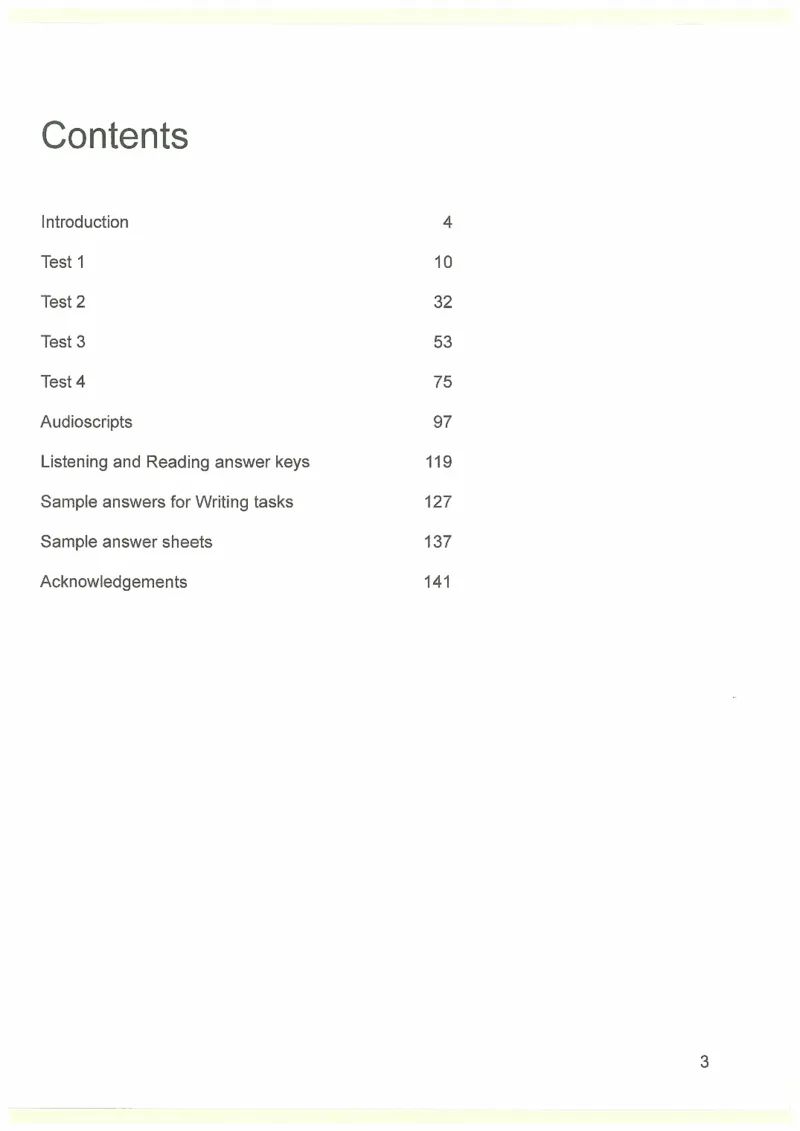
publishersdonotguaranteetheaccuracyofsuchinformationthereafter.Contents
Introduction 4
Test 1 10
Test 2 32
Test3 53
Test4 75
Audioscripts 97
Listening and Reading answer keys 119
Sampleanswers for Writing tasks 127
Sampleanswer sheets 137
Acknowledgements 141
3Introduction
The InternationalEnglish LanguageTesting System(IELTS) is widely recognised as
a reliablemeans of assessing the language ability of candidates who need to study
or work whereEnglish isthe language of communication. These PracticeTests are
designed to give future IELTS candidates an ideaofwhether their English is at the
required level.
IELTS isownedby threepartners: CambridgeAssessmentEnglish, partofthe
University ofCambridge; the British Council; IDPEducation Pty Limited (through its
subsidiary company, IELTSAustralia Pty Limited). Further information on IELTS can be
foundonthe IELTS website www.ielts.org.
WHAT IS THE TEST FORMAT?
IELTSconsists offour components.Allcandidatestakethe same Listeningand Speaking
tests. Thereisachoice ofReadingand Writing tests according to whetheracandidateis
takingtheAcademic orGeneralTraining module.
Academic GeneralTraining
For candidateswishingto study at For candidates wishingtomigrate to an
undergraduate or postgraduatelevels English-speaking country (Australia, Canada
andfor those seekingprofessional NewZealand, UK), andforthosewishingto
registration. trainorstudy atbelowdegreelevel.
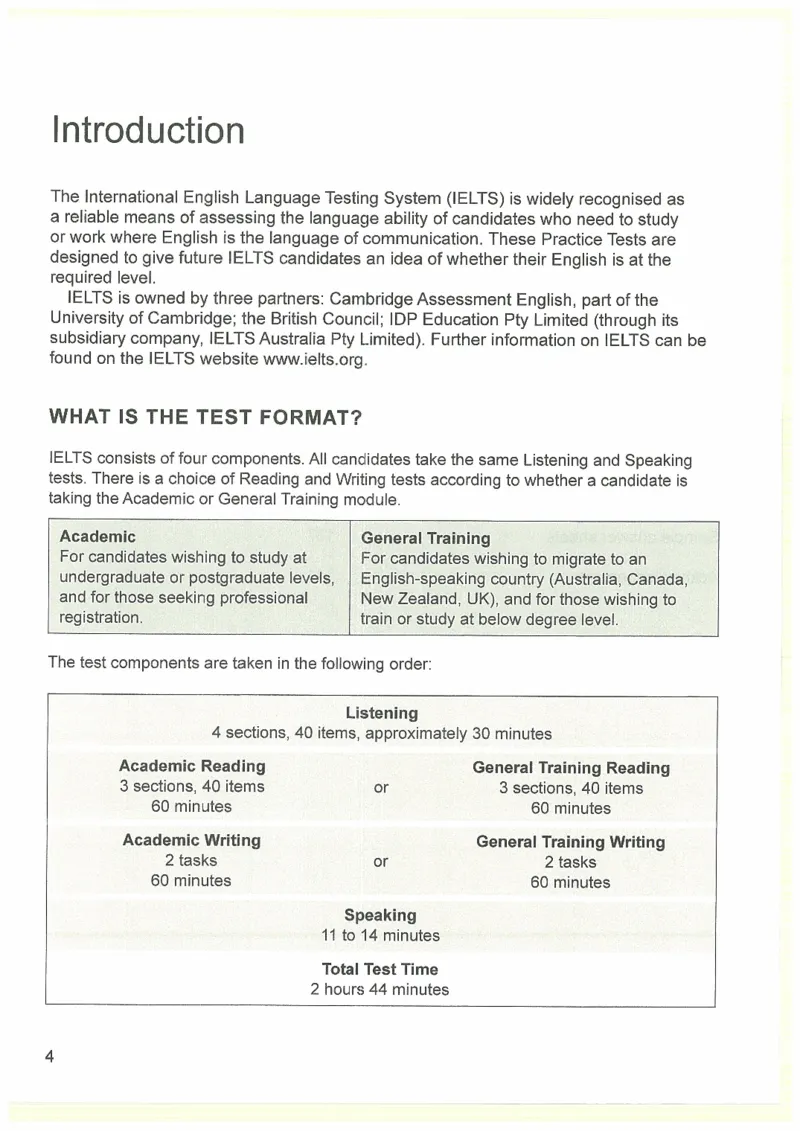
Thetestcomponents aretakeninthefollowing order:
Listening
4sections, 40items, approximately 30minutes
Academic Reading General TrainingReading
3 sections, 40items or 3 sections, 40items
60minutes 60minutes
Academic Writing GeneralTrainingWriting
2 tasks or 2tasks
60minutes 60minutes
Speaking
11 to14minutes
Total Test Time
2hours44 minutes
4Introduction
ACADEMIC TEST FORMAT
Listening
This testconsistsoffour sections, each with tenquestions. The first two sectionsare
concerned with socialneeds. The firstsectionis conversationbetweentwo speakers and
the secondsectionisa monologue. The finaltwo sectionsareconcerned with situations
relatedtoeducationalor training contexts. Thethird sectionis a conversationbetween to
four people andthe fourth sectionis a monologue.
Avariety of questiontypesisused, including: multiplechoice, matching, plan/map/
diagramlabelling, formcompletion, note completion, tablecompletion, flow-chartcompletion
summary completion, sentencecompletion and short-answer questions.
Candidateshear therecording once only andanswer the questionsas they listen. Ten
minutes are allowedat the endfor candidates totransfer theiranswersto the answer sheet.
Reading
Thistestconsistsof three sectionswith40questions. There arethree texts, whichare
takenfrom journals, books, magazines andnewspapers. Thetexts are ontopicsofgeneral
interest.Atleast onetextcontains detailedlogicalargument.
Avariety of questiontypesisused, including: multiplechoice, identifyinginformation
(True False/NotGiven), identifyingthewriters viewsclaims (Yes/No NotGiven),matching
information, matching headings, matching features, matching sentence endings, sentence
completion, summary completion,notecompletion, tablecompletion, flow-chartcompletion,
diagramlabelcompletionand short-answer questions.
Writing
Thistestconsistsof two tasks. Itis suggested thatcandidates spendabout20minuteson
Task1, whichrequires them to writeatleast150words, and40minutesonTask 2, which
requiresthemtowrite at least250 words. Task 2contributestwice asmuchasTask 1 to the
Writing score.
Task1 requirescandidates to lookat a diagram or somedata (in a graph, tableor chart)
and to presenttheinformationintheir own words. They are assessedontheir ability to
organise, presentand possibly compare data, andarerequiredto describethe stages of a
process, describean objectorevent, or explainhow something works.
InTask 2, candidates arepresented with apoint of view, argumentor problem. They are
assessedontheir ability to presenta solutionto theproblem, presentand justify anopinion,
compare andcontrastevidence andopinions, andtoevaluate andchallengeideas, evidence
or arguments.
Candidatesare also assessedontheir ability towrite inanappropriate style. More
information onassessing the Writing test, including Writing assessmentcriteria (public
version),is available ontheIELTSwebsite.
5Introduction
Speaking
Thistest takesbetween 11 and14minutes andisconductedby a trainedexaminer.
There arethreeparts:
Part1
Thecandidateandtheexaminerintroducethemselves. Candidatesthenanswergeneral
questionsaboutthemselves, their homefamily, their job studies, their interests anda wide
rangeofsimilarfamiliar topic areas.Thispartlastsbetweenfour andfiveminutes.
Part 2
Thecandidateis givena task cardwithpromptsand is askedto talkona particular topic.
Thecandidate hasoneminutetoprepare andthey canmake somenotesif they wish,
before speaking for betweenone andtwominutes.The examinerthenasksone or two
questions onthe sametopic.
Part3
The examiner andthecandidate engageina discussionof more abstractissueswhichare
thematically linkedto thetopicinPart2. Thediscussionlastsbetweenfourandfiveminutes.
The Speakingtestassesseswhether candidates cancommunicateeffectively inEnglish.
The assessmenttakesintoaccountFluency and Coherence,LexicalResource,Grammatical
RangeandAccuracy, andPronunciation. Moreinformation onassessing theSpeaking test,
includingSpeakingassessmentcriteria (public version), is availableon theIELTS website.
6Introduction
HOW IS IELTS SCORED?
IELTS resultsarereported ona nine-bandscale. Inadditionto the scorefor overall language
ability, IELTSprovides a scoreinthe form of aprofile foreachof the four skills (Listening,
Reading, Writing andSpeaking).These scores are alsoreportedonanine-bandscale.All
scores arerecordedon theTestReportForm alongwithdetailsofthecandidatesnationality,
firstlanguage anddateof birth. Each OverallBandScorecorrespondsto a descriptive
statementwhichgives a summary of the Englishlanguage ability of a candidateclassifiedat
thatlevel. Thenine bands andtheir descriptive statements areas follows:
9 ExpertUser- Has fullyoperationalcommand of the language: appropriate, accurate
and fluentwithcomplete understanding.
8 Very GoodUser-Has fully operationalcommand ofthe languagewith only occasional
unsystematic inaccuracies and inappropriacies. Misunderstandings may occurin
unfamiliarsituations. Handlescomplex detailed argumentationwell.
7 GoodUser- Has operationalcommand of the language, thoughwith occasional
inaccuracies, inappropriaciesandmisunderstandings some situations. Generally
handlescomplex language well andunderstands detailedreasoning.
6 Competent User-Hasgenerallyeffectivecommand ofthe languagedespitesome
inaccuracies, inappropriaciesandmisunderstandings. Can use and understand fairly
complex language, particularly in familiarsituations.
5 ModestUser- Haspartialcommandofthe language, copingwith overallmeaning
inmostsituations, though is likely tomake many mistakes. Should beableto handle
basiccommunicationin own field.
4 LimitedUser- Basiccompetence is limitedto familiarsituations. Hasfrequent
problemsinunderstanding and expression. Isnotable to use complex language.
3 ExtremelyLimited User-Conveys andunderstandsonly generalmeaning invery
familiarsituations. Frequent breakdownsincommunication occur.
2 IntermittentUser- No realcommunication ispossibleexcept forthemostbasic
informationusing isolated wordsorshort formulae in familiarsituationsand to meet
immediate needs. Has great difficulty understanding spoken andwritten English.
1 NonUser- Essentially hasno ability to use the language beyond possibly a few
isolated words.
0 Didnotattemptthe test-Noassessableinformationprovided.
7Introduction
MARKING THE PRACTICE TESTS
Listening and Reading
The answerkeys are onpages 119-126.
EachquestionintheListeningandReadingtestsisworthonemark.
Questions which require letter/Roman numeral answers
Forquestionswherethe answersareletters orRomannumerals, youshould write only
thenumberofanswersrequired. Forexample, ifthe answerisa singleletterornumeral
youshouldwrite only one answer.If youhavewrittenmorelettersor numeralsthanare
required, the answermustbemarkedwrong.
Questionswhichrequireanswers inthe formofwordsornumbers
(cid:127) Answersmay bewrittenin upperor lowercase.
(cid:127) Wordsinbrackets areoptional-they arecorrect, butnotnecessary.
(cid:127) Alternative answersare separatedby a slash(/).
If youare askedto write an answerusing acertain number ofwordsandor(a)
number(s), you will bepenalisedif youexceedthis. For example, if a question specifies
ananswer usingNO MORE THANTHREEWORDSandthecorrect answer is black
leather coat, theanswer coatof blackleather isincorrect.
(cid:127) Inquestionswhere you are expectedto complete a gap, youshouldonly transferthe
necessary missingword(s)ontotheanswersheet. For example, tocomplete'inthe...,
wherethe correct answeris‘morning’, the answer 'inthemorning’ wouldbeincorrect.
Allanswersrequirecorrect spelling (including wordsin brackets).
BothUSandUK spellingareacceptable andareincludedinthe answer key.
Allstandardalternativesfornumbers, dates andcurrencies areacceptable.
(cid:127) All standardabbreviationsare acceptable.
(cid:127) You willfindadditionalnotes aboutindividualanswersintheanswer key.
Writing
Thesampleanswers areonpages127-136.Itisnot possiblefor you to giveyourselfa mark
for the Writing tasks. Wehaveprovidedsample answers(written by candidates), showing
their score andthe examiner’scomments.These sample answers will give youaninsight
into whatisrequiredforthe Writing test.
8Introduction
HOW SHOULD YOU INTERPRET YOUR SCORES?
At the endof each Listening andReading answer key youwill findachart whichwillhelp
youassesswhether, onthe basis of your PracticeTest results, you areready totakethe
IELTS test.
Ininterpreting your score, there are anumber of points you should bear inmind. Your
performanceintherealIELTS test will be reportedintwoways: therewillbe a BandScore
from1to 9foreach of thecomponents andan Overall BandScore from 1 to 9, which
is the average of your scoresinthe four components. However, institutionsconsidering
yourapplicationare advisedto look atboththeOverallBandScore and the Bands for
eachcomponent in order to determine whether youhavethelanguage skillsneededfor a
particular course of study. For example, if your courseinvolvesalot of reading andwriting,
butno lectures, listening skillsmightbelessimportant anda score of 5 in Listeningmight be
acceptableif theOverall Band Score was7. However, foracourse whichhaslotsof lectures
andspokeninstructions, a score of 5in Listening might beunacceptable eventhoughthe
Overall BandScore was7.
Once youhavemarked your tests, youshouldhave some idea ofwhether yourlistening
andreading skillsaregoodenough for youto trytheIELTS test. If youdid wellenoughin
onecomponent, but notin others, you willhaveto decidefor yourself whether youareready
to takethetest.
ThePracticeTestshavebeencheckedtoensurethat they are ofapproximately the same
levelofdifficulty as therealIELTS test. However, we cannotguaranteethat your scorein the
PracticeTestswillbe reflectedin therealIELTStest. ThePracticeTests can only give you
anidea of your possible futureperformanceanditis ultimately up to youtomake decisions
basedonyour score.
Different institutions acceptdifferentIELTSscores for differenttypes ofcourses. Wehave
basedour recommendations onthe average scoreswhich themajority of institutionsaccept.
Theinstitutiontowhichyouare applying may, ofcourse, require higher or lower score than
mostother institutions.
Further information
For moreinformation about IELTS or any otherCambridgeAssessmentEnglishexamination
writeto:
CambridgeAssessmentEnglish
TheTriangle Building
Shaftesbury Road
Cambridge
CB2 8EA
https://support.cambridgeenglish.org
http://www.ielts.org
9Test 1
LISTENING
SECTION 1 Questions 1-10
Completethe form below.
Write ONE WORDAND ORANUMBER foreach answer.
CRIME REPORT FORM
Type of crime: theft
Personal information
Example
Name Louise Taylor
Nationality 1
Date of birth 14 December 1977
Occupation interior designer
Reason for visit business(tobuy antique 2 )
Length of stay two months
Current address 3 Apartments(No 15)
Details of theft
Items stolen - a wallet containing approximately 4 £
- a 5
Date of theft 6
Possible time and placeof theft
Location outside the 7 at about4 pm
Details of suspect - someboys asked for the 8 then ran off
- one had a T-shirt with apicture of a tiger
- he was about 12, slimbuildwith 9 hair
Crime reference number allocated
10
10Listening
SECTION 2 Questions 11-20
Induction talk for new apprentices
Questions 11 and 12
ChooseTWO letters, A-E.
WhichTWOpiecesofadviceforthefirstweekofanapprenticeshipdoesthemanagergive?
A get to know colleagues
B learn fromany mistakes
C ask lots of questions
D react positively to feedback
E enjoy new challenges
Questions 13 and 14
Choose TWO letters, A-E.
Which TWO things does the manager say mentors can help with?
A confidence-building
B making career plans
C completing difficult tasks
D making a weekly timetable
E reviewing progress
11Test 1
Questions 15-20
What doesthemanager say abouteach of the following aspects of the company policy
for apprentices?
Writethecorrect letter, A, BorC, nextto Questions15-20.
A It is encouraged.
B Therearesomerestrictions.
C It is against the rules.
Company policy for apprentices
15 Using the internet
16 Flexibleworking
17 Booking holidays
18 Working overtime
19 Wearingtrainers
20 Bringing foodto work
12Listening
SECTION 3 Questions 21-30
Questions 21-25
Choose thecorrect letter, A, B or C.
Cities built by the sea
21 Carlaand Rob were surprised to learnthat coastalcities
A contain nearly half the world’s population.
B includemostof the world’s largest cities.
C are growing twice as fast as other cities.
22 According to Rob, building coastal cities near to rivers
A may bring pollution tothe cities.
B may reducethe landavailable for agriculture.
C may mean thecountryside is spoiledby industry.
23 What mistake was made when building water drainage channels in Miami in
the 1950s?
A There were not enough of them.
B They weremade of unsuitablematerials.
C They did not allow for theeffects of climatechange.
24 What doRobandCarla think that the authorities in Miamishould do immediately?
A take measuresto restoreecosystems
B pay for a new flood prevention system
C stop disposing ofwaste materials intotheocean
25 What dothey agree should be the priority for internationalaction?
A greater coordination of activities
B more sharing of information
C agreement on sharedpolicies
13Test 1
Questions 26-30
Whatdecision dothe students makeabouteach of the following parts of their
presentation?
Choose FIVE answers from the box and writethe correctletter, A-G, nextto
Questions 26-30.
Decisions
A usevisuals
B keep it short
C involve other students
D check the information is accurate
E providea handout
F focus ononeexample
G do online research
Parts of thepresentation
26 Historicalbackground
27 Geographicalfactors
28 Past mistakes
29 Futurerisks
30 Internationalimplications
14Listening
SECTION 4 Questions 31-40
Complete the notes below.
Write ONE WORD ONLY for each answer.
Marine renewable energy (ocean energy)
Introduction
More energy required because of growth inpopulation and31
What’s needed:
(cid:127) renewableenergy sources
(cid:127) methodsthat won’t create pollution
Waveenergy
Advantage: waves providea 32 source of renewableenergy
Electricity canbe generated using offshore or onshore systems
Onshore systemsmay usea reservoir
Problems:
(cid:127) wavescan move in any 33
(cid:127) movementofsand, etc.onthe34 oftheoceanmaybe affected
Tidalenergy
Tides are more 35 than waves
Plannedtidallagoon in Wales:
(cid:127) willbecreated in a 36 at Swansea
breakwater (dam) containing16 turbines
risingtide forces water through turbines, generatingelectricity
(cid:127) stored water is releasedthrough 37 driving theturbines in
the reverse direction
Advantages:
(cid:127) not dependent on weather
(cid:127) no38 is required to make it work
likely tocreate a number of 39
Problem:
(cid:127) may harmfishandbirds,e.g. byaffecting40 andbuildingupsilt
Ocean thermalenergy conversion
Uses a difference in temperaturebetween the surfaceandlower levels
Water brought to the surface ina pipe
15Test 1
READING
READING PASSAGE 1
You shouldspend about20 minutes on Questions 1-13, which are based onReading
Passage 1 below.
THE IMPORTANCE OF CHILDREN’S PLAY
Brickbybrick,six-year-oldAliceisbuildingamagicalkingdom.Imaginingfairy-taleturretsand
fire-breathingdragons,wickedwitchesandgallantheroes,she’screatinganenchantingworld.
Althoughsheisn’tawareofit,thisfantasyishelpinghertakeherfirststepstowardshercapacityfor
creativityandsoitwillhaveimportantrepercussionsinheradultlife.
Minuteslater,Alicehasabandonedthekingdominfavourofplayingschoolswithheryounger
brother.Whenshebosseshimaroundashis‘teacher’,she’spractisinghowtoregulateheremotions
throughpretence.Lateron,whentheytireofthisandsettledownwithaboardgame,she’slearning
abouttheneedtofollowrulesandtaketurnswithapartner.
‘Play in all itsrich varietyisone ofthehighestachievementsofthe human species,’says
DrDavidWhitebreadfrom the FacultyofEducationat the UniversityofCambridge, UK.‘It
underpinshow wedevelopasintellectual, problem - solvingadultsandiscrucial tooursuccess as
a highly adaptablespecies.’
Recognisingtheimportanceof playisnot new: overtwomillenniaago,theGreekphilosopher
Platoextolleditsvirtuesasameansofdevelopingskillsforadultlife,andideasaboutplay-based
learninghave beendevelopingsincethe19thcentury.
Butweliveinchangingtimes,andWhitebreadismindfulofa worldwidedeclineinplay pointing
outthatoverhalfthe peopleintheworldnow liveincities.‘Theopportunitiesforfreeplay,which
Iexperiencedalmosteverydayofmychildhood,arebecomingincreasinglyscarce,’hesays.
Outdoorplayiscurtailed by perceptionsofrisk todowithtraffic,aswellasparents’increased
wishtoprotect theirchildrenfrom beingthevictimsofcrime,and bytheemphasison‘earlieris
better’whichisleading togreatercompetitioninacademiclearning and schools
International bodieslikethe United Nationsand the European Union have beguntodevelop
policiesconcerned withchildren’s right toplay and toconsiderimplicationsforleisurefacilities
andeducational programmes.But what theyoftenlackisthe evidence to base policieson.
‘Thetypeofplayweareinterested inischild-initiated,spontaneousand unpredictable-but,as
soonasyouask afive year-old toplay ,then youastheresearcherhaveintervened,’explains
DrSaraBaker.‘And wewanttoknowwhatthelong termimpactofplayis.It’sa realchallenge.’
16Reading
DrJenny Gibsonagrees,pointing outthatalthoughsomeofthestepsinthepuzzle ofhowand
whyplayisimportant havebeenlookedat,there isvery littledataontheimpactithasonthe
childslaterlife.
Now,thankstotheuniversity’snewCentreforResearchonPlayinEducation,Developmentand
Learning(PEDAL),Whitebread,Baker Gibsonandateamofresearchershopetoprovideevidence
ontheroleplayedbyplayinhowachilddevelops.
‘Astrongpossibilityisthat playsupportstheearlydevelopment ofchildren’sself-control,
explains Baker.‘Thisisour abilitytodevelopawarenessofourownthinkingprocesses-it
influenceshoweffectivelywegoaboutundertakingchallengingactivities.’
InastudycarriedoutbyBakerwithtoddlersandyoungpre-schoolers,shefoundthatchildrenwith
greaterself-controlsolvedproblemsmorequicklywhenexploringanunfamiliarset-uprequiring
scientificreasoning.‘Thissortofevidencemakesusthinkthatgivingchildrenthechancetoplaywill
makethemmoresuccessfulproblem-solversinthelongrun.’
Ifplayfulexperiencesdofacilitatethisaspect ofdevelopment,saythe researchers,it couldbe
extremely significantforeducational practices,becausetheabilityto self-regulate hasbeen
showntobeakey predictorofacademic performance.
Gibson adds: ‘Playfulbehaviourisalsoanimportant indicatorofhealthysocialandemotional
development.Inmy previous research,I investigated howobservingchildrenatplaycan
give usimportantcluesabout theirwell-beingand caneven be useful inthediagnosisof
neurodevelopmental disorderslikeautism.’
Whitebread’srecent researchhasinvolveddevelopinga play-basedapproachtosupporting
children’swriting.‘Manyprimaryschoolchildrenfindwritingdifficult,but weshowed ina
previousstudythataplayfulstimuluswasfarmoreeffective thananinstructional one.’Children
wrotelongerandbetter-structuredstorieswhentheyfirstplayed withdollsrepresenting
charactersinthestory.Inthelateststudy,childrenfirstcreatedtheirstorywith Lego*,with
similarresults.‘Manyteacherscommented thattheyhadalways previouslyhad children saying
theydidn’tknowwhattowriteabout.Withthe Lego building, however, notasinglechildsaid
thisthroughthewhole yearoftheproject.’
Whitebread,who directs PEDAL,trainedasa primaryschool teacherintheearly1970s, when,
as hedescribes,‘theteachingofyoungchildrenwaslargelyaquiet backwater,untroubled byany
seriousintellectualdebateorcontroversy.’Now,thelandscapeisverydifferent, withhotly debated
topicssuch asschool starting age.
‘Somehowtheimportanceofplay hasbeenlostin recentdecades. It’sregardedassomething
trivial,orevenassomethingnegative that contrastswith“work”. Let’snot lose sightofits
benefits,and thefundamental contributionsitmakesto humanachievements inthe arts,sciences
and technology.Let’smake surechildren havearichdietofplayexperiences.’
*Lego:colouredplasticbuildingblocksandotherpiecesthatcanbejoinedtogether
17Test 1
Questions 1-8
Complete the notesbelow.
Choose ONE WORD ONLYfromthe passage for each answer.
Write youranswers in boxes 1-8 on youranswersheet.
Children’s play
Usesofchildren’s play
(cid:127) building a ‘magical kingdom’may help develop1
(cid:127) board games involve 2 and turn-taking
Recentchangesaffecting children’s play
(cid:127) populations of 3 have grown
(cid:127) opportunities for freeplay are limiteddueto
- fear of 4
- fear of 5
- increased 6 in schools
International policiesonchildren’s play
(cid:127) it is difficult to find7 to support new policies
research needs to study the impact of play on the rest of thechild’s
8
18Reading
Questions 9-13
Dothe following statements agree with the information given in Reading Passage 1?
In boxes 9-13 on your answer sheet, write
TRUE if the statementagreeswith the information
FALSE if the statementcontradicts the information
NOT GIVEN if there is no informationon this
9 Children with good self-controlare known tobe likely to do wellat school later on.
10 The way a child playsmay provide information about possiblemedicalproblems.
11 Playing with dolls was foundtobenefit girls’writing more than boys’writing.
12 Children hadproblemsthinking up ideas when they first created the story
with Lego.
13 People nowadays regard children’splay as less significantthan they didin thepast.
19Test 1
READING PASSAGE 2
You should spend about 20 minutes on Questions 14-26, which are based on Reading
Passage2 below.
The growth of bike-sharing schemes around
the world
How Dutch engineer Luud Schimmelpennink helped to devise urban
bike-sharing schemes
A The originalidea for anurbanbike-sharingschemedatesbacktoa summer’s day
inAmsterdamin 1965. Provo, the organisation that came up with the idea, wasa
groupof Dutch activists who wanted tochange society. They believed the scheme,
whichwasknown as theWitteFietsenplan, wasan answer to theperceivedthreats
of air pollution andconsumerism. In thecentre ofAmsterdam, they painteda small
numberof usedbikeswhite. They alsodistributedleafletsdescribingthe dangers of
cars and inviting people tousethewhite bikes.The bikeswerethen left unlocked at
various locationsaroundthe city, tobeused by anyone in needof transport.
B LuudSchimmelpennink, a Dutch industrial engineer who still livesandcycles
inAmsterdam, washeavily involved inthe originalscheme. Herecallshow the
scheme succeededinattracting a great dealof attention-particularly when it
cametopublicising Provo’s aims-but struggled to get off the ground. The police
were opposedto Provo’sinitiatives andalmost as soon as the whitebikes were
distributed around the city, they removed them. However, for Schimmelpennink and
forbike-sharingschemesingeneral, thiswasjust thebeginning. ThefirstWitte
Fietsenplan wasjust a symbolic thing,’he says. ‘Wepainted a few bikes white, that
was all.Things got more serious whenIbecamea member of theAmsterdam city
counciltwo years later.’
C Schimmelpennink seizedthisopportunity topresentamoreelaborate Witte
Fietsenplan tothe city council.‘My idea was that the municipality ofAmsterdam
woulddistribute10,000 whitebikesover thecity, for everyonetouse,’heexplains.
‘Imade seriouscalculations. Itturnedout that a white bicycle-per person, per
kilometre-would cost the municipality only 10% of what it contributed to public
transportper person perkilometre.’Nevertheless,thecouncilunanimously rejected
theplan. They saidthat thebicyclebelongs to the past. They saw a glorious future
for thecar,’says Schimmelpennink. But he wasnot in theleast discouraged.
D Schimmelpennink never stoppedbelieving in bike-sharing, and in the mid-90s,
two Danes askedfor hishelp tosetupasystem inCopenhagen. Theresult was
the world’s first large-scalebike-share programme. It worked on a deposit: ‘You
droppeda coin in the bikeandwhen you returned it, you got your money back.
After setting up the Danish system,Schimmelpennink decided to try his luck again
20Reading
in the Netherlands-and thistime he succeeded in arousing the interest of the
Dutch Ministry ofTransport. Times had changed,’he recalls. ‘People hadbecome
moreenvironmentally conscious, andthe Danish experiment had provedthat
bike-sharing was a realpossibility.’Anew WitteFietsenplan was launched in 1999
inAmsterdam. However, ridinga white bike was no longer free; it cost one guilder
per trip andpayment was madewith a chipcard developed by the Dutch bank
Postbank. Schimmelpennink designed conspicuous, sturdy whitebikeslocked
in special racks whichcould be opened with the chipcard-the plan started with
250 bikes, distributedover five stations.
E Theo Molenaar, who was a systemdesigner for theproject, workedalongside
Schimmelpennink. ‘Iremember when we were testing the bike racks, he announced
that hehadalready designedbetter ones. Butof course, we had to go through with
the ones we had ’The system, however, was prone to vandalismand theft. ‘After
,
every weekend there would always be a couple of bikes missing,’Molenaar says.
‘Ireally have no idea what people did with them, because they could instantly be
recognised as white bikes.’But the biggest blow came when Postbank decided to
abolishthechip card, because it wasn’t profitable. That chipcard waspivotaltothe
system,’Molenaar says. To continue theproject wewould have needed to set up
another system, but the business partner had lost interest.’
F Schimmelpennink was disappointed, but-characteristically-not for long.In2002
hegot a call from theFrench advertising corporation JC Decaux, who wanted to set
uphisbike-sharing scheme in Vienna. That went really well.After Vienna, they set
upa system in Lyon.Then in 2007, Paris followed. That was a decisivemoment in
the history of bike-sharing.’The hugeand unexpected success of the Parisian
bike-sharingprogramme, which now boastsmorethan20,000bicycles,inspiredcities
allovertheworldto set uptheirownschemes, allmodelledon Schimmelpennink’s.
It’swonderfulthat this happened,’he says. ‘Butfinancially I didn’t really benefit from
it, becauseIneverfiledfor apatent.’
G InAmsterdam today, 38% of alltrips aremade by bike and, along with
Copenhagen, it is regardedas one of thetwomost cycle-friendly capitals in the
world-butthe city never got another WitteFietsenplan. Molenaar believes this
may bebecauseeverybody inAmsterdamalready has a bike. Schimmelpennink,
however, cannot see that thischangesAmsterdam’s need for a bike-sharing
scheme. ‘People who travelon theundergrounddon’t carry their bikes around.
But oftenthey need additionaltransport to reach their finaldestination.’Although
hethinks it is strangethata city likeAmsterdamdoesnot havea successful bike
sharing scheme, he is optimistic about the future. In the ’60s we didn’t standa
chancebecausepeople wereprepared togive their lives to keep cars in the city.
But that mentality hastotally changed. Today everybody longs for citiesthat are not
dominated by cars.’
21Test 1
Questions 14 18
Reading Passage 2has seven paragraphs, A-G
.
Whichparagraphcontainsthe followinginformation?
Write the correctletter, A-G, in boxes 14-18 on youranswer sheet.
NB You may use any lettermore thanonce.
14 a description of how people misused a bike-sharing scheme
15 an explanation of why a proposed bike-sharing scheme wasturned down
16 a reference to a person being unable toprofit fromtheir work
17 an explanationof the potential savings abike-sharing scheme would bring
18 a reference to theproblems a bike-sharing schemewas intendedto solve
Questions 19 and 20
Choose TWO letters, A-E.
Write the correct letters in boxes 19 and20 on your answersheet.
Which TWO of the following statementsaremade in thetext about theAmsterdam
bike-sharingscheme of 1999?
A It was initially opposed by a government department.
B It failedwhen a partner in the scheme withdrew support.
C It aimed tobemore successful than the Copenhagen scheme.
D Itwasmadepossibleby achange inpeople's attitudes.
E It attracted interest froma rangeofbike designers.
22Reading
Questions 21 and 22
Choose TWO letters, A-E .
Write the correct letters in boxes 21 and 22 on your answer sheet.
Which TWO of the following statements aremade in the text aboutAmsterdamtoday?
A Themajority of residents wouldlike to prevent allcars fromentering thecity.
B There is littlelikelihoodof the city having another bike-sharing scheme.
C Moretrips in thecity are madeby bike than by any other form of transport.
D Abike-sharing scheme would benefit residents whouse public transport.
E Thecity has a reputation as placethat welcomescyclists.
23Test 1
Questions 23-26
Complete the summary below.
Choose ONE WORD ONLY from the passage for each answer.
Writeyour answers inboxes23-26on your answer sheet.
The first urban bike sharing scheme
The firstbike-sharingschemewastheidea of the Dutch group Provo.Thepeople who
belonged to this group were 23... . They were concernedabout damage
to theenvironmentandabout 24 .., andbelieved that thebike-sharing
scheme woulddraw attention tothese issues.As well aspainting somebikes white,they
handedout 25 that condemned the use of cars.
However, the scheme was not a great success: almost as quickly as Provo left
thebikesaroundthecity, the 26 took themaway.Accordingto
Schimmelpennink, the scheme wasintendedto be symbolic. Theidea was to get people
thinking about theissues.
24Reading
READING PASSAGE 3
You should spend about20 minutes on Questions 27-40, which are basedon Reading
Passage 3 below.
Motivational factors and the hospitality industry
A critical ingredientinthe successofhotelsis developingand maintainingsuperiorperformance
fromtheiremployees. Howisthataccomplished?WhatHumanResourceManagement(HRM)
practicesshould organizationsinvestinto acquire andretaingreatemployees?
Somehotelsaimtoprovide superiorworkingconditionsfortheiremployees Theideaoriginated
fromworkplaces-usuallyinthenon-servicesector-thatemphasizedfunandenjoymentas
partofwork-lifebalance.Bycontrast,theservicesector,and more specificallyhotels, has
traditionallynotextended these practicesto addressbasicemployeeneeds,suchasgood
workingconditions.
Pfeffer(1994)emphasizesthatin ordertosucceedina global businessenvironment,
organizationsmustmakeinvestmentinHuman ResourceManagement(HRM) to allow them
to acquireemployeeswhopossessbetterskillsand capabilitiesthantheircompetitors.This
investmentwillbetotheircompetitiveadvantage.Despitethisrecognitionoftheimportance
ofemployeedevelopment,thehospitalityindustryhas historically beendominatedby
underdeveloped HR practices (Lucas,2002).
Lucasalso points outthat The substanceofHRM practicesdoesnotappeartobedesigned to
fosterconstructiverelationswithemployeesor torepresenta managerialapproachthatenables
developingand drawing out thefull potential ofpeople,eventhoughemployeesmay bebroadly
satisfied withmanyaspects oftheirwork’(Lucas,2002).Inaddition,ormaybe asa result,high
employeeturnoverhasbeena recurringproblemthroughoutthehospitalityindustry.Among
themanycited reasonsarelowcompensation,inadequatebenefits,poor workingconditionsand
compromisedemployeemorale andattitudes(Maroudasetal.,2008).
NgandSorensen(2008) demonstratedthat whenmanagersprovide recognitionto employees,
motivateemployeestoworktogether,andremoveobstaclespreventing effectiveperformance,
employeesfeelmoreobligated tostaywiththecompany.Thiswassuccinctlysummarized by
Micheletal.(2013):‘[Providingsupporttoemployeesgivesthemthe confidence to perform
theirjobsbetterand themotivationtostaywiththeorganization.’Hospitality organizationscan
thereforeenhance employee motivationand retentionthroughthedevelopmentand improvement
oftheir workingconditions.Theseconditionsareinherentlylinked totheworking environment.
Whileitseemslikelythatemployees’reactionstotheirjobcharacteristicscouldbeaffected
by apredispositionto view theirwork environmentnegatively, noevidenceexists tosupport
this hypothesis(Spectoretal.,2000). However, given theopportunity, many peoplewillfind
25Test 1
somethingtocomplainaboutinrelationtotheirworkplace(Poulston,2009).Thereisastrong
linkbetweentheperceptionsofemployeesandparticularfactorsoftheirworkenvironmentthat
areseparatefromthe workitself,including companypolicies,salaryand vacations.
Suchconditions are particularlytroublingfortheluxuryhotel market,wherehigh-qualityservice,
requiringasophisticatedapproachto HRM,isrecognizedasacriticalsourceofcompetitive
advantage (Maroudasetal.,2008).Ina real sense,theservicesofhotelemployeesrepresent
theirindustry (Schneiderand Bowen,1993).Thisrepresentationhascommonly beenlimited to
guestexperiences.Thissuggeststhat therehasbeena dichotomy betweentheguestenvironment
provided inluxuryhotelsandtheworkingconditionsoftheiremployees.
Itisthereforeessentialforhotel management todevelop HRM practicesthatenablethemto
inspireandretaincompetentemployees.Thisrequiresan understandingofwhatmotivates
employeesatdifferentlevelsofmanagementand differentstagesoftheircareers (Enzand Siguaw,
2000).Thisimpliesthat it isbeneficialforhotel managerstounderstand what practices aremost
favorableto increase employeesatisfactionandretention.
Herzberg(1966)proposesthatpeoplehavetwomajortypesofneeds,thefirst beingextrinsic
motivationfactorsrelatingto thecontextinwhichworkisperformed,ratherthanthework
itself.These includeworkingconditions and jobsecurity.When these factorsare unfavorable,
jobdissatisfaction mayresult.Significantly,though,justfulfillingtheseneedsdoes notresultin
satisfaction,but only inthereductionofdissatisfaction(Maroudasetal.,2008).
Employeesalsohaveintrinsicmotivation needsormotivators,which includesuchfactorsas
achievementand recognition. Unlikeextrinsicfactors,motivatorfactorsmay ideally resultinjob
satisfaction (Maroudasetal.,2008).Herzberg’s (1966)theory discussesthe needfora ‘balance
ofthesetwotypesofneeds.
Theimpactoffunasa motivatingfactorat workhasalsobeenexplored. For example,Tews,
MichelandStafford(2013)conductedastudyfocusingonstafffromachainofthemed restaurants
inthe UnitedStates.It wasfoundthatfunactivitieshadafavorableimpactonperformanceand
managersupportforfunhadafavorableimpactin reducingturnover.Theirfindingssupportthe
viewthatfunmayindeedhavea beneficialeffect,but theframingofthatfunmustbecarefully
alignedwithbothorganizational goalsandemployeecharacteristics.‘Managersmustlearnhowto
achievethedelicate balanceofallowingemployeesthefreedomtoenjoythemselvesat workwhile
simultaneouslymaintaininghighlevelsofperformance’(Tewsetal.,2013).
Deery(2008) hasrecommended several actionsthatcanbeadoptedattheorganizational level to
retaingood staffaswell asassistin balancingwork andfamilylife.Those particularlyappropriate
tothehospitalityindustryincludeallowingadequatebreaksduringtheworkingday,staff
functionsthat involvefamilies,and providing healthand well-beingopportunities.
26Reading
Questions 27-31
Look at the following statements (Questions 27-31) and the list of researchers below.
Matcheach statement with the correct researcher, A-F.
Write thecorrect letter, A-F, in boxes 27-31 on youranswersheet.
NB You may use any letter more thanonce.
27 Hotelmanagers needto know what would encourage goodstaff to remain.
28 Theactions of managers may make staff feelthey shouldn’t moveto a different
employer.
29 Little is done in the hospitality industry to help workers improvetheir skills.
30 Staff are less likely to change jobs if cooperation isencouraged.
31 Dissatisfaction with pay is not the only reason why hospitality workerschange jobs.
List of Researchers
A Pfeffer
B Lucas
C Maroudas et al.
D Ng and Sorensen
E EnzandSiguaw
F Deery
27Test 1
Questions 32-35
Dothefollowing statements agreewith the claims of the writer in Reading Passage 3?
In boxes 32-35 onyour answersheet, write
YES ifthe statement agreeswith theclaims of thewriter
NO ifthe statementcontradicts theclaimsofthewriter
NOT GIVEN ifit is impossible to saywhatthe writerthinks aboutthis
32 One reason for high staff turnover in the hospitality industry is poormorale.
33 Researchhas shownthatstaffhavea tendency to disliketheirworkplace.
34 An improvementin working conditions and job security makes staff satisfiedwith
their jobs.
35 Staff shouldbeallowed tochoose when they take breaks during the working day.
Questions 36-40
Completethesummary below.
Choose ONE WORD ONLYfrom thepassage foreach answer.
Write youranswers in boxes36-40on your answersheet.
Fun at work
Tews, Micheland Staffordcarried out research on staff in anAmerican chain of
36 .Theydiscoveredthatactivities designedfor staff to have fun
improved their 37 ,and that management involvement led to lower
staff 38 They also foundthat the activities needed to fit with both the
company’s39 andthe40 of the staff.Abalance was
requiredbetweena degree offreedomandmaintainingworkstandards.
28Writing
WRITING
WRITING TASK 1
You should spend about 20 minutes on this task.
Thechartsbelow show the average percentages intypical meals of three
types of nutrients, all of which may be unhealthy if eaten too much.
Summarise the information by selecting and reportingthe main features, and
make comparisons where relevant.
Writeat least 150 words.
Average percentages of sodium, saturated fats and
added sugars in typical meals consumed in the USA
Sodium Saturated fat
]
Breakfast Dinner
J
Lunch Snacks
Added sugar
p
6%
42%
19%
23%
29Test 1
WRITING TASK 2
You should spend about40 minutes on thistask.
Writeaboutthe followingtopic:
Some people believethat it is best to accepta bad situation, such as an
unsatisfactoryjobor shortage of money. Others arguethat it is better to try
and improve suchsituations.
Discuss both theseviews andgive your own opinion.
Givereasons for your answer and include any relevant examples fromyour own
knowledge or experience.
Write at least 250 words.
30Speaking
SPEAKING
PART 1
Theexaminer asks thecandidateabout him/herself, his/her home, work or studies and
other familiar topics.
EXAMPLE
Future
(cid:127) What job would you like to have ten years fromnow?[Why?]
(cid:127) How useful willEnglish be for your future? [Why/Why not?]
(cid:127) How much travelling do you hope to do in the future? [Why/Why not?]
(cid:127) How do you think your life willchange inthe future? [Why/Why not?]
PART 2
Describe a book that youenjoyed reading because You willhave totalk
you had to think a lot. about thetopic for one
totwominutes. You
You should say:
have one minuteto
what this book was
think about what you
why you decided toread it
are going to say. You
what reading this book made youthink about
can make some notes
and explain why you enjoyed reading this book. to helpyou if you wish.
PART 3
Discussion topics:
Childrenand reading
Example questions:
What are themost popular types of children’s books in your country?
What are thebenefits of parents reading booksto their children?
Should parents always let children choose thebooksthey read?
Electronic books
Example questions:
How popular areelectronic books are in your country?
What aretheadvantages of parentsreadingelectronic books(comparedto
printed books)?
Willelectronic books ever completely replaceprinted booksin the future?
31Test 2
LISTENING
SECTION 1 Questions 1-10
Complete the notes below.
Write ONE WORD AND/ORANUMBER foreach answer.
TOTAL HEALTH CLINIC
PATIENT DETAILS
Personal information
Example
Name JulieAnne Garcia
Contact phone
1
Dateof birth
2 1992
Occupation
works as a 3
Insurancecompany
4 Life Insurance
Detailsof theproblem
Type of problem pain in her left 5
When it began 6 ago
Action already taken has taken painkillersand appliedice
Otherinformation
Sportsplayed
belongsto a 7 club
goes 8 regularly
Medicalhistory
injuredher 9... last year
no allergies
no regular medication apart from10
32Listening
SECTION 2 Questions 11-20
Questions 11-15
Choose thecorrect letter, A, B orC.
Visit to Branley Castle
11 Before Queen ElizabethIvisited the castle in 1576,
A repairswere carried out tothe guest rooms.
B a new building wasconstructedfor her.
C a fire damaged partof the main hall.
12 Ini982, thecastle was soldto
A the government.
B theFenys family.
C an entertainment company.
13 In some ofthe rooms, visitorscan
A speak to experts on thehistory of the castle.
B interact with actors dressedas famous characters.
C seemodels of historicalfigures moving and talking.
14 In the castlepark, visitors can
A seean 800-year-oldtree.
B goto an art exhibition.
C visit a small zoo.
15 At theendof the visit, the group will have
A afternoon tea inthe conservatory.
B the chance to meet thecastle’s owners.
C a photograph together on the Great Staircase.
33Test2
Questions 16-20
Label the planbelow.
Write thecorrectletter, A-H, nextto Questions 16-20.
Branley Castle
16 Starting point for walking thewalls
17 Bow and arrow display
18 Hunting birds display
19 Traditional dancing
20 Shop
34Listening
SECTION 3 Questions 21-30
Questions 21-24
Choose the correct letter, A, B or C.
Woolly mammoths on St Paul’s Island
21 How willRosieandMartin introduce their presentation?
A witha drawing of woolly mammoths in their naturalhabitat
B with a timeline showing when woolly mammoths lived
C witha video clip about woolly mammoths
22 What was surprising about the mammothtooth found by RussellGraham?
A It was stillembedded in the mammoth’s jawbone.
B It was froman unknown species of mammoth.
C It wasnotas old asmammoth remains fromelsewhere.
23 The students willuse an animateddiagram to demonstrate how themammoths
A becameisolatedon theisland.
B spread fromthe island to other areas.
C coexisted withother animals on the island.
24 According to Martin, what isunusualabout the date of themammoths’extinction on
the island?
A how exact it is
B how early it is
C how it was established
35Test2
Questions 25-30
What action willthe studentstake for each of the following sections oftheir
presentation?
ChooseSIX answers fromthebox andwritethecorrectletter, A-H, next to
Questions 25-30.
Actions
A make it more interactive
B reducevisualinput
C addpersonalopinions
D contact one of the researchers
E makedetailed notes
F findinformation online
G check timing
H organisethecontentmoreclearly
Sections ofpresentation
25 Introduction
26 Discovery of themammoth tooth
27 Initialquestions askedby the researchers
28 Further research carriedout onthe island
29 Findingsand possibleexplanations
30 Relevance to the present day
36Listening
SECTION 4 Questions 31-40
Complete the notes below.
Write ONE WORD ONLY for each answer.
The history of weather forecasting
Ancient cultures
(cid:127) many culturesbelievedthat floods and other disasters were involved in the
creation of the world
(cid:127) many cultures invented 31 andotherceremonies tomake the
weather gods friendly
(cid:127) peopleneededtoobserveandinterprettheskytoensuretheir32
(cid:127) around650BC, Babylonians startedforecasting, using weather phenomena
such as33
(cid:127) by 300 BC, the Chinese hadacalendar made up of a number of
34 connected with the weather
AncientGreeks
(cid:127) a more scientific approach
(cid:127) Aristotle tried to explain the formation of various weather phenomena
(cid:127) Aristotle also described haloes and 35
MiddleAges
(cid:127) Aristotle’s work considered accurate
(cid:127) many proverbs, e.g. about the significance of the colour of the
36 passedon accurateinformation.
15th-19thcenturies
15thcentury:scientistsrecognisedvalueof37 forthefirsttime
Galileo inventedthe 38
Pascalshowed relationshipbetween atmospheric pressureandaltitude
from the 17th century, scientistscouldmeasureatmospheric pressure and
temperature
18th century: Franklin identified the movement of 39
19th century: data from different locationscould be sent to the same
placeby 40
37Test2
READING
READING PASSAGE 1
You should spend about20 minutes on Questions 1-13, which are based onReading
Passage 1 below.
Alexander Henderson (1831-1913)
Born in Scotland, Henderson emigrated to Canada in 1855 and became a
well-known landscape photographer
AlexanderHendersonwasborn inScotlandin 1831and wasthesonofasuccessful merchant.
Hisgrandfather,alsocalledAlexander,hadfounded thefamilybusiness,and laterbecame
thefirstchairmanoftheNational BankofScotland.Thefamilyhadextensivelandholdingsin
Scotland. Besidesitsresidencein Edinburgh,itownedPressEstate,650acresoffarmlandabout
35 milessoutheastofthecity.Thefamilyoftenstayedat PressCastle,thelargemansiononthe
northernedgeofthe property,andAlexanderspentmuch ofhischildhood in thearea,playingon
thebeachnearEyemouthorfishinginthestreamsnearby.
Evenafterhe went toschoolatMurchestonAcademy ontheoutskirts ofEdinburgh,Henderson
returned toPressat weekends.In 1849hebegana three- yearapprenticeshipto becomean
accountant.Althoughheneverlikedtheprospectofa businesscareer,hestayedwithitto
pleasehisfamily.InOctober1855,however,heemigrated toCanada withhiswifeAgnes Elder
Robertsonand theysettledin Montreal.
Henderson learnedphotography inMontrealaround theyear1857and quicklytookit up
asaseriousamateur. He becameapersonalfriendandcolleagueoftheScottish-Canadian
photographerWilliam Notman.Thetwomenmadea photographicexcursionto Niagara Falls in
1860and theycooperatedonexperiments with magnesiumflaresasasourceofartificiallight
in 1865.They belonged tothesamesocietiesand wereamongthefoundingmembersoftheArt
Associationof Montreal.Hendersonactedas chairmanofthe association’sfirst meeting,which
washeld inNotman’sstudioon 11 January 1860.
Inspiteoftheirfriendship,theirstylesofphotography werequite different.While Notman’s
landscapeswerenotedfortheirbold realism,Hendersonforthefirst20yearsofhiscareer
produced romanticimages,showingthestronginfluenceofthe British landscape tradition.His
artisticand technicalprogresswasrapidand in1865 hepublished hisfirstmajorcollectionof
landscape photographs.Thepublicationhad limitedcirculation(onlysevencopies haveever been
found),and wascalled CanadianViewsandStudies.Thecontents ofeachcopy varysignificantly
and have proveda usefulsourceforevaluatingHenderson’searlywork.
Thistextistaken,forthemostpart,verbatimfromtheDictionaryofCanadianBiography\/olumeXIV(1911-1920).Fordesignpurposes
quotationmarkshavebeenomitted.Source:http://www.biographi.ca/en/bio/henderson_alexander _ 1831 _ 1913 _ 14E.html.Reproduced ,
withpermission.
38Reading
In1866,hegave up hisbusinesstoopena photographicstudio,advertisinghimselfasa portrait
and landscape photographer.Fromabout 1870hedroppedportraituretospecializeinlandscape
photography and otherviews. Hisnumerousphotographsofcitylife revealedinstreet scenes,
houses,and marketsarealive withhumanactivity,andalthough his favouritesubjectwas
landscape he usually composed hisscenesaroundsuchhumanpursuitsasfarmingtheland,
cutting iceona river,orsailing downawoodlandstream.Therewassufficientdemandforthese
typesofscenes andothershe tookdepicting thelumbertrade,steamboatsand waterfallsto enable
himto makea living.Therewaslittlecompeting hobbyoramateurphotography beforethelate
1880s becauseofthe time-consumingtechniquesinvolvedandthe weightoftheequipment.
People wantedtobuy photographs as souvenirsofa trip orasgifts,and cateringtothismarket,
Henderson hadstockphotographsondisplayathisstudioformounting,framing,orinclusion
inalbums.
Hendersonfrequently exhibited his photographsinMontrealandabroad,inLondon,Edinburgh,
Dublin,Paris,NewYork,andPhiladelphia.Hemetwithgreatersuccessin 1877and 1878in
NewYorkwhenhe wonfirstprizesintheexhibitionheld by EandHTAnthonyandCompany
forlandscapesusingthe Lambertypeprocess. In 1878hiswork won secondprizeatthe world
exhibitionin Paris.
Inthe 1870sand 1880s Hendersontravelled widelythroughoutQuebecandOntario,in Canada,
documenting themajorcities ofthetwo provincesand many ofthevillagesinQuebec.He was
especiallyfond ofthewildernessand oftentravelled bycanoeonthe Blanche,duLievre,and
othernotedeasternrivers. He wentonseveral occasionsto the Maritimesand in 1872he sailed
byyachtalong thelowernorthshoreoftheStLawrence River.Thatsameyear,while inthelower
StLawrence Riverregion, hetooksomephotographsoftheconstructionoftheIntercolonial
Railway.Thisundertaking led in 1875 toacommissionfromtherailwaytorecord the principal
structuresalongthe almost-completed lineconnectingMontrealto Halifax.Commissionsfrom
otherrailways followed. In1876he photographed bridges ontheQuebec,Montreal,Ottawaand
Occidental RailwaybetweenMontrealand Ottawa.In1885hewentwestalong theCanadian
Pacific Railway(CPR)asfarasRogersPassin BritishColumbia, where hetookphotographs of
themountains and the progressofconstruction.
In1892Hendersonacceptedafull-timepositionwiththeCPRasmanagerofaphotographic
department whichhe wastosetup andadminister.Hisdutiesincludedspendingfour months
inthefieldeachyear.Thatsummerhemadehissecond tripwest, photographingextensively
alongthe railwaylineasfarasVictoria. Hecontinued inthispostuntil 1897,whenhe retired
completelyfromphotography.
WhenHendersondied in 1913,hishuge collectionofglass negativeswasstored inthe basement
ofhishouse.Todaycollectionsofhiswork are heldat theNationalArchivesofCanada,Ottawa,
andthe McCord MuseumofCanadian History,Montreal.
Thistextistaken,forthemostpart,verbatimfromtheDictionaryofCanadianBiographyVolumeX_IV(1911-1920).Fordesignpurposes
_ _ _
quotationmarkshavebeenomitted.Source:http://www.biographi.ca/en/bio/henderson alexander 1831 1913 14E.html.Reproduced
withpermission.
39Test2
Questions 1-8
Dothe following statements agreewiththe information given inReadingPassage 1?
In boxes 1-8on youranswer sheet, write
TRUE if the statement agrees with the information
FALSE ifthe statementcontradictsthe information
NOT GIVEN if there is no informationon this
1 Henderson rarely visitedthe areaaroundPress estate when he was younger.
2 Hendersonpursueda businesscareer becauseitwas whathis familywanted.
3 HendersonandNotman were surprised by the results of their 1865 experiment.
4 Therewere many similaritiesbetweenHenderson’s early landscapesandthose
of Notman.
5 The studio that Henderson openedin 1866 was close tohis home.
6 Hendersongave upportraiture so that hecouldfocus on taking photographs of
scenery.
7 WhenHendersonbegan work for theIntercolonialRailway, theMontrealtoHalifax
linehad been finished.
8 Henderson’s last work asaphotographer was with the CanadianPacific Railway.
40Reading
Questions 9-13
Complete the notes below.
Choose ONE WORD ONLY from the passage for each answer.
Write your answers in boxes 9-13 on your answer sheet.
Alexander Henderson
Early life
(cid:127) wasborn in Scotland in 1831-father was a 9
(cid:127) trainedas an accountant, emigrated to Canada in 1855
Startof a photographic career
(cid:127) opened up a photographic studio in 1866
(cid:127) took photos of city life, but preferred landscapephotography
(cid:127) people bought Henderson’sphotos becausephotography took up
considerable timeand the10 washeavy
(cid:127) the photographs Henderson sold were 11 or souvenirs
Travellingasa professional photographer
(cid:127) travelled widely in Quebec andOntario in 1870s and 1880s
(cid:127) took many trips along eastern rivers in a12
(cid:127) workedfor Canadian railwaysbetween 1875and 1897
(cid:127) workedfor CPR in 1885 and photographed the13
andthe railway at Rogers Pass
41Test 2
READING PASSAGE 2
You should spend about20 minutes on Questions 14-26, whichare based onReading
Passage 2 below.
Back to the future of skyscraper design
Answers to the problem of excessive electricity use by skyscrapers
and large public buildings can befound in ingenious but forgotten
architectural designs of the 19th and early-20th centuries
A The Recovery of Natural Environments in Architecture by ProfessorAlan Short is
theculminationof30years ofresearch andaward-winninggreenbuilding design
by Short and colleaguesinArchitecture,Engineering,AppliedMathsand Earth
Sciences at the University ofCambridge.
Thecrisis in building design is already here,’saidShort.‘Policy makersthink
youcan solveenergy andbuilding problems withgadgets.You can’t.As global
temperaturescontinuetorise,wearegoing tocontinueto squandermoreandmore
energy on keepingour buildingsmechanically cooluntilwehaverunout of capacity.’
B Short iscallingfora sweepingreinventionofhowskyscrapersandmajor public
buildings are designed-to end the reliance on sealed buildings which exist solely
via the ‘life support’system of vast air conditioning units.
Instead, he shows it is entirely possibleto accommodate naturalventilation
andcooling in largebuildingsby looking intothepast, beforethe widespread
introduction of air conditioning systems, which were‘relentlessly and aggressively
marketed’by their inventors.
C Shortpoints outthattomakemostcontemporary buildingshabitable, they have
to be sealed andair conditioned. Theenergy use and carbon emissions this
generates is spectacular and largely unnecessary. Buildings in theWest account for
40-50% of electricity usage, generating substantialcarbon emissions, and the rest
of the world iscatchingup at a frightening rate. Short regards glass, steeland
air-conditioned skyscrapers as symbols of status, rather than practical ways of
meeting our requirements.
D Short’sbook highlightsadevelopingandsophisticatedartandscienceof ventilating
buildings through the19th andearlier-20th centuries, including the design of
ingeniously ventilatedhospitals. Of particular interest were thosebuilt to the
designs of John Shaw Billings, includingthe firstJohns Hopkins Hospital in theUS
city of Baltimore(1873-1889).
‘We spent three years digitally modelling Billings’finaldesigns,’says Short. ‘We
put pathogens* in the airstreams,modelled for someone with tuberculosis (TB)
coughinginthe wardsandwe foundtheventilationsystemsinthe roomwould
have kept other patients safe fromharm.
*pathogens:microorganismsthatcancausedisease
42Reading
E ‘Wediscoveredthat19th-century hospitalwardscouldgenerateupto 24airchanges
anhour-that’s similartotheperformanceofamodern-day, computer-controlled
operatingtheatre. Webelieveyou couldbuildwardsbasedontheseprinciplesnow.
Singlerooms are not appropriate for allpatients. Communal wards appropriate for
certain patients-older people with dementia, for example-would work just as well
in today’s hospitals, at a fraction of theenergy cost.’
Professor Short contendsthemindset and skill-setsbehind these designs have
been completely lost, lamenting the disappearance of expertly designedtheatres,
opera houses, andother buildings where upto half the volume of thebuilding was
given over to ensuring everyone got fresh air.
F Much of the ingenuity present in 19th-century hospital and building design was
drivenby a panicked public clamouring for buildingsthatcouldprotect against
what wasthought tobe thelethal threat of miasmas-toxic air that spread disease.
Miasmas were fearedas the principal agents of disease and epidemics for
centuries, and were usedto explain the spread of infection fromtheMiddleAges
right through to thecholera outbreaks in London and Paris during the 1850s. Foul
air, rather thangerms, was believedto bethemain driver of ‘hospitalfever’, leading
to diseaseand frequent death. Theprosperous steeredclear of hospitals.
Whilemiasmatheoryhasbeenlongsincedisproved,Shorthasforthelast30years
advocatedareturntosomeofthebuilding designprinciplesproducedinitswake.
G Today, hugeamounts of abuilding’s spaceand construction cost are given over to
air conditioning. ‘ButIhave designed and built a series of buildings over the past
three decades which have tried to reinvent some of theseideas and then measure
what happens.
To go forward into our new low-energy, low-carbon future, we would be well
advised to look back at design before our high-energy, high-carbon present
appeared. What is surprising iswhat a rich legacy we haveabandoned.’
H Successful examples of Short’s approach includethe Queen’s Building at De
Montfort University in Leicester. Containing asmany as 2,000 staff andstudents,
theentire building is naturally ventilated, passively cooledand naturally lit, including
thetwo largest auditoria, each seating morethan 150people. The award-winning
building uses a fraction oftheelectricity of comparable buildings in the UK.
Shortcontends that glass skyscrapers in London andaroundthe world will become
a liability over the next 20 or 30 years if climatemodellingpredictions and energy
price rises cometopass as expected.
I He isconvinced that sufficiently cooledskyscrapers using the natural environment
can be produced in almost any climate. Heand histeam have workedon hybrid
buildings in the harsh climates of Beijing andChicago-built with natural ventilation
assistedby back-up air conditioning-which, surprisingly perhaps, can be switched
off more than half the time on milder days and duringthe spring and autumn.
Short looks at how wemight reimagine the cities, offices and homes of the future.
Maybe it’s time wechangedour outlook.
43Test2
Questions 14-18
Reading Passage2 hasnine sections, A-l.
Whichsectioncontainsthe following information?
Write thecorrect letter, A-l, in boxes14-18on youranswersheet.
14 why some peopleavoided hospitals in the 19th century
15 a suggestion that thepopularity oftall buildings is linked toprestige
16 a comparisonbetween thecirculation ofair in a 19th-century building and modern
standards
17 how Short tested thecirculation of air in a 19th-century building
18 an implicationthat advertising led tothe large increase in the use ofair conditioning
44Reading
Questions 19-26
Complete the summary below.
Choose ONE WORD ONLY from the passage foreach answer.
Writeyouranswersinboxes19-26onyouranswersheet.
Ventilation in 19th-century hospital wards
ProfessorAlan Short examined the work of John Shaw Billings, who influenced the
architectural19 of hospitals to ensure they had good ventilation.
Hecalculatedthat 20 in the air coming frompatients suffering from
21 would not have harmed other patients. He also found that the air
in 22 in hospitalscould changeas often as in a modern operating
theatre. He suggests that energy usecould bereduced by locating morepatients in
23 areas.
Amajor reason for improving ventilation in 19th-century hospitals was the demandfrom
the 24 for protectionagainstbadair, known as25
These wereblamed for the spread ofdisease for hundreds of years, including epidemics
of 26 inLondon and Parisinthe middle of the19th century.
45Test2
READING PASSAGE 3
You should spend about 20 minutes on Questions 27-40, which are based on Reading
Passage3on pages 47 and 48.
Questions 27-34
Reading Passage 3 has eight sections, A-H.
Choose thecorrect heading foreach section from the list of headings below.
-
Write thecorrect number, i ix, inboxes 27-34 on youranswersheet.
List of Headings
i Complaints about the impact of a certain approach
ii Fundamentalbeliefsthatareinfactincorrect
iii Early recommendationsconcerning businessactivities
iv Organisations thatput a new approach intopractice
v Companiesthat have suffered fromchanging their approach
vi What people are increasingly expectedto do
vii How to achieve outcomes that arecurrently impossible
viii Neither approach guaranteescontinuous improvement
ix Evidencethatacertainapproach can havemore
disadvantages than advantages
27 Section A
28 Section B
29 Section C
30 SectionD
31 SectionE
32 SectionF
33 Section G
34 SectionH
46Reading
Why companies should welcome disorder
A Organisationisbig business.Whetherit is ofourlives-all thoseinboxesand calendars-
orhowcompaniesarestructured,a multi-billiondollar industryhelps tomeetthisneed.
We havemore strategiesfortimemanagement,project managementand
self-organisation thanatanyothertimein human history.Wearetold that weoughtto
organiseourcompany,ourhomelife,ourweek,our dayandevenoursleep,allas a means
tobecomingmore productive.Everyweek,countlessseminars andworkshopstakeplace
around theworld to tell apayingpublicthattheyoughttostructuretheirlivesinorderto
achievethis.
Thisrhetorichas alsocreptintothethinking ofbusinessleadersandentrepreneurs, much
tothedelight ofself-proclaimedperfectionistswith theneedtogeteverythingright.The
numberof businessschools andgraduateshasmassivelyincreased overthepast 50years,
essentiallyteachingpeople howto organisewell.
B Ironically, however,thenumberofbusinessesthatfail has alsosteadilyincreased.
Work-relatedstresshasincreased.Alarge proportionofworkersfromalldemographics
claimtobedissatisfiedwiththe waytheirworkisstructuredand the waytheyaremanaged.
Thisbegsthequestion: what hasgonewrong?Whyisitthat onpaperthedrivefor
organisationseemsasure shotforincreasingproductivity,but in realityfallswellshort of
whatisexpected?
C Thishasbeena problemforawhile now. FrederickTaylorwasoneofthe forefathersof
scientificmanagement.Writinginthefirst halfofthe 20th century,hedesigneda number
ofprinciplestoimprove theefficiencyoftheworkprocess,whichhave sincebecome
widespread inmoderncompanies.Sotheapproachhasbeenaroundfor a while.
D Newresearchsuggeststhatthisobsessionwithefficiency ismisguided.Theproblemisnot
necessarilythemanagementtheories orstrategiesweusetoorganiseour work;it’s the basic
assumptionswe holdinapproachinghowwe work.Hereit’sthe assumptionthatorderisa
necessaryconditionforproductivity.Thisassumptionhas alsofosteredtheideathatdisorder
mustbedetrimentaltoorganisationalproductivity.Theresultisthatbusinessesandpeople
spend timeandmoney organisingthemselvesforthe sakeoforganising,ratherthanactually
lookingattheendgoal andusefulnessofsuchaneffort.
E What’smore, recentstudiesshowthatorder actuallyhasdiminishingreturns.Orderdoes
increase productivitytoacertainextent, buteventually the usefulnessoftheprocess of
organisation,and thebenefitit yields,reduce until the point where anyfurtherincreasein
orderreducesproductivity.Someargue that inabusiness,ifthecost offormallystructuring
something outweighsthe benefit ofdoingit,thenthatthingought not tobeformally
structured.Instead,the resourcesinvolved can bebetterusedelsewhere.
47Test2
F Infact,researchshowsthat,wheninnovating,thebestapproachistocreateanenvironment
devoidofstructureand hierarchyandenableeveryoneinvolved toengageasoneorganic
group.Theseenvironmentscanlead tonewsolutionsthat,underconventionallystructured
environments(filled with bottlenecksintermsofinformationflow,powerstructures,rules,
androutines)would neverbereached.
G Inrecenttimescompanieshave slowlystarted to embracethisdisorganisation.Manyof
themembraceit intermsof perception(embracing the ideaofdisorder,as opposed to
fearingit)and intermsofprocess(puttingmechanismsinplacetoreducestructure).
Forexample,Oticon, a large Danishmanufacturerofhearingaids,used what itcalleda
spaghetti’structureinordertoreduce the organisation’s rigid hierarchies.Thisinvolved
scrappingformaljobtitlesandgivingstaffhugeamountsofownershipovertheirowntime
andprojects . Thisapproachprovedtobe highlysuccessful initially,withclearimprovements
inworker productivityinallfacetsofthebusiness.
Insimilarfashion,theformerchairmanofGeneralElectricembraceddisorganisation,
puttingforward theideaofthe ‘boundaryless’organisation.Again,itinvolvesbreaking
downthe barriersbetweendifferent partsofacompanyandencouragingvirtual
collaborationandflexible working.Googleanda numberofothertechcompanieshave
embraced(at leastinpart)thesekindsofflexiblestructures,facilitated bytechnologyand
strongcompany valueswhichgluepeopletogether.
H A wordofwarning toothersthinkingofjumping onthisbandwagon: theevidencesofar
suggestsdisorder,muchlikeorder,alsoseemstohavediminishingutility,andcanalsohave
detrimentaleffectson performanceifoverused. Likeorder,disordershouldbeembraced
onlysofar as itisuseful. Butweshould notfearit-norvenerate oneovertheother.
Thisresearchalsoshowsthat weshould continuallyquestionwhetherornotourexisting
assumptionswork.
48Reading
Questions 35-37
Complete the sentences below.
Choose ONEWORD ONLY from the passage foreach answer.
Write your answers inboxes35-37 on your answer sheet.
35 Numeroustraining sessions areaimed atpeople who feel they are not
enough.
36 Being organised appeals to people who regard themselves as
37 Many people feel with aspects of their work.
Questions 38-40
Dothe following statements agree with the information given in Reading Passage 3?
In boxes 38-40on your answer sheet, write
TRUE if the statement agrees with the information
FALSE if the statementcontradicts the information
NOT GIVEN if there is no informationon this
38 Both businesses and peopleaim at order without really considering its value.
39 Innovation ismost successful if thepeople involved have distinct roles.
40 Googlewasinspired to adopt flexibility by the success ofGeneralElectric.
49Test2
WRITING
WRITING TASK 1
You should spend about20 minutes on thistask.
The chart below shows thevalue of one country’s exports in various
categories during2015and2016. Thetable showsthepercentagechangein
eachcategory of exports in2016 compared with2015.
Summarisethe information by selecting and reporting the main features, and
makecomparisons where relevant.
Writeat least 150 words.
ExportEarnings(2015-2016)
|2015 2016
70-
i
m
60
to 50
c
o
40
n
30 (i
i
20
10
Petroleum Engineered Gemsand Agricultural Textiles
products goods jewellery products
ProductCategory
Percentagechangeinvalues(2015-2016)
0
Petroleumproducts 3%
^
Engineeredgoods 8.5%
^
Gemsandjewellery 5.18%
^
Agriculturalproducts 0.81%
^
Textiles 15.24%
50Writing
WRITING TASK 2
Youshouldspend about 40 minutes on thistask.
Write about the following topic:
Somepeoplesay thatthemain environmental problemofourtimeisthe loss
ofparticularspeciesofplantsandanimals.Otherssaythattherearemore
importantenvironmental problems.
Discuss boththese views andgive yourownopinion.
Give reasons for your answer and includeany relevant examples fromyour own
knowledge or experience.
Write at least 250 words.
51Test 2
SPEAKING
PART
The examiner asksthecandidateabouthim/herself,his/her home,workor studiesand
other familiar topics.
EXAMPLE
Socialmedia
(cid:127) Which socialmedia websites do you use?
How much time do you spendon socialmedia sites? [Why/Why not?]
(cid:127) Whatkindof informationabout yourselfhaveyouputon socialmedia?[Why Why not?]
(cid:127) Is thereanything you don like about socialmedia? [Why?]
PART 2
Describesomething youliked verymuch which You willhaveto talk
you bought for your home. about thetopic for one
to twominutes. You
You should say
have oneminuteto
what you bought
think about what you
when and where you boughtit
are going to say. You
why youchose thisparticular thing
can make some notes
and explain why youliked it somuch. to help you if youwish.
PART 3
Discussion topics:
Creating a nice home
Example questions:
Why do somepeoplebuy lots ofthingsfor their home?
Do you think it is very expensive tomake a home look nice?
Why dont somepeoplecareabouthow their home looks?
Different types of home
Example questions:
In what ways is living ina flat/apartmentbetter than living in a house?
Do you think homes willlook different inthe future?
Do you agreethat thekinds of homespeopleprefer change as they get older?
52Test 3
LISTENING
SECTION 1 Questions 1-10
Complete the notes below.
Write ONE WORDAND ORANUMBER foreach answer.
Flanders Conference Hotel
Example
Customer ServicesManager:
,
Date available
(cid:127) weekendbeginning February 4th
Conferencefacilities
the1 room for talks
(projector and 2 available)
area for coffee and an 3
free 4 throughout
a standardbuffet lunchcosts 5 $ per head
Accommodation
Rooms willcost 6 $ including breakfast.
Other facilities
(cid:127) The hotelalso has a spa and rooftop 7
Theres a free shuttle service to the8..
Location
Wilby Street (quite near the9 )
near to restaurants and many10
53Test 3
SECTION 2 Questions 11-20
Questions 11 and 12
Choose TWO letters, A-E
.
Which TWO activitiesthat volunteers do arementioned?
A decorating
B cleaning
C delivering meals
D shopping
E childcare
Questions 13 and 14
Choose TWOletters, A-E
.
Which TWO waysthat volunteerscan benefit from volunteeringarementioned?
A learning how tobe part of a team
B having a senseof purpose
C realising how lucky they are
D improvedability at timemanagement
E boosting their employmentprospects
54Listening
Questions 15-20
What has each of the following volunteers helped someone to do?
Choose SIX answers from the box and write thecorrect letter, A-G, next to
Questions 15-20.
What volunteers have helped people todo
A overcomephysicaldifficulties
B rediscover skillsnot usedfor a long time
C improve their communication skills
D solveproblems independently
E escape isolation
F remember past times
G start a new hobby
Volunteers
15 Habib
16 Consuela
17 Minh
18 Tanya
19 Alexei
20 Juba
55Test3
SECTION 3 Questions 21-26
Completethenotesbelow.
Write ONE WORD AND/ORANUMBER foreach answer.
Background on school marching band
It consists of around 21 students.
It is dueto play ina 22 bandcompetition.
It hasbeen invited to play in thetowns 23
They have listenedto a talk by a 24
Joe willdiscuss a 25 with theband.
Joe hopes thebandwillattend a 26 next month.
56Listening
Questions 27-30
What problem does Joemention in connection with each of the following band
members?
Choose FOURanswers fromthe box andwrite the correct letter, A-F, next to
Questions27-30.
Problems
A makes a lot of mistakes in rehearsals
B keeps making unhelpfulsuggestions
C has difficulty with rhythm
D missestoomany rehearsals
E has a health problem
F doesnt mix with other students
Bandmembers
27 flautist
28 trumpeter
29 trombonist
30 percussionist
57Test3
SECTION 4 Questions 31-40
Complete the notesbelow.
Write ONE WORDAND/OR ANUMBER for each answer.
Concerts university arts festival
Concert 1
Australian composer:Liza Lim
studied piano and 31 before turning to composition
performersandfestivalsaroundtheworldhavegiven heralotofcommissions
compositions show a greatdealof32 andaredrawnfrom
variousculturalsources
her musicis very expressiveand also 33
festival will include her 34 called The Oresteia
Lim described the sounds in The Oresteia as 35
Britishcomposers:Ralph VaughanWilliams,Frederick Delius
Concert 2
Britishcomposers: Benjamin Britten, Judith Weir
Australiancomposer: Ross Edwards
festival will include The Towerof Remoteness, inspiredby nature
TheTowerof Remotenessisperformedbypianoand36
compositions include music for children
celebratesAustraliascultural37
Concert 3
Australiancomposer CarlVine
playedcornetthenpiano
studied38 before studying music
workedin Sydney as a pianist andcomposer
becamewellknown ascomposer of music for 39
festival will include his music for the1996 40
Britishcomposers:EdwardElgar,ThomasAdes
58Reading
READING
READING PASSAGE 1
You should spend about 20 minutes on Questions 1-13, which are based on Reading
Passage 1 below.
The concept of intelligence
A Lookedatinone way everyoneknows what intelligenceis;lookedatinanotherway, noone
does Inotherwords peopleallhave unconsciousnotions-knownas implicittheories
ofintelligence but no oneknowsforcertain whatitactuallyis.Thischapteraddresseshow
people conceptualizeintelligence whateveritmayactually be.
But whyshould weevencarewhatpeoplethinkintelligenceis asopposedonlytovaluing
whateveritactuallyis?There areatleastfour reasonspeople’sconceptions ofintelligence
matter.
B First implicit theoriesofintelligencedrivethe way in whichpeople perceiveand evaluate
theirownintelligenceand thatofothers.To betterunderstand thejudgmentspeoplemake
abouttheir ownandothers’abilities it isuseful tolearnaboutpeople’simplicit theories
For example,parents’implicittheories oftheirchildren’slanguage developmentwill
determineatwhatagestheywill be willing tomakevariouscorrectionsintheirchildren’s
speech.Moregenerally parents’implicittheories ofintelligencewill determineat whatages
theybelieve their childrenare readyto performvariouscognitivetasks Jobinterviewers
will make hiring decisionsonthebasis oftheirimplicit theoriesofintelligence.People
will decide whotobefriendswithonthe basis ofsuchtheories Insum knowledgeabout
implicittheoriesofintelligenceisimportantbecausethisknowledgeissooften used by
peopletomakejudgmentsinthecourseoftheireverydaylives
C Second,theimplicittheories ofscientificinvestigatorsultimatelygiverise totheir explicit
theories.Thusitisuseful tofind outwhat theseimplicittheoriesare Implicittheories
provideaframeworkthatisusefulindefiningthegeneralscopeofaphenomenon-
especiallya not-well understoodphenomenon.Theseimplicittheoriescansuggest what
aspects ofthephenomenon have beenmoreorlessattendedtoinpreviousinvestigations.
D Third,implicit theoriescanbe useful whenaninvestigatorsuspects thatexistingexplicit
theoriesarewrongormisleading.Ifan investigationofimplicittheoriesrevealslittle
correspondencebetweentheextantimplicitandexplicit theories theimplicittheoriesmay
be wrong But the possibility alsoneedstobetakenintoaccountthat theexplicittheories
are wrong and in need ofcorrectionorsupplementation.Forexample someimplicit
theoriesofintelligencesuggesttheneedforexpansion ofsomeofour explicit theoriesof
theconstruct.
59Test3
E Finally understanding implicit theoriesofintelligencecanhelpelucidatedevelopmentaland
cross cultural differences Asmentionedearlier, peoplehaveexpectationsforintellectual
performancesthat forchildrenofdifferentages Howtheseexpectationsdifferis
in part afunctionofculture Forexample expectations forchildrenwhoparticipatein
Western-style schoolingarealmostcertaintobedifferentfromthosefor childrenwhodo
not participateinsuchschooling
F havesuggested that therearethree majorimplicittheoriesofhowintelligencerelates to
society as a whole(Sternberg 1997).ThesemightbecalledHamiltonian Jeffersonian and
Jacksonian Theseviewsarenotbasedstrictly,but rather,loosely onthe philosophiesof
AlexanderHamilton,ThomasJefferson andAndrewJackson threegreatstatesmeninthe
historyoftheUnitedStates
G The Hamiltonianview whichissimilar tothe Platonicview,isthatpeople are bomwith
differentlevelsofintelligenceandthatthosewhoarelessintelligentneedthegoodoffices
ofthemoreintelligent tokeeptheminline,whethertheyarecalledgovernment officialsor
inPlatos term,philosopher-kings. HerrnsteinandMurray(1994)seemtohaveshared this
beliefwhentheywroteabouttheemergenceofacognitive(high-IQ)elite,whicheventually
would haveto takeresponsibility for thelargelyirresponsible massesofnon-elite (low IQ)
people who cannot takecareofthemselves Left tothemselves,the unintelligent would
create,as theyalwayshavecreated,akindofchaos
H The Jeffersonianviewisthat peopleshouldhaveequalopportunities,but theydonot
necessarilyavail themselvesequally oftheseopportunitiesandarenot necessarilyequally
rewardedfortheiraccomplishments. Peopleare rewarded for whattheyaccomplish ifgiven
equalopportunity Lowachieversarenot rewardedtothesameextentashighachievers.
IntheJeffersonianview,thegoal ofeducationisnot tofavororfosteranelite asinthe
Hamiltonian tradition, butrathertoallowchildrentheopportunitiestomakefulluseofthe
skillstheyhave Myownviewsaresimilartothese(Sternberg,1997).
I The Jacksonianviewisthatallpeopleareequal,not onlyashuman beingsbut interms
oftheircompetencies thatonepersonwould serveaswellasanotheringovernmentor
on ajuryorinalmostany positionofresponsibility.Inthisview ofdemocracy,peopleare
essentiallyintersubstitutableexceptforspecializedskills allofwhichcan belearned In
thisview,wedonotneedorwantanyinstitutionsthat mightlead to favoringonegroup
overanother.
J Implicittheoriesofintelligenceandoftherelationshipofintelligencetosocietyperhaps
need tobeconsidered morecarefully thantheyhavebeenbecausetheyoftenserveas
underlyingpresuppositionsforexplicittheoriesandevenexperimental designsthatarethen
takenasscientificcontributions.Untilscholarsareabletodiscusstheirimplicittheories
and thustheirassumptions they are likely to missthe pointofwhatothersaresaying when
discussingtheirexplicit theoriesand their data.
60Reading
Questions 1-3
ReadingPassage1 hasten sections, A-J.
Which sectioncontains the following information?
Writethecorrectletter, A-J, inboxes1-3 on your answer sheet.
1 information about how non-scientists assumptions about intelligence influence their
behaviour towards others
2 a referenceto lack of clarity over the definition of intelligence
3 thepoint that a researchers implicit andexplicit theories may be very different
Questions 4-6
Do the following statements agree with theclaims of the writer in ReadingPassage 1?
In boxes 4-6 on your answer sheet, write
YES if the statementagreeswith theclaims of the writer
NO if the statementcontradicts theclaimsof the writer
NOT GIVEN if it is impossible to say what the writer thinks about this
4 Slow language development in children is likely to prove disappointing to their
parents.
5 Peoples expectations of what children should gain from education are universal.
6 Scholars may discuss theorieswithout fully understanding each other.
61Test3
Questions 7-13
Look atthe following statements (Questions7-13) and the list of theories below.
Matcheachstatementwiththecorrecttheory, A, B, orC.
Writethecorrect letter, A, B, or C, in boxes 7-13 on your answer sheet.
NB You may use anylettermorethanonce.
7 It is desirable for the samepossibilitiestobe open to everyone.
8 No section of society should havepreferentialtreatmentat the expense of another.
9 People shouldonly gain benefits on the basisof what they actually achieve.
10 Variation in intelligencebegins at birth.
11 Themoreintelligentpeople shouldbeinpositionsofpower.
12 Everyonecan developthe sameabilities.
13 People of low intelligence are likely to lead uncontrolled lives.
List ofTheories
A Hamiltonian
B Jeffersonian
C Jacksonian
62Reading
READING PASSAGE 2
You should spend about20 minutes on Questions 14-26, which are based on Reading
Passage 2 below.
Saving bugs to find new drugs
Zoologist Ross Piper looks at the potential of insects in
pharmaceutical research
A More drugs than you might think are derivedfrom, or inspired by, compounds found
in living things. Looking to nature for the soothing andcuring of our ailments is
nothing new-we have been doing it for tens of thousands of years. You only have
to look at other primates-such as the capuchin monkeys who rubthemselves with
toxin-oozing millipedesto deter mosquitoes, or the chimpanzees who use noxious
forest plantsto ridthemselves of intestinalparasites torealisethat our ancient
ancestors too probably hada basic grasp of medicine.
B Pharmaceuticalscienceandchemistry built on theseancientfoundationsand
perfectedthe extraction, characterisation, modification and testing of these natural
products. Then, for a while, modern pharmaceuticalsciencemoved its focus away
from nature and intothe laboratory, designing chemicalcompounds from scratch.
The main cause of this shift isthatalthough thereare plenty of promising chemical
compounds in nature, finding them is far fromeasy. Securing sufficient numbers of
the organism in question, isolating andcharacterising the compounds of interest,
andproducing large quantities of thesecompounds areallsignificant hurdles.
C Laboratory-based drug discovery has achieved varying levels of success,
something which has now prompted the development of new approaches focusing
once again on naturalproducts. With theability to mine genomes for useful
compounds, it is now evident that we havebarely scratched the surface of natures
molecular diversity.This realisation, together with several looming health crises,
such as antibiotic resistance, hasput bioprospecting-the search for useful
compounds in nature-firmly back on themap.
D Insects are theundisputed masters of the terrestrialdomain, where they occupy
every possible niche. Consequently, they havea bewildering array of interactions
withother organisms, somethingwhich has driven theevolution of an enormous
range of very interesting compounds for defensive andoffensive purposes.Their
remarkable diversity exceeds that ofevery other group of animals on the planet
combined. Yet eventhough insects are far and away themost diverseanimals in
existence, their potentialas sources oftherapeutic compounds isyet tobe realised.
63Test 3
E Fromthetiny proportion of insects that havebeen investigated, severalpromising
compounds have been identified. For example, alloferon, an antimicrobial
compound producedby blow fly larvae, is usedas an antiviral and antitumor agent
in South Korea andRussia. The larvae of a few other insect species are being
investigatedfor thepotent antimicrobialcompoundsthey produce. Meanwhile, a
compound from the venom of the wasp Polybia paulista has potential incancer
treatment.
F Why is itthat insectshave receivedrelatively little attention in bioprospecting?
Firstly, thereare somany insectsthat, withoutsome manner oftargetedapproach,
investigating this huge variety of speciesisa daunting task.Secondly, insectsare
generally very small, andthe glands inside themthat secrete potentially useful
compoundsare smaller still. Thiscan make it difficult to obtain sufficient quantities
ofthecompoundfor subsequent testing.Thirdly, although weconsider insectsto be
everywhere, thereality ofthis ubiquity is vast numbers of a few extremely common
species. Many insect speciesare infrequently encountered and very difficult to rear
in captivity, which, again, can leaveus with insufficient materialto work with.
G My colleagues and I atAberystwythUniversity in theUK have developed an
approach inwhich we use our knowledge of ecology as a guide totarget our
efforts. Thecreatures that particularly interest usare themany insects that secrete
powerfulpoisonforsubduingprey andkeeping itfreshforfutureconsumption.
There areevenmore insectsthat are masters ofexploiting filthy habitats, such as
faecesandcarcasses, wherethey are regularly challenged by thousands of micro
organisms. These insectshave many antimicrobial compounds for dealing with
pathogenicbacteriaandfungi, suggestingthatthereiscertainlypotentialto find
many compounds that can serve as or inspire new antibiotics.
H Although naturalhistory knowledgepoints usin the right direction, it doesnt
solvetheproblemsassociatedwithobtainingusefulcompounds frominsects.
Fortunately, it isnow possibleto snip out the stretches of the insects DNAthat
carry the codes for the interesting compoundsand insert theminto celllinesthat
allow larger quantities to be produced.Andalthough the road from isolating and
characterisingcompoundswithdesirablequalitiestodevelopingacommercial
product is very longandfullof pitfalls, the variety of successfulanimal-derived
pharmaceuticals on themarket demonstrates there is a precedent here that is
worthexploring.
I With everybitofwilderness that disappears, we deprive ourselves of potential
medicines.Asmuch asI’dloveto help develop a groundbreaking insect-derived
medicine, my main motivationfor lookingat insects in this way isconservation. I
sincerely believethatallspecies, howeversmallandseemingly insignificant, have
a right to exist for their ownsake. Ifwecan shine a light on thedarker recesses
of natures medicine cabinet, exploringtheusefulchemistry of themost diverse
animals on theplanet, Ibelieve wecan makepeoplethink differently about the
valueof nature.
64Reading
Questions 14-20
ReadingPassage 2 has nineparagraphs, A-l.
Which paragraphcontainsthe following information?
Write thecorrectletter, A-l, in boxes 14-20 on your answer sheet.
14 mention offactors driving a renewed interest in naturalmedicinalcompounds
15 how recent technologicaladvances have made insect research easier
16 examples of animals which use medicinalsubstances from nature
17 reasons why it is challenging to use insects in drug research
18 referencetohow interest in drug research may benefit wildlife
19 a reason why nature-based medicines fellout of favour for a period
20 an exampleof an insect-derived medicine in useat themoment
Questions 21 and 22
Choose TWO letters, A-E .
Write thecorrectletters in boxes21 and 22 onyour answer sheet.
Which TWOof the following make insects interesting for drug research?
A the huge number of individual insects in the world
B the variety of substances insects have developed toprotect themselves
C thepotentialto extract andmake use of insects genetic codes
D the similarities between different species of insect
E themanageable size of most insects
65Test3
Questions 23-26
Completethe summary below.
Choose ONEWORD ONLY from the passage for each answer.
Write youranswers in boxes 23-26 on your answersheet.
Research at Aberystwyth University
Ross Piper andfellow zoologists atAberystwyth University are using their expertise
in 23 when undertaking bioprospecting with insects. They are
especiallyinterestedinthecompoundsthat insectsproducetooverpower and
preserve their 24 . They are also interested in compounds which
insects use to protect themselves from pathogenic bacteria andfungi found in their
25 . Piper hopes that these substances willbe useful in the
development of drugs such as 26
66Reading
READING PASSAGE 3
You should spend about20 minutes on Questions 27-40, which are based on Reading
Passage3 below.
The power of play
Virtuallyeverychild the world over plays.Thedriveto playissointensethatchildren will do so
inanycircumstances forinstancewhentheyhave noreal toys orwhenparentsdo notactively
encouragethe behavior.Intheeyesofayoung child,running pretending andbuildingarefun.
Researchers andeducatorsknowthatthese playfulactivitiesbenefitthedevelopmentofthe
wholechildacrosssocial cognitive physical andemotional domains Indeed,playissuchan
instrumentalcomponent tohealthy child developmentthatthe United NationsHighCommission
on Human Rights (1989)recognizedplay asafundamental rightofeverychild
Yet while expertscontinuetoexpoundapowerfulargumentfortheimportanceofplayin
childrenslives theactual timechildrenspendplayingcontinuesto decrease.Today children play
eighthourslesseachweekthantheircounterpartsdidtwodecadesago (Elkind2008).Under
pressureofrisingacademicstandards playisbeingreplaced bytestpreparationinkindergartens
andgradeschools,and parentswhoaimtogivetheirpreschoolersa legupareled tobelieve
thatflashcardsandeducational Toys’arethe pathtosuccess.Oursocietyhascreatedafalse
dichotomy betweenplayandlearning
Throughplay childrenlearntoregulatetheirbehavior laythefoundationsforlaterlearning in
scienceandmathematics figureoutthe complex negotiationsofsocial relationships builda
repertoireofcreativeproblem-solvingskills andsomuchmore Thereisalsoanimportantrole
foradultsinguidingchildrenthrough playfullearningopportunities.
Fullconsensus onaformal definitionof play continues toeludethe researchersandtheoristswho
studyit.Definitionsrangefromdiscretedescriptionsofvarious typesofplaysuchasphysical
construction language orsymbolicplay(Miller&Almon2009),tolistsofbroadcriteria,based
onobservations andattitudes thataremeant tocapture theessenceofallplay behaviors(eg.
Rubinetal.1983).
Amajority ofthecontemporarydefinitionsof playfocus severalkeycriteria.Thefounder of
the NationalInstituteforPlay,StuartBrown hasdescribedplayas anythingthatspontaneously
isdoneforitsownsake’.Morespecifically he saysit appearspurposeless producespleasure
andjoy [and]leadsonetothenextstageofmastery’(asquoted inTippett2008).Similarly Miller
andAlmon(2009)say thatplayincludes‘activities thatarefreelychosenanddirected by children
andarisefromintrinsicmotivation’.Often playisdefinedalongacontinuumasmoreorless
playful usingthefollowingset of behavioraland dispositional criteria(eg Rubinetal 1983):
Playispleasurable:Childrenmustenjoytheactivity oritisnotplay.Itisintrinsically
motivated: Childrenengageinplay simplyfor thesatisfactionthebehavioritselfbrings.
Ithasnoextrinsicallymotivatedfunctionorgoal.Playis processoriented:Whenchildren
67Test 3
play,themeansaremoreimportant thantheends Itisfreelychosen spontaneousand
voluntary.Ifachildispressured,theywill likelynotthinkoftheactivityasplay Playis
activelyengaged:Playersmust be physicallyand/or mentallyinvolved in theactivity. Play
is non literal It involves make-believe.
Accordingtothisview,childrensplayful behaviorscanrange indegreefrom0% to 100%
playful Rubinandcolleaguesdid notassigngreaterweighttoanyonedimensionin determining
playfulness;however otherresearchershavesuggested thatprocessorientationandalack of
obviousfunctional purposemay bethemostimportantaspectsofplay(eg. Pellegrini2009).
Fromtheperspectiveofacontinuum playcan thusblendwithothermotivesandattitudesthat
arelessplayful suchaswork Unlike play workistypicallynotviewedasenjoyableand it is
extrinsicallymotivated(i.e.itisgoaloriented).ResearcherJoanGoodman(1994)suggestedthat
hybridformsofwork and play arenotadetrimenttolearning;rather theycan provideoptimal
contextsforlearning.Forexample,achild may beengagedinadifficult,goal directedactivity
setupbytheirteacher,buttheymaystill beactivelyengagedandintrinsicallymotivated.Atthis
mid-pointbetweenplayand work thechild’smotivation,coupled withguidancefromanadult
can createrobust opportunitiesforplayful learning.
Critically recent researchsupportstheideathatadultscanfacilitatechildren’slearning while
maintaininga playfulapproachininteractionsknownas guided play’(Fisheret al.2011).The
adult’srolein play variesas afunctionoftheireducational goals and the child’sdevelopmental
level (Hirsch Pasek etal 2009).
Guidedplaytakestwoforms.Atavery basiclevel,adultscanenrich thechild’senvironmentby
providingobjectsorexperiencesthatpromoteaspectsofacurriculum In themoredirectform
ofguided play parentsorotheradultscan supportchildren’splaybyjoininginthefunasa
co-player, raisingthoughtful questions,commentingonchildren’s discoveries orencouraging
furtherexplorationor newfacetstothechild’sactivity.Althoughplayful learningcan be
somewhatstructured,itmustalsobechild-centered(Nicolopolouetal 2006).Playshouldstem
fromthechild’sowndesire
Bothfreeand guidedplayareessentialelementsinachild-centeredapproachtoplayful learning.
Intrinsicallymotivatedfree play providesthechild with trueautonomy,whileguidedplayisan
avenuethroughwhichparentsandeducatorscan providemoretargetedlearningexperiences.
Ineithercase playshouldbeactivelyengaged,itshouldbepredominantlychild directed,and it
must befun
68Reading
Questions 27-31
Look at the following statements (Questions 27-31) and the list of researchers below.
Match each statementwith thecorrect researcher, A-G.
Writethecorrectletter, A-G, in boxes 27-31 on youranswer sheet.
27 Play can be divided into a number of separate categories.
28 Adults intended goals affect how they play with children.
29 Combining work withplay may be the best way for children to learn.
30 Certain elements of play are more significant than others.
31 Activities can beclassified ona scale of playfulness.
Listof Researchers
A Elkind
B Miller &Aimon
C Rubin etal.
D Stuart Brown
E Pellegrini
F Joan Goodman
G Hirsch-Pasek et al.
69Test 3
Questions 32-36
Dothe following statements agree with theclaims of thewriter inReading Passage 3?
In boxes32-36 your answer sheet, write
YES if the statementagrees with theclaims of the writer
NO ifthe statementcontradicts theclaimsofthewriter
NOT GIVEN if it is impossible to say whatthe writerthinks about this
32 Children need toysinordertoplay.
33 It is a mistaketotreat play and learning as separatetypes ofactivities.
34 Play helps children to develop their artistic talents.
35 Researchershave agreedon a definition of play.
36 Work and play differ in terms of whether or not theyhavea target.
70Reading
Questions 37-40
Complete the summary below.
Choose ONE WORD ONLY from the passage foreach answer.
Write your answers in boxes 37-40 on your answer sheet.
Guided play
In the simplest form of guided play, an adultcontributestothe environment in which
thechild isplaying.Alternatively, an adult can play with a child anddeveloptheplay,
for instance by 37 the child to investigate different aspects of their
game.Adults can helpchildren tolearn through play, and may maketheactivity rather
structured,but it shouldstillbe based on the childs 38 to play.
Play without theintervention of adults gives children real 39 ; with
adults, play can be 40 at particular goals.However,allforms of play
.
shouldbean opportunity for children tohave fun
71Test 3
WRITING
WRITING TASK 1
You should spend about20minutes on this task.
The diagram below shows how electricity is generated inahydroelectric
power station.
Summarise theinformation by selectingand reportingthe main features, and
makecomparisonswhererelevant.
Write at least 150 words.
Hydroelectric power station
High-level
reservoir
Power station
Generator Powerlines Nationalgrid
Intake (Day open,
Night: closed)
(Day)
Low-level
reservoir
t
Reversible turbines
Day:operate generator
Night: pump water into
high-levelreservoir
72Writing
WRITING TASK 2
You shouldspendabout 40 minutes on thistask.
Writeaboutthe following topic:
Somepeople saythat music is agood way of bringing people of different
cultures and ages together.
To what extent do youagreeor disagree with this opinion?
Give reasons foryour answer and includeany relevant examples fromyour own
knowledge or experience.
Writeat least250 words.
73Test3
SPEAKING
PART 1
The examiner asksthecandidateabout him/herself, his her home, work or studies and
other familiar topics
EXAMPLE
Neighbours
(cid:127) How often do you seeyour neighbours? [Why/Why not?]
(cid:127) Do you inviteyour neighbours to your home? [Why Why not?]
Doyouthink youarea goodneighbour?[Why/Why not?]
Has a neighbour ever helpedyou? [Why/Why not?]
PART 2
Describe a very difficult task that you succeeded Youwill have to talk
in doingas part of your work or studies. about the topic for one
You should say:
totwominutes. You
have oneminute to
what task youdid
think about what you
why this task was very difficult
how you worked on this task
are going to say.You
can make some notes
and explainhow you feltwhen you had to help you if you wish.
successfullycompletedthistask.
PART 3
Discussiontopics:
Difficult jobs
Example questions:
Whatarethemostdifficultjobsthatpeopledo?
Why do you think somepeoplechoose to do difficult jobs?
Do you agree or disagree that alljobs aredifficult sometimes?
Personal and careersuccess
Examplequestions:
How important isit for everyoneto have a goalin their personallife?
Is italways necessary to work hardin order to achievecareer success?
Do you think that successfulpeopleare alwayshappy people?
74Test 4
LISTENING
SECTION 1 Questions 1-10
Questions 1-7
Complete the notes below.
Write ONE WORD ANDORANUMBER for each answer.
Enquiry about booking hotel room for event
Example
Andrew isthe Manager
Rooms
AdelphiRoom
number of people who can sit down to eat:
has a gallery suitable for musicians
can go out andseethe 2 in pots on theterrace
terrace has aview of a group of 3
Carlton Room
number of people who can sit down to eat: 110
has a 4
view of the lake
Options
Master ofCeremonies:
can give a 5 while people areeating
willprovide 6 .if thereare any problems
Accommodation:
in hotel rooms or 7
75Test 4
Questions 8-10
What is saidabout using each of the following hotelfacilities?
ChooseTHREE answers fromthe box andwrite thecorrect letter, A, B or C, nextto
Questions -10.
Availability
A includedin cost of hiring room
B availableat extra charge
C not available
Hotelfacilities
8 outdoor swimming pool
9 gym
10 tenniscourts
76Listening
SECTION 2 Questions 11-20
Questions 11-16
What information doesthe speaker give about each of the following excursions?
ChooseSIX answers from the box and write thecorrect letter, A-H, nextto
Questions 11-16.
Information
A all downhill
B suitable for beginners
C only in good weather
D food included
E no charge
F swimmingpossible
G fully bookedtoday
H transport not included
Excursions
dolphin watching
12 forest walk
13 cycletrip
14 localcraft tour
15 observatory trip
16 horseriding
77Test 4
Questions 17 and 18
Choose TWO letters, A-E
.
Which TWO things does the speaker say about theattractioncalled MusicalFavourites
A You pay extra for drinks.
B You must book it in advance.
C You get a reduction if you buy two tickets.
D You can meet theperformers.
E You can takepart in the show.
Questions 19 and 20
ChooseTWOletters, A-E.
Which TWO things does the speaker say about the Castle Feast
A Visitorscandanceafterthemeal.
B There is a choice of food.
C Visitors wear historicalcostume.
D Knives and forksare not used.
E Theentertainmentincludeshorseraces.
78Listening
SECTION 3 Questions 21-30
Questions 21-25
Choose the correctletter, A, BorC.
21 What doesTrevor find interesting about the purpose of childrens literature?
A the fact that authorsmay not realise what values theyre teaching
B the fact that literaturecan be entertaining andeducationalatthe sametime
C the fact that adults expectchildren to imitate characters in literature
22 Trevor saysthe module about the purpose of children’s literature made him
A analyse some of the storiesthat his niece reads.
B wonder how far popularity reflects goodquality.
C decideto start writing some children’s stories.
23 Stephanie is interested in the Pictures module because
A she intendsto become an illustrator.
B she can remember beautiful illustrations from her childhood.
C she believes illustrations are more important than words.
24 Trevor and Stephanieagreethat comics
A are inferior tobooks.
B havethe potentialfor being useful.
C discouragechildren fromusing their imagination.
25 With regard to books aimedat only boys or only girls, Trevor was surprised
A how long the distinction hadgoneunquestioned.
B how few books were aimedat both girls and boys.
C how many children enjoyedbooksintended for the opposite sex.
79Test 4
Questions 26-30
What comment is made about each ofthese stories?
Choose FIVE answers fromthe box andwrite thecorrect letter, A-G, nextto
Questions26-30.
Comments
A translatedintomany other languages
B hardtoread
C inspireda work in a different area of art
D more popular than the authors otherworks
E originaltitlerefersto another book
F starteda new genre
G unlikely topic
Stories
26 Perraults fairy tales
27 The Swiss Family Robinson
28 The Nutcracker and The Mouse King
29 The Lord of the Rings
30 War Horse
80Listening
SECTION 4 Questions 31-40
Complete the notes below.
Write ONE WORD ONLY foreach answer.
The for sunken settlements and ancient shipwrecks
ATLIT-YAM
was a village on coast of easternMediterranean
(cid:127) thrived until about 7,000 BC
stone homeshad a courtyard
(cid:127) hada semicircle of large stonesrounda 31
(cid:127) cause of destruction unknown-now under the sea
(cid:127) biggest settlement fromtheprehistoricperiodfoundon the seabed
(cid:127) researchcarriedout into structures, 32 and human remains
TRADITIONALAUTONOMOUS UNDERWATER VEHICLES (AUVs)
(cid:127) used inthe oil industry, e.g. to make33
(cid:127) problems: they wereexpensive and 34
LATESTAUVs
(cid:127) mucheasier to use, relatively cheap, sophisticated
Tests
(cid:127) Marzamemi, Sicily: found ancient Roman shipscarrying architectural
elementsmade of 35
Underwater internet:
36 is used for shortdistancecommunication, acoustic
waves for long distance
plans for communication with researchersby satellite
AUVcansenddatatoanotherAUVthathasbetter37...
forexample
Planned research in Gulf of Baratti:
to find out more about wrecks of ancientRoman ships, including
onecarrying 38 supplies; tabletsmay havebeen used
for cleaning the 39
otherscarrying containers of olive oilor40
81Test 4
READING
READING PASSAGE 1
You should spend about20 minutes on Questions 1-13, which are based onReading
Passage1 below.
The secret of staying
Pheidoledentata a nativeantofthe south-eastern U.S.,isn timmortal. Butscientistshavefound
thatitdoesn’tseemtoshowanysignsofaging.Old workerantscando everythingjustaswellas
theyoungsters and theirbrainsappearjustassharp Wegetapicturethattheseantsreallydon’t
decline,’saysYsabelGiraldo,whostudied theantsforherdoctoral thesisatBoston University
Suchage defyingfeatsare rareinthe animalkingdom Naked moleratscanliveforalmost
30yearsandstay fornearlytheirentirelives Theycanstillreproduceevenwhenold,andthey
nevergetcancer.But thevastmajority ofanimals deterioratewithagejustlike peopledo. Like
thenaked molerat,antsaresocialcreaturesthat usuallylive inhighlyorganisedcolonies ‘It’s
thissocial complexitythat makesP dentata usefulforstudyingaging inpeople’saysGiraldo,
nowattheCalifornia InstituteofTechnology Humansarealsohighlysocial atraitthathasbeen
connected tohealthieraging. By contrast,mostanimal studiesofaging usemice,worms orfruit
flies whichall lead much more isolated lives.
Inthe lab,P dentata workerants typicallyliveforaround 140days.Giraldo focused onants
atfourageranges 20to22 days 45to47days 95to97daysand 120to 122 days.Unlikeall
previousstudies whichonlyestimated howold theantswere,herwork tracked theantsfromthe
timethe pupae becameadults sosheknew theirexactages.Thensheput themthrougha range
oftests
Giraldowatchedhowwelltheantstookcareoftheyoungofthecolony recordinghowofteneach
antattended to carriedandfed them Shecompared howwell20-day-oldand95-day oldants
followed thetelltalescentthattheinsectsusuallyleavetomarkatrail tofood.Shetested how
antsresponded tolightandalsomeasured howactivetheywerebycounting howoftenantsina
small dish walkedacrossaline.And sheexperimented withhowantsreacttolive prey:atethered
fruitfly. Giraldoexpected theolderantstoperformpoorlyinallthesetasks. But theelderly
insects wereallgood caretakersand trail-followers the95-day-old antscould track thescent
evenlongerthantheiryoungercounterparts Theyallrespondedtolightwell,andtheolderants
weremoreactive.And whenitcametoreacting toprey theolderantsattacked the poorfruitfly
justasaggressivelyastheyoungonesdid,flaringtheirmandiblesorpullingat thefly’slegs.
ThenGiraldocompared the brainsof20-day-oldand95-day-oldants identifyinganycellsthat
wereclosetodeath Shesawno majordifferenceswithage,norwasthereanydifferencein the
locationofthedyingcells,showing thatagedidn’t seemtoaffect specific brainfunctions.Ants
andotherinsectshavestructuresintheirbrainscalledmushroombodies whichareimportantfor
82Reading
processinginformation learningand memory.Shealsowanted toseeifagingaffectsthedensity
ofsynapticcomplexeswithinthesestructures regionswhere neurons cometogether.Again the
answerwas no.Whatwasmore theoldantsdidn texperience any dropinthelevelsofeither
serotoninordopamine brainchemicalswhosedeclineoftencoincideswithaging In humans
forexample adecreaseinserotonin hasbeenlinked toAlzheimer’sdisease.
Thisisthefirsttimeanyone haslookedatboth behavioraland neural changesintheseantsso
thoroughly’says Giraldo,whorecentlypublishedthefindingsinthe ProceedingsoftheRoyal
Society B Scientistshavelookedat some similaraspectsin bees but the resultsofrecentbee
studies weremixed some studiesshowedage-related declines, whichbiologistscallsenescence
andothersdidn’t ‘Fornow the studyraisesmorequestionsthan itanswers’Giraldosays
including how dentatastaysinsuchgoodshape.’
Also iftheantsdon’tdeterioratewithage whydotheydie atall?Outinthewild theants
probablydon’tliveforafull 140daysthanksto predators diseaseand justbeinginan
environmentthat’smuchharsherthanthe comfortsofthelab.‘Theluckyantsthatdoliveintoold
agemay suffera steepdeclinejustbeforedying’Giraldosays,butshecan’tsayforsure because
herstudywasn’t designed tofollowanant’sfinal moments
‘It will beimportanttoextend thesefindingstootherspeciesofsocial insects’saysGeneE
Robinson,anentomologistat the Universityof Illinoisat Urbana-Champaign Thisant mightbe
unique orit mightrepresenta broaderpatternamong othersocial bugswithpossible cluestothe
scienceofaginginlargeranimals. Eitherway itseemsthatfortheseants agereally
doesn’tmatter
83Test 4
Questions 1-8
Complete thenotes below.
Choose ONE WORD ONLY fromthepassage for each answer.
Write youranswer in boxes 1-8on youranswersheet.
Ysabel Giraldo s research
Focusedonatotalof differentagegroups of ants, analysing
Behaviour:
howwellantslookedaftertheir 2
their ability to locate3 using a scent trail
theeffectthat4 hadon them
how 5 they attackedprey
Brains:
comparison between ageandthe6 of dyingcellsin the
brainsofants
condition of synaptic complexes(areas in which 7 meet) in
thebrains mushroombodies
levelof two8 inthebrain associatedwith ageing
84Reading
Questions 9-13
Dothe following statements agree with the information given in Reading Passage1?
boxes 9-13 on your answersheet, write
TRUE if the statement agrees with the information
FALSE if the statementcontradicts the information
NOT GIVEN if there is no informationon this
9 Pheidole dentata ants are the only known animals which remainactive for almost
their wholelives.
10 YsabelGiraldo was the firstperson to study Pheidole dentata antsusing precise
dataabout the insects ages.
11 Theants inGiraldos experiments behaved as shehadpredicted that they would.
12 Therecent studies of bees useddifferentmethods of measuring age-
relateddecline.
13 Pheidole dentata antskept in laboratory conditionstendto live longer lives.
85Test 4
READING PASSAGE 2
You should spend about20 minutes on Questions 14-26, which are based on Reading
Passage 2 below.
Why zoos are good
Scientist David Hone makes the case for zoos
A In my view, it isperfectly possible for many speciesof animals living in zoos
or wildlifeparkstohavea quality of lifeas high as, or higher than, inthe wild.
Animalsingoodzoos getavariedandhigh-qualitydiet with allthe supplements
required, and any illnesses they might have willbetreated. Their movement might
be somewhat restricted, but they havea safeenvironment in whichto live, and
they are sparedbullying andsocialostracism by others of their kind. They donot
suffer fromthethreator stressof predators, or theirritationandpainofparasites or
injuries. Theaveragecaptiveanimal willhave a greater lifeexpectancy compared
with its wild counterpart, andwillnot die of drought, of starvation or in the jaws of
apredator.Alot of very nasty thingshappen totruly wild animals thatsimply dont
happen in good zoos, and to view a lifethat is free’as one that is automatically
good’is, think, anerror. Furthermore, zoos serve severalkey purposes.
B Firstly, zoos aidconservation. Colossal numbers of species are becoming extinct
across the world, andmany more are increasingly threatened andtherefore risk
extinction.Moreover, some of thesecollapses havebeen sudden, dramatic and
unexpected, or were simply discovered very late in the day.A species protected
incaptivity canbebreduptoprovidea reservoir populationagainstapopulation
crash or extinction in the wild.Agood number of species only exist incaptivity, with
many ofthese living in zoos. Still more only exist in the wild because they have
been reintroducedfrom zoos, or have wild populations that have been boosted
by captivebredanimals. Withouttheseeffortstherewouldbe fewerspeciesalive
today.Although reintroduction successesare few and far between, thenumbers
are increasing, andthe very fact that species havebeen saved or reintroducedas a
result ofcaptivebreedingproves thevalue of such initiatives.
C Zoosalsoprovideeducation. Many children andadults, especially those in cities,
will never seea wildanimalbeyond a fox or pigeon. While it is truethat television
documentaries are becoming evermoredetailedand impressive, and many
naturalhistory specimens are on display in museums, there really is nothing to
compare with seeing a livingcreaturein the flesh, hearingit, smelling it, watching
what it doesand having the timeto absorb details.That alone willbring a greater
understandingandperspectivetomany, andhopefully givethema greater
appreciation for wildlife, conservation effortsand how they can contribute.
86Reading
D In addition to this, there is also theeducation that can take place in zoosthrough
signs, talks and presentations which directly communicate informationto visitors
about the animals they are seeingandtheir placein the world. This was anarea
where zoosused to be lacking, but they arenow increasingly sophisticated in
their communication and outreach work.Many zoos also work directly to educate
conservation workers in other countries, or sendtheir animalkeepers abroad
to contributetheir knowledge and skillstothoseworking in zoos and reserves,
thereby helping to improveconditions and reintroductions allover the world.
E Zoos alsoplay akey role in research. If weare to save wild species and restore
and repair ecosystems we needtoknow about how key species live, actand react.
Being able to undertake research on animals in zoos where there is less risk and
fewer variables means realchanges can beeffected on wild populations. Finding
out about, for example, the oestruscycle of an animal or its breedingrate helps
usmanage wild populations. Procedures such ascapturing andmoving at-risk or
dangerous individuals are bolstered by knowledge gained in zoos about doses for
anaesthetics, and by experience in handlingand transporting animals. Thiscan
makea realdifferencetoconservation efforts and to the reduction of human-animal
conflicts, and can providea knowledgebase for helping with the increasing threats
of habitat destruction and other problems.
F Inconclusion, considering themany ongoingglobalthreats tothe environment, it is
hard for meto see zoos as anything other than essentialto the long-term survival
of numerous species. They are vital not just in terms of protecting animals, but as
a means of learning about them toaidthose still in the wild, as wellaseducating
and informing the generalpopulation about these animals and their world so that
they can assist or at least accept the needtobe moreenvironmentally conscious.
Withoutthem the world would be, and would increasingly become, amuch
poorer place.
87Test 4
Questions 14-17
Reading Passage 2 has six paragraphs, A-F.
Which paragraph contains the following information?
Writethecorrectletter, A-F, inboxes14-17on youranswersheet.
14 a reference to how quickly animalspeciescan dieout
15 reasons why it ispreferable to study animalsin captivity rather than in the wild
16 mention of two ways of learningabout animals other than visitingthemin zoos
17 reasons why animalsin zoosmay be healthier than thosein the wild
Questions 18-22
Dothe following statements agree with the information given in ReadingPassage 2?
In boxes 18-22 youranswersheet, write
TRUE if the statement agrees with the information
FALSE if the statementcontradicts the information
NOTGIVEN ifthereis no informationonthis
18 Ananimalis likely to livelonger ina zoothan in the wild.
19 Thereare some speciesinzooswhichcan nolongerbe foundinthewild.
20 Improvements in the quality of TVwildlife documentarieshave resulted in increased
numbers of zoo visitors.
21 Zooshavealways excelled at transmitting information about animalstothepublic.
22 Studyinganimals in zoos is less stressfulfor the animals than studying them in
thewild.
88Reading
Questions 23 and 24
Choose TWO letters, A-E.
Write thecorrectletters boxes 23 and 24 on your answer sheet.
WhichTWOofthe following are statedabout zoo staffinthetext?
A Sometake part in television documentaries about animals.
B Sometravel to overseas locations to join teams in zoos.
C Some get experiencewith species in the wildbeforetaking up zoojobs.
D Someteach people who are involved with conservation projects.
E Some specialise in caring for species whichare under threat.
Questions 25 and 26
Choose TWO letters, A-E.
Write the correctletters in boxes 25 and 26 on youranswer sheet.
WhichTWOofthesebeliefs about zoos doesthewritermention in thetext?
A They can help childrenovercome their fears of wild animals.
B They can increase public awareness of environmental issues.
C They can provide employment for a range of professional people.
D They cangenerate income to support wildlifeconservation projects.
E They can raiseanimals which can later bereleasedinto the wild.
89Test4
READING PASSAGE 3
Youshouldspendabout20 minutes on Questions27 40, whicharebasedonReading
Passage 3 below.
ChelseaRochman anecologistattheUniversityofCalifornia Davis hasbeentryingtoanswer
adismalquestion: Iseverythingterrible orarethingsjust very very bad?
RochmanisamemberoftheNationalCenterforEcologicalAnalysisandSynthesiss
marine-debris working group acollectionofscientistswhostudy amongotherthings the
growingproblemofmarinedebris alsoknownasoceantrash.Plenty ofstudieshavesounded
alarm bellsabout thestateofmarinedebris inarecentpaperpublishedinthejournalEcology
Rochmanand hercolleaguessetouttodeterminehowmanyofthose perceivedrisksarereal.
Often Rochmansays,scientistswillendapaperbyspeculatingaboutthebroaderimpactsof
what they’vefound Forexample,astudy could showthatcertain seabirdseatplastic bags and
goontowarnthat whole birdpopulationsareatrisk ofdyingout.‘But thetruthwasthat nobody
had yet tested thoseperceived threats,’Rochmansays Therewasn’talotofinformation’
Rochmanand hercolleaguesexamined morethana hundredpapersontheimpacts ofmarine
debristhat werepublished through2013.Withineach paper,theyasked what threatsscientists
had studied 366perceived threatsinall-and what they’dactuallyfound
In83percentofcases,theperceived dangersofoceantrashwereproventrue.Intheremaining
cases theworkinggroupfound thestudieshadweaknessesindesign andcontentwhich affected
thevalidity oftheirconclusions-theylackedacontrol group forexample orusedfaulty
statistics
Strikingly Rochmansays only onewell-designed studyfailedtofind theeffectitwaslooking
for,aninvestigationofmusselsingestingmicroscopic plasticbits.The plasticmovedfromthe
mussels’stomachstotheirbloodstreams,scientistsfound,and stayed thereforweeks-butdidn’t
seemtostressouttheshellfish.
Whilemusselsmay befineeatingtrash,though theanalysisalsogaveaclearerpictureofthe
many waysthatoceandebrisisbothersome.
Withinthestudiestheylookedat mostoftheproventhreatscamefromplasticdebris,ratherthan
othermaterialslikemetalorwood Mostofthedangersalsoinvolved large piecesofdebris-
animalsgettingentangledintrash forexample oreating itandseverely injuringthemselves
Butalotofoceandebrisis‘microplastic’ or piecessmaller thanfivemillimeters.Thesemay
beingredientsused incosmeticsand toiletries fibersshed bysynthetic clothing in the wash or
erodedremnantsoflargerdebris.Compared tothenumberofstudiesinvestigatinglarge-scale
debris Rochman’sgroupfoundlittle researchontheeffectsofthesetiny bits ‘Therearea lot of
openquestionsstillformicroplastic’Rochman says,thoughshenotes that morepapersonthe
subjecthavebeenpublishedsince2013,thecutoffpointforthegroup’sanalysis.
90Reading
There arealso sheadds alot ofopenquestionsaboutthe waysthatoceandebriscanlead to
sea-creaturedeath.Manystudieshavelookedat howplasticaffectsanindividualanimal orthat
animalstissuesorcells ratherthan whole populations.And inthelab scientistsoften usehigher
concentrationsof plasticthan what’sreallyinthe ocean.Noneofthattellsushowmany birdsor
fishorseaturtles could diefrom plastic pollution-orhowdeathsinonespeciescould affect that
animal’spredators ortherestoftheecosystem
We need tobeaskingmoreecologicallyrelevantquestions’Rochman says.Usually scientists
don’tknowexactlyhowdisasterssuchasatankeraccidentallyspillingitswholecargoofoiland
pollutinghugeareasoftheocean willaffecttheenvironment untilafterthey’ve happened.‘We
don’tasktherightquestions earlyenough,’she says Butifecologistscanunderstandhowthe
slow movingeffectofoceantrashisdamagingecosystems they mightbeableto preventthings
fromgettingworse.
Asking therightquestionscan help policy makers,and the public,figureout wheretofocus their
attention.The problems thatlook orsound mostdramaticmaynot bethe bestplacestostart. For
example,thenameofthe ‘Great PacificGarbagePatch’-acollectionofmarinedebrisinthe
northernPacificOcean-mightconjureupa vast floatingtrashisland Inrealitythough,much
ofthe debrisistinyorbelowthesurface;a personcouldsail throughthearea withoutseeing
anytrash atall A Dutchgroupcalled‘TheOceanCleanup’iscurrentlyworkingon plansto put
mechanical devicesinthe PacificGarbage Patchand similarareastosuck up plastic.Buta recent
paperused simulationstoshow thatstrategically positioningthecleanupdevicescloser toshore
would moreeffectively reduce pollutionover thelongterm
‘Ithink clearingupsomeofthesemisperceptionsisreallyimportant’Rochman says.
Amongscientistsaswellasinthemedia,shesays ‘A lotoftheimagesabout strandingsand
entanglementandall ofthatcausethe perceptionthatplasticdebrisiskillingeverythingin
theocean.’Interrogating theexistingscientificliteraturecan help ecologistsfigureoutwhich
problems reallyneedaddressing and whichonesthey’d be betteroff-likethemussels-
absorbingand ignoring
91Test 4
Questions 27-33
Dothefollowing statements agreewiththeinformationgiveninReadingPassage3?
Inboxes27-33 on youranswer sheet, write
TRUE ifthe statementagreeswith the information
FALSE if the statementcontradicts the information
NOTGIVEN if there is no informationon this
27 Rochman and her colleagues werethe first people to research theproblemof
marine debris.
28 Thecreaturesmostindangerfromocean trasharecertainseabirds.
29 The studies Rochman hasreviewed havealready proved that populations of some
birds will soon becomeextinct.
30 Rochmananalysed papers on the different kinds ofdanger causedby oceantrash.
31 Mostof theresearch analysedby Rochman and her colleagues was badly
designed.
32 One study examinedby Rochman was expecting to findthat mussels wereharmed
by eating plastic.
33 Somemusselschooseto eatplasticinpreferencetotheir naturaldiet.
92Reading
Questions 34-39
Complete the notes below.
Choose ONE WORD ONLY from the passage foreach answer.
Write your answers in boxes 34-39 on your answer sheet.
Findings related to marine debris
Studies ofmarine debris found the biggestthreats were
(cid:127) plastic (not metal or wood)
bits of debristhat were34.. (harmfulto animals)
There waslittle research into 35 ..e.g. from synthetic fibres.
Drawbacks ofthe studiesexamined
mostof them focusedon individualanimals, not entire 36
the 37 of plastic usedin thelab did not always reflect those
inthe ocean
therewasinsufficient information on
- numbers of animals whichcouldbe affected
theimpactofa reduction in numbersonthe38 ofthat
species
the impacton the ecosystem
Rochman saysmore information is neededonthepossible impact of future
39 (e.g. involvingoil).
Question 40
Choose thecorrect letter, A, B, C or D.
Write thecorrectletter in box 40 on youranswersheet.
40 What wouldbethe best title for thispassage?
A Assessing thethreat of marine debris
B Marine debris: who istoblame?
C Anew solution to theproblem of marine debris
D Marine debris: theneed for internationalaction
93Test 4
WRITING
WRITING TASK 1
You should spend about 20minutes on this task.
The plans below show apublic park when it first opened in 1920 andthe same
park today.
Summarisethe informationby selectingand reportingthe main features, and
make comparisons where relevant
Writeat least 150 words.
GRANGE PARK (1920)
ARNOLDAVENUE
ELDONSTREET
GRANGEPARK today)
ARNOLDAVENUE
Rose
Entrance
garden Cafe
Childrens
Seats play area
Amphitheatre Rose
forconcerts garden
Seats
Entrance
Waterfeature
ELDONSTREET
Entrance
underground
carpark
94Writing
WRITING TASK 2
Youshould spendabout 40 minutes on this task.
Write about the following topic:
Nowadays many peoplechoose to be self-employed, ratherthanto work for
a company or organisation.
Why mightthis be thecase?
What could be the disadvantages of being self-employed?
Give reasons for your answer and includeany relevant examples from your own
knowledge or experience.
Writeat least 250 words.
95Test4
SPEAKING
PART 1
Theexaminer asksthecandidateabout him/herself, his/her home, work or studies and
other familiar topics.
EXAMPLE
Your neighbourhood
(cid:127) Do you likethe neighbourhood you livein? [Why Why not?]
(cid:127) Whatdoyoudoinyour neighbourhood inyour freetime?[Why Why not?]
(cid:127) What new thingswouldyou liketo have in your neighbourhood? Why/Why not?]
(cid:127) Wouldyou liketoliveinanother neighbourhoodinyour townor city?[Why Why not?]
PART 2
Describea website youhaveboughtsomething from. You will havetotalk
Youshouldsay: about the topic for one
to twominutes. You
what the website is
what you bought fromthis website
have oneminuteto
how satisfied you werewith what you bought think about what you
are going to say. You
and explain what youliked and disliked aboutusing can make somenotes
this website.
to helpyouifyouwish.
PART 3
Discussion topics:
Shoppingonline
Example questions:
What kinds of things do peoplein your country often buy fromonline shops?
Why has online shopping become sopopular in many countries?
Whatare some possibledisadvantagesof buying things fromonline shops?
Online retailbusinesses
Examplequestions:
Do you agree that thepricesof allgoods should be lower on internet shopping sitesthan
in shops?
Will large shoppingmallscontinuetobepopular, despitethe growth ofinternet shopping?
Do youthink thatsomebusinesses(e.g. banksandtravelagents)willonly operate
online in the future?
96Audioscripts
TEST 1
SECTION 1
OFFICER: Goodmorning. WhatcanIdoforyou?
LOUISE: I wanttoreport theft.Ihadsomethingsstolenoutofmybagyesterday.
OFFICER: Imsorrytohearthat. Right,soIllneedtotakeafewdetails.Can startwithyour
name?
LOUISE LouiseTavlor. Example
OFFICER: OK,thankyou.AndareyouresidentintheUK?
LOUISE: No,I’mactuallyCanadian thoughmymotherwasBritish Q1
OFFICER: Andyourdateofbirth?
LOUISE: December14th,1977.
OFFICER: Soyou’rejustvisitingthiscountry?
LOUISE: That’sright. Icomeovermostsummersonbusiness.I’maninteriordesignerand
Icomeovertobuyoldfurniture
,
antiquesyouknow Therearesomereallylovely Q
thingsaroundhere,butyouneedtogetouttothesmalltowns.I’vehad really
goodtripthisyear untilthishappened.
OFFICER: OK. Soyou’vebeenherequite while?
LOUISE Yes, ’mherefortwomonths. gobacknextweek
OFFICER: SomayIaskwhereyou’restayingnow?
LOUISE: WellatpresentI’vegotaplaceatParkApartments
,
that’sonKingStreet. was Q3
stayingattheRiversideApartmentsonthesamestreet,buttheapartmentthere
wasonlyavailableforsixweeksso hadtofindanotherone
OFFICER: OK.Andtheapartmentnumber?
LOUISE: Fifteen
LOUISE: Right
OFFICER: Now,Ineedtotakesomedetailsofthetheft.Soyousaidyouhadsomethings
stolenoutofyourbag?
LOUISE: That’sright.
OFFICER: Andwereyouactuallycarryingthebagwhenthethefttookplace?
LOUISE: Yes. Ireallycan’tunderstandit. hadmybackpackon.And wentinto
supermarkettobuy fewthingsandwhen openeditupmywalletwasn’t
there
OFFICER: Andwhatdidyourwallethaveinit?
LOUISE: Well,fortunatelyIdon’tkeepmycreditcardsinthatwallet-Ikeepthemwith
mypassportinaninsidecompartmentinmybackpack. Buttherewasquite
bitofcashthere... about£250sterling,Ishouldthink Iwithdrew£300frommy Q4
accountyesterday, butIdid bitofshopping, soImusthavealreadyspentabout
50ofthat.
OFFICER OK.
LOUISE: AtfirstIthought, oh musthaveleftthewalletbackintheapartment,butthen
Irealisedmyphonehadgone well.Itwasonlyaweekold,andthat’swhen Q5
IrealisedI’dbeenrobbed.Anywayatleasttheydidn’ttakethekeystomy
rentalcar.
97Audioscripts
OFFICER: Yes Soyousaythetheftoccurredyesterday?
LOUISE: Yes.
OFFICER SothatwasSeptemberthetenth.Anddoyouhaveanyideaatallofwhereor Q6
whenthethingsmightpossiblyhavebeenstolen?
LOUISE: WellatfirstIcouldntbelieveitbecausethebaghadbeenonmybackeversinceI
lefttheapartmentafterlunch.It’sjust smallbackpack,but generallyuseitwhen
’mtravellingbecauseitseemssaferthanahandbag.Anyway,Imetupwitha
friend,andwespent coupleofhoursinthemuseum.But dorememberthatas Q
wewereleavingthere,atabout4 ’clock,agroupofyoungboysranuptous,and
theywerereallycrowdingroundus,andtheywereaskinguswhattimeitwas,then Q8
allofasuddentheyranoff.
OFFICER Canyourememberanythingaboutthem?
LOUISE: TheonewhodidmostofthetalkingwaswearingaT-shirtwithapictureof
something... let’ssee... tiger.
OFFICER: Right Anyideaofhowoldhemighthavebeen?
LOUISE Aroundtwelveyearsold?
OFFICER: Andcanyourememberanythingelseabouthisappearance?
LOUISE: Notmuch.Hewasquitethin...
OFFICER Colourofhair?
LOUISE Idorememberthat hewasblond.Alltheothersweredark-haired Q9
OFFICER: Andanydetailsoftheothers?
LOUISE: Notreally.Theycameandwentsoquickly.
OFFICER: Right SowhatI’mgoingtodonowisgiveyouacrimereferencenumbersoyou
cancontactyourinsurancecompany. Sothisistendigits:8795482361. Q10
LOUISE: Thankyou.SoshouldI...
SECTION 2
Goodmorningeveryone.Myname’sJanetParkerandI’mthehumanresourcesmanager
We’reveryhappytowelcomeyoutoyournewapprenticeship.Ihopethatthenextsixmonths
willbeapositiveandenjoyableexperienceforyou.
’dliketostartwithsomegeneraladviceaboutbeinganapprentice.Mostofyouhavevery
littleornoexperienceofworkingforabigorganisationandthefirstweekorsomaybequite
challenging.Therewillbe lotofnewinformationtotakeinbutdon’tworrytoomuchabouttrying
toremembereverything Theimportantthingistocheckwithsomeoneif ’renotsurewhatto Q11
do-you’llfindyoursupervisorisveryapproachableandwon’tmindexplainingthingsorhelping
youout.You’reheretolearnsomakethemostofthatopportunity.You’
bespendingtimein
differentdepartmentsduringyourfirstweeksomakeanefforttotalktoasmanypeopleas Q12
possibleabouttheirwork you’ makesomenewfriendsandfindoutlotsofusefulinformation.
Aswellashavingasupervisor,you’lleachbeassigned mentor.Thispersonwillbesomeone
who’srecentlycompletedanapprenticeshipandyou’llmeetwiththemonaweeklybasis.Their
roleistoprovidehelpandsupportthroughoutyourapprenticeship Ofcourse,thisdoesn’t
meanthey’llactuallydoanyofyourworkforyou insteadthey’llbeaskingyouaboutwhat Q
goalsyou’veachievedsofar,aswellashelpingyoutoidentifyanyareasforimprovement.You
canalsodiscussvourmorelong-termambitionswiththemaswell. Q14
Now justwanttorunthroughafewcompanypoliciesforourapprenticeshipschemewith
you... Mostimportantly,theinternet.Aspartofyourjobyou’llbedoingsomeresearchonline
soobviouslyyou’llhaveunlimitedaccessforthatbutpleasedon’tuseitforpersonaluse- Q15
you’llhaveyourownphonesforthat
98Test 1
Someofyouhavealready askedmeaboutflexibleworking.Afteryourprobationarythree
monthperiod-someofyouwillbeeligibleforthis-butitwilldependonwhichdepartment Q16
youreinandwhatvourpersonalcircumstancesare. Sopleasedontassumeyou’ll
automaticallybepermittedtodothis.
wanttomakesurethere’snoconfusionaboutourholidaypolicy.Apartfromany
statutorypublicholidaysweaskthatvoudon’tbookanyholidaysuntilaftervoursix-month Q17
apprenticeshiphasfinished.Timeoffshouldonlybetakenifyouareunwell.Pleasespeakto
yoursupervisorifthisisgoingtobeaproblem.
You’llbeexpectedtowork 40-hourweekbuttheremaybeopportunitiestodoovertime
duringbusyperiods Althoughyou’renotrequiredtodothis,itcanbe valuableexperience Q18
soweadvisevoutotakeitupifpossible.Obviously, weunderstandthatpeopledohave
commitmentsoutsidework,sodon’tworryiftherearetimeswhenyouareunavailable
Asyouknow wedon’thave formaldresscodehere-youmaywearcasualclothesaslong
asthey’repractical-andtheonlyrestrictionforshoeswehaveisonhighheelsforhealth
andsafetyreasons.Comfortableshoesliketrainersarepreferable. Q19
There’s heavilysubsidisedcanteenonsitewhereyoucangethotmealsorsaladscheaply.
Snacksanddrinksarealsoprovided sowe’vedecidedtointroduceanopackedlunch Q20
policy.Thisispartlytoencouragehealthyeatingatworkandpartlytostoppeoplefromeating
attheirworkstation,whichisunhygienic
OKmovingonto...
SECTION 3
TUTOR: OK,sowhat ’dlikeyoutodonowistotalktoyourpartneraboutyour
presentationsonurbanplanning.Youshouldhavedonemost thereading
now,soI’dlikeyoutoshareyourideas andtalkaboutthestructureofyour
presentationandwhatyouneedtodonext.
CARLA: OKRob.I’mgladwechosequiteaspecifictopic-citiesbuiltnexttothesea.It
madeitmucheasiertofindrelevantinformation
ROB: Yeah.Andcitiesaregrowingsoquickly- mean,weknowthatmorethanhalf
theworld’spopulationlivesincitiesnow.
CARLA: Yeah thoughthat’sallcities,notjustonesonthecoast Butmostofthebiggest Q21
citiesareactuallybuiltbvthesea. ’dnotrealisedthatbefore.
ROB: Norme.Andwhat’smore, lotofthemarebuiltatplaceswhereriverscomeout
intothesea. Butapparentlythiscanbeaproblem.
CARLA: Why?
ROB Well,asthecityexpands,agricultureandindustrytendtospreadfurtherinland
alongtherivers, andsoagriculturemovesevenfurtherinlanduptheriver.
That’snotnecessarilyaproblem,exceptitmeansmoreandmorepollutantsare Q22
dischargedintotherivers.
CARLA: Sothesearebroughtdownstreamtothecities?
ROB: Right.Hmm DidyoureadthatarticleaboutMiami, ontheeastcoastofthe
USA?
CARLA: No.
ROB Well,apparentlybackinthe1950stheybuiltchannelstodrainawaythewaterin
caseofflooding.
CARLA: Soundssensible.
ROB: Yeah,theyspentquitealotofmoneyonthem.Butwhattheydidn’ttakeintoaccount Q23
wasglobalwarming.Sotheybuiltthedrainagechannelstooclosetosealevel,and
99Audioscripts
nowsealevelsarerising,theyremoreorlessuseless.Ifthere’salotofrain,the
watercan’trunaway,there’snowhereforittogo.Thewholedesignwasfaulty.
CARLA: Sowhataretheauthoritiesdoingaboutitnow?
ROB: Idon’tknow. Ididreadthatthey’reaimingtostopdisposingofwastewaterinto
theoceanoverthenexttenyears.
CARLA: Butthatwon’thelpwithfloodpreventionnow,willit?
ROB: No.Reallythey justneedtofindthemoneyforsomethingtoreplacethedrainage Q24
channels
,
inordertoprotectagainstfloodingnow. Butinthelongtermtheyneed
toconsiderthewholeecosystem.
CARLA: Right Really,though, coastalcitiescan’tdealwiththeirproblemsontheirown
canthey?Imean,they’vegottostartactingtogetherataninternationallevel
insteadofjustdoingtheirownthing.
ROB: Absolutely.Thethingis,everyoneknowswhattheproblemsareand
environmentalistshaveaprettygoodideaofwhatweshouldbedoingabout
them,sotheyshouldbeabletoworktogethertosomeextent.Butit’sgoingto Q25
be longtimebeforecountriescometoadecisiononwhatprinciplesthey’re
preparedtoabideby.
CARLA: Yes,iftheyeverdo
CARLA: SoIthinkwe’veprobablygotenoughforourpresentation.It’sonlyfifteenminutes.
ROB: OK. SoIsupposewe’llbeginwithsomegeneralhistoricalbackgroundaboutwhy
coastalcitieswereestablished.Butwedon’twanttospendtooIonaonthat the Q26
,
otherstudentswillalreadyknowabitaboutit.It’ alltodowithcommunications
andsoon
CARLA: Yes. Weshouldmentionsomegeographicalfactors,thingslikewetlandsand
riverestuariesandcoastalerosionandsoon Wecouldhavesomemapsof
differentcitieswiththesefeaturesmarked.
ROB On handoutyoumean?Orsomeslideseveryonecansee? Q
CARLA: Yeah, that’dbebetter.
ROB It’dbegoodtogointopastmistakesin bitmoredetail.Didyoureadthatcase
studyoftheproblemstherewereinNewOrleanswithflooding fewyearsago?
CARLA: Yes.Wecouldusethatasthebasisforthatpartofthetalk.Idon’tthinktheother Q28
studentswillhavereadit butthey’llrememberhearingaboutthefloodingatthetime
ROB: OK Sothat’sprobablyenoughbackground.
CARLA: Sothenwe’llgoontotalkaboutwhataction’sbeingtakentodealwiththe
problemsofcoastalcities.
ROB: OK. Whatelsedoweneedtotalkabout?Maybesomethingonfuturerisks,
lookingmoreatthelongterm,ifpopulationscontinuetogrow.
CARLA: Yeah.We’ needtodo bitofworkthere, haven’tgotmuchinformation,haveyou?
ROB: No. We’llneedtolookatsomewebsites. Shouldn’ taketoolong. Q29
CARLA OK.AndIthinkweshouldendbytalkingaboutinternationalimplications.Maybe
wecouldaskpeopleintheaudience. We’vegotpeoplefromquitealotof Q30
differentplaces.
ROB: That’dbeinteresting,ifwehavetime, yes. Sonowshallwe...
SECTION 4
Producingenoughenergytomeetourneedshasbecome seriousproblem.Demandisrising
rapidly,becauseoftheworld’sincreasingpopulationandexpandingindustry.Burningfossil Q31
fuels,likegas,coalandoil,seriouslydamagestheenvironmentandthey’lleventuallyrunout.
Foranumberofyearsnow,scientistshavebeenworkingouthowwecanderiveenergyfrom
100Test 1
renewablesources,suchasthesunandwind,withoutcausingpollution TodayIlloutlinemarine
renewableenergy-alsocalledoceanenergy whichharnessesthemovementoftheoceans.
Marinerenewableenergycanbedividedintothreemaincategories:waveenergy, tidal
energyandoceanthermalenergyconversion, andIllsayafewwordsabouteachone.
First,waveenergy.Numerousdeviceshavebeeninventedtoharvestwaveenergy,withnames
suchasWaveDragon,thePenguinandMightyWhale,andresearchisgoingontotryand
comeupwith reallyefficientmethod.Thisformofenergyhasplentyofpotential,asthesource
isconstant andthere’snodangerofwavescomingtoastandstill.Electricitycanbegenerated Q32
,
usingonshoresystems using reservoir,oroffshoresystems.Buttheproblemwithocean
wavesisthatthey’reerratic withthewindmakingthemtravelineverydirection.Thisaddsto Q33
thedifficultyofcreatingefficienttechnology:ideallyallthewaveswouldtravelsmoothlyand
regularlyalongthesamestraightline.Anotherdrawbackisthatsandandothersedimentonthe
oceanfloormightbestoppedfromflowingnormally,whichcanleadtoenvironmentalproblems. Q34
Thesecondcategoryofmarineenergythat ’llmentionistidalenergy. Onemajoradvantage
ofusingthetide, ratherthanwaves, as sourceofenergyisthatit’spredictable:weknow Q35
theexacttimesofhighandlowtidesfor yearstocome.
Fortidalenergytobeeffective,thedifferencebetweenhighandlowtidesneedstobeatleast
fivemetres,andthisoccursnaturallyinonlyaboutfortyplacesonEarth. Buttherightconditions
canbecreatedbyconstructing tidallagoon,anareaofseawaterseparatedfromthesea.
OnecurrentplanistocreateatidallagoononthecoastofWales Thiswillbeanareaofwater
within bayatSwansea,shelteredby U-shapedbreakwater,ordam builtoutfromthe Q36
coast.Thebreakwaterwillcontainsixteenhydroturbines, andasthetiderises,waterrushes
throughthebreakwater,activatingtheturbines,whichturnageneratortoproduceelectricity.
Then forthreehoursasthetidegoesout, thewaterisheldbackwithinthebreakwater,
increasingthedifferenceinwaterlevel,untilit’sseveralmetreshigherwithinthelagoonthanin
theopensea.Then inordertoreleasethestoredwater,gatesinthebreakwaterareopened. Q37
Itpourspowerfullyoutofthelagoon drivingtheturbinesinthebreakwaterintheopposite
directionandagaingeneratingthousandsofmegawattsofelectricity.Astherearetwohigh
tidesaday,thislagoonschemewouldgenerateelectricityfourtimesaday,everyday fora
totalofaround14hoursinevery24 andenoughelectricityforover150,000homes.
Thissystemhasquite lotinitsfavour:unlikesolarandwindenergyitdoesn’tdepend
ontheweather theturbinesareoperatedwithouttheneedforfuel
,
soitdoesn’tcreate Q38
anygreenhousegasemissions; andverylittlemaintenanceisneeded It’sestimated
thatelectricitygeneratedinthiswaywillberelativelycheap andthatmanufacturingthe
Q39
componentswouldcreatemorethan2000 jobs bigboosttothelocaleconomy.
Ontheotherhand,therearefearsthatlagoonsmightharmbothfishandbirds, forexample
bydisturbingmigrationpatterns andcausing build-upofsilt, affectinglocalecosystems. Q40
Thereareotherformsoftidalenergy butI’llgoontothethirdcategoryofmarineenergy:
oceanthermalenergyconversion Thisdependsontherebeing bigdifferencein
temperaturebetweensurfacewaterandthewateracoupleofkilometresbelowthesurface,
andthisoccursintropicalcoastalareas.Theideaistobringcoldwateruptothesurface
usingasubmergedpipe.Theconceptdatesbackto1881,when...
101Audioscripts
TEST 2
SECTION 1
CARL: Hi,comeandtake seat
JULIE: Thankyou.
CARL: MynamesCarlRogersandI’moneofthedoctorshereattheTotalHealthClinic.
SoIunderstandthisisyourfirstvisittotheclinic?
JULIE Yes,itis.
CARL: OK,wellIhopeyou’llbeveryhappywiththeserviceyoureceivehere.Soif
it’salrightwithyou ’lltake fewdetailstohelpmegiveyouthebestpossible
service
JULIE: Sure.
CARL: SocanIcheckfirstofallthatwehavethecorrectpersonaldetailsforyou?So
yourfullnameisJulieAnneGarcia? Example
JULIE: That’scorrect.
CARL: Perfect.Andcan haveacontactphonenumber? Q1
JULIE It’s2194429785.
CARL OK andthencanIjustcheckthatwehavethecorrectdateofbirth?
JULIE: Octobertenth.1992. Q2
CARL: Oh,Iactuallyhave1991 I’lljustcorrectthatnow.Right,sothat’sallgood. Now
justneedjust fewmorepersonaldetails... doyouhaveanoccupation,either
full-timeorpart-time?
JULIE: Yes,Iworkfull-timeinEsterhazy’s-youknow, therestaurantchain. started
asawaitressthere fewyearsagoandI’mamanagernow. Q
CARL Oh knowthem, yeah,they’redownon114thStreet,aren’tthey?
JULIE That’sright.
CARL: Yeah,I’vebeenthereafewtimes. justlovetheirsalads
JULIE That’sgoodtohear.
CARL: Right,soonemorethingIneedtoknowbeforewetalkaboutwhyyou’rehere,
Julie,andthat’sthenameofyourinsurancecompany.
JULIE: It’sCawleyLifeInsurance, that’sC-A W-L E-Y. Q4
CARL: Excellent,thankyousomuch.
CARL: NowJulie,let’slookathowwecanhelpyou.Sotellme littleaboutwhat
broughtyouheretoday.
JULIE: Well,I’vebeengettingapaininmyknee , theleftone.Notveryseriousatfirst, Q
butit’sgottenworse,so thought oughttoseesomeoneaboutit.
CARL: That’scertainlytherightdecision.Sohowlonghaveyoubeenawareofthis
pain?Isitjustafewdays, orisitlongerthanthat?
JULIE: Longer.It’sbeenworseforthelastcoupleofdays,butit’sthreeweekssinceI
Q6
firstnoticedit.Itcameonquitegraduallythough, soIkindofignoreditatfirst.
CARL Andhaveyoutakenanymedicationyourself,ortreateditinanyway?
JULIE: Yeah I’vebeentakingmedicationtodealwiththepain,Tylenol, andthatworks
OKfor fewhours. ButIdon’tliketokeeptakingit.
CARL: OK Andwhataboutheattreatment?Haveyoutriedapplyingheatatall?
JULIE No,butIhavebeenusingiceonitforthelastfewdays
CARL: Anddoesthatseemtohelpthepainatall?
JULIE: Alittle,yes
CARL: Good.Nowyoulookasifyou’requitefitnormally?
102Test2
JULIE: am,yes
CARL: Sodoyoudoanysporton regularbasis?
JULIE: Yes, Iplayalotoftennis. belongtoaclubso gothere lot. mquite Q7
competitivesoIenjoythatsideofitaswellastheexercise.ButIhaven’tgone
sincethisstarted.
CARL: Sure.Anddoyoudoanyothertypesofexercise?
JULIE: Yeah,Isometimesdoalittleswimming,butusuallyjustwhenI’mon
vacation.ButnormallyIgorunningafewtimesaweek, maybethreeor Q8
fourtimes.
CARL: Hmm.Soyourlegsaregettingquiteapounding. Butyouhaven’thadany
problemsuptonow?
JULIE: No, notwithmylegs. IdidhaveanaccidentlastyearwhenIslippedandhurtmy
shoulder butthat’sbetternow. Q9
,
CARL: Excellent.Anddoyouhaveanyallergies?
JULIE: No, nonethatI’mawareof.
CARL: Anddoyoutakeanymedicationonaregularbasis?
JULIE: Well,Itakevitaminsbutthat’sall.I’mgenerallyveryhealthy. Q10
CARL: OK,welllet’shaveacloserlookandseewhatmightbecausingthisproblem.
Ifyoucanjustgetup...
SECTION 2
We’llbearrivingatBranleyCastleinaboutfiveminutes, butbeforewegetthereI’llgiveyou
alittleinformationaboutthecastleandwhatourvisitwillinclude.
Soinfactthere’sbeenacastleonthissiteforoverelevenhundredyears.Thefirstbuilding
wasafortconstructedin914ADfordefenceagainstDanishinvadersbyKingAlfredthe
Great’sdaughter,whoruledEnglandatthetime.Inthefollowingcentury, aftertheNormans
conqueredEngland,thelandwasgiventoanoblemancalledRicharddeVere,andhebuilt
acastletherethatstayedinthedeVerefamilyforoverfourhundredyears.
However,whenQueenElizabethI announcedthatshewasgoingtovisitthecastlein1576
itwasbeginningtolook abitrundown, anditwasdecidedthatratherthanrepairtheguest
rooms, they’dmakeanewhouseforheroutofwoodnexttothemainhall.Shestayedthere Q11
forfournightsandapparentlyitwasveryluxurious,butunfortunatelyitwasdestroyedafew
yearslaterbyfire.
IntheseventeenthcenturythecastlebelongedtothewealthyFenysfamily,whoenlarged
itandmadeitmorecomfortable.However,by1982theFenysfamilycouldnolongerafford
tomaintainthecastle,eventhoughtheyreceivedgovernmentsupport,andtheyputiton
themarket.Itwaseventuallytakenoverbyacompanywhoownedanumberofamusement Q12
parks, butwhenwegetthereIthinkyou’llseethatthey’vemanagedtoretaintheoriginal
atmosphereofthecastle.
Whenyougoinside,you’llfindthatinthestateroomstherearelife-likemovingwaxmodels Q13
dressedincostumesofdifferentperiodsinthepast whichevencarryonconversations
,
together.Aswellasthat,ineveryroomtherearebookletsgivinginformationaboutwhatthe
roomwasusedforandthehistoryoftheobjectsandfurnitureitcontains.
Thecastlepark’squiteextensive.Atonetimesheepwerekeptthere,andinthenineteenth
centurytheownershadalittlezoowithanimalslikerabbitsandevenababyelephant.
Nowadaystheoldzoobuildingsareusedforpublicdisplaysofpaintingsandsculpture. The Q14
parkalsohassomebeautifultrees,thoughtheoldestofall, whichdatedback800years, was
sadlyblowndownin1987.
103Audioscripts
Now, you’refreetowanderaroundonyourownuntil4.30, butthenattheendofourvisitwe’ll
allmeettogetheratthebottomoftheGreatStaircase.We’llthengoontothelonggallery,
wherethere’sawonderfulcollectionofphotographsshowingthefamilywhoownedthecastle
ahundredyearsagohavingteaandcakesintheconservatory-andwe’llthentakeyouto
thesameplace , whereafternoonteawillbeservedtoyou. Q15
Nowifyoucantakealookatyourplansyou’llseeBranleyCastlehasfourtowers,joined
togetherbyahighwall,withtheriverontwosides.
Don’tmissseeingtheGreatHall.That’sneartheriverinthemaintower, thebiggestone,
whichwasextendedandredesignedintheeighteenthcentury.
Ifyouwanttogetagoodviewofthewholecastle,youcanwalkaroundthewalls.The Q16
startingpoint’squitenearthemainentrance-walk straightdownthepathuntilyougettothe
southgate
,
andit’siustthere.Don’tgoontothenorthgate-there’snowayupfromthere.
There’llshortlybeashowinwhichyoucanseearchersdisplayingtheirskillwithabowand
arrow.Thequickestwaytogetthereistotakethefirstleftafterthemainentranceandfollow Q17
thepathoastthebridge, thenyou’llseeitinfrontofyouattheend.
Ifyoulikeanimalsthere’salsoadisplayofhuntingbirds-falconsandeaglesandsoon.If
yougofromthemainentranceinthedirectionofthesouthgate, butturnrightbeforeyouget Q18
thereinsteadofgoingthroughit. you’llseeitonvourrightpastthefirsttower.
At3pmthere’sashortperformanceoftraditionaldancingontheoutdoorstage.That’sright Q19
attheothersideofthecastlefromtheentrance
,
andoverthebridge.It’sabouttenminutes’
walkorso.
Andfinallytheshop.It’sactuallyinsideoneofthetowers , butthewavinisfromtheoutside. Q20
Justtakethefirstleftafterthemainentrance
,
godownthepathandtakethefirstright.It’sgot
somelovelygiftsandsouvenirs.
Right,sowe’rejustarriving...
SECTION 3
TUTOR: So,RosieandMartin,let’slookatwhatyou’vegotforyourpresentationon
woollymammoths.
ROSE: OK,we’vegotashortoutlinehere.
TUTOR: Thanks.Soit’saboutaresearchprojectinNorthAmerica?
MARTIN: Yes.Butwethoughtweneededsomethinggeneralaboutwoollymammothsin
ourintroduction,toestablishthattheywererelatedtoourmodernelephant,and
theylivedthousandsofyearsagointhelasticeage.
ROSE: Maybewecouldshowa videoclipofacartoonaboutmammoths.Butthat’dbea
bitchildish.Orwecouldhaveadiagram,itcouldbeatimelinetoshowwhenthey Q21
lived withillustrations?
,
MARTIN: Orwecouldjustshowadrawingofthemwalkingintheice?No,let’sgowith
yourlastsuggestion.
TUTOR: Good.Thenyou’redescribingthediscoveryofthemammothtoothonStPaul’s
IslandinAlaska,andwhyitwassignificant.
104Test2
ROSIE: Yes.ThetoothwasfoundbyamancalledRussellGraham.Hepickeditupfrom
underarockinacave. Heknewitwasspecial-forastartitwasinreallygood
condition,asifithadbeenjustextractedfromtheanimal’sjawbone.Anyway,
theyfounditwas6,500yearsold.
TUTOR: Sowhywasthatsignificant?
ROSIE: WellthemammothbonespreviouslyfoundontheNorthAmericanmainlandwere Q22
muchlessrecentthanthat. Sothiswasreallyamazing.
MARTIN: Thenwe’remakingananimateddiagramtoshowthegeographyofthearea
inprehistorictimes. Sooriginally, StPaul’sIslandwasn’tanisland, itwas
connectedtothemainland, andmammothsandotheranimalslikebearswere
abletoroamaroundthewholearea.
ROSIE: Thentheclimatewarmedupandthesealevelbegantorise, andtheislandgot
cutofffromthemainland. Sothosemammothsontheislandcouldn’tescape; Q23
theyhadtostayontheisland.
MARTIN: Andinfactthespeciessurvivedthereforthousandsofyearsafterthey’dbecome
extinctonthemainland.
TUTOR: Sowhydoyouthinktheydiedoutonthemainland?
ROSIE: Noone’ssure.
MARTIN: Anyway, nextwe’llexplainhowGrahamandhisteamidentifiedthedatewhen
themammothsbecameextinctontheisland.Theyconcludedthattheextinction Q24
happened5.600yearsago, whichis veryprecisetimeforaprehistoric
extinction.It’sbasedonsamplestheytookfrommudatthebottomofalake
ontheisland.Theyanalysedittofindoutwhathadfalleninovertime-bitsof
plants, volcanicashandevenDNAfromthemammothsthemselves.It’sstandard
procedure,butittooknearlytwoyearstodo.
TUTOR: Sowhydon’tyouquicklygothroughthemainsectionsofyourpresentationand
discusswhataction’sneededforeachpart?
MARTIN: OK.Sofortheintroduction, we’reusingavisual,sooncewe’vepreparedthat
we’redone.
ROSIE: I’mnotsure.Ithinkweneedtowritedownalltheideaswewanttoincludehere
,
Q25
notjustrelyonmemory.Howwebeginthepresentationissoimportant...
MARTIN: You’reright.
ROSIE: Thediscoveryofthemammothtoothisprobablythemostdramaticpart, but
wedon’thavethatmuchinformation, onlywhatwegotfromtheonlinearticle. I
thoughtmaybewecouldgetintouchwiththeresearcherwholedtheteamand Q26
askhimtotellusabitmore.
MARTIN: Greatidea. Whataboutthesectionwiththeinitialquestionsaskedbythe
researchers?We’vegotalotonthatbutweneedtomakeitinteresting.
ROSIE: Wecouldasktheaudiencetosuggestsomequestionsaboutitandthenseehow Q27
manyofthemwecananswer.Idon’tthinkitwouldtaketoolong.
TUTOR: Yesthatwouldaddabitofvariety.
MARTIN: Thenthesectiononfurtherresearchcarriedoutontheisland-analysingthe
mudinthelake.Iwonderifwe’veactuallygottoomuchinformationhere, should
wecutsome?
ROSIE: Idon’tthinkso,butit’sallabitmuddledatpresent.
MARTIN: Yes,mavbeitwouldbebetterifitfollowedachronologicalpattern. Q28
ROSIE: Ithink so.Thefindingsandpossibleexplanationssectionisjustaboutready,but
weneedtopractiseitsowe’resureitwon’toverrun. Q29
MARTIN: IthinkitshouldbeOK, butyes,let’smakesure.
105Audioscripts
TUTOR: Inthelastsection, relevancetothepresentday,you’vegotsomegoodideasbut
thisiswhereyouneedtomoveawayfromtheideasofothersandgivevourown
Q30
viewpoint.
MARTIN: OK,we’llthinkaboutthat.Nowshallwe...
SECTION 4
Inthisseriesoflecturesaboutthehistoryofweatherforecasting,I’llstartbyexaminingits
earlyhistory-that’llbethesubjectoftoday’stalk.
OK,sowe’llstartbygoingbackthousandsofyears.Mostancientcultureshadweathergods
andweathercatastrophes,suchasfloods, playedanimportantroleinmanycreationmyths.
Generally,weatherwasattributedtothewhimsofthegods, asthewiderangeofweather
godsinvariousculturesshows.Forinstance,there’stheEgyptiansungodRa,andThor,
theNorsegodofthunderandlightning.Manyancientcivilisationsdevelopedritessuchas
dancesinordertomaketheweathergodslookkindlyonthem. Q31
Buttheweatherwasofdailyimportance:observingtheskiesanddrawingthecorrect
conclusionsfromtheseobservationswasreallyimportant,infacttheirsurvivaldependedon Q32
it.Itisn’tknownwhenpeoplefirststartedtoobservetheskies,butataround650BC,the
Babyloniansproducedthefirstshort-rangeweatherforecasts,basedontheirobservations
ofcloudsandotherphenomena.TheChinesealsorecognisedweatherpatterns, andby Q33
300BC, astronomershaddevelopedacalendarwhichdividedtheyearinto24festivals, Q34
eachassociatedwithadifferentweatherphenomenon.
TheancientGreekswerethefirsttodevelopamorescientificapproachtoexplainingthe
weather.TheworkofthephilosopherandscientistAristotle, inthefourthcenturyBC,is
especiallynoteworthy,ashisideasheldswayfornearly2,000years.In340BC,hewrotea
bookinwhichheattemptedtoaccountfortheformationofrain,clouds, windandstorms.He
alsodescribedcelestialphenomenasuchashaloes-thatis, brightcirclesoflightaround
thesun, themoonandbrightstars-andcomets.Manyofhisobservationsweresurprisingly Q35
accurate.Forexample,hebelievedthatheatcouldcausewatertoevaporate.Buthealso
jumpedtoquiteafewwrongconclusions,suchasthatwindsarebreathedoutby theEarth.
ErrorslikethiswererectifiedfromtheRenaissanceonwards.
Fornearly2,000years,Aristotle’sworkwasacceptedasthechiefauthorityonweather
theory.Alongsidethis,though,intheMiddleAgesweatherobservationswerepassedonin
theformofproverbs, suchas‘Redskyatnight,shepherd’sdelight;redskyinthemorning, Q36
shepherd’swarning’.Manyofthesearebasedonverygoodobservationsandareaccurate
ascontemporarymeteorologistshavediscovered.
Forcenturies,anyattempttoforecasttheweathercouldonlybebasedonpersonal
observations,butinthefifteenthcenturyscientistsbegantoseetheneedforinstruments. Q37
Untilthen,theonlyonesavailablewereweathervanes-todeterminethewinddirection-
andearlyversionsofraingauges.Oneofthefirst, inventedinthefifteenthcentury,wasa
hygrometer,whichmeasuredhumidity.Thiswasoneofmanyinventionsthatcontributedto
thedevelopmentofweatherforecasting.
In1592,theItalianscientistandinventorGalileodevelopedtheworld’sfirstthermometer. His Q38
studentTorricellilaterinventedthebarometer,whichallowedpeopletomeasureatmospheric
pressure.In1648, theFrenchphilosopherPascalprovedthatpressuredecreaseswith
altitude.ThisdiscoverywasverifiedbyEnglishastronomerHalleyin1686;andHalleywas
alsothefirstpersontomaptradewinds.
106Test2
Thisincreasingabilitytomeasurefactorsrelatedtoweatherhelpedscientiststounderstand
theatmosphereanditsprocessesbetter, andtheystartedcollectingweatherobservation
datasystematically.Intheeighteenthcentury, thescientistandpoliticianBenjaminFranklin
carriedoutwork onelectricityandlightninginparticular,buthewasalsoveryinterestedin
weatherandstudieditthroughoutmostofhislife. ItwasFranklinwhodiscoveredthatstorms Q39
generallytravelfromwesttoeast.
Inadditiontonewmeteorologicalinstruments,otherdevelopmentscontributedtoour
understandingoftheatmosphere.Peopleindifferentlocationsbegantokeeprecords,andin
themid-nineteenthcentury,theinventionofthetelegraphmadeitpossiblefortheserecords Q40
tobecollated.Thisled, bytheendofthenineteenthcentury, tothefirstweatherservices.
Itwasnotuntiltheearlytwentiethcenturythatmathematicsandphysicsbecamepartof
meteorology, andwe’llcontinuefromthatpointnextweek.
107Audioscripts
TEST 3
SECTION 1
ANGELA! Hello, Flandersconferencehotel.
MAN! Oh,hi.Iwantedtoaskaboutconferencefacilitiesatthehotel.HaveIcome
throughtotherightperson?
ANGELA! Youhave.I’mthecustomerservicesmanager. Myname’sAngela. SohowcanI Example
helpyou?
MAN! Well,I’mcallingfromBarrettandStansons,we’reamedicalcompanybasedin
Perth.
ANGELA! Ohyes.
MAN! Andwe’reorganisingaconferenceforourclientstobeheldinSydney.It’llbe
heldovertwodaysandwe’reexpectingaboutfiftyorsixtypeople.
ANGELA! Whenwereyouthinkingofhavingit?
MAN! Sometimeearlynextyear,liketheendofJanuary?It’dhavetobeaweekend.
ANGELA! Letmesee... ourconferencefacilitiesarealreadybookedfortheweekend
beginningJanuary28th. WecoulddothefirstweekendinFebruary?
MAN! HowaboutJanuary21st?
ANGELA! I’mafraidthat’sbookedtoo.
MAN! Well,let’sgofortheFebruarydatethen.
ANGELA! Sothat’stheweekendbeginningthe4th.
MAN! OK.Nowcanyoutellmeabitaboutwhatconferencefacilitiesyouhave?
ANGELA! Sure. SofortalksandpresentationswehavetheTeslaroom.
MAN! Sorry?
ANGELA! Tesla-that’sspelledT-E-S-L-A.Itholdsuptoahundredpeople, andit’sfully Q1
equippedwithaprojectorandsoon.
MAN! Howaboutamicrophone? Q2
ANGELA! Yes,that’llbeallsetupreadyforyou, andthere’llbeonethatmembersofthe
audiencecanusetoo,forquestions,ifnecessary.
MAN! Fine.Andwe’llalsoneedsomesortofopenareawherepeoplecansitandhave
acupofcoffee,andwe’dliketohaveanexhibitionofourproductsandservices Q3
thereaswell,sothat’llneedtobequiteabigspace.
ANGELA! That’sfine, there’sacentralatriumwithallthosefacilities,andyoucancome
beforetheconferencestartsifyouwanttoseteverythingup.
MAN! Great.AndIpresumethere’swifi? Q4
ANGELA! Ohyes,that’sfreeandavailablethroughoutthehotel.
MAN! OK.
ANGELA! Wouldyoualsolikeustoprovideabuffetlunch?Wecandoatwo-coursemeal
withanumberofdifferentoptions.
MAN! Whatsortofpricearewelookingatforthat?
ANGELA! Well,Icansendyouacopyofthestandardmenu.That’s$45perperson.Oryou Q5
canhavethespecialfor$25more.
MAN! IthinkthestandardshouldbeOK,butyes, sendmethemenu.
MAN! Nowwe’realsogoingtoneedaccommodationontheSaturdaynightforsome
oftheparticipants...I’mnotsurehowmany, butprobablyabout25.Sowhatdo
youchargeforaroom?
ANGELA! Well,forconferenceattendeeswehavea25%reduction,sowecanofferyou
roomsat$135.Normallyastandardroom’s$180. Q6
108Test 3
MAN: Anddoesthatincludebreakfast?
ANGELA! Sure.Andofcourse, guestscanalsomakeuseofalltheotherfacilitiesatthe
hotel.Sowe’vegotaspawhereyoucangetmassagesandfacialsandsoon,
andthere’sapoolupontherooffortheuseofguests. Q7
MAN: Great. Nowwhatabouttransportlinks?Thehotel’sdowntown, isn’tit?
ANGELA: Yes,it’sabout12kilometresfromtheairport, butthere’sacomplimentary Q8
shuttlebusforguests.Andit’sonlyabouttenminutes’walkfromthecentral
railwaystation.
MAN: OK.Now,Idon’tknowSydneyverywell,canyoujustgivemeanideaofthe
locationofthehotel?
ANGELA: Well,it’sdowntownonWilbyStreet, that’squiteasmallstreet,andit’snotvery
farfromthesea.Andofcourseiftheconferenceattendeeswanttogoouton Q9
theSaturdayeveningthere’sahugechoiceofplacestoeat.Theniftheywant
tomakeanightofit,theycangoontooneoftheclubsinthearea-therearea Q10
greatmanytochoosefrom.
MAN: OK.Soifwegoaheadwiththis, canyougivemesomeinformationabout
howmuch...
SECTION 2
Goodmorning. Myname’sLucyCrittenden,andI’mtheDirectorofOperationsforan
organisationthatarrangesvolunteeringinthispartofthecountry. I’mhopingIcanpersuade
oneortwoofyoutobecomevolunteersyourselves. Letmestartbybrieflyexplainingwhat
wemeanbyvolunteering.
Volunteersareteenagersandadultswhochoosetospendsometime, unpaid,helpingother
peopleinsomeway.Mostvolunteersdevotetwoorthreehourstothisevery week,whilea
fewdomuchmore.Thepeopletheyhelpmayhavephysicalorbehaviouraldifficulties,for
example.
Volunteerscandoallsortsofthings,dependingontheirownabilitiesandinterests.Ifthey’re
supportingafamilythat’sstruggling,forexample, theymaybeabletogivethemtipson
cooking,orrecommendhowtoplantheirbudgetorhowtoshopsensiblyontheirincome.
Theymightevendosomepaintingorwallpapering, perhapsalongsideanymembersofthe Q77
familywhoareabletodoit. Orevendosomebabysittingsothatparentscangooutfor Q72
awhile.
Thebenefitfromvolunteeringisn’tonlyforthepeoplebeinghelped.Volunteersalsogain
fromit: they’reusingtheirskillstocopewithsomebody’smentalorphysicalillhealth,and
volunteeringmavbeavaluableelementoftheirCVwhenthey’reapplyingfor jobs:employers Q13
usuallylook favourablyonsomeonewho’sgivenuptimetohelpothers.Significantly,most
volunteersfeelthatwhatthey’redoinggivesthemapurposeintheirlives.Andinmyopinion, Q14
they’reluckyinthatrespect, asmanypeopledon’thavethatfeeling.
NowI’dliketotellyouwhatsomeofourvolunteershavesaidaboutwhattheydo, togiveyou
anideaoftherangeofwaysinwhichtheycanhelppeople.
Habibsupportsanelderlyladywho’sbeginningtoshowsignsofdementia. Onceaweek
they, alongwithotherelderlypeople,gotothelocalcommunitycentre, whereagroupof
peoplecomeinandsing.Thesongstakethelistenersbacktotheiryouth, andforalittle Q15
whiletheycanforgetthedifficultiesthattheyfacenow.
109Audioscripts
OurvolunteerConsuelaisanamazingwoman. Shehasdifficulty walkingherself, butshe
doesn’tletthatstopher. Shehelpsacoupleofpeoplewithsimilardifficulties, whohadalmost
stoppedwalkingaltogether.Bvusingherselfasanexample.Consuelaencouragesthemto Q16
walkmoreandmore.
Minhvisitsayoungmanwholivesaloneandcan’tleavehishomeonhisown, sohehardly
eversawanyone.Buttogethertheygoouttothecinema
,
ortoseefriendstheyoungman Q17
hadn’tbeenabletovisitforalongtime.
Tanyavisitsanelderlywomanonceaweek.WhenthewomanfoundoutthatTanyaisa
professionaldressmaker, shegotinterested.Tanyashowedhersomesofttoysshe’dmade,
andthewomandecidedtotryitherself.Andnowshereallyenjoysit,andspendshours Q18
makingtoys.They’renotperhapsuptoTanya’sstandardyet,butshegainsalotofpleasure
fromdoingit.
Alexeiisavolunteerwithafamilythatfacesanumberofdifficulties.Bycalmlytalkingover
possiblesolutionswithfamilymembers,he’shelpingthemtorealisethattheyaren’thelpless,
andthattheycandosomethingthemselvestoimprovetheirsituation.Thishasbeengreatfor Q19
theirself-esteem.
AndthelastvolunteerI’llmention,thoughthereareplentymore, isJuba.Shevolunteers
withateenagegirlwithlearningdifficulties,whowasn’tverygoodattalkingtootherpeople.
Juba’sworkedverypatientlywithher,andnowthegirlisfarbetteratexpressingherself,
and Q20
atunderstandingotherpeople.
OK,Ihopethat’sgivenyouanideaofwhatvolunteeringisallabout.NowI’dlike...
SECTION 3
LIZZIE: SohowareyougettingonwithyourteachingpracticeattheHighSchool,Joe?
JOE: WellI’vebeenputinchargeoftheschoolmarchingband, andit’squitea
responsibility.I’dliketotalkitoverwithyou.
LIZZIE: Goahead.You’dbetterstartbygivingmeabitofbackground.
JOE: OK.Wellthebandhasstudentsinitfromallyears,sothey’reaged11to18,
andthereareabout50ofthemaltogether.It’squiteapopularactivitywithinthe Q21
school.I’veneverworkedwithabandofmorethan20before,andthisisvery
different.
LIZZIE: Icanimagine.
JOE: Theyaren’treallygoodenoughtoenternationalbandcompetitions, butthey’rein
aregionalonelaterintheterm.Eveniftheydon’twin, andIdon’texpectthemto, Q22
hopefullyit’llbeanincentiveforthemtotryandimprove.
LIZZIE: Yes,hopefully.
JOE: Well,nowthetowncouncil’sorganisingacarnivalinthesummer, andtheband Q23
hasbeenaskedtoperform.Ifyouaskme,theyaren’treallyuptoityet,andI
needtogetthemfunctioningbetterasaband,andinaveryshorttime.
LIZZIE: Haveyoubeendoinganythingwiththem?Apartfrompractisingthemusic,
Imean.
JOE: IplayedarecordingIcameacross,ofadrummertalkingabouthowplayingina Q24
bandhadchangedhislife.Ithinkitwasanafter-dinnerspeech.Ithoughtitwas
prettyinspiring,becausebeinginthebandhadstoppedhimfromgettinginvolved
incrime.Thestudentsseemedtofinditinteresting,too.
110Test3
LIZZIE: That’sgood.
JOE: I’mplanningtoshowthemthatoldfi]mfromthe1940s ‘StrikeUptheBand’,and Q25
talkaboutitwiththestudents. Whatdoyouthink?
LIZZIE: Goodidea.Asit’saboutaschoolband, itmightmakethestudentsrealisehow
muchtheycanachieveifthey worktogether.
JOE: That’swhatI’vegotinmind.I’mhopingIcantakesomeofthebandtoaparade Q26
that’sgoingtotakeplacenextmonth.Acoupleofmarchingbandswillbe
performing,andtheatmosphereshouldbequiteexciting. ItdependsonwhetherI
canpersuadetheschooltohireacoachortwototakeusthere.
LIZZIE: Mmm. Theysoundlikegoodideastome.
JOE: Thanks.
JOE: CanItellyouaboutafewpeopleinthebandwhoI’mfindingitquitedifficultto
copewith?I’msureyou’llhavesomeideasaboutwhatIcando.
LIZZIE: Goahead.
JOE: There’saflautistwhosaysshelovesplayingintheband. Werehearsetwicea
'weekafterschool,butshe’shardlyeverthere.Thenshelooksformethenext Q27
dayandgivesmeaveryplausiblereason-shesaysshehadtohelphermother,
orshe’sbeenill,buttobehonest,Idon’tbelieveher.
LIZZIE: Ohdear!Anymorestudentswithdifficulties?
JOE: Plenty!There’satrumpeterwhothinksshe’sthebestmusicianintheband,
thoughshecertainlyisn’t. She’salwayssavingwhatshethinksotherpeople Q28
shoulddo.whichmakesmyjobprettydifficult.
LIZZIE: Shesoundsabitofanightmare!
JOE: Youcansaythatagain. Oneofthetrombonistshasgotanimpressivesense
ofrhythm,andcouldbeanexcellentmusician-exceptthathehasbreathing Q29
difficulties andhedoesn’treallyhaveenoughbreathforthetrombone.He’dbe
,
muchbetteroffplayingpercussion, forinstance,butherefusestogiveup. Sohe
endsuponlyplayinghalfthenotes.
LIZZIE: Isupposeyouhavetoadmirehisdetermination.
JOE: Maybe.Oneofthepercussionistsisn’ttoobad,butheneverseemstointeract Q30
withotherpeople andhealwaysrushesoffassoonastherehearsalends.I
,
don’tknowiftherearefamilyreasons,orwhat.Butitisn’tgoodinaband,where
peoplereallyneedtofeelthey’repartofagroup.
LIZZIE: Hmm.
JOE: Thereareotherstoo, butatleastthatgivesyouanideaofwhatI’mupagainst.
DoyouhaveanythoughtsaboutwhatIcando,Lizzie?
SECTION 4
Asyouallknow, theuniversityisplanninganartsfestivalforlaterthisyear, andhereinthe
musicdepartmentwe’veplannedthreeconcerts.Thesewillbepublicperformances,and
theprogrammehasjustbeenfinalised.ThethemeofthefestivalislinksbetweentheUK
andAustralia, andthisisreflectedinthemusic:eachconcertwillfeaturebothBritishand
Australiancomposers.I’lltellyoubrieflyabouttheAustralianmusic,asyouprobablywon’tbe
familiarwiththat.
IllAudioscripts
ThefirstconcertwillincludemusicbyLiza Lim,whowasborninPerth, WesternAustralia,in
1966.Asachild, Limoriginallylearnedtoplaythepiano-likesomanychildren-andalso
theviolin , butwhenshewas11herteachersencouragedhertostartcomposing.Shefound Q31
thiswasherrealstrength,andshestudiedandlatertaughtcomposition,bothinAustraliaand
inothercountries.Asacomposer, shehasreceivedcommissionsfromnumerousorchestras,
otherperformersandfestivalsinseveralcountries.
LizaLim’scompositionsarevibrantandfullofenergy , andsheoftenexploresAsianand Q32
AustralianAboriginalculturalsources,includingthenativeinstrument,thedidgeridoo:this
isfeaturedinaworkcalledTheCompass. Hermusicisveryexpressive,soalthoughitis
complex , ithasthepowerofconnectingwithaudiencesandperformersalike. Q33
Inthefestivalwe’regoingtogiveasemi-stagedperformanceofTheOresteia.Thisisan
operainsevenparts,basedonthetrilogyofancientGreektragediesbyAeschylus.Lim Q34
composedthiswhenshewasinhermid-20s,andshealsowrotethetext, alongwithBarrie
Kosky.It’sperformedbysixsingers,adancer, andanorchestrathat, aswellasstandard
orchestralinstruments,includeselectricguitar, andatraditionalTurkishstringedinstrument.
Limwrotethatbecausethestoriesinthetragediesarenoteasytotell, thesoundsshe
createsarealsodisturbing,andtheyincludebreathing, sobbing,laughingandwhistling.The Q35
worklastsaround75minutes,andtherestoftheconcertwillconsistoforchestralworksby
theBritishcomposersRalphVaughanWilliamsandFrederickDelius.
Movingonnowtooursecondconcert,thiswillbeginwithinstrumentalmusicby British
composers-BenjaminBrittenandJudithWeir.Aftertheintervalwe’llgotoAustraliafora
piecebyRossEdwards: TheTowerofRemoteness. AccordingtoEdwards,theinspiration
forthispiececamefromnature,whenhewassittingaloneinthedrybedofacreek,
overshadowedbytheleavesofpalmtrees,listeningtothebirdsandinsects.TheTowerof
Remotenessisscoredforpianoandclarinet.Edwardssaysherealisedyearsafterwritingthe Q36
piecethathehadsubconsciouslymodelleditsopeningphraseonabirdcall.
RossEdwardswasbornin1943inSydney,Australia, andstudiedattheSydney
ConservatoriumofMusicandtheuniversitiesofAdelaideandSydney. He’swellknownin
Australia,andinfacthe’soneofthecountry’smostperformedcomposers.He’swrittena
widerangeofmusic,fromsymphoniesandconcertostosomecomposedspecificallyfor
children.Edwards’smusichasbeendescribedasbeing‘deeplyconnectedtoAustralia’,and
itcanberegardedasacelebrationofthediversityofculturesthatAustraliacanbeproudof. Q37
ThelastofthethreeAustraliancomposerstoberepresentedinourfestivalisCarlVine.Born
in1954, Vine,likeLizaLim, comesfromPerth,WesternAustralia. Hetookupthecornetat
theageoffive,switchingtothepianofiveyearslater. However, hewenttouniversitytostudy
physics , beforechangingtocomposition.AftergraduatinghemovedtoSydneyandworked Q38
asafreelancepianistandcomposer.BeforelonghehadbecomeprominentinAustraliaasa
composerfordance , andinfacthaswritten25scoresofthattype. Q39
Inourthirdconcert, Vinewillberepresentedbyhismusicfortheflaghand-overceremony
oftheOlympicsheldin1996.Thisseven-minuteorchestralpiecewasofcourseheardby Q40
millionsofpeopleworldwide,andwe’llhearitalongsideworkswrittenbyBritishcomposers
EdwardElgarand,morerecently,ThomasAdes.
112Test 4
TEST 4
SECTION 1
ANDREW: Goodmorning, ClareHouseHotel.Andrewspeaking. I’mtheEventsManager. Example
SAM: Goodmorning,Andrew. Myname’sSamantha.I’marrangingapartyformy
parents’fiftiethweddinganniversary,andI’mringingtoaskabouthiringaroom
sometimenextSeptember.Alsomyparentsandseveraloftheguestswillneed
accommodation.
ANDREW: OK,I’msurewecanhelpyouwiththat. Willyoubehavingasit-downmealora
buffet?
SAM: Probablyasit-down.
ANDREW: Anddoyouknowhowmanypeoplethere’llbe?
SAM: Aroundeighty,Ithink.
ANDREW: Wellwehavetworoomsthatcanholdthatnumber.OneistheAdelphiRoom.
Thatcanseateiahtv-five. orholdoverahundredifpeoplearestandingfora Q1
buffet.
SAM: Right.
ANDREW: Ifyouhavelivemusic, there’sroomforfourorfivemusiciansinthegallery
overlookingtheroom.Ourguestsusuallyappreciatethefactthatthemusiccan
beloudenoughfordancing, butnottooloudforconversation.
SAM: Yes,Ireallydon’tlikeitwhenyoucan’ttalk.
ANDREW: Exactly.NowtheAdelphiRoomisatthebackofthehotel, andthereareFrench
windowsleadingoutontotheterrace.Thishasabeautifuldisplayofpotsof
rosesatthattimeoftheyear. Q2
SAM: Whichdirectiondoesitface?
ANDREW: Southwest, sothatsideofthehotelgetsthesunintheafternoonandearly
evening.
SAM: Verynice.
ANDREW: Fromtheterraceyoucanseetheareaoftreeswithinthegroundsofthehotel,or Q3
youcanstrollthroughtheretotheriver-that’sonthefarside,soitisn’tvisible
fromthehotel.
SAM: OK.
ANDREW: ThenanotheroptionistheCarltonRoom.Thisisabitbigger-itcanholduptoa
hundredandtenpeople-andithastheadvantageofastage, whichisusefulif Q4
youhaveanyentertainment,orindeedasmallbandcanfitontoit.
SAM: Andcanyougooutsidefromtheroom?
ANDREW: No,theCarltonRoomisonthefirstfloor,butononesidethewindowslookout
ontothelake.
SAM: Lovely.Ithinkeitherofthoseroomswouldbesuitable.
ANDREW: CanItellyouaboutsomeoftheoptionsweofferinaddition?
SAM: Pleasedo.
ANDREW: Aswellasameal,youcanhaveanMC, aMasterofCeremonies,who’llbewith
youthroughouttheparty.
SAM: WhatexactlyistheMC’sfunction?Isupposetheymakeaspeechduringthe Q5
mealifweneedone,dothey?
ANDREW: That’sright.AllourMCsaretrainedaspublicspeakers,sotheycaneasilyget
people’sattention-manyguestsaregladtohavesomeonewhocanmake
themselvesheardabovethechatter!Andthey’realsoyoursupport-ifanything Q6
goeswrong, theMCwilldealwithit,soyoucanrelax.
113Audioscripts
SAM: Great!I’llneedtoaskyouaboutfood, butsomethingelsethat’simportantis
accommodation.Youobviouslyhaveroomsinthehotel, butdoyoualsohave
anyotheraccommodation,likecabins , forexample? Q7
ANDREW: Yes,therearefiveinthegrounds, allself-contained.Theyeachsleeptwotofour
peopleandhavetheirownlivingroom,bathroomandsmallkitchen.
SAM: Thatsoundsperfectforwhatwe’llneed.
SAM: Nowyouhavevariousfacilities,don’tyou?Aretheyallincludedinthepriceof
hiringtheroom?Thepool,forinstance.
ANDREW: Normallyyou’dbeabletouseit,butit’llbeclosedthroughoutSeptemberfor Q8
refurbishment.I’mafraid.Thegymwillbeavailable , though ,atnoextracharge. Q9
That’sopenallday,fromsixinthemorninguntilmidnight.
SAM: Right.
ANDREW: Andthetenniscourts,butthereisasmalladditionalpaymentforthose. Wehave Q10
fourcourts, andit’sworthbookinginadvanceifyoupossiblycan, astherecanbe
quitealongwaitinglistforthem!
SAM: Right.Nowcouldwediscussthefood?Thiswouldbedinner,aroundseven
o’clock...
SECTION 2
Helloeveryone.I’mJakeStevensandI’myourrephereatthehotel.I’msureyou’llallhave
agreattimehere.Soletmetellyouabitaboutwhat’sonoffer.I’llstartbytellingyouabout
someoftheexcursionsthatareavailableforguests.
Onethingyouhavetodowhileyou’rehereisgodolphinwatching.Onourboattrips,we
prettywellguaranteeyou’llseedolphins-ifyoudon’tyoucanrepeatthetripfreeofcharge.
Weorganisedailytripsforjust35euros.Unfortunatelytherearen’tanyplacesleftforthis Q11
afternoon’strip butcomeandseemetobookforlaterintheweek.
,
Ifyou’reenergetic,I’drecommendourforestwalk.It’saguidedwalkofaboutseven
kilometres.There’llbeastophalfway, andyou’llbeprovidedwithadrinkandsandwiches. Q12
There’ssomefairlysteepclimbsupthehills,soyouneedtobereasonablyfitforthisone,
withgoodshoes,andbringawaterproofincaseitrains. It’sjust25eurosallinclusive,andit’s
everyWednesday.
ThenonThursdaysweorganiseacycletrip,whichwillgiveyouallthefunofbikingwithout
theeffort.We’lltakeyouandyourbikeuptothetopofMountLarna,andleaveyoutobike
back-it’sa700-metredropin just20kilometressothisisn’treallyforinexperiencedcyclists Q13
asyou’llbegoingprettyfast.Andifit’saclearday,you’llhavefantasticviews.
Onourlocalcrafttouryoucanfindoutaboutthetraditionalactivitiesintheisland.And
thebestthingaboutthistripisthatit’scompletelyfree.You’llbetakentoafactorywhere
Q14
jewelleryismade,andalsoaceramicscentre.Ifyouwant, youcanbuysomeoftheproducts
butthat’sentirelyuptoyou.ThetripstartsafterlunchonThursday,andyou’llreturnby6pm.
Ifyou’reinterestedinastronomyyoumayalreadyknowthattheisland’soneofthebest
placesintheworldtoobservethenightsky. WecanoffertripstotheobservatoryonFriday
forthosewhoareinterested.Theycost90eurosperpersonandyou’llbeshownthehuge
telescopesandhaveatalkfromanexpert,who’llexplainallabouthowtheywork.Afterwards Q15
we’llheaddowntoSunsetBeach,whereyoucanhaveadipintheoceanifyouwantbefore
weheadoffbacktothehotel.
114Test4
Finally,there’shorseriding.ThisisorganisedbytheEquestrianCentreovernearPlaya
Cortinoandit’sagreatexperienceifyou’reakeenhorsebackrider,orevenifyou’venever Q16
beenonahorsebefore.Theytakeyoudowntothebeach, andyoucancanteralongthe
sandandthroughthewaves.Itcosts35eurosandit’savailableeveryday.
Sothere’splentytodointhedaytime,butwhataboutnightlife?
Well, thenumberoneattraction’scalled‘MusicalFavourites’.Guestsenjoyathree-course
mealandunlimitedfreedrinks,andwatchafantasticshow, startingwithmusicalssetin
ParisandthencrossingtheAtlantictoLasVegasandfinallyCopacabana.Attheendthe
castmemberscomedownfromthestage, stillintheirstunningcostumes,andyou’llhave Q17
achancetochatwiththem.It’shugelypopular,soletmeknownowifyou’reinterested
becauseit’snogoodleavingituntilthelastminute.It’sonFridaynight.Ticketsarejust Q18
50euroseach,butforanextra10eurosyoucanhaveatablerightbythestage.
Ifyou’dliketogobackintime,there’stheCastleFeastonSaturdayevening.It’sheldina
twelfth-centurycastle, andyoueatinthegreatcourtyard,withladiesinlonggownsserving
yourfood.You’regivenawholechickeneach, whichyoueatinthemedievalway, using Q19
yourhandsinsteadofcutlery andyou’reentertainedbycompetitionswherethehorseback
,
ridersattempttoknockoneanotherofftheirhorses.Thenyoucanwatchthedancersinthe
ballroomand joininaswellifyouwant. OK,sonowifanyone... Q20
SECTION 3
STEPHANIE: Hello,Trevor.
TREVOR: Hello,Stephanie.YousaidyouwantedtotalkaboutthecourseI’mtakingon
literatureforchildren.
STEPHANIE: That’sright.I’mthinkingofdoingitnextyear,butI’dliketofindoutmoreabout
itfirst.
TREVOR: OK,well,asyouprobablyknow, it’saone-yearcourse.It’sdividedintosix
modules,andyouhavetotakeallofthem.Oneofthemostinterestingones,for
me,atleast,wasaboutthepurposeofchildren’sliterature.
STEPHANIE: Youmean,whetheritshouldjustentertainchildrenorshouldbeeducational,
aswell.
TREVOR Right,andwhethertheteachingshouldbefactual-givingtheminformation
abouttheworld-orethical,teachingthemvalues. What’sfascinatingisthat
thewriterisn’tnecessarilyconsciousofthemessagethey’reconveying.For Q21
instance,astorymightshow childwhohasaproblemas resultofnotdoing
whatanadulthastoldthemtodo, implyingthatchildrenshouldalwaysobey
adults
STEPHANIE: I seewhatyoumean.
TREVOR: Thatmodulemademerealisehowimportantstoriesare theycanhave
significanteffectonchildrenastheygrowup.Actually,itinspiredmetohavea Q
atitmvself. justformyowninterest.IknowI can’tcompetewiththereally
popularstories,liketheHarry Potterbooks-they’reverygood,andevenyoung
kidslikemyseven-year-oldniecelovereadingthem.
STEPHANIE: Mm I’mveryinterestedinillustrationsinstories Isthatcoveredinthecourse?
TREVOR: Yes, there’s moduleonpictures, andhowthey’resometimescentraltothe
story.
115Audioscripts
STEPHANIE: Thatsgood.Iremembersomefrighteningones sawasachildand canstillsee
themvividlyinmymind,yearslater!Picturescanbesopowerful,justaspowerful
aswords.I’vealwaysenjoyeddrawing,sothat’sthefieldIwanttogointowhenI
Q23
finishthecourse.Ibetthatmodulewillbereallyhelpful.
TREVOR: I’msureitwill.Wealsostudiedcomicsinthatmodule, butI’mnotconvincedof
theirvalue, notcomparedwithbooks.Oneofthegreatthingsaboutwordsisthat
youuseyourimagination,butwithacomicyoudon’thaveto.
STEPHANIE: Butchildrenaresousedtovisualinput-onTV,videogames,andsoon.There
areplentyofkidswhowouldn’teventrytoreadabook, soI thinkcomicscan Q24
serveareallyusefulpurpose.
TREVOR: Youmean,it’sbettertoreadacomicthannottoreadatall?Yes, Isupposeyou’re
right.Ijustthinkit’ssadwhenchildrendon’treadbooks.
STEPHANIE: Whataboutbooksforgirlsandbooksforboys?Doesthecoursegointothat?
TREVOR: Yes,there’samoduleonit.Foryears,lotsofstories,inEnglish, atleast,
assumedthatboyswentoutanddidadventurousthingsandgirlsstayedat
homeandplayedwithdolls.Iwasamazedhowmanybooksweretargetedat just Q25
onesexortheother.Ofcoursethisreflectssocietyasitiswhenthebooksare
written.
STEPHANIE: That’strue.Soitsoundsasthoughyouthinkit’sagoodcourse.
TREVOR: Definitely.
TREVOR: Haveyoubeenreadinglotsofchildren’sstories, tohelpyoudecidewhetherto
takethecourse?
STEPHANIE: Yeah.I’vegoneasfarbackasthelateseventeenthcentury, thoughIknowthere
wereearlierchildren’sstories.
TREVOR: Sodoesthatmeanyou’vereadPerrault’sfairytales?Cinderella, TheSleeping
Beauty,andsoon.
STEPHANIE: Yes.Theymustbeimportant,becausenostoriesofthattypehadbeenwritten Q26
before
,
thesewerethefirst.Thenthere’sTheSwissFamilyRobinson.
TREVOR: Ihaven’treadthat.
STEPHANIE: TheEnglishnamemakesitsoundasthoughRobinsonisthefamily’ssurname,
butamoreaccuratetranslationwouldbeTheSwissRobinsons,becauseit’s
aboutaSwissfamilywhoareshipwrecked , likeRobinsonCrusoeinthenovelof Q27
acenturyearlier.
TREVOR: WellIneverknewthat!
STEPHANIE: HaveyoureadHoffmann’sTheNutcrackerandtheMouseKing?
TREVOR: Wasn’tthatthebasisforTchaikovsky’sballetTheNutcracker? Q28
STEPHANIE: That’sright.Ithassomequitebizarreelements.
TREVOR: Ihopeyou’vereadOscarWilde’sTheHappyPrince.It’sprobablymyfavourite
children’sstoryofalltime.
STEPHANIE: Minetoo!Andit’ssosurprising,becauseWildeisbestknownforhisplays,and
mostofthemareverywitty,butTheHappyPrinceisreallymoving.Istruggled Q29
withTolkien’sTheLordoftheRinas-threelongbooks, andIgaveUPafterone.
TREVOR: It’sextremelypopular,though.
STEPHANIE: Yeah,butwhereassomethinglikeTheHappyPrincejustcarriedmealongwithit
TheLordoftheRingstookmoreeffortthanIwaspreparedtogiveit.
TREVOR: Ididn’tfindthat-Iloveit.
STEPHANIE: AnotheroneI’vereadisWarHorse.
TREVOR: Ohyes.It’sabouttheFirstWorldWar,isn’tit?Hardlywhatvou’dexpectfora Q30
children’sstory.
STEPHANIE: Exactly,butit’sbeenverysuccessful. Haveyoureadany...
116Test 4
SECTION 4
Intoday’sclassI’mgoingtotalkaboutmarinearchaeology, thebranchofarchaeology
focusingonhumaninteractionwiththesea, lakesandrivers.It’sthestudyofships, cargoes,
shippingfacilities,andotherphysicalremains. I’llgiveyouanexample, thengoontoshow
howthistypeofresearchisbeingtransformedbytheuseofthelatesttechnology.
Atlit-YamwasavillageonthecoastoftheeasternMediterranean,whichseemstohave
beenthrivinguntilaround7,000BC.Theresidentskeptcattle,caughtfishandstoredgrain.
Theyhadwellsforfreshwater,manyoftheirhouseswerebuiltaroundacourtyardandwere
constructedofstone.Thevillagecontainedanimpressivemonument:sevenhalf-tonnestones
standinginasemicirclearoundaspring, thatmighthavebeenusedforceremonialpurposes. Q31
Atlit-Yammayhavebeendestroyedswiftlybyatsunami,orclimatechangemayhavecaused
glacierstomeltandsealevelstorise,floodingthevillagegradually.Whateverthecause,it
nowliestenmetresbelowthesurfaceoftheMediterranean,buriedundersandatthebottom
ofthesea.It’sbeendescribedasthelargestandbestpreservedprehistoricsettlementever
foundontheseabed.
Formarinearchaeologists,Atlit-Yamisatreasuretrove.Researchonthebuildings, toolsand Q32
thehumanremainshasrevealedhowthebustlingvillageoncefunctioned, andevenwhat
diseasessomeofitsresidentssufferedfrom.Butofcoursethisisonlyonesmallvillage,one
windowintoalostworld.Forafullerpicture, researchersneedmoresunkensettlements,but
thehardpartisfindingthem.
Underwaterresearchusedtorequirediverstofindshipwrecksorartefacts, butinthesecond
halfofthetwentiethcentury,varioustypesofunderwatervehiclesweredeveloped, some
controlledfromashiponthesurface, andsomeofthemautonomous, whichmeansthey
don’tneedtobeoperatedbyaperson.
Autonomousunderwatervehicles, orAUVs,areusedintheoilindustry, forinstance,tocreate
maosoftheseabedbeforerigsandpipelinesareinstalled. Tonavigatetheyusesensors Q33
suchascompassesandsonar.Untilrelativelyrecentlythey wereveryexpensive, andso
heavythattheyhadtobelaunchedfromalargevesselwithawinch. Q34
ButthelatestAUVsaremucheasiertomanoeuvre-theycanbelaunchedfromtheshoreora
smallship.Andthey’remuchcheaper,whichmakesthemmoreaccessibletoresearchteams.
They’realsoverysophisticated.Theycancommunicatewitheachotherand,forexample,work
outthemostefficientwaytosurveyasite,ortofindparticularobjectsontheseabed.
Fieldtestsshowtheapproachcanwork.Forexample, inatrialin2015,threeAUVssearched
forwrecksatMarzamemi, offthecoastofSicily.Thesiteisthefinalrestingplaceofan
ancientRomanship,whichsankinthesixthcenturyADwhileferryingprefabricatedmarble Q35
elementsfortheconstructionofanearlychurch.TheAUVsmappedtheareaindetail, finding
othershipscarryingcolumnsofthesamematerial.
CreatinganinternetintheseaforAUVstocommunicateisnoeasymatter.Wifinetworksonland
useelectromagneticwaves,butinwaterthesewillonlytravelafewcentimetres.Instead,amore
complexmixoftechnologiesisrequired.Forshortdistances,AUVscansharedatausinglight, Q36
whileacousticwavesareusedtocommunicateoverlongdistances.Butmorecreativesolutions
arealsobeingdeveloped,whereanAUVworkingontheseabedoffloadsdatatoasecondAUV,
whichthensurfacesandbeamsthedatahometotheresearchteamusingasatellite.
There’salsoasystemthatenablesAUVstoshareinformationfromseabedscans, and
otherdata.SoifanAUVsurveyingtheseabedfindsanintriguingobject,itcansharethe
117Audioscripts
coordinatesoftheobject-thatis,itsposition-withanearbyAUVthatcarriessuperior
cameras , andarrangeforthatAUVtomakeacloserinspectionoftheobject. Q37
MarinearchaeologistsareexcitedaboutthehugepotentialoftheseAUVsfortheirdiscipline.
Onesitewherethey’regoingtobedeployedistheGulfofBaratti, offtheItaliancoast.In
1974, a2,000-year-oldRomanvesselwasdiscoveredhere,in18metresofwater.Whenit
sank,itwascarryingmedicalgoods,inwoodenortinreceptacles.Itscargogivesusinsight Q38
intothetreatmentsavailableallthoseyearsago, includingtabletsthatarethoughttohave
beendissolvedtoformacleansingliquidfortheeves. Q39
OtherRomanshipswentdownnearby,takingtheircargoeswiththem.Someheldhugepots
madeofterracotta.Somewereusedfortransportingcargoesofoliveoil,andothersheld
wine.Inmanycasesit’sonlythesecontainersthatremain,whilethewoodenshipshavebeen Q40
buriedundersiltontheseabed.
Anotherprojectthat’saboutto...
118Listening and Reading answer keys
TEST 1
LISTENING
Section 1, Questions 1-10 Section 3, Questions 21-30
1 Canadian 21 B
2 furniture 22 A
3 Park 23 C
4 250(sterling) 24 B
5 phone 25 A
6 10(th)September 26 B
7 museum 27 A
8 time 28 F
9 blond(e) 29 G
10 8795482361 30 C
Section 2, Questions 11-20 Section 4, Questions 31-40
11&12 INEITHERORDER 31 industry
A 32 constant
C 33 direction
13&14 INEITHERORDER 34 floor
B 35 predictable
E 36 bay
15 B 37 gates
16 B 38 fuel
17 C 39 jobs
18 A 40 migration
19 A
20 C
If you score ...
0-18 19-27 28-40
youareunlikely togetan youmaygetanacceptable youarelikelytogetan
acceptablescoreunder scoreunderexamination acceptablescore under
examinationconditionsandwe conditionsbutwerecommend examinationconditionsbut
recommendthatyouspendalot thatyouthinkabouthaving rememberthatdifferent
oftime improvingyourEnglish morepracticeor lessonsbefore institutionswillfinddifferent
beforeyoutakeIELTS. youtakeIELTS. scoresacceptable.
119Listening and Reading answer keys
TEST 1
READING
Reading Passage 1,
Questions 1-13
1 creativity 21&22 INEITHERORDER
2 rules D
3 cities E
4&5 INEITHERORDER 23 activists
traffic 24 consumerism
crime 25 leaflets
6 competition 26 police
7 evidence
8 life
Reading Passage 3,
9 TRUE
10 TRUE Questions 27-40
11 NOTGIVEN 27 E
12 FALSE 28 D
13 TRUE 29 B
30 D
Reading Passage 2, 31 C
Questions14-26 32 YES
33 NO
14 E 34 NO
15 C 35 NOTGIVEN
16 F 36 restaurants
17 C 37 performance
18 A 38 turnover
19&20 INEITHERORDER 39 goals
B 40 characteristics
D
If you score ...
0-17 18-26 27-40
youareunlikely togetan youmaygetanacceptable youarelikely togetan
acceptablescoreunder scoreunderexamination acceptablescoreunder
examinationconditionsandwe conditionsbutwerecommend examinationconditionsbut
recommendthatyouspendalot thatyouthinkabouthaving rememberthatdifferent
oftimeimprovingyourEnglish morepracticeorlessonsbefore institutionswillfinddifferent
beforeyoutakeIELTS. youtakeIELTS. scoresacceptable.
120Listening and Readinganswerkeys
TEST 2
LISTENING
Section 1, Questions 1-10 Section 3, Questions 21-30
1 2194429785 21 B
2 10(th)October 22 C
3 manager 23 A
4 Cawley 24 A
5 knee 25 E
6 3weeks 26 D
7 tennis 27 A
8 running 28 H
9 shoulder 29 G
10 vitamins 30 C
Section 2, Questions 11-20 Section 4, Questions 31-40
11 B 31 dances
12 C 32 survival
13 C 33 clouds
14 B 34 festivals
15 A 35 comets
16 H 36 sky
17 D 37 instruments
18 F 38 thermometer
19 A 39 storms
20 E 40 telegraph
If you score...
0-17 18-26 27-40
youareunlikely togetan youmaygetanacceptable youarelikely togetan
acceptablescoreunder scoreunderexamination acceptablescoreunder
examinationconditionsandwe conditionsbutwerecommend examinationconditionsbut
recommendthatyouspendalot thatyouthinkabouthaving rememberthatdifferent
oftimeimprovingyourEnglish morepracticeorlessonsbefore institutionswillfinddifferent
beforeyoutakeIELTS. youtakeIELTS. scoresacceptable.
121Listening and Reading answerkeys
TEST 2
READING
Reading Passage 1, 20 pathogens
Questions 1-13 21 tuberculosis
22 wards
1 FALSE 23 communal
2 TRUE 24 public
3 NOTGIVEN 25 miasmas
4 FALSE 26 cholera
5 NOTGIVEN
6 TRUE
Reading Passage3,
7 FALSE
8 TRUE Questions 27-40
9 merchant 27
VI
10 equipment 28
11 gifts 29
12 canoe 30
i
13 mountains 31 x
32
VII
Reading Passage 2, 33
IV
Questions 14-26 34 viii
35 productive
14 F 36 perfectionists
15 C 37 dissatisfied
16 E 38 TRUE
17 D 39 FALSE
18 B 40 NOTGIVEN
19 design(s)
If you score ...
0-18 19-27 28-40
youareunlikely togetan youmaygetanacceptable youarelikelytogetan
acceptablescoreunder scoreunderexamination acceptablescoreunder
examinationconditionsandwe conditionsbutwerecommend examinationconditionsbut
recommendthatyouspendalot thatyouthinkabouthaving rememberthatdifferent
oftimeimproving yourEnglish morepracticeorlessonsbefore institutionswillfinddifferent
beforeyoutakeIELTS. youtakeIELTS. scoresacceptable.
122Listening and Readinganswerkeys
TEST 3
LISTENING
Section 1, Questions 1-10 Section 3, Questions 21-30
1 Tesla 21 50
2 microphone 22 regional
3 exhibition 23 carnival
4 wifi 24 drummer
5 45 25 film
6 135 26 parade
7 pool 27 D
8 airport 28 B
9 sea 29 E
10 clubs 30 F
Section 2, Questions 11-20 Section 4, Questions 31-40
11&12 INEITHERORDER 31 violin
A 32 energy
E 33 complex
13&14 INEITHERORDER 34 opera
B 35 disturbing
E 36 clarinet
15 F 37 diversity
16 A 38 physics
17 E 39 dance
18 G 40 Olympics
19 D
20 C
If you score...
0-17 18-27 28-40
youareunlikelytogetan youmaygetan acceptable youarelikelytogetan
acceptablescoreunder scoreunderexamination acceptablescore under
examinationconditionsandwe conditionsbutwerecommend examinationconditionsbut
recommendthatyouspendalot thatyouthinkabouthaving rememberthatdifferent
oftimeimprovingyourEnglish morepracticeorlessonsbefore institutionswillfinddifferent
beforeyoutakeIELTS. youtakeIELTS. scoresacceptable.
123Listening and Reading answer keys
TEST 3
READING
Reading Passage 1,
Questions 1-13 21&22 IN EITHERORDER
B
1 B C
2 A 23 ecology
3 D 24 prey
4 NOTGIVEN 25 habitats
5 NO 26 antibiotics
6 YES
7 B
Reading Passage 3,
8 C
9 B Questions 27-40
10 A 27 B
11 A 28 G
12 C 29 F
13 A 30 E
31 C
Reading Passage 2, 32 NO
Questions 14-26 33 YES
34 NOTGIVEN
14 C 35 NO
15 H 36 YES
16 A 37 encouraging
17 F 38 desire
18 I 39 autonomy
19 B 40 targeted
20 E
If you score ...
0-17 18-26 27-40
youareunlikely togetan youmaygetanacceptable youarelikely togetan
acceptablescoreunder scoreunderexamination acceptablescoreunder
examinationconditionsandwe conditionsbutwerecommend examinationconditionsbut
recommendthatyouspendalot thatyouthinkabouthaving rememberthatdifferent
oftimeimprovingyourEnglish morepracticeorlessonsbefore institutionswillfinddifferent
beforeyoutakeIELTS. youtakeIELTS. scoresacceptable.
124Listening and Readinganswer keys
TEST 4
LISTENING
Section 1, Questions 1-10 Section 3, Questions 21-30
1 85 21 A
2 roses 22 C
3 trees 23 A
4 stage 24 B
5 speech 25 B
6 support 26 F
7 cabins 27 E
8 C 28 C
9 A 29 B
10 B 30 G
Section 2, Questions 11-20 Section 4, Questions 31-40
11 G 31 spring
12 D 32 tools
13 A 33 maps
14 E 34 heavy
15 F 35 marble
16 B 36 light
17&18 INEITHERORDER 37 camera(s)
B 38 medical
D 39 eyes
19&20 INEITHERORDER 40 wine
A
D
If you score
0-18 19-27 28-40
youareunlikelytogetan youmaygetanacceptable youarelikely togetan
acceptablescoreunder scoreunderexamination acceptablescoreunder
examinationconditionsandwe conditionsbutwerecommend examinationconditionsbut
recommendthatyouspendalot thatyouthinkabouthaving rememberthatdifferent
oftimeimprovingyourEnglish morepracticeorlessonsbefore institutionswillfinddifferent
beforeyoutakeIELTS. youtakeIELTS. scoresacceptable.
125Listening and Reading answerkeys
TEST 4
READING
Reading Passage 1, 21 FALSE
Questions 1-13 22 NOTGIVEN
23&24 INEITHERORDER
1 four/4
B
2 young
D
3 food 25&26 INEITHERORDER
4 light B
5 aggressively E
6 location
7 neurons
Reading Passage 3,
8 chemicals
9 FALSE Questions27-40
10 TRUE 27 FALSE
11 FALSE 28 NOTGIVEN
12 NOTGIVEN 29 FALSE
13 TRUE 30 TRUE
31 FALSE
Reading Passage 2, 32 TRUE
Questions 14-26 33 NOTGIVEN
34 large
14 B 35 microplastic
15 E 36 populations
16 C 37 concentrations
17 A 38 predators
18 TRUE 39 disasters
19 TRUE 40 A
20 NOTGIVEN
If you score ...
0-17 18-26 27-40
youareunlikelytogetan youmaygetanacceptable youarelikelytogetan
acceptablescoreunder scoreunderexamination acceptablescoreunder
examinationconditionsandwe conditionsbutwerecommend examinationconditionsbut
recommendthatyouspendalot thatyouthinkabouthaving rememberthatdifferent
oftimeimproving yourEnglish morepracticeorlessonsbefore institutionswillfinddifferent
beforeyoutakeIELTS. youtakeIELTS. scoresacceptable.
126Sample answers for Writing tasks
TEST 1, WRITING TASK 1
SAMPLEANSWER
This is an answer written by a candidatewho achieved a Band6.5 score.
Tine diagrams illustrate the average proportions of three types of nutrients intypical meals , which
can be unhealthy if consumedtoo much.The three types include sodium, saturatedfats and added
sugar.The data is taken from the UnitedStates of America.
Thefirst chart shows the average percentages of sodium.Dinner contains the most sodium (4?%).
breakfast and snacks include an equal proportion of sodium consumed, with each of them adding
up 14% of sodium.Through eatinglunch,2-4% sodium is consumed.The second chart shows the
percentages of saturated fat inmeals fty eating dinner,7]% saturated fat is consumed. Lunch
,
contributes to a consumption of 2-b% saturatedfat,followedb 'f snacks with 2-1% and breakfast with
ib%.The last chart illustrates the proportions of added sugar.Snacks containthe highest amount
of added sugar (4z%). Dinner includes 23% A typical dinner includes2-?% added sugar, while lunch
contains 14% and breakfast includes ib%.
All in all,the diagrams show that evetty typical meal consumed in the USA contains a percentage of
at least l4% of nutrients that can be unhealthy if eaten too much.
Here istheexaminer’s comment:
Thecandidate has accurately reported the data for each chart and has presented
a summary of the information, but could achieve a higher score by making
comparisons acrossthecharts, e.g. breakfast contains the lowest amounts of
sodium, saturated fats and added sugar. The information is logically organised
andthere is a clear progression throughout the script. Themain points are clearly
signalled [The firstchart \ The secondchart| All inall] andthereareexamples of
other cohesive devices [each ofthem]. The range of vocabulary is varied [data \
contains \ an equal proportion of \ consumed \ consumption| illustrates]. Minor
errors do not causemisunderstanding [adding up 14%of sodium].There is a mix
of simpleandcomplex sentence structures, using active, passive and modal verb
forms and there is also subordination through theuse of participles [Througheating
lunch|By eating dinner \ followed by]. More variety in grammaticalstructures would
perhaps achievea higherscore.
127Sample answers for Writing tasks
TEST 1 , WRITING TASK 2
SAMPLEANSWER
Thisis an answer written by acandidatewho achieved a Band7.0 score:
tome peoplebelieve that it isbest to accept a bad situation,such as an unsatisfactoryjob or
shortage of money. Others argue that it is better to try and improve such situations.
5>ased on my Knowledge,some people choose to accept the fate that they have to undergo the bad
situation as they believe that goodthings might come out of it.Tneir solution is simply tojust go
with the flow because they thinK that they will learn something new along thejourney.For example,
a student received a grade& for hisPhysics examination.However,he only needs one more marK
to get an Ik. If a student requires to receive a marK percentage oflo% to get an A,this student got
a ifiT/ o onhis paper. As the teacher looKedthrough the questions with the whole class,he notices
that the teacher accidentally marKe-dhis correct answer to wrong “bo,realistically,he should get an
,
A. However,he chooses to leave his grade as a & because he believes that his current grade will
be a motivation for him to improve and worK harder to get a better grade in the next examination.
Hence,thisexplains why some people choosesto accept the bad situation.
besides that,it is also mentionedthat others argue that is better to try and improve such
situations.Ibelieve the reasonthey act that way isbecause they feel a bit paranoidthat the
situation will become worse if they do not do so. For instance,a personhad to undergo a shortage
of money. Logically,they will feel a little paranoidthat at one point, they might have to experience
an empty pocKet andhadtolive inthe streets.P-egardingthat matter,they figured out a solution to
improvise such situations by getting an extra or part-timejob.This solution will help them to gain
extra money to pay their daily expenses such as water and electricity bills.This means that their
problems are solved andthey arenow worry -free.
Inmy honest opinion,Istrongly suggest that one can chooseto act inboth situations according to
situations. Whenfacingaproblem,thinK of thebest solution to solve it.If the situationrequiresyouto
simply ignore it,thenjust do so.Tnere is a no needinfiguring out a way to improve those situations as
it will taKe up your time andcausestress.However,ifthe situationrequiresyouto taKe action quicKly,
by allmeansdo so asyoumightnotKnow what aretheconsequencesifyouignoretheproblem.
In a conclusion,the main important thing when facing bad situations is to analyse the problem,
then only you can react to them.Not all badsituations needs to be ignored andnot all needs to be
improved.ThinK wisely to get the best solutionfor all of your problems.
Here is the examiner’scomment:
The candidate has addressedallparts of thetask and shows aclear position
throughout the response. Ideasarepresented, extendedand supported. The
responseis logically organisedandthereisaclearprogressionthroughout,
128Sample answers for Writing tasks
with a range of cohesive devices [Based on|Forexample \ However \ Hence|
Besides that \ Regarding that matter| This solution \ This means that \ In my
honestopinion], with only occasionalawkwardness or error [act inboth situations
according to situations \ In a conclusion]. Each paragraph contains a clear,
centraltopic. Therange of vocabulary includes some less common items [fate \
paranoid] andshowsexamples of styleandcollocation [go with the flow \ figured
out a solution \ problems are solved \ my honest opinion]. Occasional errorsdo
not prevent the message fromcoming through.There is a range of grammatical
structuresandtheseareusually accurate, althoughtherearea few errors[some
people chooses| might not know what are theconsequences \ Not all bad
situations needs to be ignored]. Themeaning is stillclear, however.
129Sample answers for Writing tasks
TEST 2, WRITING TASK 1
SAMPLEANSWER
This is an answer written by acandidate who achieveda Band6 . 0 score:
The value of a country's exports ma^ vary in various categories in different '(ears.Usually the
percentage of changes of exports earning will differ b 'j '(ear and category Here is some information
about a country's exports earning based on the '(ear 2-015 and2-Oib.
First,Iwill start withthe country's most moneymaking export which is petroleum products. tSy the
'(ear 2-Oib,the country gained3% more inthe category than the '( 2- .However, gems and
, percentage the export earningdecreased . ' the '( 2-Oib.
-t,engineered goods earnings follow thefoot steps petroleum product earnings
'
gainingmorethan5 on 2- than - .The value increasesfrommorethan50billionsto more
than in '( .This statistic conclude that the engineers in the country have
gainedmore the 2-Oib.
besides that,agricultural products textiles earnedmore with . and 15.2- % respectively
ven though, products does not gainmore than %,it conclude that the products
wanted people it earned about more than '( .
While , is seen that it gains it popularity inthe '( .This is proved, when the
statistic statesthat the earning was increased more than 15.2- % in the '( 2. lb onthe
ear 2- 015.Textiles products earned more 2-5 in 2- and earnedmore than
billionsinthe
'( .
In conclusion ,we can see that this country succeed inthe '( 2- thanthe 2- .
country managedto gain about morethan22-%inthe '( 2 . venthoughgemsandjewellery had
decreasing ofearnings 5. %,it is thethirdmoneymaking export product the country.
Hereistheexaminerscomment:
The response coversallthe key featuresand presents an overview in the final
paragraph.However, theratingcouldbeimprovedby providingdatain$billions
for earnings for each product (not just engineeredgoods andtextiles). One of
the comments is debatable [Thisstatisticalso conclude thattheengineers in the
country have gainedmore by the year 2016], Organisation follows the order of
thebar chart, providing an overallprogression, andthereis some useof cohesive
devices to signala change oftopic.Thevocabulary usedprovides somevariety of
expression [differ \ gained \ decreased], even if it is not always appropriate [money-
making profitable | textures /textiles]. Errors occur [earning s) footstep / footstep
stills], but the intendedmeaning isclear.Thecandidateusesbothsimpleand
complex sentence forms, but better controlof both grammarand punctuation might
result in a higher rating here.
130Sample answers for Writing tasks
TEST 2 WRITING TASK 2
MODELANSWER
This modelhasbeen prepared by an examiner as an example of avery good answer.
However, please notethat this is just oneexampleout of many possibleapproaches.
Somepeopleconsider that the loss of individualspecies of plants andanimals isthe
main environmentalproblem of our time.Attemptstopreserverare or dying species
arecarried out in zoos or other specialistplantandanimalfacilities, through breeding
programmes, preservationorders and other forms of protection and there was genuine
sadness amongmany when the last surviving whiterhino died earlier thisyear.
Survivalof the fittest is naturesway ofruthlessly allowing weaker specimenstodie
out althoughmankind has alsocontributedto falling animalnumbers through hunting
andpoaching. However, whether saving individualspecies shouldbe themainfocus
ofenvironmentalprotection is debatable.Climate changeandexcessiveuse ofplastic
arejust two other major problemsthat deserve our attention.
Theevidence ofclimatechangeisthere for us allto see: risingsea levels and
associated flooding with the loss of homes at low land levels arebecoming more
frequent. Many countries and island communities are now calling for urgent actionto
delay, haltor even reverse theprocess, although ifwe believe theexperts, reversal
is impossible. Habitableareas are gradually shrinking, often for some of thepoorest
groups of people, but there seems tobe little obvious action taking place. If themajor
contributors to climatechange willnot support thereductionof greenhouse gases,
thereis little hope for the future.
Naturalists havealsobegun to exposethe seriousproblems arising from discarded
plasticwaste. Birds and animalscandie gruesome deathsthrough beingtrapped
orcaught up in plastic bags or ropes, while the longprocess required for these
plasticsto decay meansthat they remaina threat for many yearsto come. Worse,
thereis now beginning tobeevidence of seacreatures ingesting smallerglobules of
disintegrating plastic, which harmsthemand allthe other creaturesin their particular
foodchain.
The loss ofparticular species,both flora andfauna, iscause for regret, butIdo not
agreethat they arethemost important environmentalproblems these days.If climate
changeand damage fromplastic continue,there willbe less land and less foodfor
everyone, including plants and animals.
131Sample answers forWriting tasks
TEST 3, WRITING TASK 1
SAMPLEANSWER
Thisisan answer written by a candidatewho achieveda Band6 . 0 score
generate electric the energy water flowing
high level low level. It different functions in day and night.
Inthe day time, water inthehigh levelreservoir go throughthe intake under the dam which is
only open in day time. the water flow into the power station in which there generator.
The generator is operatedby reversible turbines that can the water flowingforce the
mechanical force which the power of the generator.The generated electricity then goes to the
national gridthrough the power lines.
On theother handinthe night time the power station in way.It pumps water from
the low level reservoir to high level reservoir to provide the enough for day times work.
The water ispumpedby the same reversible turbines levelreservoir, the power station
actually consumes energy at night. ut that is in order to generate more power in the day time.
In conclusion, hydroelectric power station can generate power is based on the differce heighth
level.In day time,it uses the water energy. Meanwhile inthe night ,it
water to create and store the energy for the day.
Here is theexaminerscomment:
The answer coversthekey features of theprocessand providesanoverview of this
processin the finalparagraph.Thedetailis not always clear, but thekey features
are adequately highlighted. Information is arrangedcoherently and there is a clear
overallprogression. Cohesivedevices areusedto signal different stages of the
process [Then Ontheotherhand \ So \ Ina conclusion \ Meanwhile],and there
is some use of pronouns for reference [It which \ that Therange of vocabulary
is adequate for thetask [energy \ operated by transfer mechanical], in spite of
someerrors inwordform[a reversedway] andspelling [differce heighth].There is
a mix of simpleandcomplex sentence formsandgrammaticalcontrolis generally
adequate, though there are someerrors in the useof articles.
132Sample answers forWriting tasks
TEST 3, WRITING TASK 2
SAMPLEANSWER
This is an answer written by a candidate who achieved a Band 5.5 score:
l . ' opinion that music anype who different
together, relationship between people all the world. Although it
different rhytum but when the people who listen to music,their feeling will be . the
the woman who will be mom in the future music to between mom
her . have Known how to the patientsfeel some of patients
in thehospital , the doctors will use music them. the patients listen to music music
it them feel . now we 't music only human we can it with animals
plants too.
Music usfeel , although we different ages,nationalities and culture , when we
like the Kind music. join and listen together. One more example have friend and
he is theforeigner.He is around old. He liKes go me andhe liKes to
listenThai , song for life. He to practice to sing song andhe can do it.
Now he can sing many songs.
Including thinK music some power to maKe ' mind. And it maKe relationship
between people who different ages,cultures nationalities.
Here istheexaminers comment:
The response shows aclear position that is relevant to thetask, with examples to
support themain ideas. There is a clear overall progression, witheffective use of
cohesive devices this them it] inspite of someerrors [Forthe example they
patients \ Including / In conclusion?]. Paragraphing is adequate. Vocabulary is
generally adequate, but controlover spelling andwordchoice isweak [anypeople \
rhytum \ solfI soft? | anywhere / everywhere?| song for life?], sometimes causing
difficulty for the reader. There areattempts atcomplex sentences, but these
usually contain errors [people who has \ Although ...butwhen], andpunctuation is
sometimes faulty (incorrectcapitalisation, misuse of commas andfullstops). Better
controlover spelling, grammar and punctuation might improve the overallscore.
133Sample answers forWriting tasks
TEST 4 WRITING TASK
MODELANSWER
This model has been prepared by an examiner asan example of a very good answer.
However, please notethat this is just one example out of many possible approaches.
Grange Park was opened in 1920, a rectangular area with access fromArnoldAvenue
on the north side and fromEldon Streeton the south side.Therewas a fountain in the
centre, with a stage for musicians situatedcentre left, a glasshouse totheright ofthe
Eldon Street entranceanda pond for water plants inthe north eastcorner opposite.
Aroundtheedgesofthepark therewere rose gardens, with seatsnearby for people
to smellthe flowersand listentomusic.
Thepark hasalteredconsiderably since then. Now thereis one large-ish rose garden,
occupying thecentralarea where the fountain stood,andwith seats allaroundit. One
of the smaller rose gardens remains on the north side of thepark.The bandstand
(stage for musicians)has alsobeen replaced, by an amphitheatre for concertsand
associatedseating.The glasshouse has goneand in itsplaces is a water feature;
similarly, where the pondforwater plants stood there isnow a childrensplay area
withacafenearby.Accesstotheparkis stillviathetwooriginalentrances,butthere
is now a thirdentrancenear the water feature from an undergroundcar park.
Despitetheapparently significantchanges, thepark retainsthe basic elements of
flowers, water, seatingandmusic, with theaddition ofa cafeand a childrensplay area.
134Sample answers forWriting tasks
TEST 4, WRITING TASK 2
SAMPLEANSWER
Thisis an answer written by a candidate who achieveda Band 7 . 5 score:
model of employment being employed,
tempting many. , the majority of people opt for being employed in
company and to set up their own . will attempt to into the Key
to why people may prefer entrepreneurship and to it.
To with in many modern societies,including ussian,entrepreneurship greatly encouraged
with of business seminars and .These may range slightly
to genuinely educational andsupportive, and generally any information on settingup company
is easily who willing. And willing they , as being business person,the
image itself certain feel of ,respectability and success.People beingtoldthat they
no limits and can become wealthy Steve is they wish it.
This is linked to the second,which relevant - and some counties.
ank too, andthey largely eagerly granted. person
truly knows their business, it poses no threat. , easy access to setting up company
someone inexperienced or insensible may cause range of problems.
Apparently,the first that may perplex an unskilled entrepreneur is the necessity to be jack
of if company is Havingtaken the responsibilities an accountant,
HP-manager at the same time burden and make the person wish they hadnever done
it at . If they hire other people to perform ,they must pay more tax andprovide their
employees with decent working conditions. At the same time, business is risky matter and
in our competitive reality many of go bankrupt. And ,but not least employed people
only people own vacations, sick maternity leaves any perks.
, in nutshell,being own master many downsides that is why many people decide to
play it safe.
Hereis the examiners comment:
Thecandidate hasproduceda well-developed response to thetask.Further ideas
could beincluded, e.g. wanting to develop own ideas, wanting to work more flexibly
than employment allows for.There is aclear progression throughout the response,
with information and ideas organised logically. There is a range of cohesivedevices
[To startwith \ These \ The first ...the second Apparently \ last but not least] and
each paragraph has a clear centraltopic. There is a wide range ofvocabulary,
including lesscommon items and showing evidence of styleandcollocation
[contemporary \ tempting vastmajority \ opt for \ entrepreneurship \ fraudulent \
135Sample answers forWriting tasks
image \ luxury perplex \ jackofalltrades],withonly rareexamples ofinaccuracy
[insensible There is a variety of complex structures, used flexibly and accurately.
Grammar and punctuation are wellcontrolled and thereare frequent error-free
sentences.Afew errorspersist [stillthe vastmajorityofpeople optfor(wordorder)
(the) majordrawbacks but themessage is stillclear.
136Sample answer sheets
BRITISH idp CambridgeAssessment
COUNCIL English
IELTSListeningAnswerSheet
Candidate
Name
Candidate Centre
. No
TestDate
Day Month Year
Listening Listening Listening Listening Listening Listening Listening
1 21
2 2 22 22
[= X X
3 gj 23
1 X X
4 24 24
X =X
5 25
6 6 26 26
1 1 11X
27
X =[=Xl
8 8 28 28
X X
9 29
X
10 10 30 30
X
11 31
=X X
12 12 32 32
X
13 33
X
14 14 34 34
X X
15 35
X
16 16 36 36
x
17 37
18 18 38 38
X X
19 gj 39
X
20 20 40 40
X
Marker2 Marker1
ListeningTotal
Signature: Signature:
20656
UCLES2019
137Sampleanswer sheets
BRITISH CambridgeAssessment
COUNCIL English
IELTSReadingAnswerSheet
Candidate
Name
Candidate Centre
No. No.
Mod T u es le t Academic ~ GeneralTraining TestDate Day Month
Reading Reading Reading Reading Reading Reading Reading
1 1 21
CD
2 2 22 22
CDCD CDCD
3 23
CDCD CD1
4 24 24
X
5 25
X x
6 6 26 26
X
7 27
X X
8 28 28
X
9 29
CXD
10 30 30
x CD X
ii 31
x
CD
12 12 32 32
X
CD
13 33
CDC x D CDCXD
14 14 34 34
CD x
15 35
CD X X
16 16 36 36
CD X X
17 37
CDCXD X
18 18 38 38
X x
19 39
X CXD
20 20 40 40
CD x CDCD
Marker2 Marker1
Signature: Signature: ReadingTotal:
61788
UCLES2019
138Sample answer sheets
BRITISH CambridgeAssessment
COUNCIL English
IELTSWritingAnswerSheet TASK
Candidate
Name
Candidate Centre
No. No.
Test
Module Academic GeneralTraining TestDate Day Month
If needmorespacetowriteyouranswer,useanadditional andwritein provided indicatehowmanysheetsyouareusing:
Writing Task Writing Task Writing Task Writing Task
Donotwritebelowthisline
Donotwriteinthisarea.Pleasecontinueyouranswerontheothersideofthissheet.
UCLES2019
139Sample answer sheets
BRITISH CambridgeAssessment
COUNCIL English
IELTSWritingAnswerSheet TASK2
Candidate
Name
Candidate Centre
No. No.
Test
Module ]Academic GeneralTraining TestDate Day Month Year
Ifyouneed write answer, anadditionalsheetandwriteinthe providedtoindicate manysheetsyouareusing: Sheet Of
Writing Task2 Writing Task2 Writing Task2 Writing Task2
Donotwritebelowthisline
Donotwriteinthisarea.Pleasecontinueyouranswerontheothersideofthissheet.
39507
UCLES2019
140Acknowledgements
The authorsandpublishersacknowledge the followingsourcesofcopyrightmaterial
andare gratefulfor thepermissions granted.Whileevery efforthas beenmade,ithas
notalwaysbeenpossible toidentify thesourcesofallthematerialused,ortotrace
allcopyrightholders.Ifany omissionsarebroughtto ournotice, we willbehappy to
include theappropriate acknowledgementsonreprinting andinthenextupdate to the
digital edition,asapplicable.
Reading-Test1: The Guardianfor thetextadaptedfrom 'Story of cities#30: howthis
Amsterdaminventorgave bike-sharing to the world by Renate van der Zee, TheGuardian,
26.04.2016. Reproduced withpermission; TheGuardianfor thetext adaptedfrom Why
zoosaregood byDr Dave Hone, TheGuardian,19.08.2014. Reproduced withpermission;
Adaptedtextfrom'Play’s the thing’by Louise Walsh, Horizons, Issue27, June2015.
Copyright © 2015CambridgeUniversity Press. Reproducedwithkindpermission; Adapted
textfrom MotivationalFactorsAndThe Hospitality Industry:ACase Study Examining
TheEffectsOfChangesInThe Working Environment’by ThomasMarshall. Copyright
CluteInstitute. Reproduced withkindpermissionofThomasMarshall & CluteInstitute;
Test2:Textadaptedfrom ‘Say yes tomess-why companiesshouldembrace disorder
by DinukaHerath. Copyright© 2017; Test3 Textadaptedfrom ‘Saving bugsinthename
of drugs’by RossPiper. Copyright ©2017 Syon Geographical Ltd. Reproducedwith
permission; Courtesy ofMinnesotaChildren’s Museum andDr RachelE. White.Reproduced
withpermission; Test 4: Copyright© 2016 TheAtlantic Media Co., as firstpublishedin
TheAtlantic.Com.All rightsreserved. Distributedby Tribune ContentAgency; Copyright
2016 SmithsonianInstitution. Reproduced with permissionfrom SmithsonianEnterprises.All
rightsreserved.Reproductioninany mediumis strictly prohibited withoutpermission from
SmithsonianInstitution. Reproduced withpermission. Listening-Test1:TheGuardian for
thetextadaptedfrom 'New technologiesbring marine archaeology treasures tolight byIan
Sample, TheGuardian, 29.12.2016. Reproducedwithpermission.
141ACADEMIC 14
WITH ANSWERS
PreparefortheexamwithpracticetestsfromCambridge
Insideyou'llfindfourauthenticexamination Whyaretheyunique?
papersfromCambridgeAssessmentEnglish. Allourauthentic practicetestsgothroughthe
Theyaretheperfectwaytopractise- EXACTLY samedesignprocessastheIELTStest.
liketherealexam.
Wecheckeverysinglepartofourpractice
Beconfidentonexamday:
testswithrealstudentsunderexamconditions
tomakesurewegiveyouthemostauthentic
Get toknowtheexamformat
experiencepossible.
Understandthescoringsystem
Traininexaminationtechniques
'
IELTS 8
ISBN:978-1-108-64855-4 ISBN:978- -108-64780-9 ISBN 978-1-108-64829-5 ISBN:978-1-108-63507-3 ISBN 978-1-108-64753-3
ISBN:978- -108-67150-7 ISBN:9781-108-59252-9 ISBN:978-1-108-61076-6 ISBN:978- -108-61941-7 ISBN:978-1-107-69491-0
CAMBRIDGE Cambridge Assessment
Official
UNIVERSITYPRESS English Cambridge
Exam
Preparation
Experts together
Ouraimistodeliverthematerialsyoutellusyouneed.
Exclusiveinsightsfromtestdevelopmentandcandidate
performanceguaranteeexpertcontent.Theresultisaunique
ExamJourneyineachcourse,ensuringeverystudentisready
.
onexamday Fromskillsdevelopmenttoexamtasks language
discoverytoreal-worldusage,wecreatebetter learning
experiences together. I LTS cmnDz
ISBN -1- - -8
Experience
Better
Learning 9 >
128