、
,
电 f
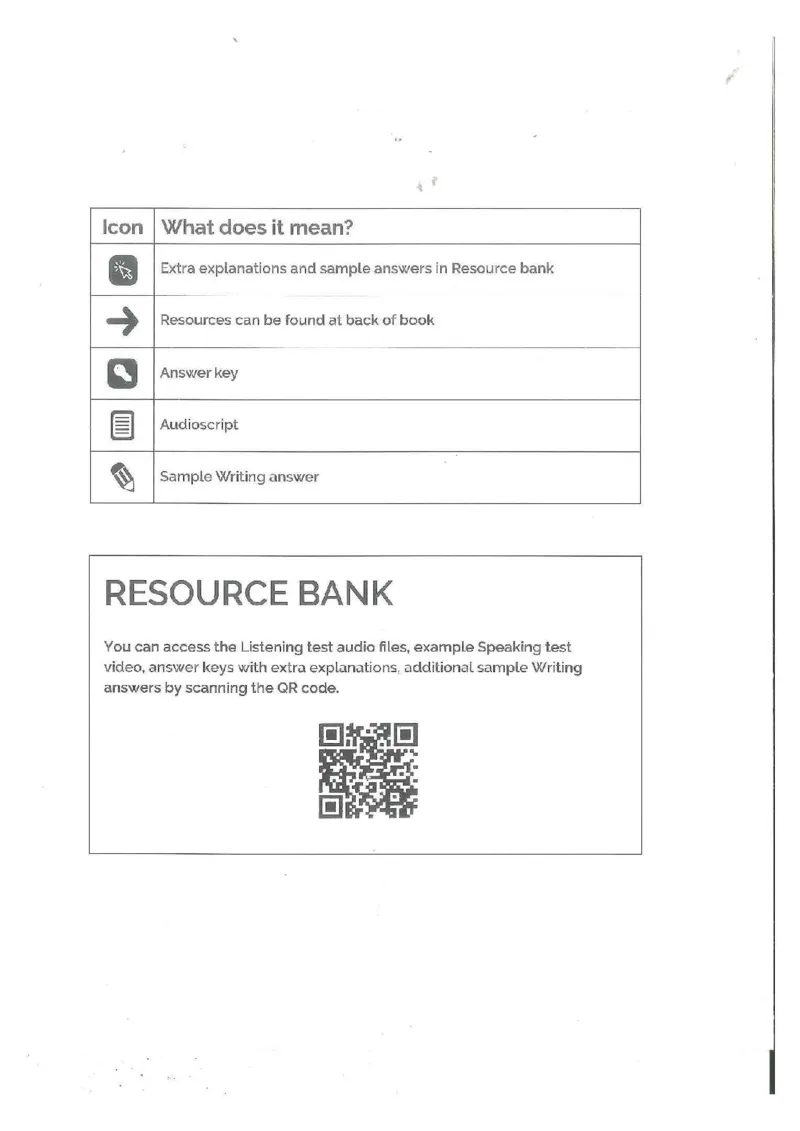
Icon What does it mean?
•
Extra explanations and sample answers in Resource bank
(cid:157)
Resources can be found at back of book
。 Answer key
自 Audioscript
飞 Sample Writing answer
RESOURCE BANK
You can access the Listening test audio files, example Speaking test
video, answer keys with extra explanations, additional sample Writing
answers by scanning the QR code.自费 CAMBRIDGE
ACADEMIC
剑桥雅思官方真题集
WITH ANSWERS 学术类
AUTHENTIC PRACTICE TESTS
Produced by Cambridge Exams Publishing
剑桥考试联合出版中心编者
磊吃U!A~ 但图书在版编目(C:IP)数据
剑桥雅思官方真题集. 15. 学术类/英国剑桥考试
联合出版中心编著. 一一 北京:群育出版社, 2020.6
书名原文: Cambridge IELTS 15 (Academic)
ISBN 978 7 5193 0494-2
I . ct剑… If. ①英…皿①IELTS一 习题集 IV.
( H310.41-44
中国版本图书馆CIP数据核字(2020 ) 第072091号
版权登记: 图字01-2020-2020号
This is a reprint of the following title published by Cambridge University Press:
Cambridge IELTS 15 (Academic) (ISBN: 9781108781619)
Cambridge University Press and Cambridge Assessmenl 2020
This reprint for tho People’s Republic of China (excluding Hong Kong, Macau and Taiwan) is published by
arrangement with the Press Syndicate of the University of Cambridge, Cambridge, United Kingdom.
。 Cambridge University Press, Cambridge Assessment English and Qunyan Press 2020.
This 「eprint is authorized for sale in the People’s Republic of China (excluding Hong Kong, Macau and Taiwan) only.
Unautho「ized exporl of this reprint is a violation of the Copyright Act. No part of this publication may be reproduced
or distributed by any means, or stored in a database or retrieval system, without the prior written permission of
Cambridge University Press and Qunyan Press.
此版本仅限在中华人民共和国境内(不包括香港、澳门特别行政区及台湾省)销售。未经授权出口此版本届违
法行为。 未经剑桥大学出版社和群言山版社书面同意,本书任何部分不得以任何方式被翻印或传播,不得载人
数据或检索系统。
责任编辑:孙平平
封面设计:李倩
出版发行:群言出版社
地 址: 北京市东城区东厂胡同北巷1号(100006)
网 址: www.qypublish.com (官网书城)
电子信箱: dywh@xdf.cn qunyancbs@126.com
联系电话: 010 62418641 65267783 65263836
经 销:全国新华书店
印 刷:北京华联印刷有限公司
版 次: 2020年6月第1版 2020年6月第l次印刷
开本: 787mm×1092mm 1/16
印张: 9
字 数: 209千字
书号: ISBN 978-7 5193-0494-2
定价: 128.00元
磊 [版权所有,侵权必究 ]
如有缺页、倒页、脱页等印装质量问题,请拔才丁服务热线: 010 626051660Contents
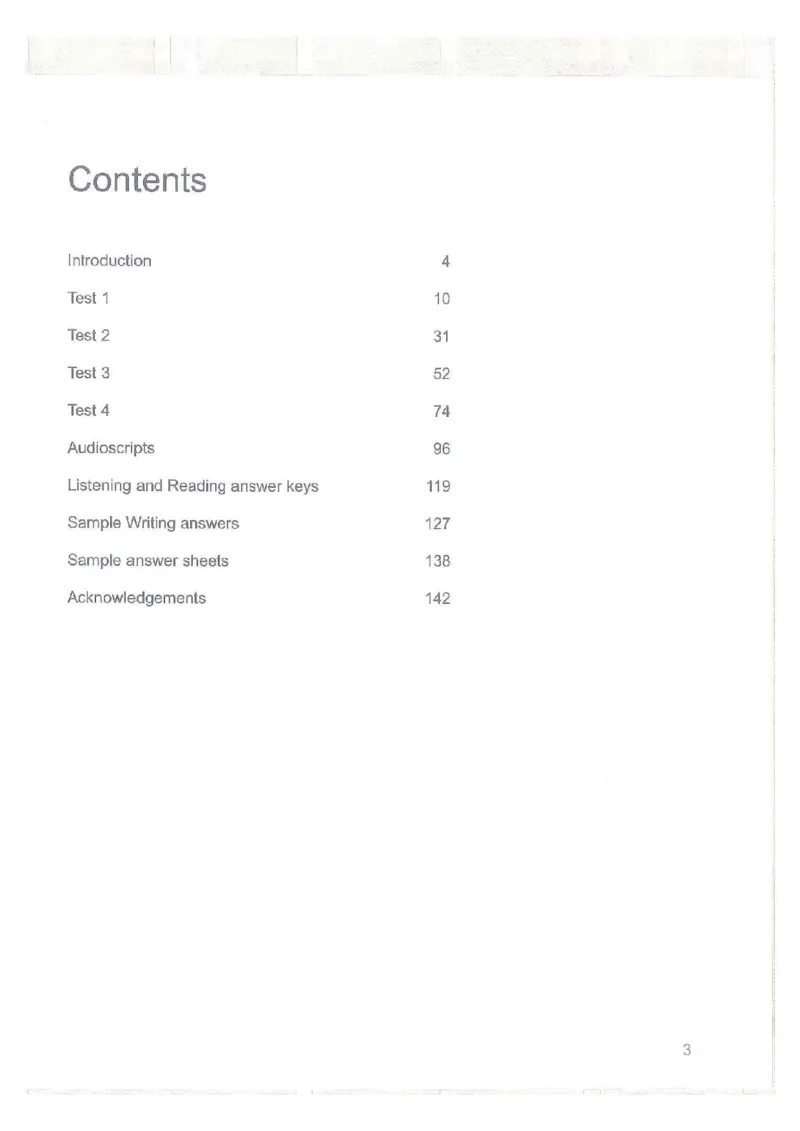
Introduction 4
Test 1 10
Test 2 31
Test 3 52
Test 4 74
Audioscripts 96
Listening and Reading answer keys 119
Sample Writing answers 127
Sample answer sheets 138
Acknowledgements 142
3
TIntroduction
Prepare f。r the exam with practice tests fr。m Cambridge
Inside you’II find four authentic examination papers f「om Cambridge Assessment English.
They are the perfect way to practise - EXACTLY like the real exam.
Why are they unique?
All our authentic practice tests go through the same design process as the IELTS test. We
check every single part of our practice tests with real students unde「 exam conditions, to
make sure we give you the most authentic experience possible.
Students can practise these tests 。ntheir own or with the help of a teacher to familiarise
themselves with the exam format, understand the scoring system and practise exam technique.
Further
inf。rmation
IELTS is jointly managed by the British Council, IDP: IELTS Australia and Cambridge
Assessment English. Further information can be found on the IELTS official website at:
ielts.。rg.
WHAT 15 THE TEST FORMAT?
IELTS consists of four components. All candidates take the same Listening and Speaking
tests. There is a choice of Reading and Writing tests according to whether a candidate is
taking the Academic or General Training module.
Academic General Training
For candidates wishing to study at For candidates wishing to migrate to an
undergraduate or postgraduate levels, English-speaking country (Australia, Canada,
and for those seeking professional New Zealand, UK), and for those wishing to
registration. train or study below degree level.
4Introduction
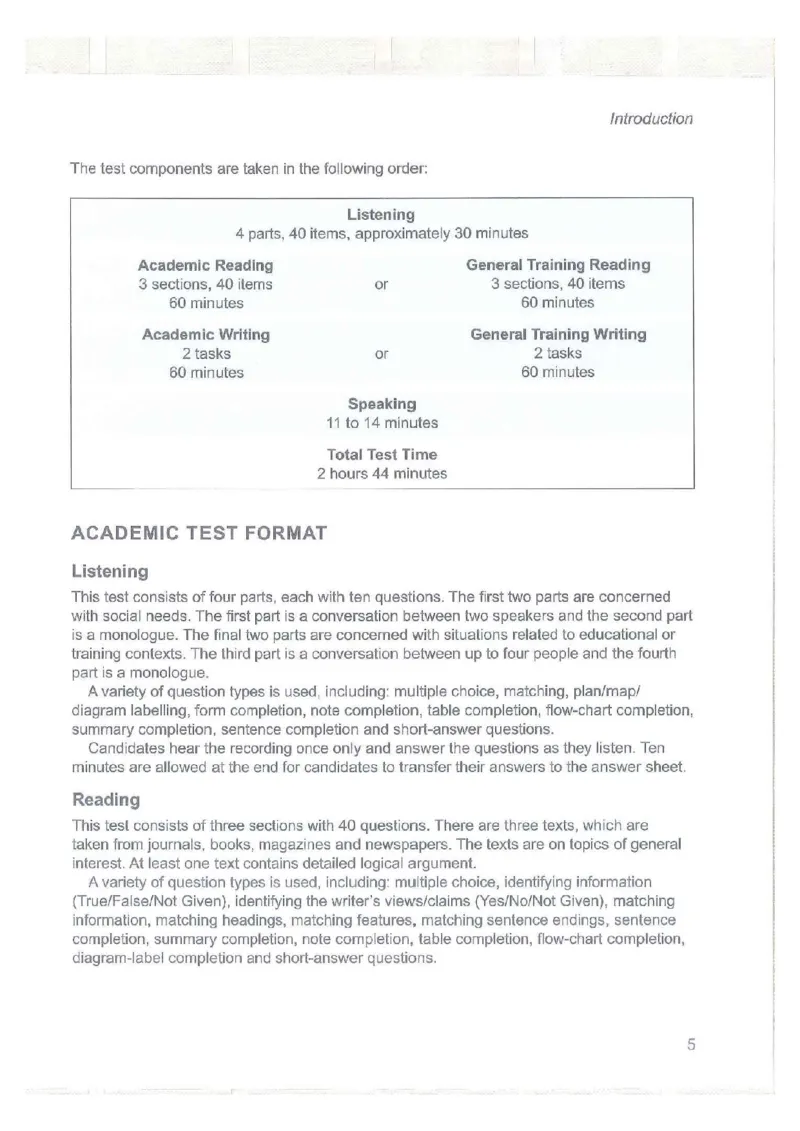
The test components are taken in the following order:
Listening
4 pa时s, 40 items, app「oximately 30 minutes
Academic Reading General Training Reading
3 sections, 40 items or 3 sections, 40 items
60 minutes 60 minutes
Academic Writing General Training Writing
2 tasks or 2 tasks
60 minutes 60 minutes
Speaking
11 to 14 minutes
Total Test Time
2 hours 44 minutes
ACADEMIC TEST FORMAT
Listening
This test consists of four parts, each with ten questions. The first two parts are concerned
with social needs. The first part is a conversation between two speake「sand the second part
is a monologue. The final two parts are concerned with situations related to educational or
training contexts. The third pa「tis a conversation between up to four people and the fourth
part is a monologue.
Ava「iety of question types is used, including: multiple choice, matching, plan/map/
diagram labelling, form completion, note completion, table completion, flow-chart completion,
summary completion, sentence completion and short-answer questions.
Candidates hear the recording once only and answer the questions as they listen. Ten
minutes are allowed at the end for candidates to transfer their answers to the answer sheet.
Reading
This test consists of three sections with 40 questions. There are three texts, which are
taken from journals, books, magazines and newspapers. The texts a「e on topics of general
interest. At least one text contains detailed logical argument.
A variety of question types is used, including: multiple choice, identifying information
(True/False/Not Given), identifying the w「iter’s views/claims (Yes/No/Not Given), matching
information, matching headings, matching features, matching sentence endings, sentence
completion, summary completion, note completion, table completion, flow-cha「t completion,
diagram-label completion and short-answer questions.
5Introduction
Writing
This test consists of two tasks. It is suggested that candidates spend about 20 minutes on
Task 1, which requires them to write at least 150 words, and 40 minutes on Task 2, which
requires them to write at least 250 words. Task 2 contributes twice as much as Task 1 to the
Writing score.
Task 1 requires candidates to look at a diagram or some data (in a graph, table or chart)
and to present the information in their own words. They are assessed on their ability to
organise, present and possibly compare data, and are required to describe the stages of a
process, describe an object or event, or explain how something works.
In Task 2, candidates are presented with a point of view, argument or problem. They are
assessed on their ability to present a solution to the problem, present and justify an opinio门,
compare and contrast evidence and opinions, and to evaluate and challenge ideas, evidence
or arguments.
Candidates are also assessed on their ability to write in an appropriate style. Mo「e
information on assessing the Writing test, including W「iting assessment criteria (public
version), is available at ielts.org.
Speaking
This test takes between 11 and 14 minutes and is conducted by a trained examiner.
There are three pa「ts:
Part 1
The candidate and the examiner introduce themselves. Candidates then answer general
questions about themselves, their home/family, their job/studies, their interests and a wide
range of similar familiar topic areas. This part lasts between four and five minutes.
Part 2
The candidate is given a task card with prompts and is asked to talk on a particular topic.
The candidate has one minute to prepare and they can make some notes if they wish,
before speaking for between one and two minutes. The examiner then asks one or two
questions on the same topic.
Part 3
The examiner and the candidate engage in a discussion of more abstract issues which are
thematically linked to the topic in Part 2. The discussion lasts between four and five minutes.
The Speaking test assesses whether candidates can communicate effectively in English.
The assessment takes into account Fluency and Coherence, Lexical Resource, Grammatical
Range and Accuracy, and Pronunciation. More information on assessing the Speaking test,
including Speaking assessment criteria (public version), is available at ielts.org.
6Introduction
HOW IS IELT S SCORED?
IELTS results are reported on a nine-band scale. In addition to the score for ove「all language
ability, IELTS provides a sco『e in the form of a profile for each of the four skills (Listening,
Reading, Writing and Speaking). These scores are also reported on a nine-band scale. All
scores are recorded on the Test Report Form along with details of the candidate’s nationality,
first language and date of birth. Each Overall Band Score corresponds to a descriptive
statement which gives a summary of the English-language ability of a candidate classified at
that level. The nine bands and thei「descriptive statements are as follows:
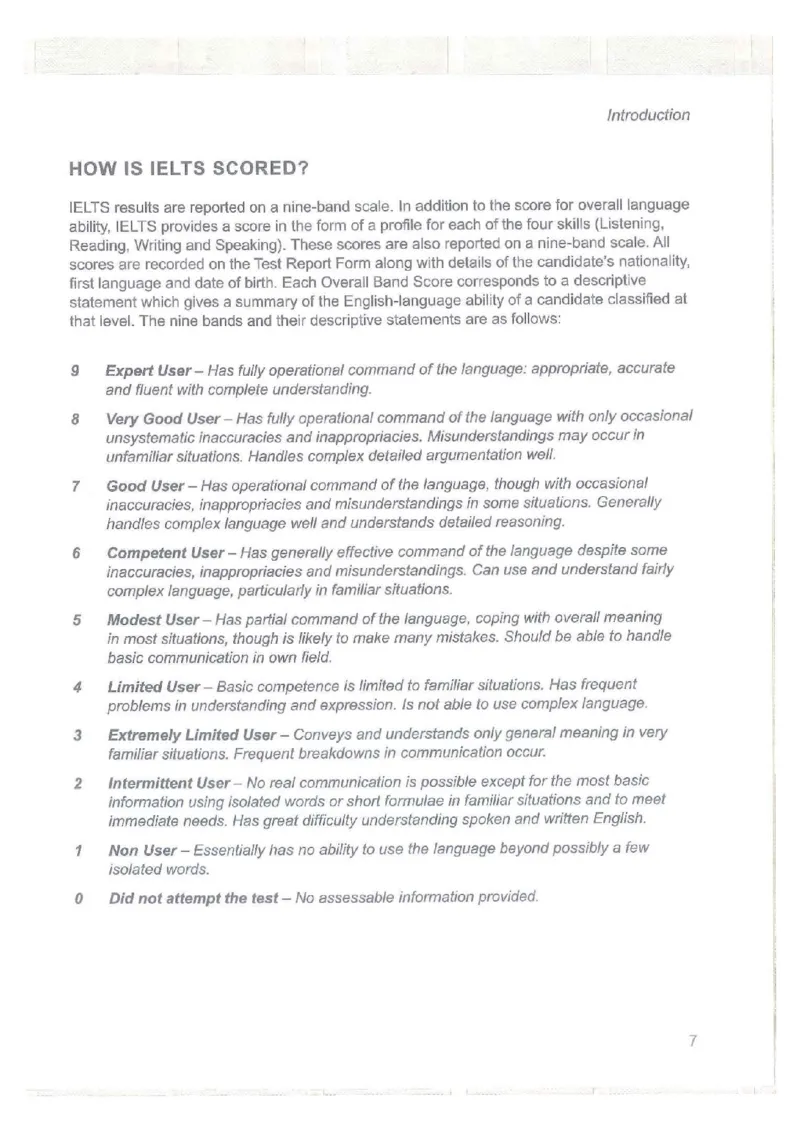
9 Expert User - Has fully operational command of the language: appropriate, accurate
and fluent with complete understanding.
8 Very G。。dUser - Has fully operational command of the language with only occasional
unsystematic inaccuracies and inappropriacies. Misunderstandings may occur in
unfamiliar situations. Handles complex detailed argumentation well.
7 G。。dUser - Has operational command of the language, though with occasional
inaccuracies, inappropriacies and misunderstandings in some situations. Generally
handles complex language well and understands detailed reasoning.
6 Competent User - Has generally e仔ective command of the language despite some
inaccuracies, inappropriacies and misunderstandings. Can use and understand fairly
complex language, particularly in familiar situations.
5 Modest User - Has partial command of the language, coping with overall meaning
in most situations, though is likely to make many mistakes. Should be able to handle
basic communication in own field.
4 Limited User - Basic competence is limited to familiar situations. Has frequent
problems in understanding and expression. Is not able to use complex language.
3 Extremely Limited User一 Conveys and understands o时ygeneral meaning in ve叩
familiar situations. Frequent breakdowns in communication occur.
2 Intermittent User - No real communication is possible except for the most basic
information using isolated words or short formulae in familiar situations and to meet
immediate needs. Has great difficulty understanding spoken and written English.
’
Non User - Essentially has no ability to use the language beyond possibly a few
isolated words.
0 Did n。tattempt the test - No assessable information provided.
7
JIntroduction
MARKING THE PRACTICE TESTS
Listening and Reading
The answer keys are on pages 119- 126.
Each question in the Listening and Reading tests is worth one ma「k.
Questions which require letter I Roman numeral answers
For questions where the answers are letters or Roman numera怡, you should write only
the number of answers required. For example, if the answer is a single lette「or numeral
you should write only one answer. If you have written more letters or numerals than a「e
required, the answer must be marked wrong.
Questions which require answers in the form of words or numbers
• Answers may be written in upper or lower case.
• Words in brackets are optional - they are correct, but not necessary.
Alternative answers are separated by a slash (/).
• If you are asked to write an answer using a certain number of words and/or (a) number(剖,
you will be penalised if you exceed this. For example, if a question specifies an answer
using NO MORE THAN THREE WORDS and the correct answe「 is ‘black leather coat’,
the answer 'coat of black leath町’ is incorrect.
• In questions where you are expected to complete a gap, you should only t「ansfer the
necessa叩 missing word(s) onto the answer sheet. Fo「examp怡, to complete ‘in the ...’,
where the correct answer is ‘morning’, the answe「‘in the morning' would be incorrect.
All answers require correct spelling (including words in brackets).
• Both US and UK spelling are acceptable and are included in the answer key.
• All standard alternatives for numbers, dates and currencies are acceptable.
• All standard abbreviations are acceptable.
• You will find additional notes about individual answers in the answer key.
Writing
The sample answers are on pages 127-137. It is not possible for you to give yourself a mark
for the Writing tasks. We have provided sample answers (written by candidates), showing
thei「score and the examiners' comments. These sample answers will give you an insight
into what is required for the Writing test.
8Introduction
HOW SHOULD YOU INTERPRET YOUR SCORES?
At the end of each Listening and Reading answer key you will find a chart which will help
you assess whether, on the basis of your Practice Test results, you are ready to take the
IELTS test.
In interpreting your score, there are a number of points you should bea「 in mind. You「
performance in the real IELTS test will be 「eported in two ways: there will be a Band Score
from 1 to 9 for each of the components and an Overall Band Score from 1 to 9, which is
the average of your scores in the four components. However, institutions considering your
application are advised to look at both the Overall Band Score and the Band Score for
each component in order to determine whether you have the language skills needed for a
particula「course of study. For example, if your course involves a lot of reading and writing,
but no lectures, listening skills might be less important and a score of 5 in Listening might be
acceptable if the Overall Band Score was 7. However, for a course which has lots of lectures
and spoken instructions, a score of 5 in Listening might be unacceptable eve门 though the
Overall Band Score was 7.
Once you have marked your tests, you should have some idea of whether your listening
and reading skills are good enough for you to t叩the IELTS test. If you did well enough in
one component, but not in others, you will have to decide for yourself whether you are ready
to take the test.
The Practice Tests have been checked to ensure that they are the same level of difficulty
as the real IELTS test. However, we cannot guarantee that your score in the Practice Tests
will be 「eflected in the real IELTS test. The Practice Tests can only give you an idea of your
possible future performance and it is ultimately up to you to make decisions based on your
score.
Different institutions accept different IELTS sco『es for different types of courses. We have
based our recommendations on the average scores which the majo「ity of institutions accept.
The institution to which you are applying may, of course, require a higher or lower score than
most other institutions.
9Test 1
归国I.EIW.WIII
PART 1 Questions 1-10
Complete the notes below.
Write ONE WORD AND/OR A NUMBER for each answer.
Ban kside Recruitment Agency
• Address of agency: 497 Eastside, Docklands
• Name of agent: Becky 1 .......... .
• Phone number: 07866 510333
• Best to call her in the 2 .............……
Typical jobs
• Clerical and admin roles, mainly in the finance industry
• Must have good 3 .........……...................…..... skills
• Jobs are usually for at least one 4 ....... ..
• Pay is usually 5 £…··…………-….......……... pe「 hour
Registration pr。cess
• Wear a 6………··········…··….......….. to the interview
• Must bring your 7 .......…….....,..·……-·…....... to the interview
• They will ask question~ about each applicant’s 8 ........... .
Advantages 。f using an agency
• The 9 ..........….......….................... you receive at interview will benefit you
• Will get access to vacancies which are not advertised
• Less 10 ..……................................... is involved in applying to「jobs
I I
10 →|。 p. 119 I国 p. 96Listening
PART 2 Questions 11-20
Questions 11-14
Choose the correct letter, A, B or C.
Matthews Island Holidays
11 According to the speake飞 the company
A has been in business for longer than most of its competitors.
B arranges holidays to more destinations than its competitors.
C has more customers than its competitors.
12 Where can customers meet the tour manager before travelling to the Isle of Man?
A Liverpool
B Heysham
C Luton
13 How many lunches are included in the price of the holiday?
A three
B four
C five
14 Customers have to pay extra for
A guaranteeing themselves a larger room.
B booking at short notice.
C transferring to another date.
11Test 1
Questions 15-20
Complete the table below.
Write ONE WORD AND/OR A NUMBER for each answer.
Timetable for Isle of Man holiday
Activity N。tes
Introduction by manager
Day 1 Arrive
Hotel dining room has view of the
15 ...
Tynwald may have been founded in
Day2 Tynwald Exhibition and Peel
16 ...............…··… ············…. not 979.
Travel along promenade in a tram;
Day 3 T「ip to Snaefell train to Laxey; train to the
17….........…··……·….......….. of Snaefell
Company provides a
Day4 F「ee day 18 ·········…·-………….......……. for local
transport and heritage sites.
Free time, then coach to Castletown
Day 5 Take the 19 ....…………·……................… railway -former 20….................……············…has old
train from Douglas to Port Erin
castle.
Day6 Leave Leave the island by fe「ry or plane
(cid:157)
I~ I I
12 p. 119 I 自 p. 97Listening
PART 3 Questions 21-30
Questions 21-26
What did findings of previous research claim about the perso门ality traits a
child is likely to have because of their position in the family?
Choose SIX answers from the box and write the correct letter. A-H next to
Questions 21-26.
Pers。nality Traits
A outgoing
B selfish
C independent
D attention-seeking
E introverted
F co-operative
G caring
H competitive
p。siti。n in family
21 the eldest child
22 a middle child
23 the youngest child
24 a twin
25 an only child
26 a child with much older siblings
13Test 1
Questions 27 and 28
Choose the correct Jetter, A, B or C.
27 What do the speake「s say about the evidence relating to birth order and academic
success?
A There is conflicting evidence about whether oldest children pe斤。rm best in
intelligence tests.
B There is little doubt that birth order has less influence on academic
achievement than socio-economic status.
C Some studies have neglected to include impo叫ant factors such as family size.
28 What does Ruth think is surprising about the difference in oldest children’s
academic performance?
ABC
It is mainly thanks to their roles as teachers for their younger siblings.
The advantages they have only lead to a slightly higher level of achievement.
The extra parental attention they receive at a young age makes little
difference.
Questions 29 and 30
Choose TWO letters, A-E.
Which TWO expe「iences of sibling rival叩 do the speakers agree has been valuable
for them?
ABCDE
learning to share
learning to stand up for oneself
learning to be a good loser
learning to be tolerant
learning to say sorry
(cid:157)
1'1 11 I
14 p. 119 l@ p. gsListening
PART 4 Questions 31-40
Complete the notes below.
Write ONE WORD ONLY for each answer.
The Eucalyptus Tree in Australia
Im p。叫anee
• it provides 31 .....… ….......….................. and food for a wide range of species
• its leaves provide 32 .......................……….......…which is used to make a disinfectant
Reas。ns for present decline in number
A) Diseases
(i)‘Mundulla Yellows'
• Cause - lime used for making 33 ....…-…··-…·……·-…...... was absorbed
- trees were unable to take in necessary iron through their roots
(ii) 'Bell-miner Associated Die-back'
• Cause - 34 ….................……............... feed on eucalyptus leaves
- they secrete a substance containing sugar
一 bell-miner birds are attracted by this and keep away other species
B) Bushfires
William Jackson's theory:
• high-frequency bushfires have impact on vegetation, resulting in the growth
of 35
• mid-frequency bushfires result in the growth of eucalyptus forests, because
they:
- make more 36 ......................................….. available to the trees
- maintain the quality of the 37 .....
• low-frequency bushfires resL』It in the growth of 38 '. ..........…............................. rainforest',
which is:
-a 39 .......…………·…................ ecosystem
- an ideal environment for the 40 .......................................... of the bell-miner
(cid:157)
1'1 I
p.119 I I 自 p.99 15
fTest 1
Iii:
lEfil且国
READING PASSAGE 1
You should spend about 20 minutes on Questions 1-13, which are based on Reading
Passage 1 below.
Nutmeg - a valuable spice
The nutmeg tree, Myristica fragrαns, is a large evergreen tree native to Southeast Asia. Until the late
18也centu町, itonly grew in one place in the world: a small group of islands in the Banda Sea, part
of the Moluccas - or Spice Islands - in northeastern Indonesia. The tree is也icklybranched with
dense foliage of tough, dark green oval leaves, and produces small, yellow, bell-shaped flowers and
pale yellow pear-shaped丘uits.The丘uitis encased in a丑eshyhusk. When the fruit is ripe, this husk _
splits into two halves along a ridge running the length of the fruit. Inside is a purple-brown shiny seed,
2-3 cm long by about 2 cm across, surrounded by a lacy red or crimson covering called m ‘aril'. These
are the sources oft he two spices m恤1egand mace, the former being produced仕omthe dried seed
and the latter仕omthe aril.
Nutmeg was a highly prized and costly ingredient in European cuisine in the Middle Ages, and was
used as a fl.a飞routing, medicinal, and preservative agent. Throughout也isperiod,吐1eArabs were the
exclusive importers oft he spice to Europe. They sold nutmeg for high prices to merchants based in
Venice, but they never revealed the exact location oft he source of this extremely valuable commodity.
The Arab-Venetian dominance oft he trade自nallyended in 1512, when the Po此uguesereached the
Banda Islands and began exploiting its precious resources.
Always in danger of competition from neighbouring Spain, the Portuguese began subcontracting
their spice distribution to Dutch traders. Profits began to flow into the Netherlands, and the Dutch
commercial fleet swiftly grew into one of the largest in the world. The Dutch quietly gained control
of most of the shipping and trading of spices in N orthem E田ope.Then, in 1580, Portugal fell under
Spanish rule, and by the end oft he 16th century the Dutch found themselves locked out of the market.
As prices for pepper, nutmeg, and other spices soared across Europe, they decided to fight back.
In 1602, Dutch merchants founded the VOC, a trading co甲orationbetter known as the Dutch East
India Company. By 1617,也eVOC was the richest commercial operation in the world. The company
had 50,000 employees worldwide, with a private缸myof30,000 men and a fleet of200 ships. At 」
the same time, thousands of people across Europe were dying of the pl鸣ue,a highly contagious and
deadly disease. Doctors were desperate for a way to stop the spread of this disease, and they decided
nutmeg held the cure. Everybody wanted nutmeg, and many were willing to spare no expense to
have it. Nu阳1egbought for a few pennies in Indonesia could be sold for 68,000 times its original cost
on the streets ofL ondon. The only problem was the short suppl予Andthat's where the Dutch found
their opportuni可.
16Reading
The Banda Islands were ruled by local sultans who insisted on maintaining a neutral trading
policy towards foreign powers. This allowed them to avoid the presence of Portuguese or Spanish
troops on their soil, but it also left them unprotected仕om other invaders. In 1621, the Dutch
arrived and took over. Once securely in control of the Bandas, the Dutch went to work protecting
their new investment. They concentrated all nutmeg production into a few easily guarded areas,
uprooting and destroying any trees outside the plantation zones. Anyone caught growing a nutmeg
seedling or carrying seeds without the proper authority was severely punished. In addition,
all exported nu位negwas covered with lime to make sure there was no chance a fertile seed
which could be grown elsewhere would leave the islands. There was only one obstacle to Dutch
domination. One of the Banda Islands, a sliver ofland called Run, only 3 km long by less than
1 km wide, was under the control of the British. After decades of fighting for control of this tiny
island, the Dutch and British arrived at a compromise settlement, the Trea可 ofBre巾, in 1667.
Intent on securing their hold over every nutmeg-producing island, the Dutch o茸ereda trade: if the
British would give them the island of Run, they would in阳m give Britain a distant and much less
valuable island in North America. The British agreed. That other island was Manhattan, which is
how New Amsterdam became New York. The Dutch now had a monopoly over the nutmeg trade
which would last for another century.
Then, in 1770, a Frenchman named Pierre Poivre successfully smuggled nu拍1egplants to safe句r
in Mauritius, an island off the coast of A仕ica. Some oft hese were later exported to the Caribbean
where they thrived, especially on the island of Grenada. Next, in 1778, a volcanic eruption in the
Banda region caused a tsunami that wiped out half the nutmeg groves. Finally, in 1809, the British
returned to Indonesia and seized the Banda Islands by force. They returned the islands to the
Dutch in 1817, but not before transpI ant ing hundreds of nutmeg seedlings to plantations in several
locations across southern Asia. The Dutch nutmeg monopoly was over.
Today, nutmeg is grown in Indonesia, the Caribbean, India, Malaysia, Papua New Guinea and
Sri Lanka, and world nutmeg production is estimated to average between I 0,000 and 12,000 tonnes
per
ye盯.
17Test 1
Questions 1- 4
Complete the notes below.
Choose ONE WORD ONLY from the passage for each answeκ
Write your answers in boxes 1-4 on your answer sheet.
The nutmeg tree and fruit
• the leaves of the tree are 1 ..............….......................…in shape
• the 2 ................…-…·……·-……. surrounds the fruit and breaks open when the f「uit
is ripe
• the 3 ......….......….....................…is used to produce the spice nutmeg
• the covering known as the aril is used to produce 4 .......……-…··
• the tree has yellow flowers and fruit
Questions 5- 7
Do the following statements agree with the information given in Reading Passage 才?
In boxes 5-7 on your answer sheet, write
TRUE if the statement agrees with the information
FALSE if the statement contradicts the information
NOT GIVEN if there is no information on this
5 In the Middle Ages, most Europeans knew where nutmeg was grown.
6 The VOC was the world’s first major trading company.
7 Following the Treaty of Breda, the Dutch had control of all the islands where
nutmeg grew.
18I
I
Reading
Questions 8—13
Complete the table below.
Choose ONE WORD ONLY from the passage for each answer.
Write your answers in boxes 8-13 on your answer sheet.
Middle Ages Nutmeg was brought to Europe by the 8 ...........................................
16th century European nations took control of the nutmeg trade
17th century Demand for nutmeg grew, as it was believed to be effective
against the disease known as the 9 ....
…...... ················· ……....
The Dutch
- took control of the Banda Islands
- restricted nutmeg production to a few areas
- put 10 ........................................ on nutmeg to avoid it being cultivated
outside the islands
- finally obtained the island of 11 ........................... from
….......
the British
Late 18th century 1770 -nutmeg plants were secretly taken to 12 ..........................................
1778 - half the Banda Islands'nutmeg plantations were destroyed
by a 13 ..........................................
➔I'-'p. 120 I 19Test 1
READING PASSAGE 2
You should spend about 20 minutes on Questions 14-26, which are based on Reading
Passage 2 below.
Driverless cars
A The automotive sector is well used to adapting to automation in manufacturing.
The implementation of robotic car manufacture from the 1970s onwards led to
significant cost savings and improvements in the reliability and flexibility of vehicle
mass production. A new challenge to vehicle production is now on the horizon
and, again, it comes from automation. However, this time it is not to do with the
manufacturing process, but with the vehicles themselves.
Research projects on vehicle automation are not new. Vehicles with limited self
driving capabilities have been around for more than 50 years, resulting in significant
contributions towards driver assistance systems. But since Google announced in
201 O that it had been trialling self-driving cars on the streets of California, progress
in this field has quickly gathered pace.
B There are many reasons why technology is advancing so fast. One frequently cited
motive is safety; indeed, research at the UK’s Transport Research Laboratory has
demonstrated that more than 90 percent of road collisions involve human error as a
contributo叩factor, and it is the prima叩 cause in the vast m司ority. Automation may
help to reduce the incidence of this.
Another aim is to free the time people spend driving for other purposes. If the
vehicle can do some or all of the driving, it may be possible to be productive, to
socialise or simply to relax while automation systems have responsibility for safe
control of the vehicle. If the vehicle can do the driving, those who are challenged
by existing mobility models - such as older or disabled travellers - may be able to
enjoy significantly greater travel autonomy.
C Beyond these di「ect benefits, we can consider the wider implications for transport
and society, and how manufacturing processes might need to respond as a
result. At present, the average car spends more than 90 percent of its life parked.
Automation means that initiatives fo「car-sharing become much more viable,
particularly in urban areas with significant travel demand. If a significant proportion
of the population choose to use shared automated vehicles, mobility demand can
be met by far fewer vehicles.
D The Massachusetts Institute of Technology investigated automated mobility in
Singapore, finding that fewer than 30 percent of the vehicles currently used would
be required if fully automated car sharing could be implemented. If this is the case,
it might mean that we need to manufacture far fewer vehicles to meet demand.
20Reading
However, the number of trips being taken would probably increase, pa叫y because
empty vehicles would have to be moved from one customer to the next.
Modelling work by the University of Michigan Transportation Research Institute
suggests automated vehicles might reduce vehicle ownership by 43 percent, but
that vehicles' average annual mileage would double as a result. As a consequence,
each vehicle would be used more intensively, and might need replacing
sooner. This faster rate of turnover may mean that vehicle production will not
necessarily decrease.
E Automation may prompt other changes in vehicle manufacture. If we move to a
model where consumers are tending not to own a single vehicle but to purchase
access to a range of vehicles through a mobility provider, drivers will have the
freedom to select one that best suits their needs for a pa民icularjourney, rathe「than
making a compromise across all their requirements.
Since, for most of the time, most of the seats in most cars are unoccupied, this may
boost production of a smaller, more efficient range of vehicles that suit the needs
of individuals. Specialised vehicles may then be available for exceptional journeys,
such as going on a family camping trip or helping a son or daughter move to
university.
F The「e are a number of hurdles to overcome in delivering automated vehicles
to our roads. These include the technical difficulties in ensuring that the vehicle
works 「eliably in the infinite range of traffic, weather and road situations it might
encounter; the regulatory challenges in understanding how liability and enforcement
might change when drivers are no longer essential for vehicle operation; and
the societal changes that may be required for communities to trust and accept
automated vehicles as being a valuable part of the mobility landscape.
G It's clear that there are many challenges that need to be addressed but, through
robust and targeted research, these can most probably be conquered within the
next 10 years. Mobility will change in such potentially significant ways and in
association with so many other technological developments, such as telepresence
and virtual reality, that it is hard to make concrete predictions about the future.
However, one thing is certain: change is coming, and the need to be flexible in
response to this will be vital for those involved in manufacturing the vehicles that
will deliver future mobility.
21Test 1
Questions 14-18
Reading Passage 2 has seven sections, A-G.
Which section contains the following information?
Write the correct letter, A-G, in boxes 14- 18 on your answer sheet.
14 reference to the amount of time when a car is not in use
15 mention of several advantages of driverless vehicles for individual road-users
16 reference to the oppo叫unity of choosing the most appropriate vehicle for each trip
17 an estimate of how long it will take to overcome a number of problems
18 a suggestion that the use of driverless cars may have no effect o门 the number of
vehicles manufactured
Questions 19-22
Complete the summary below.
Choose NO MORE THAN TWO WORDS 斤。m the passage for each answeκ
Write your answers in boxes 19-22 on your answer sheet.
The impact of driverless cars
Figures from the Transport Research Laboratory indicate that most motor accidents
are pa同ly due to 19 ..............…...................….......….... , so the introduction of driverless vehicles
will result in greater safety. In addition to the direct benefits of automation, it may bring
othe「advantages. For example, schemes for 20 .......………·…..............….................. will be more
workable, especially in towns and cities, resulting in fewer cars on the road.
According to the University of Michigan Transportation Research Institute, the「e could
be a 43 percent drop in 21 of cars. However, this would mean
.................…·……············………..
that the yearly 22 of each car would, on average, be twice as
..............................….....................…
high as it currently is. This would lead to a higher turnove「of vehicles, and therefore no
reduction in automotive manufacturing.
22Reading
Questions 23 and 24
Choose TWO letters, A-E.
Write the correct letters in boxes 23 and 24 on your answer sheet.
Which TWO benefits of automated vehicles does the writer mention?
ABCDE
Car travellers could enjoy considerable cost savings.
It would be easier to find parking spaces in urban areas.
Travellers could spend journeys doing something other than driving.
People who find d「iving physically difficult could travel independently.
A reduction in the number of cars would mean a reduction in pollution.
Questions 25 and 26
Choose TWO letters, A-E.
Write the correct letters in boxes 25 and 26 on your answer sheet.
Which TWO challenges to automated vehicle development does the writer mention?
ABCDE
making su「e the general public has confidence in automated vehicles
managing the pace of transition from conventional to automated vehicles
deciding how to compensate professional drivers who become redundant
setting up the infrastructure to make roads suitable for automated vehicles
getting automated vehicles to adapt to various different driving conditions
(cid:157)
ICJ I
p. 120 23Test 1
READING PASSAGE 3
You should spend about 20 minutes on Questi。ns 27-40, which are based on Reading
Passage 3 below.
What is exploration?
We are all explorers. 。田desireto discover, and then share that new-found knowledge, is part
of what makes us human indeed, this has played an important part in our success as a species.
Long before the first caveman slumped down beside the fire and grunted news that there were
plen可ofwildebeest over yonder, our ancestors had learnt the value of sending out scouts to
investigate the unknown. This questing nature of ours undoubtedly helped our species spread
around the globe, just as it nowadays no doubt helps the last nomadic Penan maintain their
existence in the depleted forests of Borneo, and a visitor negotiate the subways of New York.
Over the years, we’ve come to think of explorers as a peculiar breed - different仕om the rest of
时, differentfrom those ofus who are merely 飞rell travelled', even; and perhaps there is a可peof
person more suited to seeking out the new, a type of caveman more inclined to risk venturing out.
That, however, doesn't take away from the fact that we all have this enquiring instinct, even today;
and that in all sorts of professions whether artist, marine biologist or astronomer - borders of
the unknown are being tested each day.
Thomas Hardy set some of his novels in Egdon Heath, a fictional area of uncultivated land, and
used the landscape to suggest the desires and fears of his characters. He is delving into ma忧ers
we all recognise because they are common to humanity. This is surely an act of exploration, and
into a world as remote as the author chooses. Explorer and travel writer Peter Fleming talks of
the moment when the explorer returns to the existence he has left behind with his loved ones. The
traveller ‘who has for weeks or months seen himself only as a puny and irrelevant alien crawling
labor白usly over a country in which he has no roots and no background, suddenly encounters his
other self, a relatively solid直gure, with a place in the minds of certain people'.
In this book about the exploration of the earth’s surface, I have confined myself to those whose
travels were real and who also aimed at more than personal discovery. But that still left me with
another problem: the word ‘explorer’ has become associated with a past era. We think back to a
golden age, as if exploration peaked somehow in the 19th cen阳可-as if the process of discovery
is now on the decline, though the truth is that we have named only one and a half million of this
planet’s species, and there may be more than 10 million - and that’s not including bacteria. We
have studied only 5 per cent of the species we know. We have scarcely mapped the ocean floors,
and know even less about ourselves; we fully understand the workings of only 10 per cent of our
brains.
24Reading
Here is how some of today
’
s
'
'explorers
’
define the word. Ran Fiennes, dubbed the ‘greatest
living explorer', said,‘An explorer is someone who has done something that no human has done
before - and also done something scienti丑callyuse如1.’Chris Bonington, a leading mountaineer,
felt exploration was to be found in the act of physically touching the unknown:‘You have to
have gone somewhere new.’Then Robin Hanbury-Tenison, a campaigner on behalf of remote
so-called ‘tribal’ peoples, said, 'A traveller simply records information about some far-off world,
and reports back; but an explorer changes the world.' Wilfred Thesiger, who crossed Arabia's
Empty Quarter in 1946, and belongs to an era of unmechanised travel now lost to the rest of us,
told me,‘Ifl吐goneacross by camel when I could have gone by car, it would have been a stunt.’
To him, exploration meant bringing back information from a remote place regardless of any great
self-discovery.
Each definjtion is slightly different - and tends to reflect the field of endeavour of each pi.onee汇 It
was the same whoever I asked: the prominent historian would say exploration was a thing of the
past, the cutting-edge scientist would say it was of the present. And so on. They each set their own
particular criteria; the common factor in their approach being that they alJ had, unlike many of us
who simply enjoy travel or discovering new things, both a very definite objective仕omthe outset
and also a desire to record their findings.
I咀best declare my own bias. As a writer, I’m interested in the exploration of ideas. I’ve done
a great many expeditions and each one was unique. I’ve lived for months alone with isolated
groups of people all around the world, even two ‘uncontacted tribes'. But none of these things
is of the slightest interest to anyone unless, through my books, I’ve found a new slant, explored
a new idea. Why? Because the world has moved on. The time has long passed for the great
continental voyages - another walk to the poles, another crossing of the Empty Quarter. We
know how the land surface of our planet lies; exploration of it is now down to the details - the
habits of microbes, say, or the grazing behaviour of buffalo. Aside from the deep sea and deep
underground, it's the era of specialists. However, this is to disregard the role the human mind has
in conveying remote places; and this is what interests me: how a仕esh interpretation, even of a
well-travelled route, can give its readers new insights.
25Test 1
Questions 27- 32
Choose the correct letter, A, B, C or D.
Write the correct letter in boxes 27-32 on your answer sheet.
27 The writer refers to visitors to New York to illustrate the point that
A exploration is an intrinsic element of being human.
B most people are enthusiastic about exploring.
C exploration can lead to surprising results.
D most people find exploration daunting.
28 According to the second paragraph, what is the writer’s view of explorers?
A Their discoveries have brought both benefits and disadvantages.
B Their main value is in teaching others.
C They act on an urge that is common to everyone.
D They tend to be more attracted to certain professions than to others.
29 The writer refers to a description of Egdon Heath to suggest that
A Ha「dy was writing about his own experience of exploration.
B Hardy was mistaken about the nature of exploration.
C Hardy’s aim was to investigate people’s emotional states.
D Hardy’s aim was to show the attraction of isolation.
30 In the fourth paragraph, the writer refers to 'a golden age’to suggest that
A the amount of useful information produced by exploration has decreased.
B fewer people are interested in exploring than in the 19th century.
C recent developments have made exploration less exciting.
D we are wrong to think that exploration is no longer necessa叩.
31 In the sixth pa「agraph, when discussing the definition of exploration, the writer
argues that
A people tend to relate exploration to their own professional interests.
B certain people are likely to misunderstand the nature of exploration.
C the generally accepted definition has changed over time.
D historians and scientists have more valid definitions than the general public.
32 In the last paragraph, the writer explains that he is interested in
A how someone’s personality is reflected in their choice of places to visit.
B the human ability to cast new light on places that may be familiar.
C how travel writing has evolved to meet changing demands.
D the feelings that writers develop about the places that they explore.
26Reading
Questions 33-37
Look at the following statements (Questions 33-37) and the list of explorers below.
Match each statement with the correct explore飞 A-E.
Write the correct letter, A-E, in boxes 33- 37 on your answer sheet.
NB You may use any letter more than once.
33 He referred to the relevance of the form of transport used.
34 He described feelings on coming back home after a long journey.
35 He worked for the benefit of specific groups of people.
36 He did not consider learning about oneself an essential pa时 ofexploration.
37 He defined exploration as being both unique and of value to others.
List of Expl。『ers
A Peter Fleming
B Ran Fiennes
C Chris Bonington
D Robin Hanbury-Tenison
E Wilfred Thesiger
Questions 38-40
Complete the summary below.
Choose NO MORE THAN TWO WORDS from the passage for each answe仁
Write your answers in boxes 38-40 on your answer sheet.
The writer’s own bias
The writer has experience of a large number of 38 ..………...........……........….......……, and
was the first stranger that certain previously 39 ......………………………··…people
had encountered. He believes there is no need for further exploration of Earth’S
40 ..........……………··……......………, except to answer specific questions such as how buffalo eat.
(cid:157)
10
p. 120 I 27Test 1
I皿国画IImll
WRITING TASK 1
You should spend about 20 minutes on this task.
The chart below shows the results of a survey about people's coffee and tea
buying and drinking habits in five Australian cities.
Summarise the information by selecting and reporting the main features, and
make comparisons where relevant.
Write at least 150 words.
Coffee and tea buying and drinking habits in five cities in Australia
70% -一…~
65% ~-~……••un~---一…一一一一一”一’一”“…一一…一一……··…………一一…一’一……一一--·,,,,,一’“”一”
anu
u ,、 /
ω 阳
F- 山
Z 55%
ω-u
ω甲
@
』 50%
恙
。
45%
”-
。
。 40%5%
由 斗
w-
H 中
Cω 3
ω
』
。
也
30%中战l
25%叶,
20%
Sydney Melbourne Brisbane Adelaide Hobart
• Bought fresh coffee in last 4 weeks
囹 Bought instant coffee in last 4 weeks
Went to a cafe for co忏ee or tea in last 4 weeks
E
(cid:157)
QU
n
J
ιWriting
WRITING TASK 2
You should spend about 40 minutes on this task.
Write about the following topic:
In some countries, owning a home rather than renting one is very impo时ant
for people.
Why might this be the case?
Do you think this is a positive or negative situation?
Give reasons for your answer and include any relevant examples from your own
knowledge or experience.
Write at least 250 wo「ds.
(cid:157)
叮
』J丁est 1
11:1:.1苟且坷’己[etlll
PART 1
The examiner asks the candidate about him/herself, his/her home, work or studies and
other familia「topics.
EXAMPLE
Email
• What kinds of emails do you receive about your work or studies?
• Do you prefer to email, phone or text your friends? [Why?]
• Do you 「eply to emails and messages as soon as you receive them? [Why/Why not?]
• Are you happy to receive emails that are advertising things? [Why/Why not?]
PART 2
Describe a h。tel that y。u kn。w. You will have to talk
about the topic for one
You sh。uld say:
to two minutes. You
where this h。tel is
have one minute to
what this hotel l。。ks like
think about what you
what facilities this hotel has
are going to say. You
and explain whether y。u think this is a nice hotel can make so付1e notes
to stay in. to help you if you wish.
PART 3
Discussion topics:
Staying in h。tels
Example questions:
What things are important when people are choosing a hotel?
Why do some people not like staying in hotels?
Do you think staying in a luxury hotel is a waste of money?
Working in a hotel
Example questions:
Do you think hotel work is a good career for life?
How does working in a big hotel compare with working in a small hotel?
What skills are needed to be a successful hotel manager?
30Test 2
111回回回R霄’
PART 1 Questions 1-10
Questions 1-4
Complete the table below.
Write ONE WORD ONLY for each answer.
Festival information
Date Type 。fevent Details
17th a concert performers f『om Canada
18th a ballet company called 1 .....
19th-20th type of play: a comedy called Jemima
a play
(afternoon)
has had a good 2 .......…·
20th (e vening) a 3 .........……………··…........ show show is called 4 ....
Questions 5-10
Complete the notes below.
Write ONE WORD ONLY for each answer.
w。rkshops
• Making 5 ........................……............ food
• (children only) Making 6 ......... .. .
• (adults only) Making toys from 7.………...................…........... using various tools
Outd。。ractivities
• Swimming in the 8 ..........…
• Walking in the woods, led by an expert on 9 ................... .
See the festival organise「’s 10 ..........……........………….. for more information
(cid:157)
1'3 i I
p. 12丁 1 1 p. 101 31Test 2
PART 2 Questions 11- 20
Questions 11-14
Choose the correct letter, A, B or C.
Minster Park
11 The park was originally established
A as an amenity provided by the city council.
B as land belonging to a private house.
C as a shared area set up by the local community.
12 Why is there a statue of Diane Gosforth in the park?
A She was a resident who helped to lead a campaign.
B She was a council member responsible for giving the public access.
C She was a senior worker at the park for many years.
13 During the First World War, the park was mainly used for
A exercises by troops.
B growing vegetables.
C public meetings.
14 When did the physical transformation of the park begin?
A 2013
i B 2015
! C 2016
lil
--!
32Listening
Questions 15-20
Label the map below.
Write the correct letter, A·斗, next to Questions 15-20.
Minster Park
N
囚
East
West gate
gate
fl
South
gate
15 statue of Diane Gosforth
16 wooden sculptures
17 playground
18
付1aze
19 tennis courts
., 20 fitness area
(cid:157)
10 p.121 11自 p.102 1 33Test 2
PART 3 Questions 21-30
Questions 21 and 22
Choose TWO letters, A-E.
Which TWO groups of people is the display primarily intended for?
ABCDE
students from the English department
residents of the local area
the university’s teaching sta忏
potential new students
students from other departments
Questions 23 and 24
Choose TWO letters, A-E.
What are Cathy and Graham’s TWO reasons for choosing the novelist Charles Dickens?
ABCDE
His speeches inspired others to try to improve society.
He used his publications to draw attention to social problems.
His novels are well-known now.
He was consulted on a number of social issues.
His reputation has changed in recent times.
34Listening
Questions 25-30
What topic do Cathy and Graham choose to illustrate with each novel?
Choose SIX answers from the box and write the correct Jetter, A-H, next to
Questions 25-30.
Topics
A
pove时y
B education
C Dickens’s travels
D entertainment
E crime and the law
F wealth
G 『nedicine
H a woman’s life
N。vels by Dickens
25 The Pickwick Papers
26 Oliver Twist
27 Nicholas Nickleby
28 Martin Chuzz/ewit
29 Bleak House
30 Little Dorrit
(cid:157)
1a I
p. 121 11自 p. 103 35Test 2
PART 4 Questions 31-40
Complete the notes below.
Write ONE WORD ONLY for each answer.
Agricultural programme in Mozambique
H。wthe programme was organised
• It focused on a dry and arid region in Chicualacuala district, near the
Limpopo River.
• People depended on the forest to provide charcoal as a source of income.
• 31.………...........………... was seen as the main priority to ensure the supply of water.
• Most of the work organised by farmers' associations was done by
32……........…….......…...
• Fenced areas were created to keep animals away from crops.
• The programme provided
- 33…..........……........……·…for the fences
- 34 ....................................... for suitable crops
- water pumps.
• The farmers provided
一 labour
-35 ..............…...................... for the fences on their land.
Further developments
• The marketing of produce was sometimes difficult due to lack of
36 ....
• Training was therefore provided in methods of food 37 ...
• Farmers made special places where 38 ...…….......……................ could be kept.
• Local people later suggested keeping 39 …
Evaluation and lessons learned
• Agricultural production increased, improving incomes and food security.
• Enough time must be allowed, particularly for the 40 ……·········…….................. phase of
the programme.
(cid:157)
1a 11 I
36 p. 121 自 p. 105II]~
READING PASSAGE 1
You should spend about 20 minutes on Questions 1-13, which are based on Reading
Passage 1 below.
Could urban engineers learn from dance?
A The way we travel around cities has a major impact on whether they are sustainable.
Transportation is estimated to account for 30% of energy consumption in most of the
world’s most developed nations, so lowering the need for energy-using vehicles is essential
for decreasing也eenvironmental impact of mobility. But as more and more people move to
cities, it is important to think about other kinds of sustainable travel too. The ways we travel
affect our physical and mental health, our social lives, our access to work and culture, and
the air we breathe. Engineers are tasked with changing how we travel round cities through
urban design, but the engineering industry still works on the assumptions that led to the
creation of the energy-cons山口ing transport systems we have now: the emphasis placed
solely on efficiency, speed, and quantitative data. We need radical changes, to make it
healthier, more enjoyable, and less environmentally damaging to travel around cities.
B Dance might hold some of the answers. That is not to suggest everyone should dance their
way to work, however healthy and happy it might make us, but rather that the techniques
used by choreographers to experiment with and design movement in dance could provide
engineers with tools to stimulate new ideas in city-making. Richard Sennett, an influential
urbanist and sociologist who has transformed ideas about the way cities are made,
argues that urban design has suffered 仕om a separation between mind and body since the
introduction of the architectural blueprint.
C Whereas medieval builders improvised and adapted construction through their intimate
knowledge of materials and personal experience of the conditions on a site, building designs
are now conceived and stored in media technologies that detach the designer from the
physical and social realities they are creating. While the design practices created by these
new technologies are essential for managing the technical complexity of the modern city,
they have the drawback of simplifying reality in the process.
D To illustrate, Sennett discusses the Peachtree Center in Atlanta, USA, a development可pical
of the modernist approach to urban planning prevalent in the 1970s. Peachtree created a grid
of streets and towers intended as a new pedestrian-friendly downtown for Atlanta. According
to Sennett, this failed because its designers had invested too much faith in computer-aided
design to tell them how it would operate. They failed to take into account that purpose-b山lt
street caf1臼 could not operate in the hot sun without the protective awnings common in older
buildings, and would need energy-consuming air conditioning instead, or that its giant car
park would feel so unwelcoming that it would put people off getting out of their cars. What
seems entirely predictable and controllable on screen has unexpected results when translated
into reality.
37
I,.Test 2
E The same is true in transport engineering, which uses models to predict and shape the
way people move through the city. Again, these models are necess缸瓦 butthey are built
on speci直cworld views in which certain forms of efficiency and safety are considered
and other experiences of the city ignored. Designs that seem logical in models appear
counter-intuitive in the actual experience of their users. The guard rails that will be familiar
to anyone who has attempted to cross a British road, for example, were an engineering
solution to pedestrian safety based on models that prioritise the smooth flow of traffic. On
wide m句orroads, they o丘eng1且de pedestrians to speci自c crossing points and slow down
their progress across the road by using staggered access points to divide the crossing into
two - one for each carriageway. In doing so they make crossings feel longer, introducing
psychological barriers greatly impacting those that are the least mobile, and encouraging
others to make dangerous crossings to get around the guard rails. These barriers don’t
just make it harder to cross the road: they divide communities and decrease opportunities
for healthy transport. As a result, many 町enow being removed, causing disruption, cost,
and waste.
F If their designers had had the tools to think with their bodies like dancers - and imagine
how these barriers would feel, there might have been a better solution. In order to bring
about fundamental changes to the ways we use our cities, engineering will need to develop
a richer understanding of why people move in certain ways, and how this movement a他cts
them. Choreography may not seem an obvious choice for tackling this problem. Y与tit shares
with engineering the aim of designing pa忧emsof movement within limitations of space.
It is an art form developed almost entirely by trying out ideas with the body, and gaining
instant feedback on how the results feel. Choreographers have deep understanding of the
psychological, aesthetic, and physical implications of different ways of moving.
G Observing the choreographer Wayne McGregor, cognitive scientist David Kirsh described
how he ‘thinks with the body'. Kirsh 町guesthat by using the body to simulate outcomes,
McGregor is able to imagine solutions that would not be possible using purely abstract
thought. This kind of physical knowledge is valued in many areas of expertise, but currently
has no place in formal engineering design processes. A suggested method for transport
engineers is to improvise design solutions and get instant feedback about how they
would work from their own experience of them, or model designs at full scale in the way
choreographers experiment with groups of dancers. Above all, perhaps, they might learn to
design for emotional as well as functional effects.
38Reading
Questions 1-6
Reading Passage 1 has seven paragraphs, A-G.
Which paragraph contains the following information?
Write the correct letter, A-G, in boxes 丁-6 on your answer sheet
‘
1 reference to an appealing way of using dance that the writer is not proposing
2 an example of a contrast between past and present approaches to building
3 mention of an objective of both dance and engineering
4 reference to an unforeseen problem arising from ignoring the climate
5 why some measures intended to help people are being reversed
6 reference to how transport has an impact on human lives
Questions 7-13
Complete the summary below.
Choose ONE WORD ONLY from the passage for each answer.
Write your answers in boxes 7-13 on your answer sheet.
Guard rails
Guard rails were introduced on British roads to improve the 7…··………··········
of pedestrians, while ensuring that the movement of 8 ”……· …........................................... is
not disrupted. Pedestrians are led to access points, and encouraged to cross one
9 ......................…......……………....... at a time.
·llli
An unintended e忏ect is to create psychological difficulties in crossing the road,
pa同icularly for less 1 O….......….......….........……..........……. people. Another result is that some
--!
people cross the road in a 11 ............…”…”.......………··……........... way. The guard rails separate
12…·……….......……·…...............……, and make it more difficult to introduce forms of t「ansport
that are 13 ........ ..
li
(cid:157)
43Test 2
READING PASSAGE 2
You should spend about 20 minutes on Questions t牛26, which are based on Reading
Passage 2 below.
Should we try to bring extinct species back to life?
A The passenger pigeon was a legendary species. Flying in vast numbers across
North America, with potentially many millions within a single flock, their migration
was once one of nature’s great spectacles. Sadly, the passenger pigeon’s existence
came to an end on 1 September 1914, when the last living specimen died at
Cincinnati Zoo. Geneticist Ben Novak is lead researcher on an ambitious project
which now aims to bring the bird back to life through a process known as ‘de
extinction'. The basic premise involves using cloning technology to turn the DNA of
extinct animals into a fertilised embryo, which is carried by the nearest relative still
in existence - in this case, the abundant band-tailed pigeon - before being born as
a living, breathing animal. Passenger pigeons are one of the pionee「ing species in
this field, but they are far from the only ones on which this cutting-edge technology
is being trialled.
B In Australia, the thylacine, more commonly known as the Tasmanian tiger, is
another extinct creature which genetic scientists are striving to bring back to life.
‘There is no carnivore now in Tasmania that fills the niche which thylacines once
occupied,’explains Michael Arche「 ofthe University of New South Wales. He points
out that in the decades since the thylacine went extinct, there has been a spread in
a ‘dangerously debilitating' facial tumour syndrome which threatens the existence
of the Tasmanian devils, the island’s other notorious resident. Thylacines would
have prevented this spread because they would have killed significant numbers
of Tasmanian devils. 'If that contagious cancer had popped up previously, it would
have burned out in whatever region it started. The return of thylacines to Tasmania
could help to ensure that devils are never again subjected to risks of this kind.'
C If extinct species can be brought back to life, can humanity begin to correct the
damage it has caused to the natural world over the past few millennia? 'The idea
of de-extinction is that we can reverse this process, bringing species that no
longer exist back to life,’ says Beth Shapiro of University of California Santa Cruz’S
Genomics Institute. ‘I don’t think that we can do this. There is no way to bring
back something that is 100 pe「cent identical to a species that went extinct a long
time ago.’A more practical approach for long-extinct species is to take the DNA of
existing species as a template, ready for the insertion of strands of extinct animal
DNA to create something new; a hybrid, based on the living species, but which
looks and/or acts like the animal which died out.
40Reading
D This complicated p「ocess and questionable outcome begs the question: what is
the actual point of this technology?‘For us, the goal has always been replacing
the extinct species with a suitable replacement,' explains Novak. 'When it comes
to breeding, band-tailed pigeons scatter and make maybe one or two nests per
hectare, whereas passenger pigeons were very social and would make 10,000
or more nests in one hectare.’ Since the disappearance of this key species,
ecosystems in the eastern US have suffered, as the lack of disturbance caused
by thousands of passenger pigeons wrecking trees and branches means there
has been minimal need for regrowth. This has left forests stagnant and therefore
unwelcoming to the plants and animals which evolved to help regenerate the forest
after a disturbance. According to Novak, a hybridised band-tailed pigeon, with the
added nesting habits of a passenger pigeon, could, in theo「y, re-establish that
forest disturbance, thereby c「eating a habitat necessary to「a great many other
native species to thrive.
E Another popular candidate for this technology is the woolly mammoth. George
Church, professor at Harvard Medical School and leader of the Woolly Mammoth
Revival Project, has been focusing on cold 「esistance, the main way in which the
extinct woolly mammoth and its nearest living relative, the Asian elephant, differ.
By pinpointing which genetic traits made it possible for mammoths to survive the
icy climate of the tundra, the project’s goal is to return mammoths, o『 a mammoth
like species, to the area. 'My highest priority would be preserving the endangered
Asian elephant,' says Church,‘expanding their range to the huge ecosystem of the
tundra. Necessary adaptations would include smaller ears, thicker hair, and extra
insulating fat, all for the purpose of reducing heat loss in the tundra, and all traits
found in the now extinct woolly mammoth.’This repopulation of the tundra and
boreal forests of Eurasia and North America with large mammals could also be a
useful factor in reducing carbon emissions - elephants punch holes through snow
and knock down trees, which encourages g「ass growth. 丁his grass growth would
reduce temperatures, and mitigate emissions from melting permafrost.
F While the prospect of bringing extinct animals back to life might captu「e
imaginations, it is, of course, far easier to try to save an existing species which
is merely th「eatened with extinction. ‘Many of the technologies that people have
in mind when they think about de-extinction can be used as a form of “genetic
rescue”,’ explains Shapiro. She prefers to focus the debate on how this emerging
technology could be used to fully understand why various species went extinct in
the first place, and therefore how we could use it to make genetic modifications
which could prevent mass extinctions in the future. ‘l would also say there’s an
incredible moral hazard to not do anything at all,' she continues. 'We know that
what we are doing today is not enough, and we have to be willing to take some
calculated and measl』「ed risks.'
41Test 2
Questions 14- 17
Reading Passage 2 has six paragraphs, A-F.
Which paragraph contains the following information?
Write the correct le拄凹, A-F, in boxes 14- 17 on your answer sheet.
NB You may use any letter more than once.
14 a reference to how further disappearance of multiple species could be avoided
15 explanation of a way of reproducing an extinct animal using the DNA of only that
species
16 reference to a habitat which has suffered following the extinction of a species
17 mention of the exact point at which a pa时icularspecies became extinct
Questions 18-22
Complete the summary below.
Choose NO MORE THAN TWO WORDS from the passage for each answe仁
Write your answers in boxes 18-22 on your answer sheet.
The woolly mammoth revival project
Professor George Church and his team are trying to identify the
18 .....…..................…··………….......….... which enabled mammoths to live in the tundra. The findings
could help preserve the mammoth’s close relative, the endangered Asian elephant.
According to Church, introducing Asian elephants to the tundra would involve certain
physical adaptations to minimise 19 ...…………........………....................... . To survive in the tundra,
the species would need to have the mammoth-like features of thicker hair,
20…·········………...............................…of a reduced size and more 21 ...
Repopulating the tundra with mammoths or Asian elephant/mammoth hyb「ids would
also have an impact on the environment, which could help to reduce temperatures and
decrease 22 ...........
42Reading
Questions 23-26
Look at the following statements (Questions 23-26) and the list of people below.
Match each statement with the correct person, A, B or C.
Write the correct le柱町, A, B or C, in boxes 23-26 on your answer sheet.
NB You may use any letter more than once.
23 Reintroducing an extinct species to its original habitat could improve the health of a
particular species living there.
24 It is important to concentrate on the causes of an animal's extinction.
25 A species brought back from extinction could have an important beneficial impact
on the vegetation of its habitat.
26 Our current efforts at preserving biodiversity are insufficient.
List 。f Pe。pie
A Ben Novak
B Michael Archer
C Beth Shapiro
(cid:157)
A
ι
TTest 2
READING PASSAGE 3
You should spend about 20 minutes on Questions 27-40, which are based on Reading
Passage 3 below.
Having a laugh
The findings ofp sychol ogicαl scientists reνea! the importance ofh umour
Humans start developing a sense of humour as early as six weeks old, when babies begin to laugh
and smile in response to stimuli. Laughter is universal across all human cultures and even exists
in some form in rats, chimps, and bonobos. Like other human emotions and expressions, laughter
and humour provide psychological scientists with rich resources for studying human psychology,
ranging from the development of language to the neuroscience of social perception.
Theories focusing on the evolution of laughter point to it as an important adaptation for social
communication. Take, for example, the recorded laughter in TV comedy shows. Back in 1950,
US sound engineer Charley Douglass hated dealing with the unpredictable laughter of live
audiences, so started recording his own ‘laugh tracks'. These were intended to help people at
home feel like they were in a social situation, such as a crowded theatre. Douglass even recorded
various types of laughter, as well as mixtures of laughter from men, women, and children. In
doing so, he picked up on a quality of laughter that is now interesting researchers: a simple ‘haha’
communicates a remarkable amount of socially relevant information.
In one study conducted in 2016, samples oflaughter仕ompairs of English-speaking students
were recorded at the University of California, Santa Cruz. A team made up of more than 30
psychological scientists, anthropologists, and biologists then played these recordings to listeners
仕om24 diverse societies, from indigenous tribes in New Guinea to city-dwellers in India and
Europe. Participants were asked whether they thought the people laughing were 仕iendsor
strangers. On average, the results were remarkably consistent: worldwide, people’s guesses were
correct approximately 60% of the time.
Researchers have also found that different types of laughter serve as codes to complex human
social hierarchies. A臼缸nled by Christopher Oveis 仕omthe University of California, San
Diego, found that high-status individuals had different laughs from low-status individuals, and
that strangers’judgements of an individual’s social status were influenced by the dominant or
submissive quality of their laughter. In their stud弘 48 male college students were randomly
assigned to groups of four, with each group composed of two low-status members, who had just
joined their college fraternity group, and two high-status members, older students who had been
active in the fraternity for at least two years. Laughter was recorded as each student took a tum
at being teased by the others, involving the use of mildly insulting nicknames. Analysis revealed
that, as expected, high-status individuals produced more dominant laughs and fewer submissive
laughs relative to the low-status individuals. Meanwhile, low-status individuals were more likely
to change their laughter based on their position of power; that is, the newcomers produced more
44Reading
dominant laughs when they were in the ‘powerful’role of teasers. Dominant laughter was higher
in pitch, louder, and more variable in tone than submissive laughter.
A random group of飞rolunteers then listened to an equal number of dominant and submissive
laughs 仕omboth the high- and low-status individuals, and were asked to estimate the social status
of the laugher. In line with predictions, laughers producing dominant laughs were perceived to be
significantly higher in status than laughers producing submissive laughs. ‘This was particularly
位ue for low-status individuals, who were rated as significantly higher in status when displaying a
dominant versus submissive laugh,’Oveis and colleagues note. ‘Thus, by strategically displaying
more dominant laughter when the context allows, low-status individuals may achieve higher
status in the eyes of others.’ However, high-status individuals were rated as high-status whether
they produced their natural dominant laugh or tried to do a submissive one.
Another study, conducted by David Cheng and Lu Wang ofA ustralian National University,
was based on the hypothesis that humour might provide a respite from tedious situations in the
workplace. This 'mental break' might facilitate the replenisluηent of mental resources. To test this
theory, the researchers recruited 74 business students, ostensibly for an experiment on perception.
First, the students performed a tedious task in which they had to cross out every instance of the
letter ‘e’ over two pages of text. The students then were randomly assigned to watch a video
clip eliciting either humour, contentment, or neutral feelings. Some watched a clip of the BBC
comedy Mr. Bean, others a relaxing scene with dolphins swimming in the ocean, and others a
factual video about the management profession.
The students then completed a task requ让皿gpersistence in which they were asked to guess
the potential performance of employees based on provided profiles, and were told that making
IO correct assessments in a row would lead to a win. However, the software was programmed
such that it was nearly impossible to achieve 10 consecutive correct answers. Participants were
allowed to quit the task at any point. Students who had watched the Mr. Bean video ended up
spending signi丑cantlymore time working on the task, making twice as many predictions as the
other two groups.
Cheng and Wang then replicated these results in a second study, during which they had
participants complete long multiplicatio丑questions by hand. Again, participants who watched the
humorous video spent significantly more time working on this tedious task and completed more
questions correctly than did the students in either of the other groups.
‘Although humour has been found to help relieve stress and facilitate social relationships, the
traditional view of task performance implies that individuals should avoid things such as humour
that may distract them 仕om the accomplishment of task goals,’Cheng and Wang conclude. ‘We
suggest that humour is not only enjoyable but more importantly, energising.’
45Test 2
Questions 27-3丁
Choose the correct letter, A, B, C or D.
Write the correct le忧erin boxes 27-31 on your answer sheet.
27 When referring to laughter in the first pa「agraph, the writer emphasises
A its impact on language.
B its function in human culture.
C its value to scientific research.
D its universality in animal societies.
28 Whatdoesthe w「itersuggest about Charley Douglass?
A He understood the importance of enjoying humour in a group setting.
B He believed that TV viewers at home needed to be told when to laugh.
C He wanted his shows to appeal to audiences across the social spectrum.
D He preferred shows where audiences were present in the recording studio.
29 What makes the Santa Cruz study particularly significant?
A the various different types of laughter that were studied
B the similar results produced by a wide range of cultures
C the number of different academic disciplines involved
D the many kinds of people whose laughter was recorded
30 Which of the following happened in the San Diego study?
A Some pa叫cipants became very upset.
B Participants exchanged roles.
C Participants who had not met before became friends.
D Some participants were unable to laugh.
31 In the fifth paragraph, what did the results of the San Diego study suggest?
A It is clear whether a dominant laugh is produced by a high- or low-status
person.
B Low』status individuals in a position of power will still produce submissive
laughs.
C The submissive laughs of low- and high唰status individuals are surprisingly
similar.
D High-status individuals can always be identified by their way of laughing.
46Reading
Questions 32-36
Complete the summary using the list of words, A-H, below.
Write the correct letter, A-H, in boxes 32-36 on your answer sheet.
The benefits of humour
In one study at Australian National University, randomly chosen groups of participants
were shown one of three videos, each designed to generate a different kind of
32 ...…........……..................... When all participants were then given a deliberately f「ustrating
task to do, it was found that those who had watched the 33….......……........................... video
persisted with the task for longer and tried harder to accomplish the task than either of
the other two g「oups.
A second study in which participants were asked to perform a pa同icularly
34 ....…...,.……··…............... task produced similar results. According to researchers David
Cheng and Lu Wang, these findings suggest that humour not only reduces
35 ........…·-…........................... and helps build social connections but it may also have a
36 ..................…··…............... e忏ect on the body and mind.
ADG re
阳u nu h v 怡 B relaxing C boring
m
.H
nunv
a 白W E stimulating F emotion
e . U U y d m nH ·+ ·‘ H amusing
叫
47Test 2
Questions 37-40
Do the following statements agree with the claims of the writer in Reading Passage 3?
In boxes 37-40 on your answer sheet, write
YES if the statement agrees with the claims of the writer
NO if the statement contradicts the claims of the writer
NOT GIVEN if it is impossible to say what the writer thinks about this
37 Participants in the Santa Cruz study were more accurate at identifying the laughs of
friends than those of strangers.
38 The researchers in the San Diego study were correct in their predictions regarding
the behaviour of the high-status individuals.
39 The pa叫cipants in the Australian National University study were given a fixed
amount of time to complete the task focusing on employee profiles.
40 Cheng and Wang’s conclusions were in line with established notions regarding task
performance.
(cid:157)
nO
A
U寸61mm回
WRITING TASK 1
You should spend about 20 minutes on this task.
The graph below shows the number of tourists visiting a particular Caribbean
island between 2010 and 2017.
Summarise the information by selecting and reporting the main features, and
make comparisons where relevant.
Write at least 150 words.
Number 。ft。urists visiting a Caribbean island (2010-2017)
4
3.5
3
ω
』 2.5
。
立
旦 •
〉
2
毕
。ω
z
。
= 1.5
E- ,~, 企-~-旷哇-~--ι- --··· _ ...
- 、、·:- -
..·..、盒
,,, /-- . .··
-阻’一· ..··
- " / . ·
-
0.5
...·... -- :二丁-
…··..…
。
2010 2011 2012 2013 20才4 2015 2016 20才7
··•··Visitors staying on cruise ships -企- Visitors staying on island <)- Total
E
(cid:157)
A
『Test 2
WRITING TASK 2
You should spend about 40 minutes on this task.
Write about the following topic:
In the future, nobody will buy printed newspapers or books because they will be
able to read everything they want online without paying.
To what extent do you agree or disagree with this statement?
Give reasons for your answer and include any relevant examples from your own
knowledge or experience.
Write at least 250 words.
50 →|飞 p. 1s1 IE回应~
PART 1
The examiner asks the candidate about him/herself, his/her home, work or studies and
other familiar topics.
EXAMPLE
Languages
• How many languages can you speak? [Why/Why not?]
• How useful will English be to you in your future? [Why/Why not?]
• What do you re『nembe「about learning languages at school? [Why川hy not?]
• What do you think would be the hardest language for you to learn? [Why?]
PART 2
Describe a website that you b。ught s。『nething from. You will have to talk
about the topic for one
You sh。uld say:
to two minutes. You
what the website is
have one minute to
what y。u b。ught from this website
think about what you
how satisfied you were with what y。u b。ught
are going to say. You
and explain what you liked or disliked about using can make some notes
this website. to help you if you wish.
PART 3
Discussion topics:
Shopping 。nline
Example questions:
What kinds of things do people in your country often buy from online shops?
Why do you think online shopping has become so popular nowadays?
What are some possible disadvantages of buying things from online shops?
The culture of c。nsumerism
Example questions:
Why do many people today keep buying things which they do not need?
Do you believe the benefits of a consumer society outweigh the disadvantages?
How possible is it to avoid the culture of consumerism?
51Test 3
I
回国应I.WWII
PART 1 Questions 1-10
Complete the notes below.
Write ONE WORD AND/OR A NUMBER for each answer.
Employment Agency: Possible Jobs
First J。b
Administrative assistant in a company that produces 1 ..........…-….................... (No巾
London)
Responsibilities
• data ent叩
• go to 2 ...…··…..........….......…··….. and take notes
• general admin
• management of 3 ......
Requirements
• good computer skills including spreadsheets
• good interpersonal skills
• attention to 4 ..........
Experience
• need a minimum of 5 ..……··…...................….... of experience of teleconferencing
52Listening
Sec。nd J。b
Warehouse assistant in South London
Responsibilities
• stock management
• managing 6…...................
Requirements
• ability to work with numbers
• good computer skills
• ve叩 organised and 7 ....
• good communication skills
• used to working in a 8 ...
• able to cope with items that are 9 .....
Need expe「ience of
• d「iving in London
• warehouse work
• 10 ........................................... service
(cid:157) [ '3 p. 123 j [ 自 p. 107 j 53Test 3
PART 2 Questions 11-20
Questions 11- 16
Choose the correct letter, A, B or C.
Street Play Scheme
11 When did the Street Play Scheme first take place?
A two years ago
B three years ago
C six years ago
12 How often is Beechwood Road closed to traffic now?
A once a week
B on Saturdays and Sundays
C once a month
13 Who is responsible for closing the road?
A a council official
B the police
C local wa「dens
14 Residents who want to use their cars
A have to park in another street.
B must drive very slowly.
C need permission from a warden.
15 Alice says that Street Play Schemes are most needed in
A wealthy areas.
B quiet suburban areas.
C areas with heavy traffic.
16 What has been the reaction of residents who are not parents?
A Many of them were unhappy at first.
B They like seeing children play in the street.
C They are surprised by the lack of noise.
54Listening
Questions 17 and 18
Choose TWO letters A-E.
Which TWO benefits for children does Alice think are the most important?
ABCDE
increased physical activity
increased sense of independence
opportunity to learn new games
oppo时unityto be part of a community
opportunity to make new friends
Questions 19 and 20
Choose TWO letters, A-E.
Which TWO results of the King Street experiment surprised Alice?
ABCDE
more shoppers
improved safety
less air pollution
more relaxed atmosphere
less noise pollution
(cid:157)
I 。 p. 123 I I 自 p. 才08 I 55Test 3
PART 3 Questions 21-30
Questions 21- 26
Complete the notes below.
Write ONE WORD ONLY for each answeκ
What Hazel should analyse about items in newspapers:
• what 21 ..……町....…·...............…·--…............. the item is on
• the 22 ........…........…··-……..............…......... of the item, including the headline
• any 23 accompanying the item
..........................…·… ··-…-…....
• the 24……..............…...............……............. of the item, e.g. what’s made prominent
• the writer’s main 25
…
• the 26 ......…·……..….............…….......…....... the writer may make about the reader
Questions 27-30
What does Hazel decide to do about each of the following types of articles?
Write the correct letter, A, B or C, next to Questions 27- 30.
A She will definitely look for a suitable article.
B She may look for a suitable article.
C She definitely won’t look for an article.
Types of articles
27 national news item
28 editorial
29 human interest
30 arts
(cid:157)
1'1 I I
56 p. 123 I自 p. 109Listening
PART 4 Questions 31-40
Complete the notes below.
Write ONE WORD ONLY for each answer.
Early history of keeping clean
Prehistoric times:
• water was used to wash off 31 …………........….....
Ancient Babylon:
• soap-like material found in 32 ............………...................... cylinders
Ancient Greece:
’
people cleaned themselves with sand and other substances
• used a strigil - scraper made of 33 .............
• washed clothes in streams
Ancient Germany and Gaul:
• used soap to colou「their34 ...
Ancient R。me:
• animal fat, ashes and clay mixed through action of rain, used for
washing clothes
• from about 312 BC, water carried to Roman 35 ...………..........… ........... by aqueducts
Europe in Middle Ages:
• decline in bathing contributed to occurrence of 36 .…
• 37 .....……......……….........…..... began to be added to soap
Europe from 17th century:
• 1600s: cleanliness and bathing started becoming usual
• 1791: Leblanc invented a way of making soda ash from 38 .....
• early 1800s: Chevreul turned soapmaking into a 39………··
• from 1800s, there was no longer a 40 ............……………........ on soap
→I 囚 p. 123 I I 自 p. 111 I s?Test 3
II:
l罩’可rm1III
READING PASSAGE 1
You should spend about 20 minutes on Questi。ns 1-13, which are based on Reading
Passage 1 below.
Henry Moore (1898-1986)
The British sculptor Henry Moore was a leading figure
in the 20th-century art world
Henry Moore was born in Castleford, a small town near Leeds in the north of England. He
was the seventh child of Raymond Moore and his wife Mary Baker. He studied at Castleford
Grammar School from 1909 to 1915, where his early interest in art was encouraged by his teacher
Alice Gostick. After leaving school, Moore hoped to become a sculpto巳but instead he complied
with his father’s wish that he train as a schoolteacher. He had to abandon his training in 1917
when he was sent to France to句ht in the First World War.
After the war, Moore enrolled at the Leeds School ofA rt, where he studied for two years. In his
直rstyear, he spent most of his time drawing. Although he wanted to study sculpture, no teacher
was appointed until his second year. At the end of that year, he passed the sculpture exam皿ation
and was awarded a scholarship to the Royal College of Art in London. In September 1921, he
moved to London and began three years of advanced study in sculpture.
Alongside the instruction he received at the Royal College, Moore visited many of the London
museums, particularly the British Museum, which had a wide-ranging collection of ancient
sculpture. During these visits, he discovered the power and beauty of ancient Egyptian and
A仕icansculpture. As he became increasingly interested in these ‘primitive’ forms of art, he
饥rrnedaway from European sculptural traditions.
After graduating, Moore spent恍如stsix rn删hs of 1925 travelling in France. When he 巾ted
the Trocadero Museum in Paris, he was impressed by a cast of a Mayan~ sculpture of the rain
sp让it. It was a male reclining figure with its knees drawn up together, and its head at a right angle
to its body. Moore became fascinated with this stone sculpture, which he thought had a power
and originality that no other stone sculpture possessed. He himself started carving a variety of
subjects in stone, including depictions of reclining women, mother- nd-child groups, and masks.
Moore’s exceptional talent soon gained recognition, and in 1926 he started work as a sculpture
instructor at the Royal College. In 1933, he became a member of a group of young artists called
Unit One. The aim of the group was to convince the English public of the merits of the emerging
international movement in modem art and architecture.
'Mayan: belonging to an ancient civilisation that inhabited pa时sof cu『rent-dayMexico, Guatemala, Belize, El Salvador and Honduras.
58Reading
Around this time, Moore moved away from the human figure to experiment with abstract shapes.
In 1931, he held an exhibition at the Leicester Galleries in London. His work was enthusiastically
welcomed by fellow sculptors, but the reviews in the press were extremely negative and turned
Moore into a notorious figure. There were calls for his resignation from the Royal College,
and the following year, when his contract expired, he left to start a sculp阳re department at the
Chelsea School of Art in London.
Throughout the 1930s, Moore did not show any inclination to please the British public. He
became interested in the paintings of the Spanish artist Pablo Picasso, whose work inspired him
to distort the human body in a radical way. At times, he seemed to abandon the human figure
altogether. The pages of his sketchbooks仕omthis period show his ideas for abstract sculptures
that bore little resemblance to the human form.
In 1940, during the Second World War, Moore stopped teaching at the Chelsea School and moved
to a farmhouse about 20 miles north of London. A shortage of materials forced him to focus
on drawing. He did numerous small sketches of Londoners, later turning these ideas into large
coloured drawings in his studio. Tn 1942, he returned to Castleford to make a series of sketches of
the miners who worked there.
In 1944, Harlow, a town near London, offered Moore a commission for a sculpture depicting
a family. The resulting work signifies a dramatic change in Moore’s style, away from the
experimentation of the 1930s towards a more natural and humanistic subject ma忧er. He did
dozens of studies in clay for the sculpture, and these were cast in bronze and issued in editions of
seven to nine copies each. In this way, Moore’s work became available to collectors all over the
world. The boost to his income enabled him to take on ambitious projects and start working on
the scale he felt his sculpture demanded.
Critics who had begun to think that Moore had become less revolutionary were proven wrong
by the appearance, in 1950, of the first of Moore’s series of standing自gures in bronze, with their
harsh and angular pierced f01ms and distinct impression of menace. Moore also varied his subject
matter in the 1950s with such works as Warrior with Shield and Falling Warrior. These were rare
examples of Moore’s use of the male figure and owe some血ingto his visit to Greece in 19 51,
when he had the opportunity to study ancient works of art.
In his final years, Moore created the Henry Moore Foundation to promote art appreciation and
to display his work. Moore was the 且rstmodern English sculptor to achieve international critical
acclaim and he is still regarded as one of the most important sculptors of the 20th centu可·
59Test3
Questions 1- 7
Do the following statements agree with the information given in Reading Passage 1?
In boxes 1- 7 on your answer sheet, write
TRUE 厅the statement agrees with the information
FALSE if the statement contradicts the information
NOT GIVEN 厅there is no information on this
1 On leaving school, Moore did what his father wanted him to do.
2 Moore began studying sculpture in his first term at the Leeds School of Art.
3 When Moore started at the Royal College of A时, its reputation for teaching
sculptu「e was excellent.
4 Moore became aware of ancient sculpture as a result of visiting London museums.
5 The Trocadero Museum’s Mayan sculpture attracted a lot of public interest.
6 Moore thought the Mayan sculpture was similar in certain respects to other stone
sculptures.
7 The artists who belonged to Unit One wanted to make modern a「tand architecture
more popular.
60Reading
Questions 8-13
Complete the notes below.
Choose ONE WORD ONLY from the passage for each answer.
Write your answers in boxes 8-13 on your answer sheet.
Moore’s career as an artist
1930s
• Moore’s exhibition at the Leicester Galleries is criticised by the p「ess
• Moore is urged to offer his 8 ........................................………........ and leave the Royal College
1940s
• Moore turns to drawing because 9 ............…….......………·…................. for sculpting are not
readily available
• While visiting his hometown, Moore does some drawings of
10 .............. .
• Moore is employed to produce a sculpture of a 11 .......................... .
• 12 ......…·国…….................................... start to buy Moore’s work
• Moore’s increased 13 ...…........’…...............…··……...... makes it possible for him to do
more ambitious sculptures
1950s
• Moore’s series of bronze figures marks a further change in his style
I
→I囚 p. 124 61Test 3
READING PASSAGE 2
You should spend about 20 minutes on Questions 14-26, which are based on Reading
Passage 2 on pages 63 and 64.
Questions 14-20
Reading Passage 2 has seven sections, A-G.
Choose the correct heading for each section from the list of headings below.
Write the correct number, i-x, in boxes 14-20 on your answer sheet.
List of Headings
Getting the finance for production
ii An unexpected benefit
iii From initial inspiration to new product
iv The range of potential customers for the device
v What makes the device different from alternatives
vi Cleaning wate「from a range of sources
vii Overcoming production difficulties
viii Profit not the primary goal
ix A warm welcome for the device
x The number of people a忏ected by water shortages
14 Section A
15 Section B
16 Section C
17 Section D
18 Section E
19 Section F
20 Section G
62Reading
The Desolenator: producing clean water
A Travelling around Thailand in the 1990s, William Janssen was impressed with the
basic rooftop solar heating systems that were on many homes, where energy from
the sun was absorbed by a plate and then used to heat water for domestic use. Two
decades later Janssen developed that basic idea he saw in Southeast Asia into a
portable device that uses the power from the sun to purify water.
B The Desolenator operates as a mobile desalination unit that can take water from
different places, such as the sea, rivers, boreholes and rain, and purify it for human
consumption. It is particularly valuable in regions where natural groundwater
reserves have been polluted, or where seawater is the only water source available.
Jans sen saw that there was a need for a sustainable way to clean water in both the
developing and the developed countries when he moved to the United Arab Emirates
and saw large-scale water processing. ‘I was confronted with the enormous carbon
footprint that the Gulf nations have because of all of the desalination that they do,'
he says.
C The Desolenator can produce 15 litres of drinking water per day, enough to sustain
a family for cooking and drinking. Its main selling point is that unlike standard
desalination techniques, it doesn’t require a generated power supply: just sunlight. It
measures 120cm by 90cm, and is easy to transport, thanks to its two wheels. Water
enters through a pipe, and 由ows as a thin film between a sheet of double glazing and
the surface of a solar panel, where it is heated by the sun. The warr丑waterflows into
a small boiler (heated by a solar-powered battery) where it is converted to steam.
When the steam cools, it becomes distilled water. The device has a very simple filter
to trap pa口icles, and this can easily be shaken to remove them. There are two tubes
for liquid coming out: one for the waste - salt 仕om seawater, fluoride, etc. - and
another for the distilled water. The performance of the unit is shown on an LCD
screen and transmitted to the company which provides servicing when necessary.
D A recent analysis found that at least two-thirds of the world’s population lives
with severe water scarcity for at least a month every year. Jans sen says that by
2030 half of the world’s population will be living with water stress where the
demand exceeds the supply over a certain period of time. ‘It is really important that
a sustainable solution is brought to the market that is able to help these people,'
he says. Many countries ‘don’t have the money for desalination plants, which are
very expensive to build. They don’t have the money to operate them, they are veηf
maintenance intensive, and they don’t have the money to buy the diesel to run the
desalination plants, so it is a really bad situation.’
63丁est3
E The device is aimed at a wide variety of users一仕om homeowners in the developing
world who do not have a constant supply of water to people living off the grid in
rural parts of the US. The first commercial versions of the Desolenator are expected
to be in operation in India early next ye缸, afterfield tests are carried out. The market
for the self-sufficient devices in developing countries is twofold一those who cannot
afford the money for the device outright and pay through micro且nance, and middle-
income homes that can lease their own equipment. ‘People in India don’t pay for a
fridge outright; they pay for it over six months. They would put the Desolenator on
their roof and hook it up to their municipal supply and they would get very reliable
drinking water on a daily basis,’Janssen says. In the developed world, it is aimed
at niche markets where tap water is unavailable - for camping, on boats, or for the
military, for instance.
F Prices will vary according to where it is bought. In the developing world, the price
will depend on what deal aid organisations can negotiate. In developed countries, it
is likely to come in at $1,000 (£685) a unit, said Janssen. ‘We are a venture with a
social mission. We are aware that the product we have envisioned is mainly白nding
application in the developing world and humanitarian sector and that this is the way
we will proceed. We do realise, though, that to be a viable company there is a bottom
line to keep in mind,’he says.
G The company itself is based at Imperial College London, although Janssen, its chief
executive, still lives in the UAE. It has raised £340,000 in funding so far. Within two
years, he says, the company aims to be selling 1,000 units a month, mainly in the
humanitarian field. They are expected to be sold in areas such as Australia, northern
Chile, Peru, Texas and California.
64Reading
Questions 21-26
Complete the summary below.
Choose ONE WORD ONLY from the passage for each answer.
Write your answers in boxes 21-26 on your answer sheet.
How the Desolenator works
The energy required to operate the Desolenator comes from sunlight. The device can
be used in different locations, as it has 21 ......…………………·---……. Water is fed into
a pipe, and a 22 ...……….......……··…........................ of water flows over a solar panel. The water
then enters a boiler, where it turns into steam. Any particles in the water are caught in
a 23 .....…………..........…·-…............ . The purified water comes out through one tube, and all
types of 24 ...........…·町.......…...............……….... come out through another. A screen displays the
25 ...…”…………· ….......…--…...... of the device, and transmits the information to the company
so that they know when the Desolenator requires 26 ...
(cid:157)
10
p. 124 I 65Test 3
READING PASSAGE 3
You should spend about 20 minutes on Questions 27-40, which are based on Reading
Passage 3 below.
Why fairy tales are really scary tales
Some people think that fairy tales are just stories to amuse children, but their
universal and enduring appeal may be due to more serious reasons
People of every culture tell each other fairy tales but the same story often takes a variety of forms
in different parts of the world. In the story of Little Red Riding Hood that European children are
familiar with, a young girl on the way to see her grandmother meets a wolf and tells him where
she is going. The wolf runs on ahead and disposes of the grandmother, then gets into bed dressed
in the grandmother’s clothes to wait for Little Red Riding Hood. You may think you know the
story - but which version? In some versions, the wolf swallows up the grandmother, while in
others it locks her in a cupboard. In some stories Red Riding Hood gets the better of the wolf on
her own, while in others a hunter or a woodcutter hears her cries and comes to her rescue.
The universal appeal of these tales is frequently attributed to the idea that they contain cautionary
messages: in the case ofL ittle Red Riding Hood, to listen to your mother, and avoid talking
to strangers. ‘It might be what we find interesting about this story is that it’s got this survival
relevant information in it,' says anthropologist Jamie Tehrani at Durham University in the UK.
But his research suggests otherwise. ‘We have this huge gap in our knowledge about the history
and prehistory of storytelling, despite the fact that we know this genre is an incredibly ancient
one,' he says. That hasn’t stopped anthropologists, folklorists* and other academics devising
theories to explain the importance of fairy tales in human society. Now Tehrani has found a way
to test these ideas, borrowing a technique from evolutionary biologists.
To work out the evolutionary history, development and relationships among groups of organisms,
biologists comp盯ethe characteristics of living species in a process called ‘phylogenetic analysis'.
Tehrani has used the same approach to compare related versions of fairy tales to discover how
they have evolved and which elements have survived longest.
Tehrani’s analysis focused on Little Red Riding Hood in its many forms, which include another
Western fairy tale lrnown as The Wo扩andthe Kids. Checking for variants of these two tales and
similar stories from Africa, East Asia and other regions, he ended up with 58 stories recorded
from oral traditions. Once his phylogenetic analysis had established that they were indeed related,
he used the same methods to explore how they have developed and altered over time.
First he tested some ass田nptionsabout which aspects of the story alter least as it evolves, indicating
their importance. Foll王lorists believe that what happens in a story is more central to the story
than the characters in it一thatvisiting a relative, only to be met by a sea巧ranimal in disguise, is
'Folklorists: those who study traditional stories
66Reading
more fundamental than whether the visitor is a little girl or three siblings, or the animal is a tiger
instead of a wolf.
However, Tehrani found no significant difference in the rate of evolution of incidents compared
with that of characters. ℃ertain episodes are very stable because they are crucial to the story, but
there are lots of other details that can evolve quite仕eely,'he says. Neither did his analysis support
the theory that the central section of a story is the most conserved part. He found no significant
difference in the flexibility of events there compared with the beginning or the end.
But the really big surprise came when he looked at the cautionary elements of the story. ‘Studies
on hunter-gatherer folk tales suggest that these narratives include really important information
about the environment and the possible dangers 也atmay be faced there - stuff that’s relevant
to survival,’he says. Yet in his analysis such elements were just as :flexible as seemingly trivial
details. What, then, is important enough to be reproduced from generation to generation?
The answer, it would appeaζis fear - blood-thirsty and gruesome aspects of the story, such as the
eating of the grandmother by the wolf, turned out to be the best preserved of all. Why are these
details retained by generations of storytellers, when other features are not? Tehrani has an idea:
‘h an oral context, a story won't survive because of one great teller. It also needs to be interesting
when it's told by someone who’s not necessarily a great storyteller.’ Maybe being swallowed
whole by a wolf, then cut out of its stomach alive is so gripping that it helps the story remain
popular, no matter how badly it's told.
Jack Zipes at the University of Minneso钮, Minneapolis, is unconvinced by Tehrani 's views on
fairy tales. ‘Even if they’re gruesome, they won't stick unless they matter,' he says. He believes
the perennial theme of women as victims in stories like Little Red Riding Hood explains why they
continue to feel relevant. But Tehrani points out that although this is often the case in Western
versions, it is not always true elsewhere. In Chinese and Japanese versions, often known as The
Tiger Grandmother, the villain is a woman, and in both Iran and Nigeria, the victim is a boy.
Mathias Clasen at Aarhus University in Denmark isn’t surprised by Tehrani 's曲1dings. ‘Habits
and morals change, but the things that scare us, and the fact that we seek out entertainment that’s
designed to scare us - those are constant,’he says. Clasen believes that scary stories teach us what
it feels like to be afraid without having to experience real danger, and so build up resistance to
negative emotions.
67Test 3
Questions 27- 31
Complete each sentence with the correct ending, A-F, below.
Write the correct letter, A-F, in boxes 27-31 on your answer sheet.
27 In fairy tales, details of the plot
28 Tehrani rejects the idea that the useful lessons for life in fairy tales
29 Various theories about the social significance of fairy tales
30 Insights into the development of fairy tales
31 All the fairy tales analysed by Tehrani
A may be provided through methods used in biological research.
B are the reason for their survival.
C show considerable global variation.
D contain animals which transform to become humans.
E were o「iginally spoken rather than written.
F have been developed without factual basis.
68Reading
Questions 32-36
Complete the summary using the list of words, A,斗, below.
Write the correct letter, A-I, 的 boxes 32-36 on your answer sheet.
Phylogenetic analysis of Little Red Riding Hood
Tehrani used techniques from evolutionary biology to find out if 32 ............…·
existed among 58 stories from around the world. He also wanted to know which
aspects of the stories had fewest 33 .................……….........…..... , as he believed these aspects
would be the most important ones. Contrary to other beliefs, he found that some
34 ..……-··…··…··……............. that were included in a story tended to change over time,
and that the middle of a story seemed no more important than the other parts.
He was also surprised that parts of a story which seemed to provide some sort of
35 ..………….......................... were unimportant. The aspect that he found most important in a
story’s survival was 36 ...
A ending B events C warning
D links E records F variations
G horror H people plot
69Tesf 3
Questions 37-40
Choose the correct letter, A, B, C or D.
Write the correct letter in boxes 37- 40 on your answer sheet.
37 What method did Jamie Tehrani use to test his ideas about fairy tales?
A He compared oral and written forms of the same stories.
B He looked at many different forms of the same basic story.
C He looked at unrelated stories from many different countries.
D He contrasted the development of fairy tales with that of living creatures.
38 When discussing Tehrani’s views, Jack Zipes suggests that
A Tehrani ignores key changes in the role of women.
B stories which are too horrific are not always taken seriously.
C Tehrani overemphasises the impo叫ance of violence in stories.
D features of stories only survive if they have a deeper significance.
39 Why does Tehrani refer to Chinese and Japanese fairy tales?
A to indicate that Jack Zipes’theory is incorrect
B to suggest that crime is a global problem
C to imply that all fairy tales have a similar meaning
D to add more evidence for Jack Zipes’ ideas
40 What does Mathias Clasen believe about fairy tales?
A They are a safe way of learning to deal with fear.
B They are a type of entertainment that some people avoid.
C They reflect the changing values of our society.
D They reduce our ability to deal with real-world problems.
(cid:157)
nu
『
/Emim回
WRITING TASK 1
You should spend about 20 minutes on this task.
The diagram below shows how instant noodles are manufactured.
Summarise the information by selecting and reporting the main features, and
make comparisons where relevant.
Write at least 150 words.
川C叫 instant no。dies 蕾
.
.
②可J
Wa+te…r ’
·ι
( I Labelling
+ sealing
→|飞 p. 133 I 71
L_ _Test 3
WRITING TASK 2
You should spend about 40 minutes on this task.
Write about the following topic:
Some people say that advertising is extremely successful at persuading us
to buy things. Other people think that advertising is so common that we no
longer pay attention to it.
Discuss both these views and give your own opmion.
Give reasons for your answer and include any relevant examples from your own
knowledge or experience.
Write at least 250 words.
E
(cid:157)
7I
叮
/
-IE
.il3.i.t且国
PART 1
The examiner asks the candidate about him/herself his/her home, work or studies and
other familia「topics.
EXAMPLE
Swimming
Did you learn to swim when you were a child? [Why/Why not?]
How often do you go swimming now? [Why/Why not?]
• What places are there for swimming where you live? [Why?]
Do you think it would be more enjoyable to go swimming outdoors or at an indoor
pool? [Why?]
PART 2
Describe a famous business pers。n that y。u know You will have to talk
about the topic for one
ab。ut.
to two minutes. You
y。u sh。uld say:
have one minute to
wh。 this person is
think about what you
what kind of business this person is involved in
are going to say. You
what you kn。w ab。ut this business pers。n
can make some notes
and explain what you think of this business pers。n. to help you if you wish.
PART 3
Discussion topics:
Famous people t。day
Example questions:
What kinds of people a「e most famous in your count叩 today?
Why are there so many stories about famous people in the news?
Do you agree or disagree that many young people today want to be famous?
Advantages of being fam。us
Example questions:
Do you think it is easy for famous people to earn a lot of money?
Why might famous people enjoy having fans?
In what ways could famous people use their influence to do good things in the world?
73
rTest 4
Ill团曰回Trn1III
PART 1 Questions 1-10
Complete the form below.
Write ONE WORD AND/OR A NUMBER for each answer.
Customer Satisfaction Survey
Customer details
Name: Sophie Bird
Occupation: 1…
Reason for travel today: 2
…··….....
J。urney inf。rmati。n
Name of station returning to: 3 .................... .
Type of ticket purchased: standard 4 .....……···········………......................... ticket
Cost of ticket: 5£
...”’·
When ticket was purchased: yesterday
Where ticket was bought: 6 ........
Satisfaction with journey
Most satisfied with: the wifi
Least satisfied with: the 7 .........................…--…..................... this morning
Satisfaction with stati。n facilities
Most satisfied with: how much 8 was
.........................……·····……-…….......
provided
Least satisfied with: lack of seats, particularly on the
9
..…
Neither satisfied nor dissatisfied with: the 10 available
.....….......…··············…..........…··….
(cid:157)
1'1 I I
74 p. 125 I 自 p. 113Listening
PART 2 Questions 11-20
Questions 11-16
Label the map below.
Write the correct le柱er, A-H, next to Questions 11-16.
Croft Valley Park
I I
North gate
I I
Adventure playground
回 lw+E
Emr
一 「
州 叫
白
一 一
夜
号?囹贷 回 货
I
I South gate
11 cafe
12 toilets
13 formal gardens
14 outdoor gym
15 skateboard ramp
16 wild flowers
75Test4
Questions 17 and 18
Choose TWO letters, A-E.
What does the speaker say about the adventure playground?
ABCDE
Children must be supervised.
It costs more in winter.
Some activities are only for younger children.
No payment is required.
It was recently expanded.
Questions 19 and 20
Choose TWO letters, A-E.
What does the speaker say about the glass houses?
ABCDE
They are closed at weekends.
Voll』nteers are needed to work there.
They were badly damaged by fire.
More money is needed to repair some of the glass.
Visitors can see palm trees from tropical regions.
76 →I臼 p. 12s I I 自 p. 114 IListening
PART 3 Questions 21-30
Questions 21-24
Choose the correct letter, A, B or C.
Presentation about refrigeration
21 What did Annie discover from reading about icehouses?
A why they were first created
B how the ice was kept frozen
C whe「e they were located
22 What point does Annie make about refrigeration in ancient Rome?
A It became a commercial business.
B It used snow from nearby.
C It took a long time to become popular.
23 In connection with modern refrigerators, both Annie and Jack are worried about
A the complexity of the technology.
B the fact that some are disposed of irresponsibly.
C the large number that quickly break down.
24 What do Jack and Annie agree regarding domestic fridges?
A They are generally good value for money.
B There are plenty of useful variations.
C They are more useful than other domestic appliances.
77
ITest 4
Questions 25-30
Who is going to do research into each topic?
Write the correct Jette飞 A, 8 or C, next to Questions 25-30.
Pe。pie
A Annie
B Jack
C both Annie and Jack
T。pies
25 the goods that are refrigerated
26 the e仔ects on health
27 the impact on food producers
28 the impact on cities
29 refrigerated transport
30 domestic fridges
(cid:157)
la 11 I
78 p. 125 自 p. 115Listening
PART 4 Questions 31-40
Complete the notes below.
Write ONE WORD ONLY for each answer.
How the Industrial Revolution a仔·ected life in Britain
19th centu叩
• For the first time, people’s possessions were used to measure Britain’s
31 .....
• Developments in production of goods and in 32 .................…·
greatly changed lives.
MAIN AREAS OF CHANGE
Manufacturing
• The Industrial Revolution would not have happened without the new types of
33 ........................ ..........…………......... that were used then.
• The leading industry was 34 ................…··…………...........….. (its products became
widely available).
• New 35……................…….........”……........... made factories necessa叩 and so more
people moved into towns.
Transp。rt
• The railways took the place of canals.
• Because of the new transpo「t:
greater access to 36 .......……·-…………·……........…··“ made people more aware
of what they could buy in shops.
when shopping, people were not limited to buying
37 ...................……......................…....... goods.
Retailing
• The first department stores were opened.
• The displays of goods were more visible:
inside stores because of better 38 ....….........……
outside stores, because 39 …...........…........................................ were bigger.
• 40 ................………….......................... that was pe「suasive became much more common.
(cid:157)
a
p. 12s 自 p. 117 79
I 11 ITest4
11:l胃’可Il霄’
READING PASSAGE 1
You shot』Idspend about 20 minutes on Questi。ns 1-13, which are based on Reading
Passage 1 below.
The return of the huarango
The arid valleys of southern Peru are welcoming
the return of a native plant
The south coast of Peru is a narrow, 2,000-kilometre-long strip of desert squeezed between the
Andes and the Pacific Ocean. It is also one of the most fragile ecosystems on Earth. It hardly ever
rains there, and the only year-round source of water is located tens of metres below the surface.
This is why the huarango tree is so suited to life there: it has the longest roots of any tree in the
world. They stretch down 50-80 me位esand, as well as sucking up water for the tree, they bring it
into the higher subsoil, creating a water source for other plant life.
Dr David Beresford-Jones, archaeobotanist at Cambridge University, has been studying the role
of the huarango tree in landscape change in the Lower lea Valley in southern Peru. He believes
the huarango was key to the ancient people's diet and, because it could reach deep water sources,
it allowed local people to withstand years of drought when their other crops failed. But over the
centuries huarango trees were gradually replaced with crops. Cutting down native woodland leads
to erosion, as there is nothing to keep the soil in place. So when the huarangos go, the land turns
into a desert. Nothing grows at all in the Lower lea Valley now.
For centuries the huarango tree was vital to the people of the neighbouring Middle lea Valley
too. They grew vegetables under it and ate products made from its seed pods. Its leaves and bark
were used for herbal remedies, while its branches were used for charcoal for cooking and heating,
and its trunk was used to build houses. But now it is disappearing rapidly. The m句orityof the
huarango forests in the valley have already been cleared for fuel and agricult旧e- initially, these
were smallholdings, but now they’re huge farms producing crops for the international market.
‘Of the forests that were here 1,000 years ago, 99 per cent have already gone,’says botanist Oliver
Whaley from Kew Gardens in London, who, together with ethnobotanist Dr William Milliken,
is running a pioneering project to protect and restore the rapidly disappearing habitat. In order
to succeed, Whaley needs to get the local people on board, and that has meant overcoming local
prejudices. ‘Increasingly aspirational communities think that if you plant food trees in your home
or street, it shows you are poor, and still need to grow your own food,’he says. In order to stop
the Middle lea Valley going the same way as the Lower lea Valley, Whaley is encouraging locals
to love the huarangos aga血. ‘It’sa process of cultural resuscitation,’he says. He has already set
up a huarango festival to reinstate a sense of pride in their eco-heritage, and has helped local
schoolchildren plant thousands of trees.
80Reading
‘In order to get people interested in habitat restoration, you need to plant a tree that is useful to
them,’says Whaley. So, he has been working with local families to attempt to create a sustainable
income from the huarangos by turning their products into foodstuffs. 'Boil up the beans and you
get this thick brown syrup like molasses. You can also use it in drinks, soups or stews.’The pods
can be ground into flour to make cakes, and the seeds roasted into a sweet, chocolatey ‘coff忧’-
T也 packedfull of vitamins and minerals,’Whaley says.
And some farmers are already planting huarangos. Alberto Benevides, owner oflca Valley's only
certified organic farm, which Whaley helped set up, has been planting the tree for 13 years. He
produces syrup and flour, and sells these products at an organic farmers' market in Lima. His
farm is relatively small and doesn’t yet provide him with enough to live on, but he hopes this
will change. 'The organic market is growing rapidly in Peru,’Benevides says. ‘I am investing in
the future.’
But even if Whaley can convince the local people to fall in love with the huarango again, there is
still the threat of the larger farms. Some of these cut across the forests and break up the corridors
that allow the essential movement of mammals, birds and pollen up and down the narrow forest
strip. In the hope of counteracting this, he’s persuading farmers to let him plant forest corridors
on their land. He believes the extra woodland will also benefit the farms by reducing their water
usage through a lowering of evaporation and providing a refuge for bio-control insects.
‘Ifw e can record biodi凹ersityand see how it all works, then we’re in a good position to move
on 齿。mthere. Desert habitats can reduce down to very little,' Whaley explains.‘It’s not like a
rainforest that needs to have this huge expanse. Life has always been confined to corridors and
islands here. If you just have a few位ees left, the population can grow up quickly because it's
used to exploiting water when it arrives.’He sees his project as a model that has the potential to
be rolled out across other arid areas around the world. ‘If we can do it here, in the most fragile
system on Earth, then that’s a real message of hope for lots ofp laces, including A丘ica, where
there is drought and they just can’t afford to wait for rain.'
81
L_ _Tesf 4
Questions 丁-5
Complete the notes below.
Choose ONE WORD ONLY from the passage for each answer.
Write your answers in boxes 1-5 on your answer sheet.
The of the huarango tree
impo叫ance
its roots can extend as far as 80 metres into the soil
can access 1 .........…...........….......………deep below the surface
was a crucial part of local inhabitants' 2 ...............……·······……...... a long time ago
helped people to survive periods of 3 ..................…·…
prevents 4 .............................…........... of the soil
prevents land from becoming a 5 ...... .
Questions 6-8
Complete the table below.
Choose NO MORE THAN TWO WORDS from the passage for each answer.
Write your answers in boxes 6-8 on your answer sheet.
Traditional uses of the huarango tree
Part of tree Traditi。naluse
6 ..... fuel
7….....................…·-…........ and .. medicine
8 .... construction
82Reading
Questions 9-13
Do the following statements agree with the information given in Reading Passage 1?
In boxes 9-13 on your answer sheet, write
TRUE if the statement agrees with the information
FALSE if the statement contradicts the information
NOT GIVEN if there is no information on this
9 Local families have told Whaley about some traditional uses of huarango products.
10 Farmer Albe「to Benevides is now making a good profit from growing huarangos.
11 Whaley needs the co-operation of farmers to help preserve the area’s wildlife.
12 For Whaley’s project to succeed, it needs to be extended over a very large area.
13 Whaley has plans to go to Africa to set up a similar project.
→|。 p. 126 I s3Test 4
READING PASSAGE 2
You should spend about 20 minutes on Questions 14-26, which are based on Reading
Passage 2 below.
Silbo Gomero - the whistle 'language’ of
the Canary Islands
La Gomera is one of the Canary Islands si饥1atedin the Atlantic Ocean off the northwest coast
of A仕ica. This small volcanic island is mountainous, with steep rocky slopes and deep, wooded
ravines, rising to 1,487 metres at its highest peak. It is also home to the best known of the world’s
whistle ‘languages’,a means of transmitting information over long distances which is perfectly
adapted to the extreme terrain of the island.
This ‘language’,known as‘Silbo’ or‘Silbo Gomero’一仕omthe Spanish word for ‘whistle’一
is now shedding light on the language-processing abilities of the human brain, according to
scientists. Researchers say that Silbo activates parts of the brain normally associated with spoken
language, suggesting that the brain is remarkably flexible in its ability to interpret sounds as
language.
‘Science has developed the idea of brain areas that are dedicated to language, and we are starting
to understand the scope of signals that can be recognised as language,’ says David Corina,
co-author of a recent study and associate professor of psychology at the University ofW ashington
in Seattle.
Silbo is a substitute for Spanish, with individual words recoded into whistles which have high
and low-frequency tones. A whistler- or silbador puts a finger in his or her mouth to increase
the whistle's pitch, while the other hand can be cupped to adjust the direction of the sound. ‘There
is much more ambiguity in the whistled signal than in the spoken signal,' explains lead researcher
Manuel Carreiras, psychology professor at the University of La Laguna on the Canary island of
Tenerife. Because whistled ‘words’ can be hard to distinguish, silbadores rely on repetition, as
well as awareness of context, to make themselves understood.
The silbadores of Gomera are traditionally shepherds and other isolated mountain folk, and
their novel means of staying in touch allows them to communicate over distances of up to
10 kilometres. Carreiras explains that silbadores are able to pass a surprising amount of
information via their whistles.‘In daily life they use whistles to communicate short commands,
but any Spanish sentence could be whistled.’ Silbo has proved p盯ticularlyuseful when fires have
occurred on the island and rapid communication across large areas has been vital.
84Reading
The study team used neuroimaging equipment to contrast the brain activity of silbadores while
listening to whistled and spoken Spanish. Results showed the left temporal lobe of the brain,
which is usually associated with spoken language, was engaged during the processing of Silbo.
The researchers found that other key regions in the brain’s frontal lobe also responded to the
whistles, including those activated in response to sign language among deaf people. When the
experime口ts were repeated with non-whistlers, however, activation was observed in all areas of
the brain.
‘Our results provide more evidence about the flexibility of human capacity for language in a
variety of fo口ns,' Corina says. ‘These data suggest that left-hemisphere language regions are
uniquely adapted for communicative purposes, independent of the modality of signal. The non
Silbo speakers were not recognising Silbo as a language. They had nothing to grab onto, so
multiple areas of their brains were activated.’
Carreiras says the origins of Silbo Gomero remain obscure, but that indigenous Canary Islanders,
who were of North African origin, already had a whistled language when Spain conquered the
volcanic islands in the 15th century. Whistled languages survive.today in Papua New Guinea,
Mexico, Vietnam, Guyana, China, Nepal, Senegal, and a few mountainous pockets in southern
Europe. There are thought to be as many as 70 whistled languages still in use, though only 12
have been described and studied scientifically. This form of communication is an adaptation
found among cultures where people are often isolated from each other, according to Julien
Meyer, a researcher at the Institute of Human Sciences in Lyon, France. ‘They are mostly used in
mountains or dense forests,’he says. 'Whistled languages are quite clearly de直且edand represent
an original adaptation of the spoken language for the needs of isolated human groups.’
But with modern communication technology now widely available, researchers say whistled
languages like Silbo are threatened with extinction. With dwindling numbers of Gomera islanders
still fluent in the language, Canaries' authorities are taking steps to tηto ensure its survival.
Since 1999, Silbo Gomero has been taught in all of the island’s elementary schools. In addition,
locals are seeking assistance 仕om the United Nations Educational, Scientific and Cultural
Organization (UNESCO). 'The local authorities are trying to get an award from the organisation
to declare [Silbo Gomero] as something that should be preserved for humanity,' Carreiras adds.
85Test4
Questions 14- 19
Do the following statements ag「ee with the information given in Reading Passage 2?
In boxes 14-19 on your answer sheet, write
TRUE if the statement agrees with the information
FALSE if the statement contradicts the information
NOT GIVEN if there is no information on this
14 La Gomera is the most mountainous of all the Canary Islands.
15 Silbo is only appropriate for short and simple messages.
16 In the brain-activity study, silbadores and non-whistlers produced different results.
17 The Spanish introduced Silbo to the islands in the 15th century.
18 There is precise data available regarding all of the whistle languages in
existence today.
19 The children of Gomera now learn Silbo.
86Reading
Questions 20-26
Complete the notes below.
Choose ONE WORD ONLY from the passage for each answer.
Write your answers in boxes 20-26 on your answer sheet.
Silbo Gamero
H。w Silb。 is produced
• high-and low-f「equency tones represent different sounds in Spanish
20 ....
• pitch of whistle is controlled using silbador’s 21 ..……
E
• 22 ........................................... is changed with a cupped hand
How Silbo is used
• has long been used by shepherds and people living in secluded locations
• in everyday use for the transmission of brief 23 .....………
• can relay essential information quickly, e.g. to inform people about
24
…··…
The future of Silb。
• future under threat because of new 25 ..………··“
• Canaries' authorities hoping to receive a UNESCO 26 ....…······………·…··山...... to help
preserve it
(cid:157)
QU
了.. • .• •• j L.Test4
READING PASSAGE 3
You should spend about 20 minutes on Questions 27-40, which are based on Reading
Passage 3 below.
Environmental practices of big businesses
The environmental practices of big businesses are shaped by a fundamental fact that for many of
us offends our sense ofj ustice. Depending on the circumstances, a business may maximize the
amount of money it makes, at least in the short term, by damaging the environment and hurting
people. That is still the case today for fishermen in an unmanaged fishery without quotas, and for
international logging companies with short-term leases on tropical rainforest land in places with
corrupt o面cials 扭dunsophisticated landowners. When government regulation is effective, and
when the public is environmentally aware, environmentally clean big businesses may out-compete
dirty ones, but the reverse is likely to be 仕ueif government regulation is ineffective and if the
public doesn’t care.
It is easy for the rest of us to blame a business for helping itself by hurting other people.
But blaming alone is unlikely to produce change. It ignores the fact that businesses are not
charities but profit-making companies, and that publicly owned companies with shareholders
are under obligation to those shareholders to maximize profits, provided that they do so by
legal means. US laws make a company's directors legally liable for something termed ‘breach
of fiduciary responsibility’if they knowingly manage a company in a way that reduces profits.
The car manufacturer He盯yFord was in fact successfully sued by shareholders in 1919 for
raising the minimum wage ofh is workers to $5 per day: the courts declared that, while Ford’s
humanitarian sentiments about his employees were nice, his business existed to make profits for
its stockholders.
Our blaming of businesses also ignores the ultimate responsibility of the public for creating the
conditions that let a business profit through destructive environmental policies. In the iong run, it
is the public, either directly or through its politicians, that has the power to make such destructive
policies unprofitable and illegal, and to make sustainable environmental policies profitable.
The public can do that by suing businesses for harming them, as happened after the Exxon Valdez
disaster, in which over 40,000m3 of oil were spilled off the coast ofA laska. The public may also
make their opinion felt by preferring to buy sustainably harvested products; by making employees
of companies with poor track records feel ashamed of their company and complain to their own
management; by preferring their governments to award valuable contracts to businesses with a
good environmental track record; and by pressing their governments to pass and enforce laws and
regulations requiring good environmental practices.
88Reading
In tum, big businesses can exe口powerfulpressure on any suppliers that might ignore public
or government pressure. For instance, after the US public became concerned about the spread
of a disease known as BSE, which was transmitted to humans through infected meat, the US
government's Food and Drug Administration introduced rules demanding that the meat industry
abandon practices associated with the risk of the disease spreading. But for five years the meat
packers refused to follow these, claiming that they would be too expensive to obey. However,
when a major fast-food company then made the same demands after customer purchases of its
hamburgers plummeted, the meat industry complied within weeks. The public's task is therefore
to identify which links in the supply chain旺e sensitive to public pressure: for instance, fast-food
chains or jewelry stores, but not meat packers or gold miners.
Some readers may be disappointed or outraged that I place the ultimate responsibility for business
practices harming the public on the public itself. I also believe that the public must accept the
necessity for higher prices for products to cover the added costs, if any, of sound environmental
practices. My views may seem to ignore the belief that businesses should act in accordance with
moral principles even if this leads to a reduction in their profits. But I think we have to recognize
that, throughout human history, in all politically complex human societies, government regulation
has arisen precisely because it was found由atnot only did moral principles need to be made
explicit, they also needed to be enforced.
To me, the conclusion that the public has the ultimate responsibility for the behavior of even the
biggest businesses is empowering and hopeful, rather than disappointing. My conclusion is not a
moralistic one about who is right or wrong, admirable or sel白sh,a good guy or a bad思1y. In the
past, businesses have changed when the public came to expect and require different behavior, to
reward businesses for behavior that the public wanted, and to make things difficult for businesses
practicing behaviors that the public di由此want. I predict that m由efuture, just as in the past,
changes in public attitudes will be essential for changes in businesses' environmental practices.
89
l … 4Tesf 4
Questions 27- 31
Complete the summary using the list of words, A-J, below.
Write the correct le忧伤, A-J, in boxes 27-31 on your answer sheet.
Big businesses
Many big businesses today are prepared to harm people and the environment in
order to make money, and they appear to have no 27 ......................…................… Lack of
28 .....……························…….. by governments and lack of public 29 …......…..................….......... can
lead to environmental problems such as 30…..............…………··…..... or the destruction of
31 .....
A funding B trees C rare species
D moral standards E control F involvement
G flooding H overfishing I worker support
90Reading
Questions 32- 34
Choose the correct letter, A, B, C or D.
Write the correct letter in boxes 32-34 on your answer sheet.
32 The main idea of the third paragraph is that environmental damage
A requires political action if it is to be stopped.
B is the result of ignorance on the pa「tof the public.
C could be prevented by the action of O「dinary people.
D can only be stopped by educating business leaders.
33 In the fourth paragraph, the writer describes ways in which the public can
A reduce their own individual impact on the environment.
B learn more about the impact of business on the environment.
C raise awareness of the e忏ects of specific environmental disasters.
D influence the environmental policies of businesses and governments.
34 What pressure was exerted by big business in the case of the disease BSE?
A Meat packers stopped supplying hamburgers to fast-food chains.
B A fast-food company forced their meat suppliers to follow the law.
C Meat packers persuaded the government to 「educe their expenses.
D A fast-food company encouraged the government to introduce legislation.
91Test4
Questions 35- 39
Do the following statements agree with the claims of the writer in Reading Passage 3?
In boxes 35-39 on your answer sheet, write
YES if the statement agrees with the claims of the writer
NO if the statement contradicts the claims of the writer
NOT GIVEN if it is impossible to say what the writer thinks about this
35 The public should be prepared to fund good environmental practices.
36 There is a contrast between the moral principles of different businesses.
37 It is important to make a clear distinction between acceptable and unacceptable
behavim』r.
38 The public have successfully influenced businesses in the past.
39 In the future, businesses will show more concern for the environment.
Question 40
Choose the correct letter, A, 8, C or D.
Write the correct lei技erin box 40 on your answer sheet.
40 What would be the best subheading for this passage?
A Will the world survive the threat caused by big businesses?
B How can big businesses be encouraged to be less driven by profit?
C What environmental dangers are caused by the greed of businesses?
D Are big businesses to blame for the damage they cause the environment?
I
92 圃’1'3 p. 才26Elilima
WRITING TASK 1
You should spend about 20 minutes on this task.
The chart below shows what Anthropology graduates 什。m one university
did after finishing their undergraduate degree course. The table shows the
salaries of the anthropologists in work after five years.
Summarise the information by selecting and reporting the main features, and
make comparisons where relevant.
Write at least 150 words.
Destinati。n 。fAnthrop。logygraduates (fr。m one university)
8%
8%
52%
• Full-time work 囹Part-time work 口Part-timework + po啕rad study
囚Full-timepostgrad study 固u阳nployed 曰Notknown
Salaries of Antrhropology graduates (after 5 years’w。rk)
$25,000- $50,000一 $75,000-
Type of employment 49,999 74,999 99,999 $100,000+
Freelance consultants 5% 15% 40% 40%
Government sector 5% 15% 30% 50%
Private companies 10% 35% 25% 30%
→|飞 p. 136 I 93Test4
WRITING TASK 2
You should spend about 40 minutes on this task.
Write about the following topic:
In some cultures, children are often told that they can achieve anything if they
try hard enough.
What are the advantages and disadvantages of giving children this message?
Give reasons for your answer and include any relevant examples from your own
knowledge or experience.
Write at least 250 words.
94 →|飞 p. 137 Il国ilEr.i皿皿匾’
PART 1
The examiner asks the candidate about him/herself, his/her home, work or studies and
other familiar topics.
EXAMPLE
Jewellery
• How often do you wear jewellery? [Why/Why not?]
• What type of jewellery do you like best? [Why/Why not?]
• When do people like to give jewelle叩 in your country [Why?]
• Have you ever given jewellery to someone as a gift? [Why/Why not?]
PART 2
Describe an interesting TV programme you watched
ab。ut a science t。pic.
You will have to talk
You should say: about the topic for one
what science topic this TV programme was to two minutes. You
about have one minute to
when y。u saw this TV programme think about what you
what y。u learnt from this TV programme are going to say. You
ab。ut a science t。pic can 付1ake so付,e notes
to help you if you wish.
and explain why you found this TV programme
interesting.
PART 3
Discussi。n topics:
Science and the public
Example questions:
How interested are most people in your count叩 in science?
Why do you think children today might be better at science than their parents?
How do you suggest the public can learn more about scientific developments?
Scientific discoveries
Example questions:
What do you think are the most important scientific discoveries in the last 100 years?
Do you agree or disagree that there are no more major scientific discove「ies left to make?
Who shm』Id pay for scientific research - governments or private companies?
95
L._.Aud ioscri pts
...
E 王
PART 1
AMBER: Hello William. This is Amber - you said to phone if I wanted to get more
information about the job agency you mentioned. Is now a good time?
WILLIAM: Oh, hi Amber. Yes. Fine. So the agency I was talking about is called Bankside -
they’re based in Docklands - I can tell you the address now - 497 Eastside.
AMBER: OK, thanks. So is there anyone in pa「ticularI should speak to there?
WILLIAM: The agent I always deal with is called Becky Jamieson.
AMBER: Let me write that down - Becky ...
WILLIAM: 4垒血望皇QOJ-A-M-1-E-S-O-N. Q1
AMBER: Do you have her direct line?
WILLIAM: Yes,比’Sin my contacts somewhere - right, here we are: 078 double 6, 5才Otriple
3.1 wouldn’t call her until the豆芷空白QQOif I were you - she’s always really busy in Q2
the morning t叩ingto fill last-minute vacancies. She’s really helpful and friendly so
I'm sure it would be worth ge忧ing in touch with her fo「an informal chat.
AMBER: It's mainly clerical and admin jobs they deal with, isn’t it?
WILLIAM: That's付ght. I know you’re hoping to find a full-time job in the media eventually -
but Becky mostly 「ecruitstemporary staff for the finance sector-which will look
good on your CV - and generally pays bette「too.
AMBER: Yeah - |’m just a bit worried because I don’t have much office experience.
WILLIAM: I wouldn’t worry. They’II probably start you as a receptionist, or something like
that. So what’s important for that kind of job isn’t so much having business skills
or knowing lots of di仔erentcomputer systems - it’s communication that really Q3
matters - so you’d be fine there. And you’Hp ick up office skills really quickly on
the job. ”’s not that c。mplicated.
AMBER: OK good. So how long do people generally need tempora叩stafffor? It would be
great if I could get something lasting at least a month.
WILLIAM: That shouldn't be too difficult. But you’re mo「e likely to be offered something for
a旦旦旦kat first, which might get extended. It's unusual to be sent somewhere for Q4
just a day or two.
AMBER: Right. I’ve heard the pay isn’t too bad - better than working in a shop o「a
restau「ant.
WILLIAM: Oh yes - definitely. The hourly『·ateis about £1.Q, 11 if you’re lucky. 05
AMBER: That’s pretty good. I was only expecting to get eight or nine pounds an hour.
WILLIAM: Do you want me to tell you anything about the registration process?
AMBER: Yes, please. I know you have to have an inte「view.
WILLIAM: The interview usually takes about an hour and you should arrange that about a
week in advance.
AMBER: I suppose I should dress smartly if it’s fo「officework - I can probably borrow a
豆山1from Mum. Q6
WILL队M:
Good idea. It’s better to look too smart than too casual.
AMBER: Will I need to bring copies of my exam certificates or anything like that?
WILLIAM: No- they don’t need to see those, I don’t think.
96Test 1
AMBER: What about my Q皇室主旦旦且? 07
WILLIAM: Oh yes - they will ask to see that.
AMBER: OK.
WILLIAM: I wouldn't get stressed about the interview though. It』sjust a chance for them to
build a relationship with you - so they can try and match you to a job which you’H
like. So there are questions about oersonalitv that they always ask candidates - 08
fairly basic ones. And they probably won’t ask anything too difficult like what you『
plans are for the future.
AMBER: Hope not.
WILLIAM: Anyway, there are lots of benefits to using an agency - for example, the interview
will be useful because they’II give you鱼垒Q_Q垒旦kon your performance so you can Q9
improve next time.
AMBER: And they’II have access to jobs which aren’t adve叫ised.
WILLIAM: Exactly - most tempora「yjobs aren’t advertised.
AMBER: And I expect finding a tempora叩jobthis way takes a lot less tim鱼一it’smuch Q10
easier than ringing up individual c。mpanies.
WILLIAM: Yes indeed. Well I think ...
PART 2
Good morning. My name’s E「ica Matthews, and I'm the owner of Matthews Island Holidays,
a company set up by my parents. Thank you fo「coming to this presentation, in which I hope
to inte「estyou 川whatwe have to o仔er. We’re a small, family-run company, and we believe in
the importance of the personal touch, so we don’t aim to compete with other companies on
the number of customers. What we do is build on ou『manvvears’exoerience - more than Q11
almost anv other 『ail holidav comoanv - to ensure we provide perfect holidays in a small
number of destinations, which we’ve got to know extremely well.
l’II start with our six-day Isle of Man holiday. This is a fascinating island in the Irish Sea, with
Wales to the south, England to the east, Scotland to the north and No「them Ireland to the
west. Ou「holidaystarts in Hevsham. whe「evour tour manaaer will meet vou, then you’川 Q12
travel by ferry to the Isle of Man. Some people prefer to fly from Luton instead, and anothe「
popular option is to go by train to Liverpool and take a ferry from there.
You have five nights in the hotel, and the price covers five breakfasts and dinners, and 坦旦旦且 013
on the three davs when there are oraanised trios: day four is free, and most people have
lunch in a cafe or restau「antin Douglas.
The price of the holiday includes the ferry to the Isle of Ma门 , all travel on the island, the hotel,
and the meals I’ve mentioned. Incidentally, we try to make booking our holidays as simple
and fair as possible, so unlike with many companies, the price is the same whether you book
six months in advance or at the last minute, and there’s no supplement for single rooms
in hotels. If vοu make a bookina then need to chanae the start date ‘ for examole because 014
of illness. vou’re welcome to chanae to an alternative date or a different tour. fo『asmall
administrative fee.
OK, so what does the holiday consist of? Well, on day one you'll arrive in time for a short
int「oductionby your tour manager, followed by dinne「in the hotel. The dining room looks
out at the吕立鱼「, close to where it flows into the harbour, and there’s usually plenty of activity Q15
going on.
On day two you’II take the coach to the small town of Peel, on the way calling in at the
Tynwald Exhibition. The Isle of Man isn’t part of the United Kingdom, and it has its own
97Audioscripts
parliament, called Tynwald. It's claimed that this is the world’s oldest parliament that’s still
functioning, and that it dates back to 979. Howeve「, the ea「liest surviving refe「ence to it is
from 1且ll, so perhaps it isn’t quite as old as it claims! 016
Day three we have a trip to the mountain Snaefell. This begins with a leisurely ride along
the promenade in Douglas in a horse-drawn tram. Then you board an electric train which
takes you to the fishing village of Laxey. F「omthere it’s an eight-kilomet「eride in the Snaefell
Mountain Railway to the坦p_. Lunch will be in the cafe, giving you spectacular views of the Q17
island.
Day four is free fo『youto explore, using the应鱼皇皇which we’II give you. So you won’t have to Q18
pay fo「travel on local transport, or for entrance to the island’s heritage sites. Or you might
just want to take it easy in Douglas and perhaps do a little light shopping.
The last full day, day five, is fo「somepeople the highlight of the holiday, with a ride on
the革旦旦旦railway, f「omDouglas to Po「tErin. After some time to explore, a coach will take Q19
you to the headland that overlooks the Calf of Man, a small island just off the coast. From
there you continue to Castletown, which used to be the豆豆mmJ_of the Isle of Man, and its Q20
mediaeval castle.
And on day six it’s back to the ferry - or the airport, if you flew to the island - and time to go
home.
Now I'd like to tell you ...
PART 3
RUTH'. Ed, how are you ge忧ing on with the reading for ou『口『esentation next week?
ED: Well, OK, Ruth - but there’s so much 。fit.
RUTH: I know, I hadn’t realised birth orde「was such a popular area of research.
ED: But the stuff on bi「thorder and personality is mostly unreliable. F『omwhat I've
been reading a lot of the claims about how your position in the family determines
ce『tain personality traits are just stereotypes, with no robust evidence to suppo民
them.
RUTH: OK, but that’s an interesting point - we could sta「tby outlining what previous
resear℃h has shown. There are studies going back over a hundred years.
ED: Yeah - so we could just run through some of the typical traits. Like the
c。nsensus seems to be that oldest child「en a陪generallyless well-adjusted
because they never get over the a『rival of a younger sibling.
RUTH: Right, but on a positive note, some st叫diesclaimed that thev were thouaht to Q21
be aood at nurturina - ce『tainlvin the oast when oeoole had larae families thev
would have been exoected to look after the vounaer ones.
ED: There isn’t such a clear picture for middle children - but one trait that a lot of
the studies mention is that they are easie「to get on with than older or younger
siblings.
RUTH: Generallv eaaer to olease and helofu - although that’s certainly门otaccu「·ate as Q22
far as my family goes - my middle br。therwas a nightmare - always causi『1g
fights and envious of whatever I had.
ED: As I said - none of this seems to relate to my own expe川ence. I’m the youngest
in my family and I don’t recognise 11yself in any of the studies I've read about. I’m
supposed to have been a sociable and confident child who made f「iends easilv - Q23
but I was actually ter「ibly shy.
RUTH: Really? That’s funny. There have been hundreds of studies on twins but mostly
about nurture versus nature ...
98Test 1
ED: There was one on personality, which said that a twin is likely to be auite shv in 024
social situations because they always have their twin around to depend on for
support.
RUTH: My cousins were like that whιn 1hey were small - they were only inte「ested in
each other and found it hard to engage with other kids. They’re fine now though.
ED: Only child「en have had a really bad p「ess- a lot of studies have b「anded them
as loners who think the wo「Id revolves around them because they’ve never had 025
to fight for their pa「·ents’attention.
RUTH: That does seem a bit ha『sh. One category I hadn’t considered before was
children with much older siblings - a couple of studies mentioned that these
children arow uo more auicklv and are exoected to do basic thinas for Q26
themselves - like aettina dressed.
ED: I can see how that might be true - although I expect they’re sometimes the exact
opposite一playingthe baby role and clamouring for special treatment.
RUTH: What was the problem with most of these studies, do you think?
ED: I think it was because in a lot of cases data was collected from only one sibling
per family, who rated him or herself and his or her siblings at the same time.
RUTH: Mmm. Some of the old research into the relationship between bi同h order and
academic achievement has been proved to be accurate though. Pe「formances
in intelligence tests decline slightly from the eldest child to 同isor he「younge「
siblings. This has been p「oved in lots of 「ecentstudies.
ED: Yes. Althouah what manv of them didn’t take into consideration was familv 027
皇g垒. The mo「e siblings there are, the likelie「thefamily is to have a low socio-
economic status - which can also account for differences between siblings in
academic performance.
RUTH: The oldest boy might be given more opportunities than his younge「sisters, fo『
example.
ED: Exactly.
RUTH: But the main reason for the marginally higher academic pe「formanceof oldest
children is quite surprising, I think. It's not only that they be刊efitintellectually
from extra attention at a young age - which is what I would have expected. 庄~ Q28
that thev benefit from beina teachers for thei『vounaersiblinas. bv verbalisina
旦旦豆豆豆豆豆企.
ED: Right, and this gives them status and confidence, which again contribute, in a
small way, to better performance.
So would you say sibling rivalry has been a useful thing for you?
RUTH: I think so - my younger brother was incredibly annoying and we fought a lot but I
think this has made me a st「ongerperson. I know how to defend mvself. We had Q29/Q30
some terrible arguments and I would have died 「·atherthan apologise to him - but
we had to out uo with each other and most of the time we co-existed amicably Q29/Q30
enough.
ED: Yes, my situation was p「e忧ysimilar. But I don’t think having two older brothers
made me any less selfish一 I was never prepared to let my brothers use any of
my stuff (cid:157)··
RUTH: That’s perfectly no「mal, whereas ..
PART 4
Today I'm going to talk about the eucalyptus tree. This is a very common tree here in
Australia, whe「eit’s also sometimes called the gum tree. First |’「n going to talk about why it’s
impo「tant, then I'm going to describe some problems it faces at p「esent.
99A udioscripts
Right, well the eucalyptus tree is an important tree for lots of reasons. For example, it gives
出型监fto creatures like birds and bats, and these and other species also depend on it for Q31
food, particularly the nectar from its flowers. So it suppo「ts biodiversity. It's useful to us
humans too, because we can kill germs with a disinfectant made from Qll extracted f「om Q32
eucalyptus leaves.
The eucalyptus grows all over Australia and the t「ees can live for up to four hundred years.
So it’s alarming that all across the country, numbers of eucalyptus are falling because the
trees are dying o何prematurely. So what are the reasons for this?
One possible reason is disease. As far back as the 1970s the trees started getting a disease
called Mundulla Yellows. The trees’ leaves would gradually turn yellow, then the tree would
die. It wasn’t until 2004 that they found the cause of the problem was lime, or calcium
hydroxide to give it its proper chemical name, which was being used in the construction
of [Q豆豆豆. The lime was being washed away into the g「ound and affecting the roots of the Q33
eucalyptus trees nearby. What it was doing was preventing the trees from sucking up the iron
they needed fo「healthygrowth. When this was injected back into the affected trees, they
immediately recovered.
But this problem only affected a relatively small number of trees. By 2000, huge numbers
of eucalyptus were dying along Australia’s East Coast, of a disease known as Bell-mine「
Associated Die-back. The bell-miner is a bird and the disease seems to be common where
there are high populations of bell-miners. Again it’s the leaves of the trees that are affected.
What happens is that io.豆豆豆豆settle on the leaves and eat their way round them, dest「oying Q34
them as they go, and at the same time they secrete a solution which has sugar in it. The bell-
miner birds really like this solution, and in order to get as much as possible, they keep away
other creatures that might t「yto get it. So these birds and insects flourish at the expense of
other species, and eventually so much damage is done to the leaves that the t『ee dies.
-----‘-----------------’--------------------『-----------』------……·· ---------………---------------------------…
E
But experts say that trees can sta「tlooking sick before any sign of Bell-miner Associated Die
back. So it looks as if the p「oblem might have another explanation. One possibility is that it’s
to do with the huge bushfires that we have in Australia. A theory proposed over 40 years ago
by ecologist William Jackson is that the frequency of bushfires in a particular region a仔ects
the type of vegetation that grows there. If there are very frequent bushfires in a region, this
encourages g旦旦togrow afterwards, while if the bushfires are rather less frequent, this 035
results in the growth of eucalyptus forests.
So why is this? Why do fairly frequent bushfi『es actually support the growth of eucalyptus?
We川, one 「easonis that the fire stops the growth of other species which would consume
血型垒Ineeded by eucalyptus trees. And there’s another reason. If these other quick-g「owing Q36
species of bushes and plants are allowed to proliferate, they harm the eucalyptus in another
way, by a仔ecting the composition of the s旦1. and removing nutrients from it. So some Q37
bushfires are actually essential for the eucalyptus to su「vive as long as they are not too
frequent. In fact the「e’sevidence that Australia’s indigenous people practised regular burning
of bush land for thousands of years before the arrival of the Europeans.
But since Europeans arrived on the continent, the number of bushfires has been strictly
controlled. Now scientists believe that this reduced f「equencyof bushfi『es to low levels has
led to what’s known as 'Q!}" rainforest’,which seems an odd name as usually we associate Q38
tropical rainfo「estwith wet conditions. And what’s special about this type of rainforest? Well,
unlike tropical rainforest which is a 「ichecosystem, this type of ecosystem is usually a型m因垒 。39
one. It has very thick, dense vegetation, but not much variety of species. The vegetation
provides lots of shade, so one species that does find it ideal is the bell-miner bi叶, which
builds its旦旦茧豆in the unde「growth there. But again that’s not helpful for the eucalyptus tree. Q40
100I
U 蓝副匠’
PART 丁
TIM: Good morning. You’re th『ough to the tourist info「mation office, Tim speaking.
How can I help you?
JEAN: Oh hello. Could you give me some information about next month’s festival,
please? My family and I will be staying in the town that week.
TIM: Of course. Well it sta由with a concert on the afternoon of the 17th.
JEAN: Oh I heard about that. The orchestra and singers come from the USA,
don’t they?
TIM: They’re from Canada. They’re ve叩 popularover there. 丁hey’「e going to pe厅orm
a number of well-known pieces that will appeal to child「en as well as adults.
JEAN: That sounds good. My whole family are interested in music.
TIM: The next day, the 18th, there’s a perfo『mance by a ballet company called
Qt
E监坦!&.
JEAN: Sor叩?
TIM: The name is spelt 巳U-S-T-A-T-1-S. They appeared in last year’s festival, and
went down very well. Again, their p「ogramme is designed fo「all ages.
JEAN: Good. I expect we’II go to that. I hope there’s going to be a play during the
festival, a comedy, ideally.
TIM: You’re in luck! On the 19th and 20th a local amateu「group a「eperforming one
written by a member of the group. It's called Jemima. That’II be on in the town
hall. They’veal「eadyperformed it two or three times. I haven’t seen it myself, but
the旦旦垒监in the local paper was ve叩good. 02
JEAN: And is it suitable for children?
TIM: Yes, in fact it’s aimed mo「eat children than at adults, so both pe斤。rmances are
in the afternoon.
JEAN: And what about且鱼旦旦旦? Will the「e be any pe斤。rmances? Q3
TIM: Yes, also on the 20th, but in the evening. A professional company is putting on a
show of modern pieces, with electronic music by young composers.
JEAN: Uh-huh.
TIM: The show is about how people communicate, o「fail to communicate, with each
other, so it’s got the 「athe『st「ange name,主且主t. Q4
JEAN: I suppose that’s because that’s something we do both face to face and online.
TIM: That’s right.
TIM: Now there are also some workshops and other activities. They'll all take place at
least once every day, so everyone who wants to take part will have a chance.
JEAN: Good. We’re pa叫icularlyinterested in cooke「y-you don’t happen to have a
cookery workshop, do you?
TIM: We certainly do. It's going to focus on how to make food pa同ofa h旦到血x Q5
lifestyle, and it'll show that even sweet things like cakes can contain much less
sugar than they usually do.
JEAN: That might be worth going to. We’『etrying to encourage our children to cook.
TIM: Another workshop is just for children, and that’s on creating l2豆豆豆Eto reflect the Q6
history of the town. The aim is to make children aware of how both the town and
people’s lives have changed over the centu「ies. The results will be exhibited in
the community centre. Then the other workshop is in toy-making, and that’s fo「
adults only.
101Audioscripts
JEAN: Oh, why’s that?
TIM'. Because it involves carpentry - pa时icipantswill be making toys out of迦豆豆豆, so 07
there’II be a lot of sharp chisels and other tools around.
JEAN: It makes sense to keep child「en away from it.
TIM: Exactly. Now let me tell you about some of the outdoor activities. The「e’II be
supervised wild swimming ..
JEAN: Wild swimming? What’s that?
TIM: It just means swimmi「19in natural waters, rather than a swimming pool.
JEAN'. Oh OK. In a国k垒,forinstance. QB
TIM:
Yes, there’s a beautiful one just outside the town, and that'll be the venue for the
swimming. There’II be lifeguards on duty, so it’s suitable for all ages. And finally,
there’II be a walk in some nearby woods every day. The leade「is an expert on
M豆豆且呈. He’II show some that live in the woods, and how important they are for Q9
the environment. So there are going to be all sorts of different things to do during
the festival.
JEAN: The「ecertainly are.
TIM: If you’d like to read about how the preparations fo『thefestival are going, the
festival organiser is keeping a国Qg. Just search online for the festival website, Q10
and you’II find it.
JEAN: Well, thank you ve叩much for all the information.
TIM: You’re welcome. Goodbye.
JEAN: Goodbye.
PART 2
WOMAN: |’m very pleased to welcome this evening’s guest speaker, Mark Logan,
who’s going to tell us about the recent transformation of Minster Park. Over
to you, Mark.
MARK'. Thank you. I’m sure you’re all familiar with Minste『Park. It’s been a feature of
the city for well over a centu印, and has been the 『esponsibility of the city council
fo「mostof that time. What perhaps isn’t so well known is the origin of the park:
unlike manv oublic oarks that sta「ted in orivate ownershio. as the aarden of a Q11
larae house. for instance. Minster was some waste land. which oeoole livina
nearbv sta『1ed ola凡tinawith flowers in 1892. It was unclear who actually owned
the land, and this was『1'tsettled until 20 years later, when the council took
possession of it.
You may have noti。ed the statue near one of the entrances. It's of Diane
Gosfo『th, who played a key role in the history of the park. Once the council
had become the legal owner, it planned to sell the land for housing. Manv local Q12
E垒QQ!垒wanted it to remain a place that everyone COL』Id go to, to enjoy the fresh
air and natural environment - remember the park is in a densely populated
residential area. Diane Gosforth was one of those oeoole. and she oraanised
oetitions and demonstrations, which eventually made the council change its mind
about the tutu「e of the land.
Soon after this the First World War broke out, in 19才4, and most of the park was
dug up and olanted with veaetables, which were sold locally. At one stage the 013
army considered taking it over for troop exercises and got as far as contacting
the city council, then decided the park was too small to be of use. There were
occasional public meetings during the war, in an a『·eathat had been retained
as giass.
102Test2
After the war, the park was turned back more o「lessto how it had been before
1914, and continued almost unchanged until recently. Plans for transfo「ming it
were drawn up at va「ious times, most recently in 2013, though they were revised
in 2015, before any work had started. The chanαes finallv aot aoina in 2016, and Q14
were finished on schedule last year.
OK, let me tell you about some 。fthe changes that叫ave been made - and some
things that have been retained. If you look at this map, you'll see the familiar
outline of the park, with the 『iverforming the northe『n boundary, and a gate in
each of the other three walls. The statue of Diane Gosfo「th has been moved: it
used to be close to the south gate, but it’s now immediatelv to the north of the lilv 015
oond. almost in the centre of the oark which makes it much more visible.
The「e’sa new area of 呻ooden sculptures, which are on the rive「bank. where the Q16
oath from the east aate makes a sharo bend.
There are two areas that are particularly intended for children. The playground
has been enlarged and improved, and that's between the river and the oath that 017
leads f『om the oond to the rive「.
Then there’s a new maze, a circular series of paths, separated by low hedges.
That’s near the west aate - vou ao north from there towards the river and then 018
turn left to reach it.
The「·e have been tennis courts in the park for many years, and they’ve been
doubled, from four to eight. They're still in the south-west corner of the oa「k. Q19
where there’s a riaht-anale bend in the oath.
Something else I'd like to mention is the new fitness area. This is riaht next to the 020
lilv oond on the same side as the west aate.
Now, as you're all gardeners, I’m SU「eyou’II like to hear about the plants that
have been chosen for the park.
PART 3
CATHY: OK, Graham, so let’s check we both know what we’re supposed to be doing.
GRAHAM: OK.
CATHY: So, for the university’s open day we have to plan a display on British life and
literature in the mid-19th century.
GRAHAM: That's right. But we'll have some people to help us find the materials and set it
up, remember一forthe moment, we just need to plan it.
CATHY: Good. So have you gathered who’s expected to come and see the display? Is
it for the people studying English, or students from other departments? I'm not
clea『aboutit.
GRAHAM: No「me. That was how it used to be, but it did门 ’tattract many people, so this
year it’s going to be part of an open day, to raise the university’s profile. 11'且且~ Q21/Q22
oublicised in the citv. to encouraae oeoole to c。me and find out somethina of
what aoes on here. And it’s included in the information that’s sent to oeoole who Q21/Q22
are considerina aoolvina to studv here next vear.
CATHY: P「esumably some Cl」『rentstudents and lecturers will come?
GRAHAM: I would imagine so, but we’ve been told to cοncent「ate on the other catego『ies
of people.
CATHY: Right. We don’t have to cover the whole range of 19th-century literature, do we?
103Audioscripts
GRAHAM: No, it’s enti「elyup to us. I suggest just using Charles Dickens.
CATHY: That’s a good idea. Most oeoole have heard of him. and have orobablv read Q23/Q24
some of his novels. or seen films based on them, so that’s a good lead-in to life
in his time.
G阳HAM: Exactly. And his novels show the awful conditions that most oeoole had to live in. Q23/Q24
do们’tthev: he wanted to shock oeoole into doina somethina about it.
CATHY: Did he do any campaigning, other than writing?
GRAHAM: Yes, he campaigned for education and othe「social refo「ms, and gave talks, but
I'm inclined to ignore that and focus on the novels.
CATHY: Yes, I agree.
CATHY: OK, so now shall we think about a topic linked to each novel?
G阳HAM: Yes. I’ve printed out a list of Dickens's novels in the order they were published, in
the hope you’d agree to focus on him!
CATHY: You’re lucky I did agree! Let’s have a look. OK, the first was The Pickwick
Papers, published in 1836. It was very successful when it came out, wasn’t it,
and was adapted for the theatre straight away.
GRAHAM: There’s an interesting point, though, that there’s a character who keeos fallina 025
asleeo. and that medical condition was named after the book - Pickwickian
缸IlQIQ1I!垒.
CATHY: Oh, so why don’t we use that as the topic, and include some quotations from the
novel?
GRAHAM: Right. Next is Oliver Twist. There’s a lot in the novel about pove『1y. But ma~ be
something less obvious ..
CATHY: Well Oliver is taught how to steal, isn’t he? We could use that to illustrate the fact
that ve阿few children went to school. oarticula『Ivnot ooor children. so thev learnt Q26
in other wavs.
GRAHAM: Good idea. What’s next?
CATHY: Maybe Nicholas Nickleby. Actually he taught in a really cruel school, didn’t he?
GRAHAM: That’S 「ight. But there’s also the comoanv of tourina actors that Nicholas ioins. 027
We could do somethina on theatres and other amusements of the time. We don’t
want onνthe bad things, do we?
CATHY: OK.
G阳,HAM: What about Martin Chuzzlewit? He goes to the USA, doesn't he?
CATHY: Yes, and Dickens himself had been there a vea「befo陪. and drew on his Q28
exoerience the「ein the novel.
GRAHAM: I wonder, though ... The main theme is selfishness, so we could do something on
sοcial ju写tice? No, too gene「al,let’s keep to your idea一l think it would work well.
CATHY: He wrote Bleak House next - that’s my favou「ite of his novels.
GRAHAM: Yes, mine too. His satire of the legal system is pretty powerful.
CATHY: That’巳true, but think about Esther, the he「oine.As a child she lives with so响eone Q29
she doesn’t know is her aunt. who treats her verv badlv. Then she’s verv haoov
livina with her auardian. and he outs her in charae of the household. And at the
end she aets married and her auardian aives her and her husband a ho吐se.
whe「eof course thev’re verv haoov.
G阳HAM: Yes, I like that.
CATHY: What shall we take next? Little Dorrit? Old Mr Dorrit has been in a debtors’prison
fo『years ...
G阳HAM:“wasDickens’s father, wasn’t he?
CATHY: That’s right.
104Test 2
GRAHAM: What about focusing on the oart when Mr Dorrit inhe「its a fortune. and he starts 030
oretendina he’s alwavs been 『ich?
CATHY: Good idea.
GRAHAM: OK, so next we need to think about what mate「ialswe want to illustrate each
issue. That’s going to be quite hard.
PART 4
l’m going to report on a case study of a programme which has been set up to help rural
populations in Mozambique, a la「gely ag『icultural count『yin South-East Af『ica.
The programme worked with three communities in Chicualacuala dist「ict, nea「theLimpopo
River. This is a dry and arid region, with unpredictable rainfall. Because of this, people in the
area were unable to suppo「tthemselves through agriculture and instead they used the forest
as a means of providing themselves with an income, mainly by selling charcoal. However,
this was not a sustainable way of living in the long term, as they were rapidly using up this
resource.
To support ag『iculturein this dry「egion, the programme focused prima「ilyon making use of
existing water resources from the Limpopo River by setting up systems of irrig且i豆且, which Q31
would provide a dependable water supply fo「crops and animals. The programme worked
closely with the district government in order to find the best way of implementing this.丁he
「egion already had one farmers' association, and it was decided to set up two more of these.
These associations planned and carried out activities including water management, livestock
breeding and agriculture, and it was notable that in general,皿m旦formed the majo「ity of 032
the workforce.
It was decided that in order to keep the crops safe from animals, both wild and domestic,
special areas should be fenced off where the crops could be grown. The community was
responsible to「creatingthese fences, but the programme provided the necessary旦丘垒for Q33
making them.
Once the area had been fenced off, it could be cultivated. The land was dug, so that
vegetables and cereals appropriate to the climate could be grown, and the p「og「amme
provided the necessary豆豆豆且呈forthis. The programme also provided pumps so that water Q34
could be brought f「om the rive「in pipes to the fields. However, the labour was all provided by
local people, and they also p『ovided and put up the QQ豆豆thatsuppo『ted the fences around 035
the fields.
Once the programme had been set up, its development was monitored carefully. The farmers
we『eable to grow enough produce not just fo『theirown needs, but also to sell. However,
getting the produce to places where it could be ma『ketedwas sometimes a problem, as the
farmers did not have access to 1[垒旦豆豆豆且, and this resulted in large amounts of produce, 036
especially vegetables, being spoiled. This problem was discussed with the farmers’
associations and it was decided that in order to p「eventfood from being spoiled, the farmers
needed to learn techniques for its o「eservation. 037
105
L_Audioscripts
There was also an additional initiative that had not been originally planned, but which became
a central featu「eof the programme. This was when farmers started to dig holes for tanks in
the fenced-off areas and to fill these with wate「and use them for breeding E豆h- an important Q38
source of protein. After a time, another suggestion was made by local people which hadn’t
been part of the programme’s original proposal, but which was also adopted later on. They
decided to try setting up colonies of坠豆豆豆,whichwould provide honey both for their own 039
consumption and to sell.
So what lessons can be learned from this programme? First of all, it tells us that in dry,
arid regions, if there is access to a reliable source of water, there is g「eatpotential for the
development of agriculture. In Chicualacuala, there was a marked improvement in agricultural
production, which improved food security and benefited local people by providing them with
both food and income. However, it’s impo『tantto set realistic timelines for each phase of the
programme, especially for its d皇型gn, as mistakes made at this stage may be hard to correct Q40
later on.
The programme demonstrates that sustainable development is possible in areas where
.”’
106IU 蓝副匾’
PART 1
SALLY: Good morning. Thanks for coming in to see us here at the agency, Joe. I’m one
of the agency representatives, and my name’s Sally Baker.
JOE: Hi Sally. I think we spoke on the phone, didn’t we?
SALLY: That’s right, we did. So thank you for sending in your CV. We’ve had quite a
careful look at it and I think we have two jobs that might be suitable for you.
JOE: OK.
SALLY: The first one is in a company based in North London. They’re looki『19 for an
administrative assistant.
JOE: OK. What so「tof company is it?
SALLY: They’「ecalled Home Solutions and they design and make缸皿ITlJ.@. 01
JOE: Oh, I don’t know much about that, but it sounds inte『esting.
SALLY: Yes, well as I said, they want someone in thei「office, and looking at your past
experience it does look as if you fit quite a few of the 「-equirements. So on your
CV it appears you’ve done some data entry?
JOE: Yes.
SALLY: So that’s one skill they want. Then they expect the person they appoint to attend
E垒显恒g亘and take notes the「e ... Q2
JOE: OK. I've done that before, yes.
SALLY: And you’d need to be able to cope with general admin.
JOE: Filing, and keeping records and so on? That should be OK. And in my last job I
also had to manage the d垒ry. 03
SALLY: Excellent. That’s something they want here too. I’d suggest you add it to your
CV一 I don’t think you mentioned that, did you?
JOE: No.
SALLY: So as far as the requirements go, they want good compute「skills, of course, and
they pa川icularly mention spreadsheets.
JOE: That should be fine.
SALLY: And interpe「sonal skills - which would be something they’d check with your
refe「ences.
JOE: I think that should be OK, yes.
SALLY: Then they mention that they want someone who is careful and takes care with
且呈型坠-just looking at your CV, I'd say you’re probably alright the陀, 04
I think so, yes. Do they want any special experience?
」OE:
SALLY: I think they wanted some experience of teleconfe「encing.
JOE: I've got three yea「S’experienceof that.
SALLY: Let’s see, yes, good. In fact they’「eonly asking for at least one vear, so that’s 05
great. So is that something that might interest you?
JOE: It is, yes. The only thing is, you said they were in North London so it would be
quite a long commute for me.
SALLY: OK.
SALLY: So the second position might suit you better as far as the location goes; that's
for a warehouse assistant and that’s in South London.
JOE: Yes, that would be a lot close『
SALLv : And you’ve worked in a warehouse befo「e, haven’t you?
JOE: Yes.
107Audioscripts
SALLY: So as fa『as the responsibilities fo『this position go, they want someone who can
manage the stock, obviously, and also豆豆li立垒豆豆豆. Q6
JOE: That should be OK. You’ve got to keep t「ackof stuff, but I’ve always been quite
good with numbers.
SALLY: Good. that’s their first requirement. And they want someone who’s compute「
literate, which we know you are.
JOE: Sure.
SALLY: Then they mention organisational skills. They want someone who’s well
organised.
JOE: Yes, I think I am.
SALLY: And .ti_gy? 07
JOE: Yes, they go together really, don’t they?
SALLY: Sure. Then the usual stuff; they want someone who can communicate well both
orally and in w「iting.
JOE: OK. And for the last warehouse job I had, one of the things I enjoyed most was
being pa「tof a坦filn. I found that was really essential for the job. QB
SALLY: Excellent. Yes, they do mention that they want someone who’s used to that, yes.
Now when you were working in a warehouse last time, what sorts of items were
you dealing with?
JOE: It was mostly bathroom and kitchen equipment, sinks and stoves and f「idges.
SALLY: So you’「eOK moving h金鱼立Xthings? Q9
JOE: Sure. I'm quite strong, and |’ve had the trai门ing.
SALLY: Good. Now as fa「asexperience goes, they mention they want someone with a
licence, and that you have experience of d「iving in London - so you can cope
with the traffic and so on.
JOE: Yes, no problem.
SALLY: And you’ve got expe「ienceof warehouse work ... and the final thing they mention
is旦旦茧Qffi垒Iservice. I think looking at your CV you’re OK there. Q10
JOE: Right. So what about pay? Can you tell me a bit more about that, please ...
PART 2
PRESENTER: My guest on the show today is Alice Riches who started the St「eet Play Scheme
where she lives in Beechwood Road. For those of you that don’t already know -
Street Play involves local residents closing off their street for a few hours so
that children have a chance to play in the street safely. She sta「ted it in her own
street, Beechwood Road, and the idea caught on, and the「eare now Street Play
Schemes all over the city. So when did you actually start the scheme, Alice?
ALICE: Well, I first had the idea when my oldest child was still a toddler, so that’s about
six years ago now - but it took at least two years of campaigning before we
were actually able to make it happen. So the scheme’s been uo and runnina for Q11
th「ee vears now. We’d love to be able to close ou「『oad for longer - for the whole
weekend, from Saturday morning until Sunday evening, for example. filJ且立 Q12
moment it’s iust once a week. But when we started it was only once a month. But
we’re working on it.
PRESENTER: So what actually happens when Beechwood Road is closed?
ALICE: We have volunteer wa「dens. mostlv oarents but some elderlv residents too. who Q13
block off our road at either end. The council have provided special signs but there's
always a volunteer there to explain what’s happening to any motorists. Generally,
they’re fine about it - we’ve only had to get the police involved once or twice.
108丁est3
Now I should explain that the road isn’t completely closed to cars. But only
residents' cars are allowed. If people really need to get in or out of Beechwood
Road,忧’snot a problem - as Iona as thev d「ive at unde「20kilometres oer hour. Q14
But most people just decide not to use their cars during this time, o「they pa「kin
anothe「street. The wa「dens are only there to stop through t「attic.
PRESENTER: So canεnyone apply to get involved in Street Play?
ALICE: Absolutely - we want to include all kids in the citv - esoeciallv those who live on Q15
busv roads. It’s here that demand is greatest. Obviously, there isn’t such demand
in wealthier areas where the children have access to parks or large gardens - or
in the suburbs where there a「cl usually more places for children to play outside.
l’d recommend that anyone listening who likes the idea should just give it a go.
We’ve been surp「ised by the positive reaction of residents all over the city. And
that’s not just parents. There are always a few who complain but they’「e a tiny
mino「ity. On the whole everyone is very supportive and say thev're verv haoov to 016
see children out on the street - even if it does get quite noisy.
ALICE: There have been so many benefits of Street Play for the kids. Pa「entsreally like the
fact that the kids are getting fresh air instead of sitting stari『19at a computer screen,
even if they’「enot doing anything pa『ticularlyenergetic. And of course it’s g「eatthat
kids can play with their f「iendsoutside without being supervised by thei「parents一
but for me the biggest advantage is that kids develoo confidence in themselves to 0171018
be ou1side without their oarents. The other really fantastic thing is that child『eng垒t 01刀。18
to know the adults in the street - it’s like havina a bia extended familv.
PRESENTER: It certainly does have a lot of benefits. I want to move on now and ask you about
a related project in King Street.
ALICE: Right. Well this was an experiment I was involved in where local residents
decided to try and reduce the traffic along King Street, which is the busiest main
road in ou「area, by persuading people not to use their cars for one day. We
thought about making people pay more to「parking - but we decided that would
be really unpopular - so instead we just stopped people f「om parking on King
Str3et but left the other car parks open.
It was surprising how much of a difference all this made. As we’d p「edicted, ai「
quality was significantly better but what I hadn’t expected was how much auiete『 Q19/020
it would be - even with the buses still running. Of course everyone said they felt
safer but we we「eactually amazed that sales in the shoos went uo considerablv 0191020
血旦1且fil'.- we thought there’d be fewer people out shopping - not more.
PRESENTER: That’s really interesting so the fact that ...
PART 3
HAZEL: Tom, could I ask you for some advice, please?
TOM: Yes of course, if you think I can help. What’s it about?
HAZEL: It's my币rstmedia studies assignme时, and I'm not sure how to go about it. You
must have done it last year.
TOM: Is that the one comparing the coverage of a particular story in a range of
newspapers?
HAZEL: That’s right.
TOM: Oh yes, I really enjoyed writing it.
HAZEL: So what so同ofthings do I need to compare?
TOM: Well, there are several things. For example, there's the question of which lliill垒of 021
the newspaper the item appears on.
109Audioscripts
HAZEL: You mean, because there’s a big difference between having it on the front page
and the bottom of page ten, for instance?
TOM: Exactly. And that shows how important the editor thinks the sto叩is. Then there's
the豆豆垒-how many column inches the story is given, how many columns it Q22
spreads over.
HAZEL: And I suppose that includes the headline.
TOM: It certainly does. It's all part of attracting the reader's attention.
HAZEL: What about 9.@.Q旦旦-whether there’s anything visual in addition to the text? Q23
TOM: Yes, you need to consider those, too, because they can have a big e何ect on the
reader’s understanding of the story - sometimes a bigger e仔ectthan the text
itself. Then you’H need to look at how the item is put togethe『: what盖因且匹垒is Q24
it given? Bea「in mind that not many people 「eadbeyond the first paragraph,
so what has the journalist put at the beginning? And if, say, there are conflicting
opinions about something, does one appear near the end, where people
probably won't read it?
HAZEL And newspapers sometimes give wrong or misleading information, don’t they?
Either deliberately or by accident. Should I be looking at that, too?
TOM: Yes, if you can. Compare what’s in different ve「sions, and as far as possible,
t叩andwork out what’s true and what isn’t. And that relates to a very impo『tant
point: what’s the writer's旦旦旦豆豆豆, orat least the most important one, if they have 。25
several. It may seem to be to inform the public, but often it’s that they want to
create fear, or controversy,。「tomake somebody look 「idiculous.
HAZEL: Gosh, I see what you mean. And I suppose the writer may make assumotions Q26
about the reade「.
TOM: That’s right - about their knowledge of the subject, their attitudes, and their level
of education, which means writing so that the readers unde「stand without feeling
patronised. All of that will make a difference to how the story is p「esented.
HAZEL: Does it matter what type of story I write about?
TOM: No - national O「internationalpolitics, the a「ts ... Anything, as long as it’s covered
in two or three 门ewspapers. Though of course it’II be easier and more fun if it’s
something you’恐 interested in and know something about.
HAZEL: And on that basis a national news item would be worth analvsina - I’m auite Q27
keen on oolitics. so I’II t「vand find a suitable tooic. What did you choose for your
analysis, Tom?
TOM: I was interested in how newspapers express their opinions explicitly, so
I wanted to comoa「eeditorials in different oaoem but when I started lookina. I Q28
couldn’t find tw。on the same tooic that I felt like analysing.
HAZEL: In that case, I won’t even bot叫e「tolook.
TOM: So in the end I chose a huma‘l interest story - a terribly emotional story about a
young girl who was very ill, a们d lots of other people - mostly strangers - raised
money so she cot』Id go abroad for t「eatment.Actually, I was surprised - some
pape「sjust wrote about how wonderful everyone was, but othe「sconsidered the
broade『pictu陀丁 likewhy treatment wasn’t available here.
HAZEL: Hmm, I usuallv find stories like that raise auite strona feelinαs in me! I’II Q29
望立型且1且垒1. Perhaos I’II choose an a「tstooic, like different reviews of a film, or Q30
something about funding fo「the arts - I'll thin南aboutthat.
TOM: Yes, that might be interasting.
HAZEL: OK, well tha「1ksa lot fo「yourhelp, Tom. It’s been really useful.
TOM: You’re welcome. Good luck with the assignme时, Hazel.
110Test 3
PART 4
Nowadays, we use different products for personal cleanliness, laund厅, dishwashing and
household cleaning, but this is very much a 20th-century development.
The origins of cleanliness date back to p「ehistorictimes. Since water is essential for life, the
earliest people lived nea「waterand knew something about its cleansing properties - at least
that it rinsed mud off their hands. Q31
During the excavation of ancient Babylon, evidence was found that soapmaking was known
as early as 2800 BC. Archaeologists discove「ed cylinders made 。fclav, with inscriptions Q32
on them saying that fats were boiled with ashes. This is a method of making soap, though
there’s no reference to the purpose of this mate「ial.
The ea『lyGreeks bathed fo『aestheticreasons and apparently didn’t use soap. Instead, they
cleaned their bodies with blocks of sand, pumice and ashes, then anointed themselves with
。ii, and scraped off the oil and dirt with a metal instrument known as a striqil. They also used Q33
oil mixed with ashes. Clothes were washed without soap in streams.
The ancient Germans and Gauls are also credited with discovering how to make a substance
called ‘soap』, made of melted animal fat and ashes. They used this mixture to tint their hair 「ed. Q34
Soap got its name, according to an ancient Roman legend, from Mount Sapo, where animals
were sacrificed, leaving deposits of animal fat. Rain washed these deposits, along with wood
ashes, down into the clay soil along the River Tiber. Women found that this mixture greatly
reduced the e仔ort requi「ed to wash their clothes.
As Roman civilisation advanced, so did bathing. The fi「stof the famous Roman baths. 。35
supplied with wate「from their aqueducts, was built around 312 BC. The baths were
luxurious, and bathing became very popular. And by the second ce门tu「yAD, the Greek
physician Galen reco『nmended soap for both medicinal and cleansing purposes.
Afte「thefall of Rome in 467 AD and the 「esulting decline in bathing habits, much of
Europe felt the impact of filth on public health. This lack of oe「sonal cleanliness and related Q36
unsanitarv livina conditions were maior factors in the outbreaks of disease in the Middle
Ages, and especially the Black Death of the 才4thcentury.
Nevertheless, soapmaking became an established craft in Eu「ope, and associations of
soapmakers guarded their trade sec陪ts closely. Vegetable and animal oils were used with
ashes of plants, along with oerfume. aooa「entlvfo『thefirst time. Gradually more varieties of Q37
soap became available fo『shaving and shampooing, as well as bathing and laundering.
Amajo「steptoward la「ge-scalecommercial soapmaking occurred in 1791, when a French
chemist, Nicholas Leblanc, patented a process for turnina salt into soda ash, or sodium Q38
carbonate. Soda ash is the alkali obtained from ashes that combines with fat to form soap.
The Leblanc proceιs yielded quantities of good-quality, inexpensive soda ash.
Modern soapmaking was born some 20 years later, in the ea「ly 19th centu叩,with the
discovery by Michel Eugene Chevreul, another French chemist, of the chemical natu『eand
『elationship of fats, glycerine and fatty acids. His studies established the basis for both fat Q39
and soap chemist「v. and soaomakina became a science. Further developments during the
19th century made it easie「and cheaper to manufactu「esoap.
111Audioscripts
Until the 19th century, soap was regarded as a luxu叩item, and was heavily taxed in
several countries. As it became more readily available, it became an everyday necessity, a
development that was reinforced when the hiah tax was removed. Soap was then something Q40
ordina「ypeople could affo叶, andcleanliness standards improved.
With this widespread use came the development of 『nildersoaps for bathing and soaps b「use
in the washing machines that were available to consumers by the turn of the 20th century.
112l副主温噩噩
PART 1
MAN: Hello. Do you mind if I ask you some questions about your journey today? W的e
doing a customer satisfaction survey.
SOPHIE: Yes. OK. I've got about ten minutes before my train home leaves. I’m on a day
trip.
MAN: Great. Thank you. So first of all, could you tell me your name?
SOPHIE: It’s Sophie Bird.
MAN: Thank you. And would you mind telling me what you do?
SOPHIE: I’m a胆旦回坠t. Q1
MAN: Oh 「eally?That must be interesting.
SOPHIE: Yes四 Itis.
MAN: So was the reason fo「yourvisit here today work?
SOPHIE: Actually, it’s my day off. I came here to do some豆b.QQ.目!19. Q2
MAN: Oh right.
SOPHIE: But I do sometimes come here for work.
MAN: OK. Now I'd like to ask some questions about your journey today, if that’s OK.
SOPHIE: Yes. No p「obiem.
MAN: Right, so can you tell me which station you’re travelling back to?
SOPHIE: 三国旦旦旦且h, where I live. Q3
MAN: Can I just check the spelling? S-T-A-U-N-F-1-R-T-H?
SOPHIE: That’S 『ight.
MAN: And you travelled from there this morning?
SOPHIE: Yes.
MAN: OK, good. Next, can I ask what kind of ticket you bought? I assume it wasn’t a
season ticket, as you don’t travel eve叩day.
SOPHIE: 丁hat's right. No, I just got a normal Ifil1Jffi ticket. I don’t have a rail card so I didn’t Q4
get any discount. I keep meaning to get one because it’s alotcheape「·
MAN: Yes-you’d have saved 20% on you「tickettoday. So you paid the full price for
your ticket?
SOPHIE: I paid £niQ. QS
MAN: OK. Do you think that’s good value fo「money?
SOPHIE: Not really. I think it's too much for a journey that only takes 45 minutes.
MAN: Yes, that’s one of the main complaints we get. So, you didn’t buy your ticket in
advance?
SOPHIE: No. I know it’s cheaper if you buy a week in advance but I didn’t know I was
coming then.
MAN: I know. You can’t always plan ahead. So, did you buy it this morning?
SOPHIE: No, it was yeste「day.
MAN: Right. And do you usually buy your tickets at the station?
SOPHIE: Well, I do usually but the ticket office closes early and I hate using ticket
machines. I think ticket offices should be open for longer hours. There’s always a
queue for the machines and they’re often out of order.
MAN: A lot of customers are saying the same thing.
SOPHIE: So to answer your question ... I got an e-ticket QD.[坦垒. Q6
MAN: OK. 丁hankyou. Now I'd like to ask you about you「satisfaction with your journey.
So what would you say you were most satisfied with today?
113Audioscripts
SOPHIE: Well, I like the wifi on the train. It's improved a lot. It makes it easier for me to
WO「kif I want to.
MAN: That’s the first time today anyone’s mentioned that. It’s good to get some positive
feedback on that.
SOPHIE: Mmm.
MAN: And, is there anything you were『1’tsatisfied with?
SOPHIE: Well, normally, the trains run on time and are pr创tyreliable but today there was a
g__e_[鱼立; thet『ain was about 15 minutes behind schedule. Q7
MAN: OK. I'll put that down. Now I'd also like to ask about the facilities at this station.
You’ve probably noticed that the whole station’s been upgraded. What are you
most satisfied with?
SOPHIE: I think the best thing is that they’ve improved the amount of information about QB
train times etc. that's given to passenge「s-it’s much clearer - before there was
only one board and I couldn’t always see it prope「ly-whichwas frustrating.
MAN: That’s good. And is there anything you’re not satisfied with?
SOPHIE: Let’s see ... I think things have generally improved a lot. The trains are much
more modern and I like the new cafe. But one thing is that there aren’t enough
places to sit down, especially on the回到坠IT!!§. Q9
MAN: OK-so l丁I put‘seating’down, shall I, as the thing you’re least satisfied with?
SOPHIE: Yes. OK.
MAN: Can I ask you『opinion about some of the other facilities? We’d like feedback on
whether people are satisfied, dissatisfied or neither satisfied nor dissatisfied.
SOPHIE: OK.
MAN: What about the Q直!singat the station? Q10
SOPHIE: Well to be honest, I don’t 「eallyhave an opinion as I never use it.
MAN: So, neither satisfied nor dissatisfied for that then.
SOPHIE: Yes, I suppose so ...
MAN: OK, and what about ... ?
PART 2
As chair of the town council subcommittee on pa『kfacilities, I’d like to bring you up to date on
some of the changes that have been made recently to the Croft Valley Park. So if you could
just take a look at the map I handed out, let’s begin with a gene『al overview. So the basic
a『rangementof the park hasn’t changed - it still has two gates, north and south, and a lake in
the middle.
The cafe continues to serve an assortment of d『inks and snacks and is still in the same place,
lookinq out over the lake and next to the old museum. Q11
We’re hoping to change the location of the toilets, and bring them nearer to the centre of the
park as they’「e a bit out of the way at p陪sent, near the adventure plavqround. in the corner of Q12
旦旦旦旦
The formal gardens have been replanted and should be at their best in a month or two. They
used to be behind the old museum, but we’ve now used the space near the south qate- Q13
between the park boundarv and the path that ooes past the lake towa「dsthe old museum.
We have a new outdoor gym for adults and child「en, which is already proving ve叩popular.
It’s by the qlass houses, just to the riqht of the path from the south qate. You have to look to『 Q14
it as it’s a bit hidden in the trees.
1才4Test4
Oneve叩successful int「oductionhas been our skateboard ramp. It's in constant use during
the evenings and holidays. It’s near the old museum. at the end of a little oath that leads o仔 Q15
from the main oath between the lake and the museum.
We’ve also i时,oduced a new a「eafo『wild flowers, to attract bees and butterflies. It’s g旦 Q16
a bend in the oath that aoes 「oundthe east side of the lake. iust south of the adventure
olavaround.
Now let me tell you a bit more about some of the changes to Croft Valley Park.
One of ou「mostexciting developments has been the adventure playground. We were aware
that we had nowhere for children to let off steam, and decided to use ou「availablefunds to
set up a completely new facility in a large space to the no「th of the park. It's open year-round,
though it closes early in the winter months, and entrance is comoletelv f「ee. Children can Q1刀Q18
choose whateve「activitiesthey want to do, irrespective of their age, but we do ask adults not Q1ηQ18
to leave them on their own there. There are plenty of seats where parents can relax and keep
an eye on their children at the same time.
Lastly, the glass houses. A huge amount of work has been done on them to repair the
damaae followina the disast「ousfire that 『ecentlvdestroved their western side. Over £80,000 Q19/Q20
was spent on replacing the glass walls and the metal supports, as well as the plants that had
been destroyed, although unfortunately the collection of tropical palm trees has proved too
expensive to replace up to now. At present the glass houses are open f「om 10am to 3pm
Mondavs to Thursdavs. and it's hooed to extend this to the weekend soon. We’「egrateful to Q19/Q20
all those who helped us by contributing their time and money to this achievement.
The gardens have ...
PART 3
ANNIE: OK, Jack. Before we plan our presentation about ref『ige「ation, let’s discuss what
we’ve disc。vered so far.
JACK: Fine, Annie. Though I have to admit I haven’t done much research yet.
ANNIE: No「me. But I found an inte『esting article about icehouses. I'd seen some 18th
and 19th-century ones here in the UK, so I knew they were often built in a shady
area or underground, close to lakes that might freeze in the winter. Then blocks
of ice could be cut and stored in the icehouse. But I didn’t realise that insulatina Q21
the blocks with straw or sawdust meant thev didn’t melt for months. The ancient
Romans had refrigeration, too.
JACK: I didn’t know that.
ANNIE: Yes, pits were dug in the ground, and snow was impo『tedf『om the mountains一
even tho Jgh they were at quite a distance. The snow was stored in the pits. Ice
formed at the bottom of it. Both the ice and the snow were then sold.丁heice cost Q22
mo『ethan the snow and my guess is that only the wealthy members of society
could a忏0「d it.
JACK: I wouldn't be surprised. I also came across an article about modern domestic
fridges. Several different technologies are used, but they were too complex for
me to understand.
ANNIE: You have to wonder what happens when people get rid of old ones.
JACK'. You mean because the gases in them are harmful for the environment?
115Audioscripts
ANNIE: Exactly. At least there are now plenty of organisations that will recycle most of
the con司ponents safely, but of course some oeoole iust dumo old fridaes in the Q23
countrvside.
JACK: It’s harj to see how thev can be stoooed unfo「tunatelv. In the UK we get rid of
three million a year altogether!
ANNIE: That sounds a lot, especially because fridges hardly ever b「eakdown.
JACK'. That’s right. In this country we keep domestic fridges for 11 years on average, and
a lot last for 20 or more. So if vou divide the cost bv the number of vears vou can Q24
use a fr怕。e. thev're not exoensive. comoa「edwith some household aooliances.
ANNIE'. 工四垒 l suppose manufacturers encourage people to spend more by making them
different colours and designs. I’m sure when my parents bought their first fridge
they had hardly any choice!
JACK: Yes, there’s been quite a change.
JACK: Right, let's make a list of topics to cover in our presentation, and decide who’s
going to do more research on them. Then later, we can get together and plan the
next step.
ANNIE'. OK. How about starting with how useful ref「igeration is, and the ranae of aoods Q25
that are ref1『iaerated nowadays? Because of cou「se it’s not just food and drinks.
JACK'. No, I suppose flowers and medicines are refrigerated, too.
ANNIE: And computers. I could do that, unless you particularly want to.
JACK: No, that’s fine by me. What about the effects of refriaeration on oeoole's health? Q26
After all, some of the chemicals used in the 19th centu「ywe陪 prettyharmful, but
there have been lots of benefits too, like always having access to fresh food. Do
you fancy dealing with that?
ANNIE: |’m not terribly keen, to be honest.
JACK: Nor me. My mind just goes blank when I read anything about chemicals.
ANNIE'. Oh. all right then. I'll才ovou a favour. But you owe me, Jack. Q27
OK. What about the effects on food oroducers, like farmers in poorer countries
being able to export their produce to developed countries? Something for you,
maybe?
JACK'. I don’t mind. It should be quite interesting.
ANNIE'. I think we should also look at how refriae「ation has heloed whole cities - like Las Q28
Vegas, which couldn t exist without refrigeration because it’s in the middle of a
desert.
JACK: Right. I had a quick look at an economics book in the library that’s got a chapte「
about this sort of thing. I could give you the title, if you want to do this section.
ANNIE: Not particularly, to be honest. I find economics books pretty heavy going, as a
rule.
JACK'. OK. leave it to me. then.
ANNIE: Thanks. Then there’s transport, and the difference that refriaerated trucks have Q29
made. I wouldn’t mind havinαa ao at that.
JACK: Don’t forget trains, too. l 「ead something about milk and butter being transported
in refrigerated railroad cars in the USA, right back in the 1840s.
ANNIE: I hadn’t thought of t「ains. Thanks.
JACK: Shall we have a separate section on domestic fridaes? After all, they’re Q30
something eve叩one’sfamiliar with.
116Test4
ANNIE: What about solittina it into two? You could investigate 19th-and 20th『
century f「idges, and |’II concentrate on what’s available these days, and how
manufacturers differentiate their products f「om those of their competitors.
JACK: OK. that’d suit me.
PART 4
Hi everyone, in this session I'll be presenting my research about the social history of Britain
during the Industrial Revolutio『1. I pa同icularly looked at how ordinary lives were a仔ected
by changes that happened at that time. This was a time that saw the beginning of a new
phenomenon: consumerism - where buying and selling goods became a m句orpart of
ordinary people’s lives.
In fact, it was in the 19th centu「ythat the quantity and quality of people’s possessions was
used as an indication of the四垒到血ofthe country. Before this, the vast majority of people had Q31
very few possessions, but all that was changed by the Industrial Revolution. This was the e『a
from the mid-18th to the late 19th centu叩, when improvements in how goods were made as
well as in technoloav triggered massive social changes that transformed life for just about 032
eve叩bodyin several key areas.
First let's look at manufacturing. When it comes to manufacturing, we tend to think of the
lndust「ial Revolution in images of steam engines and coal. And it’s true that the Industrial
Revolution couldn’t have taken place at all if it weren’t for these new sources of旦旦旦旦「· Q33
They marked an important shift away from the traditional watermills and windmills that
had dominated before this. The most advanced industry for much of the 19th century was
望且l!§. This meant that fashionable fabrics, and lace and ribbons were made available Q34
to everyone.
Befo『ethe Industrial Revolution, most people made goods to sell in small wo「kshops, often in
their own homes. But eno「mousnew m豆豆旦旦豆豆we「enow being created that could produce Q35
the goods faster and on a larger scale, and these requi「ed a lot mo「e space. So large
facto『ieswere built, replacing the workshops, and fa「cing worke「sto t「avelto work. In fact,
la「ge numbers of people migrated from villages into towns as a resl』It.
As well as manufacturing, there were new technologies in transport, contributing to the
growth of consumerism. The horse-drawn stagecoaches and carts of the 18th centu厅, which
ca「ried very few people and goods, and travelled slowly along poo「ly SU「faced roads, were
gradually replaced by the numerous canals that were constructed. These were particularly
important for the甘ansportation of goods. The canals gradually fell out of use, though, as
railways were developed, becoming the main way of moving goods and people from one end
of the country to the other. And the goods they moved weren’t just coal, iron, clothes, and so
on - significantly, they included newsoaoers, which meant that thousands of people were not Q36
only more knowledgeable about what was going on in the c。untry, but could also read about
what was available in the shops. And that encouraged them to buy more. So faste「fo「ms of
transport resl」lted in distribution becoming far more efficient - goods could now be sold all
over the country, instead of just in the坠主主lmarket. Q37
117Audioscripts
The third main area that saw changes that contributed to consume『ism was retailing.
The number and quality of shops grew rapidly, and in pa而cular, small shops suffered as
customers flocked to the growing number of department stores - a form of retailing that
was new in the 19th century. The entrepreneurs who opened these found new ways to
stock them with goods, and to attract customers: for instance, improved 且g且i.nginside Q38
9「eatlyincreased the visibility of the goods for sale. Another development that made
goods more visible f「om outside resulted from the use of plate glass, which made it
possible for皿ind旦旦旦to be much larger than p「eviously. New ways of promoting goods Q39
were introduced, too. Previ。usly, the focus had been on infoιming potential customers
about the availability of goods; now the「ewas an explosion in advertisina trying to Q40
persuade people to go shopping.
Flanders claims that one of the great effects of the Industrial Revolution was that it created
choice. All sorts of things that had previously been luxuries - from sugar to cutlery - became
conveniences, and before long they’d turned into necessities: life without sugar O「cutlerywas
unimaginable. Rathe「likemobile phones these days!
118Listening and Reading answer keys
日军OIi
LISTENING
I I
Answer key with extra explanations
in Resource bank
hMa1 23Q456t78mWHm2 qJVn u D
Part 1, Questions 1-10 F 3 川ω ( 障4 「
r n G 剧R。
1 Jamieson 4 F
2 afternoon 吨 A
,
3 communication h - 吨
4 week n, E
4 B
5 10/ten 吨 C
,
6 suit -
h吨
7 passport n’ C
4 A
8 personality 吨 , l T E R R
9 feedback - 彷 E E
吨
10 time , B
- D
Part 2, Questi。ns 11-20 Part 4, Questions 31-40
11 A 31 shelter
12 B 32 oil
13 A 33 roads
14 C 34 insects
15 river 35 g「ass(es)
16 1422 36 water
17 top 37 soil
18 pass 38 dry
19 steam 39 simple
20 capital 40 nest(s)
If you SC。re ...
。-17 才8-27 28-40
you are unlikely to get an you may get an acceptable you are likely to get an
acceptable score under score unde「examination acceptable score unde「
examination conditions and we conditions but we recommend examination conditions but
recommend that you spend a lot that you think about having 「ememberthat different
of time improving you『English more p「actice or lessons befo「e institutions will find different
before you take IELTS. you take IELTS. scores acceptable.
才19Listening and Reading answer keys
国王温圃’
READING
E愚 An er ke
~ in Resource bank
Reading Passage 1,
Questions 1-13
1 oval 22 mileage
2 husk 23&24 IN EITHER ORDER
3 seed C
4 mace D
5 FALSE 25&26 IN EITHER ORDER
6 NOT GIVEN A
7 TRUE E
8 Arabs
eaue n z aE
9 plague R d- 用 Pm 白 5m a
10 lime Q
S们
- ’ u 陆m 7” 4 0 ,
11 Run n z w 2 r
12 Mauritius A
n C
13 tsunami C
m
D
。
A
Reading Passage 2, ” B
M E
Questions 14-26 A
U D
CBEGD E
4 ET A 且 m B
A
EE ω
4 E d 臼
4p M
2 4 E, 0 7 指
4 E 吨 , 』 呵 o h 。 u n u a E 『 o c h a w u 「 m n ( e - a ) r n s s h e h i 「 a p r r o i r ng 盯 细 细 ω u o 札 、 u n a e H -m m A 叫 n 时 , 阳 m 班 时 ep d X ! a c e / e d · 阴 阳 心 · U : lm 剖 S 创
, u
晶
If y。u score ...
。一才5 16-24 25-40
you a「e unlikely to get an you may get an acceptable you a「e likely to get an
acceptable score under score under examination acceptable score under
examination conditions and we conditions but we recommend examination conditions but
recommend that you spend a lot that you think about having remembe「that different
of time improving your English more practice or lessons before institutions will find different
before you take IELTS. you take IELTS. scores acceptable.
120Listening and Reading answer keys
I U 毒草匾’
LISTENING
II
Answer key with extra explanations
in Resource bank
Part 1, Questions 1-10 Part 3, Questions 21-30
EuHwdachhpewoMoMksMo
4
E
sM · 21&22 IN EITHER ORDER
吨 i 创Mf 陆 B
4
0
, - n a臼 y 3 D
A dt 23&24 IN EITHER ORDER
斗
民
Ah
B
d
a C
u
以创
’
z
od 吨
’
a
d
G
o ed 』a B
41 o n H· e g S 吨 , 吨 , hu 7 s D
d -o C
h u q L q 吨 , - o n n 唱 “ F H
Part 2, Questions 11-20 du
CABCECBAGD
44
EE Part 4, Questions 31-40
4 E呵
d Eq , - 句4 Irrigation
A E 4 d a 。 q E q women
· 4 E A E 4 E d a U u 『 d 吨 。 q d L 咆 O a a w se ir e e d (s (s ) )
T 吨T posts
, 。R
4 E , 。 o n g 吨 。 q d ? , J W F t p r 『 a e n s s e p rv o a r t t ion
呵n q。O fish(es)
,
-
u d 吨。n
bees
。g
an design
au
T
If you score ...
19-27 28-40
。一18
you are unlikely to get an you may get an acceptable you are likely to get an
acceptable sco「eunder score under examination acceptable score under
examination conditions and we conditions but we recommend examination conditions but
「ecommend that you spend a lot that you think about having 『ememberthat different
of time improving your English mo『epractice or lessons before institutions will find different
before you take IELTS. you take IELT S. scores acceptable.
才21Listening and Reading answer keys
|剧毒副匠’
READING
g …阳ywi…叫副ions
in Resource bank
Reading Passage 1,
Questions 1-13 R臼mQg始nnm好ωwM犯Um”wM
1 B 21 (insulating) fat
2 C 22 (ca「ban) emissions
3 F 23e u B
ae
4 D 24 C
dAENBSBYDFNCHCND
5 E 25 A WOEOUo明S 下创
6 A 26 C
7 safety
P川S
8 traffic
缸尼2陌eN’e-r
9 ca「riageway ·a nMUAυ
’-丁
10 mobile
e
11 dangerous
12 communities d?
13 healthy
Reading Passage 2,
Questions 14-26
14 F
15 A
16 D
17 A
18 genetic traits
19 heat loss
20 ears
If you score ...
26--40
。一15 才6-25
you are unlikely to get an you may get an acceptable you are likely to get an
acceptable sco「eunder score under examination acceptable score under
examination conditions and we conditions but we recommend examination conditions but
recommend that you spend a lot that you think about having remember that different
of time improving your English more practice O「lessonsbefore institutions will find different
before you take IELTS. you take IELTS. scores acceptable.
122Listening and Reading answer keys
回军田园
LISTENING
恩’ A川叫 wit
~ in Resource bank
Part 1, Questions 1-10 Part 3, Questions 21-30
1 furniture 21 page
2 meetings 22 size
3 diary 23 graphic(s)
4 detail(s) 24 structure
5 1 I one yea「 25 purpose
6 deliveries 26 assumption(s)
7 tidy 27 A
8 team 28 C
9 heavy 29 C
10 customer 30 B
Part 2, Questions 11-20 Part 4, Questions 31-40
11 B 31 mud
12 A 32 clay
13 C 33 metal
14 B 34 hair
15 C 35 bath(s)
16 B 36 disease(s)
17&18 IN EITHER ORDER 37 pe厅ume
B 38 salt
D 39 science
19&20 IN EITHER ORDER 40 tax
A
E
If you SC。re ...
18-27 28-40
。-17
you are unlikely to get an you may get an acceptable you are likely to get an
acceptable score under score under examination acceptable sco「eunder
examination conditions and we conditions but we 「ecommend examination conditions but
recommend that you spend a lot that you think about having remember that different
of time improving your English more practice or lessons before institutions will find different
before you take IELTS. you take IELTS. scores acceptable.
123Listening and Reading answer keys
圄军E回
READING
因 Answer key with extra explanations
in Resource bank
Reading Passage 1,
Questions 1-13
A E TRUE h 吨 , 4 , wheels
h 码 , FALSE q ’ 句 ’ film
q NOT GIVEN q-q- filter
a Ld
a u TRUE 吨 , a 『 waste
T NOT GIVEN q-R performance
Ld
。 , , R d p T FA R L U S E E 吨 , - a u servicing
。 o resignation Reading Passage 3,
h
w mate「ials Questions 27-40
咽 , Ad n miners CBF
E a 唱 唱 , 咽 , A a u 4 E q d 吨 , - f i c n a o ” c m ll o e i m l c y t e o rs h q q L q ι 吨 , o n u n , , 。 A
aU E
Readi g Passage 2, q- A E D
q- 吨
Questions 14-26 J’ F
v』
BCGBDAA
q吨
4 E A 『 iii d崎 a。
4 E a R J vi q d R d
-- w a V q J 户 。
a
E d ’
’u
X
v
q
,
,
E 4 E o o iv d q o n 。
吨 n w n d viii d q d A u n
’u 崎dυ
』 q
If y。u score ...
17-25 26--40
。-16
you are unlikely to get an you may get an acceptable you a「elikely to get an
acceptable score under score under examination acceptable score under
examination conditions and we conditions but we recommend examination conditions but
「ecommend that you spend a lot that you think about having remember that di仔erent
of time imp「oving your English more practice or lessons before institutions will find different
before you take IELTS. you take IELTS. sco「es acceptable.
124Listening and Reading answer keys
| 副主噩噩E
LISTENING
I I
Answer key with extra explanations
in Resource bank
Part 1, Questions 1-10 Part 3, Questions 21-30
BABAAABBAC
4 E journalist 句 , 4 ·
吨 shopping 晶 吨
, 町 ,
- Staunfi『th ,q-
叶
A吨
。 return
-
吨峙
J
V
R 23.70 ’R A
d 』hd
n on line 吨鸣a
o ,h,u
g ’ delay h 晶 吨 吨 , ? ,
o information q,。
o L。
4
n
1
u-
·
platform(s) 吨
,
n
g
n parking q-n
u au
Part 2, Questions 11-20 Part 4, Questions 31-40
11 D q4 wealth
O·
12 C 吨吨 technology
。,
13 G 哩q- power
。d
14 H 吨A『 textile(s)
。
15 A 吨R machines
。d
16 E qa newspapers
d
17&18 IN EITHER ORDER J 『?u local
,
A 咽 d。 u lighting
D qn windows
Jw
19&20 IN EITHER ORDER wu Advertisi门9
an
A au
C T
If you SC。re ...
0-18 19一27 28-40
you a「eunlikely to get an you may get an acceptable you a「e likely to get an
acceptable score under sco「eunder examination acceptable score under
examination conditions and we conditions but we recommend examination conditions but
「ecommendthat you spend a lot that you think about having remember that different
of time imp「oving your English more practice or lessons before institutions will find different
before you take IELTS. you take IELTS. scores acceptable.
125Listening and Reading answer keys
|剧毒副IUI
READING
国 Ans…ywi叫盯xplanations
~ in Resource bank
Reading Passage 1,
Questions 1-13
1 water 20 words
2 diet 21 finger
RQ22233333333334
3 ct「ought 2 e 2 u78901234 567890 direction
4 e「osion 23 ae commands
5 desert 24 d f EFsH i BCDDBYN 「 NYND es mS创TSMT
KEOOUEO
6 (its I hua「angoI the) branches 25 technology
7 IN EITHER ORDER (BOTH REQUIRED 26 awardG pGs 1l
vav
FOR ONE MARK)
SE2E
leaves (and)
埠hN’·N’·’aE
bark gmw
8 (its I huarango I the) trunk e
a
9 NOTGIVEN
,
10 FALSE
11 TRUE
12 FALSE
13 NOT GIVEN
Reading Passage 2,
Questions 14-26
14 NOT GIVEN
15 FALSE
16 TRUE
17 FALSE
18 FALSE
19 TRUE
If ...
y。u SC。re
17-25 26-40
。-16
you are unlikely to get an you may get an acceptable you a「elikely to get an
acceptable score unde『 sco「eunder examination acceptable score under
examination conditions and we conditions but we recommend examination conditions but
『ecommend that you spend a lot that you think about having 『ememberthat different
of time improving your English more practice or lessons before institutions will find different
before you take IELTS. you take IELTS. sco「es acceptable.
126Sample Writing answers
囚削d批iona
in Resource bank
~
TEST 1, WRITING TASK 1
This is an answe「written by a candidate who achieved a Band 6.0 score.
1h川ab\ι 也pid£> the outιom巳£> of a qu附ionare of holN often pιop\ιbl叫 and drink a di舱内时增巳S
of ι。他巳 in 毛idn叫, Melbournι, Bri£>bane, Me\aidι, and Hobart of Aw,t「a\ia.
T干1e firnt option i包 bought frenh ι。他巳 in \ant 4 时阳. In '5idn叫 hafi 伤.1 per cent of ιiti renidenfa
and hafi almost the name amount a£> Mι\bourne 1Nhic.h i£> 41..1. per cιnt. Bri£>bane and Melaidιhave
a near\i sam巳 amount,亨4.1. pιrι巳『1↑ and 亨4.4 p巳「 ιιnt. Nι时, 1-\obart has 亨g_亨 pιrιιnt.
1he seιond line is bought instantι。他巳 in lafit 4 1Neek£>. Bri5bane ha5 弘_(p p巳rα时 Other ti.No
ιiti巳s that havιa most ↑hιflame numbι「 ar巳队cte\aide, 4q _g p巳rι6时, and Melbournι, 4g亨 pe「 ιrnt.
1干1e \01.Nι£it number if> 4号号 p巳「 αnt of ~idn叫 and Thιnighιfit number ifi 供l per cιnt of Hobart.
1he \ag↑ 0户10n of thιwrvιy f>hOINfi the pιrcentagιof ιiti refiidιntf> that 1Nent to aιafo’ forι。他ι
or tea in laf>t 4 IN巳怵色, In 毛idn叫, peoplι1Nent to aιafo’ for ιoffoe or tea in \a5t 4 IN巳巳kfi (pl perιent
of ιiti r巳£>idι时5. In Brif>b,me, ιitiz.巳nf> wιn↑↑o aιafo’ for ιoff1巴巴 of↑ιa in laf>t 4 1Neekf> 号号.4 pιr cent
T干1e \01.Nef>t if> Mela ide that f>hOINf> 4q _q perιent of ιi叫 r阳岛附 In Hobart, pιop\巳协,ent to aι布’
fo「 ιoff巴巴 oftea in la£>·(cid:157) 4 week5 {p1..1 per cent. 1he hi9he,纣阳刚bourne that fihOINfi ω亨 pιrιιnt.
In ιonιlufiion, thιhigh巳纣 number of thιwrvei if> the pι「ιenta9巳 of ci叫「伪id巳ntf> that 1Nent to a
ιafo forιoff巴巴 or tea in laf>t 4 w巳巳\(5 bιιau£>巳 it 5how5 21\mofit th巳 high附 pιrιιn↑219巳 in 亨叫P伪
Here is the examiner’s comment:
This answer covers all three categories and shows a good level of grouping and
comparison of information in each category. The descriptions are supported by
accurate data. Organisation is clear (introduction and overview, one paragraph
I
per category) and there is evidence of cohesive devices [The first option The
second line I The last option]. Vocabulary is generally adequate and appropriate
for the task, in spite of occasional errors [questionare I questionnaire I amost I
almost]. Grammar shows a mix of simple and complex sentence structures with
a reasonable level of accuracy. A wider range of vocabulary and/or grammatical
range would help to improve the score here.
127Sample Writing answers
TEST 1, WRITING TASK 2
This is an answer written by a candidate who achieved a Band 7.0 score.
In Mme.ιountri伪 thιownιrnhip of pιop\u,' hornιif> an important mattιr. In thιf>e wunt叭仍 it if>
V巳叫 important to own iOUr own home rathιr than rιntin9 it. !(cid:157) might bιinaifforιnt for f>Omι, but
for thef>e pιop\e. it mattιr
协lh-t if> that theιaf>e.? iOU might won(\ιr. I thin\:'. it if> beιaUf>ιiOUr home. if> $Uppof>ea to be e.iad\i
wnat it f>OUnaf> \i比, -tour home.. 队s a numan I thin\:'. we \on9 a如6「 having f>tuff toιa\\ our own.
aoef>n ’ t matter what it if>, but numanf> wi\\ a\waif> want toι\aim ownerf>hip. Thif> if> notnin9 nιw and it
naf> b巳巳n \i\:'.巳 thif> tnrough numan rlif>tO叫,\i\:'.ιιo\oni伪for eiamp怜, whiιh \at巳r onι巳 again beιamι
↑hιf>ameιoun↑叫 af> before lead b-t itf> own innabitantf>. ?ιop\e will alwaif> want to bιtne onιto
c\eιic\巳 wha↑ happenf> to tnιm anc\ when iOU r己nt -tour hornιiOUιan’t ev巳n paint it without tne
ownern permif>f>ion.
If iOU af> a perf>on arιrιnting an apartmιnt th巳「巳 mignt bιa \ot of f>tr巳出Orf, in iOUr life. {\
$ιratlnec\ wa\\ ιanιauf>e iOU a m也or neac\aιh巴, bιιauf>e tnιwa\\ waf> not iourf>. Toe b巳droom iOU
arιιurrιntli f>I比ping in might not be avai\ab\e af> long af> iou hope, tningf> napp巳n in \ife anc\
maibe ↑h巳 ney.t \andlord won’t 1,>,1ant to have iOU af> a 1ιnant.
In othιr pιmpιdiv巴, not owning iOUr nomιιou\c\ bιa 「时ief wh巳n itιomιf> to iOUr finance. 问
a rent巳「 iOU won’f nave to pai mortgage. ta\:'.ι \oanf> or f>penc\ an awful \ot of mon巳ion buiin9
tne prop巳忖l You woulc\n ’ f havιto worri about thιnouf>e ma「\:'.etιraf>hin9 or a natural di伯f>ter
c\ef>t「Oiin9 iOUr ey.pιnf>iV巳 horn巳
Bottom \in巴, af> a numan I feel Ii\:'.ιwι need to nave a nomιanc\ ιa\\ing it iOUr ownιan ma\:'.e that
more 叩ιιia\. I pιrf>ona\\-t would ratne「 own mi nou饵, bιιauf>e tnιn wnatever nappιm it if> on mι
and no on巳 ι\$巳
Here is the examine「’s comment:
The candidate clearly explains why home ownership may be of importance to some
people. She or he also explores the positive and negative sides of owning your own
home before putting forward his or her own opinion丁he task is well addressed
and ideas are explored in some depth. Organisation is clear, with good use of
cohesive devices and paragraphing and the message is easy to follow. The range
of vocabula叩 is appropriate, with examples of less common items [long after I for
I house I housing market] and good use of collocations [claim ownership I a m司jor
headache I pay mo斤gage I natural disaster I The bottom line]. There is a variety of
complex sentence structures, with a high level of accuracy and only a minor error in
punctuation [owners I owner’s].
128Sample Writing answers
TEST 2, WRITING TASK 1
This is an answer written by a candidate who achieved a Band 7.0 score.
1he. 9rapn di5p\a'{5 the. 5tati纣|ιf, of (tnιnumbι「 at touri5怡 vif>itin9 a pa「ticularιar「ibe.an if>land
b巳twe.巳n (the. '{巳am) 2.010 and io门') in the. '{C-ar 2.010, tn巳「巳 W巳「e a quarte.r of a million vi5itorn (cid:157) nat
5ta'Iιd onιrui5ι £>hip£>, whi\ιanothe.r 1号。ooo vi£>itor5 we内£>ta'{in9 on i£iland that tot~ \ 5 up to a
million of vi£>itorn during tnat 'fC-ar. 1h巳 following '{ear, whiιh if> 2.011, half a mi\\ion vi5itor5 纣叫时 on
ι「Ui5e. 5r1ip5 for thιVi5itor5 WrlO w巳「巳纣叫in9 on th巳 i5\and, the. graph doe5n ’ T £>how and d巳ιr巳.3$巳 or
an inιrea5ιbeιa use(cid:157) he. numbιr was th巳 same. as thιpr巳vious '{C-ar, whiιh if> 1号。000 Vif>i(cid:157) ors. Total
visitorn fo「 that '{C-ar wa5 1 million and a qua「ter vi£>itors. Moving on,如ιnumbι「 of vi£>itorn £>ta'f in9
onιrui5e £>hips de.crea£>e.d to 2.,号。ooo visitorn in the 'fear 2.012. while. the numbι「 ofvi£>itors 纣a'{in9
on i£iland inιrea5ιd to 12.号。000 p巳op\ι.1his wm£> up to an amount of 1号00000 vi£>itorn that 'le.a「
In the 'ie.ar 2.01亨,号00000 vi£>itorn £>ta'{巳d onιrui5e. £>hip£> while- 1号00000 visi(cid:157) om £>ta'{巳d on i5\and
tha(cid:157) adds up to 2. mi\\ion vi£>itorn that '{ea「 During thιn怀t 'ie.ar -whiιh if> 2.014, a total at on巳
mi\\ion vi5itorn £it叫巳d onιrui£>e ship£> while the 5am巳 numbι「 of vi£>itor5 纣tl'{in9 on i5\and re.main巳d
ιon5i5te.n↑ whiιh if> 1号。0000 p巳ople,↑时a\\in9 up to two mi\\ion and a ha\f vif>itorn that 'i巳ar. for
↑hιyιar 2.01号, 12.·号。ooo vi5itorn wιre 彻'{ing onιruis巳£>hip5 and l号。0000 tou「if>tf> wι「巳 5ta'{in9 on
i5\and, showing noιhang伪from thιpre.viou5 'I臼「.1h巳 total of touri归 in that 'le-a「 inι「巳215ιd to
幻号。ooo vif>itors. 币1e tota\ numbe.r of vi5itorn remained the. 5amιin th巳 following 'fear whic.h if>
2.01(p wh巳「巳 it wmme-d up l号。0000 vif>itorn 纣a'{in9 onιrui£>e £>hip5 and 12.号。ooo vi£>itorn 纣a'{in9 on
i5\and. In the final 1ιar. 2.0门,如e. numbιr of vif>itorn 5ta'lin9 onιrui5e 5hip5 and s↑叫in9 on i5\and
inιre.a岱 to thr己已 and a half million of visitor5. 1hι9rapn 5howed an inιrea部 of ha\f a million for
the- numb时 of vif>itorn £it叫in9 onι「Ui5ι5hips whiιh tota\5 up to two million vi5itorn. f气.f, for tnι
numbe-r of visi↑Orf> 创a'{ing on i£iland, ↑hιgraph a\so inιrιa包巳d fo「 a quart巳「 million whiιh add5 up
to a total of l号00000 Vif>ito「5 that '/ear.
1hrou9h (cid:157) ne '{t:-ar5, the. numb巳「 of vi5itor5 sta'{in9 onι「Ui5巳 ship5 showe-d an un5table- 1nιrea5e.
and de.ιre-a岱 for thιfirf>t four 'le.am, bu↑ ιon↑1nuιd to inι「巳a5ιin th巳 nι时'{ear onward5. j气sfor
tn巳 numbι「 of Vif>itorn 5ta'f in9 on i5\anct, t\1巳rιwa5 no prog「仍5 of inι「e.as巳 O「 dιιrιa5ιin ↑hι
firf>t two 'learn wniιh are. 2.010 and 2.011 but the. graph ro5e until it r巳maine.dιon£>tantfor thr巳巳
ιons比utive 'i巳am in a row. 1he numb肘。fvi£>itorn the.n 仙ι\ce-d off in the 'ie.ar 2.0l(p, bu(cid:157) mana9e-d
to inιre.a岱 to ↑hι £>amιle.vel as th巳 'le.a「 be.fo陀↑hιpre.vious in 2.0门. All in al\, the graph 5howιd
an out5tandin9 pιrfo「manιιfor hι↑otal numbe-r of vif>itorn throughout 2.011 to 2.0门, whιr巳 it
inι「巳asιd gradual\'{ ιv巳叫 5in9le- 'i巳ar 己在αptfrom 2.01号 to 2.01[p whιr巳 i↑ rιmain巳dιom;↑ant.
129Sample Writing answers
Here is the examiner’s comment:
This is a full and detailed description of the data contained in the graph,
supplemented by a comparison of the variations in the numbers for the two types of
visitors (staying on cruise ships or staying on the island). There is a clear overview
at the end of the description. Organisation is fairly clear and progresses logically
across the time period, although it could be improved by subdividing the rather
long second paragraph. The range of vocabulary is wide enough to show some
I
variety of expression [adds up to totals up to] and some use of collocation
[three ... years in a row]. There is a high level of accuracy in grammatical control, in
both simple and complex structures, but there is an omission of a full stop between
the first and second sentences and no capital letter to indicate the beginning of the
new sentence.
130Sample Writing answers
TEST 2, WRITING TASK 2
This is an answer written by a candidate who achieved a Band 6.0 score.
Toda斗£> fιιhno\09i巳£i enab\e us to r巳ad book onιlectroniιdιviιιs and what ’ s mo陀, wιιan £>torι
hundreds of thousand£> of books on Kindle This makes
de.viαs \i\(ι f\mawn’s e-rιader. Mmιp巳op\e
to b时iιve that peop\巳 wi\1 纣op printing book£> and in thιfuture, ιvι叫thin9 wi\\ b巳 di9i↑a\iz.ed.
and have u£ie and
已iιιtroniιbooks newspap巳rs ma叫 aavanta9饨, 1h叫 ar巳 ω叫 to rιιh.1he~ 己an
in wmputern, and in huge amountf> and are available at an~
bι 纣or巳d mobi\饨, ι-r巳adιrn inιloud
manufac.turin9 and printing whic.h
↑imι.升1eιo纣 of isιompl时时1 「emoved, reduιιd thι|「 priιι.
Digital book and alf>o advantage -
n巳wspaperf> havιone v巳叫 important th叫 arιe.nvi「onmιntalli
No is u£ied to print and books, whic.h mean£> from our
friιndll papιr ma9az.in巳£i le估计巴巴s arιιut
forι£its to produιιpapιrf>. f\11 of thιse fac.torf>ιonvinαd mani people that digital w「£>ion£> of book£>
and and
magaz.in伪 is mor巳 c.onvenie.nt,时hiιal ιheapιrιhoiιe.
On the other hand, traditional for and I eve
prin↑ιd book色 and ma9az.inιs have 怀ist巳d ι巳nturi巳s bιIi
of emotional and a man a book
th叫 haveσιated somιKind c.onn巳ι.tion valu巳 for pιople. 协!hen rι.ad£>
and he probab\i would like to in a form of thing. Books form
lik伪 it, hιmo£it hav巳 it a 恼ngible a「巳 a
of and paintin9£i. You £iome famouf> painting, but
a忖, lik巳 £itatuιs ιan havιa pic.turιof th巳 painting
it£ielf haf> do not
£iomιin↑angib\e va\u巳 Ma9az.in巳sand nιWf>papιrn hav巳刨出 a valuιin thιmf>elv伪.
this, I that of book£> will and
l?af>巳don bιIiιve thιamount arιprintιd deιreaf>ιιonf>idιrab\i maib巴
tangible books bi mani
巴Vιn dramatiιa\\i, how巳V巳r print巳d, will 纣ii\ bιdemandιd pιop\ιa£> th叫
have Mme and addition to that in£iide.
au「a va\u巳 in thιthings arιwrittιn
I do think, tnou9h, that therιis a bigιhanιe ma9az.inιs and n侧£>papers will movιinto the online
WO「Idιompletι1i,1hif> if> b比au£ie thei arιpub\isned in nu9e numbern daili and w巴比Ii and mont\1\i
and no
onιn巳巳a£>
them
a古巴「 iearf>. 'P「intin9
so huge amount of
artiιle-£>
will
dιmand
add1(cid:157) ion.al
and less in of
r巳c.ourc.巳f> makιthem c.omp时itiv巴巴V巳n tιrms priιι.
131Sample Writ.的ganswers
Here is the examiner’s comment:
This is a thoughtful exploration of the topic雹 The writer considers the advantages
of having online materials rather than printed ones, and also examines why
printed books may not totally disappear, although other printed materials, such as
magazines and newspapers, may become completely digitalised. The score might
be improved by further exploration of whether online materials will be free, as cost
is mentioned only briefly. Organisation is clear, paragraphing is logical and linking
WO「ds and phrases guide the reader through the script [A// of these 臼ctors I
On the other hand [ Based on this]. The range of vocabulary is quite varied, with
many examples of collocation [electronic devices I Digital book and newspapers I
l I
environmentally friendly digi阳lversions [ traditional printed books emotional
connection and value] with only two spelling errors [rech I reach I recources I
resources]. The「e is a mix of simple and complex sentence structures and these
I I
are generally accurate. Some errors do occur [Todays I Today’s to read book(s)
makes some people to believe I makes some people believe I digital versions of
books ... is I are more convenient I Printing so I such a huge amount of articles],
but the meaning is still clear.
132Sample Writing answers
TEST 3, WRITING TASK 1
This is an answer written by a candidate who achieved a Band 6.5 score.
The giv巳n 5ιhιmιeip\ain5 tne proα55 of in纣ant nood\的 P「odudion. Morιovιr it rιvιa\$ now
tni5 product app巳am on sup巳r mar\:'.et sne\v巳5. In genιral, t\1ιrιareιignt 5t219e5 of manufac.turing
bι.forιtne. final produιf i5 bιing d时IV巳「ed to t\1巳纣or巳
T干1efi时 operation wnsi5t5 of putting 刊our into 纣orage 5ilo5. The-n the flour i5 miied wit\1 5ome
ot\1ιr in9「时ients into dou911 in a 5pιιial mac.nine. Thι5ub5tanαi5 fu「th巳「 str时ιhe,d into 5\1e时g
wniιh aι川|『1to tnin 5trip5 during tnιfourth 5t219i. Th巳 fo\\owin9 op巳ration invo\v伪↑hι5t「ips too
/\t tni5 moment tn巳『1ood\e,s ar巳 form巳d into di色ι$. /\fter tnat tn巳 round-5nap巳d figurιs a「巳 lOO\::ea
in oil and driid. The 5eve-nth 归9eιomi5t5 of plac.in9 tne. produd into c.up5 and adding 5ome
vegιtab\e5 and 5piιι5 to it. Thιfina\ pa忖 of production proι伪5 i5 main\'j abou↑ t\1ιpaι\::a9in9. 问
(cid:157) hi5 moment fr巳5\1\'j printιd I.ab\巳s art addιd to ↑neιup色 whiιh ar巳岱a\ιd af↑ιr that. j气5 Mon a$
th巳 product (in5tant nood\e,5) is ria剑 to iιaV巳 foιfac.to叫, i↑ i5 5nippιd to a 5hopping fac.ilit'j.
Ov巳「a\\, i↑↑a\::仍 aιon5id巳rabl'j long tim巳 for a produd to ge: (cid:157) to a wpe「 mar\::肘,
Here is the examiner’s comment:
This response addresses the task fully and provides a desc「iption for each stage
of the process, along with supporting details. A stronger overview would help to
「aise the overall score. Information is logically organised and the reader is guided
I I
through the answer by a range of cohesive devices [Moreover In general The first
I I I I I I I
operation Then further too At this moment After that The seventh stage The
I
final part Overa呵, There is also use of reference [th臼] and substitution [product]
to add variety to the (cid:157) description. There is some flexibility in the use of vocabula「Y
[Labelling + sealing /ables I labels are added to the cups which are sealed] and
I I
there is good use of less common items [The substance round”shaped 市gures
I
the product packag的g]. There is a variety of complex structures used and most of
these are accurate: there is an error in line 6 [which a cut I which are cut].
133
L -Sample Writing answers
TEST 3, WRITING TASK 2
This is an answer written by a candidate who achieved a Band 7 .0 score.
Advertif>ement haf> a\waif> been part in of
a ιruιial thιworld ma「lee-ting.1h「oughout 忧郁ιa此,
a in of whether it is on the
wι hav巳 f,C,巳n f>ignifiιant in町e-af>e ↑hιamount adverti岱ments, m巳dia
or through network platforms. ihe goal of advertisement\'> is to
\j\(ιfι\evision wid伪prιad soιia\ 9时
to bui a product, and while- thif> ha£>
ιon sumιrs targ时ιd m时hod beιn provenιonsidιrab\i suιιessfu\
genιral\~, wmιp巳ople vi例J it as (cid:157) oo prιvalent ↑oιatιh the 己onsum巳内’ a竹ιntion ani morι
Advertisementsιan ad as a strong p巳rsuasion deviαto seemingli hipnotiz..ιpeoplιinto buii叼
goods and serviι伪 1his is so bιιa USιof (cid:157) he tac.tiιs plaιιd in them巳ssa9巳s, f:,Uιh af> f>howing
people having a good timιtog时hιr when using a pa叶lιu\ar product, using bandwagen, f>howing on\i
of usage, and and to show tne of using
thιupsidιs app\iin9ιompare ιontraf>t 创rat叼iιs e忏巳ds tnι
product and makι i↑ stand out. 已ven if pιop\ιdo not \cnow it,如巳岱 mιssages ar己内pea协d sevιra\
times and soon i↑ m叫 brainwash people to Finalli go out and g时 the product. For instanι巴, if a
person is and sees of a mani
watι'1in9 tιiιvision aιιr怡in adve忖isemιnt snaιk tim伪, the rιpιated
sight food in that feeling to the
of 竹1e sιrumptious mai 「esult pιrson nun9叫 and wιιumbin9
at last.
adve.付isemιnt
another poin of in which of make.£>
叫巳vertnιi伪色, thιrι is (cid:157) vi协l th巳协1idespread advιrtisem巳nts
it a normal thing. a of people wi\\ see it as a
Ntι「 Watιhing doz..ιn advιrtisements m巳re evι叫
and to pai to tne of
dai 「outine L巳ase a竹ιntion m伪sage ↑hιadv巳忖if>emιnt. 色ome pιop\ιmai
to turn off a television just to avoid seeing and nearing
巳ve.n ιhoose c.hann时,for instanι巳, on\i
to get bored and f>top paiin9
rιp时时ive adve付isemιn↑s. Nt巳「 aιι忖ain frιquιn叫, th叫 f>tart
attention to ads. in goa\ of is
\1ιnιe, th巴巴nd, thιmain advertisemιnts notιomp\时巳 sinιι tnι
are sent out to do not that life be
peoplιwhom thιmesf>agef> 「巳ι巳ive message. 队rιal eY-amp\巳 c.an
from in a
5巳巳n advertif>巳m巳nts par↑1c.ular 色。ιia\ mιdia pla甘orm, Youtubι. In 廿1e Youtubιmar\c时in9
in noping that would
meιhanism, adve忖ise阳巳nt色 are p\aιe beforιand betw巳巳n vidιOS, thιvi侧巳rs
a\so be to the advertisements oo. is not usua\\i since mani
forιιd watιh ,(cid:157) Howιvι「, this th巳 ιase,
people M and
wouldju创 ιIiα 飞leip ” ιontinu巳 on.
In be in to goods and
ιondusion, advertisemen怡 ιan SUGG伪sful pιrsuadin9 pιople purιhaf>e
in mani wais. seen
f>erviι饨, or ↑h叫 ιan bιunsuιι巳sf>ful 1h叫 are veri ιommon\i nowada节, but
not all of them fulfill tneir purpose. 1hus, advertisements must be designed and presented in the
Wai in the
ιorrιd to 「ef>u\t highιst effι1 divenιss.
134Sample Writing answers
Here is the examiner’s comment:
This candidate has addressed all parts of the prompt and presents a clear position
throughout the response. Main ideas are presented, extended and supported.
Ideas and information are presented logically and there is a clear progression
throughout the answer. There is a range of cohesive devices [For instance I
I I I I I
Nevertheless Hence A real life example However In conclusion Thus],
I I
including reference and substitution [this method this is so these messages].
The range of vocabula叩 is wide enough to show some precise meanings and also
I I I I
shows less common items [prevalent hypnotize tactics brainwash succumbing]
I I
and collocations [significant increase catch the consumers' attention having a
I
good time together compare and contrast strategies]. There are only occasional
I
spelling errors [bandwagen I bandwagon repetetive I repetitive]. There is a
variety of complex structures and the writer shows good control over grammar and
punctuation.
才35Sample Writing answers
TEST 4, WRITING TASK 1
This is a门 answerw「itten by a candidate who achieved a Band 6.0 score.
1heιha忖 dιmonitratιi 'Mhat /\nthropo\09'i 9rad.uatιs f「om onιunivernit'i did aft巳r finiihin9 their
under9r.aduate d巧「eeιOU「ie.1hι table indicat阴阳 i.al.arie.i of 协 anthropolo9i侃 in WO「k after
号 'ie.arn.
f\5 Wιιan ie.e. from the. pie.ιhart, m电ori叫 of阳thropolo9'i 9「aduat巳5 a「巳巳mp\o'ie.d. fifti-two per
ιιnt of the.m havιa full斗imιjob. /\\mofi↑ twιnti perιe.nt of 9radu约e.i hav巳巳i↑h巳「 a pa叶斗im巳
worK or it ii combined wi(cid:157) h po纣 9rad itudi. 已19ht pι「 ι巳nt of s↑ude-nt5ιontinuιthι1「 fu\\-time.
巳duιation. Dn\i twelve. p巳「 L巳nt of 9raduat巳i arιunιmploie.d. 1干1e. information about a\\ the re.it
9radu对伪 if> un'!::nown.
1hui, moit of 阳thropo\09i 9raduatιs have. .a job. Ha\f of thoie. who worK in Govιrnme.nt i巳do「
巳arn morιthan a hundrιd thouiand dollar色. It if> le.% than proportion of fr巴巴\anιe. wnιu\tantanfa
who g叶和ιiame. .amount of mon叫. Be.5id饨, it ii on\'i one斗hird of甘)05巳 who worK for privatι
ιompaniιs Wιιan ie.e. ne.ar\i the. 5am巳 pιrιe.nta9ιof↑hoie. who g时 f「om fift'i thoui.and do\\a陀
(cid:157) o nin叫咱inιthou5.and doll.am ai free.Ianαιon5u\tant5 and in government iιι↑or. 1he. iituation
if> diffo「ιnt in privateιomp.anie.5. Morιof the.m 9时 from fif~ thou5and to 5e.vιn叫-four thou5and
doll.am than from f>e.vι叫-fivιto ninιti-nine. thouiand do\\arn. The. proportion of thof>e. who wor'!::
for privat巳 ιomp.aniι5 for f「om twιnti-five. thou5and to fo「叫-nin巳↑houiand do\larn ii ha\f bigger
tnan the. i.ame. one. in gov巳rnmιnt 5巳dor and .a5 fre.e.\anιιri.
'i>o, th巳 ιhart .and the. 恼blιihow Uf> th.a(cid:157) mof>t of /\ntnropo\ogi gradu.at巳色 .are.ιmplo'ie.d .and .a 5.a\.a叫
morιthan twιntγfivι ↑houi.and do\\.arf> .af(cid:157) e.r five. 'ie..ar ’ s worK.
Here is the examiner’s comment:
The candidate has described all the key features and has supported these with
relevant figures. There is some compa「ison of the figures in both the chart and the
table. Information is presented coherently and there is a clear overall progression
(introduction, desc「iption of the pie chart information, description of the information
in the table and conclusion). Some cohesive devices are used to O「ganise the
description [As we can see I Thus I Besides I So]. The range of vocabulary is
adequate for the task [combined with I earn I proportion of I freelancers], but there
are some errors [a// the rest graduates I all the rest of the graduates I It is less I
more than (the) propo时ion of freelance ... same amount of money I concultantants
I consultants I n的tyI ninety I half bigger than I twice as big as
]‘
There is a mix of
simple and complex sentence structures, with some errors [(the) majority I a part
time work I a// the rest (of the) graduates I in (the) Government sector].
136Sample Writing answers
TEST 4, WRITING TASK 2
This is an answer written by a candidate who achieved a Band 6.5 score.
It it right to te-1\ ιnilc\陀n th叫 ιan aιnie.vι2.m可thin9 b~ t叫in9 narc\?
In tomιιu\tu「饨, ιni\c\rιn are- ofte.n to\c\ that ↑h叫 ιan aιnie-ve- anitnin9 if th叫 f叫 hard 巳nough
白1vin9 thit mιttagιto th巳m c.21n proc\uιe- te-ve-r21 \巳忏巳c.tt on e-21ιhιhi\c\.
In the- toιia\ point of view, telling thit to c.ni\c\rιn if> ve-叫 important bιιaUf>ιW巳 a「ι 阳时iv21tin9 thι
ιhi\c\ not to givιup. We- 21「己 making him to T叫 hard, to mak巳 an 巳币。忖, to re-act be-twιe-n \ine-t 21nc\
at the e-nc\ of th.at \ong path ac.hie-ve- tn巳1「 0协divιs T巳l\ing that th叫 ιan aιhiιvιanithing if the-i
tri hard ιnough, wιar巳$叫ing in other worc\t (cid:157) hat thingt a「巳 not to timp\巳 O「巳a叫 but th叫 arι
not impotib\e-, i乞 a\l about working na「d and doing our bιf>t.
'5ome-tim巳S thit it not he-\pfu\l bιιaute- we- not a\waif> ac.hie-vιour dreamt or goalt but 叶 doιf> not
mean w巳 did not f叫 hard, it Wat jutt bιιaute- another pιrnon d巳te-rv巳 it more(cid:157) rlan Uf>. '00, a\tnougn
w巳 t叫 hard, th巳「巳 arιotne-r fac.torn p\aiing a role- in ou「 path.
In th巴巴ιonomiιpoint of vi侧, if our o均已div巳t demand a lot of mon叫, wιa「ιagain in tn巳 tamι
乞ituation, althougn wιWO「k hard, it wou\d bιd1忏|ιu\t to aιhiιvιit.
To tum up, we- arιT己aching ↑oιhildre-n how lifo wo「问, it dιmandf> hard work, e-ffo「↑, de-di乙纣1011,
↑imιdoing thingt wιdon’t 11问, ttudiing and attitud巴队nd attnιιnd, if iOU havιdone- all 什lf.f>f,
tningt but iOU 纣ii\ did not aιhie-ve- iour goa\, iOU will bιhaPPi aniwai bιιaUf>巳 iOU did iOUr Df.f>t.
Here is the examiner’s comment:
This candidate has presented some ideas on both sides of the topic, though there
is room for further development. Ideas are logically organised and there is a clear
progression throughout. Cohesive devices, including reference and substitution,
are generally well managed [this message I In I From the social po的tof view I
telling th臼 to children I the same situation I To sum up]. The range of vocabulary
is wide enough to show some variety, some less common items and collocations
I I I I I
[motivating give up try hard make an e厅art achieve the扩o向jectives
dedication] and the「eare few spelling errors. There is a mix of simple and complex
sentence structures, some of which are accurate [we are say的g … thatthings are
not so ... easy but they are not impos的le I we are teaching ... children how life
I
works if you have done all these things but you still did not achieve your goal, you
will be happy an户Naybecause you did your best]. Others contain errors [making
him to try hard I making him t「y hard I is all about working hard I it is all about
working hard I we not always achieve I we do not always achieve I another person
deserve I another person deserved], but the meaning is still clear.
137Sample answer sheets
.
ee BRITISH ,、idp 自费~~~~~咿Assessment
eecOUNCIL
IELT S Listening Answer Sheet
I
Cen~~~ [
S 幽 Day[口川仁口Yea,I
I I I I
’圈圈闷向世世Ft翌~Ulli.!
回 6~ I固一一一
16~
122
国
圄
M
24
c::,c::,
圄 16~
.
叫 ~6~ 26
./
回 I i
c:::,76 凸凸
8 28
圄一 国 凸 2 凸 9
a 30
已占
回 国二
」口口
|巳L
国 国n 一一_____J乒1
I .,3飞
国 国 一一一一「 35
|已占 .
1./部
37
回 国
」4
回7一 国
. 凸占 .
Marker 2 Marker 1 …otal:曰
Signature. Signature:
M
田E回 国
. ...........
回:!f...cf.!
。CambridgeAssessment 2020 .l,lit哥哥冒冒商回自霄’
138Sample answer sheets
. .
eeBRITISH 元idp 自费f~;旦i Assess nt
••coUNCIL
E
IELT S Reading Answer Sheet
产 阳 Mda 怡 NanUaduMTOd -
M 晤
怡
户 Um M ‘ n |吨;[
eMu
A
M
G i于 Test D翻』
h
m
N l
圄
旧 Ma陆尼『l>S0Qnly
l l圄 2才
占 =J=提
2 n 22
民 I ., 墨
巳::i=
口 国
圄 J
;3
占 =.'
2
=
3
X
E
d4 24
J 口 凸 1一 c: , : / :J c:. X :: J
圄 口 J 5 占 却 「., c . : , : 2 J s C. • J
「
B ., 26
Ja
一 口 口 E二,=
「 7 27
圄 J
口
占
寸
J 口占
l 8
l 口 J 8 X 固 一 口 J 2 占 .
回 E - .,2 9
口
Jg击
c:::Jc:J
10 30
叫 I ' . 町 .' X
E L!C.l [:=IC.J
., 11 国 .,3 1
CJCJ c:::Jc:::J
-2 32
E m- J 口 - x 3 曰 国 t - 一一一一「 =. ., ' 3 = 3 .X
J %
口 口 CJC.J
州 44 叫 .,3 4
口V1
J
提 ==.
口 ”
-5 .,3 5
国
口
J凸
圄 CJc:::J
晴
- 36
侃l J 口 击 c . :: , : :JC '区 J
田
口 J
al 呻
凸 叫 E , 二 /
3 7
= X
鸣
” J 口 4l占 用 =,/ 3 = 8 . a‘
国 口 I J 4自 拍 国圄一 = ., 3 = 9
;击 40
J J ,也
口 CJCJ
. .
招
Marke『1 Reading Total田
Signature:
国
E器 ... ....
。CambridgeAssessment 2020 • lk,lli顶哥哥阴固自.
139Sample answer sheets
. .
eeBRITISH 1-idp 冒瞎费Ca时m仙b材M叫耐r忖啕id电d哗g啡华eA阳s臼5臼悦essment
eecoUNCIL English
言重重重 IELT S Writing Answer Sheet嗣TASK1
I
队__:·重!!!!!!!!!!!!!重!!- Candidate
由三三三三三 Name I I I I I I I I I I I I I
三三 Candid~~~ Cen~~
:二二 M。!~~: 口Acade『川 口Gen叩
Na孽: 雪~ ……
三.‘一 ………………e叩…m叫叫…a耐叫时舶耐叫;i…l… 叫e山……阳…ma…n
.
-~ • _ \li.'A'mfilH曲同班回~宫urn,跑回画画勤时l'il!L1同盟r~rm目前夕气问置l 白
口。notwrite below this tine
D口notwrite in this area. Please continue your answer on the othe「sideof this sheet
.
-… 23505
•!留-- 「 画画
。CambridgeAssessment 2020 • 1n画m冒冒商Ji'I目r.
140Sample answer sheets
. .
ee
BRITISH J..idp 自费~~;~~id萨Assessment
••couNCIL
纷呈三三 IELTS Writing Answer Sheet-TASK 2
、、J~
∞三三三三 Candidate
ω三三三 Name
d . 4这 . 雪 . 雪 . 雪 - 主 量 Z ~ Candid N at o e . I I • I I • I • I • I I I I I l吨:. [
田三三三 Test T臼t 0町口1川仁口Yearl I I I I
M三三三 Module 口Academic 口Ge阳alT刚ii「明 Date
白量噩噩噩
o==== Sh制口d口
Ify o., need mom spac泪<owrilcyoc,町5'A•eruse 6n臼ddll,ooalshool and wale In lhe叩阳也pm'1dod10 lnd,cole how m,ay '"""阳υorecsiog
*豆豆豆豆豆==
………,, l l itI TiTtllll "曰’”•','litlTiTi-.11酝回河”•','IitiITTTi"llll1<仨~:.,a,,1rn flTiom ~时,t'..-… 一 …··
I •
D。aotwale below lhls l•ne
Do not write in this area. Please continue y口uranswe『onthe other side of this sheet.
. .
w
圄
田里回
踉里 ... ........... …----
。CambridgeAssessment 2020 ’UiI副丽丽mTl!l:I目E
141Acknowledgements
The auth。rsand publishers ackn。wledge the following sources of copyright material and are grateful for
the pe『missionsgranted. While eve叩efforthas been made, it has not always been possible to identify
the s。urcesof all the material used, or to trace all copyright holders. If any omissions are brought t。
ourn。tice, we will be happy to include the appropriate acknowledgements on reprinting and in the next
update to the digital edition, as applicable.
Text
Reading - Test 1: NewStatesman for the adapted text from ‘D「iverless cars shift up a gear' by Professo「Nick
Reed, NewStatesman, 06.05.2016. Copy「ight© NewStatesman. Rep「oducedwith permission; An extract of
text from The Faber Book of Exploration by Benedict Allen. Copyright © Benedict Allen. Rep「oducedwith kind
permission; Roy Morgan Research for the adapted text from 'Caffeine wars: which city is Australia’s coffee
capital?’,24. 03.2015. https://www.f ood processing. com .au/c ontent/business-sol uti ons/news/is-syd ney-the-real
co仔ee-capital-of-aust「alia-965774561. Copyright© Roy Morgan Research. Reproduced with kind permission;
Test 2: Theatrum Mundi for the adapted text from 'Engineers could learn a lot f「om dance when designing urban
transport' by John Bingham-Hall. Copyright© 2017 John Bingham-Hall. Reproduced with permission; Syon
Geographical Ltd for the adapted text from ‘Back to life: the wo「Idof de-extinction’by Chris Fitch, Geographical
Magazine, 17.02.2017. Copy「ight© 2017 Syon Geographical Ltd. Reproduced with permission; APS observer
by AMERICAN PSYCHOLOGICAL SOCIETY. Republished with permission of Association for Psychological
Science from The Science of Humor Is No Laughing Matter' by Alexandra Michel, 2017; pe「mission conveyed
through Copyright Clearance Center, Inc. Test 3: Encyclopa'ldia Britannica for the adapted text with pe「mission
from the Encyc/opredia Britannica,。2019by Encyclopredia B「itannica, Inc. Reproduced with permission; The
Guardian for the adapted text from The innovators: desalination unit brings clean water on wheels' by Shane
Hickey, The Guardian, 01.07.2016. Copyright Guardian News & Media Ltd 2019. Rep「oducedwith pe『mission;
New Scientist Ltd for the adapted text from 'Why fai「ytales are really sca「ytales’by Penny Sarchet, New Scientist
Ltd, 15.12.2015. Copy「ight© 2017 New Scientist Ltd. All rights 「eserved. Distributed by T「ibuneContent Agency.
Reproduced with permission; Man』chanInc. for the adapted diag「amof ‘Manufacturing instant noodles' by
Maruchan Inc. Copyright 。Maruchan Inc. Reproduced with kind pe「mission; Test 4: Syon Geographical Ltd fo「
the adapted text from 'The return of the huarango’by Olivia Edwa时, GeographicalMagazine. Copyright© 2010
Syon Geographical Ltd. Reproduced with pe「mission;National Geographic fo「theadapted text from ‘Hey Luis,
Don’t Forget Tomatoes, She Whistled' by Marilyn Terrell, National Geographic Society Copy「ight© 2015-2019
National Geographic Pa「tners, LLC. All 「ightsreserved. Reproduced with pe「mission.
Listening - Harper Collins Publishers Ltd for the adapted text Consuming passions by Judith Flanders. Rep「inted
by permission of Harpe「CollinsPublishers Ltd. Copyright© 2006 Judith Flanders. Reproduced with kind
permission; Rogers, Cole「idgeand White fo「theadapted text Consuming passions by Judith Flanders. Copyright
。2013 Rogers, Coleridge and White; AM Heath & Co. Ltd for the adapted text Consuming Passions by Judith
Flanders. Copyright© 2008 Judith Flanders. Reproduced by permission of AM Heath & Co. Ltd; Excerpt(s) from
Collapse: How Societies Choose to Fail or Succeed by Jared Diamond, copyright© 2005 by Jared Diamond. Used
by pe「missionof Viking Books, an imp「intof Penguin Publishing Group, a division of Penguin Random House LLC.
All 「ights reserved; Seven hundred and ninety-one (791) words in the English language from Collapse by Jared
Diamond Copyright© Jared Diamond, 2005, 2011.
Illustration
Illustrations commissioned by Cambridge Assessment.
Audio
Audio production by Real Deal Productions and dsound recording.
Typesetting
Typeset by QBS Learning.
URLs
The publisher has used its best endeavours to ensure that the URLs for external websites referred to in this book
a「ecorrect and active at the time of going to press. Howeve「,the publisher has no「esponsibilityfor the websites
and can make no guarantee that a site will 「emainlive or that the content is or will remain approp『iate.Practice
Makes Perfect
Get more out of Authentic Practice Tests
@. 怡、
」
• Get Tips and Tricks to use in your classroom
• Download complete lesson plans for practice test questions
• Explore the extra support, training and technology available for
your exam
因如耐回
M …陀
回斟在邢酣醺嗣同
、J「
1.巨~T~
.
。
……雪堕雪’E暨’暨’哩’哩m……··Assessment
: 食服'~班 w几 Cambridge
丁;~- English
Experts her
t。get
Our aim is t。 deliverthe materials y。utell us you need.
Exclusive insights fr。mtest development and candidate
pe斤。rmanceguarantee expert c。ntent.The res1』It is a unique
Exam Journey in each c。urse,ensuring eve叩student is ready
。nexam day. From skills devel。pmentt。 examtasks, language ·&吸乞Wai刮目~4fi耐性~
discovery t。 real-w。rid usage, we create better learning ISBN 978-7-5193-0494-2
experiences, together.
E晶
此版本仅限在中华人民共和国境内
(不包括香港、澳门特别行政区及台湾省)销售。