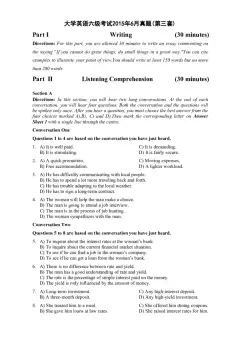
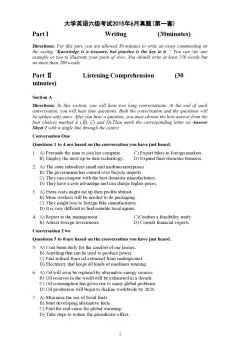
大学英语六级考试2015年6月真题(第三套)
Part I Writing (30
minutes)
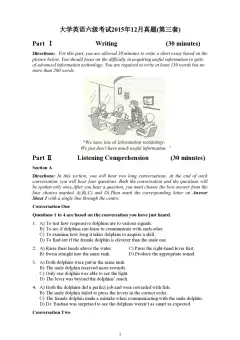
Directions: For this part, you are allowed 30 minutes to write an essay
commenting on the saying“If you cannot do great things, do small things in a
great way."You can cite examples to illustrate your point of view.You should write
at least 150 words but no more than 200 words.
Part Ⅱ Listening Comprehension (30
minutes)
Section A
Directions: In this section, you will hear two long conversations. At the end of
each conversation, you will hear four questions. Both the conversation and the
questions will be spoken only once. After you hear a question, you must choose
the best answer from the four choices marked A),B), C) and D).Then mark the
corresponding letter on Answer Sheet 1 with a single line through the centre.
Conversation One
Questions 1 to 4 are based on the conversation you have just heard.
1. A) It is well paid. C) It is demanding.
B) It is stimulating. D) It is fairly secure.
2. A) A quick promotion. C) Moving expenses.
B) Free accommodation. D) A lighter workload.
3. A) He has difficulty communicating with local people.
B) He has to spend a lot more traveling back and forth.
C) He has trouble adapting to the local weather.
D) He has to sign a long-term contract.
4. A) The woman will help the man make a choice.
B) The man is going to attend a job interview.
C) The man is in the process of job hunting.
D) The woman sympathizes with the man.
Conversation Two
Questions 5 to 8 are based on the conversation you have just heard.
5. A) To inquire about the interest rates at the woman’s bank.
B) To inquire about the current financial market situation.
C) To see if he can find a job in the woman’s company.
D) To see if he can get a loan from the woman’s bank.
6. A) There is no difference between rate and yield.
B) The man has a good understanding of rate and yield.
C) The rate is the percentage of simple interest paid on the money.
D) The yield is only influenced by the amount of money.
17. A) Long-term investment. C) Any high-interest deposit.
B) A three-month deposit. D) Any high-yield investment.
8. A) She treated him to a meal. C) She offered him dining
coupons.
B) She gave him loans at low rates. D) She raised interest rates for
him.
Section B
Directions: In this section, you will hear two passages. At the end of each
passage, you will hear three or four questions. Both the passage and the questions
will be spoken only once.After you hear a question, you must choose the best
answer from the four choices marked A),B),C) and D).Then mark the
corresponding letter on Answer Sheet 1 with a single line through the centre.
Passage One
Questions 9 to 12 are based on the passage you have just heard.
9. A) It is a Portuguese company selling coffee in New York.
B) Its most important task is to conduct coffee studies.
C) It represents several countries that export coffee.
D) Its role is to regulate international coffee prices.
10.A) The freezing weather in Brazil.
C) The increased coffee consumption.
B) The impact of global warming.
D) The fluctuation of coffee prices.
11.A) He is doing a bachelor’s degree. C) He is a heavy coffee
drinker.
B) He is young, handsome and single. D) He is tall, rich and
intelligent.
12.A) A visit to several coffee-growing plantations.
B) Coffee prices and his advertising campaign.
C) A vacation on some beautiful tropical beach.
D) A quick promotion and a handsome income.
Passage Two
Questions 13 to 15 are based on the passage you have just heard.
13.A) They were held up in a traffic jam.
B) They boarded a wrong coach in a hurry.
C) They were late for the first morning bus.
D) They were delayed by the train for hours.
14.A) It was canceled because of an unexpected strike.
C) It was spoiled by poor accommodations.
B) It was the most exciting trip they ever had.
D) It was postponed due to terrible weather.
15.A) Go overseas. C) Take romantic cruises.
B) Stay at home. D) Take escorted trips.
Section C
Directions: In this section, you will hear three recordings of lectures or talks
followed by three or four questions.The recordings will be played only once. After
2you hear a question, you must choose the best answer from the four choices
marked A),B), C) and D).Then mark the corresponding letter on Answer Sheet 1
with a single line through the centre.
Questions 16 to 19 are based on the recording you have just heard.
16.A) Their extraordinary intelligence. C) The way they communicate.
B) The special bones in their fins. D) The way they get water.
17.A) They love to keep them as pets just like cats and dogs.
B ) They love them but cannot live with them.
C) They can find many stores selling such souvenirs.
D) They believe such souvenirs can bring good luck.
18.A) They made them swim around their ships.
B) They painted their images on some items.
C) They hunted them in great numbers.
D) They trained them to perform tricks.
19.A)They are hunted in many places except Japan.
B) They have been protected thanks to literature and film.
C) They have adapted to the life in captivity.
D) They are losing their habitat and clean sea.
Questions 20 to 22 are based on the recording you have just heard.
20.A) It won’t have any side-effect.
B) It can kill drug-resistant tumours.
C) It can be as effective as conventional treatments.
D) It can stop cancer cells from spreading in the body.
21.A) How to find a way to deliver viruses to tumours effectively.
B) How to inject viruses directly into tumours.
C) How to allow viruses to do what chemotherapy drugs do.
D) How to strengthen the body’s immune system.
22.A) To use it to cure 75% of the patients with malignant cancers.
B) To make it accepted by the patients with incurable cancers.
C) To apply it to those with secondary cancers.
D) To apply it to treat all kinds of cancers.
Questions 23 to 25 are based on the recording you have just heard.
23.A) It allows users of some Kindle devices to borrow books from local
libraries.
B) It has benefited more than eleven thousand local libraries in the US.
C) It has led to a debate between publishers and libraries over e-book lending.
D) It aims at allowing everyone to read books anytime they like.
24.A) They can purchase any kind of media product.
B)They can lend books to readers repeatedly.
C)They can deal with digital products as they like.
D) They can limit the time the readers keep a certain book.
25.A) By allowing libraries to purchase e-books for lending in perpetuity.
B)By adopting the technology known as digital rights management.
C) By requiring libraries to purchase more of its e-book.
D) By persuading the critics to support the publishers.
Part Ⅲ Reading Comprehension (40minutes)
3Section A
Directions: In this section, there is a passage with ten blanks. You are required to select
one word for each blank from a list of choices given in a word bank following the
passage. Read the passage through carefully before making your choices. Each choice in
the bank is identified by a letter. Please mark the corresponding letter for each item on
Answer Sheet 2 with a single line through the centre. You may not use any of the words
in the bank more than once.
Questions 26 to 35 are based on the following passage.
Travel websites have been around since the 1990s, when Expedia, Travelocity, and
other holiday booking sites were launched, allowing travelers to compare flight and hotel
prices with the click of a mouse. With information no longer__26__by travel agents or
hidden in business networks, the travel industry was revolutionized, as greater
transparency helped __27__ prices.
Today, the industry is going through a new revolution—this time transforming
service quality. Online rating platforms— __28__ in hotels, restaurants, apartments, and
taxis—allow travelers to exchange reviews and experiences for all to see.
Hospitality businesses are now ranked, analyzed, and compared not by industry
__29__, but by the very people for whom the service is intended—the customer. This
has __30__ a new relationship between buyer and seller. Customers have always voted
with their feet; they can now explain their decision to anyone who is interested. As a
result, businesses are much more __31__, often in very specific ways, which creates
powerful __32__ to improve service.
Although some readers might not care for gossipy reports of unfriendly bellboys(行
李员)in Berlin or malfunctioning hotel hairdryers in Houston, the true power of online
reviews lies not just in the individual stories, but in the websites’ __33__ to aggregate a
large volume of ratings.
The impact cannot be __34__. Businesses that attract top ratings can enjoy rapid
growth, as new customers are attracted by good reviews and __35__ provide yet more
positive feedback. So great is the influence of online ratings that many companies now
hire digital reputation managers to ensure a favorable online identity.
4A)accountable K)professionals
B)capacity L) slash
C) controlled M)specializing
D)entail N)spectators
E)forged O)subsequently
F) incentives
G)occasionally
H)overstated
I)persisting
J)pessimistic
Section B
Directions: In this section, you are going to read a passage with ten statements attached
to it. Each statement contains information given in one of the paragraphs. Identify the
paragraph from which the information is derived. You may choose a paragraph more
than once. Each paragraph is marked with a letter . Answer the questions by marking the
corresponding letter on Answer Sheet 2.
Plastic Surgery
A better credit card is the solution to ever larger hack attacks.
[A] A thin magnetic stripe (magstripe) is all that stands between your credit-card
information and the bad guys. And they’ve been working hard to break in. That’s why
2014 is shaping up as a major showdown: banks, law enforcement and technology
companies are all trying to stop a network of hackers who are succeeding in stealing
account numbers, names, email addresses and other crucial data used in identity theft.
More than 100 million accounts at Target, Neiman Marcus and Michaels stores were
affected in some way during the most recent attacks, starting last November.
[B] Swipe(刷卡)is the operative word: cards are increasingly vulnerable to attacks
when you make purchases in a store. In several recent incidents, hackers have been
able to obtain massive information of credit-debit-(借记)or prepaid-card numbers
using malware, i.e. malicious software, inserted secretly into the retailers’ point-of-
sale system—the checkout registers. Hackers then sold the data to a second group of
criminals operating in shadowy corners of the web. Not long after, the stolen data was
showing up on fake cards and being used for online purchases.
[C] The solution could cost as little as $2 extra for every piece of plastic issued. The fix is
a security technology used heavily outside the U.S. While American credit cards use
the 40-year-old magstripe technology to process transactions, much of the rest of the
world uses smarter cards with a technology called EMV (short for Europay,
MasterCard, Visa) that employs a chip embedded in the card plus a customer PIN
(personal identification number) to authenticate(验证)every transaction on the
spot. If a purchaser fails to punch in the correct PIN at the checkout, the transaction
gets rejected. (Online purchases can be made by setting up a separate transaction code.
[D] Why haven’t big banks adopted the more secure technology? When it comes to
mailing out new credit cards, it’s all about relative costs, says David Robertson, who
runs the Nilson Report, an industry newsletter. “The cost of the card, putting the
sticker on it, coding the account number and expiration date, embossing(凸印)it,
5the small envelope—all put together, you’re in the dollar range. ” A chip- and-PIN
card currently costs closer to $3, says Robertson, because of the price of chips. (Once
large issuers convert together, the chip costs should drop.
[E] Multiply $3 by the more than 5 billion magstripe credit and prepaid cards in
circulation in the U.S. Then consider that there’s an estimated $12.4 billion in card
fraud on a global basis, says Robertson. With 44% of that in the U.S. American credit-
card fraud amounts to about $5.5 billion annually. Card issuers have so far calculated
that absorbing the liability for even big hacks like the Target one is still cheaper than
replacing all that plastic.
[F] That leaves American retailers pretty much alone the world over in relying on
magstripe technology to charge purchases—and leaves consumers vulnerable. Each
magstripe has three tracks of information, explains payments security expert Jeremy
Gumbley, the chief technology officer of Credit Call, an electronic-payments
company. The first and third are used by the bank or card issuer. Your vital account
information lives on the second track, which hackers try to capture. “Malware is
scanning through the memory in real time and looking for data,” he says. “It creates a
text file that gets stolen.”
[G] Chip-and-PIN cards, by contrast, make fake cards or skimming impossible because
the information that gets scanned is encrypted(加密). The historical reason the
U.S. has stuck with magstripe, ironically enough, is once superior technology. Our
cheap, ultra-reliable wired networks made credit- card authentication over the phone
frictionless. In France, card companies created EMV in part because the telephone
monopoly was so maddeningly inefficient and expensive. The EMV solution allowed
transactions to be verified locally and securely.
[H] Some big banks, like Wells Fargo, are now offering to convert your magstripe card to
a chip-and-PIN model. (It’s actually a hybrid(混合体)that will still have a
magstripe, since most U.S. merchants don’t have EMV terminals.) Should you take
them up on it? If you travel internationally, the answer is yes.
[I] Keep in mind, too, that credit cards typically have better liability protection than debit
cards. If someone uses your credit card fraudulently(欺诈性的),it’s the issuer or
merchant, not you, that takes the hit. Debit cards have different liability limits
depending on the bank and the events surrounding any fraud. “If it’s available, the
logical thing is to get a chip-and-PIN card from your bank,” says Eric Adamowsky, a
co-founder of Credit Cardlnsider.com. “I would use credit cards over debit cards
because of liability issues.” Cash still works pretty well too.
[J] Retailers and banks stand to benefit from the lower fraud levels of chip-and-PIN cards
but have been reluctant for years to invest in the new infrastructure (基础设施)
needed for the technology, especially if consumers don’t have access to it. It’s a
chicken-and-egg problem: no one wants to spend the money on upgraded point-of-
sale systems that can read the chip cards if shoppers aren’t carrying them—yet there’s
little point in consumers’ carrying the fancy plastic if stores aren’t equipped to use
them. (An earlier effort by Target to move to chip and PIN never gained progress.)
According to Gumbley, there’s a “you-first mentality. The logjam(僵局)has to be
broken.”
[K] JPMorgan Chase CEO Jamie Dimon recently expressed his willingness to do so,
noting that banks and merchants have spent the past decade suing each other over
interchange fees—the percentage of the transaction price they keep—rather than deal
with the growing hacking problem. Chase offers a chip- enabled card under its own
brand and several others for travel-related companies such as British Airways and
6Ritz-Carlton.
[L] The Target and Neiman hacks have also changed the cost calculation: although
retailers have been reluctant to spend the $6.75 billion that Capgemini consultants
estimate it will take to convert all their registers to be chip-and-PIN-compatible, the
potential liability they now face is dramatically greater. Target has been hit with class
actions from hacked consumers. “It’s the ultimate nightmare,” a retail executive from
a well-known chain admitted to TIME.
[M] The card-payment companies MasterCard and Visa are pushing hard for change. The
two firms have warned all parties in the transaction chain—merchant, network, bank
—that if they don’t become EMV-compliant by October 2015, the party that is least
compliant will bear the fraud risk.
[N] In the meantime, app-equipped smartphones and digital wallets—all of which can use
EMV technology—are beginning to make inroads(侵染)on cards and cash. PayPal,
for instance, is testing an app that lets you use your mobile phone to pay on the fly at
local merchants—without surrendering any card information to them. And further
down the road is biometric authentication, which could be encrypted with, say, a
fingerprint.
[O] Credit and debit cards, though, are going to be with us for the foreseeable future, and
so are hackers, if we stick with magstripe technology. “It seems crazy to me,” says
Gumbley, who is English, “that a cutting-edge-technology country is depending on a
40-year-old technology.” That’s why it may be up to consumers to move the needle on
chip and PIN. Says Robertson: “ When you get the consumer into a position of
worry and inconvenience, that’s where the rubber hits the road.”
36. It is best to use an EMV card for international travel.
37. Personal information on credit and debit cards is increasingly vulnerable to hacking.
38. The French card companies adopted EMV technology partly because of inefficient
telephone service.
39. While many countries use the smarter EMV cards, the U.S. still clings to its old
magstripe technology.
40. Attempts are being made to prevent hackers from carrying out identity theft.
41. Credit cards are much safer to use than debit cards.
42. Big banks have been reluctant to switch to more secure technology because of the
higher costs involved.
43. The potential liability for retailers using magstripe is far more costly than upgrading
their registers.
44. The use of magstripe cards by American retailers leaves consumers exposed to the
risks of losing account information.
45. Consumers will be a driving force behind the conversion from magstripe to EMV
technology.
Section C
Directions: There are 2 passages in this section. Each passage is followed by some
questions or unfinished statements. For each of them there are four choices marked A),
B), C) and D). You should decide on the best choice and mark the corresponding letter on
Answer Sheet 2 with a single line through the centre.
Passage One
7Questions 46 to 50 are based on the following passage.
What’s the one word of advice a well-meaning professional would give to a
recent college graduate? China? India? Brazil? How about trade?
When the Commerce Department reported last week that the trade deficit in
June approached $50 billion, it set off a new round of economic doomsaying.
Imports, which soared to $200.3 billion in the month, are subtracted in the
calculation of gross domestic product. The larger the trade deficit,the smaller the
GDP. Should such imbalances continue, pessimists say, they could contribute to
slower growth.
But there's another way of looking at the trade data.Over the past two years,
the figures on imports and exports seem not to signal a double-dip recession--a
renewed decline in the broad level of economic activity in the United States-but
an economic expansion.
The rising volume of trade—more goods and services shuttling in and out of
the United States— is good news for many sectors. Companies engaged in
shipping, trucking,rail freight,delivery, and logistics(物流) have all been reporting
better than expected results. The rising numbers signify growing vitality in foreign
market—when we import more stuff, it puts more cash in the hands of people
around the world, and U.S. exports are rising because more foreigners have the
ability to buy the things we produce and market. The rising tide of trade is also
good news for people who work in trade-sensitive businesses, especially those that
produce commodities for which global demand sets the price-agricultural goods,
mining, metals, oil.
And while exports always seem to lag, U.S. companies are becoming more
involved in the global economy with each passing month.General Motors sells as
many cars in China as in America each month. While that may not do much for
imports, it does help GM's balance sheet—and hence makes the jobs of U.S.-based
executives more stable.
One great challenge for the U.S. economy is slack domestic consumer
demand.Americans are paying down debt, saving more, and spending more
carefully. That's to be expected, given what we've been through. But there’s a
bigger challenge. Can U.S.-based businesses,large and small, figure out how to get
a piece of growing global demand? Unless you want to pick up and move to
India, or Brazil, or China, the best way to do that is through trade. It may seem
obvious, but it's no longer enough simply to do business with our friends and
neighbors here at home.
Companies and individuals who don't have a strategy to export more,or to get
more involved in foreign markets, or to play a role in global trade, are shutting
themselves out of the lion’s share of economic opportunity in our world.
46. How do pessimists interpret the U,S. trade deficit in June?
A) It reflects Americans' preference for imported goods.
B ) It signifies a change in American economic structure.
C) It could lead to slower growth of the national economy.
D) It is the result of America's growing focus on domestic market.
47. What does the author say about the trade data of the past two years?
A) It indicates that economic activities in the U.S. have increased.
B) It signals decreasing domestic demand for goods and services.
C) It reflects the fluctuations in the international market.
D) It shows that U.S. economy is slipping further into recession.
848. Who particularly benefit from the rising volume of trade?
A) People who have expertise in international trade.
C) Producers of agricultural goods and raw materials.
B) Consumers who favor imported goods and services.
D) Retailers dealing in foreign goods and services.
49. What is one of the challenges facing the American economy?
A) Decreasing productivity.
B) Competition from overseas.
C) People's reluctance to spend.
D ) Slack trade activities.
50. What is the author's advice to U.S. companies and individuals?
A) To import more cheap goods from developing countries.
B ) To increase their market share overseas.
C) To be alert to fluctuations in foreign markets.
D) To move their companies to where labor is cheaper.
Passage Two
Questions 51 to 55 are based on the following passage.
A recurring criticism of the UK's university sector is its perceived weakness
in translating new knowledge into new products and services.
Recently, the UK National Stem Cell Network warned the UK could lose its
place among the world leaders in stem cell research unless adequate funding and
legislation could be assured.We should take this concern seriously as universities
are key in the national innovation system.
However, we do have to challenge the unthinking complaint that the sector
does not do enough in taking ideas to market.The most recent comparative data on
the performance of universities and research institutions in Australia, Canada,USA
and UK shows that, from a relatively weak starting position, the UK now leads
on many indicators of commercialisation activity.
When viewed at the national level, the policy interventions of the past decade
have helped transform the performance of U.K. universities.Evidence suggests the
UK’s position is much stronger than in the recent past and is still showing
improvement.But national data masks the very large variation in the performance
of individual universities. The evidence shows that a large number of universities
have fallen off the back of the pack, a few perform strongly and the rest chase
the leaders.
This type of uneven distribution is not peculiar to the U.K. and is mirrored
across other economies. In the UK, research is concentrated: less than 25% of
universities receive 75% of the research funding. These same universities are also
the institutions producing the greatest share of PhD graduate, science citations,
patents and licence income. The effect of policies generating long-term resource
concentration has also created a distinctive set of universities which are research-
led and commercially active. It seems clear that the concentration of research and
commercialisation work creates differences between universities.
The core objective for universities which are research-led must be to
maximise the impact of their research efforts. These universities should be
generating the widest range of social, economic and environmental benefits. In
return for the scale. of investment,they should share their expertise in order to
build greater confidence in the sector.
9Part of the economic recovery of the UK will be driven by the next
generation of research commercialisations pilling out of our universities. There are
three dozen universities in the UK which are actively engaged in advanced
research training and commercialisation work.
If there was a greater coordination of technology transfer offices within
regions and a simultaneous investment in the scale and functions of our graduate
schools, universities could, and should, play a key role in positioning the U.K. for
the next growth cycle.
51. What does the author think of UK universities in terms of commercialisation?
A)They still have a place among the world leaders.
C) They do not regard it as their responsibility.
B) They have lost their leading position in many ways.
D) They fail to convert knowledge into money.
52. What does the author say about the national data on UK universities’
performance in commercialisation?
A) It masks the fatal weaknesses of government policy.
B) It does not reflect the differences among universities.
C) It does not rank UK universities in a scientific way.
D) It indicates their ineffective use of government resources.
53. We can infer from Paragraph 5 that “policy interventions”(Line 1, Para. 4)
refers to .
A) concentration of resources in a limited number of universities
B) compulsory cooperation between universities and industries
C) government aid to non-research-oriented universities
D) fair distribution of funding for universities and research institutions
54. What does the author suggest research-led universities do?
A)Fully utilise their research to benefit all sectors of society.
B) Generously share their facilities with those short of funds.
C) Publicise their research to win international recognition.
D) Spread their influence among top research institutions.
55.How can the university sector play a key role in the UK’s economic growth?
A) By establishing more regional technology transfer offices.
B) By asking the government to invest in technology transfer research.
C) By promoting technology transfer and graduate school education.
D) By increasing the efficiency of technology transfer agencies.
Part Ⅳ Translation (30
minutes)
Directions: For this part, you are allowed 30 minutes to translate a passage from
Chinese into English. You should write your answer on Answer Sheet 2.
中国传统的待客之道要求饭菜丰富多样,让客人吃不完。中国宴席上典型
的菜单包括开席的一套凉菜及其后的热菜,例如肉类、鸡鸭、蔬菜等。大多数
宴席上,全鱼被认为是必不可少的,除非已经上过各式海鲜。如今,中国人喜欢
把西方特色菜与传统中式菜肴融于一席,因此牛排上桌也不少见。沙拉也已流行
起来,尽管传统上中国人一般不吃任何未经烹饪的菜肴。宴席通常至少有一道汤,
10可以最先或最后上桌。甜点和水果通常标志宴席的结束。
11