机密*启用前
大 学 英 语 六 级 考 试
COLLEGE ENGLISH TEST
—Band Six—
(2020 年 9 月第 2 套)
试 题 册
敬 告 考 生
一、在答题前,请认真完成以下内容:
1. 请检查试题册背面条形码粘贴条、答题卡的印刷质量,如有问题及时向监考员反映,确
认无误后完成以下两点要求。
2. 请将试题册背面条形码粘贴条揭下后粘贴在答题卡1的条形码粘贴框内,并将姓名和准
考证号填写在试题册背面相应位置。
3. 请在答题卡1和答题卡2指定位置用黑色签字笔填写准考证号、姓名和学校名称,并用
HB-2B铅笔将对应准考证号的信息点涂黑。
二、在考试过程中,请注意以下内容:
1. 所有题目必须在答题卡上规定位置作答,在试题册上或答题卡上非规定位置的作答一律
无效。
2. 请在规定时间内在答题卡指定位置依次完成作文、听力、阅读、翻译各部分考试,作答
作文期间不得翻阅该试题册。听力录音播放完毕后,请立即停止作答,监考员将立即收回答
题卡1,得到监考员指令后方可继续作答。
3. 作文题内容印在试题册背面,作文题及其他主观题必须用黑色签字笔在答题卡指定区域
内作答。
4. 选择题均为单选题,错选、不选或多选将不得分,作答时必须使用HB-2B铅笔在答题卡
上相应位置填涂,修改时须用橡皮擦净。
三、以下情况按违规处理:
1. 未正确填写(涂)个人信息,错贴、不贴、毁损条形码粘贴条。
2. 未按规定翻阅试题册、提前阅读试题、提前或在收答题卡期间作答。
3. 未用所规定的笔作答、折叠成毁损答题卡导致无法评卷。
4. 考试期间在非听力考试时间佩戴耳机。
1全国大学英语四、六级考试委员会
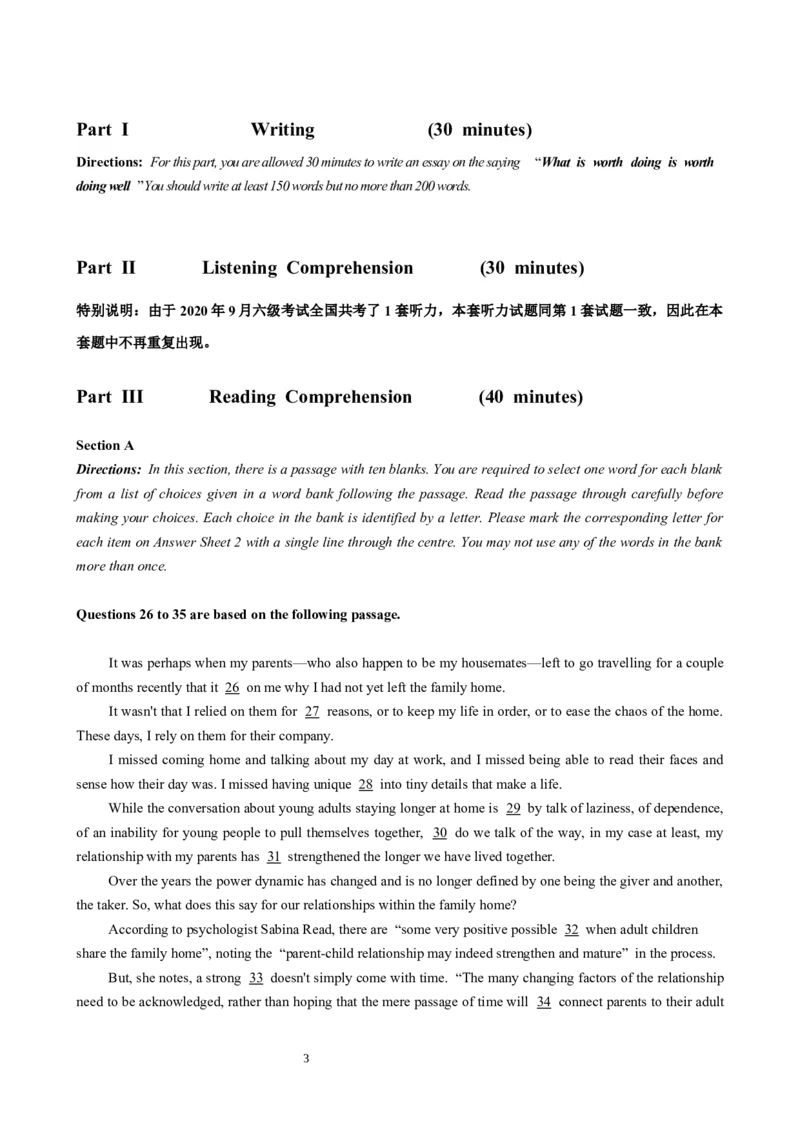
2Part I Writing (30 minutes)
Directions: For this part, you are allowed 30 minutes to write an essay on the saying “What is worth doing is worth
doing well ”You should write at least 150 words but no more than 200 words.
Part II Listening Comprehension (30 minutes)
特别说明:由于2020年9月六级考试全国共考了1套听力,本套听力试题同第1套试题一致,因此在本
套题中不再重复出现。
Part III Reading Comprehension (40 minutes)
Section A
Directions: In this section, there is a passage with ten blanks. You are required to select one word for each blank
from a list of choices given in a word bank following the passage. Read the passage through carefully before
making your choices. Each choice in the bank is identified by a letter. Please mark the corresponding letter for
each item on Answer Sheet 2 with a single line through the centre. You may not use any of the words in the bank
more than once.
Questions 26 to 35 are based on the following passage.
It was perhaps when my parents—who also happen to be my housemates—left to go travelling for a couple
of months recently that it 26 on me why I had not yet left the family home.
It wasn't that I relied on them for 27 reasons, or to keep my life in order, or to ease the chaos of the home.
These days, I rely on them for their company.
I missed coming home and talking about my day at work, and I missed being able to read their faces and
sense how their day was. I missed having unique 28 into tiny details that make a life.
While the conversation about young adults staying longer at home is 29 by talk of laziness, of dependence,
of an inability for young people to pull themselves together, 30 do we talk of the way, in my case at least, my
relationship with my parents has 31 strengthened the longer we have lived together.
Over the years the power dynamic has changed and is no longer defined by one being the giver and another,
the taker. So, what does this say for our relationships within the family home?
According to psychologist Sabina Read, there are “some very positive possible 32 when adult children
share the family home”, noting the “parent-child relationship may indeed strengthen and mature” in the process.
But, she notes, a strong 33 doesn't simply come with time. “The many changing factors of the relationship
need to be acknowledged, rather than hoping that the mere passage of time will 34 connect parents to their adult
3children. It's important to acknowledge that the relationship parameters have changed to avoid falling back into
35 from the teen years.
A) bond I) magically
B) contemplated J) outcomes
C) dawned K) patterns
D) hierarchy L) rarely
E) insight M) saturated
F) legislative N) stereotypes
G) leverage O) undoubtedly
H) logistical
I)exclusively
J)innovated
Section B
Directions: In this section, you are going to read a passage with ten statements attached to it. Each statement
contains information given in one of the paragraphs. Identify the paragraph from which the information is
derived. You may choose a paragraph more than once. Each paragraph is marked with a letter. Answer the
questions by marking the corresponding letter on Answer Sheet 2.
How Telemedicine Is Transforming Healthcare
A) After years of big promises, telemedicine is finally living up to its potential. Driven by faster internet
connections, ubiquitous(无处不在的) smartphones and changing insurance standards, more health providers are
turning to electronic communications to do their jobs—and it's dramatically changing the delivery of healthcare.
B) Doctors are linking up with patients by phone, email and webcam(网络摄像头) . They’re also consulting with
each other electronically—sometimes to make split second decisions on heart attacks and strokes. Patients,
meanwhile, are using new devices to relay their blood pressure, heart rate and other vital signs to their doctors so
they can manage chronic conditions at home. Telemedicine also allows for better care in places where medical
expertise is hard to come by. Five to 10 times a day, Doctors Without Borders relays questions about tough cases
from its physicians in Niger, South Sudan and elsewhere to its network of 280 experts around the world, and back
again via internet.
C) As a measure of how rapidly telemedicine is spreading, consider: More than 15 million Americans received
some kind of medical care remotely last year, according to the American Telemedicine Association, a trade group,
which expects those numbers to grow by 30% this year.
D) None of this is to say that telemedicine has found its way into all comers of medicine. A recent survey of 500
tech-savvy(精通技术的) consumers found that 39% hadn’t heard of telemedicine, and of those who haven’t used
it, 42% said they preferred in-person doctor visits. In a poll of 1500 family physicians, only 15% had used it in
4their practices—but 90% said they would if it were appropriately reimbursed(补偿) .
E) What's more, for all the rapid growth, significant questions and challenges remain. Rules defining and
regulating telemedicine differ widely from state to state. Physicians groups are issuing different guidelines about
what care they consider appropriate to deliver and in what form.
F) Some critics also question whether the quality of care is keeping up with the rapid expansion of telemedicine.
And there's the question of what services physicians should be paid for: Insurance coverage varies from health
plan to health plan, and a big federal plan covers only a narrow range of services. Telemedicine's future will
depend on how—and whether—regulators, providers, payers and patients can address these challenges. Here's a
closer look at some of these issues:
G) Do patients trade quality for convenience? The fastest-growing services in telemedicine connect consumers
with clinicians they've never met for a phone, video or email visit—on-demand, 24/7. Typically, these are for
nonemergency issues such as colds, flu, ear-aches and skin rashes, and they cost around $45, compared with
approximately $100 at a doctor's office, $160 at an urgent-care clinic or $750 and up at an emergency room.
H) Many health plans and employers have rushed to offer the services and promote them as a convenient way for
plan members to get medical care without leaving home or work. Nearly three-quarters of large employers will
offer virtual doctor visits as a benefit to employees this year, up from 48% last year. Web companies such as Tel a
doc and American Well are expected to host some 1.2 million such virtual doctor visits this year, up 20% from
last year, according to the American Telemedicine Association.
I) But critics worry that such services maybe sacrificing quality for convenience. Consulting a random doctor
patients will never meet, they say, further fragments the health-care system, and even minor issues such as upper
respiratory(上呼吸道的) infections can’t be thoroughly evaluated by a doctor who can’t listen to your heart or
feel your swollen glands. In a recent study, researchers posing as patients with skin problems sought help from 16
telemedicine sites—with unsettling results. In 62 encounters, fewer than one-third disclosed clinicians' credential
or let patients choose; only 32% discussed potential side effects of prescribed medications. Several sites
misdiagnosed serious conditions, largely because they failed to ask basic follow-up questions, the researchers
said. “Telemedicine holds enormous promise, but these sites are just not ready for prime time,” says Jack Res
neck, the study's lead author.
J) The American Telemedicine Association and other organizations have started accreditation(鉴定) programs to
identify top-quality telemedicine sites. The American Medical Association this month approved new ethical
guidelines for telemedicine, calling for participating doctors to recognize the limitations of such services and
ensure that they have sufficient information to make clinical recommendations.
K) Who pays for the services? While employers and health plans have been eager to cover virtual urgent-care
5visits, insurers have been far less willing to pay for telemedicine when doctors use phone, email or video to
consult with existing patients about continuing issues. “It's very hard to get paid unless you physically see the
patient,” says Peter Rasmussen, medical director of distance health at the Cleveland Clinic. Some 32 states have
passed “parity”(等同的) laws requiring private insurers to reimburse doctors for services delivered remotely if
the same service would be covered in person, though not necessarily at the same rate or frequency. Medicare lags
further behind. The federal health plan for the elderly covers a small number of telemedicine services—only for
beneficiaries in rural areas and only when the services are received in a hospital, doctor's office or clinic.
L) Bills to expand Medicare coverage of telemedicine have bipartisan(两党的) support in Congress. Opponents
worry that such expansion would be costly for taxpayers, but advocates say it would save money in the long run.
M) Experts say more hospitals are likely to invest in telemedicine systems as they move away from fee-for-
service payments and into managed-care-type contracts that give them a set fee to provide care for patients and
allow them to keep any savings they achieve.
N) Is the state-by-state regulatory system outdated? Historically, regulation of medicine has been left to individual
states. But some industry members contend that having 50 different sets of rules, licensing fees and even
definitions of “medical practice" makes less sense in the era of telemedicine and is hampering its growth.
Currently, doctors must have a valid license in the state where the patient is located to provide medical care,
which means virtual-visit companies can match users only with locally licensed clinicians. It also causes
administrative hassles(麻烦) for world-class medical centers that attract patients from across the country. At the
Mayo Clinic, doctors who treat out-of-state patients can follow up with them via phone, email or web chats when
they return home, but they can only discuss the conditions they treated in person. “If the patient wants to talk
about a new problem, the doctor has to be licensed in that state to discuss it. If not, the patient should talk to his
primary-care physician about it,” says Steve Ommen, who runs Mayo's Connected Care program.
O) To date, 17 states have joined a compact that will allow a doctor licensed in one member state to quickly
obtain a license in another. While welcoming the move, some telemedicine advocates would prefer states to
automatically honor one another's licenses, as they do with drivers' licenses. But states aren’t likely to surrender
control of medical practice, and most are considering new regulations. This year, more than 200 telemedicine-
related bills have been introduced in 42 states, many regarding what services Medicaid will cover and whether
payers should reimburse for remote patient monitoring. “A lot of states are still trying to define telemedicine,”
says Lisa Robbin, chief advocacy officer for the Federation of State Medical Boards.
36. An overwhelming majority of family physicians are willing to use telemedicine if they are duly paid.
37. Many employers are eager to provide telemedicine service as a benefit to their employees because of its
convenience.
638. Different states have markedly different regulations for telemedicine.
39. With telemedicine, patients in regions short of professional medical service are able to receive better medical
care.
40. Unlike employers and health plans, insurers have been rather reluctant to pay for some telemedicine services.
41. Some supporters of telemedicine hope states will accept each other's medical practice licenses as valid.
42. The fastest growing area for telemedicine services is for lesser health problems.
43. As telemedicine spreads quickly, some of its opponents doubt whether its service quality can be guaranteed.
44. The results obtained by researchers who pretended to be patients seeking help from telemedicine providers are
disturbing.
45. Some people argue that the fact that different states have different regulations concerning medical services
hinders the development of telemedicine.
Section C
Directions: There are 2 passages in this section. Each passage is followed by some questions or unfinished
statements. For each of them there are four choices marked A), B), C) and D). You should decide on the best
choice and mark the corresponding letter on Answer Sheet 2 with a single line through the centre.
Passage One
Questions 46 to 50 are based on the following passage.
Danielle Steel, the 71-year-old romance novelist is notoriously productive, having published 179 books at a
rate of up to seven a year. But a passing reference in a recent profile by Glamour magazine to her 20-hour
workdays prompted an outpouring of admiration.
Steel has given that 20-hour figure when describing her “exhausting” process in the past: “I start the book
and don't leave my desk until the first draft is finished.” She goes from bed, to desk, to bath, to bed, avoiding all
contact aside from phone calls with her nine children. “I don't comb my hair for weeks,” she says. Meals are
brought to her desk, where she types until her fingers swell and her nails bleed.
The business news website Quartz held Steel up as an inspiration, writing that if only we all followed her
“actually extremely liberating” example of industrious sleeplessness, we would be quick to see results.
Well, indeed. With research results showing the cumulative effects of sleep loss and its impact on
productivity, doubt has been voiced about the accuracy of Steel’s self-assessment. Her output maybe undeniable,
but sceptics have suggested that she is guilty of erasing the role of ghost writers(代笔人) at worst, gross
7exaggeration at best.
Steel says working 20 hours a day is “pretty brutal physically.” But is it even possible? “No,” says
Maryanne Taylor of the Sleep Works. While you could work that long, the impact on productivity would make it
hardly worthwhile. If Steel was routinely sleeping for four hours a night, she would be drastically underestimating
the negative impact, says Alison Gardiner, founder of the sleep improvement programme Sleep station. “It’s akin
to being drunk.”
It’s possible that Steel is exaggerating the demands of her schedule. Self-imposed sleeplessness has
“become a bit of a status symbol”, says Taylor, a misguided measure to prove how powerful and productive you
are. Margaret Thatcher was also said to get by on four hours a night, while the 130-hour workweeks endured by
tech heads has been held up as key to their success.
That is starting to change with increased awareness of the importance of sleep for mental health. “People
are starting to realise that sleep should not be something that you fit in between everything else,” says Taylor.
But it is possible—if statistically extremely unlikely—that Steel could be born a “short sleeper” with an
unusual body clock, says sleep expert Dr. Sophie Bostock. “It’s probably present in fewer than 1% of the
population.”
Even if Steel does happen to be among that tiny minority, says Bostock, it's “pretty irresponsible” to
suggest that 20-hour days are simply a question of discipline for the rest of us.
46. What do we learn from the passage about Glamour magazine readers?
A) They are intrigued by the exotic romance in Danielle Steel's novels.
B) They are amazed by the number of books written by Danielle Steel.
C) They are deeply impressed by Danielle Steel's daily work schedule.
D) They are highly motivated by Danielle Steel’s unusual productivity.
47. What did the business news website Quartz say about Danielle Steel?
A) She could serve as an example of industriousness.
B) She proved we could liberate ourselves from sleep.
C) She could be an inspiration to novelists all over the world.
D) She showed we could get all our work done without sleep.
48. What do sceptics think of Danielle Steel's work schedule claims?
A) They are questionable.
B) They are alterable.
C) They are irresistible.
D) They are verifiable.
49. What does Maryanne Taylor think of self-imposed sleeplessness?
A) It may turn out to be key to a successful career.
B) It may be practiced only by certain tech heads.
8C) It may symbolise one's importance and success.
D) It may well serve as a measure of self-discipline.
50. How does Dr. Sophie Bostock look at the 20-hour daily work schedule?
A) One should not adopt it without consulting a sleep expert.
B) The general public should not be encouraged to follow it.
C) One must be duly self-disciplined to adhere to it.
D) The majority must adjust their body clock for it.
Passage Two
Questions 51 to 55 are based on the following passage.
Organic agriculture is a relatively untapped resource for feeding the Earth's population, especially in the face
of climate change and other global challenges. That's the conclusion I reached in reviewing 40 years of science
comparing the long-term prospects of organic and conventional farming.
The review study, “Organic Agriculture in the 21st Century,” is featured as the cover story for the February
issue of the journal Nature Plants. It is the first to compare organic and conventional agriculture across the main
goals of sustainability identified by the National Academy of Sciences: productivity, economics, and environment.
Critics have long argued that organic agriculture is inefficient, requiring more land to yield the same amount
of food. It's true that organic farming produces lower yields, averaging 10 to 20 percent less than conventional.
Advocates contend that the environmental advantages of organic agriculture far outweigh the lower yields, and
that increasing research and breeding resources for organic systems would reduce the yield gap. Sometimes
excluded from these arguments is the fact that we already produce enough food to more than feed the world's 7.4
billion people but do not provide adequate access to all individuals.
In some cases, organic yields can be higher than conventional. For example, in severe drought conditions,
which are expected to increase with climate change in many areas, organic farms can produce as good, if not
better, yields because of the higher water-holding capacity of organically farmed soils.
What science does tell us is that mainstream conventional farming systems have provided growing supplies of
food and other products but often at the expense of other sustainability goals.
Conventional agriculture may produce more food, but it often comes at a cost to the environment.
Biodiversity loss, environmental degradation, and severe impacts on ecosystem services have not only
accompanied conventional farming systems but have often extended well beyond their field boundaries. With
organic agriculture, environmental costs tend to be lower and the benefits greater.
Overall, organic farms tend to store more soil carbon, have better soil quality, and reduce soil erosion
compared to their conventional counterparts. Organic agriculture also creates less soil and water pollution and
lower greenhouse gas emissions. And it’s more energy-efficient because it doesn't rely on synthetic fertilizers or
pesticides.
Organic agriculture is also associated with greater biodiversity of plants, animals, insects and
microorganisms as well as genetic diversity. Biodiversity increases the services that nature provides and improves
9the ability of farming systems to adapt to changing conditions.
Despite lower yields, organic agriculture is more profitable for farmers because consumers are willing to pay
more. Higher prices, called price premiums, can be justified as a way to compensate farmers for providing
ecosystem services and avoiding environmental damage or external costs.
51. What do we learn from the conclusion of the author's review study?
A) More resources should be tapped for feeding the world's population.
B) Organic farming may be exploited to solve the global food problem.
C) The long-term prospects of organic farming are yet to be explored.
D) Organic farming is at least as promising as conventional farming.
52. What is the critics' argument against organic farming?
A) It cannot meet the need for food.
B) It cannot increase farm yields.
C) It is not really practical.
D) It is not that productive.
53. What does the author think should be taken into account in arguing about organic farming?
A) Growth in world population.
B) Deterioration in soil fertility.
C) Inequality in food distribution.
D) Advance in farming technology.
54. What does science tell us about conventional farming?
A) It will not be able to meet global food demand.
B) It is not conducive to sustainable development.
C) It will eventually give away to organic farming.
D) It is going mainstream throughout the world.
55. Why does the author think higher prices of organic farm produce are justifiable?
A) They give farmers going organic a big competitive edge.
B) They motivate farmers to upgrade farming technology.
C) Organic farming costs more than conventional farming.
D) Organic farming does long-term good to the ecosystem.
Part IV Translation (30 minutes)
Directions: For this part, you are allowed 30 minutes to translate a passage from Chinese into English. You
10should write your answer on Answer Sheet 2.
《红楼梦》(Dream of the Red Chamber )是18世纪曹雪芹创作的一部小说。曹雪芹基于自己痛苦的个
人经历,讲述了贾宝玉和林黛玉之间的悲剧性爱情故事。书中有大约 30个主要人物和400多个次要人物,
每个人物都刻画得栩栩如生,具有鲜明的个性。小说详尽地描述了四个贵族世家兴衰的历程,反映了封建
社会隐藏的种种危机和错综复杂的社会冲突。
《红楼梦》融合了现实主义和浪漫主义,具有很强的艺术感染力。它被普遍认为是中国最伟大的小说,也
是世界上最伟大的文学创作之一。
11