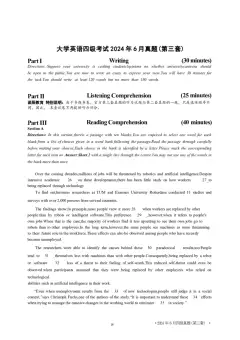
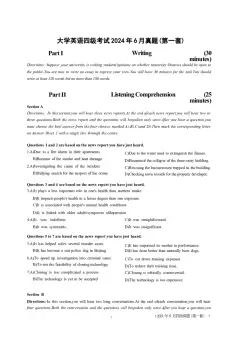
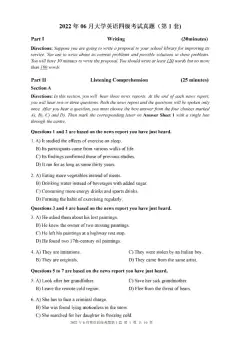
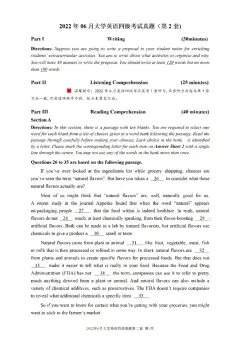
大学英语四级考试2024年6月真题(第二套)
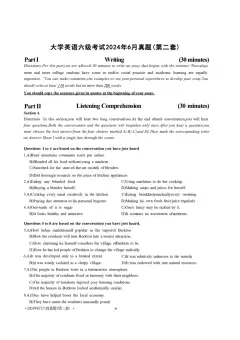
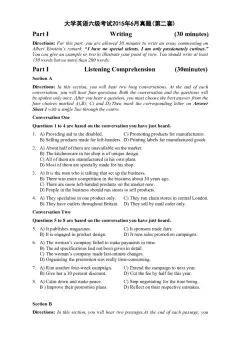
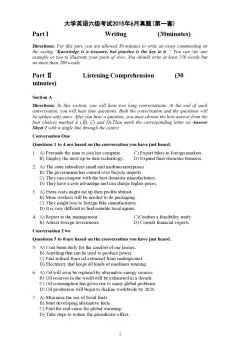
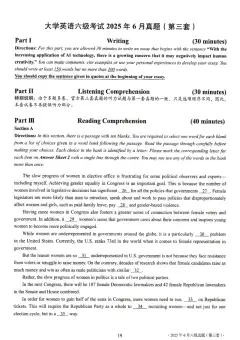
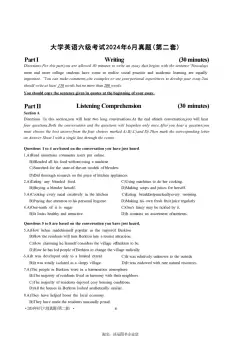
PartI Writing (30minutes)
Directions: Supposeyour university is seeking students'opinions on whether university sportsfacilities should
be open to thepublic.You are now to write an essay to expressyourview.You willhave 30 minutesfor the task.
Youshouldwriteatleast120wordsbutnomorethan180 words.
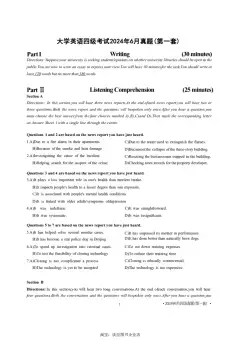
PartII ListeningComprehension (25minutes)
SectionA
Directions: In thissection,you will hear three news reports.At the endofeach news report,you will hear two or
three questions.Both the news report and the questions will bespoken only once.Afieryou hear a question,you
must choose the best answerfrom thefour choices markedA),B),C)andD).Then mark the corresponding letter
on Answer Sheet I withasinglelinethroughthecentre.
Questions 1and2arebasedonthenewsreportyouhavejustheard.
1.A)It hit a bird shortly after takeoff.
B)Its crew memberswent on strike.
C)Itnarrowly escaped aplane crashwhen turning around.
D)Its captain got slightlyinjured duringthe forced landing.
2.A)Panic. C)Relieved.
B)Nervous. D)Contented.
Questions3and4arebasedonthenewsreportyouhavejustheard.
3.A)He is now kept in a secure area. C)He has been caught a second time.
B)Hehas escapedthe zoo once again. D)He finally disappeared six days ago.
4.A)Squeezed C)Disappointed
B)Threatened. D)Frustrated.
Questions5to7arebasedonthenewsreportyouhavejustheard.
5.A)It is condemned as a crazy idea. C)It is questioned by local residents.
B)It is enriching the city's night life. D)It is giving rise to safety concerns.
6.A)Avoid entering one-way streets C)Follow all the traffic rules drivers do.
B)Ensure the safety ofpedestrians. D)Give way to automobiles at all times.
7.A)To ease the city's busy traffic. C)To add anewmeans oftransport.
B)Tobringnew life intothe city. D)To reduce the city's air pollution.
Section B
Directions: In this section,you will hear two long conversations.At the end ofeach conversation,you will hear
four questions.Both the conversation and the questions will bespoken only once.Afteryou hear a question,you
·2024年6月四级真题(第二套)·
10mustchoosethebestanswerfromthefourchoicesmarkedA),B),C)andD).Thenmarkthecorrespondingletter
onAnswerSheet1withasinglelinethroughthecentre
Questions8to 11arebasedontheconversationyouhavejustheard.
8.A)Take it seriously. C)Makeit soundscary.
B)Discussitregularly. D)Talkaboutit openly.
9.A)Byshopping around for the best deals. C)Bycitingconcrete examples
B)Bymakingabstractsumsrelevant. D)Byvisitingdiscountstores.
10.A)Payingtheirkidstohelpwithhousework
B)Settingkidsagoodexamplebysharingchores
C)Givingkidspocketmoneyaccordingtotheirneeds.
D)Urgingkidstodepositsomeoftheirgiftmoney.
11.A)Theimportanceofcuttingdownfamily expenses.C)The delight in seeingtheir savings grow.
B)Theneedtolearnimportantlessonsfromherelders.D)Thenecessityofsavingintoapension.
Questions 12to15arebasedontheconversationyouhavejustheard.
12.A)Heisasuccessfulbusinessman. C)Hehaspublishedanewbestseller.
B)Hereviewsbooksonpoliticalaffairs. D)Hehasworkedinseveralbanks.
13.A)Theman'sideasabouteducation C)Theman'sattemptsatdrawingpublicattention.
B)Theman'sacademicbackground. D)Theman'sproposalstosolveeconomicproblems
14.A)Toreducestudents'financialburden.
B)Tomotivateallstudentstobesuccessful.
C)Togivestudentsincentivetoexcelineconomics.
D)Toprovideremediesforstudents'poorperformance
15.A)Improvingschoolbudgeting. C)Seekingdonations.
B)Increasingtuitionfees. D)Raisingtaxes.
Section C
Directions: Inthissection,youwillhearthreepassages.Attheendofeachpassage,youwillhearthreeorfour
questions.Both thepassage and the questions will bespoken only once.Afteryou hear a question,you must
choosethebestanswerfrom thefourchoicesmarkedA),B),C)andD).Then markthe correspondingletter on
Answer Sheet Iwithasinglelinethroughthecentre.
Questions 16to18arebasedonthepassageyouhavejustheard.
16.A)Toshowhissympathytowardspeoplealwaysbeingbusy.
B)Topreventpeoplefromcomplainingaboutbeing“busy”.
C)Tocallonbusypeopletotakecareofthemselves.
D)Tohelpbusypeopletosortouttheirpriorities.
17.A)Avoidsayingwearebusy. C)Describeourscheduleindetail.
B)Reflectontheirtruepurpose D)Respondasmostbusypeopledo.
·2024年6月四级真题(第二套)·
1118.A)Toshowtheirachievementsresultedfromgreatefforts.
B)Toprovetheystandoutasaccomplishedprofessionals.
C)Tocoveruptheirfailuretoachievesomepurpose
D)Totellothersacompletelieabouttheirinability.
Questions 19to21arebasedonthepassageyouhavejustheard
19.A)Theywillhelponereducefear C)Theywillbelesschallengingafteratime.
B)Theyshouldbecomesopopular. D)Theyshouldcoversomanydifferenttypes
20.A)Tobreakone'sultimatelimits. C)Toavoiddangerousmistakes.
B)Tostopbeingextremelyafraid D)Toenjoythesportstothefull.
21.A)Byallowingourmotivationtobeatanall-timehigh.C)Byburningasmanyas300caloriesperhour.
B)Bystoppingushurtingthesamemusclesrepeatedly.D)Byenablingustogetanall-overworkout
Questions22to25arebasedonthepassageyouhavejustheard.
22.A)It isnatural C)It is personal
B)Itisinstrumental. D)Itisvital.
23.A)Toguardagainstbeingperceivednegatively. C)Toconcealpersonalitypreferences.
B)Topreventthemselvesfrombeingisolated. D)Tomaintainworkplaceharmony.
24.A)Ithelpstoenhanceteamspirit C)Ithelpstoresolveproblems.
B)Itstimulatesinnovativeideas D)Itfacilitatespolicy-making.
25.A)Aninnovativemind. C)Mutualtrust.
B)Corporateculture. D)Ahealthymentality.
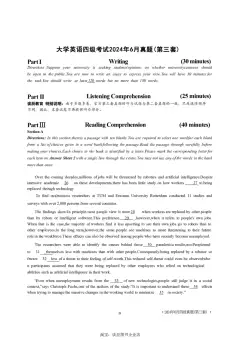
PartⅢ ReadingComprehension (40minutes)
SectionA
Directions:Inthissection,thereisapassagewithtenblanks.Youarerequiredtoselectonewordforeachblank
from a list ofchoices given in a word bankfollowing thepassage.Read thepassage through carefully before
makingyourchoices.Eachchoiceinthebankisidentifiedbyaletter.Please markthecorresponding letterfor
eachitemon AnswerSheet2withasinglelinethroughthecentre.Youmaynotuseanyofthewordsinthebank
morethan once.
A team ofresearchers ledby Priyanka Joshi examined the degree to which men and women relied on
“communicative abstraction”to verbally convey their ideas and emotions.Communicative abstraction,
according to the researchers,reflects the tendency of people to use“abstract speech that focuses on the
broaderpicture and26 purpose ofactionratherthan concrete speech focusing on details andthe means
of 27 action.”Interestingly,they found that men were far more likely to speak in the abstract than were
women.
To arrive at this 28 ,the researchers examined the linguistic(语言的)patterns of men and
women in over 600,000 blog posts written on websites.To do this,the researchers computed abstractness
ratings for29 40,000 commonly used words in the English language.Words considered to be concrete
·2024年6月四级真题(第二套)·
12could be easily visualized,such as “table”or“chair”.Words that were more 30 to visualize,for example,
“justice”or“morality”were considered to be more abstract.They found that men used31 moreabstract
language in theirblog posts.
Whatisthe 32 ofthis effect?The researchers suggest thatpower differences between the genders—
that is,men having more power in society—might be a key determinant(决定因素).For instance,in a
follow-up study conducted with a sample of 300 students,the researchers 33 power dynamics in an
interpersonal setting to see ifthis would influence communicative abstraction.They found thatparticipants
in a high-power interviewer role were more likely to give abstract descriptions of behaviors than were
participants in a low-power interviewee role.This suggests that communicating more abstractly does not
reflecta34 tendencyofmenorwomenbutrather 35 within specific contexts.
A)approximately I)manipulated
B)attaining J)recommended
C)conclusion K)refraining
D)difficult L)signals
E)emerges M)significantly
F)fixed N)source
G)ignored O)ultimate
H)legally
SectionB
Directions:Inthissection,youaregoingtoreadapassagewithtenstatementsattachedtoit.Eachstatement
contains information given in one ofthe paragraphs.Identify the paragraphfrom which the information is
derived.You may choose aparagraph more than once.Eachparagraph is markedwith a letter.Answer the
questionsbymarkingthecorrespondingletteronAnswerSheet2.
Howtobetterworktowardslong-termgoals
A)HalHershfield,apsychologistattheUCLAAnderson SchoolofManagement,wantedtoknowwhypeople
weren'tsavingforretirement.Acrosstheboard,peoplearelivinglonger.Logically,they'llneedmoremoney
to live comfortably in theirpost-workyears.And yet,savings rates in the U.S.have gone down in recent
decades,notup.
B)To help explain this seemingly irrational behavior,Hershfield and his team scanned the brains ofstudy
participantswhileaskingthemtowhatdegreevarioustraits(特征)—like“honorable”or“funny”—applied
totheircurrentself,theirfutureself,acurrent other,orafutureother.Asparticipantsanswered,Hershfield's
team recorded which parts oftheir brains lit up.Unsurprisingly,people's brains were most active when
thinkingabouttheircurrentselvesandleastactive whenthinkingaboutacurrentother.Buttheteamfound
that participants'brain activity while considering their future selves more closely resembled their brain
activitywhilethinkingaboutacurrentotherratherthanthecurrentself.
·2024年6月四级真题(第二套)·
13C)Putinpracticalterms,whenthinkingofyourselfinamonth or ayear or a decade,yourbrainregisters that
personinwayssimilartohowitwouldregisterTaylorSwiftorthemailman.Understoodinthatway,saving
forretirementistheequivalentofgivingmoneyawaytosomeoneelseentirely
D)In light ofHershfield's study,one simple question arises:Is it possible to make our present selves give a
damnaboutourfutureselves?Theanswersare anythingbutsimple.
E)Seenthroughthelensofthepresentselfversusthefutureself,our self-defeating actions—likechoosingto
watchtelevisionratherthangotothegym—suddenlymakeperfectsense.Wegettoenjoytheveryconcrete,
immediatebenefits ofouractionswhile someone else (namely,our future selves)suffersthehypothetical
(假设的),far-offconsequences.As a result,the decisions we make for our present selves often look very
differentfromourdecisionsforourfutureselves.Webelievethattomorrow.willbedifferent.Webelievethat
wewillbedifferenttomorrow;butindoingso,weprioritizeourcurrentmoodovertheconsequencesofour
inactionforthefuture self.
F)Understanding our procrastination(拖延)throughthelensofthepresentand future selves,we're leftwith
threepossiblesolutions:Thefirstistoforceyourfuture selftodowhateveryourpresentselfdoesn'twantto
do.Thesecondistoconvinceyourpresentselfthatyourfutureselfis,infact,stillyou.Ifthecentralproblem
isthatwethinkofourfutureselvesasotherpeople,itfollowsthattryingtoidentifymorecloselywithour
futureselveswillencourageustomakebetterlong-termdecisions.
G)Inafollow-up study,Hershfieldwantedtoexploreways tobridgethe disconnectbetweenthepresent and
future selves and encourage people to save more for retirement.He and his team took photos ofstudy
participants,andthenusedimageprocessingtovisuallyagetheirfaces.Participantswerethenplacedin a
virtualrealitysettingwheretheycouldlookintoamirrorand seetheiraged selveslookingbackatthem.
Participantswhosawtheiragedselvessaidtheywouldsave30%moreoftheirsalaryforretirementthanthe
controlgroup.
H)Whatever your long-term goals may be—getting in better shape,launching your own business,writing a
book—thinkingaboutyourdeadlineintermsofdaysratherthanmonthsoryearscanhelpyouwrapyour
mindaroundhowclosethefuturereallyis.
I)The third solution is to forget about your future self and use your present self's love of instant
gratifcation (满足感)to your advantage.While the two tactics(手段)above canbe effective inmaking
better long-term choices,in the end,you're still struggling against human nature.Our brains are hard-
wired for instant gratification.Instead of fighting your present self's need for immediate rewards,why
notuse ittoyour advantage?Whenmost ofus setgoals,we focus on long-term results we wantto see—
e.g.,losing weight,getting a promotion,retiring in comfort,etc.While those visions of our future selves
can be inspiring,when it comes to actually doing the day-to-day work,it may be more effective to
reframe activities in terms oftheir immediate,or at least very near-term,rewards.
J)Take writing this article,for instance.It's easy for me to imagine how amazing it will feel at the end of
the workday to have this article done.This isn'tjust my opinion.Research partners Kaitlin Woolley of
CornellUniversityandAyeletFishbachoftheUniversityofChicagohavemadeacareeroutofstudyingthe
differencesbetweenthegoalsthatpeopleachieveandtheonesthatfalltothewayside
·2024年6月四级真题(第二套)·
14K)“In onestudy,we asked people online about the goals they set at the beginning ofthe year.Most people
set goalsto achieve delayed,long-termbenefits,such as career advancement,debtrepayment,orimproved
health.Weaskedtheseindividualshowenjoyableitwastopursuetheirgoal,aswellashowimportanttheir
goalwas.Wealsoaskedwhethertheywerestillworkingontheirgoalstwomonthsafter settingthem.We
foundthatenjoymentpredictedpeople'sgoalpersistencetwomonthsaftersettingthegoalfarmorethanhow
importanttheyratedtheirgoaltobe,”Woolleysaid.
L)Thispatternheldtrueacrossawidevariety ofgoals from exercisingto studyingto eatinghealthier foods
Forexample,peopleate50%moreofahealthyfoodwhendirectedtofocusonthegoodtasteratherthanthe
long-termhealthbenefits.Otherstudieshaveshownagreateruptakeofexerciseinpeoplewhoweretoldto
thinkoftheenjoymentofdoingtheexercisenowratherthanfuturehealthgains.
M)These findings suggest that when it comes to achieving your goals,enjoying the process itselfis more
importantthanwantingthelong-termbenefits.Inotherwords,present selftrumps(战胜)future self.Who
saysinstantgratificationhastobeabadthing?Byallmeans,setambitiouslong-term goals foryour future
self,butwhenitcomestoactuallyfollowingthroughday-to-day,makesureyourpresentselfknowswhat'sin
itforhertoo.
36.Ourbrainsaregeneticallydeterminedtosatisfyimmediatedesires.
37.Takeninapracticalway,savingforpost-workyearsislikegivingmoneyawaytoothers
38.Research foundthat,asregards achievement ofone's goals,it is importantto focusmore on enjoying the
processthanthelong-termbenefits
39.Regardingourfutureselvesasstillbeingourselveswillhelpusmakebetterlong-termdecisions
40.SavingsratesinAmericahavedroppedinrecentdecadeseventhoughpeople'slifeexpectancyhasincreased.
41.Researchersfoundthatenjoymentratherthanimportanceenabledpeopletopersistintheirgoals.
42.When making decisions,we give priority to our current frame ofmind without thinking much ofthe
consequences.
43.Peopleatemoreofahealthyfoodwhentheyfocusedonitsgoodtasteinsteadofitslong-termbenefits
44.Aswasexpected,whenpeoplethoughtoftheirpresentselves,theirbrainswere observedtobecomemore
active
45.Researchersfoundthatparticipantswhosawtheimagesoftheiraged selveswould savemorefortheirlater
yearsthanthosewhodidn't.
Section C
Directions: There are 2passages in this section.Eachpassage isfollowed bysome questions or unfinished
statements.For each ofthem there arefour choices marked A),B),C)andD).You should decide on the best
choiceandmarkthecorrespondingletteronAnswerSheet2withasinglelinethroughthecentre
PassageOne
Questions46to50arebasedonthefollowingpassage.
People oftenwonderwhy some entrepreneurshave greater successthan others.Is ithabits,connections,
·2024年6月四级真题(第二套)·
15luck,work ethic or any other behavior?I believe the key to success is willpower.Willpower is the ability to
control yourself.It is a strong determination that allows you to do something difficult.It is a behavior we are
bornwith more than onewe learn;however,it is possible to not only learn it,but also strengthen it with constant
exercise.
Willpower isjust like a muscle;to keep it strong you need to constantly exercise it.People with a great
amount ofwillpower have the discipline to develop positive,successful habits.Even with an incredible amount
oftalent,withoutthe discipline andmotivationto createpositive habits,it canbe difficult to achieve success.
Willpower and habits go hand in hand.It is critical to create good habits and take the actions necessary to
sticktothosehabits dayin andday out for greater success.Almosthalfofourdaily actions arepart ofourhabits
andnot decisions,so once the correcthabits are inplace,you will automaticallyperform those tasks on a day-to-
day basis.
The best way to create and stick to a habit is to have strong motivation.It's easier to change your habits
to lose weight ifyou have a health issue and you want to be around longer for your kids,or ifyour business is
somethingyou'repassionate about.Having avaluable outcome associatedwith a habit will helpyou stickto that
habitpermanently.
The art of self-control is one that most successful individuals have mastered.Self-control enables you to
avoidbehaviorsthatdon'tcontributetoyour success and adoptthosethatdo.
Because there is a delayed satisfaction associated with self-control,it can be easy to get offtrack.However
ifyou work on sticking to those small positive habits one day at a time,it becomes easier to stay strong and
achievethat delayedreward.Once areward is achieved,it ismuch easierto continue sticking toyour habits
46.Whatdoestheauthor sayweneedto doto strengthenourwillpower?
A)Keep it under control. C)Learn from entrepreneurs
B)Apply it continuously. D)Aim at success determinedly.
47.How are almosthalfofourdaily actionsperformed accordingtothepassage?
A)Out of habit. C)Like muscle building.
B)With determination. D)By self-discipline
48.Whatwillhelppeople stickto doing something constructive automatically?
A)Practising it on a day-to-day basis C)Possessing a reasonable amount oftalent
B)Associating it with improving health. D)Foreseeingthe desired outcome itwill yield.
49.How doesthe art ofself-controlhelpus succeed?
A)By allowing us to remain clear-headed permanently.C)By enabling us to takepositive actions
B)By enablingusto alter ourbehaviors constantly. D)By allowing us toavoid taking risks.
50.Why can itbe difficult forustomaintain self-control?
A)Most ofus arenotinthehabit ofexercising self-control.
B)Wemaynotget immediaterewards from self-control.
C)Self-control tends tobe associatedwithpains.
D)Self-control only brings about small benefits
·2024年6月四级真题(第二套)·
16PassageTwo
Questions51to55 arebasedonthefollowingpassage.
Today,mostscientificresearchisfundedbygovernmentgrants,companiesdoingresearch and
development,and non-profit foundations.As a society,we reap the rewards from this science,but we also
help pay for it.You indirectly support science through taxes you pay,products and services you purchase,and
donations you make.
Funding for science has changed with the times.Historically,science has been largely supported through
private patronage(资助),church sponsorship,or simply paying for the research yourself.Today,researchers are
likely to be funded by a mix of grants from various government agencies,institutions,and foundations.Other
research is funded by private companies.Such corporate sponsorship is widespread in some fields.Almost 75%
ofU.S.clinical trials in medicine are paid for by private companies.And,ofcourse,some researchers today still
fund small-scale studies out oftheir own pockets.Most of us can't afford to do nuclear research as a private
hobby,but birdwatchers,rock collectors,and others can do real research on a limited budget.
In a perfect world,money wouldn't matter—all scientific studies would be completely objective.But in the
real world,funding may introduce biases.Drug research sponsored by the pharmaceutical(制药的)industry
is more likely to end up favoring the drug under consideration than studies sponsored by government grants or
charitable organizations.Similarly,nutrition research sponsored by the food industry is more likely to end up
favoringthefoodunderconsiderationthanindependentlyfundedresearch.
Sowhat shouldwemake ofallthis?Should we ignore any research fundedby companies or special interest
groups?Certainly not.These groups provide invaluable funding for scientific research.Furthermore,science has
many safeguards in place to catch instances ofbias that affect research outcomes.Ultimately,misleading results
will be corrected as science proceeds;however,this process takes time.Meanwhile,it pays to examine studies
fundedby industry or special interest groupswith extra care.Are the results consistentwith other independently
funded studies?What do other scientists have to say about this research?A little examination can go a long way
towardsidentifyingbiasassociatedwiththe funding source.
51.What doesthepassagemainly discussregarding scientific research?
A)Its foundation. C)Its prospect
B)Its rewards. D)Itsfunding
52.What dowelearn fromthepassage aboutresearchers likebirdwatchers androck collectors?
A)They have little access to government funding. C)They can do amateurwork intheir own fields.
B)They can do research with limited resources. D)Theyhave no means for large-scale research.
53.Whatwould scientific studieslooklikein aperfectworldaccordingtothe author?
A)They would be totally unbiased. C)They would be responsibly conducted.
B)They would be independently funded. D)They would be strictly supervised.
54.What doesthe author say about companies and special interest groups?
A)Theytryhardtopull downthe safeguards forresearch.
B)Theymake extra effortstoresearchtheir ownproducts.
·2024年6月四级真题(第二套)·
17C)Theyprovide valuable resources for scientific research.
D)They reap the mostbenefits from scientific research
55.Whatdoestheauthorthinkofresearch fundedby industry or special interestgroups?
A)Itsrecommendations shouldbe examined for feasibility.
B)Itsmisleadingresults shouldbe corrected in time.
C)Itsvalidity shouldbe checkedwith additional care.
D)Itshiddenbiases shouldbe identified independently.
PartIV Translation (30minutes)
Directions: For this part,you are allowed 30 minutes to translate a passage from Chinese into English.You
shouldwriteyouransweronAnswerSheet2.
农历(the lunar calendar)起源于数千年前的中国,根据太阳和月亮的运行规律制定。长期以来,农
历在农业生产和人们日常生活中发挥着重要作用。古人依据农历记录日期、安排农活,以便最有效地利
用自然资源和气候条件,提高农作物的产量和质量。中国的春节、中秋节等传统节日的日期都基于农历。
农历是中国传统文化的重要组成部分,当今依然广为使用。
·2024年6月四级真题(第二套)·
18