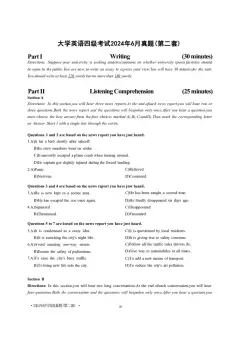
大学英语四级考试 2024 年 6 月真题(第二套)
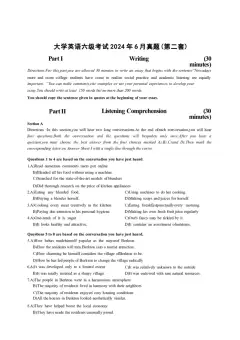
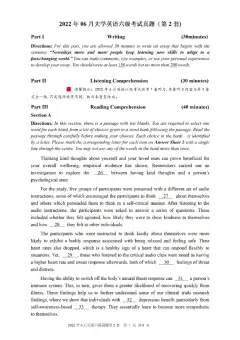
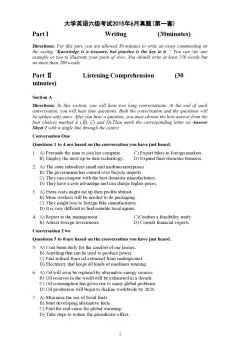
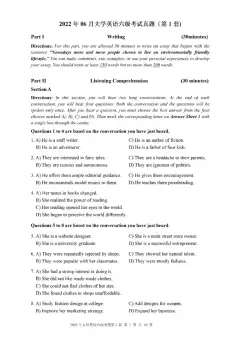
Part I Writing (30
minutes)
Directions: Suppose your university is seeking students'opinions on whether university sports facilities should
be open to the public.You are now to write an essay to express your view.You will have 30 minutes for the
task. You should write at least 120 words but no more than 180 words.
Part II Listening Comprehension (25
minutes)
Section A
Directions: In this section,you will hear three news reports.At the end ofeach news report,you will hear two or
three questions.Both the news report and the questions will bespoken only once.Afier you hear a question,you
must choose the best answer from the four choices marked A),B),C)andD).Then mark the corresponding letter
on Answer Sheet I with a single line through the centre.
Questions 1 and 2 are based on the news report you have just heard.
1.A)It hit a bird shortly after takeoff.
B)Its crew members went on strike.
C)It narrowly escaped a plane crash when turning around.
D)Its captain got slightly injured during the forced landing.
2.A)Panic. C)Relieved.
B)Nervous. D)Contented.
Questions 3 and 4 are based on the news report you have just heard.
3.A)He is now kept in a secure area. C)He has been caught a second time.
B)He has escaped the zoo once again. D)He finally disappeared six days ago.
4.A)Squeezed C)Disappointed
B)Threatened. D)Frustrated.
Questions 5 to 7 are based on the news report you have just heard.
5.A)It is condemned as a crazy idea. C)It is questioned by local residents.
B)It is enriching the city's night life. D)It is giving rise to safety concerns.
6.A)Avoid entering one-way streets C)Follow all the traffic rules drivers do.
B)Ensure the safety of pedestrians. D)Give way to automobiles at all times.
7.A)To ease the city's busy traffic.
C)To add a new means of transport.
B)To bring new life into the city. D)To reduce the city's air pollution.
Section B
Directions: In this section,you will hear two long conversations.At the end ofeach conversation,you will hear
four questions.Both the conversation and the questions will bespoken only once.After you hear a question,youmust choose the best answer from the four choices marked A),B),C)and D).Thenmarkthe corresponding
letter onAnswer Sheet 1 with a single line through the centre
Questions 8 to 11 are basedon the conversationyou have just heard.
8.A)Take it seriously. C)Make it sound scary.
B)Discuss it regularly. D)Talk about it openly.
9.A)Byshopping around for the best deals. C)By citing concrete examples
B)By making abstract sums relevant. D)By visiting discount stores.
10.A)Paying their kids to help with housework
B)Setting kids a good example by sharing chores
C)Giving kidspocket money according to their needs.
D)Urging kids to deposit some of their gift money.
11.A)The importance of cutting down family expenses.C)The delight in seeing their savings grow.
B)The need to learn important lessons from her elders.D)The necessity of saving into a pension.
Questions 12 to 15 are based on the conversation you have just heard.
12.A)He is a successful businessman. C)He has published a new bestseller.
B)He reviews books on political affairs. D)He has worked in several banks.
13.A)The man's ideas about education C)The man's attempts at drawing public attention.
B)The man's academic background. D)The man's proposals to solve economic problems
14.A)To reduce students'financial burden.
B)To motivate all students to be successful.
C)To give students incentive to excel in economics.
D)To provide remedies for students'poor performance
15.A)Improving school budgeting. C)Seeking donations.
B)Increasing tuition fees. D)Raising taxes.
Section C
Directions: In this section,you will hear three passages.At the end ofeach passage,you will hear three or four
questions.Both the passage and the questions will bespoken only once.After you hear a question,you must
choose the best answer from the four choices marked A),B),C)and D).Then mark the corresponding letter
on Answer Sheet I with a single line through the centre.
Questions 16 to 18 are based on the passage you have just heard.
16.A)To show his sympathy towards people always being busy.
B)To prevent people from complaining about being“busy”.
C)To call on busy people to take care of themselves.
D)To help busy people to sort out their priorities.
17.A)Avoid saying we are busy. C)Describeour schedule in detail.
B)Reflect on their true purpose D)Respond as most busy people do.18.A)To show their achievements resulted fromgreat efforts.
B)To prove they stand out as accomplished professionals.
C)To cover up their failure to achieve some purpose
D)To tell others a complete lie about their inability.
Questions 19 to 21 are based on the passageyou have just heard
19.A)They will help one reduce fear C)They will be less challenging after a time.
B)They should become so popular. D)They should cover so many different types
20.A)To break one's ultimate limits. C)To avoid dangerous mistakes.
B)To stop being extremely afraid D)To enjoy the sports to the full.
21.A)By allowing our motivation to be at an all-time high.C)By burning as many as 300 calories per hour.
B)By stopping us hurting the same muscles repeatedly.D)By enabling us to get an all-over workout
Questions 22 to 25 are based on the passage you have just heard.
22.A)It isnatural C)It is personal
B)It is instrumental. D)It is vital.
23.A)To guard against being perceived negatively. C)To conceal personality preferences.
B)To prevent themselves from being isolated. D)To maintain workplace harmony.
24.A)It helps to enhance team spirit C)It helps to resolve problems.
B)It stimulates innovative ideas D)It facilitates policy-making.
25.A)An innovative mind. C)Mutual trust.
B)Corporate culture. D)A healthy mentality.Part Ⅲ Reading Comprehension (40
minutes)
Section A
Directions:In this section,there is a passage with ten blanks.You are required to select one word for each
blank from a list of choices given in a word bank following the passage.Read the passage through
carefully before making your choices.Each choice in the bank is identified by a letter.Please mark the
corresponding letter for each item on Answer Sheet 2 with a single line through the centre.You may not use
any of the words in the bank more than once.
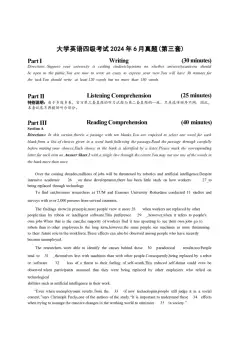
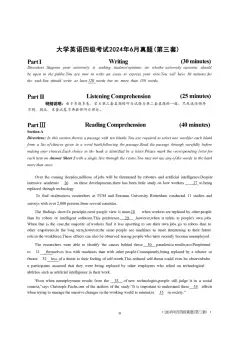
A team of researchers led by Priyanka Joshi examined the degree to which men and women relied on
“communicative abstraction”to verbally convey their ideas and emotions.Communicative abstraction,
according to the researchers,reflects the tendency of people to use“abstract speech that focuses on the
broader picture and 26 purpose of action rather than concrete speech focusing on details and the means
of 27 action.”Interestingly,they found that men were far more likely to speak in the abstract than
were
women.
To arrive at this 28 ,the researchers examined the linguistic(语言的)patterns of men and
women in over 600,000 blog posts written on websites.To do this,the researchers computed abstractness
ratings for 29 40,000 commonly used words in the English language.Words considered to be concretecould be easily visualized,such as “table”or“chair”.Words that were more 30 to visualize,for
example, “justice”or“morality”were considered to be more abstract.They found that men used 31
more abstract language in their blog posts.
What is the 32 of this effect?The researchers suggest that power differences between the genders
— that is,men having more power in society—might be a key determinant(决定因素).For instance,in
a follow-up study conducted with a sample of 300 students,the researchers 33 power dynamics in
an interpersonal setting to see if this would influence communicative abstraction.They found that
participants in a high-power interviewer role were more likely to give abstract descriptions of
behaviors than were participants in a low-power interviewee role.This suggests that communicating
more abstractly does not reflect a 34 tendency of men or women but rather 35 within specific
contexts.
A)approximately I)manipulated
B)attaining J)recommended
C)conclusion K)refraining
D)difficult L)signals
E)emerges M)significantly
F)fixed N)source
G)ignored O)ultimate
H)legally
Section B
Directions: In this section,you are going to read a passage with ten statements attached to it.Each
statement contains information given in one of the paragraphs.Identify the paragraph from which the
information is derived.You may choose a paragraph more than once.Each paragraph is marked with a
letter.Answer the questions by marking the corresponding letter on Answer Sheet 2.
How to better work towards long-term goals
A)Hal Hershfield,a psychologist at the UCLA Anderson School of Management,wanted to know why
people weren't saving for retirement.Across the board,people are living longer.Logically,they'll need more
money to live comfortably in their post-work years.And yet,savings rates in the U.S.have gone down
in recent decades,not up.
B)To help explain this seemingly irrational behavior,Hershfield and his team scanned the brains of study
participants while asking them to what degree various traits(特征)—like “honorable”or “funny”—applied
to their current self,their future self,a current other,or a future other.As participants answered,Hershfield's
team recorded which parts of their brains lit up.Unsurprisingly,people's brains were most active when
thinking about their current selves and least active when thinking about a current other.But the team found
that participants'brain activity while considering their future selves more closely resembled their brain
activity while thinking about a current other rather than the current self.C)Put in practical terms,when thinking of yourself in a month or a year or a decade,your brain registers that
person in ways similar to how it would registerTaylor Swift or the mailman.Understood in that way,saving
for retirement is the equivalentof giving money away to someone elseentirely
D)In light of Hershfield's study,one simple question arises:Is it possible to make our present selves give a
damn about our future selves?The answers are anything but simple.
E)Seen through the lens of the present self versus the future self,our self-defeating actions—like choosing to
watch television rather than go to the gym—suddenly make perfect sense.We get to enjoy the very concrete,
immediate benefits of our actions while someone else (namely,our future selves)suffers the hypothetical
(假设的),far-off consequences.As a result,the decisions we make for our present selves often look very
different from our decisions for our future selves.We believe that tomorrow.will be different.We believe that
we will be different tomorrow;but in doing so,we prioritize our current mood over the consequences of our
inaction for the future self.
F)Understanding our procrastination(拖延)through the lens of the present and future selves,we're left with
three possible solutions:The first is to force your future self to do whatever your present self doesn't want to
do.The second is to convinceyour presentself that your future self is,in fact,still you.If the central problem
is that we think of our future selves as other people,it follows that trying to identify more closely with our
future selves will encourage us to make better long-term decisions.
G)In a follow-up study,Hershfield wanted to explore ways to bridge the disconnect between the present and
future selves and encourage people to save more for retirement.He and his team took photos of study
participants,and then used image processing to visually age their faces.Participants were then placed in a
virtual reality setting where they could look into a mirror and see their aged selves looking back at them.
Participants who saw their aged selves said they would save 30%more of their salary for retirement than the
control group.
H)Whatever your long-term goals may be—getting in better shape,launching your own business,writing a
book—thinking about your deadline in terms of days rather than months or years can help you wrap your
mind around how close the future really is.
I)The third solution is to forget about your future self and use your present self's love of instant
gratifcation (满足感)to your advantage.While the two tactics(手段)above can be effective in making
better long-term choices,in the end,you're still struggling against human nature.Our brains are hard-
wired for instant gratification.Instead of fighting your present self's need for immediate rewards,why
not use it to your advantage?When most of us set goals,we focus on long-term results we want to see—
e.g.,losing weight,getting a promotion,retiring in comfort,etc.While those visions of our future selves
can be inspiring,when it comes to actually doing the day-to-day work,it may be more effective to
reframe activities in terms of their immediate,or at least very near-term,rewards.
J)Take writing this article,for instance.It's easy for me to imagine how amazing it will feel at the end of
the workday to have this article done.This isn't just my opinion.Research partners Kaitlin Woolley of
Cornell University and Ayelet Fishbach of the University of Chicago have made a career out of studying the
differences between the goals that people achieve and the ones that fall to the waysideK)“In onestudy,we asked people online about the goals they set at the beginning of the year.Most people
set goals to achieve delayed,long-term benefits,such as career advancement,debt repayment,or improved
health.We asked these individuals how enjoyable it was to pursue their goal,as well as how important their
goal was.We also asked whether they were still working on their goals two months after setting them.We
found that enjoyment predicted people's goal persistence two months after setting the goal far more than how
important they rated their goal to be,”Woolley said.
L)This pattern held true across a wide variety of goals from exercising to studying to eating healthier foods
For example,people ate 50%more ofa healthy food when directed to focus on the good taste rather than the
long-term health benefits.Other studies have shown a greater uptake of exercise in people who were told to
think of the enjoyment of doing the exercise now rather than future health gains.
M)These findings suggest that when it comes to achieving your goals,enjoying the process itself is more
important than wanting the long-term benefits.In other words,present self trumps(战胜)future self.Who
says instant gratification has to be a bad thing?By all means,set ambitiouslong-term goals for your future
self,but when it comes to actually following through day-to-day,make sure your present self knows what's in
it for her too.
36.Our brains are genetically determined to satisfy immediate desires.
37.Taken in a practical way,saving for post-work years is like givingmoney away to others
38.Research found that,as regards achievement of one's goals,it is important to focus more on enjoying the
process than the long-termbenefits
39.Regarding our future selves as still being ourselves will help us make better long-term decisions
40.Savings rates in America have dropped in recent decades even though people's life expectancy has increased.
41.Researchers found that enjoyment rather than importance enabledpeople to persist in their goals.
42.When making decisions,we give priority to our current frame of mind without thinking much of the
consequences.
43.People ate more of a healthy food when they focused on its good taste instead of its long-term benefits
44.As was expected,when people thought of their present selves,their brains were observed to become more
active
45.Researchers found that participants who saw the images oftheir aged selves would save more for their later
years than those whodidn't.
Section C
Directions: There are 2 passages in this section.Each passage is followed bysome questions or unfinished
statements.For each of them there are four choices marked A),B),C)and D).You should decide on the best
choice and mark the correspondingletter on Answer Sheet 2 with a single line through thecentre
Passage One
Questions 46 to 50 are based on the following passage.
People often wonder why some entrepreneurs have greater success than others.Is it habits,connections,luck,work ethic or any other behavior?I believe the key to success is willpower.Willpower is the ability to
control yourself.It is a strong determination that allows you to do something difficult.It is a behavior we are
bornwith more than onewe learn;however,it is possible to not only learn it,but also strengthen it with constant
exercise.
Willpower isjust like a muscle;to keep it strong you need to constantly exercise it.People with a great
amount of willpower have the discipline to develop positive,successful habits.Even with an incredible amount
of talent,without the discipline and motivation to create positive habits,it can be difficult to achieve success.
Willpower and habits go hand in hand.It is critical to create good habits and take the actions necessary to
stick to those habits day in and day out for greater success.Almost half of our daily actions are part of our habits
and not decisions,so once the correct habits are in place,you will automatically perform those tasks on a day-to-
day basis.
The best way to create and stick to a habit is to have strong motivation.It's easier to change your habits
to lose weight if you have a health issue and you want to be around longer for your kids,or if your business is
something you're passionate about.Having a valuable outcome associated with a habit will help you stick to that
habit permanently.
The art of self-control is one that most successful individuals have mastered.Self-control enables you to
avoid behaviors that don't contribute to your success and adopt those that do.
Because there is a delayed satisfaction associated with self-control,it can be easy to get off track.However
if you work on sticking to those small positive habits one day at a time,it becomes easier to stay strong and
achieve that delayed reward.Once a reward is achieved,it is much easier to continue sticking to your habits
46.What does the author say we need to do to strengthen our willpower?
A)Keep it under control. C)Learn from entrepreneurs
B)Apply it continuously. D)Aim at success determinedly.
47.How are almost half of ourdaily actions performed according to the passage?
A)Out of habit. C)Like muscle building.
B)With determination. D)By self-discipline
48.What will help people stick to doing something constructive automatically?
A)Practising it on a day-to-day basis C)Possessing a reasonable amount of talent
B)Associating it with improving health. D)Foreseeing the desired outcome it will yield.
49.How does the art of self-control help us succeed?
A)By allowing us to remain clear-headed permanently.C)By enabling us to takepositive actions
B)By enabling us to alter our behaviors constantly. D)By allowing us toavoid taking risks.
50.Why can it be difficult for us to maintain self-control?
A)Most of us are not in the habit of exercising self-control.
B)We may not get immediate rewards from self-control.
C)Self-control tends to be associated with pains.
D)Self-control only brings about small benefitsPassage Two
Questions 51 to 55 are based on the following passage.
Today,most scientific research is funded by government grants,companies doing research and
development,and non-profit foundations.As a society,we reap the rewards from this science,but we also
help pay for it.You indirectly support science through taxes you pay,products and services you purchase,and
donations you make.
Funding for science has changed with the times.Historically,science has been largely supported through
private patronage(资助),church sponsorship,or simply paying for the research yourself.Today,researchers are
likely to be funded by a mix of grants from various government agencies,institutions,and foundations.Other
research is funded by private companies.Such corporate sponsorship is widespread in some fields.Almost 75%
of U.S.clinical trials in medicine are paid for by private companies.And,ofcourse,some researchers today still
fund small-scale studies out oftheir own pockets.Most of us can't afford to do nuclear research as a private
hobby,but birdwatchers,rock collectors,and others can do real research on a limited budget.
In a perfect world,money wouldn't matter—all scientific studies would be completely objective.But in the
real world,funding may introduce biases.Drug research sponsored by the pharmaceutical(制药的)industry
is more likely to end up favoring the drug under consideration than studies sponsored by government grants or
charitable organizations.Similarly,nutrition research sponsored by the food industry is more likely to end up
favoring the food under consideration than independently funded research.
So what should we make of all this?Should we ignore any research funded by companies or special interest
groups?Certainly not.These groups provide invaluable funding for scientific research.Furthermore,science has
many safeguards in place to catch instances of bias that affect research outcomes.Ultimately,misleading results
will be corrected as science proceeds;however,this process takes time.Meanwhile,it pays to examine studies
funded by industry or special interest groups with extra care.Are the results consistent with other independently
funded studies?What do other scientists have to say about this research?A little examination can go a long way
towards identifying bias associated with the funding source.
51.What does the passage mainly discuss regarding scientific research?
A)Its foundation. C)Its prospect
B)Its rewards. D)Itsfunding
52.What do we learn from the passage about researchers like birdwatchers and rock collectors?
A)They have little access to government funding. C)They can do amateur work in their own fields.
B)They can do research with limited resources. D)They have no means for large-scale research.
53.What would scientific studies look like in a perfect world according to the author?
A)They would be totally unbiased. C)They would be responsibly conducted.
B)They would be independently funded. D)They would be strictly supervised.
54.What does the author say about companies and special interest groups?
A)They try hard to pull down the safeguards for research.
B)They make extra efforts to research their own products.C)They provide valuable resources for scientific research.
D)They reap the most benefits from scientific research
55.What does the author think of research funded by industry or special interest groups?
A)Its recommendations should be examined for feasibility.
B)Its misleading results should be corrected in time.
C)Its validity should be checked with additional care.
D)Its hidden biases should be identified independently.
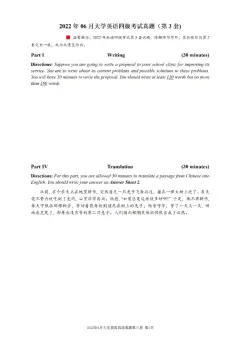
Part IV Translation (30 minutes)
Directions: For this part,you are allowed 30 minutes to translate a passage from Chinese into English.You
should write your answer on Answer Sheet 2.
农历(the lunar calendar)起源于数千年前的中国,根据太阳和月亮的运行规律制定。长期以来,农
历在农业生产和人们日常生活中发挥着重要作用。古人依据农历记录日期、安排农活,以便最有效地利
用自然资源和气候条件,提高农作物的产量和质量。中国的春节、中秋节等传统节日的日期都基于农历。
农历是中国传统文化的重要组成部分,当今依然广为使用。