·
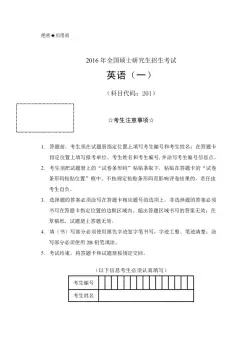
绝密★启用前
2016 年全国硕士研究生招生考试
英语(一)
(科目代码:201)
☆考生注意事项☆
1. 答题前,考生须在试题册指定位置上填写考生编号和考生姓名;在答题卡
指定位置上填写报考单位、考生姓名和考生编号,并涂写考生编号信息点。
2. 考生须把试题册上的“试卷条形码”粘贴条取下,粘贴在答题卡的“试卷
条形码粘贴位置”框中。不按规定粘贴条形码而影响评卷结果的,责任由
考生自负。
3. 选择题的答案必须涂写在答题卡相应题号的选项上,非选择题的答案必须
书写在答题卡指定位置的边框区域内。超出答题区域书写的答案无效;在
草稿纸、试题册上答题无效。
4. 填(书)写部分必须使用黑色字迹签字笔书写,字迹工整、笔迹清楚;涂
写部分必须使用 2B 铅笔填涂。
5. 考试结束,将答题卡和试题册按规定交回。
(以下信息考生必须认真填写)
考生编号
考生姓名
1·
Section I Use of English
Directions:
Read the following text. Choose the best word(s) for each numbered blank and mark
A, B, C or D on the ANSWER SHEET. (10 points)
In Cambodia, the choice of a spouse is a complex one for the young male. It may
involve not only his parents and his friends, 1 those of the young woman,
but also a matchmaker. A young man can 2 a likely spouse on his own and
then ask his parents to 3 the marriage negotiations, or the young man’s
parents may make the choice of a spouse, giving the child little to say in the
selection. 4 , a girl may veto the spouse her parents have chosen. 5 a
spouse has been selected, each family investigates the other to make sure its child is
marrying 6 a good family.
The traditional wedding is a long and colorful affair. Formerly it lasted three
days, 7 by the 1980s it more commonly lasted a day and a half. Buddhist
priests offer a short sermon and 8 prayers of blessing. Parts of the ceremony
involve ritual hair cutting, 9 cotton threads soaked in holy water around
the bride’s and groom’s wrists, and 10 a candle around a circle of happily
married and respected couples to bless the 11 . Newlyweds traditionally move
in with the wife’s parents and may 12 with them up to a year, 13 they
can build a new house nearby.
Divorce is legal and easy to 14 , but not common. Divorced persons are
15 with some disapproval. Each spouse retains 16 property he or
she G 17 into the marriage, and
jointly-acquired property is 18 equally.
Divorced persons may remarry, but a gender prejudice 19 up: The
divorced male doesn’t have a waiting period before he can remarry 20
the woman must wait ten months.
2·
1.[A] as well as [B] by way of [C] on behalf of [D] with regard to
2.[A] adapt to [B] provide for [C] compete with [D] decide on
3.[A] renew [B] close [C] arrange [D] postpone
4.[A] In theory [B] In time [C] Above all [D] For example
5. [A] Although [B] Lest [C] After [D] Unless
6. [A] within [B] into [C] from [D] through
7. [A] since [B] or [C] so [D] but
8. [A] test [B] recite [C] copy [D] create
9. [A] folding [B] piling [C] wrapping [D] tying
10. [A] passing [B] lighting [C] hiding [D] serving
11. [A] association [B] meeting [C] collection [D] union
12. [A] grow [B] part [C] live [D] deal
13. [A] whereas [B] until [C] for [D] if
14. [A] follow [B] obtain [C] challenge [D] avoid
15. [A] isolated [B] persuaded [C] viewed [D] exposed
16. [A] whatever [B] however [C] whenever [D] wherever
17. [A] changed [B] brought [C] shaped [D] pushed
18. [A] withdrawn [B] invested [C] donated [D] divided
19. [A] clears [B] shows [C] warms [D] breaks
20. [A] while [B] once [C] so that [D] in that
Section II Reading Comprehension
Part A
Directions:
Read the following four texts. Answer the questions below each text by choosing
A, B, C or D. Mark your answers on the ANSWER SHEET. (40 points)
Text 1
3·
France, which prides itself as the global innovator of fashion, has decided its
fashion industry has lost an absolute right to define physical beauty for women. Its
lawmakers gave preliminary approval last week to a law that would make it a crime
to employ ultra-thin models on runways. The parliament also agreed to ban websites
that “incite excessive thinness” by promoting extreme dieting.
Such measures have a couple of uplifting motives. They suggest beauty
should not be defined by looks that end up impinging on health. That’s a start. And
the ban on ultra-thin models seems to go beyond protecting models from starving
themselves to death – as some have done. It tells the fashion industry that it must
take responsibility for the signal it sends women, especially teenage girls, about the
social tape-measure they must use to determine their individual worth.
The bans, if fully enforced, would suggest to women (and many men) that
they should not let others be arbiters of their beauty. And perhaps faintly, they hint
that people should look to intangible qualities like character and intellect rather
than dieting their way to size zero or wasp-waist physiques.
The French measures, however, rely too much on severe punishment to
change a culture that still regards beauty as skin-deep – and bone-showing. Under
the law, using a fashion model that does not meet a government-defined index of
body mass could result in a $85,000 fine and six months in prison.
The fashion industry knows it has an inherent problem in focusing on material
adornment and idealized body types. In Denmark, the United States, and a few
other countries, it is trying to set voluntary standards for models and fashion images
that rely more on peer pressure for enforcement.
In contrast to France’s actions, Denmark’s fashion industry agreed last month
on rules and sanctions regarding the age, health, and other characteristics of
models. The newly revised Danish Fashion Ethical Charter clearly states: “We are
aware of and take responsibility for the impact the fashion industry has on body
ideals, especially on young people.” The charter’s main tool of enforcement is to
deny access for designers and modeling agencies to Copenhagen Fashion Week
(CFW), which is run by the Danish Fashion Institute. But in general it relies on a
name-and-shame method of compliance.
Relying on ethical persuasion rather than law to address the misuse of body
ideals may be the best step. Even better would be to help elevate notions of beauty
beyond the material standards of a particular industry.
21. According to the first paragraph, what would happen in France?
4·
[A]Physical beauty would be redefined.
[B]New runways would be constructed.
[C]Websites about dieting would thrive.
[D]The fashion industry would decline.
22. The phrase “impinging on” (Line 2, Para. 2) is closest in meaning to
[A]indicating the state of.
[B]heightening the value of.
[C]losing faith in.
[D]doing harm to.
23. Which of the following is true of the fashion industry?
[A]The French measures have already failed.
[B]Its inherent problems are getting worse.
[C]Models are no longer under peer pressure.
[D]New standards are being set in Denmark.
24. A designer is most likely to be rejected by CFW for
[A]pursuing perfect physical conditions.
[B]caring too much about models’ character.
[C]showing little concern for health factors.
[D]setting a high age threshold for models.
25. Which of the following may be the best title of the text?
[A]The Great Threats to the Fashion Industry
[B]Just Another Round of Struggle for Beauty
[C]A Dilemma for the Starving Models in France
[D]A Challenge to the Fashion Industry’s Body Ideals
5·
Text 2
For the first time in history more people live in towns than in the country. In
Britain this has had a curious result.While polls show Britons rate “the countryside”
alongside the royal family, Shakespeare and the National Health Service (NHS) as
what makes them proudest of their country, this has limited political support.
A century ago Octavia Hill launched the National Trust not to rescue stylish
houses but to save “the beauty of natural places for everyone forever.” It was
specifically to provide city dwellers with spaces for leisure where they could
experience “a refreshing air.” Hill’s pressure later led to the creation of national
parks and green belts. They don’t make countryside any more, and every year
concrete consumes more of it. It needs constant guardianship.
At the next election none of the big parties seem likely to endorse this
sentiment. The Conservatives’ planning reform explicitly gives rural development
priority over conservation, even authorising “off-plan” building where local
people might object. The concept of sustainable development has been defined as
profitable. Labour likewise wants to discontinue local planning where councils
oppose development. The Liberal Democrats are silent. Only Ukip, sensing its
chance, has sided with those pleading for a more considered approach to using
green land. Its Campaign to Protect Rural England struck terror into many local
Conservative parties.
The sensible place to build new houses, factories and offices is where
people are, in cities and towns where infrastructure is in place. The London agents
Stirling Ackroyd recently identified enough sites for half a million houses in the
London area alone, with no intrusion on green belt. What is true of London is even
truer of the provinces.
The idea that “housing crisis” equals “concreted meadows” is pure lobby talk.
The issue is not the need for more houses but, as always, where to put them. Under
lobby pressure, George Osborne favours rural new-build against urban renovation
and renewal. He favours out-of-town shopping sites against high streets. This is
not a free market but a biased one. Rural towns and villages have grown and will
always grow. They do so best where building sticks to their edges and respects
their character. We do not ruin urban conservation areas. Why ruin rural ones?
Development should be planned, not let rip. After the Netherlands, Britain is
Europe’s most crowded country. Half a century of town and country planning has
enabled it to retain an enviable rural coherence, while still permitting low-density
urban living. There is no doubt of the alternative – the corrupted landscapes of
southern Portugal, Spain or Ireland. Avoiding this rather than promoting it should
unite the left and right of the political spectrum.
6·
26. Britain’s public sentiment about the countryside
[A]is not well reflected in politics.
[B]is fully backed by the royal family.
[C]didn’t start till the Shakespearean age.
[D]has brought much benefit to the NHS.
27. According to Paragraph 2, the achievements of the National Trust are now being
[A]largely overshadowed.
[B]properly protected.
[C]effectively reinforced.
[D]gradually destroyed.
28. Which of the following can be inferred from Paragraph 3?
[A]Labour is under attack for opposing development.
[B]The Conservatives may abandon “off-plan” building.
[C]Ukip may gain from its support for rural conservation.
[D]The Liberal Democrats are losing political influence.
29. The author holds that George Osborne’s preference
[A]shows his disregard for the character of rural areas.
[B]stresses the necessity of easing the housing crisis.
[C]highlights his firm stand against lobby pressure.
[D]reveals a strong prejudice against urban areas.
30. In the last paragraph, the author shows his appreciation of
[A]the size of population in Britain.
[B]the enviable urban lifestyle in Britain.
[C]the town-and-country planning in Britain.
[D]the political life in today’s Britain.
7·
Text 3
“There is one and only one social responsibility of business,” wrote Milton
Friedman, a Nobel prize-winning economist, “That is, to use its resources and
engage in activities designed to increase its profits.” But even if you accept
Friedman’s premise and regard corporate social responsibility (CSR) policies as a
waste of shareholders’ money, things may not be absolutely clear-cut. New research
suggests that CSR may create monetary value for companies – at least when they
are prosecuted for corruption.
The largest firms in America and Britain together spend more than $15 billion
a year on CSR, according to an estimate by EPG, a consulting firm. This could
add value to their businesses in three ways. First, consumers may take CSR
spending as a “signal” that a company’s products are of high quality. Second,
customers may be willing to buy a company’s products as an indirect way to
donate to the good causes it helps. And third, through a more diffuse “halo effect,”
whereby its good deeds earn it greater consideration from consumers and others.
Previous studies on CSR have had trouble differentiating these effects because
consumers can be affected by all three. A recent study attempts to separate them
by looking at bribery prosecutions under America’s Foreign Corrupt Practices Act
(FCPA). It argues that since prosecutors do not consume a company’s products as part
of their investigations, they could be influenced only by the halo effect.
The study found that, among prosecuted firms, those with the most
comprehensive CSR programmes tended to get more lenient penalties. Their
analysis ruled out the possibility that it was firms’ political influence, rather than
their CSR stand, that accounted for the leniency: Companies that contributed more
to political campaigns did not receive lower fines.
In all, the study concludes that whereas prosecutors should only evaluate a
case based on its merits, they do seem to be influenced by a company’s record in
CSR. “We estimate that either eliminating a substantial labour-rights concern,
such as child labour, or increasing corporate giving by about 20% results in fines
that generally are 40% lower than the typical punishment for bribing foreign
officials,” says one researcher.
Researchers admit that their study does not answer the question of how much
businesses ought to spend on CSR. Nor does it reveal how much companies are
banking on the halo effect, rather than the other possible benefits, when they
decide their do-gooding policies. But at least they have demonstrated that when
companies get into trouble with the law, evidence of good character can win them
a less costly punishment.
8·
31.The author views Milton Friedman’s statement about CSR with
[A] tolerance.
[B] skepticism.
[C] approval.
[D] uncertainty.
32.According to Paragraph 2, CSR helps a company by
[A] guarding it against malpractices.
[B] protecting it from being defamed.
[C] winning trust from consumers.
[D] raising the quality of its products.
33.The expression “more lenient” (Para.4) is closest in meaning to
[A] less controversial.
[B] more effective.
[C] more lasting.
[D] less severe.
34.When prosecutors evaluate a case, a company’s CSR record
[A] has an impact on their decision.
[B] comes across as reliable evidence.
[C] increases the chance of being penalized.
[D] constitutes part of the investigation.
35.Which of the following is true of CSR, according to the last paragraph?
[A] Its negative effects on businesses are often overlooked.
[B]The necessary amount of companies’ spending on it is unknown.
[C] Companies’ financial capacity for it has been overestimated.
[D] It has brought much benefit to the banking industry.
9·
Text 4
There will eventually come a day when The New York Times ceases to publish
stories on newsprint. Exactly when that day will be is a matter of debate. “Sometime
in the future,” the paper’s publisher said back in 2010.
Nostalgia for ink on paper and the rustle of pages aside, there’s plenty of
incentive to ditch print. The infrastructure required to make a physical
newspaper– printing presses, delivery trucks – isn’t just expensive; it’s excessive at a
time when online-only competitors don’t have the same set of financial constraints.
Readers are migrating away from print anyway. And though print ad sales still dwarf
their online and mobile counterparts, revenue from print is still declining.
Overhead may be high and circulation lower, but rushing to eliminate its print
edition would be a mistake, says BuzzFeed CEO Jonah Peretti.
Peretti says the Times shouldn’t waste time getting out of the print business, but
only if they go about doing it the right way. “Figuring out a way to accelerate that
transition would make sense for them,” he said, “but if you discontinue it, you’re
going to have your most loyal customers really upset with you.”
Sometimes that’s worth making a change anyway. Peretti gives the example
of Netflix discontinuing its DVD-mailing service to focus on streaming. “It was
seen as a blunder,” he said. The move turned out to be foresighted. And if Peretti
were in charge at the Times? “I wouldn’t pick a year to end print,” he said. “I
would raise prices and make it into more of a legacy product.”
The most loyal customers would still get the product they favor, the idea goes,
and they’d feel like they were helping sustain the quality of something they
believe in. “So if you’re overpaying for print, you could feel like you were helping,”
Peretti said. “Then increase it at a higher rate each year and essentially try to
generate additional revenue.” In other words, if you’re going to make a print product,
make it for the people who are already obsessed with it. Which may be what the
Times is doing already. Getting the print edition seven days a week costs nearly $500
a year – more than twice as much as a digital-only subscription.
“It’s a really hard thing to do and it’s a tremendous luxury that BuzzFeed doesn’t
have a legacy business,” Peretti remarked. “But we’re going to have questions like
that where we have things we’re doing that don’t make sense when the market
changes and the world changes. In those situations, it’s better to be more aggressive
than less aggressive.”
10·
36. The New York Times is considering ending its print edition partly due to
[A] the high cost of operation.
[B] the increasing online ad sales.
[C] the pressure from its investors.
[D] the complaints from its readers.
37. Peretti suggests that, in face of the present situation, the Times should
[A] end the print edition for good.
[B] make strategic adjustments.
[C] seek new sources of readership.
[D] aim for efficient management.
38. It can be inferred from Paragraphs 5 and 6 that a “legacy product”
[A] helps restore the glory of former times.
[B] is meant for the most loyal customers.
[C] will have the cost of printing reduced.
[D] expands the popularity of the paper.
39. Peretti believes that, in a changing world,
[A] traditional luxuries can stay unaffected.
[B] cautiousness facilitates problem-solving.
[C] aggressiveness better meets challenges.
[D] legacy businesses are becoming outdated.
40.Which of the following would be the best title of the text?
[A] Shift to Online Newspapers All at Once
[B] Make Your Print Newspaper a Luxury Good
[C] Keep Your Newspapers Forever in Fashion
[D] Cherish the Newspaper Still in Your Hand
11·
Part B
Directions:
Read the following text and answer the questions by choosing the most suitable
subheading from the list A-G for each of the numbered paragraphs (41-45). There are
two extra subheadings. Mark your answers on the ANSWER SHEET. (10 points)
[A]Create a new image of yourself
[B]Have confidence in yourself
[C]Decide if the time is right
[D]Understand the context
[E]Work with professionals
[F] Know your goals
[G]Make it efficient
No matter how formal or informal the work environment, the way you present
yourself has an impact. This is especially true in first impressions. According to
research from Princeton University, people assess your competence, trustworthiness,
and likeability in just a tenth of a second, solely based on the way you look.
The difference between today’s workplace and the “dress for success” era is
that the range of options is so much broader. Norms have evolved and fragmented.
In some settings, red sneakers or dress T-shirts can convey status; in others not so
much. Plus, whatever image we present is magnified by social-media services like
Linkedln. Chances are, your headshots are seen much more often now than a
decade or two ago. Millennials, it seems, face the paradox of being the least
formal generation yet the most conscious of style and personal branding. It can be
confusing.
So how do we navigate this? How do we know when to invest in an upgrade?
And what’s the best way to pull off one that enhances our goals? Here are some tips:
41.
As an executive coach, I’ve seen image upgrades be particularly helpful during
transitions – when looking for a new job, stepping into a new or more public role,
or changing work environments. If you’re in a period of change or just feeling stuck
and in a rut, now may be a good time. If you’re not sure, ask for honest feedback
from trusted friends, colleagues and professionals. Look for cues about how others
perceive you. Maybe there’s no need for an upgrade and that’s OK.
12·
42.
Get clear on what impact you’re hoping to have. Are you looking to refresh your
image or pivot it? For one person, the goal may be to be taken more seriously and
enhance their professional image. For another, it may be to be perceived as more
approachable, or more modern and stylish. For someone moving from finance to
advertising, maybe they want to look more “SoHo.” (It’s OK to use characterizations
like that.)
43.
Look at your work environment like an anthropologist. What are the norms of
your environment? What conveys status? Who are your most important audiences?
How do the people you respect and look up to present themselves? The better you
understand the cultural context, the more control you can have over your impact.
44.
Enlist the support of professionals and share with them your goals and
context. Hire a personal stylist, or use the free styling service of a store like J.Crew.
Try a hair stylist instead of a barber. Work with a professional photographer instead
of your spouse or friend. It’s not as expensive as you might think.
45.
The point of a style upgrade isn’t to become more vain or to spend more time
fussing over what to wear. Instead, use it as an opportunity to reduce decision
fatigue. Pick a standard work uniform or a few go-to options. Buy all your clothes at
once with a stylist instead of shopping alone, one article of clothing at a time.
13·
Part C
Directions:
Read the following text carefully and then translate the underlined segments into
Chinese. Your translation should be written neatly on the ANSWER SHEET. (10
points)
Mental health is our birthright. (46) We don’t have to learn how to be
mentally healthy; it is built into us in the same way that our bodies know how to
heal a cut or mend a broken bone . Mental health can’t be learned, only reawakened.
It is like the immune system of the body, which under stress or through lack of
nutrition or exercise can be weakened, but which never leaves us. When we don’t
understand the value of mental health and we don’t know how to gain access to it,
mental health will remain hidden from us. (47) Our mental health doesn’t really go
anywhere; like the sun behind a cloud, it can be temporarily hidden from view, but it
is fully capable of being restored in an instant .
Mental health is the seed that contains self-esteem – confidence in ourselves
and an ability to trust in our common sense. It allows us to have perspective on
our lives – the ability to not take ourselves too seriously, to laugh at ourselves, to
see the bigger picture, and to see that things will work out. It’s a form of innate or
unlearned optimism. (48) Mental health allows us to view others with sympathy if
they are having troubles, with kindness if they are in pain, and with unconditional
love no matter who they are. Mental health is the source of creativity for solving
problems, resolving conflict, making our surroundings more beautiful, managing our
home life, or coming up with a creative business idea or invention to make our lives
easier. It gives us patience for ourselves and toward others as well as patience
while driving, catching a fish, working on our car, or raising a child. It allows us to
see the beauty that surrounds us each moment in nature, in culture, in the flow of our
daily lives.
(49) Although mental health is the cure-all for living our lives, it is perfectly
ordinary as you will see that it has been there to direct you through all your difficult
decisions. It has been available even in the most mundane of life situations to show
you right from wrong, good from bad, friend from foe. Mental health has commonly
been called conscience, instinct, wisdom, common sense, or the inner voice. We think
of it simply as a healthy and helpful flow of intelligent thought. (50) As you will come
to see, knowing that mental health is always available and knowing to trust it allow
us to slow down to the moment and live life happily .
14·
Section III Writing
Part A
51.Directions:
Suppose you are a librarian in your university. Write a notice of about 100
words, providing the newly-enrolled international students with relevant information
about the library.
You should write neatly on the ANSWER SHEET.
Do not sign your own name at the end of the notice. Use “Li Ming” instead.
Do not write the address. (10 points)
Part B
52.Directions:
Write an essay of 160-200 words based on the following pictures. In your
essay, you should
l) describe the pictures briefly,
2) interpret the meaning, and
3) give your comments.
You should write neatly on the ANSWER SHEET. (20 points)
15·
2016年英语一真题答案
Section Ⅰ Use of English
1.A 2.D 3.C 4.A 5.C 6.B 7.D 8.B 9.D 10.A
11.D 12.C 13.B 14.B 15.C 16.A 17.B 18.D 19.B 20.A
SectionⅡ Reading Comprehension
Part A
Text1 21~25 A D D C D Text2 26~30 A D C A C
Text3 31~35 B C D A B Text4 36~40 A B B C B
Part B
41.C 42.F 43.D 44.E 45.G
Part C
46. 我们不必学习如何保持心理健康;它是我们生来就有的,正如同我们的身
体知道如何治愈伤口或修复断骨一样。
47. 心理健康并没有真的离开;宛如云朵后面的太阳,它虽然可能暂离我们的
视线,但完全能在转瞬之间重现。
48. 心理健康让我们在他人遇到困难时心怀同情。遭受苦痛时心怀善意,不论
他们是谁(我们)都会心怀无条件的爱。
49. 尽管心理健康是我们生活的万能灵药,但它又再寻常不过,因为你会发现,
它一直在那里引领你完成所有艰难的抉择。
50.你终会明白,懂得心理健康无时不在并懂得信赖它,这能让我们慢下来活
在每一刻,快乐地生活着。
Section III Writing
51、52 略
16