Unit12 Life is full of the unexpected.单元练习
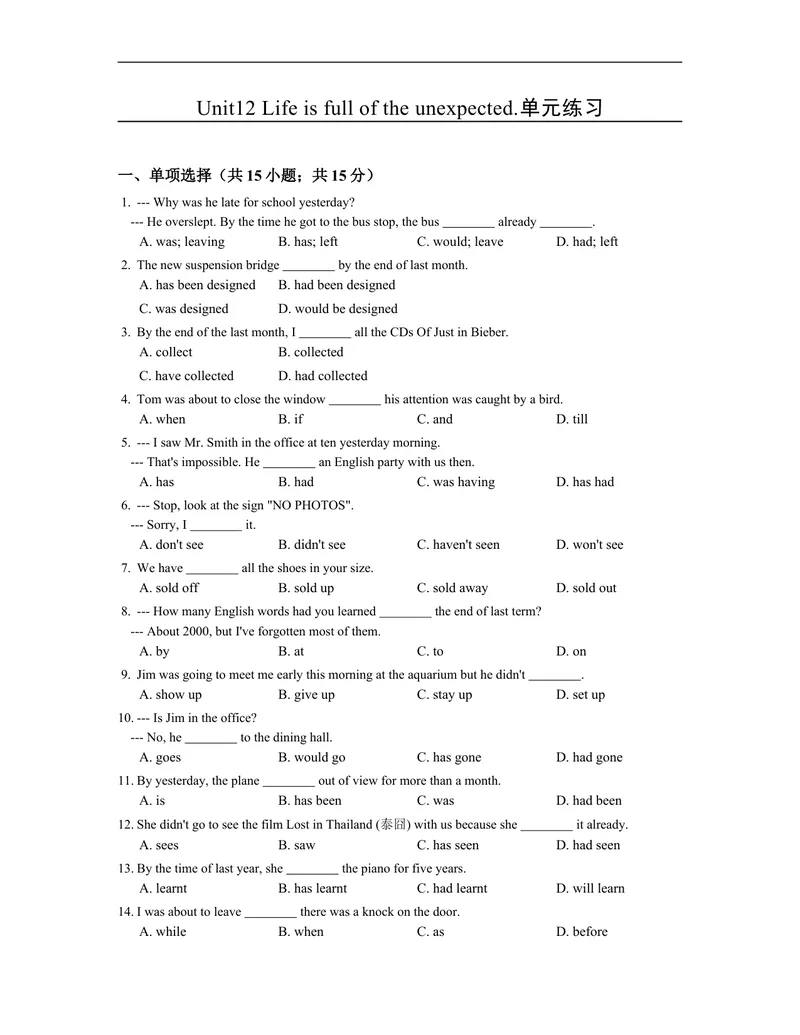
一、单项选择(共15小题;共15分)
1. --- Why was he late for school yesterday?
--- He overslept. By the time he got to the bus stop, the bus already .
A. was; leaving B. has; left C. would; leave D. had; left
2. The new suspension bridge by the end of last month.
A. has been designed B. had been designed
C. was designed D. would be designed
3. By the end of the last month, I all the CDs Of Just in Bieber.
A. collect B. collected
C. have collected D. had collected
4. Tom was about to close the window his attention was caught by a bird.
A. when B. if C. and D. till
5. --- I saw Mr. Smith in the office at ten yesterday morning.
--- That's impossible. He an English party with us then.
A. has B. had C. was having D. has had
6. --- Stop, look at the sign "NO PHOTOS".
--- Sorry, I it.
A. don't see B. didn't see C. haven't seen D. won't see
7. We have all the shoes in your size.
A. sold off B. sold up C. sold away D. sold out
8. --- How many English words had you learned the end of last term?
--- About 2000, but I've forgotten most of them.
A. by B. at C. to D. on
9. Jim was going to meet me early this morning at the aquarium but he didn't .
A. show up B. give up C. stay up D. set up
10.--- Is Jim in the office?
--- No, he to the dining hall.
A. goes B. would go C. has gone D. had gone
11.By yesterday, the plane out of view for more than a month.
A. is B. has been C. was D. had been
12.She didn't go to see the film Lost in Thailand (泰囧) with us because she it already.
A. sees B. saw C. has seen D. had seen
13.By the time of last year, she the piano for five years.
A. learnt B. has learnt C. had learnt D. will learn
14.I was about to leave there was a knock on the door.
A. while B. when C. as D. before15.--- Lisa, I called you just now. Where were you?
--- Sorry, I a shower.
A. take B. am taking C. was taking
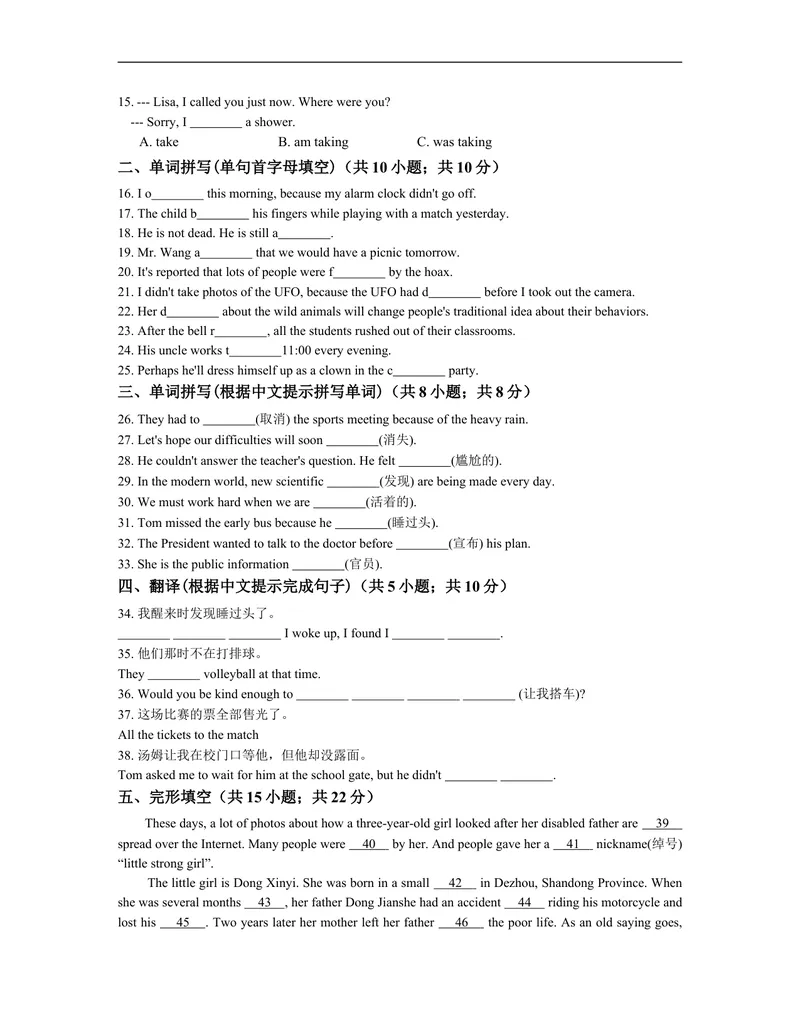
二、单词拼写(单句首字母填空)(共10小题;共10分)
16. I o this morning, because my alarm clock didn't go off.
17. The child b his fingers while playing with a match yesterday.
18. He is not dead. He is still a .
19. Mr. Wang a that we would have a picnic tomorrow.
20. It's reported that lots of people were f by the hoax.
21. I didn't take photos of the UFO, because the UFO had d before I took out the camera.
22. Her d about the wild animals will change people's traditional idea about their behaviors.
23. After the bell r , all the students rushed out of their classrooms.
24. His uncle works t 11:00 every evening.
25. Perhaps he'll dress himself up as a clown in the c party.
三、单词拼写(根据中文提示拼写单词)(共8小题;共8分)
26. They had to (取消) the sports meeting because of the heavy rain.
27. Let's hope our difficulties will soon (消失).
28. He couldn't answer the teacher's question. He felt (尴尬的).
29. In the modern world, new scientific (发现) are being made every day.
30. We must work hard when we are (活着的).
31. Tom missed the early bus because he (睡过头).
32. The President wanted to talk to the doctor before (宣布) his plan.
33. She is the public information (官员).
四、翻译(根据中文提示完成句子)(共5小题;共10分)
34. 我醒来时发现睡过头了。
I woke up, I found I .
35. 他们那时不在打排球。
They volleyball at that time.
36. Would you be kind enough to (让我搭车)?
37. 这场比赛的票全部售光了。
All the tickets to the match
38. 汤姆让我在校门口等他,但他却没露面。
Tom asked me to wait for him at the school gate, but he didn't .
五、完形填空(共15小题;共22分)
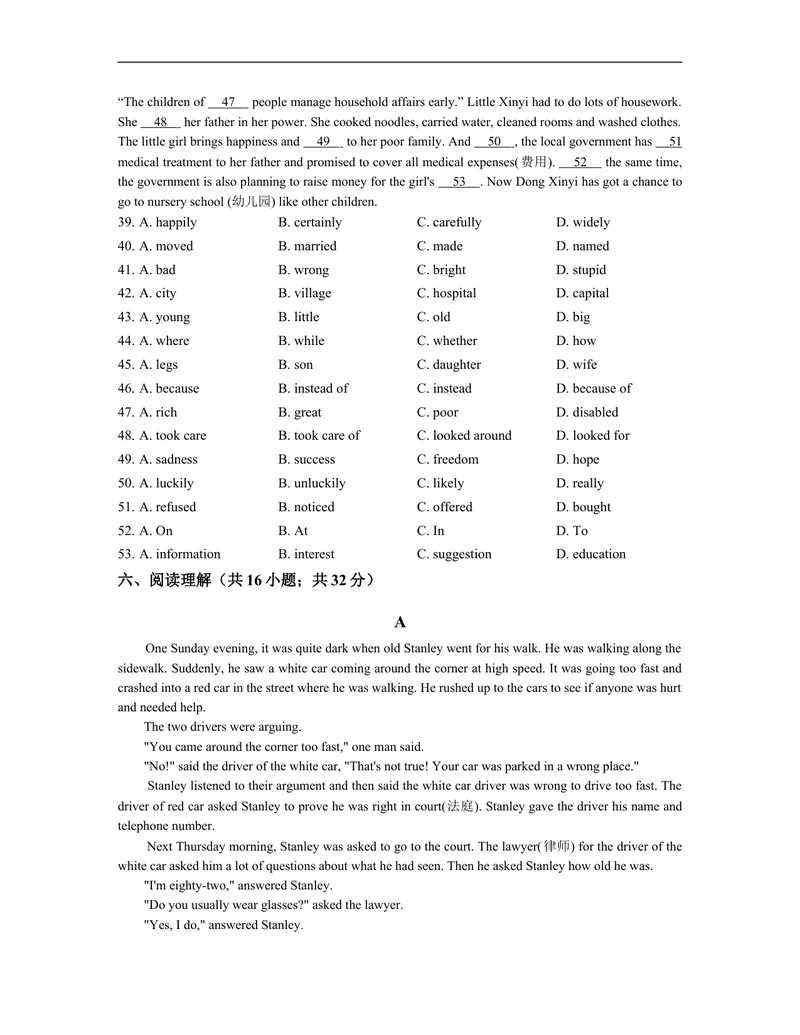
These days, a lot of photos about how a three-year-old girl looked after her disabled father are 39
spread over the Internet. Many people were 40 by her. And people gave her a 41 nickname(绰号)
“little strong girl”.
The little girl is Dong Xinyi. She was born in a small 42 in Dezhou, Shandong Province. When
she was several months 43 , her father Dong Jianshe had an accident 44 riding his motorcycle and
lost his 45 . Two years later her mother left her father 46 the poor life. As an old saying goes,“The children of 47 people manage household affairs early.” Little Xinyi had to do lots of housework.
She 48 her father in her power. She cooked noodles, carried water, cleaned rooms and washed clothes.
The little girl brings happiness and 49 to her poor family. And 50 , the local government has 51
medical treatment to her father and promised to cover all medical expenses(费用). 52 the same time,
the government is also planning to raise money for the girl's 53 . Now Dong Xinyi has got a chance to
go to nursery school (幼儿园) like other children.
39. A. happily B. certainly C. carefully D. widely
40. A. moved B. married C. made D. named
41. A. bad B. wrong C. bright D. stupid
42. A. city B. village C. hospital D. capital
43. A. young B. little C. old D. big
44. A. where B. while C. whether D. how
45. A. legs B. son C. daughter D. wife
46. A. because B. instead of C. instead D. because of
47. A. rich B. great C. poor D. disabled
48. A. took care B. took care of C. looked around D. looked for
49. A. sadness B. success C. freedom D. hope
50. A. luckily B. unluckily C. likely D. really
51. A. refused B. noticed C. offered D. bought
52. A. On B. At C. In D. To
53. A. information B. interest C. suggestion D. education
六、阅读理解(共16小题;共32分)
A
One Sunday evening, it was quite dark when old Stanley went for his walk. He was walking along the
sidewalk. Suddenly, he saw a white car coming around the corner at high speed. It was going too fast and
crashed into a red car in the street where he was walking. He rushed up to the cars to see if anyone was hurt
and needed help.
The two drivers were arguing.
"You came around the corner too fast," one man said.
"No!" said the driver of the white car, "That's not true! Your car was parked in a wrong place."
Stanley listened to their argument and then said the white car driver was wrong to drive too fast. The
driver of red car asked Stanley to prove he was right in court(法庭). Stanley gave the driver his name and
telephone number.
Next Thursday morning, Stanley was asked to go to the court. The lawyer(律师) for the driver of the
white car asked him a lot of questions about what he had seen. Then he asked Stanley how old he was.
"I'm eighty-two," answered Stanley.
"Do you usually wear glasses?" asked the lawyer.
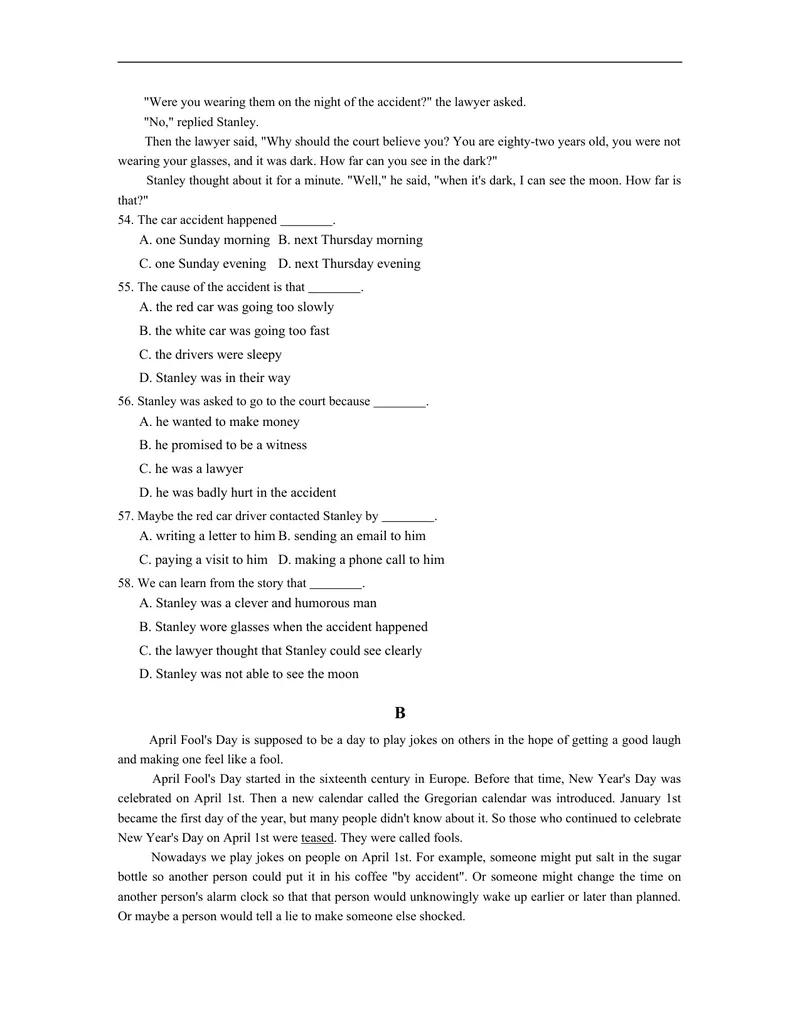
"Yes, I do," answered Stanley."Were you wearing them on the night of the accident?" the lawyer asked.
"No," replied Stanley.
Then the lawyer said, "Why should the court believe you? You are eighty-two years old, you were not
wearing your glasses, and it was dark. How far can you see in the dark?"
Stanley thought about it for a minute. "Well," he said, "when it's dark, I can see the moon. How far is
that?"
54. The car accident happened .
A. one Sunday morning B. next Thursday morning
C. one Sunday evening D. next Thursday evening
55. The cause of the accident is that .
A. the red car was going too slowly
B. the white car was going too fast
C. the drivers were sleepy
D. Stanley was in their way
56. Stanley was asked to go to the court because .
A. he wanted to make money
B. he promised to be a witness
C. he was a lawyer
D. he was badly hurt in the accident
57. Maybe the red car driver contacted Stanley by .
A. writing a letter to himB. sending an email to him
C. paying a visit to him D. making a phone call to him
58. We can learn from the story that .
A. Stanley was a clever and humorous man
B. Stanley wore glasses when the accident happened
C. the lawyer thought that Stanley could see clearly
D. Stanley was not able to see the moon
B
April Fool's Day is supposed to be a day to play jokes on others in the hope of getting a good laugh
and making one feel like a fool.
April Fool's Day started in the sixteenth century in Europe. Before that time, New Year's Day was
celebrated on April 1st. Then a new calendar called the Gregorian calendar was introduced. January 1st
became the first day of the year, but many people didn't know about it. So those who continued to celebrate
New Year's Day on April 1st were teased. They were called fools.
Nowadays we play jokes on people on April 1st. For example, someone might put salt in the sugar
bottle so another person could put it in his coffee "by accident". Or someone might change the time on
another person's alarm clock so that that person would unknowingly wake up earlier or later than planned.
Or maybe a person would tell a lie to make someone else shocked.After we play the trick, we say "April Fools". Then the poor person realizes he was fooled. It is
generally done in the spirit of fun and doesn't cause any real harm(伤害) to anyone.
59. Before the sixteenth century, New Year's Day was on .
A. April 1st B. January 1st C. September 1st D. October 1st
60. Sometimes people lie to shock someone on .
A. New Year's Day B. Christmas Day
C. April Fool's Day D. Thanksgiving Day
61. In the 2nd paragraph, the closest meaning of the underlined word "teased" is in English.
A. hit B. criticized C. laughed at D. disagreed
62. What should be the right attitude(态度) towards "April Fool"?
A. It is generally done in the spirit of fun and doesn't cause any real harm to anyone.
B. It is done for the real fools.
C. We needn't say "April Fools" when we play jokes on people on April 1st.
D. We can do anything to others.
C
Let's try doing the following experiment.
What to Do:
Use string to hang a paper clip or other small object at about chest(胸部) level.
Pick up a stick, such as a broom handle. Take three or four steps away from the paper clip.
Now close one eye and walk toward the paper clip. Try to touch it with the tip of the stick. If you miss,
try again, still keeping one eye closed. Now try it with both eyes open and see if it's easier to do.
How it works:
In the experiment, you have to judge how far away the paper clip is. Your brain has several ways of
doing this.
One simple way depends on how much your eye has to focus(聚焦) itself. Using only one eye, most
people will find it difficult to touch the paper clip on the first try, but the brain still gets some information
about distance—though not much.
Your brain can judge distance much better when you look at something with both eyes. In fact, your
brain has more than one way to use both eyes in judging distance. For example, to see anything clearly, you
have to make both of your eyes point at the object. When you look at a nearby object, your eyes turn
inward. You can feel this happening if you look at the tip of your finger and move your finger toward your
nose.
Your brain gets information from the eyes about how much they are pointing toward each other. Using
that information, the brain can tell how far away any object is, whether it is a basketball or a paper clip.
63. How many materials do we need at least to do the experiment?
A. Two. B. Three. C. Four. D. Five.
64. The passage is mainly about that with eyes our brain can judge .
A. how big an object is
B. how high an object isC. how far away an object is
D. how much information an object is
65. Which of the following is true according to the passage?
A. Our brain judges distance in one way when we use both eyes.
B. Our brain cannot judge the distance of a small object but a big one.
C. How much our eyes focus helps our brain judge the size of an object.
D. How much our eyes focus helps our brain judge the distance of an object.
66. From the experiment we can infer(推断) .
A. with one eye we can see an object as clearly as we use two eyes
B. our eyes turn towards the inside when we look at an object very near
C. within 3 or 4 steps, the nearer an object is, the more clearly we can see it
D. our brain can hardly get any information about distance when we use one eye
D
One of my sweetest memories as a child is of going down to the river and sitting comfortably on the
bank. There I would enjoy the peace and quiet, watch the water rush downstream and listen to songs of
birds. I would also watch the bamboo trees bend under the pressure from the wind and watch them return
gracefully to their original state after the wind had died down.
When I think about the bamboo tree's ability to bend and move back, the word "resilience" comes to
my mind. When it is used for a person, this word means the ability to readily recover(恢复) from shock,
sadness or any other suffering. Have you ever felt like you were going to snap? Have you ever felt like you
were at your breaking point? Thankfully, you have survived to talk about it.
Life is a mixture(混合) of good times and bad times, happy moments and unhappy moments. The next
time you are experiencing one of those bad times or unhappy moments that take you close to your breaking
point, bend, but don't break. Try your best not to let the situation get the best of you.
An amount of hope will take you through the unpleasant suffering. With hope for a better tomorrow or
a better situation, things may not be as bad as they seem. The unpleasant suffering may be easier to deal
with if the end result is worth having.
If things get tough and you are at your breaking point, show resilience. Like the bamboo trees, bend,
but don't break!
67. What does the word "snap" in the second paragraph most probably mean?
A. break B. change C. win D. complain
68. What can help people get through sufferings according to the writer?
A. Holding peace and quiet in mind.
B. Waiting until sufferings disappear.
C. Experiencing more bad times.
D. Hoping for a better tomorrow.
69. What would be the best title of this passage?
A. Memories of BambooB. Be Like BambooC. Enjoying Bamboo D. Characteristics of Bamboo
七、短文7选5(5选5等)(共5小题;共10分)
Being safe at school and in your everyday life needs knowledge. If you remember the following
information, your life will be much safer.
● Always notice the environment around you. You shouldn't walk alone outside. 70. If
anything dangerous happens, you can find them quickly.
● Don't use earphones(耳机) when running in the school yard or on the street. 71.
● School bags should be carried towards the front of your body instead of pulling them on your back.
72.
● If you are followed by a stranger(陌生人), cross the street and go in the other direction(方向), let
the stranger know that you know he or she is there. Next, go and get help from others if it is necessary. 73.
You are safer on the street than you are in your home or in a lift.
● If you have to take a bus to a place far away, try to get to the bus stop a few minutes before the
buses leave. 74. On buses, don't sit alone, sit behind the driver or with friends. Don't sleep.
A. Don't go home directly.
B. You will keep yourself from the outside world and can be dangerous.
C. Make sure where the public phones are.
D. This stops a stranger from following you.
E. When buses are crowded, it is easy enough for thieves to steal the things in your bags on your
back.
八、阅读与表达(问答式)(共5小题;共10分)
The World Wide Web (万维网) turned 25 years old on March 12th. It has become a very important
part in our daily lives. We can't imagine living without the Web, the short form of the World Wide Web.
In 1989, a British engineer named Tim Berners-Lee came up with the idea of the Web. It is a group of
"pages" of information that are connected to each other around the world. That is the very beginning of the
Web. Since then, the Web has greatly changed the way people live. With a click(点击) of a mouse we can
read news, buy things, make friends and learn anything we're interested in.
Now, 25 years after its birth, how will the Web influence life in the future? Scientists believe there are
both advantages and disadvantages.
A growing Web will help build "better relationships" between different cultures. Also in the future,
everyday items could be connected to the Web. We could share plenty of information to make our daily
lives more convenient(方便的). So one day in the future, your front door could send you a message. "Dear
sir, everyone has left the house, but I'm still open!"
But scientists warn(警告) us that if we share personal information on the Internet it could get into the
wrong hands.
"It's not wise to spend a whole day in front of the screen. People need to get close to nature and enjoy
the sun. Never be controlled by the Internet," said Berners-Lee.
根据短文内容,完成下列小题。
75. How old is the World Wide Web?76. Who came up with the idea of the Web?
77. What can we do by clicking a mouse according to the passage?
78. Will everyday items be connected by using the Web?
79. What do you think of the Internet?
答案
一、单项选择
1. D 2. B 3. D 4. A 5. C
6. B 7. D 8. A 9. A 10. C
11. D 12. D 13. C 14. B 15. C
二、单词拼写(单句首字母填空)
16. overslept
17. burnt
18. alive
19. announced
20. fooled
21. disappeared
22. discovery
23. rang
24. till
25. costume
三、单词拼写(根据中文提示拼写单词)
26. cancel
27. disappear
28. embarrassed
29. discoveries
30. alive
31. overslept
32. announcing
33. officer
四、翻译(根据中文提示完成句子)
34. By the time, had overslept
35. weren't playing36. give me a lift
37. were sold out
38. show up
五、完形填空
39. D 40. A
41. C 42. B 43. C 44. B 45. A
46. D 47. C 48. B 49. D 50. A
51. C 52. B 53. D
六、阅读理解
54. C 55. B
56. B 57. D 58. A 59. A 60. C
61. C 62. A 63. B 64. C 65. D
66. B 67. A 68. D 69. B
七、短文7选5(5选5等)
70. C
71. B 72. E 73. A 74. D
八、阅读与表达(问答式)
75. It is 25 years old.
76. Tim Berners-Lee came up with the idea of the Web.
77. With a click of mouse, we can read news, buy things, make friends and learn anything we're
interested in.
78. Yes, they will.
79. I think it's good/bad/it has both advantages and disadvantages.