六年级下册英语Unit1知识点整理(译林版)
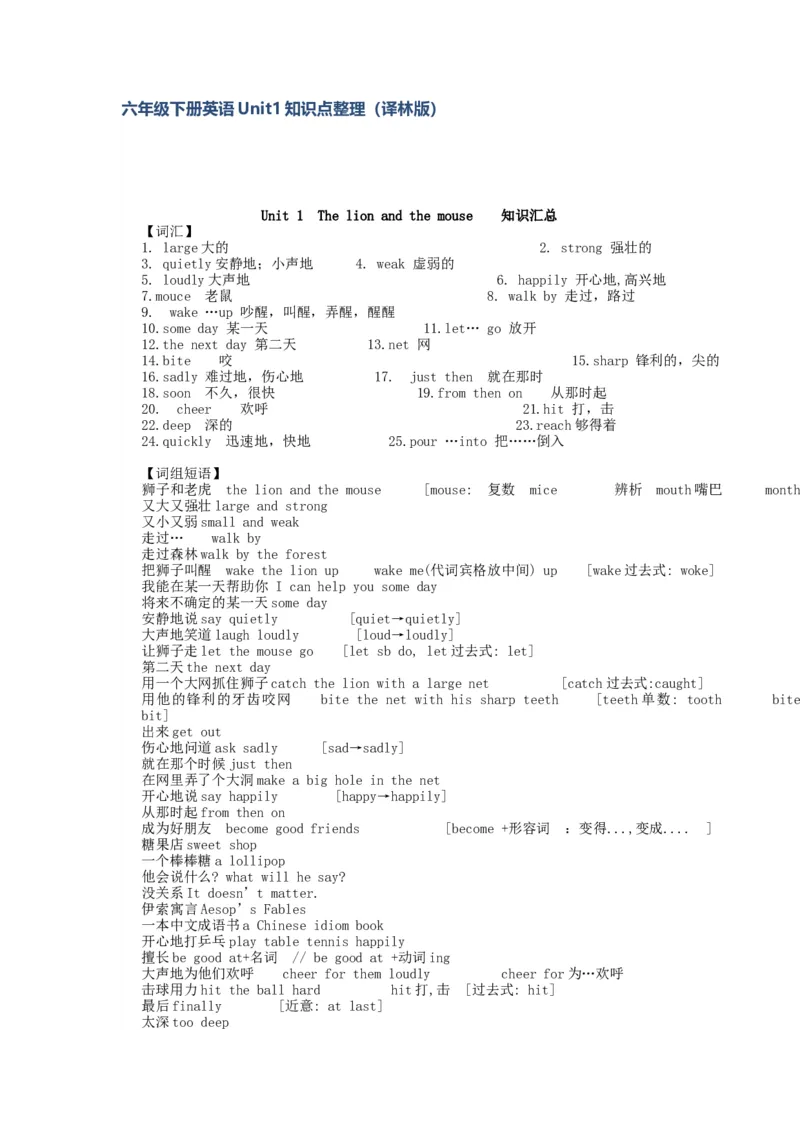
Unit 1 The lion and the mouse 知识汇总
【词汇】
1. large大的 2. strong 强壮的
3. quietly安静地;小声地 4. weak 虚弱的
5. loudly大声地 6. happily 开心地,高兴地
7.mouce 老鼠 8. walk by 走过,路过
9. wake …up 吵醒,叫醒,弄醒,醒醒
10.some day 某一天 11.let… go 放开
12.the next day 第二天 13.net 网
14.bite 咬 15.sharp 锋利的,尖的
16.sadly 难过地,伤心地 17. just then 就在那时
18.soon 不久,很快 19.from then on 从那时起
20. cheer 欢呼 21.hit 打,击
22.deep 深的 23.reach够得着
24.quickly 迅速地,快地 25.pour …into 把……倒入
【词组短语】
狮子和老虎 the lion and the mouse [mouse: 复数 mice 辨析 mouth嘴巴 month
又大又强壮large and strong
又小又弱small and weak
走过… walk by
走过森林walk by the forest
把狮子叫醒 wake the lion up wake me(代词宾格放中间) up [wake过去式: woke]
我能在某一天帮助你 I can help you some day
将来不确定的某一天some day
安静地说say quietly [quiet→quietly]
大声地笑道laugh loudly [loud→loudly]
让狮子走let the mouse go [let sb do, let过去式: let]
第二天the next day
用一个大网抓住狮子catch the lion with a large net [catch过去式:caught]
用他的锋利的牙齿咬网 bite the net with his sharp teeth [teeth单数: tooth bite
bit]
出来get out
伤心地问道ask sadly [sad→sadly]
就在那个时候just then
在网里弄了个大洞make a big hole in the net
开心地说say happily [happy→happily]
从那时起from then on
成为好朋友 become good friends [become +形容词 :变得...,变成.... ]
糖果店sweet shop
一个棒棒糖a lollipop
他会说什么? what will he say?
没关系It doesn’t matter.
伊索寓言Aesop’s Fables
一本中文成语书a Chinese idiom book
开心地打乒乓play table tennis happily
擅长be good at+名词 // be good at +动词ing
大声地为他们欢呼 cheer for them loudly cheer for为…欢呼
击球用力hit the ball hard hit打,击 [过去式: hit]
最后finally [近意: at last]
太深too deep我够不到I can’t reach it [reach到达 reach my school]
迅速地拿一些水来bring some water quickly
把它倒进洞里pour it in the hole
干得好! Well done!
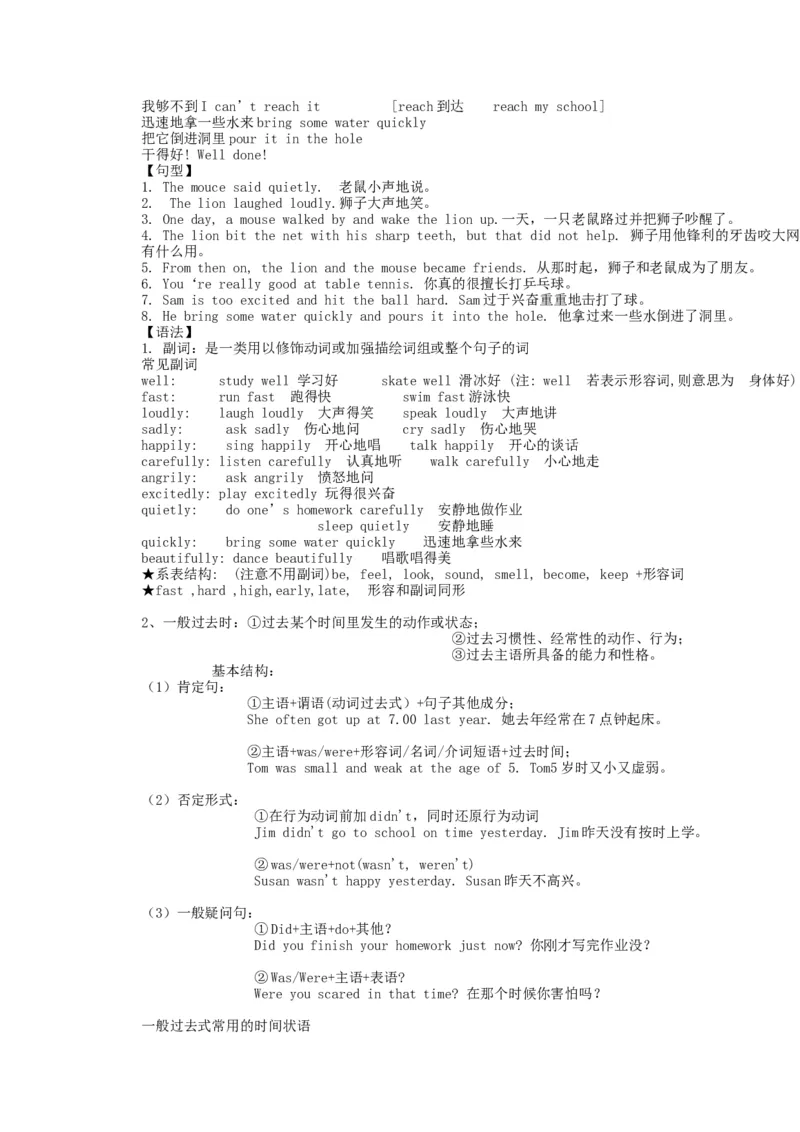
【句型】
1. The mouce said quietly. 老鼠小声地说。
2. The lion laughed loudly.狮子大声地笑。
3. One day, a mouse walked by and wake the lion up.一天,一只老鼠路过并把狮子吵醒了。
4. The lion bit the net with his sharp teeth, but that did not help. 狮子用他锋利的牙齿咬大网,但是没
有什么用。
5. From then on, the lion and the mouse became friends. 从那时起,狮子和老鼠成为了朋友。
6. You‘re really good at table tennis. 你真的很擅长打乒乓球。
7. Sam is too excited and hit the ball hard. Sam过于兴奋重重地击打了球。
8. He bring some water quickly and pours it into the hole. 他拿过来一些水倒进了洞里。
【语法】
1. 副词:是一类用以修饰动词或加强描绘词组或整个句子的词
常见副词
well: study well 学习好 skate well 滑冰好 (注: well 若表示形容词,则意思为 身体好)
fast: run fast 跑得快 swim fast游泳快
loudly: laugh loudly 大声得笑 speak loudly 大声地讲
sadly: ask sadly 伤心地问 cry sadly 伤心地哭
happily: sing happily 开心地唱 talk happily 开心的谈话
carefully: listen carefully 认真地听 walk carefully 小心地走
angrily: ask angrily 愤怒地问
excitedly: play excitedly 玩得很兴奋
quietly: do one’s homework carefully 安静地做作业
sleep quietly 安静地睡
quickly: bring some water quickly 迅速地拿些水来
beautifully: dance beautifully 唱歌唱得美
★系表结构: (注意不用副词)be, feel, look, sound, smell, become, keep +形容词
★fast ,hard ,high,early,late, 形容和副词同形
2、一般过去时:①过去某个时间里发生的动作或状态;
②过去习惯性、经常性的动作、行为;
③过去主语所具备的能力和性格。
基本结构:
(1)肯定句:
①主语+谓语(动词过去式)+句子其他成分;
She often got up at 7.00 last year. 她去年经常在7点钟起床。
②主语+was/were+形容词/名词/介词短语+过去时间;
Tom was small and weak at the age of 5. Tom5岁时又小又虚弱。
(2)否定形式:
①在行为动词前加didn't,同时还原行为动词
Jim didn't go to school on time yesterday. Jim昨天没有按时上学。
②was/were+not(wasn't, weren't)
Susan wasn't happy yesterday. Susan昨天不高兴。
(3)一般疑问句:
①Did+主语+do+其他?
Did you finish your homework just now? 你刚才写完作业没?
②Was/Were+主语+表语?
Were you scared in that time? 在那个时候你害怕吗?
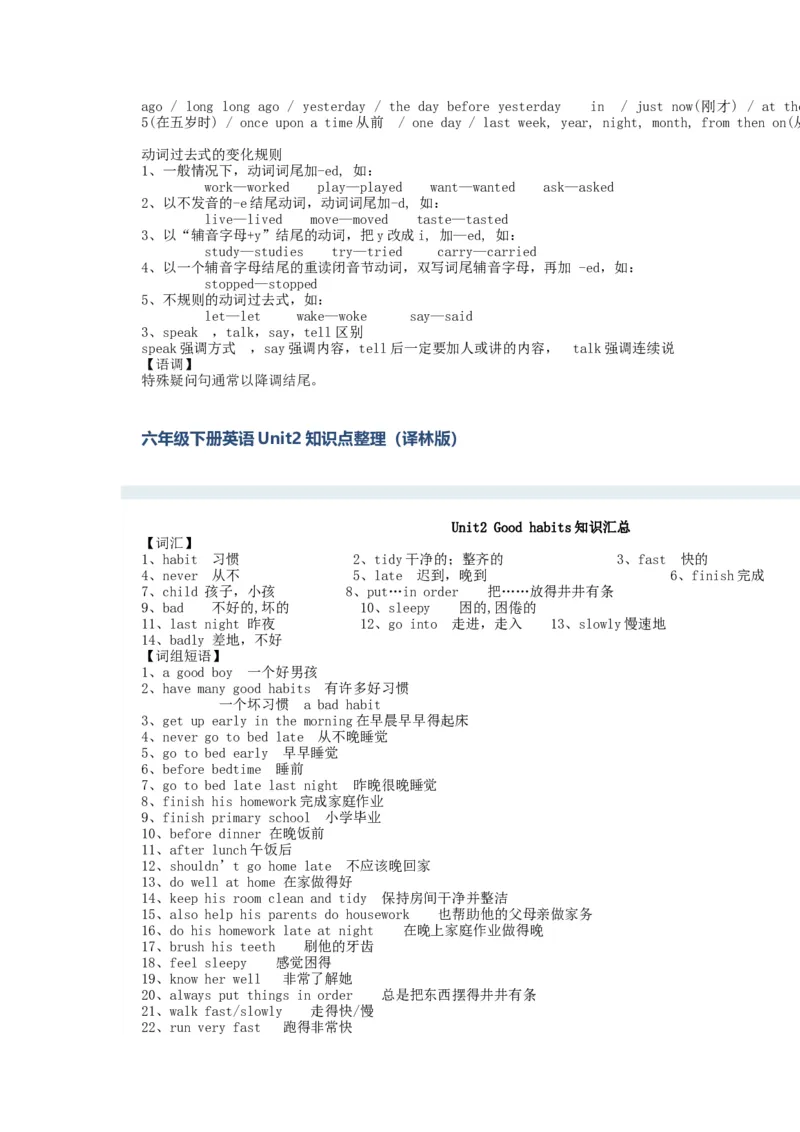
一般过去式常用的时间状语ago / long long ago / yesterday / the day before yesterday in / just now(刚才) / at the age of
5(在五岁时) / once upon a time从前 / one day / last week, year, night, month, from then on(从那时起
动词过去式的变化规则
1、一般情况下,动词词尾加-ed, 如:
work—worked play—played want—wanted ask—asked
2、以不发音的-e结尾动词,动词词尾加-d, 如:
live—lived move—moved taste—tasted
3、以“辅音字母+y”结尾的动词,把y改成i, 加—ed, 如:
study—studies try—tried carry—carried
4、以一个辅音字母结尾的重读闭音节动词,双写词尾辅音字母,再加 -ed,如:
stopped—stopped
5、不规则的动词过去式,如:
let—let wake—woke say—said
3、speak ,talk,say,tell区别
speak强调方式 ,say强调内容,tell后一定要加人或讲的内容, talk强调连续说
【语调】
特殊疑问句通常以降调结尾。
六年级下册英语Unit2知识点整理(译林版)
Unit2 Good habits知识汇总
【词汇】
1、habit 习惯 2、tidy干净的;整齐的 3、fast 快的
4、never 从不 5、late 迟到,晚到 6、finish完成
7、child 孩子,小孩 8、put…in order 把……放得井井有条
9、bad 不好的,坏的 10、sleepy 困的,困倦的
11、last night 昨夜 12、go into 走进,走入 13、slowly慢速地
14、badly 差地,不好
【词组短语】
1、a good boy 一个好男孩
2、have many good habits 有许多好习惯
一个坏习惯 a bad habit
3、get up early in the morning在早晨早早得起床
4、never go to bed late 从不晚睡觉
5、go to bed early 早早睡觉
6、before bedtime 睡前
7、go to bed late last night 昨晚很晚睡觉
8、finish his homework完成家庭作业
9、finish primary school 小学毕业
10、before dinner 在晚饭前
11、after lunch午饭后
12、shouldn’t go home late 不应该晚回家
13、do well at home 在家做得好
14、keep his room clean and tidy 保持房间干净并整洁
15、also help his parents do housework 也帮助他的父母亲做家务
16、do his homework late at night 在晚上家庭作业做得晚
17、brush his teeth 刷他的牙齿
18、feel sleepy 感觉困得
19、know her well 非常了解她
20、always put things in order 总是把东西摆得井井有条
21、walk fast/slowly 走得快/慢
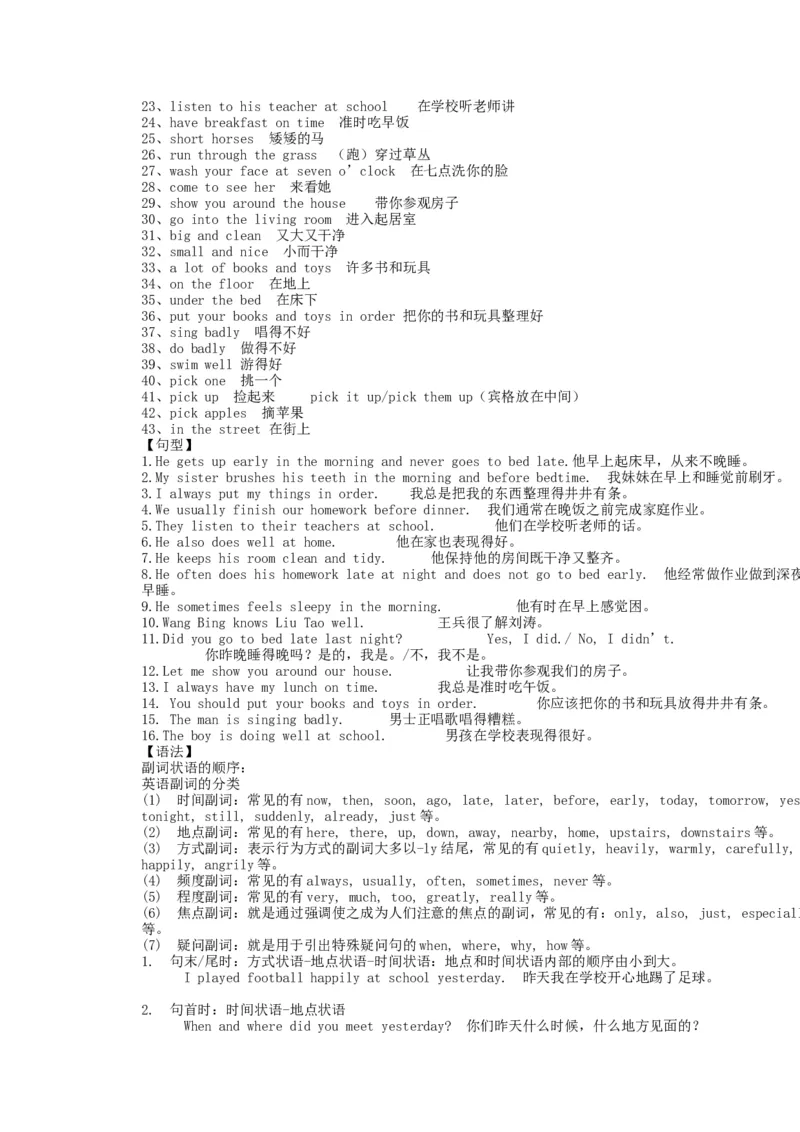
22、run very fast 跑得非常快23、listen to his teacher at school 在学校听老师讲
24、have breakfast on time 准时吃早饭
25、short horses 矮矮的马
26、run through the grass (跑)穿过草丛
27、wash your face at seven o’clock 在七点洗你的脸
28、come to see her 来看她
29、show you around the house 带你参观房子
30、go into the living room 进入起居室
31、big and clean 又大又干净
32、small and nice 小而干净
33、a lot of books and toys 许多书和玩具
34、on the floor 在地上
35、under the bed 在床下
36、put your books and toys in order 把你的书和玩具整理好
37、sing badly 唱得不好
38、do badly 做得不好
39、swim well 游得好
40、pick one 挑一个
41、pick up 捡起来 pick it up/pick them up(宾格放在中间)
42、pick apples 摘苹果
43、in the street 在街上
【句型】
1.He gets up early in the morning and never goes to bed late.他早上起床早,从来不晚睡。
2.My sister brushes his teeth in the morning and before bedtime. 我妹妹在早上和睡觉前刷牙。
3.I always put my things in order. 我总是把我的东西整理得井井有条。
4.We usually finish our homework before dinner. 我们通常在晚饭之前完成家庭作业。
5.They listen to their teachers at school. 他们在学校听老师的话。
6.He also does well at home. 他在家也表现得好。
7.He keeps his room clean and tidy. 他保持他的房间既干净又整齐。
8.He often does his homework late at night and does not go to bed early. 他经常做作业做到深夜并且不
早睡。
9.He sometimes feels sleepy in the morning. 他有时在早上感觉困。
10.Wang Bing knows Liu Tao well. 王兵很了解刘涛。
11.Did you go to bed late last night? Yes, I did./ No, I didn’t.
你昨晚睡得晚吗?是的,我是。/不,我不是。
12.Let me show you around our house. 让我带你参观我们的房子。
13.I always have my lunch on time. 我总是准时吃午饭。
14. You should put your books and toys in order. 你应该把你的书和玩具放得井井有条。
15. The man is singing badly. 男士正唱歌唱得糟糕。
16.The boy is doing well at school. 男孩在学校表现得很好。
【语法】
副词状语的顺序:
英语副词的分类
(1) 时间副词:常见的有now, then, soon, ago, late, later, before, early, today, tomorrow, yesterday,
tonight, still, suddenly, already, just等。
(2) 地点副词:常见的有here, there, up, down, away, nearby, home, upstairs, downstairs等。
(3) 方式副词:表示行为方式的副词大多以-ly结尾,常见的有quietly, heavily, warmly, carefully,
happily, angrily等。
(4) 频度副词:常见的有always, usually, often, sometimes, never等。
(5) 程度副词:常见的有very, much, too, greatly, really等。
(6) 焦点副词:就是通过强调使之成为人们注意的焦点的副词,常见的有:only, also, just, especially, too
等。
(7) 疑问副词:就是用于引出特殊疑问句的when, where, why, how等。
1. 句末/尾时:方式状语-地点状语-时间状语:地点和时间状语内部的顺序由小到大。
I played football happily at school yesterday. 昨天我在学校开心地踢了足球。
2. 句首时:时间状语-地点状语
When and where did you meet yesterday? 你们昨天什么时候,什么地方见面的?3.频度副词位于助动词和情态动词之后、行为动词之前。
常见的频率副词有:always(总是), usually(通常), often(经常), sometimes(有时,偶尔), never(从不).
但sometimes, often 等可以放在句首或句尾,usually可放在句首。
(1)Sometimes I get up early .=I sometimes get up early . 我有时起得早。
(2)The workers usually have lunch at the factory. 工人们通常在工厂里吃午饭。
(3)They often do their homework in the evening. 他们经常在晚上写作业。
(4)She was always later for school last year. 她去年上学总是迟到。
【语音】
or 通常发长音[ɔː]
sport, short, horse, for, morning, door, porridge
Unit 3 A healthy diet知识汇总
【词汇】
1.healthy健康的 3.a little 一点 2.diet 饮食
4.need 需要 5. a few 几个
6.at a time 一次 7.可乐 cola
【词组短语】
1.a little water 一点水
2. a few eggs 几个鸡蛋
3.at a time 一次
4.too much 太多
5.a healthy diet 一个健康的饮食
6.every day 每天
7.every week 每周
8. a lot of rice 很多米饭
9.in the fridge 在冰箱里
10.go home 回家
11.have a rest 休息一下
12. take a small bottle 拿了一小瓶
13. too much cola 太多可乐
14. too heavy 太重了
15. go to the supermarket 去超市
16. There’s not too much food… 不多的食物……
17. some drinks 一些饮料
18. this big fish 这条大鱼
19. take the big bag 拿这大袋子
20. sweet food 甜食
【句型】
1. I eat a lot of noodles. 我吃很多面条。
2. We eat a lot of meat. 我们吃很多肉。
3. They have some vegetables. 他们吃一些蔬菜。
4. You have some bread. 你们吃一些面包。
5. He eats a few eggs. 他吃几个鸡蛋。
6. She drinks a little water. 她喝一点水。
7. You shouldn’t drink too much cola. 你不应该喝太多的可乐。
8. Can we have a rest? 我们能休息一下吗?
9. She eats a little rice. 她吃了一些米饭。
10.Chinese people often have some porridge and steamed buns for breakfast.
中国人早餐经常喝粥和吃馒头。
11.Western people often have cereal , bread , eggs and sausages for breakfast.
西方国家的人早餐经常吃麦片,面包,鸡蛋和香肠。【语法】
可数名词:能以数目来计算,可以分成个体的人或东西
不可数名词:指不能以数目来计算,不可以分成个体的概念、状态、品质、感情或表示物质材料的东西;它一般没有复数形式,只有单数形式,它的前面不能
用不定冠词a / an ,若要表示它的个体意义时,一般要与一个名词短语连用
例如:a bottle of milk 一瓶牛奶 two pieces of bread 两片面包 three cups of juice 三杯果汁
ten pond of water 十池水 five bowls of rice 五碗饭 seven pounds of meat 七磅肉
一、修饰可数与不可数名词的形容词
①a lot of 、lots of(表示“许多”)+可数名词/不可数名词
a lot of animals 很多动物 a lot of rice 很多饭
lots of pests 很多害虫 lots of cola 很多可乐
②many/much 也表示“许多”
many+可数名词
much+不可数名词
many books 许多书 many flowers 许多花
much money 许多钱 much water 许多水
③some与any表示"一些"
some+可数名词/不可数名词,用于肯定句
any+可数名词/不可数名词,用于否定句、疑问句
There is some bread on the table. 桌子上有些面包。
There are some apples on the tree. 树上有一些苹果。
There isn't any bread on the table. 桌子上没有一些面包。
Do you have any money? 你有些钱吗?
④a few与a little均表示“少量”:
a few+可数名词
a little+不可数名词
a few vegetables 一点蔬菜 a few seats 几个座位
a little coffee 少量的咖啡 a little salt 少许盐
⑤no 表示没有+可数/不可数名词
二、名词变复数形式的多种情况
各种不同情况 变化方法 例子
一般情况 直接加-s book-books cat-cats boy-boys toy-toys
以s、x、sh、
加-es bus-buses box-boxes brush-brushes peach-peaches
ch结尾
以“辅音字母 变y为i,
baby-babies family-families city-cities
+y”结尾 再加-es
变f或fe
以“f或fe”
为v,再加- knife-knives thief-thieives
结尾
es
man-men woman-women policeman-policemen
不规则名词复
policewoman-policewomen mouse-mice foot-feet tooth-teeth
数
child-children fish-fish Chinese-Chinese
[注意]不可数名词都默认为单数,通常与is搭配
1.有时可数,有时不可数:典型例词:fish 当它解释为鱼肉时是不可数名词,当它解释成同一种鱼时,单复数同形,复数即为
时,+es,即为fishes.
2.以o结尾
a) 无生命体后通常加-s
photo→photos piano→pianos radio→radios zoo→zoosb)有生命的物体加-es
potato→potatoes tomato→tomatoes mango-mangoes
3.特殊词:child---children(小孩) man--men(男人) woman--women(女人)
4.单复数同形(单数和复数一样): people(人) sheep(绵羊) deer(鹿)
5.国人变复数 :口诀:中日不变英法变,其余s加后面。
Chinese--Chinese Japanese--Japanese
【语音】
ou为双元音,发[au]
对应的单词有:our house out about shout mouse loud loudly
六年级下册英语Unit4知识点整理(译林版)
Unit4 Road safety重点知识归纳
【词汇】
1.road马路,公路 2.must必须 3.follow遵守
4.light灯 5.cross穿过,穿行 6.rule规则
7.safety安全 8.safe安全的 9.safely安全地
10.zebracossing 斑马线 11.pavement人行道
12.look out for 当心,提防
13.easily容易地 14.stay保持
【词组短语】
1. road safety 道路安全
2. many busy roads 许多繁忙的道路
3. in the city在城市里
4. cross the road safely 安全地过马路
5. cross a busy road safely安全地通过一条繁忙的马路
6. look at the traffic lights 看交通灯
7. wait for the green man 等待绿灯
8. see the red man 看红灯
9. keep safe 保持安全
10. wait on the pavement 在人行道上等待
11. look out for cars and bikes 小心小汽车和自行车
12. look left 看左边
13. look right 看右边
14. also cross the road with other people 也可以和其他人一起过马路
15. see you easily 很容易看见你
16.some children 一些孩子们
17. a child 一个孩子
18. play on the road 在路上玩
19. many cars and bikes 许多小汽车和自行车
20. follow the rules 遵守规则
21. stay safe on the road 在路上保持安全
22. must look for a zebra crossing 必须寻找一条斑马线
23. wait for the bus 等待公交车
24. wait for me 等我
25. the other people 其他人
26. must look for a zebra crossing 必须寻找一条斑马线
27. find a zebra crossing 找到一条斑马线
28. mustn’t run quickly 绝不能快速地跑步,禁止跑得太快
29. mustn’t walk 绝不能行走,禁止行走
30. the left side of the road 马路的左边
31. drive on the right side of the road 马路的右边驾驶
32. except me 除了我
33. except Macau 除了澳门34. go to see their aunt去看望他们的阿姨
35. take the bus 乘车
36. get on the bus 上车
37. get off the bus 下车
38. so many cars 如此多的车
39. so much water 如此多的水
40. go fast 快点去
41. a red light 一个红灯
42. look at the green light 看绿灯
43. at the bus stop在公交车站
44. must stop 必须停下来
45. go on 继续,继续前进
46. run fast 跑得快
47. go to see the doctor 去看医生
48. you’re sick 你生病了
49. classroom rules 班级规则
50. play ball games 玩球类游戏
51. talk loudly 大声地谈论
52. keep your desk clean 保持桌子干净
53. listen to your teachers in class 在课堂上听老师上课
【句型】
1.A: How can you cross the road safely? 你如何安全地过马路?
B: I must look for a zebra crossing. 我必须寻找一条斑马线。
2. A: What must you do to cross the road safely? 为了安全地过马路你必须做什么?
B: I must look at the traffic lights. 我必须看交通灯。
3. A: What must you not do on the road ? 为马路上你们绝不能做什么?
B: We mustn’t play on the road. 我们绝不能在路上玩。
4.You can’t cross the road here. 你不能在这过马路。
5. A: Can I watch TV? 我能看电视吗?
B: No, you can’t. It’s late.
You must go to bed. 不行。现在晚了。你必须去睡觉。
6. A: Must I go to see the doctor? 我必须去看医生吗?
B: Yes, you must. 是的,你一定要去看医生。
You can’t go to school because you are sick. 你不能去学校因为你生病了。
【语法】
1.三个含有look的短语意思各不相同:
look for寻找 look at 看 look out for小心,留神
I am looking for my keys. 我在找我的钥匙。
Look at the picture, it is beautiful. 看那幅画,真漂亮。
To keep safe, you can wait on the pavemant and look out for cars and bikes.
为了保证安全,你可以在人行道上等待同时当心汽车和自行车。
[辨析 look for, find]
look for: 强调找的过程
find: 偏向于找到东西的结果
2.区分safe,safety,safely:
safe是形容词,译为“安全的” I am safe now. 现在我安全了。
safety是名词,译为“安全” road safety道路安全。
safely是副词,用于修饰动词或形容词,译为“安全地” We walk to school safely. 我们安全地走到学校。
3.must 和can用法
1)must和can都是情态动词,后面跟动词原形。常用的情态动词还有:should、 may等。
2)can的基本用法:
①表示能力。He can sing.②表示许可。Can I go now?
③表示请求。Can I have some paper?
can't表示“不能,不会”,和mustn't比,语气较弱。
I can't swim.
3) must的基本用法:
①表示必须的意思。You must do your homework now.
②表示必然的结果。The sun must rises from the east.太阳必定从东方升起。
mustn't却表示"不要、禁止"的意思,语气较强.
We mustn’t play on the road.
【语音】
句子中的重读
1.一般来说,在句子中需重读的词都是实词,比如,名词、动词、形容词、副词、数词、代词等。不重读的多为虚
词,比如,冠词、连词、介词、感叹词等。
例如:
The streets are wide and clean. (这句话中的streets是名词,wide和clean是形容词,它们都要重读
are,and不重读)
I am so glad to see you again. (这句话中的so, glad, see, again要重读,而I, am, to, you不重读。
2.有时候虚词也要重读,以下几点需注意:
1)强调或突出某个虚词或be动词时,应将其重读。例如:
We saw him playing by the river.(这句话中的we和him一般不重读,但为了表示强调也可以重读。比如
果we重读,则强调是"我们"而不是别人看见。)
2)介词在句首时往往要重读。例如:
On my way to school, my bike was broken. (这句话中的on在句首应重读。)
3)be动词及助动词和not结合时要重读。例如:I'm sorry I can't do that. (这句话中的can't要重读。
Didn't I tell you yesterday? (这句话中的didn't要重读。)
4)句子末尾的be动词和助动词一般要重读。例如:
-Are you a student? -Yes, I am. (这里的am要重读。)
注意:上文刚出现过的并且重读的单词,第二次提到时一般不再重读?如:
-How many boys are there in the room? -There are twenty boys in it. (问句中的boys要重读,但答语中
的boys不重读。)
六年级下册英语Unit5知识点整理(译林版)
Unit5 A party
【词汇】
1.Children’s Day儿童节 2.begin开始 3.end结束
4.clown小丑 5.appear出现 6.balloon气球
7.put on上演,表演
【词组短语】
1、Children’s Day 儿童节
2、on Children’s Day 在儿童节
3、this Sunday 这周日
4、have a party 举办聚会
5、at the party 在聚会上
6、buy some snacks and drinks 买些零食和饮料
7、bring some fruit from home 从家里带些水果
8、bring their things to Mike’s house 把他们的东西带到了迈克家
9、play with her friends 和她的朋友一起玩
10、play with the toys first 先玩玩具11、at Mike’s house /in Mike’s home 在迈克家
12、Sunday morning 星期天上午
13、on Saturday afternoon 在星期六下午
14、just then 就在那时
15、some balloons 一些气球
16、have some fun 玩会儿, 玩得开心
17、look out of the window 朝窗外看
look out for 小心,当心
18、the lovely snow 可爱的雪
19、go to a Western party 去一个西方的派对
20、take a gift 带个礼物
21、arrive too early 到得太早
22、be a few minutes late 迟到几分钟
23、play the piano 弹钢琴
24、tell a story 讲故事
25、put on a play 表演一个戏剧
26、wear his new clothes 穿他的新衣服
27、think of some party games 想一些聚会游戏
28、know about parties 知道有关聚会的知识
29、answer Mike’s question 回答麦克的问题
30、do sth. for the party 为聚会做某事
31、know about parties 了解派对
32、look for some fruit 寻找一些水果
33、look after the little child 照顾小孩
34、look at the blackboard 看黑板
35、borrow some books 借一些书
36、have a party 进行一个聚会
37、begin our party 开始我们的聚会
38、end the party 结束聚会
39、buy something for the party 为聚会买些东西
40、bring something to the party 带些东西到晚会上
【句型】
1、Class begins. 开始上课
2、The party ends. 聚会结束
3、A clown appears. 一个小丑出现了
4、It is Children’s Day this Sunday. 这周日是儿童节。
5、Where are you going to the party? 你们将去哪里举办聚会?
6、I am going to bring some toys. 我打算带一些玩具。
7、Are you going to eat or play with the toys first? 你们打算先吃还是玩玩具?
8、Does anybody know why we have snow? 有人知道为什么我们有雪吗?
9、When’s the party going to begin? 聚会什么时候开始?
10、When’s it going to end? 它什么时候结束?
11、What is he going to do for the party? 他打算为聚会做什么?
12、There are six children at the party. 在聚会上有六个小朋友。
【语法】
一般将来时
1)一般将来时的基本结构:主语+ be going to/will+动词原形。
They are going to bring some snacks to the party. 他们打算带些零食去聚会。
He will visit his aunt this weekend. 这周末他要拜访他的阿姨。
2)一般疑问句:
①be+主语+ going to+动词原形?
②Will+主语+ 动词原形?(第一人称为主语时,Will变为Shall)
肯定回答:Yes,+主语+提问的助动词.
否定回答:No,+主语+提问的助动词+not.
---Will you go to Beijing this Summer holiday? 你这个暑假回去北京吗?
---Yes, I will./ No, I won't.(won't=will not) 是的,我要去。/ 不,我不会去。
---Shall I close the window? 要我关窗户吗?
---No, you needn't. 不需要。3)特殊疑问句:特殊疑问词+助动词(will或者其他的表将来的助动词)+主语+要做的事情
你们打算明天玩什么? What are you going to play tomorrow?
你们打算明天在哪里玩? Where are you going to play tomorrow?
你们打算明天什么时候玩? When are you going to play tomorrow?
你们打算明天踢打篮球吗? Are you going to play basketball tomorrow?
Yes, we are. // No, we aren’t.
Will 和 be going to 结构的区别
1) 两者均可用来表示将来的意图,但"be going to"结构语义稍强些。例如:
They are going to climb the Qomolangma one day.
他们准备/想将来某一天去爬珠穆朗玛峰。
2)对于事先经过考虑的打算、计划、意图, 应使用be going to, 而不是will 结构。例如:
— What are you going to do next Sunday?
下星期天你打算干什么?
— I'm going to go fishing. 我打算去钓鱼。
3) 对于未经过考虑的打算,计划,只是临时之意,则用will 结构,不用be going to 结构。例如:
— Where is the telephone book? 电话号码簿在哪儿?
— I'll go and get it for you. 我去给你拿。
4)在表示即将发生某事时,两者区别意义不大,多可互换。例如:
What is going to happen? 就要发生什么事?
What will happen? 将要发生什么事?
一般说来,be going to 表示较近的将来,而will 则表示较远的将来。试比较:
It is going to snow tonight. 今晚要下雪。
There will be a strong wind in a few days. 几天后将有一场大风。
5)表示不受人的主观意愿影响的单纯将来, 一般只能用will 结构。例如:
Tomorrow will be April Fools' Day. 明天是愚人节。
6)在正式的通知(如新闻媒体公布的官方消息,气象预报等)中用will 结构。例如:
There will be a heavy rain to the south of Huai River.
淮河以南将有大雨。
【语音】
ow发双元音[əʊ]
window, slow, know, show, grow
六年级下册英语Unit6知识点整理(译林版)
Unit6 An interesting country
【词汇】
1.country 国家 2.will 将,将要
3.learn 学习
4.welcome 欢迎 5.visitor 游人, 游客6.like 如
7.month 月 8.find out 发
现 9.magazine 杂志
10.kangaroo 袋鼠 11.koala 考拉
12.sport-lover 运动爱好者
13.Australian football-澳式橄榄
球 14.Sydney 悉尼
15.for example 例如 16.London 伦
敦 17.Oxford 牛津
18.Big Ben 大本钟 19.London
Eye 伦敦眼
20.Tower Bridge 塔桥
21.exciting 令人兴奋的, 令人激动的
【词组短语】
learn about Austrailia 了解澳大
利亚
next
week
下周
learn…from
向……学习
find
out
发现before the lessons 在课
前
ask my e-friend
问我的网友
send me some photos 送我一些照片
come from Australia 来自澳
大利亚
read about Australia on the Internet 在网
上阅读有关澳大利亚的情况
love our kangaroo(s) and koala(s) 喜爱我
们的袋鼠和树袋熊
Sport- lover 体育爱好者
Australian football game 澳式橄榄球比赛
Melbourne 墨尔本(澳大利亚第二大
城市)
Canberra 堪培拉(澳大利亚首都)
People in
Australia 澳大利亚的
人们
Welcome visitor(s) 欢迎
来访者
find some photos of Australia 找到一些澳大利
亚的照片
know a woman from Australia 认识一个从澳
大利亚来的妇女an interesting
country 一个有趣的国家
some
interesting cities
一些有趣的城市
516 parks for planets and animals 516 座
动植物公园
tell you about the UK 告诉你有关英
国的情况
fresh air 新鲜的空气
the Great Wall (in China) 长城
Yellowstone National Park (in the US) 黄石国
家公园(在美国)
Stonehenge (in the UK) 巨石阵
the Great Barrier Reef (in
Australia) 大堡礁
find out about cooking 查找有关烹
饪的知识
Just wait and
see 就等着瞧
in the
kitchen
在厨房里
make a potato salad 做一
个土豆沙拉for
example
比如
eat nice
food
吃好吃的食物
learn about cooking 学习关
于烹饪的知识
喜1子的2商铺(淘宝店):http://t.cn/Ri466E4 微6店:http://shop83755268.vpubao.com/
【句型】
I will send an email to my friend in
Australia. 我要寄一封信给我在澳大利亚的朋
友。
You'll find many interesting things in
Australia. 你会在澳大利亚找到很多有趣的事
物。
We'll learn about Australia next week. 我们
将要在下星期学习澳大利亚的相关知识。
They'll find out about this country next
week. 他们会在下周找到这个国家的相关信息。
He will ask Mr Green tomorrow. 他将在明天问
格林先生。
She will go to the library tomorrow. 她将在
明天去图书馆。
Its view is fair.它的景色很美。Sydney is a beautiful city. 悉尼是一个美丽的
城市。
They are very exciting. 它们非常令人激
动。
I want to be a cook. 我想成为一名厨师。
What will you cook? 你要做(烹饪)什么?
Will you cook a fish for me? 你给我烧条鱼好
吗?
What do you think?你觉得呢?
【语法】
一、will 在一般将来时的用法
will + V 将做什么,表示客观上,从逻辑、情
理、事情发展的情况上将会发生什么事情。
与“打算”无关的句子只能用 will +动词原形
杨玲要去图书馆。 Yang Ling will
go to the library.
明天是星期天。 Tomorrow
will be Sunday.
她明年将会 15 岁。 She will be 15
next year.
常见时间状语:tomorrow, tomorrow
afternoon, next week, in a year(一年后),
this evening
①基本语法结构:主语+will+动词原形+其他
They will have a picnic. 他们将要去野餐。
②否定句: 将 will 换成 won't 或 will not
They won't/wii not have a picnic. 他们
不会去野餐。
③一般疑问句: Will+ 主语 +动词原形 +其他
Will they have a picnic? 他们会去野餐
吗?
④特殊疑问句: 特殊疑问词+ 一般疑问句语序
When will they have a picnic? 他们将
在什么时候去野餐?
二、The children will the about Australia
next week.
孩子们将要在下周学习关于澳大利亚
的相关知识。
① learn 近意词: study
learn…from 从...习得
learn a lot from her 从她身上学到
很多
② Australia 澳大利亚(名词)
Australian 澳大利亚的(形容
词);澳大利亚人(名词)
Susan is from Australia, she is an
Australian. Susan 来自澳大利亚,她是澳大利亚
人。
三、They want to find out about this countrybefore the lessons.
他们想在课前查找到这个国家的相关
信息。
find 找到,强调寻找的结果
find out 是经过研究、计算、探询等
获知
四、Sports lovers will like Australian
Football games because they are very
exciting.
运动爱好者将会喜欢澳式足球赛因为
它们十分令人兴奋。
Australian Football 是一种橄榄球
[辨别 exciting,excited]
exciting: 某物令人感到兴奋
excited: 某人感到兴奋
两个词的主语不同
The news is very exciting. 这则新
闻十分振奋人心。
She is very excited about the
news. 她对这则新闻感到十分兴奋。
【语音】
air 发双元音[eə]
air, fair, chair, hair, pair六年级下册英语Unit7知识点整理(译林版)
Unit7 Summer holiday plans
【词汇】
1.Go back to 回去 2.how long 多久
3.photo 照片 4.travel
游
5.summer holiday 暑假 6.stay 停留
7.sound 听起来,听上去 8.Disney Park
迪士尼乐园
9.Ocean Park 海洋公园 10.Taipei 台北
11.traveller 旅游者
12.travel around the world 环游世界
13.different 不同的
【词组短语】
1.summer holiday plans 暑假计划
2. talk about their plans for the summer
holiday 谈论他们的暑假计划
3. go back to London 回到伦敦
4. how long 多久
5. stay there 呆在那儿
6. stay there for a month 在那里呆一个月
7. visit their aunt and uncle 拜访他们的阿姨和叔叔
8. in Beijing 在北京
9. That sounds great 那听起来真不错
10. go to Beijing by plane 乘飞机去北京
11. go there by train 乘火车去那里
12. go to Hong Kong with my family 和我的家
人去香港
13.go to Disneyland 去迪士尼乐园
14. go to Ocean Park 去海洋公园
15. What about you?那你呢?
16. How about you ?那你呢?
17.go to Taipei 去台北
18. That’s wonderful!那真是精彩啊!
19. show you some photos 向你展示一些照片
20. after the holiday 节日后
21. before Children’s Day 儿童节前
22. want to see the city 想看看这座城市
23. will be busy 将会很繁忙
24. in the summer holiday 在暑假
25.live in Australia 住在澳大利亚
26.look at the little 看看这个小男孩
27. play with toys 玩玩具
28. really happy 真的很开心
29. full of joy 充满欢乐
30. Uluru in Australia 澳大利亚的乌卢鲁巨岩31. the Grand Canyon in the US 美国大峡谷
32. Buckingham Palace in the UK 英国的白金
汉宫
33. Niagara Falls in Canada 澳大利亚的尼亚
加拉大瀑布
34. read a travel book 读一本旅游书
35. want to be a traveller 想要成为一名旅行
者
36. talk about his travel plans with her
她一起谈论他的旅行计划
37. visit many places 参观许多地方
38. go with me 和我一起去
39. be excited about the plans 对这个计划感
到十分激动
40. go to the US 去美国
41. get to the UK 到达英国
42. take a taxi 乘出租车
43. do many things 做许多事情
44. have a wonderful summer holiday 有一个
精彩的假期
【句型】
1.Where will you go for the holiday? 你假期
打算去哪儿?
I will go to Hong Kong. 我打算去香港。2.When will you go? 你将何时去?
I will go there in June/July/August.
将在六月/七月/八月去。
I will go on the 1st of March.我将在
月 1 日去。
3.How long will you stay there? 你将在那呆多
久?
I will stay there for one month. 我将在
那呆一个月。
4.What will you do? 你将做什么?
I will visit Disneyland and Ocean
ark. 我将参观迪士尼乐园和海洋公园。
5.How will you go there? 你将怎样去那儿?
I will go there by plane.我将乘飞机去那
儿.
6.Will you go to Hong Kong? 你将去香港吗?
Yes, I will. 是的,我将去。
No, I won’t. 不,我不去.
【语法】
1.一般将来时 will 相关的一般疑问句与特殊疑问
句
一般疑问句:Will+主语+动词原形+其他?
Will you go to Beijing by plane?
你会搭飞机去北京吗?肯定回答:Yes, I will.
否定回答:No, I won't./No, I will not.
特殊疑问句:特殊疑问词+一般疑问句语序?
Who will he visit? 他要去拜访谁?
2.That sounds great! 那听起来真棒!
sound 译为“听起来”,是系动词,后面常
接形容词作表语。
与 sound 相同用法的系动词有: look(看起
来), smell(闻起来), feel(摸起来), taste(尝起
来)
The woman looks very young. 这位女士看
起来很年轻。
The flower smells good. 这朵花闻起来很
香。
The silk feels soft. 这匹丝绸摸起来很柔
软。
The dish tastes good. 这盘菜尝起来很好
吃。
3.Sam is very excited about Bobby's plan.
Sam 对 Bobby 的计划感到十分兴奋。
excited 某人对什么感到兴奋;exciting 什
么令人兴奋
【语音】
oy 为双元音,读作[ɔi]joy, toy, boy, enjoy
六年级下册英语Unit8知识点整理(译林版)
Unit 8 Dreams
【词汇】
1. dream 梦想 2. future 将来,未来
3. scientist 科学家 4. artist 艺术家
5. tooth, 牙齿 6. take care of 爱护, 照顾
7. pianist 钢琴家 8. astronaut宇航员
9. spaceship 宇宙飞船 10. paint 绘画
11.Moon 月球 12.dancer 舞蹈家
【词组短语】
1. care about 关心,在乎
2. play in the World Cup 在世界杯上踢球/打球
3. football player 足球运动员
4. come true 实现,成真
5. take care of 爱护;照顾
6. our dreams 我们的梦想
7. make people happy 使人们开心
8. fly a spaceship to the Moon驾驶飞船飞去月球
9. walk on Mars 在火星行走
10. look at all the stars 看所有的星星
11. in the future 在未来
12.want to be an astronaout想要成为一名宇航员
13. want to be…想要成为
14. some day 将来有一天,某一天
15. make people healthy and beautiful 使人们健康美丽
16.write stories for children 给孩子们写故事
17 be good at writing 擅长写作
18.like sport喜欢运动
19 have a big dream 有一个大梦想
20. a little teacher 一位小老师
21. study hard 努力学习
22. brave and strong 勇敢又强壮
23. do more sport 做更多的运动
24. like painting 喜欢画画
25. paint pictures 画画
26. have painting lessons 上画画课
27. like food 喜欢美食
28. go to cooking school 去烹饪学校学习
29. write stories for children 为孩子们写故事
30 ask the children about their dreams 问孩子们有关的他们的梦想
(ask…about… 问关于……的事情、内容)
31.in the future 在将来
32 be a dentist 成为一个牙医
34. help them 帮助他们35.in your group在你们组
36.look at all the stars 看所有的星星
37.have their dreams 拥有他们的梦想
38.do more sport 做更多的运动
39. go to cooking school 上烹饪学校
【句型】
1. Your dreams are great! 你们的梦想都好极了!
2. Dancing makes people healthy and beautiful. 跳舞可以使人们健康而美丽。
3. Music makes people happy. 音乐使人们快乐。
4. What’s your dream? 你的梦想是什么?
5.I want to play in the World Cup someday. 我希望将来有一天能在世界杯踢球。
6.Many children don’t care about their teeth. 许多孩子不太关心他们的牙齿。
7.I want to write stories for children. 我想为孩子们写故事。
8.I want to see your dreams come true. 我希望看到你们的梦想都能实现。
9.He should study hard. 他应该刻苦学习。
10.A policeman should be brave and strong. 一名警察应该勇敢和强壮。
11.Sam will do more sport. 萨姆将做更多的运动。
12.Who wants to be a writer? 谁想成为一名作家?
13.What do you want to do in the future? 你们将来想做什么呢?
14.What do you want to be in the future? 你们将来想成为什么样的人呢?
【语法】
1. want to与would like
①want to be= would like to be…(职业) 想成为…
如:I want to be a pianist. 我想成为一位钢琴家。
He wants to be an artist. 他想成为一位艺术家。
②want to do sth 想要做某事
=would like to do sth
如:I want to fly to the Moon. 我想飞去月球。
She wants to see your dreams come true. 她想看你们的梦想成真。
例题:
( ) 1.I want to________ a scientist.
A. do B. be C./
解析:“我想成为一名科学家。”want to be…固定搭配,选B。
( ) 2. He wants ________ stories for the children.
A. write B. writing C.to write
解析:“他想给孩子们写故事。”want to do sth固定搭配选C。
2. What do you want to be in the future? 你们将来想成为什么样的人呢?
in the future 与 someday均表示未来某时候,可以互换
What do you want to be in the future?=What do you want to be someday?
I want to be a farmer in the future.= I want to be a farmer someday.
3. I want to see your dreams come true. 我希望看到你们的梦想都能实现。
come true通常与梦想连用,意思为“实现梦想”
I want to make my dream come true someday.
未来某一天我想让我的梦想实现。
【语音】
连读:为使说话流畅,相邻的词中,前一个词的末尾是辅音,后一个词的开头是元音,可以连在一起读。
Let me have a look at it.
I looked for it here and there.
Would you like a cup of tea?